
Duologue from Much Ado About Nothing by William Shakespeare
Beatrice and Benedick: “Kill Claudio”
At the wedding, Claudio has publicly shamed Beatrice's cousin Hero. Left alone, Benedick and Beatrice confess they love each other, and she tells him what he must do to prove it.
- 4 min 15 sec
- Comic
- Benedick: Man, 25 to 40
- Beatrice: Woman, 25 to 40
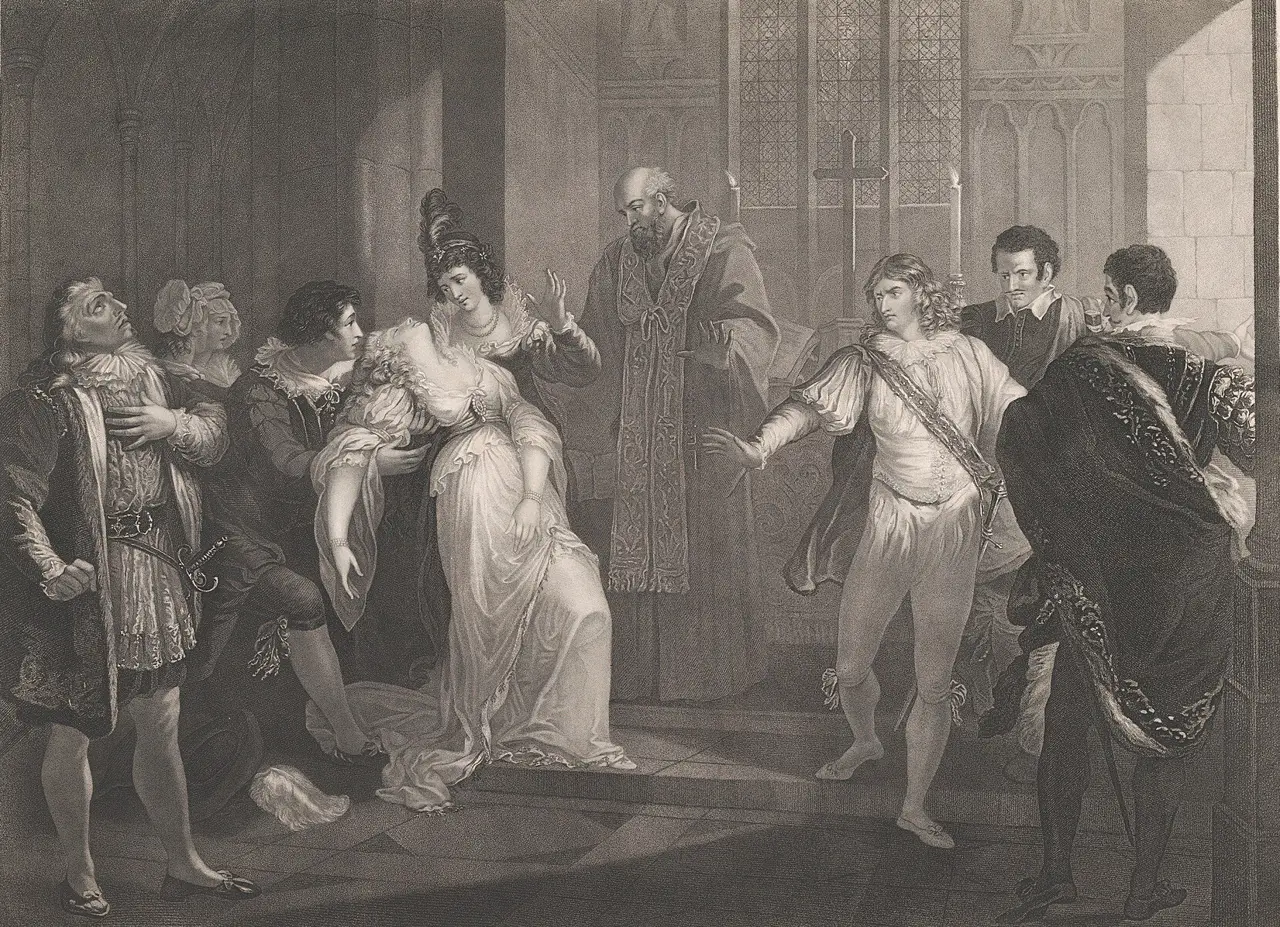

Act 4, Scene 1A church
Lady Beatrice, have you wept all this while?
Yea, and I will weep a while longer.
I will not desire that.
You have no reason; I do it freely.
Surely I do believe your fair cousin is wronged.
Ah, how much might the man deserve of me that would right her!
Is there any way to show such friendship?
A very even way, but no such friend.
May a man do it?
It is a man's office, but not yours.
I do love nothing in the world so well as you: is
not that strange?
As strange as the thing I know not. It were as
possible for me to say I loved nothing so well as
you: but believe me not; and yet I lie not; I
confess nothing, nor I deny nothing. I am sorry for my cousin.
By my sword, Beatrice, thou lovest me.
Do not swear, and eat it.
I will swear by it that you love me; and I will make
him eat it that says I love not you.
Will you not eat your word?
With no sauce that can be devised to it. I protest
I love thee.
Why, then, God forgive me!
What offence, sweet Beatrice?
You have stayed me in a happy hour: I was about to
protest I loved you.
And do it with all thy heart.
I love you with so much of my heart that none is
left to protest.
Come, bid me do any thing for thee.
Kill Claudio.
Ha! not for the wide world.
You kill me to deny it. Farewell.
Tarry, sweet Beatrice.
I am gone, though I am here: there is no love in
you: nay, I pray you, let me go.
Beatrice,--
In faith, I will go.
We'll be friends first.
You dare easier be friends with me than fight with mine enemy.
Is Claudio thine enemy?
Is he not approved in the height a villain, that
hath slandered, scorned, dishonoured my kinswoman? O
that I were a man! What, bear her in hand until they
come to take hands; and then, with public
accusation, uncovered slander, unmitigated rancour,
--O God, that I were a man! I would eat his heart
in the market-place.
Hear me, Beatrice,--
Talk with a man out at a window! A proper saying!
Nay, but, Beatrice,--
Sweet Hero! She is wronged, she is slandered, she is undone.
Beat--
Princes and counties! Surely, a princely testimony,
a goodly count, Count Comfect; a sweet gallant,
surely! O that I were a man for his sake! or that I
had any friend would be a man for my sake! But
manhood is melted into courtesies, valour into
compliment, and men are only turned into tongue, and
trim ones too: he is now as valiant as Hercules
that only tells a lie and swears it. I cannot be a
man with wishing, therefore I will die a woman with grieving.
Tarry, good Beatrice. By this hand, I love thee.
Use it for my love some other way than swearing by it.
Think you in your soul the Count Claudio hath wronged Hero?
Yea, as sure as I have a thought or a soul.
Enough, I am engaged; I will challenge him. I will
kiss your hand, and so I leave you. By this hand,
Claudio shall render me a dear account. As you
hear of me, so think of me. Go, comfort your
cousin: I must say she is dead: and so, farewell.
More duologues for a woman and a man
 Romeo and Juliet: “Thou know'st the mask of night is on my face”Romeo and Juliet · 3 min 15 sec · Dramatic
 Orsino and Viola: “She never told her love”Twelfth Night · 2 min 45 sec · Dramatic
 Macbeth and Lady Macbeth: “We will proceed no further in this business”Macbeth · 3 min 15 sec · Dramatic
- Macbeth and Lady Macbeth: “I have done the deed”Macbeth · 3 min 30 sec · Dramatic