
Duologue from Henry IV, Part 1 by William Shakespeare
Falstaff and Hal: “Now, Hal, what time of day is it, lad?”
Prince Hal, heir to the throne, idles at the tavern with Sir John Falstaff, his fat, old, thieving friend. They trade insults about Falstaff's habits and what he'll do when Hal is king.
- 4 min 15 sec
- Comic
- Falstaff: Man, 50 to 70
- Prince Henry: Man, 20 to 30
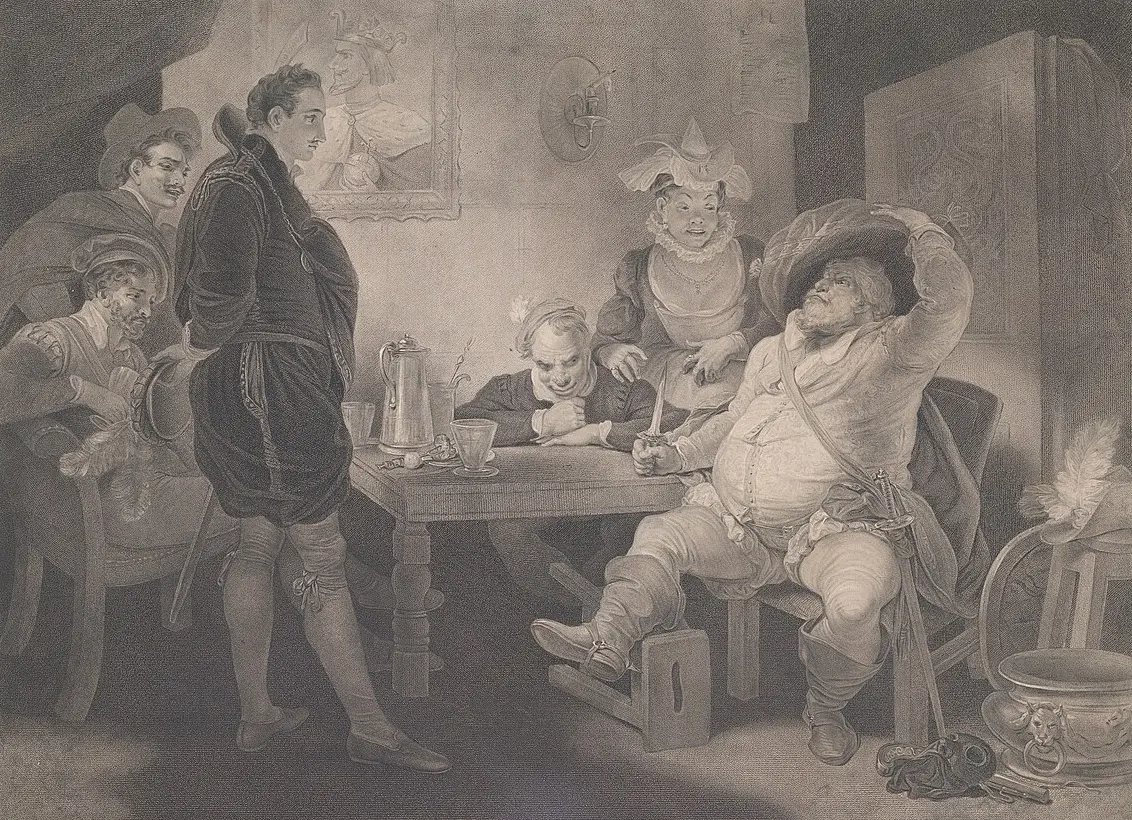

Act 1, Scene 2London. An apartment of the Prince's
Now, Hal, what time of day is it, lad?
Thou art so fat-witted, with drinking of old sack
and unbuttoning thee after supper and sleeping upon
benches after noon, that thou hast forgotten to
demand that truly which thou wouldst truly know.
What a devil hast thou to do with the time of the
day? Unless hours were cups of sack and minutes
capons and clocks the tongues of bawds and dials the
signs of leaping-houses and the blessed sun himself
a fair hot wench in flame-coloured taffeta, I see no
reason why thou shouldst be so superfluous to demand
the time of the day.
Indeed, you come near me now, Hal; for we that take
purses go by the moon and the seven stars, and not
by Phoebus, he,'that wandering knight so fair.' And,
I prithee, sweet wag, when thou art king, as, God
save thy grace,--majesty I should say, for grace
thou wilt have none,--
What, none?
No, by my troth, not so much as will serve to
prologue to an egg and butter.
Well, how then? come, roundly, roundly.
Marry, then, sweet wag, when thou art king, let not
us that are squires of the night's body be called
thieves of the day's beauty: let us be Diana's
foresters, gentlemen of the shade, minions of the
moon; and let men say we be men of good government,
being governed, as the sea is, by our noble and
chaste mistress the moon, under whose countenance we steal.
Thou sayest well, and it holds well too; for the
fortune of us that are the moon's men doth ebb and
flow like the sea, being governed, as the sea is,
by the moon. As, for proof, now: a purse of gold
most resolutely snatched on Monday night and most
dissolutely spent on Tuesday morning; got with
swearing 'Lay by' and spent with crying 'Bring in;'
now in as low an ebb as the foot of the ladder
and by and by in as high a flow as the ridge of the gallows.
By the Lord, thou sayest true, lad. And is not my
hostess of the tavern a most sweet wench?
As the honey of Hybla, my old lad of the castle. And
is not a buff jerkin a most sweet robe of durance?
How now, how now, mad wag! what, in thy quips and
thy quiddities? what a plague have I to do with a
buff jerkin?
Why, what a pox have I to do with my hostess of the tavern?
Well, thou hast called her to a reckoning many a
time and oft.
Did I ever call for thee to pay thy part?
No; I'll give thee thy due, thou hast paid all there.
Yea, and elsewhere, so far as my coin would stretch;
and where it would not, I have used my credit.
Yea, and so used it that were it not here apparent
that thou art heir apparent--But, I prithee, sweet
wag, shall there be gallows standing in England when
thou art king? and resolution thus fobbed as it is
with the rusty curb of old father antic the law? Do
not thou, when thou art king, hang a thief.
No; thou shalt.
Shall I? O rare! By the Lord, I'll be a brave judge.
Thou judgest false already: I mean, thou shalt have
the hanging of the thieves and so become a rare hangman.
Well, Hal, well; and in some sort it jumps with my
humour as well as waiting in the court, I can tell
you.
More duologues for two men
 Brutus and Cassius: “That you have wrong'd me doth appear in this”Julius Caesar · 2 min 45 sec · Dramatic
 Antipholus and Dromio: “She is spherical, like a globe”The Comedy of Errors · 4 min 45 sec · Comic
 Algernon and Jack: “How are you, my dear Ernest?”The Importance of Being Earnest · 4 min · Comic
 Sir Toby and Sir Andrew: “Thou lackest a cup of canary”Twelfth Night · 3 min 15 sec · Comic