
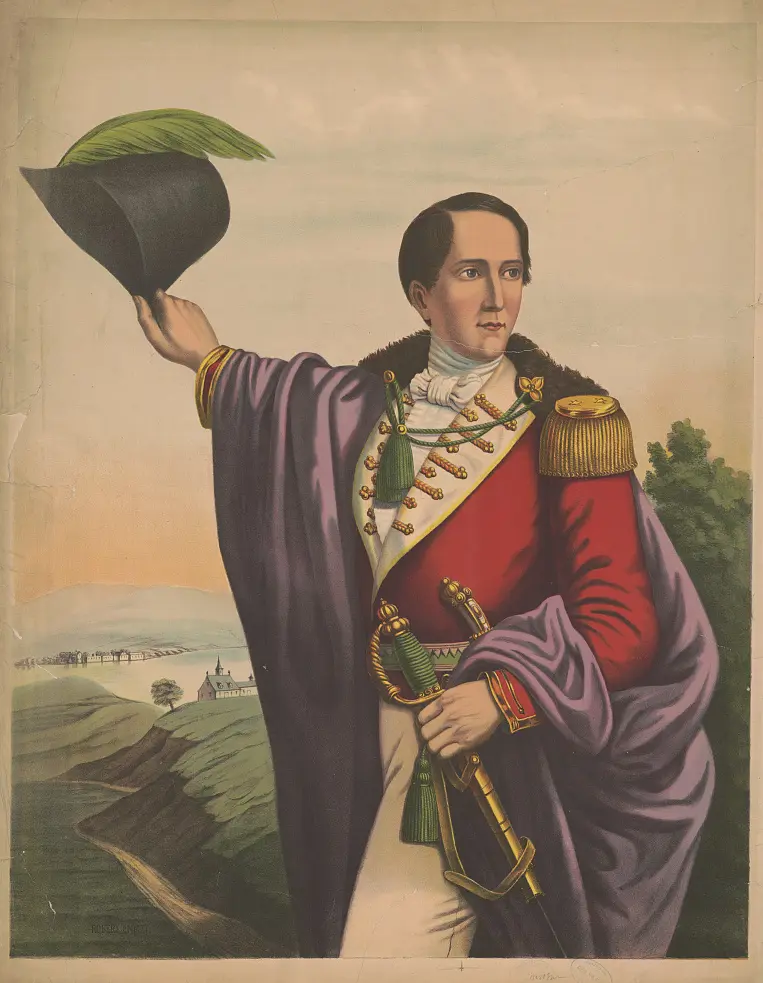
 The Piperby Conal O'RiordanIn 1798, beaten Irish rebels on a hilltop argue among themselves while the redcoats close in.
 Shakespeare's Endby Conal O'RiordanShakespeare's last birthday, at New Place, with Ben Jonson, Drayton, and two strangers who come in out of the night.
The play
The characters in the play are all young: EMMET, the eldest, is rather less than twenty. SCENE.—Tommy Moore's room over his father's shop in Aungier Street, Dublin, May, 1797. TOMMY MOORE, seated at the piano picking out “Let Erin Remember,” stops suddenly as the door opens and MR. ROBERT EMMET enters in riding costume.
Hulloa!
Hulloa! Tommy, how goes it?
Grand, Bob, thank ye kindly. You look hot.
Yes, I'm hot with riding. How is it you have the window closed a fine day like this?... Are you afraid of fresh air, Tommy?
The air's not so fresh as all that in Aungier Street. [Opens window.] I never thought of seeing you.
Driven away the Muse, have I? What was that you were playing when I came in?
[confused] O, nothing, nothing... only one of them old Irish airs I'm trying to put words to.
'Twill be well worth it, I was thinking, as I came upstairs... if the words are as good as the tune....
[scratching his head] That's the difficulty.... Sit down, won't you? Anything I can do for you, Bob?
[sitting down and looking in front of him] Yes. I've thoughts on my mind that want music. Play me the Marseillaise, Tom.
[doubtfully] Play you the Marseillaise?... the Marseillaise hymn?
Yes, don't shut the instrument. Play the Marseillaise, Tom, and sing it.
O, sure I've got no voice.
Don't be so modest. You can stir the heart when you please.
O, it's Kate you ought to hear sing the Marseillaise.
Let Kate come and sing it then.
Kate's out and won't be home.
Then you sing it, Tom.
I don't rightly know the words.
But I've heard you sing it, man. Within the walls of old Trinity itself. It's a wonder they didn't fall down.
[anxious to change the subject] That'd be the fine sight now.... Not but I'm proud of being a Trinity boy myself.
So am I—there's plenty to be proud of there. Swift and Goldy and Burke—only Burke's a traitor....
Is he now? I never heard that.
[fiercely] The age of chivalry is dead, said he... when the age of chivalry for all but a few fine ladies and gentlemen is only beginning.
O, the Revolution...'tis a bloody beginning, Bob.
All beginnings are bloody, Tom. You and I and all of us began in blood.
[shocked] Where did you hear that, Bob?
You'll find it in Ezekiel, Tom.
Ah, one of them old Jews.... Anyhow, you've queer notions, Bob. My mother doubts they're not quite gentlemanly.
My compliments to her, Tom, and they're not at all gentlemanly. Write me down a low fellow, and sing me the Marseillaise.
[uncomfortable] Ah, now, what's the good of singing the Marseillaise?
Read the papers, Tom, and see the good it did France.
I don't much like the goings on in France myself.
Since when have you changed your mind about that?
O, since I've been thinking about it, and hearing what people say, and—I [catches EMMET'S eye]—and anyhow, Ireland isn't France.
No, and I'm not one to wish her a province of France any more than a province of England. For me, Ireland is always Ireland still... and she might be greater than England, and as great as France, only if... if we had something to stir the heart of Ireland as the Marseillaise stirred the heart of France.
O, you think that, do you? [Looks uneasily at piano.]
Do I think it? [Shrugs his shoulders] At least let me dream it. And now, Tommy, there's a good little Irishman—[patting him on the back]—though we're not free ourselves, though we never may be free, let us rejoice in the freedom of others. Come, let's have the Marseillaise.
[Disengaging himself, and moving about the room anxiously] You see, my mother's in the house.
Well, let's have her in. She's proud of your singing, isn't she?
O, yes, she likes me to do a bit of music, but...
She seemed pleased enough when I said you would be able to do for the cause what no other man could do.
O, she'd like to hear you say a thing like that.
She's proud to know that her dear boy can do as much as the pikes or the muskets, or even the cannon, Tom.
O, yes, she's very pleased I'm able to do things as long as I don't do them, but she hates to hear me sing the Marseillaise. She says she doesn't want to have her head cut off like Queen Marie Antoinette, and the Princesse de Lamballe, and Madame Elisabeth, and the Duchesse de—
But what has the fate of all these poor women—Lord, have mercy on them!—to do with your mother?
Well, that's what I keep on saying to her.
She's not afraid, even if there were such goings on in Ireland—and you know yourself it's impossible—she's not afraid of sharing the doom of the tyrants, the aristocrats—call them what you will?
[dubiously] Well, my father's not exactly an aristocrat, of course—my mother often reminds him that he's just plain Mr. John Moore, the merchant.... But her own people, my mother's people, the Codds—her name was Codd, you know; she was a Miss Codd, the Codds of Wexford—they were highly respected. In a sense, I may say the Codd family as a whole... the late Mr. Tom Codd especially, of the Corn Market, Wexford...
Well, the late Mr. Codd is safe. There'll be no guillotine for him. And even though the Lord-Lieutenant, and the Lord Chancellor, and a few more, should perish, I promise you, Tom, that as long as Providence can spare Mrs. Moore she's safe, with the whole of her family.
O, I'm not afraid of anything, Bob. But she's my mother; I owe her my obedience and respect, and she doesn't like me to be mixed up in anything dangerous.
Quite right, Tom. Always obey your mother, and avoid dangerous things so long as you feel it your duty to tell your mother about them. [Rising.] But if the songs of Liberty are never more to be heard in this house, I think I'd better get out of it. I'm always humming them to myself, you see, and your mother might hear me.
Stay, Bob, I'm with you entirely. It's only for my mother's sake.... Maybe she's gone out by this. I thought I heard the door bang. I'll go see. [He goes to open the door, and meets his sister KATE coming in. She is a fashionable young lady, brightly dressed.]
[bursting in without seeing EMMET] O, Tom, I saw such a lovely officer in Capel Street—riding towards the Castle. Was he an aide-de-camp, d'you think?
[Anxious, indicating EMMET with the corner of his eye] Ah, how should I know?
[startled, perceiving EMMET] La! Mr. Emmet, how you frightened me! Is that you?
[bowing with grave politeness] I believe it is, Miss Moore.
Get along with your humbugging, Mr. Emmet! You know well you're yourself.
[shaking his head] Not every man knows himself nowadays, Miss Moore.
But you're so thoughtful, Mr. Emmet.
[smiling] Always thinking about myself, you mean.
[shaking her finger at him] Ah, now, Mr. Emmet; you're fishing, you are. I only meant you're not like poor Tommy here. He never thinks about anything, do you, Tom?
I don't think about the things you young ladies think about.... Nor yet do I think about the things Bob thinks about. But I think a lot, I think a lot.
[with irony] Tommy has a mother to think about. [Then, seeing MOORE wince] He has also a particularly charming sister to think about.
There, Mr. Emmet, when you talk like that I do protest you remind me of the officers—humbugging fellows—but there, you're not interested in the military, are you?
I'faith, Miss Moore, I'm more interested in them than you, or perhaps they, imagine, and I quite agree with your opinion of them.
There, Tom, you hear that? And mother would be telling us Mr. Emmet's a rebel. But I told her no gentleman could be against the Government. They couldn't, could they, Mr. Emmet?
That depends upon the Government, I imagine. But ask your brother here. He knows more about polite society than I.
O, never mind about these things now. We thought of having a little music, Kate. [With an affectation of indifference.] D'you know, is mother in or out?
She's out to Mrs. Alderman Broderick's in Rutland Square. A fine mansion the alderman has there, and him only an attorney. [With her best society manner] It's a great thing that Catholics can go to the Bar now, isn't it, Mr. Emmet?
Is it, Miss Moore?
What's the use of talking to him like that, and Bob a Protestant?
[slightly shrinking] Indeed, now, Mr. Emmet, I never thought of you as being a Protestant.
Never think of me as being anything but what pleases you, Miss Moore.
I won't, Mr. Emmet... thank you, Mr. Emmet. It's yourself would look grand in a wig and gown.
[laughing] O, dress me up, indeed!
[disappointed] You wouldn't like to go to the Bar, Mr. Emmet?
To be tried for high treason, Miss Moore?
O, what an odious imagination you have, Mr. Emmet! As if I'd hint at a thing like that. [Suddenly dropping her voice to a great tenderness of tone] If you ever came to that, Mr. Emmet, it's more than one of us'd be breaking our hearts for you.
[bowing politely] Your very obliged and obedient, Miss Moore.
[softly to him] Call me Kate, Mr. Emmet.
Well, Kate, as I'm not hanged yet, what say you to a little music?
[joyously] I'll sing to you with a heart and a half. [Sits down at piano and strikes a chord] Anything I know—take your choice.
There's only one tune I want—the Marseillaise.
Ugh! that's so old-fashioned. [Coaxingly.] Sure, if you want something French, why can't I sing you Rousseau's Dream?
Rousseau is a good name too, but I want my own dream.... Kate, I want the Marseillaise.... Kate...
Ah, then...'tis an odious air, but when you call me by my name like that I can't refuse you anything. Here goes.... [Leading MOORE over to the piano.] Tommy, you accompany me. Yes, in F. [Sings] Allons, enfants de la patrie, / Le jour de gloire est arrivé; / Contre nous de la tyrannie / L'étendard sanglant est levé / L'étendard sanglant est levé. / Entendez vous dans les campagnes / Mugir ces feroces soldats; / Ils viennent jusque dans vos bras / Egorger vos fils et vos compagnes. / Aux armes, citoyens, / Formez vos bataillons! / Marchons! Marchons! / Qu'un sang impur / Abreuve nos sillons. [EMMET and TOM join in the repeated lines] Marchons! Marchons! / Qu'un sang impur / Abreuve nos sillons.
[excitedly] By God! that's what I call the song! Don't you see Barbaroux and his fellows marching all the long leagues to Paris singing that?
Yes, and I see them being guillotined at the journey's end.
Yes, they died, but can't you hear them singing it still, even as the steel fell? Can't you hear it ringing over Paris as their souls soared to God?
[pouting] O, you're so dismal, Mr. Emmet.
[mildly surprised] Yes, I'm dismal, Miss Kate.
[in a low voice] Not Miss—plain Kate.
I'm so dismal I can hear it break through the thunder of the Austrian guns at Valmy. I can hear it yelling behind the tails of the Duke of York and his handsome officers across Flanders. I am so dismal I can hear it echo in my heart.... [Putting his hand under her chin to study her]... Can't you hear it too?... Kate, doesn't it make you dismal too, to think of Ireland and compare her with France?
[her eyes in his] When I said you were dismal, I protest I only meant you were poetical.
[groaning to himself] O God! O God! [Turns away.]
[Bites her lip, and after a moment's pause] Would you drink some tay, Mr. Emmet? [As he does not answer] Mr. Emmet, would you drink a cup of tay?
[to her softly] There now, don't bother the poor creature.... Don't you see he's thinking?
[to MOORE] That's not the way for a young gentleman to behave. [Goes over to him.] Mr. Emmet, I was asking if you'd drink a cup of tay?
[rousing himself] A thousand pardons!... Would you not sing me the song again?
Come, Bob, let me sing you a little thing of my own.
Yes, let's have that new thing of yours.
That's what I was thinking of. But what do you know of it?
Why, I mean that about Love when you're young—Love's young Dream—isn't that what you call it?
[disappointed] O, that! Bob won't care for that. I've tried him with it.
O, you've tried him! that's nothing. Let me try..... You'd like me to sing Love's young Dream to you, Mr. Emmet?
[politely, but without interest] Anything about love from you, Miss Moore...
[reproachfully] Kate!...
... Kate, Kate... will be highly agreeable.... Tom's words too... exquisite!
You don't deserve to have me wasting my time on you, Mr. Emmet.
[moodily] No... Kate.
If you're ready, come on.
[Sings, much moved by her brother's words and her own voice] O, the days are gone when beauty bright / My heart's chain wove! / When my dream of life from morn till night / Was love, still love! / New hope may bloom and days may come / Of milder, calmer beam, / Yet there's nothing half so sweet in life / As love's young dream. / No, there's nothing half so sweet in life / As love's young dream. [At the close of the first verse there is silence. The brother and sister look at each other. She is eager to sing on, but MOORE checks her.]
[testily] There, there, that's enough. I told you he'd heard it before. What's the good of plaguing him with things he doesn't understand?
How could I know he wouldn't understand it?
Didn't I tell you I'd sung it for him myself? You remember hearing it before, don't you, Bob?
[moodily] I've heard a very good song to that air.
[pouting at him] Have you nothing better to say than that, Mr. Emmet?
[rousing himself] Exquisite... exquisite...
'Tis easy to see you don't care for fine sentiments, Mr. Emmet.
Quite so.
True poetry is nothing to you, is it, Mr. Emmet?
I dare not differ from you, Miss Moore.
'Tis a terrible thing to be that stony-hearted music won't affect one at all.
I think there are few so unfortunate, Miss Moore. Even I, as you may have seen, am stirred by the Marseillaise.
O, but what's that, Mr. Emmet? 'Tis a vulgar tune, not fit for gentlefolks. Why, the mob love naught better than the Marseillaise.
And I love what the mob loves.
The mob is made up of men and women, Bob.
And men and women love each other, don't they?... Mr. Emmet, don't they?
I have heard so.
We're commanded to love one another, Mr. Emmet.
Bob won't hear of being commanded.
There are some commandments...
If you were a Catholic you'd obey them all, Mr. Emmet.
Well, I'm not converted yet, Miss...
When you are, I hope you'll marry and settle down, Mr. Emmet. [He shrugs his shoulders] Do you never think of marrying, Mr. Emmet?
This is no time for marrying and giving in marriage.
La! are you afraid of the Deluge, Mr. Emmet?
[looking in front of him] I am afraid sometimes that, after all, there may be no Deluge.
I'm afraid if there was, there'd be no Ark.
Well, I'd be sorry myself if the Liffey overflowed.
Or ran with blood.
[looking from her brother to EMMET] Mr. Emmet, dear, what has the Deluge to do with you?
If Tom's to be believed—drown me.
Mother and I don't understand what you and Tom do be talking about, up here alone.
O, talking about old songs and things...
And new songs we hear the mob sing.... [To EMMET] What has the mob to do with you?
I don't rightly know yet... I'm only thinking about that.
What is it that you and the mob love?
Liberty.
It's very pretty when you say it like that, Mr. Emmet; but can you think of nothing better to love than Liberty?
[looking at her] No.
[dropping her eyes] La! don't look at me so. I'm not saying a word against Miss Liberty. I'm sure she's a very fortunate young lady... but I've not seen her look very pretty. Is she at all pretty, Mr. Emmet?
She's the most beautiful mistress a man can have.
And young still, Mr. Emmet?
No, she's as old as history.
And I'll tell you something more about her. She's a cold, cruel devil, worse than the Assyrian queen that has been killing her lovers all the time. Has it ever occurred to you, Bob, that you're not the first, eh?
I hope I'll not be the last, Tom.
[turning away] O, I despair of you, Bob... you're a lost man.
That may be. You see, I had no mother to keep me from loving Liberty.
[turning angrily back again] O, damn it all, Bob, I can't stand this! I love Liberty as well as you—and many a one I've told of it.
Yes, you've given her words in plenty.
What more can I give? I'm not a big, stout fellow to... carry a—carry a banner...
If you won't give Liberty your body, Tom, won't you at least give her a song?
[overcome with excitement] I have, Bob! I've done it! [Pointing to the piano.] I was just playing it over when you came in. I'll sing it for you now, if you like. [Hesitating and turning to his sister]. You're sure mother's out of the house, aren't you? [Sits down to piano, and rises again.] I'll just close the window so that it mayn't be heard in the street.
Why may it not be heard in the street?
[Having closed the window, sits down at the piano] Whisht! You'll know in a minute. The tune's The Red Fox. [He sings in rather a quavering little voice] Let Erin remember the days of old, / Ere her faithless sons betrayed her, / When Malachy wore the collar of gold / That he won from the proud invader... [At this point KATE comes behind her brother, and reading the music over his shoulder, lifts the end of the verse with her ringing voice] When her sons with standards of green unfurled / Led the Red Branch knights to danger, / Ere the emerald gem of the western world / Was set in the crown of a stranger.... [MOORE crashes off the symphony to well-marked march time, and then springs to his feet triumphantly.] There, Bob, what have you to say to that?
[Starting up with tremendous vehemence] O, that I were at the head of twenty thousand men marching to that! [A moment's pause. MOORE, scared, closes the piano.]
I think that'll do for to-day. We'll have the window open again. [He rises to open it.]
Why do you stop—is that all?
I hear my mother coming in again. [Opens the window, while EMMET sits down in his chair and buries his face in his hands.]
Well, anyhow, if you won't have any tay, Mr. Emmet, you'll have a glass of sherry wine and a bit of barm brack? [Receiving no answer, she looks at him amazed.] La! Tom... I protest, Mr. Emmet is crying. [MOORE shrugs his shoulders, and stares through the window.]