
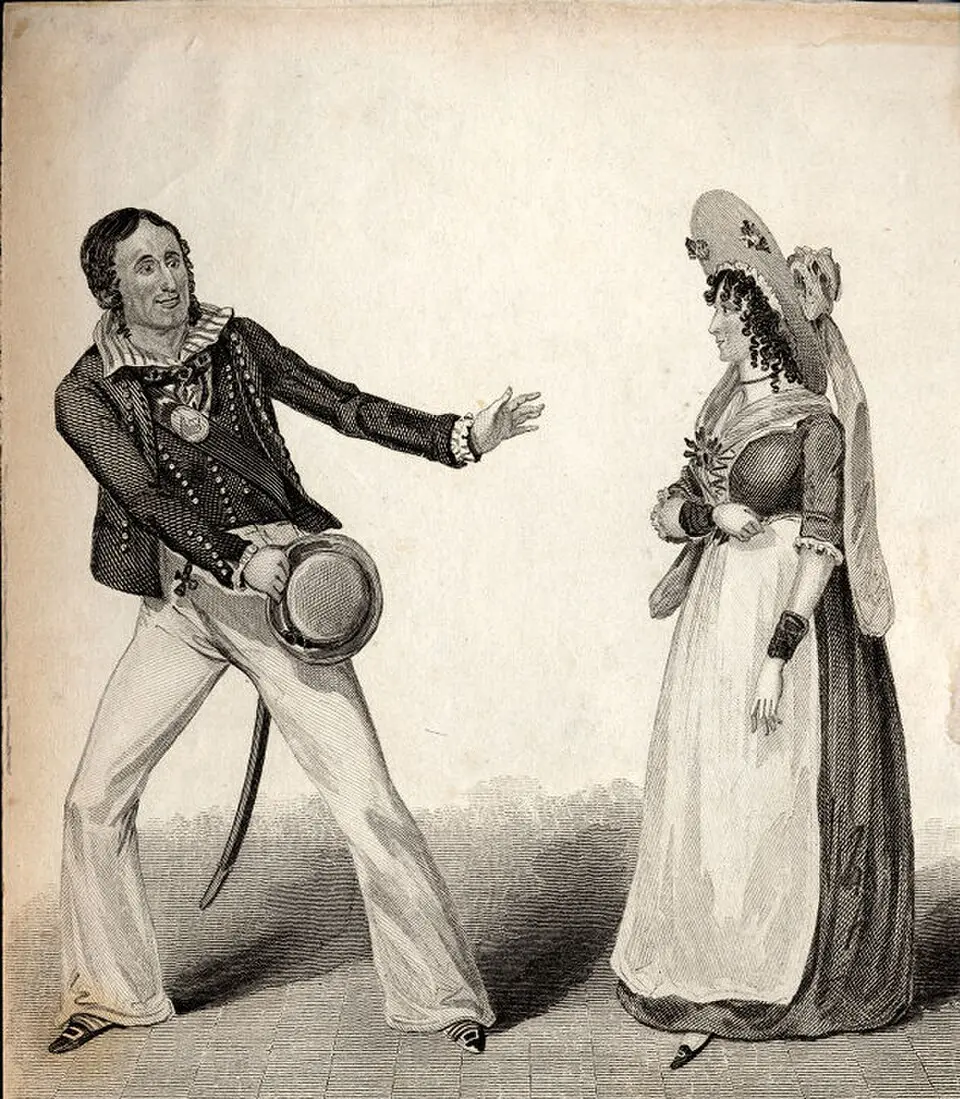

Act 1, Scene 1
A View of the Country.
Enter Doggrass and Gnatbrain, R.
Tut! if you are inclined to preach, here is a mile stone, I'll leave you in its company.
Ay, it's all very well—very well—but you have broken poor Susan's heart, and as for William—
What of him?
The sharks of him, for what you care. Didn't you make him turn a sailor, and leave his young wife, the little, delicate black-eyed Susan, that pretty piece of soft speaking womanhood, your niece? Now say, hav'nt you qualms? On a winter's night, now, when the snow is drifting at your door, what do you do?
Shut it.
And what when you hear the wind blowing at your chimney corner?
Get closer to it.
What, when in your bed, you turn up one side at the thunder?
Turn round on the other. Will you go on with your catechism?
No, I'd rather go and talk to the echoes. A fair day to you, master Doggrass!—If your conscience—
Conscience!—phoo! my conscience sleeps well enough.
Sleeps! don't wake it then—it might alarm you.
One word with you,—no more of your advice—I go about like a surly bull, and you a gadfly buzzing around me. From this moment throw off the part of counsellor.
But don't you see?
Don't you see these trees growing about us?
Very well.
If a cudgel was cut from them for every knave who busies himself in the business of others—don't you think it would mightily open the prospect?
Perhaps it might: and don't you think that if every hardhearted, selfish rascal that destroys the happiness of others, were strung up to the boughs before they were cut for cudgels, don't you think that instead of opening the prospect, it would mightily darken it?
I have given you warning—take heed! take heed! and with this council, I give you a good day. [Exit L.]
Ay, it's the only thing good you can give; and that only good, because it's not your own. That rascal has no more heart than a bagpipe! one could sooner make Dover Cliffs dance a reel to a penny whistle, than move him with words of pity or distress—No matter, let the old dog bark, his teeth will not last forever—and I yet hope to see the day when poor black-eyed Susan, and the jovial sailor, William, may defy the surly cur that now divides them. [Exit. R.]
Act 1, Scene 2
Dame Hatley's Cottage, 2 G. Susan is heard without, singing a verse of Black-eyed Susan. D. L. F. H. Practical and at Lattice Window in L. flat. Set door, 2 E. R.
Enter Susan, R.
Twelve long tedious months have passed, and no, tidings of William. Shame upon the unkind hearts that parted us—that sent my dear husband to dare the perils of the ocean, and made me a pining, miserable creature. Oh! the pangs, the dreadful pangs that tear the sailor's wife, as wakeful on her tear-wet pillow, she lists and trembles at the roaring sea.
Enter Gnatbrain, at the cottage door, L. C.
There she is, like a caged nightingale, singing her heart out against her prison bars—for this cottage is little better than a gaol to her. Susan!
Gnatbrain!
In faith Susan, if sorrow makes such sweet music, may I never turn skylark, but always remain a goose.
Have you seen my uncle?
Oh, yes!
Will he show any kindness?
I cannot tell. Did you ever see gooseberries grow upon a cabbage stump? you have flowers from an aloe tree, if you wait a hundred years.
He has threatened to distress the good dame.
Ay, for the rent. Oh Susan, I would I were your landlord. I should think myself well paid if you would allow me every quarter-day to put my ear to the key-hole, and listen to one of your prettiest ditties. Why for such payment, were I your landlord, I'd find you in board, washing, and lodging, and the use of a gig on Sundays. I wish I—but la! what's the use of my wishing? I'm nobody but half-gardener, half-waterman—a kind of alligator, that gets his breakfast from the shore, and his dinner from the sea—a—
[without] Come along Jacob.
Oh! begone! I see Mr, Doggrass; if he find you here—
He must not; here's a cubboard—I'm afraid there's plenty of room in it.
No, no, I would not for the world—there is no occasion—meet him.
Not I, for quiet's sake. We never meet but, like gunpowder and fire, there is an explosion. This will do. [Goes into the closet, 2 E. R.]
Enter Doggrass, D. F. L.
Now, Susan, you know my business—I say, you know my business. I come for money.
I have none, sir.
A pretty answer, truly, Are people to let their houses to beggars?
Beggars! Sir, I am your brother's orphan child.
I am sorry for it. I wish he were alive to pay for you. And where is your husband.
Do you ask where he is? I am poor, sir—poor and unprotected—do not, as you have children of your own—do not insult me. [Weeps.]
Ay, this it is to let houses to women; if the tax gatherer were to be paid with crying, why nobody would roar more lustily than myself; let a man ask for his rent, and you pull out your pocket-handkerchief. Where's dame Hatley?
In the next room—ill, very ill.
An excuse to avoid me; she shall not. [Going R.]
You will not enter?
Who shall stop me?
If heaven give me power—I! Uncle, the old woman is sick—I fear dangerously. Her spirit, weakened by late misfortune, flickers, like a dying light—your sudden appearance might make all dark. Uncle—landlord! would you have murder on your soul?
Murder?
Yes; tho' such may not be the common word, hearts are daily crushed, spirits broken—whilst he who slays, destroys in safety.
Can Dame Hatley pay me the money?
No.
Then she shall to prison.
She will die there.
Well?
Would you make the old woman close her eyes in a gaol?
I have no time to hear sentiment. Mrs. Hatley has no money—you have none. Well, though she doesn't merit lenity of me, I'll not be harsh with her.
I thought you could not.
I'll just take whatever may be in the house, and will put up with the rest of the loss.
Enter Dolly Mayflower, D. F. L. H.
So, Mr. Doggrass, this is how you behave to unfortunate folks—coming and selling them up, and turning them out. Is this your feeling for the poor?
Feeling! I pay the rates. What business have you here? Go to your spinning.
Spinning! if it were to spin a certain wicked old man a halter, I'd never work faster. Ugh! I always thought you very ugly, but now you look hideous.
Peace, good Dolly.
Peace! oh, you are too quiet—too gentle. Take example by me: I only wish he'd come to sell me up, that's all. [Doggrass goes to door.] Oh, I know who you are looking after—your man, Jacob Twig; he hops after you on your dirty work, like a tomtit after a jackdaw—I saw him leering in at the door. I wish my dear Gnatbrain was here. Oh, Susan, I wish he was here; he's one of the best, most constant of lovers—he'd befriend you for my sake.
[goes to the door] Jacob. [Enter Jacob Twig, D. F. L. H.] You know your business.
What here, master? What, at old Dame Hatley's?
To be sure, good Jacob, if your master had a tree, and but one squirrel lived in it, he'd take its nuts, sooner than allow it lodging gratis.
Uncle, have compassion—wait but another week—a day.
Not an hour—a minute. Jacob, do your duty. Now begin; put down everything you see in the cottage.
Master, hadn't you better wait a little? perhaps the Dame can find friends. [Doggrass is imperative.] Well, here goes; I'll first begin with the cupboard.
[anxiously] No, let me entreat you do not. Come this way if you are still determined.
Eh! why that way? why not with the cupboard! suspect.—
And now, so do I.
You suspect! I dare say; suspicion is all your brain can manage; what should you suspect—a thing that never had a thought deeper than a mug of ale? You suspect Susan! why, we shall have the crows suspecting the lilies.
You say so, do you? Now I'll show you my consequence. I'll put everything down, master, and begin with the cupboard. Ah! it's fast; I'll have it open—and I'll put the first thing down.
Pulls open the door, when Gnatbrain knocks Jacob down with rolling pin, puts his foot upon him, and stands [2. E. R.] in attitude. Susan in R. corner, Dolly L. C. in surprise. Doggrass standing L. corner exulting.
No, I'll put the first thing down.
Gnatbrain! Oh, Susan, Susan!
Oh, oh! we shall have the crows suspecting the lilies; Pretty flower! how it hangs its head! Go on with your duty, Jacob; put down everything in the house.
Do, Jacob; and begin with "one broken head"—then, one stony-hearted landlord—one innocent young woman—ditto, jealous—one man tolerably honest—and one somewhat damaged.
I'll have you up before justices—you have broken my crown.
Broken your crown Jacob! Jacob, it was cracked before.
How do you know that?
By the ring of it, Jacob—by the ring: I never heard such a bit of Brummagem in my life.
[To Susan] Well Susan, it is sometimes convenient, is it not, for a husband to be at sea?
Sir, scorn has no word, contempt no voice to speak my loathing of your insinuations. Take, sir, all that is here; satisfy your avarice—but dare not indulge your malice at the cost of one, who has now nothing left her in her misery but the sweet consciousness of virtue. [Exit R. H.]
The way with all women when they are found out, is it not, Mrs. Dolly?
I can't tell, sir; I never was found out.
Ay, you are lucky.
Yes—you don't meet often. But as for you, Mr. Gnatbrain——
Now, no insinuations. I wish I could remember what Susan said about virtue: it would apply to my case admirably; nothing like a sentiment to stop accusation—one may apply it to a bleeding reputation, as barbers do cobwebs to a wound.
Jacob, do you stay here—see that nothing of the least value leaves the house.
In that case, Jacob, you may let your master go out.
Some day, my friend, I shall be a match for you.
Doggrass shakes stick at Gnatbrain, and Exit D. F. L. H. Gnatbrain throws the rolling pin at him—who then pursues Jacob into R. corner.
Perhaps so, but one of us must change greatly to make us pairs. Jacob, I never look upon your little carcass, but it puts me in mind of a pocket edition of the Newgate Calendar—a neat Old Bailey duodecimo: you are a most villanous looking rascal—an epitome of a noted highwayman.
What!
True as the light. You have a most Tyburnlike physiognomy—there's Turpin in the curl of your upper lip—Jack Shepperd in the under one—Your nose is Jerry Abershaw himself—Duval and Barrington are your eyes—and as for your chin, why Sixteen String Jack lives again in it. [Gnatbrain goes to window L. F. affecting to see what is passing outside.] Eh! well done—excellent! there's all the neighbors getting the furniture out the garden window.
Is there? It's against the law; I'm his Majesty's officer, and I'll be among them in a whistle.
Jacob runs to L. and Exit D. F. L. H. Gnatbrain instantly bolts it.
A bailiff, like a snow-storm, is always best on the outside. Now Dolly, sweet Dolly Mayflower, won't you look at your Natty Gardner? won't you be the summer cabbage of my heart, and let me cultivate you?
Don't talk to me, sir! What were you cultivating in the cupboard, sir—the cupboard, sir, the cuboard.
Hear my defence. On my word, I had not the least idea that you would have found me, or the cupboard is the very last place I should have gone into.
It's no matter; there's Mr. James Rattlin, boatswain's mate of the Bellerophon——
What! you wouldn't marry a sailor?
And why not?
Your natural timidity wouldn't allow you.
My timidity?
Yes; you wouldn't like to be left alone o'nights. Your husband would be at sea for six months out of the twelve; there would be a wintry prospect for you.
But he would be at home the other six months—and there's summer, sir.
True, but when you can have summer all the year round, don't you think it more to your advantage?
No—for if it always shone, we should never really enjoy fine weather.
Oh, my dear, when we are married, we'll get up a thunderstorm or two, depend upon it. But come, Dolly, your heart is too good—your head too clear, to nourish idle suspicion—let us go and see poor Susan; there is real calamity enough in our every-day paths, we need not add to it by our idle follies. [Exeunt L.]
Act 1, Scene 3
1 G.]—A view of the Country.
Enter Hatchet, R.
Doggrass has made the seizure by this time. Now I'll step in, pay the money, and thus buy the gratitude of Susan, before I tell her the story of her husband's death.
Enter Jacob, running R. who has a memorandum book in his hand, pen in his ear, and ink bottle at the button-hole of his coat.
Bring up there, my young skiff. Whither bound?
I'm in a hurry.
Bring up, I say, or I'll spoil your figurehead—[Lifting his cudgel.]
Do you know who I am?
No; what are you, my young flying-fish?
I'm a bailiff—ar'n't you frightened? I serve Mr. Doggrass.
The very craft I was sailing after. You have been to Susan's—Black-eyed Susan's, as she's called?
How do you know that?
You have made a seizure there?
Right again.
Have secured everything?
Wrong. I had made as pretty a piece of business of it as any of my craft—a very pretty stroke of handiwork; but somehow or the other——
You frighten me. Nobody paid the money I hope?
Oh, don't be alarmed at that; no, but somehow or the other, quite by a mistake, when I thought I was in possession, I found myself on the wrong side of the house. And, here comes Susan. [Enter Susan, R.] Ar'n't you ashamed of yourself, Mrs. Susan, to make one to cozen so innocent a little bailiff as myself—ar'n't you ashamed of yourself?
[Throwing Jacob over to L] Stand o' one side! what, in trouble, my pretty Susan? what, have the land sharks got aboard of the cottage? come, cheer up.
What, do you indeed pity me? this is kind, and from a stranger, unexpected.
Not such a stranger as you may think.
No.
No, I know your husband—sailed with him.
You did! oh, tell me everything.
All in good time—[To Jacob] what do you want here—sticking like a barnacle to a ship's copper. [Hatchet strikes Jacob with cudgel.]
Want! Oh, here comes my master, he'll tell you what I want; I'll leave you with him, he'll answer all questions. [Exit L. Jacob returns L. and strikes Hatchet with book, and runs off L. H.]
Enter Doggrass, R.
So, madam, you must show contempt to a king's officer, put a servant of the law out of doors!
Steady there! none of your overhauling—what do you want with the young woman?
What's that to you?
Oh, pray don't quarrel on my account—do not, I entreat you.
[Aside] I'll swagger a little. Quarrel, my dear, I'd fight yard arm to yard-arm for you—go on a boarding party, cut out, row under a battery, or fight in a rocket-boat; anything for the pretty black-eyed Susan.
Well, as you'll do all this, perhaps you'll pay the money she owes.
That will I, though it were the last shot in my locker.
No, no, there is no occasion; I would not have it for the world.
You wouldn't? I would; but don't be afraid, he'll talk, but he'll be long ere he pays twelve pounds seventeen and sixpence for you, black-eyed and pretty as you are.
See how little you know of a sailor; there's thirteen pounds—I'm not much of an accountant, but it strikes me that that will pay your little bill, and just leave a dirty two-and-sixpence for young Jibboom, the bailiff.
Oh, my good, kind friend—this generosity—my thanks, my prayers!
Not a word, not a word—good bye.
Yet, do not leave me; you said you knew my husband—had a tale to tell of him.
Yes, but not now; to-morrow. If I have done any thing to oblige you, let me ask the delay. Besides, then I will bring one with me who can tell you more of William than myself; meantime, farewell. [Aside.] She's softened; a woman is like sealing-wax, only melt her, and she will take what form you please. I've bought her heart with the chink, and to-morrow will secure it. [Exit L. H.]
Wait 'till tomorrow! Alas! there is no remedy but patience; yet spite of myself, I feel forebodings which I know 'tis weakness to indulge.
I suppose Mrs. Susan, as the case at present stands, neither you or the old dame will now think of leaving the cottage?
Indeed, landlord, we shall.
Landlord! why not uncle? it is a much better word.
It might have been, but your unkindness has taught me to forget it.
Now, hear reason. [She turns from him] Well, to be sure, a plain-spoken man can't expect it from one of your sex, so I'll leave you. You'll think again about the cottage? it has a pretty situation, and as for the rent why, as one may say, it's a mere nothing. [Exit R.]
Cruel man. Oh, William! when, when will you return to your almost heart-broken Susan? Winds, blow prosperously, be tranquil, seas, and bring my husband to my longing eyes. [Exit L.]
Act 1, Scene 4
6 G.]—A view of the Downs.—The fleet at Anchor.
Enter Jacob Twig, L 2 E
After all, I don't much like this trade of bailiff. I've a great mind to give it up, go back to my native Dover again, and turn ploughman. [Three cheers, U E L.] Holloa! the boats are putting off from the ships. Deal will be crowded again; there will be no getting a sweetheart for these six months. [Music. Three cheers, U E L. Enter Sailors, &c. William last. Jacob runs into L corner.]
Enter William, Seaweed, Blue Peter, and Sailors.
Huzza! huzza! my noble fellows, my heart jumps like a dolphin—my head turns round like a capstern; I feel as if I were driving before the gale of pleasure for the haven of joy.
But I say, William, there's nobody here to meet us.
Why, no! that is, you see, because we dropped anchor afore the poor things had turned out of their hammocks. Ah! if my Susan knew who was here, she'd soon lash and carry, roused up by the whistle of that young boatswain's mate, Cupid, piping in her heart. Holloa! what craft is this? Cutter, ahoy!—what ship?
[Taking off his hat] My name is Jacob Twig.
You needn't bring too, under bare poles—cover your truck, and up with your answering pendant. Come! clear your signal halyards, and hoist away.—What service?
I'm in the law.
Umph! belongs to the rocket boats. May my pockets be scuttled, if I didn't think so! 'Tis Beelzebub's ship, the Law! she's neither privateer, bomb-ship, nor letter-o-mark; she's built of green timber, manned with lob-lolly boys and marines; provisioned with mouldy biscuit and bilge-water, and fires nothing but red hot shot; there's no grappling with or boarding her. She always sails best in a storm, and founders in fair weather. I'd sooner be sent adrift in the North Sea, in a butter cask, with a 'bacco-box for my storeroom, than sail in that devil's craft the Law. My young grampus, I should like to have the mast-heading of you in a stiff north-wester.
Avast there, messmate! don't rake the cock-boat fore and aft.
[L corner] Don't cock the rake boat fore and aft.
Why, yes, I know it's throwing away powder and shot to sink cockle-shells with forty-two-pounders. But warn't it the lawyers that turned me and Susan out of our stowage? Why I'd as soon have met one of Mother Carey's chickens, as—eh! [Looking out L.] There's a fleet bearing down.
A fleet!—ay, and as smart as a seventy-four on the king's birth-day.
A little more to larboard, messmate. [William throws Jacob to his R H the Sailors pass him from one to the other till he is off, R H the last Sailor on R H kicks him, Jacob returns, R H and says, "I'll put that down," and runs off again, R.] There's my Susan! now pipe all hands for a royal salute; there she is, schooner-rigged. I'd swear to her canvass from a whole fleet. Now she makes more sail!—outs with her studding booms—mounts her royals, moon-rakers and sky-scrapers; now she lies to it!—now! now!—eh! may I be put on six-water grog for a lubber.
What's the matter?
'Tisn't she—'tisn't my craft.
Enter men and women, L who welcome all the Sailors. Every one except William, is met by a female. He looks anxiously at every one, Music.—All go off except William.
What! and am I left alone in the doctor's list, while all the crew are engaging? I know I look as lubberly as a Chinese junk under a jewry mast. I'm afraid to throw out a signal—my heart knocks against my timbers, like a jolly-boat in a breeze, alongside a seventy-four. Damn it, I feel as if half of me was wintering in the Baltic, and the other half stationed in Jamaica. [Enter Ploughshare, 3 E R crossing behind L—[Music.]] It's no use, I must ask for dispatches. Damn it, there can be no black seal to them! [To Ploughshare,] Messmate!
Now, friend, [Comes down L.]
Give us your grappling-iron! Mayhap you don't know me!
No.
Well, that's hard to a sailor, come to his native place. We have ploughed many an acre together in Farmer Sparrow's ground.
What—William! William that married Susan!
Avast there! hang it—that name, spoke by another, has brought the salt water up; I can feel one tear standing in either eye like a marine at each gangway; but come, let's send them below. [Wipes his eyes.] Now don't pay away your line till I pipe. I have been three years at sea; all that time, I have heard but once from Susan: she has been to me a main-stay in all weathers. I have been piped up, roused from my hammock, dreaming of her, for the cold, black middle watch—I have walked the deck, the surf beating in my face, but Susan was at my side, and I did not feel it; I have been reefing on the yards, in cold and darkness, when I could hardly see the hand of my next messmate—but Susan's eyes were on me, and there was light: I have heard the boatswain pipe to quarters; a voice in my heart, whispered Susan, and I strode like a lion; the first broadside was given—shipmates whose words were hardly off their lips, lay torn and mangled about me—their groans were in my ears, and their blood hot on my face—I whispered, 'Susan!' it was a word that seemed to turn the balls aside, and keep me safe. When land was cried from the mast head, I seized the glass—my shipmates saw the cliffs of England—I, I could see but Susan! I leap upon the beach; my shipmates find hands to grasp and lips to press—I find not Susan's.
Believe me——
Avast there! if you must hoist the black flag—gently. Is she yet in commission?—does she live?
She does.
Thank heaven! I'll go to church next Sunday, and you shall have a can of grog—eh! but your figure-head changes like a dying dolphin; she lives, but perhaps hove down in the port of sickness. No! what then, eh—avast! not dead—not sick—yet—why there's a galley fire lighted up in my heart—there's not an R put in her name?
What do you mean?
Mean! grape and canister! She's not Run, not shown false colors?
No, no.
I deserve a round dozen for the question. Damn it, none of your small arms; but open all your ports and give fire.
Susan is well—is constant; but has been made to feel that poverty is too often punished for crime.
What, short of ammunition to keep off the land-sharks? But her uncle?
He has treated her very unkindly.
I see it! damn it, I'll overhaul him—I'll bring him on his beam ends. Heave a-head, shipmate!—now for my dear Susan, and no quarters for her uncle. [Music.] [Exeunt Ploughshare and William., L 1 E.]
Enter Captain Crosstree, 3 E L.
In faith that's the prettiest little vessel I ever saw in a long cruise. I threw out signals to her, but she wouldn't answer. Here comes the fellow that passed me whilst I was talking to her.
Enter Gnatbrain, 1 E L and crosses to R.
Shipmate, there is a dollar for you.
Truly, sir, I would we had been messmates, you might then have made it ten shillings.
You passed me a few minutes since, when I was in company with a petticoat.
Ay; its no use Captain; she's a tight little craft, and as faithful to all that is good, as your ship to her helm.
What is her name?—who is she?
We simply call her Susan—Black-eyed Susan; she is the wife of a sailor.
Ah, what fond of the blue-jackets.
Yes, so fond of the jacket that she'll never look at your long coat—good-day, Captain. [Exit L H.]
The wife of a sailor! wife of a common seaman! why she's fit for an admiral. I know it's wrong, but I will see her—and come what may, I must, and will possess her. [Exit, R.]
Act 1, Scene 5
Interior of Susan's Cottage. Same as Scene II.—Enter William at door, L F.
Well, here I am at last! I've come fifteen knots an hour, yet I felt as if I were driving astern all the time. So, this is poor Susan's berth—not aboard—out on liberty, and not come to the beach?—eh! that's she;—ha! and with two strange-rigged craft in convoy—I'll tack abit, and—damn it, if there's foul play! chain-shot and bar-shot! I'll rake 'em fore and aft. [Retires.]
[Without L F] Oh, say not so, for mercy's sake!
[Aside] What, hanging out signals of distress?
Enter Susan, Hatchet, and Raker, door F L H. Slow Music.
Oh, these are heavy tidings, indeed.
Don't take on so, pretty Susan! if William is dead, there are husbands enough for so pretty a face as yours.
Dead! may I never splice the mainbrace, if that swab don't want to get into my hammock. [Hatchet approaches nearer to Susan.] Now, he's rowing alongside her with muffled oars, to cut her cable!—I'll tomahawk his rigging for him.
But is there no hope.
Hope! none. I tell you Susan, this honest fellow was William's messmate; he saw him go down, you didn't rightly hear him when he first told the story—tell it again, Tom. [Raker suddenly indicates his unwillingness.] Poor fellow! he was William's friend, and the story hurts him. I'll tell it you.—You see the ship had got upon the rocks, and it came on to blow great guns; her timbers opened, and she broke her back—all her masts were overboard, and orders were given to take to the boats. William was in the jolly boat;—well, she hadn't got the length of a boarding pike from the wreck, when she shipped a sea, and down she went. William, and twelve other brave fellows, were in the water:—this shipmate here threw out a rope; it was too late; William sunk, and was never seen more. His shipmate turned round and saw—[Chord. During his speech, Raker has moved into the corner of the stage, his back to Hatchet as if unwilling to hear the story. William, by the conclusion of this speech, has placed himself between Hatchet and Susan.] Damnation.
[Shrieking and throwing herself into William's arms] William!
Damn it, I'm running over at the scuppers, or you lubbers, I'd been aboard of you before this. What! hang out false signals to the petticoat—may you both have the yellow flag over you, and go up in the smoke of the castle-chaser. Bring-to, a minute, and I'll be yard-arm and yard-arm with you. What, Susan, Susan! see, you swabs, how you've brought the white flag into her pretty figure-head. [Puts Susan aside.] Now then I'll make junk of one of you.
William! William! for heaven's sake!—
Just one little bout, Susan, to see how I'll make small biscuit of 'em. You won't fight? Then take that to the paymaster and ask him for the change. [Strikes Hatchet over the cheek.]
Struck! then here's one of us for old Davey!
Music. Runs at William with drawn cutlass, who catches his R arm, they struggle round on L. William throws him off, and stands over him. Hatchet on his knee; same time Lieut. Pike appears inside of door in F L H. 2 Marines appear at window L flat. Tableau.
Smugglers surrender! or you have not a moment's life.
Hatchet and Raker, startled by the appearance of Pike's party, recoil.
Smugglers! I thought they were not man-of-war's men; true blue never piloted a woman on a quicksand. [Signs to Hatchet, who gives cutlass and belt to Pike.]
Here, William, wear this as a trophy of your victory.
Thank ye, your honor, I'll ship it—there's a cheese knife for you!
Come, my lads, as you have cheated the king long enough, you shall now serve him—the fleet wants hands, and you shall aboard.
If they are drafted aboard of us, all I wish is, that I was boat-swain's mate for their sake! Oh, wouldn't I start 'em. [Music—Exeunt Pike, Hatchet, Raker, D F L H.—2 Marines follow] Now Susan, [Embraces her.] May I be lashed here until death gives the last whistle.
Oh, William! I never thought we should meet again.
Not meet! why we shall never part again. The Captain has promised to write to the Admiralty for my discharge; I saved his life in the Basque Roads. But I say, Sue, why wasn't you on the beach?
I knew not of your arrival.
Why a sailor's wife, Susan, ought to know her husband's craft, if he sailed in a washing-tub, from a whole fleet. But how is this, Sue? how is it? Poverty aboard [Doggrass coughs without, L F.] and then your uncle——
Enter Doggrass, D F L H.
Now Mrs. Susan, I am determined—[Sees William.]
The very griffin I was talking of. Now, what are you staring at? what are you opening your mouth for like the main-hold of a seventy four? I should like to send you to sea in a leaky gun-boat, and keep you at the pumps for a six month's cruise.
What! William!
Avast, there! don't think to come under my lee in that fashion. Ar'n't you a neat gorgon of an uncle now, to cut the painter of a pretty pinnace like this, and send her drifting down the tide of poverty, without ballast, provisions or compass? May you live a life of ban-yan days, and be out six upon four for't!
But you mistake, William——
No palaver: tell it to the marines. What, tacking and double tacking! come to what you want to say at once—if you want to get into the top, go up to the futtock shrouds like a man—don't creep through lubber's hole. What have you got to say?
Don't—you have put my heart into my mouth.
Have I? I couldn't put a blacker morsel there. Just come a longside here. [Pulls him by neckcloth.] I am not much of a scholar, and don't understand fine words—your heart is as hard as a ring-bolt—to coil it up at once you are a d——d rascal. If you come here after your friends you'll find 'em in the cock-pit of one of the fleet: you have missed the ratlin this time, but brought yourself up by the shrouds. Now, take my advice, strike your false colors, or I wouldn't give a dead marine for the chance of your neck. [Dog. Exit at door.] That fellow would sit still at his grog, at the cry of "a man overboard!" Oh, Susan, when I look at your eyes, you put me in mind of a frigate, with marines firing from the tops. Come along, Sue; first to fire a salute to old Dame Hatley, then to my shipmates; to-day we'll pitch Care overboard, without putting a buoy over him—call for the fiddles—start the rum cask—tipple the grog—and pipe all hands to mischief. [Exeunt D F L.]
Act 1, Scene 6
5 G—A View near Deal. Public House on R H. Table with bottles, cups at back, 6 forms and stools for sailors, &c. Loud laughing as scene opens. Peter, Seaweed, Gnatbrain, Dolly, Sailors, Rustics, Men and Women discovered drinking.
Belay that galley yarn, Peter; belay!
Oh, let him go on—he lies like a purser at reckoning day.
Where's William, I wonder? he promised to meet us. I suppose he's with his Susan now.
And where can he be better, do you think? But just to pass away the time I give you the song that was made by Tom Splinter, upon Susan's parting with William in the Downs?
Ay, the song—the song!
Come, pipe up, my boy. Poor Tom Splinter! he was cut in half by a bar-shot from the Frenchman; well, every ball's commissioned. The song, the song!
Here goes; but I know I can't sing it now.
Can't sing! bless you; whenever we want to catch a mermaid, we only make him chant a stave, and we've twenty round the ship in the letting go of an anchor.
Peter sings the first, second and last verse of "Black-Eyed Susan."
All in the Downs the fleet was moored, The streamers waving on the wind, When Black-eyed Susan came on board, Oh! where shall I my true love find? Tell me ye jovial sailors, tell me true, Does my sweet William sail among your crew?
William, who high upon the yard, Rocked with the billows to and fro; Soon as her well-known voice he heard, He sighed and cast his eyes below. The cord slides swiftly through his glowing hands, And quick as lightning on the deck he stands.
The boatswain gave the dreadful word, The sails their swelling bosom spread; No longer must she stay on board; They kissed; she sighed; he hung his head; Her less'ning boat unwilling rows to land; Adieu! she cries, and waves her lily hand.
Halloo! who have we here? Man the yards my boys—here comes the Captain.
Enter Captain Crosstree L H.—Sailors doff caps to him—Lasses' curtsy.
I am sorry my fine fellows, to interrupt your festivities, but you must aboard to-night.
To-night, your honor!
Yes; it is yet uncertain, that we may not be ordered to set sail to-morrow.
Set sail to-morrow! why the lords of the Admiralty will break the women's hearts, your honor.
Where is William?
He's with Susan, your honor; pretty black-eyed Susan, as she is called.
With black-eyed Susan! how is that?
How, your honor! why they are spliced together for life.
Married! I never heard of this?
No! why your honor, I thought it was as well known as the union-jack. They were spliced before we went upon the last station: not know it, your honor; why many a time has the middle-watch sung the parting of William and Susan.
[Aside] Married! I had rather forfeited all chance of being an admiral. Well, my lads, you hear my advice, so make the best of your time, for to-morrow you may be sailing for blue water again. [Sailors bow, go up—Crosstree Exits in House, R. H.]
Them lords of the Admiralty know no more about pleasures of liberty, plenty of grog, and dancing with the lasses, than I knows about stronomy. Here comes William!
Music—Enter William and Susan, L H—they cheer him.
Here's my shipmates, Susan! Look at her, my hearties—I wouldn't give up the command of this craft, no—not to be made Lord High Admiral.
[to rustics] Stand aside, and let me show off my craft. [Brings Dolly down, R C.] Here's my craft. I wouldn't give up the command of this 'ere craft to be made Lord High Gardner on.
What, honest Gnatbrain, Susan has told me about you—give us a grapple! [Shakes hands very forcibly. Gnatbrain writhes under it.] What are you looking for?
Looking for my fingers.
I beg your pardon, my lad, I thought I was clapping on the main top bowline. [Takes out box.] Here take a bit from St. Domingo Billy.
From what? [Sailors gather round William.]
From St. Domingo Billy! I see you are taken back—steering in a fog; well, I'll just put on my top-lights to direct your course.
Now, I'm a bit of a sailor—but none of your hard words.
Hard words! no, I always speak good English:—you don't think I'm like Lieutenant Lavender, of the Lily-white schooner.
But about St. Domingo Billy.
It's lucky for you, that you've been good to Susan, or I shouldn't spin you these yarns. You see it was when the fleet was lying off St. Domingo in the West Indies, the crew liked new rum and dancing with the niggers: well, the Admiral, [a good old fellow and one as didn't like flogging,] wouldn't give the men liberty; some of 'em, howsomever, would swim ashore at night, and come off in the morning. Now, you see to hinder this, the admiral and the captains put St Domingo Billy on the ship's books, and served him out his mess every morning.
Who was St. Domingo Billy?
Why, a shark, as long as the Captain's gig. This shark or Billy, for that's what the sailors called him—used to swim round the fleet, and go from ship to ship, for his biscuit and raw junk, just like a Christian.
Well, but your 'bacco-box, what about that?
Steady!—I'm coming to it. Well, one morning, about eight bells, there was a black bumboat woman aboard, with a little piccaninny, not much longer than my hand—well, she sat just in the gang-way,—and there was Billy along side, with his three decks of grinders ready for what might come:—well, afore you could say about-ship, the little black baby jumped out of its mother's grappling, and fell into Billy's jaws—the black woman gave a shriek that would have split the boatswain's whistle! Tom Gunnel saw how the wind was; he was as fine a seaman as ever stept—stood six feet two, and could sit upon his pig-tail;—well, he snatched up a knife, overboard he jumps, and dives under Billy, and in a minute the sea was as red as a marine; all the crew hung like a swarm of bees upon the shrouds, and when Tom came up, all over blood with the corpse of the baby, and the shark upon its side—my eyes! such a cheer—it might have been heard at Greenwich.
Oh, no, William, not quite so far.
Oh, yes, you might; that is, if the wind had blowed that way. Why, I heard it myself at Blackwall.
We had 'em on board, cut up Billy, and what do you think we found in him? all the watches and 'bacco-boxes as had been lost for the last ten years—an Admiral's cocked hat, and three pilot's telescopes. This is one on 'em! [Showing box.]
What! of the telescopes?
No, of the boxes, you lubber.
Well, friend, William, that's a tolerable yarn.
True, true as the Nore Light. But come, my hearties, we are not by the galley fire—let's have a dance.
Ay, a dance!—a dance!
Dance—end of which, Quid enters, L 2 E.
Now, lads, all hands on board.
On board, Master Quid! why, you are not in earnest?
Indeed, but I am: there's the first lieutenant waiting on the beach for all the liberty men.
The first lieutenant!
Sailors and Lasses retire and converse together, bidding each other farewell. William and Susan down in front.
Oh, William, must you leave me so early?
Why, duty, you know, Susan, must be obeyed—[Aside.] Cruise about here a little while—I'll down to the lieutenant, and ax him for leave 'till to-morrow. Well, come along, shipmates, if so be that blue Peter must fly at the fore, why it's no use putting a black face on the matter.
Music—William, Sailors, and Girls, exeunt. U E L. Sailors go off with girls.
This it is, you see, pretty Susan, to be married to a sailor; now don't you think it would be much better if William had a little cot, with six feet square for the cultivation of potatoes, than the forecastle for the rearing of laurels? to be obliged to leave you now!
Yes, but I trust he will be enabled to return; nay there are hopes that he will gain his discharge; and then, with his prize money,——
Ay, I see, go into the mercantile line—take a shop for marine stores. But, come along, Susan, the evening is closing in—I'll see you to your cottage.
I thank you, good Gnatbrain, but I would for a time, be alone.
Ah, I see, melancholy and fond of moonlight: well, poor thing, it's not to be wondered at; I was melancholy when I was first in love, but now I contrive to keep a light heart, though it is struck with an arrow. [Exit, R.]
I hope he will return—surely, his officer will not be so unkind as to refuse him.
Enter Captain Crosstree, from Inn, rather intoxicated, R U E.
[Singing] "Cease, rude Boreas."—Confound that fellow's wine!—or mischief on that little rogue's black eyes, for one or the other of them has made sad havoc here.
[Aside] The stranger officer that accosted me.
Well, now for the boat. [Sees Susan.] May I never see salt water again, if this is not the very wench. My dear! my love! come here!
Intoxicated, too! I will hence. [Going, R.]
[Staying her] Stop! why, what are you fluttering about? don't you know, I've found out a secret—ha, ha! I'm your husband's captain.
I'm glad of it, sir.
Are you so? well, that sounds well.
For I think you will give my husband leave of absence, or, if that if is impossible, allow me to go on board his ship.
Go on board, that you shall! you shall go in the captain's gig—you shall live in the captain's cabin.
Sir!
Would it not be a shame for such a beautiful black-eyed, tender little angel as yourself to visit between decks? Come, think of it—as for William, he's a fine fellow, certainly, but you can forget him.
Sir, let me go!
Forget him and live for me—by heavens, I love you, and must have you!
If you are a gentleman, if you are a sailor, you will not insult a defenceless woman.
My dear, I have visited too many seaports not to understand all this; I know I may be wrong, but passion hurries me—the wine fires me—your eyes dart lightning into me, and you shall be mine!
Let me go! in mercy!—William, William!
Your cries are vain! resistance useless!
Monster! William, William! [Music,—Crosstree seizes Susan, she breaks away from him, and runs off, U E L. he follows and drags her back L., and as he throws her round to R H., she shrieks.]
Enter William, with drawn cutlass, Sailors, and Girls, U E L.
Susan! and attacked by the buccaneers! die! [Strikes Crosstree with cutlass, throws him around to L H., he is caught by Seaweed; Susan rushes up to William, and falls at his feet.]
The captain! [Sailors, Ploughshare, Rustics,—slow Music,—Male and female form a group.]
TABLEAU.
Act 2, Scene 1
The State Cabin—The Court Martial—The Admiral sits at the head of the table—Six Captains sit on each side of the table—William the Master-at-Arms and Marine-Officer—Marines at each side. A Midshipman is in attendance, Music. Slow drop.
Prisoner, as your ship is ordered for instant service, and it has been thought expedient that your shipmates should be witnesses of whatever punishment the Court may award you, if found guilty of the crime wherewith you are charged, it will be sufficient to receive the depositions of the witnesses, without calling for the attendance of Captain Crosstree, whom it is yet impossible to remove from shore. One of the witnesses, I am sorry to say, is your wife; however, out of mercy to your peculiar situation, we have not summoned her to attend.
Bless you, your honors, bless you. My wife, Susan, standing here before me, speaking words that would send me to the fore-yard—it had been too much for an old sailor. I thank your honors! if I must work for the dead reckoning, I wouldn't have it in sight of my wife.
Prisoner, you are charged with an attempt to slay Robert Crosstree, Captain of his Majesty's Navy, and your superior officer. Answer, are you guilty, or not guilty?
I want, your honor, to steer well between the questions. If it be asked, whether I wished to kill the captain? I could, if I'd a mind to brag, show that I loved him—loved him next to my own Susan! all's one for that. I am not guilty of an attempt to kill the captain, but if it be guilt to strike in defence of a sailor's own sheet-anchor, his wife, why I say guilty, your honor: I say it, and think I've no cause to hang out the red at my fore.
You plead guilty—let me as one of your judges, advise you to reconsider the plea. At least take the chances which the hearing of your case may allow.
I leave that chance to your own hearts, your honors; if they have not a good word for poor Will, why it is below the honesty of a sailor, to go upon the half tack of a lawyer.
You will not retract the plea?
I'm fixed; anchored to it, fore an aft, with chain cable.
Does no one of your shipmates attend to speak to your character? have you no one?
No one, your honor? I didn't think to ask them—but let the word be passed, and may I never go aloft, if from the boatswain to the black cook, there's one that could spin a yarn to condemn me.
Pass the word forward for witnesses.
[On L H] [goes to 1 E L.] Witnesses for the prisoner.
[without, L] Witnesses for the prisoner.
Enter Quid, L. H., Bows to Court.
What are you?
Boatswain, your honor.
What know you of the prisoner?
Know your honor, the trimmest sailor as ever handled rope; the first on his watch, the last to leave the deck; one as never belonged to the after-guard—he has the cleanest top, and the whitest hammock; from reefing a main-top-sail to stowing a netting give me taut Bill afore any able seaman in his Majesty's fleet.
But what know you of his moral character?
His moral character, you honor? why he plays upon the fiddle like an angel.
Are there any other witnesses? [Exit Quid, L.] [Enter Seaweed, L.] What do you know of the prisoner?
Nothing but good, your honor.
He was never known to disobey command?
Never but once, your honors, and that was when he gave me half of his grog when I was upon the black list.
What else do you know?
Why this I know, your honor, if William goes aloft, there's sartin promotion for him.
Have you nothing else to show? Did he ever do any great benevolent action?
Yes, he twice saved the Captain's life, and once ducked a Jew slopseller. [Admiral motions witnesses to retire.]
Are there any more witnesses?
Your honors, I feel as if I were in irons, or seized to the grating, to stand here and listen, like the landlord's daughter of the Nelson, to nothing but yarns about service and character. My actions, your honors, are kept in the log-book aloft—if, when that's overhauled, I'm not found a trim seaman, why it's on'y throwing salt to the fishes to patter here.
Remove the prisoner. [Exeunt Master-at-Arms, with William, R H.] Gentlemen, nothing more remains for us than to consider the justice of our verdict. Although the case of the unfortunate man admits of many palliatives, still for the upholding of a necessary discipline, any commiseration would afford a dangerous precedent, and I fear, cannot be indulged—Gentlemen, are you all determined on your verdict? Guilty, or not guilty?—Guilty? [After a pause, the Captains bow assent.] It remains then for me to pass the sentence of the law? [Captains bow.] Bring back the prisoner.
Re-enter William and Master-at-Arms, R H.
Prisoner—after a patient and impartial investigation of your case, this court has unanimously pronounced you Guilty—[pause.] If you have anything to say in arrest of judgment,—now is your time to speak.
In a moment, your honors,—Damn it my top-lights are rather misty. Your honors, I had been three years at sea, and had never looked upon or heard from my wife—as sweet a little craft as was ever launched—I had come ashore, and I was as lively as a petrel in a storm—I found Susan, that's my wife, your honors, all her gilt taken by the land-sharks; but yet all taut, with a face as red and as rosy as the king's head on the side of a fire-bucket. Well, your honors, when we were as merry as a ship's crew on a pay-day, there comes an order to go aboard—I left Susan, and went with the rest of the liberty-men to ax leave of the first-lieutenant. I hadn't been gone the turning of an hour-glass, when I heard Susan giving signals of distress, I out with my cutlass, made all sail, and came up to my craft—I found her battling with a pirate—I never looked at his figure head, never stopped—would any of your honors? long live you and your wives, say I! would any of your honors have rowed alongside as if you'd been going aboard a royal yacht?—no, you wouldn't; for the gilt swabs on the shoulders can't alter the heart that swells beneath; you would have done as I did; and what did I; why, I cut him down like a piece of old junk—had he been the first lord of the Admiralty, I had done it. [Overcome with emotion.]
Prisoner, we keenly feel for your situation; yet you, as a good sailor, must know that the course of justice cannot be evaded.
Your honors, let me be no bar to it; I do not talk for my life. Death! why, if I 'scaped it here—the next capfull of wind might blow me from the yard-arm. All I would strive for, is to show I had no malice: all I wish whilst you pass sentence, is your pity. That, your honors, whilst it is your duty to condemn the sailor, may, as having wives your honor and children you love, respect the husband.
Have you any thing further to advance?
All my cable is run out.—I'm brought too.
[All the Captains rise] Prisoner! it is now my most painful duty to pass the sentence of the Court upon you. The Court commiserates your situation! and, in consideration of your services, will see that every care is taken of your wife when deprived of your protection.
Poor Susan!
Prisoner! your case falls under the twenty-second article of war. [Reads.] "If any man in, or belonging to the Fleet, shall draw, or offer to draw, or lift up his hand against his superior officer, he shall suffer death." [Putting on his hat.] The sentence of the Court is, that you be hanged at the fore-yard-arm of this his Majesty's ship, at the hour of 10 o'clock: Heaven pardon your sins, and have mercy on your soul! This Court is now dissolved. [Gun fired R H]
Music.—Admiral and Captains, come forward—Admiral shakes hands with William, who overcome, kneels. After a momentary struggle, he rises, collects himself, and is escorted from the cabin in the same way that he entered. The scene closes.
Act 2, Scene 2
1 G.] The gun room of William's Ship. Music.—Enter Lieut. Pike, two Marines, William, Master-at-arms, R H., followed by Quid and Seaweed.
Now, William, what cheer?
Water logged, your honor—my heart's sprung a leak, I'm three feet water in the hold.
Come, summon all your firmness.
I will, your honor; but just then I couldn't help thinking that when I used to keep the middle watch with you I never thought it would come to this.
But you are a brave fellow, William, and fear not death.
Death! No—since I first trod the king's oak, he has been about me—I have slept near him, watched near him—he has looked upon my face, and saw I shrunk not—in a storm I have heeded him not—in the fury of the battle I've thought not of him—had I been mowed down by ball or cutlass my shipmates, as they had thrown me to the sharks, would have given me a parting look of friendship and over their grog have said I did my duty—this, your honor, would not have been death, but lying up in ordinary—but to be swayed up like a wet jib, to dry. The whole fleet—nay, the folks of Deal, people that knew me, used to pat me on the head when a boy, all these looking at me. Oh! thank heaven, my mother's dead.
Come, William; [Shakes his hand.] there, think no more after that fashion. Here are two of your favorite shipmates on whom you would wish to bestow something.
Thankee, your honor. Lieutenant, I know you won't despise the gift because it comes from one who walked the forecastle—here's my box, keep it for poor Will's sake—you and I, your honor, have laid yard arm and yard-arm with many a foe—let us hope we shall come gunwale to gunwale in another climate. [Gives him box. To Marine Officer.] Your honor's hand—blue Peter's flying—the vessel of life has her anchor a-trip, and must soon get under way for the ocean of eternity—your honor will have to march me to the launching place—you won't give a ship a bad name because she went awkwardly off the stocks—take this, your honor, [Opens watch.] this paper was cut by Susan's fingers before we left the Downs; take it your honor, I can't look at it. Master Quid, take this for my sake. [Gives chain and seals, among which is a bullet.] You see that bullet, preserve that more than the gold—that ball was received by Harry Trunnion in defence of me—I was disarmed, and the Frenchman was about to fire, when Harry threw himself before me, and received that bullet in his breast—I took it flattened from his dead body—have worn it about me—it has served to remind me that Harry suffered for my sake, and that it was my duty when chance might serve, to do the like for another.
William is overcome by his feelings, and hurriedly distributes the contents among the shipmates.
And now, William, have you any request to make?
Lieutenant, you see this locket, [Points to locket at his neck.] It is Susan's hair—when I'm in dock, don't let it be touched: I know you won't; you have been most kind to me, Lieutenant, and if those who go aloft may know what passes on the high sea, I shall yet look down upon you in the middle-watch, and bless you. Now, one word more. How fares the Captain?
Very ill, so ill that he has been removed from the command, and the first Lieutenant acts until the new Captain arrives.
His case, then, is desperate—well, if he go out of commission, I can't tremble to meet him—I bear no malice, your honor, I loved the Captain.
You have nothing to ask?
Nothing, your honor. Susan and some friends, will shortly be on board—all I want is, that I may ask for strength to see my wife—my poor young, heart breaking wife, for the last time, and then die like a seaman and a man. [Music—Lieut. Pike, Quid, Seaweed, and Marines exeunt R H.] I am soon to see poor Susan! I should like, first, to beat all my feelings to quarters, that they may stand well to their guns, in this their last engagement. I'll try and sing that song, which I have many a time sung in the mid-watch; that song which has often placed my heart, though a thousand miles at sea, at my once happy home. [William sings a verse of "Black-Eyed Susan."] My heart is splitting.
Susan shrieks without—rushes in L., and throws herself into William's arms.
Oh, Susan! Well, my poor wench, how fares it?
Oh, William! and I have watched, prayed for your return—smiled in the face of poverty, stopped my ears to the reproaches of the selfish, the worse pity of the thoughtless—and all, all for this?
Ay, Sue, it's hard; but that's all over—to grieve is useless. Susan, I might have died disgraced—have left you the widow of a bad, black-hearted man; I know 'twill not be so—and in this, whilst you remain behind me, there is at least some comfort. I died in a good cause; I died in defence of the virtue of a wife—her tears will fall like spring rain on the grass that covers me.
Talk not so—your grave! I feel it is a place where my heart must throw down its heavy load of life.
Come, Susan, shake off your tears. There, now, smile a bit—we'll not talk again of graves. Think, Susan, that I am a going on a long foreign station—think so. Now, what would you ask—have you nothing, nothing to say?
Nothing! oh, when at home, hoping, yet trembling for this meeting, thoughts crowded on me, I felt as if I could have talked to you for days. Stopping for want of power, not words. Now, the terrible time is come—now I am almost tongue-tied—my heart swells to my throat, I can but look and weep. [Gun fires.] That gun! oh, William! husband! is it so near!—You speak not—tremble.
Susan, be calm. If you love your husband, do not send him on the deck a white faced coward. Be still my poor girl, I have something to say—until you are calm, I will not utter it; now Susan——
I am cold, motionless as ice.
Susan! you know the old aspen that grows near to the church porch; you and I, when children, almost before we could speak plainly, have sat and watched and wondered at its shaking leaves—I grew up, and that tree seemed to me a friend that loved me, yet had not the tongue to tell me so. Beneath its boughs our little arms have been locked together—beneath its boughs I took the last kiss off your white lips when hard fortune made me turn sailor. I cut from that tree this branch. [Produces it.] Many a summer's day aboard, I've lain in the top and looked at these few leaves, until I saw green meadows in the salt sea, and heard the bleating of the sheep. When I am dead, Susan let me be laid under that tree—let me—
Gun fires—Susan falls. Slow music—Lieut. Pike and Seaweed enter R. H., and L H., William gives Susan in charge of Seaweed, who carries her off L. Lieut. Pike and William, exeunt R. H.
Act 2, Scene 3
The forecastle of the ship.—Discovered, the Parson, Master-at-Arms, with a drawn sword under his arm, William without his neckcloth, Marines, Officer of Marines; Admiral, Captain, Lieuts, and Midshipmen; a Sailor standing at one of the forecastle guns, with the lock-string in his hand.—A platform extends from the cat-head to the fore rigging. Slow Music.
Prisoner, are you prepared?
Bless you! bless you all—
Mounts the platform, when Capt. Crosstree rushes on from Gangway. 3 E L. Admiral crossing into R corner.
Hold! hold!
Captain Crosstree—retire, sir, retire.
Never! if the prisoner be executed, he is a murdered man. I alone am the culprit—'twas I who would have dishonored him.
This cannot plead here—he struck a superior officer.
No.
No?
He saved my life; I had written for his discharge—villany has kept back the document—'tis here, dated back; when William struck me he was not the king's sailor—I was not his officer.
[Taking the paper. Music] He is free—
The Seamen give three cheers, William leaps from the platform. Susan is brought on by Captain Crosstree. 3 E L H.