
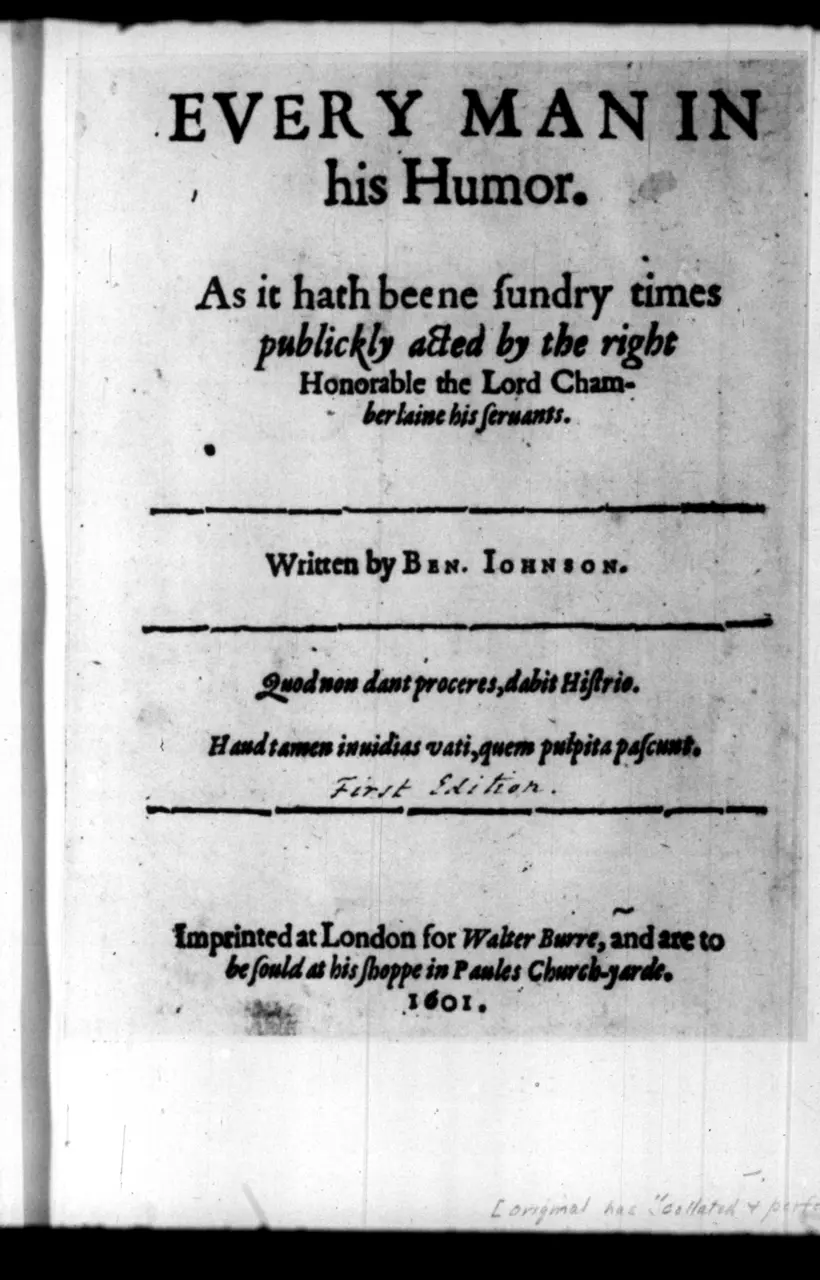
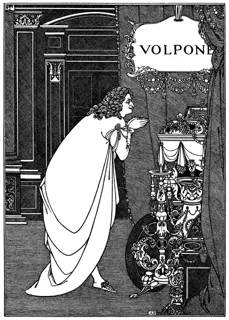
 Volponeby Ben JonsonA rich Venetian pretends to be dying so that greedy would-be heirs will shower him with gifts.
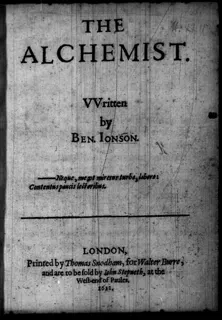 The Alchemistby Ben JonsonThree swindlers turn an empty London house into a business, until its master comes home.
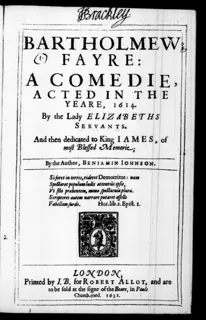 Bartholomew Fairby Ben JonsonAll London goes to the fair, and the fair gets the better of everyone.
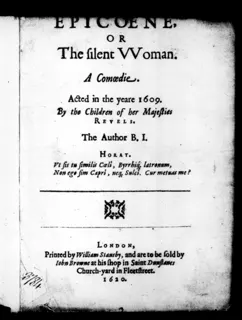 Epicoene, or The Silent Womanby Ben JonsonA man who can't bear noise marries a silent woman.
Prologue
Though need make many poets, and some such
As art and nature have not better'd much;
Yet ours for want hath not so loved the stage,
As he dare serve the ill customs of the age,
Or purchase your delight at such a rate,
As, for it, he himself must justly hate:
To make a child now swaddled, to proceed
Man, and then shoot up, in one beard and weed,
Past threescore years; or, with three rusty swords,
And help of some few foot and half-foot words,
Fight over York and Lancaster's king jars,
And in the tyring-house bring wounds to scars.
He rather prays you will be pleas'd to see
One such to-day, as other plays should be;
Where neither chorus wafts you o'er the seas,
Nor creaking throne comes down the boys to please;
Nor nimble squib is seen to make afeard
The gentlewomen; nor roll'd bullet heard
To say, it thunders; nor tempestuous drum
Rumbles, to tell you when the storm doth come;
But deeds, and language, such as men do use,
And persons, such as comedy would choose,
When she would shew an image of the times,
And sport with human follies, not with crimes.
Except we make them such, by loving still
Our popular errors, when we know they're ill.
I mean such errors as you'll all confess,
By laughing at them, they deserve no less:
Which when you heartily do, there's hope left then,
You, that have so grac'd monsters, may like men.
Act 1, Scene 1
A Street
Enter Knowell, at the door of his house
A goodly day toward, and a fresh morning.--Brainworm!
[Enter Brainworm]
Call up your young master: bid him rise, sir.
Tell him, I have some business to employ him.
I will, sir, presently.
But hear you, sirrah,
If he be at his book, disturb him not.
Very good, sir.
How happy yet should I esteem myself,
Could I, by any practice, wean the boy
From one vain course of study he affects.
He is a scholar, if a man may trust
The liberal voice of fame in her report,
Of good account in both our Universities,
Either of which hath favoured him with graces:
But their indulgence must not spring in me
A fond opinion that he cannot err.
Myself was once a student, and indeed,
Fed with the self-same humour he is now,
Dreaming on nought but idle poetry,
That fruitless and unprofitable art,
Good unto none, but least to the professors;
Which then I thought the mistress of all knowledge:
But since, time and the truth have waked my judgment.
And reason taught me better to distinguish
The vain from the useful learnings.
[Enter Master Stephen]
Cousin Stephen, What news with you, that you are here so early?
Nothing, but e'en come to see how you do, uncle.
That's kindly done; you are welcome, coz.
Ay, I know that, sir; I would not have come else.
How does my cousin Edward, uncle?
O, well, coz; go in and see; I doubt he be scarce stirring yet.
Uncle, afore I go in, can you tell me, an he have e'er a book of the science of hawking and hunting; I would fain borrow it.
Why, I hope you will not a hawking now, will you?
No, wusse; but I'll practise against next year, uncle. I have bought me a hawk, and a hood, and bells and all; I lack nothing but a book to keep it by.
Oh, most ridiculous!
Nay, look you now, you are angry, uncle:--Why, you know an a man have not skill in the hawking and hunting languages now-a-days, I'll not give a rush for him: they are more studied than the Greek, or the Latin. He is for no gallant's company without them; and by gadslid I scorn it, I, so I do, to be a consort for every humdrum: hang them, scroyles! there's nothing in them i' the world. What do you talk on it? Because I dwell at Hogsden, I shall keep company with none but the archers of Finsbury, or the citizens that come a ducking to Islington ponds! A fine jest, i' faith! 'Slid, a gentleman mun shew himself like a gentleman. Uncle, I pray you be not angry; I know what I have to do, I trow. I am no novice.
You are a prodigal, absurd coxcomb, go to!
Nay, never look at me, 'tis I that speak;
Take't as you will, sir, I'll not flatter you.
Have you not yet found means enow to waste
That which your friends have left you, but you must
Go cast away your money on a buzzard,
And know not how to keep it, when you have done?
O, it is comely! this will make you a gentleman!
Well, cousin, well, I see you are e'en past hope
Of all reclaim:---ay, so; now you are told on't,
You look another way.
What would you ha' me do?
What would I have you do? I'll tell you, kinsman;
Learn to be wise, and practise how to thrive;
That would I have you do: and not to spend
Your coin on every bauble that you fancy,
Or every foolish brain that humours you.
I would not have you to invade each place,
Nor thrust yourself on all societies,
Till men's affections, or your own desert,
Should worthily invite you to your rank.
He that is so respectless in his courses,
Oft sells his reputation at cheap market.
Nor would I, you should melt away yourself
In flashing bravery, lest, while you affect
To make a blaze of gentry to the world,
A little puff of scorn extinguish it;
And you be left like an unsavoury snuff,
Whose property is only to offend.
I'd have you sober, and contain yourself,
Not that your sail be bigger than your boat;
But moderate your expenses now, at first,
As you may keep the same proportion still:
Nor stand so much on your gentility,
Which is an airy and mere borrow'd thing,
From dead men's dust and bones; and none of yours,
Except you make, or hold it.
[Enter a Servant]
Who comes here?
Save you, gentlemen!
Nay, we do not stand much on our gentility, friend; yet you are welcome: and I assure you mine uncle here is a man of a thousand a year, Middlesex land. He has but one son in all the world, I am his next heir, at the common law, master Stephen, as simple as I stand here, if my cousin die, as there's hope he will: I have a pretty living O' mine own too, beside, hard by here.
In good time, sir.
In good time, sir! why, and in very good time, sir! You do not flout, friend, do you?
Not I, sir.
Not you, sir! you were best not, sir; an you should; here be them can perceive it, and that quickly too; go to: and they can give it again soundly too, an need be.
Why, sir, let this satisfy you; good faith, I had no such intent.
Sir, an I thought you had, I would talk with you, and that presently.
Good master Stephen, so you may, sir, at your pleasure.
And so I would, sir, good my saucy companion! an you were out O' mine uncle's ground, I can tell you; though I do not stand upon my gentility neither, in't.
Cousin, cousin, will this ne'er be left?
Whoreson, basefellow! a mechanical serving-man! By this cudgel, an 'twere not for shame, I would--
What would you do, you peremptory gull?
If you cannot be quiet, get you hence.
You see the honest man demeans himself
Modestly tow'rds you, giving no reply
To your unseason'd, quarrelling, rude fashion;
And still you huff it, with a kind of carriage
As void of wit, as of humanity.
Go, get you in; 'fore heaven, I am ashamed
Thou hast a kinsman's interest in me.
[Exit Master Stephen]
I pray, sir, is this master Knowell's house?
Yes, marry is it, sir.
I should inquire for a gentleman here, one master Edward Knowell; do you know any such, sir, I pray you?
I should forget myself else, sir.
Are you the gentleman? cry you mercy, sir: I was required by a gentleman in the city, as I rode out at this end o' the town, to deliver you this letter, sir.
To me, sir! What do you mean? pray you remember your court'sy. [Reads] To his most selected friend, master Edward Knowell. What might the gentleman's name be, sir, that sent it? Nay, pray you be covered.
One master Wellbred, sir.
Master Wellbred! a young gentleman, is he not?
The same, sir; master Kitely married his sister; the rich merchant in the Old Jewry.
You say very true.---Brainworm! [Enter Brainworm]
[Enter Brainworm]
Sir.
Make this honest friend drink here: pray you, go in.
[Exeunt Brainworm and Servant]
This letter is directed to my son;
Yet I am Edward Knowell too, and may,
With the safe conscience of good manners, use
The fellow's error to my satisfaction.
Well, I will break it ope [old men are curious],
Be it but for the style's sake and the phrase;
To see if both do answer my son's praises,
Who is almost grown the idolater
Of this young Wellbred. What have we here?
What's this? [Reads]
Why, Ned, I beseech thee, hast thou forsworn all thy friends in the Old Jewry? or dost thou think us all Jews that inhabit there? yet, if thou dost, come over, and but see our frippery; change an old shirt for a whole smock with us: do not conceive that antipathy between us and Hogsden, as was between Jews and hogs-flesh. Leave thy vigilant father alone, to number over his green apricots, evening and morning, on the north-west wall: an I had been his son, I had saved him the labour long since, if taking in all the young wenches that pass by at the back-door, and codling every kernel of the fruit for them, would have served, But, pr'ythee, come over to me quickly this morning; I have such a present for thee!--our Turkey company never sent the like to the Grand Signior. One is a rhymer, sir, of your own batch, your own leaven; but doth think himself poet-major of the town, willing to be shewn, and worthy to be seen. The other--I will not venture his description with you, till you come, because I would have you make hither with an appetite. If the worst of 'em be not worth your journey draw your bill of charges, as unconscionable as any Guildhall verdict will give it you, and you shall be allowed your viaticum. From the Windmill.
From the Bordello it might come as well,
The Spittle, or Pict-hatch. Is this the man
My son hath sung so, for the happiest wit,
The choicest brain, the times have sent us forth!
I know not what he may be in the arts,
Nor what in schools; but, surely, for his manners,
I judge him a profane and dissolute wretch;
Worse by possession of such great good gifts,
Being the master of so loose a spirit.
Why, what unhallowed ruffian would have writ
In such a scurrilous manner to a friend!
Why should he think I tell my apricots,
Or play the Hesperian dragon with my fruit,
To watch it? Well, my son, I had thought you
Had had more judgment to have made election
Of your companions, than t' have ta'en on trust
Such petulant, jeering gamesters, that can spare
No argument or subject from their jest.
But I perceive affection makes a fool
Of any man too much the father.---Brainworm!
Enter Brainworm
Sir.
Is the fellow gone that brought this letter?
Yea, sir, a pretty while since.
And where is your young master?
In his chamber, sir.
He spake not with the fellow, did he?
No, sir, he saw him not.
Take you this letter, and deliver it my son; but with no notice that I have opened it, on your life.
O Lord, sir! that were a jest indeed. [Exit]
[Exit]
I am resolved I will not stop his journey,
Nor practise any violent means to stay
The unbridled course of youth in him; for that
Restrain'd, grows more impatient; and in kind
Like to the eager, but the generous greyhound,
Who ne'er so little from his game withheld,
Turns head, and leaps up at his holder's throat.
There is a way of winning more by love,
And urging of tho modesty, than fear:
Force works on servile natures, not the free.
He that's compell'd to goodness may be good,
But 'tis but for that fit; where others, drawn
By softness and example, get a habit.
Then, if they stray, but warn them, and the same
They should for virtue have done, they'll do for shame. [Exit]
Act 1, Scene 2
A Room in Knowell's House
Enter E. Knowell, with a letter in his hand, followed by Brainworm
Did he open it, say'st thou?
Yes, O' my word, sir, and read the contents.
That scarce contents me. What countenance, prithee, made he in the reading of it? was he angry, or pleased?
Nay, sir, I saw him not read it, nor open it, I assure your worship.
No! how know'st thou then that he did either?
Marry, sir, because he charged me, on my life, to tell nobody that he open'd it; which, unless he had done, he would never fear to have it revealed.
That's true: well, I thank thee, Brainworm.
Enter Stephen
O, Brainworm, didst thou not see a fellow here in what-sha-call-him doublet? he brought mine uncle a letter e'en now.
Yes, master Stephen; what of him?
O, I have such a mind to beat him--where is he, canst thou tell?
Faith, he is not of that mind: he is gone, master Stephen.
Gone! which way? when went he? how long since?
He is rid hence; he took horse at the street-door.
And I staid in the fields! Whoreson scanderbag rogue! O that I had but a horse to fetch him back again!
Why, you may have my master's gelding, to save your longing, sir.
But I have no boots, that's the spite on't.
Why, a fine wisp of hay, roll'd hard, master Stephen.
No, faith, it's no boot to follow him now: let him e'en go and hang. Prithee, help to truss me a little: he does so vex me--
You'll be worse vexed when you are trussed, master Stephen. Best keep unbraced, and walk yourself till you be cold; your choler may founder you else.
By my faith, and so I will, now thou tell'st me on't: how dost thou like my leg, Brainworm?
A very good leg, master Stephen; but the woollen stocking does not commend it so well.
Foh! the stockings be good enough, now summer is coming on, for the dust: I'll have a pair of silk against winter, that I go to dwell in the town. I think my leg would shew in a silk hose--
Believe me, master Stephen, rarely well.
In sadness, I think it would: I have a reasonable good leg.
You have an excellent good leg, master Stephen; but I can not stay to praise it longer now, and I am very sorry for it.
Exit
Another time will serve, Brainworm. Gramercy for this.
Ha, ha, ha.
'Slid, I hope he laughs not at me; an he do--
Here was a letter indeed, to be intercepted by a man's father, and do him good with him! He cannot but think most virtuously, both of me, and the sender, sure, that make the careful costermonger of him in our familiar epistles. Well, if he read this with patience I'll be gelt, and troll ballads for master John Trundle yonder, the rest of my mortality. It is true, and likely, my father may have as much patience as another man, for he takes much physic; and oft taking physic makes a man very patient. But would your packet, master Wellbred, had arrived at him in such a minute of his patience! then we had known the end of it, which now is doubtful, and threatens--[Sees Master Stephen] What, my wise cousin! nay, then I'll furnish our feast with one gull more toward the mess. He writes to me of a brace, and here's one, that's three: oh, for a fourth, Fortune, if ever thou' It use thine eyes, I entreat thee--
Oh, now I see who he laughed at: he laughed at somebody in that letter. By this good light, an he had laughed at me--
How now, cousin Stephen, melancholy?
Yes, a little: I thought you had laughed at me, cousin.
Why, what an I had, coz? what would you have done?
By this light, I would have told mine uncle.
Nay, if you would have told your uncle, I did laugh at you, coz.
Did you, indeed?
Yes, indeed.
Why then
What then?
I am satisfied; it is sufficient.
Why, be so, gentle coz: and, I pray you, let me entreat a courtesy of you. I am sent for this morning by a friend in the Old Jewry, to come to him; it is but crossing over the fields to Moorgate: Will you bear me company? I protest it is not to draw you into bond or any plot against the state, coz.
Sir, that's all one an it were; you shall command me twice so far as Moorgate, to do you good in such a matter. Do you think I would leave you? I protest--
No, no, you shall not protest, coz.
By my fackings, but I will, by your leave:--I'll protest more to my friend, than I'll speak of at this time.
You speak very well, coz.
Nay, not so neither, you shall pardon me: but I speak to serve my turn.
Your turn, coz! do you know what you say? A gentleman of your sorts, parts, carriage, and estimation, to talk of your turn in this company, and to me alone, like a tankard-bearer at a conduit! fie! A wight that, hitherto, his every step hath left the stamp of a great foot behind him, as every word the savour of a strong spirit, and he! this man! so graced, gilded, or, to use a more fit metaphor, so tenfold by nature, as not ten housewives' pewter, again a good time, shews more bright to the world than he! and he! [as I said last, so I say again, and still shall say it] this man! to conceal such real ornaments as these, and shadow their glory, as a milliner's wife does her wrought stomacher, with a smoaky lawn, or a black cyprus! O, coz! it cannot be answered; go not about it: Drake's old ship at Deptford may sooner circle the world again. Come, wrong not the quality of your desert, with looking downward, coz; but hold up your head, so: and let the idea of what you are be portrayed in your face, that men may read in your physnomy, here within this place is to be seen the true, rare, and accomplished monster, or miracle of nature, which is all one. What think you of this, coz?
Why, I do think of it: and I will be more proud, and melancholy, and gentlemanlike, than I have been, I'll insure you.
Why, that's resolute, master Stephen!--Now, if I can but hold him up to his height, as it is happily begun, it will do well for a suburb humour: we may hap have a match with the city, and play him for forty pound.--Come, coz.
I'll follow you.
Follow me! you must go before.
Nay, an I must, I will. Pray you shew me, good cousin.
Exeunt
Act 1, Scene 3
The Lane before Cob's House
Enter Master Mathew
I think this be the house: what ho!
Enter Cob
Who's there? O, master Mathew! give your worship good morrow.
What, Cob! how dost thou, good Cob? dost thou inhabit here, Cob?
Ay, sir, I and my lineage have kept a poor house here, in our days.
Thy lineage, monsieur Cob! what lineage, what lineage?
Why, sir, an ancient lineage, and a princely. Mine ance'try came from a king's belly, no worse man; and yet no man either, by your worship's leave, I did lie in that, but herring, the king of fish [from his belly I proceed], one of the monarchs of the world, I assure you. The first red herring that was broiled in Adam and Eve's kitchen, do I fetch my pedigree from, by the harrot's book. His cob was my great, great, mighty great grandfather.
Why mighty, why mighty, I pray thee?
O, it was a mighty while ago, sir, and a mighty great cob.
How know'st thou that?
How know I! why, I smell his ghost ever and anon.
Smell a ghost! O unsavoury jest! and the ghost of a herring cob?
Ay, sir: With favour of your worship's nose, master Mathew, why not the ghost of a herring cob, as well as the ghost of Rasher Bacon?
Roger Bacon, thou would'st say.
I say Rasher Bacon. They were both broiled on the coals; and a man may smell broiled meat, I hope! you are a scholar, upsolve me that now.
O raw ignorance!--Cob, canst thou shew me of a gentleman, one captain Bobadill, where his lodging is?
O, my guest, sir, you mean.
Thy guest! alas, ha, ha, ha!
Why do you laugh, sir? do you not mean captain Bobadill?
Cob, pray thee advise thyself well; do not wrong the gentleman, and thyself too. I dare be sworn, he scorns thy house; he! he lodge in such a base obscure place as thy house! Tut, I know his disposition so well, he would not lie in thy bed if thou'dst give it him.
I will not give it him though, sir. Mass, I thought somewhat was in it, we could not get him to bed all night: Well, sir, though he lie not on my bed, he lies on my bench: an't please you to go up, sir, you shall find him with two cushions under his head, and his cloak wrapped about him, as though he had neither won nor lost, and yet, I warrant, he ne'er cast better in his life, than he has done to-night.
Why, was he drunk?
Drunk, sir! you hear not me say so: perhaps he swallowed a tavern-token, or some such device, sir, I have nothing to do withal. I deal with water and not with wine--Give me my tankard there, ho!--God be wi' you, sir. It's six o'clock: I should have carried two turns by this. What ho! my stopple! come.
Enter Tib with a water-tankard
Lie in a water-bearer's house! a gentleman of his havings! Well, I'll tell him my mind.
What, Tib; shew this gentleman up to the captain.[Exit Tib with Master Mathew] Oh, an my house were the Brazen-head now! faith it would e'en speak Moe fools yet. You should have some now would take this master Mathew to be a gentleman, at the least. His father's an honest man, a worshipful fishmonger, and so forth; and now does he creep and wriggle into acquaintance with all the brave gallants about the town, such as my guest is [O, my guest is a fine man!], and they flout him invincibly. He useth every day to a merchant's house where I serve water, one master Kitely's, in the Old Jewry; and here's the jest, he is in love with my master's sister, Mrs. Bridget, and calls her mistress; and there he will sit you a whole afternoon sometimes, reading of these same abominable, vile [a pox on 'em! I cannot abide them], rascally verses, poetrie, poetrie, and speaking of interludes; 'twill make a man burst to hear him. And the wenches, they do so jeer, and ti-he at him--Well, should they do so much to me, I'd forswear them all, by the foot of Pharaoh! There's an oath! How many water-bearers shall you hear swear such an oath? O, I have a guest--he teaches me-he does swear the legiblest of any man christened: By St. George! the foot of Pharaoh! the body of me! as I am a gentleman and a soldier! such dainty oaths! and withal he does take this same filthy roguish tobacco, the finest and cleanliest! it would do a man good to see the fumes come forth at's tonnels.--Well, he owes me forty shillings, my wife lent him out of her purse, by sixpence at a time, besides his lodging: I would I had it! I shall have it, he says, the next action. Helterskelter, hang sorrow, care'll kill a cat, up-tails all, and a louse for the hangman.
Exit
Act 1, Scene 4
A Room in Cob's House
Bobadill discovered lying on a bench
Hostess, hostess!
Enter Tib
What say you, sir?
A cup of thy small beer, sweet hostess.
Sir, there's a gentleman below would speak with you.
A gentleman! 'odso, I am not within.
My husband told him you were, sir.
What a plague-what meant he?
[below] Captain Bobadill!
Who's there!-Take away the bason, good hostess;--Come up, sir.
He would desire you to come up, cleanly house, here!
Enter Mathew
Save you, sir; save you, captain!
Gentle master Mathew! Is it you, sir? down.
Thank you, good captain; you may see I am somewhat audacious.
Not so, sir. I was requested to supper last night by a sort of gallants, where you were wished for, and drunk to, I assure you.
Vouchsafe me, by whom, good captain?
Marry, by young Wellbred, and others.--Why, hostess, stool here for this gentleman.
No haste, sir, 'tis very well.
Body O' me! it was so late ere we parted last night, I can scarce open my eyes yet; I was but new risen, as you came; how passes the day abroad, sir? you can tell.
Faith, some half hour to seven; Now, trust me, you have an exceeding fine lodging here, very neat, and private.
Ay, sir: sit down, I pray you. Master Mathew, in any case possess no gentlemen of our acquaintance with notice of my lodging.
Who? I, sir; no.
Not that I need to care who know it, for the cabin is convenient; but in regard I would not be too popular, and generally visited, as some are.
True, captain, I conceive you.
For, do you see, sir, by the heart of valour in me, except it be to some peculiar and choice spirits, to whom I am extraordinarily engaged, as yourself, or so, I could not extend thus far.
O Lord, sir! I resolve so.
I confess I love a cleanly and quiet privacy, above all the tumult and roar of fortune. What new book have you there? What! Go by, Hieronymo?
Ay: did you ever see it acted? Is't not well penned?
While Master Mathew reads, Bobadill makes himself ready
Well penned! I would fain see all the poets of these times pen such another play as that was: they'll prate and swagger, and keep a stir of art and devices, when, as I am a gentleman, read 'em, they are the most shallow, pitiful, barren fellows, that live upon the: face of the earth again.
Indeed here are a number of fine speeches in this book. O eyes, no eyes, but fountains fraught with tears! there's a conceit! fountains fraught with tears! O life, no life, but lively form of death! another. O world, no world, but mass of public wrongs! a third. Confused and fill'd with murder and misdeeds! a fourth. O, the muses! Is't not excellent? Is't not simply the best that ever you heard, captain? Ha! how do you like it?
'Tis good.
To thee, the purest object to my sense,
The most refined essence heaven covers,
Send I these lines, wherein I do commence
The happy state of turtle-billing lovers.
If they prove rough, unpolish'd, harsh, and rude,
Haste made the waste: thus mildly I conclude.
Nay, proceed, proceed. Where's this?
This, sir! a toy of mine own, in my non-age; the infancy of my muses. But when will you come and see my study? good faith, I can shew you some very good things I have done of late.--That boot becomes your leg passing well, captain, methinks.
So, so; it's the fashion gentlemen now use.
Troth, captain, and now you speak of the fashion, master Wellbred's elder brother and I are fallen out exceedingly: This other day, I happened to enter into some discourse of a hanger, which, I assure you, both for fashion and workmanship, was most peremptory beautiful and gentlemanlike: yet he condemned, and cried it down for the most pied and ridiculous that ever he saw.
Squire Downright, the half brother, was't not?
Ay, sir, he.
Hang him, rook! he! why he-has no more judgment than a malt horse: By St. George, I wonder you'd lose a thought upon such an animal; the most peremptory absurd clown of Christendom, this day, he is holden. I protest to you, as I am a gentleman and a soldier, I ne'er changed with his like. By his discourse, he should eat nothing but hay; he was born for the manger, pannier, or pack-saddle. He has not so much as a good phrase in his belly, but all old iron and rusty proverbs: a good commodity for some smith to make hob-nails of.
Ay, and he thinks to carry it away with his manhood still, where he comes: he brags he will give me the bastinado, as I hear.
How! he the bastinado! how came he by that word, trow?
Nay, indeed, he said cudgel me; I termed it so, for my more grace.
That may be: for I was sure it was none of his word; but when, when said he so?
Faith, yesterday, they say; a young gallant, a friend of mine, told me so.
By the foot of Pharaoh, an 'twere my case now, I should send him a chartel presently. The bastinado! a most proper and sufficient dependence, warranted by the great Caranza. Come hither, you shall chartel him; I'll shew you a trick or two you shall kill him with at pleasure; the first stoccata, if you will, by this air.
Indeed, you have absolute knowledge in the mystery, I have heard, sir.
Of whom, of whom, have you heard it, I beseech you?
Troth, I have heard it spoken of divers, that you have very rare, and un-in-one-breath-utterable skill, sir.
By heaven, no, not I; no skill in the earth; some small rudiments in the science, as to know my time, distance, or so. I have professed it more for noblemen and gentlemen's use, than mine own practice, I assure you.--Hostess, accommodate us with another bed-staff here quickly. Lend us another bed-staff--the woman does not understand the words of action.--Look you, sir: exalt not your point above this state, at any hand, and let your poniard maintain your defence, thus:--give it the gentleman, and leave us. [Exit Tib] So, sir. Come on: O, twine your body more about, that you may fall to a more sweet, comely, gentlemanlike guard; so! indifferent: hollow your body more, sir, thus: now, stand fast O' your left leg, note your distance, keep your due proportion of time--oh, you disorder your point most i rregularly.
How is the bearing of it now, sir?
O, out of measure ill: a well-experienced hand would pass upon you at pleasure.
How mean you, sir, pass upon me?
Why, thus, sir,--make a thrust at me--[Master Mathew pushes at Bobadill] come in upon the answer, control your point, and make a full career at the body: The best-practised gallants of the time name it the passado; a most desperate thrust, believe it.
Well, come, sir.
Why, you do not manage your weapon with any facility or grace to invite me. I have no spirit to play with you; your dearth of judgment renders you tedious.
But one venue, sir.
Venue! fie; the most gross denomination as ever I heard: O, the stoccata, while you live, sir; note that.--Come, put on your cloke, and we'll go to some private place where you are acquainted; some tavern, or so--and have a bit. I'll send for one of these fencers, and he shall breathe you, by my direction; and then I will teach you your trick: you shall kill him with it at the first, if you please. Why, I will learn you, by the true judgment of the eye, hand, and foot, to control any enemy's point in the world. Should your adversary confront you with a pistol, 'twere nothing, by this hand! you should, by the same rule, control his bullet, in a line, except it were hail shot, and spread. What money have you about you, master Mathew?
Faith, I have not past a two shilling or so.
'Tis somewhat with the least; but come; we will have a bunch of radish and salt to taste our wine, and a pipe of tobacco to close the orifice of the stomach: and then we'll call upon young Wellbred: perhaps we shall meet the Corydon his brother there, and put him to the question.
Act 2, Scene 1
The Old Jewry. A Hall in Kitely's House
Enter Kitely, Cash, and Downright
Thomas, come hither.
There lies a note within upon my desk;
Here take my key: it is no matter neither.---
Where is the boy?
Within, sir, in the warehouse.
Let him tell over straight that Spanish gold,
And weigh it, with the pieces of eight. Do you
See the delivery of those silver stuffs
To Master Lucar: tell him, if he will,
He shall have the grograns, at the rate I told him,
And I. will meet him on the Exchange anon.
Good, sir. [Exit]
[Exit]
Do you see that fellow, brother Downright?
Ay, what of him?
He is a jewel, brother.
I took him of a child up at my door,
And christen'd him, gave him mine own name, Thomas:
Since bred him at the Hospital; where proving
A toward imp, I call'd him home, and taught him
So much, as I have made him my cashier,
And giv'n him, who had none, a surname, Cash:
And find him in his place so full of faith,
That I durst trust my life into his hands.
So would not I in any bastard's, brother,
As it is like he is, although I knew
Myself his father. But you said you had somewhat
To tell me, gentle brother: what is't, what is't?
Faith, I am very loath to utter it,
As fearing it may hurt your patience:
But that I know your judgment is of strength,
Against the nearness of affection---
What need this circumstance? pray you, be direct.
I will not say how much I do ascribe
Unto your friendship, nor in what regard
I hold your love; but let my past behaviour,
And usage of your sister, [both] confirm
How well I have been affected to your---
You are too tedious; come to the matter, the matter.
Then, without further ceremony, thus.
My brother Wellbred, sir, I know not how,
Of late is much declined in what he was,
And greatly alter'd in his disposition.
When he came first to lodge here in my house,
Ne'er trust me if I were not proud of him:
Methought he bare himself in such a fashion,
So full of man, and sweetness in his carriage,
And what was chief, it shew'd not borrow'd in him,
But all he did became him as his own,
And seem'd as perfect, proper, and possest,
As breath with life, or colour with the blood.
But now, his course is so irregular,
So loose, affected, and deprived of grace,
And he himself withal so far fallen off
From that first place, as scarce no note remains,
To tell men's judgments where he lately stood.
He's grown a stranger to all due respect,
Forgetful of his friends; and not content
To stale himself in all societies,
He makes my house here common as a mart,
A theatre, a public receptacle
For giddy humour, and deceased riot;
And here, as in a tavern or a stews,
He and his wild associates spend their hours,
In repetition of lascivious jests,
Swear, leap, drink, dance, and revel night by night,
Control my servants; and, indeed, what not?
'Sdeins, I know not what I should say to him, in the whole world! He values me at a crack'd three-farthings, for aught I see. It will never out of the flesh that's bred in the bone. I have told him enough, one would think, if that would serve; but counsel to him is as good as a shoulder of mutton to a sick horse. Well! he knows what to trust to, for George: let him spend, and spend, and domineer, till his heart ake; an he think to be relieved by me, when he is got into one O' your city pounds, the counters, he has the wrong sow by the ear, i'faith; and claps his dish at the wrong man's door: I'll lay my hand on my halfpenny, ere I part with it to fetch him out, I'll assure him.'
Nay, good brother, let it not trouble you thus.
'Sdeath! he mads me; I could eat my very spur leathers for anger! But, why are you so tame? why do you not speak to him, and tell him how he disquiets your house?
O, there are divers reasons to dissuade me.
But, would yourself vouchsafe to travail in it
[Though but with plain and easy circumstance],
It would both come much better to his sense,
And savour less of stomach, or of passion.
You are his elder brother, and that title
Both gives and warrants your authority,
Which, by your presence seconded, must breed
A kind of duty in him, and regard:
Whereas, if I should intimate the least,
It would but add contempt to his neglect,
Heap worse on ill, make up a pile of hatred,
That in the rearing would come tottering down,
And in the ruin bury all our love.
Nay, more than this, brother; if I should speak,
He would be ready, from his heat of humour,
And overflowing of the vapour in him,
To blow the ears of his familiars
With the false breath of telling what disgraces,
And low disparagement's, I had put upon him.
Whilst they, sir, to relieve him in the fable,
Make their loose comments upon every word,
Gesture, or look, I use; mock me all over,
From my flat cap unto my shining shoes;
And, out of their impetuous rioting phant'sies,
Beget some slander that shall dwell with me.
And what would that be, think you? marry, this:
They would give out, because my wife is fair,
Myself but lately married; and my sister '.
Here sojourning a virgin in my house,
That I were jealous I---nay, as sure as death,
That they would say: and, how that I had quarrell'd,
My brother purposely, thereby to find
An apt pretext to banish them my house.
Mass, perhaps so; they're like enough to do it.
Brother, they would, believe it; so should I,
Like one of these penurious quack-salvers,
But set the bills up to mine own disgrace,
And try experiments upon myself;
Lend scorn and envy opportunity
To stab my reputation and good name--
Enter Master Mathew struggling with Bobadill
I will speak to him.
Speak to him! away! By the foot of Pharaoh, you shall not! you shall not do him that grace.--The time of day to you, gentleman o' the house. Is master Wellbred stirring?
How then? what should he do?
Gentleman of the house, it is to you: is he within, sir?
He came not to his lodging to-night, sir, I assure you.
Why, do you hear? you!
The gentleman citizen hath satisfied me;
I'll talk to no scavenger.
[Exeunt Bobadill and Mathew]
How! scavenger! stay, sir, stay!
Nay, brother Downright.
'Heart! stand you away, an you love me.
You shall not follow him now, I pray you, brother, good faith you shall not; I will overrule you.
Ha! scavenger! well, go to, I say little: but, by this good day [God forgive me I should swear], if I put it up so, say I am the rankest cow that ever pist. 'Sdeins, an I swallow this, I'll ne'er draw my sword in the sight of Fleet-street again while I live; I'll sit in a barn with madge-howlet, and catch mice first. Scavenger! heart!--and I'll go near to fill that huge tumbrel-slop of yours with somewhat, an I have good luck: your Garagantua breech cannot carry it away so.
Oh, do not fret yourself thus: never think on't.
These are my brother's consorts, these! these are his camerades, his walking mates! he's a gallant, cavaliero too, right hangman cut! Let me not live, an I could not find in my heart to swinge the whole gang of 'em, one after another, and begin with him first. I am grieved it should be said he is my brother, and take these courses: Well, as he brews, so shall he drink, for George, again. Yet he shall hear on't, and that tightly too, an I live, i'faith.
But, brother, let your reprehension, then,
Run in an easy current, not o'er high
Carried with rashness, or devouring choler;
But rather use the soft persuading way,
Whose powers will work more gently, and compose
The imperfect thoughts you labour to reclaim;
More winning, than enforcing the consent.
Ay, ay, let me alone for that, I warrant you.
How now! [Bell rings] Oh, the bell rings to breakfast.
Brother, I pray you go in, and bear my wife company till I come;
I'll but give order for some despatch of business to my servants.
Exit Downright. Enter Cob, with his tankard
What, Cob! our maids will have you by the back, i'faith, for coming so late this morning.
Perhaps so, sir; take heed somebody have not them by the belly, for walking so late in the evening.
[Exit]
Well; yet my troubled spirit's somewhat eased,
Though not reposed in that security
As I could wish: but I must be content,
Howe'er I set a face on't to the world.
Would I had lost this finger at a venture,
So Wellbred had ne'er lodged within my house.
Why't cannot be, where there is such resort
Of wanton gallants, and young revellers,
That any woman should be honest long.
Is't like, that factious beauty will preserve
The public weal of chastity unshaken,
When such strong motives muster, and make head
Against her single peace? No, no: beware.
When mutual appetite doth meet to treat,
And spirits of one kind and quality
Come once to parley in the pride of blood,
It is no slow conspiracy that follows.
Well, to be plain, if I but thought the time
Had answer'd their affections, all the world
Should not persuade me but I were a cuckold.
Marry, I hope they have not got that start;
For opportunity hath balk'd them yet,
And shall do still, while I have eyes and ears
To attend the impositions of my heart.
My presence shall be as an iron bar,
'Twixt the conspiring motions of desire:
Yea, every look or glance mine eye ejects
Shall check occasion, as one doth his slave,
When he forgets the limits of prescription.
Enter Dame Kitely and Bridget
Sister Bridget, pray you fetch down the rose-water, above in the closet.---
[Exit Bridget]
Sweet-heart, will you come in to breakfast?
An she have overheard me now!---
I pray thee, good muss, we stay for you.
By heaven, I would not for a thousand angels.
What ail you, sweet-heart? are you not well? speak, good muss.
Troth my head akes extremely on a sudden.
[putting her hand to his forehead] O, the Lord!
How now! What?
Alas, how it burns! Muss, keep you warm; good truth it is this new disease. There's a number are troubled withal. For love's sake, sweetheart, come in, out of the air.
How simple, and how subtle are her answers!
A new disease, and many troubled with it?
Why true; she heard me, all the world to nothing.
I pray thee, good sweet-heart, come in; the air will do you harm, in troth.
The air! she has me in the wind.--Sweet-heart, I'll come to you presently; 'twill away, I hope.
Pray Heaven it do. [Exit]
[Exit]
A new disease! I. know not, new or old,
But it may well be call'd poor mortals' plague;
For, like a pestilence, it doth infect
The houses of the brain. First it begins
Solely to work upon the phantasy,
Filling her seat with such pestiferous air,
As soon corrupts the judgment; and from thence,
Sends like contagion to the memory:
Still each to other giving the infection.
Which as a subtle vapour spreads itself
Confusedly through every sensive part,
Till not a thought or motion in the mind
Be free from the black poison of suspect.
Ah! but what misery is it to know this?
Or, knowing it, to want the mind's erection
In such extremes? Well, I will once more strive,
In spite of this black cloud, myself to be,
And shake the fever off that thus shakes me.
[Exit]
Act 2, Scene 2
Moorfields
Enter Brainworm disguised like a maimed Soldier
'Slid, I cannot choose but laugh to see myself translated thus, from a poor creature to a creator; for now must I create an intolerable sort of lies, or my present profession loses the grace: and yet the lie, to a man of my coat, is as ominous a fruit as the fico. O, sir, it holds for good polity ever, to have that outwardly in vilest estimation, that inwardly is most dear to us: so much for my borrowed shape. Well, the troth is, my old master intends to follow my young master, dry-foot, over Moorfields to London, this morning; now, I knowing of this hunting-match, or rather conspiracy, and to insinuate with my young master [for so must we that are blue waiters, and men of hope and service do, or perhaps we may wear motley at the year's end, and who wears motley, you know], have got me afore in this disguise, determining here to lie in ambuscado, and intercept him in the mid-way. If I can but get his cloke, his purse, and his hat, nay, any thing to cut him off, that is, to stay his journey, Veni, vidi, vici, I may say with captain Caesar, I am made for ever, i'faith. Well, now I must practise to get the true garb of one of these lance-knights, my arm here, and my--Odso! my young master, and his cousin, master Stephen, as I am true counterfeit man of war, and no soldier!
Enter E. Knowell and Stephen
So, sir! and how then, coz?
'Sfoot! I have lost my purse, I think.
How! lost your purse? where? when had you it?
I cannot tell; stay.
'Slid, I am afraid they will know me: would I could get by them!
What, have you it?
No; I think I was bewitched, I-- [Cries]
[Cries]
Nay, do not weep the loss: hang it, let it go.
Oh, it's here: No, an it had been lost, I had not cared, but for a jet ring mistress Mary sent me.
A jet ring! O the poesie, the poesie?
Fine, i'faith.
Though Fancy sleep,
My love is deep.
Meaning, that though I did not fancy her, yet she loved me dearly.
Most excellent!
And then I sent her another, and my poesie was,
The deeper the sweeter,
I'll be judg'd by St. Peter.
How, by St. Peter? I do not conceive that.
Marry, St. Peter, to make up the metre.
Well, there the saint was your good patron, he help'd you at your need; thank him, thank him.
I cannot take leave on 'em so; I will venture, come what will. [Comes forward] Gentlemen, please you change a few crowns for a very excellent blade here? I am a poor gentleman, a soldier, one that, in the better state of my fortunes, scorned so mean a refuge; but now it is the humour of necessity to have it so. You seem to be gentlemen well affected to martial men, else I should rather die with silence, than live with shame: however, vouchsafe to remember it is my want speaks, not myself; this condition agrees not with my spirit--
Where hast thou served?
May it please you, sir, in all the late wars of Bohemia, Hungary, Dalmatia, Poland, where not, sir? I have been a poor servitor by sea and land any time this fourteen years, and followed the fortunes of the best commanders in Christendom. I was twice, shot at the taking of Aleppo, once at the relief of Vienna; I have been at Marseilles, Naples, and the Adriatic gulf, a gentleman-slave in the gallies, thrice; where I was most dangerously shot in the head, through both the thighs; and yet, being thus maimed, I am void of maintenance, nothing left me but my scars, the noted marks of my resolution.
How will you sell this rapier, friend?
Generous sir, I refer it to your own judgment; you are a gentleman, give me what you please.
True, I am a gentleman, I know that, friend; but what though! I pray you say, what would you ask?
I assure you, the blade may become the side or thigh of the best prince in Europe.
Ay, with a velvet scabbard, I think.
Nay, an't be mine, it shall have a velvet scapbard, coz, that's flat; I'd not wear it, as it is, an you would give me an angel,
At your worship's pleasure, sir; nay, 'tis a most pure Toledo.
I had rather it were a Spaniard. But tell me, what shall I give you for it? An it had a silver hilt
Come, come, you shall not buy it: hold, there's a shilling, fellow; take thy rapier.
Why, but I will buy it now, because you say so; and there's another shilling, fellow; I scorn to be out-bidden. What, shall I walk with a cudgel, like Higginbottom, and may have a rapier for money.
You may buy one in the city.
Tut! I'll buy this i' the field, so I will: I have a mind to't, because 'tis a field rapier. Tell me your lowest price.
You shall not buy it, I say.
By this money, but I will, though I give more than 'tis worth.
Come away, you are a fool.
Friend, I am a fool, that's granted; but I'll have it, for that word's sake. Follow me for your money.
At your service, sir.
Exeunt
Act 2, Scene 3
Another Part of Moorfields
Enter Knowell
I cannot lose the thought yet of this letter,
Sent to my son; nor leave t' admire the change
Of manners, and the breeding of our youth
Within the kingdom, since myself was one---
When I was young, he lived not in the stews
Durst have conceived a scorn, and utter'd it,
On a gray head; age was authority
Against a buffoon, and a man had then
A certain reverence paid unto his years,
That had none due unto his life: so much
The sanctity of some prevail'd for others.
But now we all are fallen; youth, from their fear,
And age, from that which bred it, good example.
Nay, would ourselves were not the first, even parents,
That did destroy the hopes in our own children;
Or they not learn'd our vices in their cradles,
And suck'd in our ill customs with their milk;
Ere all their teeth be born, or they can speak,
We make their palates cunning; the first words
We form their tongues with, are licentious jests:
Can it call whore? cry bastard? O, then, kiss it!
A witty child! can't swear? the father's darling!
Give it two plums. Nay, rather than't shall learn
No bawdy song, the mother herself will teach it!---
But this is in the infancy, the days
Of the long coat; when it puts on the breeches,
It will put off all this: Ay, it is like,
When it is gone into the bone already!
No, no; this dye goes deeper than the coat,
Or shirt, or skin; it stains into the liver,
And heart, in some; and, rather than it should not,
Note what we fathers do! look how we live!
What mistresses we keep! at what expense,
In our sons' eyes! where they may handle our gifts,
Hear our lascivious courtships, see our dalliance,
Taste of the same provoking meats with us,
To ruin of our states! Nay, when our own
Portion is fled, to prey on the remainder,
We call them into fellowship of vice;
Bait 'em with the young chamber-maid, to seal,
And teach 'em all bad ways to buy affliction.
This is one path: but there are millions more,
In which we spoil our own, with leading them.
Well, I thank heaven, I never yet was he
That travell'd with my son, before sixteen,
To shew him the Venetian courtezans;
Nor read the grammar of cheating I had made,
To my sharp boy, at twelve; repeating still
The rule, Get money; still, get money, boy;
No matter by what means; money will do
More, boy, than my lord's letter. Neither have I
Drest snails or mushrooms curiously before him,
Perfumed my sauces, and taught him how to make them;
Preceding still, with my gray gluttony,
At all the ord'naries, and only fear'd
His palate should degenerate, not his manners.
These are the trade of fathers now; however,
My son, I hope, hath met within my threshold
None of these household precedents, which are strong,
And swift, to rape youth to their precipice.
But let the house at home be ne'er so clean
Swept, or kept sweet from filth, nay dust and cobwebs,
If he will live abroad with his companions,
In dung and leystals, it is worth a fear;
Nor is the danger of conversing less
Than all that I have mention'd of example.
Enter Brainworm, disguised as before
My master! nay, faith, have at you; I am flesh'd now, I have sped so well. [Aside] Worshipful sir, I beseech you, respect the estate of a poor soldier; lam ashamed of this base course of life,--God's my comfort--but extremity provokes me to't: what remedy?
I have not for you, now.
By the faith I bear unto truth, gentleman, it is no ordinary custom in me, but only to preserve manhood. I protest to you, a man I have been: a man I may be, by your sweet bounty.
Pray thee, good friend, be satisfied.
Good sir, by that hand, you may do the part of a kind gentleman, in lending a poor soldier the price of two cans of beer, a matter of small value: the king of heaven shall pay you, and I shall rest thankful: Sweet worship--
Nay, an you be so importunate
Oh, tender sir! need will have its course: I was not made to this vile use. Well, the edge of the enemy could not have abated me so much: it's hard when a man hath served in his prince's cause, and be thus. [Weeps] Honourable worship, let me derive a small piece of silver from you, it shall not be given in the course of time. By this good ground, I was fain to pawn my rapier last night for a poor supper; I had suck'd the hilts long before, am a pagan else: Sweet honour--
Believe me, I am taken with some wonder,
To think a fellow of thy outward presence,
Should, in the frame and fashion of his mind,
Be so degenerate, and sordid-base.
Art thou a man? and sham'st thou not to beg,
To practise such a servile kind of life?
Why, were thy education ne'er so mean,
Having thy limbs, a thousand fairer courses
Offer themselves to thy election.
Either the wars might still supply thy wants,
Or service of some virtuous gentleman,
Or honest labour; nay, what can I name,
But would become thee better than to beg:
But men of thy condition feed on sloth,
As cloth the beetle on the dung she breeds in;
Nor caring how the metal of your minds
Is eaten with the rust of idleness.
Now, afore me, whate'er he be, that should
Relieve a person of thy quality,
While thou insist'st in this loose desperate course,
I would esteem the sin not thine, but his.
Faith, sir, I would gladly find some other course, if so---
Ay,
You'd gladly find it, but you will not seek it.
Alas, sir, where should a man seek? in the wars; there's no ascent by desert in these days; but--and for service, would it were as soon purchased, as wished for! the air's my comfort.--- [Sighs]---l know what I would say.
What's thy name?
Please you, Fitz-Sword, sir.
Fitz-Sword!
Say that a man should entertain thee now,
Wouldst thou be honest, humble, just, and true?
Sir, by the place and honour of a soldier---
Nay, nay, I like not these affected oaths; speak plainly, man, what think'st thou of my words?
Nothing, sir, but wish my fortunes were as happy as my service should be honest.
Well, follow me; I'll prove thee, if thy deeds
Will carry a proportion to thy words.
[Exit]
Yes, sir, straight; I'll but garter my hose. Oh that my belly were hoop'd now, for I am ready to burst with laughing! never was bottle or bagpipe fuller. 'Slid, was there ever seen a fox in years to betray himself thus! now shall I be possest of all his counsels; and, by that conduit, my young master. Well, he is resolved to prove my honesty; faith, and I'm resolved to prove his patience: Oh, I shall abuse him intolerably. This small piece of service will bring him clean out of love with the soldier for ever. He will never come within the sign of it, the sight of a cassock, or a musket-rest again. He will hate the musters at Mile-end for it, to his dying day. It's no matter, let the world think me a bad counterfeit, if I cannot give him the slip at an instant: why, this is better than to have staid his journey: well, I'll follow him. Oh, how I long to be employed!
Exit
Act 3, Scene 1
The Old Jewry. A Room in the Windmill Tavern
Enter Master Mathew, Wellbred, and Bobadill
Yes, faith, sir, we were at your lodging to seek you too.
Oh, I came not there to-night.
Your brother delivered us as much.
Who, my brother Downright?
He. Mr. Wellbred, I know not in what kind you hold me; but let me say to you this: as sure as honour, I esteem it So much out of the sunshine of reputation, to throw the least beam of regard upon such a--
Sir, I must hear no ill words of my brother.
I protest to you, as I have a thing to be saved about me, I never saw any gentlemanlike part--
Good captain, faces about to some other discourse.
With your leave, sir, an there were no more men living upon th' face of the earth, I should not fancy him, by St. George!
Troth, nor I; he is of a rustical cut, I know not how: he doth not carry himself like a gentleman of fashion.
Oh, master Mathew, that's a grace peculiar but to a few, quos aequus amavit Jupiter.
I understand you, sir.
No question, you do,--or do you not, sir.
[Enter E. Knowell and Master Stephen]
Ned Knowell! by my soul, welcome: how dost thou, sweet spirit, my genius? 'Slid, I shall love Apollo and the mad Thespian girls the better, while I live, for this, my dear Fury; now, I see there's some love in thee. Sirrah, these be the two I writ to thee of: nay, what a drowsy humour is this now! why dost thou not speak?
Oh, you are a fine gallant; you sent me a rare letter.
Why, was't not rare?
Yes, I'll be sworn, I was ne'er guilty of reading the like; match it in all Pliny, or Symmachus's epistles, and I'll have my judgment burn'd in the ear for a rogue: make much of thy vein, for it is inimitable. But I marle what camel it was, that had the carriage of it; for, doubtless, he was no ordinary beast that brought it.
Why?
Why, say'st thou! why, dost thou think that any reasonable creature, especially in the morning, the sober time of the day too, could have mistaken my father for me?
'Slid, you jest, I hope.
Indeed, the best use we can turn it to, is to make a jest on't; now: but I'll assure you, my father had the full view of your flourishing style some hour before I saw it.
What a dull slave was this! but, sirrah, what said he to it, i'faith?
Nay, I know not what he said; but I have a shrewd guess what he thought.
What, what?
Marry, that thou art some strange, dissolute young fellow, and I--a grain or two better, for keeping thee company.
Tut! that thought is like the moon in her last quarter, 'twill change shortly: but, sirrah, I pray thee be acquainted with my two hang-by's here; thou wilt take exceeding pleasure in them if thou hear'st 'em once go; my wind-instruments; I'll wind them up--But what strange piece of silence is this, the sign of the Dumb Man?
Oh, sir, a kinsman of mine, one that may make your music the fuller, an he please; he has his humour, sir.
Oh, what is't, what is't?
Nay, I'll neither do your judgment nor his folly that wrong, as to prepare your apprehension: I'll leave him to the mercy of your search; if you can take him, so!
Well, captain Bobadill, master Mathew, pray you know this gentleman here; he is a friend of mine, and one that will deserve your affection. I know not your name, sir, [to Stephen] but I shall be glad of any occasion to render me more familiar to you.
My name is master Stephen, sir; I am this gentleman's own cousin, sir; his father is mine uncle, sir: I am somewhat melancholy, but you shall command me, sir, in whatsoever is incident to a gentleman.
Sir, I must tell you this, I am no general man; but for master Wellbred's sake, [you may embrace it at what height of favour you please,] I do communicate with you, and conceive you to be a gentleman of some parts; I love few words.
And I fewer, sir; I have scarce enough to thank you.
But are you, indeed, sir, so given to it?
Ay, truly, sir, I am mightily given to melancholy.
Oh, it's your only fine humour, sir: your true melancholy breeds your perfect fine wit, sir. I am melancholy myself, diver times, sir, and then do I no more but take pen and paper, presently, and overflow you half a score, or a dozen of sonnets at a sitting.
Sure he utters them then by the gross. [Aside]
Truly, sir, and I love such things out of measure.
I'faith, better than in measure, I'll undertake.
Why, I pray you, sir, make use of my study, it's at your service.
I thank you, sir, I shall be bold I warrant you; have you a stool there to be melancholy upon?
That I have, sir, and some papers there of mine own doing, at idle hours, that you'll say there's some sparks of wit in 'em, when you see them,
Would the sparks would kindle once, and become a fire amongst them! I might see self-love burnt for her heresy. [Aside]
Cousin, is it well? am I melancholy enough?
Oh ay, excellent.
Captain Bobadill, why muse you so?
He is melancholy too.
Faith, sir, I was thinking of a most honourable piece of service, was performed to-morrow, being St. Mark's day, shall be some ten years now.
In what place, captain?
Why, at the beleaguering of Strigonium, where, in less than two hours, seven hundred resolute gentlemen, as any were in Europe, lost their lives upon the breach. I'll tell you, gentlemen, it was the first, but the best leaguer that ever I beheld with these eyes, except the taking in of--what do you call it?--last year, by the Genoways; but that, of all other, was the most fatal and dangerous exploit that ever I was ranged in, since I first bore arms before the face of the enemy, as I am a gentleman and a soldier!
So! I had as lief as an angel I could swear as well as that gentleman.
Then, you were a servitor at both, it seems; at Strigonium, and what do you call't?
O lord, sir! By St. George, I was the first man that entered the breach; and had I not effected it with resolution, I had been slain if I had had a million of lives.
'Twas pity you had not ten; a cat's and your own, i'faith. But, was it possible?
Pray you mark this discourse, sir.
So I do.
I assure' you, upon my reputation, 'tis true, and you shall confess.
You must bring me to the rack, first. [Aside]
Observe me judicially, sweet sir; they had planted me three demi-culverins just in the mouth of the breach; now, sir, as we were to give on, their master-gunner [a man of no mean skill and mark, you must think,] confronts me with his linstock, ready to give fire; I, spying his intendment, discharged my petronel in his bosom, and with these single arms, my poor rapier, ran violently upon the Moors that guarded the ordnance, and put them pell-mell, to the sword.
To the sword! To the rapier, captain.
Oh, it was a good figure observed, sir: but did you all this, captain, without hurting your blade?
Without any impeach o' the earth: you shall perceive, sir. [Shews his rapier] It is the most fortunate weapon that ever rid on poor gentleman's thigh. Shall I tell you, sir? You talk of Morglay, Excalibur, Durindana, or so; tut! I lend no credit to that is fabled of 'em: I know the virtue of mine own, and therefore I dare the boldlier maintain it.
I marle whether it be a Toledo or no.
A most perfect Toledo, I assure you, sir.
I have a countryman of his here.
Pray you, let's see, sir; yes, faith, it is.
This a Toledo! Pish!
Why do you pish, captain?
A Fleming, by heaven! I'll buy them for a guilder a-piece. An I would have a thousand of them.
How say you, cousin? I told you thus much.
Where bought you it, master Stephen?
Of a scurvy rogue soldier: a hundred of lice go with him! He swore it was a Toledo.
A poor provant rapier, no better.
Mass, I think it be indeed, now I look on't better.
Nay, the longer you look on't, the worse. Put it up, put it up.
Well, I will put it up; but by--I have forgot the captain's oath, I thought to have sword! by it,--an e'er I meet him--
O, it is past help now, sir; you must have patience.
Whoreson, coney-hatching rascal! I could eat the very hilts for anger.
A sign of good digestion; you have an ostrich stomach, Cousin.
A stomach! would I had him here, you should see an I had a stomach.
It's better as it is.--Come, gentlemen, shall we go?
Enter Brainworm, disguised as before
A miracle, cousin; look here, look here!
Oh--'Od's lid. By your leave, do you know me, sir?
Ay, sir, I know you by sight.
You sold me a rapier, did you not?
Yes, marry did I, sir.
You said it was a Toledo, ha?
True, I did so.
But it is none.
No, sir, I confess it; it is none.
Do you confess it? Gentlemen, bear witness, he has confest it:--'Od's will, an you had not confest it.
Oh, cousin, forbear, forbear!
Nay, I have done, cousin.
Why, you have done like a gentleman; he has confest it, what would you more?
Yet, by his leave, he is a rascal, under his favour, do you see.
Ay, by his leave, he is, and under favour: a pretty piece of civility! Sirrah, how dost thou like him?
Oh, it's a most precious fool, make much on him: I can compare him to nothing more happily than a drum; for every one may play upon him.
No, no, a child's whistle were far the fitter.
Shall I intreat a word with you?
With me, sir? you have not another Toledo to sell, have you?
You are conceited, sir: Your name is Master Knowell, as I take it?
You are in the right; you mean not to proceed in the catechism, do you?
No, sir; I am none of that coat.
Of as bare a coat, though: well, say, sir.
[taking E. Know. aside] Faith, sir, I am but servant to the drum extraordinary, and indeed, this smoky varnish being washed off, and three or four patches removed, I appear your worship's in reversion, after the decease of your good father, Brainworm.
Brainworm'! 'Slight, what breath of a conjurer hath blown thee hither in this shape?
The breath of your letter, sir, this morning; the same that blew you to the Windmill, and your father after you.
My father!
Nay, never start, 'tis true; he has followed you over the fields by the foot, as you would do a hare in the snow.
Sirrah Wellbred, what shall we do, sirrah? my father is come over after me.
Thy father! Where is he?
At justice Clement's house, in Coleman-street, where he but stays my return; and then--
Who's this? Brainworm!
The same, sir.
Why how, in the name of wit, com'st thou transmuted thus?
Faith, a device, a device; nay, for the love of reason, gentlemen, and avoiding the danger, stand not here; withdraw, and I'll tell you all.
But art thou sure he will stay thy return?
Do I live, sir? what a question is that!
We'll prorogue his expectation, then, a little: Brainworm, thou shalt go with us.--Come on, gentlemen.--Nay, I pray thee, sweet Ned, droop not; 'heart, an our wits be so wretchedly dull, that one old plodding brain can outstrip us all, would we were e'en prest to make porters of, and serve out the remnant of our days in Thames-street, or at Custom-house key, in a civil war against the carmen!
Amen, amen, amen, say I. [Exeunt]
[Exeunt]
Act 3, Scene 2
The Old Jewry. Kitely's Warehouse
Enter Kitely and Cash
What says he, Thomas? did you speak with him?
He will expect you, sir, within this half hour.
Has he the money ready, can you tell?
Yes, sir, the money was brought in last night.
O, that is well; fetch me my cloak, my cloak!---
[Exit Cash]
Stay, let me see, an hour to go and come;
Ay, that will be the least; and then 'twill be
An hour before I can dispatch with him,
Or very near; well, I will say two hours.
Two hours! ha! things never dreamt of yet,
May be contrived, ay, and effected too,
In two hours' absence; well, I will not go.
Two hours! No, fleering Opportunity,
I will not give your subtilty that scope.
Who will not judge him worthy to be robb'd,
That sets his doors wide open to a thief,
And shews the felon where his treasure lies?
Again, what earthly spirit but will attempt
To taste the fruit of beauty's golden tree,
When leaden sleep seals up the dragon's eyes?
I will not go. Business, go by for once.
No, beauty, no; you are of too good caract,
To be left so, without a guard, or open,
Your lustre, too, 'll inflame at any distance,
Draw courtship to you, as a jet doth straws;
Put motion in a stone, strike fire from ice,
Nay, make a porter leap you with his burden.
You must be then kept up, close, and well watch'd,
For, give you opportunity, no quick-sand
Devours or swallows swifter! He that lends
His wife, if she be fair, or time or place,
Compels her to be false. I will not go!
The dangers are too many;---and then the dressing
Is a most main attractive! Our great heads
Within this city never were in safety
Since our wives wore these little caps: I'll change 'em;
I'll change 'em straight in mine: mine shall no more
Wear three-piled acorns, to make my horns ake.
Nor will I go; I am resolved for that.
[Re-enter Cash with a cloak]
Carry in my cloak again. Yet stay. Yet do, too:
I will defer going, on all occasions.
Sir, Snare, your scrivener, will be there with the bonds.
That's true: fool on me! I had clean forgot it;
I must go. What's a clock?
Exchange-time, sir.
'Heart, then will Wellbred presently be here too,
With one or other of his loose consorts.
I am a knave, if I know what to say,
What course to take, or which way to resolve.
My brain, methinks, is like an hour-glass,
Wherein my imaginations run like sands,
Filling up time; but then are turn'd and turn'd:
So that I know not what to stay upon,
And less, to put in act.---It shall be so.
Nay, I dare build upon his secrecy,
He knows not to deceive me.---Thomas!
Sir.
Yet now I have bethought me too, I will not.---
Thomas, is Cob within?
I think he be, sir.
But he'll prate too, there is no speech of him.
No, there were no man on the earth to Thomas,
If I durst trust him; there is all the doubt.
But should he have a clink in him, I were gone.
Lost in my fame for ever, talk for th' Exchange!
The manner he hath stood with, till this present,
Doth promise no such change: what should I fear then?
Well, come what will, I'll tempt my fortune once.
Thomas---you may deceive me, but, I hope---
Your love to me is more---
Sir, if a servant's
Duty, with faith, may be call'd love, you are
More than in hope, you are possess'd of it.
I thank you heartily, Thomas: give me your hand:
With all my heart, good Thomas. I have, Thomas,
A secret to impart unto you---but,
When once you have it, I must seal your lips up;
So far I tell you, Thomas.
Sir, for that---
Nay, hear me out. Think I esteem you, Thomas,
When I will let you in thus to my private.
It is a thing sits nearer to my crest,
Than thou art 'ware of, Thomas; if thou should'st
Reveal it, but---
How, I reveal it?
Nay,
I do not think thou would'st; but if thou should'st,
'Twere a great weakness.
A great treachery:
Give it no other name.
Thou wilt not do't, then?
Sir, if I do, mankind disclaim me ever!
He will not swear, he has some reservation,
Some conceal'd purpose, and close meaning sure;
Else, being urg'd so much, how should he choose
But lend an oath to all this protestation?
He's no precisian, that I'm certain of,
Nor rigid Roman Catholic: he'll play
At fayles, and tick-tack; I have heard him swear.
What should I think of it? urge him again,
And by some other way! I will do so.
Well, Thomas, thou hast sworn not to disclose:---
Yes, you did swear?
Not yet, sir, but I will,
Please you---
No, Thomas, I dare take thy word,
But, if thou wilt swear, do as thou think'st; good;
I am resolv'd without it; at thy pleasure.
By my soul's safety then, sir, I protest,
My tongue shall ne'er take knowledge of a word
Deliver'd me in nature of your trust.
It is too much; these ceremonies need not:
I know thy faith to be as firm as rock.
Thomas, come hither, near; we cannot be
Too private in this business. So it is,---
Now he has sworn, I dare the safelier venture.
[Aside]
I have of late, by divers observations---
But whether his oath can bind him, yea, or no,
Being not taken lawfully? ha! say you?
I will ask council ere I do proceed:----
[Aside]
Thomas, it will be now too long to stay,
I'll spy some fitter time soon, or to-morrow.
Sir, at your pleasure.
I will think:-and, Thomas,
I pray you search the books 'gainst my return,
For the receipts 'twixt me and Traps.
I will, sir.
And hear you, if your mistress's brother, Wellbred,
Chance to bring hither any gentleman,
Ere I come back, let one straight bring me word.
Very well, sir.
To the Exchange, do you hear?
Or here in Coleman-street, to justice Clement's.
Forget it not, nor be not out of the way.
I will not, sir.
I pray you have a care on't.
Or, whether he come or no, if any other,
Stranger, or else; fail not to send me word.
I shall not, sir.
Be it your special business
Now to remember it.
Sir, I warrant you.
But, Thomas, this is not the secret, Thomas,
I told you of.
No, sir; I do suppose it.
Believe me, it is not.
Sir, I do believe you.
By heaven it is not, that's enough: but, Thomas,
I would not you should utter it, do you see,
To any creature living; yet I care not.
Well, I must hence. Thomas, conceive thus much;
It was a trial of you, when I meant
So deep a secret to you, I mean not this,
But that I have to tell you; this is nothing, this.
But, Thomas, keep this from my wife, I charge you,
Lock'd up in silence, midnight, buried here.---
No greater hell than to be slave to fear.
[Exit]
Lock'd up in silence, midnight, buried here!
Whence should this flood of passion, trow, take head? ha!
Best dream no longer of this running humour,
For fear I sink; the violence of the stream
Already hath transported me so far,
That I can feel no ground at all: but soft---
Oh, 'tis our water-bearer: somewhat has crost him now.
Enter Cob, hastily
Fasting-days! what tell you me of fasting days? 'Slid, would they were all on a light fire for me! they say the whole world shall be consumed with fire one day, but would I had these Ember-weeks and villanous Fridays burnt in the mean time, and then--
Why, how now, Cob? what moves thee to this choler, ha?
Collar, master Thomas! I scorn your collar, I, sir; I am none O' your cart-horse, though I carry and draw water. An you offer to ride me with your collar or halter either, I may hap shew you a jade's trick, sir.
O, you'll slip your head out of the collar? why, goodman Cob, you mistake me.
Nay, I have my rheum, and I can be angry as well as another, sir.
Thy rheum, Cob! thy humour, thy humour--thou misstak'st.
Humour! mack, I think it be so indeed; what is that humour? some rare thing, I warrant.
Marry I'll tell thee, Cob: it is a gentlemanlike monster, bred in the special gallantry of our time, by affectation; and fed by folly.
How! must it be fed?
Oh ay, humour is nothing if it be not fed: didst thou never hear that? it's a common phrase, feed my humour.
I'll none on it: humour, avaunt! I know you not, be gone! let who will make hungry meals for your monstership, it shall not be I. Feed you, quoth he! 'slid, I have much ado to feed myself; especially on these lean rascally days too; an't had been any other day but a fasting-day--a plague on them all for me! By this light, one might have done the commonwealth good service, and have drown'd them all in the flood, two or three hundred thousand years ago. O, I do stomach them hugely. I have a maw now, and 'twere for sir Bevis his horse, against them.
I pray thee, good Cob, what makes thee so out of love with fasting days?
Marry, that which will make any man out of love with 'em, I think; their bad conditions, an you will needs know. First they are of a Flemish breed, I am sure on't, for they raven up more butter than all the days of the week beside; next, they stink of fish and leek-porridge miserably; thirdly, they'll keep a man devoutly hungry all day, and at night send him supperless to bed.
Indeed, these are faults, Cob.
Nay, an this were all, 'twere something; but they are the only known enemies to my generation. A fasting-day no sooner comes, but my lineage goes to wrack; poor cobs! they smoak for it, they are made martyrs o' the gridiron, they melt in passion: and your maids to know this, and yet would have me turn Hannibal, and eat my own flesh and blood. My princely coz, [pulls out a red herring] fear nothing; I have not the heart to devour you, an I might be made as rich as king Cophetua. O that I had room for my tears, I could weep salt-water enough now to preserve the lives of ten thousand thousand of my kin! But I may curse none but these filthy almanacks; for an't were not for them, these days of persecution would never be known. I'll be hang'd an some fish-monger's son do not make of 'em, and puts in more fasting-days than he should do, because he would utter his father's dried stock--fish and stinking conger.
'Slight peace! thou'lt be beaten like a stock-fish else: here's master Mathew.
[Enter Wellbred, E. Knowell, Brainworm, Mathew, Bobadill, and Stephen]
Now must I look out for a messenger to my master.
Exit with Cob
Beshrew me, but it was an absolute good jest, and exceedingly well carried!
Ay, and our ignorance maintain'd it as well, did it not?
Yes, faith; but was it possible thou shouldst not know him? I forgive master Stephen, for he is stupidity itself.
'Fore God, not I, an I might have been join'd patten with one of the seven wise masters for knowing him. He had so writhen himself into the habit of one of your poor infantry, your decayed; ruinous, worm-eaten gentlemen of the round; such as have vowed to sit on the skirts of the city, let your provost and his half-dozen of halberdiers do what they can; and have translated begging out of the old hackney-pace to a fine easy amble, and made it run as smooth off the tongue as a shove-groat shilling. Into the likeness of one of these reformados had he moulded himself so perfectly, observing every trick of their action, as, varying the accent, swearing with an emphasis, indeed, all with so special and exquisite a grace, that, hadst thou seen him, thou wouldst have sworn he might have been sergeant-major, if not lieutenant-colonel to the regiment.
Why, Brainworm, who would have thought thou hadst been such an artificer?
An artificer! an architect. Except a man had studied begging all his life time, and been a weaver of language from his infancy for the cloathing of it, I never saw his rival.
Where got'st thou this coat, I marle?
Of a Hounsditch man, sir, one of the devil's near kinsmen, a broker.
That cannot be, if the proverb hold; for 'A crafty knave needs no broker.'
True, sir; but I did need a broker, ergo--
Well put off:--no crafty knave, you'll say.
Tut, he has more of these shifts.
And yet, where I have one the broker has ten, sir.
Re-enter Cash
Francis! Martin! ne'er a one to be found now? what a spite's this!
How now, Thomas? Is my brother Kitely within?
No, sir, my master went forth e'en now; but master Downright is within.--Cob! what, Cob! Is he gone too?
Whither went your master, Thomas, canst thou tell?
I know not: to justice Clement's, I think, sir--Cob!
Exit
Justice Clement! what's he?
Why, dost thou not know him? He is a city-magistrate, a justice here, an excellent good lawyer, and a great scholar; but the only mad, merry old fellow in Europe. I shewed him you the other day.
Oh, is that he? I remember him now. Good faith, and he is a very strange presence methinks; it shews as if he stood out of the rank from other men: I have heard many of his jests in the University. They say he will commit a man for taking the wall of his horse.
Ay, or wearing his cloak on one shoulder, or serving of God; any thing, indeed, if it come in the way of his humour.
Re-enter Cash
Gasper! Martin! Cob! 'Heart, where should they be trow?
Master Kitely's man, pray thee vouchsafe us the lighting of this match.
Exit
Fire on your match! no time but now to vouchsafe?--Francis! Cob!
Body O' me! here's the remainder of seven pound since yesterday was seven-night. 'Tis your right Trinidado: did you never take any master Stephen?
No, truly, sir; but I'll learn to take it now, since you commend it so.
Sir, believe me, upon my relation for what I tell you, the world shall not reprove. I have been in the Indies, where this herb grows, where neither myself, nor a dozen gentlemen more of my knowledge, have received the taste of any other nutriment in the world, for the space of one and twenty weeks, but the fume of this simple only: therefore, it cannot be, but 'tis most divine. Further, take it in the nature, in the true kind; so, it makes an antidote, that, had you taken the most deadly poisonous plant in all Italy, it should expel it, and clarify you, with as much ease as I speak. And for your green wound,--your Balsamum and your St. John's wort, are all mere gulleries and trash to it, especially your Trinidado: your Nicotian is good too. I could say what I know of the virtue of it, for the expulsion of rheums, raw humours, crudities, obstructions, with a thousand of this kind; but I profess myself no quack-salver. Only thus much; by Hercules, I do hold it, and will affirm it before any prince in Europe, to be the most sovereign and precious weed that ever the earth tendered to the use of man.
This speech would have done decently in a tobacco-trader's mouth.
Re-enter Cash with Cob
At justice Clement's he is, in the middle of Coleman-street.
Oh, oh!
Where's the match I gave thee, master Kitely's man?
Would his match and he, and pipe and all, were at Sancto Domingo! I had forgot it.
Exit
'Od's me, I marle what pleasure or felicity they have in taking this roguish tobacco. It's good for nothing but to choke a man, and fill him full of smoke and embers: there were four died out of one house last week with taking of it, and two more the bell went for yesternight; one of them, they say, will never scape it; he voided a bushel of soot yesterday, upward and downward. By the stocks, an there were no wiser men than I, I'd have it present whipping, man or woman, that should but deal with a tobacco pipe: why, it will stifle them all in the end, as many as use it; it's little better than ratsbane or rosaker.
Bobadill beats him
Oh, good captain, hold, hold!
You base cullion, you!
Re-enter Cash
Sir, here's your match. Come, thou must needs be talking too, thou'rt well enough served.
Nay, he will not meddle with his match, I warrant you: well, it shall be a dear beating, an I live.
Do you prate, do you murmur?
Nay, good captain, will you regard the humour of a fool? Away, knave.
Thomas, get him away. [Exit Cash with Cob]
[Exit Cash with Cob]
A whoreson filthy slave, a dung-worm, an excrement! Body O' Caesar, but that I scorn to let forth so mean a spirit, I'd have stabb'd him to the earth.
Marry, the law forbid, sir!
By Pharaoh's foot, I would have done it.
Oh, he swears most admirably! By Pharaoh's foot! Body O' Caesar!--I shall never do it, sure. Upon mine honour, and by St. George!--No, I have not the right grace.
Master Stephen, will you any? By this air, the most divine tobacco that ever I drunk.
[Practises at the post]
As I am a gentleman! By--
[Exeunt Bobadill and Mathew]
None, I thank you, sir. O, this gentleman does it rarely, too: but nothing like the other. By this air!
[pointing to Master Stephen] Master, glance, glance! master Wellbred!
As I have somewhat to be saved, I protest--
You are a fool; it needs no affidavit.
Cousin, will you any tobacco?
I, sir! Upon my reputation--
How now, cousin!
I protest, as I am a gentleman, but no soldier, indeed--
No, master Stephen! As I remember, your name is entered in the artillery-garden.
Ay, sir, that's true. Cousin, may I swear, as I am a soldier, by that?
O yes, that you may; it is all you have for your money.
Then, as I am a gentleman, and a soldier, it is "divine tobacco!"
But soft, where's master Mathew! Gone?
No, sir; they went in here.
O let's follow them: master Mathew is gone to salute his mistress in verse; we shall have the happiness to hear some of his poetry now; he never comes unfinished.--Brainworm!
Brainworm! Where? Is this Brainworm?
Ay, cousin; no words of it, upon your gentility.
Not I, body of me! By this air! St. George! and the foot of Pharaoh!
Rare! Your cousin's discourse is simply drawn out with oaths.
'Tis larded with them; a kind of French dressing, if you love it.
Exeunt
Act 3, Scene 3
Coleman-Street. A Room in Justice Clement's House
Enter Kitely and Cob
Ha! how many are there, say'st thou?
Marry, sir, your brother, master Wellbred--
Tut, beside him: what strangers are there, man?
Strangers? let me see, one, two; mass; I know not well,-- there are so many.
How! so many?
Ay, there's some five or six of them at the most.
A swarm, a swarm!
Spite of the devil...how they sting my head
With forked stings, thus wide and large!
But, Cob, How long hast thou been coming hither, Cob?
A little while, sir.
Didst thou come running?
No, sir.
Nay, then I am familiar with thy haste.
Bane to my fortunes! what meant I to marry?
I, that before was rank'd in such content,
My mind at rest too, in so soft a peace,
Being free master of mine own free thoughts,
And now become a slave? What! never sigh;
Be of good cheer, man; for thou art a cuckold:
'Tis done, 'tis done! Nay, when such flowing-store,
Plenty itself, falls into my wife's lap,
The cornucopiae will be mine, I know.--But, Cob,
What entertainment had they? I am sure
My sister and my wife would bid them welcome: ha?
Like enough, sir; yet I heard not a word of it.
No;
Their lips were seal'd with kisses, and the voice,
Drown'd in a flood of joy at their arrival,
Had lost her motion, state and faculty.--
Cob,
Which of them was it that first kiss'd my wife,
My sister, I should say?--My wife, alas!
I fear not her: ha! who was it say'st thou?
By my troth, sir, will you have the truth of it?
Oh, ay, good Cob, I pray thee heartily.
Then I am a vagabond, and fitter for Bridewell than your worship's company, if I saw any body to be kiss'd, unless they would have kiss'd the post in the middle of the warehouse; for there I left them all at their tobacco, with a pox!
How! were they not gone in then ere thou cam'st?
O no, sir.
Spite of the devil! what do I stay here then? Cob, follow me.
Exit
Nay, soft and fair; I have eggs on the spit; I cannot go yet, sir. Now am I, for some five and fifty reasons, hammering, hammering revenge: oh for three or four gallons of vinegar, to sharpen my wits! Revenge, vinegar revenge, vinegar and mustard revenge! Nay, an he had not lien in my house, 'twould never have grieved me; but being my guest, one that, I'll be sworn, my wife has lent him her smock off her back, while his own shirt has been at washing; pawned her neck-kerchers for clean bands for him; sold almost all my platters, to buy him tobacco; and he to turn monster of ingratitude, and strike his lawful host! Well, I hope to raise up an host of fury for't: here comes justice Clement.
Enter Justice Clement, Knowell, and Formal
What's master Kitely gone, Roger?
Ay, sir.
'Heart O' me! what made him leave us so abruptly?--How now, sirrah! what make you here? what would you have, ha?
An't please your worship, I am a poor neighbour of your worship's--
A poor neighbour of mine! Why, speak, poor neighbour.
I dwell, sir, at the sign of the Water-tankard, hard by the Green Lattice: I have paid scot and lot there any time this eighteen years.
To the Green Lattice?
No, sir, to the parish: Marry, I have seldom scaped scot-free at the Lattice.
O, well; what business has my poor neighbour with me?
An't like your worship, I am come to crave the peace of your worship.
Of me, knave! Peace of me, knave! Did I ever hurt thee, or threaten thee, or wrong thee, ha?
No, sir; but your worship's warrant for one that has wrong'd me, sir: his arms are at too much liberty, I would fain have them bound to a treaty of peace, an my credit could compass it with your worship.
Thou goest far enough about for't, I am sure.
Why, dost thou go in danger of thy life for him, friend?
No, sir; but I go in danger of my death every hour, by his means; an I die within a twelve-month and a day, I may swear by the law of the land that he killed me.
How, how, knave, swear he killed thee, and by the law? What pretence, what colour hast thou for that?
Marry, an't please your worship, both black and blue; colour enough, I warrant you. I have it here to shew your worship.
What is he that gave you this, sirrah?
A gentleman and a soldier, he says, he is, of the city here.
A soldier of the city! What call you him?
Captain Bobadill.
Bobadill! and why did he bob and beat you, sirrah? How began the quarrel betwixt you, ha? speak truly, knave, I advise you.
Marry, indeed, an't please your worship, only because I spake against their vagrant tobacco, as I came by them when they were taking on't; for nothing else.
Ha! you speak against tobacco? Formal, his name.
What's your name, sirrah?
Oliver, sir, Oliver Cob, sir.
Tell Oliver Cob he shall go to the jail, Formal.
Oliver Cob, my master, justice Clement, says you shall go to the jail.
O, I beseech your worship, for God's sake, dear master justice!
'Sprecious! an such drunkards and tankards as you are, come to dispute of tobacco once, I have done: away with him!
O, good master justice! Sweet old gentleman! [To Knowell]
"Sweet Oliver," would I could do thee any good!--justice Clement, let me intreat you, sir.
What! a thread-bare rascal, a beggar, a slave that never drunk out of better than piss-pot metal in his life! and he to deprave and abuse the virtue of an herb so generally received in the courts of princes, the chambers of nobles, the bowers of sweet ladies, the cabins of soldiers!--Roger, away with him! 'Od's precious--I say, go to.
Dear master justice, let me be beaten again, I have deserved it: but not the prison, I beseech you.
Alas, poor Oliver!
Roger, make him a warrant:--he shall not go, but I fear the knave.
Do not stink, sweet Oliver, you shall not go; my master will give you a warrant.
O, the Lord maintain his worship, his worthy worship!
Away, dispatch him. [Exeunt Formal and Cob;] How now, master Knowell, in dumps, in dumps! Come, this becomes not.
Sir, would I could not feel my cares.
Your cares are nothing: they are like my cap, soon put on, and as soon put off. What! your son is old enough to govern himself: let him run his course, it's the only way to make him a staid man. If he were an unthrift, a ruffian, a drunkard, or a licentious liver, then you had reason; you had reason to take care: but, being none of these, mirth's my witness, an I had twice so many cares as you have, I'd drown them all in a cup of sack. Come, come, let's try it: I muse your parcel of a soldier returns not all this while.
Exeunt
Act 4, Scene 1
A Room in Kitely's House
Enter Downright and Dame Kitely
Well, sister, I tell you true; and you'll find it so in the end.
Alas, brother, what would you have me to do? I cannot help it; you see my brother brings them in here; they are his friends.
His friends! his fiends. 'Slud! they do nothing but haunt him up and down like a sort of unlucky spirits, and tempt him to all manner of villainy that can be thought of. Well, by this light, a little thing would make me play the devil with some of them: an 'twere not more for your husband's sake than anything else, I'd make the house too hot for the best on 'em; they should say, and swear, hell were broken loose, ere they went hence. But, by God's will, 'tis nobody's fault but yours; for an you had done as you might have done, they should have been parboiled, and baked too, every mother's son, ere they should have come in, e'er a one of them.
God's my life! did you ever hear the like? what a strange man is this! Could I keep out all them, think you? I should put myself against half a dozen men, should I? Good faith, you'd mad the patien'st body in the world; to hear you talk so, without any sense or reason.
Enter Mistress Bridget, Master Mathew, and Bobadill; followed, at a distance, by Wellbred, E. Knowell, Stephen, and Brainworm
Servant, in troth you are too prodigal
Of your wit's treasure, thus fu pour it forth
Upon so mean a subject as my worth.
You say well, mistress, and I mean as well.
Hoy-day, here is stuff!
O, now stand close; pray Heaven, she can get him to read! he should do it of his own natural impudency.
Servant, what is this same, I pray you?
Marry, an elegy, an elegy, an odd toy--
To mock an ape withal! O, I could sew up his mouth, now.
Sister, I pray you let's hear it.
Are you rhyme-given too?
Mistress, I'll read it if you please.
Pray you do, servant.
O, here's no foppery! Death! I can endure the stocks better.
Exit
What ails thy brother? can he not hold his water at reading of a ballad?
O, no; a rhyme fu him is worse than cheese, or a bag-pipe; but mark; you lose the protestation.
Faith, I did it in a humour; I know not how it is; but please you come near, sir. This gentleman has judgment, he knows how to censure of a--pray you, sir, you can judge?
Not I, sir; upon my reputation, and by the foot of Pharaoh!
O, chide your cousin for swearing.
Not I, so long as he does not forswear himself.
Master Mathew, you abuse the expectation of your dear mistress, and her fair sister: fie! while you live avoid this prolixity.
I shall, sir, well; incipere dulce.
How, insipere duke! a sweet thing to be a fool, indeed!
What, do you take incipere in: that sense?
You do not, you! This was your villainy, to gull him with a motte.
O, the benchers' phrase: pauca verba, pauca verba!
Rare creature, let me speak without offence,
Would God my rude words had the influence
To rule thy thoughts, as thy fair looks do mine,
Then shouldst thou be his prisoner, who is thine.
This is Hero and Leander.
O, ay: peace, we shall have more of this.
Be not unkind and fair: misshapen stuff
Is of behaviour boisterous and rough.
How like you that, sir? [Master Stephen shakes his head]
[Master Stephen shakes his head]
'Slight, he shakes his head like a bottle, to feel an there be any brain in it.
But observe the catastrophe, now:
And I in duty will exceed all other,
As you in beauty do excel Love's mother.
Well, I'll have him free of the wit-brokers, for he utters nothing but stolen remnants.
O, forgive it him.
A filching rogue, hang him!---and from the dead! it's worse than sacrilege.
Wellbred, E. Knowell, and Master Stephen, come forward
Sister, what have you here, verses? pray you let's see: who made these verses? they are excellent good.
O, Master Wellbred, 'tis your disposition to say so, sir. They were good in the morning: I made them ex tempore this morning.
How! ex tempore?
Ay, would I might be hanged else; ask Captain Bobadill: he saw me write them, at the--pox on it!--the Star, yonder.
Can he find in his heart to curse the stars so?
Faith, his are even with him; they have curst him enough already.
Cousin, how do you like this gentleman's verses?
O, admirable! the best that ever I heard, coz.
Body O' Caesar, they are admirable! the best that I ever heard, as I am a soldier!
Re-enter Downright
I am vext, I can hold ne'er a bone of me still: 'Heart, I think they mean to build and breed here.
Sister, you have a simple servant here, that crowns your beauty with such encomiums and devices; you may see what it is to be the mistress of a wit, that can make your perfections so transparent, that every blear eye may look through them, and see him drowned over head and ears in the deep well of desire: Sister Kitely. I marvel you get you not a servant that can rhyme, and do tricks too.
O monster! impudence itself! tricks!
Tricks, brother! what tricks?
Nay, speak, I pray you what tricks?
Ay, never spare any body here; but say, what tricks.
Passion of my heart, do tricks!
'Slight, here's a trick vied and revied! Why, you monkeys, you, what a cater-wauling do you keep! has he not given you rhymes and verses and tricks?
O, the fiend!
Nay, you lamp of virginity, that take it in snuff so, come, and cherish this tame poetical fury in your servant; you'll be begg'd else shortly for a concealment: go to, reward his muse. You cannot give him less than a shilling in conscience, for the book he had it out of cost him a teston at least. How now, gallants! Master Mathew! Captain! what, all sons of silence, no spirit?
Come, you might practise your ruffian tricks somewhere else, and not here, I wuss; this is no tavern or drinking-school, to vent your exploits in.
How now; whose cow has calved?
Marry, that has mine, sir.
Nay, boy, never look askance at me for the matter; I'll tell you of it, I, sir; you and your companions mend yourselves when I have done.
My companions!
Yes, sir, your companions, so I say; I am not afraid of you, nor them neither; your hang-byes here. You must have your poets and your potlings, your soldados and foolados to follow you up and down the city; and here they must come to domineer and swagger. Sirrah, you ballad-singer, and slops your fellow there, get you out, get you home; or by this steel, I'll cut off your ears, and that presently.
'Slight, stay, let's see what he dare do; cut off his ears! cut a whetstone. You are an ass, do you see; touch any man here, and by this hand I'll run my rapier to the hilts in you.
Yea, that would I fain see, boy.
They all draw
O Jesu! murder! Thomas! Gasper!
Help, help! Thomas!
Enter Cash and some of the house to part them
Gentlemen, forbear, I pray' you.
Well, sirrah, you Holofernes; by my hand, I will pink your flesh full of holes with my rapier for this; I will, by this good heaven! nay, let him come, let him come, gentlemen; by the body of St. George, I'll not kill him.
Offer to fight again, and are parted
Hold, hold, good gentlemen.
You whoreson, bragging coystril!
Enter Kitely
Why, how now! what's the matter, what's the stir here?
Whence springs the quarrel? Thomas! where is he?
Put up your weapons, and put off this rage:
My wife and sister, they are the cause of this.
What, Thomas! where is the knave?
Here, sir.
Come, let's go: this is one of my brother's ancient humours, this.
I am glad nobody was hurt by his ancient humour.
Exeunt Wellbred, Stephen, E. Knowell, Bobadill, and Brainworm
Why, how now, brother, who enforced this brawl?
A sort of lewd rake-hells, that care neither for God nor the devil And they must come here to read ballads, and roguery, and trash! I'll mar the knot of 'em ere I sleep, perhaps; especially Bob there, he that's all manner of shapes: and songs and sonnets, his fellow.
Brother, indeed you are too violent,
Too sudden in your humour: and you know
My brother Wellbred's temper will not bear
Any reproof, chiefly in such a presence,
Where every slight disgrace he should receive
Might wound him in opinion and respect.
Respect! what talk you of respect among such, as have no spark of manhood, nor good manners? 'Sdeins, I am ashamed to hear you'! respect!
Exit
Yes, there was one a civil gentleman,
And very worthily demeaned himself.
O, that was some love of yours, sister.
A love of mine! I would it were no worse, brother;
You'd pay my portion sooner than you think for.
Indeed he seem'd to be a gentleman of a very exceeding fair disposition, and of excellent good parts.
Exeunt Dame Kitely and Bridget
Her love, by heaven! my wife's minion.
Fair disposition! excellent good parts!
Death! these phrases are intolerable.
Good parts! how should she know his parts?
His parts! Well, well, well, well, well, well;
It is too plain, too clear: Thomas, come hither.
What, are they gone?
Ay, sir, they went in.
My mistress and your sister--
Are any of the gallants within?
No, sir, they are all gone.
Art thou sure of it---?
I can assure you, sir.
What gentleman was that they praised so, Thomas?
One, they call him Master Knowell, a handsome young gentleman, sir.
Ay, I thought so; my mind gave me as much:
I'll die, but they have hid him in the house,
Somewhere, I'll go and search; go with me, Thomas:
Be true to me, and thou shalt find me a master.
Exeunt
Act 4, Scene 2
The Lane before Cob's House
Enter Cob
[knocks at the door] What, Tib! Tib, I say!
[within] How now, what cuckold is that knocks so hard?
[Enter Tib]
O, husband! is it you? What's the news?
Nay, you have stunn'd me, i'faith; you have, given me a knock o' the forehead will stick by me. Cuckold! 'Slid, cuckold!
Away, you fool! did I know it was you that knocked? Come, come, you may call me as bad when you list.
May I? Tib, you are a whore.
You lie in your throat, husband.
How, the lie! and in my throat tool do you long to be stabb'd, ha?
Why, you are no soldier, I hope.
O, must you be stabbed by a soldier? Mass, that's true! when was Bobadill here, your captain? that rogue, that foist, that fencing Burgullion? I'll tickle him, i'faith.
Why, what's the matter, trow?
O, he has basted me rarely, sumptuously! but I have it here in black and white, [pulls out the warrant] for his black and blue shall pay him. O, the justice, the honestest old brave Trojan in London; I do honour the very flea of his dog. A plague on him, though, he put me once in a villanous filthy fear; marry, it vanished away like the smoke of tobacco; but I was smoked soundly first. I thank the devil, and his good angel, my guest. Well, wife, or Tib, which you will, get you in, and lock the door; I charge you let nobody in to you, wife; nobody in to you; those are my words: not Captain Bob himself, nor the fiend in his likeness. You are a woman, you have flesh and blood enough in you to be tempted; therefore keep the door shut upon all comers.
I warrant you, there shall nobody enter here without my consent.
Nor with your consent, sweet Tib; and so I leave you.
It's more than you know, whether you leave me so.
How?
Why, sweet.
Tut, sweet or sour, thou art a flower.
Keep close thy door, I ask no more.
Exeunt
Act 4, Scene 3
A Room in the Windmill Tavern
Enter E. Knowell, Wellbred, Stephen, and Brainworm, disguised as before
Well, Brainworm, perform this business happily, and thou makest a purchase of my love for ever.
I'faith, now let thy spirits use their best faculties: but, at any hand, remember the message to my brother; for there's no other means to start him.
I warrant you, sir; fear nothing; I have a nimble soul has waked all forces of my phant'sie by this time, and put them in true motion. What you have possest me withal, I'll discharge it amply, sir; make it no question.
Exit
Forth, and prosper, Brainworm. Faith, Ned, how dost thou approve of my abilities in this device?
Troth, well, howsoever; but it will come excellent if it take.
Take, man! why it cannot choose but take, if the circumstances miscarry not: but, tell me ingenuously, dost thou affect my sister Bridget as thou pretend'st?
Friend, am I worth belief?
Come, do not protest. In faith, she is a maid of good ornament, and much modesty; and, except I conceived very worthily of her, thou should'st not have her.
Nay, that I am afraid, will be a question yet, whether I shall have her, or no.
'Slid, thou shalt have her; by this light thou shalt.
Nay, do not swear.
By this hand thou shalt have her; I'll go fetch her presently. 'Point but where to meet, and as I am an honest man I'll bring her.
Hold, hold, be temperate.
Why, by--what shall I swear by? thou shalt have her, as I am--
Praythee, be at peace, I am satisfied; and do believe thou wilt omit no offered occasion to make my desires complete.
Thou shalt see, and know, I will not.
Exeunt
Act 4, Scene 4
The Old Jewry
Enter Formal and Knowell
Was your man a soldier, sir?
Ay, a knave
I took him begging o' the way, this morning,
As I came over Moorfields.
[Enter Brainworm. disguised as before]
O, here he is!---you've made fair speed, believe me,
Where, in the name of sloth, could you be thus?
Marry, peace be my comfort, where I thought I should have had little comfort of your worship's service.
How so?
O, sir, your coming to the city, your entertainment of me, and your sending me to watch---indeed all the circumstances either of your charge, or my employment, are as open to your son, as to yourself.
How should that be, unless that villain, Brainworm,
Have told him of the letter, and discover'd
All that I strictly charg'd him to conceal?
'Tis so.
I am partly o' the faith, 'tis so, indeed.
But, how should he know thee to be my man?
Nay, sir, I cannot tell; unless it be by the black art. Is not your son a scholar, sir?
Yes, but I hope his soul is not allied
Unto such hellish practice: if it were,
I had just cause to weep my part in him,
And curse the time of his creation.
But, where didst thou find them, Fitz-Sword?
You should rather ask where they found me, sir; for I'll be sworn, I was going along in the street, thinking nothing, when, of a sudden, a voice calls, Mr. Knowell's man! another cries, Soldier! and thus half a dozen of them, till they had call'd me within a house, where I no sooner came, but they seem'd men, and out flew all their rapiers at my bosom, with some three or four score oaths to accompany them; and all to tell me, I was but a dead man, if I did not confess where you were, and how I was employed, and about what; which when they could not get out of me, [as, I protest, they must have dissected, and made an anatomy of me first, and so I told them,] they lock'd me up into a room in the top of a high house, whence by great miracle [having a light heart] I slid down by a bottom of packthread into the street, and so 'scaped. But, sir, thus much I can assure you, for I heard it while I was lock'd up, there were a great many rich merchants and brave citizens' wives with them at a feast; and your son, master Edward, withdrew with one of them, and has 'pointed to meet her anon at one Cob's house a water-bearer that dwells by the Wall. Now, there your worship shall be sure to take him, for there he preys, and fail he will not.
Nor will I fail to break his match, I doubt not.
Go thoualong with justice Clement's man,
And stay there for me. At one Cob's house, say'st thou?
Ay, sir, there you shall have him. [Exit Knowell] Yes-- invisible! Much wench, or much son! 'Slight, when he has staid there three or four hours, travailing with the expectation of wonders, and at length be deliver'd of air! O the sport that I should then take to look on him, if I durst! But now, I mean to appear no more afore him in this shape: I have another trick to act yet. O that I were so happy as to light on a nupson now of this justice's novice!--Sir, I make you stay somewhat long.
Not a whit, sir. Pray you what do you mean, sir?
I was putting up some papers.
You have been lately in the wars, sir, it seems.
Marry have I, sir, to my loss, and expense of all, almost.
Troth, sir, I would be glad to bestow a bottle of wine on you, if it please you to accept it--
O, sir
But to hear the manner of your services, and your devices in the wars; they say they be very strange, and not like those a man reads in the Roman histories, or sees at Mile-end.
No, I assure you, sir; why at any time when it please you, I shall be ready to discourse to you all I know;--and more too somewhat.
[Aside]
No better time than now, sir; we'll go to the Windmill: there we shall have a cup of neat grist, we call it. I pray you, sir, let me request you to the Windmill.
I'll follow you, sir;--and make grist of you, if I have good luck.
[Aside]
Exeunt
Act 4, Scene 5
Moorfields
Enter Mathew, E. Knowell, Bobadill, and Stephen
Sir, did your eyes ever taste the like clown of him where we were to-day, Mr. Wellbred's half-brother? I think the whole earth cannot shew his parallel, by this daylight.
We were now speaking of him: captain Bobadill tells me he is fallen foul of you too.
O, ay, sir, he threatened me with the bastinado.
Ay, but I think, I taught you prevention this morning, for that: You shall kill him beyond question; if you be so generously minded.
Indeed, it is a most excellent trick.
Fences
O, you do not give spirit enough to your motion, you are too tardy, too heavy! O, it must be done like lightning, hay!
Practises at a post with his cudgel
Rare, captain!
Tut! 'tis nothing, an't be not done in a--punto.
Captain, did you ever prove yourself upon any of our masters of defence here?
O good sir! yes, I hope he has.
I will tell you, sir. Upon my first coming to the city, after my long travel for knowledge, in that mystery only, there came three or four of them to me, at a gentleman's house, where it was my chance to be resident at that time, to intreat my presence at their schools: and withal so much importuned me, that I protest to you, as I am a gentleman, I was ashamed of their rude demeanour out of all measure: Well, I told them that to come to a public school, they should pardon me, it was opposite, in diameter, to my humour; but if so be they would give their attendance at my lodging, I protested to do them what right or favour I could, as I was a gentleman, and so forth.
So, sir! then you tried their skill?
Alas, soon tried: you shall hear, sir. Within two or three days after, they came; and, by honesty, fair sir, believe me, I graced them exceedingly, shewed them some two or three tricks of prevention have purchased them since a credit to admiration: they cannot deny this; and yet now they hate me, and why? because I am excellent; and for no other vile reason on the earth.
This is strange and barbarous, as ever I heard.
Nay, for a more instance of their preposterous natures; but note; sir. They have assaulted me some three, four, five, six of them together, as I have walked alone in divers skirts it'll town, as Turnbull, Whitechapel, Shoreditch, which were then my quarters; and since, upon the Exchange, at my lodging, and at my ordinary: where I have driven them afore me the whole length of a street, in the open view of all our gallants, pitying to hurt them, believe me. Yet all this lenity will not overcome their spleen; they will be doing with the pismire, raising a hill a man may spurn abroad with his foot at pleasure. By myself, I could have slain them all, but I delight not in murder. I am loth to bear any other than this bastinado for them: yet I hold it good polity not to go disarmed, for though I be skilful, I may be oppressed with multitudes.
Ay, believe me, may you, sir: and in my conceit, our whole nation should sustain the loss by it, if it were so.
Alas, no? what's a peculiar man to a nation? not seen.
O, but your skill, sir.
Indeed, that might be some loss; but who respects it? I will tell you, sir, by the way of private, and under seal; I am a gentleman, and live here obscure, and to myself; but were I known to her majesty and the lords,--observe me,--I would undertake, upon this poor head and life, for the public benefit of the state, not only to spare the entire lives of her subjects in general; but to save the one half, nay, three parts of her yearly charge in holding war, and against what enemy soever. And how would I do it, think you?
Nay, I know not, nor can I conceive.
Why thus, sir. I would select nineteen more, to myself. throughout the land; gentlemen they should be of good spirit, strong and able constitution; I would choose them by an instinct, a character that I have: and I would teach these nineteen the special rules, as your punto, your reverso, your stoccata, your imbroccato, your passada, your montanto; till they could all play very near, or altogether as well as myself. This done, say the enemy were forty thousand strong, we twenty would come into the field the tenth of March, or thereabouts; and we would challenge twenty of the enemy; they could not in their honour refuse us: Well, we would kill them; challenge twenty more, kill them; twenty more, kill them; twenty more, kill them too; and thus would we kill every man his twenty a day, that's twenty score; twenty score that's two hundred; two hundred a day, five days a thousand: forty thousand; forty times five, five times forty, two hundred days kills them all up by computation. And this will I venture my poor gentlemanlike carcase to perform, provided there be no treason practised upon us, by fair and discreet manhood; that is, civilly by the sword.
Why, are you so sure of your hand, captain, at all times?
Tut! never miss thrust, upon my reputation with you.
I would not stand in Downright's state then, an you meet him, for the wealth of anyone street in London.
Why, sir, you mistake me: if he were here now, by this welkin, I would not draw my weapon on him. Let this gentleman do his mind: but I will bastinado him, by the bright sun, wherever I meet him.
Faith, and I'll have a fling at him, at my distance.
'Od's, so, look where he is! yonder he goes.
Downright crosses the stage
What peevish luck have I, I cannot meet with these bragging rascals?
It is not he, is it?
Yes, faith, it is he.
I'll be hang'd then if that were he.
Sir, keep your hanging good for some greater matter, for I assure you that were he.
Upon my reputation, it was he.
Had I thought it had been he, he must not have gone so: but I can hardly be induced to believe it was he yet.
That I think, sir.
[Re-enter Downright]
But see, he is come again.
O, Pharaoh's foot, have I found you? Come, draw to your tools; draw, gipsy, or I'll thrash you.
Gentleman of valour, I do believe in thee; hear me--
Draw your weapon then.
Tall man, I never thought on it till now--Body of me, I had a warrant of the peace served on me, even now as I came along, by a water-bearer; this gentleman saw it, Master Mathew.
'Sdeath! you will not draw then?
Disarms and beats him. Mathew runs away
Hold, hold! under thy favour forbear!
Prate again, as you like this, you whoreson foist you! You'll control the point, you! Your consort is gone; had he staid he had shared with you, sir.
Exit
Well, gentlemen, bear witness, I was bound to the peace, by this good day.
No, faith, it's an ill day, captain, never reckon it other: but, say you were bound to the peace, the law allows you to defend yourself: that will prove but a poor excuse.
I cannot tell, sir; I desire good construction in fair sort. I never sustain'd the like disgrace, by heaven! sure I was struck with a planet thence, for I had no power to touch my weapon.
Ay, like enough; I have heard of many that have been beaten under a planet: go, get you to a surgeon. 'Slid! an these be your tricks, your passadoes, and your montantos, I'll none of them. [Exit Bobadill] O, manners! that this age should bring forth such creatures! that nature should be at leisure to make them! Come, coz.
Mass, I'll have this cloak.
'Od's will, 'tis Downright's.
Nay, it's mine now, another might have ta'en it up as well: I'll wear it, so I will.
How an he see it? he'll challenge it, assure yourself.
Ay, but he shall not have it: I'll say I bought it.
Take heed you buy it not too dear, coz.
Exeunt
Act 4, Scene 6
A Room in Kitely's House
Enter Kitely, Wellbred, Dame Kitely, and Bridget
Now, trust me, brother, you were much to blame,
T' incense his anger, and disturb the peace
Of my poor house, where there are sentinels
That every minute watch to give alarms
Of civil war, without adjection
Of your assistance or occasion.
No harm done, brother, I warrant you: since there is no harm done, anger costs a man nothing; and a tall man is never his own man till he be angry. To keep his valour in obscurity, is to keep himself as it were in a cloak bag. What's a musician, unless he play? What's a tall man unless he fight? For, indeed, all this my wise brother stands upon absolutely; and that made me fall in with him so resolutely.
Ay, but what harm might have come of it, brother?
Might, sister? so might the good warm clothes your husband wears be poisoned, for any thing he knows: or the wholesome wine he drank, even now at the table.
Now, God forbid! O me! now I remember
My wife drank to me last, and changed the cup,
And bade me wear this cursed suit to-day.
See, if Heaven suffer murder undiscover'd!
I feel me ill; give me some mithridate,
Some mithridate and oil, good sister, fetch me:
O, I am Sick at heart, I burn. I burn.
If you will save my life, go fetch it me.
O strange humour! my very breath has poison'd him.
Good brother be content, what do you mean?
The strength of these extreme conceits will kill you.
Beshrew your heart, blood, brother Wellbred, now,
For putting such a toy into his head!
Is a fit simile a toy? will he be poison'd with a simile? Brother Kitely, what a strange and idle imagination is this! For shame, be wiser. O' my soul there's no such matter.
Am I not sick? how am I then not poison'd? Am I not poison'd? how am I then so sick?
If you be sick, your own thoughts make you sick.
His jealousy is the poison he has taken.
Enter Brainworm, disguised in Formal's clothes
Master Kitely, my master, justice Clement salutes you; and desires to speak with you with all possible speed.
No time but now, when I think I am sick, very sick! well, I will wait upon his worship. Thomas! Cob! I must seek them out, and set them sentinels till I return. Thomas! Cob! Thomas!
Exit
This is perfectly rare, Brainworm; [takes him aside] but how got'st thou this apparel of the justice's man?
Marry, sir, my proper fine pen-man would needs bestow the grist on me, at the Windmill, to hear some martial discourse; where I so marshall'd him, that I made him drunk with admiration; and, because too much heat was the cause of his distemper, I stript him stark naked as he lay along asleep, and borrowed his suit to deliver this counterfeit message in, leaving a rusty armour, and an old brown bill to watch him till my return; which shall be, when I have pawn'd his apparel, and spent the better part o' the money, perhaps.
Well, thou art a successful merry knave, Brainworm: his absence will be a good subject for more mirth. I pray thee return to thy young master, and will him to meet me and my sister Bridget at the Tower instantly; for here, tell him the house is so stored with jealousy, there is no room for love to stand up'right in. We must get our fortunes committed to some larger prison, say; and than the Tower, I know no better air, nor where the liberty of the house may do us more present service. Away.
Exit Brainworm
Re-enter Kitely, talking aside to Cash
Come hither, Thomas. Now my secret's ripe,
And thou shalt have it: lay to both thine ears.
Hark what I say to thee. I must go forth, Thomas;
Be careful of thy promise, keep good watch,
Note every gallant, and observe him well,
That enters in my absence to thy mistress:
If she would shew him rooms, the jest is stale,
Follow them, Thomas, or else hang on him,
And let him not go after; mark their looks;
Note if she offer but to see his band,
Or any other amorous toy about him;
But praise his leg, or foot: or if she say
The day is hot, and bid him feel her hand,
How hot it is; O, that's a monstrous thing!
Note me all this, good Thomas, mark their sighs,
And if they do but whisper, break 'em off:
I'll bear thee out in it. Wilt thou do this?
Wilt thou be true, my Thomas?
As truth's self, sir.
Why, I believe thee: Where is Cob, now? Cob!
Exit
He's ever calling for Cob: I wonder how he employs Cob so.
Indeed, sister, to ask how he employs Cob, is a necessary question for you that are his wife, and a thing not very easy for you to be satisfied in; but this I'll assure you, Cob's wife is an excellent bawd, sister, and oftentimes your husband haunts her house; marry, to what end? I cannot altogether accuse him; imagine you what you think convenient: but I have known fair hides have foul hearts ere now, sister.
Never said you truer than that, brother, so much I can tell you for your learning. Thomas, fetch your cloak and go with me. [Exit Gash] I'll after him presently: I would to fortune I could take him there, i'faith, I'd return him his own, I warrant him!
Exit
So, let 'em go; this may make sport anon. Now, my fair sister-in-law, that you knew but how happy a thing it were to be fair and beautiful.
That touches not me, brother.
That's true; that's even the fault of it; for indeed, beauty stands a woman in no stead, unless it procure her touching.--But, sister, whether it touch you or no. It touches your beauties; and I am sure they will abide the touch; an they do not, a plague of all ceruse, say I! and it touches me too in part, though not in the--Well, there's a dear and respected friend of mine, sister, stands very strongly and worthily affected toward you, and hath vowed to inflame whole bonfires of zeal at his heart, in honour of your perfections. I have already engaged my promise to bring you where you shall hear him confirm much more. Ned Knowell is the man, sister: there's no exception against the party. You are ripe for a husband; and a minute's loss to such all occasion, is a great trespass in a wise beauty. What say you, sister? On 'my soul he loves you; will you give him the meeting?
Faith, I had very little confidence in mine own constancy, brother, if I durst not meet a man; but this motion of yours savours of an old knight adventurer's servant a little too much, methinks.
What' s that, sister?
Marry, of the squire.
No matter if it did, I would be such an one for my friend. But see, who is return'd to hinder us!
Re-enter Kitely
What villainy is this? call'd out on a false message!
This was some plot; I was not sent for.---Bridget,
Where is your sister?
I think she be gone forth, sir.
How! is my wife gone forth? whither, for God's sake?
She's gone abroad with Thomas.
Abroad with Thomas! Oh, that villain dors me:
Beast that I was, to trust him! whither, I pray you,
Went she?
I know not, sir.
I'll tell you, brother, Whither I suspect she's gone;
Whither, good brother?
To Cob's house, I believe: but, keep my counsel.
I will, I will: to Cob's house! doth she haunt Cob's?
She's gone a purpose now to cuckold me,
With that lewd rascal, who, to win her favour,
Hath told her all.
Exit
Come, he is once more gone,
Sister, let's lose no time; the affair is worth it.
[Exeunt]
Act 4, Scene 7
A Street
Enter Mathew and Bobadill
I wonder, captain, what they will say of my going away, ha?
Why, what should they say; but as of a discreet gentleman; quick, wary, respectful of nature's fair lineaments? and that's all.
Why so! but what can they say of your beating?
A rude part, a touch with soft wood, a kind of gross battery used, laid on strongly, borne most patiently; and that's all.
Ay, but would any man have offered it in Venice, as you say?
Tut! I assure you, no: you shall have there your nobilis, your gentilezza, come in bravely upon your reverse, stand you close, stand you firm, stand you fair, save your retricato with his left leg, come to the assalto with the right, thrust with brave steel, defy your base wood! But wherefore do I awake this remembrance? I was fascinated, by Jupiter; fascinated, but I will be unwitch'd and revenged by law.
Do you hear? is it not best to get a warrant, and have him arrested and brought before justice Clement?
It were not amiss; would we had it!
Enter Brainworm disguised as Formal
Why, here comes his man; let's speak to him.
Agreed, do you speak,
Save you, sir.
With all my heart, sir.
Sir, there is one Downright hath abused this gentleman and myself, and we determine to make our amends by law: now, if you would do us the favour to procure a warrant to bring him afore your master, you shall be well considered, I assure you, sir.
Sir, you know my service is my living; such favours as these gotten of my master is his only preferment, and therefore you must consider me as I may make benefit of my place.
How is that, Sir?
Faith, sir, the thing is extraordinary, and the gentleman may be of great account; yet, be he what he will, if you will lay me down a brace of angels in my hand you shall have it, otherwise not.
How shall we do, captain? he asks a brace of angels, you have no money?
Not a cross, by fortune.
Nor I, as I am a gentleman, but twopence left of my two shillings in the morning for wine and radish: let's find him some pawn.
Pawn! we have none to the value of his demand.
O, yes; I'll pawn this jewel in my ear, and you may pawn your silk stockings, and pull up your boots, they will ne'er be mist: it must be done now.
Well, an there be no remedy, I'll step aside and pull them off.
Withdraws
Do you hear, sir? we have no store of money at this time, but you shall have good pawns; look you, sir, this jewel, and that gentleman's silk stockings; because we would have it dispatch'd ere we went to our chambers.
I am content, sir; I will get you the What's his name, say you? Downright?
Ay, ay, George Downright.
What manner of man is he?
A tall big man, sir; he goes in a cloak most commonly of silk-russet, laid about with russet lace.
'Tis very good, sir.
Here, Sir, here's my jewel.
[returning] And here are my stockings.
Well, gentlemen, I'll procure you this warrant presently; but who will you have to serve it?
That's true, captain: that must be considered.
Body O' me, I know not; 'tis service of danger.
Why, you were best get one o' the varlets of the city, a serjeant: I'll appoint you one, if you please.
Will you, sir? why, we can wish no better.
We'll leave it to you, sir.
Exeunt Bobadill and Mathew
This is rare! Now will I go and pawn this cloak of the justice's man's at the broker's, for a varlet's suit, and be the varlet myself; and get either more pawns, or more money of Downright, for the arrest.
Exit
Act 4, Scene 8
The Lane before Cob's House
Enter Knowell
Oh, here it is; I am glad I have found it now;
Ho! who is within here?
[within] I am within, sir; what's your pleasure?
To know who is within beside yourself.
Why, sir, you are no constable, I hope?
O, fear you the constable? then I doubt not,
You have some guests within deserve that fear;
I'll fetch him straight.
Enter Tib
O' God's name, sir!
Go to: come tell me, is not young Knowell here?
Young Knowell! I know none such, sir, o' mine honesty.
Your honesty, dame! it flies too lightly from you.
There is no way but fetch the constable.
The constable! the man is mad, I think.
Exit, and claps to the door
Enter Dame Kitely and Cash
Ho! who keeps house here?
O, this is the female copesmate of my son:
Now shall I meet him straight.
Knock, Thomas, hard.
Ho, goodwife!
Re-enter Tib
Why, what's the matter with you?
Why, woman, grieves it you to ope your door?
Belike you get something to keep it shut.
What mean these questions, pray ye?
So strange you make it! is not my husband here?
Her husband!
My tried husband, master Kitely?
I hope he needs not to be tried here.
No, dame, he does it not for need, but pleasure.
Neither for need nor pleasure is he here.
This is but a device to balk me withal:
[Enter Kitely, muffled in his cloak]
Soft, who is this? 'tis not my son disguised?
[spies her husband, and runs to him]
O, sir, have I fore-stall'd your honest market,
Found your close walks? You stand amazed now, do you?
I'faith, I am glad I have smok'd you yet at last.
What is your jewel, trow? In, come, let's see her;
Fetch forth your housewife, dame; if she be fairer,
In any honest judgment, than myself,
I'll be content with it: but she is change,
She feeds you fat, she soothes your appetite,
And you are well! Your wife, an honest woman,
Is meat twice sod to you, sir! O, you treachour!
She cannot counterfeit thus palpably.
Out on thy more than strumpet impudence!
Steal'st thou thus to thy haunts? and have I taken
Thy bawd and thee, and thy companion,
This hoary-headed letcher, this old goat,
Close at your villainy, and would'st thou 'scuse it
With this stale harlot's jest, accusing me?
O, old incontinent, [to Knowell] dost thou not shame,
When all thy powers in chastity are spent,
To have a mind so hot? and to entice,
And feed the enticements of a lustful woman?
Out, I defy thee, I, dissembling wretch!
Defy me, strumpet! Ask thy pander here,
Can he deny it; or that wicked elder?
Why, hear you, sir.
Tut, tut, tut; never speak:
Thy guilty conscience will discover thee.
What lunacy is this, that haunts this man?
Well, good wife bawd, Cob's wife, and you,
That make your husband such a hoddy-doddy;
And you, young apple-squire, and old cuckold-maker;
I'll have you every one before a justice:
Nay, you shall answer it, I charge you go.
Marry, with all my heart, sir, I go willingly;
Though I do taste this as a trick put on me,
To punish my impertinent search, and justly,
And half forgive my son for the device.
Come, will you go?
Go! to thy shame believe it.
Enter Cob
Why, what's the matter here, 'what's here to do?
O; Cob, art thou come? I have been abused,
And in thy house; was never man so wrong'd!
'Slid, in my house, my master Kitely! who wrongs you in my house? '
Marry, young lust in old, and old in young here:
Thy wife's their bawd, here have I taken them.
How, bawd! is my house come to that? Am I preferr'd thither? Did I not charge you to keep your doors shut, Isbel? and---you let them lie open for all comers!
[Beats his wife]
Friend, know some cause, before thou beat'st thy wife. This is madness in thee.
Why, is there no cause?
Yes, I'll shew cause before the justice, Cob:
Come, let her go with me.
Nay, she shall go.
Nay, I will go. I'll see an you may be allowed to make a bundle of hemp of your right and lawful wife thus, at every cuckoldy knave's pleasure. Why do you not go?
A bitter quean! Come, we will have you tamed.
Exeunt
Act 4, Scene 9
A Street
Enter Brainworm, disguised as a City Serjeant
Well, of all my disguises yet, now am I most like myself, being in this serjeant's gown. A man of my present profession never counterfeits, till he lays hold upon a debtor, and says, he rests him; for then he brings him to all manner of unrest. A kind of little kings we are, bearing the diminutive of a mace, made like a young artichoke, that always carries pepper and salt in itself. Well, I know not what danger I undergo by this exploit; pray Heaven I come well off!
Enter Mathew and Bobadill
See, I think, yonder is the varlet, by his gown.
Let's go in quest of him.
'Save you, friend! 'are not you here by appointment of justice Clement's man?
Yes, an't please you, sir; he told me, two gentlemen had will'd him to procure a warrant from his master, which I have about me, to be served on one Downright.
It is honestly done of you both; and see where the party comes you must arrest; serve it upon him quickly afore he be aware.
Bear back, master Mathew.
Enter Stephen in Downright's cloak
Master Downright, I arrest you in the queen's name, and must carry you afore a justice by virtue of this warrant:
Me, friend! I am no Downright, I; I am master Stephen; You do not well to arrest me, I tell you, truly; I am in nobody's bonds nor books, I would you should know it. A plague on you heartily, for making me thus afraid afore my time!
Why, now you are deceived, gentlemen.
He wears such a cloak, and that deceived us: but see, here a' comes indeed; this is he; officer.
Enter Downright
Why how now, signior gull! are you turn'd filcher of late! Come, deliver my cloak.
Your cloak, sir! I bought it even now, in open market.
Master Downright, I have a warrant I must serve upon you, procured by these two gentlemen.
These gentlemen! these rascals!
Offers to beat them
Keep the peace, I charge you in her majesty's name.
I obey thee. What must I do, officer?
Go before master justice Clement; to answer that they can object against you, sir: I will use you kindly, sir.
Come, let's before, and make the justice, captain.
The varlet's a tall man, afore heaven!
Exeunt Bobadill and Mathew
Gull, you'll give me my cloak.
Sir, I bought it, and I'll keep it.
You will?
Ay, that I will.
Officer, there's thy fee, arrest him.
Master Stephen I must arrest you.
Arrest me! I scorn it. There, take your cloak, I'll none on't.
Nay, that shall not serve your turn now, sir. Officer, I'll go with thee to the justice's; bring him along.
Why, is not here your cloak? what would you have?
I'll have you answer it, sir.
Sir, I'll take your word, and this gentleman's too, for his appearance.
I'll have no words taken: bring him along.
Sir, I may choose to do that, I may take bail.
'Tis true, you may take bail, and choose at another time: but you shall not now, varlet: bring him along, or I'll swinge you.
Sir, I pity the gentleman's case: here's your money again.
'Sdeins, tell not me of my money; bring him away, I say.
I warrant you he will go with you of himself, sir.
Yet more ado?
I have made a fair mash on't;
Aside
Must I go?
I know no remedy, master Stephen.
Come along afore me here; I do not love your hanging look behind.
Why, sir, I hope you cannot hang me for it: can he, fellow?
I think not, sir; it is but a whipping matter, sure.
Exeunt
Act 5, Scene 1
Coleman Street. A Hall in Justice Clement's House
Enter Clement, Knowell, Kitely, Dame Kitely, Tib, Cash, Cob, and Servants
Why then let him do his worst, I am resolute.
Nay, but stay, stay, give me leave: my chair, sirrah. You, master Knowell, say you went thither to meet your son?
Ay, sir.
But who directed you thither?
That did mine own man, sir.
Where is he?
Nay, I know not now; I left him with your clerk, and appointed him to stay here for me.
My clerk! about what time was this?
Marry, between one and two, as I take it.
And what time came my man with the false message to you, master Kitely?
After two, sir.
Very good: but, mistress Kitely, how chance that you were at Cob's, ha?
An't please you, sir, I'll tell you: my brother Wellbred told me, that Cob's house was a suspected place--
So it appears, methinks: but on.
And that my husband used thither daily.
No matter, so he used himself well, mistress.
True, sir: but you know what grows by such haunts oftentimes.
I see rank fruits of a jealous brain, mistress Kitely: but did you find your husband there, in that case as you suspected?
I found her there, sir.
Did you, so! that alters the case. Who gave you knowledge of your wife's being there?
Marry, that did my brother Wellbred.
How, Wellbred first tell her; then tell you after! Where is Wellbred?
Gone with my sister, sir, I know not whither.
Why this is a mere trick, a device; you are gull'd in this most grossly all. Alas, poor wench! wert thou beaten for this?
Yell, most pitifully, an't please you.
And worthily, I hope, if it shall prove so.
Ay, that's like, and a piece of a sentence.--
[Enter a Servant]
How now, sir! what's the matter?
Sir, there's a gentleman in the court without, desires to speak with your worship.
A gentleman! what is he?
A soldier, sir, he says.
A soldier! take down my armour, my sword quickly. A soldier speak with me! Why, when, knaves? Come on, come on; [arms himself] hold my cap there, so; give me my gorget, my sword: stand by, I will end your matters anon.--Let the soldier enter.
[Exit Servant]
[Enter Bobadill, followed by Mathew]
Now, sir, what have you to say to me?
By your worship's favour--
Nay, keep out, sir; I know not your pretence. You send me word, sir, you are a soldier: why, sir, you shall be answer'd here: here be them that have been amongst soldiers. Sir, your pleasure.
Faith, sir, so it is, this gentleman and myself have been most uncivilly wrong'd and beaten by one Downright, a coarse fellow, about the town here; and for mine own part, I protest, being a man in no sort given to this filthy humour of quarrelling, he hath assaulted me in the way of my peace, despoiled me of mine honour, disarmed me of my weapons, and rudely laid me along in the open streets, when I not so much as once offered to resist him.
O, God's precious! is this the soldier? Here, take my armour off quickly, 'twill make him swoon, I fear; he is not fit to look on't, that will put up a blow.
An't please your worship, he was bound to the peace.
Why, an he were, sir, his hands were not bound, were they?
Re-enter Servant
There's one of the varlets of the city, sir, has brought two gentlemen here; one, upon your worship's warrant.
My warrant!
Yes, sir; the officer says, procured by these two.
Bid him come in. [Exit Servant] Set by this picture.
[Enter Downright, Stephen, and Brainworm, disguised as before]
What, Master Downright! are you brought in at Mr. Freshwater's suit here?
I'faith, sir, and here's another brought at my suit.
What are you, sir?
A gentleman, sir. O, uncle!
Uncle! who, Master Knowell?
Ay, sir; this is a wise kinsman of mine.
God's my witness, uncle, I am wrong'd here monstrously, he charges me with stealing of his cloak, and would I might never stir, if I did not find it in the street by chance.
O, did you find it now? You said you bought it erestwhile.
And you said, I stole it: nay, now my uncle is here, I'll do well enough with you.
Well, let this breathe awhile. You that have cause to complain there, stand forth: Had you my warrant for this gentleman's apprehension?
Ay, an't please your worship.
Nay, do not speak in passion so: where had you it?
Of your clerk, sir.
That's well! an my clerk can make warrants, and my hand not at them! Where is the warrant-officer, have you it?
No, sir; your worship's man, Master Formal, bid me do it for these gentlemen, and he would be my discharge.
Why, Master Downright, are you such a novice, to be ser'ved and never see the warrant?
Sir, he did not serve it on me.
No! how then?
Marry, sir, he came to me, and said he must serve it, and he would use me kindly, and so--
O, God's pity, was it so, sir? He must serve it! Give me my long sword there, and help me off. So, come on, sir varlet, I must cut off your legs, sirrah; [Brainworm kneels] nay, stand up, I'll use you kindly, I must cut off your legs, I say.
Flourishes over him with his long sword
O, good sir, I beseech you; nay, good master justice!
I must do it, there is no remedy; I must cut off your legs, sirrrah, I must cut off your ears, you rascal, I must do it: I must cut off your nose, I must cut off your head.
O, good your worship!
Well, rise; how dost thou do now? dost thou feel thyself well? hast thou no harm?
No, I thank your good worship, sir.
Why so! I said I must cut off thy legs, and I must cut off thy arms, and I must cut off thy head; but I did not do it: so you said you must serve this gentleman with my warrant, but you did not serve him. You knave, you slave, you rogue, do you say you must, sirrah! away with him to the jail; I'll teach you a trick for your must, sir.
Good sir, I beseech you, be good to me.
Tell him he shall to the jail; away with him, I say.
Nay, sir, if you will commit me, it shall be for committing more than this: I will not lose by my travail any grain of my fame, certain.
Throws off his serjeant's gown
How is this?
My man Brainworm!
O, yes, uncle; Brainworm has been with my cousin Edward and I all this day.
I told you all there was some device.
Nay, excellent justice, since I have laid myself thus open to you, now stand strong for me; both with your sword and your balance.
Body O' me, a merry knave! give me a bowl of sack: if he belong to you, Master Knowell, I bespeak your patience.
That is it I have most need of; Sir, if you'll pardon me, only, I'll glory in all the rest of my exploits.
Sir, you know I love not to have my favours come hard from me. You have your pardon, though I suspect you shrewdly for being of counsel with my son against me.
Yes, faith, I have, sir, though you retain'd me doubly this morning for yourself: first as Brainworm; after, as Fitz-Sword. I was your reform'd soldier, sir. 'Twas I sent you to Cob's upon the errand without end.
Is it possible? or that thou should'st disguise thy language so as I should not know thee?
O, sir, this has been the day of my metamorphosis. It is not that shape alone that I have run through to-day. I brought this gentleman, master Kitely, a message too, in the form of master Justice's man here, to draw him out o' the way, as well as your worship, while master Wellbred might make a conveyance of mistress Bridget to my young master.
How! My sister stolen away?
My son is not married, I hope.
Faith, Sir, they are both as sure as love, a priest, and three thousand pound, which is her portion, can make them; and by this time are ready to bespeak their wedding-supper at the Windmill, except some friend here prevent them, and invite them home.
Marry, that will I; I thank thee for putting me in mind on't. Sirrah, go you and fetch them hither upon my warrant. [Exit Servant] Neither's friends have cause to be sorry, if I know the young couple aright. Here, I drink to thee for thy good news. But I pray thee, what hast thou done with my man, Formal?
Faith, sir, after some ceremony past, as making him drunk, first with story, and then with wine, [but all in kindness,] and stripping him to his shirt, I left him in that cool vein; departed, sold your worship's warrant to these two, pawn'd his livery for that varlet's gown, to serve it in; and thus have brought myself by my activity to your worship's consideration.
And I will consider thee in another cup of sack. Here's to thee, which having drunk off this my sentence: Pledge me. Thou hast done, or assisted to nothing, in my judgment, but deserves to be pardon'd for the wit of the offence. If thy master, or any man here, be angry with thee, I shall suspect his ingine, while I know him, for't. How now, what noise is that?
Enter Servant
Sir, it is Roger is come home.
Bring him in, bring him in.
[Enter Formal in a suit of armour]
What! drunk? in arms against me? your reason, your reason for this?
I beseech your worship to pardon me; I happened into ill company by chance, that cast me into a sleep, and stript me of all my clothes.
Well, tell him I am Justice Clement, and do pardon him: but what is this to your armour? what may that signify?
An't please you, sir, it hung up in the room where I was stript; and I borrow'd it of one of the drawers to come home in, because I was loth to do penance through the street in my shirt.
Well, stand by a while.
[Enter E. Knowell, Wellbred, and Bridget]
Who be these? O, the young company; welcome, welcome! Give you joy. Nay, mistress Bridget, blush not; you are not so fresh a bride, but the news of it is come hither afore you. Master bridegroom, I have made your peace, give me your hand: so will I for all the rest ere you forsake my roof.
We are the more bound to your humanity, sir.
Only these two have so little of man in them, they are no part of my care.
Yes, sir, let me pray you for this gentleman, he belongs to my sister the bride.
In what place, sir?
Of her delight, sir, below the stairs, and in public: her poet, sir.
A poet! I will challenge him myself presently at extempore.
Mount up thy Phlegon, Muse, and testify,
How Saturn, sitting in an ebon cloud,
Disrobed his podex, white as ivory,
And through the welkin thunder'd all aloud.
He is not for extempore, sir: he is all for the pocket muse; please you command a sight of it.
Yes, yes, search him for a taste of his vein. [They search Mathew's pockets]
You must not deny the queen's justice, sir, under a writ of rebellion.
What! all this verse? body O' me, he carries a whole realm, a commonwealth of paper in his hose: let us see some of his subjects.
[Reads]
Unto the boundless ocean of thy face,
Runs this poor river, charg'd with streams of eyes.
How! this is stolen.
A parody! a parody! with a kind of miraculous gift, to make it absurder than it was.
Is all the rest of this batch? bring me a torch; lay it together, and give fire. Cleanse the air. [Sets the papers on fire] Here was enough to have infected the whole city, if it had not been taken in time. See, see, how our poet's glory shines! brighter and brighter! still it increases! O, now it is at the highest; and now it declines as fast. You may see, sic transit gloria mundi!
There's an emblem for you, son, and your studies.
Nay, no speech or act of mine be drawn against such as profess it worthily. They are not born every year, as an alderman. There goes more to the making of a good poet, than a sheriff. Master Kitely, you look upon me!--though I live in the city here, amongst you, I will do more reverence to him, when I meet him, than I will to the mayor out of his year. But these paper-pedlars! these ink-dabblers! they cannot expect reprehension or reproach; they have it with the fact,
Sir, you have saved me the labour of a defence.
It shall be discourse for supper between your father and me, if he dare undertake me. But to dispatch away these, you sign o' the soldier, and picture of the poet, [but both so false, I will not have you hanged out at my door till midnight,] while we are at supper, you two shall penitently fast it out in my court without; and, if you will, you may pray there that we may be so merry within as to forgive or forget you when we come out. Here's a third, because we tender your safety, shall watch you, he is provided for the purpose. Look to your charge, sir.
And what shall I do?
O! I had lost a sheep an he had not bleated: why, sir, you shall give master Downright his cloak; and I will intreat him to take it. A trencher and a napkin you shall have in the buttery, and keep Cob and his wife company here; whom I will intreat first to be reconciled; and you to endeavour with your wit to keep them so.
I'll do my best.
Why, now I see thou art honest, Tib, I receive thee as my dear and mortal wife again.
And I you, as my loving and obedient husband.
Good compliment! It will be their bridal night too. They are married anew. Come, I conjure the rest to put off all discontent. You, master Downright, your anger; you, master Knowell, your cares; Master Kitely and his wife, their jealousy.
For, I must tell you both, while that is fed,
Horns in the mind are worse than on the head.
Sir, thus they go from me; kiss me, sweetheart.
See what a drove of horns fly in the air,
Wing'd with my cleansed and my credulous breath!
Watch' em suspicious eyes, watch where they fall.
See, see! on heads that think they have none at all!
O, what a plenteous world of this will come!
When air rains horns, all may be sure of some!
I have learn'd so much verse out of a jealous man's part in a play.
'Tis well, 'tis well! This night we'll dedicate to friendship, love, and laughter. Master bridegroom, take your bride and lead; every one a fellow. Here is my mistress, Brainworm! to whom all my addresses of courtship shall have their reference: whose adventures this day, when our grandchildren shall hear to be made a fable, I doubt not but it shall find both spectators and applause.
Exeunt