
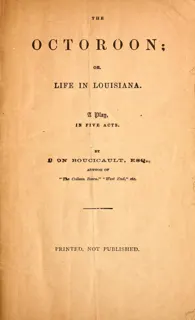
 The Octoroonby Dion BoucicaultOn a Louisiana plantation, the daughter of a white planter and an enslaved woman is put up for sale.
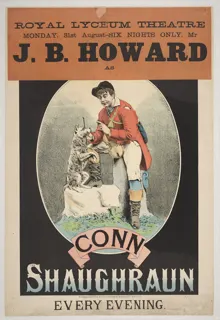 The Shaughraunby Dion BoucicaultA poacher, a fiddler and the life of every funeral, Conn the Shaughraun risks his neck, and fakes his own death, to bring his exiled master home to Sligo.
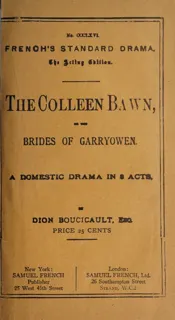 The Colleen Bawnby Dion BoucicaultA young gentleman hides his marriage to a peasant girl, and his servant takes it on himself to be rid of her.
Act 1
Scene.—An ante-room in SIR HARCOURT COURTLY'S house in Belgrave square.
Enter COOL, C.
Half-past nine, and Mr. Charles has not yet returned. I am in a fever of dread. If his father happens to rise earlier than usual on any morning, he is sure to ask first for Mr. Charles. Poor deluded old gentleman—he little thinks how he is deceived.
Enter MARTIN, lazily, L.
Well, Martin, he has not come home yet!
No, and I have not had a wink of sleep all night. I cannot stand this any longer; I shall give warning. This is the fifth night Mr. Courtly has remained out, and I'm obliged to stand at the hall window to watch for him.
You know, if Sir Harcourt was aware that we connived at his son's irregularities, we should all be discharged.
I have used up all my common excuses on his duns. "Call again," "Not at home," and "Send it down to you," won't serve any more; and Mr. Crust, the wine merchant, swears he will be paid.
So they all say. Why he has arrests out against him already. I've seen the fellows watching the door. [loud knock and ring heard L.] There he is, just in time—quick, Martin, for I expect Sir Harcourt's bell every moment, [bell rings, R.] and there it is. [Exit MARTIN, slowly, R.] Thank Heaven! he will return to college to-morrow, and this heavy responsibility will be taken off my shoulders. A valet is as difficult a post to fill properly as that of prime minister. [Exit. L.]
[without] Hollo!
[without] Steady.
Enter YOUNG COURTLY and DAZZLE, L.
Hollo-o-o!
Hush! what are you about, howling like a Hottentot. Sit down there, and thank Heaven you are in Belgrave square instead of Bow street.
D—d—damn Bow street.
Oh, with all my heart!—you have not seen as much of it as I have.
I say—let me see—what was I going to say?—oh, look here—[pulls out a large assortment of bell-pulls, knockers, etc., from his pocket] There! dam'me! I'll puzzle the two-penny postmen—I'll deprive them of their right of disturbing the neighborhood. That black lion's head did belong to old Vampire, the money-lender; this bell-pull to Miss Stitch, the milliner.
And this brass griffin—
That! oh, let me see—I think I twisted that off our own hall-door as I came in, while you were paying the cab.
What shall I do with them?
Pack 'em in a small hamper, and send 'em to the sitting magistrate with my father's compliments; in the meantime come into my room, and I'll astonish you with some Burgundy.
Re-enter COOL, C. door.
[R] Mr. Charles—
[C] Out! out! not at home to any one.
And drunk——
As a lord.
If Sir Harcourt knew this he would go mad, he would discharge me.
You flatter yourself; that would be no proof of his insanity. [to DAZZLE, L.] This is Cool, sir, Mr. Cool; he is the best liar in London—there is a pungency about his invention, and an originality in his equivocation, that is perfectly refreshing.
[aside] Why, Mr. Charles, where did you pick him up?
You mistake, he picked me up. [bell rings, R.]
Here comes Sir Harcourt—pray do not let him see you in this state.
State! what do you mean? I am in a beautiful state.
I should lose my character.
That would be a fortunate epoch in your life, Cool.
Your father would discharge me.
Cool, my dad is an old ass.
Retire to your own room, for Heaven's sake, Mr. Charles.
I'll do so for my own sake. [to DAZZLE] I say, old fellow, [staggering] just hold the door steady while I go in.
This way. Now, then!—take care! [helps him into the room, R.]
Enter SIR HARCOURT COURTLY, L., in an elegant dressing-gown, and Greek skull-cap and tassels, etc.
[C] Cool, is breakfast ready?
[R] Quite ready, Sir Harcourt.
Apropos. I omitted to mention that I expect Squire Harkaway to join us this morning, and you must prepare for my departure to Oak Hall immediately.
Leave town in the middle of the season, Sir Harcourt? So unprecedented a proceeding!
It is! I confess it; there is but one power could effect such a miracle—that is divinity.
How?
In female form, of course. Cool, I am about to present society with a second Lady Courtly; young—blushing eighteen; lovely! I have her portrait; rich! I have her banker's account;—an heiress, and a Venus!
Lady Courtly could be none other.
Ha! ha! Cool, your manners are above your station. Apropos, I shall find no further use for my brocade dressing-gown.
I thank you, Sir Harcourt; might I ask who the fortunate lady is?
Certainly; Miss Grace Harkaway, the niece of my old friend, Max.
Have you never seen the lady, sir?
Never—that is, yes—eight years ago. Having been, as you know, on the Continent for the last seven years, I have not had the opportunity of paying my devoirs. Our connection and betrothal was a very extraordinary one. Her father's estates were contiguous to mine;—being a penurious, miserly, ugly old scoundrel, he made a market of my indiscretion, and supplied my extravagance with large sums of money on mortgages, his great desire being to unite the two properties. About seven years ago he died—leaving Grace, a girl, to the guardianship of her uncle, with this will:—if, on attaining the age of nineteen, she would consent to marry me, I should receive those deeds, and all his property, as her dowry. If she refused to comply with this condition, they should revert to my heir, presumptive or apparent. She consents.
[aside] Who would not?
I consent to receive her £15,000 a year. [crosses to L.]
Who would not?
So prepare, Cool, prepare; [crosses to R.] but where is my boy, where is Charles?
Why—oh, he is gone out, Sir Harcourt; yes, gone out to take a walk.
Poor child! A perfect child in heart—a sober, placid mind—the simplicity and verdure of boyhood, kept fresh and unsullied by any contact with society. Tell me, Cool, at what time was he in bed last night?
Half-past nine, Sir Harcourt.
Half-past nine! Beautiful! What an original idea! Reposing in cherub slumbers, while all around him teems with drinking and debauchery! Primitive sweetness of nature! no pilot-coated, bear-skinned brawling!
Oh, Sir Harcourt!
No cigar-smoking——
Faints at the smell of one.
No brandy and water bibbing——
Doesn't know the taste of anything stronger than barley-water.
No night parading——
Never heard the clock strike twelve, except at noon.
In fact, he is my son, and became a gentleman by right of paternity—he inherited my manners.
Enter MARTIN, L.
Mr. Harkaway.
Enter MAX HARKAWAY, L.
Squire Harkaway, fellow, or Max Harkaway, another time, [MARTIN bows and exit, L.] Ah! ha! Sir Harcourt, I'm devilish glad to see you! Gi' me your fist—dang it but I'm glad to see you! Let me see: six—seven years or more, since we have met. How quickly they have flown!
[throwing off his studied manner] Max, Max! give me your hand, old boy. [aside] Ah! he is glad to see me; there is no fawning pretence about that squeeze. Cool, you may retire. [Exit COOL, R.]
Why, you are looking quite rosy.
Ah, ah! rosy! Am I too florid?
Not a bit; not a bit.
I thought so. [aside] Cool said I had put too much on.
[L] How comes it, Courtly, you manage to retain your youth? See, I'm as gray as an old badger, or a wild rabbit; while you are—are as black as a young rook. I say, whose head grew your hair, eh?
Permit me to remark, that all the beauties of my person are of home manufacture. Why should you be surprised at my youth? I have scarcely thrown off the giddiness of a very boy—elasticity of limb—buoyancy of soul! Remark this position. [throws himself into an attitude] I held that attitude for ten minutes at Lady Acid's last reunion, at the express desire of one of our first sculptors, while he was making a sketch of me for the Apollo.
[aside] Making a butt of thee for their gibes.
Lady Sarah Sarcasm started up, and, pointing to my face, ejaculated, "Good gracious! does not Sir Harcourt remind you of the countenance of Ajax, in the Pompeian portrait?"
Ajax!—humbug!
You are complimentary.
I'm a plain man, and always speak my mind. What's in a face or figure? Does a Grecian nose entail a good temper? Does a waspish waist indicate a good heart? Or, do oily perfumed locks necessarily thatch a well-furnished brain?
It's an undeniable fact, plain people always praise the beauties of the mind.
Excuse the insinuation; I had thought the first Lady Courtley had surfeited you with beauty.
No; she lived fourteen months with me, and then eloped with an intimate friend. Etiquette compelled me to challenge the seducer; so I received satisfaction—and a bullet in my shoulder at the same time. However, I had the consolation of knowing that he was the handsomest man of the age. She did not insult me by running away with a damned ill-looking scoundrel.
That, certainly, was flattering.
I felt so, as I pocketed the ten thousand pounds damages.
That must have been a great balm to your sore honor.
It was—Max, my honor would have died without it; for on that year the wrong horse won the Derby—by some mistake. It was one of the luckiest chances—a thing that does not happen twice in a man's life—the opportunity of getting rid of his wife and his debts at the same time.
Tell the truth, Courtly—Did you not feel a little frayed in your delicacy—your honor, now? Eh?
Not a whit. Why should I? I married money, and I received it—virgin gold! My delicacy and honor had nothing to do with it. The world pities the bereaved husband, when it should congratulate. No; the affair made a sensation, and I was the object. Besides, it is vulgar to make a parade of one's feelings, however acute they may be; impenetrability of countenance is the sure sign of your highly-bred man of fashion.
So a man must, therefore, lose his wife and his money with a smile—in fact, everything he possesses but his temper.
Exactly; and great ruin with vive la bagatelle! For example: your modish beauty never discomposes the shape of her features with convulsive laughter. A smile rewards the bon mot, and also shows the whiteness of her teeth. She never weeps impromptu—tears might destroy the economy of her cheek. Scenes are vulgar, hysterics obsolete; she exhibits a calm, placid, impenetrable lake, whose surface is reflection, but of unfathomable depth—a statue, whose life is hypothetical, and not a prima facie fact. [crosses to L.]
Well, give me the girl that will fly at your eyes in an argument, and stick to her point like a fox to his own tail.
But etiquette, Max! remember etiquette!
Damn etiquette! I have seen a man who thought it sacrilege to eat fish with a knife, that would not scruple to rise up and rob his brother of his birthright in a gambling-house. Your thorough-bred, well-blooded heart will seldom kick over the traces of good feeling. That's my opinion, and I don't care who knows it.
Pardon me—etiquette is the pulse of society, by regulating which the body politic is retained in health. I consider myself one of the faculty in the art.
Well, well; you are a living libel upon common sense, for you are old enough to know better.
Old enough! What do you mean? Old! I still retain all my little juvenile indiscretions, which your niece's beauties must teach me to discard. I have not sown my wild oats yet.
Time you did, at sixty-three.
Sixty-three! Good Heavens!—forty, 'pon my life forty, next March.
Why, you are older than I am.
Oh! you are old enough to be my father.
Well, if I am, I am; that's etiquette, I suppose. Poor Grace! how often have I pitied her fate! That a young and beautiful creature should be driven into wretched splendor, or miserable poverty!
Wretched! wherefore? Lady Courtly wretched! Impossible!
Will she not be compelled to marry you, whether she likes you or not?—a choice between you and poverty. [aside] And hang me if it isn't a tie! But why do you not introduce your son Charles to me? I have not seen him since he was a child. You would never permit him to accept any of my invitations to spend his vacation at Oak Hall—of course, we shall have the pleasure of his company now.
He is not fit to enter society yet. He is a studious, sober boy.
Boy! Why, he's five and twenty.
Good gracious! Max—you will permit me to know my own son's age—he is not twenty.
I'm dumb.
You will excuse me while I indulge in the process of dressing. Cool!
Enter COOL, R.
Prepare my toilet. [Exit COOL, C.] That is a ceremony which, with me, supersedes all others. I consider it a duty which every gentleman owes to society, to render himself as agreeable an object as possible; and the least compliment a mortal can pay to nature, when she honors him by bestowing extra care in the manufacture of his person, is to display her taste to the best possible advantage; and so, au revoir. [Exit, L.]
[sits R. of table] That's a good soul—he has his faults, and who has not? Forty years of age! Oh, monstrous!—but he does look uncommonly young for sixty, spite of his foreign locks and complexion.
Enter DAZZLE, R.
Who's my friend with the stick and gaiters, I wonder—one of the family—the governor, may be?
[R. C] Who's this? Oh, Charles—is that you, my boy? How are you? [aside] This is the boy.
He knows me—he is too respectable for a bailiff. [aloud] How are you?
Your father has just left me.
[aside] The devil he has! He has been dead these ten years. Oh! I see, he thinks I'm young Courtly. [aloud] The honor you would confer upon me, I must unwillingly disclaim—I am not Mr. Courtly.
I beg pardon—a friend, I suppose?
Oh, a most intimate friend—a friend of years—distantly related to the family—one of my ancestors married one of his. [aside] Adam and Eve.
Are you on a visit here?
Yes; oh! yes. [aside] Rather a short one, I'm afraid.
[aside] This appears a dashing kind of fellow—as he is a friend of Sir Harcourt's, I'll invite him to the wedding. [aloud] Sir, if you are not otherwise engaged, I shall feel honored by your company at my house, Oak Hall, Gloucestershire.
Your name is——
Harkaway—Max Harkaway.
Harkaway—let me see—I ought to be related to the Harkaways, somehow.
A wedding is about to come off—will you take a part on the occasion?
With pleasure! any part but that of the husband.
Have you any previous engagement?
I was thinking—eh? why, let me see. [aside] Promised to meet my tailor and his account to-morrow; however, I'll postpone that. [aloud] Have you good shooting?
Shooting! Why, there's no shooting at this time of the year.
Oh! I'm in no hurry—I can wait till the season, of course. I was only speaking precautionally—you have good shooting?
The best in the country.
Make yourself comfortable!—Say no more—I'm your man—wait till you see how I'll murder your preserves.
Do you hunt?
Pardon me—but will you repeat that? [aside] Delicious and expensive idea!
You ride?
Anything! Everything! From a blood to a broomstick. Only catch me a flash of lightning, and let me get on the back of it, and dam'me if I wouldn't astonish the elements.
Ha! ha!
I'd put a girdle round about the earth in very considerably less than forty minutes.
Ah! ha! We'll show old Fiddlestrings how to spend the day. He imagines that Nature, at the earnest request of Fashion, made summer days long for him to saunter in the Park, and winter nights that he might have good time to get cleared out at hazard or at whist. Give me the yelping of a pack of hounds before the shuffling of a pack of cards. What state can match the chase in full cry, each vying with his fellows which shall be most happy? A thousand deaths fly by unheeded in that one hour's life of ecstacy. Time is outrun, and Nature seems to grudge our bliss by making the day so short.
No, for then rises up the idol of my great adoration.
Who's that?
The bottle—that lends a lustre to the soul!—When the world puts on its night-cap, and extinguishes the sun—then comes the bottle! Oh, mighty wine! don't ask me to apostrophize. Wine and love are the only two indescribable things in nature; but I prefer the wine, because its consequences are not entailed, and are more easily got rid of.
How so?
Love ends in matrimony, wine in soda water.
Well, I can promise you as fine a bottle as ever was cracked.
Never mind the bottle, give me the wine. Say no more; but, when I arrive, just shake one of my hands, and put the key of the cellar into the other, and if I don't make myself intimately acquainted with its internal organization—well, I say nothing—time will show.
I foresee some happy days.
And I some glorious nights.
It mustn't be a flying visit.
I despise the word—I'll stop a month with you.
Or a year or two.
I'll live and die with you.
Ha! ha! Remember Max Harkaway, Oak Hall, Gloucestershire.
I'll remember—fare ye well. [MAX is going] say, holloa!—Tallyho-o-o-o!
Yoicks!—Tallyhoa-o-o-o!—— [Exit, L.]
There I am—quartered for a couple of years, at the least. The old boy wants somebody to ride his horses, shoot his game, and keep a restraint on the morals of the parish: I'm eligible. What a lucky accident to meet Young Courtly last night! Who could have thought it? Yesterday, I could not make certain of a dinner, except at my own proper peril; to-day I would flirt with a banquet.
Enter YOUNG COURTLY, R.
What infernal row was that? Why, [seeing DAZZLE] are you here still?
Yes. Ain't you delighted? I'll ring, and send the servant for my luggage.
The devil you will! Why, you don't mean to say you seriously intend to take up a permanent residence here? [rings the bell]
Now, that's a most inhospitable insinuation.
Might I ask your name?
With a deal of pleasure—Richard Dazzle, late of the Unattached Volunteers, vulgarly entitled the Dirty Buffs.
Enter MARTIN, L.
Then, Mr. Richard Dazzle, I have the honor of wishing you a very good morning. Martin, show this gentleman the door.
If he does, I'll kick Martin out of it. No offence. [Exit, MARTIN, L.] Now, sir, permit me to place a dioramic view of your conduct before you. After bringing you safely home this morning—after indulgently waiting, whenever you took a passing fancy to a knocker or bell-pull—after conducting a retreat that would have reflected honor on Napoleon—you would kick me into the street, like a mangy cur; and that's what you call gratitude. Now, to show you how superior I am to petty malice, I give you an unlimited invitation to my house—my country house—to remain as long as you please.
Your house!
Oak Hall, Gloucestershire—fine old place!—for further particulars see road book—that is, it nominally belongs to my old friend and relation, Max Harkaway; but I'm privileged. Capital old fellow—say, shall we be honored?
Sir, permit me to hesitate a moment. [aside] Let me see; I go back to college to-morrow, so I shall not be missing; tradesmen begin to dun—[a noise off L., between MARTIN and ISAACS; COOL has entered C., crosses and goes off L.] I hear thunder; here is shelter ready for me.
Re-enter COOL, L.
Oh, Mr. Charles, Mr. Solomon Isaacs is in the hall, and swears he will remain till he has arrested you!
Does he!—sorry he is so obstinate—take him my compliments, and I will bet him five to one he will not.
Double or quits, with my kind regards.
But, sir, he has discovered the house in Curzon street; he says he is aware the furniture at least belongs to you, and he will put a man in immediately.
That's awkward—what's to be done?
Ask him whether he couldn't make it a woman.
I must trust that to fate.
I will give you my acceptance, if it will be of any use to you—it is of none to me.
No, sir; but in reply to your most generous and kind invitation, if you be in earnest, I shall feel delighted to accept it.
Certainly.
Then off we go—through the stables—down the Mews, and so slip through my friend's fingers.
But, stay, you must do the polite; say farewell to him before you part. Damn it, don't cut him!
You jest!
Here, lend me a card. [COURTLY gives him one] Now, then. [writes] "Our respects to Mr. Isaacs—sorry to have been prevented from seeing him." Ha! ha!
Ha! ha!
We'll send him up some game.
[to COOL] Don't let my father see him. [Exeunt YOUNG COURTLY and DAZZLE, R.]
What's this? "Mr. Charles Courtly, P. P. C., returns thanks for obliging inquiries." [Exit, L.]
Act 2
Scene—The lawn before Oak Hall, a fine Elizabethan mansion; a drawing-room is seen through large French windows at the back. Statues, urns and garden chairs about the stage.
Enter PERT, through window, L., to JAMES who is discovered.
James, Miss Grace desires me to request that you will watch at the avenue and let her know when the squire's carriage is seen on the London road. [Exit, L.]
I will go to the lodge.
How I do long to see what kind of a man Sir Harcourt Courtly is! They say he is sixty; so he must be old, and consequently ugly. If I were Miss Grace, I would rather give up all my fortune and marry the man I liked, than go to church with a stuffed eel-skin. But taste is everything—she doesn't seem to care whether he is sixty or sixteen; jokes at love; prepares for matrimony as she would for dinner; says it is a necessary evil, and what can't be cured must be endured. Now, I say this is against all nature; and she is either no woman, or a deeper one than I am, if she prefers an old man to a young one. Here she comes! looking as cheerfully as if she was going to marry Mr. Jenks! My Mr. Jenks! whom nobody wont lead to the halter till I have that honor.
Enter GRACE, from the drawing-room, L.
Well, Pert! any signs of my uncle yet?
[L] No, Miss Grace; but James has gone to watch the road.
In my uncle's letter he mentions a Mr. Dazzle, whom he has invited; so you must prepare a room for him. He is some friend of my husband that is to be, and my uncle seems to have taken an extraordinary predilection for him. Apropos! I must not forget to have a bouquet for the dear old man when he arrives.
The dear old man! Do you mean Sir Harcourt?
La, no! my uncle of course. [plucking flowers] What do I care for Sir Harcourt Courtly? [crosses R.]
Isn't it odd, Miss, you have never seen your intended, though it has been so long since you were betrothed?
Not at all; marriage matters are conducted now-a-days in a most mercantile manner; consequently, a previous acquaintance is by no means indispensable. Besides, my prescribed husband has been upon the continent for the benefit of his—property! They say a southern climate is a great restorer of consumptive estates.
Well, Miss, for my own part, I should like to have a good look at my bargain before I paid for it; 'specially when one's life is the price of the article. But why, ma'am, do you consent to marry in this blind-man's-buff sort of manner? What would you think if he were not quite so old?
I should think he was a little younger.
I should like him all the better.
That wouldn't I. A young husband might expect affection and nonsense, which 'twould be deceit in me to render; nor would he permit me to remain with my uncle. Sir Harcourt takes me with the incumbrances on his estate, and I shall beg to be left among the rest of the live stock. [crosses L.]
Ah, Miss! but some day you might chance to stumble over the man—what could you do then?
Do! beg the man's pardon, and request the man to pick me up again.
Ah! you were never in love, Miss.
I never was, nor will be, till I am tired of myself and common sense. Love is a pleasant scape-goat for a little epidemic madness. I must have been inoculated in my infancy, for the infection passes over poor me in contempt.
Enter JAMES, L.
Two gentlemen, Miss Grace, have just alighted.
Very well, James. [Exit JAMES, L.] Love is pictured as a boy; in another century they will be wiser, and paint him as a fool, with cap and bells, without a thought above the jingling of his own folly. Now, Pert, remember this as a maxim—A woman is always in love with one of two things.
What are they, Miss?
A man, or herself—and I know which is the most profitable. [Exit L.]
I wonder what my Jenks would say, if I was to ask him. La! here comes Mr. Meddle, his rival, contemporary solicitor, as he calls him—a nasty, prying, ugly wretch—what brings him here? He comes puffed with some news. [retires up R.]
Enter MEDDLE, with a newspaper, L.
I have secured the only newspaper in the village—my character, as an attorney-at-law, depended on the monopoly of its information. I took it up by chance, when this paragraph met my astonished view: [reads] "We understand that the contract of marriage so long in abeyance on account of the lady's minority, is about to be celebrated at Oak Hall, Gloucestershire, the well-known and magnificent mansion of Maximilian Harkaway, Esq., between Sir Harcourt Courtly, baronet, of fashionable celebrity, and Miss Grace Harkaway, niece to the said Mr. Harkaway. The preparations are proceeding in the good old English style." Is it possible! I seldom swear, except in a witness box, but, damme, had it been known in the village, my reputation would have been lost; my voice in the parlor of the Red Lion mute, and Jenks, a fellow who calls himself a lawyer, without more capability than a broomstick, and as much impudence as a young barrister after getting a verdict by mistake, why, he would actually have taken the Reverend Mr. Spout by the button, which is now my sole privilege. [sees PERT] Ah! here is Mrs. Pert; couldn't have hit upon a better person. I'll cross-examine her—lady's maid to Miss Grace—confidential purloiner of second-hand silk—a nisi prius of her mistress—Ah! sits on the woolsack in the pantry, and dictates the laws of kitchen etiquette. [PERT comes forward] Ah! Mrs. Pert, good-morning; permit me to say—and my word as a legal character is not unduly considered—I venture to affirm that you look a—quite like the—a—
[L] Law! Mr. Meddle.
[R] Exactly, like the law.
Ha! indeed; complimentary, I confess; like the law; tedious, prosy, made up of musty paper. You sha'n't have a long suit of me. Good-morning. [going]
Stay, Mrs. Pert; don't calumniate my calling, or disseminate vulgar prejudices.
Vulgar! you talk of vulgarity to me! you, whose sole employment is to sneak about like a pig, snouting out the dust-hole of society, and feeding upon the bad ends of vice! you, who live upon the world's iniquity; you miserable specimen of a bad six-and-eightpence! [following him around to R.]
[R] But, Mrs. Pert——
[R. C] Don't but me, sir; I won't be butted by any such low fellow.
This is slander; an action will lie.
Let it lie; lying is your trade. I'll tell you what, Mr. Meddle; if I had my will, I would soon put a check on your prying propensities. I'd treat you as the farmers do inquisitive hogs.
How?
I would ring your nose. [Exit into house, L.]
Not much information elicited from that witness. Jenks is at the bottom of this. I have very little hesitation in saying, Jenks is a libellous rascal; I heard reports that he was undermining my character here, through Mrs. Pert. Now I'm certain of it. Assault is expensive; but I certainly will put by a small weekly stipendium, until I can afford to kick Jenks.
[outside] Come along; this way!
Ah! whom have we here? Visitors; I'll address them.
Enter DAZZLE, L.
Who's this, I wonder; one of the family? I must know him. [to MEDDLE] Ah! how are ye?
Quite well. Just arrived?—ah!—um! Might I request the honor of knowing whom I address?
Richard Dazzle, Esquire; and you——
Mark Meddle, attorney-at-law.
Enter YOUNG COURTLY, L.
What detained you?
My dear fellow, I have just seen such a woman——
[aside] Hush! [aloud] Permit me to introduce you to my very old friend, Meddle. He's a capital fellow; know him.
[R] I feel honored. Who is your friend?
Oh, he? What, my friend? Oh! Augustus Hamilton.
How d'ye do? [looking off] There she is again!
[looking off] Why, that is Miss Grace.
[L. C] Of course, Grace.
[C] I'll go and introduce myself. [DAZZLE stops him]
[aside] What are you about? would you insult my old friend Puddle by running away? [aloud] I say, Puddle, just show my friend the lions, while I say how d'ye do to my young friend Grace. [aside] Cultivate his acquaintance. [Exit, L. U. E. YOUNG COURTLY looks after him]
Mr. Hamilton, might I take the liberty?
[looking off] Confound the fellow!
Sir, what did you remark?
She's gone! Oh, are you here still, Mr. Thingomerry Puddle?
Meddle, Sir, Meddle, in the list of attorneys.
Well, Muddle or Puddle, or whoever you are, you are a bore.
[aside] How excessively odd! Mrs. Pert said I was a pig; now I'm a boar! I wonder what they'll make of me next.
Mr. Thingamy, will you take a word of advice?
Feel honored.
Get out.
Do you mean to—I don't understand.
Delighted to quicken your apprehension. You are an ass, Puddle.
Ha! ha! another quadruped! Yes; beautiful. [aside] I wish he'd call me something libellous; but that would be too much to expect. [aloud] Anything else?
Some miserable pettifogging scoundrel!
Good! ha! ha!
What do you mean by laughing at me?
Ha! ha! ha! excellent! delicious!
Mr. ——, are you ambitious of a kicking?
Very, very—Go on—kick—go on.
[looking off] Here she comes! I'll speak to her.
But, sir—sir——
Oh, go to the devil! [runs off, L. U. E.]
There, there's a chance lost—gone! I have no hesitation in saying that, in another minute, I should have been kicked; literally kicked—a legal luxury. Costs, damages, and actions rose up like sky-rockets in my aspiring soul, with golden tails reaching to the infinity of my hopes. [looking] They are coming this way; Mr. Hamilton in close conversation with Lady Courtly that is to be. Crim. Con. Courtly versus Hamilton—damages problematical—Meddle, chief witness for plaintiff—guinea a day—professional man! I'll take down their conversation verbatim. [retires behind a bush, R.]
Enter GRACE, followed by YOUNG COURTLY, L. U. E.
[R] Perhaps you would follow your friend into the dining-room; refreshment, after your long journey, must be requisite.
[L] Pardon me, madam; but the lovely garden and the loveliness before me, is better refreshment than I could procure in any dining-room.
Ha! Your company and compliments arrive together.
I trust that a passing remark will not spoil so welcome an introduction as this by offending you.
I am not certain that anything you could say would offend me.
I never meant——
I thought not. In turn, pardon me, when I request you will commence your visit with this piece of information—I consider compliments impertinent, and sweetmeat language fulsome.
I would condemn my tongue to a Pythagorean silence, if I thought it could attempt to flatter.
It strikes me, sir, that you are a stray bee from the hive of fashion; if so, reserve your honey for its proper cell. A truce to compliments.—You have just arrived from town, I apprehend.
This moment I left mighty London, under the fever of a full season, groaning with the noisy pulse of wealth and the giddy whirling brain of fashion. Enchanting, busy London! how have I prevailed on myself to desert you! Next week the new ballet comes out—the week after comes Ascot. Oh!
How agonizing must be the reflection!
Torture! Can you inform me how you manage to avoid suicide here? If there was but an opera, even, within twenty miles! We couldn't get up a rustic ballet among the village girls? No?—ah!
I am afraid you would find that difficult. How I contrive to support life I don't know—it is wonderful—but I have not precisely contemplated suicide yet, nor do I miss the opera.
How can you manage to kill time?
I can't. Men talk of killing time, while time quietly kills them. I have many employments—this week I devote to study and various amusements—next week to being married—the following week to repentance, perhaps.
Married!
You seem surprised; I believe it is of frequent occurrence in the metropolis—is it not?
O, yes, I believe they do it there. Might I ask to whom?
I have never seen him yet, but he is a gentleman who has been strongly recommended to me for the situation of husband.
What an extraordinary match! Would you not consider it advisable to see him, previous to incurring the consequences of such an act?
You must be aware that fashion says otherwise. The gentleman swears eternal devotion to the lady's fortune, and the lady swears she will outvie him still. My lord's horses and my lady's diamonds shine through a few seasons, until a seat in Parliament, or the Continent stares them in the face; then, when thrown upon each other for resources of comfort, they begin to quarrel about the original conditions of the sale.
Sale! No! that would be degrading civilization into Turkish barbarity.
Worse, sir, a great deal worse; for there at least they do not attempt concealment of the barter; but here, every London ball-room is a marriage mart—young ladies are trotted out, while the mother, father, or chaperone plays auctioneer, and knocks them down to the highest bidder—young men are ticketed up with their fortunes on their backs—and Love, turned into a dapper shopman, descants on the excellent qualities of the material.
Oh! that such a custom could have ever emanated from the healthy soil of an English heart!
No; it never did—like most of our literary dandyisms and dandy literature, it was borrowed from the French.
You seem to laugh at love.
Love! why, the very word is a breathing satire upon man's reason—a mania, indigenous to humanity—nature's jester, who plays off tricks upon the world, and trips up common sense. When I'm in love, I'll write an almanac, for very lack of wit—prognosticate the sighing season—when to beware of tears—about this time expect matrimony to be prevalent! Ha! ha! Why should I lay out my life in love's bonds upon the bare security of a man's word?
Enter JAMES, L.
The squire, madam, has just arrived, and another gentleman with him. [Exit JAMES, L.]
[aside] My intended, I suppose.
I perceive you are one of the railers against what is termed the follies of high life.
No, not particularly; I deprecate all folly. By what prerogative can the west-end mint issue absurdity, which, if coined in the east, would be voted vulgar?
By a sovereign right—because it has Fashion's head upon its side, and that stamps it current.
Poor Fashion, for how many sins hast thou to answer! The gambler pawns his birthright for fashion—the roué steals his friend's wife for fashion—each abandons himself to the storm of impulse, calling, it the breeze of fashion.
Is this idol of the world so radically vicious?
No; the root is well enough, as the body was, until it had outgrown its native soil; but now, like a mighty giant lying over Europe, it pillows its head in Italy, its heart in France, leaving the heels alone its sole support for England.
Pardon me, madam, you wrong yourself to rail against your own inheritance—the kingdom to which loveliness and wit attest your title.
A mighty realm, forsooth—with milliners for ministers, a cabinet of coxcombs, envy for my homage, ruin for my revenue—my right of rule depending on the shape of a bonnet or the set of a pelisse, with the next grand noodle as my heir-apparent. Mr. Hamilton, when I am crowned, I shall feel happy to abdicate in your favor. [curtesy and exit into house, L.]
What did she mean by that? Hang me if I can understand her—she is evidently not used to society. Ha!— takes every word I say for infallible truth—requires the solution of a compliment, as if it were a problem in Euclid. She said she was about to marry, but I rather imagine she was in jest. 'Pon my life, I feel very queer at the contemplation of such an idea—I'll follow her. [MEDDLE comes down, L.] Oh! perhaps this booby can inform me something about her. [MEDDLE makes signs at him] What the devil is he at?
It won't do—no—ah! um—it's not to be done.
What do you mean?
[points after GRACE] Counsel retained—cause to come off.
Cause to come off!
Miss Grace is about to be married.
Is it possible?
Certainly. If I have the drawing out of the deeds——
To whom?
Ha! hem! Oh, yes! I dare say—information being scarce in the market, I hope to make mine valuable.
Married! married! [pacing the stage]
Now I shall have another chance.
I'll run and ascertain the truth of this from Dazzle. [Exit L.]
It's of no use; he either dare not kick me, or he can't afford it—in either case, he is beneath my notice. Ah! who comes here?—can it be Sir Harcourt Courtly himself? It can be no other.
Enter COOL, L.
Sir, I have the honor to bid you welcome to Oak Hall and the village of Oldborough.
[aside] Excessively polite. [aloud] Sir, thank you.
The township contains two thousand inhabitants.
Does it? I am delighted to hear it. [crosses R.]
[aside] I can charge him for that—ahem—six and eightpence is not much—but it is a beginning. [aloud] If you will permit me, I can inform you of the different commodities for which it is famous.
Much obliged—but here comes Sir Harcourt Courtly, my master, and Mr. Harkaway—any other time I shall feel delighted.
Oh! [aside] Mistook the man for the master. [retires up R.]
Enter MAX and SIR HARCOURT, L.
[C] Here we are at last. Now give ye welcome to Oak Hall, Sir Harcourt, heartily!
[L. C., languidly] Cool, assist me. [COOL takes off his cloak and gloves; gives him white gloves and handkerchief, then places a flower in his coat]
Why, you require unpacking as carefully as my best bin of port. Well, now you are decanted, tell me what did you think of my park as we came along?
That it would never come to an end. You said it was only a stone's throw from your infernal lodge to the house; why, it's ten miles, at least.
I'll do it in ten minutes any day.
Yes, in a steam carriage. Cool, perfume my handkerchief.
Don't do it. Don't! perfume in the country! why, it's high treason in the very face of Nature; 'tis introducing the robbed to the robber. Here are the sweets from which your fulsome essences are pilfered, and libelled with their names; don't insult them, too. [MEDDLE comes down, C.]
[to MEDDLE] Oh! cull me a bouquet, my man!
[turning] Ah, Meddle! how are you? This is Lawyer Meddle. [goes up, R.]
Oh! I took him for one of your people.
Ah! naturally—um—Sir Harcourt Courtly, I have the honor to congratulate—happy occasion approaches. Ahem! I have no hesitation in saying this very happy occasion approaches.
Cool, is the conversation addressed towards me?
[L] I believe so, Sir Harcourt.
[C] Oh, certainly! I was complimenting you.
Sir, you are very good; the honor is undeserved; but I am only in the habit of receiving compliments from the fair sex. Men's admiration is so damnably insipid. [crosses to MAX who is seated on bench, L.]
I had hoped to make a unit on that occasion.
Yes, and you hoped to put an infernal number of cyphers after your unit on that and any other occasion.
Ha! ha! very good. Why, I did hope to have the honor of drawing out the deeds; for, whatever Jenks may say to the contrary, I have no hesitation in saying——
[putting him aside; to MAX] If the future Lady Courtly be visible at so unfashionable an hour as this, I shall beg to be introduced.
Visible! Ever since six this morning, I'll warrant ye. Two to one she is at dinner.
Dinner! Is it possible? Lady Courtly dine at half-past one P. M.?
[down L] I rather prefer that hour to peck a little my——
Dear me! who was addressing you?
Oh! I beg pardon.
Here, James! [calling.]
Enter JAMES, L.
Tell Miss Grace to come here directly. [Exit JAMES, into house L.] Now prepare, Courtly, for, though I say it, she is—with the exception of my bay mare, Kitty—the handsomest thing in the country. Considering she is a biped, she is a wonder! Full of blood, sound wind and limb, plenty of bone, sweet coat, in fine condition, with a thorough-bred step, as dainty as a pet greyhound.
Damme, don't compare her to a horse!
Well, I wouldn't, but she's almost as fine a creature—close similarities.
Oh, very fine creature! Close similarity, amounting to identity.
Good gracious, sir! What can a lawyer know about women?
Everything. The consistorial court is a fine study of the character, and I have no hesitation in saying that I have examined more women than Jenks, or——
Oh, damn Jenks!
Sir, thank you. Damn him again, sir, damn him again!
Enter GRACE, from house, L.
[runs to him] My dear uncle!
Ah, Grace, you little jade, come here.
[eying her through his glass] Oh, dear! she is a rural Venus! I'm astonished and delighted.
Won't you kiss your old uncle? [kisses her.]
[draws an agonizing face] Oh!—ah—um!—N'importe!—my privilege in embryo—hem! It's very tantalizing, though.
You are not glad to see me, you are not. [kissing her again.]
Oh; no, no! [aside] that is too much. I shall do something horrible presently if this goes on. [aloud] I should be sorry to curtail any little ebullition of affection; but—ahem! May I be permitted?
Of course you may. There, Grace, is Sir Harcourt, your husband that will be. Go to him, girl. [she courtsies]
Permit me to do homage to the charms, the presence of which have placed me in sight of Paradise. [SIR HARCOURT and GRACE retire]
Enter DAZZLE, L.
Ah! old fellow, how are you? [crosses to MAX.]
[R. C] I'm glad to see you. Are you comfortably quartered yet, eh?
Splendidly quartered! What a place you've got here! Here, Hamilton.
Enter YOUNG COURTLY, from house, down R.
Permit me to introduce my friend, Augustus Hamilton. Capital fellow! drinks like a sieve, and rides like a thunder-storm.
[R. C] Sir, I'm devilish glad to see you. Here, Sir Harcourt, permit me to introduce to you——[goes up to SIR HARCOURT]
The devil!
[R. C. aside] What's the matter?
[aside] Why, that is my governor, by Jupiter!
[aside] What, old Whiskers! you don't say that?
[aside] It is; what's to be done now?
[advancing, C] Mr. Hamilton, Sir Harcourt Courtly—Sir Harcourt Courtly, Mr. Hamilton.
[advancing, L. C] Hamilton! Good gracious! Bless me! Why, Charles, is it possible?—why, Max, that's my son!
[aside] What shall I do?
Your son?
Your son, Sir Harcourt! have you a son as old as that gentleman?
No—that is—a—yes,—not by twenty years—a—Charles, why don't you answer me, sir?
[aside to DAZZLE] What shall I say?
[aside] Deny your identity.
[aside] Capital! [aloud] What's the matter, sir?
How came you down here, sir?
By one of Newman's best fours—in twelve hours and a quarter.
Isn't your name Charles Courtly?
Not to my knowledge.
Do you mean to say that you are usually called Augustus Hamilton?
Lamentable fact—and quite correct.
Cool, is that my son?
[L] No, sir—it is not Mr. Charles—but it is very like him.
I cannot understand all this. [goes up]
[aside] I think I can. [goes up]
[aside to YOUNG C] Give him a touch of the indignant.
[crosses R. C] Allow me to say, Sir What-d'ye-call-'em-Hartly——
Hartly, sir! Courtly, sir! Courtly!
Well, Hartly, or Court-heart, or whatever your name may be, I say your conduct is—a—a—, and were it not for the presence of this lady, I should feel inclined—to—to——
No, no, that can't be my son,—he never would address me in that way.
[coming down] What is all this?
Sir, your likeness to my son Charles is so astonishing, that it, for a moment—the equilibrium of my etiquette—'pon my life, I—permit me to request your pardon.
[L] Sir Harcourt, don't apologize, don't—bring an action. I'm witness.
Some one take this man away. [MEDDLE goes up stage with COOL],
Enter JAMES, from house, L.
Luncheon is on the table, sir.
Miss Harkaway, I never swore before a lady in my life—except when I promised to love and cherish the late Lady Courtly, which I took care to preface with an apology,—I was compelled to the ceremony, and consequently not answerable for the language—but to that gentleman's identity I would have pledged—my hair.
[aside] If that security were called for, I suspect the answer would be—no effects. [Exeunt SIR HARCOURT and GRACE, L.]
[to MAX] I have something very particular to communicate.
Can't listen at present. [Exit, L., into house]
[to DAZZLE and YOUNG C] I can afford you information, which I——
Oh, don't bother!
Go to the devil! [Exeunt L., into house]
Now, I have no hesitation in saying that is the height of ingratitude.—Oh—Mr. Cool—can you oblige me? [presents his account]
[R] Why, what is all this?
Small account versus you—to giving information concerning the last census of the population of Oldborough and vicinity, six and eightpence.
Oh, you mean to make me pay for this, do you?
Unconditionally.
Well, I have no objection—the charge is fair—but remember, I am a servant on board wages,—will you throw in a little advice, gratis—if I give you the money?
Ahem!—I will.
A fellow has insulted me. I want to abuse him—what terms are actionable?
You may call him anything you please, providing there are no witnesses.
Oh, may I? [looks around] then you rascally, pettifogging scoundrel!
Hello! [retreats to R.]
[following him] You mean—dirty—disgrace to your profession.
Libel—slander—
[going up L; turns] Ay, but where are your witnesses?
Give me the costs—six and eightpence.
I deny that you gave me the information at all.
You do!
Yes, where are your witnesses? [Exit into house, L.]
Ah—damme. I'm done at last! [Exit into house, L.]
Act 3
Scene.—A morning room in Oak Hall, French windows opening to the lawn. MAX and SIR HARCOURT seated on one side, DAZZLE on the other; GRACE and YOUNG COURTLY playing chess at back. All dressed for dinner.
[aside to SIR HARCOURT] What can I do?
Get rid of them civilly.
What, turn them out, after I particularly invited them to stay a month or two?
Why, they are disreputable characters; as for that young fellow, in whom my Lady Courtly appears so particularly absorbed—I am bewildered—I have written to town for my Charles, my boy—it certainly is the most extraordinary likeness——
Sir Harcourt, I have an idea——
Sir, I am delighted to hear it. [aside to MAX] That fellow is a swindler.
I met him at your house.
Never saw him before in all my life.
[crossing to SIR HARCOURT] I will bet you five to one that I can beat you three out of four games of billiards, with one hand.
No, sir.
I don't mind giving you ten points in fifty.
Sir, I never gamble.
You don't! Well, I'll teach you—easiest thing in life—you have every requisite—good temper.
I have not, sir.
A long-headed, knowing old buck.
Sir! [they go up, conversing with MAX, C.]
Really, Mr. Hamilton, you improve. A young man pays us a visit, as you half intimate, to escape inconvenient friends—that is complimentary to us, his hosts.
Nay, that is too severe.
After an acquaintanceship of two days, you sit down to teach me chess and domestic economy at the same time. Might I ask where you graduated in that science—where you learned all that store of matrimonial advice which you have obliged me with? [they come forward]
I imbibed it, madam, from the moment I beheld you, and having studied my subject con amore, took my degree from your eyes.
Oh, I see you are a Master of Arts already.
Unfortunately, no—I shall remain a bachelor—till you can assist me to that honor. [SIR HARCOURT rises]
[aside, R] How do you get on?
[aside] Splendidly! Keep the old boy away!
[going to them] Is the conversation strictly confidential?—or might I join?
[taking his arm] Oh, not in the least, my dear sir—we were remarking that rifle shooting was an excellent diversion during the summer months.
[drawing himself up] Sir, I was addressing——
And I was saying what a pity it was I couldn't find any one reasonable enough to back his opinion with long odds—come out on the lawn, and pitch up your hat, and I will hold you ten to one I put a bullet into it every time, at forty paces.
No, sir—I consider you——
[at window] Here, all of you—look, here is Lady Gay Spanker coming across the lawn at a hand gallop!
[running to window] Bless me, the horse is running away!
Look how she takes that fence! there's a seat.
[comes down, L. C] Lady Gay Spanker—who may she be?
[down C] Gay Spanker, Sir Harcourt? My cousin and dearest friend—you must like her.
It will be my devoir, since it is your wish—though it will be a hard task in your presence.
I am sure she will like you.
Ha! ha! I flatter myself.
Who, and what is she?
Glee, glee, made a living thing—Nature, in some frolic mood, shut up a merry devil in her eye, and, spiting Art, stole Joy's brightest harmony to thrill her laugh, which peals out sorrow's knell. Her cry rings loudest in the field—the very echo loves it best, and as each hill attempts to ape her voice, Earth seems to laugh that it made a thing so glad.
[L] Ay, the merriest minx I ever kissed. [LADY GAY laughs without]
[without] Max!
Come in, you mischievous puss.
Enter JAMES, R.
Mr. Adolphus and Lady Gay Spanker. [Exit.]
Enter LADY GAY, R., fully equipped in riding habit, etc.
Ha! ha! Well, governor, how are ye? I have been down five times, climbing up your stairs in my long clothes. How are you, Grace dear? [kisses her] There, don't fidget, Max. And there—[kisses him, R. C.] there's one for you.
[L] Ahem!
[C] Oh, gracious, I didn't see you had visitors.
[R] Permit me to introduce [crosses C.] Sir Harcourt Courtly, Lady Gay Spanker. Mr. Dazzle, Mr. Hamilton—Lady Gay Spanker.
[aside] A devilish fine woman!
[aside to SIR HARCOURT] She's a devilish fine woman.
You mustn't think anything of the liberties I take with my old papa here—bless him! [kisses him again]
Oh, no! [aside] I only thought I should like to be in his place.
I am so glad you have come, Sir Harcourt. Now we shall be able to make a decent figure at the heels of a hunt.
Does your ladyship hunt?
Ha! I say, governor, does my ladyship hunt? I rather flatter myself that I do hunt! Why, Sir Harcourt, one might as well live without laughing as without hunting. It's indigenous to humanity. Man was formed expressly to fit a horse. Are not hedges and ditches created for leaps? Of course! And I look upon foxes to be one of the most blessed dispensations of a benign Providence.
Yes, it is all very well in the abstract; I tried it once.
Once! Only once?
Once, only once. And then the animal ran away with me.
Why, you would not have him walk?
Finding my society disagreeable, he instituted a series of kicks, with a view to removing the annoyance; but aided by the united stays of the mane and tail, I frustrated his intentions. [all laugh] His next resource, however, was more effectual, for he succeeded in rubbing me off against a tree.
Ha! ha! ha!
How absurd you must have looked with your legs and arms in the air, like a shipwrecked tea-table.
Sir, I never looked absurd in my life. Ah, it may be very amusing in relation, I dare say, but very unpleasant in effect.
I pity you, Sir Harcourt; it was criminal in your parents to neglect your education so shamefully.
Possibly; but be assured, I shall never break my neck awkwardly from a horse, when it might be accomplished with less trouble from a bed room window.
[R., aside] My dad will be caught by this she Bucephalus tamer.
Ah! Sir Harcourt, had you been here a month ago, you would have witnessed the most glorious run that ever swept over merry England's green cheek—a steeple-chase, sir, which I intended to win, but my horse broke down the day before. I had a chance, notwithstanding, and but for Gay here, I should have won. How I regretted my absence from it! How did my filly behave herself, Gay?
Gloriously, Max! gloriously! There were sixteen horses in the field, all mettle to the bone; the start was a picture—away we went in a cloud—pell mell—helter-skelter—the fools first, as usual, using themselves up—we soon passed them—first your Kitty, then my Blueskin, and Craven's colt last. Then came the tug—Kitty skimmed the walls—Blueskin flew over the fences—the colt neck-and-neck, and half a mile to run—at last the colt baulked a leap and went wild. Kitty and I had it all to ourselves—she was three lengths ahead as we breasted the last wall, six feet, if an inch, and a ditch on the other side. Now, for the first time, I gave Blueskin his head—ha! ha! Away he flew like a thunderbolt—over went the filly—I over the same spot, leaving Kitty in the ditch—walked the steeple, eight miles in thirty minutes, and scarcely turned a hair. [crosses R. and L. C.]
Bravo! Bravo!
[L. C] Do you hunt?
[L] Hunt! I belong to a hunting family. I was born on horseback and cradled in a kennel! Ay, and I hope I may die with a whoo-whoop!
[to SIR HARCOURT] You must leave your town habits in the smoke of London; here we rise with the lark.
Haven't the remotest conception when that period is.
[C] The man that misses sunrise loses the sweetest part of his existence.
Oh, pardon me; I have seen sunrise frequently after a ball, or from the windows of my travelling carriage, and I always considered it excessively disagreeable.
I love to watch the first tear that glistens in the opening eye of morning, the silent song the flowers breathe, the thrilling choir of the woodland minstrels, to which the modest brook trickles applause; these swelling out the sweetest chord of sweet creation's matins, seem to pour some soft and merry tale into the daylight's ear, as if the waking world had dreamed a happy thing, and now smiled o'er the telling of it.
The effect of a rustic education! Who could ever discover music in a damp foggy morning, except those confounded waits, who never play in tune, and a miserable wretch who makes a point of crying coffee under my window just as I am persuading myself to sleep: in fact, I never heard any music worth listening to, except in Italy.
No? then you never heard a well-trained English pack in full cry!
Full cry!
Ay! there is harmony, if you will. Give me the trumpet-neigh; the spotted pack just catching scent. What a chorus is their yelp! The view-hallo, blent with a peel of free and fearless mirth! That's our old English music—match it where you can.
[L. C., aside] I must see about Lady Gay Spanker.
[L., aside to SIR HARCOURT] Ah, would you——
Time then appears as young as love, and plumes as swift a wing. Away we go! The earth flies back to aid our course! Horse, man, hound, earth, heaven!—all—all—one piece of glowing ecstacy! Then I love the world myself, and every living thing—my jocund soul cries out for very glee, as it could wish that all creation had but one mouth, that I might kiss it! [goes up, C.]
[aside] I wish I were the mouth!
Why, we will regenerate you, Baronet!
[clapping his shoulder] Ay, we'll regenerate you! [SIR H. angrily goes up and gets around to R.]
But Gay, where is your husband? Where is Adolphus?
[coming down] Bless me, where is my Dolly?
You are married, then?
I have a husband somewhere, though I can't find him just now. [calls] Dolly, dear! [aside to MAX] Governor, at home I always whistle when I want him.
Enter SPANKER, R. U. E.; GRACE and MAX meet him and shake hands.
Here I am—did you call me, Gay?
[eying him] Is that your husband?
[aside] Yes, bless his stupid face, that's my Dolly.
Permit me to introduce you to Sir Harcourt Courtly.
How d'ye do? I—ah!—um! [appears frightened]
[gets behind him, L. C] Delighted to have the honor of making the acquaintance of a gentleman so highly celebrated in the world of fashion.
Oh, yes, delighted, I'm sure—quite—very, so delighted—delighted! [gets quite confused, draws on his glove and tears it.]
Where have you been, Dolly?
Oh, ah, I was just outside.
Why did you not come in?
I'm sure I didn't—I don't exactly know, but I thought as—perhaps—I can't remember.
Shall we have the pleasure of your company to dinner?
I always dine—usually—that is, unless Gay remains——
Stay to dinner, of course; we came on purpose to stop three or four days with you.
Will you excuse my absence, Gay?
What! what! Where are you going? What takes you away?
We must postpone the dinner till Gay is dressed.
Oh, never mind,—stay where you are.
No, I must go.
I say you sha'n't! I will be king in my own house.
Do, my dear uncle; [crosses] you shall be king, and I'll be your prime minister,—that is, I'll rule, and you shall have the honor of taking the consequences. [Exit, L.]
Well said, Grace; have your own way, it is the only thing we women ought to be allowed.
Come, Gay, dress for dinner.
[R] Permit me, Lady Gay Spanker.
[C] With pleasure,—what do you want?
To escort you.
Oh, never mind, I can escort myself, thank you, and Dolly too; come, dear! [Exit R.]
Au revoir!
Ah! thank you! [Exit, awkwardly, R.]
What an ill-assorted pair!
Not a bit! She married him for freedom, and she has it; he married her for protection, and he has it.
How he ever summoned courage to propose to her, I can't guess.
[takes his arm] Bless you, he never did. She proposed to him. She says he would if he could; but as he couldn't, she did it for him. [Exeunt MAX and SIR H., laughing, through window, R.]
Enter COOL with letter, L.
[L] Mr. Charles, I have been watching to find you alone. Sir Harcourt has written to town for you.
[R] The devil he has!
He expects you down to-morrow evening.
[C] Oh! he'll be punctual. A thought strikes me.
Pooh! Confound your thoughts! I can think of nothing but the idea of leaving Grace, at the very moment when I had established the most——
What if I can prevent her marriage with your governor?
Impossible!
He's pluming himself for the conquest of Lady Gay Spanker. It will not be difficult to make him believe she accedes to his suit. And if she would but join in the plan——
I see it all. And do you think she would?
I mistake my game if she would not.
Here comes Sir Harcourt!
I'll begin with him. Retire, and watch how I'll open the campaign for you. [YOUNG COURTLY and COOL retire.]
Enter SIR HARCOURT, by window, R.
Here is that cursed fellow again.
Ah, my dear old friend!
Mr. Dazzle!
I have a secret of importance to disclose to you. Are you a man of honor? Hush! don't speak; you are. It is with the greatest pain I am compelled to request you, as a gentleman, that you will shun studiously the society of Lady Gay Spanker!
Good gracious! Wherefore, and by what right do you make such a demand?
Why, I am distantly related to the Spankers.
Why, hang it, sir, if you don't appear to be related to every family in Great Britain!
A good many of the nobility claim me as a connection. But, to return—she is much struck with your address; evidently, she laid herself out for display——
Ha! you surprise me!
To entangle you.
Ha! ha! why, it did appear like it.
You will spare her for my sake; give her no encouragement; if disgrace come upon my relatives, the Spankers, I should never hold up my head again.
[aside] I shall achieve an easy conquest, and a glorious. Ha! ha! I never remarked it before, but this is a gentleman.
May I rely on your generosity?
Faithfully. [shakes his hand] Sir, I honor and esteem you; but, might I ask, how came you to meet our friend, Max Harkaway, in my house in Belgrave Square?
Re-enter YOUNG COURTLY, sits on sofa at back, L.
Certainly. I had an acceptance of your son's for one hundred pounds.
[astonished] Of my son's? Impossible!
Ah, sir, fact! he paid a debt for a poor unfortunate man—fifteen children—half-a-dozen wives—the devil knows what all.
Simple boy.
Innocent youth, I have no doubt; when you have the hundred convenient, I shall feel delighted.
Oh! follow me to my room, and if you have the document, it will be happiness to me to pay it. Poor Charles! good heart!
Oh, a splendid heart! I dare say. [Exit SIR HARCOURT, L.] Come here; bring your splendid heart here and write me the bill.
[R., at table] What for?
What for? why, to release the unfortunate man and his family, to be sure, from jail.
Who is he?
Yourself.
But I haven't fifteen children!
Will you take your oath of that?
Nor four wives.
More shame for you, with all that family. Come, don't be obstinate; write and date it back.
Ay, but where is the stamp?
Here they are, of all patterns. [pulls out a pocket-book] I keep them ready drawn in case of necessity, all but the date and acceptance. Now, if you are in an autographic humor, you can try how your signature will look across half-a-dozen of them;—there—write—exactly—you know the place—across—good—and thank your lucky stars that you have found a friend at last, that gives you money and advice. [takes paper] I'll give the old gentleman this, and then you can relieve the necessities of your fifteen little unfortunates. [Exit L.]
Things are approaching to a climax; I must appear in propria persona—and immediately—but I must first ascertain what are the real sentiments of this riddle of a woman. Does she love me? I flatter myself—by Jove here she comes—I shall never have such an opportunity again! [retires up, R.]
Enter GRACE, L.
I wish I had never seen Mr. Hamilton. Why does every object appear robbed of the charm it once presented to me? Why do I shudder at the contemplation of this marriage which, till now, was to me a subject of indifference? [crosses, R.] Am I in love? In love! if I am, my past life has been the work of raising up a pedestal to place my own folly on—I—the infidel—the railer!
[advancing, L] Meditating upon matrimony, madam?
[aside] He little thinks he was the subject of my meditations! [aloud] No, Mr. Hamilton, I——
[aside] I must unmask my battery now.
[aside] How foolish I am—he will perceive that I tremble—I must appear at ease. [a pause]
Eh? ah! um!
Ah! [they sink into silence again; aside] How very awkward!
[aside] It is a very difficult subject to begin. [aloud] Madam—ahem—there was—is—I mean—I was about to remark that I was about to observe——a—[aside] Hang me if it is not a very slippery subject. I must brush up my faculties; attack her in her own way. [aloud] Sing! oh, muse! [aside] Why, I have made love before to a hundred women!
[aside] I wish I had something to do, for I have nothing to say.
Madam—there is—a subject so fraught with fate to my future life, that you must pardon my lack of delicacy should a too hasty expression mar the fervent courtesy of its intent. [pause] To you, I feel aware, I must appear in the light of a comparative stranger.
[aside] I know what's coming.
Of you—I know perhaps too much for my own peace.
[aside] He is in love.
I forget all that befell before I saw your beauteous self; I seem born into another world—my nature changed—the beams of that bright face falling on my soul, have, from its chaos, warmed into life the flowrets of affection, whose maiden odors now float toward the sun, pouring forth on their pure tongue a mite of adoration, midst the voices of a universe. [aside] That's something in her own style.
Mr. Hamilton!
You cannot feel surprised——
I am more than surprised. [aside] I am delighted.
Do not speak so coldly.
You have offended me.
No, madam; no woman, whatever her state, can be offended by the adoration even of the meanest; it is myself whom I have offended and deceived—but still I ask your pardon.
[aside] Oh! he thinks I am refusing him. [aloud] I am not exactly offended, but——
Consider my position—a few days—and an unsurmountable barrier would have placed you beyond my wildest hopes—you would have been my mother. [he starts up, annoyed at having betrayed himself]
I should have been your mother! [aside] I thought so.
No—that is, I meant Sir Harcourt Courtly's bride.
[with great emphasis] Never!
How! never! may I then hope?—you turn away—you would not lacerate me by a refusal?
[aside] How stupid he is!
Still silent! I thank you, Miss Grace—I ought to have expected this—fool that I have been—one course alone remains—farewell!
[aside] , Now he's going.
Farewell forever! [sits] Will you not speak one word? I shall leave this house immediately—I shall not see you again.
Unhand me, sir, I insist.
[aside] Oh! what an ass I've been! [rushes up to her and seizes her hand] Release this hand? Never! never! [kissing it] Never will I quit this hand! it shall be my companion in misery—in solitude—when you are far away.
Oh! should any one come! [drops her handkerchief; he stoops to pick it up] For Heaven's sake do not kneel.
[kneels] Forever thus prostrate, before my soul's saint, I will lead a pious life of eternal adoration.
Should we be discovered thus—pray, Mr. Hamilton—pray—pray.
Pray! I am praying; what more can I do?
Your conduct is shameful.
It is. [rises]
And if I do not scream, it is not for your sake—that—but it might alarm the family.
It might—it would. Say, am I wholly indifferent to you? I entreat one word—I implore you—do not withdraw your hand. [she snatches it away—he puts his arm around her waist] You smile.
Leave me, dear Mr. Hamilton!
Dear! Then I am dear to you; that word once more; say—say you love me!
Is this fair? [he catches her in his arms and kisses her]
Enter LADY GAY SPANKER, R.
Ha! oh!
Gay! destruction! [Exit, L.]
Fizgig! The devil!
Don't mind me—pray, don't let me be any interruption!
I was just——
Yes, I see you were.
Oh! madam, how could you mar my bliss in the very ecstasy of its fulfilment?
I always like to be in at the death. Never drop your ears; bless you, she's only a little fresh—give her her head, and she will outrun herself.
Possibly; but what am I to do?
Keep your seat.
But in a few days she will take a leap that must throw me—she marries Sir Harcourt Courtly.
Why, that is awkward, certainly; but you can challenge him, and shoot him.
Unfortunately that is out of the question.
How so?
You will not betray a secret, if I inform you?
All right—what is it?
I am his son.
What—his son? But he does not know you?
No; I met him here by chance, and faced it out, I never saw him before in my life.
Beautiful! I see it all—you're in love with your mother that should be—your wife, that will be.
Now, I think I could distance the old gentleman, if you will but lend us your assistance.
I will, in anything.
You must know, then, that my father, Sir Harcourt, has fallen desperately in love with you.
With me! [utters a scream of delight] That is delicious!
Now, if you only could——
Could!—I will! Ha! ha! I see my cue. I'll cross his scent—I'll draw him after me. Ho! ho! won't I make love to him? Ha!
The only objection might be Mr. Spanker who might——
No, he mightn't, he has no objection. Bless him he's an inestimable little character—you don't know him as well as I do. I dare say—ha! ha! [dinner-bell rings] Here they come to dinner. I'll commence my operations on your governor immediately. Ha! ha! how I shall enjoy it.
Be guarded!
Enter MAX HARKAWAY, R.; SIR HARCOURT, L.; DAZZLE, R.; GRACE and SPANKER, L.
Now, gentlemen—Sir Harcourt, do you lead Grace.
I believe Sir Harcourt is engaged to me. [takes his arm]
Well, please yourselves.
They file out, L. MAX first, YOUNG COURTLY and GRACE, SIR HARCOURT coquetting with LADY GAY, leaving DAZZLE, who offers his arm to SPANKER, and walks on. SPANKER runs after him, trying to take it.
Act 4
Scene.—Same as Act III. GRACE and LADY GAY, discovered drinking coffee.
[on ottoman, C] If there be one habit more abominable than another, it is that of the gentlemen sitting over their wine; it is a selfish, unfeeling fashion, and a gross insult to our sex.
[R] We are turned out just when the fun begins. How happy the poor wretches look at the contemplation of being rid of us.
The conventional signal for the ladies to withdraw is anxiously and deliberately waited for.
Then I begin to wish I were a man.
The instant the door is closed upon us, there rises a roar!
In celebration of their short-lived liberty, my love; rejoicing over their emancipation.
I think it very insulting, whatever it may be.
Ah! my dear, philosophers say that man is the creature of an hour—it is the dinner hour, I suppose.
[without] A song, a song! [VOICES as if in approval of the proposition, knocking on table, etc. "Bravo!" at back. Enter SERVANT. L., to take coffee cups from LADY GAY and GRACE.]
I am afraid they are getting too pleasant to be agreeable.
I hope the squire will restrict himself; after his third bottle he becomes rather voluminous. [cries of "Silence."] Some one is going to sing. [jumps up] Let us hear! [SPANKER is heard to sing "A Southerly Wind and a Cloudy sky;" after verse, chorus]
Oh, no, Gay, for Heaven's sake!
Oho! ha! ha! why, that is my Dolly. [at the conclusion of the verse] Well, I never heard my Dolly sing before! Happy wretches, how I envy them!
Enter JAMES, L., with a note.
Mr. Hamilton has just left the house for London.
Impossible!—that is, without seeing—that is——
Ha! ha!
He never—speak, sir!
He left, Miss Grace, in a desperate hurry, and this note, I believe, for you. [presenting a note on salver.]
For me! [about to snatch it, but restraining herself, takes it coolly.] [Exit, JAMES, L.] Excuse me, Gay. [reads] "Your manner during dinner has left me no alternative but instant departure; my absence will release you from the oppression which my society must necessarily inflict on your sensitive mind. It may tend also to smother, though it can never extinguish, that indomitable passion, of which I am the passive victim. Dare I supplicate pardon and oblivion for the past? It is the last request of the self-deceived, but still loving AUGUSTUS HAMILTON." [puts her hand to her forehead and appears giddy]
Hallo, Grace! Pull up; what's the matter?
[recovering herself] Nothing—the heat of the room.
Oh! what excuse does he make? particular unforeseen business, I suppose?
Why, yes—a mere formula—a—a—you may put it in the fire. [puts it in her bosom]
[aside] It is near enough to the fire where it is.
[C] I'm glad he's gone.
[R] So am I.
He was a disagreeable, ignorant person.
Yes; and so vulgar.
No, he was not at all vulgar.
I mean in appearance.
Oh! how can you say so? he was very distingué.
Well, I might have been mistaken, but I took him for a forward, intrusive——
Good gracious, Gay! he was very retiring—even shy.
[aside] It's all right. She is in love,—blows hot and cold in the same breath.
How can you be a competent judge? Why, you have not known him more than a few hours,—while I—I——
Have known him two days and a quarter! I yield—I confess, I never was, or will be so intimate with him as you appeared to be! Ha! ha! [loud noise of argument; the folding-doors are thrown open]
Enter the whole party of GENTLEMEN, apparently engaged in warm discussion. They assemble in knots, while the SERVANTS hand coffee, etc. MAX, SIR HARCOURT, DAZZLE, and SPANKER, together.
[L] But, my dear sir, consider the state of the two countries, under such a constitution.
[L. C] The two countries! What have they to do with the subject?
[L. C] Everything. Look at their two legislative bodies.
[C] Ay, look at their two legislative bodies.
Why, it would inevitably establish universal anarchy and confusion.
[R. C] I think they are pretty well established already.
Well, suppose it did, what has anarchy and confusion to do with the subject?
[R. C] Do look at my Dolly: he is arguing—talking politics—'pon my life he is. [calling] Mr. Spanker, my dear!
Excuse me, love, I am discussing a point of importance.
Oh, that is delicious; he must discuss that to me. [she goes up and leads him down, he appears to have shaken off his gaucherie; she shakes her head] Dolly! Dolly!
Pardon me, Lady Gay Spanker, I conceive your mutilation of my sponsorial appellation highly derogatory to my amour propre.
Your what? Ho! ho!
And I particularly request that, for the future, I may not be treated with that cavalier spirit which does not become your sex nor your station, your ladyship.
You have been indulging till you have lost the little wit nature dribbled into your unfortunate little head—your brains want the whipper-in—you are not yourself.
Madam, I am doubly myself; and permit me to inform you, that unless you voluntarily pay obedience to my commands, I shall enforce them.
Your commands!
Yes, madam; I mean to put a full stop to your hunting.
You do! ah! [aside] I can scarcely speak from delight. [aloud] Who put such an idea into your head, for I am sure it is not an original emanation of your genius?
Sir Harcourt Courtly, my friend; and now, mark me! I request, for your own sake, that I may not be compelled to assert my a—my authority, as your husband. I shall say no more than this—if you persist in your absurd rebellion——
Well?
Contemplate a separation. [looks at her haughtily and retires, C.]
Now I'm happy! My own little darling, inestimable Dolly, has tumbled into a spirit, somehow. Sir Harcourt, too! Ha! ha! he's trying to make him ill-treat me, so that his own suit may thrive.
[L., advances] Lady Gay!
[aside] Now for it. [they sit on ottoman, C.]
What hours of misery were those I passed when, by your secession, the room suffered a total eclipse.
Ah! you flatter.
No, pardon me, that were impossible. No, believe me, I tried to join in the boisterous mirth, but my thoughts would desert to the drawing-room. Ah! how I envied the careless levity and cool indifference with which Mr. Spanker enjoyed your absence.
[who is lounging in a chair, R] Max, that Madeira is worth its weight in gold; I hope you have more of it.
[R., talking with GRACE and SPANKER] A pipe, I think.
I consider a magnum of that nectar, and a meerschaum of kanaster, to consummate the ultimatum of all mundane bliss. To drown myself in liquid ecstacy and then blow a cloud on which the enfranchised soul could soar above Olympus. Oh!
Enter JAMES, L.
Mr. Charles Courtly! [Exit L.]
Ah now, Max, you must see a living apology for my conduct.
Enter YOUNG COURTLY, dressed very plainly, L.
Well, Charles, how are you? Don't be afraid. There, Max, what do you say now?
[R. C] Well, this is the most extraordinary likeness.
[R. aside] Yes—considering it is the original. I am not so easily deceived!
[crosses L. C. and shakes hands] Sir, I am delighted to see you.
Thank you, sir.
[R] Will you be kind enough to introduce me, Sir Harcourt?
This is Mr. Dazzle, Charles.
Which? [looking from SPANKER R. C. to DAZZLE R. DAZZLE crosses R. C., nearly tumbling over SPANKER who goes up. CHARLES winks at DAZZLE]
[to LADY GAY] Is not that refreshing? Miss Harkaway—Charles, this is your mother, or rather will be.
Madam, I shall love, honor, and obey you punctually. [takes out a book, sighs, and goes up reading]
Enter JAMES, L.
You perceive? Quite unused to society—perfectly ignorant of every conventional rule of life.
The doctor and the young ladies have arrived. [Exit, L.]
The young ladies—now we must go to the hall—I make it a rule always to commence the festivities with a good old country dance—a rattling Sir Roger de Coverly; come, Sir Harcourt.
Does this antiquity require a war-whoop in it?
[C] Nothing but a nimble foot and a light heart.
Very antediluvian indispensables! Lady Gay Spanker, will you honor me by becoming my preceptor?
Why, I am engaged—but [aloud] on such a plea as Sir Harcourt's, I must waive all obstacles. [gives her hand]
Now, Grace, girl—give your hand to Mr. Courtly.
[sitting C] Pray, excuse me, uncle—I have a headache.
[aside L. C., leading LADY GAY] Jealousy! by the gods. Jealous of my devotions at another's fane! [aloud] Charles, my boy! amuse Miss Grace during our absence. [Exit with LADY GAY, L.]
[L] But don't you dance, Mr. Courtly?
[R] Dance, sir!—I never dance—I can procure exercise in a much more rational manner—and music disturbs my meditations.
Well, do the gallant. [Exit L., with SPANKER and DAZZLE]
I never studied that art—but I have a Prize Essay on a hydrostatic subject, which would delight her—for it enchanted the Reverend Doctor Pump, of Corpus Christi.
[aside] What on earth could have induced him to disfigure himself in that frightful way!—I rather suspect some plot to entrap me into a confession.
[aside] Dare I confess this trick to her? No! Not until I have proved her affection indisputably. Let me see, I must concoct. [takes a chair, and forgetting his assumed character, is about to take his natural free manner. GRACE looks surprised. He turns abashed] Madam, I have been desired to amuse you.
Thank you.
"The labor we delight in, physics pain." I will draw you a moral, ahem! Subject, the effects of inebriety!— which, according to Ben Jonson—means perplexion of the intellects, caused by imbibing spirituous liquors. About an hour before my arrival, I passed an appalling evidence of the effects of this state—a carriage was overthrown—horses killed—gentleman in a hopeless state, with his neck broken—all occasioned by the intoxication of the post-boy.
That is very amusing.
I found it edifying—nutritious food for reflection—the expiring man desired his best compliments to you.
To me? [she rises]
Yes.
His name was——
Mr. Augustus Hamilton.
Augustus! Oh! [affects to faint, sinking on the ottoman.]
[aside] Huzza! She loves me!
But where, sir, did this happen?
About four miles down the road.
He must be conveyed here.
Enter JAMES, L.
Mr. Meddle, madam. [Exit L.]
Enter MEDDLE, L.
On very particular business.
The very person. My dear sir!
[L] My dear madam!
[C] You must execute a very particular commission for me immediately. Mr. Hamilton has met with a frightful accident on the London road, and is in a dying state.
Well! I have no hesitation in saying, he takes it uncommonly easy—he looks as if he was used to it.
You mistake; that is not Mr. Hamilton, but Mr. Courtly, who will explain everything, and conduct you to the spot.
[aside] Oh! I must put a stop to all this, or I shall be found out. [aloud] Madam, that were useless, for I omitted to mention a small fact which occurred before I left Mr. Hamilton—he died.
Dear me! Oh, then we needn't trouble you, Mr. Meddle. [music heard without, L.] Hark! I hear they are commencing a waltz—if you will ask me—perhaps a turn or two in the dance may tend to dispel the dreadful sensations you have aroused.
[aside] If I can understand her, hang me! Hears of my death—screams out—and then asks me to waltz! I am bewildered! Can she suspect me? I wonder which she likes best—me or my double? Confound this disguise—I must retain it—I have gone too far with my dad to pull up now. [aloud] At your service, madam. [he crosses behind to L. and offers his hand]
[aside] I will pay him well for this trick! [aloud] Ah, poor Augustus Hamilton! [Exeunt, L., all but MEDDLE]
Well, if that is not Mr. Hamilton, scratch me out with a big blade, for I am a blot—a mistake upon the rolls. There is an error in the pleadings somewhere, and I will discover it. I would swear to his identity before the most discriminating jury. By the bye, this accident will form a capital excuse for my presence here. I just stepped in to see how matters worked, and—stay—here comes the bridegroom elect—and, oh! in his very arms, Lady Gay Spanker! [looks round] Where are my witnesses? Oh, that some one else were here! However I can retire and get some information, eh—Spanker versus Courtly—damages—witness. [gets into an arm-chair, which he turns round, back to the audience.]
Enter SIR HARCOURT COURTLY, supporting LADY GAY, L.
This cool room will recover you.
Excuse my trusting to you for support.
I am transported! Allow me thus ever to support this lovely burden, and I shall conceive that paradise is regained. [they sit]
Oh! Sir Harcourt, I feel very faint.
The waltz made you giddy.
And I have left my salts in the other room.
I always carry a flacon, for the express accommodation of the fair sex. [producing a smelling-bottle and sitting R. of her]
Thank you—ah! [she sighs]
What a sigh was there!
The vapor of consuming grief.
Is it possible! Have you a grief? Are you unhappy? Dear me!
Am I not married?
What a horrible state of existence!
I am never contradicted, so there are none of those enlivening, interesting little differences, which so pleasingly diversify the monotony of conjugal life, like spots of verdure—no quarrels, like oases in the desert of matrimony—no rows.
How vulgar! what a brute!
I never have anything but my own way; and he won't permit me to spend more than I like.
Mean-spirited wretch!
How can I help being miserable?
Miserable! I wonder you are not in a lunatic asylum, with such unheard of barbarism!
But worse than all that!
Can it be out-Heroded?
Yes, I could forgive that—I do—it is my duty. But only imagine—picture to yourself, my dear Sir Harcourt, though I, the third daughter of an Earl, married him out of pity for his destitute and helpless situation as a bachelor with ten thousand a year—conceive, if you can—he actually permits me, with the most placid indifference, to flirt with any old fool I may meet.
Good gracious! miserable idiot!
I fear there is an incompatability of temper, which renders a separation inevitable.
Indispensable, my dear madam! Ah! had I been the happy possessor of such a realm of bliss—what a beatific eternity unfolds itself to my extending imagination! Had another man but looked at you, I should have annihilated him at once; and if he had the temerity to speak, his life alone could have expiated his crime.
Oh, an existence of such a nature is too bright for the eye of thought—too sweet to bear reflection.
My devotion, eternal, deep——
Oh, Sir Harcourt!
[more fervently] Your every thought should be a separate study—each wish forestalled by the quick apprehension of a kindred soul.
Alas! how can I avoid my fate?
If a life—a heart—were offered to your astonished view by one who is considered the index of fashion—the vane of the beau monde—if you saw him at your feet begging, beseeching your acceptance of all, and more than this, what would your answer——
Ah! I know of none so devoted!
You do! [throwing himself upon his knees] Behold Sir Harcourt Courtly! [MEDDLE jumps up into the chair and writes in his memorandum book]
[aside] Ha! ha! Yoicks! Puss has broken cover. [MEDDLE sits again]
Speak, adored, dearest Lady Gay!—speak—will you fly from the tyranny, the wretched misery of such a monster's roof, and accept the soul which lives but in your presence!
Do not press me. Oh, spare a weak, yielding woman—be contented to know that you are, alas! too dear to me. But the world—the world would say——
Let us be a precedent to open a more extended and liberal view of matrimonial advantages to society.
How irresistible is your argument! Oh! pause! [they put their chairs back]
I have ascertained for a fact, that every tradesman of mine lives with his wife, and thus you see it has become a vulgar and plebian custom.
Leave me; I feel I cannot withstand your powers of persuasion. Swear that you will never forsake me.
Dictate the oath. May I grow wrinkled—may two inches be added to the circumference of my waist—may I lose the fall in my back—may I be old and ugly the instant I forego one tithe of adoration!
I must believe you.
Shall we leave this detestable spot—this horrible vicinity?
The sooner the better; to-morrow evening let it be. Now let me return; my absence will be remarked. [he kisses her hand] Do I appear confused? Has my agitation rendered me unfit to enter the room?
More angelic by a lovely tinge of heightened color.
To-morrow, in this room, which opens on the lawn.
At eleven o'clock.
The rest of the family will be at supper; I'll plead indisposition. Have your carriage in waiting, and four horses. Remember, please be particular to have four; don't let the affair come off shabbily. Adieu, dear Sir Harcourt! [Exit, R.]
[marches pompously across the stage] Veni, vidi, vici! Hannibal, Cæsar, Napoleon, Alexander never completed so fair a conquest in so short a time. She dropped fascinated. This is an unprecedented example of the irresistible force of personal appearance combined with polished address. Poor creature! how she loves me! I pity so prostrating a passion, and ought to return it. I will; it is a duty I owe to society and fashion. [Exit, L.]
[turns the chair round] "There is a tide in the affairs of men, which, taken at the flood, leads on to fortune." This is my tide—I am the only witness. "Virtue is sure to find its own reward." But I've no time to contemplate what it shall be—something huge. Let me see—Spanker versus Courtly—Crim. Con. Damages placed at £150,000 at least, for juries always decimate your hopes.
Enter SPANKER, L.
I cannot find Gay anywhere.
The plaintiff himself—I must commence the action. Mr. Spanker, as I have information of deep and vital importance to impart, will you take a seat? [they sit solemnly. MEDDLE takes out a note-book and pencil] Ahem! You have a wife?
Re-enter LADY GAY, R. She crosses behind to L. door, and listens.
[L. C] Yes, I believe I——
[R. C] Will you be kind enough, without any prevarication, to answer my questions?—You have a wife?
You alarm—I——
Compose yourself and reserve your feelings; take time to consider. You have a wife?
Yes——
He has a wife—good—a bona fide wife—bound morally and legally to be your wife, and nobody else's in effect, except on your written permission——
But what has this——
Hush! allow me, my dear sir, to congratulate you. [shakes his hand]
What for?
Lady Gay Spanker is about to dishonor the bond of wedlock by eloping from you.
[starting] What?
[pushing him down again] I thought you would be overjoyed. Place the affair in my hands, and I will venture to promise the largest damages on record.
[starts up] Damn the damages!—I want my wife. Oh, I'll go and ask her not to run away. She may run away with me—she may hunt—she may ride—anything she likes. Oh, sir, let us put a stop to this affair.
[who has put the chairs back] Put a stop to it! do not alarm me, sir. Sir, you will spoil the most exquisite brief that was ever penned. It must proceed—it shall proceed. It is illegal to prevent it, and I will bring an action against you for wilful intent to injure the profession.
Oh, what an ass I am! Oh, I have driven her to this. It was all that cursed brandy punch on the top of Burgundy. What a fool I was!
It was the happiest moment of your life.
So I thought at the time; but we live to grow wiser. Tell me, who is the vile seducer?
Sir Harcourt Courtly.
Ha! he is my best friend.
I should think he is. If you will accompany me—here is a verbatim copy of the whole transaction in short-hand—sworn to by me.
Only let me have Gay back again.
Even that may be arranged—this way.
That ever I should live to see my wife run away. Oh, I will do anything—keep two packs of hounds—buy up every horse and ass in England—myself included—oh! [Exeunt SPANKER and MEDDLE, R.]
Ha! ha! ha! Poor Dolly! I'm sorry I must continue to deceive him. If he would but kindle up a little. So, that fellow overheard all—well, so much the better.
Enter YOUNG COURTLY, L.
My dear madam, how fares the plot? does my governor nibble.
Nibble! he is caught and in the basket. I have just left him with a hook in his gills, panting for very lack of element. But how goes on your encounter?
Bravely. By a simple ruse, I have discovered that she loves me. I see but one chance against the best termination I could hope.
What is it?
My father has told me that I return to town again to-morrow afternoon.
Well, I insist you stop and dine—keep out of the way.
Oh, but what excuse shall I offer for disobedience? What can I say when he sees me before dinner?
Say—say Grace.
Enter GRACE, L., and gets behind the window curtains, R. C.
Ha! ha!
I have arranged to elope with Sir Harcourt myself to-morrow night.
The deuce you have!
Now if you could persuade Grace to follow that example—his carriage will be in waiting at the Park—be there a little before eleven, and it will just prevent our escape. Can you make her agree to that?
Oh, without the slightest difficulty, if Mr. Augustus Hamilton supplicates.
Success attend you. [going, R.]
I will bend the haughty Grace. [going, L.]
Do. [Exeunt severally]
[R. C., at back] Will you?
Act 5
Scene.—The same.
Enter COOL, L.
This is the most serious affair Sir Harcourt has ever been engaged in. I took the liberty of considering him a fool when he told me he was going to marry; but voluntarily to incur another man's incumbrance is very little short of madness. If he continues to conduct himself in this absurd manner, I shall be compelled to dismiss him.
Enter SIR HARCOURT, R., equipped for travelling.
Cool!
Sir Harcourt.
Is my chariot in waiting?
For the last half hour at the park wicket. But, pardon the insinuation, sir; would it not be more advisable to hesitate a little for a short reflection before you undertake the heavy responsibility of a woman?
No; hesitation destroys the romance of a faux pas, and reduces it to the level of a mere mercantile calculation.
What is to be done with Mr. Charles?
Ay, much against my will, Lady Gay prevailed on me to permit him to remain. You, Cool, must return him to college. Pass through London, and deliver these papers; here is a small notice of the coming elopement for the morning Post; this, by an eye-witness, for the Herald; this, with all the particulars, for the Chronicle; and the full and circumstantial account for the evening journals—after which, meet us at Boulogne.
Very good, Sir Harcourt. [going L.]
Lose no time. Remember—Hotel Anglais, Boulogne-sur-Mer. And, Cool, bring a few copies with you, and don't forget to distribute some amongst my very particular friends.
It shall be done. [Exit, L.]
With what indifference does a man of the world view the approach of the most perilous catastrophe! My position, hazardous as it is, entails none of that nervous excitement which a neophyte in the school of fashion would feel. I am as cool and steady as possible. Habit, habit! Oh! how many roses will fade upon the cheek of beauty when the defalcation of Sir Harcourt Courtly is whispered—then hinted—at last, confirmed and bruited. I think I see them. Then, on my return, they will not dare eject me—I am their sovereign! Whoever attempts to think of treason, I'll banish him from the West End—I'll cut him—I'll put him out of fashion!
Enter LADY GAY, R.
Sir Harcourt!
At your feet.
I had hoped you would have repented.
Repented!
Have you not come to say it was a jest?—say you have!
Love is too sacred a subject to be trifled with. Come, let us fly! See, I have procured disguises——
My courage begins to fail me. Let me return.
Impossible!
Where do you intend to take me?
You shall be my guide. The carriage waits.
You will never desert me?
Desert! Oh, Heavens! Nay, do not hesitate—flight, now, alone is left to your desperate situation! Come, every moment is laden with danger. [they are going R.]
Oh! gracious!
Hush! what is it?
I have forgotten—I must return.
Impossible!
I must! I must! I have left Max—a pet staghound, in his basket—without whom life would be unendurable—I could not exist!
No, no. Let him be sent after us in a hamper.
In a hamper! Remorseless man! Go—you love me not. How would you like to be sent after me—in a hamper? Let me fetch him. Hark! I hear him squeal! Oh? Max—Max!
Hush! for Heaven's sake. They'll imagine you're calling the Squire. I hear footsteps; where can I retire? [goes up, R.]
Enter MEDDLE, SPANKER, DAZZLE, and MAX, L. LADY GAY screams.
Spanker versus Courtly!—I subpœna every one of you as witnesses!—I have 'em ready—here they are—shilling a-piece. [giving them round]
Where is Sir Harcourt?
There!—bear witness!—call on the vile delinquent for protection!
Oh! his protection!
What? ha!
I'll swear I overheard the whole elopement planned—before any jury!—where's the book?
[to LADY GAY] Do you hear, you profligate?
Ha! ha! ha! ha!
But where is this wretched Lothario?
Ay, where is the defendant?
Where lies the hoary villain?
What villain?
That will not serve you!—I'll not be blinded that way!
We won't be blinded any way!
I must seek Sir Harcourt, and demand an explanation! Such a thing never occurred in Oak Hall before—it must be cleared up! [Exit R.]
[aside to SPANKER] Now, take my advice; remember your gender. Mind the notes I have given you.
[L. C., aside] All right! Here they are! Now, madam, I have procured the highest legal opinion on this point.
[L] Hear! hear!
And the question resolves itself into a—into—what's this? [looks at notes]
A nutshell!
Yes, we are in a nutshell. Will you, in every respect, subscribe to my requests—desires—commands—[looks at notes]—orders—imperative—indicative—injunctive—or otherwise?
[aside] 'Pon my life, he's actually going to assume the ribbons, and take the box-seat. I must put a stop to this. I will! [to SPAN.] Mr. Spanker, I have been insulted by Sir Harcourt Courtly. He tried to elope with me; I place myself under your protection—challenge him!
[R] Oh! I smell powder!
I know it will all end in smoke, Sir Harcourt would rather run than fight.
Command my services. My dear madam, can I be of any use?
Oh! a challenge! I must consult my legal adviser.
No! impossible! [crosses, R. C.]
Pooh! the easiest thing in life! Leave it to me. What has an attorney to do with affairs of honor?—they are out of his element.
Compromise the question! Pull his nose!—we have no objection to that.
[turning to LADY GAY] Well, we have no objection either—have we?
No!—pull his nose that will be something.
And, moreover, it is not exactly actionable!
Isn't it!—thank you—I'll note down that piece of information—it may be useful.
How! cheated out of my legal knowledge? [crosses to DAZZLE who signifies he will pull his nose; MEDDLE hastily gets back to L.]
[crosses to L. C] Mr. Spanker, I am determined!—I insist upon a challenge being sent to Sir Harcourt Courtly!—and—mark me—if you refuse to fight him—I will.
Don't; take my advice you'll incapacit——
Look you, Mr. Meddle, unless you wish me to horse-whip you, hold your tongue.
What a she-tiger—I shall retire and collect my costs. [Exit L.]
Mr. Spanker, oblige me by writing as I dictate.
Don't go! He's gone—and now I am defenceless! Is this the fate of husbands!—a duel! Is this the result of becoming master of my own family?
Come, Dolly!
I won't be Dollied! [sits L. C. DAZZLE wheels him round to L. table, and sits on the arm of the chair]
"Sir, the situation in which you were discovered with my wife, admits of neither explanation nor apology."
Oh, yes! but it does—I don't believe you really intended to run quite away.
You do not; but I know better, I say I did, and if it had not been for your unfortunate interruption, I do not know where I might have been by this time. Go on.
"Nor apology." I'm writing my own death-warrant—committing suicide on compulsion.
"The bearer"——
That will be you.
I am the bearer.
"Will arrange all preliminary matters, for another day must see this sacrilege expiated by your life or that of"—the bearer?
No.
"Yours very sincerely [looking at DAZZLE]—very sincerely?—[LADY GAY and DAZZLE repeat "very sincerely," which SPANKER repeats in astonishment]
"Dolly Spanker."
Dolly? No! No!
Oh! "Adolphus Spanker,"
Now, Mr. Dazzle. [gives the letter over his head]
The document is as sacred as if it were a hundred pound bill.
We trust to your discretion.
His discretion! Oh, put your head in a tiger's mouth, and trust to his discretion!
[sealing letter, etc., with SPANKER'S seal] My dear Lady Gay, matters of this kind are indigenous to my nature, independently of their pervading fascination to all humanity; but this is the more especially delightful, as you may perceive I shall be the intimate and bosom friend of both parties.
Is it not the only alternative in such a case?
It is a beautiful panacea in any, in every case. [going—returns] By the way, where would you like this party of pleasure to come off? Open air shooting is pleasant enough, but if I might venture to advise, we could order half-a-dozen of that Madeira and a box of cigars into the billiard room, so make a night of it. Eh, Mr. Spanker?
I don't smoke.
Take up the irons every now and then; string for first shot, and blaze away at one another in an amicable and gentlemanlike way; so conclude the matter before the potency of the liquor could disturb the individuality of the object, or the smoke of the cigars render the outline dubious. Does such an arrangement concide with your views?
Perfectly.
I trust shortly to be the harbinger of happy tidings. [Exit L.]
[crosses] Lady Gay Spanker, are you ambitious of becoming a widow?
Why, Dolly, woman is at best but weak, and weeds become me.
Female! am I to be immolated on the altar of your vanity?
If you become pathetic, I shall laugh.
You are laughing! Farewell—base, heartless, unfeeling woman! [Exit, L.]
Ha! well, so I am. I am heartless, for he is a dear, good little fellow, and I ought not to play upon his feelings; but 'pon my life he sounds so well up at concert pitch, that I feel disinclined to untune him. Poor Doll, I didn't think he cared so much about me. I will put him out of pain. [Exit L. SIR HARCOURT comes down from window]
I have been a fool! a dupe to my own vanity. I shall be pointed at as a ridiculous old coxcomb—and so I am. The hour of conviction is arrived. Have I deceived myself? Have I turned all my senses inwards—looking towards self—always self?—and has the world been ever laughing at me? Well, if they have, I will revert the joke; they may say I am an old ass; but I will prove that I am neither too old to repent my folly, nor such an ass as to flinch from confessing it. A blow half met is but half felt.
Enter DAZZLE, L.
Sir Harcourt, may I be permitted the honor of a few minutes' conversation with you?
With pleasure.
Have the kindness to throw your eye over that. [gives letter]
[reads] "Situation—my wife—apology—expiate—my life." Why, this is intended for a challenge.
Why, indeed, I am perfectly aware that it is not quite en regle in the couching, for with that I had nothing to do; but I trust that the irregularity of the composition will be confounded in the beauty of the subject.
Mr. Dazzle, are you in earnest?
Sir Harcourt Courtly, upon my honor I am, and I hope that no previous engagement will interfere with an immediate reply in propria persona. We have fixed upon the billiard room as the scene of action, which I have just seen properly illuminated in honor of the occasion; and, by the bye, if your implements are not handy, I can oblige you with a pair of the sweetest things you ever handled—hair-triggered—saw grip; heir-looms in my family. I regard them almost in the light of relations.
Sir, I shall avail myself of one of your relatives. [aside] One of the hereditaments of my folly—I must accept it. [aloud] Sir, I shall be happy to meet Mr. Spanker at any time or place he may appoint.
The sooner the better, sir. Allow me to offer you my arm. I see you understand these matters;—my friend Spanker is wofully ignorant—miserably uneducated. [Exeunt L.]
Re-enter MAX with GRACE, R.
[L] Give ye joy, girl, give ye joy. Sir Harcourt Courtly must consent to waive all title to your hand in favor of his son Charles.
[R] Oh, indeed! Is that the pitch of your congratulation—humph! the exchange of an old fool for a young one? Pardon me if I am not able to distinguish the advantage.
Advantage!
Moreover, by what right am I a transferable cipher in the family of Courtly? So, then, my fate is reduced to this, to sacrifice my fortune, or unite myself with a worm-eaten edition of the Classics!
Why, he certainly is not such a fellow as I could have chosen for my little Grace; but consider, to retain fifteen thousand a year! Now, tell me honestly—but why should I say honestly? Speak, girl, would you rather not have the lad?
Why do you ask me?
Why, look ye, I'm an old fellow; another hunting season or two, and I shall be in at my own death—I can't leave you this house and land, because they are entailed, nor can I say I am sorry for it, for it is a good law; but I have a little box with my Grace's name upon it, where, since your father's death and miserly will, I have yearly placed a certain sum to be yours, should you refuse to fulfil the conditions prescribed.
My own dear uncle! [clasping him round the neck]
Pooh! pooh! what's to do now? Why, it was only a trifle—why, you little rogue, what are you crying about?
Nothing, but——
But what? Come, out with it. Will you have young Courtly?
Re-enter LADY GAY, L.
Oh! Max, Max!
Why, what's amiss with you?
I'm a wicked woman!
What have you done?
Everything! oh, I thought Sir Harcourt was a coward, but now I find that a man may be a coxcomb without being a poltroon. Just to show my husband how inconvenient it is to hold the ribbons sometimes, I made him send a challenge to the old fellow, and he, to my surprise, accepted it, and is going to blow my Dolly's brains out in the billiard-room.
The devil!
Just when I imagined I had got my whip hand of him again, out comes my linch-pin—and over I go—oh!
I will soon put a stop to that—a duel under my roof! Murder in Oak Hall! I'll shoot them both! [Exit, L.]
Are you really in earnest?
Do you think it looks like a joke? Oh! Dolly, if you allow yourself to be shot, I will never forgive you—never! Ah, he is a great fool, Grace! but I can't tell why, I would sooner lose my bridle hand than he should be hurt on my account. [two shots are fired without, L.]
Enter SIR HARCOURT, L.
Tell me—tell me—have you shot him—is he dead—my dear Sir Harcourt? You horrid old brute—have you killed him? I shall never forgive myself. [Exit, L.]
[R] Oh! Sir Harcourt, what has happened?
[L] Don't be alarmed, I beg—your uncle interrupted us—discharged the weapons—locked the challenger up in the billiard-room to cool his rage.
Thank Heaven!
Miss Grace, to apologize for my conduct were useless, more especially as I am confident that no feelings of indignation or sorrow for my late acts are cherished by you; but still, reparation is in my power, and I not only waive all title, right, or claim to your person or your fortune, but freely admit your power to bestow them on a more worthy object.
This generosity, Sir Harcourt, is most unexpected.
No, not generosity, but simply justice, justice!
May I still beg a favor?
Claim anything that is mine to grant.
You have been duped by Lady Gay Spanker, I have also been cheated and played upon by her and Mr. Hamilton—may I beg that the contract between us, may, to all appearance be still held good?
Certainly, although I confess I cannot see the point of your purpose.
Enter MAX, with YOUNG COURTLY, L.
Now, Grace, I have brought the lad.
Thank you, uncle, but the trouble was quite unnecessary—Sir Harcourt holds to his original contract.
The deuce he does!
And I am willing—nay, eager, to become Lady Courtly.
[aside] The deuce you are!
But, Sir Harcourt——
One word, Max, for an instant. [they retire, off R.]
[aside] What can this mean? Can it be possible that I have been mistaken—that she is not in love with Augustus Hamilton?
[aside] Now we shall find how he intends to bend the haughty Grace.
Madam—Miss, I mean—are you really in earnest—are you in love with my father?
No, indeed I am not.
Are you in love with any one else?
No, or I should not marry him.
Then you actually accept him as your husband?
In the common acceptation of the word.
[aside] Hang me if I have not been a pretty fool! [aloud] Why do you marry him, if you don't care about him?
To save my fortune.
[aside] Mercenary, cold-hearted girl! [aloud] Were you never in love?
Never!
[aside] Oh! what an ass I've been! [aloud] I heard Lady Gay mention something about a Mr. Hamilton.
Ah, yes, a person who, after an acquaintanceship of two days, had the assurance to make love to me, and I——
Yes—you—well?
I pretended to receive his attentions.
[aside] It was the best pretence I ever saw.
An absurd, vain, conceited coxcomb, who appeared to imagine that I was so struck with his fulsome speech that he could turn me around his finger.
[aside] My very thoughts!
But he was mistaken.
[aside] Confoundedly! [aloud] Yet you seemed rather concerned about the news of his death.
His accident? No, but——
But what?
[aside] What can I say? [aloud] Ah! but my maid Pert's brother is a post-boy, and I thought he might have sustained an injury, poor boy.
[aside] Curse the post-boy! [aloud] Madam, if the retention of your fortune be the plea on which you are about to bestow your hand on one you do not love, and whose very actions speak his carelessness for that inestimable jewel he is incapable of appreciating—know that I am devotedly, madly attached to you.
You, sir? Impossible!
Not at all—but inevitable—I have been so for a long time.
Why, you never saw me until last night.
I have seen you in imagination—you are the ideal I have worshipped.
Since you press me into a confession—which nothing but this could bring me to speak—know, I did love poor Augustus Hamilton—
Re-enter MAX and SIR HARCOURT, R.
but he—he is—no—more! Pray, spare me, sir.
[aside] She loves me! And, oh! here's my governor again! What a situation I am in. What is to be done?
Enter LADY GAY, L.
Where have you put my Dolly? I have been racing all round the house—tell me, is he quite dead?
I'll have him brought in. [Exit, L.]
[R] My dear madam, you must perceive this unfortunate occurrence was no fault of mine. I was compelled to act as I have done—I was willing to offer any apology, but that resource was excluded as unacceptable.
I know—I know—'twas I made him write that letter —there was no apology required—'twas I that apparently seduced you from the paths of propriety—'twas all a joke, and here is the end of it.
Enter MAX, SPANKER and DAZZLE, L.
Oh! if he had but lived to say, "I forgive you Gay!"
So I do!
[seeing SPANKER] Ah! he is alive!
Of course I am!
Ha! ha! ha! [embraces him] I will never hunt again—unless you wish it. Sell your stable——
No, no,—do what you like—say what you like for the future! I find the head of a family has less ease and more responsibility than I, as a member, could have anticipated. I abdicate! [they go up, his arm round her waist, hers on his shoulder]
Enter COOL, L.
Ah! Cool, here! [aside to COOL] You may destroy those papers—I have altered my mind, and I do not intend to elope at present. Where are they?
As you seemed particular, Sir Harcourt, I sent them off by the mail to London.
Why, then, a full description of the whole affair will be published to-morrow.
Most irretrievably!
You must post to town immediately, and stop the press.
Beg pardon—but they would see me hanged first, Sir Harcourt; they don't frequently meet with such a profitable lie.
[without] No, sir! no, sir!
Enter JAMES, L.
Sir, there's a gentleman, who calls himself Mr. Solomon Isaacs, insists upon following me up. [Exit, L.]
Enter MR. SOLOMON ISAACS, L.
Mr. Courtly, you will excuse my performance of a most disagreeable duty at any time, but more especially in such a manner. I must beg the honor of your company to town.
What! how! what for?
[L. C] For debt, Sir Harcourt.
[C] Arrested? impossible! Here must be some mistake.
Not the slightest, sir. Judgment has been given in five cases, for the last three months; but Mr. Courtly is an eel rather too nimble for my men. We have been on his track, and traced him down to this village, with Mr. Dazzle.
[R] Ah! Isaacs! how are you?
Thank you, sir. [speaks to SIR HARCOURT]
[L] Do you know him?
Oh, intimately! Distantly related to his family—same arms on our escutcheon—empty purse falling thro' a hole in a pocket; motto, "Requiescat in pace"—which means, "Let virtue be its own reward."
[to ISAACS] Oh, I thought there was a mistake! Know to your misfortune, that Mr. Hamilton was the person you dogged to Oak Hall, between whom and my son a most remarkable likeness exists.
Ha! ha! Know, to your misfortune, Sir Harcourt, that Mr. Hamilton and Mr. Courtly are one and the same person!
Charles!
[up C] Concealment is in vain—I am Augustus Hamilton.
Hang me if I didn't think it all along! Oh you infernal cozening dog! [crosses to him]
Now, then, Mr. Courtly——
[C] Stay, sir—Mr. Charles Courtly is under age—ask his father.
Ahem!—I won't—I won't pay a shilling of the rascal's debts—not a sixpence!
Then I will—you may retire. [Exit ISAACS, L.]
I can now perceive the generous point of your conduct towards me; and, believe me, I appreciate, and will endeavor to deserve it.
[crosses] Ha! ha! Come, Sir Harcourt, you have been fairly beaten—you must forgive him—say you will.
So, sir, it appears you have been leading, covertly, an infernal town life?
[C] Yes, please, father. [imitating MASTER CHARLES]
None of your humbug, sir! [aside] He is my own son—how could I expect him to keep out of the fire? [aloud] And you, Mr. Cool!—have you been deceiving me?
[R] Oh! Sir Harcourt, if your perception was played upon, how could I be expected to see? [pause—he goes up and off, L.]
Well, it would be useless to withhold my hand. There, boy! [he gives his hand to YOUNG COURTLY, L. GRACE comes down on the R. side and offers her hand; he takes it] What is all this? What do you want?
Your blessing, father.
If you please, father.
Oho! the mystery is being solved. So, so, you young scoundrel, you have been making love—under the rose.
[L. C] He learnt that from you, Sir Harcourt.
Ahem! What would you do now, if I were to withhold my consent?
Do without it.
The will says, if Grace marries any one but you, her property reverts to your heir-apparent—and there he stands.
Make a virtue of necessity.
[R] I married from inclination, and see how happy I am. And if ever I have a son——
Hush! Dolly, dear!
Well! take her, boy! Although you are too young to marry. [they retire with MAX.]
Am I forgiven, Sir Harcourt?
Ahem! Why—a—[aside] Have you really deceived me?
Can you not see through this?
And you still love me?
As much as I ever did.
[is about to kiss her hand, when SPANKER interposes between them] A very handsome ring indeed.
Very. [puts her arm in his and they go up to DAZZLE]
Poor little Spanker!
[coming down L., aside to SIR HARCOURT] One point I wish to have settled. Who is Mr. Dazzle?
[C] A relative of the Spankers, he told me.
Oh no, a near connection of yours.
Never saw him before I came down here, in all my life. [to YOUNG COURTLY] Charles, who is Mr. Dazzle?
Who? I don't know. Dazzle, Dazzle [DAZZLE comes R.] will you excuse an impertinent question?
[R] Certainly.
Who the deuce are you?
I have not the remotest idea.
How, sir?
Simple question as you may think it, it would puzzle half the world to answer. One thing I can vouch—Nature made me a gentleman—that is, I live on the best that can be procured for credit. I never spend my own money when I can oblige a friend. I'm always thick on the winning horse. I'm an epidemic on the trade of tailor. For further particulars inquire of any sitting magistrate.
And these are the deeds which attest your title to the name of gentleman? I perceive you have caught the infection of the present age. Charles, permit me, as your father, and you, sir, as his friend, to correct you on one point. Barefaced assurance is the vulgar substitute for gentlemanly ease; and there are many, who, by aping the vices of the great, imagine that they elevate themselves to the rank of those, whose faults alone they copy. No, sir! The title of gentleman is the only one out of any monarch's gift, yet within the reach of every peasant. It should be engrossed by Truth—stamped with Honor—sealed with Good-feeling—signed Man—and enrolled in every true young English heart.