
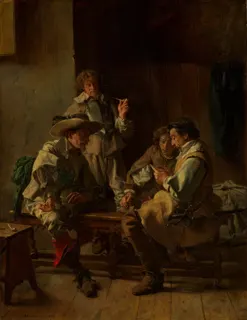
 The Gamblersby Nikolai GogolA card-sharp with a marked deck he calls Adelaida Ivanovna meets a gang of sharper ones.
 The Inspector-Generalby Nikolai GogolA provincial town's crooked officials mistake a penniless clerk at the inn for the government inspector they dread.
Act 1, Scene 1
A Bachelor's Room
[Alone, lying on the couch and smoking his pipe] So, when you are alone, like this, and you think things over leisurely, you do come to feel that, after all, one ought to get married. Well, really—what kind of a life is it? You live, just live, like this—it's getting disgusting. And here I have again missed my chance! And why? Everything seemed all right, too! And the marriage broker has been coming for three months! Really, I'm getting ashamed of myself. Hey, there, Stepan!
Act 1, Scene 2
Podkolyossin and Stepan
Has the matchmaker been here?
No, sir.
Did you see the tailor?
I did.
Well, is he making my frock-coat?
He's working on it.
Has he done much on it?
Well, considerable. He's started on the buttonholes.
What do you say?
I say, he's started on the buttonholes.
Well, didn't he ask what your master wanted a frock-coat for?
No, he didn't ask.
Maybe he asked if your master was about to get married, eh?
No, he didn't say anything.
Well, did you see other frock-coats in his shop? He has many customers, hasn't he?
Yes, sir. I saw many frock-coats hanging there.
I guess, though, my cloth is of better quality than the others, eh?
To be sure, yours looks somewhat better.
What do you say?
I say that yours looks somewhat better.
All right. But didn't the tailor make some remark about the superior quality of my cloth?
No.
Maybe he did hint that your master means to get married? Now, didn't he?
No, he didn't hint at it.
But you told him that I was in the Government service, and what position I hold?
That I did.
Well, what did he say then?
He said he'd do his best.
All right, you can go now.
Exit STEPAN.
Act 1, Scene 3
[Alone] Now it is my opinion that a black frock-coat looks a bit more dignified. Colored ones—well, that's more for the smaller fry—for a clerk or some such. Those of a higher rank should observe, so to speak, the . . . eh, what's the word? Can't think of it—and a good word, too—clean forgotten. Well, old boy, say what you will, but a Privy Councillor—ranking with a Colonel, if you please, even if his uniform is without epaulets. Hey, Stepan!
Act 1, Scene 4
You didn't forget to buy me shoe-blacking, did you?
I bought it.
Where did you buy it? Did you go to that little shop that I told you about—on the Voznessensky Boulevard?
Yes, sir, that's where I got it.
Well, is it good stuff?
Pretty good.
Have you cleaned my boots with it?
I have.
Well, did you put a good shine on them?
They shine all right, fine stuff.
Tell me, when you bought the blacking, didn't the man ask why your master wanted such fine stuff?
No, he didn't ask.
Didn't he remark that your master was perhaps thinking of getting married, eh?
No, he made no remarks.
Well, all right, you can go!
Act 1, Scene 5
[Alone] Of course, may seem unimportant—boots, just a pair of boots, but when you consider that if they are badly made—if they don't fit just right, or maybe some vile blacking on them—why, what respect can you command in good society? None at all! . . . And if you have corns to boot,—why, it's simply awful! I'm ready to suffer anything, God knows! But save me from corns. Hey, Stepan!
Act 1, Scene 6
Yes, sir?
Did you tell the shoemaker that your master had corns?
I did.
Well, what did he say?
He said: "All right."
Exit STEPAN.
Act 1, Scene 7
If you consider it well, it's a bothersome thing, after all, this marriage business! It's this and that and something else again—and seeing to it that everything is just right. No, the devil take it, it isn't as simple as it looks. Hey, Stepan! [Enter STEPAN.] I wanted to tell you . . .
The old woman is here.
Ah, she's come! Call her in. [Exit STEPAN.] Yes, it isn't so simple . . . it's something . . . not so easy.
Act 1, Scene 8
Ah, good morning, good morning, Fyokla Ivanovna! Well, what now? How is it? Here, take a chair, sit down, and tell me everything. Well, how now? how is it? How is she—eh, what's her name—yes, Melanya? . . .
Agafya Tikhonovna.
Yes, of course, Agafya Tikhonovna. To be sure, some lass of forty, eh?
Oh, no, sirree! You'll see—when you are married you'll thank me every day for it.
You are fibbing, Fyokla Ivanovna!
Too old for that, my dear. I ain't lying. Only curs lie!
But the dowry, eh? How about the dowry, that's the question. Come, tell me again about it.
The dowry—I've told you: A brown-stone house, my dear, two stories high, mind you, and profitable, that's what! A real pleasure, that's what one gets from it. The grocery man alone pays seven hundred rent for it; and the saloon in the cellar draws a big crowd, too. And two wooden wings, mind you, that's what! One entirely of wood, the other on a stone foundation—and each brings in about four hundred in rent, that's what! And there is also an orchard in the Viborg district. It's rented for three years to a merchant—grows cabbages—that's what! And such a good man, too, the merchant, he is! Never a drop does he take, that's what! And three children he has raised, sons. Two already married, and the third, why, "the third," he says, says he, "he's young yet, let him help in the grocery," he says. That's what! "I'm old," says he, "let him help with the cabbage," he says, "will be a bit easier for me,"—that's what!
But how is she? What does she look like?
Beautifool! That's what! Peaches and cream, such a complexion! And sweet! Words can't describe it, that's what! Well, well, you'll have nothing to complain of, never fear, you'll be more than satisfied! And you'll tell everyone, friend and enemy, that you are satisfied. "Well, well," you'll say, "that Fyokla Ivanovna, I have cause to be thankful to her." That's what!
But, after all, she has no rank, though!
Daughter of a well-to-do merchant, my dear! And such a one: fit for a general, that's what! She won't look at any merchant, though! "My husband," she says, says she, "even if he ain't handsome, he must be of the nobility!" Yes, sir, that's what! A grand one, all right, all right. And on a holiday, when she is all dressed up in silk, just fit to kill, that's what! By God, it just makes zhoo-zhoo all the time, just a pleasure, that's what! A reg'lar duchess, she is, all right, all right!
You understand, of course, why I am asking you, don't you? Don't forget I am a man of rank, a Privy Councillor, you know. Well, you understand . . .
To be sure, to be sure, why shouldn't I understand? But we've had a Privy Councillor for her,—refused him, that's what! Didn't please her! Nice looking he was, too, very dignified, but a queer way he had about him: every time he'd open his mouth, out came a lie. Guess he couldn't help it—the good Lord made him so, I fancy. Just couldn't help it, that's what. Not a word that wasn't a lie. God's will, I guess.
But haven't you got someone else, some other lady?
What d'you want another one for? She is the very best of the lot.
Now, now! Really the very best?
You'd go further and fare worse, s'help me! That's what!
Well, I shall think of it, I'll consider it, my good woman. Come to see me again day after tomorrow. We will then talk a little more about it. Just like this, you know: I'll lie here on the divan, and you will be sitting there, just where you are now, and you will be relating . . .
Merciful God! Why, my dear, here it's nigh three months that I am coming to you and telling you and 'lating to you, and not a bit of use all this time. Sits there half-dressed, puffs at his pipe all the time, and that's all. What's the use, then? That's what, my dear!
Well, do you think marriage is such a light matter? Like calling Stepan there to get my boots, put them on and be off, eh? No, my dear woman, one must consider the matter well, weigh it on all sides and think over it.
Well, what of it! Of course, you must think it over and have a good look at it. That's what the goods are there for, to be looked over! Well, why not take a look at it right now? Tell Stepan to hand you your coat—it's a nice morning—we'll go and look.
What, now! Right now! But—no, don't you see it's a bit cloudy. I might start out, and then suddenly it might rain, and I'd get wet all over.
Oh, you! The worse for you! Look here, man, you have no time to lose: I can see the grey hair on your head, and soon you will not be fit any more for the marriage business. A Privy Councillor! Not such a big cheese. I can find better men for the bride, that's what!
What nonsense are you talking there! What d'you mean by saying there is a grey hair in my head, eh? Nothing of the kind! [Feels at his hair.]
Why shouldn't there be a grey hair! Man lives and grey hair will come, that's what! You needn't be so touchy, either! And not so pertic'ler! This one don't suit him, and that one won't do—what d'you want, anyway? Why, I have a Captain in view, a real Captain, some man, I tell you—you don't come up to his shoulder, that's what! And his voice—got a voice like a river-boat. A real man, that's what!
You are lying—I'll just take a look at the mirror—pure invention that I have a grey hair! Hey, Stepan, there! Bring me the mirror. No, no, wait, I'll go and look myself. The idea! A grey hair! Why, God forbid, that's worse than the pox! [Goes into the other room.]
Act 1, Scene 9
[Rushing in] Podkolyossin, hey, where are you! [Noticing FYOKLA.] What, you here?! What do you want here, eh? Say, you! Why the deuce did you ever marry me?
Well, why not? What's wrong about it? You did the right thing.
Right thing, indeed! Wonderful thing—a wife! I'd do better without one!
Then why did you insist? You kept begging me: marry me, little gran'mother, marry me! Didn't ye?
You old hag, you! How you talk! And now, what are you doing here? Can it be that old Podkolyossin wants to . . .
Why not! God has sent a blessing . . .
What! Really? Ah, the scoundrel, never a word to me! Just think of it, not a word to me! Secretly, eh?
Act 1, Scene 10
Enter PODKOLYOSSIN, carrying a hand-mirror. Absorbed in examining his hair.
[Stealing up from behind, frightens him] Humph!
[Startled, drops the mirror] Madman! Why—what do you mean, are you crazy! Such a trick; Why, you've scared me so, my heart has stopped beating.
All right, never mind, it was just in fun.
Fine fun! Why, you've frightened me out of my wits. And look at the mirror—smashed to pieces! You thought it was a gift, huh? An expensive thing—imported from England.
Enough, now! I'll get you another mirror.
Yes, you will! I know those other mirrors, those cheap things: one looks ten years older in them, and all out of shape.
Listen, old boy! It's me that ought to be angry with you. To think that you are hiding it from your best friend! Getting married, aren't you!
Nonsense! Never thought of it!
There's the evidence! [Pointing at FYOKLA.] There she is—we know the bird! Well, well, all right! After all, nothing wrong about it. A Christian duty; even necessary for the fatherland. It's all right, old man, just leave it to me, I'll manage the business. [To FYOKLA.] Now, speak: how and what and so forth. Of the nobility—daughter of a merchant—or what? What's her name?
Agafya Tikhonovna.
Agafya Tikhonovna Brandakhlistova?
Oh, no—Kuperdyagina.
Lives in the "Six Store" Street, eh?
Wrong again. It's nearer to the Peski, in the Soapy Alley.
Sure thing! That's it! Right back of the grocery, wooden house.
It ain't back of the grocery—it's behind the saloon, that's what.
How, back of the saloon? Where's the saloon?
Well, it's this way: you turn into the alley and you face the shed. After the shed, you just turn to the left and there it is. That is, there is the wooden house, kind of frame building, you understand. That's where the seamstress lives, the one that had the Senator's secretary, you know. You don't need to go to the seamstress, but right back of her is the other house, stone one. That's the house, that's where she lives, Agafya Tikhonovna, I mean, the bride.
Fine! Now I'll attend to everything. And you—you go now, no use your hanging around here. We don't need you any more.
What d'you mean? Don't need me, indeed! You ain't going to fix the marriage yourself?
Sure I will! Don't mix in any more.
The shameless thing! Why, that's not a man's business. Now, leave it alone, will you?
Go on now, go! You don't understand anything in these matters. Get out now!
Robber, that's what you are! Stealing a piece of bread out of my mouth, that's what! Such meanness! If I had known it before, I wouldn't have told him a thing! [Exit in high dudgeon.]
Act 1, Scene 11
Well, my boy, this is not a matter that can wait. Come, we'll go now.
But—why, I haven't yet—I've only been thinking . . .
Nonsense, nonsense! No fooling! I'll marry you so quick you won't know it. We go right now to the bride and everything will be settled in a jiffy.
How you talk! The idea of going right away!
What's the difficulty? Why not go at once? Look here, man, see what your bachelor life is like. Just take a look at this room; what disgusting disorder! There is a dirty boot, just lying around like that! And here is the washstand, and a pile of tobacco on the table, and you yourself lying around all day on that divan, just lazying your time away. Is that the way to live? Now, just tell me!
Well, it's true, of course. I know there is no order here.
That's it! Now, when you'll have a wife, you won't know yourself any more. It will all be different. The couch will be here, a little puppy near-by, a song-bird in a cage, a lady's work-basket. . . . Just imagine, you will sit here on the divan, and all at once a sweet little dove of a wife will be near you, right at your side, and her hand, her sweet little hand, will . . .
Ah! Really, you know, when I think of it, how delightful a woman's hands can be—why, you know, just like cream . . .
Only hands! Why, boy, as if they have only hands! . . . I tell you, man. . . . What's the use: what haven't they got!!
And to tell you the truth, I would just love to have some sweet one beside me.
Well, you know it all yourself. . . . Now, there is nothing more to be done than to arrange things. Don't worry about anything. Just leave it to me—the wedding feast and everything else, I'll attend to all that is necessary. Of course, champagne, no less than a dozen bottles—no, sir, can't do with less,—don't contradict, now. Madeira, also, at least half a dozen. And the bride, no doubt, has a heap of aunts and relatives—you must consider that, you know; we must do it on the proper scale. Rheinwein?—Ah, no, let that go, don't need it. But about the dinner—well, just be easy on that score. I know a caterer that supplies the Court—I tell you that fellow will give us such a feed, it will just make you burst.
Why, man, you are rushing matters as if there was really going to be a wedding.
Of course there is! Why not? And why delay matters? You are agreed, aren't you?
I? Well, no, I am . . . well, not entirely.
I like that! Why, you've just said yourself that you are willing.
I only said that it wouldn't be a bad thing.
What's the matter with you? Why, the whole thing was almost arranged, and now all of a sudden. . . . Don't you like married life?
Of course, it would be nice.
Well, then, what's the trouble? What's the obstacle?
No obstacle at all, only it is a bit strange. . . .
Strange! Nothing strange about it!
It is strange. All the time unmarried, and suddenly married!
Now, ain't you ashamed of yourself! No, I see I must speak earnestly with you. I'll talk to you like a father. Now, look at me, just look at me, straight in the face. And now take a look at yourself, just as you look at me. Well, what are you, what do you amount to? Nothing! A mere nothing, you are just a flea. What do you live for? What purpose and meaning is there in your life? Just tell me that! Take a look at yourself in the mirror: What do you see there, eh? A fool, that's all! But think—you will have a bunch of kids about you—who says two or three! Why, may be six, half a dozen of them, and all of them will resemble you—just think!—like two drops of water! Now you are alone, a Privy Councillor or some Secretary or something, whatever you are, and what of it? But then there will be a whole brood of little secretaries all around you, little kiddies all over the house, and one pretty one will crawl all over you, and with his little baby fingers he will pull at your side-whiskers and you will bark like a puppy: Wow, Wow, Aw, Aw! Just like that! Is there any greater bliss than that, now, tell me!
But they are noisy little scamps—they will break things and even mess my papers up.
Let them play around, man. The main thing is that they all resemble you! That's the point!
That's funny, you know. Really: just a wee bit of a thing, a little puppy, and already resembling you.
Funny! I should say it is! Well, then, let's go to her.
Y-e-s, all right.
Hey, Stepan, help your master dress! Quick!
[Dressing in front of the mirror] I think—I ought to put on my white waistcoat.
Nonsense. It doesn't matter.
[Putting on the collar] Damn that laundress—the collar won't stand up right. You tell her, Stepan, that if she can't do better I'll hire another one. She probably spends all her time with her lovers instead of tending to the work.
Hurry, man, hurry a bit!
Just a moment now. [Puts on his frock-coat and sits down.] Listen, friend—you know what? You better go yourself.
What now? Are you crazy? I should go? Who is going to marry her—you or I?
Somehow I don't feel like going. . . . Maybe tomorrow.
You're out of your senses! I ask you, are you an idiot? All ready to go, and now all of a sudden changing your mind. I say, if you act like that, you are a pig and a scoundrel, that's what you are!
What are you calling me names for? What for? What have I done to you?
You're a pig, a fool, an imbecile! Everybody will tell you that! Just an imbecile, even if you are a Privy Councillor. Here I am trying my best for you, and you—— Why just sprawling on the couch, damn it. Fool, what are you looking at me for? You're just a blockhead, a . . . I'd call you . . . well, I don't want to be indecent, but you are an old woman, worse than an old woman!
How you talk! [Lowering his voice.] Here is my servant and you use such language to me in his presence. Have you no consideration?
Consideration! After letting a fellow down like this, who could help calling you names? You have decided to get married, like a decent man; you've listened to reason. And suddenly it's no, without any rhyme or reason, just out of stubbornness, like some wooden Indian. . . .
All right, all right, stop it. I'll go. What are you shouting for?
"I'll go!" Of course, you'll go; what else is there to be done. [To STEPAN.] Give him his hat and coat!
[At the door] You are such a queer fellow. Can't say a word to you but what you call me names. You have no manners at all.
It's all right now. Let's go. [Exeunt.]
Act 1, Scene 12
A room in the house of AGAFYA TIKHONOVNA. AGAFYA TIKHONOVNA is telling her fortune with cards. Her aunt, ARINA PANTELEYMOVNA, is near her.
Again, auntie, a journey. The King of Clubs is in it! . . . oh tears . . . and . . . a love letter to the left, the Jack of Spades, also interested, but some villainous woman is in the way. . . .
Who can that King of Clubs be?
I don't know.
I know who.
Who, then?
Who else but that good merchant, Alexei Dmitrovitch Starikov, the one who sells cloth.
No, I am sure it's not him. I'll bet it ain't.
Don't be stubborn, Agafya Tikhonovna. Isn't he red-headed? There is no other King of Clubs.
No, it can't be. The King of Clubs here must surely be of the nobility. How can it be a merchant? It's a far cry from a merchant to the King of Clubs.
Ah, my dear, you wouldn't have talked like this when your good father was alive,—may the Lord bless his memory. Your father was a man, a true man, my dear. Did he care for the nobility? Not he! Remember how he'd strike the table with his big fist and thunder, "I don't give a red copper for anyone who's ashamed of being a merchant!" "Never will I give my daughter even to a Colonel," he'd say; "let others do it, but I won't, never! And I won't give my son to the army, either!" That's how he talked! "What!" he'd say, "don't a merchant serve the Tsar as well as others, eh?" And his fist would come down upon the table, you'd think some artillery was hitting it. A fist, I tell you, like a hundredweight, and temperamental,—just look out! To tell the truth, your dead mother might still be among the living if he hadn't been so free with his big fist.
God forbid I should have such a bad-tempered husband. No, never will I marry a merchant!
But Alexei Dmitrovitch isn't like that at all.
I won't have him! I won't have him! He's got a beard: when he is eating, everything must be running down his beard. Fie! No, I don't want him, I won't! Never!
But it ain't so easy to find a good husband among the nobility. They ain't picked up on the street, you know.
Fyokla Ivanovna will find one all right. She has promised to get the very best one for me.
Fyokla, indeed! Such a liar!
Act 1, Scene 13
Ah, Arina Panteleymovna, it's a sin for you to talk like that behind my back.
Oh, is that you, Fyokla Ivanovna! Tell me, quick, what's the news? You got something, yes?
Sure, sure, my dear, but first let me catch my breath. How you rush me! I have been working for you all right, my dear. Where haven't I been? How many places haven't I visited, private houses, and offices, and the ministries, and what not. And do you know, one old hag of a woman almost beat me up. That old shrew that married the Aferovs, why, she threatened me: "You so and so," she raved at me, "you such and such a one, you're taking my business away, and you'd better keep to your own quarter of the city!" "I will do all I can for my young lady," says I to her, that's what I did, straight to her face! That's what, And what a fine lot to select from I've brought you, my dear. The world was created a long time ago, dearie, but such bridegrooms there never was before, that's what! This very day they'll be here, and I've just run in for a minute to have you get ready, my dear.
Not today? Dearest Fyokla, I'm afraid!
No cause to fear, child. They won't hurt you. Just a domestic matter: they'll come, they'll take a look, and that's all. And you'll look them over, too: if they won't please you, well—let them go back, that's what.
Well, did you really get good ones?
How many of them?
About six of 'em.
[Cries out] Oh, my!
What, dearie, don't be frightened. More to choose from: if one won't do, another will.
But are they of the nobility?
Every single one of 'em. Noblemen—all of 'em, such noblemen there never was before, that's what.
What kind, then; tell me.
Splendid ones, all very good and proper. The first, Baltazar Baltazarovitch Zhevakin, a sweet one, served in the navy. Just the man for you! He says he wants a bride that's a bit buxom, he don't like 'em hungry-looking, no skinny ones for him. And Ivan Pavlovitch, that's the one in high civil service, oh, he's a gentleman of importance, one can hardly get to him. Himposing looking, that's what he is, and well fed all right. He ain't no common folk, sure, my dearie. You should have just heerd 'im shout at me: "Don't you give me any gaff about the bride being so and so. No nonsense, woman! Ye jest tell me what she's worth—how much cash there is in it, and real estate." I tell 'im, so and so much. "Ye lie, ye beast," he thundered, and you know, my dear, he switched in such cuss words, it's indecent to repeat 'em to you. I knew at once that he's some person of importance, that's what!
Well, and who else?
There is also Nikanor Ivanovitch Anutchkin, a delicate one, he is, and lips!—my, I tell you, lips like raspberries, ready to eat. Nice man, very. "Give me," he says, says he, "a bride that's good-looking, well brought up, and must speak French." That's what! Yes, my dear, there's one for you, fine as silk, and feet—oh, the sweetest feet, so small and narrow, wee ones . . .
Oh, his feet! No, I never cared for those fine ones with small feet. Not to my taste somehow.
If you like something more solid, so t' speak, then take Ivan Pavlovitch. A better one would be hard to find. No use talking—that's a gentleman all right, all right: he'd hardly squeeze through this door, he's so grand.
How old might he be?
Oh, he's quite young yet: about fifty and maybe not that much.
What is his name?
Ivan Pavlovitch Omelet.
Is that a name?
His name.
Oh, Lord, what a name! Why, Fyokla dear, if I should marry him, suddenly my name would be Agafya Omelet, Mrs. Omelet! Oh, my! Never, never!
But my dear, what's in a name! Believe me, there are worse names in the world. Why, there are names that just make you feel like spitting out and crossing yourself, that's what! But, after all, if you don't find the name to your taste, then take Baltazar Baltazarovitch Zhevakin. None better, my dear.
What kind of hair has he?
Nice hair.
And his nose?
Nose also good. Everything in its place, my dear. Nothing wrong and nothing missing, believe me. Only that . . . well, in his rooms there is just . . . well, there is nothing there, clean as a whistle, only an old stove pipe there, not a stick of furniture.
Whom else have you?
Akinf Stepanovitch Panteleyev, a man of rank—he stutters a bit, but otherwise splendid and very modest in his demands. A high officer.
Oh, all you do is spout about officers, official rank. All nonsense! Does he drink, that's the question. Tell us that!
Drink? Well, I won't lie, he drinks a bit, of course. What high government official don't drink! But he is as quiet as a lamb, I assure you.
No, I won't have a drunkard!
As you wish, my dear. Don't like one, take another. Plenty to choose from. But, between us, what if a man takes a drink now and then! An' perhaps a bit too much. He ain't drunk all the week round, is he? Some days he is sure to be sober.
Anyone else?
There is . . . but he's such a . . . Let 'im be. These are better.
But who is he?
I don't care to talk about him. It's true, he's a titled one, a Privy Councillor, but you won't raise him with a crowbar: can't pull him out of his house.
Who else is there, then? You said there were six, but you mentioned only five.
Ain't you got enough with five, my dear? A minute ago you were scared at so many, and now—you're a brazen one!
What good are they all, these titled ones of yours, even if there are six of them! One good merchant is better than all of them.
Ah, no, Arina Panteleymovna, you're wrong there! A nobleman is a nobleman; you can't compare a mere merchant with a man of title and rank. A nobleman's more respectable, sure enough.
Respectable, fiddlesticks! Look at Alexei Dmitrovitch, a merchant, but that's a man for you! What expensive furs he wears, a fine sleigh, and blooded horses . . .
But a man of rank will meet him, raise his shoulders with the big epaulets on them—like this—and say: "Hey, you, swine of a merchant, turn out of my way!" That's what! Or he'll say: "Now, you pig, show me your finest plush goods," and the merchant will bow low, "Yes, sir; yes sir, if you please, sir." And the nobleman will say: "You stupid, take your hat off before your betters!" That's what!
But the merchant, if he is so minded, will refuse to sell and won't give your nobleman the cloth. And your nobleman will remain as naked as his mother bore him.
And the nobleman will out with his sword and cut the merchant in two.
And the merchant will report him to the police.
And the nobleman will go to the Mayor.
And the merchant will go to the Governor.
And the nobleman . . .
You're a liar! The Governor is higher than the Mayor—don't tell me, now! Nobleman, nobleman! A fig for your nobleman! Don't he also pull his hat off before . . . [Loud bell outside.] Someone's ringing.
My, my,—that's them!
Who, them?
Them—some one of those five.
[Jumping up] Oh, my!
Good Lord, why, the room isn't in order! [Excitedly runs about the room, snatching a thing here and there.] The napkin, the napkin! That dirty napkin on the table! Dunyashka! Dunyashka! Quick! [Servant girl appears.] Hurry! A clean napkin! [Grabs the napkin off the table and rushes about like one possessed.]
Oh, auntie, what am I to do? I have nothing but my shirt on!
Run quick, my dear, and dress. [Rushes about the room. DUNYASHKA brings a napkin. The bell rings again.] Hurry, Dunyashka, tell 'em, "Just a minute!" [DUNYASHKA shouts through the door: "Just a minute!"]
Auntie, dear, my dress isn't ironed!
The Lord have mercy! Put something else on!
[Running in] Why don't you come! Agafya Tikhonovna, quicker, dearie! [Another ring.] My, my, he's waiting!
Dunyashka, let him in and ask him to wait a moment.
DUNYASHKA runs out into the corridor and opens the outside door. Voices are heard: "At home?" "Yes, sir, please step in." The three women all struggle to get a look at the visitor through the keyhole.
Oh, he's so fat!
He's coming, coming in, all right.
All rush out of the room pell-mell.
Act 1, Scene 14
Please wait here. [Exit.]
Well, I can wait a moment—but not very long. Left the Department just for a second. What if the Chief should suddenly take it into his head to ask for me. "Where is he?" "Went to look a bride over." He'd give me a bride, all right! But I must examine the matter again. [Takes a paper out of his pocket and reads.] "Stone two-story house." [Raises his eyes, observes the room.] Correct! [Continues to read.] "Two wings: wing on stone foundation, wing wooden. . . ." Well, the wooden one is pretty rotten. "A chaise, a sleigh with hand-worked design. . . ." Probably old junk. But the old woman asserted it was good stuff. Well, maybe, we'll see. "Two dozen silver spoons. . . ." Of course, silver spoons are needed in married life. "Two fox furs. . . ." Hm! "Four large quilts of down, two small ones. . . ." [Makes a significant grimace.] "Six silk dresses and six cotton ones, two nightgowns and two. . . ." Well, that's nothing! "Linen, napkins. . . ." Well, that's in the woman's line. But it will all have to be counted all right. Now they promise, of course—house, and carriage and so on, but when I am married I may find only the quilts and nightgowns. [Bell rings. DUNYASHKA rushes in and runs across the room into the corridor. Voices: "At home?" "Yes, sir."]
Act 1, Scene 15
Wait here, please. They'll be here immediately.
Exit. The newcomer, ANUTCHKIN, bows to OMELET.
'Morning!
I presume I have the honor of meeting the father of the young lady?
Nothing of the kind! I have no children.
Beg your pardon, beg pardon!
[Aside] This fellow's mug looks somewhat suspicious to me. Wonder if he isn't here on the same business as myself. [Aloud.] I suppose you have come to call on the young lady?
Well, that is . . . I mean . . . I have been out for a walk and I have just dropped in.
[Aside] Liar, filthy liar! Out for a walk! He wants to marry her, the scoundrel!
Bell rings. DUNYASHKA runs across the room to open the outside door. Voices: "At home?" "Yes, sir!"
Act 1, Scene 16
[To DUNYASHKA] Please, dearie, brush me off a bit. . . . Such a dusty street. . . . There, on my sleeve, pick that off. [Turns around.] Good! Thanks, dearie. Ah, brush off the back a little, please. Feels like some insect. Is there, dearie? Thanks, thanks. Here a bit yet. [Tries to pull down his short sleeve, the while observing ANUTCHKIN and OMELET.] Fine English cloth, you know. And how it wears! 'Twas in '95, when our squadron was in Sicily, myself a marine then, I bought this cloth and made me a uniform out of it; in '801, under Tsar Paul, I was made a lieutenant, and the cloth was as good as new yet. In '814 we circled the globe, and the stuff held out, only the seams got loose a bit. In '815 I was pensioned, and, just had the thing renovated, and now it's ten years since and still it's almost like new. Thanks, dearie, my little beauty.
Waves his hand to DUNYASHKA, then goes to the mirror, and smoothes his hair.
Permit me to ask . . . you mention Sicily—what kind of a country is it?
Wonderful! We stay 34 days there, and I kin tell you the country is grand. What mountains, and the woods, real pomegranate, and everywhere Italian wenches, little roses they are, sweet things, you just want to kiss 'em.
And are they educated?
I should say they be! Educated like our countesses. Often, when out for a constitutional—well, you know, a young lieutenant, here epaulets [indicating his shoulders] gold braid, and those black-eyed vixens—you know—every house there has a little balcony, or verander, and the roofs are flat, just like this floor here—so, you just strut along the street, and there sits one of them beauties. . . . Naturally, of course, you don't want to appear like a boor. . . . [He makes a bow and waves his hand] but she just so. . . . [Makes slight motion with his hand.] She's of course dressed like a lady—some silk thing, light stuff, almost see through, feminine pretty things, ear-rings . . . well, just made to bite into. . . .
Permit another question, sir: what language do they speak?
All speak French in Sicily, naturally.
Really, every young lady speaks French?
No exception. You'll hardly believe it—it sounds so strange, but we stayed there 34 days, and in all that time we didn't hear a word of Russian. Think of it!
Not a word?
Nary a word. And I'm not speaking of their noblemen and signors and other such officers of theirs. Just take the common man there, some filthy fellow that carries about all kinds of stuff on his neck, and just say to him: "Give us some bread, good man." He won't understand—I swear to you, he won't. But tell him in French: "Dateci del pane" or "portate vino!" he'll get you, sure enough, and he'll run and fetch it right, every time.
Interesting country, that Sicily. But tell me, friend, how about the peasant there? What is he like? Like the Russian muzhik, is he? Broad of shoulder and tills the ground? Or doesn't he?
That I cannot tell you—whether they till the soil or not—I didn't notice it. But about tobacco snuffing, that I know. Not only do they all snuff it, but they actually stuff it into their mouths! All of 'em! Another thing, travelling is cheap there: it's all water there, almost everywhere, and gondolas all around and about. . . . Naturally you see in them a sweet little bouquet of an Italian dame—just a waist and a kerchief on! . . . We had with us also some English officers: people about the same as we, sailors, but it was funny at first, couldn't understand each other. But by and by, we got to know each other and we freely understood their lingo. I'd just point to a bottle, for instance, or to a glass—well, quick as a flash he knows it means a drink. Or I'd put my bent palm to my lips and make: pough, pough—he'd be on to it that I want to smoke a pipe. On the whole I can say 'tis an easy language, theirs. Our sailors learned to understand 'em in less than three days.
Indeed, I see it's an interesting country. It's splendid to travel in foreign lands. I am pleased to meet a man of your great experience. Permit me to ask, sir, with whom have I the pleasure?
Zhevakin, sir, retired Lieutenant of the Navy. Permit me also to inquire, with whom have I the happiness to . . .
Privy Secretary, Ivan Pavlovitch Omelet.
[Not having heard well, misunderstands] Yes, I've also had a bite. Was a bit cool—I took a snack, some herring and bread.
Pardon me, you've misunderstood. It's my name, Omelet.
Beg pardon, sir, I'm a little hard of hearing. I really thought that you said you had some omelet for lunch.
It's a nuisance, of course. I've been thinking of getting permission to change my name to Omeletson, but my friends tell me it will sound like . . .
That happens, that happens, sure thing. Our whole third squadron, all the officers and sailors, had the funniest names ever! One was called Swill, another Pusher, and a midshipman we had, and a good midshipman he was, too,—his name was Hole, and the Captain would have his fun with him and call him, "Hey, there, where is that Hole!" Or he would say to him, "Oh, what a Hole you are!"
Bell ringing in the corridor. FYOKLA hastens across the room to open.
Ah, good woman, are you here?
Good morning, little mother!
Good morning, Fyokla Ivanovna!
[Running on] Thanks, thanks, my good men, I'm well, thanks!
Door is heard opening. Voices: "At home?" "At home." Then several whispers, to which FYOKLA replies: "What a man you are!"
Act 1, Scene 17
Enter KOTCHKAREV, PODKOLYOSSIN, and FYOKLA.
[To PODKOLYOSSIN] Just keep your nerve, that's all. [Looks somewhat surprised at the many people present. To himself:] Hell, what a crowd! What do they all want here, I wonder! All candidates? [Nudges FYOKLA, whispering to her:] Where did you collect all this riff-raff, eh?
[Speaking low] How you talk! Riff-raff! All honest men, that's what!
[To FYOKLA] Guests a-plenty, all down at the heels!
[To KOTCHKAREV] Yosself a bum: fine feathers and no meal-ticket.
[To FYOKLA] Your fine guests: pockets full of holes! [Aloud.] Well, what is she about, now? This door leads to her chamber, I bet! [Approaches the door.]
You shameless thing! I tell you she's dressing.
Well, what of it! No harm, I just want to take a peep! [Looks through the keyhole.]
Permit me . . . my curiosity. . . .
Give me a look, too.
[Remaining at the keyhole] There's nothing to be seen, gentlemen. Can't even tell if that white is her or the pillow.
All besiege the door and strive to get at the keyhole.
Sh—sh! Someone coming.
All withdraw from the door.
Act 1, Scene 18
Enter ARINA and AGAFYA. All bow.
Gentlemen, to what do we owe this pleasure?
Madam, I've seen your advertisement in the papers about your offer to supply lumber, and being in the fuel department of the Civil Service, I have come to inquire the kind of lumber you have, what price and quantity, and when you can deliver the goods.
Some mistake: we do not deal in lumber, but we are glad of your visit. What's the name?
Privy Secretary, Ivan Pavlovitch Omelet.
Please be seated. [Turning to ZHEVAKIN.] Permit me to ask . . .
Me, too . . . I saw the ad in the papers, about something. Thinks I, why not go and take a look? Fine weather, the road all covered with grass. . . .
What name?
Navy Lieutenant, m'am, retired, Baltazar Baltazarovitch Zhevakin II. There was another Zhevakin in our squadron, but he left the service long ago: was wounded, you know, right below the knee, and would you b'lieve it, such a funny wound, the shot never touched the knee bone but just went through the vein, clean as a whistle—but it was funny when you stood near him, it seemed as if he was about to kick you from behind with his knee.
Please be seated. [To ANUTCHKIN.] To what cause. . . .
A neighborly visit, madam. I live right here, nearby, that is, not very far. . . .
Perhaps in the house of the merchant-widow Tulubova, right opposite here?
No, at present I still live at the other end of the city, but I've been thinking of becoming your neighbor by moving into these parts. . . .
Please be seated. [To KOTCHKAREV.] Permit me to inquire. . . .
Why, don't you really recognize me? [To AGAFYA.] And you, Miss?
Seems to me I have never met you before.
Just try to remember: you've surely seen me before.
Really, I don't know. Or perhaps it was at the Birulins'?
Sure enough, at the Birulins'.
Oh, do you know the awful thing that happened to her?
Of course, she got married.
Well, that would not be so terrible. But she broke her leg.
A very serious break, too. She was coming home pretty late one evening, in a cab. The driver must have been drunk: upset the cab.
Yes, yes, I do remember something happened to her. She got married, or broke her leg, or something.
And your name, please?
Why, Ilya Fomitch Kotchkarev, and we are relatives, at that. My wife is always speaking of. . . . Permit me, ladies. [Takes PODKOLYOSSIN by the hand and introduces him.] My friend, Podkolyossin, Ivan Kuzmitch, Privy Councillor, an expert in his line.
What's the name?
Podkolyossin, Ivan Kuzmitch, madam, Podkolyossin. His Chief, the Director, is just a figurehead, put there because of his rank. But it's Podkolyossin that attends to the entire management of the department, a fine head.
Really? Please be seated.
Act 1, Scene 19
Enter STARIKOV
[Bows quickly and energetically, merchant style, and lightly places his arms akimbo] Good morning, morning, my dear Arina Panteleymovna! The boys at the Inn were telling me that you wanted to sell some wool, little mother.
[Turns away in disgust, saying in low voice, but so that he can hear:] Thinks he's in a store!
What's the matter, eh? What's wrong? Business settled already, what?
Please, Alexey Dmitrovitch, though we don't have any wool to sell, you are welcome, just the same. Please be seated.
All are seated. Silence.
Strange weather we're having these days. Looked like rain this morning, but now seems to clear up a bit.
Yes, this weather is quite unbearable: sometimes it's clear, and again it's rainy. It's a nuisance.
In Sicily, ladies, it's different. We were there with our squadron in the spring, or what is spring there: more or less February in our part of the world. Well, I'd go out of the house, and the sun would shine warm as you please. Yes, sir. And then a bit rainy; that is, if you look sharp, then it seems just like rain.
It's most unpleasant to be alone on such a day. For a married man it's an entirely different matter—no lonesomeness for him. But if you are alone—well, it's simply . . .
Why, it's death; no better than death!
Y-e-e-s, one may say as much. . . .
It's the deuce, that's all: purest torture. God save one from such a position.
What might be your taste, my dear young lady? Suppose you were to choose and decide. Pardon me for being so straightforward, but, let us say, for example, . . . in what service would you prefer your husband to be?
Would you prefer, miss, to have your husband familiar with the storms of the sea?
No, no! In my opinion the best husband is the man who alone manages the whole department.
Why such preferences? A man is not to be sneezed at who has been in the infantry, but who knows how to appreciate the usages of better society.
Dear miss, won't you please tell us your decision?
Answer them, my dearie; tell 'em something.
How, now, young lady?
What is your opinion, Agafya Tikhonovna?
[Whispers to AGAFYA] Speak up, dearie. Say, "Thank you," or "With pleasure," or something. It ain't nice to sit so.
[Low] I'm ashamed, ashamed! I'll go away. Auntie, you sit for me.
How can you, dear? Don't disgrace yourself by leaving now. They might think something.
No, I can't stand it! I'll go, I'll go!
She runs away. FYOKLA and ARINA leave after her.
Act 1, Scene 20
Well, I'll be blasted! Now they're all gone! What does it mean?
Something must have happened.
I guess something about the lady's toilet. . . . You know, things will happen . . . necessary to pin something or other . . .
Enter FYOKLA. All besiege her with the question, "What is it? What happened?"
What's the matter? Something gone wrong?
Nothin' gone wrong! What could go wrong?
Then why did she leave?
You've made her ashamed, that's what! Got confused, she did, the poor thing. Begs you to pardon her and invites you for a cup of tea. [Exit.]
[Aside] How I hate those cups of tea! A nuisance, these ceremonies all are! Today they can't; come tomorrow; and the day after for a cup of tea, and then they must consider the matter. The deuce take it, I haven't the time for all this nonsense. Why, it's a simple matter, but they play for delay and delay. . . . I have duties, I'm a busy man.
[To PODKOLYOSSIN] Pretty, ain't she?
Not bad-looking.
Very fetching, the young lady is!
[Aside] Devil take the old fool—fallen in love, sure. Might spoil everything. [Aloud.] No, she is not attractive at all.
Her nose's too large.
Never noticed her nose. But she's peaches and cream.
Not quite the right one, I guess. I wonder if she is familiar with the customs of higher society! And can she speak French?
Why didn't you try to speak French with her? Maybe she can.
You think I can speak French? No, I regret to say, I did not enjoy the opportunity of such a superior education. My father was a scoundrel, a swine. He never even thought of having me learn French. I was a child then and it would have been easy to teach me the language—if they'd just flogged me a few times, I would have surely learned, certainly.
Well, if you don't know French, what would be the use of her speaking the language?
Ah, you see, it's different about a woman. Absolutely necessary she should know French. Without it this won't be right, nor the other thing quite, quite, you know . . . [Illustrates by gesture.] No, somehow nothing would be quite right.
[Aside] Well, let the others worry about this. I'd better go into the yard and have a look at the house and the two wings. If everything is as it ought to be, then it's no use losing time. This very evening I must have the matter settled. And these fellows—why, they don't look very dangerous to me; they have no chance with her.
Guess I'll go and have a smoke. And you, sir, are you not going in the same direction? Where do you live, if I may ask?
In the Petrovsky Alley, far away from here.
Yes, sir, that's quite a way off. Still, I think I shall accompany you.
No no, there's something rotten here! Well, well, Agafya Tikhonovna, you might think of us one of these days! Good bye, gentlemen! [Bows and leaves.]
Act 1, Scene 21
PODKOLYOSSIN and KOTCHKAREV.
What are we waiting for?
But the girl is really pretty, ain't she, now?
No, I don't think so at all.
What! How's that? You've just agreed that she was!
Something not quite right, I say. Nose too large and she don't speak French.
I never. . . . What the deuce do you want her to talk French for?
After all, the right kind of a bride should know French.
But why?
Because . . . well, I don't know why, but things won't be quite right without it.
There you go! Heard some fool say it and you just repeat it like a parrot. She's a beauty, I tell you. Beautiful—and never will you see another such.
At first I did like her myself, but when they started to say—nose too large, long nose—now I see myself that her nose is long.
You simpleton, you stupid! Don't you see that they just talked like that to scare you off? That's the way I talked to them, too. It's the custom. But I tell you she is a wonderfully beautiful girl. Didn't you notice her eyes? My, what eyes! Why, they just talk, they breathe! Her nose? Pure alabaster, that's her darling nose! Just perfect! Bethink yourself, man!
[Smiling] Now it seems to me again that she is good-looking.
Of course she is! Now, listen: now that they are all gone, let's step right into her room, explain ourselves and settle the whole thing.
Now? Never would I be guilty of such a thing!
Why not?
Why, it would be simply unheard-of impudence: there are several of us: let her have her choice.
Nonsense, man! What do you care about them! Are you afraid of their competition? You know what? I'll get rid of them all in a jiffy!
How can you do that?
Leave that to me. But promise me that you won't withdraw afterwards.
Why should I withdraw?
Your word of honor, you won't back out?
Why back out? I want to get married.
Done! Your hand!
[Gives him his hand] Here!
It's a bet!
Both go out.
Act 2, Scene 1
Room in the house of AGAFYA.
Ah, it's so hard—to make a choice! If there were one only, or even two—but from a lot of four! How can I choose? Nikanor Ivanovitch is rather pleasing, though he is too slender; Ivan Kuzmitch is also attractive. And to tell the truth, I also like Ivan Pavlovitch—a bit stout, of course, but impressive. Well, then, how can I make my selection? Baltazar Baltazarovitch is rather charming, too. Just impossible to choose! If the mouth of Nikanor Ivanovitch could be placed under the fine nose of Ivan Kuzmitch, and add to it the grace of Baltazar Baltazarovitch, and perhaps also a little of Ivan Pavlovitch's good manners, then it would be easy to make my choice. But as it is—how and whom am I to choose? Why, I've got a headache from thinking about it! I guess it is best to leave it to the Lord's will: I'll draw lots! Whatever name will come out, let him be the husband. I'll write them all on little pieces of paper, roll them up, and then—God's will be done. [Approaches the little table, produces paper and a pair of scissors, cuts several pieces and rolls them into little tubes, the while continuing talking:] A girl has such a difficult position! And particularly if she is in love. Men are not that way, and they can't even understand it. Now, they are all ready. Need only put them into my purse, mix them up, close my eyes, and—let happen what may! [Puts the pieces of paper into her handbag, and mixes them up.] I'm afraid! . . . Fearful feeling. Oh, Lord, if only Nikanor Ivanovitch would come out! No, why he? Better Ivan Kuzmitch! But . . . why Ivan Kuzmitch? He's no better than the others. What's the matter with . . . No, no, whichever comes out, him I'll marry. [Fusses with her hand in the handbag and pulls out all the names instead of one.] Ough! All of 'em at once! And my heart beats so! No, it must be one, only one. [Puts the pieces of paper again into the handbag and mixes them. At this moment KOTCHKAREV enters very quietly and remains standing behind her.] Ah, if I could draw Baltazar . . . ah, what's the matter with me—I meant to say Nikanor Ivanovitch. . . . No, no, I didn't mean it. . . . I must let fate decide.
Take Ivan Kuzmitch—he's the best of them.
Oh! [Cries out in fright and covers her face with both hands, afraid to glance behind her.]
What are you afraid of?! Don't be frightened: that's only me, Kotchkarev. Really, I advise you—take Ivan Kuzmitch.
Oh, I'm so ashamed! You've been listening.
Never mind, never mind, I'm one of the family, a relative. You need not feel ashamed before me. Won't you take your hands from your face, please?
[Looking through her spread fingers] Really I'm ashamed.
Better take Ivan Kuzmitch.
Oh! [Cries out and again covers her face.]
He's a wonder, a fine head! Knows his business to a T. Splendid man!
[Gradually withdrawing her hands from her face] Yes? But the other also. . . . Nikanor Ivanovitch is also a good man.
Why, dear, just scum, that's what he is, compared with Ivan Kuzmitch.
Why so?
Very simple. Ivan Kuzmitch is a man who . . . a real man, you know, such as you don't find every day.
And what's the matter with Ivan Pavlovitch?
Ivan Pavlovitch and all the others, they're all scum, riff-raff, all of 'em!
As if all of them are . . .
Every one of them! Why, judge for yourself, just compare them: Ivan Kuzmitch and the others! A man, is Ivan Kuzmitch, as a man should be! And what are the others? Chaff, rabble! Can you compare them with Ivan Kuzmitch?
But they seemed to me very nice and modest men.
How can you talk like that! Nice, modest indeed! Why, can't you see they are ruffians? Do you want to be beaten up the day after your wedding?
Oh, my God! How terrible!
Sure it's terrible. Nothing could be worse. I warn you!
So your advice is to take Ivan Kuzmitch?
Of course, Ivan Kuzmitch; naturally Ivan Kuzmitch. [Aside.] Seems things are going my way. Podkolyossin is waiting in the pastry shop—I'd better go and call him quick.
You think—Ivan Kuzmitch would really be best?
Absolutely—Ivan Kuzmitch!
And those others—should I refuse them?
Of course—refuse them!
But how am I to do it? Somehow—it's awkward, I'm ashamed.
What's there to be ashamed of? Tell 'em you're too young yet: you don't want to marry yet.
But they will not believe it. They'll begin asking me why and how.
Well, if you want to settle the matter with one stroke, just tell them simply: "Get out of here, you fools!"
How can I speak to them like that?
Just try it. I assure you, they won't remain a minute after that.
But that would be scolding.
What do you care? You'll never see them again!
But it wouldn't sound well—they would get angry!
What difference does it make? Let 'em be angry. The worst that could happen is that one of them might spit in your eye, that's all.
Well, you see!
What of it! No harm done. It often happens. Why, I know the case of a friend of mine—fine-looking man and very impressive, he is! Well, he was anxious to get a raise in his salary and he kept reminding his Chief about it till the latter got tired of it. A man of temperament he was, the Chief. One day, as my friend again asked for a raise, the Chief just jumped from his chair and spat right into his face. Right in the eye, by Gosh! "Here, you idiot," he says, "here's your raise!" But he gave him a raise, after all. So you see, what does it matter if he did spit in his eye? It would be different, of course, if you couldn't reach a handkerchief; but one is right handy, in your pocket, so you just wipe your face, and that's all! [Bell rings in the corridor.] Someone's coming! One of those guys, sure. I don't want to meet 'em now. Isn't there some other exit here?
Yes, there is: the back stairs. Oh, I'm so excited, I'm afraid
Just a little courage. Brace up! Everything will be all right. S'long now. [Aside.] I'd better fetch Podkolyossin at once.
Act 2, Scene 2
Pardon me, but I have come a little earlier on purpose, because I want to have a talk with you alone. Well, my dear young lady, as concerns my rank, I believe you are informed already that I am a Privy Secretary, have a good position, am liked by my superiors, and everything is in order. . . . Only one thing is lacking—a life-mate.
Y-e-s.
Now I have made my choice—that's you! Tell me plainly, Yes or No? [Looking at her shoulder. Aside.] Not like some of those skinny Dutch girls: there's something to her.
I am very young yet . . . too early to get married.
Why, my dear,—how can that be? The matchmaker said— Perhaps you mean something else. Won't you please explain? [Bell ringing.] The deuce take it! Won't give me a chance to attend to business!
Act 2, Scene 3
Pardon me, madam, perhaps I'm a bit early. [Turning around, notices OMELET.] Ah, someone's here already. . . . My respects, Ivan Pavlovitch!
[Aside] To the devil with your respects! [Aloud.] What is your answer, miss? Just say one word, Yes or No? . . . [The bell. OMELET expectorates passionately.] Again that damned bell!
Act 2, Scene 4
My dear young lady, maybe I am a little early . . . [Noticing the others, makes an exclamation of surprise and bows.] My respects, gentlemen!
[Aside] Who wants his respects, the fool! Wish he'd broken his neck on his way here. [Aloud.] What, then, is your decision, madam? I have my duties, you know, and my time is limited. Is it Yes or No?
[Confused] Not necessary, not necessary . . . [Aside.] I don't know what I am saying.
How, not necessary? What does it mean, "Not necessary?"
No . . . nothing . . . I mean . . . [With sudden courage.] Get out of here! [Frightened.] Oh, my God! What did I say!
How, "Get out of here!" What d'you mean, "Get out of here"? Please explain what you mean. [Arms akimbo, he approaches her threateningly.]
[Frightened by his anger] Oh, oh! He'll beat me up! [Rushes out in a panic. OMELET remains standing in astonishment, mouth open. ARINA hastens in, alarmed by AGAFYA'S cries. Glancing at OMELET'S enraged appearance, she is terrorized. Cries out, "He'll beat me up!" and rushes out again.]
What does it all mean? What a mess! [Bell rings and voices are heard in the corridor.]
Well, come in, come, what are you standing in the door for?
You go in first. Just a minute—got to fix my suspenders.
Don't you sneak out again!
No, no, I won't sneak out, I swear it!
Act 2, Scene 5
Never mind your suspenders—you'll fix them later.
[To KOTCHKAREV] Tell me, please, is the bride crazy, or what?
Why, what's happened?
Her behavior is most strange: she ran out, began shouting, "He'll beat me up, beat me up!" just like a mad one. What's wrong with her?
Well, you see—she is subject to such fits—occasionally.
You are related to her, aren't you?
Yes, a relative.
May I ask what kind of a relation?
Really, I don't know. My mother's aunt is some relation of her father, or may be it's her father somehow connected with my aunt. My wife knows more about it—it's her business.
Has she long been subject to these fits?
Since childhood.
Too bad! Still, it wouldn't matter so much, if the promised dowry is all right.
Her dowry? Why, she hasn't a thing!
How so? And the brown-stone house?
Some brown-stone! That's all talk, man! You know how it's built, that grand house? Nothing but old brick and just filled with all kinds of dirt and refuse.
Really?
Of course! Don't you know how houses are built nowadays? Just to look so they can be mortgaged.
But there is no mortgage on it, is there?
Is there? It's not only mortgaged, but even the interest hasn't been paid for two years. And her brother, the worst kind of a scamp, is having his eye on the house, at that! A scoundrel,—he'd rob his own mother of her last petticoat.
But that old Fyokla—why, she swore that— Ah, the old hag! [Aside.] Maybe he's lying, though! Must see the old woman at once. I'll grill her so, I'll roast the truth out of her.
Permit me to trouble you with a question, sir. I confess, not being familiar with the French language, I cannot judge whether the young lady speaks French well. Will you be good enough to inform me, does she know French?
Not a word.
Really? You're sure?
I should say so! Why, she went to school together with my wife, and she had the worst reputation for laziness. Was just stupid. The French teacher used to beat her with a cane.
Just think of it, from the very first minute I had the feeling that she did not know French.
Oh, to hell with French! But that cursed old hag of a Fyokla—such a brazen liar—If you only knew how she pictured this business to me! A reg'lar painter, I tell you, an artist! "Fine house," she said, "two wings on foundations, silver spoons, carriage and sleigh." It's all ready—just get in and drive off! Like a page out of a romance! Just let me catch that old witch—I'll . . .
Act 2, Scene 6
Enter FYOKLA. All address her at once.
There she is! Just come here, you old sinner; come on here!
That's how you deceived me, Fyokla Ivanovna!
Face your judgment day, now!
Nary a word can I understand—you deafen me!
The house is just of old brick, you lying beast; and built of dirt!
What do I know! Did I build it, what? Maybe that's the way it had to be built, that's what!
And mortgaged, too! You cursed old hag! [Stamps his foot.]
Just look at 'im! The ingrate! You ought to thank me for taking all that trouble for you.
But, Fyokla Ivanovna, you assured me she speaks French.
Indeed, she does! And German and everything else. And her manners—like a grand lady, that's what.
No, it seems to me she can speak Russian only.
D'ye see any harm in that? You understand Russian better, so she speaks Russian, nat'chrally. And if she talked Chinese, would be so much the worse for you—you wouldn't understand. No, no, don't be kicking and fussing—Russ'an is good enough—all our saints spoke in that language.
You just come here, you hag, just come nearer.
[Backing toward the door] No, that I won't! I know you—you're a bad one, you'd beat me up.
Look out, you'd better look out! I'll get the police after you! They'll show you how to deceive honest people. Just wait and see! And you tell the bride she's an idiot! Don't you forget it! [Exit.]
How he carries on! The fat-belly! Because he's so big, thinks there's no one like 'im! And I tell you, you are yousself an idiot! And a scoundrel, too!
I admit, dear woman, I wouldn't have believed that you would have deceived me like that. If I had known before that the bride lacks education, you'd never seen me inside this door. Believe me! [Exit.]
What talk! Must have had a drop too much. And how perticler they are! Choosers, ain't they! Fool edjication's taken all their good sense away, that's what!
Act 2, Scene 7
[Irritated] What are you guffawing about?
What's tickling you, eh?
What a master you are at your business!!! Ha, ha, ha! Ain't you! Knows how to marry people!!! Ha, ha, ha!!!!
You big horse-laugh! Stupid! Sure your mother went daft when she gave birth to you. [Leaves in high rage.]
Act 2, Scene 8
[Continuing to laugh] Oh, I can't any more, really I'll burst laughing. [Continues to roar.]
[Exhausted by his laughter, falls into a chair] I can't, I can't! If I keep on, I'll burst a vessel, sure!
I like your jolly disposition. In our squadron we had a midshipman—Rooster, his name was: Anton Ivanovitch Rooster. Jolly as can be, just like yourself. Sometimes you'd just have to point a finger at him—one finger—and he'd start. Laughing? Why, he'd just burst laughing, all day long, way into the evening. Just that one finger, you know. And looking at him, you'd yourself begin laughing, couldn't help it, really you couldn't.
[Catching his breath] Oh, Lord, I really can't laugh any more! But just think of that old fool! As if she could marry anyone! The idea of her marrying anyone! Too funny for words! If I'd undertake it, I'd marry them all right, all right.
Really? You know how to do it?
Do I? Can marry anyone to anyone.
If you can really do it, then marry me to this young lady here.
Marry you? What do you want to get married for?
How, what do I want to get married for! Peculiar question, rather. Want to get married, naturally.
Didn't you hear that she has no dowry?
Well, that can't be helped. It's bad, of course, but—after all, one can get along with such a nice girl even without a dowry. And her fine manners, too. A little room [illustrates with his hands], don't need to be very large, here a pretty curtain, or better perhaps, a screen or something . . .
But what is it that pleased you so in her? Has she taken your fancy?
Truth to tell, I like her for her full figure. I'm crazy about them when they're plump.
[Examining him with a side glance, speaks aside] Skinny as a stick himself, like a squeezed lemon. [Aloud.] No, my friend, you ought not to get married.
Why so?
Naturally. Now, look at yourself! What kind of a figure have you? Between ourselves, legs like spindles . . .
What—d'you mean, spindles!
Sure, spindles! Some figure, you have!
Seems to me, it's getting personal, so to speak . . .
I am talking to you as to a sensible man. Do you think I'd say such a thing to any one else? But you are a reasonable person. Well, listen to me: I'll marry you, but to another woman.
No, thank you, I don't want to marry another woman. Be good enough to marry me to this one.
If you insist, I'll do it, friend. But on one condition: you mustn't interfere with me whatever I do, and you shouldn't even see the girl till I've arranged everything. I'll manage without you.
But how without me? I must see her now and then at least.
No, it's not necessary at all. You just go home and wait: by this very evening I'll have the matter settled.
[Rubs his hands in glee] That would be fine! But don't you need some paper, my credentials as a former lieutenant of the Imperial Navy? The bride might be curious and want to take a look at them. I can run over home and get them in a minute.
Don't need them. Just go home—I'll let you know this evening. [Sees him to the door.] Curse it all, where's Podkolyossin? What's detaining him? Is he still fixing his suspenders, I wonder! Hadn't I better go look for him?
Act 2, Scene 9
[Cautiously entering] Are they gone? All gone?
Come in, come in, they're all gone.
You don't know how scared I was, how I trembled! I have never before lived through anything like it. And that man Omelet, how terrible he is! It would be awful to have such a tyrant for a husband. I am still fearful he might come back any moment.
Be easy on that point. No danger of him returning. I'd wager anything, not a single one will ever come back.
And the third one?
What third one?
[Putting his head through the door] I'd give anything to see how her little rosebud of a mouth will look when she'll be talking about me . . . such a sweet one . . .
Ah, Baltazar Baltazarovitch?
Himself, at your service, madam! [Rubs his hands.]
Why, curse it, this fellow is the stupidest scarecrow ever!
What's that? I can't understand . . .
But he looked pretty decent.
A drunkard!
By God, I don't understand this!
Truly, a drunkard?
A known scoundrel.
Well, now, lookee here! [Loud.] Beg pardon, but I've surely never asked you to say such things about me. Something in my favor, a little boost—that's natural. But what does it mean—to speak like that. . . . No, thank you. . . . I won't have it.
[Aside] What evil wind brought him back? [To AGAFYA, in a whisper.] Look, he can hardly stand on his feet! That's the way with him. Tell him to go, and finished! [Aside.] Where the deuce is Podkolyossin? The scoundrel! I'll fix him, all right! [Exit.]
Act 2, Scene 10
[Aside] Promised to boost me, but what does he do but. . . . Strange fellow! [Aloud.] My dear Miss, don't you believe . . .
Excuse me, but I'm not feeling well . . . headache . . . [About to leave.]
Maybe there's something about me you don't like? [Pointing at his head.] Don't mind that I am somewhat bald there—it's nothing, just from a fever. The hair will soon grow there again.
I don't care . . .
Why, Miss, when I put on a black waistcoat . . . I won't look so florid in the face . . .
The better for you. Good bye! [Exit.]
Act 2, Scene 11
ZHEVAKIN alone, talking as if AGAFYA were still there.
Just tell me the reason, Miss, explain why and how? Is there anything wrong about me? Something fundamentally lacking? . . . There! She's gone! How peculiar! It's the seventeenth time this has happened to me, and almost every time the same way: at first everything seems to be going well, but when it reaches the critical point,—nothing doing! [Paces the room absorbed in thought.] Yes, sir, that's the seventeenth bride. And what does she really think? What is it she wants? Simply says No, and no explanation! [In thought.] Strange, very strange! If I were a cripple or something, a hunchback, perhaps . . . [Regards himself.] Seems I am all right, nothing wrong with me. Nature hasn't been a stepmother to me, thank God! Simply inconceivable! Maybe . . . perhaps I'd better go home and look in my trunk—I had some little poetry there, sweet rimes . . . no woman could withstand them. . . . Inconceivable! At first all was favorable to me. . . . There's nothing left to do but turn about . . . Too bad! Too bad! [Exit.]
Act 2, Scene 12
Enter PODKOLYOSSIN and KOTCHKAREV, repeatedly glancing backward.
He didn't notice us. Did you see his face as he left?
Did she really refuse him like the others?
Absolutely.
[With a smile of self-satisfaction] Must be awkward when one is refused.
I should think so!
Somehow I cannot yet believe that she will say outright that she prefers me to the others.
Prefer! Why, man, she's just crazy about you! What affectionate names she's been calling you. I tell you, she's conceived a powerful passion for you—she's terribly in love.
[Smiles contentedly] It's true, you know, what cute words a woman can find when she wants to! A man would never think of such names as "dovie mine," or "honeybug," "piggie." Oh!
That's nothing! Wait till you're married and then you'll hear such words—'twill make your heart melt.
[With a smirk] You don't say so!
You innocent, you! But look here, now, it's time to get down to business. Go, now, tell her, open your heart to her and demand her hand.
So suddenly?
You go right now!
Now? Why, man . . .
This very minute. But here she is herself!
Act 2, Scene 13
I am bringing to you, my dear young lady, a mortal whom you behold now. Never was there any man so deeply in love, the Lord be my witness!
[Nudging him and whispering] You're putting it on too thick.
[To him] Never you mind! [To her, low.] He's very timid. You must encourage him, you know. Just let yourself go, a bit; raising the eyebrows is good, or suddenly dropping your eyes out of feminine modesty, and then—a bit of shoulder helps, you know—let the innocent admire it! But it's too bad you've not put on that dress with the short sleeves! Oh, well, this will do. [Aloud.] Well, I'm going to leave you in interesting company! I shall just look in for a moment in the dining room and the kitchen: a few things to be arranged yet, the last touches, you know—the caterer will be here presently, from whom the supper has been ordered. And the wine has already arrived, I suppose. . . . Well, I must be off. . . . So long! [To PODKOLYOSSIN.] Courage, old man, courage! [Exit.]
Act 2, Scene 14
Please, be seated.
They sit down. Silence.
You like to row?
What did you say, row?
Yes; in the summer-time, in the country, it is nice to go out rowing.
Yes, we sometimes go out with friends.
Hard to say what kind of a summer we are going to have.
Very desirable to have nice weather.
Both are silent.
What flowers do you prefer?
Those that have the strongest odor—carnations.
Ladies love flowers.
Yes, very. [Silence.] To what church did you go last Sunday?
In the Voznessensk. The previous week I went to the Kazan Cathedral. But, after all, it is just the same in what church we glorify the good Lord. Some are more decorated, that's all. [Silence. PODKOLYOSSIN drums with his fingers on the table.] Soon we are going to have the Ekaterinhof festival.
Yes, within a month, I think.
Less than a month now.
It will be a very jolly time.
Today is the eighth; [counts on his fingers] the ninth, tenth, eleventh . . . just twenty-two days yet.
So soon?
I am not counting today. [Silence.] What courage our people have!
Why?
The workingmen. They stand on the very top. . . . As I was coming here, I saw a man, high, high up, and he didn't seem at all afraid.
Yes? Where was it?
It's on the way to my Department. I go, of course, every day to my Department. [Silence. PODKOLYOSSIN again drums on the table, and finally picks up his hat and begins to bow.]
You are not going already?
Yes. . . . Pardon me if I've bored you . . .
How can you? On the contrary, I want to thank you for the interesting time . . .
[Smiling] I was afraid I was boring you.
Oh, no, not at all!
Well, then, maybe you will permit me to call again, some evening . . .
With pleasure.
They bow and shake hands. PODKOLYOSSIN leaves.
Act 2, Scene 15
AGAFYA alone.
What a nice man! Only now I have gotten to know him well; really, one could not help loving him: he's so modest and sensible. Indeed, his friend was right in what he said about him—I'm only sorry he went away so soon—it's too bad. I'd love to talk with him a little more—it's such a pleasure to listen to his conversation. And what's more—no hot air about him: his words have meaning, and every one counts. Very interesting man. I also would have liked to say a few words to him—but, I confess, I lost my courage, my heart beat so. . . . Splendid man! I must go and tell Auntie. [Exit.]
Act 2, Scene 16
Enter PODKOLYOSSIN and KOTCHKAREV.
Going home? What nonsense! What are you going home for?
Why should I remain here? I've said to her everything that was necessary already.
Then you've declared your love?
Well, not exactly. That I didn't yet.
What the deuce! Why didn't you?
Well, you don't expect me to do it just like that . . . all of a sudden . . . without having talked of other things, just to blurt out: "Madam, I want to marry you!"
Then what stupidities have you been telling her all this half hour?
Oh, we discussed many things, and I must say I am quite satisfied: it was very interesting.
But look here, man: there is no time to lose; within an hour we must be in the church, for the wedding.
Are you crazy? Today? . . . Get married today?
Of course today.
To be married today?
You've solemnly promised that you will be ready to marry as soon as we get rid of the other men.
Well, I'm not going back on my word, but why marry today? I want at least a month's time.
You don't seem in your right mind, you stupid! A month!
Not a day less than a month!
Just gone crazy, that's all!
I can't in less than a month.
But, you idiot, I've ordered supper for tonight! Now, listen, Ivan Kuzmitch, don't be stubborn, marrying at once!
My God, how can I at once?
I beg of you, Ivan Kuzmitch. Do me the favor, won't you?!
I really can't, I can't!
You can, you can, my friend! Please, now, do it!
But how can I? It's so awkward!
What, awkward! Nonsense! Who told you such a thing! The idea—awkward! Why, look here, man, you are a sensible fellow, and you know I'm doing it for your own good. I am your friend, ain't I? Well, then, just do as I tell you. I'm talking to you like a father. . . . Well, enough now, don't hesitate any more. A little courage, my boy. Decide to do it now, there's a good boy!
If it could be done, I might . . .
Of course, it can! Now, my dear friend, please, please, I beg you. . . . I'll beg you on my knees!
You confuse me . . .
[On his bended knee] Look at me, man,—I beg you—see, I am on my knees before you. Do me the favor, Ivan Kuzmitch. . . . All my life long I'll be grateful to you for it. Don't be stubborn, dear, dear friend!
No, I can't, I can't!
[Getting up] You swine!
There you go cursing again!
You idiot, scoundrel you! Never saw such a lout before in my life!
How you talk!
That's how you appreciate all my efforts! Why, I've been working for you like a beaver, you pig that you are! Am I doing it for my benefit or for yours, what? You're a fool, a natural-born fool, that's all! I wash my hands of the whole business, and you can go . . .
Who asked you to do it, anyhow? I'm sure I didn't.
You'd be lost without me, man! Could you get married without me? You know you can't! If I don't marry you off, you'll remain a fool for the rest of your life!
Never mind that!
I've been trying my best for you, you blockhead!
I don't need your trying for me!
Then you can go to the devil!
I'll go where I please!
To the devil you'll go! That's where you belong! And I hope you'll break your leg on the way. May some drunken driver run over your fool neck! An official, Privy Councillor! An old woman you are, a rag, that's what you are! Go, you chump! I'll never have anything more to do with you! Never want to see you again, you ninny, mutton-head you!
Don't need to see me! [Exit.]
[Shouts at him as he is leaving] To the devil, go straight to him. Idiot!
Act 2, Scene 17
KOTCHKAREV, alone, paces the room in great excitement.
Such a blockhead! Was there ever another like it in the world before? A downright fool! And I myself am not much better, either! What's the use trying for a fool like that! I've been working my finger-nails off for him, and what for? I'm stupid myself! What is it to me, anyhow? A brother, a son, or what! Just nothing! It's none of my business, and here I've been slaving for him and talking my head off! Why should I care? Why worry myself sick for that fool? Don't know myself what's possessed me! Ask a man why he is doing this or that! Who can tell! He can't tell himself! And for such a simpleton, at that! Such a disgusting fellow with that ugly mug of his! The scoundrel! I'd just like to punch his face, the boob! Right between his eyes, the nincompoop! [In a rage punches into the air.] On the nose, on the jaw! That's the way! Take that, you pieface, and that! And to think how coolly he took it! Just walked out as if the whole thing didn't concern him! Like water off a duck! Now he'll go to his room and he'd be lying there on his divan and smoke his pipe as if nothing happened! It's maddening! But no, I won't let him, by gosh, I won't! I'll just go right to the scoundrel! I won't let him slip away like that! I'll go and fetch back the blamed idiot! [Runs out.]
Act 2, Scene 18
Enter AGAFYA TIKHONOVNA.
My heart's beating so. . . . I can't even understand it—wherever I look, I seem to see Ivan Kuzmitch. It is true indeed: there's no getting away from your fate. I tried to think of something else, but whatever I did, it was always him standing before me. When I am sewing or embroidering or threading a needle—I see Ivan Kuzmitch between me and my work! [She remains silent for a while.] So I am to change my single state for. . . . They'll lead me to church . . . then they'll leave me alone with a man. . . . Oh! . . . I'm trembling at the very thought. . . . Goodbye, my maidenhood. . . . [Crying quietly.] So many years I've lived quietly. . . . Lived and lived, and now I have to get married! There will be so much to worry about: children, boys no doubt, a rough crowd, and then girls will come and they'll soon grow up, and I'll have to get them married. If they'd only get decent husbands—but they might get some drunkards or such that are always ready to stake their last rouble at cards. Terrible. [Begins to weep again.] I didn't have time to enjoy much my innocent youth—hardly twenty-seven years I've been a virgin . . . [Changing her tone.] But where is Ivan Kuzmitch—what's keeping him so long?
Act 2, Scene 19
AGAFYA and PODKOLYOSSIN. The latter is being pushed out onto the stage by KOTCHKAREV using both his hands.
[Hesitatingly] I came, madam—to explain—a little matter to you—but I'd like to ask first—wouldn't it seem strange to you?
[Modestly lowering her eyes] What is it?
No, madam, you—must tell me first if you will not think it strange.
[As before] But I don't know what it is.
But admit, what I am going to say to you may seem queer to you?
Pardon me, that can hardly be. It will be a pleasure to have you tell me something.
But it is something you have never heard before. [AGAFYA still more lowers her eyes. At this moment enters KOTCHKAREV and walking on tiptoe remains behind PODKOLYOSSIN.] It is this. . . . But maybe I'd better tell you some other time.
But what is it?
It is. . . . I'd like to tell you now about it, but . . . I have some doubts . . .
[To himself] My God, what a man! Not a man—just an old rag, a worn-out lady's shoe—a satire upon man, a caricature!
But why do you have doubts?
Somehow I am not sure . . .
[Aloud] Stupid nonsense, that's what it is! You see, madam, he's asking for your hand, he wants to tell you that he cannot live without you, that life would be a miserable torture if you will not marry him. He desires your reply, will you make him happy for the rest of his life?
[Frightened, pushes KOTCHKAREV aside, saying excitedly] Why, what's the matter with you?
Well, then, dear young lady, are you willing to make him happy?
I dare not think I could give happiness . . . but I consent.
Of course, of course! Fine, splendid! Should have said so long ago! Here, your hands!
A moment! [He wants to whisper something in KOTCHKAREV'S ear, but the latter threatens him with his fist, looking fiercely at him. PODKOLYOSSIN holds out his hand.]
[Placing their hands together] God's blessings upon you! I give you my consent and I approve of your union. Marriage is a serious matter. . . . It is not to be taken lightly, not to be taken . . . as you take a cab, for instance, for a short ride. No, it is a different matter, a duty, so to speak, an obligation. . . . But just now I haven't the time to enlarge upon it. Later I will tell you more. . . . Well, Ivan Kuzmitch, kiss your bride. You may do it now; it's your duty to do it now. [AGAFYA lowers her eyes.] That's all right, Agafya Tikhonovna; it is customary, let him kiss you now!
Permit me, madam, now you must permit me! [Kisses her and takes her hand.] What a pretty hand! How is it you have such a pretty hand? . . . Now, then, I want the wedding to take place at once.
At once? Right now? Why, that is a little too soon.
Too soon, nothing! The wedding must be immediately: can't be too soon for me!
Bravo! Fine! A gentleman, a man of honor! I confess, I've always expected you to do the right thing. Agafya Tikhonovna, you must hurry now, dress quickly, for I must inform you that I have already ordered the carriage and invited the wedding guests. They're all gone to the church now. I know you have your wedding gown ready, haven't you?
Surely, it's ready long ago. I'll be dressed in a minute.
Act 2, Scene 20
KOTCHKAREV and PODKOLYOSSIN
Well, my friend, thanks, thanks! I see now what you have done for me. I thank you, old boy! My own father could not have done more. You're a real friend—I'll never forget it—[Deeply moved.] Next spring I'm going to bring flowers to your father's grave, sure!
It's all right, my boy. I am very happy it's ended so well. Come, I'll kiss you. [Kisses him on one cheek, then on the other.] May God give you happiness. [They kiss again.] May you live in peace and contentment, and raise a multitude of offspring. . . .
Thanks, thanks! It's only now that I realise what life is! It's like an entirely new world! Now I see how everything lives, moves, feels, yes, feels, that's the main thing, f-e-e-l-s,—I don't know how to explain it, but—feels, yes, siree! I didn't understand a thing of it before—I was like a man without any comprehension at all, I did not consider matters; did not get down to rock bottom, just lived like some ordinary man. . . .
I'm awfully glad, awfully glad! I must run off now to see that everything is in order. I'll be back in a minute. [Aside.] But I'd better take no chances: it's safer to take his hat with me. [Exit with PODKOLYOSSIN'S hat.]
Act 2, Scene 21
PODKOLYOSSIN alone
Really, now, what kind of a man was I before? Did I know anything of life? Not a thing, just as if I were deaf and dumb, and blind, too. A bachelor, that's all! A life without meaning, with no sense in it. I slept, I ate, I went to my office—in short, an empty, insignificant life! A commonplace, ordinary man! Only now I see how stupid are those that don't marry. And to think, how many thousands, millions of them are like that! Why, the majority, you might say. Living in darkness and blindness. If I were King of some land, I wouldn't permit a single bachelor! To think of it—in a few minutes I'll be a married man! All at once I'll taste of the bliss that one reads only in romances—a bliss that I could not even find words to describe. One must feel it. . . . [After a short silence.] But, you may say what you will—it is a bit disconcerting, when you consider it thoughtfully. To bind oneself for an entire lifetime—however you look at it, it's a long time, and no more excuses, no regrets of any use—it's all finished, all done! Even now I could not change matters, couldn't back out any more: in a few minutes I'm to be in the church, the wedding is to be performed—the carriage stands ready, everything waiting. . . . But could I really . . . Couldn't I get away? Of course, I couldn't: there are people all about; they will ask, "What is it? Where are you going?" No, no, it's impossible! But—here the window is open. . . . How would it be . . . No, I can't! It would be indecent, and it's too high! [Approaching the window.] No, it's not so very high, it's rather low. But I haven't my hat! I can't without a hat—it'll look funny, even suspicious. But must I have my hat, after all? What if I were to try? Shall I? Attempt it? [He climbs upon the sill of the window and saying, "The Lord help me!" jumps off into the street. His voice is heard: "Oh, pretty high, though! Hey, cabman, here!"]
Where to, sir?
To the Semenovsky Bridge!
It'll cost you a quarter, sir!
All right. Quick!
The sound of a cab, gradually dying away.
Act 2, Scene 22
AGAFYA enters, dressed for the wedding, in white veil, etc., walks slowly, head somewhat lowered.
Such a strange feeling. . . . I don't know myself what it is. . . . I feel ashamed; I'm all aquiver. Oh, I wish he were not here in the room, just for a moment! If he had only gone out for a minute somewhere! [Timidly looks about her.] Why, where is he? There's no one here! Where could he have gone? [She opens the door leading into the corridor and calls:] Fyokla, where did Ivan Kuzmitch go to?
Why, he's there!
Where, there?
[Entering] He was here a minute ago, sitting in the room here.
Don't you see that he is not here?
But he didn't leave the room, I'm sure. I was in the corridor all the time.
Where is he, then?
Don't know—maybe he went by the back entrance, or wait! Perhaps he's sitting in Arina Panteleymovna's room!
Auntie, oh, auntie!
Act 2, Scene 23
[Enters half-dressed] What is it, dear?
Is Ivan Kuzmitch in your room?
No, he is here. He wasn't in my room.
He ain't in the corridor, either.
But you can see he isn't here!
Act 2, Scene 24
[Entering] What is it?
Ivan Kuzmitch isn't here!
How, not here? Gone away?
Not gone away, either!
Not here, and not gone away—what then?
I can't understand it misself! Not here and not gone out! Not through the corridor, anyhow.
He couldn't have gone by the back exit. Impossible!
But that's nonsense! He couldn't disappear like that without leaving this room! Maybe he's hidden himself somewhere? Ivan Kuzmitch! Where are you? Don't play the fool, now! Come on out of there! Stupid joke! It's time to go to church! [Looks behind the wardrobe, and casts a glance beneath the chairs even.] Can't understand it! It can't be! He couldn't have left, he couldn't! May be in that other room? His hat is there, too—I purposely put it there.
Maybe we'd better ask the maid—she's been on the street all this time—maybe she knows something. . . . Dunyashka! Dunyashka!
Act 2, Scene 25
Enter DUNYASHKA
Where is Ivan Kuzmitch? Have you seen him?
He's jumped out of th' window.
Through the window?
Yes, sir. And after he'd jumped out, he called a cab and went away.
Are you telling the truth?
She's lying! It's impossible!
S'help me! He's jumped out! The grocery man also saw it. The cabman asked a quarter and then drove off.
[Coming up close to KOTCHKAREV] What does it mean, Sir? Were you just poking fun at us? It's disgraceful! I am sixty years old, the Lord be thanked, but never, never have I been subjected to such a shameful thing! For this I'll spit in your face, if you are a decent man! If you are a decent man and do such a thing, then you are a scoundrel, I tell you! To disgrace a young girl before the whole world! I am a peasant woman, but never would I do such a low thing, and you a nobleman at that! Just for meanness you have enough nobility! [Leaves in a rage, leading the bride with her. KOTCHKAREV stands overwhelmed.]
You! You know how to marry people, eh? Without me you can do the business, huh! Without me, eh? Why, I've had all kinds of bridegrooms for girls, good ones and bad ones, and raggedy ones, but such that jump out of the window I never had! No, sirree! Save me from such, that's what!
That's all nonsense! It can't be! I'll run after him and bring him back. [Exit.]
Yes, go bring him back! That's how much you know about the marriage business! If he had at least run out through the door—there might be some hope. But when the bridegroom jumps through a window—well, excuse me! That's what!