
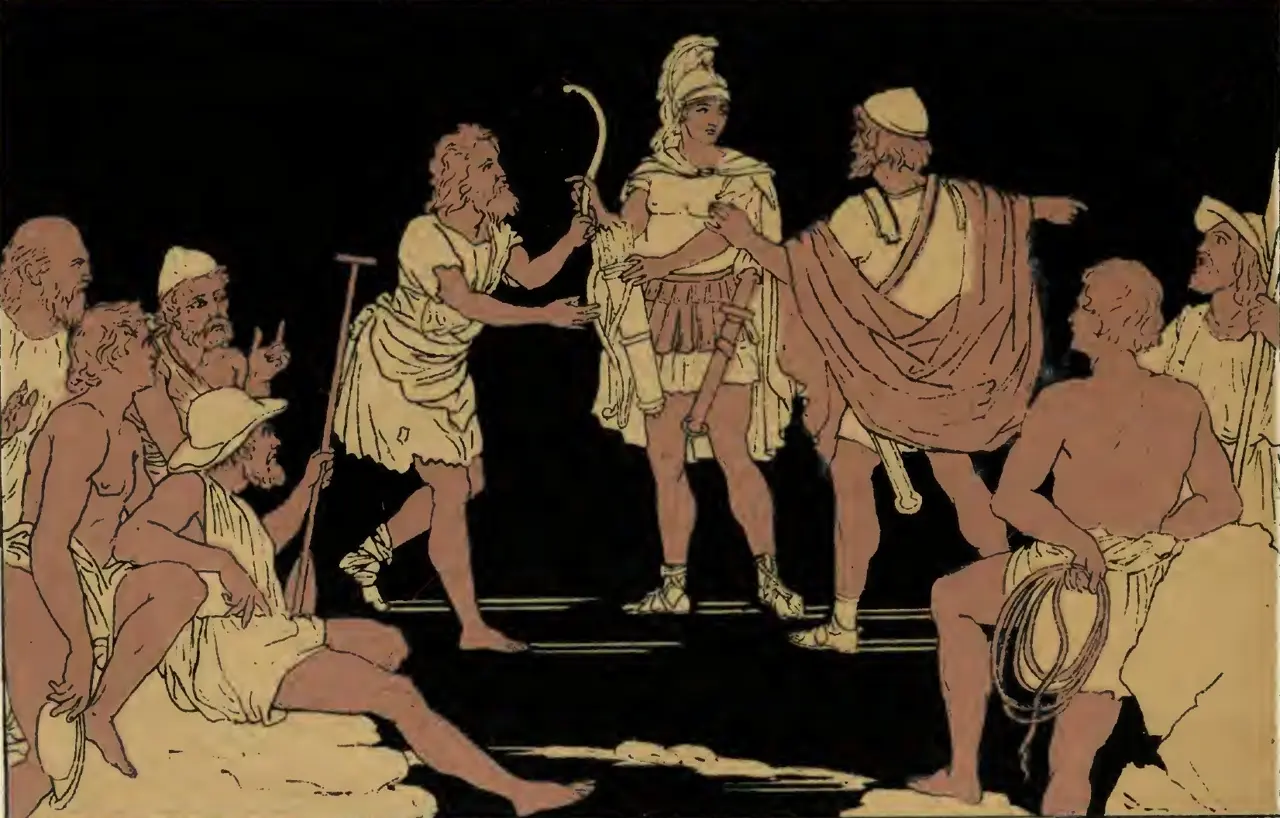
 The Trachinian Maidensby SophoclesA wife tries to win back her husband's love with a charm, not knowing what it will do.
 Aiasby SophoclesDenied the armour of Achilles, a great warrior sets out to kill his commanders, and wakes to his shame.
 Antigoneby SophoclesA young woman buries her brother against the king's law, and pays with her life.
 Electraby SophoclesA daughter waits years for her brother to come home and avenge their father.
The play
ODYSSEUS, NEOPTOLEMUS.
This coast of sea-girt Lemnos, where we stand,
Is uninhabited, untrodden of men.
And here, O noble son of noblest sire,
Achilles-born Neoptolemus, I erewhile,
Ordered by those who had command,--cast forth
Trachinian Philoctetes, Poeas' son,
His foot dark-dripping with a rankling wound;
When with wild cries, that frighted holy rest,
Filling the camp, he troubled every rite,
That none might handle sacrifice, or pour
Wine-offering, but his noise disturbed our peace.
But why these words? No moment this for talk,
Lest he discern my coming, and I lose
The scheme, wherewith I think to catch him soon.
Now most behoves thy service, to explore
This headland for a cave with double mouth,
Whose twofold aperture, on wintry days,
Gives choice of sunshine, and in summer noons
The breeze wafts slumber through the airy cell.
Then, something lower down, upon the left,
Unless 'tis dried, thine eye may note a spring.
Go near now silently, and make me know
If still he persevere, and hold this spot,
Or have roamed elsewhere, that informed of this
I may proceed with what remains to say,
And we may act in concert.
Lord Odysseus,
Thy foremost errand will not task me far.
Methinks I see the cave whereof thou speakest.
Where? let me see it. Above there, or below?
Yonder, above. And yet I hear no tread.
[NEOPTOLEMUS climbs up to the cave]
Look if he be not lodged in slumber there.
I find no inmate, but an empty room.
What? no provision for a dwelling-place?
A bed of leaves for some one harbouring here.
Nought else beneath the roof? Is all forlorn?
A cup of wood, some untaught craftsman's skill,
And, close at hand, these embers of a fire.
That store is his. I read the token clear.
Oh! and these festering rags give evidence,
Steeped as with dressing some malignant sore.
The man inhabits here: I know it now.
And sure he's not far off. How can he range,
Whose limb drags heavy with an ancient harm?
But he's gone, either to bring forage home,
Or where he hath found some plant of healing power.
Send therefore thine attendant to look forth,
Lest unawares he find me. All our host
Were not so fair a prize for him as I.
My man is going, and shall watch the path.
What more dost thou require of me? Speak on.
Son of Achilles, know that thou art come
To serve us nobly, not with strength alone,
But, faithful to thy mission, if so be,
To do things strange, unwonted to thine ear.
What dost thou bid me?
'Tis thy duty now
To entrap the mind of Poeas' son with words.
When he shall ask thee, who and whence thou art,
Declare thy name and father. 'Tis not that
I charge thee to conceal. But for thy voyage,
'Tis homeward, leaving the Achaean host,
With perfect hatred hating them, because
They who had drawn thee with strong prayers from home,
Their hope for taking Troy, allowed thee not
Thy just demand to have thy father's arms,
But, e'er thy coming, wrongly gave them o'er
Unto Odysseus: and thereon launch forth
With boundless execration against me.
That will not pain me, but if thou reject
This counsel, thou wilt trouble all our host,
Since, if his bow shall not be ta'en, thy life
Will ne'er be crowned through Troy's discomfiture.
Now let me show, why thine approach to him
Is safe and trustful as mine cannot be
Thou didst sail forth, not to redeem thine oath,
Nor by constraint, nor with the foremost band.
All which reproaches I must bear: and he,
But seeing me, while master of his bow,
Will slay me, and my ruin will be thine.
This point then craves our cunning, to acquire
By subtle means the irresistible bow
Thy nature was not framed, I know it well,
For speaking falsehood, or contriving harm.
Yet, since the prize of victory is so dear,
Endure it--We'll be just another day
But now, for one brief hour, devote thyself
To serve me without shame, and then for aye
Hereafter be the pearl of righteousness.
The thing that, being named, revolts mine ear,
Son of Laertes, I abhor to do
'Tis not my nature, no, nor, as they tell,
My father's, to work aught by craft and guile.
I'll undertake to bring him in by force,
Not by deceit. For, sure, with his one foot,
He cannot be a match for all our crew
Being sent, my lord, to serve thee, I am loth
To seem rebellious. But I rather choose
To offend with honour, than to win by wrong.
Son of a valiant sire, I, too, in youth,
Had once a slow tongue and an active hand.
But since I have proved the world, I clearly see
Words and not deeds give mastery over men.
What then is thy command? To lie? No more?
To entangle Philoctetes with deceit.
Why through deceit? May not persuasion fetch him?
Never. And force as certainly will fail.
What lends him such assurance of defence?
Arrows, the unerring harbingers of Death.
Then to go near him is a perilous thing.
Unless with subtlety, as I have said.
And is not lying shameful to thy soul?
Not if by lying I can save my soul.
How must one look in speaking such a word?
Where gain invites, this shrinking is not good.
What gain I through his coming back to Troy?
His arms alone have power to take Troy-town.
Then am not I the spoiler, as ye said?
Thou without them, they without thee, are powerless.
If it be so, they must be sought and won.
Yea, for in this two prizes will be thine.
What? When I learn them, I will not refuse.
Wisdom and valour joined in one good name.
Shame, to the winds! Come, I will do this thing.
Say, dost thou bear my bidding full in mind?
Doubt not, since once for all I have embraced it.
Thou, then, await him here. I will retire,
For fear my hated presence should be known,
And take back our attendant to the ship.
And then once more, should ye appear to waste
The time unduly, I will send again
This same man hither in disguise, transformed
To the strange semblance of a merchantman;
From dark suggestion of whose crafty tongue,
Thou, O my son, shalt gather timely counsel.
Now to my ship. This charge I leave to thee.
May secret Hermes guide us to our end,
And civic Pallas, named of victory,
The sure protectress of my devious way.
[entering] Strange in the stranger land,
What shall I speak? What hide
From a heart suspicious of ill?
Tell me, O master mine!
Wise above all is the man,
Peerless in searching thought,
Who with the Zeus-given wand
Wieldeth a Heaven-sent power.
This unto thee, dear son,
Fraught with ancestral might,
This to thy life hath come.
Wherefore I bid thee declare,
What must I do for thy need?
Even now methinks thou longest to espy
Near ocean's marge the place where he doth lie.
Gaze without fear. But when the traveller stern,
Who from this roof is parted, shall return,
Advancing still as I the signal give,
To serve each moment's mission thou shalt strive.
That, O my son, from of old
Hath been my care, to take note
What by thy beck'ning is told;
Still thy success to promote.
But for our errand to-day
Behoves thee, master, to say
Where is the hearth of his home;
Or where even now doth he roam?
O tell me, lest all unaware
He spring like a wolf from his lair
And I by surprise should be ta'en,
Where doth he move or remain,
Here lodging, or wandering away?
Thou seest yon double doorway of his cell,
Poor habitation of the rock.
But tell
Where is the pain-worn wight himself abroad?
To me 'tis clear, that, in his quest for food,
Here, not far off, he trails yon furrowed path.
For, so 'tis told, this mode the sufferer hath
Of sustenance, oh hardness! bringing low
Wild creatures with wing'd arrows from his bow;
Nor findeth healer for his troublous woe.
I feel his misery.
With no companion eye,
Far from all human care,
He pines with fell disease;
Each want he hourly sees
Awakening new despair.
How can he bear it still?
O cruel Heavens! O pain
Of that afflicted mortal train
Whose life sharp sorrows fill!
Born in a princely hall,
Highest, perchance, of all,
Now lies he comfortless
Alone in deep distress,
'Mongst rough and dappled brutes,
With pangs and hunger worn;
While from far distance shoots,
On airy pinion borne,
The unbridled Echo, still replying
To his most bitter crying.
At nought of this I marvel--for if I
Judge rightly, there assailed him from on high
That former plague through Chrysa's cruel sting:
And if to-day he suffer anything
With none to soothe, it must be from the will
Of some great God, so caring to fulfil
The word of prophecy, lest he should bend
On Troy the shaft no mortal may forfend,
Before the arrival of Troy's destined hour,
When she must fall, o'er-mastered by their power.
Hush, my son!
Why so?
A sound
Gendered of some mortal woe,
Started from the neighbouring ground.
Here, or there? Ah! now I know.
Hark! 'tis the voice of one in pain,
Travelling hardly, the deep strain
Of human anguish, all too clear,
That smites my heart, that wounds mine ear.
From far it peals. But thou, my son!
What?
Think again. He moveth nigh:
He holds the region: not with tone
Of piping shepherd's rural minstrelsy,
But belloweth his far cry,
Stumbling perchance with mortal pain,
Or else in wild amaze,
As he our ship surveys
Unwonted on the inhospitable main.
Enter PHILOCTETES.
Ho!
What men are ye that to this desert shore,
Harbourless, uninhabited, are come
On shipboard? Of what country or what race
Shall I pronounce ye? For your outward garb
Is Grecian, ever dearest to this heart
That hungers now to hear your voices' tune.
Ah! do not fear me, do not shrink away
From my wild looks: but, pitying one so poor,
Forlorn and desolate in nameless woe,
Speak, if with friendly purpose ye are come.
Oh answer! 'Tis not meet that I should lose
This kindness from your lips, or ye from mine.
Then know this first, O stranger, as thou wouldest,
That we are Greeks.
O dear, dear name! Ah me!
In all these years, once, only once, I hear it!
My son, what fairest gale hath wafted thee?
What need hath brought thee to the shore? What mission?
Declare all this, that I may know thee well.
The sea-girt Scyros is my native home.
Thitherward I make voyage:--Achilles' son,
Named Neoptolemus.--I have told thee all.
Dear is that shore to me, dear is thy father
O ancient Lycomedes' foster-child,
Whence cam'st thou hither? How didst thou set forth?
From Troy we made our course in sailing hither.
How? Sure thou wast not with us, when at first
We launched our vessels on the Troyward way?
Hadst thou a share in that adventurous toil?
And know'st thou not whom thou behold'st in me,
Young boy?
How should I know him whom I ne'er
Set eye on?
Hast not even heard my name,
Nor echoing rumour of my ruinous woe?
Nay, I know nought of all thy questioning.
How full of griefs am I, how Heaven-abhorred,
When of my piteous state no faintest sound
Hath reached my home, or any Grecian land!
But they, who pitilessly cast me forth,
Keep silence and are glad, while this my plague
Blooms ever, and is strengthened more and more.
Boy, great Achilles' offspring, in this form
Thou seest the man, of whom, methinks, erewhile
Thou hast been told, to whom the Herculean bow
Descended, Philoctetes, Poeas' son;
Whom the two generals and the Ithacan king
Cast out thus shamefully forlorn, afflicted
With the fierce malady and desperate wound
Made by the cruel basilisk's murderous tooth.
With this for company they left me, child!
Exposed upon this shore, deserted, lone.
From seaward Chrysa came they with their fleet
And touched at Lemnos. I had fallen to rest
From the long tossing, in a shadowy cave
On yonder cliff by the shore. Gladly they saw,
And left me, having set forth for my need,
Poor man, some scanty rags, and a thin store
Of provender. Such food be theirs, I pray!
Imagine, O my son, when they were gone,
What wakening, what arising, then was mine;
What weeping, what lamenting of my woe!
When I beheld the ships, wherewith I sailed,
Gone, one and all! and no man in the place,
None to bestead me, none to comfort me
In my sore sickness. And where'er I looked,
Nought but distress was present with me still.
No lack of that, for one thing!--Ah! my son,
Time passed, and there I found myself alone
Within my narrow lodging, forced to serve
Each pressing need. For body's sustenance
This bow supplied me with sufficient store,
Wounding the feathered doves, and when the shaft,
From the tight string, had struck, myself, ay me!
Dragging this foot, would crawl to my swift prey.
Then water must be fetched, and in sharp frost
Wood must be found and broken,--all by me.
Nor would fire come unbidden, but with flint
From flints striking dim sparks, I hammered forth
The struggling flame that keeps the life in me.
For houseroom with the single help of fire
Gives all I need, save healing for my sore.
Now learn, my son, the nature of this isle.
No mariner puts in here willingly.
For it hath neither moorage, nor sea-port,
For traffic or kind shelter or good cheer.
Not hitherward do prudent men make voyage.
Perchance one may have touched against his will.
Many strange things may happen in long time.
These, when they come, in words have pitied me,
And given me food, or raiment, in compassion.
But none is willing, when I speak thereof,
To take me safely home. Wherefore I pine
Now this tenth year, in famine and distress,
Feeding the hunger of my ravenous plague.
Such deeds, my son, the Atridae, and the might
Of sage Odysseus, have performed on me.
Wherefore may all the Olympian gods, one day,
Plague them with stern requital for my wrong!
Methinks my feeling for thee, Poeas' child,
Is like that of thy former visitants.
I, too, a witness to confirm his words,
Know them for verities, since I have found
The Atridae and Odysseus evil men.
Art thou, too, wroth with the all-pestilent sons
Of Atreus? Have they given thee cause to grieve?
Would that my hand might ease the wrath I feel!
Then Sparta and Mycenae should be ware
That Scyros too breeds valiant sons for war.
Brave youth! I love thee. Tell me the great cause
Why thou inveighest against them with such heat?
O son of Poeas, hardly shall I tell
What outrage I endured when I had come;
Yet I will speak it. When the fate of death
O'ertook Achilles
Out, alas! no more!
Hold, till thou first hast made me clearly know,
Is Peleus' offspring dead?
Alas! he is,
Slain by no mortal, felled by Phoebus' shaft:
So men reported
Well, right princely was he!
And princely is he who slew him. Shall I mourn
Him first, or wait till I have heard thy tale?
Methinks thou hast thyself enough to mourn,
Without the burden of another's woe.
Well spoken. Then renew thine own complaint,
And tell once more wherein they insulted thee.
There came to fetch me, in a gallant ship,
Odysseus and the fosterer of my sire,
Saying, whether soothly, or in idle show,
That, since my father perished, it was known
None else but I should take Troy's citadel.
Such words from them, my friend, thou may'st believe,
Held me not long from making voyage with speed,
Chiefly through longing for my father's corse,
To see him yet unburied,--for I ne'er
Had seen him. Then, besides, 'twas a fair cause,
If, by my going, I should vanquish Troy.
One day I had sailed, and on the second came
To sad Sigeum with wind-favoured speed,
When straightway all the host, surrounding me
As I set foot on shore, saluted me,
And swore the dead Achilles was in life,
Their eyes being witness, when they looked on me.
He lay there in his shroud: but I, unhappy,
Soon ending lamentation for the dead,
Went near to those Atridae, as to friends,
To obtain my father's armour and all else
That had been his. And then,--alas the while,
That men should be so hard!--they spake this word:
'Seed of Achilles, thou may'st freely take
All else thy father owned, but for those arms,
Another wields them now, Laertes' son.'
Tears rushed into mine eyes, and in hot wrath
I straightway rose, and bitterly outspake:
'O miscreant! What? And have ye dared to give
Mine arms to some man else, unknown to me?'
Then said Odysseus, for he chanced to be near,
'Yea, child, and justly have they given me these.
I saved them and their master in the field.'
Then in fierce anger all at once I launched
All terms of execration at his head,
Bating no word, being maddened by the thought
That I should lose this heirloom,--and to him!
He, at this pass, though not of wrathful mood,
Stung by such utterance, made rejoinder thus:
'Thou wast not with us here, but wrongfully
Didst bide afar. And, since thou mak'st so bold,
I tell thee, never shalt thou, as thou sayest,
Sail with these arms to Scyros.'--Thus reviled,
With such an evil echo in mine ear,
I voyage homeward, robbed of mine own right
By that vile offset of an evil tree.
Yet less I blame him than the men in power.
For every multitude, be it army or state,
Takes tone from those who rule it, and all taint
Of disobedience from bad counsel springs.
I have spoken. May the Atridae's enemy
Be dear to Heaven, as he is loved by me!
Mother of mightiest Zeus, 1
Feeder of all that live,
Who from thy mountainous breast
Rivers of gold dost give!
To thee, O Earth, I cried that shameful day,
When insolence from Atreus' sons went forth
Full on our lord: when they bestowed away
His father's arms to crown Odysseus' worth;
Thou, whom bull-slaughtering lions yoked bear,
O mighty mother, hear!
Your coming is commended by a grief
That makes you kindly welcome. For I feel
A chord that vibrates to your voice, and tells,
Thus have Odysseus and the Atridae wrought.
Full well I know, Odysseus' poisoned tongue
Shrinks from no mischief nor no guileful word
That leads to bad achievement in the end.
This moves not my main marvel, but if one
Saw this and bore it,--Aias of the shield.
Ah, friend, he was no more. Had he but lived,
This robbery had ne'er been wrought on me.
What? Is he too departed?
He is dead.
The light no more beholds him.
Oh! alas!
But Tydeus' offspring, and the rascal birth
Laertes bought of Sisyphus, they live:
I know it. For their death were to be wished.
Yea, be assured, they live and flourish high
Exalted in the host of Argive men.
And Nestor, my old friend, good aged man,
Is he yet living? Oft he would prevent
Their evils, by the wisdom of his thought.
He too is now in trouble, having lost
Antilochus, the comfort of his age.
There, there! In one brief word thou hast revealed
The mournful case of twain, whom I would last
Have chosen to hear of as undone. Ah me!
Where must one look? when these are dead, and he,
Odysseus, lives,--and in a time like this,
That craves their presence, and his death for theirs.
He wrestles cleverly; but, O my friend,
Even ablest wits are ofttimes snared at last.
Tell me, I pray, what was become of him,
Patroclus, whom thy father loved so well?
He, too, was gone. I'll teach thee in a word
One truth for all. War doth not willingly
Snatch off the wicked, but still takes the good.
True! and to prove thy saying, I will inquire
The fate of a poor dastard, of mean worth,
But ever shrewd and nimble with his tongue.
Whom but Odysseus canst thou mean by this?
I meant not him. But there was one Thersites,
Who ne'er made conscience to stint speech, where all
Cried 'Silence!' Is he living, dost thou know?
I saw him not, but knew he was alive.
He must be: for no evil yet was crushed.
The Heavens will ever shield it. 'Tis their sport
To turn back all things rancorous and malign
From going down to the grave, and send instead
The good and true. Oh, how shall we commend
Such dealings, how defend them? When I praise
Things god-like, I find evil in the Gods.
I, O thou child of a Trachinian sire,
Henceforth will take good care, from far away
To look on Troy and Atreus' children twain.
Yea, where the trickster lords it o'er the just,
And goodness languishes and rascals rule,
--Such courses I will nevermore endure.
But rock-bound Scyros henceforth shall suffice
To yield me full contentment in my home.
Now, to my vessel! And thou, Poeas' child,
Farewell, right heartily farewell! May Heaven
Grant thy desire, and rid thee of thy plague!
Let us be going, that when God shall give
Fair voyage, that moment we may launch away.
My son, are ye now setting forth?
Our time
Bids us go near and look to sail erelong.
Now, by thy father, by thy mother,--nay,
By all thy love e'er cherished in thy home,
Suppliant I beg thee, leave me not thus lone,
Forlorn in all my misery which thou seest,
In all thou hast heard of here surrounding me!
Stow me with other freightage. Full of care,
I know, and burdensome the charge may prove.
Yet venture! Surely to the noble mind
All shame is hateful and all kindness blest.
And shame would be thy meed, didst thou fail here
But, doing this, thou shalt have glorious fame,
When I return alive to Oeta's vale.
Come, 'tis the labour not of one whole day.
So thou durst take me, fling me where thou wilt
O' the ship, in hold, prow, stern, or wheresoe'er
I least may trouble those on board with me.
Ah! by great Zeus, the suppliant's friend, comply,
My son, be softened! See, where I am fall'n
Thus on my knees before thee, though so weak,
Crippled and powerless. Ah! forsake me not
Thus far from human footstep. Take me, take me!
If only to thy home, or to the town
Of old Chalcodon in Euboea.--From thence
I have not far to Oeta, and the ridge
Of Trachis, and Spercheius' lordly flood.
So thou shalt bless my father with my sight.
And yet long since I fear he may be gone.
For oft I sent him suppliant prayers by men
Who touched this isle, entreating him to fetch
And bear me safely home with his own crew.
But either he is dead, or else, methinks,
It well may be, my messengers made light
Of my concerns, and hastened onward home.
But now in thee I find both messenger
And convoy, thou wilt pity me and save.
For, well thou knowest, danger never sleeps,
And fear of dark reverse is always nigh.
Mortals, when free, should look where mischief lurks,
And in their happiest hour consider well
Their life, lest ruin unsuspected come.
Pity him, O my king! 2
Many a crushing woe
He telleth, such as I pray
None of my friends may know.
And if, dear master, thou mislikest sore
Yon cruel-hearted lordly pair, I would,
Turning their plan of evil to his good,
On swift ship bear him to his native shore,
Meeting his heart's desire; and free thy path
From fear of heavenly wrath.
Thou mak'st small scruple here; but be advised:
Lest, when this plague on board shall weary thee,
Thy voice should alter from this liberal tone.
No, truly! Fear not thou shalt ever have
Just cause to utter such reproach on me.
Then sure 'twere shame, should I more backward prove
Than thou, to labour for the stranger's need.
Come, if thou wilt, let us make voyage, and he,
Let him set forth with speed. Our ship shall take him.
He shall not be refused. Only may Heaven
Lead safely hence and to our destined port!
O morning full of brightness! Kindest friend,
Sweet mariners, how can I make you feel,
In act, how dearly from my heart I love you!
Ye have won my soul. Let us be gone, my son,
First having said farewell to this poor cave,
My homeless dwelling-place, that thou may'st know,
How barely I have lived, how firm my heart!
Methinks another could not have endured
The very sight of what I bore. But I
Through strong necessity have conquered pain.
Stay: let us understand. There come two men
A stranger, with a shipmate of thy crew.
When ye have heard them, ye may then go in.
Enter Messenger, disguised as a merchantman.
Son of Achilles, my companion here,
Who with two more remained to guard thy ship,
Agreed to help me find thee where thou wert,
Since unexpectedly, through fortune's will,
I meet thee, mooring by the self-same shore.
For like a merchantman, with no great sail,
Making my course from Ilion to my home,
Grape-clustered Peparethos, when I heard
The mariners declare that one and all
Were of thy crew, I would not launch again,
Without a word, till we had told our news.
Methinks thou knowest nought of thine own case,
What new devices of the Argive chiefs
Surround thee; nor devices only now,
But active deeds, no longer unperformed.
Well, stranger, for the kindness thou hast shown,
Else were I base,--my heart must thank thee still.
But tell me what thou meanest, that I may learn
What new-laid plot thou bring'st me from the camp.
Old Phoenix, Acamas and Demophon
Are gone in thy pursuit with ships and men.
To bring me back with reasons or perforce?
I know not. What I heard, I am here to tell.
How? And is this in act? Are they set forth
To please the Atridae, Phoenix and the rest?
The thing is not to do, but doing now.
What kept Odysseus back, if this be so,
From going himself? Had he some cause for fear?
He and the son of Tydeus, when our ship
Hoist sail, were gone to fetch another man.
For whom could he himself be sailing forth?
For some one,--but first tell me, whispering low
Whate'er thou speakest,--who is this I see?
[speaking aloud] This, sir, is Philoctetes the renowned.
[aside to NEOPTOLEMUS] Without more question, snatch thyself away
And sail forth from this land.
What saith he, boy?
Through what dark traffic is the mariner
Betraying me with whispering in thine ear?
I have not caught it, but whate'er he speaks
He must speak openly to us and thee.
Seed of Achilles, let me not offend
The army by my words! Full many a boon,
Being poor, I reap from them for service done.
The Atridae are my foes; the man you see
Is my fast friend, because he hates them sore.
Then, if you come in kindness, you must hide
Nothing from him or me of all thou hast heard.
Look what thou doest, my son!
I mark it well.
Thou shalt be answerable.
Content: but speak.
Then hear me. These two men whom I have named,
Diomedes and Odysseus, are set forth
Engaged on oath to bring this man by force
If reasons fail. The Achaeans every one
Have heard this plainly from Odysseus' mouth.
He was the louder and more confident.
Say, for what cause, after so long a time,
Can Atreus' sons have turned their thoughts on him,
Whom long they had cast forth? What passing touch
Of conscience moved them, or what stroke from Heaven,
Whose wrath requites all wicked deeds of men?
Methinks thou hast not heard what I will now
Unfold to thee. There was a princely seer,
A son of Priam, Helenus by name,
Whom he for whom no word is bad enough,
Crafty Odysseus, sallying forth alone
One night, had taken, and in bonds displayed
'Fore all the Achaeans, a right noble prey.
He, 'mid his other prophecies, foretold
No Grecian force should sack Troy's citadel,
Till with fair reasons they had brought this man
From Lemnos isle, his lonely dwelling-place.
When thus the prophet spake, Laertes' son
Straight undertook to fetch this man, and show him
To all the camp:--he hoped, with fair consent:
But else, perforce.--And, if he failed in this,
Whoever would might smite him on the head.
My tale is told, dear youth. I counsel speed
To thee and to the friend for whom thou carest.
Ah me, unhappy! has that rascal knave
Sworn to fetch me with reasons to their camp?
As likely might his reasons bring me back,
Like his begetter, from the house of death.
You talk of what I know not. I will go
Shipward. May God be with you for all good. [Exit]
Is not this terrible, Laertes' son
Should ever think to bring me with soft words
And show me from his deck to all their host?
No! Sooner will I listen to the tongue
Of the curs'd basilisk that thus hath maim'd me.
Ay, but he'll venture anything in word
Or deed. And now I know he will be here.
Come, O my son, let us be gone, while seas
And winds divide us from Odysseus' ship.
Let us depart. Sure timely haste brings rest
And quiet slumber when the toil is done.
Shall we not sail when this south-western wind
Hath fallen, that now is adverse to our course?
All winds are fair to him who flies from woe.
Nay, but this head-wind hinders them no less.
No head-wind hinders pirates on their way,
When violence and rapine lead them on.
Well, then, let us be going, if you will;
When you have taken from within the cave
What most you need and value.
Though my all
Be little, there is that I may not lose.
What can there be that we have not on board?
A leaf I have found, wherewith I still the rage
Of my sore plague, and lull it quite to rest.
Well, bring it forth.--What? Is there something more?
If any of these arrows here are fallen,
I would not leave them for a casual prey.
How? Do I see thee with the marvellous bow?
Here in my hand. The world hath only one.
And may one touch and handle it, and gaze
With reverence, as on a thing from Heaven?
Thou mayest, my son. This and whate'er of mine
May stead thee, 'tis thy privilege to enjoy.
In very truth I long for it, but so,
That longing waits on leave. Am I permitted?
Thou art, my son,--and well thou speakest,--thou art.
Thou, that hast given me light and life, the joy
Of seeing Mount Oeta and my father's home,
With all I love there, and his aged head,
Thou that hast raised me far above my foes
Who triumphed! Thou may'st take it in thine hand,
And,--when thou hast given it back to me,--may'st vaunt
Alone of mortals for thine excellence
To have held this in thy touch. I, too, at first,
Received it as a boon for kindness done.
Well, go within.
Nay, I must take thee too.
My sickness craves thee for its comforter.
[PHILOCTETES and NEOPTOLEMUS go into]
the cave
In fable I have heard,
Though sight hath ne'er confirmed the word,
How he who attempted once the couch supreme,
To a whirling wheel by Zeus the all-ruler bound,
Tied head and heel, careering ever round,
Atones his impious unsubstantial dream.
Of no man else, through eye or ear,
Have I discerned a fate more full of fear
Than yonder sufferer's of the cureless wound:
Who did no violence, defrauded none:
A just man, had he dwelt among the just
Unworthily behold him thrust
Alone to hear the billows roar
That break around a rugged shore!
How could he live, whose life was thus consumed with moan?
Where neighbour there was none:
No arm to stay him wandering lone,
Unevenly, with stumbling steps and sore;
No friend in need, no kind inhabitant,
To minister to his importunate want,
No heart whereto his pangs he might deplore.
None who, whene'er the gory flow
Was rushing hot, might healing herbs bestow,
Or cull from teeming Earth some genial plant
To allay the anguish of malignant pain
And soothe the sharpness of his poignant woe.
Like infant whom the nurse lets go,
With tottering movement here and there,
He crawled for comfort, whensoe'er
His soul-devouring plague relaxed its cruel strain.
Not fed with foison of all-teeming Earth
Whence we sustain us, ever-toiling men,
But only now and then
With winged things, by his wing'd shafts brought low,
He stayed his hunger from his bow.
Poor soul, that never through ten years of dearth
Had pleasure from the fruitage of the vine,
But seeking to some standing pool,
Nor clear nor cool,
Foul water heaved to head for lack of heartening wine.
But now, consorted with the hero's child,
He winneth greatness and a joyful change;
Over the water wild
Borne by a friendly bark beneath the range
Of Oeta, where Spercheius fills
Wide channels winding among lovely hills
Haunted of Melian nymphs, till he espies
The roof-tree of his father's hall,
And high o'er all
Shines the bronze shield of him, whose home is in the skies.
[NEOPTOLEMUS comes out of the cave, followed]
by PHILOCTETES in pain
Prithee, come on! Why dost thou stand aghast,
Voiceless, and thus astonied in thine air?
Oh! oh!
What?
Nothing. Come my son, fear nought.
Is pain upon thee? Hath thy trouble come?
No pain, no pain! 'Tis past; I am easy now.
Ye heavenly powers!
Why dost thou groan aloud,
And cry to Heaven?
To come and save. Kind Heaven!
Oh, oh!
What is 't? Why silent? Wilt not speak?
I see thy misery.
Oh! I am lost, my son!
I cannot hide it from you. Oh! it shoots,
It pierces. Oh unhappy! Oh! my woe!
I am lost, my son, I am devoured. Oh me!
Oh! Oh! Oh! Oh! Pain! pain! Oh pain! oh pain!
Child, if a sword be to thine hand, smite hard,
Shear off my foot! heed not my life! Quick, come!
What hath so suddenly arisen, that thus
Thou mak'st ado and groanest o'er thyself?
Thou knowest.
What know I?
O! thou knowest, my son!
I know not.
How? Not know? Ah me! Pain, pain!
Thy plague is a sore burden, heavy and sore.
Sore? 'Tis unutterable. Have pity on me!
What shall I do?
Do not in fear forsake me.
This wandering evil comes in force again,
Hungry as ere it fed.
O hapless one!
Thrice hapless in thy manifold distress!
What wilt thou? Shall I raise thee on mine arm?
Nay, but receiving from my hand the bow,
As late thou didst desire me, keep it safe
And guard it, till the fury of my pain
Pass over me and cease. For when 'tis spent,
Slumber will seize me, else it ne'er would end.
I must sleep undisturbed. But if meanwhile
They come,--by Heaven I charge thee, in no wise,
Willingly nor perforce, let them have this!
Else thou wilt be the slayer of us both;
Of me thy suppliant, and of thyself.
Fear not my care. No hand shall hold these arms
But thine and mine. Give, and Heaven bless the deed!
I give them; there, my son! But look to Heaven
And pray no envy smite thee, nor such bane
In having them, as fell on me and him
Who bore them formerly.
O grant it, Gods!
And grant us fair and happy voyage, where'er
Our course is shaped and righteous Heaven shall guide.
Ah! but I fear, my son, thy prayer is vain:
For welling yet again from depths within,
This gory ooze is dripping. It will come!
I know it will. O, foot, torn helpless thing,
What wilt thou do to me? Ah! ah! It comes,
It is at hand. 'Tis here! Woe's me, undone!
I have shown you all. Stay near me. Go not far:
Ah! ah!
O island king, I would this agony
Might cleave thy bosom through and through! Woe, woe!
Woe! Ah! ye two commanders of the host,
Agamemnon, Menelaues, O that ye,
Another ten years' durance in my room
Might nurse this malady! O Death, Death, Death!
I call thee daily--wilt thou never come?
Will it not be?--My son, thou noble boy,
If thou art noble, take and burn me there
Aloft in yon all-worshipped Lemnian fire!
Yea, when the bow thou keep'st was my reward,
I did like service for the child of Heaven.
How now, my son?
What say'st? Art silent? Where--where art thou, boy?
My heart is full, and groaning o'er thy woes.
Nay, yet have comfort. This affliction oft
Goes no less swiftly than it came. I pray thee,
Stand fast and leave me not alone!
Fear nought.
We will not stir.
Wilt thou remain?
Be sure of it.
I'll not degrade thee with an oath, my son.
Rest satisfied. I may not go without thee.
Thy hand, to pledge me that!
There, I will stay.
Now, now, aloft!
Where mean'st thou?
Yonder aloft!
Whither? Thou rav'st. Why starest thou at the sky?
Now, let me go.
Where?
Let me go, I say!
I will not.
You will kill me. Let me go!
Well, thou know'st best I hold thee not.
O Earth,
I die. receive me to thy breast! This pain
Subdues me utterly, I cannot stand.
Methinks he will be fast in slumber soon
That head sinks backward, and a clammy sweat
Bathes all his limbs, while from his foot hath burst
A vein, dark bleeding. Let us leave him, friends,
In quietness, till he hath fallen to sleep.
Lord of the happiest life, I
Sleep, thou that know'st not strife,
That know'st not grief,
Still wafting sure relief,
Come, saviour now!
Thy healing balm is spread
Over this pain worn head,
Quench not the beam that gives calm to his brow.
Look, O my lord, to thy path,
Either to go or to stay
How is my thought to proceed?
What is our cause for delay?
Look! Opportunity's power,
Fitting the task to the hour,
Giveth the race to the swift.
He hears not. But I see that to have ta'en
His bow without him were a bootless gain
He must sail with us. So the god hath said
Heaven hath decreed this garland for his head:
And to have failed with falsehood were a meed
Of shameful soilure for a shameless deed.
God shall determine the end-- II
But for thine answer, friend,
Waft soft words low!
All sick men's sleep, we know,
Hath open eye;
Their quickly ruffling mind
Quivers in lightest wind,
Sleepless in slumber new danger to spy.
Think, O my lord, of thy path,
Secretly look forth afar,
What wilt thou do for thy need?
How with the wise wilt thou care?
If toward the nameless thy heart
Chooseth this merciful part,
Huge are the dangers that drift.
The wind is fair, my son, the wind is fair,
The man is dark and helpless, stretched in night.
[O kind, warm sleep that calmest human care!]
Powerless of hand and foot and ear and sight,
Blind, as one lying in the house of death.
[Think well if here thou utterest timely breath.]
This, O my son, is all my thought can find,
Best are the toils that without frightening bind.
Hush! One word more were madness. He revives.
His eye hath motion. He uplifts his head.
Fair daylight following sleep, and ye, dear friends,
Faithful beyond all hope in tending me!
I never could have dreamed that thou, dear youth,
Couldst thus have borne my sufferings and stood near
So full of pity to relieve my pain.
Not so the worthy generals of the host;
This princely patience was not theirs to show.
Only thy noble nature, nobly sprung,
Made light of all the trouble, though oppressed
With fetid odours and unceasing cries.
And now, since this my plague would seem to yield
Some pause and brief forgetfulness of pain,
With thine own hand, my son, upraise me here,
And set me on my feet, that, when my strength
After exhaustion shall return again,
We may move shoreward and launch forth with speed.
I feel unhoped-for gladness when I see
Thy painless gaze, and hear thy living breath,
For thine appearance and surroundings both
Were deathlike. But arise! Or, if thou wilt,
These men shall raise thee. For they will not shrink
From toil which thou and I at once enjoin.
Right, right, my son! But lift me thine own self,
As I am sure thou meanest. Let these be,
Lest they be burdened with the noisome smell
Before the time. Enough for them to bear
The trouble on board.
I will; stand up, endure!
Fear not. Old habit will enable me.
O me!
What shall I do? Now 'tis my turn to exclaim!
What canst thou mean? What change is here, my son?
I know not how to shift the troublous word.
'Tis hopeless.
What is hopeless? Speak not so,
Dear child!
But so my wretched lot hath fallen.
Ah! Can it be, the offence of my disease
Hath moved thee not to take me now on board?
All is offence to one who hath forced himself
From the true bent to an unbecoming deed.
Nought misbecoming to thyself or sire
Doest thou or speak'st, befriending a good man.
My baseness will appear. That wrings my soul.
Not in thy deeds. But for thy words, I fear me!
O Heaven! Must double vileness then be mine
Both shameful silence and most shameful speech?
Or my discernment is at fault, or thou
Mean'st to betray me and make voyage without me.
Nay, not without thee, there is my distress!
Lest I convey thee to thy bitter grief.
How? How, dear youth? I do not understand.
Here I unveil it. Thou art to sail to Troy,
To join the chieftains and the Achaean host.
What do I hear? Ah!
Grieve not till you learn.
Learn what? What wilt thou make of me? What mean'st thou?
First to release thee from this plague, and then
With thee to go and take the realm of Troy.
And is this thine intent?
'Tis so ordained
Unchangeably. Be not dismayed! 'Tis so.
Me miserable! I am betrayed, undone!
What guile is here? My bow! give back my bow!
I may not. Interest, and duty too,
Force me to obey commandment.
O thou fire,
Thou terror of the world! Dark instrument
Of ever-hateful guile!--What hast thou done?
How thou hast cheated me! Art not ashamed
To look on him that sued to thee for shelter?
O heart of stone, thou hast stolen my life away
With yonder bow!--Ah, yet I beg of thee,
Give it me back, my son, I entreat thee, give!
By all thy father worshipped, rob me not
Of life!--Ah me! Now he will speak no more,
But turns away, obdurate to retain it.
O ye, my comrades in this wilderness,
Rude creatures of the rocks, O promontories,
Creeks, precipices of the hills, to you
And your familiar presence I complain
Of this foul trespass of Achilles' son.
Sworn to convey me home, to Troy he bears me.
And under pledge of his right hand hath ta'en
And holds from me perforce my wondrous bow,
The sacred gift of Zeus-born Heracles,
Thinking to wave it midst the Achaean host
Triumphantly for his. In conquering me
He vaunts as of some valorous feat, and knows not
He is spoiling a mere corse, an empty dream,
The shadow of a vapour. In my strength
He ne'er had vanquished me. Even as I am,
He could not, but by guile. Now, all forlorn,
I am abused, deceived. What must I do?
Nay, give it me. Nay, yet be thy true self!
Thou art silent. I am lost. O misery!
Rude face of rock, back I return to thee
And thy twin gateway, robbed of arms and food,
To wither in thy cave companionless:
No more with these mine arrows to destroy
Or flying bird or mountain-roving beast.
But, all unhappy! I myself must be
The feast of those on whom I fed, the chase
Of that I hunted, and shall dearly pay
In bloody quittance for their death, through one
Who seemed all ignorant of sinful guile.
Perish,--not till I am certain if thy heart
Will change once more,--if not, my curse on thee!
What shall we do, my lord? We wait thy word
Or to sail now, or yield to his desire.
My heart is pressed with a strange pity for him,
Not now beginning, but long since begun.
Ay, pity me, my son! by all above,
Make not thy name a scorn by wronging me!
O! I am troubled sore. What must I do?
Would I had never left mine island home!
Thou art not base, but seemest to have learnt
Some baseness from base men. Now, as 'tis meet,
Be better guided--leave me mine arms, and go.
[to Chorus] What shall we do?
Enter ODYSSEUS.
What art thou doing, knave?
Give me that bow, and haste thee back again.
Alas! What do I hear? Odysseus' voice?
Be sure of that, Odysseus, whom thou seest.
Oh, I am bought and sold, undone! 'Twas he
That kidnapped me, and robbed me of my bow.
Yea. I deny it not. Be sure, 'twas I.
Give back, my son, the bow; release it!
That,
Though he desire it, he shall never do.
Thou too shalt march along, or these shall force thee.
They force me! O thou boldest of bad men!
They force me?
If thou com'st not willingly.
O Lemnian earth and thou almighty flame,
Hephaestos' workmanship, shall this be borne,
That he by force must drag me from your care?
'Tis Zeus, I tell thee, monarch of this isle,
Who thus hath willed. I am his minister.
Wretch, what vile words thy wit hath power to say!
The gods are liars when invoked by thee.
Nay, 'tis their truth compels thee to this voyage.
I will not have it so.
I will. Thou shalt.
Woe for my wretchedness! My father, then,
Begat no freeman, but a slave in me.
Nay, but the peer of noblest men, with whom
Thou art to take and ravage Troy with might.
Never,--though I must suffer direst woe,
While this steep Lemnian ground is mine to tread!
What now is thine intent?
Down from the crag
This head shall plunge and stain the crag beneath.
[to the Attendants] Ay, seize and bind him. Baffle him in this.
Poor hands, for lack of your beloved string,
Caught by this craven! O corrupted soul!
How thou hast undermined me, having taken
To screen thy quest this youth to me unknown,
Far worthier of my friendship than of thine,
Who knew no better than to obey command.
Even now 'tis manifest he burns within
With pain for his own error and my wrong.
But, though unwilling and mapt for ill,
Thy crafty, mean, and cranny spying soul
Too well hath lessoned him in sinful lore.
Now thou hast bound me, O thou wretch, and thinkest
To take me from this coast, where thou didst cast me
Outlawed and desolate, a corpse 'mongst men.
Oh!
I curse thee now, as ofttimes in the past:
But since Heaven yields me nought but bitterness,
Thou livest and art blithe, while 'tis my pain
To live on in my misery, laughed to scorn
By thee and Atreus' sons, those generals twain
Whom thou art serving in this chase. But thou
With strong compulsion and deceit was driven
Troyward, whilst I, poor victim, of free will
Took my seven ships and sailed there, yet was thrown
Far from all honour,--as thou sayest, by them,
But, as they turn the tale, by thee.--And now
Why fetch me hence and take me? To what end?
I am nothing, dead to you this many a year.
How, O thou Heaven-abhorred! am I not now
Lame and of evil smell? how shall ye vaunt
Before the gods drink-offering or the fat
Of victims, if I sail among your crew?
For this, as ye professed, was the chief cause
Why ye disowned me. Perish!--So ye shall,
For the wrong done me, if the Heavens be just.
And that they are, I know. Else had ye ne'er
Sailed on this errand for an outcast wretch,
Had they not pricked your heart with thoughts of me.
Oh, if ye pity me, chastising powers,
And thou, the Genius of my land, revenge,
Revenge this crime on all their heads at once!
My life is pitiable; but if I saw
Their ruin, I would think me well and strong.
How full of bitterness is his resolve,
Wrathfully spoken with unbending will!
I might speak long in answer, did the time
Give scope, but now one thing is mine to say.
I am known to vary with the varying need;
And when 'tis tried, who can be just and good,
My peer will not be found for piety.
But though on all occasions covetous
Of victory, this once I yield to thee,
And willingly. Unhand him there. Let go!
Leave him to stay. What further use of thee,
When we have ta'en these arms? Have we not Teucer,
Skilled in this mystery? Yea, I may boast
Myself thine equal both in strength and aim
To wield them. Fare thee well, then! Thou art free
To roam thy barren isle. We need thee not.
Let us be going! And perchance thy gift
May bring thy destined glory to my brow.
What shall I do? Alas, shalt thou be seen
Graced with mine arms amongst Achaean men?
No more! I am going.
O Achilles' child!
Wilt thou, too, vanish? Must I lose thy voice?
Come on, and look not, noble though thou be,
Lest thou undo our fortune.
Mariners,
Must ye, too, leave me thus disconsolate?
Will ye not pity me?
Our captain's here.
Whate'er he saith to thee, that we too speak.
My chief will call me weakling, soft of heart;
But go not yet, since our friend bids you stay.
Till we have prayed, and all be ready on board.
Meanwhile, perchance, he may conceive some thought
That favours our design. We two will start;
And ye, be swift to speed forth at our call. [Exit]
Monody.
O cavern of the hollow rock,
Frosty and stifling in the seasons' change!
How I seem fated never more to range
From thy sad covert, that hath felt the shock
Of pain on pain, steeped with my wretchedness.
Now thou wilt be my comforter in death!
Grief haunted harbour, choked with my distress!
Tell me, what hope is mine of daily food,
Who will be careful for my good?
I fail. Ye cowering creatures of the sky,
Oh, as ye fly,
Snatch me, borne upward on the blast's sharp breath!
Thou child of misery!
No mightier power hath this decreed,
But thine own will and deed
Hath bound thee thus in grief,
Since, when kind Heaven had sent relief
And shown the path of wisdom firm and sure,
Thou still hast chosen this evil to endure.
O hapless life, sore bruised with pain!
No more with living mortal may I dwell,
But ever pining in this desert cell
With lonely grief, all famished must remain
And perish; for what food is mine to share,
When this strong arm no longer wields my bow,
Whose fleet shafts flew to smite the birds of air
I was o'erthrown by words, words dark and blind,
Low-creeping from a traitorous mind!
O might I see him, whose unrighteous thought
This ruin wrought,
Plagued for no less a period with like woe!
Not by our craft thou art caught,
But Destiny divine hath wrought
The net that holds thee bound.
Aim not at us the sound
Of thy dread curse with dire disaster fraught.
On others let that light! 'Tis our true care
Thou should'st not scorn our love in thy despair.
Now, seated by the shore
Of heaving ocean hoar,
He mocks me, waving high
The sole support of my precarious being,
The bow which none e'er held but I.
O treasure of my heart, torn from this hand,
That loved thy touch,--if thou canst understand,
How sad must be thy look in seeing
Thy master destined now no more,
Like Heracles of yore,
To wield thee with an archer's might!
But in the grasp of an all-scheming wight,
O bitter change! thou art plied;
And swaying ever by his side,
Shalt view his life of dark malignity,
Teeming with guileful shames, like those he wrought on me.
Nobly to speak for the right
Is manly and strong;
But not with an envious blight
To envenom the tongue;
He to serve all his friends of the fleet,
One obeying a many-voiced word,
Through the minist'ring craft of our lord
Hath but done what was meet.
Come, legions of the wild,
Of aspect fierce or mild,
Fowl from the fields of air,
And beasts that roam with bright untroubled gaze,
No longer bounding from my lair
Fly mine approach! Now freely without fear
Ye may surround my covert and come near,
Treading the savage rock-strewn ways.
The might I had is no more mine,
Stolen with those arms divine.
This fort hath no man to defend.
Come satisfy your vengeful jaws, and rend
These quivering tainted limbs!
Already hovering death bedims
My fainting sense. Who thus can live on air,
Tasting no gift of earth that breathing mortals share?
Ah! do not shrink from thy friend,
If love thou reverest,
But know 'tis for thee to forfend
The fate which thou fearest.
The lot thou hast here to deplore,
Is sad evermore to maintain,
And hardship in sickness is sore,
But sorest in pain.
Kindest of all that e'er before
Have trod this shore,
Again thou mind'st me of mine ancient woe!
Why wilt thou ruin me? What wouldst thou do?
How mean'st thou?
If to Troy, of me abhorred
Thou e'er hast hoped to lead me with thy lord.
So I judge best.
Begone at once, begone!
Sweet is that word, and swiftly shall be done!
Let us be gone, each to his place on board.
[The Chorus make as if they were going]
Nay, by dear Zeus, to whom all suppliants moan
Leave me not yet!
Keep measure in thy word.
Stay, by Heaven, stay!
What wilt thou say?
O misery! O cruel power
That rul'st this hour!
I am destroyed. Ah me!
O poor torn limb, what shall I do with thee
Through all my days to be?
Ah, strangers, come, return, return!
What new command are we to learn
Crossing thy former mind?
Ah! yet be kind.
Reprove not him, whose tongue, with grief distraught,
Obeys not, in dark storms, the helm of thought!
Come, poor friend, the way we call.
Never, learn it once for all!
Not though he, whom Heaven obeys,
Blast me with fierce lightning's blaze!
Perish Troy, and all your host,
That have chosen, to their cost,
To despise and cast me forth,
Since my wound obscured my worth!
Ah, but, strangers, if your sense
Hath o'er-mastered this offence,
Yield but one thing to my prayer!
What wouldst thou have?
Some weapon bare,
Axe or sword or sharpened dart,
Bring it to content my heart.
What is thy new intent?
To sever point by point
This body, joint from joint.
On bloody death my mind is bent.
Wherefore?
To see my father's face.
Where upon earth?
He hath no place
Where sun doth shine, but in the halls of night.
O native country, land of my delight,
Would I were blest one moment with thy sight!
Why did I leave thy sacred dew
And loose my vessels from thy shore,
To join the hateful Danaaen crew
And lend them succour? Oh, I am no more!
Long since thou hadst seen me nearing yonder ship,
Had I not spied Odysseus and the son
Of great Achilles hastening to our side.
Wilt thou not tell me why thou art hurrying
This backward journey with reverted speed?
To undo what I have wrongly done to-day.
Thy words appal me. What is wrongly done?
When in obeying thee and all the host
Thou didst what deed that misbecame thy life?
I conquered with base stratagem and fraud
Whom? What new plan is rising in thy mind?
Not new. But to the child of Poeas here
What wilt thou do? I quake with strange alarm.
From whom I took these weapons, back again--
O Heaven! thou wilt not give them! Mean'st thou this?
Yea, for I have them through base sinful means.
I pray thee, speak'st thou thus to anger me?
If the truth anger thee, the truth is said.
Achilles' son! What word is fallen from thee?
Must the same syllables be thrice thrown forth?
Once was too much. Would they had ne'er been said!
Enough. Thou hast heard my purpose clearly told.
I know what power shall thwart thee in the deed.
Whose will shall hinder me?
The Achaean host
And I among them.
Thou'rt sharp-witted, sure!
But little wit or wisdom show'st thou here.
Neither thy words nor thy design is wise.
But if 'tis righteous, that is better far.
How righteous, to release what thou hast ta'en
By my device?
I sinned a shameful sin,
And I will do mine utmost to retrieve it.
How? Fear'st thou not the Achaeans in this act?
In doing right I fear not them nor thee.
I call thy power in question.
Then I'll fight,
Not with Troy's legions, but with thee.
Come on!
Let fortune arbitrate.
Thou seest my hand
Feeling the hilt.
And me thou soon shalt see
Doing the like and dallying not!--And yet
I will not touch thee, but will go and tell
The army, that shall wreak this on thy head. [Exit]
Thou show'st discretion: which if thou preserve,
Thou may'st maintain a path exempt from pain.
Ho! son of Poeas, Philoctetes, come
And leave thy habitation in the rock.
What noise again is troubling my poor cave?
Why do ye summon me? What crave ye, sirs?
Ha! 'tis some knavery. Are ye come to add
Some monster evil to my mountainous woe?
Fear not, but hearken to what now I speak.
I needs must fear thee, whose fair words erewhile
Brought me to bitter fortune.
May not men
Repent and change?
Such wast thou in thy talk,
When thou didst rob me of my bow,--so bright
Without, so black within.
Ah, but not now,
Assure thee! Only let me hear thy will,
Is 't constant to remain here and endure,
Or to make voyage with us?
Stop, speak no more!
Idle and vain will all thine utterance be.
Thou art so resolved?
More firmly than I say.
I would I might have brought thee to my mind,
But since my words are out of tune, I have done.
Thou wert best. No word of thine can touch my soul
Or win me to thy love, who by deceit
Hast reft my life away. And then thou com'st
To school me,--of noblest father, basest son!
Perish, the Atridae first of all, and then
Laertes' child, and thou!
Curse me no more,
But take this hallowed weapon from my hand.
What words are these? Am I again deceived?
No, by the holiest name of Zeus on high!
O voice of gladness, if thy speech be true!
The deed shall prove it. Only reach thy hand,
And be again sole master of thy bow. [ODYSSEUS appears]
But I make protest, in the sight of Heaven,
For Atreus' sons, and all the Achaean host.
Dear son, whose voice disturbs us? Do I hear
Odysseus?
Ay, and thou behold'st him nigh,
And he shall force thee to the Trojan plain,
Howe'er Achilles' offspring make or mar.
This shaft shall bear thee sorrow for that boast.
Let it not fly, by Heaven!
Dear child, let go
Mine arm!
I will not. [Exit ODYSSEUS]
Ah! Why hast thou robbed
My bow of bringing down mine enemy?
This were ignoble both for thee and me.
One thing is manifest, the first o' the host
Lying forerunners of the Achaean band,
Are brave with words, but cowards with the steel.
Well, now the bow is thine. Thou hast no cause
For blame or anger any more 'gainst me.
None. Thou hast proved thy birthright, dearest boy.
Not from the loins of Sisyphus thou earnest,
But from Achilles, who in life was held
Noblest of men alive, and now o' the dead.
It gladdens me that thou shouldst speak in praise
Both of my sire and me. But hear me tell
The boon for which I sue thee.--Mortal men
Must bear such evils as high Heaven ordains;
But those afflicted by self-chosen ills,
Like thine to-day, receive not from just men
Or kind indulgence or compassionate thought.
And thou art restive grown, and wilt not hearken,
But though one counsel thee with kind'st intent,
Wilt take him for a dark malignant foe.
Yet, calling Zeus to witness for my soul,
Once more I will speak. Know this, and mark it well:
Thou bear'st this sickness by a heavenly doom,
Through coming near to Chrysa's sentinel,
The lurking snake, that guards the sky-roofed fold.
And from this plague thou ne'er shall find reprieve
While the same Sun god rears him from the east
And droops to west again, till thou be come
Of thine own willing mind to Troia's plain,
Where our physicians, sons of Phoebus' child,
Shall soothe thee from thy sore, and thou with me
And with this bow shalt take Troy's citadel.
How do I know this? I will tell thee straight
We have a Trojan captive, Helenus,
Both prince and prophet, who hath clearly told
This must be so, yea, and ere harvest time
This year, great Troy must fall, else if his words
Be falsified, who will may slay the seer.
Now, since thou know'st of this, yield thy consent;
For glorious is the gain, being singled forth
From all the Greeks as noblest, first to come
To healing hands, and then to win renown
Unrivalled, vanquishing all tearful Troy.
Oh how I hate my life! Why must it keep
This breathing form from sinking to the shades?
How can I prove a rebel to his mind
Who thus exhorts me with affectionate heart?
And yet, oh misery! must I give way?
Then how could I endure the light of heaven?
With whom could I exchange a word? Ay me!
Eyes that have seen each act of my sad life,
How could ye bear it, to behold the sons
Of Atreus, my destroyers, comrades now
And friends! Laertes' wicked son, my friend!
And less I feel the grief of former wrong
Than shudder with expectance of fresh harm
They yet may work on me. For when the mind
Hath once been mother of an evil brood,
It nurses nought but evils. Yea, at thee
I marvel. Thou should'st ne'er return to Troy,
Nor suffer me to go, when thou remember'st
What insult they have done thee, ravishing
Thy father's rights from thee. And wilt thou then
Sail to befriend them, pressing me in aid?
Nay, do not, son; but, even as thou hast sworn,
Convey me home, and thou, in Scyros dwelling,
Leave to their evil doom those evil men.
So thou shalt win a twofold gratitude
From me and from my father, and not seem,
Helping vile men, to be as vile as they.
'Tis fairly spoken. Yet I would that thou
Relying on my word and on Heaven's aid,
Would'st voyage forth from Lemnos with thy friend.
Mean'st thou to Troy, and to the hateful sons
Of Atreus, me, with this distressful limb?
Nay, but to those that will relieve the pain
Of thy torn foot and heal thee of thy plague.
Thy words are horrible. What mean'st thou, boy?
The act I deem the noblest for us both.
Wilt thou speak so? Where is thy fear of Heaven?
Why should I fear, when I see certain gain?
Gain for the sons of Atreus, or for me?
Methinks a friend should give thee friendly counsel.
Friendly, to hand me over to my foes?
Ah, be not hardened in thy misery!
I know thou wilt ruin me by what thou speakest.
Not I. The case is dark to thee, I see.
I know the Atreidae cast me on this rock.
But how, if they should save thee afterward?
They ne'er shall make me see Troy with my will.
Hard is my fortune, then, if by no sleight
Of reasoning I can draw thee to my mind.
For me, 'twere easiest to end speech, that thou
Might'st live on as thou livest in hopeless pain.
Then leave me to my fate!--But thou hast touched
My right hand with thine own, and given consent
To bear me to my home. Do this, dear son!
And do not linger to take thought of Troy.
Enough that name hath echoed in my groans.
If thou wilt, let us be going.
Nobly hast thou said the word.
Lean thy steps on mine.
As firmly as my foot will strength afford.
Ah! but how shall I escape Achaean anger?
Do not care!
Ah! but should they spoil my country!
I to shield thee will be there.
How to shield me, how to aid me?
With the shafts of Heracles
I will scare them.
Give thy blessing to this isle, and come in peace.
HERACLES appears from above.
First, son of Poeas, wait till thou hast heard
The voice of Heracles, and weighed his word.
Him thou beholdest from the Heavenly seat
Come down, for thee leaving the blest retreat,
To tell thee all high Zeus intends, and stay
Thy purpose in the journey of to-day.
Then hear me, first how after my long toils
By strange adventure I have found and won
Immortal glory, which thine eyes perceive;
And the like lot, I tell thee, shall be thine,
After these pains to rise to glorious fame.
Sailing with this thy comrade to Troy-town,
First thou shalt heal thee from thy grievous sore,
And then, being singled forth from all the host
As noblest, thou shalt conquer with that bow
Paris, prime author of these years of harm,
And capture Troy, and bear back to thy hall
The choicest guerdon, for thy valour's meed,
To Oeta's vale and thine own father's home.
But every prize thou tak'st be sure thou bear
Unto my pyre, in memory of my bow.
This word, Achilles' offspring, is for thee
No less. For, as thou could'st not without him,
So, without thee, he cannot conquer Troy.
Then, like twin lions hunting the same hill,
Guard thou him, and he thee! and I will send
Asclepius Troyward to relieve thy pain.
For Ilion now a second time must fall
Before the Herculean bow. But, take good heed,
Midst all your spoil to hold the gods in awe.
For our great Father counteth piety
Far above all. This follows men in death,
And fails them not when they resign their breath.
Thou whom I have longed to see,
Thy dear voice is law to me.
I obey with gladdened heart.
Lose no time: at once depart!
Bright occasion and fair wind
Urge your vessel from behind.
Come, let me bless the region ere I go.
Poor house, sad comrade of my watch, farewell!
Ye nymphs of meadows where soft waters flow
Thou ocean headland, pealing thy deep knell,
Where oft within my cavern as I lay
My hair was moist with dashing south-wind's spray,
And ofttimes came from Hermes' foreland high
Sad replication of my storm-vext cry;
Ye fountains and thou Lycian water sweet,
I never thought to leave you, yet my feet
Are turning from your paths,--we part for aye.
Farewell! and waft me kindly on my way,
O Lemnian earth enclosed by circling seas,
To sail, where mighty Fate my course decrees,
And friendly voices point me, and the will
Of that heroic power, who doth this act fulfil.
Come now all in one strong band;
Then, ere loosing from the land,
Pray we to the nymphs of sea
Kind protectresses to be,
Till we touch the Trojan strand.