
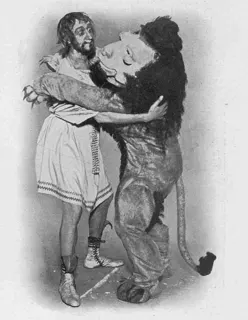
 Androcles and the Lionby George Bernard ShawA gentle Christian takes a thorn from a lion's paw, and meets the lion again in the Roman arena.
 Annajanska, the Bolshevik Empressby George Bernard ShawA general of a revolution receives a runaway grand duchess under arrest.
 Arms and the Manby George Bernard ShawA runaway Swiss soldier hides in a young woman's bedroom, and punctures her romantic ideas of war.
 Augustus Does His Bitby George Bernard ShawA lord in charge of a town's war effort hands a lady spy exactly what she came for.

Act 1
A glade in Wiltstoken Park
Enter LYDIA
Ye leafy breasts and warm protecting wings
Of mother trees that hatch our tender souls,
And from the well of Nature in our hearts
Thaw the intolerable inch of ice
That bears the weight of all the stamping world.
Hear ye me sing to solitude that I,
Lydia Carew, the owner of these lands,
Albeit most rich, most learned, and most wise,
Am yet most lonely. What are riches worth
When wisdom with them comes to show the purse bearer
That life remains unpurchasable? Learning
Learns but one lesson: doubt! To excel all
Is, to be lonely. Oh, ye busy birds,
Engrossed with real needs, ye shameless trees
With arms outspread in welcome of the sun,
Your minds, bent singly to enlarge your lives,
Have given you wings and raised your delicate heads
High heavens above us crawlers.
A rook sets up a great cawing; and the other birds chatter loudly as a gust of wind sets the branches swaying. She makes as though she would shew them her sleeves.
Lo, the leaves
That hide my drooping boughs! Mock me--poor maid!
Deride with joyous comfortable chatter
These stolen feathers. Laugh at me, the clothed one.
Laugh at the mind fed on foul air and books.
Books! Art! And Culture! Oh, I shall go mad.
Give me a mate that never heard of these,
A sylvan god, tree born in heart and sap;
Or else, eternal maidhood be my hap.
Another gust of wind and bird-chatter. She sits on the mossy root of an oak and buries her face in her hands. CASHEL BYRON, in a white singlet and breeches, comes through the trees.
What's this? Whom have we here? A woman!
[looking up] Yes.
You have no business here. I have. Away!
Women distract me. Hence!
Bid you me hence?
I am upon mine own ground. Who are you?
I take you for a god, a sylvan god.
This place is mine: I share it with the birds,
The trees, the sylvan gods, the lovely company
Of haunted solitudes.
A sylvan god!
A goat-eared image! Do your statues speak?
Walk? heave the chest with breath? or like a feather
Lift you--like this? [He sets her on her feet.
[panting] You take away my breath!
You're strong. Your hands off, please. Thank you. Farewell.
Before you go: when shall we meet again?
Why should we meet again?
Who knows? We shall.
That much I know by instinct. What's your name?
Lydia Carew.
Lydia's a pretty name.
Where do you live?
I' the castle.
[thunderstruck] Do not say
You are the lady of this great domain.
I am.
Accursed luck! I took you for
The daughter of some farmer. Well, your pardon.
I came too close: I looked too deep. Farewell.
I pardon that. Now tell me who you are.
Ask me not whence I come, nor what I am.
You are the lady of the castle. I
Have but this hard and blackened hand to live by.
I have felt its strength and envied you. Your name?
I have told you mine.
My name is Cashel Byron.
I never heard the name; and yet you utter it
As men announce a celebrated name.
Forgive my ignorance.
I bless it, Lydia.
I have forgot your other name.
Carew.
Cashel's a pretty name, too.
[calling through the wood] Coo-ee! Byron!
A thousand curses! Oh, I beg you, go.
This is a man you must not meet.
[further off] Coo-ee!
He's losing us. What does he in my woods?
He is a part of what I am. What that is
You must not know. It would end all between us.
And yet there's no dishonor in't: your lawyer,
Who let your lodge to me, will vouch me honest.
I am ashamed to tell you what I am
At least, as yet. Some day, perhaps.
[nearer] Coo-ee!
His voice is nearer. Fare you well, my tenant.
When next your rent falls due, come to the castle.
Pay me in person. Sir: your most obedient. [She curtsies and goes.
Lives in this castle! Owns this park! A lady
Marry a prizefighter! Impossible.
And yet the prizefighter must marry her.
Enter MELLISH
Ensanguined swine, whelped by a doggish dam,
Is this thy park, that thou, with voice obscene,
Fillst it with yodeled yells, and screamst my name
For all the world to know that Cashel Byron
Is training here for combat.
Swine you me?
I've caught you, have I? You have found a woman.
Let her shew here again, I'll set the dog on her.
I will. I say it. And my name's Bob Mellish.
Change thy initial and be truly hight
Hellish. As for thy dog, why dost thou keep one
And bark thyself? Begone.
I'll not begone.
You shall come back with me and do your duty
Your duty to your backers, do you hear?
You have not punched the bag this blessed day.
The putrid bag engirdled by thy belt
Invites my fist.
[weeping] Ingrate! O wretched lot!
Who would a trainer be? O Mellish, Mellish,
Trainer of heroes, builder-up of brawn,
Vicarious victor, thou createst champions
That quickly turn thy tyrants. But beware:
Without me thou art nothing. Disobey me,
And all thy boasted strength shall fall from thee.
With flaccid muscles and with failing breath
Facing the fist of thy more faithful foe,
I'll see thee on the grass cursing the day
Thou didst forswear thy training.
Noisome quack
That canst not from thine own abhorrent visage
Take one carbuncle, thou contaminat'st
Even with thy presence my untainted blood
Preach abstinence to rascals like thyself
Rotten with surfeiting. Leave me in peace.
This grove is sacred: thou profanest it.
Hence! I have business that concerns thee not.
Ay, with your woman. You will lose your fight.
Have you forgot your duty to your backers?
Oh, what a sacred thing your duty is!
What makes a man but duty? Where were we
Without our duty? Think of Nelson's words:
England expects that every man--
Shall twaddle
About his duty. Mellish: at no hour
Can I regard thee wholly without loathing;
But when thou play'st the moralist, by Heaven,
My soul flies to my fist, my fist to thee;
And never did the Cyclops' hammer fall
On Mars's armor--but enough of that.
It does remind me of my mother.
Ah,
Byron, let it remind thee. Once I heard
An old song: it ran thus. [He clears his throat.] Ahem, Ahem!
[Sings] --They say there is no other
Can take the place of mother
I am out o' voice: forgive me; but remember:
Thy mother--were that sainted woman here
Would say, Obey thy trainer.
Now, by Heaven,
Some fate is pushing thee upon thy doom.
Canst thou not hear thy sands as they run out?
They thunder like an avalanche. Old man:
Two things I hate, my duty and my mother.
Why dost thou urge them both upon me now?
Presume not on thine age and on thy nastiness.
Vanish, and promptly.
Can I leave thee here
Thus thinly clad, exposed to vernal dews?
Come back with me, my son, unto our lodge.
Within this breast a fire is newly lit
Whose glow shall sun the dew away, whose radiance
Shall make the orb of night hang in the heavens
Unnoticed, like a glow-worm at high noon.
Ah me, ah me, where wilt thou spend the night?
Wiltstoken's windows wandering beneath,
Wiltstoken's holy bell hearkening,
Wiltstoken's lady loving breathlessly.
The lady of the castle! Thou art mad.
'Tis thou art mad to trifle in my path.
Thwart me no more. Begone.
My boy, my son,
I'd give my heart's blood for thy happiness.
Thwart thee, my son! Ah, no. I'll go with thee.
I'll brave the dews. I'll sacrifice my sleep.
I am old--no matter: ne'er shall it be said
Mellish deserted thee.
You resolute gods
That will not spare this man, upon your knees
Take the disparity twixt his age and mine.
Now from the ring to the high judgment seat
I step at your behest. Bear you me witness
This is not Victory, but Execution.
He solemnly projects his fist with colossal force against the waistcoat of MELLISH who doubles up like a folded towel, and lies without sense or motion.
And now the night is beautiful again.
The castle clock strikes the hour in the distance.
Hark! Hark! Hark! Hark! Hark! Hark! Hark! Hark! Hark! Hark!
It strikes in poetry. 'Tis ten o'clock.
Lydia: to thee!
He steals off towards the castle. MELLISH stirs and groans.
Act 2, Scene 1
London. A room in Lydia's house
Enter LYDIA and LUCIAN
Welcome, dear cousin, to my London house.
Of late you have been chary of your visits.
I have been greatly occupied of late.
The minister to whom I act as scribe
In Downing Street was born in Birmingham,
And, like a thoroughbred commercial statesman,
Splits his infinities, which I, poor slave,
Must reunite, though all the time my heart
Yearns for my gentle coz's company.
Lucian: there is some other reason. Think!
Since England was a nation every mood
Her scribes have prepositionally split;
But thine avoidance dates from yestermonth.
There is a man I like not haunts this house.
Thou speak'st of Cashel Byron?
Aye, of him.
Hast thou forgotten that eventful night
When as we gathered were at Hoskyn House
To hear a lecture by Herr Abendgasse,
He placed a single finger on my chest,
And I, ensorceled, would have sunk supine
Had not a chair received my falling form.
Pooh! That was but by way of illustration.
What right had he to illustrate his point
Upon my person? Was I his assistant
That he should try experiments on me
As Simpson did on his with chloroform?
Now, by the cannon balls of Galileo
He hath unmanned me: all my nerve is gone.
This very morning my official chief,
Tapping with friendly forefinger this button,
Levelled me like a thunderstricken elm
Flat upon the Colonial Office floor.
Fancies, coz.
Fancies! Fits! the chief said fits!
Delirium tremens! the chlorotic dance
Of Vitus! What could any one have thought?
Your ruffian friend hath ruined me. By Heaven,
I tremble at a thumbnail. Give me drink.
What ho, without there! Bashville.
[without] Coming, madam.
Enter BASHVILLE
My cousin ails, Bashville. Procure some wet. [Exit BASHVILLE.
Some wet!!! Where learnt you that atrocious word?
This is the language of a flower-girl.
True. It is horrible. Said I "Some wet"?
I meant, some drink. Why did I say "Some wet"?
Am I ensorceled too? "Some wet"! Fie! fie!
I feel as though some hateful thing had stained me.
Oh, Lucian, how could I have said "Some wet"?
The horrid conversation of this man
Hath numbed thy once unfailing sense of fitness.
Nay, he speaks very well: he's literate:
Shakespear he quotes unconsciously.
And yet
Anon he talks pure pothouse.
Enter BASHVILLE
Sir: your potion.
Thanks. [He drinks.] I am better.
[calling without] Extra special Star!
Result of the great fight! Name of the winner!
Who calls so loud?
The papers, madam.
Why?
Hath ought momentous happened?
Madam: yes. [He produces a newspaper.
All England for these thrilling paragraphs
A week has waited breathless.
Read them us.
[reading] "At noon to-day, unknown to the police,
Within a thousand miles of Wormwood Scrubbs,
Th' Australian Champion and his challenger,
The Flying Dutchman, formerly engaged
I' the mercantile marine, fought to a finish.
Lord Worthington, the well-known sporting peer
Acted as referee."
Lord Worthington!
"The bold Ned Skene revisited the ropes
To hold the bottle for his quondam novice;
Whilst in the seaman's corner were assembled
Professor Palmer and the Chelsea Snob.
Mellish, whose epigastrium has been hurt,
'Tis said, by accident at Wiltstoken,
Looked none the worse in the Australian's corner.
The Flying Dutchman wore the Union Jack:
His colors freely sold amid the crowd;
But Cashel's well-known spot of white on blue----"
Whose, did you say?
Cashel's, my lady.
Lucian:
Your hand--a chair
Madam: you're ill.
Proceed.
What you have read I do not understand;
Yet I will hear it through. Proceed.
Proceed.
"But Cashel's well-known spot of white on blue
Was fairly rushed for. Time was called at twelve,
When, with a smile of confidence upon
His ocean-beaten mug----"
His mug?
[explaining] His face.
[continuing] "The Dutchman came undaunted to the scratch,
But found the champion there already. Both
Most heartily shook hands, amid the cheers
Of their encouraged backers. Two to one
Was offered on the Melbourne nonpareil;
And soon, so fit the Flying Dutchman seemed,
Found takers everywhere. No time was lost
In getting to the business of the day.
The Dutchman led at once, and seemed to land
On Byron's dicebox; but the seaman's reach,
Too short for execution at long shots,
Did not get fairly home upon the ivory;
And Byron had the best of the exchange."
I do not understand. What were they doing?
Fighting with naked fists.
Oh, horrible!
I'll hear no more. Or stay: how did it end?
Was Cashel hurt?
[to BASHVILLE] Skip to the final round.
"Round Three: the rumors that had gone about
Of a breakdown in Byron's recent training
Seemed quite confirmed. Upon the call of time
He rose, and, looking anything but cheerful,
Proclaimed with every breath Bellows to Mend.
At this point six to one was freely offered
Upon the Dutchman; and Lord Worthington
Plunged at this figure till he stood to lose
A fortune should the Dutchman, as seemed certain,
Take down the number of the Panley boy.
The Dutchman, glutton as we know he is,
Seemed this time likely to go hungry. Cashel
Was clearly groggy as he slipped the sailor,
Who, not to be denied, followed him up,
Forcing the fighting mid tremendous cheers."
Oh stop--no more--or tell the worst at once.
I'll be revenged. Bashville: call the police.
This brutal sailor shall be made to know
There's law in England.
Do not interrupt him:
Mine ears are thirsting. Finish, man. What next?
"Forty to one, the Dutchman's friends exclaimed.
Done, said Lord Worthington, who shewed himself
A sportsman every inch. Barely the bet
Was booked, when, at the reeling champion's jaw
The sailor, bent on winning out of hand,
Sent in his right. The issue seemed a cert,
When Cashel, ducking smartly to his left,
Cross-countered like a hundredweight of brick----"
Death and damnation!
Oh, what does it mean?
"The Dutchman went to grass, a beaten man."
Hurrah! Hurrah! Hurrah! Oh, well done, Cashel!
"A scene of indescribable excitement
Ensued; for it was now quite evident
That Byron's grogginess had all along
Been feigned to make the market for his backers.
We trust this sample of colonial smartness
Will not find imitators on this side.
The losers settled up like gentlemen;
But many felt that Byron shewed bad taste
In taking old Ned Skene upon his back,
And, with Bob Mellish tucked beneath his oxter,
Sprinting a hundred yards to show the crowd
The perfect pink of his condition"--[a knock].
[turning pale] Bashville
Didst hear? A knock.
Madam: 'tis Byron's knock.
Shall I admit him?
Reeking from the ring!
Oh, monstrous! Say you're out.
Send him away.
I will not see the wretch. How dare he keep
Secrets from ME? I'll punish him. Pray say
I'm not at home. [BASHVILLE turns to go.] Yet stay. I am afraid
He will not come again.
A consummation
Devoutly to be wished by any lady.
Pray, do you wish this man to come again?
No, Lucian. He hath used me very ill.
He should have told me. I will ne'er forgive him.
Say, Not at home.
Yes, madam. [Exit.
Stay
[stopping her] No, Lydia:
You shall not countermand that proper order.
Oh, would you cast the treasure of your mind,
The thousands at your bank, and, above all,
Your unassailable social position
Before this soulless mass of beef and brawn?
Nay, coz: you're prejudiced.
[without] Liar and slave!
What words were those?
The man is drunk with slaughter.
Enter BASHVILLE running: he shuts the door and locks it.
Save yourselves: at the staircase foot the champion
Sprawls on the mat, by trick of wrestler tripped;
But when he rises, woe betide us all!
Who bade you treat my visitor with violence?
He would not take my answer; thrust the door
Back in my face; gave me the lie i' the throat;
Averred he felt your presence in his bones.
I said he should feel mine there too, and felled him;
Then fled to bar your door.
O lover's instinct!
He felt my presence. Well, let him come in.
We must not fail in courage with a fighter.
Unlock the door.
Stop. Like all women, Lydia,
You have the courage of immunity.
To strike you were against his code of honor;
But me, above the belt, he may perform on
T' th' height of his profession. Also Bashville.
Think not of me, sir. Let him do his worst.
Oh, if the valor of my heart could weigh
The fatal difference twixt his weight and mine,
A second battle should he do this day:
Nay, though outmatched I be, let but my mistress
Give me the word: instant I'll take him on
Here--now--at catchweight. Better bite the carpet
A man, than fly, a coward.
Bravely said:
I will assist you with the poker.
No:
I will not have him touched. Open the door.
Destruction knocks thereat. I smile, and open.
BASHVILLE opens the door. Dead silence. CASHEL enters, in tears. A solemn pause.
You know my secret?
Yes.
And thereupon
You bade your servant fling me from your door.
I bade my servant say I was not here.
[to BASHVILLE] Why didst thou better thy instruction, man?
Hadst thou but said, "She bade me tell thee this,"
Thoudst burst my heart. I thank thee for thy mercy.
Oh, Lucian, didst thou call him "drunk with slaughter"?
Canst thou refrain from weeping at his woe?
[to LUCIAN] The unwritten law that shields the amateur
Against professional resentment, saves thee.
O coward, to traduce behind their backs
Defenceless prizefighters!
Thou dost avow
Thou art a prizefighter.
It was my glory.
I had hoped to offer to my lady there
My belts, my championships, my heaped-up stakes,
My undefeated record; but I knew
Behind their blaze a hateful secret lurked.
Another secret?
Is there worse to come?
Know ye not then my mother is an actress?
How horrible!
Nay, nay: how interesting!
A thousand victories cannot wipe out
That birthstain. Oh, my speech bewrayeth it:
My earliest lesson was the player's speech
In Hamlet; and to this day I express myself
More like a mobled queen than like a man
Of flesh and blood. Well may your cousin sneer!
What's Hecuba to him or he to Hecuba?
Injurious upstart: if by Hecuba
Thou pointest darkly at my lovely cousin,
Know that she is to me, and I to her,
What never canst thou be. I do defy thee;
And maugre all the odds thy skill doth give,
Outside I will await thee.
I forbid
Expressly any such duello. Bashville:
The door. Put Mr. Webber in a hansom,
And bid the driver hie to Downing Street.
No answer: 'tis my will. [Exeunt LUCIAN and BASHVILLE.
And now, farewell.
You must not come again, unless indeed
You can some day look in my eyes and say:
Lydia: my occupation's gone.
Ah, no:
It would remind you of my wretched mother.
O God, let me be natural a moment!
What other occupation can I try?
What would you have me be?
A gentleman.
A gentleman! I, Cashel Byron, stoop
To be the thing that bets on me! the fool
I flatter at so many coins a lesson!
The screaming creature who beside the ring
Gambles with basest wretches for my blood,
And pays with money that he never earned!
Let me die broken-hearted rather!
But
You need not be an idle gentleman.
I call you one of Nature's gentlemen.
That's the collection for the loser, Lydia.
I am not wont to need it. When your friends
Contest elections, and at foot o' th' poll
Rue their presumption, 'tis their wont to claim
A moral victory. In a sort they are
Nature's M. P.s. I am not yet so threadbare
As to accept these consolation stakes.
You are offended with me.
Yes, I am.
I can put up with much; but--"Nature's gentleman"!
I thank your ladyship of Lyons, but
Must beg to be excused.
But surely, surely,
To be a prizefighter, and maul poor mariners
With naked knuckles, is no work for you.
Thou dost arraign the inattentive Fates
That weave my thread of life in ruder patterns
Than these that lie, antimacassarly,
Asprent thy drawingroom. As well demand
Why I at birth chose to begin my life
A speechless babe, hairless, incontinent,
Hobbling upon all fours, a nurse's nuisance?
Or why I do propose to lose my strength,
To blanch my hair, to let the gums recede
Far up my yellowing teeth, and finally
Lie down and moulder in a rotten grave?
Only one thing more foolish could have been,
And that was to be born, not man, but woman.
This was thy folly, why rebuk'st thou mine?
These are not things of choice.
And did I choose
My quick divining eye, my lightning hand,
My springing muscle and untiring heart?
Did I implant the instinct in the race
That found a use for these, and said to me,
Fight for us, and be fame and fortune thine?
But there are other callings in the world.
Go tell thy painters to turn stockbrokers,
Thy poet friends to stoop o'er merchants' desks
And pen prose records of the gains of greed.
Tell bishops that religion is outworn,
And that the Pampa to the horsebreaker
Opes new careers. Bid the professor quit
His fraudulent pedantries, and do i' the world
The thing he would teach others. Then return
To me and say: Cashel: they have obeyed;
And on that pyre of sacrifice I, too,
Will throw my championship.
But 'tis so cruel.
Is it so? I have hardly noticed that,
So cruel are all callings. Yet this hand,
That many a two days' bruise hath ruthless given,
Hath kept no dungeon locked for twenty years,
Hath slain no sentient creature for my sport.
I am too squeamish for your dainty world,
That cowers behind the gallows and the lash,
The world that robs the poor, and with their spoil
Does what its tradesmen tell it. Oh, your ladies!
Sealskinned and egret-feathered; all defiance
To Nature; cowering if one say to them
"What will the servants think?" Your gentlemen!
Your tailor-tyrannized visitors of whom
Flutter of wing and singing in the wood
Make chickenbutchers. And your medicine men!
Groping for cures in the tormented entrails
Of friendly dogs. Pray have you asked all these
To change their occupations? Find you mine
So grimly crueller? I cannot breathe
An air so petty and so poisonous.
But find you not their manners very nice?
To me, perfection. Oh, they condescend
With a rare grace. Your duke, who condescends
Almost to the whole world, might for a Man
Pass in the eyes of those who never saw
The duke capped with a prince. See then, ye gods,
The duke turn footman, and his eager dame
Sink the great lady in the obsequious housemaid!
Oh, at such moments I could wish the Court
Had but one breadbasket, that with my fist
I could make all its windy vanity
Gasp itself out on the gravel. Fare you well.
I did not choose my calling; but at least
I can refrain from being a gentleman.
You say farewell to me without a pang.
My calling hath apprenticed me to pangs.
This is a rib-bender; but I can bear it.
It is a lonely thing to be a champion.
It is a lonelier thing to be a woman.
Be lonely then. Shall it be said of thee
That for his brawn thou misalliance mad'st
Wi' the Prince of Ruffians? Never. Go thy ways;
Or, if thou hast nostalgia of the mud,
Wed some bedogged wretch that on the slot
Of gilded snobbery, ventre a terre,
Will hunt through life with eager nose on earth
And hang thee thick with diamonds. I am rich;
But all my gold was fought for with my hands.
What dost thou mean by rich?
There is a man,
Hight Paradise, vaunted unconquerable,
Hath dared to say he will be glad to hear from me.
I have replied that none can hear from me
Until a thousand solid pounds be staked.
His friends have confidently found the money.
Ere fall of leaf that money shall be mine;
And then I shall possess ten thousand pounds.
I had hoped to tempt thee with that monstrous sum.
Thou silly Cashel, 'tis but a week's income.
I did propose to give thee three times that
For pocket money when we two were wed.
Give me my hat. I have been fooling here.
Now, by the Hebrew lawgiver, I thought
That only in America such revenues
Were decent deemed. Enough. My dream is dreamed.
Your gold weighs like a mountain on my chest.
Farewell.
The golden mountain shall be thine
The day thou quit'st thy horrible profession.
Tempt me not, woman. It is honor calls.
Slave to the Ring I rest until the face
Of Paradise be changed.
Enter BASHVILLE
Madam, your carriage,
Ordered by you at two. 'Tis now half-past.
Sdeath! is it half-past two? The king! the king!
The king! What mean you?
I must meet a monarch
This very afternoon at Islington.
At Islington! You must be mad.
A cab!
Go call a cab; and let a cab be called;
And let the man that calls it be thy footman.
You are not well. You shall not go alone.
My carriage waits. I must accompany you.
I go to find my hat. [Exit.
Like Paracelsus,
Who went to find his soul. [To BASHVILLE.] And now, young man,
How comes it that a fellow of your inches,
So deft a wrestler and so bold a spirit,
Can stoop to be a flunkey? Call on me
On your next evening out. I'll make a man of you.
Surely you are ambitious and aspire--
To be a butler and draw corks; wherefore,
By Heaven, I will draw yours.
He hits CASHEL on the nose, and runs out.
[thoughtfully putting the side of his forefinger to his nose, and studying the blood on it] Too quick for me!
There's money in this youth.
Re-enter LYDIA, hatted and gloved.
O Heaven! you bleed.
Lend me a key or other frigid object,
That I may put it down my back, and staunch
The welling life stream.
[giving him her keys] Oh, what have you done?
Flush on the boko napped your footman's left.
I do not understand.
True. Pardon me.
I have received a blow upon the nose
In sport from Bashville. Next, ablution; else
I shall be total gules. [He hurries out.
How well he speaks!
There is a silver trumpet in his lips
That stirs me to the finger ends. His nose
Dropt lovely color: 'tis a perfect blood.
I would 'twere mingled with mine own!
Enter BASHVILLE
What now?
Madam, the coachman can no longer wait:
The horses will take cold.
I do beseech him
A moment's grace. Oh, mockery of wealth!
The third class passenger unchidden rides
Whither and when he will: obsequious trams
Await him hourly: subterranean tubes
With tireless coursers whisk him through the town;
But we, the rich, are slaves to Houyhnhnms:
We wait upon their colds, and frowst all day
Indoors, if they but cough or spurn their hay.
Madam, an omnibus to Euston Road,
And thence t' th' Angel
Enter CASHEL
Let us haste, my love:
The coachman is impatient.
Did he guess
He stays for Cashel Byron, he'd outwait
Pompei's sentinel. Let us away.
This day of deeds, as yet but half begun,
Must ended be in merrie Islington. [Exeunt LYDIA and CASHEL.
Gods! how she hangs on's arm! I am alone.
Now let me lift the cover from my soul.
O wasted humbleness! Deluded diffidence!
How often have I said, Lie down, poor footman:
She'll never stoop to thee, rear as thou wilt
Thy powder to the sky. And now, by Heaven,
She stoops below me; condescends upon
This hero of the pothouse, whose exploits,
Writ in my character from my last place,
Would damn me into ostlerdom. And yet
There's an eternal justice in it; for
By so much as the ne'er subdued Indian
Excels the servile negro, doth this ruffian
Precedence take of me. "Ich dien." Damnation!
I serve. My motto should have been, "I scalp."
And yet I do not bear the yoke for gold.
Because I love her I have blacked her boots;
Because I love her I have cleaned her knives,
Doing in this the office of a boy,
Whilst, like the celebrated maid that milks
And does the meanest chares, I've shared the passions
Of Cleopatra. It has been my pride
To give her place the greater altitude
By lowering mine, and of her dignity
To be so jealous that my cheek has flamed
Even at the thought of such a deep disgrace
As love for such a one as I would be
For such a one as she; and now! and now!
A prizefighter! O irony! O bathos!
To have made way for this! Oh, Bashville, Bashville:
Why hast thou thought so lowly of thyself,
So heavenly high of her? Let what will come,
My love must speak: 'twas my respect was dumb.
Act 2, Scene 2
The Agricultural Hall in Islington, crowded with spectators. In the arena a throne, with a boxing ring before it. A balcony above on the right, occupied by persons of fashion: among others, LYDIA and LORD WORTHINGTON.
Flourish. Enter LUCIAN and CETEWAYO, with Chiefs in attendance.
Is this the Hall of Husbandmen?
It is.
Are these anaemic dogs the English people?
Mislike us not for our complexions,
The pallid liveries of the pall of smoke
Belched by the mighty chimneys of our factories,
And by the million patent kitchen ranges
Of happy English homes.
When first I came
I deemed those chimneys the fuliginous altars
Of some infernal god. I now perceive
The English dare not look upon the sky.
They are moles and owls: they call upon the soot
To cover them.
You cannot understand
The greatness of this people, Cetewayo.
You are a savage, reasoning like a child.
Each pallid English face conceals a brain
Whose powers are proven in the works of Newton
And in the plays of the immortal Shakespear.
There is not one of all the thousands here
But, if you placed him naked in the desert,
Would presently construct a steam engine,
And lay a cable t' th' Antipodes.
Have I been brought a million miles by sea
To learn how men can lie! Know, Father Webber,
Men become civilized through twin diseases,
Terror and Greed to wit: these two conjoined
Become the grisly parents of Invention.
Why does the trembling white with frantic toil
Of hand and brain produce the magic gun
That slays a mile off, whilst the manly Zulu
Dares look his foe i' the face; fights foot to foot;
Lives in the present; drains the Here and Now;
Makes life a long reality, and death
A moment only! whilst your Englishman
Glares on his burning candle's winding-sheets,
Counting the steps of his approaching doom.
And in the murky corners ever sees
Two horrid shadows, Death and Poverty:
In the which anguish an unnatural edge
Comes on his frighted brain, which straight devises
Strange frauds by which to filch unearned gold,
Mad crafts by which to slay unfaced foes,
Until at last his agonized desire
Makes possibility its slave. And then
Horrible climax! All-undoing spite!
Th' importunate clutching of the coward's hand
From wearied Nature Devastation's secrets
Doth wrest; when straight the brave black-livered man
Is blown explosively from off the globe;
And Death and Dread, with their white-livered slaves
O'er-run the earth, and through their chattering teeth
Stammer the words "Survival of the Fittest."
Enough of this: I came not here to talk.
Thou say'st thou hast two white-faced ones who dare
Fight without guns, and spearless, to the death.
Let them be brought.
They fight not to the death,
But under strictest rules: as, for example,
Half of their persons shall not be attacked;
Nor shall they suffer blows when they fall down,
Nor stroke of foot at any time. And, further,
That frequent opportunities of rest
With succor and refreshment be secured them.
Ye gods, what cowards! Zululand, my Zululand:
Personified Pusillanimity
Hath ta'en thee from the bravest of the brave!
Lo, the rude savage whose untutored mind
Cannot perceive self-evidence, and doubts
That Brave and English mean the self-same thing!
Well, well, produce these heroes. I surmise
They will be carried by their nurses, lest
Some barking dog or bumbling bee should scare them.
CETEWAYO takes his state. Enter PARADISE
What hateful wretch is this whose mighty thews
Presage destruction to his adversaries?
'Tis Paradise.
He of whom Cashel spoke?
A dreadful thought ices my heart. Oh, why
Did Cashel leave us at the door?
Enter CASHEL
Behold!
The champion comes.
Oh, I could kiss him now,
Here, before all the world. His boxing things
Render him most attractive. But I fear
Yon villain's fists may maul him.
Have no fear.
Hark! the king speaks.
Ye sons of the white queen:
Tell me your names and deeds ere ye fall to.
Your royal highness, you beholds a bloke
What gets his living honest by his fists.
I may not have the polish of some toffs
As I could mention on; but up to now
No man has took my number down. I scale
Close on twelve stun; my age is twenty-three;
And at Bill Richardson's Blue Anchor pub
Am to be heard of any day by such
As likes the job. I don't know, governor,
As ennythink remains for me to say.
Six wives and thirty oxen shalt thou have
If on the sand thou leave thy foeman dead.
Methinks he looks scornfully on thee.
[To CASHEL] Ha! dost thou not so?
Sir, I do beseech you
To name the bone, or limb, or special place
Where you would have me hit him with this fist.
Thou hast a noble brow; but much I fear
Thine adversary will disfigure it.
There's a divinity that shapes our ends
Rough hew them how we will. Give me the gloves.
THE MASTER OF THE REVELS. Paradise, a professor.
Cashel Byron,
Also professor. Time! [They spar.
Eternity
It seems to me until this fight be done.
Dread monarch: this is called the upper cut,
And this a hook-hit of mine own invention.
The hollow region where I plant this blow
Is called the mark. My left, you will observe,
I chiefly use for long shots: with my right
Aiming beside the angle of the jaw
And landing with a certain delicate screw
I without violence knock my foeman out.
Mark how he falls forward upon his face!
The rules allow ten seconds to get up;
And as the man is still quite silly, I
Might safely finish him; but my respect
For your most gracious majesty's desire
To see some further triumphs of the science
Of self-defence postpones awhile his doom.
How can a bloke do hisself proper justice
With pillows on his fists?
He tears off his gloves and attacks CASHEL with his bare knuckles.
Unfair! The rules!
The joy of battle surges boiling up
And bids me join the mellay. Isandhlana
And Victory! [He falls on the bystanders.
Victory and Isandhlana!
They run amok. General panic and stampede. The ring is swept away.
Forbear these most irregular proceedings.
Police! Police!
He engages CETEWAYO his umbrella. The balcony comes down with a crash. Screams from its occupants. Indescribable confusion.
[dragging LYDIA from the struggling heap] My love, my love, art hurt?
No, no; but save my sore o'ermatched cousin.
Give us a lead, sir. Save the English flag.
Africa tramples on it.
Africa!
Not all the continents whose mighty shoulders
The dancing diamonds of the seas bedeck
Shall trample on the blue with spots of white.
Now, Lydia, mark thy lover. [He charges the Zulus.
Hercules
Cannot withstand him. See: the king is down;
The tallest chief is up, heels over head,
Tossed corklike o'er my Cashel's sinewy back;
And his lieutenant all deflated gasps
For breath upon the sand. The others fly
In vain: his fist o'er magic distances
Like a chameleon's tongue shoots to its mark;
And the last African upon his knees
Sues piteously for quarter. [Rushing into CASHEL'S arms.]
Oh, my hero: Thou'st saved us all this day.
'Twas all for thee.
[trying to rise] Have I been struck by lightning?
Sir, your conduct
Can only be described as most ungentlemanly.
One of the prone is white.
'Tis Paradise.
He's choking: he has something in his mouth.
[to CASHEL] Oh Heaven! there is blood upon your hip.
You're hurt.
The morsel in yon wretch's mouth
Was bitten out of me.
Sensation. LYDIA screams and swoons in CASHEL'S arms.
Act 3
Wiltstoken. A room in the Warren Lodge
LYDIA at her writing table
O Past and Present, how ye do conflict
As here I sit writing my father's life!
The autumn woodland woos me from without
With whispering of leaves and dainty airs
To leave this fruitless haunting of the past.
My father was a very learned man.
I sometimes think I shall oldmaided be
Ere I unlearn the things he taught to me.
Enter POLICEMAN
Asking your ladyship to pardon me
For this intrusion, might I be so bold
As ask a question of your people here
Concerning the Queen's peace?
My people here
Are but a footman and a simple maid;
And both have craved a holiday to join
Some local festival. But, sir, your helmet
Proclaims the Metropolitan Police.
Madam, it does; and I may now inform you
That what you term a local festival
Is a most hideous outrage 'gainst the law,
Which we to quell from London have come down:
In short, a prizefight. My sole purpose here
Is to inquire whether your ladyship
Any bad characters this afternoon
Has noted in the neighborhood.
No, none, sir.
I had not let my maid go forth to-day
Thought I the roads unsafe.
Fear nothing, madam:
The force protects the fair. My mission here
Is to wreak ultion for the broken law.
I wish your ladyship good afternoon.
Good afternoon. [Exit POLICEMAN.
A prizefight! O my heart!
Cashel: hast thou deceived me? Can it be
Thou hast backslidden to the hateful calling
I asked thee to eschew?
O wretched maid,
Why didst thou flee from London to this place
To write thy father's life, whenas in town
Thou might'st have kept a guardian eye on him
What's that? A flying footstep
Enter CASHEL
Sanctuary!
The law is on my track. What! Lydia here!
Ay: Lydia here. Hast thou done murder, then,
That in so horrible a guise thou comest?
Murder! I would I had. Yon cannibal
Hath forty thousand lives; and I have ta'en
But thousands thirty-nine. I tell thee, Lydia,
On the impenetrable sarcolobe
That holds his seedling brain these fists have pounded
By Shrewsb'ry clock an hour. This bruised grass
And caked mud adhering to my form
I have acquired in rolling on the sod
Clinched in his grip. This scanty reefer coat
For decency snatched up as fast I fled
When the police arrived, belongs to Mellish.
'Tis all too short; hence my display of rib
And forearm mother-naked. Be not wroth
Because I seem to wink at you: by Heaven,
'Twas Paradise that plugged me in the eye
Which I perforce keep closing. Pity me,
My training wasted and my blows unpaid,
Sans stakes, sans victory, sans everything
I had hoped to win. Oh, I could sit me down
And weep for bitterness.
Thou wretch, begone.
Begone!
I say begone. Oh, tiger's heart
Wrapped in a young man's hide, canst thou not live
In love with Nature and at peace with Man?
Must thou, although thy hands were never made
To blacken others' eyes, still batter at
The image of Divinity? I loathe thee.
Hence from my house and never see me more.
I go. The meanest lad on thy estate
Would not betray me thus. But 'tis no matter. [He opens the door.
Ha! the police. I'm lost. [He shuts the door again.
Now shalt thou see
My last fight fought. Exhausted as I am,
To capture me will cost the coppers dear.
Come one, come all!
Oh, hide thee, I implore:
I cannot see thee hunted down like this.
There is my room. Conceal thyself therein.
Quick, I command. [He goes into the room.
With horror I foresee,
Lydia, that never lied, must lie for thee.
Enter POLICEMAN, with PARADISE and MELLISH in
custody, BASHVILLE, constables, and others
Keep back your bruised prisoner lest he shock
This wellbred lady's nerves. Your pardon, ma'am;
But have you seen by chance the other one?
In this direction he was seen to run.
A man came here anon with bloody hands
And aspect that did turn my soul to snow.
'Twas he. What said he?
Begged for sanctuary.
I bade the man begone.
Most properly.
Saw you which way he went?
I cannot tell.
He seen me coming; and he done a bunk.
Peace, there. Excuse his damaged features, lady:
He's Paradise; and this one's Byron's trainer,
Mellish.
Injurious copper, in thy teeth
I hurl the lie. I am no trainer, I.
My father, a respected missionary,
Apprenticed me at fourteen years of age
T' the poetry writing. To these woods I came
With Nature to commune. My revery
Was by a sound of blows rudely dispelled.
Mindful of what my sainted parent taught,
I rushed to play the peacemaker, when lo!
These minions of the law laid hands on me.
A lovely woman, with distracted cries,
In most resplendent fashionable frock,
Approaches like a wounded antelope.
Enter ADELAIDE GISBORNE
Where is my Cashel? Hath he been arrested?
I would I had thy Cashel by the collar:
He hath escaped me.
Praises be for ever!
Why dost thou call the missing man thy Cashel?
He is mine only son.
Thy son!
My son.
I thought his mother hardly would have known him,
So crushed his countenance.
A ribald peer,
Lord Worthington by name, this morning came
With honeyed words beseeching me to mount
His four-in-hand, and to the country hie
To see some English sport. Being by nature
Frank as a child, I fell into the snare,
But took so long to dress that the design
Failed of its full effect; for not until
The final round we reached the horrid scene.
Be silent all; for now I do approach
My tragedy's catastrophe. Know, then,
That Heaven did bless me with an only son,
A boy devoted to his doting mother--
Hark! did you hear an oath from yonder room?
Respect a broken-hearted mother's grief,
And do not interrupt me in my scene.
Ten years ago my darling disappeared
(Ten dreary twelvemonths of continuous tears,
Tears that have left me prematurely aged;
For I am younger far than I appear).
Judge of my anguish when to-day I saw
Stripped to the waist, and fighting like a demon
With one who, whatsoe'er his humble virtues,
Was clearly not a gentleman, my son!
O strange event! O passing tearful tale!
I thank you from the bottom of my heart
For the reception you have given my woe;
And now I ask, where is my wretched son?
He must at once come home with me, and quit
A course of life that cannot be allowed.
Enter CASHEL
Policeman: I do yield me to the law.
Oh, no.
My son!
My mother! Do not kiss me.
My visage is too sore.
The lady hid him.
This is a regular plant. You cannot be
Up to that sex. [To CASHEL] You come along with me.
Fear not, my Cashel: I will bail thee out.
Never. I do embrace my doom with joy.
With Paradise in Pentonville or Portland
I shall feel safe: there are no mothers there.
Ungracious boy
Constable: bear me hence.
Oh, let me sweetest reconcilement make
By calling to thy mind that moving song:
[Sings] They say there is no other
Forbear at once, or the next note of music
That falls upon thine ear shall clang in thunder
From the last trumpet.
A disgraceful threat
To level at this virtuous old man.
Oh, Cashel, if thou scorn'st thy mother thus,
How wilt thou treat thy wife?
There spake my fate:
I knew you would say that. Oh, mothers, mothers,
Would you but let your wretched sons alone
Life were worth living! Had I any choice
In this importunate relationship?
None. And until that high auspicious day
When the millennium on an orphaned world
Shall dawn, and man upon his fellow look,
Reckless of consanguinity, my mother
And I within the self-same hemisphere
Conjointly may not dwell.
Ungentlemanly!
I am no gentleman. I am a criminal,
Redhanded, baseborn
Baseborn! Who dares say it?
Thou art the son and heir of Bingley Bumpkin
FitzAlgernon de Courcy Cashel Byron,
Sieur of Park Lane and Overlord of Dorset,
Who after three months' wedded happiness
Rashly fordid himself with prussic acid,
Leaving a tearstained note to testify
That having sweetly honeymooned with me,
He now could say, O Death, where is thy sting?
Sir: had I known your quality, this cop
I had averted; but it is too late.
The law's above us both.
Enter LUCIAN, with an Order in Council
Not so, policeman
I bear a message from The Throne itself
Of fullest amnesty for Byron's past.
Nay, more: of Dorset deputy lieutenant
He is proclaimed. Further, it is decreed,
In memory of his glorious victory
Over our country's foes at Islington,
The flag of England shall for ever bear
On azure field twelve swanlike spots of white;
And by an exercise of feudal right
Too long disused in this anarchic age
Our sovereign doth confer on him the hand
Of Miss Carew, Wiltstoken's wealthy heiress. [General acclamation.
Was anything, sir, said about me?
Thy faithful services are not forgot:
In future call thyself Inspector Smith. [Renewed acclamation.
I thank you, sir. I thank you, gentlemen.
My former opposition, valiant champion,
Was based on the supposed discrepancy
Betwixt your rank and Lydia's. Here's my hand.
And I do here unselfishly renounce
All my pretensions to my lady's favor. [Sensation.
What, Bashville! didst thou love me?
Madam: yes.
'Tis said: now let me leave immediately.
In taking, Bashville, this most tasteful course
You are but acting as a gentleman
In the like case would act. I fully grant
Your perfect right to make a declaration
Which flatters me and honors your ambition.
Prior attachment bids me firmly say
That whilst my Cashel lives, and polyandry
Rests foreign to the British social scheme,
Your love is hopeless; still, your services,
Made zealous by disinterested passion,
Would greatly add to my domestic comfort;
And if--
Excuse me. I have other views.
I've noted in this man such aptitude
For art and exercise in his defence
That I prognosticate for him a future
More glorious than my past. Henceforth I dub him
The Admirable Bashville, Byron's Novice;
And to the utmost of my mended fortunes
Will back him 'gainst the world at ten stone six.
Hail, Byron's Novice, champion that shall be!
Must I renounce my lovely lady's service,
And mar the face of man?
'Tis Fate's decree.
For know, rash youth, that in this star crost world
Fate drives us all to find our chiefest good
In what we can, and not in what we would.
A post-horn--hark!
What noise of wheels is this?
LORD WORTHINGTON drives upon the scene in his four-in-hand,
and descends
Perfidious peer!
Sweet Adelaide--
Forbear,
Audacious one: my name is Mrs. Byron.
Oh, change that title for the sweeter one
Of Lady Worthington.
Unhappy man,
You know not what you do.
Nay, 'tis a match
Of most auspicious promise. Dear Lord Worthington,
You tear from us our mother-in-law
Ha! true.
but we will make the sacrifice. She blushes:
At least she very prettily produces
Blushing's effect.
My lord: I do accept you. [They embrace. Rejoicings.
[aside] It wrings my heart to see my noble backer
Lay waste his future thus. The world's a chessboard,
And we the merest pawns in fist of Fate.
[Aloud.] And now, my friends, gentle and simple both,
Our scene draws to a close. In lawful course
As Dorset's deputy lieutenant I
Do pardon all concerned this afternoon
In the late gross and brutal exhibition
Of miscalled sport.
[throwing herself into his arms] Your boats
are burnt at last.
This is the face that burnt a thousand boats,
And ravished Cashel Byron from the ring.
But to conclude. Let William Paradise
Devote himself to science, and acquire,
By studying the player's speech in Hamlet,
A more refined address. You, Robert Mellish,
To the Blue Anchor hostelry attend him;
Assuage his hurts, and bid Bill Richardson
Limit his access to the fatal tap.
Now mount we on my backer's four-in-hand,
And to St. George's Church, whose portico
Hanover Square shuts off from Conduit Street,
Repair we all. Strike up the wedding march;
And, Mellish, let thy melodies trill forth
Broad o'er the wold as fast we bowl along.
Give me the post-horn. Loose the flowing rein;
And up to London drive with might and main. [Exeunt.