
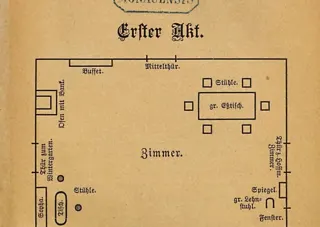
 Before Dawnby Gerhart HauptmannA reformer finds love in a mining village made rich and ruined by coal.
 The Ratsby Gerhart HauptmannIn a Berlin tenement, a childless woman buys a servant girl's baby.
Act 1
A small, blue-tinted kitchen with low ceiling; a window at the left; at the right a door of rough boards leading out into the open; in the rear mall an empty casing from which the door has been lifted.--In the left corner a flat oven, above which hang kitchen utensils in a wooden frame; in the right corner oars and other boating implements. Rough, stubby pieces of hewn wood lie in a heap under the window. An old kitchen bench, several stools, etc.--Through the empty casing in the rear a second room is visible. In it stands a high, neatly, made bed; above it hang cheap photographs in still cheaper frames, small chromolithographs, etc. A chair of soft mood stands with its back against the bed.--It is winter and moonlight. On the oven a tallow-candle is burning in a candle-stick of tin. LEONTINE WOLFF has fallen asleep on a stool by the oven and rests her head and arms on it. She is a pretty, fair girl of seventeen in the working garb of a domestic servant. A woolen shawl is tied over her cotton jacket.--For several seconds there is silence. Then someone is heard trying to unlock the door from without. But the key is in the lock and a knocking follows.
[Unseen, from without.] Adelaide! Adelaide! [There is no answer and a loud knocking is heard at the window.] Are you goin' to open or not?
[Drowsily.] No, no, I'm not goin' to be abused that way!
Open, girl, or I'll come in through the window!
She raps violently at the panes.
[Waking up.] Oh, it's you, mama! I'm coming now!
She unlocks the door from within.
[Without laying down a sack which she carries over her shoulder.] What are you doin' here?
[Sleepily.] Evenin', mama.
How did you get in here, eh?
Well, wasn't the key lyin' on the goat shed?
But what do you want here at home?
[Awkwardly affected and aggrieved.] So you don't want me to come no more at all?
Aw, you just go ahead and put on that way! I'm so fond o' that! [She lets the sack drop from her shoulder.] You don't know nothin', I s'ppose, about how late it's gettin'? You hurry and go back to your mistress.
It matters a whole lot, don't it, if I get back there a little too late?
You want to be lookin' out, y'understand? You see to it that you go, or you'll catch it!
[Tearfully and defiantly.] I ain't goin' back to them people no more, mama!
[Astonished.] Not goin'?... [Ironically.] Oh, no! That's somethin' quite new!
Well, I don't have to let myself be abused that way!
[Busy extracting a piece of venison from the sack.] So the Kruegers abuse you, do they? Aw, the poor child that you are!--Don't you come round me with such fool talk! A wench like a dragoon...! Here, lend a hand with this sack, at the bottom. You can't act more like a fool, eh? You won't get no good out o' me that way! You can't learn lazyin' around, here, at all. [They hang up the venison on the door.] Now I tell you for the last time....
I ain't goin' back to them people, I tell you. I'd jump in the river first!
See that you don't catch a cold doin' it.
I'll jump in the river!
Go ahead. Let me know about it and I'll give you a shove so you don't miss it.
[Screaming.] Do I have to stand for that, that I gotta drag in two loads o' wood at night!
[In mock astonishment.] Well, now, that's pretty awful, ain't it? You gotta drag in wood? Such people, I tell you!
... An' I gets twenty crowns for the whole year. I'm to get my hands frost-bitten for that, am I? An' not enough potatoes and herring to go round!
You needn't go fussin' about that, you silly girl. Here's the key; go, cut yourself some bread. An' when you've had enough, go your way, y'understand? The plum butter's in the top cupboard.
[Takes a large loaf of bread from a drawer and cuts some slices.] An' Juste gets forty crowns a year from the Schulze's an'....
Don't you try to be goin' too fast.--You ain't goin' to stay with them people always; you ain't hired out to 'em forever.--Leave 'em on the first of April, for all I care.--But up to then, you sticks to your place.--Now that you got your Christmas present in your pocket, you want to run away, do you? That's no way. I have dealin's with them people, an' I ain't goin' to have that kind o' thing held against me.
These bits o' rag that I got on here?
You're forgettin' the cash you got?
Yes! Six shillin's. That was a whole lot!
Cash is cash! You needn't kick.
But if I can go an' make more?
Yes, talkin'!
No, sewin'! I can go in to Berlin and sew cloaks. Emily Stechow's been doin' that ever since New Year.
Don't come tellin' me about that slattern! I'd like to get my hands on her, that's all. I'd give that crittur a piece o' my mind! You'd like to be promoted into her class, would you? To go sportin' all night with the fellows? Just to be thinkin' o' that makes me feel that I'd like to beat you so you can't hardly stand up.--Now papa's comin' an' you'd better look out!
If papa thrashes me, I'll run away. I'll see how I can get along!
Shut up now! Go an' feed the goats. They ain't been milked yet to-night neither. An' give the rabbits a handful o' hay.
LEONTINE tries to make her escape. In the door, however, she runs into her father, but slips quickly by him with a perfunctory Evenin'.
JULIUS WOLFF, the father, is a shipwright. A tall man, with dull eyes and slothful gestures, about forty-three years old.--He places two long oars, which he has brought in across his shoulder in a corner and silently throws down his shipwright's tools.
Did you meet Emil?
JULIUS growls.
Can't you talk? Yes or no? Is he goin' to come around, eh?
[Irritated.] Go right ahead! Scream all you want to!
You're a fine, brave fellow, ain't you? An' all the while you forget to shut the door.
[Closes the door.] What's up again with Leontine?
Aw, nothin'.--What kind of a load did Emil have?
Bricks again. What d'you suppose he took in?--But what's up with that girl again?
Did he have half a load or a whole load?
[Flying into a rage.] What's up with the wench, I asks you?
[Outdoing him in violence.] An' I want to know how big a load Emil had--a half or a whole boat full?
That's right! Go on! The whole thing full.
Sst! Julius!
Suddenly frightened she shoots the window latch.
[Scared and staring at her, is silent. After a few moments, softly.] It's a young forester from Rixdorf.
Go an' creep under the bed, Julius. [After a pause.] If only you wasn't such an awful fool. You don't open your mouth but what you act like a regular tramp. You don't understand nothin' o' such things, if you want to know it. You let me look out for the girls. That ain't no part o' your concern. That's a part of my concern. With boys that'd be a different thing. I wouldn't so much as give you advice. But everybody's got their own concerns.
Then don't let her come runnin' straight across my way.
I guess you want to beat her till she can't walk. Don't you take nothin' like that into your head. Don't you think I'm goin' to allow anythin' like that! I let her be beaten black an' blue? We c'n make our fortune with that girl. I wish you had sense about some things!
Well, then let her go an' see how she gets along!
Nobody needn't be scared about that, Julius. I ain't sayin' but what you'll live to see things. That girl will be livin' up on the first floor some day and we'll be glad to have her condescend to know us. What is it the doctor said to me? Your daughter, he says, is a handsome girl; she'd make a stir on the stage.
Then let her see about gettin' there.
You got no education, Julius. Yon ain't got a trace of it. Lord, if it hadn't been for me! What would ha' become o' those girls! I brought 'em up to be educated, y'understand? Education is the main thing these days. But things don't come off all of a sudden. One thing after another--step by step. Now she's in service an' that'll learn her somethin'. Then maybe, for my part, she can go into Berlin. She's much too young for the stage yet.
During MRS. WOLFF'S speech repeated knocking has been heard. Now ADELAIDE'S voice comes in. Mama! Mama! Please, do open! MRS. WOLFF opens the door, ADELAIDE comes in. She is a somewhat overgrown schoolgirl of fourteen with a pretty, child-like face. The expression of her eyes, however, betrays premature corruption.
Why didn't you open the door, mama? I nearly got my hands and feet frozen!
Don't stand there jabberin' nonsense. Light a fire in the oven and you'll soon be warm. Where've you been all this long time, anyhow?
Why, didn't I have to go and fetch the boots for father?
An' you staid out two hours doin' it!
Well, I didn't start to go till seven.
Oh, you went at seven, did you? It's half past ten now. You don't know that, eh? So you've been gone three hours an' a half. That ain't much. Oh, no. Well now you just listen good to what I've got to tell you. If you go an' stay that long again, and specially with that lousy cobbler of a Fielitz--then watch out an' see! That's all I says.
Oh, I guess I ain't to do nothin' except just mope around at home.
Now you keep still an' don't let me hear no more.
An' even if I do go over to Fielitz's sometime....
Are you goin' to keep still, I'd like to know? You teach me to know Fielitz! He needn't be putting on's far as I know. He's got another trade exceptin' just repairin' shoes. When a man's been twice in the penitentiary....
That ain't true at all.... That's all just a set o' lies. He told me all about it himself, mama!
As if the whole village didn't know, you fool girl! That man! I know what he is. He's a pi
Oh, but he's friends even with the justice!
I don't doubt it. He's a spy. And what's more, he's a deenouncer!
What's that--a deenouncer?
[From the next room, into which he has gone.] I'm just waitin' to hear two words more.
ADELAIDE turns pale and at once and silently she sets about building a fire in the oven.
LEONTINE comes in.
[Has opened the stag. She takes out the heart, liver, etc, and hands them to LEONTINE.] There, hurry, wash that off. An' keep still, or somethin'll happen yet.
LEONTINE, obviously intimidated, goes at her task. The girls whisper together.
Say, Julius. What are you doin' in there? I guess you'll go an' forget again. Didn't I tell you this mornin' about the board that's come loose?
What kind o' board?
You don't know, eh? Behind there, by the goat-shed. The wind loosened it las' night. You better get out there an' drive a few nails in, y'understand?
Aw, to-morrow mornin'll be another day, too.
Oh, no. Don't take to thinkin' that way. We ain't goin' to make that kind of a start--not we. [JULIUS comes into the room growling.] There, take, the hammer! Here's your nails! Now hurry an' get it done.
You're a bit off' your head.
[Calling out after him.] When Wulkow comes what d'you want me to ask?
About twelve shillin's sure.
Exit.
[Contemptuously.] Aw, twelve shillin's. [A pause.] Now you just hurry so that papa gets his supper.
A brief pause.
[Looking at the stag.] What's that anyhow, mama?
A stork.
Both girls laugh.
A stork, eh? A stork ain't got horns. I know what that is--that's a stag!
Well, if you know why d'you go an' ask?
Did papa shoot it, mama?
That's right! Go and scream it through the village: Papa's shot a stag!
I'll take mighty good care not to. That'd mean the cop!
Aw, I ain't scared o' policeman Schulz. He chucked me under the chin onct.
He c'n come anyhow. We ain't doin' nothin' wrong. If a stag's full o' lead and lays there dyin' an' nobody finds it, what happens? The ravens eat it. Well now, if the ravens eat it or we eat it, it's goin' to be eaten anyhow. [A brief pause.] Well now, tell me: You was axed to carry wood in?
Yes, in this frost! Two loads o' regular clumps! An' that when a person is tired as a dog, at half past nine in the evenin'!
An' now I suppose that wood is lyin' there in the street?
It's lyin' in front o' the garden gate. That's all I know.
Well now, but supposin' somebody goes and steals that wood? What's goin' to happen in the mornin' then?
I ain't goin' there no more!
Are those clumps green or dry?
They're fine, dry ones! [She yawns again and again.] Oh, mama, I'm that tired! I've just had to work myself to pieces.
She sits down with every sign of utter exhaustion.
[After a brief silence.] You c'n stay at home tonight for all I care. I've thought it all out a bit different. An' to-morrow mornin' we c'n see.
I've just got as thin as can be, mama! My clothes is just hangin' on to me.
You hurry now and go in to bed or papa'll raise a row yet. He ain't got no understandin' for things like that.
Papa always speaks so uneducated!
Well, he didn't learn to have no education. An' that'd be just the same thing with you if I hadn't brought you up to be educated. [Holding a saucepan over the oven: to LEONTINE:] Come now, put it in! [LEONTINE places the pieces of washed venison into the sauce-pan.] So, now go to bed.
[Goes into the next room. While she is still visible, she says:] Oh, mama, Motes has moved away from Krueger.
I guess he didn't pay no rent.
It was just like pullin' a tooth every time, Mr. Krueger says, but he paid. Anyhow, he says, he had to kick him out. He's such a lyin' loudmouthed fellow, and always so high and mighty toward Mr. Krueger.
If I had been in Mr. Krueger's place I wouldn't ha' kept him that long.
Because Mr. Krueger used to be a carpenter onct, that's why Motes always acts so contemptuous. And then, too, he quarrelled with Dr. Fleischer.
Well, anybody that'll quarrel with him...! I ain't sayin' anythin', but them people wouldn't harm a fly!
They won't let him come to the Fleischers no more.
If you could get a chanct to work for them people some day!
They treat the girls like they was their own children.
And his brother in Berlin, he's cashier in a theatre.
[Has knocked at the door repeatedly and now calls out in a hoarse voice.] Ain't you goin' to have the kindness to let me in.
Well, I should say! Why not! Walk right in!
[Comes in. He is a lighterman on the Spree river, near sixty years old, bent, with a greyish-yellow beard that frames his head from ear to ear but leaves his weather-beaten face free.] I wish you a very good evenin'.
Look at him comin' along again to take in a woman a little bit.
I've give up tryin' that this long while!
Maybe, but that's the way it's goin' to be anyhow.
T'other way roun', you mean.
What'll it be next?--Here it's hangin'! A grand feller, eh?
I tell you, Julius ought to be lookin' out sharp. They's gettin' to be pretty keen again.
What are you goin' to give us for it, that's the main thing. What's the use o' jabberin'?
Well, I'm tellin' you. I'm straight from Gruenau. An' there I heard it for certain. They shot Fritz Weber. They just about filled his breeches with lead.
What are you goin' to give? That's the main thing.
[Feeling the stag.] The trouble is I got four o' them bucks lyin' at home now.
That ain't goin' to make your boat sink.
An' I don't want her to do that. That wouldn't be no joke. But what's the good if I get stuck with the things here. I've gotta get 'em in to Berlin. It's been hard enough work on the river all day, an' if it goes on freezin' this way, there'll be no gettin' along to-morrow. Then I c'n sit in the ice with my boat, an' then I've got these things for fun.
[Apparently changing her mind.] Girl, you run down to Schulze. Say how-dee-do an' he's to come up a while, cause mother has somethin' to sell.
Did I say as I wasn't goin' to buy it?
It's all the same to me who buys it.
Well, I'm willin' to.
Any one that don't want it can let it be.
I'll buy this feller! What's he worth?
[Touching the venison.] This here piece weighs a good thirty pounds. Every bit of it, I c'n tell you. Well, Adelaide! You was here. We could hardly lift it up.
[Who had not been present at all.] I pretty near sprained myself liftin' it.
Thirteen shillin's will pay for it, then. An' I won't be makin' ten pence on that bargain!
[Acts amazed. She busies herself at the oven as though she had forgotten WULKOW'S presence. Then, as though suddenly becoming aware of it again, she says:] I wish you a very pleasant trip.
Well. I can't give more than thirteen!
That's right. Let it alone.
I'm just buyin' it for the sake o' your custom. God strike me dead, but it's as true as I'm standin' here. I don't make that much with the whole business. An' even if I was wantin' to say: fourteen, I'd be puttin' up money, I'd be out one shillin'. But I ain't goin' to let that stand between us. Just so you see my good intentions, I'll say fourteen.... I can't give no more. I'm tellin' you facts.
That's all right! That's all right! We c'n get rid o' this stag. We won't have to keep it till morning.
Yes, if only nobody don't see it hangin' here. Money wouldn't do no good then.
This stag here, we found it dead.
Yes, in a trap. I believe you.
You needn't try to get around us that way. That ain't goin' to do no good! You want to gobble up everythin' for nothin'! We works till we got no breath. Hours an' hours soakin' in the snow, not to speak o' the risk, there in the pitch dark. That's no joke, I tell you.
The only trouble is that I got four of 'em already. Or I'd say fifteen shillin's quick enough.
No, Wulkow, we can't do business together today. You c'n be easy an' go a door further. We just dragged ourselves across the lake ... a hairbreadth an' we would've been stuck in the ice. We couldn't get forward an' we couldn't get backward. You can't give away somethin' you got so hard.
Well, what do I get out of it all, I want to know! This here lighter business ain't a natural thing. An' poachin', that's a bad job. If you all get nabbed, I'd be the first one to fly in. I been worryin' along these forty years. What've I got to-day? The rheumatiz--that's what! When I get up o' mornin's early, I gotta whine like a puppy dog. Years an' years I been wantin' to buy myself a fur-coat. That's what all doctors has advised me to do, because I'm that sensitive. But I ain't been able to buy me none. Not to this day. An' that's as true as I'm standin' here.
[To her mother.] Did you hear what Leontine said?
But anyhow. Let it go. I'll say sixteen.
No, it's no good. Eighteen! [To ADELAIDE.] What's that you was talkin' about?
Mrs. Krueger has bought a fur-coat that cost pretty near a hundred crowns. It's a beaver coat.
A beaver coat?
Who bought it?
Why, Mrs. Krueger, I tell you, as a Christmas present for Mr. Krueger.
Is that girl in service with the Kruegers?
Not me, but my sister, I ain't goin' in service like that at all.
Well now, if I could have somethin' like that! That's the kind o' thing I been tryin' to get hold of all this time. I'd gladly be givin' sixty crowns for it. All this money that goes to doctors and druggists, I'd much rather spend it for furs. I'd get some pleasure out of that at least.
All you gotta do is to go there, Wulkow. Maybe Kruger'll make you a present of the coat.
I don't suppose he'd do it kindly. But's I said: I'm interested in that sort o' thing.
I believes you. I wouldn't mind havin' a thing like that myself.
How do we stand now? Sixteen?
Nothin' less'n eighteen'll do. Not under eighteen--that's what Julius said. I wouldn't dare show up with sixteen. No, sir. When that man takes somethin' like that into his head! [JULIUS comes in.] Well, Julius, you said eighteen shillin's, didn't you?
What's that I said?
Are you hard o' hearin' again for a change? You said yourself: not under eighteen. You told me not to sell the stag for less.
I said?... Oh, yes, that there piece o' venison! That's right. H-m. An' that ain't a bit too much; either.
[Taking' out money and counting it.] We'll make an end o' this. Seventeen shillin's. Is it a bargain?
You're a great feller, you are! That's what I said exactly: he don't hardly have to come in the door but a person is taken in!
[Has unrolled a sack which had been hidden about his person.] Now help me shoot it right in here. [MRS. WOLFF helps him place the venison in the sack.] An' if by some chanst you should come to hear o' somethin' like that--what I means is, just f'r instance--a--fur coat like that, f'r instance. Say, sixty or seventy crowns. I could raise that, an' I wouldn't mind investin' it.
I guess you ain't right in your head...! How should we come by a coat like that?
[Calls from without.] Mrs. Wolff! Oh, Mrs. Wolff! Are you still up?
[Sharing the consternation of the others, rapidly, tensely.] Slip it in! Slip it in! And get in the other room!
She crowds them all into the rear room and locks the door.
Mrs. Wolff! Oh, Mrs. Wolff! Have you gone to bed?
MRS. WOLFF extinguishes the light.
Mrs. Wolff! Mrs. Wolff! Are you still up? [The voice recedes singing:] "Morningre-ed, morningre-ed, Thou wilt shine when I am dea-ead!"
Aw, that's only old "Morningred," mama!
[Listens for a while, opens the door softly and listens again. When she is satisfied she closes the door and lights the candle. Thereupon she admits the others again.] 'Twas only the constable Mitteldorf.
The devil, you say. That's nice acquaintances for you to have.
Go on about your way now! Hurry!
Mama, Mino has been barkin'.
Hurry, hurry, Wulkow! Get out now! An' the back way through the vegetable garden! Julius will open for you. Go on, Julius, an' open the gate.
An's I said, if somethin' like such a beaver coat was to turn up, why
Sure. Just make haste now.
If the Spree don't freeze over, I'll be gettin' back in, say, three or four days from Berlin. An' I'll be lyin' with my boat down there.
By the big bridge?
Where I always lies. Well, Julius, toddle ahead!
Exit.
Mama, Mino has been barkin' again.
[At the oven.] Oh, let him bark!
A long-drawn call is heard in the distance. "Ferry over!"
Somebody wants to get across the river, mama!
Well, go'n tell papa. He's down there by the river.--["Ferry over!"] An' take him his oars. But he ought to let Wulkow get a bit of a start first.
ADELAIDE goes out with the oars. For a little while MRS. WOLFF is alone. She marks energetically. Then ADELAIDE returns.
Papa's got his oars down in the boat.
Who wants to get across the river this time o' night?
I believe, mama, it's that stoopid Motes!
What? Who is't you say?
I think the voice was Motes's voice.
[Vehemently.] Go down! Ran! Tell papa to come up! That fool Motes can stay on the other side. He don't need to come sniffin' around in the house here.
ADELAIDE exits. MRS. WOLFF hides and clears away everything that could in any degree suggest the episode of the stag. She covers the sauce-pan with an apron. ADELAIDE comes back.
Mama, I got down there too late. I hear 'em talkin' a'ready.
Well, who is it then?
I've been tellin' you: Motes.
MR. and MRS. MOTES appear in turn in the doorway. Both are of medium height. She is an alert young woman of about thirty, modestly and neatly dressed. He wears a green forester's overcoat; his face is healthy but insignificant; his left eye is concealed by a black bandage.
[Calls in.] We nearly got our noses frozen, Mrs. Wolff.
Why do you go walkin' at night. You got time enough when it's bright day.
It's nice and warm here.--Who's that who has time by day?
Why, you!
I suppose you think I live on my fortune.
I don't know; I ain't sayin' what you live on.
Heavens, you needn't be so cross. We simply wanted to ask about our bill.
You've asked about that a good deal more'n once.
Very well. So we're asking again. Anything wrong with that? We have to pay sometime, you know?
[Astonished.] You wants to pay?
Of course, we do. Naturally.
You act as if you were quite overwhelmed. Did you think we'd run off without paying?
I ain't given to thinkin' such things. If you want to be so good then. Here, we can arrange right now. The amount is eleven shillin's, six pence.
Oh, yes. Mrs. Wolff. We're going to get money. The people around here will open their eyes wide.
There's a smell of roasted hare here.
Burned hair! That'd be more likely.
Let's take a look and see.
He is about to take the cover from the sauce-pan.
[Prevents him.] No sniffin' 'round in my pots.
[Who has observed everything distrustfully.] Mrs. Wolff, we've found something, too.
I ain't lost nothin'.
There, look at these.
She shows her several wire snares.
[Without losing her equanimity in the slightest.] I suppose them are snares?
We found them quite in the neighbourhood here! Scarcely twenty paces from your garden.
Lord love you! The amount of poachin' that's done here!
If you were to keep a sharp lookout, you might actually catch the poacher some day.
Aw, such things is no concern o' mine.
If I could just get hold of a rascal like that. First, I'd give him something to remember me by, and then I'd mercilessly turn him over to the police.
Mrs. Wolff have you got a few fresh eggs?
Now, in the middle of winter? They're pretty scarce!
[To JULIUS, who has just come in.] Forester Seidel has nabbed a poacher again. He'll be taken to the detention prison to-morrow. There's an officer with style about him. If I hadn't had my misfortune, I could have been a head forester to-day. I'd go after those dogs even more energetically.
There's many a one has had to pay for doin' that!
Yes, if he's afraid. I'm not! I've denounced quite a few already. [Fixing his gaze keenly on MRS. WOLFF and her husband in turn.] And there are a few others whose time is coming. They'll run straight into my grip some day. These setters of snares needn't think that I don't know them. I know them very well.
Have you been baking, perhaps, Mrs. Wolff? We're so tired of baker's bread.
I thought you was goin' to square your account.
On Saturday, as I've told you, Mrs. Wolff. My husband has been appointed editor of the magazine "Chase and Forest."
Aha, yes. I know what that means.
But if I assure you, Mrs. Wolff! We've moved away from the Kruegers already.
Yes, you moved because you had to.
We had to? Hubby, listen to this!--[She gives a forced laugh.]--Mrs. Wolff says that we had to move from Kruegers.
[Crimson with rage.] The reason why I moved away from that place? You'll find it out some day. The man is a usurer and a cutthroat!
I don't know nothin' about that; I can't say nothin' about that.
I'm just waiting to get hold of positive proof. That, man had better be careful where I'm concerned--he and his bosom friend, Dr. Fleischer. The latter more especially. If I just wanted to say it--one word and that man would be under lock and key.
From the beginning of his speech on he has gradually withdrawn and speaks the last words from without.
I suppose the men got to quarrelin' again?
[Apparently confidential.] There's no jesting with my husband. If he determines on anything, he doesn't let go till it's done. And he stands very well with the justice.--But how about the eggs and the bread?
[Reluctantly.] Well, I happen to have five eggs lyin' here. An' a piece o' bread. [MRS. MOTES puts the eggs and the half of a loaf into her basket.] Are you satisfied now?
Certainly; of course. I suppose the eggs are fresh?
As fresh as my chickens can lay 'em.
[Hastening in order to catch up with her husband.] Well, good-night. You'll get your money next Saturday.
Exit.
All right; that'll be all right enough! [She closes the door and speaks softly to herself.] Get outta here, you! Got nothin' but debts with everybody around. [Over her sauce-pan.] What business o' theirs is it what we eat? Let 'em spy into their own affairs. Go to bed, child!
Good night, mama.
She kisses her.
Well, ain't you goin' to kiss papa good-night?
Good night, papa.
She kisses him, at which he growls. ADELAIDE, exit.
You always gotta say that to her special!
A pause.
Why do'you go an' give the eggs to them people?
I suppose you want me to make an enemy o' that feller? You just go ahead an' get him down on you! I tell you, that's a dangerous feller. He ain't got nothin' to do except spy on people. Come. Sit down. Eat. Here's a fork for you. You don't understand much about such things. You take care o' the things that belongs to you! Did you have to go an' lay the snares right behind the garden? They was yours, wasn't they?
[Annoyed.] Go right ahead!
An', o' course, that fool of a Motes had to find 'em first thing. Here near the house you ain't goin' to lay no more snares at all! Y'understan'? Next thing'll be that people say we laid 'em.
Aw, you stop your jawin'.
Both eat.
Look here, Julius, we're out of wood, too.
An' you want me to go this minute, I suppose?
It'd be best if we got busy right off.
I don't feel my own bones no more. Anybody that wants to go c'n go. I ain't.
You men folks always does a whole lot o' talkin', an' when it comes to the point, you can't do nothin'. I'd work enough to put the crowd of you in a hole and drag you out again too. If you ain't willin' to go to-night by no means, why, you've got to go to-morrow anyhow. So what good is it? How are the climbin' irons? Sharp?
I loaned 'em to Karl Machnow.
[After a pause.] If only you wasn't such a coward!--We might get a few loads o' wood in a hurry, an' we wouldn't have to work ourselves blue in the face neither.--No, nor we wouldn't have to go very far for 'em.
Aw, let me eat a bite, will you?
[Punches his head amicably.] Don't always be so rough, I'm goin' to be good to you now for onct. You watch. [Fetching a bottle of whiskey and showing it to him.] Here! See? I brought that for you. Now you c'n make a friendly face, all right.
She fills a glass for her husband.
[Drinks.] That's fine--in this cold weather--fine.
Well, you see? Don't I take care o' you?
That was pretty good, pretty good all right.
He fills the glass anew and drinks.
[After a pause. She is splitting kindling wood and eating a bite now and then.] Wulkow--that feller--he's a regular rascal--. He always--acts--as if he was hard up.
Aw, he'd better shut up--he with his trade!
You heard that about the beaver coat, didn't you?
Naw, I didn't hear nothin'.
[With assumed carelessness.] Didn't you hear the girl tell how Mrs. Krueger has given Krueger a fur coat?
Well, them people has the money.
That's true. An' then Wulkow was sayin' ... you musta heard ... that if he could get hold of a coat like that some day, he'd give as much as a seventy crowns for it.
You just let him go and get into trouble his own self.
[After a pause, refilling her husband's glass.] Come now, you c'n stand another.
Well, go ahead, go ahead! What in...!
MRS. WOLFF gets out a little note book and turns over the leaves.
How much is it we put aside since July?
About thirty crowns has been paid off.
An' that'll leave ... leave ...
That'll still leave seventy. You don't get along very fast this way. Fifty, sixty crowns--all in a lump; if you could add that onct! Then the lot would be paid for all right. Then maybe we could borrow a couple o' hundred and build up a few pretty rooms. We can't take no summer boarders like this an' it's the summer boarders what brings the money.
Well, go ahead! What are you ...
[Resolutely.] My, but you're a slow crittur, Julius! Would you've gone an' bought that lot? An' if we wanted to go an' sell it now, we could be gettin' twice over what we paid for it! I got a different kind of a nature! Lord, if you had one like it!
I'm workin' all right. What's the good o' all that?
You ain't goin' to get very far with all your work.
Well, I can't steal. I can't go an' get into trouble!
You're just stoopid, an' that's the way you'll always be. Nobody here ain't been talkin' o' stealin'. But if you don't risk nothin', you don't get nothin'. An' when onct you're rich, Julius, an' c'n go and sit in your own carridge, there ain't nobody what's goin' to ask where you got it! Sure, if we was to take it from poor people! But now suppose really--suppose we went over to the Kruegers and put the two loads o' wood on a sleigh an' took 'em into our shed--them people ain't no poorer on that account!
Wood? What you startin' after again now with wood?
Now that shows how you don't take notice o' nothin'! They c'n work your daughter till she drops; they c'n try an' make her drag in wood at ten o'clock in the evenin'. That's why she run away. An' you take that kind o' thing an' say thank you. Maybe you'd give the child a hidin' and send her back to the people.
Sure!--That's what!--What d'you think ...
Things like that hadn't ought to go unpunished. If anybody hits me, I'll hit him back. That's what I says.
Well, did they go an' hit the girl?
Why should she be runnin' away, Julius? But no, there ain't no use tryin' to do anything with you. Now the wood is lyin' out there in the alley. An' if I was to say: all right, you abuse my children, I'll take your wood--a nice face you'd make.
I wouldn't do no such thing ... I don't give a--! I c'n do more'n eat, too. I'd like to see! I wouldn't stand for nothin' like that. Beatin'!
Well, then, don't talk so much. Go an' get your cord. Show them people that you got some cuteness! The whole thing will be over in an hour. Then we c'n go to bed an' it's all right. An' you don't have to go out in the woods to-morrow. We'll have more fuel than we need.
Well, if it leaks out, it'll be all the same to me.
There ain't no reason why it should. But don't wake the girls.
[From without.] Mrs. Wolff! Mrs. Wolff! Are you still up?
Sure, Mitteldorf! Come right in!
She opens the door.
[Enters. He has an overcoat over his shabby uniform. His face has a Mephistophelian cast. His nose betrays an alcoholic colouring. His demeanour is gentle, almost timid. His speech is slow and dragging and unaccompanied by any change in expression.] Good evenin', Mrs. Wolff.
I guess you mean to say: Good night!
I was around here once before a while ago. First I thought I saw a light, an' then, all of a sudden, it was dark again. Nobody didn't answer me neither. But this time there was a light an' no mistake; an' so I came back once more.
Well, what have you got for me now, Mitteldorf?
[Has taken a seat, thinks a while and then says:] That's what I came here for. I got a message for you from the justice's wife.
She ain't wantin' me to do washin'?
[Raises his eye-brows thoughtfully.] That she does.
An' when?
To-morrow.--To-morrow mornin'.
An' you come in tellin' me that twelve o'clock at night?
But to-morrow is the missis' wash day.
But a person ought to know that a few days ahead o' time.
That' a fac'. But don't go makin' a noise. I just plumb forgot all about it again. I got so many things to think of with my poor head, that sometimes I just naturally forgets things.
Well, Mitteldorf, I'll try an' arrange it. We always was good friends. You got enough on your shoulders, I suppose, with them twelve children o' yours at home, eh? You ain't got no call to make yourself out worse'n you are.
If you don't come in the mornin', I'll have a pretty tough time of it!
I'll come. You needn't go worryin'. There, take a drink. I guess you need it this weather. [She gives him a glass of toddy.] I just happened to have a bit o' hot water. You know, we gotta take a trip yet to-night--for fat geese over to Treptow. You don't get no time in the day. That can't be helped in this kind of a life. Poor people is got to work themselves sick day an' night, an' rich people lies in bed snorin'.
I been given notice. Did you know that? The justice has given me notice. I ain't keen enough after the people.
They wants you to be like an old watch dog, I suppose.
I'd rather not go home at all. When I gets there, it'll be nothin' but quarrelin'. She just drives me crazy with her reproaches.
Put your fingers in your ears!
An' then a man goes to the tavern a bit, so that the worries don't down him altogether; an' now he ain't to do that no more neither! He ain't to do nothin'. An' now I just come from a bit of a time there. A feller treated to a little keg.
You ain't goin' to be scared of a woman? If she scolds, scold harder; an' if she beats you, beat her back. Come here now--you're taller'n me--get me down them things off the shelf. An' Julius, you get the sleigh ready! [JULIUS exit.] How often have I got to tell you? [MITTELDORF has taken cords and pulley lines front the high shelf on the wall.] Get ready the big sleigh! You c'n hand them cords right down to him.
[From without.] I can't see!
What can't you do?
[Appears in the doorway.] I can't get that sleigh out alone! Everythin' is all mixed up in a heap here. An' there ain't nothin' to be done without a light.
Now you're helpless again--like always. [Rapidly she puts shawls about her head and chest.] You must wait, I'll come an' lend a hand. There's the lantern, Mitteldorf. [MITTELDORF slowly takes a lantern and hands it to MRS. WOLFF.] There! thank you. [She puts the burning candle into the lantern.] We'll put that in here an' then we c'n go. Now I'll help you drag out the sleigh. [She goes ahead with the lantern. MITTELDORF follows her. In the door she turns around and hands the lantern to MITTELDORF.] You c'n come an' hold the light for us a bit!
Holding the light and humming to himself:
"Morningre-ed, morningre-ed ..."
Act 2
Court room of Justice VON WEHRHAHN. A great, bare, white-washed room with three windows in the rear wall. The main door is in the left wall. Along the wall to the right stands the long official table covered with books, legal documents, etc.; behind it the chair of the justice. Near the centre window are the clerk's chair and table. To the right is a bookcase of white wood, so arranged that it is within reach of the justice when he sits in his chair. The left wall is hidden by cases containing documents. In the foreground, beginning at the wall to the left, six chairs stand in a row. Their occupants would be seen by the spectator from behind.--It is a bright forenoon in Winter. The clerk GLASENAPP sits scribbling at his table. He is a poverty-stricken, spectacled person. Justice VON WEHRHAHN, carrying a roll of documents under his arm, enters rapidly. WEHRHAHN is about forty years old and wears a monocle. He makes the impression of a son of the landed nobility of Prussia. His official garb consists of a buttoned, black walking coat, and very tall boots put on over his trousers. He speaks in what is almost a falsetto voice and carefully cultivates a military brevity of expression.
[By the way, like one crushed by the weight of affairs.] Mornin'.
Servant, sir.
Anything happened, Glasenapp?
[Standing and looking through some papers.] I've got to report, your honour--there was first, oh, yes,--the innkeeper Fiebig. He begs for permission, your honour, to have music and dancing at his inn next Sunday.
Isn't that ... perhaps you can tell me. Fiebig? There was some one who recently rented his hall...?
To the liberals. Quite right, your honour.
This same Fiebig?
Yes, my lord.
We'll have to put a check-rein on him for a while.
The constable MITTELDORF enters.
Servant, my lord.
Listen here: once and for all--officially I am simply the justice.
Yes, sir. As you wish, my--your honour, I meant to say.
I wish you would try to understand this fact: my being a baron is purely by the way. Is not, at all events, to be considered here. [To GLASENAPP.] Now I'd like to hear further, please. Wasn't the author Motes here?
Yes, your honour.
Aha! So he was here! I confess that I am very curious. I hope that it was his intention to come back?
He intended to be back here about half past eleven.
Did he by any chance tell you anything?
He came in the matter of Dr. Fleischer.
Well, now, you may as well tell me--are you acquainted with this Dr. Fleischer?
All I know is that he lives in the Villa Krueger.
And how long has he been living in this place?
Well, I've been here since Michaelmas.
To be sure, you came here at the same time with me; about four months ago.
[Looking toward MITTELDORF for information.] From what I hear the man has been living here about two years.
[To MITTELDORF.] I don't suppose you can give us any information?
Beggin' your pardon, he came Michaelmas a year ago.
At that time he moved here?
Exactly, your honour--from Berlin.
Have you any more intimate information about this individual?
All I know is his brother is cashier of a theatre.
I didn't ask for information concerning his brother! What is his occupation?--What does he himself do? What is he?
I don't know as I can say anythin' particular. People do say that he's sick. I suppose he suffers from diabetes.
I'm quite indifferent as to the character of his malady. He can sweat syrup if it amuses him. What is he?
[Shrugging his shoulders.] He calls himself a free spear in scholarship.
Lance! Lance! Not spear! A free lance.
The bookbinder Hugk always does work for him; he has some books bound every week.
I wouldn't mind seeing what an individual of that kind reads.
The postman thinks he must take in about twenty newspapers. Democratic ones, too.
You may summon Hugk to this court some time.
Right away?
No, at a more convenient time. To-morrow or the next day. Let him bring a few of the books in question with him. [To MITTELDORF.] You seem to take naps all day. Or perhaps the man has good cigars and knows how to invest them!
Your honour...!
Never mind! Never mind! I will inspect the necessary persons myself. My honourable predecessor has permitted a state of affairs to obtain that...! We will change all that by degrees--It is simply disgraceful for a police official to permit himself to be deceived by any one. That is, of course, entirely beyond your comprehension. [To GLASENAPP.] Didn't Motes say anything definite?
I can't say that he did--nothing definite. He was of the opinion that your honour was informed....
In a very general way, I am. I have had my eye on the man in question for some time--on this Dr. Fleischer I mean. Mr. Motes simply confirmed me in my own entirely correct judgment of his peculiar character.--What kind of a reputation has Motes himself? [GLASENAPP and MITTELDORF exchange glances and GLASENAPP shrugs his shoulders.] Lives largely on credit, eh?
He says he has a pension.
Pension?
Well, you know he got shot in the eye.
So his pension is really paid as damages.
Beggin' your honour's pardon, but if it's a question of damages the man inflicts more than he's ever received. Nobody's ever seen him have a penny for anything.
[Amused.] Is there anything else of importance?
Nothing but minor matters, your honour--somebody giving notice
That'll do; that'll do. Do you happen ever to have heard any reports to the effect that this Dr. Fleischer does not guard his tongue with particular care?
Not that I know of at this moment.
Because that is the information that has come to me. He is said to have made illegal remarks concerning a number of exalted personages. However, all that will appear in good time. We can set to work now. Mitteldorf, have you anything to report?
They tell me that a theft has been committed during the night.
A theft? Where?
In the Villa Krueger.
What has been stolen?
Some firewood.
Last night, or when?
Just last night.
From whom does your information come?
My information? It come from ... from....
Well, from whom? Out with it!
I heard it from--I got it from Dr. Fleischer.
Aha! You're in the habit then of conversing with him?
Mr. Krueger told me about it himself too.
The man is a nuisance with his perpetual complaints. He writes me about three letters a week. Either he has been cheated, or some one has broken his fence, or else some one has trespassed on his property. Nothing but one annoyance after another.
[Enters. He laughs almost continually in a nervous way.] Beg to bid you a good morning, your honour.
Ah, there you are. Very glad you came in. You can help me out with some information at once. A theft is said to have been committed at the Villa Krueger.
I don't live there any longer.
And nothing has come to your ears either?
Oh, I heard something about it, but nothing definite. As I was just passing by the Villa I saw them both looking for traces in the snow.
Is that so? Dr. Fleischer is assisting him. I take it for granted then that they're pretty thick together?
Inseparable in every sense, your honour.
Aha! As far as Fleischer is concerned--he interests me most of all. Take a seat, please. I confess that I didn't sleep more than half the night. This matter simply wouldn't let me sleep. The letter that you wrote me excited me to an extraordinary degree.--That is a matter of temperament, to be sure. The slumbers of my predecessor would scarcely have been disturbed.--As far as I am concerned I have made up my mind, so to speak, to go the whole way.--It is my function here to make careful tests and to exterminate undesirable elements.--Under the protection of my honourable predecessor the sphere of our activity has become a receptacle for refuse of various kinds: lives that cannot bear the light--outlawed individuals, enemies of royalty and of the realm. These people must be made to suffer.--As for yourself, Mr. Motes, you are an author?
I write on subjects connected with forestry and game.
In the appropriate technical journals, I take it. A propos: do you manage to make a living that way?
If one is well known, it can be done. I may gratefully say that I earn an excellent competency.
So you are a forester by profession?
I studied at the academy, your honour, and pursued my studies in Eberswalde. Shortly before the final examinations I met with this misfortune....
Ah, yes; I see you wear a bandage.
I lost an eye while hunting. Some bird shot flew into my right eye. The responsibility for the accident could not, unfortunately, be placed. And so I had to give up my career.
Then you do not receive a pension?
No. But I have fought my way through pretty well now. My name is getting to be known in a good many quarters.
H-m.--Are you by any chance acquainted with my brother-in-law?
Yes, indeed--Chief Forester von Wachsmann. I correspond a good deal with him and furthermore we are fellow members of the society for the breeding of pointers.
[Somewhat relieved.] Ah, so you are really acquainted with him? I'm very glad indeed to hear that. That makes the whole matter easier of adjustment and lays a foundation for mutual confidence. It serves to remove any possible obstacle.--You wrote me in your letter, you recall, that you had had the opportunity of observing this Dr. Fleischer. Now tell me, please, what you know.
[Coughs.] When I--about a year ago--took up my residence in the Villa Krueger, I had naturally no suspicion of the character of the people with whom I was to dwell under one roof.
Yon were acquainted with neither Krueger nor Fleischer?
No; but you know how things go. Living in one house with them I couldn't keep to myself entirely.
And what kind of people visited the house?
[With a significant gesture.] Ah!
I understand.
Tom, Dick and Harry--democrats, of course.
Were regular meetings held?
Every Thursday, so far as I could learn.
That will certainly bear watching.--And you no longer associate with those people?
A point was reached where intercourse with them became impossible, your honour.
You were repelled, eh?
The whole business became utterly repulsive to me.
The unlawful atmosphere that obtained there, the impudent jeering at exalted personages--all that, I take it, you could no longer endure?
I stayed simply because I thought it might serve some good purpose.
But finally you gave notice after all?
I moved out, yes, your honour.
And finally you made up your mind to
I considered it my duty
To lodge notice with the authorities.--I consider that very worthy in you.--So he used a certain kind of expression--we will make a record of all that later, of course--a certain kind of expression in reference to a personage whose exalted station demands our reverence.
He certainly did that, your honour.
You would be willing, if necessary, to confirm that by oath.
I would be willing to confirm it.
In fact, you will be obliged to make such confirmation.
Yes, your honour.
Of course it would be best if we could procure an additional witness.
I would have to look about. The trouble is, though, that the man is very prodigal of his money.
Ah, just wait a minute. Krueger is coming in now. I will first attend to his business. At all events I am very grateful to you for your active assistance. One is absolutely dependent on such assistance if one desires to accomplish anything nowadays.
[Enters hastily and excitedly.] O Lord, O Lord! Good day, your honour.
[To MOTES.] Pardon me just a moment. [In an arrogant and inquisitorial tone to KRUEGER.] What is it you want?
KRUEGER is a small man, somewhat hard of hearing and nearly seventy years old. He is slightly bowed with age; his left shoulder hangs somewhat. Otherwise he is still very vigorous and emphasises his remarks by violent gesticulations. He wears a fur cap which he is now holding in his hand, a brown winter overcoat and a thick woolen shawl around his neck.
[Literally charged with rage, explodes:] I've been robbed, your honour.
Getting his breath, he wipes the perspiration from his forehead with a handkerchief and, after the manner of people with impaired hearing, stares straight at the mouth of the justice.
Robbed, eh?
[Already exasperated.] Robbed is what I said. I have been robbed. Two whole loads of wood have been stolen from me.
[Looking around at those present, half-smiling, says lightly:] Not the least thing of that kind has happened here recently.
[Putting his hand to his ear.] What? Not the slightest thing? Then perhaps I came into this office for fun?
You need not become violent. What is your name, by the way?
[Taken aback.] My name?
Yes, your name!
So my name isn't known to you? I thought we had had the pleasure before.
Sorry. Can't say that I have a clear recollection. And that wouldn't matter officially anyhow.
[Resignedly.] My name is Krueger.
Capitalist by any chance?
[With extreme and ironic vehemence.] Exactly--capitalist and houseowner here.
Identify yourself, please.
I--Identify myself! My name is Krueger. I don't think we need go to any further trouble. I've been living here for thirty years. Every child in the place knows me.
The length of your residence here doesn't concern me. It is my business merely to ascertain your identity. Is this gentleman known to you--Mr. Motes?
MOTES half rises with an angry expression.
Ah, yes, I understand. Kindly sit down. Well, Glasenapp?
Yes, at your service. It is Mr. Krueger all right.
Very well.--So you have been robbed of wood?
Of wood, exactly. Two loads of pine wood.
Did you have the wood stored in your shed?
[Growing violent again.] That's quite a separate matter. That's the substance of another complaint I have to make.
[With an ironic laugh and looking at the others.] Still another one?
What do you mean?
Nothing. You may go ahead with your statement. The wood, it appears, was not in your shed?
The wood was in the garden, that is, in front of the garden.
In other words: it lay in the street.
It lay in front of the garden on my property.
So that any one could pick it up without further ado?
And that is just the fault of the servant-girl. She was to take the wood in last night.
And it dropped out of her mind.
She refused to do it. And when I insisted on her doing it, she ended by running away. I intend to bring suit against her parents. I intend to claim full damages.
You may do about that as you please. It isn't likely to help you very greatly.--Now is there any one whom you suspect of the theft?
No. They're all a set of thieves around here.
You will please to avoid such general imputations. You must surely be able to offer me a clue of some kind.
Well, you can't expect me to accuse any one at random.
Who lives in your house beside yourself?
Dr. Fleischer.
[As if trying to recall something.] Dr. Fleischer? Dr. Fleischer? Why, he is a--What is he, anyhow?
He is a thoroughly learned man, that's what he is--thoroughly learned.
And I suppose that you and he are very intimate with each other.
That is my business, with whom I happen to be intimate. That has no bearing on the matter in hand, it seems to me.
How is one to discover anything under such circumstances? You must give me a hint, at least!
Must I? Goodness, gracious me! Must I? Two loads of wood have been stolen from me! I simply come to give information concerning the theft....
But you must have a theory of some kind. The wood must necessarily have been stolen by somebody.
Wha.... Yes ... well, I didn't do it! I of all people didn't do it!
But my dear man....
Wha...? My name is Krueger.
[Interrupting and apparently bored.] M-yes.--Well, Glasenapp, just make a record of the facts.--And now, Mr. Krueger, what's this business about your maid? The girl, you say, ran away?
Yes, that's exactly what she did--ran off to her parents.
Do her parents live in this place?
[Not having heard correctly.] I'm not concerned with her face.
I asked whether the parents of the girl live here?
She's the daughter of the washerwoman Wolff.
Wolff--the same one who's washing for us today, Glasenapp?
The same, your honour.
[Shaking his head.] Very strange indeed!--She's a very honest and a very industrious woman.--[To KRUEGER.] Is that a fact? Is she the daughter of the woman in question?
She is the daughter of the washerwoman Wolff.
And has the girl come back?
Up to the present time the girl has not come back.
Then suppose we call in Mrs. Wolff herself. Mitteldorf! You act as though you were very tired. Well, go across the yard. Mrs. Wolff is to come to me at once. I beg you to be seated, Mr. Krueger.
[Sitting down and sighing.] O Lord! O Lord! What a life!
[Softly to GLASENAPP and MOTES.] I'm rather curious to see what will develop. There's something more than meets the eye in all this. I think a great deal of Mrs. Wolff. The woman works enough for four men. My wife assures me that if Wolff doesn't come she has to hire two women in her place.--Her opinions aren't half bad either.
She wants her daughters to go on the operatic stage....
Oh, of course, she may have a screw loose in that respect. But that's no fault of character. What have you hanging there, Mr. Motes?
They're some wire snares. I'm taking them to the forester Seidel.
Do let me see one of those things. [He takes one and looks at it closely.] And in these things the poor beasts are slowly throttled to death.
MRS. WOLFF enters, followed by MITTELDORF. She is drying her hands, which are still moist from the wash tub.
[Unembarrassed, cheerfully, with a swift glance at the snares.] Here I am. What's up now? What'm I bein' wanted for?
Mrs. Wolff, is this gentleman known to you?
Which one of 'em? [Pointing with her finger at KRUEGER.] This here, this is Mr. Krueger. I guess I know him all right. Good mornin', Mr. Krueger.
Your daughter is in Mr. Krueger's service?
Who? My daughter? That's so--Leontine. [To KRUEGER.] But then, she run away from you, didn't she?
[Enraged.] She did indeed.
[Interrupting.] Now wait a moment.
What kind o' trouble did you have together?
Mrs. Wolff, you listen to me. Your daughter must return to Mr. Krueger at once.
Oh, no, we'd rather keep her at home now.
That can't be done quite so easily as you think. Mr. Krueger has the right, if he wishes to exert it, of calling in the help, of the police. In that case we would have to take your daughter back by force.
But my husband just happened to take it into his head. He's just made up his mind not to let the girl go no more. An' when my husband takes a notion like that into his head.... The trouble is: all you men has such awful tempers!
Suppose you let that go, for the moment, Mrs. Wolff. How long has your daughter been, at home?
She came back last night.
Last night? Very well. She had been told to carry wood into the shed and she refused.
Eh, is that so? Refused? That girl o' mine don't refuse to do work. An' I wouldn't advise her to do that kind o' thing neither.
You hear what Mrs. Wolff says.
That girl has always been a willin' girl. If she'd ever refused to lend a hand....
She simply refused to carry in the wood!
Yes, drag in wood! At half past ten at night! People who asks such a thing of a child like that
The essential thing, however, Mrs. Wolff, is this: the wood was left out over night and has been stolen. And so....
[Losing self-control.] You will replace that wood, Mrs. Wolff.
All that remains to be seen, if you will wait.
You will indemnify me for that wood to the last farthing!
An' is that so? That'd be a new way o' doin' things! Did I, maybe, go an' steal your wood?
You had better let the man calm down, Mrs. Wolff.
No, when Mr. Krueger comes round me with things like that, payin' for wood and such like, he ain't goin' to have no luck. I always been friendly with them people--that's sure. Nobody can't complain o' nothin' 'sfar 's I'm concerned. But if things gets to this point, then I'd rather up and says my say just exactly how I feel, you know. I do my dooty and that's enough. There ain't nobody in the whole village what c'n say anythin' against me. But I ain't goin' to let nobody walk all over me!
You need not wear yourself out, Mrs. Wolff. You have absolutely no cause for it. Just remain calm, quite calm. You're not entirely unknown to me, after all. There isn't a human being who would undertake to deny your industry and honesty. So let us hear what you have to say in answer to the plaintiff.
The woman can't possibly have anything to say!
Hol' on, now, everybody! How's that, I'd like to know? Ain't the girl my daughter? An' I'm not to have anythin' to say! You gotta go an' look for some kind of a fool! You don't know much about me. I don't has to hide what I thinks from no one--no, not from his honour hisself, an' a good deal less from you, you may take your oath on that!
I quite understand your excitement, Mrs. Wolff. But if you desire to serve the cause at issue, I would advise you to remain calm.
That's what a person gets. I been washin' clothes for them people these ten years. All that time we ain't had a fallin' out. An' now, all of a sudden, they treat you this way. I ain't comin' to your house no more, you c'n believe me.
You don't need to. There are other washerwomen.
An' the vegetables an' the fruit out o' your garden--you c'n just go an' get somebody else to sell 'em for you.
I can get rid of all that. There's no fear. All you needed to have done was to have taken a stick to that girl of yours and sent her back.
I won't have no daughter of mine abused.
Who has been abusing your daughter, I'd like to know!
[To WEHRHAHN.] The girl came back to me no better'n a skeleton.
Then let her not spend all her nights dancing.
She sleeps like the dead all day.
[Past MRS. WOLFF to KRUEGER.] By the way, where did you buy the wood in question?
Is this thing goin' to last much longer?
Why, Mrs. Wolff?
Why, on account o' the washin'. If I wastes my time standin' round here, I can't get done.
We can't take that into consideration here, Mrs. Wolff.
An' your wife? What's she goin' to say? You c'n go an' settle it with her, your honour.
It will only last another minute, anyhow.--You tell us frankly, Mrs. Wolff--you know the whole village. Whom do you consider capable of the crime in question? Who could possibly have stolen the wood?
I can't tell you nothin' about that, your honour.
And nothing suspicious came to your attention?
I wasn't even at home last night. I had to go over to Treptow to buy geese.
At what time was that?
A little after ten. Mitteldorf, he was there when we started.
And no team carrying wood met you?
No, nothin' like that.
How about you, Mitteldorf, did you notice nothing?
[After some thought.] No, I didn't notice nothin' suspicious.
Of course not, I might have known that. [To KRUEGER.] Well, where did you buy the wood?
Why do you have to know that?
You will kindly leave that to me.
I naturally bought the wood from the department of forestry.
Why naturally? I don't see that at all. There are, for instance, private wood yards. Personally I buy my wood from Sandberg. Why shouldn't you buy yours from a dealer? One really almost gets a better bargain.
[Impatiently.] I haven't any more time, your honour.
What do you mean by that? Time? You have no time? Have you come to me, or do I come to you? Am I taking up your time or are you taking up mine?
That's your business. That's what you're here for.
Perhaps I'm your bootblack, eh?
Perhaps I've stolen silver spoons! I forbid you to use that tone to me. You're not a corporal and I'm not a recruit.
Well, that passes.... Don't shout so!
It is you who do all the shouting.
You are half deaf. It is necessary for me to shout.
You shout all the time. You shout at every one who comes in here.
I don't shout at any one. Be silent.
You carry on as if you were heaven knows what! You annoy the whole place with your chicanery!
I'm only making a beginning. I'll make you a good deal more uncomfortable before I get through.
That doesn't make the slightest impression on me. You're a pretentious nobody--nothing else. You simply want to cut a big figure. As though you were the king himself, you....
I am king in this place.
[Laughs heartily.] You'd better let that be. In my estimation you're nothing at all. You're nothing but an ordinary justice of the peace. In fact, you've got to learn to be one first.
Sir, if you don't hold your tongue this minute....
Then, I suppose, you'll have me arrested. I wouldn't advise you to go to such lengths after all. You might put yourself into a dangerous position.
Dangerous? [To MOTES.] Did you hear that? [To KRUEGER.] And however much you intrigue, you and your admirable followers, and however you try to undermine my position--you won't force me to abandon my station.
Good heavens! I try to undermine your position? Your whole personality is far too unimportant. But you may take my word for this, that if you don't change your tactics completely, you will cause so much trouble that you will make yourself quite impossible.
[To MOTES.] I suppose, Mr. Motes, that one must consider his age.
I beg to have my complaint recorded.
[Turning over the papers on his table.] You will please to send in your complaint in writing. I have no time at this moment.
KRUEGER looks at him in consternation, turns around vigorously, and leaves the office without a word.
[After a pause of embarrassment.] That's the way people annoy me with trifles.--Ugh!--[To MRS. WOLFF.] You'd better get back to your washing.--I tell you, my dear Motes, a position like mine is made hard enough. If one were not conscious of what one represents here--one might sometimes be tempted to throw up the whole business. But as it is, one's motto must be to stand one's ground bravely. For, after all, what is it that we are defending? The most sacred goods of the nation!
Act 3
It is about eight o'clock in the morning. The scene is the dwelling of MRS. WOLFF. Water for coffee is boiling on the oven. MRS. WOLFF is sitting on a footstool and counting out money on the seat of a chair. JULIUS enters, carrying a slaughtered rabbit.
You better go an' hide that there money!
[Absorbed in her calculations, gruffly:] Don't bother me!
Silence.
JULIUS throws the rabbit on a stool. He wanders about irresolutely, picking up one object after another. Finally he sets about blacking a boot. From afar the blowing of a huntsman's horn is heard.
[Listens. Anxious and excited.] I axed you to go an' hide that there money!
An' I'm tellin' you not to bother me, Julius. Just let that fool Motes tootle all he wants. He's out in the woods an' ain't thinkin' o' nothin'.
You go right ahead and land us in gaol!
Don't talk that fool talk. The girl's comin'.
[Comes in, just out of bed.] Good mornin', mama.
Did you sleep well?
You was out in the night, wasn't you?
I guess you musta been dreamin'. Hurry now! Bring in some wood, an' be quick about it!
ADELAIDE, playing ball with an orange, goes toward the door.
Where did you get that?
Schoebel gave it to me out o' his shop.
Exit.
I don't want you to take no presents from that feller.--Come here, Julius! Listen to me! Here I got ninety-nine crowns! That's always the same old way with Wulkow. He just cheated us out o' one, because he promised to give a hundred.--I'm puttin' the money in this bag, y'understand? Now go an' get a hoe and dig a hole in the goatshed--but right under the manger where it's dry. An' then you c'n put the bag into the hole. D'you hear me? An' take a flat stone an' put it across. But don't be so long doin' it.
I thought you was goin' to pay an instalment to Fischer!
Can't you never do what I tell you to? Don't poke round so long, y'understand?
Don't you go an' rile me or I'll give you somethin' to make you stop. I don't hold with that money stayin' in this here house.
Well, what's goin' to be done with it?
You take it an' you carry it over to Fischer. You said we was goin' to use it to make a payment to him.
You're stoopid enough to make a person sick. If it wasn't for me you'd just go to the dogs.
Go on with your screamin'! That's right.
A person can't help screamin', you're such a fool. If you had some sense, I wouldn't have to scream. If we go an' takes that money to Fischer now, you look out an' see what happens!
That's what I say. Look at the whole dam' business. What's the good of it to me if I gotta go to gaol!
Now it's about time you was keepin' still.
You can't scream no louder, can you?
I ain't goin' to get me a new tongue on your account. You raise a row ... just as hard as you can, all on account o' this bit o' business. You just look out for yourself an' not for me. Did you throw the key in the river?
Has I had a chanst to get down there yet?
Then it's about time you was gettin' there! D'you want 'em to find the key on you? [JULIUS is about to go.] Oh, wait a minute, Julius. Let me have the key!
What you goin' to do with it?
[Hiding the key about her person.] That ain't no business o' yours; that's mine. [She pours coffee beans into the hand-mill and begins to grind.] Now you go out to the shed; then you c'n come back an' drink your coffee.
If I'd ha' known all that before. Aw!
JULIUS exit. ADELAIDE enters, carrying a large apron full of firewood.
Where d'you go an' get that wood?
Why, from the new blocks o' pine.
You wasn't to use that new wood yet.
[Dropping the wood on the floor in front of the oven.] That don't do no harm, mama, if it's burned up!
You think you know a lot! What are you foolin' about? You grow up a bit an' then talk!
I know where it comes from!
What do you mean, girl?
I mean the wood.
Don't go jabberin' now; we bought that at a auction.
[Playing ball with her orange.] Oh, Lord, if that was true! But you just went and took it!
What's that you say?
It's just taken. That's the wood from Krueger's, mama. Leontine told me.
[Cuffs her head.] There you got an answer. We ain't no thieves. Now go an' get your lessons. An' do 'em nice! I'll come an' look 'em over later!
[Exit. From the adjoining room.] I thought I could go skatin'.
An' your lessons for your confirmation? I guess you forgot them!
That don't come till Tuesday.
It's to-morrow! You go an' study your verses. I'll come in an' hear you say 'em later.
Loud yawning is heard from the adjoining room. Then she says:
"Jesus to his disciples said, Use your fingers to eat your bread."
JULIUS comes back.
Well, Julius, did you go an' do what I told you?
If you don't like my way o' doin', go an' do things yourself.
God knows that is the best way--always. [She pours out two cupfuls of coffee, one for him and one for herself, and places the two cups with bread and butter on a wooden chair.] Here, drink your coffee.
[Sitting down and cutting himself some bread.] I hope Wulkow's been able to get away!
In this thaw!
Even if it is thawin', you can't tell.
An' you needn't care if it do freeze a bit; he ain't goin' to be stuck. I guess he's a good way up the canal by this time.
Well, I hope he ain't lyin' under the bridge this minute.
For my part he can be lyin' where he wants to.
You c'n take it from me, y'understan'? That there man Wulkow is goin' to get into a hell of a hole some day.
That's his business; that ain't none o' ours.
Trouble is we'd all be in the same hole. You just let 'em go an' find that coat on him!
What coat are you talkin' about?
Krueger's, o' course!
Don't you go talkin' rot like that, y'understan'? An' don't go an' give yourself a black eye on account o' other people's affairs!
I guess them things concerns me!
Concerns you--rot! That don't concern you at all. That's my business an' not yours. You ain't no man at all; you're nothin' but an old woman!--Here you got some change. Now hurry an' get out o' here. Go over to Fiebig and take a drink. I don't care if you have a good time all day Sunday. [A knocking is heard.] Come right in! Come right in, any one that wants to!
DR. FLEISCHER enters, leading his little son of five by the hand. FLEISCHER is twenty-seven years old. He wears one of the Jaeger reform suits. His hair, beard and moustache are all coal-black. His eyes are deep-set; his voice, as a rule, gentle. He displays, at every moment, a touching anxiety for the child.
[Jubilantly.] Lord! Is little Philip comin' to see us once more! Now, ain't that fine? Now I really feel proud o' that! [She gets hold of the child and takes off his overcoat.] Come now an' take off your coat. It's warm back here an' you ain't goin' to be cold.
Mrs. Wolff, there's a draught. I believe there's a draught.
Oh, he ain't so weak as all that. A bit o' draught, ain't goin' to hurt this little feller!
Oh, but it will, I assure you. You have no idea. He catches cold so easily! Exercise, Philip! Keep moving a little.
PHILIP jerks his shoulders back with a pettish exclamation.
Come now, Philip. You'll end by being ill. All you have to do is to walk slowly up and down.
[Naughtily.] But, I don't want to.
Let him do like he wants to.
Well, good morning, Mrs. Wolff.
Good morning, Doctor. I'm glad to see you comin' in onct more.
Good morning, Mr. Wolff.
Good mornin', Mr. Fleischer.
You're very welcome. Please sit down.
We have just a few minutes to stay.
Well, if we has such a fine visit paid us so early in the mornin', we're sure to have a lucky day this day. [Kneeling down by the child.] Ain't it so, my boy? You'll bring us good luck, won't you?
[Excitedly.] I went to ze zological darden; I saw ze storks zere, an' zey bit each ozzer wis zeir dolden bills.
Well now, you don't mean to say so! You're tellin' me a little fib, ain't you? [Hugging and kissing the child.] Lord, child, I could just eat you up, eat you right up. Mr. Fleischer, I'm goin' to keep this boy. This is my boy. You're my boy, ain't you? An' how's your mother, eh?
She's well an' she sends her redards an' you'll please tome in ze morning to wash.
Well now, just listen to that. A little feller like that an' he can give all that message already! [To FLEISCHER.] Won't you sit down, just a bit?
The boy bothers me about boating. Is it possible to go?
Oh, sure. The Spree is open. My girl there c'n row you out a way.
The boy won't stop about it! He's just taken that into his head.
[Showing herself in the door that leads to the next room, beckons to PHILIP.] Come, Philip, I'll show you somethin' real fine!
PHILIP gives a stubborn screech.
Now, Philip, you musn't be naughty!
Just look at that fine orange!
PHILIP'S face is wreathed in smiles. He takes a few steps in ADELAIDE's direction.
Go ahead, but don't beg!
Come on! Come on! We'll eat this orange together now.
She walks in the child's direction, takes him by the hand, holds up the orange temptingly, and both go, now quite at one, into the next room.
[Following the child with her eyes.] No, that boy, I could just sit an' look at him. I don't know, when I see a boy like that ... [She takes up a corner of her apron and wipes her eyes.] ... I feel as if I had to howl right out.
Did you have a boy like that once?
That I had. But what's the use o' all that. You can't make people come back to life. You see--things like that--that's life....
A pause.
One can't be careful enough with children,
You can go an' be as careful as you want to be. What is to be, will be. [A pause.--Shaking her head.] What trouble did you have with Mr. Motes?
I? None at all! What trouble should I have had with him?
Oh, I was just thinkin'.
How old is your daughter anyhow?
She'll be out o' school this Easter. Why? Would you like to have her? I wouldn't mind her goin' into service if it's with you.
I don't see why not. That wouldn't be half bad.
She's grown up to be a strong kind o' body. Even if she is a bit young, she c'n work most as well as any one, I tell you. An' I tell you another thing. She's a scamp now an' then; she don't always do right. But she ain't no fool. That girl's got genius.
That's quite possible, no doubt.
You just let her go an' recite a single piece for you--just once--a pome, or somethin'. An' I tell you, Doctor, you ain't goin' to be able to get through shiverin'. You c'n possibly call her in some day when you got visitors from Berlin. All kinds o' writers comes to your house, I believe. An' she ain't backward; she'll sail right in. Oh, she does say pieces that beautiful.--[With a sudden change of manner.] Now I want to give you a bit o' advice; only you musn't be offended.
I'm never offended by good advice.
First thing, then: Don't give away so much. Nobody ain't goin' to thank you for it. You don't get nothin' but ingratitude.
Why, I don't give away very much, Mrs. Wolff.
That's all right, I know. An' the more you talk, the more scared people gets. First thing they says: that's a demercrat. Yon can't be too careful talkin'.
In what way am I to take all that, Mrs. Wolff?
Yon c'n go an' you c'n think what you please. But you gotta be careful when it comes to talkin', or you sit in gaol before you know it.
[Turns pale.] Well, now, look here, but that's nonsense, Mrs. Wolff.
No, no. I tell you that's serious. An' be careful o' that feller, whatever you do!
Whom do you mean by that?
The same man we was talkin' about a while ago.
Motes, you mean?
I ain't namin' no names. You must ha' had some kind o' trouble with that feller.
I don't even associate with him any longer.
Well, you see, that's just what I've been think-in'.
Nobody could possibly blame me for that, Mrs. Wolff.
An' I ain't blamin' you for it.
It would be a fine thing, wouldn't it--to associate with a swindler, a notorious swindler.
That man is a swindler; you're right there.
Now he moved over to Dreier's. That poor woman will have a hard time getting her rent. And whatever she has, she'll get rid of it. Why, a fellow like that--he's a regular gaol-bird.
Sometimes, you know, he'll say things ...
Is that so? About me? Well, I am curious.
I believe you was heard to say somethin' bad about some high person, or somethin' like that.
H-m. You don't know anything definite, I dare say?
He's mighty thick with Wehrhahn, that's certain. But I tell you what. You go over to old mother Dreier. That old witch is beginnin' to smell a rat. First they was as nice as can be to her; now they're eatin' her outta house and home!
Oh, pshaw! The whole thing is nonsense.
You c'n go to the Dreier woman. That don't do no harm. She c'n tell you a story ... He wanted to get her into givin' false witness.... That shows the kind o' man you gotta deal with.
Of course, I might go there. It can do no harm. But, in the end, the whole matter is indifferent to me. It would be the deuce of a world, if a fellow like that.... You just let him come!--Here, Philip, Philip! Where are you? We've got to go.
Oh, we're lookin' at such pretty pictures.
What do you think of that other business, anyhow?
What business?
Haven't you heard anything yet?
[Restlessly.] Well, what was I sayin'?... [Impatiently.] Hurry, Julius, an' go, so's you c'n get back in time for dinner. [To FLEISCHER.] We killed' a rabbit for dinner to-day. Ain't you ready yet, Julius?
Well, give me a chanst to find my cap.
I can't stand seein' anybody just foolin' round that way, as if it didn't make no difference about to-day or to-morrow, I like to see things move along.
Why, last night, at Krueger's, they ...
Do me a favour, Doctor, an' don't talk to me about that there man. I'm that angry at him! That man hurt my feelin's too bad. The way we was--him an' me, for so long--an' then he goes and tries to blacken my character with all them people. [To JULIUS.] Are you goin' or not?
I'm goin' all right; don't get so huffy. Good mornin' to you, Mr. Fleischer.
Good morning, Mr. Wolff.
JULIUS exit.
Well, as I was sayin' ...
That time when his wood was stolen, I suppose he quarreled with you. But he's repented of that long since.
That man and repent!
You may believe me all the same, Mrs. Wolff. And especially after this last affair. He has a very high opinion of you indeed. The best thing would be if you were to be reconciled.
We might ha' talked together like sensible people, but for him to go an' run straight to the police--no, no!
Well, the poor little old couple is having bad luck: only a week ago their wood, and now the fur coat....
Are you comin' to your great news now? Out with it!
Well, it's a clear case of burglary.
Some more stealin'? Don't make fun o' me!
Yes, and this time it's a perfectly new fur coat.
Well now, you know, pretty soon I'll move away from here. That's a crowd round here! Why, a person ain't sare o' their lives. Tst! Tst! Such folks! It ain't hardly to be believed!
You can form an idea of the noise they're making.
Well, you can't hardly blame the people.
And really, it was, a very expensive garment--of mink, I believe.
Ain't that somethin' like beaver, Mr. Fleischer?
Perhaps it was beaver, for all I know. Anyhow, they were real proud of it.--I admit, I laughed to myself over the business. When something like that is discovered it always has a comic effect.
You're a cruel man, really, Doctor. I can't go an' laugh about things like that.
You mustn't think that I'm not sorry for the man, for all that.
Them must be pretty strange people. I don't know. There ain't no way o' understandin' that. Just to go an' rob other people o' what's theirs--no, then it's better to work till you drop.
You might perhaps make a point of keeping your ears open. I believe the coat is supposed to be in the village.
Has they got any suspicion o' anybody?
Oh, there was a washerwoman working at the Krueger's....
By the name o' Miller?
And she has a very large family...?
The woman's got a large family, that's so, but to steal that way ... no! She might take some little thing, yes.
Of course Krueger put her out.
Aw, that's bound to come out. My goodness, the devil hisself'd have to be back o' that if it don't. I wish I was justice here. But the man is that stoopid!--well! I c'n see better'n the dark than he can by day with his glass eye.
I almost believe you could.
I c'n tell you, if I had to, I could steal the chair from under that man's behind.
[Has arisen and calls, laughingly, into the adjoining room.] Come, Philip, come! We've got to go! Good-bye, Mrs. Wolff.
You get dressed, Adelaide. You c'n go an' row Mr. Fleischer a ways.
[Enters, buttoning the last buttons at her throat and leading PHILIP by the hand.] I'm all ready. [To PHILIP.] You come right here; I'll take you on my arm.
[Anxiously helping the boy on with his coat.] He's got to be wrapped up well; he's so delicate, and no doubt it's windy out on the river.
I better go ahead an' get the boat ready.
Is your health better these days?
Much better since I'm living out here.
[Calls back in from the door.] Mama, Mr. Krueger.
Who's comin'?
Mr. Krueger.
It ain't possible!
He meant to come to you during the forenoon.
Exit.
[Throws a swift glance at the heap of fire wood and vigorously sets about clearing it away.] Come on, now, help me get this wood out o' sight.
Why, mama? Oh, on account o' Mr. Krueger.
Well, what for d'you suppose? Is this a proper way for a place to look, the way this one is look-in'? Is that decent an' on Sunday mornin', too? What is Mr. Krueger goin' to think of us? [KRUEGER appears, exhausted by his walk. MRS. WOLFF calls out to him.] Mr. Krueger, please don't look 'round. This place is in a terrible state!
[Impetuously.] Good morning! Good morning! Don't worry about that at all! You go to work every week and your house can't be expected to be perfect on Sunday. You are an excellent woman, Mrs. Wolff, and a very honest one. And I think we might do very well to forget whatever has happened between us.
[Is moved, and dries her eyes from time to time with a corner of her apron.] I never had nothin' against you in the world. I always liked to work for you. But you went an' got so rough like, you know, that a person's temper couldn't hardly help gettin' away with 'em. Lord, a person is sorry for that kind o' thing soon enough.
You just come back and wash for us. Where is your daughter Leontine?
She went to take some cabbage to the postmaster.
You just let us have that girl again. She can have thirty crowns wages instead of twenty. We were always quite satisfied with her in other respects. Let's forgive and forget the whole affair.
He holds out his hand to MRS. WOLFF, who takes it heartily.
All that hadn't no need to happen. The girl, you see, is still foolish like a child. We old people always did get along together.
Well, then, the matter is settled. [Gradually regaining his breath.]--Well, then, my mind is at rest about that, anyhow.--But now, do tell me! This thing that's happened to me! What do you say to that?
Oh, well, you know--what can a person say about such things?
And there we got that Mr. von Wehrhahn! He's very well when it comes to annoying honest citizens and thinking out all sorts of chicanery and persecution, but--That man, what doesn't he stick his inquisitive nose into!
Into everything exceptin' what he ought to.
I'm going to him now to give formal notice. I won't rest! This thing has got to be discovered.
You oughtn't by no means to let a thing o' that kind go.
And if I've got to turn everything upside down--I'll get back my coat, Mrs. Wolff.
What this place needs is a good cleanin' out. We won't get no rest in the village till then. They'll end up by stealin' the roof from over a person's head.
I ask you to consider, for heaven's sake--two robberies in the course of two weeks! Two loads of wood, just like the wood you have there. [He takes up a piece that is lying on the floor.] Such good and expensive wood, Mrs. Wolff.
It's enough to make a person get blue in the face with rage. The kind o' crowd we gotta live with here! Aw, things like that! No, you know! Just leave me alone with it!
[Irately gesticulating with the piece of wood.] And if it costs me a thousand crowns, I'll see to it that those thieves are hunted down. They won't escape the penitentiary this time.
An' that'd be a blessin' too, as sure's we're alive!
Act 4
The court room. GLASENAPP is sitting at his table. MRS. WOLFF and ADELAIDE are waiting for the justice. ADELAIDE holds on her lap a small package wrapped in linen.
He's takin' his time again to-day.
[Writing.] Patience! Patience!
Well, if he's goin' to be so late again to-day, he won't have no more time for us.
Goodness! You an' your trifles! We got different kinds o' things to deal with here.
Aw, I guess they're fine things you got to do.
That's no way to talk. That ain't proper here!
Aw, act a little more grand, will you? Krueger hisself sent my girl here!
The same old story about the coat, I suppose.
An' why not!
Now the old fellow's got somethin' for sure. Now he can go stirrin' things up--the knock-kneed old nuisance.
You c'n use your tongue. You better see about findin' out somethin'.
[Appears in the doorway.] You're to come right over, Glasenapp. His honour wants to ax you somethin'.
Has I got to interrupt myself again?
He throws down his pen and goes out.
Good mornin', Mitteldorf.
Good mornin'.
What's keepin' the justice all this while?
He's writin' pages an' pages! An' them must be important things, I c'n tell you that. [Confidentially.] An' lemme tell you: there's somethin' in the air.--I ain't sayin' I know exactly what. But there's somethin'--I know that as sure 's ... You just look out, that's all, and you'll live to see it. It's goin' to come down--somethin'--and when it do--look out. That's all I say. No, I don't pretend to understand them things. It's all new doin's to me. That's what they calls modern. An' I don't know nothin' about that. But somethin's got to happen. Things can't go on this way. The whole place is got to be cleaned out. I can't say 's I gets the hang of it. I'm too old. But talk about the justice what died. Why, he wan't nothin' but a dam' fool to this one. I could go an' tell you all kinds o' things, but I ain't got no time. The baron'll be missin' me. [He goes but, having arrived at the door, he turns back.] The lightenin' is goin' to strike, Mrs. Wolff. Take my word for that!
I guess a screw's come loose somewhere with him.
Pause.
What's that I gotta say? I forgot.
What did you say to Mr. Krueger?
Why, I said that I found this here package.
Well, you don't need to say nothin' but that here neither. Only say it right out strong an' sure. You ain't such a mouse other times.
[Comes in.] I wish you a good morning.
[Stares at WULKOW. She is speechless for a moment. Then:] No, Wulkow, I guess you lost your mind! What are you doin' here?
Well, my wife, she has a baby ...
What's that she's got?
A little girl. So I gotta go to the public registry an' make the announcement.
I thought you'd be out on the canal by this time.
An' I wouldn't mind it one little bit if I was! An' so I would be, if it depended on me. Didn't I go an' starts out the very minute? But when I come to the locks there wasn't no gettin' farther. I waited an' waited for the Spree to open up. Two days an' nights I lay there till this thing with my wife came along. There wasn't no use howlin' then. I had to come back.
So your boat is down by the bridge again?
That's where it is. I ain't got no other place, has I?
Well, don't come to me, if ...
I hope they ain't caught on to nothin', at least.
Go to the shop an' get three cents' worth o' thread.
I'll go for that when we get home.
Do's I tell you an' don't answer back.
Aw, I ain't no baby no more.
Exit.
[Eagerly.] An' so you lay there by the locks?
Two whole days, as I been tellin' you.
Well, you ain't much good for this kind o' thing. You're a fine feller to go an' put on that coat in bright daylight!
Put it on? Me?
Yes, you put it on, an' in bright daylight, so's the whole place c'n know straight off what a fine fur coat you got.
Aw, that was 'way out in the middle o' the
It was a quarter of a hour from our house. My girl saw you sittin' there. She had to go an' row Dr. Fleischer out an' he went an' had his suspicion that minute.
I don't know nothin' about that. That ain't none o' my business.
Some one is heard approaching.
Sh! You want to be on the lookout now, that's all.
[Enters hurriedly with an attempt to imitate the manner of the justice. He asks WULKOW condescendingly:] What business have you?
[Still without.] What do you want, girl? You're looking for me? Come in, then. [WEHRHAHN permits ADELAIDE to precede him and then enters.] I have very little time to-day. Ah, yes, aren't you Mrs. Wolff's little girl? Well, then, sit down. What have you there?
I got a package ...
Wait a moment first ... [To WULKOW.] What do you want?
I'd like to report the birth of ...
Matter of the public registry. The books, Glasenapp. That is to say, I'll attend to the other affair first. [To MRS. WOLFF.] What's the trouble about your daughter? Did Mr. Krueger box her ears again?
Well, he didn't go that far no time.
What's the trouble, then?
It's about this here package ...
[To GLASENAPP.] Hasn't Motes been here yet?
Not up to this time.
That's incomprehensible. Well, girl, what do you want?
It's in the matter of the stolen fur coat, your honour.
Is that so? Can't possibly attend to that today. No one can do everything at once. [To MRS. WOLFF.] She may come in to-morrow.
She's tried to talk to you a couple o' times already.
Then let her try for a third time to-morrow.
But Mr. Krueger don't give her no peace no more.
What has Mr. Krueger to do with it?
The girl went to him with the package.
What kind of a rag is that? Let me see it.
It's all connected with the business of the fur coat. Leastways that's what Mr. Krueger thinks.
What's wrapped up in those rags, eh?
There's a green waist-coat what belongs to Mr. Krueger.
And you found that?
I found it, your honour.
Where did you find it?
That was when I was goin' to the train with mama. I was walkin' along this way and there ...
Never mind about that now. [To MRS. WOLFF.] Make your deposition some time soon. We can come back to this matter to-morrow.
Oh, I'm willin' enough ...
Well, who isn't then?
Mr. Krueger is so very anxious about it.
Mr. Krueger, Mr. Krueger--I care very little about him. The man just simply annoys me. Things like this cannot be adjusted in a day. He has offered a reward and the matter has been published in the official paper.
You can't never do enough for him, though.
What does that mean: we can't do enough for him? We have recorded the facts in the case. His suspicions fell upon his washerwoman and we have searched her house. What more does he want? The man ought to keep quiet. But, as I said, to-morrow I'm at the service of this affair again.
It's all the same to us. We c'n come back.
Very well, then. To-morrow morning.
Good mornin'.
[Dropping a courtsey.] Good mornin'.
MRS. WOLFF and ADELAIDE exeunt.
[Turning over some documents. To GLASENAPP.] I'm curious to see what the result of all this will be. Mr. Motes has finally agreed to offer witnesses. He says the Dreier woman, that old witch of a pastry cook, once stood within earshot when Fleischer expressed himself disrespectfully. How old is the woman, anyhow?
Somewhere around seventy, your honour.
A bit confused in her upper story, eh?
Depends on how you look at it. She's fairly sensible yet.
I can assure you, Glasenapp, that it would be no end of a satisfaction to me to flutter these dove-cotes here pretty thoroughly. These people ought to be made to feel that they're dealing with somebody, after all. Who absented himself from the festivities on the emperor's birthday? Fleischer, of course. The man is simply capable of anything. He can put on all the innocent expressions he pleases. We know these wolves in sheep's clothing. They're too sweet-tempered to harm a fly, but if they think the occasion has come, the hounds can blow up a whole place. Well, here, at least, it will be made too hot for them!
[Comes in.] Your servant.
Well, how are things going?
Mrs. Dreier said that she would be here around eleven.
This matter will attract quite a little notice. It will, is fact, make a good deal of noise. I know what will be said: "That man Wehrhahn pokes his nose into everything." Well, thank heaven, I'm prepared for that. I'm not standing in this place for my private amusement. I haven't been put here for jest. People think--a justice, why he's nothing but a superior kind of gaoler. In that case they can put some one else here. The gentlemen, to be sure, who appointed me know very well with whom they are dealing. They know to the full the seriousness with which I conceive of my duties. I consider my office in the light of a sacred calling. [Pause.] I have reduced my report to the public prosecutor to writing. If I send it off at noon to-day, the command of arrest can reach us by day after to-morrow.
Now everybody will be coming down on me.
You know I have an uncle who is a chamberlain. I'll talk to him about you. Confound it all! There comes Fleischer! What does that fellow want? Does he smell a rat by any chance? [A knocking is heard and WEHRHAHN shouts:] Come in!
[Enters, pale and excited.] Good morning! [He receives no answer.] I should like to lodge information which has reference to the robbery recently committed here.
[With his most penetrating official glance.] You are Dr. Joseph Fleischer?
Quite right. My name is Joseph Fleischer.
And you come to give me some information.
If you will permit me, that is what I should like to do. I have made an observation which may, quite possibly, help the authorities to track down the thief in question.
[Drums on the table with his fingers. He looks around at the others with an expression of affected surprise which tempts them to laughter.] What is this important observation which you have made?
Of course, if you have previously made up your mind to attach no importance to my evidence, I should prefer ...
[Quickly and arrogantly.] What would you prefer?
To hold my peace.
[Turns to MOTES with a look expressive of inability to understand FLEISCHER'S motives. Then, in a changed tone, with very superficial interest.] My time is rather fully occupied. I would request you to be as brief as possible.
My time is no less preëmpted. Nevertheless I considered it my duty ...
[Interrupting.] You considered it your duty. Very well. Now tell us what you know.
[Conquering himself.] I went boating yesterday. I had taken Mrs. Wolff's boat and her daughter was rowing.
Are these details necessarily pertinent to the business in hand?
They certainly are--in my opinion.
[Drumming impatiently on the table.] Very well! Very well! Let's get on!
We rowed to the neighbourhood of the locks. A lighter lay at anchor there. The ice, we were able to observe, was piled up there. The lighter had probably not been able to proceed.
H-m. Is that so? That interests us rather less. What is the kernel of this whole story?
[Keeping his temper by main force.] I must confess that this method of ... I have come here quite voluntarily to offer a voluntary service to the authorities.
[Impudently.] His honour is pressed for time. You are to talk less and state what you have to say briefly and compactly.
[Vehemently.] Let's get to business at once. What is it you want?
[Still mastering himself.] I am concerned that the matter be cleared up. And in the interest of old Mr. Krueger, I will ...
[Yawning and bored.] The light dazzles me; do pull down the shades.
On the lighter was an old boatman--probably the owner of the vessel.
[Yawning as before.] Yes, most probably.
This man sat on his deck in a fur coat which, at a distance, I considered a beaver coat.
[Bored.] I might have taken it to be marten.
I pulled as close up to him as possible and thus gained a very good view. The man was a poverty-stricken, slovenly boatman and the fur coat seemed by no means appropriate. It was, in addition, a perfectly new coat ...
[Apparently recollecting himself.] I am listening, I am listening! Well? What else?
What else? Nothing.
[Waking up thoroughly.] I thought you wanted to lodge some information. You mentioned something important.
I have said all that I had to say.
You have told us an anecdote about a boatman who wears a fur coat. Well, boatmen do, no doubt, now and then wear such coats. There is nothing new or interesting about that.
You may think about that as you please. In such circumstances I have no more to say.
Exit.
Well now, did you ever see anything like that? Moreover, the fellow is a thorough fool. A boatman had on a fur coat! Why, has the man gone mad? I possess a beaver coat myself. Surely that doesn't make me a thief.--Confound it all! What's that again? I suppose I am to get no rest to-day at all! [To MITTELDORF, who is standing by the door.] Don't let anyone else in now! Mr. Motes, do me the favour of going over to my apartment. We can have our discussion there without interruptions. There's Krueger for the hundred and first time. He acts as though he'd been stung by a tarantula. If that old ass continues to plague me, I'll kick him straight out of this room some day.
In the open door KRUEGER becomes visible, together with FLEISCHER and MRS. WOLFF.
[To KRUEGER.] His honour can't be seen, Mr. Krueger.
Nonsense! Not to be seen! I don't care for such talk at all. [To the others.] Go right on, right on! I'd like to see!
All enter, KRUEGER leading the way.
I must request that there be somewhat more quiet. As you see, I am having a conference at present.
Go right ahead with it. We can wait. Later you can then have a conference with us.
[To MOTES.] Over in my apartment, then, if you please. And if you see Mrs. Dreier, tell her I had rather question her there too. You see for yourself: it isn't possible here.
[Pointing to FLEISCHER.] This gentleman knows something about Mrs. Dreier too. He has some documentary evidence.
Your honour's servant. I take my leave.
Exit.
That's a good thing for that man to take.
You will kindly omit remarks of that nature.
I'll say that again. The man is a swindler.
[As though he had not heard, to WULKOW.] Well, what is it? I'll get rid of you first. The records, Glasenapp!--Wait, though! I'll relieve myself of this business first. [To KRUEGER.] I will first attend to your affair.
Yes, I must ask you very insistently to do so.
Suppose we leave that "insistently" quite out of consideration. What request have you to make?
None at all. I have no request to make. I am here in order to demand what is my right.
Your right? Ah, what is that, exactly?
My good right. I have been robbed and it is my right that the local authorities aid me in recovering my stolen possessions.
Have you been refused such assistance?
Certainly not. And that is not possible. Nevertheless, it is quite clear that nothing is being done. The whole affair is making no progress.
You imagine that things like that can be done in a day or two.
I don't imagine anything, your honour. I have very definite proofs. You are taking no interest in my affairs.
I could interrupt you at this very point. It lies entirely beyond the duties of my office to listen to imputations of that nature. For the present, however, you may continue.
You could not interrupt me at all. As a citizen of the Prussian state I have my rights. And even if you interrupt me here, there are other places where I could make my complaint. I repeat that you are not showing any interest in my affair.
[Apparently calm.] Suppose you prove that.
[Pointing to MRS. WOLFF and her daughter.] This woman here came to you. Her daughter made a find. She didn't shirk the way, your honour, although she is a poor woman. You turned her off once before and she came back to-day ...
But his honour didn't have no time, you know.
Go on, please!
I will. I'm not through yet by any means. What did you say to the woman? You said to her quite simply that you had no time for the matter in question. You did not even question her daughter. You don't know the slightest circumstance: you don't know anything about the entire occurrence.
I will have to ask you to moderate yourself a little.
My expressions are moderate; they are extremely moderate. I am far too moderate, your honour. My entire character is far too full of moderation. If it were not, what do you think I would say? What kind of an investigation is this? This gentleman here, Dr. Fleischer, came to you to report an observation which he has made. A boatman wears a beaver coat ...
[Raising his hand.] Just wait a moment. [To WULKOW.] You are a boatman, aren't you?
I been out on the river for thirty years.
Are you nervous? You seem to twitch.
I reely did have a little scare. That's a fac'.
Do the boatmen on the Spree frequently wear fur coats?
A good many of 'em has fur coats. That's right enough.
This gentleman saw a boatman who stood on his deck wearing a fur coat.
There ain't nothin' suspicious about that, your honour. There's many as has fine coats. I got one myself, in fac'.
You observe: the man himself owns a fur coat.
But then he hasn't exactly a beaver coat.
You were not in a position to discover that.
What? Has this man a beaver coat?
There's many of 'em, I c'n tell you, as has the finest beaver coats. An' why not? We makes enough.
[Filled with a sense of triumph but pretending indifference.] Exactly. [Lightly.] Now, please go on, Mr. Krueger. That was only a little side-play. I simply wanted to make clear to you the value of that so-called "observation."--You see now that this man himself owns a fur coat. [More violently.] Would it therefore occur to us in our wildest moments to assert that he has stolen the coat? That would simply be an absurdity.
Wha--? I don't understand a word.
Then I must talk somewhat louder still. And since I am talking to you now, there's something else I might as well say to you--not in my capacity as justice, but simply man to man, Mr. Krueger. A man who is after all an honourable citizen should be more chary of his confidence--he should not adduce the evidence of people ...
Are you talking about my associates? My associates?
Exactly that.
In that case you had better take care of yourself. People like Motes, with whom you associate, were kicked out of my house.
I was obliged to show the door to this person whom you receive in your private apartment!
He cheated me out of my rent.
There ain't many in this village that that man ain't cheated all ways--cheated out o' pennies an' shillin's, an' crowns an' gold pieces.
He has a regular system of exacting tribute.
[Pulling a document out of his pocket.] More than that, the fellow is ripe for the public prosecutor. [He places the document on the table.] I would request you to read this through.
Mrs. Dreier has signed that paper herself. Motes tried to inveigle her into committing perjury.
She was to give evidence against me.
[Putting his hand on FLEISCHER'S arm.] This gentleman is of unblemished conduct and that scoundrel wanted to get him into trouble. And you lend your assistance to such things!
All speak at once.
My patience is exhausted now. Whatever dealings you may have with Motes don't concern me and are entirely indifferent to me. [To FLEISCHER.] You'll be good enough to remove that rag!
[Alternately to MRS. WOLFF and to GLASENAPP.] That man is his honour's friend: that is his source of information. A fine situation. We might better call him a source of defamation!
[To MITTELDORF.] I'm not accountable to any one. It's my own business what I do; it's my own business with whom I associate; it's my own business what I choose to think and write!
Why you can't hear your own words in this place no more! Your honour, shall I go an' fetch a policeman? I can run right over and get one. Mitteldorf!...
End of all speaking at once.
Quiet, please! [Quiet is restored. To FLEISCHER.] You will please remove that rag.
[Obeys.] That rag, as you call it, will be forwarded to the public prosecutor.
You may do about that exactly as you please. [He arises and takes from a case in the wall the package brought by MRS. WOLFF.] Let us finally dispose of this matter, then. [To MRS. WOLFF.] Where did you find this thing?
It ain't me that found it at all.
Well, who did find it?
My youngest daughter.
Well, why didn't you bring her with you then?
She was here, all right, your honour. An' then, I c'n go over an' fetch her in a minute.
That would only serve to delay the whole business again. Didn't the girl tell you anything about it?
You said it was found on the way to the railway station.
In that case the thief is probably in Berlin, That won't make our search any easier.
I don't believe that at all, your honour, Mr. Fleischer seems to me to have an entirely correct opinion. The whole business with the package is a trick meant to mislead us.
Well, well. That's mighty possible.
Now, Mrs. Wolff, you're not so stupid as a rule. Things that are stolen here go in to Berlin. That fur coat was sold in Berlin before we even knew that it was stolen.
No, your honour, I can't help it, but I ain't quite, not quite of the same opinion. If the thief is in Berlin, why, I ax, does he have to go an' lose a package like that?
Such things are not always lost intentionally.
Just look at that there package. It's all packed up so nice--the vest, the key, an' the bit o' paper ...
I believe the thief to be in this very place.
[Confirming him.] Well, you see, Mr. Krueger.
I firmly believe it.
Sorry, but I do not incline to that opinion. My experience is far too long ...
What? A long experience? H-m!
Certainly. And on the basis of that experience I know that the chance of the coat being here need scarcely be taken into account.
Well, well, we shouldn't go an' deny things that way, your honour.
[Referring to FLEISCHER.] And then he saw the boatman ...
Don't bother me with that story. I'd have to go searching people's houses every day with twenty constables and policemen, I'd have to search every house in the village.
Then you better go an' start with my house, your honour.
Well, isn't that ridiculous? No, no, gentlemen: that's not the way. That method will lead us nowhither, now or later. You must give me entire freedom of action. I have my own suspicions and will continue to make my observations. There are a number of shady characters here on whom I have my eye. Early in the morning they ride in to Berlin with heavy baskets on their backs, and in the evening they bring home the same baskets empty.
I suppose you mean the vegetable hucksters. That's what they do.
Not only the vegetable hucksters, Mr. Krueger. And I have no doubt but that your coat travelled in the same way.
That's possible, all right. There ain't nothin' impossible in this world, I tell you.
Well, then! Now, what did you want to announce?
A little girl, your honour.
I will do all that is possible.
I won't let the matter rest until I get back my coat.
Well, whatever can be done will be done. Mrs. Wolff can use her ears a little.
The trouble is I don't know how to act like a spy. But if things like that don't come out--there ain't no sayin' what's safe no more.
You are quite right, Mrs. Wolff, quite right. [To WEHRHAHN.] I must ask you to examine that package carefully. The handwriting on the slip that was found in it may lead to a discovery. And day after to-morrow morning, your honour, I will take the liberty of troubling you again. Good morning!
Exit.
Good morning.
Exit.
[To WULKOW.] How old are you?--There's something wrong with those two fellows up here. [He touches his forehead. To WULKOW.] What is your name?
August Philip Wulkow.
[To MITTELDORF.] Go over to my apartment. That Motes is still sitting there and waiting. Tell him I am sorry but I have other things to do this morning.
An' you don't want him to wait?
[Harshly.] No, he needn't wait!
MITTELDORF, exit.
[To MRS. WOLFF.] Do you know this author Motes?
When it comes to people like that, your honour, I'd rather go an' hold my tongue. There ain't much good that I could tell you.
[Ironically.] But you could tell me a great deal that's good about Fleischer.
He ain't no bad sort, an' that's a fac'.
I suppose you're trying to be a bit careful in what you say.
No, I ain't much good at that. I'm right out with things, your honour. If I hadn't always gone an' been right out with what I got to say, I might ha' been a good bit further along in the world.
That policy has never done you any harm with me.
No, not with you, your honour. You c'n stand bein' spoken to honest. Nobody don't need to be sneaky 'round you.
In short: Fleischer is a man of honour.
That he is! That he is!
Well, you remember my words of to-day.
An' you remember mine.
Very well. The future will show. [He stretches himself, gets up, and stamps his feet gently on the floor. To WULKOW.] This is our excellent washerwoman. She thinks that all people are like herself. [To MRS. WOLFF.] But unfortunately the world is differently made. You see human beings from the outside; a man like myself has learned to look a little deeper. [He takes a few paces, then stops before her and lays his hand on her shoulder.] And as surely as it is true when I say: Mrs. Wolff is an honest woman; so surely I tell you: this Dr. Fleischer of yours, of whom we were speaking, is a thoroughly dangerous person!
[Shaking her head resignedly.] Well, then I don't know no more what to think ...