
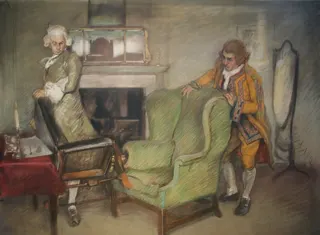
 The Rivalsby Richard Brinsley SheridanIn Bath, a romantic heiress who wants a poor lover is wooed by a captain pretending to be one.
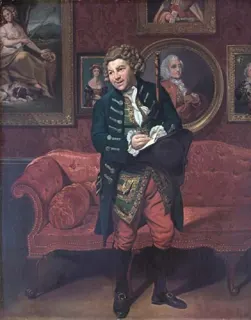 The School for Scandalby Richard Brinsley SheridanA circle of gossips, two very different brothers, and a rich uncle who tests them in disguise.
Act 1, Scene 1
A Room in DANGLE's House. Mr. and MRS. DANGLE discovered at breakfast, and reading newspapers. Dang
Reading.] Brutus to Lord North.--Letter the second on the State of the Army--Psha! To the first L dash D of the A dash Y.--Genuine extract of a Letter from St. Kitt's.--Coxheath Intelligence.--It is now confidently asserted that Sir Charles Hardy--Psha! nothing but about the fleet and the nation!--and I hate all politics but theatrical politics.--Where's the Morning Chronicle?
Yes, that's your Gazette.
So, here we have it.--[Reads] Theatrical intelligence extraordinary.--We hear there is a new tragedy in rehearsal at Drury Lane Theatre, called the Spanish Armada, said to be written by Mr. Puff, a gentleman well-known in the theatrical world. If we may allow ourselves to give credit to the report of the performers, who, truth to say, are in general but indifferent judges, this piece abounds with the most striking and received beauties of modern composition.--So! I am very glad my friend Puff's tragedy is in such forwardness.--Mrs. Dangle, my dear, you will be very glad to hear that Puff's tragedy--
Lord, Mr. Dangle, why will you plague me about such nonsense?--Now the plays are begun I shall have no peace.-- Isn't it sufficient to make yourself ridiculous by your passion for the theatre, without continually teasing me to join you? Why can't you ride your hobby-horse without desiring to place me on a pillion behind you, Mr. Dangle?
Nay, my dear, I was only going to read--
No, no; you will never read anything that's worth listening to. You hate to hear about your country; there are letters every day with Roman signatures, demonstrating the certainty of an invasion, and proving that the nation is utterly undone. But you never will read anything to entertain one.
What has a woman to do with politics, Mrs. Dangle?
And what have you to do with the theatre, Mr. Dangle? Why should you affect the character of a critic? I have no patience with you!--haven't you made yourself the jest of all your acquaintance by your interference in matters where you have no business? Are you not called a theatrical Quidnunc, and a mock Maecenas to second-hand authors?
True; my power with the managers is pretty notorious. But is it no credit to have applications from all quarters for my interest--from lords to recommend fiddlers, from ladies to get boxes, from authors to get answers, and from actors to get engagements?
Yes, truly; you have contrived to get a share in all the plague and trouble of theatrical property, without the profit, or even the credit of the abuse that attends it.
I am sure, Mrs. Dangle, you are no loser by it, however; you have all the advantages of it. Mightn't you, last winter, have had the reading of the new pantomime a fortnight previous to its performance? And doesn't Mr. Fosbrook let you take places for a play before it is advertised, and set you down for a box for every new piece through the season? And didn't my friend, Mr. Smatter, dedicate his last farce to you at my particular request, Mrs. Dangle?
Yes; but wasn't the farce damned, Mr. Dangle? And to be sure it is extremely pleasant to have one's house made the motley rendezvous of all the lackeys of literature; the very high 'Change of trading authors and jobbing critics!--Yes, my drawing-room is an absolute register-office for candidate actors, and poets without character.--Then to be continually alarmed with misses and ma'ams piping hysteric changes on Juliets and Dorindas, Pollys and Ophelias; and the very furniture trembling at the probationary starts and unprovoked rants of would-be Richards and Hamlets!--And what is worse than all, now that the manager has monopolized the Opera House, haven't we the signors and signoras calling here, sliding their smooth semibreves, and gargling glib divisions in their outlandish throats--with foreign emissaries and French spies, for aught I know, disguised like fiddlers and figure dancers?
Mercy! Mrs. Dangle!
And to employ yourself so idly at such an alarming crisis as this too--when, if you had the least spirit, you would have been at the head of one of the Westminster associations--or trailing a volunteer pike in the Artillery Ground! But you--o' my conscience, I believe, if the French were landed to-morrow, your first inquiry would be, whether they had brought a theatrical troop with them.
Mrs. Dangle, it does not signify--I say the stage is the mirror of Nature, and the actors are the Abstract and brief Chronicles of the Time: and pray what can a man of sense study better?--Besides, you will not easily persuade me that there is no credit or importance in being at the head of a band of critics, who take upon them to decide for the whole town, whose opinion and patronage all writers solicit, and whose recommendation no manager dares refuse.
Ridiculous!--Both managers and authors of the least merit laugh at your pretensions.--The public is their critic--without whose fair approbation they know no play can rest on the stage, and with whose applause they welcome such attacks as yours, and laugh at the malice of them, where they can't at the wit.
Very well, madam--very well! Enter SERVANT.
Mr. Sneer, sir, to wait on you.
Oh, show Mr. Sneer up.--[Exit SERVANT]-- Plague on't, now we must appear loving and affectionate, or Sneer will hitch us into a story.
With all my heart; you can't be more ridiculous than you are.
You are enough to provoke-- Enter SNEER. Ha! my dear Sneer, I am vastly glad to see you.--My dear, here's Mr. Sneer.
Good-morning to you, sir.
Mrs. Dangle and I have been diverting ourselves with the papers. Pray, Sneer, won't you go to Drury Lane Theatre the first night of Puff's tragedy?
Yes; but I suppose one shan't be able to get in, for on the first night of a new piece they always fill the house with orders to support it. But here, Dangle, I have brought you two pieces, one of which you must exert yourself to make the managers accept, I can tell you that; for'tis written by a person of consequence.
So! now my plagues are beginning.
Ay, I am glad of it, for now you'll be happy. Why, my dear Dangle, it is a pleasure to see how you enjoy your volunteer fatigue, and your solicited solicitations.
It's a great trouble--yet, egad, it's pleasant too. --Why, sometimes of a morning I have a dozen people call on me at breakfast-time, whose faces I never saw before, nor ever desire to see again.
That must be very pleasant indeed!
And not a week but I receive fifty letters, and not a line in them about any business of my own.
An amusing correspondence!
[Reading] Bursts into tears and exit.--What, is this a tragedy?
No, that's a genteel comedy, not a translation-- only taken from the French: it is written in a style which they have lately tried to run down; the true sentimental, and nothing ridiculous in it from the beginning to the end.
Well, if they had kept to that, I should not have been such an enemy to the stage; there was some edification to be got from those pieces, Mr. Sneer!
I am quite of your opinion, Mrs. Dangle: the theatre, in proper hands, might certainly be made the school of morality; but now, I am sorry to say it, people seem to go there principally for their entertainment!
It would have been more to the credit of the managers to have kept it in the other line.
Undoubtedly, madam; and hereafter perhaps to have had it recorded, that in the midst of a luxurious and dissipated age, they preserved two houses in the capital, where the conversation was always moral at least, if not entertaining!
Now, egad, I think the worst alteration is in the nicety of the audience!--No double-entendre, no smart innuendo admitted; even Vanbrugh and Congreve obliged to undergo a bungling reformation!
Yes, and our prudery in this respect is just on a par with the artificial bashfulness of a courtesan, who increases the blush upon her cheek in an exact proportion to the diminution of her modesty.
Sneer can't even give the public a good word! But what have we here?--This seems a very odd--
Oh, that's a comedy on a very new plan; replete with wit and mirth, yet of a most serious moral! You see it is called The Reformed House-breaker; where, by the mere force of humour, house-breaking is put in so ridiculous a light, that if the piece has its proper run, I have no doubt but that bolts and bars will be entirely useless by the end of the season.
Egad, this is new indeed!
Yes; it is written by a particular friend of mine, who has discovered that the follies and foibles of society are subjects unworthy the notice of the comic muse, who should be taught to stoop only to the greater vices and blacker crimes of humanity--gibbeting capital offences in five acts, and pillorying petty larcenies in two.--In short, his idea is to dramatize the penal laws, and make the stage a court of ease to the Old Bailey.
It is truly moral. Re-enter SERVANT.
Sir Fretful Plagiary, sir.
Beg him to walk up.--[Exit SERVANT] Now, Mrs. Dangle, Sir Fretful Plagiary is an author to your own taste.
I confess he is a favourite of mine, because everybody else abuses him.
Very much to the credit of your charity, madam, if not of your judgment.
But, egad, he allows no merit to any author but himself, that's the truth on't--though he's my friend.
Never.--He is as envious as an old maid verging on the desperation of six and thirty; and then the insidious humility with which he seduces you to give a free opinion on any of his works, can be exceeded only by the petulant arrogance with which he is sure to reject your observations.
Very true, egad--though he's my friend.
Then his affected contempt of all newspaper strictures; though, at the same time, he is the sorest man alive, and shrinks like scorched parchment from the fiery ordeal of true criticism: yet he is so covetous of popularity, that he had rather be abused than not mentioned at all.
There's no denying it--though he is my friend.
You have read the tragedy he has just finished, haven't you?
Oh, yes; he sent it to me yesterday.
Well, and you think it execrable, don't you?
Why, between ourselves, egad, I must own--though he is my friend--that it is one of the most--He's here-- [Aside]--finished and most admirable perform-- Sir Fret. [Without] Mr. Sneer with him did you say? Enter SIR FRETFUL PLAGIARY.
Ah, my dear friend!--Egad, we were just speaking of your tragedy.--Admirable, Sir Fretful, admirable!
You never did anything beyond it, Sir Fretful-- never in your life.
You make me extremely happy; for without a compliment, my dear Sneer, there isn't a man in the world whose judgment I value as I do yours and Mr. Dangle's.
They are only laughing at you, Sir Fretful; for it was but just now that--
Mrs. Dangle!--Ah, Sir Fretful, you know Mrs. Dangle.--My friend Sneer was rallying just now:--he knows how she admires you, and--
O Lord, I am sure Mr. Sneer has more taste and sincerity than to--[Aside] A damned double-faced fellow!
Yes, yes--Sneer will jest--but a better humoured--
Oh, I know--
He has a ready turn for ridicule--his wit costs him nothing.
No, egad--or I should wonder how he came by it. [Aside]
Because his jest is always at the expense of his friend. [Aside]
But, Sir Fretful, have you sent your play to the managers yet?--or can I be of any service to you?
No, no, I thank you: I believe the piece had sufficient recommendation with it.--I thank you though.--I sent it to the manager of Covent Garden Theatre this morning.
I should have thought now, that it might have been cast [as the actors call it] better at Drury Lane.
O Lud! no--never send a play there while I live--hark'ee! [Whispers SNEER]
Writes himself!--I know he does.
I say nothing--I take away from no man's merit--am hurt at no man's good fortune--I say nothing.--But this I will say--through all my knowledge of life, I have observed--that there is not a passion so strongly rooted in the human heart as envy.
I believe you have reason for what you say, indeed.
Besides--I can tell you it is not always so safe to leave a play in the hands of those who write themselves.
What, they may steal from them, hey, my dear Plagiary?
Steal!--to be sure they may; and, egad, serve your best thoughts as gypsies do stolen children, disfigure them to make 'em pass for their own.
But your present work is a sacrifice to Melpomene, and he, you know, never--
That's no security: a dexterous plagiarist may do anything. Why, sir, for aught I know, he might take out some of the best things in my tragedy, and put them into his own comedy.
That might be done, I dare be sworn.
And then, if such a person gives you the least hint or assistance, he is devilish apt to take the merit of the whole--
If it succeeds.
Ay, but with regard to this piece, I think I can hit that gentleman, for I can safely swear he never read it.
I'll tell you how you may hurt him more.
How?
Swear he wrote it.
Plague on't now, Sneer, I shall take it ill!--I believe you want to take away my character as an author.
Then I am sure you ought to be very much obliged to me.
Hey!--sir!--
Oh, you know, he never means what he says.
Sincerely then--do you like the piece?
Wonderfully!
But come, now, there must be something that you think might be mended, hey?--Mr. Dangle, has nothing struck you?
Why, faith, it is but an ungracious thing for the most part, to--
With most authors it is just so, indeed; they are in general strangely tenacious! But, for my part, I am never so well pleased as when a judicious critic points out any defect to me; for what is the purpose of showing a work to a friend, if you don't mean to profit by his opinion?
Very true.--Why, then, though I seriously admire the piece upon the whole, yet there is one small objection; which, if you'll give me leave, I'll mention.
Sir, you can't oblige me more.
I think it wants incident.
Good God! you surprise me!--wants incident!
Yes; I own I think the incidents are too few.
Good God! Believe me, Mr. Sneer, there is no person for whose judgment I have a more implicit deference. But I protest to you, Mr. Sneer, I am only apprehensive that the incidents are too crowded.--My dear Dangle, how does it strike you?
Really I can't agree with my friend Sneer. I think the plot quite sufficient; and the four first acts by many degrees the best I ever read or saw in my life. If, I might venture to suggest anything, it is that the interest rather falls off in the fifth.
Rises, I believe you mean, sir.
No, I don't, upon my word.
Yes, yes, you do, upon my soul!--it certainly don't fall off, I assure you.--No, no; it don't fall off.
Now, Mrs. Dangle, didn't you say it struck you in the same light?
No, indeed, I did not.--I did not see a fault in any part of the play, from the beginning to the end.
Upon my soul, the women are the best judges after all!
Or, if I made any objection, I am sure it was to nothing in the piece; but that I was afraid it was on the whole, a little too long.
Pray, madam, do you speak as to duration of time; or do you mean that the story is tediously spun out?
O Lud! no.--I speak only with reference to the usual length of acting plays.
Then I am very happy--very happy indeed-- because the play is a short play, a remarkably short play. I should not venture to differ with a lady on a point of taste; but on these occasions, the watch, you know, is the critic.
Then, I suppose, it must have been Mr. Dangle's drawling manner of reading it to me.
Oh, if Mr. Dangle read it, that's quite another affair!--But I assure you, Mrs. Dangle, the first evening you can spare me three hours and a half, I'll undertake to read you the whole, from beginning to end, with the prologue and epilogue, and allow time for the music between the acts.
I hope to see it on the stage next.
Well, Sir Fretful, I wish you may be able to get rid as easily of the newspaper criticisms as you do of ours.
The newspapers! Sir, they are the most villainous--licentious--abominable--infernal.--Not that I ever read them--no--I make it a rule never to look into a newspaper.
You are quite right; for it certainly must hurt an author of delicate feelings to see the liberties they take.
No, quite the contrary! their abuse is, in fact, the best panegyric--I like it of all things. An author's reputation is only in danger from their support.
Why, that's true--and that attack, now, on you the other day--
What? where?
Ay, you mean in a paper of Thursday: it was completely ill-natured, to be sure.
Oh so much the better.--Ha! Ha! Ha! I wouldn't have it otherwise.
Certainly it is only to be laughed at; for--
You don't happen to recollect what the fellow said, do you?
Pray, Dangle--Sir Fretful seems a little anxious--
O Lud, no!--anxious!--not I--not the least.-- I--but one may as well hear, you know.
Sneer, do you recollect?--[Aside to SNEER] Make out something.
[Aside to DANGLE] I will.--[Aloud] Yes, yes, I remember perfectly.
Well, and pray now--not that it signifies--what might the gentleman say?
Why, he roundly asserts that you have not the slightest invention or original genius whatever; though you are the greatest traducer of all other authors living.
Ha! ha! ha!--very good!
That as to comedy, you have not one idea of your own, he believes, even in your commonplace-book--where stray jokes and pilfered witticisms are kept with as much method as the ledger of the lost and stolen office.
Ha! ha! ha!--very pleasant!
Nay, that you are so unlucky as not to have the skill even to steal with taste:--but that you glean from the refuse of obscure volumes, where more judicious plagiarists have been before you; so that the body of your work is a composition of dregs and sentiments--like a bad tavern's worst wine.
Ha! ha!
In your more serious efforts, he says, your bombast would be less intolerable, if the thoughts were ever suited to the expression; but the homeliness of the sentiment stares through the fantastic encumbrance of its fine language, like a clown in one of the new uniforms!
Ha! ha!
That your occasional tropes and flowers suit the general coarseness of your style, as tambour sprigs would a ground of linsey-woolsey; while your imitations of Shakspeare resemble the mimicry of Falstaff's page, and are about as near the standard as the original.
Ha!
In short, that even the finest passages you steal are of no service to you; for the poverty of your own language prevents their assimilating; so that they lie on the surface like lumps of marl on a barren moor, encumbering what it is not in their power to fertilize!
[After great agitation] Now, another person would be vexed at this!
Oh! but I wouldn't have told you--only to divert you.
I know it--I am diverted.--Ha! ha! ha!--not the least invention!--Ha! ha! ha!--very good!--very good!
Yes--no genius! ha! ha! ha!
A severe rogue! ha! ha! ha! But you are quite right, Sir Fretful, never to read such nonsense.
To be sure--for if there is anything to one's praise, it is a foolish vanity to be gratified at it; and, if it is abuse--why one is always sure to hear of it from one damned good-natured friend or other! Enter SERVANT.
Sir, there is an Italian gentleman, with a French interpreter, and three young ladies, and a dozen musicians, who say they are sent by Lady Rondeau and Mrs. Fugue.
Gadso! they come by appointment!--Dear Mrs. Dangle, do let them know I'll see them directly.
You know, Mr. Dangle, I shan't understand a word they say.
But you hear there's an interpreter.
Well, I'll try to endure their complaisance till you come. [Exit]
And Mr. Puff, sir, has sent word that the last rehearsal is to be this morning, and that he'll call on you presently.
That's true--I shall certainly be at home.-- [Exit SERVANT]--now, Sir Fretful, if you have a mind to have justice done you in the way of answer, egad, Mr. Puff's your man.
Psha! sir, why should I wish to have it answered, when I tell you I am pleased at it?
True, I had forgot that. But I hope you are not fretted at what Mr. Sneer--
Zounds! no, Mr. Dangle; don't I tell you these things never fret me in the least?
Nay, I only thought--
And let me tell you, Mr. Dangle, 'tis damned affronting in you to suppose that I am hurt when I tell you I am not.
But why so warm, Sir Fretful?
Gad's life! Mr. Sneer, you are as absurd as Dangle: how often must I repeat it to you, that nothing can vex me but your supposing it possible for me to mind the damned nonsense you have been repeating to me!--let me tell you, if you continue to believe this, you must mean to insult me, gentlemen-- and, then, your disrespect will affect me no more than the newspaper criticisms--and I shall treat it with exactly the same calm indifference and philosophic contempt--and so your servant. [Exit] Sneer. Ha! ha! ha! poor Sir Fretful! Now will he go and vent his philosophy in anonymous abuse of all modern critics and authors.--But, Dangle, you must get your friend Puff to take me to the rehearsal of his tragedy.
I'll answer for't, he'll thank you for desiring it. But come and help me to judge of this musical family: they are recommended by people of consequence, I assure you.
I am at your disposal the whole morning!--but I thought you had been a decided critic in music as well as in literature.
So I am--but I have a bad ear. I'faith, Sneer, though, I am afraid we were a little too severe on Sir Fretful-- though he is my friend.
Why, 'tis certain, that unnecessarily to mortify the vanity of any writer is a cruelty which mere dulness never can deserve; but where a base and personal malignity usurps the place of literary emulation, the aggressor deserves neither quarter nor pity.
That's true, egad!--though he's my friend!
Act 1, Scene 2
A drawing-room in DANGLE'S House. MRS. DANGLE, SIGNOR PASTICCIO RITORNELLO, SIGNORE PASTICCIO RITORNELLO, INTERPRETER, and MUSICIANS discovered
Je dis, madame, j'ai l'honneur to introduce et de vous demander votre protection pour le Signor Pasticcio Ritornello et pour sa charmante famille.
Ah! vosignoria, not vi preghiamo di favoritevi colla vostra protezione. 1 Signora Past. Vosignoria fatevi questi grazie. 2 Signora Past. Si, signora.
Madame--me interpret.--C'est à dire--in English-- qu'ils vous prient de leur faire l'honneur--
I say again, gentlemen, I don't understand a word you say.
Questo signore spiegheró--
Oui--me interpret.--Nous avons les lettres de recommendation pour Monsieur Dangle de--
Upon my word, sir, I don't understand you.
La Contessa Rondeau è nostra padrona. 3 Signora Past. Si, padre, et Miladi Fugue.
O!--me interpret.--Madame, ils disent--in English--Qu'ils ont l'honneur d'être protégés de ces dames.--You understand?
No, sir,--no understand! Enter DANGLE and SNEER.
Ah, voici, Monsieur Dangle!
Ah! Signor Dangle!
Mr. Dangle, here are two very civil gentlemen trying to make themselves understood, and I don't know which is the interpreter.
Eh, bien! [The INTERPRETER and SIGNOR PASTICCIO here speak at the same time]
Monsieur Dangle, le grand bruit de vos talens pour la critique, et de votre intérêt avec messieurs les directeurs à tous les théâtres--
Vosignoria siete si famoso par la vostra conoscenza, e vostra interessa colla le direttore da--
Egad, I think the interpreter is the hardest to be understood of the two!
Why, I thought, Dangle, you had been an admirable linguist!
So I am, if they would not talk so damned fast.
Well, I'll explain that--the less time we lose in bearing them the better--for that, I suppose, is what they are brought here for. [Speaks to SIGNOR PASTICCIO--they sing trios, &c., DANGLE beating out of time] Enter SERVANT and whispers DANGLE.
Show him up.--[Exit SERVANT] Bravo! admirable! bravissimo! admirablissimo!--Ah! Sneer! where will you find voices such as these in England?
Not easily.
But Puff is coming.--Signor and little signoras obligatissimo!--Sposa Signora Danglena--Mrs. Dangle, shall I beg you to offer them some refreshments, and take their address in the next room. [Exit MRS. DANGLE with SIGNOR PASTICCIO, SIGNORE PASTICCIO, MUSICIANS, and INTERPRETER, ceremoniously] Re-enter SERVANT.
Mr. Puff, sir. [Exit] Enter PUFF.
My dear Puff!
My dear Dangle, how is it with you?
Mr. Sneer, give me leave to introduce Mr. Puff to you.
Mr. Sneer is this?--Sir, he is a gentleman whom I have long panted for the honour of knowing--a gentleman whose critical talents and transcendent judgment--
Dear Sir--
Nay, don't be modest, Sneer; my friend Puff only talks to you in the style of his profession.
His profession.
Yes, sir; I make no secret of the trade I follow: among friends and brother authors, Dangle knows I love to be frank on the subject, and to advertise myself viva voce.-- I am, sir, a practitioner in panegyric, or, to speak more plainly, a professor of the art of puffing, at your service--or anybody else's.
Sir, you are very obliging!--I believe, Mr. Puff, I have often admired your talents in the daily prints.
Yes, sir, I flatter myself I do as much business in that way as any six of the fraternity in town.--Devilish hard work all the summer, friend Dangle,--never worked harder! But, hark'ee,--the winter managers were a little sore, I believe.
No; I believe they took it all in good part.
Ay! then that must have been affectation in them: for, egad, there were some of the attacks which there was no laughing at!
Ay, the humorous ones.--But I should think, Mr. Puff, that authors would in general be able to do this sort of work for themselves.
Why, yes--but in a clumsy way. Besides, we look on that as an encroachment, and so take the opposite side. I dare say, now, you conceive half the very civil paragraphs and advertisements you see to be written by the parties concerned, or their friends? No such thing: nine out of ten manufactured by me in the way of business.
Indeed!
Even the auctioneers now--the auctioneers, I say--though the rogues have lately got some credit for their language--not an article of the merit theirs: take them out of their pulpits, and they are as dull as catalogues!--No, sir; 'twas I first enriched their style--'twas I first taught them to crowd their advertisements with panegyrical superlatives, each epithet rising above the other, like the bidders in their own auction rooms! From me they learned to inlay their phraseology with variegated chips of exotic metaphor: by me too their inventive faculties were called forth:--yes, sir, by me they were instructed to clothe ideal walls with gratuitous fruits--to insinuate obsequious rivulets into visionary groves--to teach courteous shrubs to nod their approbation of the grateful soil; or on emergencies to raise upstart oaks, where there never had been an acorn; to create a delightful vicinage without the assistance of a neighbour; or fix the temple of Hygeia in the fens of Lincolnshire!
I am sure you have done them infinite service; for now, when a gentleman is ruined, he parts with his house with some credit.
Service! if they had any gratitude, they would erect a statue to him; they would figure him as a presiding Mercury, the god of traffic and fiction, with a hammer in his hand instead of a caduceus.--But pray, Mr. Puff, what first put you on exercising your talents in this way?
Egad, sir, sheer necessity!--the proper parent of an art so nearly allied to invention. You must know, Mr. Sneer, that from the first time I tried my hand at an advertisement, my success was such, that for some time after I led a most extraordinary life indeed!
How, pray?
Sir, I supported myself two years entirely by my misfortunes.
By your misfortunes!
Yes, sir, assisted by long sickness, and other occasional disorders: and a very comfortable living I had of it.
From sickness and misfortunes! You practised as a doctor and an attorney at once?
No, egad; both maladies and miseries were my own.
Hey! what the plague!
'Tis true, i'faith.
Hark'ee!--By advertisements--. Oh, I understand you.
And, in truth, I deserved what I got! for, I suppose never man went through such a series of calamities in the same space of time. Sir, I was five times made a bankrupt, and reduced from a state of affluence, by a train of unavoidable misfortunes: then, sir, though a very industrious tradesman, I was twice burned out, and lost my little all both times: I lived upon those fires a month. I soon after was confined by a most excruciating disorder, and lost the use of my limbs: that told very well; for I had the case strongly attested, and went about to collect the subscriptions myself.
Egad, I believe that was when you first called on me.
In November last?--O no; I was at that time a close prisoner in the Marshalsea, for a debt benevolently contracted to serve a friend. I was afterwards twice tapped for a dropsy, which declined into a very profitable consumption. I was then reduced to--O no--then, I became a widow with six helpless children, after having had eleven husbands pressed, and being left every time eight months gone with child, and without money to get me into an hospital!
And you bore all with patience, I make no doubt?
Why yes; though I made some occasional attempts at felo de se, but as I did not find those rash actions answer, I left off killing myself very soon. Well, sir, at last, what with bankruptcies, fires, gout, dropsies, imprisonments, and other valuable calamities, having got together a pretty handsome sum, I determined to quit a business which had always gone rather against my conscience, and in a more liberal way still to indulge my talents for fiction and embellishment, through my favourite channels of diurnal communication--and so, sir, you have my history.
Most obligingly communicative indeed! and your confession, if published, might certainly serve the cause of true charity, by rescuing the most useful channels of appeal to benevolence from the cant of imposition. But, surely, Mr. Puff, there is no great mystery in your present profession?
Mystery, sir! I will take upon me to say the matter was never scientifically treated nor reduced to rule before.
Reduced to rule!
O Lud, sir, you are very ignorant, I am afraid!--Yes, sir,. puffing is of various sorts; the principal are, the puff direct, the puff preliminary, the puff collateral, the puff collusive, and the puff oblique, or puff by implication. These all assume, as circumstances require, the various forms of Letter to the Editor, Occasional Anecdote, Impartial Critique, Observation from Correspondent, or Advertisement from the Party.
The puff direct, I can conceive--
O yes, that's simple enough! For instance,--a new comedy or farce is to be produced at one of the theatres [though by-the-by they don't bring out half what they ought to do]--the author, suppose Mr. Smatter, or Mr. Dapper, or any particular friend of mine--very, well; the day before it is to be performed, I write an account of the manner in which it was received; I have the plot from the author, and only add--"characters strongly drawn--highly coloured--hand of a master--fund of genuine humour--mine of invention--neat dialogue--Attic salt." Then for the performance--"Mr. Dodd was astonishingly great in the character of Sir Harry. That universal and judicious actor, Mr. Palmer, perhaps never appeared to more advantage than in the colonel;--but it is not in the power of language to do justice to Mr. King: indeed he more than merited those repeated bursts of applause which he drew from a most brilliant and judicious audience. As to the scenery--the miraculous powers of Mr. De Loutherbourg's pencil are universally acknowledged. In short, we are at a loss which to admire most, the unrivalled genius of the author, the great attention and liberality of the managers, the wonderful abilities of the painter, or the incredible exertions of all the performers."
That's pretty well indeed, sir.
Oh, cool!--quite cool!--to what I sometimes do.
And do you think there are any who are influenced by this?
O Lud, yes, sir! the number of those who undergo the fatigue of judging for themselves is very small indeed.
Well, sir, the puff preliminary.
O, that, sir, does well in the form of a caution. In a matter of gallantry now--Sir Flimsy Gossamer wishes to be well with Lady Fanny Fete--he applies to me--I open trenches for him with a paragraph in the Morning Post.--"It is recommended to the beautiful and accomplished Lady F four stars F dash E to be on her guard against that dangerous character, Sir F dash G; who, however pleasing and insinuating his manners may be, is certainly not remarkable for the constancy of his attachments!"-- in italics. Here, you see, Sir Flimsy Gossamer is introduced to the particular notice of Lady Fanny, who perhaps never thought of him before--she finds herself publicly cautioned to avoid him, which naturally makes her desirous of seeing him; the observation of their acquaintance causes a pretty kind of mutual embarrassment; this produces a sort of sympathy of interest, which if Sir Flimsy is unable to improve effectually, he at least gains the credit of having their names mentioned together, by a particular set, and in a particular way--which nine times out of ten is the full accomplishment of modern gallantry.
Egad, Sneer, you will be quite an adept in the business.
Now, Sir, the puff collateral is much used as an appendage to advertisements, and may take the form of anecdote,-- "Yesterday, as the celebrated George Bonmot was sauntering down St. James's Street, he met the lively Lady Mary Myrtle coming out of the park:--'Good God, Lady Mary, I'm surprised to meet you in a white jacket,--for I expected never to have seen you, but in a full-trimmed uniform and a light horseman's cap!'--'Heavens, George, where could you have learned that?'--'Why,' replied the wit, ' I just saw a print of you, in a new publication called the Camp Magazine; which, by-the-by, is a 'devilish clever thing, and is sold at No. 3, on the right hand of the way, two doors from the printing-office, the corner of Ivy Lane, Paternoster Row, price only one shilling.'"
Very ingenious indeed!
But the puff collusive is the newest of any; for it acts in the disguise of determined hostility. It is much used by bold booksellers and enterprising poets.--"An indignant correspondent observes, that the new poem called Beelsebub's Cotillon, or Proserpine's Fête Champêtre, is one of the most unjustifiable performances he ever read. The severity with which certain characters are handled is quite shocking: and as there are many descriptions in it too warmly coloured for female delicacy, the shameful avidity with which this piece is bought by all people of fashion is a reproach on the taste of the times, and a disgrace to the delicacy of the age." Here you see the two strongest inducements are held forth; first, that nobody ought to read it; and secondly, that everybody buys it: on the strength of which the publisher boldly prints the tenth edition, before he had sold ten of the first; and then establishes it by threatening himself with the pillory, or absolutely indicting himself for scan. mag.
Ha! ha! ha!--'gad, I know it is so.
As to the puff oblique, or puff by implication, it is too various and extensive to be illustrated by an instance: it attracts in titles and resumes in patents; it lurks in the limitation of a subscription, and invites in the assurance of crowd and incommodation at public places; it delights to draw forth concealed merit, with a most disinterested assiduity; and sometimes wears a countenance of smiling censure and tender reproach. It has a wonderful memory for parliamentary debates, and will often give the whole speech of a favoured member with the most flattering accuracy. But, above all, it is a great dealer in reports and suppositions. It has the earliest intelligence of intended preferments that will reflect honour on the patrons; and embryo promotions of modest gentlemen, who know nothing of the matter themselves. It can hint a ribbon for implied services in the air of a common report; and with the carelessness of a casual paragraph, suggest officers into commands, to which they have no pretension but their wishes. This, sir, is the last principal class of the art of puffing--an art which I hope you will now agree with me is of the highest dignity, yielding a tablature of benevolence and public spirit; befriending equally trade, gallantry, criticism, and politics: the applause of genius--the register of charity--the triumph of heroism--the self-defence of contractors--the fame of orators--and the gazette of ministers.
Sir, I am completely a convert both to the importance and ingenuity of your profession; and now, sir, there is but one thing which can possibly increase my respect for you, and that is, your permitting me to be present this morning at the rehearsal of your new trage--
Hush, for heaven's sake!--My tragedy!--Egad, Dangle, I take this very ill: you know how apprehensive I am of being known to be the author.
I'faith I would not have told--but it's in the papers, and your name at length in the Morning Chronicle.
Ah! those damned editors never can keep a secret I --Well, Mr. Sneer, no doubt you will do me great honour--I shall be infinitely happy--highly flattered--Dang. I believe it must be near the time--shall we go together?
No; it will, not be yet this hour, for they are always late at that theatre: besides, I must meet you there, for I have some little matters here to send to the papers, and a few paragraphs to scribble before I go.--[Looking at memorandums] Here is A conscientious Baker, on the subject of the Army Bread; and a Detester of visible Brick-work, in favour of the new invented Stucco; both in the style of Junius, and promised for to-morrow. The Thames navigation too is at a stand. Misomud or Anti-shoal must go to work again directly.--Here too are some political memorandums--I see; ay-- To take Paul Jones and get the Indiamen out of the Shannon-- reinforce Byron--compel the Dutch to--so!--I must do that in the evening papers, or reserve it for the Morning Herald; for I know that I have undertaken to-morrow, besides, to establish the unanimity of the fleet in the Public Advertiser, and to shoot Charles Fox in the Morning Post.--So, egad, I ha'n't a moment to lose.
Well, we'll meet in the Green Room. [Exeunt severally.
Act 2, Scene 1
The Theatre before the Curtain. Enter DANGLE, PUFF, and SNEER. Puff: No, no, sir; what Shakspeare says of actors may be better applied to the purpose of plays; they ought to be the abstract and brief chronicles of the time. Therefore when history, and particularly the history of our own country, furnishes anything like a case in point, to the time in which an author writes, if he knows his own interest, he will take advantage of it; so, sir, I call my tragedy The Spanish Armada; and have laid the scene before Tilbury Fort
A most happy thought, certainly I Dang. Egad it was--I told you so. But, pray now, I don't understand how you have contrived to introduce any love into it.
Love! oh, nothing so easy! for it is a received point among poets, that where history gives you a good heroic outline for a play, you may fill up with a little love at your own discretion: in doing which, nine times out of ten, you only make up a deficiency in the private history of the times. Now, I rather think I have done this with some success.
No scandal about Queen Elizabeth, I hope?
O Lud! no, no;--I only suppose the governor of Tilbury Fort's daughter to be in love with the son of the Spanish admiral.
Oh, is that all!
Excellent, i'faith! I see at once. But won't this appear rather improbable?
To be sure it will--but what the plague! a play is not to show occurrences that happen every day, but things just so strange, that though they never did, they might happen.
Certainly nothing is unnatural, that is not physically impossible.
Very true--and for that matter Don Ferolo Whiskerandos, for that's the lover's name, might have been over here in the train of the Spanish ambassador, or Tilburina, for that is the lady's name, might have been in love with him, from having heard his character, or seen his picture; or from knowing that he was the last man in the world she ought to be in love with--or for any other good female reason.--However; sir, the fact is, that though she is but a knight's daughter, egad! she is in love like any princess!
Poor young lady! I feel for her already! for I can conceive how great the conflict must be between her passion and her duty; her love for her country, and her love for Don Ferolo Whiskerandos!
Oh, amazing!--her poor susceptible heart is swayed to and fro by contending passions like-- Enter UNDER PROMPTER.
Sir, the scene is set, and everything is ready to begin, if you please.
Egad, then we'll lose no time.
Though, I believe, sir, you will find it very short, for all the performers have profited by the kind permission you granted them.
Hey! what?
You know, sir, you gave them leave to cut out or omit whatever they found heavy or unnecessary to the plot, and I must own they have taken very liberal advantage of your indulgence.
Well, well.--They are in general very good judges, and I know I am luxuriant.--Now, Mr. Hopkins, as soon as you please.
[To the Orchestra] Gentlemen, will you play a few bars of something, just to--
Ay, that's right; for as we have the scenes and dresses, egad, we'll go to't, as if it was the first night's performance,--but you need not mind stopping between the acts-- [Exit UNDER PROMPTER.--Orchestra play--then the bell
rings.] Soh! stand clear; gentlemen. Now you know there will be a cry of down! down!--Hats off!--Silence!--Then up curtain, and let us see what our painters have done for us. [Curtain rises
Act 2, Scene 2
Tilbury Fort. "Two SENTINELS discovered asleep."
Tilbury Fort!--very fine indeed!
Now, what do you think I open with?
Faith, I can't guess--
A clock.--Hark!--[Clock strikes] I open with a clock striking, to beget an awful attention in the audience: it also marks the time, which is four o'clock in the morning, and saves a description of the rising sun, and a great deal about gilding the eastern hemisphere.
But pray, are the sentinels to be asleep?
Fast as watchmen.
Isn't that odd though at such an alarming crisis?
To be sure it is,--but smaller things must give way to a striking scene at the opening; that's a rule. And the case is, that two great men are coming to this very spot to begin the piece; now it is not to be supposed they would open their lips, if these fellows were watching them; so, egad, I must either have sent them off their posts, or set them asleep.
Oh, that accounts for it. But tell us, who are these coming?
These are they--Sir Walter Raleigh, and Sir Christopher Hatton. You'll know Sir Christopher by his turning out his toes--famous, you know, for his dancing. I like to preserve all the little traits of character.--Now attend. "Enter SIR WALTER RALEIGH and SIR CHRISTOPHER HATTON.
True, gallant Raleigh!"
What, they had been talking before?
O yes; all the way as they came along.--[To the actors] I beg pardon, gentlemen, but these are particular friends of mine, whose remarks may be of great service to us.-- [To SNEER and DANGLE] Don't mind interrupting them whenever anything strikes you.
" True, gallant Raleigh But oh, thou champion of thy country's fame, There is a question which I yet must ask A question which I never ask'd before-- What mean these mighty armaments? This general muster? and this throng of chiefs?"
Pray, Mr. Puff, how came Sir Christopher Hatton never to ask that question before?
What before the play began?-how the plague could he?
That's true, i'faith!
But you will hear what he thinks of the matter.
"Alas I my noble friend, when I behold
Yon tented plains in martial symmetry
Array'd; when I count o'er yon glittering lines
Of crested warriors, where the proud steeds' neigh,
And valour-breathing trumpet's shrill appeal,
Responsive vibrate on my listening ear;
When virgin majesty herself I view,
Like her protecting Pallas, veil'd in steel,
With graceful confidence exhort to arms!
When, briefly, all I hear or see bears stamp
Of martial vigilance and stern defence,
I cannot but surmise--forgive, my friend,
If the conjecture's rash--I cannot but
Surmise the state some danger apprehends!"
A very cautious conjecture that.
Yes, that's his character; not to give an opinion but on secure grounds.--Now then.
"O most accomplish'd Christopher!"--
He calls him by his Christian name, to show that they are on the most familiar terms.
O most accomplish'd Christopher! I find Thy staunch sagacity still tracks the future, In the fresh print of the o'ertaken past."
Figurative!
Thy fears are just.
But where? whence? when? and what The danger is,--methinks I fain would learn.
You know, my friend, scarce two revolving suns, And three revolving moons, have closed their course Since haughty Philip, in despite of peace, With hostile hand hath struck at England's trade.
I know it well.
Philip, you know, is proud Iberia's king!
He is.
His subjects in base bigotry And Catholic oppression held;-while we, You know, the Protestant persuasion hold.
We do.
You know, beside, his boasted armament, The famed Armada, by the Pope baptized, With purpose to invade these realms--
Is sailed, Our last advices so report.
While the Iberian admiral's chief hope, His darling son--
Ferolo Whiskerandos hight--
The same--by chance a prisoner hath been ta'en, And in this fort of Tilbury--
Is now Confined--'tis true, and oft from yon tall turret's top I've mark'd the youthful Spaniard's haughty mien Unconquer'd, though in chains.
You also know-- Dang. Mr. Puff, as he knows all this, why does Sir Walter go on telling him?
But the audience are not supposed to know any-thing of the matter, are they? Sneer. True; but I think you manage ill: for there certainly appears no reason why Sir Walter should be so communicative.
'Fore Gad, now, that is one of the most ungrateful observations I ever heard!--for the less inducement he has to tell all this, the more, I think, you ought to be obliged to him; for I am sure you'd know nothing of the matter without it.
That's very true, upon my word.
But you will find he was not going on. "Sir Christ. Enough, enough--'tis plain--and I no more Am in amazement lost!"--
Here, now you see, Sir Christopher did not in fact ask any one question for his own information.
No, indeed: his has been a most disinterested curiosity!
Really, I find that we are very much obliged to them both.
To be sure you are. Now then for the commander-in-chief, the Earl of Leicester, who, you know, was no favourite but of the queen's.--We left off--in amazement lost! "Sir Christ. Am in amazement lost. But, see where noble Leicester comes supreme in honours and command.
And yet, methinks, At such a time, so perilous, so fear'd, That staff might well become an abler grasp.
And so, by Heaven! think I; but soft, he's here!"
Ay, they envy him!
But who are these with him?
Oh! very valiant knights: one is the governor of the fort, the other the master of the horse. And now, I think, you shall hear some better language: I was obliged to be plain and intelligible in the first scene, because there was so much matter of fact in it; but now, i'faith, you have trope, figure, and metaphor, as plenty as noun-substantives. "Enter EARL OF LEICESTER, GOVERNOR, MASTER OF THE HORSE, KNIGHTS, &c.
How's this, my friends! is't thus your new-fledged zeal,
And plumed valour moulds in roosted sloth?
Why dimly glimmers that heroic flame,
Whose reddening blaze, by patriot spirit fed,
Should be the beacon of a kindling realm?
Can the quick current of a patriot heart
Thus stagnate in a cold and weedy converse,
Or freeze in tideless inactivity?
No! rather let the fountain of your valour
Spring through each stream of enterprise,
Each petty channel of conducive daring,
Till the full torrent of your foaming wrath
O'erwhelm the flats of sunk hostility!"
There it is--followed up!
" No more!--the freshening breath of thy rebuke Hath fill'd the swelling canvas of our souls! And thus, though fate should cut the cable of [All take hands] Our topmost hopes, in friendship's closing line We'll grapple with despair, and if we fall, We'll fall in glory's wake!
There spoke old England's genius!
Then, are we all resolved?
We are--all resolved.
To conquer--or be free?
To conquer, or be free.
All?
"
Nem. con. egad!
O yes!--where they do agree on the stage, their unanimity is wonderful!
" Then let's embrace--and now--[Kneels."
What the plague, is he going to pray?
Yes; hush!--in great emergencies, there Is nothing like a prayer.
" O mighty Mars!"
But why should he pray to Mars?
Hush!
" If in thy homage bred, Each point of discipline I've still observed; Nor but by due promotion, and the right Of service, to the rank of major-general Have risen; assist thy votary now!
Yet do not rise--hear me! [Kneels]
And me! [Kneels]
And me! [Kneels]
And me! [Kneels]
And me! [Kneels]"
Now pray altogether.
" Behold thy votaries submissive beg, That thou wilt deign to grant them all they ask; Assist them to accomplish all their ends, And sanctify whatever means they use To gain them!"
A very orthodox quintetto!
Vastly well, gentlemen!--Is that well managed or not? Have you such a prayer as that on the stage?
Not exactly.
[To PUFF] But, sir, you haven't settled how we are to get off here.
You could not go off kneeling, could you?
[To PUFF] O no, sir; impossible!
It would have a good effect i'faith, if you could exeunt praying!--Yes, and would vary the established mode of springing off with a glance at the pit.
Oh, never mind, so as you get them off!--I'll answer for it, the audience won't care how.
Well, then, repeat the last line standing, and go off the old way. "All. And sanctify whatever means we use To gain them. [Exeunt]"
Bravo! a fine exit.
Well, really, Mr. Puff--
Stay a moment! "The SENTINELS get up. 1 Sent. All this shall to Lord Burleigh's ear. 2 Sent. 'Tis meet it should. [Exeunt]"
Hey!--why, I thought those fellows had been asleep?
Only a pretence; there's the art of it: they were spies of Lord Burleigh's.
But isn't it odd they never were taken notice of, not even by the commander-in-chief?
O Lud, sir! if people who want to listen, or overhear, were not always connived at in a tragedy, there would be no carrying on any plot in the world.
That's certain.
But take care, my dear Dangle! the morning gun is going to fire. [Cannon fires]
Well, that will have a fine effect!
I think so, and helps to realize the scene.-- [Cannon twice] What the plague! three morning guns! there never is but one!--Ay, this is always the way at the theatre: give these fellows a good thing, and they never know when to have done with it.--You have no more cannon to fire?
[Within] No, sir.
Now, then, for soft music.
Pray, what's that for?
It shows that Tilburina is coming!--nothing introduces you a heroine like soft music. Here she comes!
And her confidant, I suppose?
To be sure! Here they are--inconsolable to the minuet in Ariadne! [Soft music] "Enter TILNURINA and CONFIDANT.
Now has the whispering breath of gentle morn
Bid Nature's voice and Nature's beauty rise;
While orient Phoebus, with unborrow'd hues,
Clothes the waked loveliness which all night slept
In heavenly drapery I Darkness is fled.
Now flowers unfold their beauties to the sun,
And, blushing, kiss the beam he sends to wake them--
The striped carnation, and the guarded rose,
The vulgar wallflower, and smart gillyflower,
The polyanthus mean--the dapper daisy,
Sweet-William, and sweet marjoram--and all
The tribe of single and of double pinks!
Now, too, the feather'd warblers tune their notes
Around, and charm the listening grove. The lark!
The linnet! chaffinch! bullfinch! goldfinch! greenfinch!
But O, to me no joy can they afford!
Nor rose, nor wallflower, nor smart gillyflower,
Nor polyanthus mean, nor dapper daisy,
Nor William sweet, nor marjoram--nor lark,
Linnet nor all the finches of the grove!"
Your white handkerchief, madam!--
I thought, sir, I wasn't to use that till heart-rending woe.
O yes, madam, at the finches of the grove, if you please.
" Nor lark, Linnet, nor all the finches of the grove! [Weeps]
Vastly well, madam! Dang. Vastly well, indeed!
" For, O, too sure, heart-rending woe is now The lot of wretched Tilburina!"
Oh!--it's too much.
Oh!--it is indeed.
" Be comforted, sweet lady; for who knows, But Heaven has yet some milk-white day in store?
Alas! my gentle Nora, Thy tender youth as yet hath never mourn'd Love's fatal dart. Else wouldst thou know, that when The soul is sunk in comfortless despair, It cannot taste of merriment."
That's certain. "Con. But see where your stern father comes It is not meet that he should find you thus."
Hey, what the plague!--what a cut is here! Why, what is become of the description of her first meeting with Don Whiskerandos--his gallant behaviour in the sea-fight--and the simile of the canary-bird?
Indeed, sir, you'll find they will not be missed.
Very well, very well!
[To CONFIDANT] The cue, ma'am, if you please. "Con. It is not meet that he should find you thus.
Thou counsel'st right; but 'tis no easy task For barefaced grief to wear a mask of joy.
Enter. GOVERNOR..
How's this!--in tears?--O Tilburina, shame! Is this a time for maudling tenderness, And Cupid's baby woes?--Hast thou not heard That haughty Spain's pope-consecrated fleet Advances to our shores, while England's fate, Like a clipp'd guinea, trembles in the scale?
Then is the crisis of my fate at hand! I see the fleets approach--I see--"
Now, pray, gentlemen, mind. This is one of the most useful figures we tragedy writers have, by which a hero or heroine, in consideration of their being often obliged to overlook things that are on the stage, is allowed to hear and see a number of things that are not.
Yes; a kind of poetical second-sight!
Yes.--Now then, madam. "Tilb. I see their decks Are clear'd!--I see the signal made! The line is form'd!--a cable's length asunder! I see the frigates station'd in the rear; And now, I hear the thunder of the guns! I hear the victor's shouts--I also hear The vanquish'd groan!--and now 'tis smoke-and now I see the loose sails shiver in the wind! I see--I see--what soon you'll see--
Hold, daughter! peace! this love hath turn'd thy brain The Spanish fleet thou canst not see--because--It is not yet in sight!"
Egad, though, the governor seems to make no allowance for this poetical figure you talk of.
No, a plain matter-of-fact man;--that's his character. "Tilb. But will you then refuse his offer?
I must--I will--I can--I ought--I do.
Think what a noble price.
No more--you urge in vain.
His liberty is all he asks."
All who asks, Mr. Puff? Who is--
Egad, sir, I can't tell! Here has been such cutting and slashing, I don't know where they have got to myself.
Indeed, sir, you will find it will connect very well. "--And your reward secure."
Oh, if they hadn't been so devilish free with their cutting here, you would have found that Don Whiskerandos has been tampering for his liberty, and has persuaded Tilburina to make this proposal to her father. And now, pray observe the conciseness with which the argument is conducted. Egad, the pro and con goes as smart as hits in a fencing match. It is indeed a sort of small-sword-logic, which we have borrowed from the French. "Tilb. A retreat in Spain!
Outlawry here!
Your daughter's prayer!
Your father's oath!
My lover!
My country!
Tilburina!
England!
A title!
Honour!
A pension!
Conscience!
A thousand pounds!
Ha! thou hast touch'd me nearly!"
There you see-she threw in Tilburina. Quick, parry Carte with England! Ha! thrust in tierce a title!--parried by honour. Ha! a pension over the arm!--put by by conscience. Then flankonade with a thousand pounds--and a palpable hit, egad! "Tilb. Canst thou--Reject the suppliant, and the daughter too?
No more; I would not hear thee plead in vain: The father softens--but the governor Is fix'd! [Exit]"
Ay, that antithesis of persons is a most established figure. "Tilb. 'Tis well,--hence then, fond hopes,--fond passion hence; Duty, behold I am all over thine--
[Without] Where is my love--my--
Ha! Enter DON FEROLO WHISKERANDOS.
My beauteous enemy!--"
O dear, ma'am, you must start a great deal more than that! Consider, you had just determined in favour of duty--when, in a moment, the sound of his voice revives your passion-- overthrows your resolution--destroys your obedience. If you don't express all that in your start, you do nothing at all.
Well, we'll try again.
Speaking from within has always a fine effect.
Very. "Whisk. My conquering Tilburina! How! is't thus We meet? why are thy looks averse? what means That falling tear--that frown of boding woe? Ha! now indeed I am a prisoner! Yes, now I feel the galling weight of these Disgraceful chains--which, cruel Tilburina! Thy doting captive gloried in before.--But thou art false, and Whiskerandos is undone!
O no! how little dost thou know thy Tilburina!
Art thou then true?--Begone cares, doubts, and fears, I make you all a present to the winds; And if the winds reject you--try the waves."
The wind, you know, is the established receiver of all stolen sighs, and cast-off griefs and apprehensions. "Tilb. Yet must we part!--stern duty seals our doom Though here I call yon conscious clouds to witness, Could I pursue the bias of my soul, All friends, all right of parents, I'd disclaim, And thou, my Whiskerandos, shouldst be father And mother, brother, cousin, uncle, aunt, And friend to me!
Oh, matchless excellence! and must we part? Well, if--we must--we must--and in that case The less is said the better."
Heyday! here's a cut!--What, are all the mutual protestations out?
Now, pray, sir, don't interrupt us just here: you ruin our feelings.
Your feelings!--but, zounds, my feelings, ma'am!
No, pray don't interrupt them. "Whisk. One last embrace.
Now,--farewell, for ever.
For ever!
Ay, for ever! [Going]"
'Sdeath and fury!--Gad's life!--sir! madam! if you go out without the parting look, you might as well dance out. Here, here!
But pray, sir, how am I to get off here?
You! pshaw! what the devil signifies how you get off! edge away at the top, or where you will--[Pushes the CONFIDANT off] Now, ma'am, you see--
We understand you, sir. "Ay, for ever.
Oh! [Turning back, and exeunt.--Scene closes]"
Oh, charming!
Hey!--'tis pretty well, I believe: you see I don't attempt to strike out anything new--but I take it I improve on the established modes.
You do, indeed! But pray is not Queen Elizabeth to appear?
No, not once--but she is to be talked of for ever; so that, egad, you'll think a hundred times that she is on the point of coming in.
Hang it, I think it's a pity to keep her in the green-room all the night.
O no, that always has a fine effect--it keeps up expectation.
But are we not to have a battle?
Yes, yes, you will have a battle at last: but, egad, it's not to be by land, but by sea--and that is the only quite new thing in the piece.
What, Drake at the Armada, hey?
Yes, i'faith--fire-ships and all; then we shall end with the procession. Hey, that will do, I think?,
No doubt on't.
Come, we must not lose time; so now for the under-plot.
What the plague, have you another plot?
O Lord, yes; ever while you live have two plots to your tragedy. The grand point in managing them is only to let your under-plot have as little connection with your main-plot as possible.--I flatter myself nothing can be more distinct than mine; for as in my chief plot the characters are all great people, I have laid my under-plot in low life, and as the former is to end in deep distress, I make the other end as happy as a farce.--Now, Mr. Hopkins, as soon as you please. Enter UNDER PROMPTER.
Sir, the carpenter says it is impossible you can go to the park scene yet.
The park scene! no! I mean the description scene here, in the wood.
Sir, the performers have cut it out.
Cut it out!
Yes, sir.
What! the whole account of Queen Elizabeth?
Yes, sir.
And the description of her horse and side-saddle?
Yes, sir.
So, so; this is very fine indeed!--Mr. Hopkins, how the plague could you suffer this?
[Within] Sir, indeed the pruning-knife--
The pruning-knife--zounds!--the axe! Why, here has been such lopping and topping, I shan't have the bare trunk of my play left presently!--Very well, sir--the performers must do as they please; but, upon my soul, I'll print it every word.
That I would, indeed.
Very well, sir; then we must go on.--Zounds! I would not have parted with the description of the horse!--Well, sir, go on.--Sir, it was one of the finest and most laboured things.-- Very well, sir; let them go on.--There you had him and his accoutrements, from the bit to the crupper.--Very well, sir; we must go to the park scene.
Sir, there is the point: the carpenters say, that unless there is some business put in here before the drop, they sha'n't have time to clear away the fort, or sink Gravesend and the river.
So! this is a pretty dilemma, truly!--Gentlemen, you must excuse me--these fellows will never be ready, unless I go and look after them myself.
O dear, sir, these little things will happen.
To cut out this scene!--but I'll print it--egad, I'll print it every word! [Exeunt]
Act 3, Scene 1
The Theatre, before the curtain. Enter PUFF, SNEER, and DANGLE
Well, we are ready; now then for the justices. [Curtain rises] "JUSTICES, CONSTABLES, &c., discovered."
This, I suppose, is a sort of senate scene.
To be sure; there has not been one yet.
It is the under-plot, isn't it?
Yes.--What, gentlemen, do you mean to go at once to the discovery scene?
If you please, sir.
Oh, very well!--Hark'ee, I don't choose to say anything more; but, i'faith they have mangled my play in a most shocking manner.
It's a great pity!
Now, then, Mr. justice, if you please. "Just. Are all the volunteers without?
They are. Some ten in fetters, and some twenty drunk.
Attends the youth, whose most opprobrious fame And clear convicted crimes have stamp'd him soldier?
He waits your pleasure; eager to repay The best reprieve that sends him to the fields Of glory, there to raise his branded hand In honour's cause.
'Tis well--'tis justice arms him! Oh! may he now defend his country's laws With half the spirit he has broke them all! If 'tis your worship's pleasure, bid him enter.
I fly, the herald of your will. [Exit]"
Quick, sir.
But, Mr. Puff, I think not only the justice, but the clown seems to talk in as high a style as the first hero among them.
Heaven forbid they should not in a free country!-- Sir, I am not for making slavish distinctions, and giving all the fine language to the upper sort of people.
That's very noble in you, indeed. "Enter JUSTICE'S LADY."
Now, pray mark this scene. "Lady Forgive this interruption, good my love; But as I just now pass'd a prisoner youth, Whom rude hands hither lead, strange bodings seized My fluttering heart, and to myself I said, An' if our Tom had lived, he'd surely been This stripling's height!
Ha! sure some powerful sympathy directs Us both-- Enter CONSTABLE with Son. What is thy name?
My name is Tom Jenkins--alias have I none-- Though orphan'd, and without a friend!
Thy parents?
My father dwelt in Rochester--and was, As I have heard--a fishmonger--no more."
What, sir, do you leave out the account of your birth, parentage, and education? Son They have settled it so, sir, here.
Oh! oh! "Lady. How loudly nature whispers to my heart Had he no other name?
I've seen a bill Of his sign'd Tomkins, creditor.
This does indeed confirm each circumstance The gipsy told!--Prepare!
I do.
No orphan, nor without a friend art thou--I am thy father; here's thy mother; there Thy uncle--this thy first cousin, and those Are all your near relations!
O ecstasy of bliss!
O most unlook'd for happiness!
O wonderful event! [They faint alternately in each other's arms]"
There, you see, relationship, like murder, will out. "Just. Now let's revive--else were this joy too much! But come--and we'll unfold the rest within; And thou, my boy, must needs want rest and food. Hence may each orphan hope, as chance directs, To find a father--where he least expects! [Exeunt]"
What do you think of that?
One of the finest discovery-scenes I ever saw!-- Why, this under-plot would have made a tragedy itself.
Ay! or a comedy either.
And keeps quite clear you see of the other. "Enter SCENEMEN, taking away the seats."
The scene remains, does it?
Yes, sir.
You are to leave one chair, you know.--But it is always awkward in a tragedy, to have your fellows coming in in your play-house liveries to remove things.--I wish that could be managed better.--So now for my mysterious yeoman. "Enter BEEFEATER.
Perdition catch my soul, but I do love thee."
Haven't I heard that line before?
No, I fancy not.--Where, pray?
Yes, I think there is something like it in Othello.
Gad! now you put me in mind on't, I believe there is--but that's of no consequence; all that can be said is, that two people happened to hit upon the same thought--and Shakspeare made use of it first, that's all.
Very true.
Now, sir, your soliloquy--but speak more to the pit, if you please--the soliloquy always to the pit, that's a rule. "Beef. Though hopeless love finds comfort in despair, It never can endure a rival's bliss! But soft--I am observed. [Exit]"
That's a very short soliloquy.
Yes--but it would have been a great deal longer if he had not been observed.
A most sentimental Beefeater that, Mr. Puff!
Hark'ee--I would not have you be too sure that he is a Beefeater.
What, a hero in disguise?
No matter--I only give you a hint. But now for my principal character. Here he comes--Lord Burleigh in person! Pray, gentlemen, step this way--softly--I only hope the Lord High Treasurer is perfect--if he is but perfect! "Enter LORD BURLEIGH, goes slowly to a chair, and sits."
Mr. Puff!
Hush!--Vastly well, sir! vastly well! a most interesting gravity.
What, isn't he to speak at all?
Egad, I thought you'd ask me that!--Yes, it is a very likely thing--that a minister in his situation, with the whole affairs of the nation on his head, should have time to talk!--But hush! or you'll put him out.
Put him out; how the plague can that be, if he's not going to say anything?
There's the reason! why, his part is to think; and how the plague do you imagine he can think if you keep talking?
That's very true, upon my word! "LORD BURLEIGH comes forward, shakes his head, and exit."
He is very perfect indeed! Now, pray what did he mean by that?
You don't take it?
No, I don't, upon my soul.
Why, by that shake of the head, he gave you to understand that even though they had more justice in their cause, and wisdom in their measures--yet, if there was not a greater spirit shown on the part of the people, the country would at last fall a sacrifice to the hostile ambition of the Spanish monarchy.
The devil! did he mean all that by shaking his head?
Every word of it--if he shook his head as I taught him.
Ah! there certainly is a vast deal to be done on the stage by dumb show and expressions of face; and a judicious author knows how much he may trust to it.
Oh, here are some of our old acquaintance. "Enter SIR CHRISTOPHER HATTON and SIR WALTER RALEIGH.
My niece and your niece too! By Heaven! there's witchcraft in't.--He could not else Have gain'd their hearts.--But see where they approach Some horrid purpose lowering on their brows!
Let us withdraw and mark them. [They withdraw]"
What is all this?
Ah! here has been more pruning!--but the fact is, these two young ladies are also in love with Don Whiskerandos.-- Now, gentlemen, this scene goes entirely for what we call situation and stage effect, by which the greatest applause may be obtained, without the assistance of language, sentiment, or character: pray mark! "Enter the two NIECES. 1st Niece. Ellena here! She is his scorn as much as I-- that is Some comfort still !"
O dear, madam, you are not to say that to her face! --Aside, ma'am, aside.--The whole scene is to be aside. "1st Niece. She is his scorn as much as I--that is Some comfort still. [Aside] 2nd Niece. I know he prizes not Pollina's love; But Tilburina lords it o'er his heart. [Aside] 1st Niece. But see the proud destroyer of my peace. Revenge is all the good I've left. [Aside] 2nd Niece. He comes, the false disturber of my quiet. Now vengeance do thy worst. [Aside] Enter DON FEROLO WHISKERANDOS.
O hateful liberty--if thus in vain I seek my Tilburina!
And ever shalt! SIR CHRISTOPHER HATTON and SIR WALTER RALEIGH come forward.
and Sir Walt. Hold! we will avenge you.
Hold you--or see your nieces bleed! [The two NIECES draw their two daggers to strike WHISKERANDOS: the two UNCLES at the instant, with their two swords drawn, catch their two NIECES' arms, and turn the points of their swords to WHISKERANDOS, who immediately draws two daggers, and holds them to the two NIECES' bosoms]"
There's situation for you! there's an heroic group! --You see the ladies can't stab Whiskerandos--he durst not strike them, for fear of their uncles--the uncles durst not kill him, because of their nieces.--I have them all at a dead lock!--for every one of them is afraid to let go first.
Why, then they must stand there for ever!
So they would, if I hadn't a very fine contrivance for't.--Now mind-- "Enter BEEFEATER, with his halbert.
In the queen's name I charge you all to drop Your swords and daggers! [They drop their swords and daggers."]
That is a contrivance indeed!
Ay--in the queen's name.
Come, niece!
Come, niece! [Exeunt with the two NIECES]
What's he, who bids us thus renounce our guard?
Thou must do more--renounce thy love!
Thou liest--base Beefeater!
Ha! hell! the lie! By Heaven thou'st roused the lion in my heart! Off, yeoman's habit!--base disguise! off! off! [Discovers himself by throwing off his upper dress, and appearing in a very fine waistcoat] Am I a Beefeater now? Or beams my crest as terrible as when In Biscay's Bay I took thy captive sloop?"
There, egad! he comes out to be the very captain of the privateer who had taken Whiskerandos prisoner--and was himself an old lover of Tilburina's.
Admirably managed, indeed!
Now, stand out of their way. "Whisk. I thank thee, Fortune, that hast thus bestowed A weapon to chastise this insolent. [Takes up one of the swords]
I take thy challenge, Spaniard, and I thank thee, Fortune, too! [Takes up the other sword]"
That's excellently contrived!--It seems as if the two uncles had left their swords on purpose for them.
No, egad, they could not help leaving them. "Whisk. Vengeance and Tilburina!
Exactly so-- [They fight--and after the usual number of wounds given, WHISKERANDOS falls]
O cursed parry!--that last thrust in tierce Was fatal.--Captain, thou hast fenced well! And Whiskerandos quits this bustling scene For all eter--
--nity--he would have added, but stern death Cut short his being, and the noun at once!"
Oh, my dear sir, you are too slow: now mind me.-- Sir, shall I trouble you to die again? "Whisk. And Whiskerandos quits this bustling scene For all eter--
--nity--he would have added,--"
No, sir--that's not it--once more, if you please.
I wish, sir, you would practise this without me--I can't stay dying here all night.
Very well; we'll go over it by-and-by.--[Exit WHISKERANDOS] I must humour these gentlemen! "Beef. Farewell, brave Spaniard! and when next--"
Dear sir, you needn't speak that speech, as the body has walked off.
That's true, sir--then I'll join the fleet.
If you please.--[Exit BEEFEATER] Now, who comes on? "Enter GOVERNOR, with his hair properly disordered.
A hemisphere of evil planets reign! And every planet sheds contagious frenzy! My Spanish prisoner is slain! my daughter, Meeting the dead corse borne along, has gone Distract! [A loud flourish of trumpets] But hark! I am summoned to the fort: Perhaps the fleets have met! amazing crisis! O Tilburina! from thy aged father's beard Thou'st pluck'd the few brown hairs which time had left! [Exit]"
Poor gentleman!
Yes--and no one to blame but his daughter!
And the planets--
True.--Now enter Tilburina!
Egad, the business comes on quick here.
Yes, sir--now she comes in stark mad in white satin.
Why in white satin?
O Lord, sir--when a heroine goes mad, she always goes into white satin.--Don't she, Dangle?
Always--it's a rule.
Yes--here it is--[Looking at the book] "Enter Tilburina stark mad in white satin, and her confidant stark mad in white linen." "Enter TILBURINA and CONFIDANT, mad, according to custom."
But, what the deuce! is the confidant to be mad too?
To be sure she is: the confidant is always to do whatever her mistress does; weep when she weeps, smile when she smiles, go mad when she goes mad.--Now, Madam Confidant--but keep your madness in the background, if you please. "Tilb. The wind whistles--the moon rises--see, They have kill'd my squirrel in his cage: Is this a grasshopper?--Ha! no; it is my Whiskerandos--you shall not keep him--I know you have him in your pocket--An oyster may be cross'd in love!--who says A whale's a bird?--Ha! did you call, my love?--He's here! he's there!--He's everywhere! Ah me! he's nowhere! [Exit]"
There, do you ever desire to see anybody madder than that?
Never, while I live!
You observed how she mangled the metre?
Yes,--egad, it was the first thing made me suspect she was out of her senses!
And pray what becomes of her?
She is gone to throw herself into the sea, to be sure--and that brings us at once to the scene of action, and so to my catastrophe--my sea-fight, I mean.
What, you bring that in at last?
Yes, yes--you know my play is called The Spanish Armada; otherwise, egad, I have no occasion for the battle at all.--Now then for my magnificence!--my battle!--my noise!--and my procession!--You are all ready?
[Within] Yes, sir.
Is the Thames dressed? "Enter THAMES with two ATTENDANTS."
Here I am, sir.
Very well, indeed!--See, gentlemen, there's a river for you!--This is blending a little of the masque with my tragedy--a new fancy, you know--and very useful in my case; for as there must be a procession, I suppose Thames, and all his tributary rivers, to compliment Britannia with a fête in honour of the victory.
But pray, who are these gentlemen in green with him?
Those?--those are his banks.
His banks?
Yes, one crowned with alders, and the other with a villa!--you take the allusions?--But hey! what the plague!--you have got both your banks on one side.--Here, sir, come round.-- Ever while you live, Thames, go between your banks.--[Bell rings] There; so! now for't!--Stand aside, my dear friends!--Away, Thames! [Exit THAMES between his banks] [Flourish of drums, trumpets, cannon, &c., &'c. Scene changes to the sea--the fleets engage--the music plays--"Britons strike home."--Spanish fleet destroyed by fire-ships, &c.--English fleet advances--music plays, "Rule Britannia."--The procession of all the English rivers, and their tributaries, with their emblems, &c., begins with Handel's water music, ends with a chorus to the march in Judas' Maccabaeus.--During this scene, PUFF directs and applauds everything--then
Well, pretty well--but not quite perfect. So, ladies and gentlemen, if you please, we'll rehearse this piece again to-morrow. [Curtain drops]