
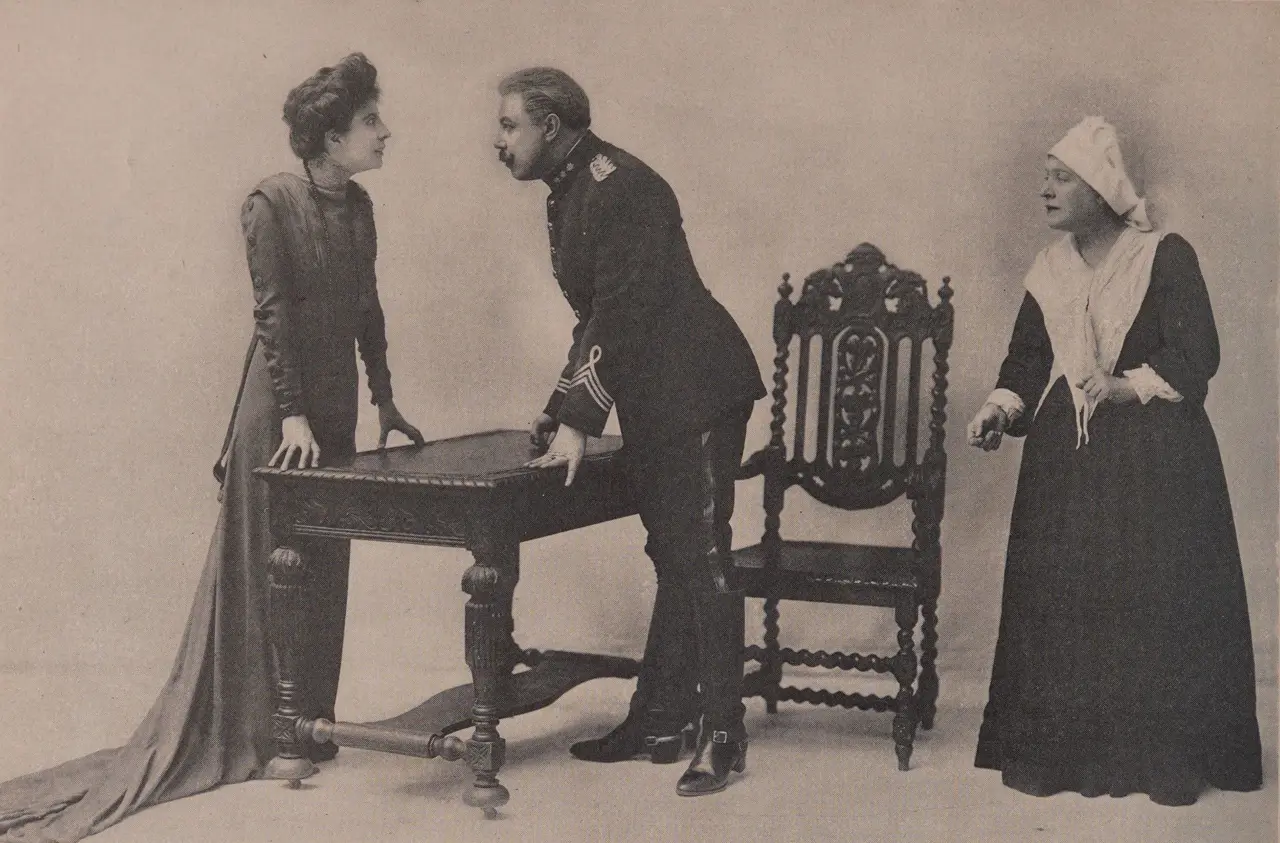
 The Linkby August StrindbergA baron and his wife come to a country court to agree their separation, and end up fighting over their son.
 Lucky Pehrby August StrindbergA young man kept in a church tower is given a ring that grants every wish, and goes out to find happiness.
 Miss Juliaby August StrindbergOn Midsummer Eve, a count's daughter and her father's valet play a dangerous game across the line between them.
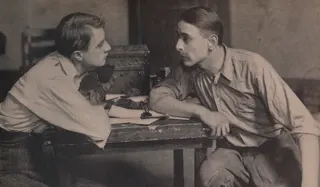 Pariahby August StrindbergTwo men sit out a stormy summer morning in a farmhouse, each working out the other's crime.
Act 1, Scene 1
A sitting-room at the Captain's. A door in the background to the right. In the middle of the room a large round table strewn with newspapers and magazines. To the right a leathered-covered sofa and table. In the right-hand corner a private door. To the left a bureau with a clock on it, and a door to the inner rooms. Arms on the wall, also guns and gamebags. Clothes pegs by the door on which hang uniform coats. A lighted lamp on the large table.
THE CAPTAIN and THE PASTOR, on the sofa.
The Captain in undress uniform and riding boots with spurs. The Pastor in black with a white neckcloth, but without his clerical ruff; he is smoking a pipe.
THE CAPTAIN rings
Yes, sir.
Is Nöjd out there?
Nöjd is waiting for orders in the kitchen.
Is he in the kitchen again! Fetch him in at once.
Yes, sir. [Goes.]
What is wrong now?
Oh, the rascal has got the girl into trouble again; he is a thoroughly bad lot.
Nöjd do you say? Why, he was to the fore in the spring, wasn't he?
Yes, don't you remember? But won't you be kind enough to say a few friendly words to him, and perhaps you may make some impression on him. I've sworn at him, and I've flogged him too, but it hasn't the least effect.
And now you want me to lecture him. What impression do you suppose the Word of God will make on a trooper?
Well, it certainly has no effect on me, you know.
I know that well enough.
But on him! Try at all events.
Act 1, Scene 2
THE FORMER, NÖJD.
What have you been doing now, Nöjd?
Begging your pardon, Captain, I can't possibly say while the Pastor is here.
Don't be bashful, my lad.
You had better confess, or you know how it will be.
Well, then, it was like this; we were at a dance at Gabriel's, and then—and then Ludwig said...
What has Ludwig to do with the story. Stick to the truth.
Yes, and then Emma said that we should go into the barn.
Ah, I suppose it was Emma who led you astray?
Well, that's about it. And I must say that unless the girl is willing nothing ever comes of it.
Once for all: are you the child's father or not?
How should I know?
What do you mean? Can't you tell that?
Why no, one can never be quite sure.
Were you not the only one then?
Yes, that time, but I can't be sure that I was the only one for all that.
Do you lay the blame on Ludwig then? Is that what you mean?
It isn't easy to know who to lay the blame on.
Yes, but you told Emma that you would marry her.
Oh, one always has to say that...
[to Pastor] This is really dreadful.
These are old stories! But listen, Nöjd, you are surely man enough to know whether you are the father or not.
Well, certainly, I and the girl——, but you know yourself, Pastor, that it needn't come to anything for all that.
Look here, my lad, we are talking about you now. You will surely not leave the girl alone with the child. I suppose we can't compel you to marry her, but you shall provide for the child! that you shall do.
Well, then, Ludwig must too.
Then the case must go to the Courts. I can't disentangle all this, and after all it doesn't concern me. So now, be off.
Nöjd, one word! Don't you think it is dishonourable to leave a girl like that in absolute destitution with her child? Don't you think so? Heigh? Don't you see that such a mode of action... h'm... h'm.
Yes, if only I knew for certain that I was father to the child, but one can never be sure of that, Pastor, and to slave all one's life for another man's child is not pleasant. Surely you, Pastor, and the Captain, can understand that for yourselves.
Be off.
God keep you, Captain. [Goes.]
But don't go into the kitchen again, you rascal!
Act 1, Scene 3
THE CAPTAIN and THE PASTOR.
Now why didn't you come down upon him?
What do you mean? Didn't I give it him?
Why, you only sat and muttered to yourself.
To tell the truth I really don't know what to say. It is a pity about the girl, certainly, but it is a pity about the lad, too. For just think if he were not the father. The girl can nurse the child for four months at the orphanage, and then it will be permanently provided for, but the lad can do no such thing. The girl will get a good place afterwards in some respectable house, but the lad's future may be ruined if he is dismissed from the regiment.
Upon my soul I should like to be in the Magistrate's shoes and judge this case. The lad is probably not quite innocent, one can't be sure, but the one thing one can be sure of is that the girl is guilty if there be any guilt in the matter.
Well, well, I judge no man! But what were we talking about when this tiresome story interrupted us. It was about Bertha and the confirmation, wasn't it?
Yes, but it was surely not about the confirmation particularly, but the whole of her education. This house is full of women who all want to educate my child. My mother-in-law wants to make a spiritualist of her, Laura insists on her being an artist; the governess wants to make her a Methodist, old Margret a Baptist, and the servant-girls a Salvationist. It won't do to try and make a soul in patches like that: especially when I, who have the chief right to form her character, have all my efforts opposed. I am determined to get her out of this house.
There are too many women here governing the house.
Yes, aren't there? It is like going into a cage full of tigers, and if I did not hold red-hot irons under their noses they might tear me to pieces at any moment! And you, you laugh, you villain. Was it not enough that I took your sister for my wife, without your palming off your old stepmother on me.
Well but, good Heavens, one cannot have stepmothers in one's house.
No, you think it better to have mothers-in-law instead—in other people's houses that is to say.
Ah well, everyone of us has his burden in this life.
Yes, but I have certainly too heavy a one. I have even my old nurse in addition, who treats me as if I ought to wear bibs still. She is a good old soul, Heaven knows, but she is not in the right place here.
You must keep order among the women folk, Adolf. You let them dictate to you far too much.
Now, look here, will you enlighten me as to how to keep order among the women folk?
Laura was treated with a firm hand, but then, although she is my own sister, I must admit she really was a little troublesome.
Laura has certainly her weak points, but with her they don't amount to much.
Pray speak quite plainly, I know her.
She has been brought up with romantic ideas and finds it a little difficult to accommodate herself to circumstances, but in any case she is my wife...
And because she is your wife she is the best of them. No, my dear fellow, it is really she who oppresses you most.
In the meantime the whole house is turned upside down. Laura won't let Bertha leave her, and I can't let her remain in this bedlam.
Oh, Laura won't. Well, then, do you know, I'm afraid there will be difficulties. If she set her mind on anything when she was a child, she used to lie like a corpse till she got it, and then as likely as not she would give it back, explaining that she didn't care about the thing, whatever it was, but about getting her own way.
So she was like that even then? H'm—— She really sometimes gets into such passions that I am quite anxious about her and fear that she is ill.
But what do you wish to do with Bertha that is so unpardonable? Is no compromise possible?
You mustn't think that I wish to make a prodigy of her, or a copy of myself.—I will not play the pander to my daughter and educate her exclusively for matrimony, for in that case she would have bitter days if she remained unmarried. But I will not, on the other hand, persuade her into a masculine career that requires a long course of training, which would be entirely thrown away in case she should wish to marry.
What do you intend then?
I intend her to be a teacher. If she remains unmarried she will be able to support herself and at anyrate be in no worse position than the poor schoolmasters who have to share their salaries with a family. If she marries she can apply her knowledge to the education of her children. Don't you think I'm right?
Perfectly right. But hasn't she, on the other hand, shown such talents for painting that it would outrage nature to suppress them?
No! I have shown her performances to an eminent painter, and he says that they are only the kind of thing that can be learnt in schools. But then a young fellow came here in the summer who, of course, understood the matter much better, and declared that she had a remarkable talent, and so it was settled to Laura's satisfaction.
Was he in love with the girl?
I take that entirely for granted.
Then God be with you, old fellow, for in that case I see no help. But all this is very tiresome, and, of course, Laura has her supporters... in there.
Yes, that you may depend on! The whole house is already up in arms, and, between ourselves, it is not exactly a noble conflict that is waged from that quarter.
[gets up] Do you think I don't know that?
You also?
Also?
But the worst of it is that it seems to me as if Bertha's career was being determined by most objectionable motives, in there. They drop hints about man having to see that woman can do this and can do that. It is Man and Woman against one another, incessantly, all day long. Must you go now? Do stay for supper. I have certainly nothing to offer you, but still. You know that I am expecting the new Doctor. Have you seen him?
I caught a glimpse of him as I passed by. He looked pleasant and trustworthy.
I'm glad of that. Do you think it possible he may side with me?
Who knows? It depends on how much he has been accustomed to women.
Oh! but won't you stay?
No thanks, my dear fellow; I promised to come home to supper, and the old lady gets so uneasy if I am late.
Uneasy? Angry you should say. Well, as you will. Let me help you with your overcoat.
It seems to be very cold this evening. Thanks. You must take care of your health, Adolf, you look so nervous.
Do I look nervous?
Yes, you are not really well.
Has Laura put that into your head? She has treated me these twenty years as if I were at the point of death.
Laura? No; but, but I'm really uneasy about you. Take care of yourself. That's my advice! Good-bye, dear old man; but didn't you want to talk about the confirmation?
Not at all! I assure you that matter will proceed in the ordinary course at the expense of the official conscience, for I have no intention of being either a confessor or a martyr. We have put all that behind us. Good-bye. Remember me at home.
Good-bye, Adolf. Love to Laura.
Act 1, Scene 4
The CAPTAIN, afterwards LAURA.
The Captain opens his desk, and seats himself at it with his accounts.
Thirty-four... nine, forty-three... seven, eight, fifty-six.
[enters from the inner rooms] Will you be so kind as to...
In a moment! Fifty-six..., seventy-one, eighty-four, eighty-nine, ninety-two, a hundred. What is it?
Am I disturbing you?
Not at all. Housekeeping money, I suppose?
Yes, housekeeping money.
Put the accounts down there and I will go through them.
The accounts?
Yes.
Am I to keep accounts now?
Of course you are to keep accounts now. Our affairs are in a precarious condition, and in case of a liquidation there must be accounts or one may be punished as a fraudulent debtor.
It is not my fault that our affairs are in a precarious condition.
That is exactly what will be shown by the accounts.
It is not my fault that the bailiff doesn't pay.
Who recommended the bailiff so warmly? You! Why did you recommend a—shall we say—a fool.
And why did you take the fool, then?
Because I was not allowed to eat in peace, nor to sleep in peace, nor to work in peace, till you got the man here. You wanted him so that your brother might be rid of him, your mother wanted him because I didn't want him, the governess wanted him because he was a Scripture-reader, and old Margret because she had known his mother from her childhood. That's why I took him, and if I hadn't taken him I should be shut up in a mad-house now, or lying in the family grave. Meantime here is the housekeeping money and your allowance. You can give me the accounts presently.
[curtesies] Thanks so much. Do you also keep accounts of what you spend besides the housekeeping money?
That does not concern you.
No, that is true, just as little as my child's education concerns me. Have my lords made up their minds after the conference of this evening?
I had made up my mind beforehand, and it therefore only remained for me to announce my intention to the one friend I and the family have in common. Bertha is to board in town and starts in a fortnight.
Where is she to board, if I may venture to ask?
At Auditor Säfberg's.
That free thinker!
The law declares that children are to be brought up in their father's faith.
And the mother is to have no voice in the matter?
None whatever. She has sold her birthright by a legal transaction, and surrendered her rights in return for the man's undertaking to care for her and her children.
Therefore she has no power over her child.
No, none whatever. When one has once sold one's goods, one cannot have them back and yet keep the money.
But if both father and mother agree...
How could that happen? I wish her to live in town, you wish her to live at home. The arithmetical result would be that she remained at the railway station, midway between town and home. This is a knot that cannot be untied. Do you see?
Then it must be broken! What was Nöjd doing here?
That is a professional secret.
Which the whole kitchen knows.
Good, then you must know it.
I do know it!
And have your judgment ready beforehand.
My judgment is the law's judgment.
It is not written in "the judgment of the law" who the child's father is.
No, but one can usually find that out.
Wise people say that one never can tell those things.
That is remarkable. Can one never tell who is the father of a child?
No; so it is maintained.
That is remarkable. How, then, can the father have such rights over the child?
He only has them when he has assumed the responsibility, or has had the responsibility thrust on him. And in marriage there is, of course, no doubt about paternity.
No doubt?
No, I should hope not.
And in case the wife has been unfaithful?
This is no such case! Have you anything further to ask about?
Nothing whatever.
Then I shall go up to my room, and perhaps you will be good enough to inform me when the Doctor comes.
Shuts the bureau and gets up.
Certainly.
Captain goes through the private door to right.
As soon as he comes. For I don't wish to be rude to him. You understand. [Goes.]
I understand.
Act 1, Scene 5
LAURA, alone, she gazes at the bank notes she holds in her hand.
[within] Laura!
Yes.
Is my tea ready?
[in the doorway to the inner rooms] You shall have it directly.
Laura goes towards the hall door in the background, as the orderly opens it and announces—Doctor Östermark.
Madam!
[goes towards him and gives him her hand] Good evening, Doctor? We are all very glad to see you here. The Captain is out, but he will be back directly.
I beg your pardon for coming so late, but I have had to pay some professional visits already.
Won't you sit down? Do!
Thank you.
Yes, there is a great deal of illness in the neighbourhood just now, but I hope that you will settle down comfortably all the same. It is so very important for lonely country people like us to find a doctor who is interested in his patients. And I hear so much good of you, Doctor, that I hope the happiest relations will prevail between us.
You are much too kind, but I hope on the other hand that my visits to you may not too frequently be caused by necessity. Your family, I believe, is usually in good health...
We have fortunately not had any acute illness, but still things are not entirely as they ought to be.
Indeed?
They are, Heaven knows, not so satisfactory as we might wish.
You really alarm me.
There are circumstances in a family, which one is bound in honour and conscience to conceal from the whole world...
Excepting from the doctor.
Exactly. It is, therefore, my painful duty to tell you the whole truth immediately.
Can we not postpone this conference until I have had the honour of being introduced to the Captain?
No! You must hear me before seeing him.
It relates to him, then?
Yes—to him, my poor, dear husband.
You make me uneasy, Madam, and believe me, I sympathise with your misfortune.
[taking out her handkerchief] My husband's mind is affected. Now you know all, and must judge for yourself when you see him.
Is it possible! I have read the Captain's excellent treatises on mineralogy with great admiration, and have always found them display a clear and powerful intellect.
Really? I should be delighted if his whole family should prove to be mistaken.
But of course it is possible that his mind is disturbed in other directions. Let me hear.
That is what we also fear. You see he has sometimes the most extraordinary ideas, which of course one would expect in a learned man if they did not exercise a disastrous influence on the welfare of his whole family. For instance, he has a fancy for buying all manner of things.
That is serious; but what does he buy?
Whole boxes of books that he never reads.
Oh, it is nothing out of the way for a scholar to buy books.
You don't believe what I say?
Yes, Madam, I am convinced that you believe what you say.
Then is it reasonable to think that one can see, by looking in a microscope, what is going on in another planet?
Does he say he can do that?
Yes, he says so.
In a microscope?
In a microscope, yes.
This is serious, if it is so.
If it is so. Then you have no belief in me, Doctor, and I am sitting here and confiding the family secret in you...
Indeed, Madam, your confidence honours me, but as a physician I must investigate and observe before I can judge. Has the Captain ever shown any symptoms of uncertainty of temper, or instability of will?
Has he ever? We have been married for twenty years and he has never yet made a decision without abandoning it afterwards.
Is he obstinate?
He always insists on having his own way, but when he has got it he drops the whole thing and asks me to decide.
This is serious and requires close observation. The will, you see, is the mainspring of the mind, and if it is injured the whole mind collapses.
And God knows that I have had to teach myself to meet his wishes half-way all through these long years of trial. Ah, if you only knew what a life I have endured with him—if you only knew?
Your misfortune touches me deeply, and I promise you to see what can be done. I pity you with my whole heart, and I beg you to trust me absolutely. But after what I have heard I must impress one thing on you. Avoid suggesting any ideas that make a strong impression on the sufferer, for in a weak brain they are rapidly developed and readily turn to monomania or "Idées fixes." Do you understand?
You mean, avoid rousing his suspicions?
Exactly so. One can make the insane believe anything just because they are receptive to everything.
Indeed. Then I understand. Yes—yes. [Ringing heard within.] Excuse me, my mother has something to say to me. One moment.... Ah, there is Adolf.
Act 1, Scene 6
THE DOCTOR and THE CAPTAIN.
[Enters by the private door] Ah, you are here already, Doctor. You are very welcome.
Captain! It is a very great pleasure to me to make the acquaintance of so celebrated a man of science.
You are very good. My professional duties don't allow me to make any profound investigations, but I believe myself to be really on the track of a discovery.
Really.
You see I have submitted meteoric stones to spectrum analysis, with the result that I have found coal, that is to say, a clear trace of organic life. What do you think of that?
Can you see that in the microscope?
No, deuce take it, in the spectroscope.
The spectroscope! Pardon: Well, then, you will soon be able to tell us what is happening in Jupiter.
Not what is happening, but what has happened. If only the confounded booksellers in Paris would send me the books; but I believe that all the booksellers in the universe have conspired against me. Just imagine that for the last two months not a single one has even answered my communications, either letters or abusive telegrams. I shall go frantic over it, and I can't imagine what it all means.
Oh, they are generally unbusinesslike fellows, you mustn't take it so much to heart.
No, but the deuce is that I shall not get my treatise done in time, and I know that they are working on the same lines in Berlin. But that's not what we ought to be talking about.... What about you? If you care to live here we have a small apartment at your disposal in the wing, or perhaps you would rather live in the old doctor's quarters.
Just as you like.
No, as you like. Which is it to be?
You must decide that, Captain.
No, I shall decide nothing. You must say what you wish. I wish nothing, nothing whatever.
Oh, but I really cannot decide....
For God's sake, do say, Doctor, what you would like. I have no will in this matter, no opinion, no wishes. Are you so utterly feeble that you don't know what you wish? Answer me or I shall get angry.
As it rests with me, I choose to live here.
Good! Thank you.... Ah, forgive me, Doctor, but nothing annoys me so much as to hear people profess indifference about anything. [Rings.]
Enter Nurse.
Oh, there you are, Margret. Do you happen to know if the wing is in order for the Doctor?
Yes, sir, it is.
All right. Then I wont detain you, Doctor; you must be tired. Good-bye and welcome again; we shall meet to-morrow, I hope.
Good evening, Captain.
I presume that my wife explained our circumstances to you a little, so that you have some idea how the land lies.
Your excellent wife has given me a few hints about one thing and another such as were necessary to a stranger. Good evening, Captain.
Act 1, Scene 7
CAPTAIN, NURSE.
What do you want, you old dear! Is anything the matter?
Now, my dear Mr Adolf, you must just listen.
Yes, old Margret. Talk away, you are the only one I can listen to without getting into a rage.
Now just listen, Mr Adolf. Don't you think you should go half-way and come to an agreement with Mistress about this fuss over the child. Just think of a mother....
Think of a father, Margret.
There, there, there! A father has something besides his child, but a mother has nothing but her child.
Just so, old lady. She has only one burden, but I have three, and I bear her burden too. Don't you think that I should have had a better position in the world than a poor soldier's if I had not had her and her child.
Yes, but it wasn't that I wanted to say.
No, I believe that, for you wanted to make me confess I was in the wrong.
Don't you believe, Mr Adolf, that I wish you well?
Yes, dear friend, I do believe it, but you don't know what is for my good. You see it isn't enough for me to have given the child life, I want to give her my soul too.
I don't understand anything about that. But I do think that you ought to be able to agree.
You are not my friend, Margret!
I? Ah God! How can you say that, Mr Adolf. Do you think I can forget that you were my child when you were little.
No, you dear, have I forgotten it? You have been like a mother to me, and have supported me hitherto when I had everybody against me, but now, when I really need you, you desert me and go over to the enemy.
The enemy!
Yes, the enemy! You know well enough how things are in this house, you have seen everything from beginning to end.
I have seen well enough! but, my God, why should two people torment the life out of one another; two people who are otherwise so good and wish all others well. Mistress is never like that to me or to anyone else....
Only to me, I know it. But let me tell you, Margret, that if you desert me now, you will do wrong. For they have begun to plot against me, and that doctor is not my friend.
Ah, Mr Adolf, you believe evil about everybody, but, you see, it's because you haven't the true faith, that's just what it is.
But you and the Baptists have found the only true faith. You are indeed happy!
At any rate, I am not so unhappy as you, Mr Adolf. Humble your proud heart and you will see that God will make you happy in love to your neighbour.
It is a strange thing that you no sooner speak of God and love than your voice becomes hard and your eyes evil. No, Margret, you have certainly not the true faith.
Yes, you're proud and hard enough in your learning, but it doesn't amount to much when it comes to the pinch.
How arrogantly you talk, humble heart. I know well enough learning is of no use with such creatures as you.
You should be ashamed of yourself! But in spite of everything, old Margret loves her great big boy best, and he will come back again, you'll see, like a good child, in the day of trouble.
Margret! Forgive me, but believe me there is no one here who wishes me well but you. Help me, for I am sure that something is going to happen. What it is I don't know, but some evil thing is on its way. [Scream from within]. What is it? Who is screaming?
Act 1, Scene 8
THE FORMER, BERTHA, enters from inner rooms.
Father! Father! help me, save me!
What is it my darling child? Speak!
Help me. She is going to hurt me!
Who is going to hurt you. Speak! Speak!
Grandmother! But it's my fault for I deceived her!
Go on.
Yes, but you mustn't say anything about it! Do you hear! Promise!
Well, but tell me what it is. [Nurse goes.]
In the evening she generally turns down the lamp, and then she makes me sit at a table holding a pen over a piece of paper. And then she says that the spirits are to write.
What do you say? And you have never told me this?
Forgive me, but I dared not. For grandmother says that the spirits take revenge if one speaks about them. And then the pen writes, but I don't know if it is I. And sometimes it goes beautifully, but sometimes it can't do anything at all. And when I am tired nothing comes, but she wants it to come all the same. And this evening I thought I was writing beautifully, but then grandmother said it was all out of Stagnelius, and that I was deceiving her, and then she got so fearfully angry.
Do you believe that there are spirits?
I don't know.
But I know that there are none.
But grandmother says that you don't understand, papa, and that you have much worse things that can see to other planets.
Does she say that! Does she say that! What else does she say?
She says that you can't work wonders.
I never said I could. You know what meteoric stones are,—stones that fall down from other heavenly bodies. I can examine them and say whether they contain the same elements as our world. That is all that I can see.
But grandmother says there are things that she can see, but that you cannot see.
Then she lies!
Grandmother doesn't tell lies.
Why not?
Then mother tells lies too.
H'm.
If you say that mother tells lies, I will never believe you again.
I have not said so, and therefore you must believe me when I tell you, that your future welfare requires that you should leave your home. Will you! Will you go to town and learn something useful?
Ah, yes, I should love to go to town, away from here, anywhere! Only let me see you sometimes, often. Oh, it is always so gloomy and sad in there, as if it were a winter's night, but when you come, father, it is like some spring morning when they take out the inner windows.
My beloved child. My dear child.
But, father, you must be good to mother, do you hear. She cries so often.
H'm. Then you will go to town.
Yes, yes.
But suppose mother will not let you go?
But she must let me.
But what if she won't?
Well, then, I don't know what will happen. But she must! She must!
Will you ask her?
You must ask her very nicely, for she doesn't care about me.
H'm! Now if you wish it, and I wish it, and she doesn't wish it, what shall we do then?
Ah, then, it will be all in a muddle again! Why can't you ask.... [Enter Laura.]
Act 1, Scene 9
THE FORMER, LAURA.
Ah, so Bertha is here! Then perhaps we may hear her own opinion, as the question of her future has to be decided.
The child can hardly have any well-founded opinion as to how a young girl's life is likely to shape itself, while we, on the contrary, can easily make an approximate calculation, for we have seen a great number of young girls' lives unfold themselves.
But as we are of different opinions, Bertha's must be the determining one.
No, I let no one usurp my rights, neither women nor children. Bertha, leave us. [Bertha goes out.]
You were afraid of hearing her opinion, because you thought it would be to my advantage.
I know that she wishes to go away from home, but I know also that you possess the power of changing her mind according to your pleasure.
Am I really so powerful?
Yes, you have a fiendish power of getting your own way, but people who are not ashamed of interfering always have. How did you get Doctor Nordling away, for instance, and how did you get the new man here?
Yes, how did I manage that?
You insulted the first, until he went, and made your brother scrape votes together for the other.
Well, that was quite simple and perfectly legitimate. Is Bertha to leave home?
Yes, she is to start in a fortnight.
Is that your determination?
Yes.
Have you spoken to Bertha about it?
Yes.
Then I must try to prevent it.
You cannot.
Can't I? Do you really think I would trust my daughter to these wicked people to be told that everything her mother has taught her is mere foolishness? Why, she would despise me for the rest of her life!
Do you think that a father will allow ignorant and conceited women to teach his daughter that her father is a charlatan?
It ought to mean less to the father.
Why so?
Because the mother is nearer to the child, since it has been discovered that no one can tell for certain who is the father of a child.
What is the application in this case?
That you do not know whether you are Bertha's father.
Do I not know?
No; what no one can know, you surely cannot know.
Are you joking?
No; I am only making use of your own teaching. Besides, how can you tell that I have not been unfaithful to you?
I believe a great deal of you, but not that, nor that you would talk about it if it were true.
Assume that I was prepared to bear anything, even scorn and rejection, for the sake of being allowed to keep and dispose of my child, and that I was truthful just now when I declared that Bertha is my child, but not yours. Assume...
Stop!
Only assume this: In that case your power would be at an end.
Yes, when you had proved that I was not the father.
That would not be so difficult! Should you like me to do that?
Stop!
I should of course only need to declare the name of the real father, give all details of place and time, for instance——, when was Bertha born? In the third year of our marriage.
Stop, or...
Or what? I am to stop now. Just think for a moment of all you do and decide, and whatever you do, don't make yourself ridiculous.
I consider all this most lamentable.
Which is more ridiculous than ever.
And what of you?
Oh, I have managed too cleverly.
That is why one cannot contend with you.
Then why do you provoke contests with a superior enemy.
Superior?
Yes, it is singular, but I have never looked at a man without knowing myself his superior.
Well, you shall be made to see your superior for once, so that you never shall forget it.
That will be interesting.
[enters] Supper is ready. Will you come in, Ma'am?
Yes, directly.
Captain lingers; sits down in an arm chair by the table.
Won't you come in to supper?
No thanks, I don't want anything.
What! Are you annoyed?
No, but I am not hungry.
Come, or they will question me in a way that is——unnecessary... Be good now... You won't; then stay there.
Goes.
Mr Adolf! What is all this about?
I don't know what it is. Can you explain to me how it is that a grown man can be treated as if he were a child?
I don't understand it, but it must be because you are all women's children, every man of you, great and small....
But no women are born of men. Yes, but I am Bertha's father. Tell me, Margret, don't you believe it? Don't you?
Lord, how childish you are. Of course you are your own child's father. Come and eat now, and don't sit there and brood. There, there, come now.
Get out, woman. To hell with the witches. [Goes to the private door] Svärd, Svärd! [Enter Orderly.]
Yes, Captain.
Let them put the horses in the covered sleigh at once.
Captain, just listen!
Out woman! At once!
Lord preserve us, what will come of all this.
Captain puts on his cap and prepares to go out.
Don't expect me home before midnight.
Jesus help us, what will be the end of this!
Act 2, Scene 1
The same scene as in the previous Act. A lighted lamp on the table; it is night.
THE DOCTOR, LAURA.
From what I could find out in the course of our conversation, the case is not yet clearly proved to me. To begin with, you had made one mistake in saying that he had arrived at these astonishing results about other celestial bodies by means of a microscope. Now that I hear it was a spectroscope, he is not only entirely cleared of any suspicion of insanity, but is shown to have done a great service to science.
Yes, but I never said that.
Madam, I made careful notes of our conversation, and I remember that I asked about this very point because I thought that I could not have heard aright. One must be scrupulous in making such assertions when a certificate of insanity is in question.
A certificate of insanity?
Yes, you must surely know that an insane person loses his civil and family rights.
No, I did not know that.
There was a further point that seems to me suspicious. He spoke of his communications to his booksellers having remained unanswered. Permit me to ask if you intercepted them from motives of mistaken kindness.
Yes, I did. It was my duty to watch over the interests of the household and I could not let him ruin us all without intervention.
Pardon me, but I think that you cannot have considered the consequences of such an act. If he discovers your secret interference with his affairs, his suspicions will be aroused and will grow with the rapidity of an avalanche. But besides this, you have raised obstacles to his will and consequently still further provoked his irritability. You must know how maddening it is to have your most ardent desires thwarted and your will restrained.
As if I didn't know that!
Then consider what he must have gone through.
[getting up] It is midnight and he hasn't come home. We may fear the worst now.
But tell me what actually happened this evening after I left. I must know everything.
He talked in the wildest way about the most extraordinary things. Such fancies, for instance, as that he is not the father of his child.
That is strange. How did such an idea come into his head.
I really can't imagine, unless it was that he had to examine one of the men in a child maintenance case, and when I took the girl's part, he got excited and said that no one could tell who was father to a child. God knows that I did everything to calm him, but I fear that nothing can help him now. [Crys.]
This really cannot be allowed to go on. Something must be done, without of course rousing his suspicions. Tell me, has the captain ever had such delusions before?
Six years ago we had the same state of things and then he actually confessed, in his own letter to the doctor, that he feared for his reason.
Ah, yes, this is of course a story that has deep roots, and the sanctity of family life—and so on—prevents.... I cannot ask about everything, but must keep to the surface. What is done can't be undone, alas, and yet the remedy should have some application to the past. —— ——Where do you think he is now?
I have no idea. He has such wild fancies now.
Should you like me to stay till he returns? I could say, to avoid suspicion, that I had come to see your mother, who is unwell.
Yes, that will do admirably. And do not leave us, Doctor; I can't tell you how anxious I am! But wouldn't it be better to tell him right out what you think of his condition?
We never do that unless the patient speaks of the subject himself, and very rarely even then. It depends entirely on the direction the case takes. But we mustn't stay here; perhaps I had better go into the next room, it will look more natural.
Yes, it will be better, and then Margret can sit here. She is accustomed to sit up when he is out, and she is the only one too who has any power over him. [Goes to the door on the left] Margret, Margret!
Yes, Ma'am. Is the master home?
No, but you are to sit here and wait for him, and when he comes you are to say that my mother is ill and that the Doctor is here because of that.
Yes, Ma'am. I'll see that it is all right.
[opens door to inner rooms] Will you come in here, Doctor?
Thanks.
Act 2, Scene 2
THE NURSE, sits at the table and takes up a hymn-book and spectacles.
Ah yes, ah yes! [reads half aloud]. Ah, woe is me, how sad a thing Is life within this vale of tears, Death's angel triumphs like a king And calls aloud to all the spheres— 'Tis vanity, all vanity. Yes, yes! yes, yes! All that on earth hath life and breath Falls stricken down before his spear, And sorrow, saved alone from death, Inscribes above the mighty bier— 'Tis vanity, all vanity. Yes, yes.
BERTHA, enters with a coffee-pot and some needle work; she speaks low.
Margret may I sit with you? It is so lonely up there.
Oh! Good gracious, are you still up, Bertha.
I must work at papa's Christmas present, you see. And I've got something good for you here.
Yes, but dear heart it won't do. You have to get up in the morning and it is past twelve o'clock.
Well, what does that matter? I dare not sit up there alone, I believe its haunted.
There now, didn't I say so! Yes, mark my words, this house is no good place. What did you hear?
Oh, just fancy, I heard some one singing up in the garret.
In the garret? At this time of night!
And it was a very, very sad song, such as I never heard. And it seemed as if it came from the lumber-room, where the cradle stands, you know, on the left....
Oh dear, oh dear! And it's such fearful weather to-night! I believe the chimneys will blow down. Ah, what is then this earthly life But grief, affliction, trouble, strife? E'en when fairest it has seemed Vanity it must be deemed. Yes, dear child, God send us a happy Christmas!
Margret, is it true that papa is ill?
Yes; he is indeed.
Then we shan't be able to keep Christmas Eve. But how can he be up if he is ill?
You see, my child, the kind of illness that he has doesn't prevent him from being up. Hush, there's someone out in the hall. Go to bed now and take the coffee-pot away, or the master will be angry.
[going out with the tray] Good-night, Margret!
Good-night, my child. God bless you!
Act 2, Scene 3
NURSE, CAPTAIN, takes off his overcoat.
Are you still up? Go to bed.
I was only waiting till....
Captain lights a candle, opens his desk, sits down at it, and takes letters and newspapers out of his pocket.
Mr Adolf.
What do you want?
Old mistress is ill, and the doctor is here.
Is it anything dangerous?
No, I don't think so. It is only a cold.
[gets up] Who was the father of your child, Margret?
Oh, I have told you that many and many a time; it was that scamp Johansson.
Are you sure that it was he?
How childish you are; of course I am sure of it, since he was the only one.
Yes; but was he sure that he was the only one? No; he could not be, but you could be sure of it. You see that's the difference.
I can't see any difference.
No; you cannot see it, but the difference is there all the same. [Turns over the pages of a photograph album that is on the table.] Do you think Bertha is like me? [Looks at a portrait in the album.]
Why, yes; you are as like as two peas.
Did Johansson confess that he was the father?
He had no choice.
How dreadful! There is the doctor.
Act 2, Scene 4
CAPTAIN, NURSE, DOCTOR.
Good evening, Doctor. How is my mother-in-law?
Oh, it is not at all serious; it is merely a slight sprain of the left foot.
I thought Margret said that it was a cold. There seem to be different interpretations of the same case. Go to bed, Margret. [Nurse goes.] [A Pause.]
Do sit down, Doctor Ostermark.
[sits down] Thanks.
Is it true that you obtain striped foals if you cross a zebra and a mare?
[astonished] Perfectly true.
Is it true that the foals continue to be striped if the breed is carried on with a stallion?
Yes, that is also true.
Therefore, under certain conditions, a stallion can be sire to striped foals?
Yes, so it appears.
That is to say: the offspring's likeness to the father proves nothing.
Well...
That is to say, paternity cannot be proved.
H'm... Well!
You are a widower and have had children?
Ye-es.
Did you never see how ridiculous you were as a father? I know nothing so comical as to see a father leading his child about the streets, or to hear a father talk of his children. "My wife's children," he ought to say. Did you never realise how false your position was? Were you never troubled by doubts, I won't say suspicions, for I assume, as a gentleman, that your wife was above suspicion?
No, really, I never was, and, indeed, Captain, a man must take his children on trust as Goethe, I think, says.
On trust when there is a woman in the case? that is risky.
Oh! there are so many kinds of women.
Modern investigation has pronounced that there is only one kind!... When I was young I was strong and—if I may boast—handsome. I can only remember two momentary impressions that in recalling them have caused me to doubt this. I was once on board a steamer sitting with a few friends in the fore-saloon. The young stewardess came and flung herself down by me, burst into tears, and told us that her sweetheart was drowned. We pitied her, and I ordered some champagne. After the second glass, I touched her foot, after the fourth her knee, and before morning I had consoled her.
One swallow does not make a summer.
Now comes the second, and that was really a summer swallow. I was at Lysekil. A young woman was staying there. She had her children with her, but her husband was in town. She was religious, had extremely severe principles, preached morality to me, and was, I believe, entirely virtuous. I lent her some books, and when she was leaving she unexpectedly enough returned them. Three months later I found a visiting card in those very books with a fairly plain declaration. It was innocent, as innocent that is to say as a declaration of love from a married woman to a strange man who never made any advances can be. Now comes the moral. Whatever you do, don't believe too much.
But don't believe too little either.
No. Not that either. But don't you see, Doctor Östermark, the woman was so unconsciously dishonest that she spoke of her infatuation for me to her husband. This very unconsciousness of their instinctive duplicity is what is so dangerous. It is, I grant you, an extenuating circumstance, but it cannot make me reverse my judgment, only soften it.
Captain, your thoughts are taking a morbid direction, and you ought to control them.
You must not use the word morbid. All steam boilers, as you know, explode when the pressure gauge registers 100, but the scale is not the same for all boilers; do you understand? In the meantime you are here to watch me. If I only were not a man I should have the right of making accusations, or complaints as they are so cleverly called, and, perhaps, I should be able to give you the whole diagnosis, and what is more, the history of my disease; but I am unfortunately a man, and there is nothing for me but to fold my arms across my breast like the Roman, and hold my breath till I die. Good-night.
Captain, if you are ill, it will not offend your dignity as a man to tell me all. Indeed, I am bound to hear the other side.
It is enough that you have heard the one, I imagine.
No, Captain. And do you know when I heard Mrs Alving eulogise her dead husband, I thought to myself it was a confounded pity the fellow was dead.
Do you suppose that he would have spoken if he had been alive! And do you suppose that any dead husbands would be believed if they were to come to life? Good-night, Doctor. You hear that I am calm, and you can safely go to bed.
Good-night, then, Captain. I can take no further part in this affair.
Are we enemies?
Far from it? Only it is a pity that we cannot be friends. Good-night. [Goes.]
The Captain follows the doctor to the door in the background, and then goes to the door at the left and opens it slightly.
Come in, I want to talk to you! I heard you standing out there listening.
Act 2, Scene 5
LAURA, embarrassed. CAPTAIN, sits down at the bureau.
It is late, but we must talk things out. Sit down. [A pause.] I have been at the post office this evening to fetch the letters. From these it appears that you have kept back my letters, both on their departure and arrival. The direct consequence of this is that the delay has entirely frustrated the results I hoped for from my work.
It was an act of kindness on my part, since you neglected your professional duties for this other work.
It surely cannot have been kindness, for you knew quite well that I should one day win more renown from that than from the service; but you were particularly anxious that I should not distinguish myself, lest your own insignificance should be eclipsed. In consequence of this I have intercepted letters addressed to you.
That is very noble of you.
I see you have a high opinion of me.—It appears from these letters that for some time past you have been arraying my former friends against me by spreading reports about my mental condition. And you have succeeded in your efforts, for now there is not more than one person from the colonel down to the cook who believes me to be sane. Now the facts about my illness are these: my reason is unaffected, as you know, so that I can discharge both my duties to the service and my duties as a father; my nerves are still more or less under my control, and will continue so as long as my will remains fairly intact. You have, however, so thoroughly undermined it that it will soon be ready to fly off the cog-wheel, and then the whole mechanism will go to smash. I will not appeal to your feelings, for you have none, that is your strength; but I will appeal to your interests.
Let me hear.
You have succeeded by this conduct in arousing my suspicions to such an extent that my judgment is nearly destroyed, and my thoughts begin to wander. This is that approaching insanity you are waiting for, and that may come now at any time. The question then arises for you: is it more to your interest that I should be sane or insane. Consider! If I succumb I shall have to leave the service, and you will be in a very awkward position. If I die my life insurance will fall to you. But if I take my own life you will get nothing. It is therefore to your interest that I should live out my life.
Is this a trap?
Of course! But it rests with you to avoid it or to run your head into it.
You say that you will kill yourself? You shall not do it!
Don't be sure. Do you think a man can live when he has nothing and nobody to live for?
You surrender then?
No, I offer you peace.
The conditions?
That I may keep my reason. Deliver me from my suspicions and I throw up the struggle.
What suspicions?
About Bertha's origin.
Is there any doubt about that?
Yes, I have doubts, and you have awakened them.
I?
Yes, you have dropped them like henbane in my ears, and circumstances have given them growth. Deliver me from uncertainty, tell me outright that my suspicions are justified, and I will forgive you in advance.
You really can't expect me to take upon myself a sin that I have not committed.
What can it matter when you are certain that I shall not betray you? Do you think that a man would be likely to blazon his own shame abroad.
If I say it is not true, you won't be convinced; but if I say it is true, you will be convinced. You seem to hope it is true?
Yes, strangely enough; no doubt because the first supposition can't be proved, only the last.
Have you any reasons for your suspicions?
Yes, and no.
I believe that you want to prove me guilty, so that you can get rid of me and have absolute control over the child. But you won't lure me into any such snare.
You surely don't think that I would adopt another man's child, if I were convinced of your guilt?
No, I'm sure you wouldn't, and that convinces me that you lied just now when you said that you forgave me in advance.
[gets up] Laura, save me and my reason. You don't seem to understand what I say. If the child is not mine, I have no control over it, and don't want to have any, and that is precisely what you want, isn't it? You will have the power over the child, and I shall be left to maintain you both.
The power, yes. Has this whole life and death struggle been fought for anything but the power?
You know I do not believe in a future life. The child was my future life. She was my conception of immortality, and perhaps the only one that has any analogy in reality. If you deprive me of that, you cut short my existence.
Why did we not separate in time?
Because the child bound us together; but the bond became a chain. And how did it happen; how? I have never thought of this, but now the memory of it rises up in accusation, perhaps in condemnation. We had been married two years, and had no child, you best know why. I fell ill and lay at the point of death. In an interval of the fever I heard voices outside in the drawing-room. You and the solicitor were talking about the fortune that I then still possessed. He explained that you could not inherit anything, because we had no children, and asked you if you were enceinte. What you answered I did not hear. I recovered, and we had a child. Who is it's father?
You.
No, it is not I. There is a buried crime here which begins to give off poisonous exhalations, and what a hellish crime. You have been tender enough about freeing black slaves, but you have kept white ones yourself. I have worked and slaved for you, your child, your mother, your servants; I have sacrificed career and promotion, I have endured torture, flagellation, sleeplessness, unrest for your sake, until my hair has grown grey; and all in order that you might enjoy a life without care, and when you grew old, enjoy it over again in your child. I have borne it all without complaint, because I thought myself the father of the child. This is the crudest form of theft, the most brutal slavery. I have had seventeen years of penal servitude and have been innocent. What can you give me in return for this?
Now you are quite mad!
[sits] That is your hope!... And I have seen how you have laboured to conceal your sin. I have had sympathy with you because I did not understand your grief; I have often lulled your evil conscience to rest, because I thought I was chasing away a morbid thought; I have heard you cry out in your sleep without allowing myself to listen. Now I remember the night before last—Bertha's birthday—I was sitting up reading between two and three in the morning. You screamed as if someone were strangling you "don't, don't!" I knocked on the wall because I wished to hear no more. I have long had my suspicions, but I did not dare to hear them confirmed. I have suffered this for you, what will you do for me?
What can I do? I can swear by God and all that I hold sacred that you are Bertha's father.
Of what use is that, as you have said before that a mother can and ought to commit any crime for her child. I implore you by the memory of the past, I implore you as a wounded man begs for a death-blow, to tell me all. Don't you see that I am as helpless as a child, don't you hear that I am complaining as to a mother, won't you forget that I am a man, that I am a soldier who with a word can tame men and beasts; I simply implore pity like a sick man, I lay down the tokens of my power and pray for mercy on my life.
[approaches him and lays her hand on his brow] What! You are crying, man!
Yes, I am crying, although I am a man. But has not a man eyes? Has not a man hands, limbs, senses, opinions, passions? Is he not fed with the same food, hurt by the same weapons, warmed and cooled by the same summer and winter as a woman is? If you prick us do we not bleed? If you tickle us do we not laugh? If you poison us do we not die? Why should not a man complain, a soldier cry? Because it is unmanly? Why is it unmanly?
Cry then, my child, and you will have your mother with you again. Do you remember that it was as your second mother I first entered your life. Your great strong body was without nerve. You were a giant child that had either come too early into the world, or perhaps was not wanted.
Yes, that's just how it was. My father and mother did not want me and consequently I was born without a will. I naturally enough thought that I was completing myself when you and I became one, and therefore you got the upper hand, and I, the commander in barracks and before the troops, became obedient to you, grew by you, looked up to you as a highly gifted being, listened to you as if I had been your ignorant child.
Yes, so it was, and therefore I loved you as my child. But you know, you must have seen, when the nature of your feelings changed and you appeared as my lover I blushed and the joy of your embraces turned to remorse as if my blood were ashamed. The mother became the mistress. Ugh!
I saw but did not understand it. And when I imagined that you despised me for my unmanliness, I wanted to win you as a woman by being a man.
Yes, but there was your mistake. The mother was your friend, you see, but the woman was your enemy, and love between the sexes is strife. Do not believe either that I gave myself; I did not give, but I took—what I wanted. You had one advantage however, that I realised and wanted you to realise.
You always had the advantage. You could hypnotize me when I was wide awake, so that I neither saw nor heard, but merely obeyed; you could give me a raw potato and make me imagine it was a peach; you could force me to admire your foolish ideas as if they were strokes of genius; you could lead me into crime, yes, even into dishonourable actions. For you were without understanding, and instead of carrying out my ideas you acted on your own initiative. But when at last I awoke to reflection and realised that my honour was outraged, I wanted to blot out the memory by a great deed, an achievement, a discovery, or an honourable suicide. I wanted to go to the wars, but was not permitted. It was then that I threw myself into science. And now, when I was about to stretch out my hand and gather in its fruits, you suddenly cut off my arm. Now I am dishonoured and can live no longer, for a man cannot live without honour.
But a woman?
Yes, for she has her children, which he has not. But we and the rest of mankind lived our lives, unconscious as children, full of imaginations, ideals, and illusions, and then we awoke; it was all over. But we awoke with our feet on the pillow, and he who waked us was himself a sleep-walker. When women grow old and cease to be women, they get beards on their chins; I wonder what men get who grow old and cease to be men. Those who crowed were no longer cocks but capons, and the pullets answered the call, so that when we thought the sun was about to rise we found ourselves in the bright moonlight amidst ruins, just as in the good old times. It had only been a little morning slumber with wild dreams, and there was no awakening.
Do you know, you should have been a poet!
Very possibly.
Now I am sleepy, so if you have any more fancies, keep them till to-morrow.
A word more first about realities. Do you hate me?
Yes, sometimes, when you are a man.
This is race-hatred. If it is true that we are descended from monkeys, it must at least be from two separate species. We are not like one another, are we?
What do you mean by all this?
I realise that one of us must go under in this struggle.
Which?
The weaker, of course.
And the stronger will be in the right.
Certainly, since he has the power.
Then I am right.
Have you the power already, then?
Yes, the power of the law, by means of which I shall put you under control to-morrow.
Under control!
And then I shall educate my child myself without listening to your visions.
And who will pay for the education when I am not there?
Your pension.
[goes menacingly towards her] How can you have me put under control?
[takes out a letter] By means of this letter of which an attested copy is lying before the Commissioners in Lunacy.
What letter?
[moves backwards towards the door on the left] Yours! Your declaration to the doctor that you are insane. [Captain looks at her in silence.]
Now you have fulfilled your function as an unfortunately necessary father and breadwinner. You are not needed any longer and you must go. You must go since you have realised that my intellect is as strong as my will, and since you will not stay and acknowledge it.
The Captain goes to the table, takes the lighted lamp and throws it at Laura, who escapes backwards through the door.
Act 3, Scene 1
Same scene as in former acts. Another lamp—the private door is barricaded with a chair.
LAURA, NURSE.
Did he give you the keys?
Give them to me, no, heaven help us, but I took them from the things that Nöjd had out to brush.
Then it is Nöjd who is on duty to-day.
Yes, it is Nöjd.
Give me the keys.
Yes, but it seems like downright stealing. Do you hear his footsteps up there, Ma'am. Backwards and forwards, backwards and forwards.
Is the door safely fastened?
Oh yes, it's fastened safely enough.
[opens the desk and sits down at it] Control your feelings, Margret. Nothing but calm can save us all. [Knock.] Who is it?
[opens passage door] It is Nöjd.
Let him come in.
[comes in] A note from the colonel.
Bring it here [reads]. Ah!——Nöjd have you taken all the cartridges out of the guns and pouches?
I have done what you ordered, Ma'am.
Then wait outside while I answer the colonel's letter.
Nöjd goes.
LAURA writes
Listen, Ma'am. Whatever is he doing up there now.
Be silent while I write. [The sound of sawing is heard.]
[half aloud to herself] Oh, may God in His mercy help us all! Where will this end!
There; give this to Nöjd. And my mother is to know nothing of all this. Do you hear?
Nurse goes to door.
Laura opens drawers in top of bureau and takes out papers.
Act 3, Scene 2
LAURA, PASTOR, he takes a chair and sits by Laura at the bureau.
Good evening, sister. I have been away all day as you heard, and have only just got back. Distressing things have happened here.
Yes, brother, never before have I gone through such a night and such a day.
Ah, but at all events I see that you are none the worse.
No, God be thanked, but think what might have happened!
Do tell me how it all began. I have heard so many different accounts.
It began with his wild fancy that he was not Bertha's father, and ended with his throwing the lighted lamp in my face.
But that is dreadful! It is fully developed insanity. And what is to be done now?
We must try to prevent further violence, and the doctor has sent to the hospital for a strait-waistcoat. In the meantime I have written to the colonel, and am now trying to acquaint myself with the affairs of the household, which he has conducted in a most reprehensible manner.
It is a sad story, but I have always expected something of the sort. Fire and water must end in exploding! What have you got there in the drawers.
[opens a drawer in the bureau] Look, he seems to have kept everything here.
[looking through the drawer] Good heavens, he has your doll here, and there is your christening cap and Bertha's rattle; and your letters; and the locket [drys his eyes]. He must after all have loved you very dearly, Laura. I never kept such things as these!
I believe that he used to love me, but time—time changes so many things.
What is this great paper? The receipt for a grave! Yes, better the grave than the lunatic asylum! Laura, tell me, are you blameless in all this?
I? Why should I be to blame because a man goes out of his mind?
Ah, well! I shall say nothing! Blood is thicker than water after all!
What do you dare to mean?
[gazing at her] Listen!
What?
Listen. You surely cannot deny that it is in conformity with your wishes that you will be able to educate your child yourself?
I don't understand.
How I admire you!
Me? H'm!
And I shall become the guardian of that freethinker up there. Do you know I have always considered him as a weed in our garden.
[gives a short suppressed laugh, and then becomes suddenly grave] And you dare to say that to me—his wife?
You are strong, Laura, incredibly strong! Like a trapped fox, you would rather bite off your own leg than let yourself be caught! Like a master thief—no accomplice, not even your own conscience! Look at yourself in the glass! You dare not!
I never use a looking-glass!
No, you dare not! Let me look at your hand. Not a treacherous blood stain, not a trace of cunning poison! A little innocent murder that cannot be reached by the law; an unconscious sin; unconscious! That is a splendid invention! Do you hear how he is working up there? Beware! if the man gets out he will make short work of you.
You talk as much as if you had a bad conscience. Accuse me if you can!
I cannot.
You see! You cannot, and therefore I am innocent. You take care of your ward, and I will look after mine! There's the doctor.
Act 3, Scene 3
THE FORMER, DOCTOR.
[getting up] Good evening, Doctor. You at least will help me, will you not? But unfortunately there is not much to be done. Do you hear how he is going on up there? Are you convinced now?
I am convinced that an act of violence has been committed, but the question is whether that act of violence is to be considered as an outbreak of anger or of madness.
But apart from the actual outbreak you must acknowledge that his ideas are those of a monomaniac.
I think that your ideas, Pastor, are much more those of a monomaniac.
My firmly-rooted convictions about the highest things—
We will put convictions on one side. Madam, it rests with you to decide whether your husband has made himself liable to imprisonment and fine or to detention in an asylum! What do you think of the behaviour?
I will not answer for it now.
Then you have no firmly-rooted convictions as to what is most advantageous in the interests of the family? What do you say, Pastor?
Well, there will be a scandal in either case. It is not easy to say.
But if he is only sentenced to a fine for violence, he will be able to repeat the violence.
And if he is sent to prison he will soon be out again. Therefore we consider it most advantageous for all parties that he should immediately be treated as insane. Where is the nurse?
Why?
She must put the strait-waistcoat on the patient when I have talked to him and given the order! But not before. I have—the—the garment out here. [Goes out into the hall and comes in with a large parcel.] Please ask the nurse to come in. [Laura rings.]
Shocking! Shocking! [Enter Nurse.]
[takes out the strait-waistcoat] Please pay attention! I wish you to slip this strait-waistcoat on to the Captain from behind when I consider that circumstances require it to prevent outbreaks of violence. As you see, it has excessively long sleeves with the object of hindering his movements. They are to be tied at the back. There are two straps here that go through buckles, which are afterwards made fast to the arm of the chair or the sofa or whatever is convenient. Will you do this?
No, sir, I can't do that; I can't, indeed!
Why don't you do it yourself, Doctor?
Because the patient distrusts me. You, Madam, would appear the most obvious person, but I fear that he distrusts even you. [Laura makes an involuntary movement.]
Perhaps you, Pastor.
No, I must decline.
Act 3, Scene 4
THE FORMER, NÖJD.
Have you delivered the note already?
Yes, ma'am.
Is that you, Nöjd? You know the circumstances here; you know that the Captain is out of his mind, and you must help us to look after him.
If there is anything I can do for the Captain, you may be sure I will do it.
You are to put this jacket on him...
No, he shan't touch him. Nöjd shall not hurt him. I would rather do it myself, very, very gently. But Nöjd can stand outside and help me if necessary. He may do that. [Loud knocking at the private door.]
Here he is! Put the jacket under your shawl on that chair, and if you will all go out for the present, the Pastor and I will receive him, for that door will not hold out many minutes. Now go.
[out to left] Lord Jesus help us!
Laura locks bureau, and goes out to left.
Nöjd goes out at back.
Act 3, Scene 5
The private door is forced open, so that the chair is thrown forward on the floor and the lock is broken.
THE CAPTAIN, DOCTOR, PASTOR.
The Captain comes in with a pile of books under his arm. Puts them on the table.
The whole thing is to be read here, and in every book. So I was not out of my mind! Here it is in the Odyssey, canto one, verse 215, page 6 of the Upsala translation. It is Telemakos who speaks to Athene. "My Mother indeed maintains that he, Odysseus, is my Father, but I myself know it not, for no man yet hath known his own origin." And this suspicion is harboured by Telemakos of Penelope, the most virtuous of women. It is beautiful! Is it not? And here we have the prophet Ezekiel: "The Fool saith; see here is my father, but who can tell whose loins have engendered him." It is quite clear. What have I got here? Mersläkow's History of Russian Literature. "Alexander Puschkin, Russia's greatest poet, was tortured to death by the reports that were circulated about his wife's unfaithfulness rather than by the ball he received in his breast in a duel. On his deathbed he swore that she was innocent." Ass, Ass! How could he answer for it? In the meantime you hear that I read my books—Ah, Jonas, are you there? And the Doctor of course? Have you heard how I answered an English lady, when she complained of an Irishman who used to throw lighted lamps in his wife's face. "God, what women," I cried.—"Women," she lisped.—"Yes, of course," I answered. "When things go to such a length that a man, a man who loved and worshipped a woman, takes a lighted lamp and throws it in her face, then one can tell."
What can one tell?
Nothing. One never knows anything. One only believes. Is not that true, Jonas? One believes, and then one is saved! Yes; so one would be. No, I know that one may be lost by one's faith. I know that.
Captain!
Hush! I will not speak to you; I will not hear you repeating the chatter in there like a telephone! In there! You know!—Listen, Jonas; do you believe that you are the father of your children? I remember that you had a tutor in the house who was good-looking, and who was a great deal gossiped about.
Adolf, beware!
Grope about under your wig, and feel if there are not two knobs there. By my soul, I believe he turns pale! Yes, yes; they only talk; but, good Lord, there is so much talk. Still we are nothing but ridiculous dupes for all that, we married men. Don't you think so, Doctor? How was it with your marriage bed. Had you not a lieutenant in the house, too? Wait, and I will guess? His name is [whispers in Doctor's ear]. You see he turns pale, too! Don't be unhappy now. She is dead and buried, and what is done can't be undone? I knew him well, by the by, and he is now... look at me, Doctor... No, right into my eyes... a major of dragoons! By God, if I don't believe he has horns, too.
[annoyed] Captain, won't you talk of something else?
Do you see. He immediately wants to talk of something else when I mention horns.
Do you know, Adolf, that you are insane?
Yes; I know that well enough. But if I only had the management of your crowned brains awhile, I should soon have you shut up, too! I am mad, but how did I become so? That does not matter to you, and it does not matter to anyone! Will you talk of something else now? [Takes photograph album from the table.] Lord Jesus, is that my child! Mine! We cannot tell that. Do you know what would have to be done to make sure? First, one would have to marry to get a position in society, then immediately be divorced and become lovers, and finally adopt the children. Then one would at least be sure that they were one's adopted children. That is right enough. But how does all this help me now? What can help me now that you have taken my conception of immortality from me, what do science and philosophy avail me when I have nothing to live for, what can I do with life when I have no honour? I grafted my right arm, half my brain, half my marrow on to another stem, for I thought they would grow up together and knit themselves into a more perfect tree, and then someone came with a knife and cut them asunder below the graft, and now I am only half a tree. As for the other half, it goes on growing with my arm and half my brain, while I pine and die, for they were the best parts I gave away. Now I will die. Do what you like with me. I shall not be found any more.
The Doctor whispers to the Pastor, and they go into the inner rooms on the left. Immediately afterwards Bertha comes out.
Act 3, Scene 6
THE CAPTAIN, BERTHA.
The Captain sinks into a chair by the table.
[goes up to him] Are you ill, father?
[looks up offended] I?
Do you know what you have done? Do you know that you threw the lamp at mother?
Did I?
Yes you did. Just think if she had been hurt.
What would that have mattered?
You are not my father if you can talk like that.
What do you say? Am I not your father? How do you know that? Who told you that? And who is your father, then? Who?
Not you at any rate.
Still not I! Who, then? Who? You seem to be well informed! Who told you? That I should live to see my child come and tell me straight in the face that I am not her father! But do you not know that you disgrace your mother when you say that? Do you not know that it is her shame if it is so?
Say nothing bad about mother; do you hear?
No; you all hold together against me! And so you have done all the time.
Father!
Do not say that word again!
Father, father!
[drawing her to him] Bertha, dearly beloved child, you are my child, are you not? Yes, yes; it cannot be otherwise. It is so. The rest was only morbid thoughts which come on the wind like pestilence and fevers. Look at me, and then I shall see my soul in your eyes!—But I see her soul, too! You have two souls, and you love me with one of them and hate me with the other. But you must only love me! You must only have one soul, or you will never have peace, nor I either. You must only have one thought, which is the child of my thought; you must only have one will, which is mine.
But I will not. I want to be myself.
You must not. You see, I am a cannibal, and I will eat you. Your mother wanted to eat me, but she could not. I am Saturn who ate his children because it had been prophesied that they would eat him. To eat or be eaten! That is the question. If I do not eat you, you will eat me, and you have already showed me your teeth! But don't be frightened, my darling child; I won't do you any harm.
Goes to the trophy of weapons and takes down a revolver.
[trying to escape] Help, mother, help, he's going to murder me!
[coming in] Mr Adolf, what is it?
[examines revolver] Have you taken the cartridges out?
Yes, I just tidied them away, but sit down and be quiet, and I'll get them out again!
She takes the Captain by the arm and puts him in a chair, into which he sinks feebly. Then she takes out the strait-waistcoat and places herself behind the chair.
Bertha slips out on the left.
Mr Adolf, do you remember when you were my darling little child and I tucked you in of nights, and said "Gentle Jesus" to you, and do you remember how I got up in the night and gave you a drink; do you remember how I lighted the candle and talked about pretty things when you had bad dreams and couldn't sleep. Do you remember?
Go on talking, Margret, it soothes my head so: Go on talking again.
Oh yes, but you must listen to me! Do you remember when you once took the great kitchen knife and wanted to cut out boats with it, and how I came in and had to get the knife away by tricking you. You were a little foolish child so I had to trick you, for you didn't believe that we meant well by you. "Give me that ugly snake," I said, "or it will bite you"! and then you gave up the knife. [Takes the revolver out of the Captain's hand.] And then when you had to dress yourself and didn't want to. Then I had to coax you and say that you should have a golden coat and be dressed like a prince. And then I took your little vest that was only made of green worsted, and held it up in front of you and said: "In with both arms," and then I said "sit nice and still while I button it down the back." [She gets the jacket on.] And then I said: "Get up now, and walk across the floor like a good boy so that I can see whether it's straight. [She leads him to the sofa.] And then I said: "Now you must go to bed."
What did you say? Was I to go to bed when I was dressed.... Damnation! What have you done with me? [Tries to free himself.] Ah! You infernally cunning woman! Who would have thought that you had so much wit. [Lies down on the sofa.] Trapped, shorn, outwitted, forbidden to die.
Forgive me, Mr Adolf, forgive me, but I wanted to hinder you from killing your child.
Why didn't you let me kill the child? For life is a hell and death a heaven, and children belong to heaven.
How do you know what comes after death?
That is the only thing we do know, but of life we know nothing! Oh, if one had only known from the beginning.
Mr Adolf, humble your hard heart and cry to God for mercy, it is not yet too late. It was not too late for the thief on the cross when the Saviour said, "To-day shalt thou be with Me in Paradise."
Are you croaking for a corpse already, old crow?
NURSE takes a hymn book out of her pocket
[calls] Nöjd, is Nöjd there? [Enter Nöjd.]
Fling that woman out! She is trying to strangle me with her hymn book. Throw her out of the window, or up the chimney or anywhere.
[looks at Nurse] Heaven help you, Captain, but I can't do that, I simply can't. If only it were six men, but a woman!
Have you never got the better of a woman, heigh?
Of course I have, but it is a very different thing to lay hands on a woman.
Why is it so different? Have they not laid hands on me?
Yes, but I can't, Captain. It is downright as if you were to ask me to strike the pastor. It's against nature! I can't!
Act 3, Scene 7
THE FORMER, LAURA, she signs to Nöjd to go.
Omphale, Omphale! Now you play with the club while Hercules spins the wool.
Laura comes forward to the sofa.
Adolf. Look at me. Do you think that I am your enemy?
Yes, I do think so. I believe that you are all my enemies! My mother who did not want to bring me into the world because I was to be born with pain was my enemy when she deprived my embryonic life of its nourishment and made a weakling of me. My sister was my enemy when she taught me that I was to be obedient to her. The first woman I embraced was my enemy, for she gave me ten years of illness in payment for the love I gave her. My daughter became my enemy when she had to choose between me and you. And you, my wife, you have been my arch-enemy, because you have never left me till I lay here lifeless.
I don't know that I ever thought or intended what you think I did. It may be that an obscure desire to get rid of you as something troublesome may have existed within me, and if you see any plan in my conduct, it is possible that it was to be found there, although I was unconscious of it. I have never reflected about my actions, but they have proceeded on the lines that you yourself laid down, and before God and my conscience I consider myself innocent, even if I am not. Your existence has lain like a stone on my heart, which weighed so heavily that the heart sought to shake off the oppressive burden. These are the facts, and if I have wounded you to the death, I ask your forgiveness.
All that sounds plausible. But of what help is it to me? And whose is the fault? Perhaps that of a spiritual marriage! Formerly one married a wife, now one enters into partnership with a business woman, or goes to live with a friend.... And then one cheats the partner, and outrages the friend! What becomes of love, healthy physical love? It dies in the meantime. And what is the result of this love in shares, payable to the bearer without joint liability? Who is the bearer when the crash comes? Who is the fleshly father to the spiritual child?
And with regard to your suspicions about the child, they are quite without foundation.
That is just what is so appalling! If at least there was any foundation for them, it would be something to take hold of, to cling to. Now there are only shadows that hide themselves in the bushes, and stick out their heads to grin; it is like fighting with the air, or firing blank cartridges at a sham-fight. A fatal reality would have called forth resistance, nerved life and soul to action; but now my thoughts dissolve into thin air, and my brain grinds a void until it is on fire. Put a pillow under my head, and throw something over me, I am cold. I am so terribly cold!
Laura takes her shawl and spreads it over him. Nurse goes to fetch a pillow.
Give me your hand, friend.
My hand! The hand that you have bound! Omphale! Omphale!... But I can feel your shawl against my mouth; it is as warm and soft as your arm, and it smells of vanilla, like your hair when you were young! Laura, when you were young, and we walked in the birchwoods, with the oxlips and the thrushes... glorious, glorious! Think how beautiful life was, and what it is now. You did not wish to have it so, and neither did I, and yet it happened. Who then rules over life?
God alone rules...
The God of strife then! Or perhaps the goddess nowadays. Take away the cat that is lying on me! Take it away!
Nurse brings in a pillow and takes away the shawl.
Give me my uniform coat! Throw it over me! [Nurse takes the coat from the clothes pegs and lays it over him.] Ah, my rough lion skin that you wanted to take away from me! Omphale! Omphale! Thou cunning woman who wast the lover of peace and the deviser of disarmaments. Wake, Hercules, before they take thy club from thee! You will wile our armour off us too, and make believe that it is tinsel. No, it was iron, do you hear, before it became tinsel. In olden days the smith made the cuirass, now it is the needlewoman. Omphale! Omphale! rude strength has fallen before treacherous weakness.—Out on you, infernal woman, and damnation on your sex! [He raises himself to spit at her, but falls back on to the sofa.] What sort of a pillow have you given me, Margret? It is so hard, and so cold, so cold! Come and sit here by me on the chair. There now! May I lay my head on your lap? Ah, that is warm! Bend over me so that I can feel your breast! Oh, it is sweet to sleep on a woman's breast, a mother's or a mistress's, but the mother's is best.
Would you like to see your child, Adolf?
My child? A man has no children, it is only women who have children, and therefore the future is theirs, when we die childless. Oh, God! who lovest children!
Listen, he is praying to God.
No, to you to put me to sleep, for I am tired, so tired. Good night, Margret, and blessed be you among women.
He raises himself but falls back on the nurse's lap with a cry.
Act 3, Scene 8
LAURA goes to the left and calls in the DOCTOR who enters with the PASTOR.
Help, Doctor! if it is not too late. Look, he has ceased to breathe!
[feels the patient's pulse] It is a fit.
Is he dead?
No, he may still come back to life, but to what an awakening we do not know.
"First death, and then the judgment."
No judgment, and no accusations. You who believe that a God overrules the fortunes of men must ask of Him concerning this matter.
Ah, Pastor, he prayed to God in his last moments.
[to Laura] Is that true?
It is true.
In that case, of which I can judge just as little as of the origin of the illness, my science is at an end. You try now, Pastor.
Is this all that you have to say by this death-bed, Doctor?
This is all! I know no more. Let him speak that knows more!
[enters on the left and runs forward to her mother] Mother! Mother!
My child, my own child!
Amen.