
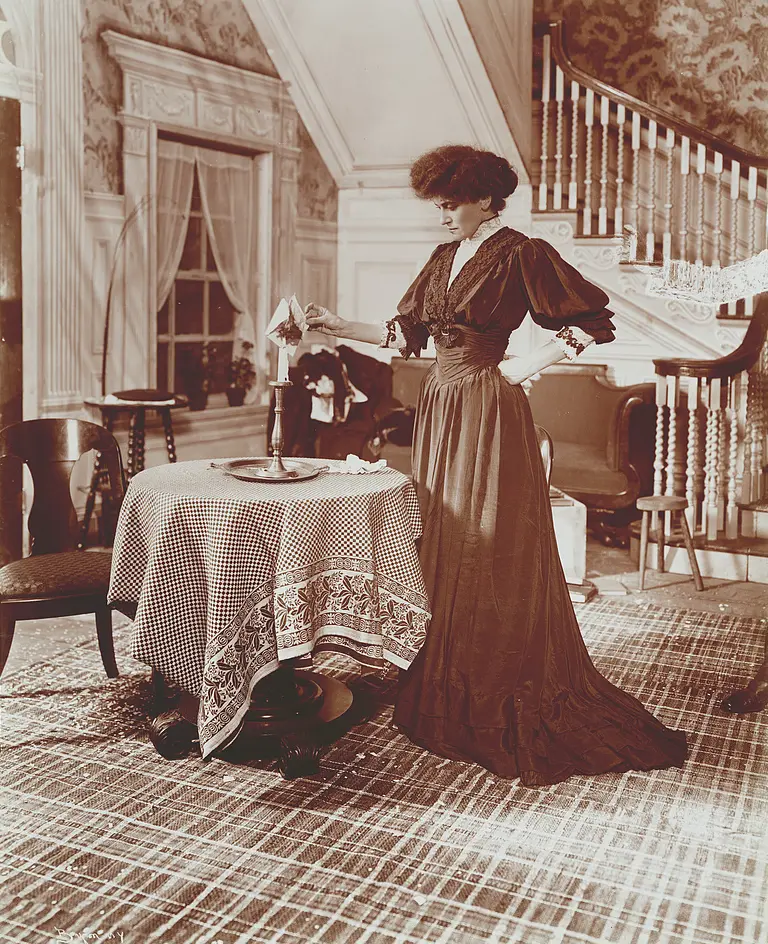
Act 1
Drawing-room in Raphael Friedlander’s house; Krementschug, Russia. Noon of a day in May. Doors, R. 2 E., Back L. C., and L. 2 E. Wide window back R. C., through which the city is seen. Curtain rises on Celia, practicing a difficult etude. She sits on revolving piano stool, down L. After the curtain is up she continues, trying the same passage over and over again. As she begins the passage the third time enter Natasha, R. Natasha has a work basket, knitting material, etc. She glances at Celia, who continues practicing and does not see Natasha. Natasha places her things on table, down R., and sits at table; begins knitting or sewing, glances at Celia, sighs and looks up, as if wishing Celia would stop. Celia begins the passage all over again, and Natasha can’t stand it.
Oh! [Celia starts slightly; stops playing; sees Natasha]
Good gracious, nania, how you made me jump!
Jump? The stones in the street will jump if you play that any more. Why do you go over it, and over it, and——
[Natasha continues sewing] To acquire a brilliant technique on the piano one must practice a great deal.
You’ve practised for nine years, barushnia Celia.
Oh, oh!
Nine years. You were nine years old when that fat old German professor taught you your scales. [Celia bus. of denying this] Nine years old, barushnia—and you’ll be eighteen to-morrow.
Seventeen.
[Tranquilly] Eighteen. [Celia rises and goes to C.]
Natasha, can you count eighteen? [Natasha gives her a tranquil look] You can only count to eleven! Aha! [Celia, C., curtsies mockingly to Natasha, and then makes a turn around the room] Eleven, and I am seventeen!
[Does not look at Celia at all, but goes on sewing; speaks in same tranquil tone, but now a little sadly] Oh, I remember the day you were born. I’ve not brought you all up for nothing, barushnia. You and your brother, and your sister—poor dear, she was not eighteen months when you came along! [Chirrups] How she did cry to be taken to her mother! [Celia, with her back to Natasha, looks out of the open window, back. She clasps her hands behind her head] I had to sit and sing, and rock and fuss—dear, dear, poor little Miriam! [Sighs] I can see her now, in her little crib—such a good, reasonable, quiet baby! Three children—but only Miriam is a blessing to her parents. [Celia turns] And see what she suffers now! Ah, boze moj! [Natasha looks up toward door, back. Celia movement of impatience]
Who suffers? Miriam?
Yes, yes—Miriam! There she lies on her bed, half dressed and crying her eyes out.
Oh, you make me so cross with you, Natasha! Good Heavens! Other people have troubles, too. Miriam’s not the only girl who has had an unlucky love affair. It’s her first; she’ll get over it.
[Shakes her head] Ah, my dear!
Of course, she feels ashamed. Oh, well, Natasha, she must. She behaves like a fool, for she falls in love with an officer. A Russian, a Christian, a count—hah! Where did she expect it to end? Did she dream he’d marry her? He couldn’t—and yet, she must have, or she wouldn’t have gone to the Bishop, and said she wanted to be converted and baptized. She must have thought Captain Beliusoff was a fool.
Fool?
He would have been to marry her—to marry Miriam, lose his estate and his spending money. Have his own mother cut him on the street, and be kicked out of the army—oh, well, out of the officers’ mess, and that’s worse. Of course, he couldn’t marry her. But why on earth he shot himself—that’s beyond me! [Piano. Natasha bus.]
[Sadly] Had he known all I know he would never have shot himself.
[Curiously] Had he known all you know? You mean——
[Quickly, with an anxious glance, speaking falsely] Well—see how your sister Miriam feels——
Oh, she cries, she sobs! [Piano] What’s the use of crying over spilt milk?
Miriam’s not of your sort. She has my character. I loved but once in my life, Barushnia, but how I loved, then!
Oh, Miriam will fall in love again, some day.
Miriam will have no chance! [Celia interested]
Why? Why not? What’s father going to do with her?
Haven’t you guessed? Well—you’ve heard who’s coming to the house?
Gregor Randar.
And his father and mother.
Do you mean to say—oh! Father’s going to make Miriam marry Gregor Randar. What luck for her! [Natasha looks up] Certainly, he’s an artist.
Artist—what’s that?
A musician—he plays the violin. He’s a handsome fellow. You should see his eyes—each one is as big as your fist.
Handsome? Hm! I wouldn’t give the crack of my knuckle for a handsome man. Handsome men have no character. And he plays the fiddle, does he?
Divinely!
Yes, he plays an hour, but you’ve got to live with him the whole day. [Rises]
[Bell distantly] There they are now!
Good Lord! And Miriam’s not dressed! [Crosses as if to go back. Celia at window]
It’s not they—it’s not Gregor! It’s nobody at all, Natasha; it’s only Samuel.
Natasha stops up L. Celia turns. Enter Samuel, L.
Oh, it’s your brother!
What do you think, Celia! I was sitting in Libert’s Cafe, when—hello, Nania!—an officer came in and swaggered over to me, and—[Natasha looks R., as if she heard some one. Door R. opens. Enter Rebecca]—here comes mother. [Rebecca enters, much dressed up for the occasion. She has a good deal of “side on” until Raphael enters. Her eyebrows are raised, superciliously. She smoothes out her gown, looks indifferently at every one, but now and again raises her shoulders and holds her waist, in order to catch a long breath, as her waist is too tight. She stops by table R.] I say, mother, I’m just telling Celia how an officer—[On the word “officer,” Natasha gives Samuel a look]—came to me, and——
Do be quiet, Samuel! [Beckons Celia, who doesn’t come. Feels her waist and catches a breath with difficulty]
Well, but I say, this officer——[Natasha is about to exit back. She again gives Samuel a look; then she waits, with her hand on the doorknob]
Well, we’ve had enough of officers in this house! I should think you’d have more tact—or—eh, pity for poor Miriam than to speak even of an officer. Celia! [Sam bus. as before. Rebecca beckons again. Celia crosses to Rebecca. Natasha quietly exits back]
Well, hang it all, this officer was the Colonel, Baron von Austensaken, and, I say, he said to me: “Are you Sam Friedlander?” And when I said I was, he dropped a wallet into my hand. “Hold that for me!” he said, “till I come back. There are seven thousand, seven hundred and seventy-seven roubles in it!” And, I say, mother, it was stuffed full——
[Over her shoulder] Full of saw-dust! [Samuel bridles, as if wounded]
It’s too dreadfully tight, and I told that woman——[Bus. seeks relief]
[To Celia] Oh, you’re very funny! But all the officers of the regiment are chummy with me now—we’re regular pals.
Through Miriam we can become related to all the officers of the regiment.
[To Samuel] If your father should hear you!
Oh, of course, every one respects me, excepting father. Every day he asks me, “Well, young man, what business are you in?” He asks me that seven hundred days in the year. It hurts my feelings.
Why should you care, you goose! Your father will take care of you. But don’t speak to him of your officer friends.
Samuel shrugs his shoulders and turns to the piano, sits on stool and is about to play
[To Rebecca] Suppose he did kill himself! Miriam’s alive—and I hope Miriam will introduce me to the whole mess——
Oh, you’ll get into a mess quick enough! [Rebecca affects great pain at this levity. Very soft and distant sound of the town clock striking the hour]
Oh, oh—I’ve cried myself into a headache over Miriam—it’s simply—[She catches a breath with extreme difficulty]—simply too—too——
[Maliciously] Too tight!
Samuel snickers. Rebecca bridles. Celia listens as she hears the last strokes of the city clock striking. Re-enter Natasha, back; she comes in slowly—looks sadder
[To Rebecca] It’s twelve o’clock. Barina, they—they’re expected at twelve, and Miriam is not dressed yet.
Rebecca makes a movement of impatience. Raphael’s voice off
[Calling] Natasha! Natasha!
Natasha comes down as if about to cross
If father’s coming, I’m going. [Exit L.]
[Voice off] Natasha!
Coming, barin!
Door, R., opens. Enter Raphael. Natasha stops above C. Celia is up back. Rebecca down L. Rebecca at once loses her supercilious manner. She watches Raphael rather carefully. Celia, too, loses her levity. Raphael comes to table, down R.—stops
[To Natasha] Have they come? [Natasha shakes head] Where’s Miriam? [Natasha makes a gesture showing she’s in her room] Send her to me. [Natasha goes up and then pauses up back. To Rebecca and Celia] Leave the room! [Rebecca with feigned distress]
Raphael! [Comes C. Celia crosses R. and exits, watching her father] I am her mother; I’m so afraid you’ll become angry. Let me stay here, and—
Be so good as to go! [Rebecca sighs heavily, crosses, and exits R.] [To Natasha] Send her in.
Barin, she’s not dressed.
Let her come at once. [Natasha, false exit] Oh, Natasha, that such a thing should have happened to my Miriam! [He sits near table, down R.] If it had happened to Celia, she’s her mother’s daughter—but Miriam—Miriam!——
I’ll tell her to come in, barin. [He begins to break down. Exerts his self-control. Exit Natasha. Pause. He starts slightly as if he heard Miriam approaching. Door, back, is opened by Natasha, who remains off. Enter Miriam, back, very plainly dressed. She has a book in her hand]
You sent for me, father?
Yes, they will be here soon. [He looks round at her; she returns his gaze without covering her eyes] Hm! Hm! That’s the dress you used to wear this time last May, when we walked together, in the field outside the town. The same dress. [Bus.] You were young, innocent, loving and obedient. [Rises. Moves.] The matter must be settled to-day!
He crosses
I will do whatever you command.
You know who I have asked to come here this morning, and for what purpose?
No.
You don’t know? Well, you’re to marry the man who is coming here this morning. His name is Gregor Randar. He is coming with his parents.
Father!
[Sternly] You will marry him, and after your wedding, you’re to leave with him for America.
After my wedding—at once?
At once.
Father, I shall know him so little—to go so far away with one who is a stranger.
You must!
As you say, father.
So—after your wedding—you’ll disappear—to
—America. [Short pause—bus.] Do you know how necessary it is for me—yes—necessary—that you should go away? I’ll tell you, then. Here in Krementschug all people know is that for the sake of a soldier you were ready to become an apostate. The worst of all they don’t know. But yet look what’s happening—already. Here Melech Homsche tells me he will not pay me the thousand roubles he owes me, because my daughter has abandoned her faith! And Baruch, the same; and Viener, Ezra Viener, only yesterday, he, too, told me. But you can’t understand—you pretend to. Here am I tied up with a number of contracts—dependent on the good will of others—my name, my credit—and then, you—you—and yet the worst of all is not known! Not even your mother nor Celia knows. Natasha and I—It will be better for you, too, in America—before things are discovered. It would never be forgotten here. In America no one need ever know. You don’t need to tell them there the true date of your wedding—they won’t look you over—[Bus.]—Oh! who could have dreamed—you wanton! (Raises his hand
I know how hard it is for you. Kill me, if you wish—it’s all the same to me.
[Calmer] Well, the business of it is this: this Gregor Randar, he knows very well it’s not of choice that I marry my daughter into his stock, and to him, a common music monger. You need tell him nothing. I shall explain to him and to his father. Have no fear; he shall know all. As for your dowry—in my letter I told him twenty thousand—but that’s too much. [He sits down, R., fatigue—sullen anger] Why do you stare at me?
Don’t be angry, father, but I think he may perhaps be kinder to me—if you would reduce down my dowry.
[Speaks quietly but bitterly] I know what you’re worth!
[Bus. Pause] As you think best.
Raphael is sitting down, R. Miriam is down, L. Pause, bus.
Why do you stand? Sit down! [Miriam sits down, L. Bus.] What is that book?
Tolstoi! [Raphael bus.] It’s the story of—[Raphael bus.] I am not telling you a lie, father.
Just see what a state of nerves you’ve got into. What is the story?
It’s called “The Kreutzer Sonata.” It makes life seem very unhappy—even more unhappy than I feel it to be. [Raphael makes a movement of contempt]
Tolstoi! Let me see the book! [Miriam rises slowly. As she rises she sees the door, R., open, and she does not cross. Enter Celia, R. She looks in curiously at what is taking place. Raphael follows Miriam’s glance, turns, and sees Celia. Celia comes C. To Celia] Well, Celia?
I—I—think they’re coming, and I want to look out of the window. [Celia moves as if to go up]
Here, here! Give me that book! [Celia goes to Miriam, who remains standing by piano, down L. Miriam gives Celia the book. Celia crosses to R., and as she does, reads the title of the book. Raphael takes book] What is this Kreutzer Sonata—a novel? [To Celia] I thought a sonata was played.
Father, the great composer Beethoven wrote a sonata for violin and piano, and dedicated it to Kreutzer, the musician.
Well, why is this story called “The Kreutzer Sonata”?
Because Count Tolstoi tells the story of a woman who falls in love with a musician. [Celia gives Miriam a malicious glance] That is, they both fall in love while they’re playing the sonata. [She smiles. Speaks more maliciously. Raphael lays the book on table, R.] And then her husband sees they’re in love—[Gaily]—and he kills her!
Raphael rises and comes down below C. Celia takes up the book. Miriam sees her do so, and comes down below C.
He kills her? I should have killed him!
Celia casually looks into book; speaks with the utmost lightness of insincerity
I’d have cut them both to pieces. I should have been horribly jealous.
Miriam lays her hand on Raphael’s arm
[Smiles] And you, Miriam?
[Aside to Raphael] Please take the book from her. His last letter and his photograph are in the book. Celia mustn’t see them.
Miriam? She’d have done nothing! How could Miriam be jealous?
Bell is heard distantly. Celia goes up quickly to window; looks out
[To Miriam] Go dress yourself.
Miriam moves as if to go back at once; stops and turns to Raphael
Father—will you ever forgive me?
Raphael looks at her sternly
Go, go!
Miriam goes up slowly. Exits slowly back—pause for this
Here he is! No, yes—no, it’s only his father and mother. [Celia comes down R. of C. Raphael is below table]
Here—run off, you! Take the book with you.
Celia pouts with disappointment
I will see him! [Places book on table R.]
Raphael waves her to the door, R. More sternly. Door opens L. Enter Natasha. Celia quickly exit, R.
Come in, please. [Natasha faces door] The master is here. [Enter, L., Ephroym and Beila—in holiday attire] Come in! Come in! [Short pause]
They stand. Natasha shuts the door; stands at door and observes them. Ephroym keeps his hat on
Please be seated. [They remain standing] Natasha, call the barina. Something to eat and drink here.
Natasha observes the couple
[Apart] A fine team of oxen! [Exit L.]
Well, sir, this is a festive occasion, eh? You wrote me to bring myself around—[To Beila]—Eh? She wants you to know I brought her, too. [Beila nudges him to behave with more propriety. To Beila] Vell, I’ll introduce us all! Sir, let me introduce the head of our humble family—[Bows]—and my humble family herself.
You are Gregor’s father, I suppose?
Yes, Ephroym Randar—yes, yes, Ephroym Randar——
[Bus. cigarettes; offers] Will you smoke? No? [Raphael lights cigarette] I know you only by sight.
[Easy and sits] Who in Krementschug or in Krakov don’t know Ephroym de Bandmaster—by sight, or by hearing? I always kept a band.
You mean de band always kept you.
At de richest weddings and dances in Krementschug and Krakov, even in Polstava, too, me and my band! At de Russian Teeayter, during de contra-acts—my band! [Wipes his nose with his hand. Beila stands up behind Ephroym.]
[Aside to Ephroym] Use de handkerchief! Now talk to him about Gregor! [With a curtsy to Raphael] Our son will be here soon—he is goming in a garriage.
He was ashamed to come vid us. Too proud to be his fader’s son. Vid him it is Pizzicate, Flagelleto, but me and she is very plain peoples! [Ephroym and Beila bus.]
Enter, L., Natasha and a servant with a tray of refreshments. Natasha shuts door. Servant crosses to table, down R. Natasha crosses same. Raphael rises. Servant places tray
[To Ephroym] Perhaps you would like a little something? [Raphael pours out wine. Natasha whispers to servant; indicates door, R. Servant crosses R. Exit servant, R. Natasha picks up book, opens it, sees letter and photograph; frowns, glances at Raphael; shuts book, and takes it with her; she goes up R. as enter Rebecca, R. Natasha remains up R.]
I don’t hate a little something. [Ephroym rises, takes off his hat. Raphael waves his hand toward Ephroym and Beila, as much as to say, “There they are!” Rebecca inclines her head. Ephroym nods]
I am delighted.
Ephroym, Bandmaster, of de family Randar!
[To Ephroym and Beila] Come on, come on!
Your son——
He is coming. Well, well, well!
Sit down. [To Beila] Sit down here. Drink. Make merry. Rebecca!
Well, here’s good luck to the matrimony! Eh—I spilt a leetle! [Rubs his foot over it] Looks like blood on de floor. May God help us all! [Drinks. All are seated about table] Hm! Well—do you know, sir, once on a time, I had a real, genuine orchestra! Second fiddles, two! first fiddle I played myself; one trombone, one flute; a kettle drum—and vould you believe it, dere vass a Gentile in my band—he played de clarinet. His name vass Ferafenkin. Vot a drunkard he vass! His nose had alvays de measles—yet he could talk Yiddish better den a rabbi!
May you get de measles for talking so much!
My madam is always afraid I will say someting dat wouldn’t be nice in a house like dis! But, never mind her; she means well. [Bus.] So, here’s to our two young peoples! Wid God’s help, we will be relatives! [Drinks. Natasha bus. of offering Beila a glass] Ah—dat gives a ticklement by de insides!
[To Natasha] Natasha, you’re not wanted here! [Natasha about to go]
Eh? What? Natasha? Come here, Natasha! [Raphael fills a glass and gives it to Natasha. Natasha is much embarrassed] Miriam is as dear to you as she is to us. You must drink her health!
[To Beila] She is our nurse; she has been in our house twenty-five years.
Some servants are pretty good.
[Curtsies to Raphael] Barin, your health and our Miriam’s happiness! [Natasha drinks and exits, L., with glass in her hand]
And where is de young lady, eh?
Don’t talk so much!
Bell rings
Dis is our son!
Raphael rises. Rebecca rises. They go up above C., and Raphael speaks dumb to Rebecca. Ephroym drinks quickly, and puts some of the cakes in his pocket
What are you doing?
For de children. [Door opens, L. Natasha enters and holds door open. Enter Gregor, dressed in the height of fashion—Krementschug fashion. Gregor takes his hat off with easy dash, and looks from Raphael to Rebecca. Bows very low to Rebecca and smiles confidently] Ah, dat is our son! Hah!
[To Raphael] You must pardon me for being so unpunctual.
[Takes out his watch] A half hour—nothing serious.
Hm! I see the old people are here before me. [Aside to Raphael] You can see, without my telling you, Monsieur Friedlander, that—aha—I don’t spring from the aristocracy. But, on my soul, it’s not my fault—it isn’t, I assure you!
What has aristocracy got to do with——[Gesture indicating the house] Sit down. [Bus.] Do you smoke?
[Sits, lolls back in chair] Thanks, no—I neither smoke nor drink.
[Aside to Ephroym] De liar!
Well, I say, a good musician plays all the better for good liquor! [Ephroym sips his glass. Raphael is about to speak] Ah, if I had my fiddle here now I vould strike up a tune. [Gregor, Beila and Raphael all glare at him] Vell, anyway, let’s have a little more of dis red moisture. It warms you up on de inside like de sweet melodies of a big drum.
[To Ephroym] Shut up, already!
[To Gregor] Well, Herr Randar, I have asked you and your family to come here to-day.
Enter Celia R. excitedly. Raphael frowns at interruption. Gregor glances at Celia and instantly rises. He watches her narrowly. As she moves his eyes follow, not her face, but the motions of her body
Excuse me, father, I—eh—I forgot—
What is it?
[Looking at Gregor] I forgot “The Kreutzer Sonata.”
[Looks on table] It’s gone.
[Bows to Celia] Mademoiselle Celia, I hear you play charmingly. Have you ever tried the “Kreutzer Sonata”?
Oh, it’s the book I’m looking for. The sonata must be terrible difficult. [Gregor and Celia bus. Raphael frowns angrily]
Practice the first part, and we’ll play it together.
Run away, Celia!
[Still gazing at Gregor] Yes, father. [To Gregor] I’d love to! [Celia turns and exits, R., with a coquettish glance at Gregor as she opens the door. Raphael gestures to Celia to go quickly]
Suppose we get down to the matter in hand.
Suppose we get a leetle more of the bottle in hand.
[Impatiently] You have heard that my daughter wished to become a convert to Christianity?
[Sips] Suppose she did want? Everybody of flesh and blood wants!
[More impatiently] Rebecca, I wish to be left alone with the young man. Take these good people into the dining-room. [Rebecca rises. Beila rises. To Ephroym] Will you be good enough—[Ephroym sips; pays no attention]—eh—you! What is your name?
My name? Hah! He has been talking to me all this time and doesn’t yet know my name.
Do come! [Beila gently pinches Ephroym]
Au veh!
The lady asks you——
[Rises. To Beila] Haven’t I behaved nice?
[To Beila at door, R] I’ll show you all my table linen. [Ephroym follows Beila, but glances back at table with wine glasses on it]
[Stops at door, R] Gregor, she thinks I behave bad!
Exit Rebecca, followed by Beila and Ephroym, R. Raphael is still standing above C. Gregor is down, L. Gregor crosses R. and sits near table. Raphael comes down, watches Gregor keenly
I am told you wish to go to America?
[Easily] Ah, yes! America. That’s the place for me! [Lolls] Why, my dear sir, an artist such as I am could have a career in New York—a meteoric career! Yes, my ambition is to get to New York—that is, if that doesn’t conflict with your——
[Interrupts] On the contrary. [Raphael sits L.] Are you willing to marry my daughter?
What a question! Such a family—everything, refinement, education. As to what’s happened—of course, one hears rumors—she fell in love, and, of course, she wanted to become a Christian. [He fills a glass for himself] That’s all as things go in the world. I only hope I may please her.
What pleases me, pleases my daughter. After the wedding I will give you ten thousand roubles.
Thank you! To be candid, ten thousand roubles is not at all bad.
I promised her twenty thousand.
Oh, so you want to cut me down ten thousand because you’re displeased with her?
That is what Miriam thinks. Three years after the wedding you shall have the second ten thousand, with interest—you understand? Friedlander’s word is as good as an Imperial Bond. Of course, that second ten thousand is yours only if things go as I wish. You must live respectably. She must have no cause for complaint——
Why should she?
You must be kind to her.
Of course, kind—why not? Are you hiding something from me? Is she——? Eh? Of course, I’ve not yet even seen your daughter, but as to the circumstances——
You know them.
They might be a thousand times worse than they are. What do I care?
You mean that? You pledge me your word you will be kind to her?
My word of honor as man [Bus.] and artist. [Gives Raphael his hand]
Listen, young man. You don’t know me. You don’t know what Friedlander’s capable of doing—If she is happy with you, if you help her to forget all this suffering and—She’s in agony over it—day and night, crying her heart out. Such suffering! It isn’t that I wish to excuse her—but, young man, no one knows how dear that child is to me! [Tears] My Miriam! [Turns away; is silent; controls himself] Confound my tears! I say, if she’s happy with you, not only the ten thousand, but my life, my fortune shall be yours! Oh, you’ll not be there long without me. As soon as I can liquidate, arrange my affairs—my obligations—I shall join you. [With tears] What, did you think I could live without Miriam! I, here alone—without her! [He hears a sound off and lowers his voice] Hush! Hush! Not a word of—[Wipes his eyes, tremblingly, in haste]—of this—to her. Yes, I heard her speak. [In almost a whisper] I say, if she’s happy with you I’ll make you happy. Happy! I swear it, I will! [Raphael goes up quickly; calls sternly through door, back] Miriam! Miriam! [To Gregor] She’s coming. [Raphael, gesture of anger]
Monsieur Friedlander, now—eh—lay aside your anger. That’s my advice.
Young man, never advise me. Here she is. [Raphael makes an effort at self-control. Gregor moves up R. Miriam enters, very pale, dressed handsomely; comes down L. Gregor goes up R.] Everything is arranged. [Short pause] You need tell him no tales. [Short pause] I am an old business man, and do things in a business way. [Bitterly] Every purchaser must know what he is buying. You’re to marry, and leave here at once for America—out of my sight! Why are you crying? If things don’t suit—cable me—you can have a divorce. A daughter who’s a divorced woman—that’s no misfortune. But it is a misfortune to have a—to have a daughter who—who’s not fit to remain in Friedlander’s house. Hsh! I’ll leave you with him.
Exit Raphael, R. Miriam is down, L. Gregor up, R. Gregor comes down C.
Fraulein, we are strangers to each other. You know me only by name—but at least you know I am an artist; and presently I’ll play for you. When I do—when you hear my “tone” your heart will warm for me—you’ll understand my heart—and you’ll love the man for the sake of the artist. Are you listening, Fraulein?
So, you have decided to take me?
If I may have the happiness and the honor.
Honor and happiness! No, I will not deceive you. Before you agree to take me I wish you to know everything. I wished to be baptized.
Oh, well, I’d be baptized quick enough, if after the sprinkling they’d admit me to the Imperial Orchestra in St. Petersburg.
I have loved.
Ha, ha! Who of us has not had his little romance? Why, my dear Fraulein, I couldn’t count how many times I have loved!
I have loved only once in my life. I loved a Christian; an officer. I don’t want to lie to you, or in any way deceive you. I gave him my heart and my soul. His parents would not permit him to marry a Jewess—not even when I agreed to accept baptism. He honored his father and mother; he felt he couldn’t marry without their blessing. But neither could he leave me. He didn’t know which way to turn. He loved me truly. He shot himself.
Turns away and weeps
My dear Fraulein, why do you tell me all this? You can’t suppose I didn’t hear that Captain Beliusoff shot himself?
Yes, he shot himself. He is dead; but beneath my wounded heart lives his child. [Gregor is now R. of C. Miriam is C.]
A child! Upon my soul, that is news! [Pause.] And every one of your family knows—
No, no—only my father and Natasha know anything at all of the real truth—I mean they know. No one but they—not even my mother! You see, my father and Natasha are—are everything to me. They love me, and, I,—well, my father—he doesn’t know, he doesn’t guess, he doesn’t dream how much, how dearly, I love him. A kind word from him is happiness, and his pain—oh, his pain, when I see it, it breaks my heart! Oh, what I tell you is the truth. And now, my father wishes me to marry you, and sail with you across the ocean. I do it only because he wishes me to. Indeed, I am telling you the truth. But, if now that you know all, you—you don’t despise me, or spurn me—I know what a girl who has done—who—who—I mean I know I deserve to be held in contempt, but if you can, if you will have a little compassion—I mean pity—I promise you, from now on, I will be your loyal and devoted servant. And perhaps after a long while you’ll forget how I sinned against you, before we met—and—you’ll forgive me, I hope. And if I do everything, if I am obedient, loyal, serviceable—if I try, if I do make you happy, promise me you will be kind to my father, won’t you? [Bus.] You’ll give my child your name? [Bus.] Yes—yes? Thank you! Now you know everything there is to know. Do as you think best.
Miriam weeps. Gregor remains lost in thought. Door, back, opens
[In a whisper] Miriam, Miriam, my little dove!
Come in, Natasha. It’s all over now.
Oh, my poor child! Does he know everything? It’s better so! Hsh! Here’s your father.
Raphael enters, R. Gregor rouses himself
[To Gregor] Well?
Well, we’ve talked the business—everything—over. [Pause. Looks at Raphael] The Fraulein has made it all clear enough. I’m posted. You may congratulate us.
[To Gregor] I am glad to hear it. I forgot to tell you—I shall give to you a thousand roubles for expenses—to you, not to her. To her I give no gifts; she deserves none. Natasha, tell them to come in! [Enter Celia, R., as Natasha crosses R.] Celia, congratulate your sister. [Celia kisses Miriam. Enter Samuel. Celia crosses to Gregor and grasps his hand warmly. They speak together]
Ah, Herr Randar, the artist! [Comes C.] I have the honor to congratulate. I have often heard you play at the Imperial Guards’ Club.
I—I play at the Imperial Guards’ Club?
I meant to say—eh—eh—the Yiddish-Galician Club. You played beautifully. Didn’t you bring your violin? Too bad! It’s a Stradivarius, I suppose. Well, I have a friend who has an old Italian ’cello—cost him seventeen thousand roubles—
Samuel, come here—stop!
Gregor and Celia speak together in dumb show. Enter Rebecca, Beila and Ephroym. Natasha shuts door, R., and goes up. Rebecca comes down, R. Ephroym and Beila go to C.
[As he enters] So, den—de veding is to be—eh?
Oh, I am so glad!
[To Miriam] My dear, I wish you welcome. I hope you will be happier than enough. My blessing! [To Beila] What a fine daughter-in-law! I wish I vass his fader’s son! [To Raphael] What is dat old saying—“De meanest dog always gets de best bite”?
[Softly] Vait! I vill give you a bite dat vill choke you ven you get home!
Beila embraces Miriam. Ephroym, Beila, Raphael, Samuel together. Rebecca embraces Miriam. Beila and Rebecca congratulate each other. Miriam is now left standing alone. Natasha comes down R. Miriam crosses to Natasha and bus. Celia and Gregor bus.
Au veh!
It makes me remember when I vas a young maiden.
Vell, shall we indulge ourselves with a leetle of de juice, eh?
Yes, yes! [Drinks, etc.]
Ah, now we are all happier than a sweet melody!
[To Rebecca] They will be happy.
[To Gregor] Well, let’s try it now. Why not?
Why not? I can feel you’re an artist, my dear! Your hands are the hands of a virtuoso—and I read music in your eyes!
Oh, that’s impossible!
They play. He strikes a few chords and then stops to place her hands. Miriam and Natasha are down, R. Miriam sits in arm chair, draws Natasha to her so as to conceal herself from the others
Nania, I want to cry, but softly, softly, so father shan’t hear me. [Bus.] Oh, I can’t control myself. I’m afraid I shall cry out loud.
Hush! Hush! Be strong, my baby, my little dove, my lamb!
Falls on her breast and cries softly
Oh, nania, nania, nania!
Act 2
Gregor Randar’s flat, on the upper East Side [near Seventy-second Street], New York. A parlor, with arch and adjoining room at back. Doors, R., L. and R. C. Door from ante-room leads to public hallway. Piano, chairs, sofa, etc. Seven years have elapsed. It is early in June. Forenoon.
Curtain on Samuel entering; leaves door open behind him. Sam is dressed as a young dude of the East Side. Keeps hat on. Looks about for some one.
[Calls] Hello, Gregor! Gregor! [Listens at door, L. Violin is heard off L., faintly; scales being practised. Turns, speaks off] Come on up, Celia! No one here—not a soul. Gregor’s got a pupil in his music-room. [Enter Celia, back; carries small hand bag. Very American costume. Black stockings, low shoes, rakish hat. Over-dressed; except for that, in good taste. Gloves too loud. Older in manner. Anxious, but not too much so, as she enters]
Where’s Gregor? [Samuel, gesture with his thumb over his shoulder] Are you sure father isn’t with Miriam? [Indicates off R.] Is Miriam in?
How do I know? I suppose Miriam’s in. And what’s the matter with your meeting father? What are you afraid of? [He lolls. Celia puts hand-bag down on floor, up R.; comes down. Bus. gloves]
Well, if you want to know, I’ve come to the city to stay. [Sits R.]
[Opens his mouth with astonishment] Eh? You’ve left father, and mother, and Natasha, and the farm?
For good.
What’ll father do, and say?
Why, he’ll storm and swear, and talk about King David and the Psalms, and children obey your parents.
You ought to stay.
Did you? [Celia sits, R. Crosses one leg over the other; takes off her hat] You didn’t stay one year down on the farm: and I’ve been there ever since we got to America, four years ago. For four years I’ve been dying down there—no music, no theatre, no people. I’m going to live a little now. See if I don’t.
Is father coming up?
He took the early train. I think he’s been here and gone. But he may have left Natasha here.
How’s mother?
Just as sick of it as I am.
The trouble with you is you’re looking for trouble, and trouble doesn’t grow in the country—it grows on the East Side. [Celia bus. of impatience]
Distant violin at intervals throughout scene
Oh, it’s all very well for you. But I’m a girl—I don’t last forever. In a few years I’ll be old, and then it’ll be too late. Men won’t look at me.
You’ve got a lover.
Suppose I have?
Where are you going to live?
Here.
Oho! [Bus. He looks at her knowingly]
Well, what of it? [Bell outside] There’s the door bell.
I’ll bet it’s father. [Celia looks out of door, back, shakes her head]
It’s those two old greenhorns.
Ephroym and his wife?
Celia nods assent
I wouldn’t be seen dead on the street with that pair. They’ve been over here three months—[Voices off R.]—Three! And she wears the same things she did in Krementschug!
Door, R., opens. Celia plays a run on the piano. Enter Ephroym and Beila. They come in with smiles, freshly, good-humoredly
[To Beila and then to Sam] I pressed a leetle button, and the front door opened solemnly of himself! Eh, what? I tell you, America is beyond Jordan.
Well, here we are! [Celia shakes hands with Beila coolly; Samuel cordially with Ephroym. To Celia] How are you?
[To Samuel] How’s de old people on de farm?
[Very self-important] Don’t ask me! I’ve told father that he ought to leave that old pumpkin of a place in the country. [Ephroym nods assent] I tell you, these old men, they come here from Russia and they think they know it all. They think it’s all the same here as there. They think that in America the sons respect the fathers. They think a policeman’s a Cossack. I’m no foreigner. I’m a born American. I don’t respect anybody. If anybody thinks he’s my equal I’ll show him he ain’t.
Oi! You have certainly hatched out of de egg!
You think you’re awful funny, but let me tell you, old man, in America the hens lay eggs by machinery—seven and a half eggs a minute.
[To Beila] Beila, ve have an awful pile to learn!
What you want to learn is the American commandments: First, fathers, respect your sons. And the second one is, everybody do what he pleases. [Celia bus. of pleasure in this commandment. Beila looks serious and puzzled; Ephroym ironic] And the third is, whatever you learned in Russia ain’t so.
And de fourth is, de young fellars talk de old ones to death.
Would you belief it, we have been three months in America, and this is the third time I have been in my son’s house. [Looks about; so does Ephroym]
We was never in this room before, Beila.
The professor keeps this room for himself.
Beila, our son is a professor! [Listens, L., distant piano] He may be professor, but if dat is him playing, God pity de pupil.
Vat vunderful luxus. I never dreamed—but vy don’t Miriam come? And ver is de leetle boy?
Ah, ver is my grandson? Eh? [Samuel crosses R.] He is prouder looking dan ever. He surprised me when I saw him.
[Calls out door, R] Come along, David. Tell Miriam we’re here. Come on!
Enter David, R.
Ah!
Aha! [Kiss, etc.] Miriam dresses him too plain. [David shakes his head and lays his finger on his lips]
No, no! If father hears me romping with you he’ll come in and whip me.
Oh, no!
Yes, he will—after you’re gone.
Beila and Ephroym bus. Violin stops off L., and voices off L. Celia plays an air, forte, and looks over her shoulder, L., watching for Gregor. Enter Gregor with girl pupil. He wears a velvet jacket, smokes a cigar. He accompanies pupil to door back, saying: “Good-day. Be sure you practice.” Pupil exits. Pause. He takes every one in cooly, closes door and comes C. slowly
[To Ephroym and Beila] So you are all here. I thought I smelled greenhorns around. [To David sharply] I see who has been muttering in here! It’s time for your music lesson, mister. [David shrinks. Gregor, gesture for David to go into room, R. Beila takes him by the hand]
[To Gregor] Look here, Gregor, der must be an end to this business of my seeking you. It cost ten cents up and ten cents down.
Later. Later. I wish you’d both clear out. If some of my pupils happen in they’d take you for a pair of beggars. [Celia remains seated before piano]
For beggars? Himmel! Der is no beggar in New York dat is such a fool as to try to beg from you.
Gregor looks at Celia, Celia at Gregor, as if they had mutual communications to make, but Ephroym stands between them
And, by der way, Gregor, vy is it dat ve always come here de wrong way? De station is in Seventy-six Street—ve vant Seventy-second Street. Instead of valking down we always seem to valk up.
How should I know vitch is up and vitch is down in New York where everything is flat? If I vas on a hill I could climb up or fall down, but vitch is up, and vitch is down here on a flat? Ven ve got lost I asked a policeman: “Vere is Seventy-toot Street?” And he said, “Ah, you poor ignorant dago, it’s not Seventy-toot, it’s Seventy-second,” so I understood dat “second” is like de musician’s secundo. Ve must say “Secundo, terto Street.”
[Crosses, aside to Celia] So you have come?
Yes.
I must see you alone sometime.
Why not now?
Because Miriam’s due with my cup of chocolate. [Turns and goes C. To Ephroym and Beila, who are occupied with David] If you people want to see Miriam, you’ll find her in there.
[Aside to Samuel] Go tell Miriam we want to see her. [Exit Samuel R.] Beila and David bus. together. David leads her by the hand and shows her bric-a-brac. Ephroym shakes his head sadly as he looks at Gregor. Gregor crosses, stands beside Celia. Ephroym, aside to Beila, while David pulls at her hand) Dis America is a strange state of affairs. De sons and daughters here are der own fadders and modders, and dey are also de fadders and modders of der own fadders and modders!
Beila yields to David and moves toward back. Ephroym same
[Aside to Celia] When you’re not here, you little torment, I’m sour and cross, and all I care for is to get out—get away.
And when I am here I don’t believe you feel a bit different.
[Catches her arm] Feel? I feel like talking, and laughing, and playing; I feel life is worth something, you little torment, you!
Don’t do that! They’ll see you.
When you’re not here I sit and dream about you.
[Makes a face at him] Nonsense! [Gregor bus.]
When are you going back to the farm?
I’m not going at all.
What?
Never again.
You darling! We must be alone to-day, sometime.
Don’t! Don’t! They’ll see you.
Re-enter Samuel, R.
[Sarcastically] Well, it’s time for me to give the young aristocrat his music lesson.
David shrinks. Gregor crosses L. Enter Miriam with chocolate on tray. David crosses to her
Oh, mother! Here’s grandfather.
Miriam smiles at David. Sees Ephroym and Beila, but crosses L. without stopping to welcome them. Places chocolate on table, L.
Here is your chocolate, Herr Professor.
[To Beila] Herr Professor! Do you hear? Not like you call your husband—musical pig!
Everybody calls papa professor.
Gregor bus. with chocolate. Miriam crosses to C., greets Ephroym and Beila cordially. Celia comes slowly down, L., bus. of Celia to Gregor from here
How good it is to see you! You haven’t been here for ever so long. [In a lower voice] And you know I can’t get away. There are such thousands of things to do. Why don’t you sit down. How’s father, Celia? [Celia, gesture. Miriam smiles at Samuel, who has David on his lap. To Beila] And now tell me all about your new home. I have so wanted to come and see you.
[Aside to Miriam] But he would not let you, eh?
[Shakes her head] Tell me all about your home.
It is nodding but a bird’s nest in a tree. Ven Beila vants to let her tongue have a little daily exercise—she ain’t even got room enough to open her mouth. Vell, never mind. How is Herr Friedlander? Ah, I shall never enough be grateful to him for paying our vay over here. My son would never have——
[Gently interrupts] Do you see how happy David is with Samuel?
David is pale.
Miriam sighs
Who does he look like?
[Troubled] Like my father. He is pale. He is not very strong. I hope father will take him down to the farm for an outing. And you must come to the farm, too. It is in Connecticut—oh, far away.
But does the farm make money?
Father says it will after a while. But he doesn’t want the farm only to make money, you know. Oh, no! It’s partly a charity, for our people who have been worked to death in the sweatshops may go down there to get well. You’ll love the farm.
Who helps your father—manages—economizes?
Natasha.
And Samuel?
He lives in New York.
Well, Fraulein Celia? And your mother?
Miriam looks across at Celia
Natasha is father’s only real help. He has aged very much. But you’ll see him this morning. Yes, he’s coming here.
[To all] So the young man, when he had killed the dragon, was elected to be President eighteen times by five millions majority, and reigned happily for a hundred and three years, and more, too.
Tell me another story!
[To David] It’s time for your lesson, my young—hero.
Oh! Not yet!
Come to me, David.
David goes to Miriam
[Samuel smiles and nods to David. Speaks to Gregor] I’m going to smoke one of your cigarettes, Gregor. [Gregor nods. Samuel exits, R.]
He looks so unhappy.
I am unhappy when father——
[Gently hushes him. To Beila] And all this while you have told me nothing about Krementschug. Does it all look the same? Do the people——
Now, mother, you’ll cry!
No, indeed!
[To Beila] When mother talks about Russia she gets frightened and cries—just the way I do when father gives me my music lesson.
Know your lesson, and then you won’t need to cry.
He frightens me so I forget everything. [Short pause] Grandpa, in Russia, when people get angry, do they always shout “Officer” at you?
“Officer”?
And “aristocrat”? Oh, but mother, he does! You know he does!
Compose yourself, dear. It’s time now for your lesson.
Some day when I am a great man I am going to be a great musician, and play before kings and people, and——
Hush, dear!
And—when I am—[Sees Gregor and shrinks suddenly]—Oh!
There, dear, take your violin and go.
Come along, my young—[He frames his mouth to say “officer,” but changes the word]—my little puppy.
David crosses slowly and exits slowly, L.
[To Gregor] It’s my fault, Gregor, that he doesn’t know his lesson to-day. He was looking so ill I told him not to practice.
[Aside to Celia] Alone—later!
Exit Gregor, L. Miriam looks troubled
[To Ephroym and Beila] Oh, I forgot to tell you, father has sent us some Russian tea.
Aha!
Good!
[To Beila and Ephroym] Would you not like a glass of it now?
Too glad.
Vy not?
We’ll have some, then.
Come, Celia; come into the dining-room.
Exit Beila and Ephroym, R., followed by Celia. Miriam looks anxiously towards Gregor’s room, L., and exits. Empty stage. The voice of Gregor is heard off L., and violin practice. Re-enter Miriam, R. She crosses to L., shows her fear. Pauses near door. Sound of violin. She listens and beats time with her finger. Shows by her expression and gesture that she considers David is playing correctly
[Voice off L] Oh, tempo—tempo—you puppy—you dunce! [Violin ceases, Miriam looks frightened] Go on! Go on! One, two, three, four—one, two, three, four! Can’t you count four quarters, you dirty little blockhead? Officer!—[Violin stops]—well? well?—play—go on! What’s the matter? Curse you! [Sound of a scuffle]
[Voice off L] Oh, father, father, don’t strike me!
Officer!
My God! My God! He struck him! He’s beating him! [Struggles with herself; turns as if to exit and interfere] No, no, I must not. He’d be furious—next time he’d beat him more cruelly. Oh, I can’t listen to it! Oh, my poor miserable child!
Door opens, L.
Don’t strike me!
Get out, you blockhead of an officer, or I’ll——
David enters up L.; still holds the violin. His hair is disordered. His eyes red with crying. He comes in slowly and looks dazed. Door shuts. He breathes very fast
[With his back to door, L., he bends his head, as if expecting a blow] Oh, please, please——
David!
David sees her for the first time
Mother!
David falls into her arms
Hush, hush. Don’t cry! Don’t cry!
Mother, when father strikes me I get all dizzy.
Enter Gregor, L.
[Releases David] Yes, dear! Hush!
Why do you stop kissing him?
When I show my love for him it wounds you. I don’t wish to wound you. You must realize that, by now. David, bathe your face, and go to your grandfather.
Exit David, R.
His grandfather! Ha, ha, ha!
[Feigns not to hear] Gregor! One thing I beg of you, don’t strike him again. It ruins the child; it makes his life miserable. [Passes her hand across her brow]
It does ruin, eh? Pray, who put that ridiculous idea into your head? That officer of yours? [He walks up and down] Strike him! Do you suppose I go in there determined to strike him? No. I say to myself: “Now, I won’t beat him! I’m patient enough with my other pupils; I’ll be patient with him.” And then when I see him standing there—Oh, well—enough said! I’ll not teach the boy at all! I’ll pay that German fellow over there to teach him. So that settles it. Miriam, do you hear me? Miriam, do you hear?
Yes, I hear, and I’m grateful to you.
You’re not angry, then?
What right have I to be angry?
No woman has any right to be angry. She has the right to be good and to love. So, if you’re not out of temper, give me a kiss. Come here. Sit down here near me. [Both sit] Yes, what did I want to ask you? Other women are not so miserly with their kisses—at least, not where I am concerned. Well? [She kisses him] I suppose lots of men would envy me. Their envy is my pleasure. [He kisses her. Throws her off, not violently] Your lips are as cold as stone. Come, come, now—when you kissed him——
Gregor!
Oh, I’m not jealous, but I’ll wager your lips glowed and burned then—didn’t they?
I don’t know.
What did he say to you after he kissed you?
Gregor!
Oh, I’m calm! Did he tell you he loved you?
Yes.
[Excitedly] He did? [Controls himself] Tell me, do you ever compare him with me?
No.
You do, you must!
Why speak of him? The man is dead.
Not so dead that you don’t recall his kisses. Oh! You remember him——
I will not lie. I have not forgotten him.
I knew it. And as long as you live you’ll recall the hour and the moment when he first loved you. I know why you have not forgotten him.
I have not forgotten him because I loved him.
You loved him! You love him still! Strumpet! [He slaps her face. Miriam is down, R. She seizes bronze statuette on piano]
Oh! You have struck me again! [Raises statuette over her head and quickly advances on Gregor. Gregor gives way shrinkingly. She suddenly drops her arm. Her look changes to contempt] No, I must not. [Replaces statuette]
Ha, ha, ha! I laugh because you—you really terrified me! On my soul, you looked like your father. Well, it’s all over? Eh? Come, come, I didn’t strike you. I meant it for love. I didn’t hurt you. You shall return it. [Seizes her hands and strikes his own face with them] See! See! [Miriam sits in chair, below table, L.] And I love you all the more, all the more, for your anger. I love you all the more.
Door bell rings. Kisses her hands and then her cheek passionately. Door bell rings again. David enters, R.
[To David] What’s the matter, you blockhead?
[Points to door] The door bell. [Goes up to door, back, and opens it. Raphael’s voice is heard, off. Speaking to Natasha] It’s grandpa. [Enter Raphael, back]
Well, well, David. Where’s your mother? Ah, here you are! [Miriam goes to Raphael]
Father!
Miriam, my Miriam. Heigh! What bright eyes! And what rosy cheeks! [He holds her a little off from him and scans her face]
Bright eyes and red cheeks—yes.
Well, Gregor, how are you? [Gregor replies with an indifferent gesture] Not very glad to see me? Well, here’s something to bribe you to be glad. [Gives Gregor box of cigars]
What have you brought for David, father?
[Coldly] For David? I forgot. Here—buy something with this. [Gives David some coins]
Is mother well?
Yes, yes.
And Natasha?
Natasha came up with me. [He goes to door, back, and opens it. Calls off] Natasha!
[Voice off] Coming, barin.
Natasha enters, a bunch of wild flowers in her hand. Crosses to Miriam. Miriam comes forward
Nania! [They embrace] Nania!
These are for you, my dove.
Dear nania!
American wild flowers. Oh, God shows his face, even in America. [Miriam takes them]
[To David] Here, David, take these and put them in water for mother, like a dear boy.
David takes flowers and exits, R.
Dear love, dear lamb!
Nania, tell me, did you find the book—the one I asked you to look for? You remember, Tolstoi’s “Kreutzer Sonata”—with his picture and letter inside? [Natasha shakes her head] You couldn’t find it? [Short pause] I’m so glad to see you. Nania, nania, don’t ever stop loving me!
Eh, what’s all that nonsense?
I’m asking Natasha about the farm.
I’d like to hear how the farm is getting on, too.
All Natasha will tell you is that she’s going to leave the farm. Yes, she’s homesick. Homesick for Krementschug. And your mother’s homesick for Broadway. And Celia, she’s homesick for God knows what! The opera and black silk stockings. [Sits] She’s in New York half of each week. So this morning I told her once for all she must stay at home and look after things for me. I propose to be obeyed, even in America.
But father, Celia—[Short pause]—she had some business in town—at least, there was something important that made her disobey you. Yes, she’s here now.
Here? Now?
Please don’t say anything. Perhaps it won’t happen again. She’ll go back in the train with you. Dear, little father, promise you won’t scold her!
If she promises to remain and do my will, I won’t scold her. So there! [Affectionate bus. Aside to Miriam] Speak to Natasha and talk her out of her scheme of leaving me. Without her God knows what will happen, Miriam! And now, didn’t some one say——[Natasha opens door, R. Voices off] Oh, Ephroym! Ah, there they are! [Enter Ephroym, Beila, Samuel, R.] Well, well, well!
How’s de old man?
Splendid, splendid!
Does me good to see you!
General hearty bus.
And how does America suit you?
I’ve been talking to him like a father in there and telling him what he must do. And what I tell him is that America’s the land of the young. The President is only twenty-two years old, and I know seven hundred young fellars of fifteen that are multi-millionaires.
Be quiet! Well, what about America?
Miriam and Natasha quiet bus. of talking together on sofa, up stage. Enter Celia, R.; quickly crosses L.
America! They say it is a pig country. And I say the same. It is a pig country—too pig for me!
Eh? Eh?
Dey say it is a free country. How is it free? Dey have a President and police, and dey have a labor union. Ver, den, is de freedom?
You can go where you like.
I can’t play where I like. Me, Ephroym, vot have played violin for forty years—me—I must play before a committee of the labor union. Nu, vot you tink to dat?
All his life he never hoid of such tings, and now it’s union!
Vait, let me tell you. First, I must ask for a permit to allow me to fiddle, and ven dey already let me fiddle, I must play for dem joost to show that I can fiddle; and if I can fiddle, I must give dem one hundred dollars, so dey shall let me fiddle, and if den already dey finally let me fiddle, I must first stand in line, and take my turn to fiddle. But maybe I am hungry and can’t wait. Or maybe I ain’t got the hundred dollars! So den I go and fiddle for somebody! I fiddle—and along comes a man and says: “I am an alligator!” I says: “What are you?” He says: “A valking alligator!”
Delegator!
A walking delegate.
A walking alligator, or delegator—he may be the president in disguise. Whatever he is, he says to me, “You git,” and I says, “Who are you?” and he says: “Aw, hell, don’t you know me? I’m the Czar of the country. I’m the Bureaucracy. I’m all there is.” And if I keep on fiddling, what happens? He calls the police, and they say to me: “You’re a scab! See? And if you fiddle here we’ll mob you!” Ah, Fader in Heaven, in Russia, whoever wants to make music, he makes music! Ah, you laugh, but listen here. I have heard dem union fellers play. Music? Hah! Dey play a half tone lower and don’t know it. Der was Tavel Woronik, played de cymbals by me, in de band, and here he plays ‘cello! Nu! Nu! And der is von of der musicians who tinks he is de whole bunch. Von day I says to him: “Brother, vot is septimo accord?” “Septimo accord,” he says, “is if you will be a scab ve will kick you out of de union, and send you scooting to de fader of scabs, who is de devil.” Nu! Ain’t dat hot talk?
Much you know about septimo accord. Here in America if the people want unions they must have unions.
Dat is easy to say on a full stomach. Vy do dey let you play? Dey always squeeze de fellers whose stomach was empty. Let dem squeeze dem big, dem strong fellers whose stomach vas full. [Gregor laughs scornfully] And, besides, dey don’t know music from trolley cars. Did you ever already hear an American sing? Vot does he sing? Dollar, dollar, dollar! Oh, laugh, laugh! But souls of good musicians, vot do dey play? Who is de great American componist? Vell, I tell you den. He is de componist vat you hear played everyvere. He composes all de bum melodies. And even he is not an American. I don’t know vat he is. He is an Irishman or a German. And ven I hear de melodies dat man has written I vish I vas in Russia mid my neck broke, and my house on fire mid Cossacks cursing me!
Stop, stop! What’s his name?
De name of dot bum composer? His name is Coon.
Coon?
Coon?
Coon—dat writes de coon songs! [Laughter]
Oh, go join the union. Be an American. Advertise yourself.
Rent a handsome apartment like this.
And charge your pupils five dollars an hour.
Yes, but he’ll have to learn English.
Be quiet! No one asked you for your ideas!
Celia rises and goes up, in anger
No matter what you do it won’t do any good. You compare yourself with me? I’m no fiddler—I’m an artist. And, besides, here in America a fellow must have brains. He must know how to make his way, as I have—leader of a quartette, first violin in the Symphony—you have to have brains in this country.
Raphael turns to Ephroym. Gregor crosses to Celia, leans over her, and they talk. Natasha observes them. Raphael gives one hundred dollars to Ephroym, but hides it in giving
[Aside to Ephroym] You say it costs one hundred dollars? There! Hush!
I owe you already so much!
Nothing.
Gregor, is it not time for your new pupil?
Yes, yes; he’ll be coming.
[To Raphael and Beila] Shall we go into the dining-room?
General movement
Yes, and have a leetle something—vat is de name de Americans call it?—a—a pye-ball?
Miriam opens door, R.
He tinks if he drinks enough American drinks he von’t be a greenhorn.
[As he exits] Dat’s all right!
Exit Ephroym and Beila
As soon as a greenhorn can say “Dat’s all right” and “Pooty as a pictoor” he thinks he’s more American than an Irish policeman.
Samuel!
Samuel turns. Raphael makes a gesture. Samuel sees Raphael wishes him to remain
[Aside to Gregor] If I stay he’ll storm. I am going.
Come, father.
I will join you in a moment.
Exit Miriam, R.
[To Gregor, crossing] I tell you I won’t wait a moment. If I do——[Sees Raphael]
Well, mistress, do you mean to take the next train back to the farm?
[Pettishly] Oh! Oh! [Natasha comes down, Gregor quietly exit, R.]
I’ll go back with you, Fraulein Celia. And, oh, if you’d only all come down there and stay——
Stay? In that wilderness? Me? Why, I am seven hundred times better off here than I am on the farm. Here I’m a man; there I’m a hen or a hayseed. Fine business for me to be planting potatoes.
To leave her father and mother, as you have done! Celia is more dutiful than you. [To Celia] If you wait till four o’clock, Celia, we’ll go down together.
I am not going back.
Eh? What?
Love of Heaven!
Good for you, Celia!
I’m going to live here in New York. I can’t stand it down there—it bores me to death.
[To Raphael] Barin!
I will not beg her to stay. [Looks at Samuel] And as for him——
Say what you like, but as an agent for sewing machines I make——
Money! Money! Money!
And what I make is my own. If I only sell two machines a week it’s thirty-nine dollars—not thirty-nine potatoes in the ground, but good green money to spend as I like. What’s the use of talking? Money is the stuff, and I make it.
[To Celia] And you? What sort of profession will you follow? [Celia shrugs her shoulders] Listen! I don’t command you—I don’t exact obedience—I don’t say “Honor thy father,” for obedience and honor in this country are all smoke. What I do say is this: I need you sorely. Very good, I will pay you wages, just as if you were a stranger under my roof.
I can’t stand it. It’s a desert. No people. No, no, no! Here in New York one can be well dressed and gay and go out on the street.
Exactly.
Fancy waists and gloves can be worn there just as well as here. Your mother wears a veil whenever she steps out of the house.
I mean to teach music. Why, my gracious, people who don’t know with which finger to strike do and which re, even they make money, and I am a pianist.
[Interrupts] Good for you!
So you intend to go around banging do and re in New York. Mademoiselle, you will go home.
Don’t shout at me! I won’t have it! This is not Russia.
Oh!
Yes, this is a free country, and the sooner you get used——
Permit me to bow to my daughter. You hear, I speak in a low, polite voice. I honor you, I obey.
Nonsense!
You’ll go home with me—four o’clock, mistress!
It’s a free country, and I won’t go!
And I say——
I won’t stay to be screamed at!
Exit Celia, L.
Oh, bozé moi!
You heard her, Natasha? This is not Russia. Respect for father and mother—that obtains in Russia. Family honor—in Russia. Order, obedience, love—in Russia. The fear of God—in Russia.
Look here, father, now let’s try to be reasonable. Why do you want to stay on the farm? With your capital in New York, there are nine hundred thousand million billion things you could do—and more, too—see?
I did not come here to make money through speculation. I bought a farm, and I said: “Here I will work.” And there I will work till I die. I shall go my own way. [Enter Miriam, R.] As for Celia——
What’s wrong?
That my daughters—that my daughters should—[To Miriam]—yes, you, too. No. I don’t want to speak to you!
Father!
Exit Raphael, R.
It’s all stuff, you know. He thinks he’s in Krementschug. Oh, well, there’s no use talking. Onions will grow whether he likes them or not. He ain’t an American—that’s what’s biting him so hard.
Exit Samuel, R.
Miriam, Celia says she won’t go back to the farm.
Poor father!
Yes, but—why should she care so much to be here? You haven’t—haven’t seen anything?
Seen anything?
There must be some reason—and—of course—well, you must have seen.
Seen what, nania?
Oh, my dear lamb! A good woman has no eyes for evil.
Evil?
I saw them—as they stood there. Their glances told the story. Bozé moi—a sister!
You imagined it, nania.
Watch them! Your father should be told.
No, no! He has enough misfortune of his own.
It wouldn’t be a misfortune—separated, according to Jewish law.
[After a pause] No, nania! It would only bring disgrace and suffering upon him. Father has one comfort, one joy—he thinks I am happy. Must I rob him of that one comfort? And my child has a father—he knows nothing—need never know. Gregor has done what he promised me. He has told no one. Not even his parents know that the child is not his. Oh, my dear nania, a scandal—a vile American divorce suit—no, no—I couldn’t! And father—you know what sacrifices he has made to cover up my disgrace? And if I was divorced I should be a new burden on his shoulders.
You’d marry again—
Oh, no, nania, I couldn’t marry again.
Oh, you’d find a better man——
Oh, no, no! How can one? First to have a lover, then a husband, and then to abandon that husband for another, just as the gypsies trade horses. No, nania, I must suffer, endure, and be silent. That’s what I promised to do. Nania, such is the world—a whole life of pain is the price you pay for a moment’s joy. Yes, you smile and are happy. You love and hope—you feel as if Heaven was within you, and after that nothing at all but tears and more tears. [Bus.] Oh, nania, if I didn’t have you to talk to and cry to—what should I do, nania, what should I do?
My dear one!
[Indistinctly, off L] Be careful! Some one’s there!
Miriam dries her eyes, speaks in haste and fear of being seen in tears
They are coming.
Exit Miriam, L. Natasha crosses R. to near piano. Enter Gregor, L. He comes in, looking back over his shoulder at Celia. Stands at door
Oh, Natasha, you’re there alone? Where’s Miriam? Go in to the company—they need you! [Natasha exits, R., shaking her head disapprovingly. Celia enters, R. He embraces her] You must not leave me. We’ve scarcely had a moment alone! [He kisses her. He speaks in a low voice] You won’t go away, will you?
Do you think I will? [She holds up her face. He kisses her]
Don’t ever go. Stay here. Never mind them——
[Laughs] Oh, they! They can all stand on their heads. What do I care, so I have—you? [He tries to kiss her; she avoids him. Louder] Do you like me?
Re-enter Miriam, L.
I’m crazy about you!
[Louder] Do I kiss you as clumsily as that dear wife of yours, eh? [Miriam hears this, and turns, not too quickly, handkerchief in hand; as she turns Gregor embraces Celia, and kisses her. Celia pretends to hold him off. Miriam sees them] Poor Miriam! She doesn’t know how an artist wants to be loved. [Gregor kisses her] I know. There, don’t kiss me again——[She pushes him away]
[Calmly, fluently] So, you are here, Gregor—and Celia, you! [When Miriam speaks they are not in a close embrace. Celia starts at Miriam’s voice and faces away from her. Gregor remains perfectly motionless]
Yes, Miriam, we—eh—Celia was going. She gave me a kiss for good-bye.
[In a tranquil, even tone] Yes, a kiss for good-bye. Shall we join the others before they leave?
Of course, yes. [Gregor crosses R., opens door and waits for Celia]
You go, Gregor. I’ve a question to ask Celia.
Celia stops, L. Gregor frowns, looks worried and exits, R. Pause
You have a question to ask me? Well?
Are you going home with father?
No.
Celia, it’s dreadful for father to be there alone.
I can’t live always for father. I have my own life. I want to be free.
Free? It isn’t free to conceal things. [Celia throws her head up, but does not look at Miriam] You love my husband.
Celia faces Miriam
What?
Yes, you love my husband. Well, we’ll call father and Gregor in, and we’ll talk the thing over so as to avoid scandal and disgrace. [Miriam movement toward door]
Who told you I loved your husband? [Miriam stops] It’s nothing more than—as a sister.
Oh, don’t imagine I’m blind. I saw before. I see now. Oh, you needn’t be afraid. I shall bear you no ill-will. But, of course, as it is so, he must divorce me. If you were a stranger, and he loved you, I should not stand in his way, much less for a sister. But, naturally, everything must be honorable and open. [Celia moves and frowns in anger and fear] We can’t behave like women of the town!
[Rapidly, without break] Women of the town! What honorable right did you have to your lover? And whose child is that in there? Of course, Gregor told me—long ago! [Short pause] So, after all, you concealed things! I couldn’t imagine why everybody hated the child—and why I, too——
[Interrupts] I don’t accuse you of loving my child. I accuse you of loving my husband.
Well, you are not in a position to preach morality to me.
Celia, I simply will not permit such a vile scandal—two sisters, the daughters of Raphael Friedlander. No, no! If you don’t mean to marry my husband in honor, openly, and to let me step aside, then you must go home at once with father and your relations with Gregor end there. [Miriam moves to door, R.]
Since you will have it—I won’t go, then! [Celia crosses, L.]
Then he must divorce me at once. [Miriam calls off R.] Father!
What are you doing? No—no!
It must end now! [Calls off R.] Are you coming, father?
[Goes C., alarmed] No, no, Miriam, no!
You say “no”! [Celia nods yes] Give me your word, then—swear that you’ll go! Swear it’s all over between you! [Pause. Celia gasps. Opens her mouth to speak and does not speak—turns this way and that—trembles] No? [Voices off R.] Here they are!
Re-enter Raphael and goes C. Re-enter Natasha and re-enter Gregor, looking afraid
[To Miriam] You called me? [Short pause; looks from Celia to Miriam] What’s the matter?
[Uneasily] Sisters will quarrel.
[In a low voice] Sisters? God in Heaven!
What’s happened between you two?
[Calmly] Well, Celia?
[Aloud] Yes!
What? What?
What’s all this?
What’s all this? [Smiles] Nothing. Celia is going home with father—yes—home to the farm.
CURTAIN
Act 3
Living-room of Friedlander’s farm-house in Connecticut. Window and door to porch, R. Staircase C. leading to second story. Wide recessed window L. C. Door L. 2 E. Large fireplace L. 1 E. Hat rack beside door L. Tables, chairs, etc. Piano. Winter backing. Snow falls outside. It is late in the evening of Christmas, the same year. Curtain on Natasha and Miriam. Miriam is sitting on the floor up L.—a dozen books are beside her. She opens and looks through several, gazes into fire. Natasha is at table, L., standing. In her hand she has a large brass cup, which she polishes with a cloth. Short pause after curtain is up.
What do you find that’s good to read, in all that litter of books, my lamb? [Miriam is lost in a book, and makes no reply] They’ve been in the attic ever since your father came down here to live on the farm. Well, God be praised, it is Christmas! They say that at home Christmas comes twelve days later. I wonder why? Are the Americans always in such a hurry? Do you remember Christmas in Krementschug, child dear? Snow—just like this!—but more, and whiter,—yes, the snow in Russia is whiter, it falls quietly, too—it takes its time to fall. This American snow is just like everything else in America. Hurrying and flurrying! Well, what’s in the books. [Scornfully] Words, I’ll warrant!
These books remind me of the old, lost, happy days, when there was no memory of yesterday, and no care for tomorrow! There was nothing but today, and dreams. [Sighs. Natasha looks up, rises, and crosses to Miriam]
My darling, how does he treat you now? [Sits]
As usual—two days of peace, and two weeks of war. Nania, oh, I have become hardened to it. I never think of it, except [Gazes straight out to audience] every now and then, when I’m afraid that everything I’ve endured may be useless. I mean that David and my father may both in the end have to suffer. [Natasha shakes her head in sympathy] I have had such strange feelings lately. I go to bed so unhappy I could cry, and next morning I wake up in a sort of unnatural happiness. [Passes her hand lightly across brow] I laugh at just nothing.
What harm in that, my dear lamb, if things are all right?
[Interrupts] Yes, things are better. He seems never to see Celia now, and you see how happy father has been all this week.
The barin is happy because he dreams that this celebration to-day and the gifts he’s making every one will bring the family together. Celia’s coming back here has pleased him, and Gregor’s consenting to stay the week out with you. Then, your mother lately has not talked of leaving him. The barin hopes that by being more American and what with gifts, and good cheer, he can bind Fraulein Celia and your mother, to remain here on the farm—and God knows he needs help and encouragement! Things are going badly for him. No money! Well, I must be getting the things ready for the celebration!
Nania, where is David?
Your brother took David skating. [Looks at clock] They’ll be here shortly. And so will the barin. He told me he’d be back from the village before Ephroym and Beila got here. [Moves]
Their train is not in yet.
Are they coming for any special reason?
[Nods assent and smiles] Ephroym is founding a conservatory of music, and I suppose he’s coming to beg a little from father.
Ah, my dear lamb, you can’t drink from a dry brook. [Moves]
Oh! here it is!
What book is that?
Nania, who tied it with a white cord? You did!
Yes, I did. [Pretends to be in haste] Oh, see the time! [Exit Natasha, L.]
[Crosses R. and sits near table, undoes cord] No one has opened the book since that day. [Opens book]
His picture! His last letter! They must be in it. Here they are! [Miriam looks back to see no one is coming] I’ll read it once and then destroy it forever. It’s all crumpled and tear-stained—[Looks to see no one is coming] “Miriam, my darling, when you read these words I shall be no more. I have no alternative. Between you and me there is a wall. A wall at which human beings have labored for a thousand years. They have built it in madness, and against its stones human lives dash themselves to pieces,—a wall of enmity and hatred—a wall of race-prejudice—built with scorn, cemented in blood. I am too weak to break through this wall and find you and happiness on the further side. I must die. You, Miriam, you are stronger than I. Live! I implore you to live. You will suffer—but, oh, remember me! I grasp my revolver, and my last words are: Miriam, Miriam, I love you! You are mine to eternity. I cannot be yours in life—I am yours in death!” [Breaks down and sobs hysterically] Why did it have to be? Oh, his picture—his dear face! [Stops suddenly as she is about to kiss the picture] No, I must not It is not honest—not honest to Gregor. I belong to him No.
Gregor appears on stairs back, very spruce, stops in coming down, sees Miriam, peers over at her. Then runs silently downstairs, and comes lightly and swiftly down C.
Hello!
[Starts] Oh!
Upon my soul, it’s the first time I ever saw you frightened!
Oh!
What’s that?
A letter.
Some man’s. When did you get it?
No, no, you don’t understand. [Gregor approaches to seize it]
When I’ve read it I’ll understand.
The letter—and this picture—they’ve both lain in this book for eight years. I have not seen them for eight years. It was written by the man who is dead.
By him! By that beast! [Approaches her] [Tears letter and picture from her hand] It’s the face of a dirty scoundrel.
I don’t care if you abuse him.
Oh, you care for nothing, eh? [Tears picture in two and throws it down]
I meant to destroy it.
[Sarcastically] Did you? And this is his writing, eh? [Unfolds letter]
Gregor, that letter was written to me. It’s not for you to read. I don’t read your letters.
You have no right to open my letters. But a faithful wife has no secrets from her husband.
I might ask you, should a faithful husband have secrets from his wife? But all I say is, there are no secrets in that letter. I have hidden nothing from you. He who wrote it, is dead, and when I first received it, he—[Miriam turns slightly from Gregor] was even then not in our world,—our vile, base, miserable world. [Gregor begins to read letter] No, no! [Miriam advances upon him] You, with your wicked, your unclean thoughts,—[Holds out her hand] Give me that letter!
He surrenders letter involuntarily. He does not shrink from her, but his absence of movement, and his eyes, express positive fear. Miriam, goes R., crushes letter in her hand. Pauses and swiftly bending down, burns letter at candle
Ha!—well—ha, ha, ha! When you do the grand manner, my very knees knock together, don’t they? Eh? What? Ha, ha! [Sound of distant sleigh bells]
[Watches letter] Ashes!
So you’ve burned it? And I shan’t ever know what he said to you! Well, I’ll tell you what you are, you’re a—you’re a—[Sleigh bells suddenly much louder]
Father’s coming. [Enter Natasha, L., with things, white cloth, etc.]
Does the young gentleman wish some tea?
I don’t want your tea. [To Miriam] The matter with you is that here, what with old books and memories, you’re becoming Russianized. [Miriam gestures] Oh, you’re very brave in your father’s house. But I won’t stay here another moment. [Looks at watch] We can catch the last train.
Gregor, must I go too?
There’s a bright question! Do you think I will let you remain here? If you want to stay, stay—and never come back!
We shan’t have time to pack, but they can send our things after us. [To Natasha] His coat and hat, and my cloak, Natasha. [Natasha chirrups her disappointment. Goes R., gets cloak for Miriam. Helps Miriam on with cloak] You must call David, Natasha!
Lord love us!
You are slow, Natasha. His coat and hat, Natasha, dear, [Natasha crosses L.] and call David, Natasha!
Ah, God’s goodness! [Exit Natasha L.]
So you’ll know after this I don’t stand any fooling. When I say “Go” it’s go! Where’s Celia? Confound her! She had something or other important to tell me—[Re-enter Natasha with coat and hat L.] and, now, I shan’t hear it just because you—I don’t care, I will go. Damn the coat!
Don’t you want it?
Certainly I want it! [Miriam helps him on with coat. To Miriam] Clumsy! And all I say is,—[Raphael and Celia and John appear off back, seen first through the large window, then after disappearing, through the small window down R. as they mount the steps to enter R. They are in furs, snow-covered, John in the customary New England rig of a hired man. He is a red-faced, jolly, strong looking man of twenty] There’s your father and Celia now!
We ought to go at once, Gregor. The sleigh’s there.
Exactly! And you’ve timed it all nicely, haven’t you? So that I shall appear in a sweet, pretty light to your father. But I won’t stay. I’m going.
Raphael enters R. Flurry of snow and wind. Enter Celia, followed by John. They are all carrying packages
Here we are! [Speaks off] Don’t forget to blanket the horses.
Phew! [Stamps his feet]
What a cold wind! Here, Miriam, lend a hand.
Yes, father. [To Gregor] Gregor, we must be going. [John takes packages and cloak from Celia down R.]
All right!
Going where? [Celia looks anxiously at Gregor]
I know—she’s taking him back to New York.
[To Gregor] What sort of trick are you playing me? You know how much I expect from our all being together on this day?
We—we really must—we—
Dear little father, it was merely a whim of mine to have Gregor take me out in the sleigh—in the snow—just for five minutes.
Oh, well, take your sleigh ride to-morrow.
Yes, put it off till to-morrow, Miriam. It was a crazy idea of yours, anyway! [Kisses Miriam’s hand, aside to Miriam] Clever! [Celia looks angered by this]
Natasha, take these things!
Gregor!
Yes, yes, in a minute!
[In a low voice to Gregor] I must speak to you. [Gregor follows Miriam and pays Celia no attention]
Call your mother, Celia. Ephroym and Beila will be here in no time. Where’s the boy? Everybody come! [Gregor takes Miriam’s arm in his hands, pushes up her sleeve and kisses it]
[To Miriam] What a wise little devil you can be!
[To Raphael] I’ll be down in a moment, father!
Exit Miriam, stairs back
[To Gregor] Do you think that’s the sort of thing I enjoy seeing?
[Laughs] I don’t care what you enjoy. [He is about to go]
Gregor! [He pauses] I must see you alone. I’ve something to tell you—it’s very important.
To-morrow!
Listen! I shall go back to New York.
Back to New York?
To-morrow!
What are you talking about, when you know he’s making all this fuss for you and your mother, to keep you here! And besides, you’ve promised to stay. You’ll get into trouble.
Come here! [Beckons him to come closer]
No, I won’t! [Exit upstairs. Celia stamps her foot and nearly cries, then sits]
There! All’s ready now! [Enter Rebecca downstairs back] Where’s Celia? [Sees her] Oh, you sit, while I work for you? Oh, well, this is America. I’ll pretend I don’t see you! [To Rebecca] Rebecca, I’ve a surprise for you.
Oh, indeed! Is it a milking stool, or a pitchfork? [Gregor smiles and hides his smile]
I have bought you an opera cloak!
I don’t see how you can afford it.
Natasha! [Gives Natasha gold crucifix and chain]
Oh, barin, it’s far too fine for me! Oh, it’s a lovely crucifix! [Makes him a little curtesy, kisses crucifix and hangs it around her neck] May the Mother of God bless you, barin!
Celia! Shall I approach on bended knee to give you your gift?
[Wearily—rises] No, father. [Raphael clasps bracelet on her wrist—a gesture of admiration from Gregor]
There!
Thanks. [Heavily] It’s very pretty.
Enter Sam and David, R. David wears a rough cap, gloves, and coat, such as a farmer’s boy would wear. They carry their skates. Flurry of snow as they enter
Here we are! Here we are! Phew!—cold, my!
Gee whiz, but we skated! I fell about seven hundred thousand times, and every time I fell I saw eighty million stars—I did! Eighty million to a star! And I don’t know how many moons I saw!
Bunches o’ moons! [Laughs. Samuel helps David with his coat, etc.]
I fell only once.
If it hadn’t been for the wind I could have given one shove and gone clear to Brooklyn.
If you tell any more o’ them whoppers you’ll go clear to—[whistles]
[To David] And now, young man, I’ve something for you! [Gives David a Russian fur cap and a Russian boy’s blouse. Natasha bus. with these. All gather about the table. Natasha puts the cap and blouse on David. Raphael takes Samuel by the arm and is seen giving him something. Celia looks crossly at David. Rebecca looks indifferent. Samuel pleased. David is rosy with exercise. John takes his and Sam’s skates and dries them, and hangs them R.]
Doesn’t he look a little Russian!
Just as soon as Ephroym and Beila come we’ll have some veranuche and then music, and singing. Natasha, do you remember how to make veranuche?
Well, barin,—
[Interrupts] You’ve forgotten. Instead of water you fill the samovar with red wine, and when it boils [Bus. packages] throw in licorice, cloves, almonds, salt and—but I won’t trust you. Here—take these. We’ll go make it together. [Exit Raphael L. and exit Natasha L. Sam takes David on his back and plays horse]
[To Celia] Oh, he’s losing his mind! All this Russian childishness! Where am I to wear an opera cloak? I suppose, when at five o’clock I hear the sweet bass and treble of the pigs, when John feeds them! I have a great mind to pack up and go to New York.
You’re a Russian arch-duke, see? And I’m three horses and a sleigh. [Points to John] He’s the wolves. [Sam prances by John. John “miaous.”] Oh, say, John, you’re not cats. You’re wolves.
Well, I’m varmints—will that do? [Sam prances by John. John makes a sound of a bellowing nature. David shrieks—bus., etc.]
[To David] This game’s too rough—I’ll tell you, you saddle me, and we’ll ride to Russia. [David nods. He looks grave]
To Russia? How far away is Russia?
Thirty-eight thousand miles to a dot. But here’s the horse for your money. I’m worth forty thousand dollars. I can gallop a mile in seventeen minutes, or slower yet.
Ready!
Exit John, R.
[Aside to Celia] Doesn’t he look like a little somebody or other? Eh? Regular little aristocrat!
Ignoramus! Of course he looks like an aristocrat.
I don’t see why.
Enter Miriam back
You don’t see anything. Whose son is he?
Whose son is he? Are you getting soft up there?
Miriam enters and pauses on stairs back
Soft? Ha, you’re soft. But we’ll see if you love him so much—when you know whose son he is! [David takes Sam’s hand and pulls him to make him come] Haven’t you guessed it—that he’s Captain Belusoff’s son? Ah, now you’re struck dumb! Well, you think it over, and you’ll understand. [Sam releases himself from David and moves away]
Is that true? I never dreamed—[Looks at David. David stands wonderingly. Sam suddenly crosses to him, and lifts him up in his arms and kisses him] What’s the difference? A child is a child, and I don’t care. [Takes David up to sofa]
[To Celia, with a knowing look] Ahem! Celia, help me lay the table.
Just a moment, mother. Celia! [Celia crosses to Miriam C.]
[In a low voice] What are you saying? What are you doing?
Saying and doing nothing.
Why do you hate the child?
I don’t hate him.
Why do you say those things before him?
It’s no secret. Everybody——
[Interrupts] Yes, I’ve always known that if ever you knew it, everybody would.
[Mockingly] And would you like to know why I tell everyone? Simply because I wish every one to know just how you once behaved—so that, in case anything ever happens to me, at least they won’t point me out as the first in our family—to—[Laughs] to get her own gait.
Your laughter is even more shameful than your words.
Oh, don’t glare at me! You can’t frighten me.
There may come a time when I will frighten you,—I hope not, I hope not.
Enter Raphael, L.
[Under her breath] Father!
What’s wrong with you two?
It’s my fault, father. I—I lost my temper about a mere nothing.
None of your tempers, Miriam. This is Christmas night.
Yes, dear father.
Listen!
It must be Ephroym!
Raphael goes up. Sam crosses R. to door. Natasha enters L. Rebecca rises and looks out window, back. Celia goes up to table R. David stands before the fire. Looks into fire. Pays no heed to the others. Miriam goes L. quickly, eagerly. She leans down and leads David to the easy chair above fireplace. She sits to take him on her lap. He shakes his head, looks in fire. Miriam puts her arm round him, and covers him with kisses. He kisses her. He continues to stand. She takes his hand and plays with it with extreme and unsatisfied tenderness. He gazes in fire as before. This bus. continues through Ephroym’s and Beila’s entrance. Natasha goes C.
Here they are! [Sleigh-bells louder and stop. Enter John, and stands in doorway, flurry of snow]
Here they come, all-a-kitin’!
Shut that door!
No, no——
Ephroym and Beila appear back through window, etc.
[Bellowing] Come in, come in! You’ll be snowed under!
Enter Ephroym and Beila, very snowy and muffled up beyond recognition. John slams door
Welcome, welcome, my friends!
Natasha undoes Beila’s wraps. John undoes Ephroym and in undoing him whirls him, but not rudely
Heavenly mother!
There ye are, Dutchy! I’ll swan to succotash thet you don’t know yourself from a blizzard!
How are you, Ephroym?
Speak up!
Can’t speak—cold—stiff lips!
John roars—Raphael shakes a finger at him
[Mocking Ephroym] Can’t speak—cold—stiff lips! Some nice young gal had ought to kiss him! Ha, ha, ha! [Natasha turns John about in a twinkle and he goes to door R.]
[To Natasha] No, no! He must enjoy himself. We’re all one family to-day.
Rebecca bus. to Celia of irritation and contempt
Dat varm heat is so goot! Abend, Miriam! Abend, Celia!
It vass never so cold in Russia! It is velcome to see you! [Waves Miriam L.] How d’ye do, Miriam? All, all,—everybody. How dy do?
Sound of distant sleigh-bells
Now, Natasha, bring in the veranuche. Samuel, open that bottle of rum! Sit down all! [Raphael, Rebecca, Celia, Ephroym, Beila, Sam, John, all prepare to sit]
Well, Ephroym, how goes it? I’ll wager you need twenty-five dollars to buy your release from the Union.
Vot do you talk? He has become a reg’lar dyed-in-de-vool Union man. You ought to see him excite himself—talk about “constitootion, constribootion, organization, smorganization,”—and ven a new member comes, he kicks.
Would you believe it?
Vy not? Ve must organize our constitootion mid delegations of proletarians to contribute contributions of—but you are a capitalist; you do not understand. But I’ve got a new idea—I vant to talk business mid you. I vant to open a consoivatory of music in Houston Street—something first-class, fine—to be called [Enter Gregor on stairs] “De-Krementschug Consoivatory of Music of New York.” Ahem! Here comes Gregor. He don’t like de idea.
[To Raphael] Father, have a cigar? [Ephroym holds out his hand] What do you want a cigar for? You don’t know Havana from hay.
Your cigars are not strong enough for me. I’d rather smoke my pipe. Ephroym, perhaps you would like it. [Gives Ephroym cigar and lights his pipe] And now for some music. Gregor, play something.
Let David play. He is really talented. Come here, David, Grandpa wants to hear you play. [Pause] Well?
Mother, dear, I’m so tired with skating.
Of course he is. We skated not less than one hundred and forty-six and a half——
[Interrupts] Come, David, play——
Please not!
What do you call this, Miriam? I don’t like it.
Mother, I’m so sleepy! I’d a great deal rather sleep than play.
Sleigh-bells off
Here, here, come to me! I’ll tell you a story. (David crosses to Samuel. [Sleigh bells louder] Hello! What’s that?
[Goes to the window] That’s the Christmas sleighing party. They’ve got the choir and the parson with ’em. Goin’ to hev a spellin’-bee at Foster’s. [Bells a trifle louder and voices singing]
Listen! They’re singing.
That’s a lovely tune.
It makes me think of Russia. [Opens door, R.] A beautiful night. [Bells and voices louder]
The snow has stopped.
Come—come and listen. [Raphael, Rebecca, and Ephroym exit, followed by Beila, Gregor, Celia, Samuel, Natasha and John, who closes the door. They are seen for a moment on the porch through the window, R. Sleigh bells and singing continue through ensuing scene between Miriam and David, and Celia and Gregor]
[To Miriam] Mother!
Yes, dear!
Is Russia very far from here?
Yes, very far!
Is it a happy land?
Sometimes, dear.
Mother, let’s go back to Russia.
Russia is too far away, dear.
How far?
Oh, very far—far away in the Past!
If we had seven league boots—
Yes, if we had seven league boots we could go everywhere!
I am going back to Russia tonight—as soon as I can get to sleep! Will you come? [She nods yes] Where shall we go to first? Let’s go to the place you told me about, where your youth and love are buried.
Hush, darling. You must go to bed now. [Exit Miriam and David up stairs back. Song off continues. Celia enters R. Gregor is seen through window. Celia calls softly]
Gregor! [More excitedly] Gregor! [Enter Gregor R. and shuts door] Before they come back I’ve got something to tell you. [Celia looks anxiously up back and again turns to Gregor]
Oh, don’t bother me! I know what you want. You want to come and see me in New York. I don’t want to see you. Just understand—everything is over between us!
[Slowly and significantly] It’s too late for that sort of talk now!
[Alarmed] What do you mean?
Can’t you guess?
My God, no—impossible!
Gregor, you’ve got to see me through!
You’ve got to see yourself through. You’ll wiggle out—you always do! [Enter Natasha and Raphael, R. Enter Rebecca]
Come in. It’s too cold for music out there! [Enter Beila and Ephroym, R.]
Phew! What a coldish air!
Vell, Herr Friedlander, let me talk over dat little business mid you. I am going to morganize dat Krementschug Consoivatory of Music of New York.
Miriam, sing us something that will make us remember the old days in Russia. Sing that Folkslied you used to sing when you were a child.
That was a long time ago. I have forgotten how to sing.
Oh, you don’t need to be bashful mid us because ve vass musicians. Joost sing plain, like for plain people. [Miriam hesitates]
Once I commanded, now I beg and I beg in vain.
If I can only remember the words! It was a prayer.
Miriam sings. When she finishes, she buries her face in her hands. Ephroym heaves a sigh of contentment. Pause
It iss good to be here.
Rebecca, Celia, Miriam—we are all under one roof—we are one, we are at unity, in love, obedience, and hope, tonight!
Now, now, you want us to say we’ll live here, with you, forever, and ever! Well, for my part—
[Gasps] One moment!
I won’t stay!
Hear me! I am not accustomed to bend, and beg alms of obedience from my own family! But on this day, I will, I do. I beg you, my wife—
Not I!
I beg you, Celia and Samuel, remain here, under this roof. I am prepared to—I will not be so severe—I will be more American. All I ask is that you make this house your home.
Oh, well, father, you know I can’t stay here, so what’s the use?
What is the use? If he thinks I mean to stay down here, in a desert, and milk cows in an opera cloak.
Be silent!
I mean to leave you, tomorrow!
My wife leaves me! Well, Celia, you are my one prop now! I ask you, then—
[After a pause and uneasy business] I—I can’t stay.
You, my youngest?
I—I’ve got to go to New York and stay there some time, too.
You made a promise to me, Celia.
What of it?
You mean to break that?
I do.
[Calmly] Have a care. You may go too far with me.
Oh, she wants to go to New York and hang about with some man.
Celia rises terrified. Raphael looks up suspiciously, amazed. Gregor shows his fright. Miriam, calmly and sternly
Oh, that’s just one of his exaggerations, father!
It’s absurd, and a lie.
May I be darned if that’s a lie! I tell you, I saw them—
What does he mean?
He saw Celia at the opera, father. There’s no sin in that.
Oh, well, who cares if it’s a sin or not? I go where I please, and I do what I like. America is not Russia, and New York is not Krementschug. People aren’t afraid to sin over here—they go their own way, and if there’s a scandal they don’t care.
So, sin and scandal are nothing to you. You are right; your place is in New York. Samuel! The sleigh and two horses.
I can’t go now, like this.
You leave my house now, and like this!
There are no trains—
That’s not my affair! What do you care for father, family, home? One place is as good as another. Find a home for yourself.
Are you crazy?
I’m of the old school still, and when my daughter throws off her obedience, I throw her to the winds, to the streets. Out of my house!
[At door R. appealingly] Gregor! [Gregor turns his back on Celia] Oh! [Exit Celia R.]
I, too, leave you. [Crosses L.] I go with my children. Natasha, my cloak. [Natasha bows slightly and gets cloaks.] [To Raphael] And as for you, you’ll learn that in America the father of a family is nobody and you’ll leave this house and come to us and ask for shelter.
The shelter I shall ask for, Madam, when I leave this house, will be the shelter of the grave. [Rebecca adopts a tone of cutting irony]
No doubt! And till then, auf wiedersehen! [Exit Rebecca R.]
Apostates!
[Lightly] Well, father, you can depend on me.
I may need to call upon you. [Quietly. Exit Gregor up stairs, back]
Good night, Raphael.
Sleep fast—goodman!
Ephroym and Beila go up, slowly mount stairs, and exeunt. Natasha busies herself with the room, preparing it for the night
Father, haven’t you anything to say to me? [Pause] Shall I sit with you awhile?
No, Miriam, go—go to bed.
Miriam goes slowly up. Miriam kisses Natasha, they both look pityingly at Raphael. Miriam goes up, back. Natasha crosses L., stops at door L.
Raphael Myseyevitch, I am only a servant in the house, but as long as I live, I will never leave you.
Good night, Natasha.
Natasha exits L., taking candelabra. Lights half down. Short pause. Raphael sighs heavily. Crosses to mantel. Takes pipe. Crosses to C., sighs, walks to door R., locks and bolts it; returns to table R., and sits; takes candle and lights pipe; puffs a few times quickly, then blows out candle. Sleigh bells and mixed voices heard singing in distance. Enter David, back. He wears his Russian fur cap and fur-lined coat, but his throat is bare, and shows the collar of his night-gown; he has slippers on his feet. He comes down slowly at first. Miriam, near window, turns and sees him. She starts. Moves quickly forward as if to intercept David, then evidently concludes not to do so; shrinks slowly back so that the folds of the window-curtain half cover her. As she shrinks back, David comes down, does not see Miriam, crosses L., takes down his violin from table; comes down softly, and sees Raphael
Is that you, Grandpa?
[Slowly turns his head] David? [Short pause] What are you doing here?
I’m going to Russia!
To Russia? [The bells and singing gradually grow louder and louder] And why do you want to go to Russia?
Grandpa, I don’t like New York; people beat you, and no one loves me here, except mother, and mother’s not happy here, either. Mother often and often says, that her heart’s happiness is in the ground in Russia.
Miriam gasps and movement. Raphael looks sterner, frowns, sits up straight
And, I hear people say—perhaps I’d better not.
Go on!
They say my father is in Russia.
Miriam business
Yes!
David approaches Raphael and lays a hand on his arm
Let’s you and I go to Russia, grandpa. [Miriam turns her back to audience] You know, Russia isn’t far. Mother says that for her it’s always just over the next hill. Come, grandpa. [David gently pulls Raphael by the hand] Let’s go, before we fall asleep. I’ll play such pleasant music and you’ll be in Russia in no time! [Raphael sobs; then suddenly bursts into painful crying. David starts slightly. Miriam turns] Oh, grandpa!
Ah, ah, my boy, if I could but take your hand, and go with you to Russia, to find my buried happiness! [David nestles close to Raphael, but makes no other demonstration] You lost your father there and I lost my children. But, David, my son, we should find there only graves covered with snow—no loving heart there—and none here, none here! David, my son, you and I, we have no one in the wide world who loves us. [Raphael sobs and covers his face. C. between them. Miriam comes down]
No one, father?
[Brokenly] Miriam!
Oh, my two dearest children! My own! My beloved, precious, unhappy children!
Act 4
Ephroym’s Krementschug Conservatory of Music, East Houston Street, New York. Doors R. and L. Door at back, leading to stairway to front door. A window at back, L. C. Two pianos, musical instruments, etc. Table, chairs. It is evening, November of one year later. Curtain on Ephroym and Beila. Ephroym is in his shirt sleeves; he has a more American look; Beila very tidy. Ephroym is mending a violin on table down L. Beila is dusting piano R.
Vell, all de same, I disaproof.
You disaproof dat I am successful!
No, I disaproof of——
You disaproof dat I am successful. Here am I—I have bestraddled my ambition! Now for six months I am Director of—[Points to signs; on which is painted “Krementschug Conservatory of Music of New York”] dere, you see! Director, leader, componist. I am Meyerbeer, Tschaikowsky, Rubinstein! Dey come, I teach—dey pay, ve make money. I tell you, dat for a man mid a spetchelty—like me—America vass joost as if made to order. And, denn, you object!
[In a lower voice, indicating L] I only object to the way Celia carries on.
Yes, but the Conservatory is depending on Fraulein Celia. Her goot English, her pretty dresses, her goot technique on de piano—but for dose, I vood long ago have played her a tune mid my tongue. Ve must vink at her goings-on, and tank de Creator of de Universe dat He has permitted dese American-Anglo-Irish-Saxons to create so much vealth for demselves in order dat now His chosen people can provide for demselves—mid economy—and live in a land flowing mid milk and honey!
She is Raphael’s daughter, and he it vas who set you up here. Ve owe him a vink or two, no doubt! But I thank God, her mudder lives mid us, as vell as her!
Dere is a pupil.
Beila opens door back, and looks out
It’s Natasha. [Enter Natasha, door back. Ephroym nods to her] So goot to see you! Sit down.
I’ve been buying all day in the city for David and Herr Friedlander.
How are dey?
Ephroym finishes business with violin.
Ah, boje moi! My heart aches to be in Russia.
In Russia? I’d as sooner live in New Jersey. I vouldn’t go back to Russia if dey made me a grand duke. America for me! America and equality. Oh, vot a pleasure it is to be everybody’s superior!
I wish I were in Krementschug!
Vy, since I came here de police ain’t once asked me for my passport.
But that—what is the name—Union?
Oh, dot Union—dot iss only for de common people. Ven I vass common, and nobody, I vass a union man, but now I am Professor Randar—director, componist, leader of de Hugonot orchestra, named in honor of Meyerbeer. Everybody comes to me mid money, and ven dey go avay I have dere money. Over dere in Russia nobody hass money. Vell, vell, it is goot to see you. And how iss everyting on de farm, eh?
[Sighs] Everything’s gone wrong on the farm. He can’t get any labor at all. He hasn’t a soul to speak to—only David. Ever since that day last winter, when they all left him, he will have the boy there—and indeed, Beila, the lad can twist him round his finger! But he’s alone and very poor. [Beila bus. of horror] Debts, troubles! He’s in the city now on some money business.
And how is Miriam?
She never comes here. We only see Gregor.
Miriam is not well. [Short pause] So Gregor comes here?
Yes, ever since Fraulein Celia got back from Chicago.
Gives Natasha a significant look. Natasha sighs
Where is Celia now?
In her own room. [Indicates door L.] She’s dressing for the opera. Gregor is going to take her there. [Natasha shakes her head. Knock on door, back] Perhaps diss is Gregor now. [Enter Gregor, door back, in evening dress. He carries some roses wrapped in tissue paper] Joost look at him! A regeler sport!
Natasha? Is Celia dressed? Oh, never mind, I’ll see in a moment. [Looks at watch] The curtain rises in half an hour—I must hear the overture. [To Natasha]
And vere will Miriam join you? At the Opera House?
Why should she join us? Celia and I are artists. We must be seen at the opera. [Knocks at door of room L.] It’s Gregor. I have some roses for you.
Exit Gregor L. Beila and Natasha exchange glances
Oh, bojé moi! That parents should allow a girl to carry on that way.
[Easily] An easy thing to say in America, “don’t allow dem.” If dey vood come and ask me, “Fader, do you allow me?” I vood say “No!” mid a loud voice. But vat can you do if de loafers “allow demselves” midout asking?
Door L. opens and enter Rebecca. She is rather loudly and expensively dressed
Oh, Natasha!
Barina! [Rebecca speaks back through door L. before she shuts it]
You’ll be late for the overture, you two, unless you hurry! [Shuts door and crosses. To Natasha] I wish I was going to hear Calvé in “Carmen”! And how is Herr Friedlander, Natasha? [Natasha gesture and expression of sorrow and unwillingness to say anything] I suppose he hates me. Oh, don’t worry! He will become wiser and come back to us. All will be well!
If God wills.
Miriam knocks and enters door C.
Vat iss?
Miriam.
Am I too late? Have they gone?
Gregor? No, he’s here still.
What’s wrong?
Oh, don’t be frightened, Natasha! [To Beila] Am I unexpected? It’s just a matter of business. I have to speak to Gregor. Gregor was hardly out of the house when father arrived, with David. Father needs help. Oh, nania, you should see David! He’s becoming a real little farmer! They’re both out on the street.
Father won’t come up.
That’s because I’m here!
But, my goodness——
He wants to see Gregor alone. [To Beila] But where is Gregor?
Celia is not dressed yet. That is, she’s putting on her hat. He’s just gone in—to tell her—
Miriam raps on Celia’s door L.
[Within] Who is it?
It’s I, Miriam! [Miriam crosses C. and waits. To Natasha] What a relief they’re not gone! Oh, nania, when you see David! Do you know my headache’s all left me—and ever since, I feel as light as if I was walking on air. [Enter Gregor L. He looks angry, anxious and afraid] I’m sorry to trouble you. [Enter Celia L.]
What’s the matter? What brought you here?
Miriam looks at Gregor and Celia. Pause. Gregor falters and moves; tries to remain easy and natural. Celia does not meet Miriam’s glance; puts on her gloves. Beila glances nervously at Ephroym
[Coolly] Is that your new dress, Miriam? It’s awfully becoming—to you!
Ah, isn’t it? But I tell you it cost something! [Moves] But my wife must be dressed comme il faut—richly and tastefully. I must say, though, when the bill came in [brushes speck from her dress] we had a little scene—didn’t we, Miriam?
Father wishes to see you, Gregor. He’s waiting below on the street.
[At window. Opens sash] There he is! Raphael, come up! Vy, of course! [Beila goes to door, back, and exits, leaving door open. Natasha moves toward door. Ephroym comes down to above C. Gregor goes R. and Gregor and Celia exchange glances; he bus. with watch. Rebecca looks more and more elegantly indifferent. Miriam goes to door R.]
[Off] Come up, come up, Herr Friedlander! [Re-enter Beila, door back] Here he comes! [To Ephroym ] Put on your coat! [Ephroym shakes his head. Enter Raphael and David, door back. Raphael looks older, greyer; he is poorly dressed. David carries a satchel; holds Raphael’s hand. Miriam, as they enter, takes David gently away from Raphael and guides him up to Natasha. Natasha and David bus. up stage. Miriam accompanies her father C. She has a protecting air towards him] Put on your coat den!
In America, it’s all right midout a coat; ain’t it, Raphael?
[Grimly] Oh, in America everyone strips naked and isn’t ashamed!
I mean in America ve vass all equal, eh? Ain’t dot so?
Yes, all equal.
Raphael helps David off with his overcoat
But how are you?
It does my heart good to see him!
[To Beila] Thanks! Thanks! [Looks at Rebecca] And that lady? How does her heart feel? [Rebecca goes up, stately, and with an expression of supercilious contempt. Raphael follows her with his eyes. Miriam looks troubled] Hm! Hm!
Father, shall I tell Gregor? [He assents; sits R.] Gregor, father wishes to know how much money you have in bank. You know, I never ask you about money matters.
For every thousand he has in bank, may I have a good year in heaven!
This is something new. To whom and why, pray, must I render an account of my money?
I think I know that tone! [Sternly] Ha! Millionaires, and Raphael Friedlander is compelled to ask favors from them.
Grandpa, you promised me you wouldn’t get angry. Don’t you remember?
So I did! [Quietly] It happens, Gregor, that I stand in need of a little assistance. [Gregor movement] I’ve waited until the last minute, hoping this and that, and now if I don’t deposit the interest on the farm mortgage [General slight movement] before twelve o’clock to-morrow, the property will be foreclosed, and I shall lose everything. [Gregor bus.] You all are aware I’m no great hand at asking favors, but, of course, at my age to be thrown out on the streets—David suggested we arm ourselves, eh David?—and shoot the authorities when they come along to dispossess us. [Laughs naturally]
[Dryly] Military blood!
Miriam bus. Short pause. Gregor shrugs his shoulders
I need twelve hundred dollars.
Twelve hundred dollars! Well, I will tell you candidly, even if I had it I wouldn’t give it to you. What for? To help you suffer out another year? My money would be lost, and you’d lose the farm twelve months later. That’s all there would be to it. No, no! You must learn to be practical.
I did not come for advice.
I mean it for your good.
Gregor, if I save the farm by paying this interest to-morrow I can sell out—sell everything and rescue a fair sum. You will have your twelve hundred again, with interest.
Gregor turns away, shakes his head
[To David] It’s your fault, my young diplomat. I told you.
Wait a moment, grandpa. Nania! [Natasha, surprised, comes down a little] Perhaps you have twelve hundred dollars? I give you my word of honor it shall be returned to you.
Oh, my darling child! If only I had the money!
And so—
No, not a cent will I give. But there are others present.
Oh, of course, others—ha!
[Softly] Gregor!
Well?
[Under her breath as if to Gregor only] In all these years I have never asked you a favor; but if father doesn’t get this money—
You attend to your own affairs!
But it’s only a loan.
It’s a gift!
Father gave you once a very large sum.
Church bell in distance tolls eight.
Do you think I should have taken you as you were without any money? [Laughs, looks at watch] Come along Celia. We shall miss the overture. It is eight o’clock. [To Miriam] After the opera, I’ll call for you here. [Opens door, Celia exits, door back] Au revoir, dear family. Au revoir! [Exit Gregor, following her]
[To Miriam] So that’s how matters stand!
Mother, mother! You have six hundred dollars in bank.
I won’t borrow from a stranger!
No doubt! Ha, ha! It was a good thing, though, that I had the foresight to nip off a dollar or two here and there at the farm.
Come, David, we’re going home.
Mother!
Miriam and Rebecca bus.
If it wasn’t for you, my little man, I’d just as soon go where money is neither lent nor borrowed.
Mother dear!
Come along, boy!
If you don’t pay dat money to-morrow you lose everything?
[Assents] Come, David!
A bad business!
I know you want to give him your money. Don’t say you don’t. Say you will—you can’t see him in the poor house, mother—mother!
Stop, stop! Listen! I haf five hundred and sixty-five in de bank.
Ah, now I see why you’re wearing a French beard.
And Beila has one hundred! Now—if somebody else—
Father—she will, she does—she gives it—lends it to you, I mean.
From her—not one dollar.
But you don’t understand. Mother’s given it to me, to do what I like with. [Offers Raphael Rebecca’s bank book. He does not take it. Ephroym takes it] There! There! It’s a gift.
Passes her hand across her forehead. Natasha comes down R., looking her happiness; approaches Miriam. Raphael sinks into chair down L. Ephroym flourishes bank books. Pats Raphael on shoulders
Grandpa, take the bank books and do business like a good business man.
Ha, ha! Do you hear what my old friend says?
Ve vill make dose checks out before you leave!
A pauper! Ephroym, Ephroym, my good friend!
Not so goot as you to me!
Natasha pats Miriam affectionately, smiles and then glances at her, and sees her extremely abstracted look. Pause
[To Miriam] What is it, dear? [Short pause] Miriam! What’s wrong?
[In a dry voice with unmeaning inflection] What’s wrong? What is wrong? [Comes to herself; naturally] What is it, Natasha?
You made me afraid.
Oh, nania, nania, I feel, oh, so light, so dry! [Sadly; quietly, almost practically] I wish I could cry! [Leans on Natasha in a whisper] Dear, dear nania!
Where’s my list, David! [Miriam sits in chair, down R.] Things to be purchased for the farm: Turpentine, tarred rope, cough medicine for the sheep, carbolic acid—all to be had cheaper in New York. Come along, David! [To Beila] We’ll be back presently. Now then, David, forward, march! [Starts to exit, back]
Vait, vait! I go vid you.
[Stops. Looks at Ephroym] Oh, you fiddler! Upon my word, I need not be ashamed of you!
Embraces Ephroym heartily; thrusts him away, and exits with David, door back
I go, too. [Exit Ephroym, door back]
[To Rebecca] I vant a vord alone mid Miriam. You take Natasha and start de supper. Ve vill half a good supper, pan-cakes, delicatessen, and some wine. [Rebecca goes to door R.] Natasha! Vill you gif a hand mid—
The supper? To be sure! [Beila comes down. To Rebecca] Coming, barina. [Exit Rebecca and Natasha, R.]
Miriam, listen. I vant to talk about a certain matter mid you. [Enter Samuel, door back] Oh, Samuel! Vere do you come from?
I am just back from the Metropolitan Opera House. Calvé is ill—no “Carmen.” So I got back my money. They’ve faked me ten thousand times, but not this time. There were over twelve thousand people at the box office, forty policemen, an ambulance and a patrol wagon. Gee! such an excitement.
Then “Carmen” is not being sung to-night.
No, it’s “Die Meistersinger.” You know how I love Wagner! Where are the others? In there? [Exit Samuel, R.]
Now, Miriam, I must talk with you. I know it vill hurt you, but dere must be an end to it sometime.
“End” is a sad word. I do not want to think of the end.
Celia keeps her mother here only to blind the eyes of the world. And you don’t say nothing.
What should I do? As long as I can stand it I am silent. During the four or five months that she was away from New York he conducted himself very decently.
Oh, Miriam, if you knew where she was!
What do you mean?
You fool—she gave birth to a child.
What? No! What are you saying? That’s a poor joke!
It is not a joke.
I don’t understand! [Moves and stops]
Vy do you not understand? Vere do you suppose she vass? Gregor sent her away to the Vest—she gave birth to a child; it is living. [Miriam bus.] Dey gave it to a—vat iss de name—so shameful, dat dey call dose places?—a—foundling asylum!
Oh! [Moves and stops]
[More and more sharply] Celia rules him; he— he is vax in her hands, and, if you keep quiet, vy—vy—it vill go on, it vill happen again. God knows!
I believe it is not what you say. How do you know?
[Lowers her voice] I promised I voodn’t say nudding. Your mudder told me.
[Pause. Slowly and calmly] My mother told you?
Ask her?
Told you! And she’s known all this time. [Laughs a short, rude laugh. Crosses R. rapidly opens door R. Calls off] Mother, please—just a moment! [Miriam goes C. Beila goes up]
Enter Rebecca R. She wears an apron. She enters merrily with a smile
Natasha and I are making pan-cakes, Beila, and you never saw such a—
Sees Miriam and her words die out
[Interrupts] Mother! Sit down. Tell me, is it true? You knew all, and you were silent?
[Quite humbly] What could I do?
You knew and were silent?
Yes, yes. I know, Miriam. In Krementschug I couldn’t have condoned it, but over here everything’s different—you don’t feel ashamed!
No, you are not ashamed, but I am. [Moves] I’m ashamed for you! What a beast I’ve been to pity myself—living with Gregor, and all these years my father has lived with you!
They’re coming back. Hush!
Enter Raphael and David back. Raphael carries a bottle and one or two articles wrapped up in paper. He enters cheerfully. Beila offers to take packages. Miriam is down R. and when he comes in she faces away from him. Rebecca goes down L.
Here we are again! Thanks, Beila. Those can go anywhere; but we must be careful of this. It’s carbolic acid! [Looks about to place it somewhere out of reach] No shelves, eh? Put it on the mantel, then. David won’t touch it. [Beila puts bottle of carbolic acid on table; she places the other packages so that the bottle of carbolic does not stand out too much to the audience. Raphael comes down C. Sees Rebecca’s expression, and observes Miriam’s rigid position. To Miriam] What is the matter, Miriam? [Beila and David cross together; she caresses David and exits R. David goes up and sits on sofa up R. Opens satchel]
Nothing. [Short pause] Mother wants to go home with you. [Raphael bus.] She says she’s sorry now she ever left you. [Rebecca assents with no very great grace] When she’s away from you she—[Her tone becomes stern]—she doesn’t live honestly—as people should live.
[Lightly] Oh, well, we each go our own way.
Miriam crosses to Rebecca L.
No, you shall not go your own way. You shall go his way—the way of honest dealing, the way of kindness. [Seizes Rebecca’s hand and pulls her C.] Father—forgive her! She needs you—without you, she’s—[With sudden violence] Oh, her heart’s foul! What is it, age? age? [Tries to force Rebecca to her knees] Down on your knees! Get down! Get down!
Rebecca is terrified. Raphael interposes
How dare you, Miriam? [Pause] Your mother! [Raphael takes Rebecca in his arms; he puts an arm around her. Pause] Respect—do you hear?
It’s nothing. [Laughs hysterically] Ha, ha, ha! [David gazes at Miriam] I don’t know what I’m about. I forgot who you are, mother! [Goes L. and sits at table. Rebecca cries on Raphael’s shoulder]
Raphael, have mercy on me! Take me away—take me home.
What are you crying about, foolish old wife? I don’t beg you to come home; if you wish to come—come! [She nods assent, still crying. Warningly] You won’t find me changed, you know! and never more unchanged than to-day. Happily or not, we always lived together, and God knows how much I forgave you because you were the mother of Raphael Friedlander’s children.
Miriam looks at Raphael; David opens satchel and takes out revolver
[Quietly, imploringly] Raphael!
I shall forgive you. But I have much to forgive . You, she, all my obedient children—between you, you’ve brought me to—look at me! Pauper! A good work! [To Miriam] It was begun long ago by my eldest. [Miriam starts slightly. David plays with revolver] I say no more.
Quickly and hotly) But I’ll bear no more! [Moves L.] Cursed country! [To David] Put it away; it’s loaded. [David looks slowly up at Raphael. Raphael turns. Miriam sees revolver, glances at it, a long glance. David replaces revolver in satchel, leaving it open] Not a tie, not a bond, but it’s loosed here—every good and ancient thing. What in our Russia stood like the eternal rocks, Faith, Family, over here they thaw—yes, thaw, melt and dance away. Dissolution! Chaos! [Miriam draws quick breaths—watches, suffering with him] All I say is no more! If I’m to endure more scandal, more horror and spitting on. [Miriam bus. of suffering] I tell you there’ll be a reckoning.
Enter Ephroym back. He carries a small basket, comes down. Miriam crosses swiftly, R.; pays Ephroym no heed
Here I vass! And now, Raphael, my old friend, hey? Vat den, scenes and tragedies? Oi! Ve must make merry. Ve must be glad mit pan-cakes and a leetle of de real spirit of life, de real vodka! [He taps the basket—crosses] It vass smuggled, and ve vill smuggle it into us. It iss goot dat a man should rejoice mid his stomach, hold his friends by der hand, and be conciliated mid everything in particular. Eh, boy? Open de door, David! [David opens door R. and slowly exits, looking smilingly at Ephroym] And come everybody! [Pats Raphael on the back; smiles] Ve vill make an end of trouble! Oi! I forgot my delicatessen. [To Rebecca—hands her basket and crosses to table] Please! [Miriam is at table. Exit Raphael R. Exit Rebecca R. Miriam, from Ephroym’s entrance, remains in the shocked state of tensity and suffering, that her father’s last words threw her into. Ephroym, crossing, comes face to face with Miriam, starts and stops short as he sees her expression] Hey? But vat has happened?
I don’t know.
[With kindly solicitude] You are all in thick moisture!
I don’t know.
You are unhappy?
[Poignantly] Unhappy?
Ephroym shakes his head sorrowfully
Nu, nu, you must try to be happy.
Only a headache.
Vell, ve are going to have a good eating and drinking, music and relationships. Dat vill cure your headache, all right.
Yes, yes. I think I’ll go out.
Go out?
Just for a moment to get the air. [Exit door C.]
Dot vill do you good. [Moves R., stops] Perhaps I vill put out der gaz. [Moves to gas fixtures. Miriam exits door, back. Ephroym turns gas out slowly. Dark stage] De whole city is full of natural gaz; every manhole is a vell of combustion. [Crosses R.] Gaz spouts out of de ground like milk from a cow, and yet dey charge me whole dollars of money. [Exit Ephroym R.]
Immediately re-enter Miriam, swiftly, door back. Bus. She throws up sash of window, leans out, then sits close to window. Stage dark, except for electric lights of the street at back, which shine through window, sharply silhouetting Miriam’s face. Characteristic sounds and voices; a piano organ distantly; children playing; newsboys crying the Jewish papers, “Vorwarts,” “Warheit,” “Tageblatt”; street car bells, etc. The lights and sounds gradually become fainter and die out entirely. Intermezzo by orchestra, based on the andante movement of “The Kreutzer Sonata.” Bell of neighboring church tolls eleven as lights back of window slowly steal up again, revealing Miriam in tense attitude of waiting, as before. The street is silent now
Enter Samuel, R.
Why, it’s all dark! [Bus. Sees Miriam at window] Hello, Miriam that you? If I’ve told you once I’ve told you seven million times that if you sit all alone in the dark you’ll get awful unhappy. [Samuel strikes a match and lights gas] What’s wrong?
Nothing!
Voices of Gregor and Celia off
Hello! Who’s this?
Enter Gregor and Celia, door back
Ah! I knew Miriam would wait for me.
Miriam’s manner changes as they enter) Didn’t I tell you she was a model wife? [To Celia, aside] Let go my hand! [Aloud] I told her to be here—and here she is! Let go, Celia!
[With a malicious look at Miriam] Why should I let it go? It’s a very kind hand! [Gregor frowns at Celia. She laughs; throws his hand away, crosses near to Miriam. Gregor comes down. To Miriam] How’s the wife? Phew!
[Calmly] Where have you been? At the opera?
Well, what do you think of her? Where do you suppose we have been? Of course, at the opera.
What was sung? “Carmen”?
Another bright question! [Laughs] To be sure, “Carmen.”
Samuel looks up
Ah, how Calvé sang! She surpassed herself.
That is a lie: “Carmen” was not the opera, Calvé did not sing, and you were not there. You are lying.
What do you mean by such a tone?
She’s perfectly right. I can furnish you with a hundred and fifty-two proofs that “Carmen” was not sung to-night. The opera given to-night was “Die Meistersinger.”
You’re lying, as usual.
Oh, I’m a liar, am I? Well, I may have lied now and then, but I never deceived anyone yet. You pretend to tell the truth and you deceive everyone. Why, good gracious, I was there.
What of it? [Samuel laughs. Miriam goes to door down L.] Oh, of course, your word is to be taken against mine.
[Takes paper from pocket] Here’s the announcement! “Carmen” will not be sung—“Die Meistersinger”—I was there—got my money back!
Spreads the paper out and shows it to Gregor. Gregor reads. Miriam holds door R. open
Samuel!
Samuel crosses over R.
Who’s the liar? [Exit R.]
Miriam shuts door R.
Look how frightened he is! [Comes down] Do you call yourself a man? [To Miriam] We were not at the opera. What of it? Are we children? Must I give an account to you, my dear—tell you where I’ve been?
You don’t have to tell me: I know.
[Viciously] Do you? Ha, ha, ha!
I know—and I know you have lied. But it’s the last lie you will ever tell; yes, it’s the last.
Sh! your father! [Indicates R.] Listen, Miriam. You’ve always been so good, so sensible. Why, I boast to my friends that my wife gives me full freedom.
Oh, that’s it! Kiss her and love her right before my eyes!
So you are jealous! Celia, you promised me to give him up.
Oh, yes, I remember.
Oh, you remember. Is that all you have to say for yourself?
You had a love affair once—free-love, too. Have you forgotten it? [Laughs]
I recall my love and my lover. But he was not married, and I believed that my child’s father would become my husband. I have submitted to torture for the sake of my child. For his sake I have borne every form of humiliation. I have suffered silently while you scorned me, reviled me, sapped my blood—yes, for the sake of my child. [Celia laughs] Have you so soon forgotten yours?
Celia shrinks in fear, but still seeks to brazen it out
Miriam!
Are you a mother? Where is your child? Go suffer for your child as I have suffered for mine. Oh, you have made me taste bitter days.
Miriam?
And you, too! I know what you think, both of you—you think that I shall get over this and you’ll live with each other again as you’re living now—a life of operas and songs and secrecy—a life of lies. You think that; but it will never be. The end is near.
Hush, Miriam! Be kind, just this once.
She thinks she can frighten me. [To Miriam] I will do as I please.
You will? I’m glad you’ve said that.
Not so loud. Your father will hear.
Yes, it’s for father’s sake, too, I’ve endured it all—for his sake and in the hope that David might be spared shame and agony. Oh, there’s no night but he cries himself to sleep, no night but he dreams you are beating him, or else [To Celia] he dreams of your cruel face.
A little fool!
[To Miriam] Dearest, be reasonable. You know you’re the only woman I care for—you are worth more than all the rest. Of course, I may be weak or foolish now and then, but all men are that. I am no better and no worse than the others. Miriam, I’ll do anything you like. I’ll never see her—I’ll cast her off—I’ll——
You coward.
I love you only, and you are mine—aren’t you? You are mine.
Yours? Yours? Yes, I’m your chattel. My body belongs to you and must belong to you until I die. When you want my body, you say you love me; and when you say you love me, you want my body. [A gesture and exclamation of protest from Gregor] I have lived with you ten years as your servant, and no day of that ten years but you have trampled and derided me, deceived and betrayed me. Yes, and you have struck me. You did not know and did not care what I felt, what I suffered. I was silent, and I endured. But it was not for your sake—it was for his, for his—poor little child whom I brought into this vile world. Enough! I’ll no longer be humiliated, deceived, betrayed. No—no more!
She’s been reading “The Kreutzer Sonata” again. [Laughs]
Don’t laugh.
But you are so amusing. Ha, ha, ha!
Don’t laugh.
Ha, ha! What? Are you angry? Look at her, Gregor, look! Ha, ha!
Miriam crosses rapidly to mantel on which the bottle of carbolic lies
[Takes bottle of carbolic] Be silent!
[Whose face is hid in his hands] Oh, it’s too bad.
[Sees Miriam’s action, with sudden apprehension] Look, look! [To Miriam] What are you doing? What is it?
[Rapidly and with evidence of insanity in her manner of speaking] What is it? [Crosses] It’s fire, to burn your face with—
It’s carbolic!
[Without pausing] To burn your eyes with—[Struggles to uncork bottle]
Gregor!
To kill you with, [Gregor crosses] so you shan’t be able to lure other men—make them cruel. [Gregor tries to take the bottle from her] I’ll scar your face, I’ll blacken your roses, so men will turn from you with loathing and disgust—I’ll——[Gregor wrests bottle from her] It’s God—you can’t prevent God! He told me you had gone too far—He bade me—
Miriam! Miriam! [Speaking together]
Thank heaven! [Speaking together]
That will not help you—nothing can help you now! [Miriam seizes revolver, Gregor advances toward her, shielding Celia, who gives way]
Take it away from her!
Miriam shoots Gregor as he comes toward her. He staggers up stage, gradually sinks down, collapses on edge of the sofa and thence to the floor, where he lies motionless. Instantly and while Gregor does this, Miriam fires at Celia, who falls at once [not C.]. Miriam fires remaining three shots at her body. Then Miriam turns, still holding the revolver. Short pause. Excited voices outside door R. Enter Natasha swiftly, as if she surmised what has happened; expression and gesture of horror as she sees Celia’s body, but no pause or stop. She crosses rapidly to Miriam, who turns to her, listlessly dropping the revolver on the floor. Meanwhile Raphael has entered door R., immediately after Natasha. He sweeps the scene with his eyes, grasps the full import of the tragedy, utters a half-smothered exclamation of grief and horror, quickly turns and closes the door, leaning against it, with eyes fixed on Miriam. Voices of Ephroym, Beila, David, and the others heard outside door, clamoring to know what is the matter
[Speaks, when she reaches Miriam, quietly, in a low voice] Miriam, my lamb.
Yes, yes, it’s done; they are both dead. I’m tired.
Oh!
Oh, nania, I can’t rest. My head! Night and day I hear voices. [Her eyes stare] Who’s that? [To Natasha] What are you? [Shrinks from her] What is it? [Louder] No, no, I don’t know. I am sinking. Where are you, nania? [Shouts in frenzy] Oh, nania, nania, nania!