
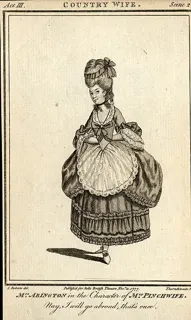
 The Country Wifeby William WycherleyA rake spreads word that he's impotent, so that husbands will trust him with their wives.
Act 1, Scene 1
MANLY'S Lodging
Enter MANLY, surlily, Lord PLAUSIBLE, following him; and two Sailors behind.
Tell not me, my good Lord Plausible, of your decorums, supercilious forms, and slavish ceremonies! your little tricks, which you, the spaniels of the world, do daily over and over, for and to one another; not out of love or duty, but your servile fear.
Nay, i' faith, i' faith, you are too passionate; and I must humbly beg your pardon and leave to tell you, they are the arts and rules the prudent of the world walk by.
Let 'em. But I'll have no leading-strings; I can walk alone: I hate a harness, and will not tug on in a faction, kissing my leader behind, that another slave may do the like to me.
What, will you be singular then, like nobody? follow, love, and esteem nobody?
Rather than be general, like you, follow everybody; court and kiss everybody; though perhaps at the same time you hate everybody.
Why, seriously, with your pardon, my dear friend--
With your pardon, my no friend, I will not, as you do, whisper my hatred or my scorn; call a man fool or knave by signs or mouths over his shoulder, whilst you have him in your arms.--For such as you, like common whores and pickpockets, are only dangerous to those you embrace.
Such as I! Heavens defend me!--upon my honour--
Upon your title, my lord, if you'd have me believe you.
Well, then, as I am a person of honour, I never attempted to abuse or lessen any person in my life.
What, you were afraid?
No; but seriously, I hate to do a rude thing: no, faith, I speak well of all mankind.
I thought so: but know, that speaking well of all mankind is the worst kind of detraction; for it takes away the reputation of the few good men in the world, by making all alike. Now, I speak ill of most men, because they deserve it; I that can do a rude thing, rather than an unjust thing.
Well, tell not me, my dear friend, what people deserve; I ne'er mind that. I, like an author in a dedication, never speak well of a man for his sake, but my own; I will not disparage any man, to disparage myself: for to speak ill of people behind their backs, is not like a person of honour; and, truly, to speak ill of 'em to their faces, is not like a complaisant person. But if I did say or do an ill thing to anybody, it should be sure to be behind their backs, out of pure good manners.
Very well; but I, that am an unmannerly sea-fellow, if I ever speak well of people, [which is very seldom indeed,] it should be sure to be behind their backs; and if I would say or do ill to any, it should be to their faces. I would jostle a proud, strutting, overlooking coxcomb, at the head of his sycophants, rather than put out my tongue at him when he were past me; would frown in the arrogant, big, dull face of an overgrown knave of business, rather than vent my spleen against him when his back were turned; would give fawning slaves the lie whilst they embrace or commend me; cowards whilst they brag; call a rascal by no other title, though his father had left him a duke's; laugh at fools aloud before their mistresses; and must desire people to leave me, when their visits grow at last as troublesome as they were at first impertinent.
I would not have my visits troublesome.
The only way to be sure not to have 'em troublesome, is to make 'em when people are not at home; for your visits, like other good turns, are most obliging when made or done to a man in his absence. A pox! why should any one, because he has nothing to do, go and disturb another man's business?
I beg your pardon, my dear friend.--What, you have business?
If you have any, I would not detain your lordship.
Detain me, dear sir!--I can never have enough of your company.
I'm afraid I should be tiresome: I know not what you think.
Well, dear sir, I see you'd have me gone. [Aside.
But I see you won't.
Your most faithful--
God be w'ye, my lord.
Your most humble--
Farewell.
And eternally--
And eternally ceremony--[Aside] Then the devil take thee eternally.
You shall use no ceremony, by my life.
I do not intend it.
Why do you stir then?
Only to see you out of doors, that I may shut 'em against more welcomes.
Nay, faith, that shall not pass upon your most faithful humble servant.
Nor this any more upon me. [Aside.
Well, you are too strong for me.
[Aside] I'd sooner be visited by the plague; for that only would keep a man from visits, and his doors shut. [Exit thrusting out Lord PLAUSIBLE.
Here's a finical fellow, Jack! What a brave fair-weather captain of a ship he would make!
He a captain of a ship! it must be when she's in the dock then; for he looks like one of those that get the king's commissions for hulls to sell a king's ship, when a brave fellow has fought her almost to a longboat.
On my conscience then, Jack, that's the reason our bully tar sunk our ship; not only that the Dutch might not have her; but that the courtiers, who laugh at wooden legs, might not make her prize.
A pox of his sinking, Tom! we have made a base, broken, short voyage of it.
Ay, your brisk dealers in honour always make quick returns with their ships to the dock, and their men to the hospitals. 'Tis, let me see, just a month since we set out of the river, and the wind was almost as cross to us as the Dutch.
Well, I forgive him sinking my own poor truck, if he would but have given me time and leave to have saved black Kate of Wapping's small venture.
Faith, I forgive him, since, as the purser told me, he sunk the value of five or six thousand pound of his own, with which he was to settle himself somewhere in the Indies; for our merry lieutenant was to succeed him in his commission for the ship back; for he was resolved never to return again for England.
So it seemed, by his fighting.
No; but he was a-weary of this side of the world here, they say.
Ay, or else he would not have bid so fair for a passage into t'other.
Jack, thou thinkest thyself in the forecastle, thou'rt so waggish. But I tell you, then, he had a mind to go live and bask himself on the sunny side of the globe.
What, out of any discontent? for he's always as dogged as an old tarpaulin, when hindered of a voyage by a young pantaloon captain.
'Tis true I never saw him pleased but in the fight; and then he looked like one of us coming from the pay-table, with a new lining to our hats under our arms.
A pox! he's like the Bay of Biscay, rough and angry, let the wind blow where 'twill.
Nay, there's no more dealing with him, than with the land in a storm, no near--
'Tis a hurry-durry blade. Dost thou remember after we had tugged hard the old leaky longboat to save his life, when I welcomed him ashore, he gave me a box on the ear, and called me fawning water-dog?
Re-enter MANLY with FREEMAN.
Hold thy peace, Jack, and stand by; the foul weather's coming.
You rascals! dogs! how could this tame thing get through you?
Faith, to tell your honour the truth, we were at hob in the hall, and whilst my brother and I were quarrelling about a cast, he slunk by us.
He's a sneaking fellow I warrant for't.
Have more care for the future, you slaves. Go, and with drawn cutlasses stand at the stair-foot, and keep all that ask for me from coming up; suppose you were guarding the scuttle to the powder-room. Let none enter here, at your and their peril.
No, for the danger would be the same: you would blow them and us up, if we should.
Must no one come to you, sir?
No man, sir.
No man, sir; but a woman then, an't like your honour--
No woman neither, you impertinent dog! Would you be pimping? sea-pimp is the strangest monster she has.
Indeed, an't like your honour, 'twill be hard for us to deny a woman anything, since we are so newly come on shore.
We'll let no old woman come up, though it were our trusting landlady at Wapping.
Would you be witty, you brandy casks you? you become a jest as ill as you do a horse. Begone, you dogs! I hear a noise on the stairs. [Exeunt Sailors.
Faith, I am sorry you would let the fop go, I intended to have had some sport with him.
Sport with him! A pox! then, why did you not stay? You should have enjoyed your coxcomb, and had him to yourself for me.
No, I should not have cared for him without you neither; for the pleasure which fops afford is like that of drinking, only good when 'tis shared; and a fool, like a bottle, which would make you merry in company, will make you dull alone. But how the devil could you turn a man of his quality down stairs? You use a lord with very little ceremony, it seems.
A lord! What, thou art one of those who esteem men only by the marks and value fortune has set upon 'em, and never consider intrinsic worth! but counterfeit honour will not be current with me: I weigh the man, not his title; 'tis not the king's stamp can make the metal better or heavier. Your lord is a leaden shilling, which you bend every way, and debases the stamp he bears, instead of being raised by it.--Here again, you slaves!
Re-enter Sailors.
Only to receive farther instructions, an't like your honour.--What if a man should bring you money, should we turn him back?
All men, I say: must I be pestered with you too?--You dogs, away!
Nay, I know one man your honour would not have us hinder coming to you, I'm sure.
Who's that? speak quickly, slaves.
Why, a man that should bring you a challenge. For though you refuse money, I'm sure you love fighting too well to refuse that.
Rogue! rascal! dog! [Kicks the Sailors out.
Nay, let the poor rogues have their forecastle jests: they cannot help 'em in a fight, scarce when a ship's sinking.
Damn their untimely jests! a servant's jest is more sauciness than his counsel.
But what, will you see nobody? not your friends?
Friends!--I have but one, and he, I hear, is not in town; nay, can have but one friend, for a true heart admits but of one friendship, as of one love. But in having that friend, I have a thousand; for he has the courage of men in despair, yet the diffidency and caution of cowards; the secrecy of the revengeful, and the constancy of martyrs; one fit to advise, to keep a secret, to fight and die for his friend. Such I think him; for I have trusted him with my mistress in my absence: and the trust of beauty is sure the greatest we can show.
Well, but all your good thoughts are not for him alone, I hope? Pray, what d'ye think of me for a friend?
Of thee! Why, thou art a latitudinarian in friendship, that is, no friend; thou dost side with all mankind, but wilt suffer for none. Thou art indeed like your Lord Plausible, the pink of courtesy, therefore hast no friendship: for ceremony and great professing renders friendship as much suspected as it does religion.
And no professing, no ceremony at all in friendship, were as unnatural and as undecent as in religion: and there is hardly such a thing as an honest hypocrite, who professes himself to be worse than he is, unless it be yourself; for though I could never get you to say you were my friend, I know you'll prove so.
I must confess, I am so much your friend, I would not deceive you; therefore must tell you, not only because my heart is taken up, but according to your rules of friendship, I cannot be your friend.
Pray, why?
Because he that is, you'll say, a true friend to a man, is a friend to all his friends. But you must pardon me, I cannot wish well to pimps, flatterers, detractors, and cowards, stiff nodding knaves, and supple, pliant, kissing fools. Now, all these I have seen you use like the dearest friends in the world.
Ha! ha! ha!--What, you observed me, I warrant, in the galleries at Whitehall, doing the business of the place? Pshaw! Court-professions, like court promises, go for nothing, man. But, faith, could you think I was a friend to all those I hugged, kissed, flattered, bowed to? Ha! ha!--
You told 'em so, and swore it too; I heard you.
Ay, but when their backs were turned, did not I tell you they were rogues, villains, rascals, whom I despised and hated?
Very fine! But what reason had I to believe you spoke your heart to me, since you professed deceiving so many?
Why, don't you know, good captain, that telling truth is a quality as prejudicial to a man that would thrive in the world, as square play to a cheat, or true love to a whore? Would you have a man speak truth to his ruin? You are severer than the law, which requires no man to swear against himself. You would have me speak truth against myself I warrant, and tell my promising friend the courtier, he has a bad memory.
Yes.
And so make him remember to forget my business? And I should tell the great lawyer too, that he takes oftener fees to hold his tongue, than to speak?
No doubt on't.
Ay, and have him hang or ruin me, when he should come to be a judge, and I before him? And you would have me tell the new officer, who bought his employment lately, that he is a coward?
Ay.
And so get myself cashiered, not him, he having the better friends, though I the better sword? And I should tell the scribbler of honour, that heraldry were a prettier and fitter study for so fine a gentleman than poetry?
Certainly.
And so find myself mauled in his next hired lampoon? And you would have me tell the holy lady, too, she lies with her chaplain?
No doubt on't.
And so draw the clergy upon my back, and want a good table to dine at sometimes? And by the same reason too, I should tell you that the world thinks you a mad man, a brutal, and have you cut my throat, or worse, hate me. What other good success of all my plain-dealing could I have, than what I've mentioned?
Why, first, your promising courtier would keep his word out of fear of more reproaches, or at least would give you no more vain hopes: your lawyer would serve you more faithfully; for he, having no honour but his interest, is truest still to him he knows suspects him: the new officer would provoke thee to make him a coward, and so be cashiered, that thou, or some other honest fellow, who had more courage than money, might get his place: the noble sonnetteer would trouble thee no more with his madrigals: the praying lady would leave off railing at wenching before thee, and not turn away her chambermaid for her own known frailty with thee: and I, instead of hating thee, should love thee for thy plain dealing; and in lieu of being mortified, am proud that the world and I think not well of one another.
Well, doctors differ. You are for plain dealing, I find: but against your particular notions, I have the practice of the whole world. Observe but any morning what people do when they get together on the Exchange, in Westminster-hall, or the galleries in Whitehall.
I must confess, there they seem to rehearse Bayes's grand dance. Here you see a bishop bowing low to a gaudy atheist; a judge to a door-keeper; a great lord to a fishmonger, or scrivener with a jack-chain about his neck; a lawyer to a sergeant-at-arms; a velvet physician to a threadbare chemist; and a supple gentleman-usher to a surly beefeater: and so tread round in a preposterous huddle of ceremony to each other, whilst they can hardly hold their solemn false countenances.
Well, they understand the world.
Which I do not, I confess.
But, sir, pray believe the friendship I promise you real, whatsoever I have professed to others: try me, at least.
Why, what would you do for me?
I would fight for you.
That you would do for your own honour. But what else?
I would lend you money, if I had it.
To borrow more of me another time. That were putting your money to interest; a usurer would be as good a friend.--But what other piece of friendship?
I would speak well of you to your enemies.
To encourage others to be your friends, by a show of gratitude.--But what else?
Nay, I would not hear you ill spoken of behind your back by my friend.
Nay, then, thou'rt a friend, indeed.--But it were unreasonable to expect it from thee, as the world goes now, when new friends, like new mistresses, are got by disparaging old ones.
Enter FIDELIA.
But here comes another, will say as much at least.--Dost thou not love me devilishly too, my little volunteer, as well as he or any man can?
Better than any man can love you, my dear captain.
Look you there, I told you so.
As well as you do truth or honour, sir; as well.
Nay, good young gentleman, enough, for shame! Thou hast been a page, by thy flattering and lying, to one of those praying ladies who love flattery so well they are jealous of it; and wert turned away for saying the same things to the old housekeeper for sweetmeats, as you did to your lady; for thou flatterest everything and everybody alike.
You, dear sir, should not suspect the truth of what I say of you, though to you. Fame, the old liar, is believed when she speaks wonders of you: you cannot be flattered, sir, your merit is unspeakable.
Hold, hold, sir, or I shall suspect worse of you, that you have been a cushion-bearer to some state-hypocrite, and turned away by the chaplains, for out-flattering their probation-sermons for a benefice.
Suspect me for anything, sir, but the want of love, faith, and duty to you, the bravest, worthiest of mankind; believe me, I could die for you, sir.
Nay, there you lie, sir; did not I see thee more afraid in the fight than the chaplain of the ship, or the purser that bought his place?
Can he be said to be afraid, that ventures to sea with you?
Fy! fy! no more; I shall hate thy flattery worse than thy cowardice, nay, than thy bragging.
Well, I own then I was afraid, mightily afraid; yet for you I would be afraid again, a hundred times afraid. Dying is ceasing to be afraid, and that I could do sure for you, and you'll believe me one day. [Weeps.
Poor youth! believe his eyes, if not his tongue: he seems to speak truth with them.
What, does he cry? A pox on't! a maudlin flatterer is as nauseously troublesome as a maudlin drunkard.--No more, you little milksop, do not cry, I'll never make thee afraid again; for of all men, if I had occasion, thou shouldst not be my second; and when I go to sea again, thou shalt venture thy life no more with me.
Why, will you leave me behind then?--[Aside] If you would preserve my life, I'm sure you should not.
Leave thee behind! ay, ay, thou art a hopeful youth for the shore only. Here thou wilt live to be cherished by fortune and the great ones; for thou mayst easily come to outflatter a dull poet, outlie a coffee-house or gazette-writer, outswear a knight of the post, outwatch a pimp, outfawn a rook, outpromise a lover, outrail a wit, and outbrag a sea-captain:--all this thou canst do, because thou'rt a coward, a thing I hate; therefore thou'lt do better with the world than with me, and these are the good courses you must take in the world. There's good advice, at least, at parting; go, and be happy with't.
Parting, sir! O let me not hear that dismal word.
If my words frighten thee, begone the sooner; for to be plain with thee, cowardice and I cannot dwell together.
And cruelty and courage never dwelt together sure, sir. Do not turn me off to shame and misery, for I am helpless and friendless.
Friendless! there are half a score friends for thee then.--[Offers her gold] I leave myself no more: they'll help thee a little. Begone, go, I must be cruel to thee [if thou callest it so] out of pity.
If you would be cruelly pitiful, sir, let it be with your sword, not gold. [Exit.
Re-enter 1st Sailor.
We have, with much ado, turned away two gentlemen, who told us, forty times over, their names were Mr. Novel and Major Oldfox.
Well, to your post again.--[Exit Sailor] But how come those puppies coupled always together?
O, the coxcombs keep each other company, to show each other, as Novel calls it; or, as Oldfox says, like two knives, to whet one another.
And set other people's teeth on edge.
Re-enter 2nd Sailor.
Here is a woman, an't like your honour, scolds and bustles with us, to come in, as much as a seaman's widow at the Navy office: her name is Mrs. Blackacre.
That fiend too!
The Widow Blackacre, is it not? that litigious she petty-fogger, who is at law and difference with all the world; but I wish I could make her agree with me in the church. They say she has fifteen hundred pounds a year jointure, and the care of her son, that is, the destruction of his estate.
Her lawyers, attorneys, and solicitors, have fifteen hundred pounds a year, whilst she is contented to be poor, to make other people so. For she is as vexatious as her father was, the great attorney, nay, as a dozen Norfolk attorneys, and as implacable an adversary as a wife suing for alimony, or a parson for his tithes; and she loves an Easter term, or any term, not as other country ladies do, to come up to be fine, cuckold their husbands, and take their pleasure; for she has no pleasure but in vexing others, and is usually clothed and daggled like a bawd in disguise, pursued through alleys by sergeants. When she is in town, she lodges in one of the inns of Chancery, where she breeds her son, and is herself his tutoress in law-French; and for her country abode, though she has no estate there, she chooses Norfolk.--But, bid her come in, with a pox to her! she is Olivia's kinswoman, and may make me amends for her visit, by some discourse of that dear woman. [Exit Sailor.
Enter Widow BLACKACRE, with a mantle and a green bag, and several papers in the other hand; JERRY BLACKACRE in a gown, laden with green bags, following her.
I never had so much to do with a judge's door-keeper, as with yours; but--
But the incomparable Olivia, how does she since I went?
Since you went, my suit--
Olivia, I say, is she well?
My suit, if you had not returned--
Damn your suit! how does your cousin Olivia?
My suit, I say, had been quite lost; but now--
But now, where is Olivia? in town? for--
For to-morrow we are to have a hearing.
Would you would let me have a hearing to-day!
But why won't you hear me?
I am no judge, and you talk of nothing but suits; but, pray tell me, when did you see Olivia?
I am no visitor, but a woman of business; or if I ever visit, 'tis only the Chancery-lane ladies, ladies towards the law; and not any of your lazy, good-for-nothing flirts, who cannot read law-French, though a gallant writ it. But as I was telling you, my suit--
Damn these impertinent vexatious people of business, of all sexes! they are still troubling the world with the tedious recitals of their lawsuits: and one can no more stop their mouths than a wit's when he talks of himself, or an intelligencer's when he talks of other people.
And a pox of all vexatious, impertinent lovers! they are still perplexing the world with the tedious narrations of their love-suits, and discourses of their mistresses! You are as troublesome to a poor widow of business, as a young coxcombly rhyming lover.
And thou art as troublesome to me, as a rook to a losing gamester, or a young putter of cases to his mistress or sempstress, who has love in her head for another.
Nay, since you talk of putting of cases, and will not hear me speak, hear our Jerry a little; let him put our case to you, for the trial's to-morrow: and since you are my chief witness, I would have your memory refreshed and your judgment informed, that you may not give your evidence improperly.--Speak out, child.
Yes, forsooth. Hem! hem! John-a-Stiles--
You may talk, young lawyer, but I shall no more mind you, than a hungry judge does a cause after the clock has struck one.
Nay, you'll find him as peevish too.
No matter. Jerry, go on.--Do you observe it then, sir; for I think I have seen you in a gown once. Lord, I could hear our Jerry put cases all day long.--Mark him, sir.
John-a-Stiles--no--there are first, Fitz, Pere, and Ayle,--no, no, Ayle, Pere, and Fitz; Ayle is seised in fee of Blackacre; John-a-Stiles disseises Ayle; Ayle makes claim, and the disseisor dies; then the Ayle--no, the Fitz--
No, the Pere, sirrah.
Oh, the Pere! ay, the Pere, sir, and the Fitz--no, the Ayle,--no, the Pere and the Fitz, sir, and--
Damn Pere, Mere, and Fitz, sir!
No, you are out, child.--Hear me, captain, then. There are Ayle, Pere, and Fitz; Ayle is seised in fee of Blackacre; and, being so seised, John-a-Stiles disseises the Ayle, Ayle makes claim, and the disseisor dies; and then the Pere re-enters, the Pere, sirrah, the Pere--[to JERRY] and the Fitz enters upon the Pere, and the Ayle brings his writ of disseisin in the post; and the Pere brings his writ of disseisin in the Pere, and--
Canst thou hear this stuff, Freeman? I could as soon suffer a whole noise of flatterers at a great man's levee in a morning; but thou hast servile complacency enough to listen to a quibbling statesman in disgrace, nay, and be beforehand with him, in laughing at his dull no-jest; but I--[Offering to go out.
Nay, sir, hold! Where's the subpœna, Jerry? I must serve you, sir. You are required by this, to give your testimony--
I'll be forsworn to be revenged on thee. [Exit, throwing away the subpœna.
Get you gone, for a lawless companion!--Come, Jerry, I had almost forgot, we were to meet at the master's at three: let us mind our business still, child.
Ay, forsooth, e'en so let's.
Nay, madam, now I would beg you to hear me a little, a little of my business.
I have business of my own calls me away, sir.
My business would prove yours too, dear madam.
Yours would be some sweet business, I warrant. What, 'tis no Westminster Hall business? would you have my advice?
No, faith, 'tis a little Westminster Abbey business; I would have your consent.
O fy, fy, sir! to me such discourse, before my dear minor there!
Ay, ay, mother, he would be taking livery and seisin of your jointure by digging the turf, but I'll watch your waters, bully, i'fac.--Come away, mother. [Exit, haling away his Mother.
Re-enter FIDELIA.
Dear sir, you have pity; beget but some in our captain for me.
Where is he?
Within; swearing as much as he did in the great storm, and cursing you, and sometimes sinks into calms and sighs, and talks of his Olivia.
He would never trust me to see her.--Is she handsome?
No, if you'll take my word: but I am not a proper judge.
What is she?
A gentlewoman, I suppose, but of as mean a fortune as beauty; but her relations would not suffer her to go with him to the Indies: and his aversion to this side of the world, together with the late opportunity of commanding the convoy, would not let him stay here longer, though to enjoy her.
He loves her mightily then?
Yes, so well, that the remainder of his fortune [I hear about five or six thousand pounds] he has left her, in case he had died by the way, or before she could prevail with her friends to follow him; which he expected she should do, and has left behind him his great bosom friend to be her convoy to him.
What charms has she for him, if she be not handsome?
He fancies her, I suppose, the only woman of truth and sincerity in the world.
No common beauty, I confess.
Or else sure he would not have trusted her with so great a share of his fortune, in his absence, I suppose [since his late loss] all he has.
Why, has he left it in her own custody?
I am told so.
Then he has showed love to her indeed, in leaving her, like an old husband that dies as soon as he has made his wife a good jointure.--But I'll go in to him, and speak for you, and know more from him of his Olivia. [Exit.
His Olivia, indeed, his happy Olivia!
Yet she was left behind, when I was with him:
But she was ne'er out of his mind or heart.
She has told him she loved him; I have show'd it,
And durst not tell him so, till I had done,
Under this habit, such convincing acts
Of loving friendship for him, that through it
He first might find out both my sex and love;
And, when I'd had him from his fair Olivia,
And this bright world of artful beauties here,
Might then have hoped, he would have look'd on me,
Amongst the sooty Indians; and I could,
To choose, there live his wife, where wives are forced
To live no longer, when their husbands die;
Nay, what's yet worse, to share 'em whilst they live
With many rival wives. But here he comes,
And I must yet keep out of his sight, not
To lose it for ever. [Exit.
Re-enter MANLY and FREEMAN.
But pray what strange charms has she that could make you love?
Strange charms indeed! she has beauty enough to call in question her wit or virtue, and her form would make a starved hermit a ravisher; yet her virtue and conduct would preserve her from the subtle lust of a pampered prelate. She is so perfect a beauty, that art could not better it, nor affectation deform it. Yet all this is nothing. Her tongue as well as face ne'er knew artifice; nor ever did her words or looks contradict her heart. She is all truth, and hates the lying, masking, daubing world, as I do: for which I love her, and for which I think she dislikes not me. For she has often shut out of her conversation for mine, the gaudy fluttering parrots of the town, apes and echoes of men only, and refused their common-place pert chat, flattery and submissions, to be entertained with my sullen bluntness, and honest love: and, last of all, swore to me, since her parents would not suffer her to go with me, she would stay behind for no other man; but follow me without their leave, if not to be obtained. Which oath--
Did you think she would keep?
Yes; for she is not [I tell you] like other women, but can keep her promise, though she has sworn to keep it. But, that she might the better keep it, I left her the value of five or six thousand pounds: for women's wants are generally the most importunate solicitors to love or marriage.
And money summons lovers more than beauty, and augments but their importunity, and their number; so makes it the harder for a woman to deny 'em. For my part, I am for the French maxim;--"If you would have your female subjects loyal, keep 'em poor."--But in short, that your mistress may not marry, you have given her a portion.
She had given me her heart first, and I am satisfied with the security; I can never doubt her truth and constancy.
It seems you do, since you are fain to bribe it with money. But how come you to be so diffident of the man that says he loves you, and not doubt the woman that says it?
I should, I confess, doubt the love of any other woman but her, as I do the friendship of any other man but him I have trusted; but I have such proofs of their faith as cannot deceive me.
Cannot!
Not but I know that generally no man can be a great enemy but under the name of friend; and if you are a cuckold, it is your friend only that makes you so, for your enemy is not admitted to your house: if you are cheated in your fortune, 'tis your friend that does it, for your enemy is not made your trustee: if your honour or good name be injured, 'tis your friend that does it still, because your enemy is not believed against you. Therefore, I rather choose to go where honest, downright barbarity is professed, where men devour one another like generous hungry lions and tigers, not like crocodiles; where they think the devil white, of our complexion; and I am already so far an Indian. But if your weak faith doubts this miracle of a woman, come along with me, and believe; and thou wilt find her so handsome, that thou, who art so much my friend, wilt have a mind to lie with her, and so wilt not fail to discover what her faith and thine is to me.
When we're in love, the great adversity,
Our friends and mistresses at once we try.
Exeunt.
Act 2, Scene 1
OLIVIA'S Lodging
Enter OLIVIA, ELIZA, and LETTICE.
Ah, cousin, what a world 'tis we live in! I am so weary of it.
Truly, cousin, I can find no fault with it, but that we cannot always live in't, for I can never be weary of it.
O hideous! you cannot be in earnest sure, when you say you like the filthy world.
You cannot be in earnest sure, when you say you dislike it.
You are a very censorious creature, I find.
I must confess, I think we women as often discover where we love by railing, as men when they lie by their swearing; and the world is but a constant keeping gallant, whom we fail not to quarrel with when anything crosses us, yet cannot part with't for our hearts.
A gallant indeed, madam, whom ladies first make jealous, and then quarrel with it for being so; for if, by her indiscretion, a lady be talked of for a man, she cries presently, "'Tis a censorious world!" if by her vanity the intrigue be found out, "'Tis a prying malicious world!" if by her over-fondness the gallant proves unconstant, "'Tis a false world!" and if by her niggardliness the chambermaid tells, "'Tis a perfidious world!" But that, I'm sure, your ladyship cannot say of the world yet, as bad as 'tis.
But I may say, "'Tis a very impertinent world!"--Hold your peace.--And, cousin, if the world be a gallant, 'tis such a one as is my aversion. Pray name it no more.
But is it possible the world, which has such variety of charms for other women, can have none for you? Let's see--first, what d'ye think of dressing and fine clothes?
Dressing! Fy, fy, 'tis my aversion.--[To LETTICE] But come hither, you dowdy; methinks you might have opened this toure better; O hideous! I cannot suffer it! D'ye see how't sits?
Well enough, cousin, if dressing be your aversion.
'Tis so: and for variety of rich clothes, they are more my aversion.
Ay, 'tis because your ladyship wears 'em too long; for indeed a gown, like a gallant, grows one's aversion by having too much of it.
Insatiable creature! I'll be sworn I have had this not above three days, cousin, and within this month have made some six more.
Then your aversion to 'em is not altogether so great.
Alas! 'tis for my woman only I wear 'em, cousin.
If it be for me only, madam, pray do not wear 'em.
But what d'ye think of visits--balls?
O, I detest 'em!
Of plays?
I abominate 'em; filthy, obscene, hideous things.
What say you to masquerading in the winter, and Hyde Park in the summer?
Insipid pleasures I taste not.
Nay, if you are are for more solid pleasures, what think you of a rich young husband?
O horrid! marriage! what a pleasure you have found out! I nauseate it of all things.
But what does your ladyship think then of a liberal handsome young lover?
A handsome young fellow, you impudent! begone out of my sight. Name a handsome young fellow to me! foh, a hideous handsome young fellow I abominate! [Spits.
Indeed! But let's see--will nothing please you? what d'ye think of the court?
How, the court! the court, cousin! my aversion, my aversion, my aversion of all aversions!
How, the court! where--
Where sincerity is a quality as much out of fashion and as unprosperous as bashfulness: I could not laugh at a quibble, though it were a fat privy-counsellor's; nor praise a lord's ill verses, though I were myself the subject; nor an old lady's young looks, though I were her woman; nor sit to a vain young smile-maker, though he flattered me. In short, I could not glout upon a man when he comes into a room, and laugh at him when he goes out; I cannot rail at the absent to flatter the standers-by; I--
Well, but railing now is so common, that 'tis no more malice, but the fashion; and the absent think they are no more the worse for being railed at, than the present think they're the better for being flattered. And for the court--
Nay, do not defend the court; for you'll make me rail at it like a trusting citizen's widow.
Or like a Holborn lady, who could not get in to the last ball, or was out of countenance in the drawing-room the last Sunday of her appearance there. For none rail at the court but those who cannot get into it, or else who are ridiculous when they are there; and I shall suspect you were laughed at when you were last there, or would be a maid of honour.
I a maid of honour! To be a maid of honour, were yet of all things my aversion.
In what sense am I to understand you? But in fine, by the word aversion, I'm sure you dissemble; for I never knew woman yet used it who did not. Come, our tongues belie our hearts more than our pocket-glasses do our faces. But methinks we ought to leave off dissembling, since 'tis grown of no use to us; for all wise observers understand us now-a-days, as they do dreams, almanacs, and Dutch gazettes, by the contrary: and a man no more believes a woman, when she says she has an aversion for him, than when she says she'll cry out.
O filthy! hideous! Peace, cousin, or your discourse will be my aversion: and you may believe me.
Yes; for if anything be a woman's aversion, 'tis plain dealing from another woman: and perhaps that's your quarrel to the world; for that will talk, as your woman says.
Talk? not of me sure; for what men do I converse with? what visits do I admit?
Enter Boy.
Here's the gentleman to wait upon you, madam.
On me! you little unthinking fop; d'ye know what you say?
Yes, madam, 'tis the gentleman that comes every day to you, who--
Hold your peace, you heedless little animal, and get you gone.--[Exit Boy] This country boy, cousin, takes my dancing-master, tailor, or the spruce milliner, for visitors.
No, madam; 'tis Mr. Novel, I'm sure, by his talking so loud: I know his voice too, madam.
You know nothing, you buffle-headed stupid creature you: you would make my cousin believe I receive visits. But if it be Mr.--what did you call him?
Mr. Novel, madam; he that--
Hold your peace; I'll hear no more of him. But if it be your Mr.--[I cannot think of his name again] I suppose he has followed my cousin hither.
No, cousin, I will not rob you of the honour of the visit: 'tis to you, cousin; for I know him not.
Nor did I ever hear of him before, upon my honour, cousin; besides, han't I told you, that visits, and the business of visits, flattery and detraction, are my aversion? D'ye think then I would admit such a coxcomb as he is? who rather than not rail, will rail at the dead, whom none speak ill of; rather than not flatter, will flatter the poets of the age, whom none will flatter; who affects novelty as much as the fashion, and is as fantastical as changeable, and as well known as the fashion; who likes nothing but what is new, nay, would choose to have his friend or his title a new one. In fine, he is my aversion.
I find you do know him, cousin; at least, have heard of him.
Yes, now I remember. I have heard of him.
Well; but since he is such a coxcomb, for Heaven's sake, let him not come up. Tell him, Mrs. Lettice, your lady is not within.
No, Lettice, tell him my cousin is here, and that he may come up. For notwithstanding I detest the sight of him, you may like his conversation; and though I would use him scurvily, I will not be rude to you in my own lodging: since he has followed you hither, let him come up, I say.
Very fine! pray let him go to the devil, I say, for me: I know him not, nor desire it. Send him away, Mrs. Lettice.
Upon my word, she shan't: I must disobey your commands, to comply with your desires. Call him up, Lettice.
Nay, I'll swear she shall not stir on that errand. [Holds LETTICE.
Well then, I'll call him myself for you, since you will have it so.--[Calls out at the door] Mr. Novel, sir, sir!
Enter NOVEL.
Madam, I beg your pardon; perhaps you were busy: I did not think you had company with you.
Yet he comes to me, cousin! [Aside to OLIVIA.
Chairs there. [They sit.
Well; but, madam, d'ye know whence I come now?
From some melancholy place, I warrant, sir, since they have lost your good company.
So!
From a place where they have treated me at dinner with so much civility and kindness, a pox on them! that I could hardly get away to you, dear madam.
You have a way with you so new and obliging, sir!
You hate flattery, cousin! [Apart to OLIVIA.
Nay, faith, madam, d'ye think my way new? Then you are obliging, madam. I must confess, I hate imitation, to do anything like other people. All that know me do me the honour to say, I am an original, faith. But, as I was saying, madam, I have been treated to-day with all the ceremony and kindness imaginable at my Lady Autumn's. But, the nauseous old woman at the upper end of her table--
Revives the old Grecian custom, of serving in a death's head with their banquets.
Ha! ha! fine, just, i'faith, nay, and new. 'Tis like eating with the ghost in "The Libertine:" she would frighten a man from her dinner with her hollow invitations, and spoil one's stomach--
To meat or women. I detest her hollow cherry cheeks: she looks like an old coach new painted; affecting an unseemly smugness, whilst she is ready to drop in pieces.
You hate detraction, I see, cousin. [Apart to OLIVIA.
But the silly old fury, whilst she affects to look like a woman of this age, talks--
Like one of the last; and as passionately as an old courtier who has outlived his office.
Yes, madam; but pray let me give you her character. Then she never counts her age by the years, but--
By the masques she has lived to see.
Nay then, madam, I see you think a little harmless railing too great a pleasure for any but yourself; and therefore I've done.
Nay, faith, you shall tell me who you had there at dinner.
If you would hear me, madam.
Most patiently; speak, sir.
Then, we had her daughter--
Ay, her daughter; the very disgrace to good clothes, which she always wears but to heighten her deformity, not mend it: for she is still most splendidly, gallantly ugly, and looks like an ill piece of daubing in a rich frame.
So! But have you done with her, madam? and can you spare her to me a little now?
Ay, ay, sir.
Then, she is like--
She is, you'd say, like a city bride; the greater fortune, but not the greater beauty, for her dress.
Well: yet have you done, madam? Then she--
Then she bestows as unfortunately on her face all the graces in fashion, as the languishing eye, the hanging or pouting lip. But as the fool is never more provoking than when he aims at wit, the ill-favoured of our sex are never more nauseous than when they would be beauties, adding to their natural deformity the artificial ugliness of affectation.
So, cousin, I find one may have a collection of all one's acquaintance's pictures as well at your house as at Mr. Lely's. Only the difference is, there we find 'em much handsomer than they are, and like; here much uglier, and like: and you are the first of the profession of picture-drawing I ever knew without flattery.
I draw after the life; do nobody wrong, cousin.
No, you hate flattery and detraction.
But, Mr. Novel, who had you besides at dinner?
Nay, the devil take me if I tell you, unless you will allow me the privilege of railing in my turn.--But, now I think on't, the women ought to be your province, as the men are mine: and you must know we had him whom--
Him, whom--
What, invading me already? and giving the character before you know the man?
No, that is not fair, though it be usual.
I beg your pardon, Mr. Novel; pray go on.
Then, I say, we had that familiar coxcomb who is at home wheresoe'er he comes.
Ay, that fool--
Nay then, madam, your servant; I'm gone. Taking the fool out of one's mouth is worse than taking the bread out of one's mouth.
I've done; your pardon, Mr. Novel: pray proceed.
I say, the rogue, that he may be the only wit in company, will let nobody else talk, and--
Ay, those fops who love to talk all themselves are of all things my aversion.
Then you'll let me speak, madam, sure. The rogue, I say, will force his jest upon you; and I hate a jest that's forced upon a man, as much as a glass.
Why, I hope, sir, he does not expect a man of your temperance in jesting should do him reason?
What! interruption from this side too? I must then--[Offers to rise. OLIVIA holds him.
No, sir.--You must know, cousin, that fop he means, though he talks only to be commended, will not give you leave to do't.
But, madam--
He a wit! Hang him; he's only an adopter of straggling jests and fatherless lampoons; by the credit of which he eats at good tables, and so, like the barren beggar-woman, lives by borrowed children.
Madam--
And never was author of anything but his news; but that is still all his own.
Madam, pray--
An eternal babbler; and makes no more use of his ears, than a man that sits at a play by his mistress, or in Fop-corner. He's, in fine, a base detracting fellow, and is my aversion.--But who else, prithee Mr. Novel, was there with you? Nay, you shan't stir.
I beg your pardon, madam; I cannot stay in any place where I'm not allowed a little Christian liberty of railing.
Nay, prithee Mr. Novel, stay: and though you should rail at me, I would hear you with patience. Prithee, who else was there with you?
Your servant, madam.
Nay, prithee tell us, Mr. Novel, prithee do.
We had nobody else.
Nay, faith, I know you had. Come, my Lord Plausible was there too; who is, cousin, a--
You need not tell me what he is, cousin; for I know him to be a civil, good-natured, harmless gentleman, that speaks well of all the world, and is always in good-humour; and--
Hold, cousin, hold; I hate detraction. But I must tell you, cousin, his civility is cowardice, his good-nature want of wit; and he has neither courage nor sense to rail: and for his being always in humour, 'tis because he is never dissatisfied with himself. In fine, he is my aversion; and I never admit his visits beyond my hall.
No, he visit you! Damn him, cringing grinning rogue! if I should see him coming up to you, I would make bold to kick him down again.--Ha!
Enter Lord PLAUSIBLE.
My dear lord, your most humble servant. [Rises and salutes Lord PLAUSIBLE, and kisses him.
So, I find kissing and railing succeed each other with the angry men as well as with the angry women; and their quarrels are like love-quarrels, since absence is the only cause of them; for as soon as the man appears again, they are over. [Aside.
Your most faithful humble servant, generous Mr. Novel. And, madam, I am your eternal slave, and kiss your fair hands; which I had done sooner, according to your commands, but--
No excuses, my lord.
What, you sent for him then, cousin? [Apart to OLIVIA.
Ha! invited! [Aside.
I know you must divide yourself; for your good company is too general a good to be engrossed by any particular friend.
O Lord, madam, my company! your most obliged, faithful, humble servant. But I could have brought you good company indeed; for I parted at your door with two of the worthiest, bravest men--
Who were they, my lord?
Who do you call the worthiest, bravest men, pray?
O, the wisest, bravest gentlemen! men of such honour and virtue! of such good qualities! ah--
This is a coxcomb that speaks ill of all people a different way, and libels everybody with dull praise, and commonly in the wrong place; so makes his panegyrics abusive lampoons. [Aside.
But pray let me know who they were?
Ah! such patterns of heroic virtue! such--
Well: but who the devil were they?
The honour of our nation! the glory of our age! Ah, I could dwell a twelvemonth on their praise; which indeed I might spare by telling their names; Sir John Current and Sir Richard Court-Title.
Court-Title! ha! ha!
And Sir John Current! Why will you keep such a wretch company, my lord?
O madam, seriously you are a little too severe; for he is a man of unquestioned reputation in everything.
Yes, because he endeavours only with the women to pass for a man of courage, and with the bullies for a wit; with the wits for a man of business, and with the men of business for a favourite at court; and at court for city security.
And for Sir Richard, he--
He loves your choice picked company, persons that--
He loves a lord indeed; but--
Pray, dear madam, let me have but a bold stroke or two at his picture. He loves a lord, as you say, though--
Though he borrowed his money, and ne'er paid him again.
And would bespeak a place three days before at the back-end of a lord's coach to Hyde Park.
Nay, i'faith, i'faith, you are both too severe.
Then to show yet more his passion for quality, he makes love to that fulsome coach-load of honour, my Lady Goodly, for he's always at her lodging.
Because it is the conventicle-gallant, the meeting-house of all the fair ladies, and glorious superfine beauties of the town.
Very fine ladies! there's first--
Her honour, as fat as an hostess.
She is something plump indeed, a goodly, comely, graceful person.
Then there's my Lady Frances--what d'ye call her? as ugly--
As a citizen's lawfully begotten daughter.
She has wit in abundance, and the handsomest heel, elbow, and tip of an ear, you ever saw.
Heel and elbow! ha! ha! And there's my Lady Betty, you know--
As sluttish and slatternly as an Irish woman bred in France.
Ah! all she has hangs with a loose air, indeed, and becoming negligence.
You see all faults with lovers' eyes, I find, my lord.
Ah, madam, your most obliged, faithful, humble servant to command! But you can say nothing sure against the superfine mistress--
I know who you mean. She is as censorious and detracting a jade as a superannuated sinner.
She has a smart way of raillery, 'tis confessed.
And then for Mrs. Grideline--
She, I'm sure is--
One that never spoke ill of anybody, 'tis confessed. For she is as silent in conversation as a country lover, and no better company than a clock, or a weather-glass: for if she sounds, 'tis but once an hour to put you in mind of the time of day, or to tell you 'twill be cold or hot, rain or snow.
Ah, poor creature! she's extremely good and modest.
And for Mrs. Bridlechin, she's--
As proud as a churchman's wife.
She's a woman of great spirit and honour, and will not make herself cheap, 'tis true.
Then Mrs. Hoyden, that calls all people by their surnames, and is--
As familiar a duck--
As an actress in the tiring room. There I was once beforehand with you, madam.
Mrs. Hoyden! a poor, affable, good-natured soul. But the divine Mrs. Trifle comes thither too. Sure her beauty, virtue, and conduct, you can say nothing to.
No!
No!--Pray let me speak, madam.
First, can any one be called beautiful that squints?
Her eyes languish a little, I own.
Languish! ha! ha!
Languish!--Then, for her conduct, she was seen at the "Country Wife" after the first day. There's for you, my lord.
But, madam, she was not seen to use her fan all the play long, turn aside her head, or by a conscious blush discover more guilt than modesty.
Very fine! Then you think a woman modest that sees the hideous "Country Wife" without blushing or publishing her detestation of it? D'ye hear him, cousin?
Yes, and am, I must confess, something of his opinion; and think, that as an over-conscious fool at a play, by endeavouring to show the author's want of wit, exposes his own to more censure, so may a lady call her own modesty in question, by publicly cavilling with the poet's. For all those grimaces of honour and artificial modesty disparage a woman's real virtue, as much as the use of white and red does the natural complexion: and you must use very, very little, if you would have it thought your own.
Then you would have a woman of honour with passive looks, ears, and tongue, undergo all the hideous obscenity she hears at nasty plays.
Truly, I think a woman betrays her want of modesty, by showing it publicly in a playhouse, as much as a man does his want of courage by a quarrel there; for the truly modest and stout say least, and are least exceptious, especially in public.
O hideous, cousin! this cannot be your opinion. But you are one of those who have the confidence to pardon the filthy play.
Why, what is there of ill in't, say you?
O fy! fy! fy! would you put me to the blush anew? call all the blood into my face again? But to satisfy you then; first, the clandestine obscenity in the very name of Horner.
Truly, 'tis so hidden, I cannot find it out, I confess.
O horrid! Does it not give you the rank conception or image of a goat, or town-bull, or a satyr? nay, what is yet a filthier image than all the rest, that of an eunuch?
What then? I can think of a goat, a bull, or a satyr, without any hurt.
Ay: but cousin, one cannot stop there.
I can, cousin.
O no; for when you have those filthy creatures in your head once, the next thing you think, is what they do; as their defiling of honest men's beds and couches, rapes upon sleeping and waking country virgins under hedges, and on haycocks. Nay, farther--
Nay, no farther, cousin. We have enough of your comment on the play, which will make me more ashamed than the play itself.
O, believe me, 'tis a filthy play! and you may take my word for a filthy play as soon as another's. But the filthiest thing in that play, or any other play, is--
Pray keep it to yourself, if it be so.
No, faith, you shall know it; I'm resolved to make you out of love with the play. I say, the lewdest, filthiest thing is his china; nay, I will never forgive the beastly author his china. He has quite taken away the reputation of poor china itself, and sullied the most innocent and pretty furniture of a lady's chamber; insomuch that I was fain to break all my defiled vessels. You see I have none left; nor you, I hope.
You'll pardon me, I cannot think the worse of my china for that of the playhouse.
Why, you will not keep any now, sure! 'Tis now as unfit an ornament for a lady's chamber as the pictures that come from Italy and other hot countries; as appears by their nudities, which I always cover, or scratch out, whereso'er I find 'em. But china! out upon't, filthy china! nasty debauched china!
All this will not put me out of conceit with china, nor the play, which is acted to-day, or another of the same beastly author's, as you call him, which I'll go see.
You will not, sure! nay, you sha' not venture your reputation by going, and mine by leaving me alone with two men here: nay, you'll disoblige me for ever, if--[Pulls her back.
I stay!--your servant. [Exit.
Well--but, my lord, though you justify everybody, you cannot in earnest uphold so beastly a writer, whose ink is so smutty as one may say.
Faith, I dare swear the poor man did not think to disoblige the ladies, by any amorous, soft, passionate, luscious saying in his play.
Fy, my lord! But what think you, Mr. Novel, of the play? though I know you are a friend to all that are new.
Faith, madam, I must confess, the new plays would not be the worse for my advice, but I could never get the silly rogues, the poets, to mind what I say; but I'll tell you what counsel I gave the surly fool you spake of.
What was't?
Faith, to put his play into rhyme; for rhyme, you know, often makes mystical nonsense pass with the critics for wit, and a double-meaning saying with the ladies, for soft, tender, and moving passion. But now I talk of passion, I saw your old lover this morning--Captain--[Whispers.
Enter MANLY, FREEMAN, and FIDELIA standing behind.
Whom?--nay, you need not whisper.
We are luckily got hither unobserved!--How! in a close conversation with these supple rascals, the outcasts of sempstresses' shops!
Faith, pardon her, captain, that, since she could no longer be entertained with your manly bluntness and honest love, she takes up with the pert chat and commonplace flattery of these fluttering parrots of the town, apes and echoes of men only.
Do not you, sir, play the echo too, mock me, dally with my own words, and show yourself as impertinent as they are.
Nay, captain--
Nay, lieutenant, do not excuse her; methinks she looks very kindly upon 'em both, and seems to be pleased with what that fool there says to her.
You lie, sir! and hold your peace, that I may not be provoked to give you a worse reply.
Manly returned, d'ye say! and is he safe?
My lord saw him too.--Hark you, my lord. [Whispers to Lord PLAUSIBLE.
She yet seems concerned for my safety, and perhaps they are admitted now here but for their news of me: for intelligence indeed is the common passport of nauseous fools, when they go their round of good tables and houses. [Aside.
I heard of his fighting only, without particulars, and confess I always loved his brutal courage, because it made me hope it might rid me of his more brutal love.
What's that? [Aside.
But is he at last returned, d'ye say, unhurt?
Ay, faith, without doing his business; for the rogue has been these two years pretending to a wooden leg, which he would take from fortune as kindly as the staff of a marshal of France, and rather read his name in a gazette--
Than in the entail of a good estate.
So! [Aside.
I have an ambition, I must confess, of losing my heart before such a fair enemy us yourself, madam; but that silly rogues should be ambitious of losing their arms, and--
Looking like a pair of compasses.
But he has no use of his arms but to set 'em on kimbow, for he never pulls off his hat, at least not to me, I'm sure; for you must know, madam, he has a fanatical hatred to good company: he can't abide me.
O, be not so severe to him, as to say he hates good company: for I assure you he has a great respect, esteem and kindness for me.
That kind, civil rogue has spoken yet ten thousand times worse of me than t'other. [Aside.
Well, if he be returned, Mr. Novel, then shall I be pestered again with his boisterous sea-love; have my alcove smell like a cabin, my chamber perfumed with his tarpaulin Brandenburgh; and hear volleys of brandy-sighs, enough to make a fog in one's room. Foh! I hate a lover that smells like Thames Street!
[Aside] I can bear no longer, and need hear no more.--[To OLIVIA] But since you have these two pulvillio boxes, these essence-bottles, this pair of musk-cats here, I hope I may venture to come yet nearer you.
Overheard us then!
I hope he heard me not. [Aside.
Most noble and heroic captain, your most obliged, faithful, humble servant.
Dear tar, thy humble servant.
Away!--[Thrusts NOVEL and Lord PLAUSIBLE on each side] Madam--
Nay, I think I have fitted you for listening.
You have fitted me for believing you could not be fickle, though you were young; could not dissemble love, though 'twas your interest; nor be vain, though you were handsome; nor break your promise, though to a parting lover; nor abuse your best friend, though you had wit: but I take not your contempt of me worse than your esteem, or civility for these things here, though you know 'em.
Things!
Let the captain rally a little.
Yes, things! Canst thou be angry, thou thing? [Coming up to NOVEL.
No, since my lord says you speak in raillery; for though your sea-raillery be something rough, yet, I confess, we use one another too as bad every day at Locket's, and never quarrel for the matter.
Nay, noble captain, be not angry with him.--A word with you, I beseech you--[Whispers to MANLY.
Well, we women, like the rest of the cheats of the world, when our cullies or creditors have found us out, and will or can trust no longer, pay debts and satisfy obligations with a quarrel, the kindest present a man can make to his mistress, when he can make no more presents. For oftentimes in love, as at cards, we are forced to play foul, only to give over the game; and use our lovers like the cards, when we can get no more by them, throw 'em up in a pet upon the first dispute. [Aside.
My lord, all that you have made me know by your whispering, which I knew not before, is, that you have a stinking breath; there's a secret for your secret.
Pshaw! pshaw!
But, madam, tell me, pray, what was't about this spark could take you? Was it the merit of his fashionable impudence; the briskness of his noise, the wit of his laugh, his judgment, or fancy in his garniture? or was it a well-trimmed glove, or the scent of it, that charmed you?
Very well, sir: 'gad these sea captains make nothing of dressing. But let me tell you, sir, a man by his dress, as much as by anything, shows his wit and judgment; nay, and his courage too.
How, his courage, Mr. Novel?
Why, for example, by red breeches, tucked-up hair or peruke, a greasy broad belt, and now-a-days a short sword.
Thy courage will appear more by thy belt than thy sword, I dare swear.--Then, madam, for this gentle piece of courtesy, this man of tame honour, what could you find in him? Was it his languishing affected tone? his mannerly look? his second-hand flattery? the refuse of the playhouse tiring-rooms? or his slavish obsequiousness in watching at the door of your box at the playhouse, for your hand to your chair? or his jaunty way of playing with your fan? or was it the gunpowder spot on his hand, or the jewel in his ear, that purchased your heart?
Good jealous captain, no more of your--
No, let him go on, madam, for perhaps he may make you laugh: and I would contribute to your pleasure any way.
Gentle rogue!
No, noble captain, you cannot sure think anything could take me more than that heroic title of yours, captain; for you know we women love honour inordinately.
Ha! ha! faith, she is with thee, bully, for thy raillery.
Faith, so shall I be with you, no bully, for your grinning. [Aside to NOVEL.
Then that noble lion-like mien of yours, that soldier-like, weather-beaten complexion, and that manly roughness of your voice; how can they otherwise than charm us women, who hate effeminacy!
Ha! ha! faith I can't hold from laughing.
Nor shall I from kicking anon. [Aside to NOVEL.
And then, that captain-like carelessness in your dress, but especially your scarf; 'twas just such another, only a little higher tied, made me in love with my tailor as he passed by my window the last training-day; for we women adore a martial man, and you have nothing wanting to make you more one, or more agreeable, but a wooden leg.
Nay, i'faith, there your ladyship was a wag, and it was fine, just, and well rallied.
Ay, ay, madam, with you ladies too, martial men must needs be very killing.
Peace, you Bartholomew-fair buffoons! And be not you vain that these laugh on your side, for they will laugh at their own dull jests; but no more of 'em, for I will only suffer now this lady to be witty and merry.
You would not have your panegyric interrupted. I go on then to your humour. Is there anything more agreeable than the pretty sullenness of that? than the greatness of your courage, which most of all appears in your spirit of contradiction? for you dare give all mankind the lie; and your opinion is your only mistress, for you renounce that too, when it becomes another man's.
Ha! ha! I cannot hold, I must laugh at thee, tar, faith!
And i'faith, dear captain, I beg your pardon, and leave to laugh at you too, though I protest I mean you no hurt; but when a lady rallies, a stander-by must be complaisant, and do her reason in laughing: ha! ha!
Why, you impudent, pitiful wretches, you presume sure upon your effeminacy to urge me; for you are in all things so like women, that you may think it in me a kind of cowardice to beat you.
No hectoring, good captain.
Or, perhaps, you think this lady's presence secures you; but have a care, she has talked herself out of all the respect I had for her; and by using me ill before you, has given me a privilege of using you so before her; but if you would preserve your respect to her, and not be beaten before her, go, begone immediately.
Begone! what?
Nay, worthy, noble, generous, captain--
Begone, I say!
Begone again! to us begone!
No chattering, baboons, instantly begone, or--[Puts them out of the room: NOVEL struts, Lord PLAUSIBLE cringes.
Well, madam, we'll go make the cards ready in your bedchamber: sure you will not stay long with him. [Exeunt Lord PLAUSIBLE and NOVEL.
Turn hither your rage, good captain Swaggerhuff, and be saucy with your mistress, like a true captain; but be civil to your rivals and betters, and do not threaten anything but me here; no, not so much as my windows; nor do not think yourself in the lodgings of one of your suburb mistresses beyond the Tower.
Do not give me cause to think so; for those less infamous women part with their lovers, just as you did from me, with unforced vows of constancy and floods of willing tears; but the same winds bear away their lovers and their vows: and for their grief, if the credulous unexpected fools return, they find new comforters, fresh cullies, such as I found here. The mercenary love of those women too suffers shipwreck with their gallants' fortunes; now you have heard chance has used me scurvily, therefore you do too. Well, persevere in your ingratitude, falsehood, and disdain; have constancy in something, and I promise you to be as just to your real scorn as I was to your feigned love; and henceforward will despise, contemn, hate, loathe, and detest you most faithfully.
Enter LETTICE.
Get the ombre-cards ready in the next room, Lettice, and--[Whispers to LETTICE, who goes out.
Bravely resolved, captain!
And you'll be sure to keep your word, I hope, sir?
I hope so too.
Do you but hope it, sir? If you are not as good as your word, 'twill be the first time you ever bragged, sure.
She has restored my reason with my heart.
But now you talk of restoring, captain, there are other things, which next to one's heart one would not part with; I mean your jewels and money, which it seems she has, sir.
What's that to you, sir?
Pardon me, whatsoever is yours I have a share in't I'm sure, which I will not lose for asking, though you may be too generous or too angry now to do't yourself.
Nay, then I'll make bold to make my claim too. [Both going towards OLIVIA.
Hold, you impertinent, officious fops--[Aside] How have I been deceived!
Madam, there are certain appurtenances to a lover's heart, called jewels, which always go along with it.
And which, with lovers, have no value in themselves, but from the heart they come with. Our captain's, madam, it seems you scorn to keep, and much more will those worthless things without it, I am confident.
A gentleman so well made as you are, may be confident--us easy women could not deny you anything you ask, if 'twere for yourself, but, since 'tis for another, I beg your leave to give him my answer.--[Aside] An agreeable young fellow this--and would not be my aversion.--[Aloud] Captain, your young friend here has a very persuading face, I confess; yet you might have asked me yourself for those trifles you left with me, which [hark you a little, for I dare trust you with the secret; you are a man of so much honour, I'm sure] I say then, not expecting your return, or hoping ever to see you again, I have delivered your jewels to--
Whom?
My husband.
Your husband!
Ay, my husband. For since you could leave me, I am lately and privately married to one, who is a man of so much honour and experience in the world, that I dare not ask him for your jewels again to restore 'em to you; lest he should conclude you never would have parted with 'em to me on any other score but the exchange of my honour: which rather than you'd let me lose, you'd lose I'm sure yourself, those trifles of yours.
Triumphant impudence! but married too!
O, speak not so loud, my servants know it not: I am married, there's no resisting one's destiny or love, you know.
Why, did you love him too?
Most passionately; nay, love him now, though I have married him, and he me: which mutual love I hope you are too good, too generous a man to disturb, by any future claim, or visits to me. 'Tis true, he is now absent in the country, but returns shortly; therefore I beg of you, for your own ease and quiet, and my honour, you will never see me more.
I wish I never had seen you.
But if you should ever have anything to say to me hereafter, let that young gentleman there be your messenger.
You would be kinder to him; I find he should be welcome.
Alas! his youth would keep my husband from suspicions, and his visits from scandal; for we women may have pity for such as he, but no love: and I already think you do not well to spirit him away to sea; and the sea is already but too rich with the spoils of the shore.
True perfect woman! If I could say anything more injurious to her now, I would; for I could outrail a bilked whore, or a kicked coward; but now I think on't, that were rather to discover my love than hatred; and I must not talk, for something I must do. [Aside.
I think I have given him enough of me now, never to be troubled with him again. [Aside.
Re-enter LETTICE.
Well, Lettice, are the cards and all ready within? I come then.--Captain, I beg your pardon: you will not make one at ombre?
No, madam, but I'll wish you a little good luck before you go.
No, if you would have me thrive, curse me: for that you'll do heartily, I suppose.
Then if you will have it so, may all the curses light upon you, women ought to fear, and you deserve!--First, may the curse of loving play attend your sordid covetousness, and fortune cheat you, by trusting to her, as you have cheated me; the curse of pride, or a good reputation, fall on your lust; the curse of affectation on your beauty; the curse of your husband's company on your pleasures; and the curse of your gallant's disappointments in his absence; and the curse of scorn, jealousy, or despair on your love; and then the curse of loving on!
And to requite all your curses, I will only return you your last; may the curse of loving me still fall upon your proud hard heart, that could be so cruel to me in these horrid curses! but heaven forgive you! [Exit.
Hell and the devil reward thee!
Well, you see now, mistresses, like friends, are lost by letting 'em handle your money; and most women are such kind of witches, who can have no power over a man, unless you give 'em money: but when once they have got any from you, they never leave you till they have all. Therefore I never give a woman a farthing.
Well, there is yet this comfort by losing one's money with one's mistress, a man is out of danger of getting another; of being made prize again by love, who, like a pirate, takes you by spreading false colours: but when once you have run your ship a-ground, the treacherous picaroon loofs; so by your ruin you save yourself from slavery at least.
Enter Boy.
Mrs. Lettice, here's Madam Blackacre come to wait upon her honour. [Exeunt LETTICE and Boy.
D'ye hear that? Let us be gone before she comes: for henceforth I'll avoid the whole damned sex for ever, and woman as a sinking ship. [Exeunt MANLY and FIDELIA.
And I'll stay, to revenge on her your quarrel to the sex: for out of love to her jointure, and hatred to business, I would marry her, to make an end of her thousand suits, and my thousand engagements, to the comfort of two unfortunate sort of people, my plaintiffs and her defendants, my creditors and her adversaries.
Enter Widow BLACKACRE, led in by Major OLDFOX, and JERRY BLACKACRE following, laden with green bags.
'Tis an arrant sea-ruffian; but I am glad I met with him at last, to serve him again, major; for the last service was not good in law. Boy, duck, Jerry, where is my paper of memorandums? Give me, child: so. Where is my cousin Olivia now, my kind relation?
Here is one that would be your kind relation, madam.
What mean you, sir?
Why, faith, [to be short] to marry you, widow.
Is not this the wild rude person we saw at Captain Manly's?
Ay, forsooth, an't please.
What would you? what are you? Marry me!
Ay, faith; for I am a younger brother, and you are a widow.
You are an impertinent person; and go about your business.
I have none, but to marry thee, widow.
But I have other business, I'd have you to know.
But you have no business a-nights, widow; and I'll make you pleasanter business than any you have. For a-nights, I assure you, I am a man of great business; for the business--
Go, I'm sure you're an idle fellow.
Try me but, widow, and employ me as you find my abilities and industry.
Pray be civil to the lady, Mr.----she is a person of quality, a person that is no person--
Yes, but she's a person that is a widow. Be you mannerly to her, because you are to pretend only to be her squire, to arm her to her lawyer's chambers; but I will be impudent and bawdy; for she must love and marry me.
Marry come up, you saucy familiar Jack! You think, with us widows, 'tis no more than up, and ride. Gad forgive me! now-a-days, every idle, young, hectoring, roaring companion, with a pair of turned red breeches, and a broad back, thinks to carry away any widow of the best degree. But I'd have you to know, sir, all widows are not got, like places at court, by impudence and importunity only.
No, no, soft, soft, you are a young man, and not fit--
For a widow? yes sure, old man, the fitter.
Go to, go to; if others had not laid in their claims before you--
Not you, I hope.
Why not I, sir? sure I am a much more proportionable match for her than you, sir; I, who am an elder brother, of a comfortable fortune, and of equal years with her.
How's that, you unmannerly person? I'd have you to know, I was born but in Ann' undec' Caroli prim'.
Your pardon, lady, your pardon: be not offended with your very humble servant--But, I say, sir, you are a beggarly younger brother, twenty years younger than her, without any land or stock, but your great stock of impudence: therefore what pretension can you have to her?
You have made it for me: first, because I am a younger brother.
Why, is that a sufficient plea to a relict? how appears it, sir? by what foolish custom?
By custom time out of mind only. Then, sir, because I have nothing to keep me after her death, I am the likelier to take care of her life. And for my being twenty years younger than her, and having a sufficient stock of impudence, I leave it to her whether they will be valid exceptions to me in her widow's law or equity.
Well, she has been so long in chancery, that I'll stand to her equity and decree between us. Come, lady, pray snap up this young snap at first, or we shall be troubled with him. Give him a city-widow's answer, that is, with all the ill-breeding imaginable.--[Aside to Widow BLACKACRE] Come, madam.
Well then, to make an end of this foolish wooing, for nothing interrupts business more: first for you, major--
You declare in my favour, then?
What, direct the court! come, young lawyer, thou shalt be a counsel for me. [To JERRY.
Gad, I shall betray your cause then, as well as an older lawyer; never stir.
First, I say, for you, major, my walking hospital of an ancient foundation; thou bag of mummy, that wouldst fall asunder, if 'twere not for thy cerecloths--
How, lady!
Ha! ha!--
Hey, brave mother! use all suitors thus, for my sake.
Thou withered, hobbling, distorted cripple; nay, thou art a cripple all over: wouldst thou make me the staff of thy age, the crutch of thy decrepidness? me--
Well said, widow! Faith, thou wouldst make a man love thee now, without dissembling.
Thou senseless, impertinent, quibbling, drivelling, feeble, paralytic, impotent, fumbling, frigid nincompoop!
Hey, brave mother, for calling of names, i'fac!
Wouldst thou make a caudle-maker, a nurse of me? can't you be bedrid without a bed-fellow? won't your swan-skins, furs, flannels, and the scorched trencher, keep you warm there? would you have me your Scotch warming-pan, with a pox to you! me--
O Heavens!
I told you I should be thought the fitter man, major.
Ay, you old fobus, and you would have been my guardian, would you, to have taken care of my estate, that half of't should never come to me, by letting long leases at pepper-corn rents?
If I would have married an old man, 'tis well known I might have married an earl, nay, what's more, a judge, and been covered the winter nights with the lambskins, which I prefer to the ermines of nobles. And dost thou think I would wrong my poor minor there for you?
Your minor is a chopping minor, God bless him! [Strokes JERRY on the head.
Your minor may be a major of horse or foot, for his bigness; and it seems you will have the cheating of your minor to yourself.
Pray, sir, bear witness:--cheat my minor! I'll bring my action of the case for the slander.
Nay, I would bear false witness for thee now, widow, since you have done me justice, and have thought me the fitter man for you.
Fair and softly, sir, 'tis my minor's case, more than my own; and I must do him justice now on you.
How!
So then.
You are, first, [I warrant,] some renegado from the inns of court and the law; and thou'lt come to suffer for't by the law, that is, be hanged.
Not about your neck, forsooth, I hope.
But, madam--
Hear the court.
Thou art some debauched, drunken, lewd, hectoring, gaming companion, and wantest some widow's old gold to nick upon; but I thank you, sir, that's for my lawyers.
Faith, we should ne'er quarrel about that; for guineas would serve my turn. But, widow--
Thou art a foul-mouthed boaster of thy lust, a mere bragadochio of thy strength for wine and women, and wilt belie thyself more than thou dost women, and art every way a base deceiver of women; and would deceive me too, would you?
Nay, faith, widow, this is judging without seeing the evidence.
I say, you are a worn-out whoremaster at five-and-twenty, both in body and fortune, and cannot be trusted by the common wenches of the town, lest you should not pay 'em; nor by the wives of the town lest you should pay 'em: so you want women, and would have me your bawd to procure 'em for you.
Faith, if you had any good acquaintance, widow, 'twould be civilly done of thee; for I am just come from sea.
I mean, you would have me keep you, that you might turn keeper; for poor widows are only used like bawds by you; you go to church with us, but to get other women to lie with. In fine, you are a cheating, cozening spendthrift; and having sold your own annuity, would waste my jointure.
And make havoc of our estate personal, and all our gilt plate; I should soon be piling up all our mortgaged apostle-spoons, bowls, and beakers, out of most of the ale-houses betwixt Hercules-pillars and the Boatswain in Wapping; nay, and you'd be scouring amongst my trees, and make 'em knock down one another, like routed reeling watchmen at midnight; would you so, bully?
Nay, prithee, widow, hear me.
No, sir; I'd have you to know, thou pitiful, paltry, lath-backed fellow, if I would have married a young man, 'tis well known I could have had any young heir in Norfolk, nay, the hopefullest young man this day at the King's-bench bar; I that am a relict and executrix of known plentiful assets and parts, who understand myself and the law. And would you have me under covert-baron again? No, sir, no covert-baron for me.
But, dear widow, hear me. I value you only, not your jointure.
Nay, sir, hold there; I know your love to a widow is covetousness of her jointure: and a widow, a little stricken in years, with a good jointure, is like an old mansion-house in a good purchase, never valued, but take one, take t'other: and perhaps, when you are in possession, you'd neglect it, let it drop to the ground, for want of necessary repairs or expenses upon't.
No, widow, one would be sure to keep all tight, when one is to forfeit one's lease by dilapidation.
Fy! fy! I neglect my business with this foolish discourse of love. Jerry, child, let me see the list of the jury: I'm sure my cousin Olivia has some relations amongst them. But where is she?
Nay, widow, but hear me one word only.
Nay, sir, no more, pray. I will no more hearken to your foolish love-motions, than to offers of arbitration. [Exeunt Widow BLACKACRE and JERRY.
Well, I'll follow thee yet; for he that has a pretension at court, or to a widow, must never give over for a little ill-usage.
Therefore, I'll get her by assiduity, patience, and long sufferings, which you will not undergo; for you idle young fellows leave off love when it comes to be business; and industry gets more women than love.
Ay, industry, the fool's and old man's merit.--But I'll be industrious too, and make a business on't, and get her by law, wrangling, and contests, and not by sufferings: and, because you are no dangerous rival, I'll give thee counsel, major:--
If you litigious widow e'er would gain,
Sigh not to her, but by the law complain;
To her, as to a bawd, defendant sue
With statutes, and make justice pimp for you.
Exeunt.
Act 3, Scene 1
Westminster Hall
Enter MANLY and FREEMAN, two Sailors behind.
I hate this place worse than a man that has inherited a chancery suit: I wish I were well out on't again.
Why, you need not be afraid of this place: for a man without money needs no more fear a crowd of lawyers than a crowd of pickpockets.
This, the reverend of the law would have thought the palace or residence of Justice; but, if it be, she lives here with the state of a Turkish emperor, rarely seen; and besieged rather than defended by her numerous black-guard here.
Methinks 'tis like one of their own halls in Christmas time, whither from all parts fools bring their money, to try by the dice [not the worst judges] whether it shall be their own or no: but after a tedious fretting and wrangling, they drop away all their money on both sides; and, finding neither the better, at last go emptily and lovingly away together to the tavern, joining their curses against the young lawyer's box, that sweeps all, like the old ones.
Spoken like a revelling Christmas lawyer.
Yes, I was one, I confess, but was fain to leave the law, out of conscience, and fall to making false musters: rather choose to cheat the king than his subjects; plunder rather than take fees.
Well, a plague and a purse-famine light on the law; and that female limb of it who dragged me hither to-day! But prithee go see if, in that crowd of daggled gowns there, [Pointing to a crowd of Lawyers at the end of the stage,] thou canst find her. [Exit FREEMAN.
How hard it is to be a hypocrite!
At least to me, who am but newly so.
I thought it once a kind of knavery,
Nay, cowardice, to hide one's fault; but now
The common frailty, love, becomes my shame.
He must not know I love the ungrateful still,
Lest he contemn me more than she; for I,
It seems, can undergo a woman's scorn,
But not a man's--
Enter FIDELIA.
Sir, good sir, generous captain.
Prithee, kind impertinence, leave me. Why should'st thou follow me, flatter my generosity now, since thou knowest I have no money left? if I had it, I'd give it thee, to buy my quiet.
I never followed yet, sir, reward or fame, but you alone; nor do I now beg anything but leave to share your miseries. You should not be a niggard of 'em, since, methinks, you have enough to spare. Let me follow you now, because you hate me, as you have often said.
I ever hated a coward's company, I must confess.
Let me follow you till I am none, then; for you, I'm sure, will go through such worlds of dangers, that, I shall be inured to 'em; nay, I shall be afraid of your anger more than danger, and so turn valiant out of fear. Dear captain, do not cast me off till you have tried me once more: do not, do not go to sea again without me.
Thou to sea! to court, thou fool; remember the advice I gave thee: thou art a handsome spaniel, and canst fawn naturally: go, busk about and run thyself into the next great man's lobby; first fawn upon the slaves without, and then run into the lady's bedchamber; thou mayst be admitted at last to tumble her bed. Go seek, I say, and lose me; for I am not able to keep thee; I have not bread for myself.
Therefore I will not go, because then I may help and serve you.
Thou!
I warrant you, sir; for, at worst, I could beg or steal for you.
Nay, more bragging! Dost thou not know there's venturing your life in stealing? Go, prithee, away: thou art as hard to shake off as that flattering, effeminating mischief, love.
Love did you name? Why, you are not so miserable as to be yet in love, sure?
No, no, prithee away, begone, or--[Aside] I had almost discovered my love and shame; well, if I had, that thing could not think the worse of me--or if he did--no--yes, he shall know it--he shall--but then I must never leave him, for they are such secrets, that make parasites and pimps lords of their masters: for any slavery or tyranny is easier than love's.--[Aloud] Come hither, since thou art so forward to serve me: hast thou but resolution enough to endure the torture of a secret? for such to some is insupportable.
I would keep it as safe as if your dear, precious life depended on't.
Damn your dearness! It concerns more than my life,--my honour.
Doubt it not, sir.
And do not discover it, by too much fear of discovering it; but have a great care you let not Freeman find it out.
I warrant you, sir, I am already all joy with the hopes of your commands; and shall be all wings in the execution of 'em: speak quickly, sir.
You said you'd beg for me.
I did, sir.
Then you shall beg for me.
With all my heart, sir.
That is, pimp for me.
How, sir?
D'ye start! Thinkest thou, thou couldst do me any other service? Come, no dissembling honour: I know you can do it handsomely, thou wert made for't. You have lost your time with me at sea, you must recover it.
Do not, sir, beget yourself more reasons for your aversion to me, and make my obedience to you a fault; I am the unfittest in the world to do you such a service.
Your cunning arguing against it shows but how fit you are for it. No more dissembling; here, I say, you must go use it for me to Olivia.
To her, sir?
Go flatter, lie, kneel, promise, anything to get her for me: I cannot live unless I have her. Didst thou not say thou wouldst do anything to save my life? and she said you had a persuading face.
But did you not say, sir, your honour was dearer to you than your life? and would you have me contribute to the loss of that, and carry love from you to the most infamous, most false, and--
And most beautiful!--[Sighs aside.
Most ungrateful woman that ever lived; for sure she must be so, that could desert you so soon, use you so basely, and so lately too: do not, do not forget it, sir, and think--
No, I will not forget it, but think of revenge; I will lie with her out of revenge. Go, begone, and prevail for me, or never see me more.
You scorned her last night.
I know not what I did last night; I dissembled last night.
Heavens!
Begone, I say, and bring me love or compliance back, or hopes at least, or I'll never see thy face again, by--
O, do not swear, sir! first hear me.
I'm impatient, away! you'll find me here till twelve. [Turns away.
Sir--
Not one word; no insinuating argument more, or soothing persuasion; you'll have need of all your rhetoric with her; go strive to alter her, not me; begone. [Retires to the end of the stage, and exit.
Should I discover to him now my sex,
And lay before him his strange cruelty,
'Twould but incense it more.--No, 'tis not time.
For his love must I then betray my own?
Were ever love or chance till now severe?
Or shifting woman posed with such a task?
Forced to beg that which kills her, if obtained,
And give away her lover not to lose him! [Exit.
Enter Widow BLACKACRE, in the middle of half-a-dozen Lawyers, whispered to by a fellow in black, JERRY BLACKACRE following the crowd.
Offer me a reference, you saucy companion you! d'ye know who you speak to? Art thou a solicitor in chancery, and offer a reference? A pretty fellow! Mr. Serjeant Ploddon, here's a fellow has the impudence to offer me a reference!
Who's that has the impudence to offer a reference within these walls?
Nay, for a splitter of causes to do't!
No, madam; to a lady learned in the law, as you are, the offer of a reference were to impose upon you.
No, no, never fear me for a reference, Mr. Serjeant. But come, have you not forgot your brief? Are you sure you shan't make the mistake of--hark you--[Whispers] Go then, go to your court of Common-pleas, and say one thing over and over again: you do it so naturally, you'll never be suspected for protracting time.
Come, I know the course of the court, and your business. [Exit.
Let's see, Jerry, where are my minutes? Come, Mr. Quaint, pray go talk a great deal for me in chancery, let your words be easy, and your sense hard; my cause requires it: branch it bravely, and deck my cause with flowers, that the snake may lie hidden. Go, go, and be sure you remember the decree of my Lord Chancellor, Tricesimo quart' of the queen.
I will, as I see cause, extenuate or examplify matter of fact; baffle truth with impudence; answer exceptions with questions, though never so impertinent; for reasons give 'em words; for law and equity, tropes and figures; and so relax and enervate the sinews of their argument with the oil of my eloquence. But when my lungs can reason no longer, and not being able to say anything more for our cause, say everything of our adversary; whose reputation, though never so clear and evident in the eye of the world, yet with sharp invectives--
Alias, Billingsgate.
With poignant and sour invectives, I say, I will deface, wipe out, and obliterate his fair reputation, even as a record with the juice of lemons; and tell such a story, [for the truth on't is, all that we can do for our client in chancery, is telling a story,] a fine story, a long story, such a story--
Go, save thy breath for the cause; talk at the bar, Mr. Quaint: you are so copiously fluent, you can weary any one's ears sooner than your own tongue. Go, weary our adversaries' counsel, and the court; go, thou art a fine-spoken person: adad, I shall make thy wife jealous of me, if you can but court the court into a decree for us. Go, get you gone, and remember--[Whispers]--[Exit QUAINT]--Come, Mr. Blunder, pray bawl soundly for me, at the King's-bench, bluster, sputter, question, cavil; but be sure your argument be intricate enough to confound the court; and then you do my business. Talk what you will, but be sure your tongue never stand still; for your own noise will secure your sense from censure: 'tis like coughing or hemming when one has got the belly-ache, which stifles the unmannerly noise. Go, dear rogue, and succeed; and I'll invite thee, ere it be long, to more soused venison.
I'll warrant you, after your verdict, your judgment shall not be arrested upon if's and and's. [Exit.
Come, Mr. Petulant, let me give you some new instructions for our cause in the Exchequer. Are the barons sat?
Yes, no; may be they are, may be they are not: what know I? what care I?
Heyday! I wish you would but snap up the counsel on t'other side anon at the bar as much; and have a little more patience with me, that I might instruct you a little better.
You instruct me! what is my brief for, mistress?
Ay, but you seldom read your brief but at the bar, if you do it then.
Perhaps I do, perhaps I don't, and perhaps 'tis time enough: pray hold yourself contented, mistress.
Nay, if you go there too, I will not be contented, sir; though you, I see, will lose my cause for want of speaking, I wo' not: you shall hear me, and shall be instructed. Let's see your brief.
Send your solicitor to me. Instructed by a woman! I'd have you to know, I do not wear a bar-gown--
By a woman! and I'd have you to know, I am no common woman; but a woman conversant in the laws of the land, as well as yourself, though I have no bar-gown.
Go to, go to, mistress, you are impertinent, and there's your brief for you: instruct me! [Flings her breviate at her.
Impertinent to me, you saucy Jack, you! you return my breviate, but where's my fee? you'll be sure to keep that, and scan that so well, that if there chance to be but a brass half-crown in't, one's sure to hear on't again: would you would but look on your breviate half so narrowly! But pray give me my fee too, as well as my brief.
Mistress, that's without precedent. When did a counsel ever return his fee, pray? and you are impertinent and ignorant to demand it.
Impertinent again, and ignorant, to me! Gads-bodikins, you puny upstart in the law, to use me so! you green-bag carrier, you murderer of unfortunate causes, the clerk's ink is scarce off of your fingers,--you that newly come from lamp-blacking the judges' shoes, and are not fit to wipe mine; you call me impertinent and ignorant! I would give thee a cuff on the ear, sitting the courts, if I were ignorant. Marry-gep, if it had not been for me, thou hadst been yet but a hearing counsel at the bar. [Exit PETULANT.
Enter Mr. BUTTONGOWN, crossing the stage in haste.
Mr. Buttongown, Mr. Buttongown, whither so fast? what, won't you stay till we are heard?
I cannot, Mrs. Blackacre, I must be at the council, my lord's cause stays there for me.
And mine suffers here.
I cannot help it.
I'm undone.
What's that to me?
Consider the five-pound fee, if not my cause: that was something to you.
Away, away! pray be not so troublesome, mistress: I must be gone.
Nay, but consider a little: I am your old client, my lord but a new one; or let him be what he will, he will hardly be a better client to you than myself: I hope you believe I shall be in law as long as I live; therefore am no despicable client. Well, but go to your lord; I know you expect he should make you a judge one day; but I hope his promise to you will prove a true lord's promise. But that he might be sure to fail you, I wish you had his bond for't.
But what, will you yet be thus impertinent, mistress?
Nay, I beseech you, sir, stay; if it be but to tell me my lord's case; come, in short--
Nay, then--[Exit.
Well, Jerry, observe child, and lay it up for hereafter. These are those lawyers who, by being in all causes, are in none: therefore if you would have 'em for you, let your adversary fee 'em; for he may chance to depend upon 'em; and so, in being against thee, they'll be for thee.
Ay, mother; they put me in mind of the unconscionable wooers of widows, who undertake briskly their matrimonial business for their money; but when they have got it once, let who will drudge for them. Therefore have a care of 'em, forsooth. There's advice for your advice.
Well said, boy.--Come, Mr. Splitcause, pray go see when my cause in Chancery comes on; and go speak with Mr. Quillit in the King's-bench, and Mr. Quirk in the Common-pleas, and see how matters go there.
Enter Major OLDFOX.
Lady, a good and propitious morning to you; and may all your causes go as well as if I myself were judge of 'em!
Sir, excuse me; I am busy, and cannot answer compliments in Westminster Hall.--Go, Mr. Splitcause, and come to me again to that bookseller's; there I'll stay for you, that you may be sure to find me.
No, sir, come to the other bookseller's. I'll attend your ladyship thither. [Exit SPLITCAUSE.
Why to the other?
Because he is my bookseller, lady.
What, to sell you lozenges for your catarrh? or medicines for your corns? What else can a major deal with a bookseller for?
Lady, he prints for me.
Why, are you an author?
Of some few essays; deign you, lady, to peruse 'em.--[Aside] She is a woman of parts; and I must win her by showing mine.
Will you see Culpepper, mistress? "Aristotle's Problems?" "The Complete Midwife?"
No; let's see Dalton, Hughs, Shepherd, Wingate.
We have no law books.
No! you are a pretty bookseller then.
Come, have you e'er a one of my essays left?
Yes, sir, we have enough, and shall always have 'em.
How so?
Why, they are good, steady, lasting ware.
Nay, I hope they will live; let's see.--Be pleased, madam, to peruse the poor endeavours of my pen: for I have a pen, though I say it, that--[Gives her a book.
Pray let me see "St. George for Christendom," or, "The Seven Champions of England."
No, no; give him "The Young Clerk's Guide."--What, we shall have you read yourself into a humour of rambling and fighting, and studying military discipline, and wearing red breeches.
Nay, if you talk of military discipline, show him my "Treatise of the Art Military."
Hold; I would as willingly he should read a play.
O, pray forsooth, mother, let me have a play.
No, sirrah; there are young students of the law enough spoiled already by plays. They would make you in love with your laundress, or, what's worse, some queen of the stage that was a laundress; and so turn keeper before you are of age. [Several cross the stage] But stay, Jerry, is not that Mr. What d'ye-call-him, that goes there, he that offered to sell me a suit in chancery for five hundred pounds, for a hundred down, and only paying the clerk's fees?
Ay, forsooth, 'tis he.
Then stay here, and have a care of the bags, whilst I follow him.--Have a care of the bags, I say.
And do you have a care, forsooth, of the statute against champarty, I say. [Exit Widow BLACKACRE.
Re-enter FREEMAN.
[Aside] So, there's a limb of my widow, which was wont to be inseparable from her: she can't be far.--[Aloud] How now, my pretty son-in-law that shall be, where's my widow?
My mother, but not your widow, will be forthcoming presently.
Your servant, major. What, are you buying furniture for a little sleeping closet, which you miscall a study? For you do only by your books, as by your wenches, bind 'em up neatly and make 'em fine, for other people to use 'em. And your bookseller is properly your upholsterer, for he furnishes your room, rather than your head.
Well, well, good sea-lieutenant, study you your compass; that's more than your head can deal with.--[Aside] I will go find out the widow, to keep her out of his sight, or he'll board her, whilst I am treating a peace. [Exit.
Nay, prithee, friend, now let me have but "The Seven Champions." You shall trust me no longer than till my mother's Mr. Splitcause comes; for I hope he'll lend me wherewithal to pay for't.
Lend thee! here, I'll pay him. Do you want money, squire? I'm sorry a man of your estate should want money.
Nay, my mother will ne'er let me be at age: and till then, she says--
At age! why you are at age already to have spent an estate, man. There are younger than you have kept their women these three years, have had half a dozen claps, and lost as many thousand pounds at play.
Ay, they are happy sparks! Nay, I know some of my schoolfellows, who, when we were at school, were two years younger than me; but now, I know not how, are grown men before me, and go where they will, and look to themselves. But my curmudgeonly mother won't allow me wherewithal to be a man of myself with.
Why, there 'tis; I knew your mother was in fault. Ask but your schoolfellows what they did to be men of themselves.
Why, I know they went to law with their mothers: for they say, there's no good to be done upon a widow mother, till one goes to law with her; but mine is as plaguy a lawyer as any's of our inn. Then would she marry too, and cut down my trees. Now, I should hate, man, to have my father's wife kissed and slapped, and t'other thing too, [you know what I mean,] by another man: and our trees are the purest, tall, even, shady twigs, by my fa--
Come, squire, let your mother and your trees fall as she pleases, rather than wear this gown and carry green bags all thy life, and be pointed at for a Tony. But you shall be able to deal with her yet the common way. Thou shalt make false love to some lawyer's daughter, whose father, upon the hopes of thy marrying her, shall lend thee money and law to preserve thy estate and trees: and thy mother is so ugly nobody will have her, if she cannot cut down thy trees.
Nay, if I had but anybody to stand by me, I am as stomachful as another.
That will I: I'll not see any hopeful young gentleman abused.
By any but yourself. [Aside.
The truth on't is, mine's as arrant a widow-mother to her poor child as any's in England. She won't so much as let one have sixpence in one's pocket to see a motion, or the dancing of the ropes, or--
Come, you shan't want money; there's gold for you.
O lord, sir, two guineas! D'ye lend me this? Is there no trick in't? Well, sir, I'll give you my bond for security.
No, no; thou hast given me thy face for security: anybody would swear thou dost not look like a cheat. You shall have what you will of me; and if your mother will not be kinder to you, come to me, who will.
[Aside] By my fa--he's a curious fine gentleman!--[Aloud] But will you stand by one?
If you can be resolute.
Can be resolved! Gad, if she gives me but a cross word, I'll leave her to-night, and come to you. But now I have got money, I'll go to Jack-of-all-Trades, at t'other end of the Hall, and buy the neatest purest things--
[Aside] And I'll follow the great boy, and my blow at his mother. Steal away the calf, and the cow will follow you. [Exit JERRY, followed by FREEMAN.
Re-enter, on the other side, MANLY, Widow BLACKACRE, and Major OLDFOX.
Damn your cause, can't you lose it without me? which you are like enough to do, if it be, as you say, an honest one: I will suffer no longer for't.
Nay, captain, I tell you, you are my prime witness; and the cause is just now coming on, Mr. Splitcause tells me. Lord, methinks you should take a pleasure in walking here, as half you see now do; for they have no business here, I assure you.
Yes; but I'll assure you then, their business is to persecute me. But d'ye think I'll stay any longer, to have a rogue, because he knows my name, pluck me aside and whisper a news-book secret to me with a stinking breath? a second come piping angry from the court, and sputter in my face his tedious complaints against it? a third law-coxcomb, because he saw me once at a reader's dinner, come and put me a long law case, to make a discovery of his indefatigable dulness and my wearied patience? a fourth, a most barbarous civil rogue, who will keep a man half an hour in the crowd with a bowed body, and a hat off, acting the reformed sign of the Salutation tavern, to hear his bountiful professions of service and friendship, whilst he cares not if I were damned, and I am wishing him hanged out of my way?--I'd as soon run the gauntlet, as walk t'other turn.
Re-enter JERRY BLACKACRE, without his bags, but laden with trinkets, which he endeavours to hide from his Mother, and followed at a distance by FREEMAN.
O, are you come, sir? but where have you been, you ass? and how came you thus laden?
Look here, forsooth, mother; now here's a duck, here's a boar-cat, and here's an owl. [Making a noise with catcalls and other such like instruments.
Yes, there is an owl, sir.
He's an ungracious bird indeed.
But go, thou trangame, and carry back those trangames, which thou hast stolen or purloined; for nobody would trust a minor in Westminster Hall, sure.
Hold yourself contented, forsooth: I have these commodities by a fair bargain and sale; and there stands my witness and creditor.
How's that? What sir, d'ye think to get the mother by giving the child a rattle?--But where are my bags, my writings, you rascal?
O, la! where are they, indeed! [Aside.
How, sirrah? speak, come--
You can tell her, Freeman, I suppose. [Apart to him.
'Tis true, I made one of your salt-water sharks steal 'em whilst he was eagerly choosing his commodities, as he calls 'em, in order to my design upon his mother. [Apart to him.
Won't you speak? Where were you, I say, you son of a--an unfortunate woman?--O, major, I'm undone! They are all that concern my estate, my jointure, my husband's deed of gift, my evidences for all my suits now depending! What will become of them?
[Aside] I'm glad to hear this.--[Aloud] They'll be all safe, I warrant you, madam.
O where? where? Come, you villain, along with me, and show me where. [Exeunt Widow BLACKACRE, JERRY, and OLDFOX.
Thou hast taken the right way to get a widow, by making her great boy rebel; for when nothing will make a widow marry, she'll do it to cross her children. But canst thou in earnest marry this harpy, this volume of shrivelled blurred parchments and law, this attorney's desk?
Ay, ay; I'll marry and live honestly, that is, give my creditors, not her, due benevolence,--pay my debts.
Thy creditors, you see, are not so barbarous as to put thee in prison; and wilt thou commit thyself to a noisome dungeon for thy life? which is the only satisfaction thou canst give thy creditors by this match.
Why, is not she rich?
Ay; but he that marries a widow for her money, will find himself as much mistaken as the widow that marries a young fellow for due benevolence, as you call it.
Why, d'ye think I shan't deserve wages? I'll drudge faithfully.
I tell thee again, he that is the slave in the mine has the least propriety in the ore. You may dig, and dig; but if thou wouldst have her money, rather get to be her trustee than her husband; for a true widow will make over her estate to anybody, and cheat herself rather than be cheated by her children or a second husband.
Re-enter JERRY, running in a fright.
O la, I'm undone! I'm undone! my mother will kill me:--you said you'd stand by one.
So I will, my brave squire, I warrant thee.
Ay, but I dare not stay till she comes; for she's as furious, now she has lost her writings, as a bitch when she has lost her puppies.
The comparison's handsome!
O, she's here!
[To the Sailor] Take him, Jack, and make haste with him to your master's lodging; and be sure you keep him up till I come. [Exeunt JERRY and Sailor.
Re-enter Widow BLACKACRE and Major OLDFOX.
O my dear writings! Where's this heathen rogue, my minor?
Gone to drown or hang himself.
No, I know him too well; he'll ne'er be felo de se that way: but he may go and choose a guardian of his own head, and so be felo de ses biens; for he has not yet chosen one.
Say you so? And he shan't want one. [Aside.
But, now I think on't, 'tis you, sir, have put this cheat upon me; for there is a saying, "Take hold of a maid by her smock, and a widow by her writings, and they cannot get from you." But I'll play fast and loose with you yet, if there be law, and my minor and writings are not forthcoming; I'll bring my action of detinue or trover. But first, I'll try to find out this guardianless, graceless villain.--Will you jog, major?
If you have lost your evidence, I hope your causes cannot go on, and I may be gone?
O no; stay but a making-water while [as one may say] and I'll be with you again. [Exeunt Widow BLACKACRE and Major OLDFOX.
Well; sure I am the first man that ever began a love-intrigue in Westminster Hall.
No, sure; for the love to a widow generally begins here: and as the widow's cause goes against the heir or executors, the jointure-rivals commence their suit to the widow.
Well; but how, pray, have you passed your time here, since I was forced to leave you alone? You have had a great deal of patience.
Is this a place to be alone, or have patience in? But I have had patience, indeed; for I have drawn upon me, since I came, but three quarrels and two lawsuits.
Nay, faith, you are too curst to be let loose in the world: you should be tied up again in your sea-kennel, called a ship. But how could you quarrel here?
How could I refrain? A lawyer talked peremptorily and saucily to me, and as good as gave me the lie.
They do it so often to one another at the bar, that they make no bones on't elsewhere.
However, I gave him a cuff on the ear; whereupon he jogs two men, whose backs were turned to us, [for they were reading at a bookseller's,] to witness I struck him, sitting the courts; which office they so readily promised, that I called 'em rascals and knights of the post. One of 'em presently calls two other absent witnesses, who were coming towards us at a distance; whilst the other, with a whisper, desires to know my name, that he might have satisfaction by way of challenge, as t'other by way of writ; but if it were not rather to direct his brother's writ, than his own challenge.--There, you see, is one of my quarrels, and two of my lawsuits.
So!--and the other two?
For advising a poet to leave off writing, and turn lawyer, because he is dull and impudent, and says or writes nothing now but by precedent.
And the third quarrel?
For giving more sincere advice to a handsome, well-dressed young fellow, [who asked it too,] not to marry a wench that he loved, and I had lain with.
Nay, if you will be giving your sincere advice to lovers and poets, you will not fail of quarrels.
Or if I stay in this place; for I see more quarrels crowding upon me. Let's be gone, and avoid 'em.
Enter NOVEL at a distance, coming towards them.
A plague on him, that sneer is ominous to us; he is coming upon us, and we shall not be rid of him.
Dear bully, don't look so grum upon me; you told me just now, you had forgiven me a little harmless raillery upon wooden legs last night.
Yes, yes, pray begone, I am talking of business.
Can't I hear it? I love thee, and will be faithful, and always--
Impertinent. 'Tis business that concerns Freeman only.
Well, I love Freeman too, and would not divulge his secret.--Prithee speak, prithee, I must--
Prithee let me be rid of thee, I must be rid of thee.
Faith, thou canst hardly, I love thee so. Come, I must know the business.
[Aside] So, I have it now.--[Aloud] Why, if you needs will know it, he has a quarrel, and his adversary bids him bring two friends with him: now, I am one, and we are thinking who we shall have for a third. [Several cross the stage.
A pox, there goes a fellow owes me a hundred pounds, and goes out of town to-morrow: I'll speak with him, and come to you presently. [Exit.
No, but you won't.
You are dexterously rid of him.
Re-enter Major OLDFOX.
To what purpose, since here comes another as impertinent? I know by his grin he is bound hither.
Your servant, worthy, noble captain. Well, I have left the widow, because she carried me from your company: for, faith, captain, I must needs tell thee thou art the only officer in England, who was not an Edgehill officer, that I care for.
I'm sorry for't.
Why, wouldst thou have me love them?
Anybody rather than me.
What! you are modest, I see; therefore, too, I love thee.
No, I am not modest; but love to brag myself, and can't patiently hear you fight over the last civil war. Therefore, go look out the fellow I saw just now here, that walks with his sword and stockings out at heels, and let him tell you the history of that scar on his cheek, to give you occasion to show yours got in the field at Bloomsbury, not that of Edgehill. Go to him, poor fellow; he is fasting, and has not yet the happiness this morning to stink of brandy and tobacco: go, give him some to hear you; I am busy.
Well, egad, I love thee now, boy, for thy surliness. Thou art no tame captain, I see, that will suffer--
An old fox.
All that shan't make me angry: I consider that thou art peevish, and fretting at some ill success at law. Prithee, tell me what ill luck you have met with here.
You.
Do I look like the picture of ill luck? gadsnouns, I love thee more and more. And shall I tell thee what made me love thee first?
Do; that I may be rid of that damned quality and thee.
'Twas thy wearing that broad sword there.
Here, Freeman, let's change: I'll never wear it more.
How! you won't, sure. Prithee, don't look like one of our holiday captains now-a-days, with a bodkin by your side, your martinet rogues.
[Aside] O, then, there's hopes.--[Aloud] What, d'ye find fault with martinet? Let me tell you, sir, 'tis the best exercise in the world; the most ready, most easy, most graceful exercise that ever was used, and the most--
Nay, nay, sir, no more; sir, your servant: if you praise martinet once, I have done with you, sir.--Martinet! martinet!--[Exit.
Nay, you have made him leave you as willingly as ever he did an enemy; for he was truly for the king and parliament: for the parliament in their list; and for the king in cheating 'em of their pay, and never hurting the king's party in the field.
Enter a Lawyer towards them.
A pox! this way:--here's a lawyer I know threatening us with another greeting.
Sir, sir, your very servant; I was afraid you had forgotten me.
I was not afraid you had forgotten me.
No, sir; we lawyers have pretty good memories.
You ought to have by your wits.
O, you are a merry gentleman, sir: I remember you were merry when I was last in your company.
I was never merry in thy company, Mr. Lawyer, sure.
Why, I'm sure you joked upon me, and shammed me all night long.
Shammed! prithee what barbarous law-term is that?
Shamming! why, don't you know that? 'tis all our way of wit, sir.
I am glad I do not know it then. Shamming! what does he mean by't, Freeman!
Shamming is telling you an insipid dull lie with a dull face, which the sly wag the author only laughs at himself; and making himself believe 'tis a good jest, puts the sham only upon himself.
So, your lawyer's jest, I find, like his practice, has more knavery than wit in't. I should make the worst shammer in England: I must always deal ingenuously, as I will with you, Mr. Lawyer, and advise you to be seen rather with attorneys and solicitors, than such fellows as I am: they will credit your practice more.
No, sir, your company's an honour to me.
No, faith; go this way, there goes an attorney; leave me for him; let it never be said a lawyer's civility did him hurt.
No, worthy, honoured sir; I'll not leave you for any attorney, sure.
Unless he had a fee in his hand.
Have you any business here, sir? Try me: I'd serve you sooner than any attorney breathing.
Business--[Aside] So, I have thought of a sure way.--[Aloud] Yes, faith, I have a little business.
Have you so, sir? in what court, sir? what is't, sir? Tell me but how I may serve you, and I'll do't, sir, and take it for as great an honour--
Faith, 'tis for a poor orphan of a sea officer of mine, that has no money. But if it could be followed in forma pauperis, and when the legacy's recovered--
Forma pauperis, sir!
Ay, sir. [Several crossing the stage.
Mr. Bumblecase, Mr. Bumblecase! a word with you.--Sir, I beg your pardon at present; I have a little business--
Which is not in forma pauperis. [Exit Lawyer.
So, you have now found a way to be rid of people without quarrelling?
Enter Alderman.
But here's a city-rogue will stick as hard upon us, as if I owed him money.
Captain, noble sir, I am yours heartily, d'ye see; why should you avoid your old friends?
And why should you follow me? I owe you nothing.
Out of my hearty respects to you: for there is not a man in England--
Thou wouldst save from hanging with the expense of a shilling only.
Nay, nay, but, captain, you are like enough to tell me--
Truth, which you won't care to hear; therefore you had better go talk with somebody else.
No, I know nobody can inform me better of some young wit, or spendthrift, that has a good dipped seat and estate in Middlesex, Hertfordshire, Essex, or Kent; any of these would serve my turn: now, if you knew of such a one, and would but help--
You to finish his ruin.
I'faith, you should have a snip--
Of your nose, you thirty-in-the-hundred rascal; would you make me your squire setter, your bawd for manors? [Takes him by the nose.
Oh!
Hold, or here will be your third law-suit.
Gads-precious, you hectoring person you, are you wild? I meant you no hurt, sir: I begin to think, as things go, land-security best, and have for a convenient mortgage, some ten, fifteen or twenty thousand pound by me.
Then go lay it out upon an hospital, and take a mortgage of Heaven, according to your city custom; for you think by laying out a little money to hook in that too hereafter. Do, I say, and keep the poor you've made by taking forfeitures, that Heaven may not take yours.
No, to keep the cripples you make this war. This war spoils our trade.
Damn your trade! 'tis the better for't.
What, will you speak against our trade?
And dare you speak against the war, our trade?
[Aside] Well, he may be a convoy of ships I am concerned in.--[Aloud] Come, captain, I will have a fair correspondence with you, say what you will.
Then prithee be gone.
No, faith; prithee, captain, let's go drink a dish of laced coffee, and talk of the times. Come, I'll treat you: nay, you shall go, for I have no business here.
But I have.
To pick up a man to give thee a dinner. Come, I'll do thy business for thee.
Faith, now I think on't, so you may, as well as any man: for 'tis to pick up a man to be bound with me, to one who expects city security for--
Nay, then your servant, captain; business must be done.
Ay, if it can. But hark you, alderman, without you--
Business, sir, I say, must be done; and there's an officer of the treasury [Several cross the stage] I have an affair with--[Exit.
You see now what the mighty friendship of the world is; what all ceremony, embraces, and plentiful professions come to! You are no more to believe a professing friend than a threatening enemy; and as no man hurts you, that tells you he'll do you a mischief, no man, you see, is your servant who says he is so. Why the devil, then, should a man be troubled with the flattery of knaves if he be not a fool or cully; or with the fondness of fools, if he be not a knave or cheat?
Only for his pleasure: for there is some in laughing at fools, and disappointing knaves.
That's a pleasure, I think, would cost you too dear, as well as marrying your widow to disappoint her. But, for my part, I have no pleasure by 'em but in despising 'em, wheresoe'er I meet 'em; and then the pleasure of hoping so to be rid of 'em. But now my comfort is, I am not worth a shilling in the world, which all the world shall know; and then I'm sure I shall have none of 'em come near me.
A very pretty comfort, which I think you pay too dear for.--But is the twenty pound gone since the morning?
To my boat's crew.--Would you have the poor, honest, brave fellows want?
Rather than you or I.
Why, art thou without money? thou who art a friend to everybody?
I ventured my last stake upon the squire to nick him of his mother; and cannot help you to a dinner, unless you will go dine with my lord--
No, no; the ordinary is too dear for me, where flattery must pay for my dinner: I am no herald or poet.
We'll go then to the bishop's--
There you must flatter the old philosophy: I cannot renounce my reason for a dinner.
Why, then let's go to your alderman's.
Hang him, rogue! that were not to dine; for he makes you drunk with lees of sack before dinner, to take away your stomach: and there you must call usury and extortion God's blessings, or the honest turning of the penny; hear him brag of the leather breeches in which he trotted first to town, and make a greater noise with his money in his parlour, than his cashiers do in his counting-house, without hopes of borrowing a shilling.
Ay, a pox on't! 'tis like dining with the great gamesters; and when they fall to their common dessert, to see the heaps of gold drawn on all hands, without going to twelve. Let us go to my Lady Goodly's.
There to flatter her looks. You must mistake her grandchildren for her own; praise her cook, that she may rail at him; and feed her dogs, not yourself.
What d'ye think of eating with your lawyer, then?
Eat with him! damn him! To hear him employ his barbarous eloquence in a reading upon the two-and-thirty good bits in a shoulder of veal, and be forced yourself to praise the cold bribe-pie that stinks, and drink law-French wine as rough and harsh as his law-French. A pox on him! I'd rather dine in the Temple-rounds or walks, with the knights without noses, or the knights of the post, who are honester fellows and better company. But let us home and try our fortune; for I'll stay no longer here for your damned widow.
Well, let us go home then; for I must go for my damned widow, and look after my new damned charge. Three or four hundred years ago a man might have dined in this Hall.
But now the lawyer only here is fed;
And, bully-like, by quarrels gets his bread.
Exeunt.
Act 4, Scene 1
MANLY'S Lodging
Enter MANLY and FIDELIA.
Well, there's success in thy face. Hast thou prevailed? say.
As I could wish, sir.
So; I told thee what thou wert fit for, and thou wouldst not believe me. Come, thank me for bringing thee acquainted with thy genius. Well, thou hast mollified her heart for me?
No, sir, not so; but what's better.
How, what's better?
I shall harden your heart against her.
Have a care, sir; my heart is too much in earnest to be fooled with, and my desire at height, and needs no delay to incite it. What, you are too good a pimp already, and know how to endear pleasure by withholding it? But leave off your page's bawdy-house tricks, sir, and tell me, will she be kind?
Kinder than you could wish, sir.
So, then: well, prithee, what said she?
She said--
What? thou'rt so tedious: speak comfort to me; what?
That of all things you are her aversion.
How!
That she would sooner take a bedfellow out of an hospital, and diseases into her arms, than you.
What?
That she would rather trust her honour with a dissolute debauched hector, nay worse, with a finical baffled coward, all over loathsome with affectation of the fine gentleman.
What's all this you say?
Nay, that my offers of your love to her were more offensive, than when parents woo their virgin-daughters to the enjoyment of riches only; and that you were in all circumstances as nauseous to her as a husband on compulsion.
Hold! I understand you not.
So, 'twill work, I see. [Aside.
Did you not tell me--
She called you ten thousand ruffians.
Hold, I say.
Brutes--
Hold.
Sea-monsters--
Damn your intelligence! Hear me a little now.
Nay, surly coward she called you too.
Won't you hold yet? Hold, or--
Nay, sir, pardon me; I could not but tell you she had the baseness, the injustice, to call you coward, sir; coward, coward, sir.
Not yet--
I've done:--coward, sir.
Did not you say, she was kinder than I could wish her?
Yes, sir.
How then?--O--I understand you now. At first she appeared in rage and disdain; the truest sign of a coming woman: but at last you prevailed, it seems; did you not?
Yes, sir.
So then; let's know that only: come, prithee, without delays. I'll kiss thee for that news beforehand.
So; the kiss I'm sure is welcome to me, whatsoe'er the news will be to you. [Aside.
Come, speak, my dear volunteer.
How welcome were that kind word too, if it were not for another woman's sake! [Aside.
What, won't you speak? You prevailed for me at last, you say?
No, sir.
No more of your fooling, sir: it will not agree with my impatience or temper.
Then not to fool you, sir, I spoke to her for you, but prevailed for myself; she would not hear me when I spoke in your behalf, but bid me say what I would in my own, though she gave me no occasion, she was so coming, and so was kinder, sir, than you could wish; which I was only afraid to let you know, without some warning.
How's this? Young man, you are of a lying age; but I must hear you out, and if--
I would not abuse you, and cannot wrong her by any report of her, she is so wicked.
How, wicked! had she the impudence, at the second sight of you only--
Impudence, sir! oh, she has impudence enough to put a court out of countenance, and debauch a stews.
Why, what said she?
Her tongue, I confess, was silent; but her speaking eyes gloated such things, more immodest and lascivious than ravishers can act, or women under a confinement think.
I know there are those whose eyes reflect more obscenity than the glasses in alcoves; but there are others too who use a little art with their looks, to make 'em seem more beautiful, not more loving; which vain young fellows like you are apt to interpret in their own favour, and to the lady's wrong.
Seldom, sir. Pray, have you a care of gloating eyes; for he that loves to gaze upon 'em, will find at last a thousand fools and cuckolds in 'em instead of cupids.
Very well, sir.--But what, you had only eye-kindness from Olivia?
I tell you again, sir, no woman sticks there; eye-promises of love they only keep; nay, they are contracts which make you sure of 'em. In short, sir, she seeing me, with shame and amazement dumb, unactive, and resistless, threw her twisting arms about my neck, and smothered me with a thousand tasteless kisses. Believe me, sir, they were so to me.
Why did you not avoid 'em then?
I fenced with her eager arms, as you did with the grapples of the enemy's fireship; and nothing but cutting 'em off could have freed me.
Damned, damned woman, that could be so false and infamous! and damned, damned heart of mine, that cannot yet be false, though so infamous! what easy, tame suffering trampled things does that little god of talking cowards make of us! but--
So; it works, I find, as I expected. [Aside.
But she was false to me before, she told me so herself, and yet I could not quite believe it; but she was, so that her second falseness is a favour to me, not an injury, in revenging me upon the man that wronged me first of her love. Her love! a whore's, a witch's love!--But what, did she not kiss well, sir?--I'm sure I thought her lips--but I must not think of 'em more--but yet they are such I could still kiss--grow to--and then tear off with my teeth, grind 'em into mammocks, and spit 'em into her cuckold's face.
Poor man, how uneasy he is! I have hardly the heart to give so much pain, though withal I give him cure, and to myself new life. [Aside.
But what, her kisses sure could not but warm you into desire at last, or a compliance with hers at least?
Nay, more, I confess--
What more? speak.
All you could fear had passed between us, if I could have been made to wrong you, sir, in that nature.
Could have been made! you lie, you did.
Indeed, sir, 'twas impossible for me; besides, we were interrupted by a visit; but I confess, she would not let me stir, till I promised to return to her again within this hour, as soon as it should be dark; by which time she would dispose of her visit, and her servants, and herself, for my reception. Which I was fain to promise, to get from her.
Ha!
But if ever I go near her again, may you, sir, think me as false to you, as she is; hate and renounce me, as you ought to do her, and, I hope, will do now.
Well, but now I think on't, you shall keep your word with your lady. What, a young fellow, and fail the first, nay, so tempting an assignation!
How, sir?
I say, you shall go to her when 'tis dark, and shall not disappoint her.
I, sir! I should disappoint her more by going.
How so?
Her impudence and injustice to you will make me disappoint her love, loathe her.
Come, you have my leave; and if you disgust her, I'll go with you, and act love, whilst you shall talk it only.
You, sir! nay, then I'll never go near her. You act love, sir! You must but act it indeed, after all I have said to you. Think of your honour, sir: love!--
Well, call it revenge, and that is honourable: I'll be avenged on her; and thou shalt be my second.
Not in a base action, sir, when you are your own enemy. O go not near her, sir; for Heaven's sake, for your own, think not of it!
How concerned you are! I thought I should catch you. What, you are my rival at last, and are in love with her yourself; and have spoken ill of her out of your love to her, not me: and therefore would not have me go to her!
Heaven witness for me, 'tis because I love you only, I would not have you go to her.
Come, come, the more I think on't, the more I'm satisfied you do love her. Those kisses, young man, I knew were irresistible; 'tis certain.
There is nothing certain in the world, sir, but my truth and your courage.
Your servant, sir. Besides, false and ungrateful as she has been to me, and though I may believe her hatred to me great as you report it, yet I cannot think you are so soon and at that rate beloved by her, though you may endeavour it.
Nay, if that be all, and you doubt it still, sir, I will conduct you to her; and, unseen, your ears shall judge of her falseness, and my truth to you, if that will satisfy you.
Yes, there is some satisfaction in being quite out of doubt; because 'tis that alone withholds us from the pleasure of revenge.
Revenge! What revenge can you have, sir? Disdain is best revenged by scorn; and faithless love, by loving another, and making her happy with the other's losings. Which, if I might advise--
Enter FREEMAN.
Not a word more.
What, are you talking of love yet, captain? I thought you had done with't.
Why, what did you hear me say?
Something imperfectly of love, I think.
I was only wondering why fools, rascals, and desertless wretches, should still have the better of men of merit with all women, as much as with their own common mistress, Fortune.
Because most women, like Fortune, are blind, seem to do all things in jest, and take pleasure in extravagant actions. Their love deserves neither thanks, nor blame, for they cannot help it: 'tis all sympathy; therefore, the noisy, the finical, the talkative, the cowardly, and effeminate, have the better of the brave, the reasonable, and man of honour; for they have no more reason in their love, or kindness, than Fortune herself.
Yes, they have their reason. First, honour in a man they fear too much to love; and sense in a lover upbraids their want of it; and they hate anything that disturbs their admiration of themselves; but they are of that vain number, who had rather show their false generosity, in giving away profusely to worthless flatterers, than in paying just debts. And, in short, all women, like fortune [as you say] and rewards, are lost by too much meriting.
All women, sir! sure there are some who have no other quarrel to a lover's merit, but that it begets their despair of him.
Thou art young enough to be credulous; but we--
Enter Sailor.
Here are now below, the scolding daggled gentlewoman, and that Major Old--Old--Fop, I think you call him.
Oldfox:--prithee bid 'em come up, with your leave, captain, for now I can talk with her upon the square, if I shall not disturb you. [Exit Sailor.
No; for I'll begone. Come, volunteer.
Nay, pray stay; the scene between us will not be so tedious to you as you think. Besides, you shall see how I rigged my 'squire out, with the remains of my shipwrecked wardrobe; he is under your sea valet-de-chambre's hands, and by this time dressed, and will be worth your seeing. Stay, and I'll fetch my fool.
No; you know I cannot easily laugh: besides, my volunteer and I have business abroad. [Exeunt MANLY and FIDELIA on one side; FREEMAN on the other.
Enter Major OLDFOX and Widow BLACKACRE.
What, nobody here! did not the fellow say he was within?
Yes, lady; and he may be perhaps a little busy at present; but if you think the time long till he comes, [Unfolding papers] I'll read you here some of the fruits of my leisure, the overflowings of my fancy and pen.--[Aside] To value me right, she must know my parts.--[Aloud] Come--
No, no; I have reading work enough of my own in my bag, I thank you.
Ay, law, madam; but here's a poem, in blank verse, which I think a handsome declaration of one's passion.
O, if you talk of declarations, I'll show you one of the prettiest penned things, which I mended too myself, you must know.
Nay, lady, if you have used yourself so much to the reading harsh law, that you hate smooth poetry, here is a character for you, of--
A character! nay, then I'll show you my bill in chancery here, that gives you such a character of my adversary, makes him as black--
Pshaw! away, away, lady! But if you think the character too long, here is an epigram, not above twenty lines, upon a cruel lady, who decreed her servant should hang himself, to demonstrate his passion.
Decreed! if you talk of decreeing, I have such a decree here, drawn by the finest clerk--
O lady, lady, all interruption, and no sense between us, as if we were lawyers at the bar! but I had forgot, Apollo and Littleton never lodge in a head together. If you hate verses, I'll give you a cast of my politics in prose. 'Tis "a Letter to a Friend in the Country;" which is now the way of all such sober solid persons as myself, when they have a mind to publish their disgust to the times; though perhaps, between you and I, they have no friend in the country. And sure a politic, serious person may as well have a feigned friend in the country to write to, as an idle poet a feigned mistress to write to. And so here's my letter to a friend, or no friend, in the country, concerning the late conjuncture of affairs, in relation to coffee-houses; or, "The Coffee-man's Case."
Nay, if your letter have a case in't, 'tis something; but first I'll read you a letter of mine to a friend in the country, called a letter of attorney.
Re-enter FREEMAN, with JERRY BLACKACRE in an old gaudy suit and red breeches of FREEMAN'S.
What, interruption still! O the plague of interruption! worse to an author than the plague of critics. [Aside.
What's this I see? Jerry Blackacre, my minor, in red breeches! What, hast thou left the modest seemly garb of gown and cap for this? and have I lost all my good inns-of-chancery breeding upon thee then? and thou wilt go a-breeding thyself from our inn of chancery and Westminster Hall, at coffee-houses, and ordinaries, play-houses, tennis-courts, and bawdy-houses?
Ay, ay, what then? perhaps I will; but what's that to you? Here's my guardian and tutor now, forsooth, that I am out of your huckster's hands.
How! thou hast not chosen him for thy guardian yet?
No, but he has chosen me for his charge, and that's all one; and I'll do anything he'll have me, and go all the world over with him; to ordinaries, and bawdy-houses, or anywhere else.
To ordinaries and bawdy-houses! have a care, minor, thou wilt enfeeble there thy estate and body: do not go to ordinaries and bawdy-houses, good Jerry.
Why, how come you to know any ill by bawdy-houses? you never had any hurt by 'em, had you, forsooth? Pray hold yourself contented; if I do go where money and wenches are to be had, you may thank yourself; for you used me so unnaturally, you would never let me have a penny to go abroad with; nor so much as come near the garret where your maidens lay; nay, you would not so much as let me play at hotcockles with 'em, nor have any recreation with 'em though one should have kissed you behind, you were so unnatural a mother, so you were.
Ay, a very unnatural mother, faith, squire.
But, Jerry, consider thou art yet but a minor; however, if thou wilt go home with me again, and be a good child, thou shalt see--
Madam, I must have a better care of my heir under age, than so; I would sooner trust him alone with a stale waiting-woman and a parson, than with his widow-mother and her lover or lawyer.
Why, thou villain, part mother and minor! rob me of my child and my writings! but thou shalt find there's law; and as in the case of ravishment of guard--Westminster the Second.
Young gentleman squire, pray be ruled by your mother and your friends.
Yes, I'll be ruled by my friends, therefore not by my mother, so I won't: I'll choose him for my guardian till I am of age; nay, maybe, for as long as I live.
Wilt thou so, thou wretch? and when thou'rt of age, thou wilt sign, seal and deliver too, wilt thou?
Yes, marry will I, if you go there too.
O do not squeeze wax, son; rather go to ordinaries and bawdy-houses, than squeeze wax. If thou dost that, farewell the goodly manor of Blackacre, with all its woods, underwoods, and appurtenances whatever! Oh, oh! [Weeps.
Come, madam, in short, you see I am resolved to have a share in the estate, yours or your son's; if I cannot get you, I'll keep him, who is less coy, you find; but if you would have your son again, you must take me too. Peace or war? love or law? You see my hostage is in my hand: I'm in possession.
Nay, if one of us must be ruined, e'en let it be him. By my body, a good one! Did you ever know yet a widow marry or not marry for the sake of her child? I'd have you to know, sir, I shall be hard enough for you both yet, without marrying you, if Jerry won't be ruled by me. What say you, booby, will you be ruled? speak.
Let one alone, can't you?
Wilt thou choose him for guardian, whom I refuse for husband?
Ay, to choose, I thank you.
And are all my hopes frustrated? Shall I never hear thee put cases again to John the butler, or our vicar? never see thee amble the circuit with the judges; and hear thee, in our town-hall, louder than the crier?
No, for I have taken my leave of lawyering and pettifogging.
Pettifogging! thou profane villain, hast thou so? Pettifogging!--then you shall take your leave of me, and your estate too; thou shalt be an alien to me and it forever. Pettifogging!
O, but if you go there too, mother, we have the deeds and settlements, I thank you. Would you cheat me of my estate, i'fac?
No, no, I will not cheat your little brother Bob; for thou wert not born in wedlock.
How's that?
How? what quirk has she got in her head now?
I say, thou canst not, shalt not inherit the Blackacres' estate.
Why? why, forsooth? What d'ye mean, if you go there too?
Thou art but my base child; and according to the law, canst not inherit it. Nay, thou art not so much as bastard eigne.
What, what, am I then the son of a whore, mother?
The law says--
Madam, we know what the law says; but have a care what you say. Do not let your passion, to ruin your son, ruin your reputation.
Hang reputation, sir! am not I a widow? have no husband, nor intend to have any? Nor would you, I suppose, now have me for a wife. So I think now I'm revenged on my son and you, without marrying, as I told you.
But consider, madam.
What, have you no shame left in you, mother?
Wonder not at it, major. 'Tis often the poor pressed widow's case, to give up her honour to save her jointure; and seem to be a light woman, rather than marry: as some young men, they say, pretend to have the filthy disease, and lose their credit with most women, to avoid the importunities of some. [Aside to OLDFOX.
But one word with you, madam.
No, no, sir. Come, major, let us make haste now to the Prerogative-court.
But, lady, if what you say be true, will you stigmatise your reputation on record? and if it be not true, how will you prove it?
Pshaw! I can prove anything: and for my reputation, know, major, a wise woman will no more value her reputation, in disinheriting a rebellious son of a good estate, than she would in getting him, to inherit an estate. [Exeunt Widow BLACKACRE and Major OLDFOX.
Madam.--We must not let her go so, squire.
Nay, the devil can't stop her though, if she has a mind to't. But come, bully-guardian, we'll go and advise with three attorneys, two proctors, two solicitors, and a shrewd man of Whitefriars, neither attorney, proctor, nor solicitor, but as pure a pimp to the law as any of 'em: and sure all they will be hard enough for her, for I fear, bully-guardian, you are too good a joker to have any law in your head.
Thou'rt in the right on't, squire, I understand no law; especially that against bastards, since I'm sure the custom is against that law, and more people get estates by being so, than lose 'em. [Exeunt.
Act 4, Scene 2
OLIVIA'S Lodging
Enter Lord PLAUSIBLE and Boy with a candle.
Little gentleman, your most obedient, faithful, humble servant. Where, I beseech you, is that divine person, your noble lady?
Gone out, my lord; but commanded me to give you this letter. [Gives him a letter.
Enter NOVEL.
Which he must not observe. [Aside. Puts letter up.
Hey, boy, where is thy lady?
Gone out, sir; but I must beg a word with you. [Gives him a letter, and exit.
For me? So.--[Puts up the letter] Servant, servant, my lord; you see the lady knew of your coming, for she is gone out.
Sir, I humbly beseech you not to censure the lady's good breeding: she has reason to use more liberty with me than with any other man.
How, viscount, how?
Nay, I humbly beseech you, be not in choler; where there is most love, there may be most freedom.
Nay, then 'tis time to come to an eclaircissement with you, and to tell you, you must think no more of this lady's love.
Why, under correction, dear sir?
There are reasons, reasons, viscount.
What, I beseech you, noble sir?
Prithee, prithee, be not impertinent, my lord; some of you lords are such conceited, well-assured, impertinent rogues.
And you noble wits are so full of shamming and drolling, one knows not where to have you seriously.
Well, you shall find me in bed with this lady one of these days.
Nay, I beseech you, spare the lady's honour; for hers and mine will be all one shortly.
Prithee, my lord, be not an ass. Dost thou think to get her from me? I have had such encouragements--
I have not been thought unworthy of 'em.
What, not like mine! Come to an eclaircissement, as I said.
Why, seriously then, she has told me viscountess sounded prettily.
And me, that Novel was a name she would sooner change hers for than for any title in England.
She has commended the softness and respectfulness of my behaviour.
She has praised the briskness of my raillery, of all things, man.
The sleepiness of my eyes she liked.
Sleepiness! dulness, dulness. But the fierceness of mine she adored.
The brightness of my hair she liked.
The brightness! no, the greasiness, I warrant. But the blackness and lustre of mine she admires.
The gentleness of my smile.
The subtilty of my leer.
The clearness of my complexion.
The redness of my lips.
The whiteness of my teeth.
My jaunty way of picking them.
The sweetness of my breath.
Ha! ha! nay, then she abused you, 'tis plain; for you know what Manly said:--the sweetness of your pulvillio she might mean; but for your breath! ha! ha! ha! Your breath is such, man, that nothing but tobacco can perfume; and your complexion nothing could mend but the small-pox.
Well, sir, you may please to be merry; but, to put you out of all doubt, sir, she has received some jewels from me of value.
And presents from me; besides what I presented her jauntily, by way of ombre, of three or four hundred pounds value, which I'm sure are the earnest-pence for our love-bargain.
Nay, then, sir, with your favour, and to make an end of all your hopes, look you there, sir, she has writ to me--
How! how! well, well, and so she has to me; look you there--[They deliver to each other their letters.
What's here?
How's this? [Reads out]--"My dear lord,--You'll excuse me for breaking my word with you, since 'twas to oblige, not offend you; for I am only gone abroad but to disappoint Novel, and meet you in the drawing-room; where I expect you with as much impatience as when I used to suffer Novel's visits--the most impertinent fop that ever affected the name of a wit, therefore not capable, I hope, to give you jealousy; for, for your sake alone, you saw I renounced an old lover, and will do all the world. Burn the letter, but lay up the kindness of it in your heart, with your--Olivia." Very fine! but pray let's see mine.
I understand it not; but sure she cannot think so of me.
[Reads the other letter] Hum! ha!--"meet--for your sake"--hum--"quitted an old lover--world--burn--in your heart--with your--Olivia." Just the same, the names only altered.
Surely there must be some mistake, or somebody has abused her and us.
Yes, you are abused, no doubt on't, my lord; but I'll to Whitehall, and see.
And I, where I shall find you are abused.
Where, if it be so, for our comfort, we cannot fail of meeting with fellow-sufferers enough; for, as Freeman said of another, she stands in the drawing room, like the glass, ready for all comers, to set their gallantry by her: and, like the glass too, lets no man go from her unsatisfied with himself. [Exeunt.
Enter OLIVIA and Boy.
Both here, and just gone?
Yes, madam.
But are you sure neither saw you deliver the other a letter?
Yes, yes, madam, I am very sure.
Go then to the Old Exchange, to Westminster, Holborn, and all the other places I told you of; I shall not need you these two hours: begone, and take the candle with you, and be sure you leave word again below, I am gone out, to all that ask.
Yes, madam. [Exit.
And my new lover will not ask, I'm sure; he has his lesson, and cannot miss me here, though in the dark: which I have purposely designed, as a remedy against my blushing gallant's modesty; for young lovers, like game-cocks, are made bolder by being kept without light.
Enter VERNISH, as from a journey.
Where is she? Darkness everywhere? [Softly.
What! come before your time? My soul! my life! your haste has augmented your kindness; and let me thank you for it thus, and thus--[Embracing and kissing him] And though, my soul, the little time since you left me has seemed an age to my impatience, sure it is yet but seven--
How! who's that you expected after seven?
Ha! my husband returned! and have I been throwing away so many kind kisses on my husband, and wronged my lover already? [Aside.
Speak, I say, who was't you expected after seven?
[Aside] What shall I say?--oh--[Aloud] Why 'tis but seven days, is it, dearest, since you went out of town? and I expected you not so soon.
No, sure, 'tis but five days since I left you.
Pardon my impatience, dearest, I thought 'em seven at least.
Nay, then--
But, my life, you shall never stay half so long from me again; you shan't indeed, by this kiss you shan't.
No, no; but why alone in the dark?
Blame not my melancholy in your absence.--But, my soul, since you went, I have strange news to tell you: Manly is returned.
Manly returned! Fortune forbid!
Met with the Dutch in the channel, fought, sunk his ship, and all he carried with him. He was here with me yesterday.
And did you own our marriage to him?
I told him I was married to put an end to his love and my trouble; but to whom, is yet a secret kept from him and all the world. And I have used him so scurvily, his great spirit will ne'er return to reason it farther with me: I have sent him to sea again, I warrant.
'Twas bravely done. And sure he will now hate the shore more than ever, after so great a disappointment. Be you sure only to keep a while our great secret, till he be gone. In the mean time, I'll lead the easy, honest fool by the nose, as I used to do; and whilst he stays, rail with him at thee; and when he's gone, laugh with thee at him. But have you his cabinet of jewels safe? part not with a seed-pearl to him, to keep him from starving.
Nor from hanging.
He cannot recover 'em; and, I think, will scorn to beg 'em again.
But, my life, have you taken the thousand guineas he left in my name out of the goldsmith's hands?
Ay, ay; they are removed to another goldsmith's.
Ay, but, my soul, you had best have a care he find not where the money is; for his present wants, as I'm informed, are such as will make him inquisitive enough.
You say true, and he knows the man too; but I'll remove it to-morrow.
To-morrow! O do not stay till to-morrow; go to-night, immediately.
Now I think on't, you advise well, and I will go presently.
Presently! instantly! I will not let you stay a jot.
I will then, though I return not home till twelve.
Nay, though not till morning, with all my heart. Go, dearest; I am impatient till you are gone.--[Thrusts him out] So, I have at once now brought about those two grateful businesses, which all prudent women do together, secured money and pleasure; and now all interruptions of the last are removed. Go, husband, and come up, friend; just the buckets in the well; the absence of one brings the other. But I hope, like them too, they will not meet in the way, jostle, and clash together.
Enter FIDELIA, and MANLY treading softly and staying behind at some distance.
So, are you come? [but not the husband-bucket, I hope, again]--Who's there? my dearest? [Softly.
My life--
Right, right.--Where are thy lips? Here, take the dumb and best welcomes, kisses and embraces; 'tis not a time for idle words. In a duel of love, as in others, parleying shows basely. Come, we are alone; and now the word is only satisfaction, and defend not thyself.
How's this? Why, she makes love like a devil in a play; and in this darkness, which conceals her angel's face, if I were apt to be afraid, I should think her a devil. [Aside.
What, you traverse ground, young gentleman! [FIDELIA avoiding her.
I take breath only.
Good Heavens! how was I deceived! [Aside.
Nay, you are a coward; what, are you afraid of the fierceness of my love?
Yes, madam, lest its violence might presage its change; and I must needs be afraid you would leave me quickly, who could desert so brave a gentleman as Manly.
O, name not his name! for in a time of stolen joys, as this is, the filthy name of husband were not a more allaying sound.
There's some comfort yet. [Aside.
But did you not love him?
Never. How could you think it?
Because he thought it; who is a man of that sense, nice discerning, and diffidency, that I should think it hard to deceive him.
No; he that distrusts most the world, trusts most to himself, and is but the more easily deceived, because he thinks he can't be deceived. His cunning is like the coward's sword, by which he is oftener worsted than defended.
Yet, sure, you used no common art to deceive him.
I knew he loved his own singular moroseness so well, as to dote upon any copy of it; wherefore I feigned a hatred to the world too that he might love me in earnest: but, if it had been hard to deceive him, I'm sure 'twere much harder to love him. A dogged, ill-mannered--
D'ye hear, sir? pray, hear her. [Aside to MANLY.
Surly, untractable, snarling brute! He! a mastiff dog were as fit a thing to make a gallant of.
Ay, a goat, or monkey, were fitter for thee. [Aside.
I must confess, for my part, though my rival, I cannot but say he has a manly handsomeness in's face and mien.
So has a Saracen in the sign.
Is proper, and well made.
As a drayman.
Has wit.
He rails at all mankind.
And undoubted courage.
Like the hangman's; can murder a man when his hands are tied. He has cruelty indeed; which is no more courage, than his railing is wit.
Thus women, and men like women, are too hard for us, when they think we do not hear 'em: and reputation, like other mistresses, is never true to a man in his absence. [Aside.
He is--
Prithee, no more of him: I thought I had satisfied you enough before, that he could never be a rival for you to apprehend. And you need not be more assured of my aversion to him, than by the last testimony of my love to you; which I am ready to give you. Come, my soul, this way. [Pulls FIDELIA.
But, madam, what could make you dissemble love to him, when 'twas so hard a thing for you; and flatter his love to you?
That which makes all the world flatter and dissemble, 'twas his money: I had a real passion for that. Yet I loved not that so well, as for it to take him; for as soon as I had his money I hastened his departure like a wife, who when she has made the most of a dying husband's breath, pulls away his pillow.
Damned money! its master's potent rival still; and like a saucy pimp, corrupts itself the mistress it procures for us. [Aside.
But I did not think with you, my life, to pass my time in talking. Come hither, come; yet stay, till I have locked a door in the other room, that may chance to let us in some interruption; which reciting poets or losing gamesters fear not more than I at this time do. [Exit.
Well, I hope you are now satisfied, sir, and will be gone to think of your revenge?
No, I am not satisfied, and must stay to be revenged.
How, sir? You'll use no violence to her, I hope, and forfeit your own life, to take away hers? that were no revenge.
No, no, you need not fear: my revenge shall only be upon her honour, not her life.
How, sir? her honour? O Heavens! consider, sir, she has no honour. D'ye call that revenge? can you think of such a thing? But reflect, sir, how she hates and loathes you.
Yes, so much she hates me, that it would be a revenge sufficient to make her accessory to my pleasure, and then let her know it.
No, sir, no; to be revenged on her now, were to disappoint her. Pray, sir, let us begone. [Pulls MANLY.
Hold off! What, you are my rival then! and therefore you shall stay, and keep the door for me, whilst I go in for you; but when I'm gone, if you dare to stir off from this very board, or breathe the least murmuring accent, I'll cut her throat first; and if you love her, you will not venture her life.--Nay, then I'll cut your throat too; and I know you love your own life at least.
But, sir; good sir.
Not a word more, lest I begin my revenge on her by killing you.
But are you sure 'tis revenge that makes you do this? how can it be?
Whist!
'Tis a strange revenge, indeed.
If you make me stay, I shall keep my word, and begin with you. No more. [Exit at the same door OLIVIA went out by.
O Heavens! is there not punishment enough
In loving well, if you will have't a crime,
But you must add fresh torments daily to't,
And punish us like peevish rivals still,
Because we fain would find a heaven here?
But did there never any love like me,
That untried tortures you must find me out?
Others at worst, you force to kill themselves;
But I must be self-murdress of my love,
Yet will not grant me power to end my life,
My cruel life; for when a lover's hopes
Are dead and gone, life is unmerciful.
Sits down and weeps.
Re-enter MANLY.
I have thought better on't: I must not discover myself now I am without witnesses; for if I barely should publish it, she would deny it with as much impudence, as she would act it again with this young fellow here.--Where are you?
Here--oh--now I suppose we may be gone.
I will; but not you. You must stay and act the second part of a lover, that is, talk kindness to her.
Not I, sir.
No disputing, sir, you must; 'tis necessary to my design of coming again to-morrow night.
What, can you come again then hither?
Yes; and you must make the appointment, and an apology for your leaving her so soon; for I have said not a word to her; but have kept your counsel, as I expect you should do mine. Do this faithfully, and I promise you here, you shall run my fortune still, and we will never part as long as we live; but if you do not do it, expect not to live.
'Tis hard, sir; but such a consideration will make it easier. You won't forget your promise, sir?
No, by Heavens! But I hear her coming. [Exit.
Re-enter OLIVIA.
Where is my life? Run from me already! You do not love me, dearest; nay, you are angry with me, for you would not so much as speak a kind word to me within: what was the reason?
I was transported too much.
That's kind.--But come, my soul, what make you here? Let us go in again; we may be surprised in this room, 'tis so near the stairs.
No, we shall hear the better here, if anybody should come up.
Nay, I assure you, we shall be secure enough within: come, come--
I am sick, and troubled with a sudden dizziness; and cannot stir yet.
Come, I have spirits within.
O! don't you hear a noise, madam?
No, no; there is none: come, come. [Pulls her.
Indeed there is; and I love you so much, I must have a care of your honour, if you won't, and go; but to come to you to-morrow night, if you please.
With all my soul. But you must not go yet; come, prithee.
Oh!--I'm now sicker, and am afraid of one of my fits.
What fits?
Of the falling sickness; and I lie generally an hour in a trance: therefore pray consider your honour for the sake of my love, and let me go, that I may return to you often.
But will you be sure then to come to-morrow night?
Yes.
Swear.
By our past kindness!
Well, go your ways then, if you will, you naughty creature you.--[Exit FIDELIA] These young lovers, with their fears and modesty, make themselves as bad as old ones to us; and I apprehend their bashfulness more than their tattling.
Re-enter FIDELIA.
O madam, we're undone! There was a gentleman upon the stairs, coming up with a candle, which made me retire. Look you, here he comes!
Re-enter VERNISH, and his Servant with a light.
How, my husband! Oh, undone indeed! This way. [Exit.
Ha! You shall not escape me so, sir. [Stops FIDELIA.
O Heavens! more fears, plagues, and torments yet in store! [Aside.
Come, sir, I guess what your business was here, but this must be your business now. Draw. [Draws.
Sir--
No expostulations; I shall not care to hear of't. Draw.
Good sir!
How, you rascal! not courage to draw; yet durst do me the greatest injury in the world? Thy cowardice shall not save thy life. [Offers to run at FIDELIA.
O hold, sir, and send but your servant down, and I'll satisfy you, sir, I could not injure you as you imagine.
Leave the light and begone.--[Exit Servant] Now, quickly, sir, what have you to say, or--
I am a woman, sir, a very unfortunate woman.
How! a very handsome woman, I'm sure then: here are witnesses of't too, I confess--[Pulls off her peruke and feels her breasts; then aside,] Well, I'm glad to find the tables turned; my wife is in more danger of cuckolding than I was.
Now, sir, I hope you are so much a man of honour, as to let me go, now I have satisfied you, sir.
When you have satisfied me, madam, I will.
I hope, sir, you are too much a gentleman to urge those secrets from a woman which concern her honour. You may guess my misfortune to be love by my disguise: but a pair of breeches could not wrong you, sir.
I may believe love has changed your outside, which could not wrong me; but why did my wife run away?
I know not, sir; perhaps because she would not be forced to discover me to you, or to guide me from your suspicions, that you might not discover me yourself; which ungentlemanlike curiosity I hope you will cease to have, and let me go.
Well, madam, if I must not know who you are, 'twill suffice for me only to know certainly what you are; which you must not deny me. Come, there is a bed within, the proper rack for lovers; and if you are a woman, there you can keep no secrets; you'll tell me there all unasked. Come. [Pulls her.
Oh! what d'ye mean? Help! oh!
I'll show you: but 'tis in vain to cry out: no one dares help you; for I am lord here.
Tyrant here!--But if you are master of this house, which I have taken for a sanctuary, do not violate it yourself.
No, I'll preserve you here, and nothing shall hurt you, and will be as true to you as your disguise; but you must trust me then. Come, come. [Pulls her.
Oh! oh! rather than you should drag me to a deed so horrid and so shameful, I'll die here a thousand deaths.--But you do not look like a ravisher, sir.
Nor you like one would put me to't; but if you will--
Oh! oh! help! help!
Re-enter Servant.
You saucy rascal, how durst you come in? When you heard a woman squeak, that should have been your cue to shut the door.
I come, sir, to let you know, the alderman coming home immediately after you were at his house, has sent his cashier with the money, according to your note.
Damn his money! Money never came to any, sure, unseasonably till now. Bid him stay.
He says, he cannot a moment.
Receive it you then.
He says he must have your receipt for it:--he is in haste, for I hear him coming up, sir.
Damn him! Help me in here then with this dishonourer of my family.
Oh! oh!
You say she is a woman, sir.
No matter, sir: must you prate?
Oh Heavens! is there--[They thrust her in, and lock the door.
Stay there, my prisoner; you have a short reprieve.
I'll fetch the gold, and that she can't resist,
For with a full hand 'tis we ravish best.
Exeunt.
Act 5, Scene 1
ELIZA'S Lodgings
Enter OLIVIA and ELIZA.
Ah, cousin! nothing troubles me but that I have given the malicious world its revenge, and reason now to talk as freely of me as I used to do of it.
Faith, then, let not that trouble you; for, to be plain, cousin, the world cannot talk worse of you than it did before.
How, cousin! I'd have you to know, before this faux pas, this trip of mine, the world could not talk of me.
Only that you mind other people's actions so much that you take no care of your own, but to hide 'em; that, like a thief, because you know yourself most guilty, you impeach your fellow-criminals first, to clear yourself.
O wicked world!
That you pretend an aversion to all mankind in public, only that their wives and mistresses may not be jealous, and hinder you of their conversation in private.
Base world!
That abroad you fasten quarrels upon innocent men for talking of you, only to bring 'em to ask your pardon at home, and to become dear friends with them, who were hardly your acquaintance before.
Abominable world!
That you condemn the obscenity of modern plays, only that you may not be censured for never missing the most obscene of the old ones.
Damned world!
That you deface the nudities of pictures, and little statues, only because they are not real.
O, fy! fy! fy! hideous, hideous! Cousin, the obscenity of their censures makes me blush!
The truth of 'em, the naughty world would say now.
Enter LETTICE hastily.
O, madam! here is that gentleman coming up who now you say is my master.
O, cousin! whither shall I run? protect me, or--[OLIVIA runs away, and stands at a distance.
Enter VERNISH.
Nay, nay, come--
O, sir, forgive me!
Yes, yes, I can forgive you being alone in the dark with a woman in man's clothes: but have a care of a man in woman's clothes.
What does he mean? he dissembles only to get me into his power: or has my dear friend made him believe he was a woman? My husband may be deceived by him, but I'm sure I was not. [Aside.
Come, come, you need not have lain out of your house for this; but perhaps you were afraid, when I was warm with suspicions, you must have discovered who she was.--And, prithee, may I not know it?
She was!--[Aside] I hope he has been deceived: and since my lover has played the card, I must not renounce.
Come, what's the matter with thee? If I must not know who she is, I'm satisfied without. Come hither.
Sure you do know her; she has told you herself, I suppose.
No, I might have known her better but that I was interrupted by the goldsmith, you know, and was forced to lock her into your chamber, to keep her from his sight; but, when I returned, I found she was got away by tying the window-curtains to the balcony, by which she slid down into the street. For, you must know, I jested with her, and made her believe I'd ravish her; which she apprehended, it seems, in earnest.
And she got from you?
Yes.
And is quite gone?
Yes.
I'm glad on't--otherwise you had ravished her, sir? But how durst you go so far, as to make her believe you would ravish her? let me understand that, sir. What! there's guilt in your face, you blush too: nay, then you did ravish her, you did, you base fellow! What, ravish a woman in the first month of our marriage! 'tis a double injury to me, thou base, ungrateful man! wrong my bed already, villain! I could tear out those false eyes, barbarous, unworthy wretch!
So, so!--
Prithee hear, my dear.
I will never hear you, my plague, my torment!
I swear--prithee, hear me.
I have heard already too many of your false oaths and vows, especially your last in the church. O wicked man! and wretched woman that I was! I wish I had then sunk down into a grave, rather than to have given you my hand, to be led to your loathsome bed. Oh--Oh--[Pretends to weep.
So, very fine! just a marriage-quarrel! which though it generally begins by the wife's fault, yet, in the conclusion, it becomes the husband's; and whosoever offends at first, he only is sure to ask pardon at last. My dear--
My devil!--
Come, prithee be appeased, and go home; I have bespoken our supper betimes: for I could not eat till I found you. Go, I'll give you all kind of satisfactions; and one, which uses to be a reconciling one, two hundred of those guineas I received last night, to do what you will with.
What, would you pay me for being your bawd?
Nay, prithee no more; go, and I'll thoroughly satisfy you when I come home; and then, too, we will have a fit of laughter at Manly, whom I am going to find at the Cock in Bow-street, where I hear he dined. Go, dearest, go home.
A very pretty turn, indeed, this! [Aside.
Now, cousin, since by my wife I have that honour and privilege of calling you so, I have something to beg of you too; which is not to take notice of our marriage to any whatever yet a while, for some reasons very important to me. And, next, that you will do my wife the honour to go home with her; and me the favour, to use that power you have with her, in our reconcilement.
That I dare promise, sir, will be no hard matter. Your servant.--[Exit VERNISH]--Well, cousin, this, I confess, was reasonable hypocrisy; you were the better for't.
What hypocrisy?
Why, this last deceit of your husband was lawful, since in your own defence.
What deceit? I'd have you to know I never deceived my husband.
You do not understand me, sure: I say, this was an honest come-off, and a good one. But 'twas a sign your gallant had had enough of your conversation, since he could so dexterously cheat your husband in passing for a woman.
What d'ye mean, once more, with my gallant and passing for a woman?
What do you mean? you see your husband took him for a woman.
Whom?
Heyday! why, the man he found you with, for whom last night you were so much afraid; and who you told me--
Lord, you rave sure!
Why, did you not tell me last night--
I know not what I might tell you last night, in a fright.
Ay, what was that fright for? for a woman? besides, were you not afraid to see your husband just now? I warrant only for having been found with a woman! Nay, did you not just now, too, own your false step, or trip, as you called it? which was with a woman too! fy, this fooling is so insipid, 'tis offensive!
And fooling with my honour will be more offensive. Did you not hear my husband say he found me with a woman in man's clothes? and d'ye think he does not know a man from a woman?
Not so well, I'm sure, as you do; therefore I'd rather take your word.
What, you grow scurrilous, and are, I find, more censorious than the world! I must have a care of you, I see.
No, you need not fear yet, I'll keep your secret.
My secret! I'd have you to know, I have no need of confidants, though you value yourself upon being a good one.
O admirable confidence! you show more in denying your wickedness, than other people in glorying in't.
Confidence, to me! to me such language! nay, then I'll never see your face again.--[Aside] I'll quarrel with her, that people may never believe I was in her power; but take for malice all the truth she may speak against me.--[Aloud] Lettice, where are you! Let us be gone from this censorious ill woman.
[Aside] Nay, thou shalt stay a little, to damn thyself quite.--[Aloud] One word first, pray, madam; can you swear that whom your husband found you with--
Swear! ay, that whosoever 'twas that stole up, unknown, into my room, when 'twas dark, I know not, whether man or woman, by Heavens! by all that's good; or, may I never more have joys here, or in the other world! Nay, may I eternally--
Be damned. So, so, you are damned enough already by your oaths; and I enough confirmed, and now you may please to be gone. Yet take this advice with you, in this plain-dealing age, to leave off forswearing yourself; for when people hardly think the better of a woman for her real modesty, why should you put that great constraint upon yourself to feign it?
O hideous, hideous advice! let us go out of the hearing of it. She will spoil us, Lettice.
Exeunt OLIVIA and LETTICE at one door, ELIZA at the other.
Act 5, Scene 2
The Cock in Bow Street. A table and bottles
Enter MANLY and FIDELIA.
How! saved her honour by making her husband believe you were a woman! 'Twas well, but hard enough to do, sure.
We were interrupted before he could contradict me.
But can't you tell me, d'ye say, what kind of man he was?
I was so frightened, I confess, I can give no other account of him, but that he was pretty tall, round-faced, and one, I'm sure, I ne'er had seen before.
But she, you say, made you swear to return to-night?
But I have since sworn, never to go near her again; for the husband would murder me, or worse, if he caught me again.
No, I will go with you, and defend you to-night, and then I'll swear, too, never to go near her again.
Nay, indeed, sir, I will not go, to be accessory to your death too. Besides, what should you go again, sir, for?
No disputing, or advice, sir, you have reason to know I am unalterable. Go therefore presently, and write her a note, to inquire if her assignation with you holds; and if not to be at her own house, where else; and be importunate to gain admittance to her to-night. Let your messenger, ere he deliver your letter, inquire first if her husband be gone out. Go, 'tis now almost six of the clock; I expect you back here before seven, with leave to see her then. Go, do this dextrously, and expect the performance of my last night's promise, never to part with you.
Ay, sir; but will you be sure to remember that?
Did I ever break my word? Go, no more replies, or doubts. [Exit FIDELIA.
Enter FREEMAN.
Where hast thou been?
In the next room with my Lord Plausible and Novel.
Ay, we came hither, because 'twas a private house; but with thee indeed no house can be private, for thou hast that pretty quality of the familiar fops of the town, who, in an eating-house, always keep company with all people in't but those they came with.
I went into their room, but to keep them, and my own fool the squire, out of your room; but you shall be peevish now, because you have no money. But why the devil won't you write to those we were speaking of? Since your modesty, or your spirit, will not suffer you to speak to 'em, to lend you money, why won't you try 'em at last that way?
Because I know 'em already, and can bear want better than denials, nay, than obligations.
Deny you! they cannot. All of 'em have been your intimate friends.
No, they have been people only I have obliged particularly.
Very well; therefore you ought to go to 'em the rather, sure.
No, no. Those you have obliged most, most certainly avoid you, when you can oblige 'em no longer; and they take your visits like so many duns. Friends, like mistresses, are avoided for obligations past.
Pshaw! but most of 'em are your relations; men of great fortune and honour.
Yes; but relations have so much honour as to think poverty taints the blood, and disown their wanting kindred; believing, I suppose, that as riches at first make a gentleman, the want of 'em degrades him. But damn 'em! now I am poor, I'll anticipate their contempt, and disown them.
But you have many a female acquaintance whom you have been liberal to, who may have a heart to refund to you a little, if you would ask it: they are not all Olivias.
Damn thee! how couldst thou think of such a thing? I would as soon rob my footman of his wages. Besides, 'twere in vain too: for a wench is like a box in an ordinary, receives all people's money easily, but there is no getting, nay, shaking any out again; and he that fills it is sure never to keep the key.
Well, but noble captain, would you make me believe that you, who know half the town, have so many friends, and have obliged so many, can't borrow fifty or a hundred pounds?
Why, noble lieutenant, you who know all the town, and call all you know friends, methinks should not wonder at it; since you find ingratitude too. For how many lords' families [though descended from blacksmiths or tinkers] hast thou called great and illustrious? how many ill tables called good eating? how many noisy coxcombs wits? how many pert cocking cowards stout? how many tawdry affected rogues well-dressed? how many perukes admired? and how many ill verses applauded? and yet canst not borrow a shilling. Dost thou expect I, who always spoke truth, should?
Nay, now you think you have paid me; but hark you, captain, I have heard of a thing called grinning honour, but never of starving honour.
Well, but it has been the fate of some brave men; and if they won't give me a ship again, I can go starve anywhere with a musket on my shoulder.
Give you a ship! why, you will not solicit it.
If I have not solicited it by my services, I know no other way.
Your servant, sir; nay, then I'm satisfied, I must solicit my widow the closer, and run the desperate fortune of matrimony on shore. [Exit.
Enter VERNISH.
How!--Nay, here is a friend indeed; and he that has him in his arms can know no wants. [Embraces VERNISH.
Dear sir! and he that is in your arms is secure from all fears whatever: nay, our nation is secure by your defeat at sea, and the Dutch that fought against you have proved enemies to themselves only in bringing you back to us.
Fy! fy! this from a friend? and yet from any other 'twere insufferable: I thought I should never have taken anything ill from you.
A friend's privilege is to speak his mind, though it be taken ill.
But your tongue need not tell me you think too well of me; I have found it from your heart, which spoke in actions, your unalterable heart. But Olivia is false, my friend, which I suppose is no news to you.
He's in the right on't. [Aside.
But couldst thou not keep her true to me?
Not for my heart, sir.
But could you not perceive it at all before I went? Could she so deceive us both?
I must confess, the first time I knew it was three days after your departure, when she received the money you had left in Lombard-street in her name; and her tears did not hinder her, it seems, from counting that. You would trust her with all, like a true generous lover.
And she like a mean jilting--
Traitorous--
Base--
Damned--
Covetous--
Mercenary whore.--[Aside] I can hardly hold from laughing.
Ay, a mercenary whore indeed; for she made me pay her before I lay with her.
How!--Why, have you lain with her?
Ay, ay.
Nay, she deserves you should report it at least, though you have not.
Report it! by Heaven, 'tis true!
How! sure not.
I do not use to lie, nor you to doubt me.
When?
Last night, about seven or eight of the clock.
Ha!--[Aside] Now I remember, I thought she spake as if she expected some other rather than me. A confounded whore, indeed!
But what, thou wonderest at it! nay, you seem to be angry too.
I cannot but be enraged against her, for her usage of you: damned infamous, common jade!
Nay, her cuckold, who first cuckolded me in my money, shall not laugh all himself: we will do him reason, shan't we?
Ay, ay.
But thou dost not, for so great a friend, take pleasure enough in your friend's revenge, methinks.
Yes, yes; I'm glad to know it, since you have lain with her.
Thou canst not tell who that rascal, her cuckold, is?
No.
She would keep it from you, I suppose.
Yes, yes.
Thou wouldst laugh, if thou knewest but all the circumstances of my having her. Come, I'll tell thee.
Damn her! I care not to hear any more of her.
Faith, thou shalt. You must know--
Re-enter FREEMAN backwards, endeavouring to keep out NOVEL, Lord PLAUSIBLE, JERRY BLACKACRE, and Major OLDFOX, who all press upon him.
I tell you he has a wench with him, and would be private.
Damn 'em! a man can't open a bottle in these eating-houses, but presently you have these impudent, intruding, buzzing flies and insects in your glass.--Well, I'll tell thee all anon. In the mean time prithee go to her, but not from me, and try if you can get her to lend me but a hundred pounds of my money, to supply my present wants; for I suppose there is no recovering any of it by law.
Not any: think not of it. Nor by this way neither.
Go try, at least.
I'll go; but I can satisfy you beforehand it will be to no purpose. You'll no more find a refunding wench--
Than a refunding lawyer; indeed their fees alike scarce ever return. However, try her; put it to her.
Ay, ay, I'll try her; put it to her home with a vengeance. [Exit.
Nay, you shall be our judge, Manly--Come, major, I'll speak it to your teeth; if people provoke me to say bitter things to their faces, they must take what follows; though, like my lord Plausible, I'd rather do't civilly behind their backs.
Nay, thou art a dangerous rogue, I've heard, behind a man's back.
You wrong him sure, noble captain; he would do a man no more harm behind his back than to his face.
I am of my lord's mind.
Yes, a fool, like a coward, is the more to be, feared behind a man's back, more than a witty man; for as a coward is more bloody than a brave man, a fool is more malicious than a man of wit.
A fool, tar,--a fool! nay, thou art a brave sea-judge of wit! a fool! Prithee when did you ever find me want something to say, as you do often?
Nay, I confess thou art always talking, roaring, or making a noise; that I'll say for thee.
Well, and is talking a sign of a fool?
Yes, always talking, especially too if it be loud and fast, is the sign of a fool.
Pshaw! talking is like fencing, the quicker the better; run 'em down, run 'em down, no matter for parrying; push on still, sa, sa, sa! No matter whether you argue in form, push in guard or no.
Or hit or no; I think thou always talkest without thinking, Novel.
Ay, ay; studied play's the worse, to follow the allegory, as the old pedant says.
A young fop!
I ever thought the man of most wit had been like him of most money, who has no vanity in showing it everywhere, whilst the beggarly pusher of his fortune has all he has about him still only to show.
Well, sir, and make a pretty show in the world, let me tell you; nay, a better than your close hunks. A pox, give me ready money in play! what care I for a man's reputation? what are we the better for your substantial thrifty curmudgeon in wit, sir?
Thou art a profuse young rogue indeed.
So much for talking, which, I think, I have proved a mark of wit; and so is railing, roaring, and making a noise; for railing is satire, you know; and roaring and making a noise, humour.
Re-enter FIDELIA; she takes MANLY aside, and shows him a paper.
The hour is betwixt seven and eight exactly: 'tis now half an hour to six.
Well, go then to the Piazza, and wait for me: as soon as it is quite dark, I'll be with you. I must stay here yet a while for my friend.--[Exit FIDELIA] But is railing satire, Novel?
And roaring and making a noise, humour?
What, won't you confess there's humour in roaring and making a noise?
No.
Nor in cutting napkins and hangings?
No, sure.
Dull fops!
O rogue, rogue, insipid rogue!--Nay, gentlemen, allow him those things for wit; for his parts lie only that way.
Peace, old fool! I wonder not at thee; but that young fellows should be so dull, as to say there's no humour in making a noise, and breaking windows! I tell you there's wit and humour too in both; and a wit is as well known by his frolic as by his smile.
Pure rogue! there's your modern wit for you! Wit and humour in breaking of windows: there's mischief, if you will, but no wit or humour.
Prithee, prithee, peace, old fool! I tell you, where there's mischief, there's wit. Don't we esteem the monkey a wit amongst beasts, only because he's mischievous? and, let me tell you, as good-nature is a sign of a fool, being mischievous is a sign of a wit.
O rogue, rogue! pretend to be a wit, by doing mischief and railing!
Why, thou, old fool, hast no other pretence to the name of a wit, but by railing at new plays!
Thou, by railing at that facetious noble way of wit, quibbling!
Thou callest thy dulness gravity; and thy dozing, thinking.
You, sir, your dulness, spleen; and you talk much and say nothing.
Thou readest much, and understandest nothing, sir.
You laugh loud, and break no jest.
You rail, and nobody hangs himself; and thou hast nothing of the satire but in thy face.
And you have no jest, but your face, sir.
Thou art an illiterate pedant.
Thou art a fool with a bad memory.
Come, a pox on you both! you have done like wits now: for you wits, when you quarrel, never give over till ye prove one another fools.
And you fools have never any occasion of laughing at us wits but when we quarrel. Therefore let us be friends, Oldfox.
They are such wits as thou art, who make the name of a wit as scandalous as that of bully: and signify a loud-laughing, talking, incorrigible, coxcomb, as bully a roaring hardened coward.
And would have his noise and laughter pass for wit, as t'other his huffing and blustering for courage.
Re-enter VERNISH.
Gentlemen, with your leave, here is one I would speak with; and I have nothing to say to you. [Puts all out of the room except VERNISH.
I told you 'twas in vain to think of getting money out of her. She says, if a shilling would do't, she would not save you from starving or hanging, or what you would think worse, begging or flattering; and rails so at you, one would not think you had lain with her.
O, friend, never trust for that matter a woman's railing; for she is no less a dissembler in her hatred than her love; and as her fondness of her husband is a sign he's a cuckold, her railing at another man is a sign she lies with him.
He's in the right on't: I know not what to trust to. [Aside.
But you did not take any notice of it to her, I hope?
So!--Sure he is afraid I should have disproved him by an inquiry of her: all may be well yet. [Aside.
What hast thou in thy head that makes thee seem so unquiet?
Only this base impudent woman's falseness; I cannot put her out of my head.
O, my dear friend, be not you too sensible of my wrongs; for then I shall feel 'em too with more pain, and think 'em unsufferable. Damn her, her money, and that ill-natured whore too, Fortune herself! But if thou wouldst ease a little my present trouble, prithee go borrow me somewhere else some money. I can trouble thee.
You trouble me, indeed, most sensibly, when you command me anything I cannot do. I have lately lost a great deal of money at play, more than I can yet pay; so that not only my money, but my credit too is gone, and know not where to borrow: but could rob a church for you.--[Aside] Yet would rather end your wants by cutting your throat.
Nay, then I doubly feel my poverty, since I'm incapable of supplying thee. [Embraces him.
But, methinks, she that granted you the last favour, [as they call it,] should not deny you anything.
[Looking in] Hey, tarpaulin, have you done? [Retires again.
I understand not that point of kindness, I confess.
No, thou dost not understand it, and I have not time to let you know all now; for these fools, you see, will interrupt us: but anon, at supper, we'll laugh at leisure together at Olivia's cuckold, who took a young fellow, that goes between his wife and me, for a woman.
Ha!
Senseless, easy rascal! 'twas no wonder she chose him for a husband; but she thought him, I thank her, fitter than me, for that blind bearing office.
I could not be deceived in that long woman's hair tied up behind, nor those infallible proofs, her pouting swelling breasts: I have handled too many sure not to know 'em. [Aside.
What, you wonder the fellow could be such a blind coxcomb?
Yes, yes--
[Looking in again] Nay, prithee, come to us, Manly. Gad, all the fine things one says in their company, are lost without thee.
Away, fop! I'm busy yet. [NOVEL retires] You see we cannot talk here at our ease: besides, I must be gone immediately, in order to meeting with Olivia again to-night.
To-night! it cannot be, sure--
I had an appointment just now from her.
For what time?
At half an hour after seven precisely.
Don't you apprehend the husband?
He! snivelling gull! he a thing to be feared! a husband! the tamest of creatures!
Very fine! [Aside.
But, prithee, in the mean time, go try to get me some money. Though thou art too modest to borrow for thyself, thou canst do anything for me, I know. Go; for I must be gone to Olivia. Go, and meet me here, anon.--Freeman, where are you? [Exit.
Ay, I'll meet with you, I warrant; but it shall be at Olivia's. Sure, it cannot be: she denies it so calmly, and with that honest modest assurance, it cannot be true--and he does not use to lie--but belying a woman when she won't be kind, is the only lie a brave man will least scruple. But then the woman in man's clothes, whom he calls a man--well, but by her breasts I know her to be a woman--but then again, his appointment from her, to meet him again to-night! I am distracted more with doubt than jealousy. Well, I have no way to disabuse or revenge myself, but by going home immediately, putting on a riding-suit, and pretending to my wife the same business which carried me out of town last, requires me again to go post to Oxford to-night. Then, if the appointment he boasts of be true, it's sure to hold, and I shall have an opportunity either of clearing her, or revenging myself on both. Perhaps she is his wench, of an old date, and I am his cully, whilst I think him mine; and he has seemed to make his wench rich, only that I might take her off his hands. Or if he has but lately lain with her, he must needs discover by her my treachery to him; which I'm sure he will revenge with my death, and which I must prevent with his, if it were only but for fear of his too just reproaches; for I must confess, I never had till now any excuse but that of interest, for doing ill to him. [Exit.
Re-enter MANLY and FREEMAN.
Come hither; only, I say, be sure you mistake not the time. You know the house exactly where Olivia lodges, 'tis just hard by.
Yes, yes.
Well then, bring 'em all, I say, thither, and all you know that may be then in the house; for the more witnesses I have of her infamy, the greater will be my revenge: and be sure you come straight up to her chamber without more ado. Here, take the watch; you see 'tis above a quarter past seven; be there in half an hour exactly.
You need not doubt my diligence or dexterity; I am an old scourer, and can naturally beat up a wench's quarters that won't be civil. Shan't we break her windows too?
No, no; be punctual only. [Exeunt.
Act 5, Scene 3
A Room in the same
Enter Widow BLACKACRE, and two Knights of the Post, a Waiter following with wine.
Sweetheart, are you sure the door was shut close, that none of those roysters saw us come in?
Yes, mistress; and you shall have a privater room above, instantly. [Exit.
You are safe enough, gentlemen; for I have been private in this house ere now, upon other occasions, when I was something younger. Come, gentlemen; in short, I leave my business to your care and fidelity: and so here's to you.
We are ungrateful rogues if we should not be honest to you; for we have had a great deal of your money.
And you have done me many a good job for't; and so, here's to you again.
Why, we have been perjured but six times for you.
Forged but four deeds, with your husband's last deed of gift.
And but three wills.
And counterfeited hands and seals to some six bonds; I think that's all, brother?
Ay, that's all, gentlemen; and so, here's to you again.
Nay, 'twould do one's heart good to be forsworn for you. You have a conscience in your ways, and pay us well.
You are in the right on't, brother; one would be damned for her with all one's heart.
But there are rogues, who make us forsworn for 'em; and when we come to be paid, they'll be forsworn too, and not pay us our wages, which they promised with oaths sufficient.
Ay, a great lawyer that shall be nameless bilked me too.
That was hard, methinks, that a lawyer should use gentlemen witnesses no better.
A lawyer! d'ye wonder a lawyer should do't? I was bilked by a reverend divine, that preaches twice on Sundays, and prays half an hour still before dinner.
How! a conscientious divine and not pay people for damning themselves! sure then, for all his talking, he does not believe damnation. But, come, to our business. Pray be sure to imitate exactly the flourish at the end of this name. [Pulls out a deed or two.
O, he's the best in England at untangling a flourish, madam.
And let not the seal be a jot bigger. Observe well the dash too, at the end of this name.
I warrant you, madam.
Well, these and many other shifts, poor widows are put to sometimes; for everybody would be riding a widow, as they say, and breaking into her jointure. They think marrying a widow an easy business, like leaping the hedge where another has gone over before. A widow is a mere gap, a gap with them.
Enter Major OLDFOX, with two Waiters. The Knights of the Post huddle up the writings.
What, he here! Go then, go my hearts, you have your instructions. [Exeunt Knights of the Post.
Come, madam, to be plain with you, I'll be fobbed off no longer.--[Aside] I'll bind her and gag her but she shall hear me.--[To the Waiters] Look you, friends, there's the money I promised you; and now do you what you promised me: here my garters, and here's a gag.--[To the Widow] You shall be acquainted with my parts, lady, you shall.
Acquainted with your parts! A rape! a rape!--what, will you ravish me? [The Waiters tie her to the chair, gag her, and exeunt.
Yes, lady, I will ravish you: but it shall be through the ear, lady, the ear only, with my well-penned acrostics.
Enter FREEMAN, JERRY BLACKACRE, three Bailiffs, a Constable, and his Assistants with the two Knights of the Post.
What, shall I never read my things undisturbed again?
O la! my mother bound hand and foot, and gaping as if she rose before her time to-day!
What means this, Oldfox? But I'll release you from him; you shall be no man's prisoner but mine. Bailiffs, execute your writ. [Unties her.
Nay, then, I'll be gone, for fear of being bail, and paying her debts without being her husband. [Exit.
We arrest you in the king's name, at the suit of Mr. Freeman, guardian to Jeremiah Blackacre, esquire, in an action of ten thousand pounds.
How, how, in a choke-bail action! What, and the pen and-ink gentlemen taken too!--Have you confessed, you rogues?
We needed not to confess; for the bailiffs have dogged us hither to the very door, and overheard all that you and we said.
Undone, undone then! no man was ever too hard for me till now. O Jerry, child, wilt thou vex again the womb that bore thee?
Ay, for bearing me before wedlock, as you say. But I'll teach you call a Blackacre bastard, though you were never so much my mother.
[Aside] Well, I'm undone! not one trick left? no law-mesh imaginable?--[To FREEMAN] Cruel sir, a word with you, I pray.
In vain, madam; for you have no other way to release yourself but by the bonds of matrimony.
How, sir, how! that were but to sue out a habeas-corpus, for a removal from one prison to another.--Matrimony!
Well, bailiffs, away with her.
O stay, sir! can you be so cruel as to bring me under covert-baron again, and put it out of my power to sue in my own name? Matrimony to a woman is worse than excommunication, in depriving her of the benefit of the law; and I would rather be deprived of life. But hark you, sir, I am contented you should hold and enjoy my person by lease or patent, but not by the spiritual patent called a licence; that is, to have the privileges of a husband, without the dominion; that is, Durante beneplacito. In consideration of which, I will out of my jointure secure you an annuity of three hundred pounds a year, and pay your debts; and that's all you younger brothers desire to marry a widow for, I'm sure.
Well, widow, if--
What! I hope, bully-guardian, you are not making agreements without me?
No, no. First, widow, you must say no more that he is a son of a whore; have a care of that. And, then, he must have a settled exhibition of forty pounds a year, and a nag of assizes, kept by you, but not upon the common; and have free ingress, egress, and regress, to and from your maids' garret.
Well, I can grant all that too.
Ay, ay, fair words butter no cabbage: but guardian, make her sign, sign and seal; for otherwise, if you knew her as well as I, you would not trust her word for a farthing.
I warrant thee, squire.--Well, widow, since thou art so generous, I will be generous too; and if you'll secure me four hundred pounds a year, but during your life, and pay my debts, not above a thousand pounds, I'll bate you your person, to dispose of as you please.
Have a care, sir, a settlement without a consideration is void in law; you must do something for't.
Prithee, then let the settlement on me be called alimony; and the consideration, our separation. Come; my lawyer, with writings ready drawn, is within, and in haste. Come.
But, what, no other kind of consideration, Mr. Freeman? Well, a widow, I see, is a kind of sinecure, by custom of which the unconscionable incumbent enjoys the profits, without any duty, but does that still elsewhere. [Exeunt.
Act 5, Scene 4
OLIVIA'S Lodging
Enter OLIVIA with a candle in her hand.
So, I am now prepared once more for my timorous young lover's reception. My husband is gone; and go thou out too, thou next interrupter of love.--[Puts out the candle] Kind darkness, that frees us lovers from scandal and bashfulness, from the censure of our gallants and the world!--So, are you there?
Enter FIDELIA, followed softly by MANLY.
Come, my dear punctual lover, there is not such another in the world; thou hast beauty and youth to please a wife; address and wit, to amuse and fool a husband; nay, thou hast all things to be wished in a lover, but your fits. I hope, my dear, you won't have one to-night; and that you may not, I'll lock the door, though there be no need of it, but to lock out your fits: for my husband is just gone out of town again. Come, where are you? [Goes to the door and locks it.
Well, thou hast impudence enough to give me fits too, and make revenge itself impotent; hinder me from making thee yet more infamous, if it can be. [Aside.
Come, come, my soul, come.
Presently, my dear, we have time enough sure.
How, time enough! True lovers can no more think they ever have time enough, than love enough. You shall stay with me all night; but that is but a lover's moment. Come.
But won't you let me give you and myself the satisfaction of telling you how I abused your husband last night?
Not when you can give me, and yourself too, the satisfaction of abusing him again to-night. Come.
Let me but tell you how your husband--
O name not his, or Manly's more loathsome name, if you love me! I forbid 'em last night: and you know I mentioned my husband but once, and he came. No talking, pray, 'twas ominous to us.--[A noise at the door] You make me fancy a noise at the door already, but I'm resolved not to be interrupted. Where are you? Come, for rather than lose my dear expectation now, though my husband were at the door, and the bloody ruffian Manly here in the room, with all his awful insolence, I would give myself to this dear hand, to be led away to heavens of joys, which none but thou canst give.--[The noise at the door increases] But what's this noise at the door? So, I told you what talking would come to. Ha!--O Heavens, my husband's voice!--[Listens at the door.
[Aside] Freeman is come too soon.
O, 'tis he!--Then here's the happiest minute lost that ever bashful boy or trifling woman fooled away! I'm undone! my husband's reconcilement too was false, as my joy all delusion. But come this way, here's a back door.--[Exit, and returns] The officious jade has locked us in, instead of locking others out: but let us then escape your way, by the balcony; and whilst you pull down the curtains, I'll fetch from my closet what next will best secure our escape. I have left my key in the door, and 'twill not suddenly be broken open. [Exit.
A noise as if people were forcing the door.
Stir not, yet fear nothing.
Nothing but your life, sir.
We shall know this happy man she calls husband.
Re-enter OLIVIA.
Oh, where are you? What, idle with fear? Come, I'll tie the curtains, if you will hold. Here take this cabinet and purse, for it is thine, if we escape;--[MANLY takes them from her]--therefore let us make haste. [Exit.
'Tis mine indeed now again, and it shall never escape more from me, to you at least. [The door is broke open, enter VERNISH with a dark-lantern and a sword, running at MANLY, who draws, puts by the thrust, and defends himself, whilst FIDELIA runs at VERNISH behind.
So, there I'm right, sure--[In a low voice.
[Softly] Sword and dark-lantern, villain, are some odds; but--
Odds! I'm sure I find more odds than I expected. What, has my insatiable two seconds at once? but--[In a low voice.
Whilst they fight, OLIVIA re-enters, tying two curtains together.
Where are you now?--What, is he entered then, and are they fighting? O do not kill one that can make no defence!--[MANLY throws VERNISH down and disarms him] How! but I think he has the better on't. Here's his scarf, 'tis he. So, keep him down still: I hope thou hast no hurt, my dearest? [Embracing MANLY.
Enter FREEMAN, Lord PLAUSIBLE, NOVEL, JERRY BLACKACRE, and Widow BLACKACRE, lighted by the two Sailors with torches.
Ha!--what! Manly! and have I been thus concerned for him! embracing him! and has he his jewels again too! What means this? O, 'tis too sure, as well as my shame! which I'll go hide for ever. [Offers to go out, MANLY stops her.
No, my dearest; after so much kindness as has passed between us, I cannot part with you yet.--Freeman, let nobody stir out of the room; for notwithstanding your lights, we are yet in the dark, till this gentleman please to turn his face--[Pulls VERNISH by the sleeve] How, Vernish! art thou the happy man then? thou! thou! speak, I say; but thy guilty silence tells me all.--Well, I shall not upbraid thee; for my wonder is striking me as dumb as thy shame has made thee. But what? my little volunteer hurt, and fainting!
My wound, sir, is but a slight one in my arm; 'tis only my fear of your danger, sir, not yet well over.
But what's here? more strange things--[Observing FIDELIA'S hair untied behind, and without a peruke, which she lost in the scuffle] What means this long woman's hair, and face! now all of it appears too beautiful for a man; which I still thought womanish indeed! What, you have not deceived me too, my little volunteer?
Me she has, I'm sure. [Aside.
Speak!
Enter ELIZA and LETTICE.
What, cousin, I am brought hither by your woman, I suppose, to be a witness of the second vindication of your honour?
Insulting is not generous. You might spare me, I have you.
Have a care, cousin, you'll confess anon too much; and I would not have your secrets.
Come, your blushes answer me sufficiently, and you have been my volunteer in love. [To FIDELIA.
I must confess I needed no compulsion to follow you all the world over; which I attempted in this habit, partly out of shame to own my love to you, and fear of a greater shame, your refusal of it; for I knew of your engagement to this lady, and the constancy of your nature; which nothing could have altered but herself.
Dear madam, I desired you to bring me out of confusion, and you have given me more. I know not what to speak to you, or how to look upon you; the sense of my rough, hard, and ill usage of you, [though chiefly your own fault,] gives me more pain now 'tis over, than you had when you suffered it: and if my heart, the refusal of such a woman--[Pointing to OLIVIA]--were not a sacrifice to profane your love, and a greater wrong to you than ever yet I did you, I would beg of you to receive it, though you used it as she had done; for though it deserved not from her the treatment she gave it, it does from you.
Then it has had punishment sufficient from her already, and needs no more from me; and, I must confess, I would not be the only cause of making you break your last night's oath to me, of never parting with me; if you do not forget or repent it.
Then take for ever my heart, and this with it;--[Gives her the cabinet] for 'twas given to you before, and my heart was before your due: I only beg leave to dispose of these few.--Here, madam, I never yet left my wench unpaid. [Takes some of the jewels, and offers them to OLIVIA; she strikes them down: Lord PLAUSIBLE and NOVEL take them up.
So it seems, by giving her the cabinet.
These pendants appertain to your most faithful humble servant.
And this locket is mine; my earnest for love, which she never paid: therefore my own again.
By what law, sir, pray?--Cousin Olivia, a word. What, do they make a seizure on your goods and chattels, vi et armis? Make your demand, I say, and bring your trover, bring your trover. I'll follow the law for you.
And I my revenge. [Exit.
[To VERNISH] But 'tis, my friend, in your consideration most, that I would have returned part of your wife's portion; for 'twere hard to take all from thee, since thou hast paid so dear for't, in being such a rascal. Yet thy wife is a fortune without a portion; and thou art a man of that extraordinary merit in villany, the world and fortune can never desert thee, though I do; therefore be not melancholy. Fare you well, sir.--[Exit VERNISH doggedly] Now, madam, I beg your pardon [Turning to FIDELIA] for lessening the present I made you; but my heart can never be lessened. This, I confess, was too small for you before; for you deserve the Indian world; and I would now go thither, out of covetousness for your sake only.
Your heart, sir, is a present of that value, I can never make any return to't.--[Pulling MANLY from the company] But I can give you back such a present as this, which I got by the loss of my father, a gentleman of the north, of no mean extraction, whose only child I was, therefore left me in the present possession of two thousand pounds a-year; which I left, with multitudes of pretenders, to follow you, sir; having in several public places seen you, and observed your actions thoroughly, with admiration, when you were too much in love to take notice of mine, which yet was but too visible. The name of my family is Grey, my other Fidelia. The rest of my story you shall know when I have fewer auditors.
Nay, now, madam, you have taken from me all power of making you any compliment on my part; for I was going to tell you, that for your sake only I would quit the unknown pleasure of a retirement; and rather stay in this ill world of ours still, though odious to me, than give you more frights again at sea, and make again too great a venture there, in you alone. But if I should tell you now all this, and that your virtue [since greater than I thought any was in the world] had now reconciled me to't, my friend here would say, 'tis your estate that hast made me friends with the world.
I must confess I should; for I think most of our quarrels to the world are just such as we have to a handsome woman; only because we cannot enjoy her as we would do.
Nay, if thou art a plain dealer too, give me thy hand; for now I'll say, I am thy friend indeed; and for your two sakes, though I have been so lately deceived in friends of both sexes,--
I will believe there are now in the world
Good-natured friends, who are not prostitutes,
And handsome women worthy to be friends;
Yet, for my sake, let no one e'er confide
In tears, or oaths, in love, or friend untried.
Exeunt.