
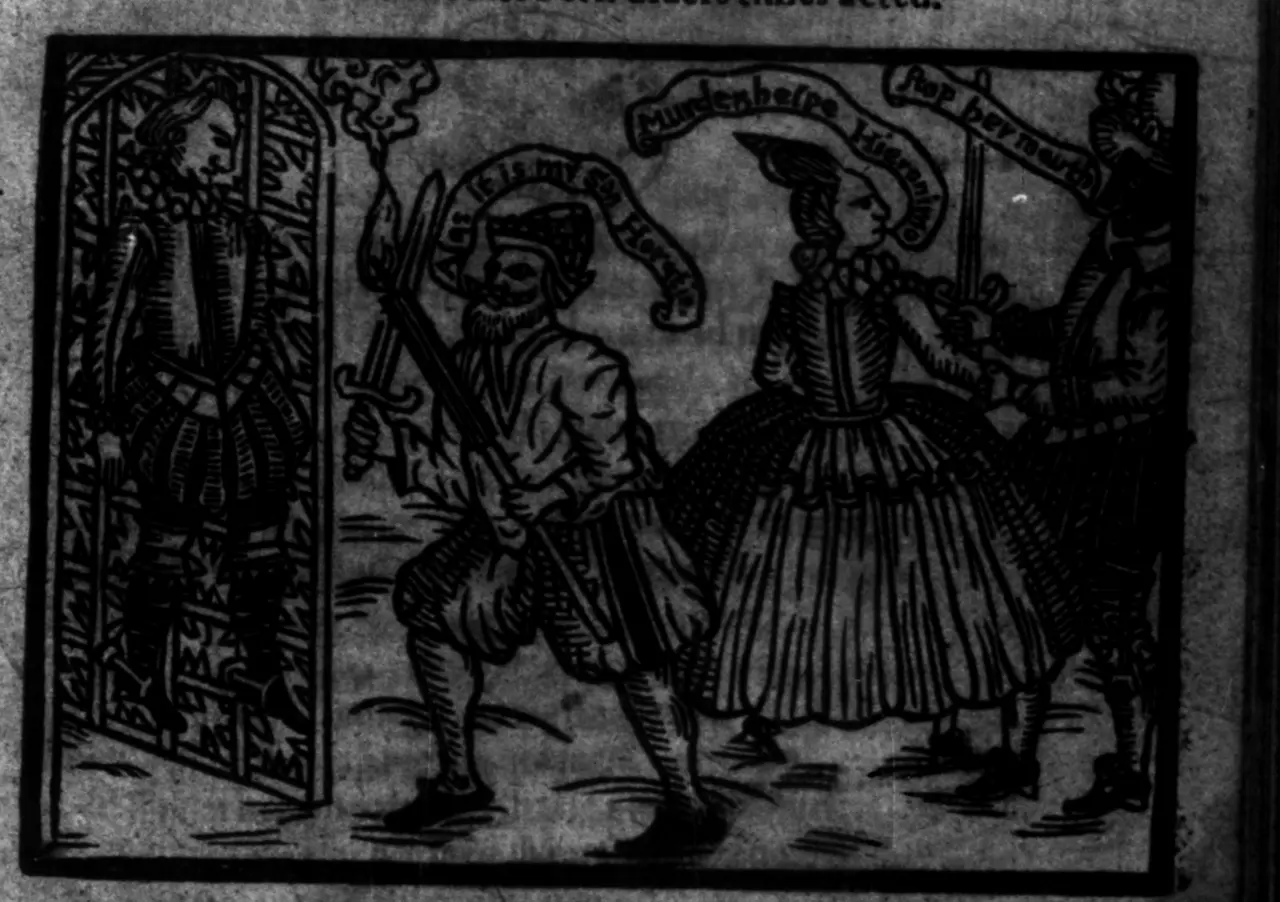
Act 1, Scene 1
Induction
Enter the GHOST OF ANDREA, and with him REVENGE.
When this eternal substance of my soul
Did live imprison’d in my wanton flesh,
Each in their function serving other’s need,
I was a courtier in the Spanish court.
My name was Don Andrea; my descent,
Though not ignoble, yet inferior far
To gracious fortunes of my tender youth:
For there in prime and pride of all my years,
By duteous service and deserving love,
In secret I possess’d a worthy dame,
Which hight sweet Bel-imperia by name.
But in the harvest of my summer joys
Death’s winter nipp’d the blossoms of my bliss,
Forcing divorce betwixt my love and me.
For in the late conflict with Portingale
My valour drew me into danger’s mouth
Till life to death made passage through my wounds.
When I was slain, my soul descended straight
To pass the flowing stream of Acheron;
But churlish Charon, only boatman there,
Said that, my rites of burial not perform’d,
I might not sit amongst his passengers.
Ere Sol had slept three nights in Thetis’ lap,
And slak’d his smoking chariot in her flood,
By Don Horatio, our knight marshal’s son,
My funerals and obsequies were done.
Then was the ferryman of hell content
To pass me over to the slimy strand,
That leads to fell Avernus’ ugly waves.
There, pleasing Cerberus with honey’d speech,
I pass’d the perils of the foremost porch,
Not far from hence, amidst ten thousand souls,
Sat Minos, Aeacus, and Rhadamanth;
To whom no sooner ’gan I make approach,
To crave a passport for my wand’ring ghost,
But Minos, in graven leaves of lottery,
Drew forth the manner of my life and death.
“This knight,” quoth he, “both liv’d and died in love;
And for his love tried fortune of the wars;
And by war’s fortune lost both love and life.”
“Why then,” said Aeacus, “convey him hence,
To walk with lovers in our fields of love,
And spend the course of everlasting time
Under green myrtle-trees and cypress shades.”
“No, no,” said Rhadamanth, “it were not well,
With loving souls to place a martialist.
He died in war, and must to martial fields,
Where wounded Hector lives in lasting pain,
And Achilles’ Myrmidons do scour the plain.”
Then Minos, mildest censor of the three,
Made this device to end the difference:
“Send him,” quoth he, “to our infernal king,
To doom him as best seems his majesty.”
To this effect my passport straight was drawn.
In keeping on my way to Pluto’s court,
Through dreadful shades of ever-glooming night,
I saw more sights than thousand tongues can tell,
Or pens can write, or mortal hearts can think.
Three ways there were: that on the right-hand side
Was ready way unto the ’foresaid fields,
Where lovers live and bloody martialists;
But either sort contain’d within his bounds.
The left-hand path, declining fearfully,
Was ready downfall to the deepest hell,
Where bloody Furies shakes their whips of steel,
And poor Ixion turns an endless wheel;
Where usurers are chok’d with melting gold,
And wantons are embrac’d with ugly snakes,
And murderers groan with never-killing wounds,
And perjur’d wights scalded in boiling lead,
And all foul sins with torments overwhelm’d.
’Twixt these two ways I trod the middle path,
Which brought me to the fair Elysian green,
In midst whereof there stands a stately tower,
The walls of brass, the gates of adamant.
Here finding Pluto with his Proserpine,
I show’d my passport, humbled on my knee;
Whereat fair Proserpine began to smile,
And begg’d that only she might give my doom.
Pluto was pleas’d, and seal’d it with a kiss.
Forthwith, Revenge, she rounded thee in th’ ear,
And bade thee lead me through the gates of horn,
Where dreams have passage in the silent night.
No sooner had she spoke, but we were here—
I wot not how—in twinkling of an eye.
Then know, Andrea, that thou art arriv’d
Where thou shalt see the author of thy death,
Don Balthazar, the prince of Portingale,
Depriv’d of life by Bel-imperia.
Here sit we down to see the mystery,
And serve for Chorus in this tragedy.
Act 1, Scene 2
The Court of Spain
Enter SPANISH KING, GENERAL, CASTILE, and HIERONIMO
Now say, lord General, how fares our camp?
All well, my sovereign liege, except some few
That are deceas’d by fortune of the war.
But what portends thy cheerful countenance,
And posting to our presence thus in haste?
Speak, man, hath fortune given us victory?
Victory, my liege, and that with little loss.
Our Portingals will pay us tribute then?
Tribute and wonted homage therewithal.
Then bless’d be heaven and guider of the heavens,
From whose fair influence such justice flows.
O multum dilecte Deo, tibi militat aether,
Et conjuratae curvato poplite gentes
Succumbunt: recti soror est victoria juris.
Thanks to my loving brother of Castile.
But, General, unfold in brief discourse
Your form of battle and your war’s success,
That, adding all the pleasure of thy news
Unto the height of former happiness,
With deeper wage and greater dignity
We may reward thy blissful chivalry.
Where Spain and Portingale do jointly knit
Their frontiers, leaning on each other’s bound,
There met our armies in their proud array;
Both furnish’d well, both full of hope and fear,
Both menacing alike with daring shows,
Both vaunting sundry colours of device,
Both cheerly sounding trumpets, drums, and fifes,
Both raising dreadful clamours to the sky,
That valleys, hills, and rivers made rebound,
And heav’n itself was frighted with the sound.
Our battles both were pitch’d in squadron form,
Each corner strongly fenc’d with wings of shot;
But ere we join’d and came to push of pike,
I brought a squadron of our readiest shot
From out our rearward to begin the fight:
They brought another wing t’ encounter us.
Meanwhile, our ordnance play’d on either side,
And captains strove to have their valours tried.
Don Pedro, their chief horsemen’s colonel,
Did with his cornet bravely make attempt
To break the order of our battle ranks:
But Don Rogero, worthy man of war,
March’d forth against him with our musketeers,
And stopp’d the malice of his fell approach.
While they maintain hot skirmish to and fro,
Both battles join, and fall to handy-blows,
Their violent shot resembling th’ ocean’s rage,
When, roaring loud, and with a swelling tide,
It beats upon the rampiers of huge rocks,
And gapes to swallow neighbour-bounding lands.
Now, while Bellona rageth here and there,
Thick storms of bullets ran like winter’s hail,
And shivered lances dark the troubled air.
Pede pes et cuspide cuspis;
Arma sonant armis, vir petiturque viro.
On every side drop captains to the ground,
And soldiers, some ill-maim’d, some slain outright:
Here falls a body sund’red from his head,
There legs and arms lie bleeding on the grass,
Mingled with weapons and unbowell’d steeds,
That scattering overspread the purple plain.
In all this turmoil, three long hours and more,
The victory to neither part inclin’d;
Till Don Andrea, with his brave lanciers,
In their main battle made so great a breach,
That, half dismay’d, the multitude retir’d:
But Balthazar, the Portingals’ young prince,
Brought rescue, and encourag’d them to stay.
Here-hence the fight was eagerly renew’d,
And in that conflict was Andrea slain:
Brave man at arms, but weak to Balthazar.
Yet while the prince, insulting over him,
Breath’d out proud vaunts, sounding to our reproach,
Friendship and hardy valour join’d in one
Prick’d forth Horatio, our knight marshal’s son,
To challenge forth that prince in single fight.
Not long between these twain the fight endur’d,
But straight the prince was beaten from his horse,
And forc’d to yield him prisoner to his foe.
When he was taken, all the rest they fled,
And our carbines pursu’d them to the death,
Till, Phoebus waving to the western deep,
Our trumpeters were charg’d to sound retreat.
Thanks, good lord General, for these good news;
And for some argument of more to come,
Take this and wear it for thy sovereign’s sake.
[Gives him his chain]
But tell me now, hast thou confirm’d a peace?
No peace, my liege, but peace conditional,
That if with homage tribute be well paid,
The fury of your forces will be stay’d:
And to this peace their viceroy hath subscrib’d,
[Gives the King a paper]
And made a solemn vow that, during life,
His tribute shall be truly paid to Spain.
These words, these deeds, become thy person well.
But now, knight marshal, frolic with thy king,
For ’tis thy son that wins this battle’s prize.
Long may he live to serve my sovereign liege,
And soon decay, unless he serve my liege.
Nor thou, nor he, shall die without reward.
[A tucket afar off]
What means this warning of this trumpet’s sound?
This tells me that your grace’s men of war,
Such as war’s fortune hath reserv’d from death,
Come marching on towards your royal seat,
To show themselves before your majesty;
For so I gave in charge at my depart.
Whereby by demonstration shall appear
That all, except three hundred or few more,
Are safe return’d, and by their foes enrich’d.
The Army enters; BALTHAZAR, between LORENZO and HORATIO, captive
A gladsome sight! I long to see them here.
[They enter and pass by]
Was that the warlike prince of Portingale,
That by our nephew was in triumph led?
It was, my liege, the prince of Portingale.
But what was he that on the other side
Held him by th’ arm, as partner of the prize?
That was my son, my gracious sovereign;
Of whom though from his tender infancy
My loving thoughts did never hope but well,
He never pleas’d his father’s eyes till now,
Nor fill’d my heart with over-cloying joys.
Go, let them march once more about these walls,
That, staying them, we may confer and talk
With our brave prisoner and his double guard.
[Exit a messenger]
Hieronimo, it greatly pleaseth us
That in our victory thou have a share,
By virtue of thy worthy son’s exploit.
[Enter again]
Bring hither the young prince of Portingale:
The rest march on; but, ere they be dismiss’d,
We will bestow on every soldier
Two ducats and on every leader ten,
That they may know our largess welcomes them.
[Exeunt all but the KING, BALTHAZAR, LORENZO and HORATIO]
Welcome, Don Balthazar! welcome, nephew!
And then, Horatio, thou art welcome too.
Young prince, although thy father’s hard misdeeds,
In keeping back the tribute that he owes,
Deserve but evil measure at our hands,
Yet shalt thou know that Spain is honourable.
The trespass that my father made in peace
Is now controll’d by fortune of the wars;
And cards once dealt, it boots not ask why so.
His men are slain, a weakening to his realm;
His colours seiz’d, a blot unto his name,
His son distress’d, a cor’sive to his heart:
These punishments may clear his late offence.
Ay, Balthazar, if he observe this truce,
Our peace will grow the stronger for these wars.
Meanwhile live thou, though not in liberty,
Yet free from bearing any servile yoke;
For in our hearing thy deserts were great,
And in our sight thyself art gracious.
And I shall study to deserve this grace.
But tell me—for their holding makes me doubt—
To which of these twain art thou prisoner?
To me, my liege.
To me, my sovereign.
This hand first took his courser by the reins.
But first my lance did put him from his horse.
I seiz’d his weapon, and enjoy’d it first.
But first I forc’d him lay his weapons down.
Let go his arm, upon our privilege.
[They let him go]
Say, worthy prince, to whether did’st thou yield?
To him in courtesy, to this perforce.
He spake me fair, this other gave me strokes;
He promis’d life, this other threat’ned death;
He won my love, this other conquer’d me,
And, truth to say, I yield myself to both.
But that I know your grace for just and wise,
And might seem partial in this difference,
Enforc’d by nature and by law of arms
My tongue should plead for young Horatio’s right.
He hunted well that was a lion’s death,
Not he that in a garment wore his skin;
So hares may pull dead lions by the beard.
Content thee, marshal, thou shalt have no wrong;
And, for thy sake, thy son shall want no right.
Will both abide the censure of my doom?
I crave no better than your grace awards.
Nor I, although I sit beside my right.
Then by my judgment, thus your strife shall end:
You both deserve, and both shall have reward.
Nephew, thou took’st his weapon and his horse:
His weapons and his horse are thy reward.
Horatio, thou didst force him first to yield:
His ransom therefore is thy valour’s fee;
Appoint the sum, as you shall both agree.
But, nephew, thou shalt have the prince in guard,
For thine estate best fitteth such a guest:
Horatio’s house were small for all his train.
Yet, in regard thy substance passeth his,
And that just guerdon may befall desert,
To him we yield the armour of the prince.
How likes Don Balthazar of this device?
Right well, my liege, if this proviso were,
That Don Horatio bear us company,
Whom I admire and love for chivalry.
Horatio, leave him not that loves thee so.—
Now let us hence to see our soldiers paid,
And feast our prisoner as our friendly guest. [Exeunt]
Act 1, Scene 3
The Court of Portugal
Enter VICEROY, ALEXANDRO, VILLUPPO
Is our ambassador despatch’d for Spain?
Two days, my liege, are past since his depart.
And tribute-payment gone along with him?
Ay, my good lord.
Then rest we here awhile in our unrest,
And feed our sorrows with some inward sighs,
For deepest cares break never into tears.
But wherefore sit I in a regal throne?
This better fits a wretch’s endless moan.
[Falls to the ground]
Yet this is higher than my fortunes reach,
And therefore better than my state deserves.
Ay, ay, this earth, image of melancholy,
Seeks him whom fates adjudge to misery.
Here let me lie; now am I at the lowest.
Qui jacet in terra, non habet unde cadat.
In me consumpsit vires fortuna nocendo;
Nil superest ut jam possit obesse magis.
Yes, Fortune may bereave me of my crown:
Here, take it now;—let Fortune do her worst,
She will not rob me of this sable weed.
O no, she envies none but pleasant things.
Such is the folly of despiteful chance!
Fortune is blind, and sees not my deserts;
So is she deaf, and hears not my laments;
And could she hear, yet is she wilful-mad,
And therefore will not pity my distress.
Suppose that she could pity me, what then?
What help can be expected at her hands
Whose foot [is] standing on a rolling stone,
And mind more mutable than fickle winds?
Why wail I, then, where’s hope of no redress?
O yes, complaining makes my grief seem less.
My late ambition hath distain’d my faith;
My breach of faith occasion’d bloody wars;
Those bloody wars have spent my treasury;
And with my treasury my people’s blood;
And with their blood, my joy and best belov’d,
My best belov’d, my sweet and only son.
O, wherefore went I not to war myself?
The cause was mine; I might have died for both.
My years were mellow, his but young and green;
My death were natural, but his was forc’d.
No doubt, my liege, but still the prince survives.
Survives! Ay, where?
In Spain, a prisoner by mischance of war.
Then they have slain him for his father’s fault.
That were a breach to common law of arms.
They reck no laws that meditate revenge.
His ransom’s worth will stay from foul revenge.
No; if he liv’d, the news would soon be here.
Nay, evil news fly faster still than good.
Tell me no more of news, for he is dead.
My sovereign, pardon the author of ill news,
And I’ll bewray the fortune of thy son.
Speak on, I’ll guerdon thee, whate’er it be.
Mine ear is ready to receive ill news;
My heart grown hard ’gainst mischief’s battery.
Stand up, I say, and tell thy tale at large.
Then hear that truth which these mine eyes have seen.
When both the armies were in battle join’d,
Don Balthazar, amidst the thickest troops,
To win renown did wondrous feats of arms.
Amongst the rest, I saw him, hand to hand,
In single fight with their lord-general;
Till Alexandro, that here counterfeits
Under the colour of a duteous friend,
Discharg’d his pistol at the prince’s back
As though he would have slain their general:
But therewithal Don Balthazar fell down;
And when he fell, then we began to fly:
But, had he liv’d, the day had sure been ours.
O wicked forgery! O traitorous miscreant!
Hold thou thy peace! But now, Villuppo, say,
Where then became the carcase of my son?
I saw them drag it to the Spanish tents.
Ay, ay, my nightly dreams have told me this.—
Thou false, unkind, unthankful, traitorous beast,
Wherein had Balthazar offended thee,
That thou shouldst thus betray him to our foes?
Was’t Spanish gold that bleared so thine eyes
That thou couldst see no part of our deserts?
Perchance, because thou art Terceira’s lord,
Thou hadst some hope to wear this diadem,
If first my son and then myself were slain;
But thy ambitious thought shall break thy neck.
Ay, this was it that made thee spill his blood;
[Takes the crown and puts it on again]
But I’ll now wear it till thy blood be spilt.
Vouchsafe, dread sovereign, to hear me speak.
Away with him! His sight is second hell.
Keep him till we determine of his death:
[They take him out]
If Balthazar be dead, he shall not live.
Villuppo, follow us for thy reward. [Exit Viceroy]
Thus have I with an envious, forged tale
Deceiv’d the king, betray’d mine enemy,
And hope for guerdon of my villany. [Exit]
Act 1, Scene 4
The Court of Spain
Enter HORATIO and BEL-IMPERIA
Signior Horatio, this is the place and hour,
Wherein I must entreat thee to relate
The circumstance of Don Andrea’s death,
Who, living, was my garland’s sweetest flower,
And in his death hath buried my delights.
For love of him and service to yourself,
I nill refuse this heavy doleful charge;
Yet tears and sighs, I fear, will hinder me.
When both our armies were enjoin’d in fight,
Your worthy chevalier amidst the thick’st,
For glorious cause still aiming at the fairest,
Was at the last by young Don Balthazar
Encount’red hand to hand. Their fight was long,
Their hearts were great, their clamours menacing,
Their strength alike, their strokes both dangerous,
But wrathful Nemesis, that wicked power,
Envying at Andrea’s praise and worth,
Cut short his life, to end his praise and worth.
She, she herself, disguis’d in armour’s mask—
As Pallas was before proud Pergamus—
Brought in a fresh supply of halberdiers,
Which paunch’d his horse, and ding’d him to the ground.
Then young Don Balthazar with ruthless rage,
Taking advantage of his foe’s distress,
Did finish what his halberdiers begun,
And left not, till Andrea’s life was done.
Then, though too late, incens’d with just remorse,
I with my band set forth against the prince,
And brought him prisoner from his halberdiers.
Would thou hadst slain him that so slew my love!
But then was Don Andrea’s carcase lost?
No, that was it for which I chiefly strove,
Nor stepp’d I back till I recover’d him.
I took him up, and wound him in mine arms;
And wielding him unto my private tent,
There laid him down, and dew’d him with my tears,
And sigh’d and sorrowed as became a friend.
But neither friendly sorrow, sighs, nor tears
Could win pale Death from his usurped right.
Yet this I did, and less I could not do:
I saw him honoured with due funeral.
This scarf I pluck’d from off his lifeless arm,
And wear it in remembrance of my friend.
I know the scarf: would he had kept it still!
For had he liv’d, he would have kept it still,
And worn it for his Bel-imperia’s sake;
For ’t was my favour at his last depart.
But now wear thou it both for him and me;
For after him thou hast deserv’d it best.
But for thy kindness in his life and death,
Be sure, while Bel-imperia’s life endures,
She will be Don Horatio’s thankful friend.
And, madam, Don Horatio will not slack
Humbly to serve fair Bel-imperia.
But now, if your good liking stand thereto,
I’ll crave your pardon to go seek the prince;
For so the duke, your father, gave me charge.
Ay, go, Horatio, leave me here alone;
For solitude best fits my cheerless mood. [Exit HORATIO]
Yet what avails to wail Andrea’s death,
From whence Horatio proves my second love?
Had he not lov’d Andrea as he did,
He could not sit in Bel-imperia’s thoughts.
But how can love find harbour in my breast
Till I revenge the death of my belov’d?
Yes, second love shall further my revenge!
I’ll love Horatio, my Andrea’s friend,
The more to spite the prince that wrought his end;
And where Don Balthazar, that slew my love,
Himself now pleads for favour at my hands,
He shall, in rigour of my just disdain,
Reap long repentance for his murderous deed.
For what was’t else but murderous cowardice,
So many to oppress one valiant knight,
Without respect of honour in the fight?
And here he comes that murd’red my delight.
Enter LORENZO and BALTHAZAR
Sister, what means this melancholy walk?
That for a while I wish no company.
But here the prince is come to visit you.
That argues that he lives in liberty.
No, madam, but in pleasing servitude.
Your prison then, belike, is your conceit.
Ay, by conceit my freedom is enthrall’d.
Then with conceit enlarge yourself again.
What, if conceit have laid my heart to gage?
Pay that you borrowed, and recover it.
I die, if it return from whence it lies.
A heartless man, and live? A miracle!
Ay, lady, love can work such miracles.
Tush, tush, my lord! let go these ambages,
And in plain terms acquaint her with your love.
What boots complaint, when there’s no remedy?
Yes, to your gracious self must I complain,
In whose fair answer lies my remedy,
On whose perfection all my thoughts attend,
On whose aspect mine eyes find beauty’s bower,
In whose translucent breast my heart is lodg’d.
Alas, my lord, these are but words of course.
And but devis’d to drive me from this place.
She, in going in, lets fall her glove, which HORATIO, coming out, takes up
Madam, your glove.
Thanks, good Horatio; take it for thy pains.
Signior Horatio stoop’d in happy time!
I reap’d more grace than I deserv’d or hop’d.
My lord, be not dismay’d for what is past;
You know that women oft are humorous.
These clouds will overblow with little wind;
Let me alone, I’ll scatter them myself.
Meanwhile, let us devise to spend the time
In some delightful sports and revelling.
The king, my lords, is coming hither straight,
To feast the Portingal ambassador;
Things were in readiness before I came.
Then here it fits us to attend the king,
To welcome hither our ambassador,
And learn my father and my country’s health.
Act 1, Scene 5
The same
Enter the Banquet, Trumpets, the KING, and Ambassador.
See, lord Ambassador, how Spain entreats
Their prisoner Balthazar, thy viceroy’s son.
We pleasure more in kindness than in wars.
Sad is our king, and Portingale laments,
Supposing that Don Balthazar is slain.
So am I!—slain by beauty’s tyranny.
You see, my lord, how Balthazar is slain:
I frolic with the Duke of Castile’s son,
Wrapp’d every hour in pleasures of the court,
And grac’d with favours of his majesty.
Put off your greetings, till our feast be done;
Now come and sit with us, and taste our cheer.
[Sit to the banquet]
Sit down, young prince, you are our second guest;
Brother, sit down; and, nephew, take your place.
Signior Horatio, wait thou upon our cup;
For well thou hast deserved to be honoured.
Now, lordings, fall to; Spain is Portugal,
And Portugal is Spain: we both are friends;
Tribute is paid, and we enjoy our right.
But where is old Hieronimo, our marshal?
He promis’d us, in honour of our guest,
To grace our banquet with some pompous jest.
Enter HIERONIMO, with a drum, three knights, each his scutcheon; then he fetches three kings; they take their crowns and them captive
Hieronimo, this masque contents mine eye,
Although I sound not well the mystery.
The first arm’d knight, that hung his scutcheon up,
[He takes the scutcheon and gives it to the KING]
Was English Robert, Earl of Gloucester,
Who, when King Stephen bore sway in Albion,
Arriv’d with five and twenty thousand men
In Portingale, and by success of war
Enforc’d the king, then but a Saracen,
To bear the yoke of the English monarchy.
My lord of Portingale, by this you see
That which may comfort both your king and you,
And make your late discomfort seem the less.
But say, Hieronimo, what was the next?
The second knight, that hung his scutcheon up,
[He doth as he did before]
Was Edmund, Earl of Kent in Albion,
When English Richard wore the diadem.
He came likewise, and razed Lisbon walls,
And took the King of Portingale in fight;
For which and other such-like service done
He after was created Duke of York.
This is another special argument,
That Portingale may deign to bear our yoke,
When it by little England hath been yok’d.
But now, Hieronimo, what were the last?
The third and last, not least, in our account,
[Doing as before]
Was, as the rest, a valiant Englishman,
Brave John of Gaunt, the Duke of Lancaster,
As by his scutcheon plainly may appear.
He with a puissant army came to Spain,
And took our King of Castile prisoner.
This is an argument for our viceroy
That Spain may not insult for her success,
Since English warriors likewise conquered Spain,
And made them bow their knees to Albion.
Hieronimo, I drink to thee for this device,
Which hath pleas’d both the ambassador and me:
Pledge me, Hieronimo, if thou love the king.
[Takes the cup of Horatio]
My lord, I fear we sit but over-long,
Unless our dainties were more delicate;
But welcome are you to the best we have.
Now let us in, that you may be despatch’d:
I think our council is already set. [Exeunt omnes]
Chorus
Come we for this from depth of underground,
To see him feast that gave me my death’s wound?
These pleasant sights are sorrow to my soul:
Nothing but league, and love, and banqueting?
Be still, Andrea; ere we go from hence,
I’ll turn their friendship into fell despite,
Their love to mortal hate, their day to night,
Their hope into despair, their peace to war,
Their joys to pain, their bliss to misery.
Act 2, Scene 1
Palace of Don Cyprian
Enter LORENZO and BALTHAZAR
My lord, though Bel-imperia seem thus coy,
Let reason hold you in your wonted joy.
In time the savage bull sustains the yoke,
In time all haggard hawks will stoop to lure,
In time small wedges cleave the hardest oak,
In time the flint is pierc’d with softest shower,
And she in time will fall from her disdain,
And rue the sufferance of your friendly pain.
No, she is wilder, and more hard withal,
Than beast, or bird, or tree, or stony wall.
But wherefore blot I Bel-imperia’s name?
It is my fault, not she, that merits blame.
My feature is not to content her sight,
My words are rude and work her no delight.
The lines I send her are but harsh and ill,
Such as do drop from Pan and Marsyas’ quill.
My presents are not of sufficient cost,
And being worthless, all my labour’s lost.
Yet might she love me for my valiancy:
Ay, but that’s sland’red by captivity.
Yet might she love me to content her sire:
Ay, but her reason masters his desire.
Yet might she love me as her brother’s friend:
Ay, but her hopes aim at some other end.
Yet might she love me to uprear her state:
Ay, but perhaps she hopes some nobler mate.
Yet might she love me as her beauty’s thrall:
Ay, but I fear she cannot love at all.
My lord, for my sake leave this ecstasy,
And doubt not but we’ll find some remedy.
Some cause there is that lets you not be lov’d;
First that must needs be known, and then remov’d.
What, if my sister love some other knight?
My summer’s day will turn to winter’s night.
I have already found a stratagem
To sound the bottom of this doubtful theme.
My lord, for once you shall be rul’d by me;
Hinder me not, whate’er you hear or see.
By force or fair means will I cast about
To find the truth of all this question out.
Ho, Pedringano!
Signior!
Vien qui presto.
Enter PEDRINGANO
Hath your lordship any service to command me?
Ay, Pedringano, service of import;
And—not to spend the time in trifling words—
Thus stands the case: it is not long, thou know’st,
Since I did shield thee from my father’s wrath,
For thy conveyance in Andrea’s love,
For which thou wert adjudg’d to punishment.
I stood betwixt thee and thy punishment,
And since, thou knowest how I have favoured thee.
Now to these favours will I add reward,
Not with fair words, but store of golden coin,
And lands and living join’d with dignities,
If thou but satisfy my just demand.
Tell truth, and have me for thy lasting friend.
Whate’er it be your lordship shall demand,
My bounden duty bids me tell the truth,
If case it lie in me to tell the truth.
Then, Pedringano, this is my demand:
Whom loves my sister Bel-imperia?
For she reposeth all her trust in thee.
Speak, man, and gain both friendship and reward:
I mean, whom loves she in Andrea’s place?
Alas, my lord, since Don Andrea’s death
I have no credit with her as before,
And therefore know not, if she love or no.
Nay, if thou dally, then I am thy foe,
[Draws his sword]
And fear shall force what friendship cannot win.
Thy death shall bury what thy life conceals;
Thou diest for more esteeming her than me.
O, stay, my lord!
Yet speak the truth, and I will guerdon thee,
And shield thee from whatever can ensue,
And will conceal whate’er proceeds from thee.
But if thou dally once again, thou diest.
If madam Bel-imperia be in love——
What, villain! Ifs and ands?
[Offers to kill him]
O, stay, my lord! She loves Horatio.
[BALTHAZAR starts back]
What, Don Horatio, our knight marshal’s son?
Even him, my lord.
Now say but how know’st thou he is her love,
And thou shalt find me kind and liberal.
Stand up, I say, and fearless tell the truth.
She sent him letters, which myself perus’d,
Full-fraught with lines and arguments of love,
Preferring him before Prince Balthazar.
Swear on this cross that what thou say’st is true,
And that thou wilt conceal what thou hast told.
I swear to both, by him that made us all.
In hope thine oath is true, here’s thy reward;
But if I prove thee perjur’d and unjust,
This very sword whereon thou took’st thine oath
Shall be the worker of thy tragedy.
What I have said is true, and shall—for me—
Be still conceal’d from Bel-imperia.
Besides, your honour’s liberality
Deserves my duteous service, even till death.
Let this be all that thou shalt do for me:
Be watchful when and where these lovers meet,
And give me notice in some secret sort.
I will, my lord.
Then shalt thou find that I am liberal.
Thou know’st that I can more advance thy state
Than she; be therefore wise, and fail me not.
Go and attend her, as thy custom is,
Lest absence make her think thou dost amiss.
[Exit PEDRINGANO]
Why so: tam armis quam ingenio:
Where words prevail not, violence prevails;
But gold doth more than either of them both.
How likes Prince Balthazar this stratagem?
Both well and ill; it makes me glad and sad:
Glad, that I know the hinderer of my love;
Sad, that I fear she hates me whom I love:
Glad, that I know on whom to be reveng’d;
Sad, that she’ll fly me, if I take revenge.
Yet must I take revenge, or die myself,
For love resisted grows impatient.
I think Horatio be my destin’d plague:
First, in his hand he brandished a sword,
And with that sword he fiercely waged war,
And in that war he gave me dangerous wounds,
And by those wounds he forced me to yield,
And by my yielding I became his slave.
Now in his mouth he carries pleasing words,
Which pleasing words do harbour sweet conceits,
Which sweet conceits are lim’d with sly deceits,
Which sly deceits smooth Bel-imperia’s ears,
And through her ears dive down into her heart,
And in her heart set him, where I should stand.
Thus hath he ta’en my body by his force,
And now by sleight would captivate my soul;
But in his fall I’ll tempt the destinies,
And either lose my life, or win my love.
Let’s go, my lord; your staying stays revenge.
Do you but follow me, and gain your love:
Her favour must be won by his remove. [Exeunt]
Act 2, Scene 2
The same
Enter HORATIO and BEL-IMPERIA
Now, madam, since by favour of your love
Our hidden smoke is turn’d to open flame,
And that with looks and words we feed our thought
[Two chief contents, where more cannot be had];
Thus, in the midst of love’s fair blandishments,
Why show you sign of inward languishments.
PEDRINGANO showeth all to the PRINCE and LORENZO, placing them in secret
My heart, sweet friend, is like a ship at sea:
She wisheth port, where, riding all at ease,
She may repair what stormy times have worn,
And leaning on the shore, may sing with joy
That pleasure follows pain, and bliss annoy.
Possession of thy love is th’ only port,
Wherein my heart, with fears and hopes long toss’d,
Each hour doth wish and long to make resort,
There to repair the joys that it hath lost,
And, sitting safe, to sing in Cupid’s choir
That sweetest bliss is crown of love’s desire.
[BALTHAZAR and LORENZO above]
O sleep, mine eyes, see not my love profan’d;
Be deaf, my ears, hear not my discontent;
Die, heart; another joys what thou deserv’st.
Watch still, mine eyes, to see this love disjoin’d;
Hear still, mine ears, to hear them both lament;
Live, heart, to joy at fond Horatio’s fall.
Why stands Horatio speechless all this while?
The less I speak, the more I meditate.
But whereon dost thou chiefly meditate?
On dangers past, and pleasures to ensue.
On pleasures past, and dangers to ensue.
What dangers and what pleasures dost thou mean?
Dangers of war, and pleasures of our love.
Dangers of death, but pleasures none at all.
Let dangers go, thy war shall be with me:
But such a war as breaks no bond of peace.
Speak thou fair words, I’ll cross them with fair words;
Send thou sweet looks, I’ll meet them with sweet looks;
Write loving lines, I’ll answer loving lines;
Give me a kiss, I’ll countercheck thy kiss:
Be this our warring peace, or peaceful war.
But, gracious madam, then appoint the field,
Where trial of this war shall first be made.
Ambitious villain, how his boldness grows!
Then be thy father’s pleasant bower the field,
Where first we vow’d a mutual amity:
The court were dangerous, that place is safe.
Our hour shall be, when Vesper ’gins to rise,
That summons home distressful travellers.
There none shall hear us but the harmless birds;
Haply the gentle nightingale
Shall carol us asleep, ere we be ware,
And, singing with the prickle at her breast,
Tell our delight and mirthful dalliance.
Till then each hour will seem a year and more.
But, honey-sweet and honourable love,
Return we now into your father’s sight;
Dangerous suspicion waits on our delight.
Ay, danger mixed with jealous despite
Shall send thy soul into eternal night. [Exeunt]
Act 2, Scene 3
The Court of Spain
Enter KING OF SPAIN, PORTINGALE AMBASSADOR, DON CYPRIAN, etc
Brother of Castile, to the prince’s love
What says your daughter Bel-imperia?
Although she coy it, as becomes her kind,
And yet dissemble that she loves the prince,
I doubt not, I, but she will stoop in time.
And were she froward, which she will not be,
Yet herein shall she follow my advice,
Which is to love him, or forgo my love.
Then, lord Ambassador of Portingale,
Advise thy king to make this marriage up,
For strengthening of our late-confirmed league;
I know no better means to make us friends.
Her dowry shall be large and liberal:
Besides that she is daughter and half-heir
Unto our brother here, Don Cyprian,
And shall enjoy the moiety of his land,
I’ll grace her marriage with an uncle’s gift,
And this it is, in case the match go forward:
The tribute which you pay, shall be releas’d;
And if by Balthazar she have a son,
He shall enjoy the kingdom after us.
I’ll make the motion to my sovereign liege,
And work it, if my counsel may prevail.
Do so, my lord, and if he give consent,
I hope his presence here will honour us,
In celebration of the nuptial day;
And let himself determine of the time.
Will’t please your grace command me aught beside?
Commend me to the king, and so farewell.
But where’s Prince Balthazar to take his leave?
That is perform’d already, my good lord.
Amongst the rest of what you have in charge,
The prince’s ransom must not be forgot:
That’s none of mine, but his that took him prisoner;
And well his forwardness deserves reward.
It was Horatio, our knight marshal’s son.
Between us there’s a price already pitch’d,
And shall be sent with all convenient speed.
Then once again farewell, my lord.
Farewell, my lord of Castile, and the rest. [Exit]
Now, brother, you must take some little pains
To win fair Bel-imperia from her will.
Young virgins must be ruled by their friends.
The prince is amiable, and loves her well;
If she neglect him and forgo his love,
She both will wrong her own estate and ours.
Therefore, whiles I do entertain the prince
With greatest pleasure that our court affords,
Endeavour you to win your daughter’s thought:
If she give back, all this will come to naught.
[Exeunt]
Act 2, Scene 4
Hieronimo’s garden
Enter HORATIO, BEL-IMPERIA, and PEDRINGANO
Now that the night begins with sable wings
To overcloud the brightness of the sun,
And that in darkness pleasures may be done:
Come, Bel-imperia, let us to the bower,
And there in safety pass a pleasant hour.
I follow thee, my love, and will not back,
Although my fainting heart controls my soul.
Why, make you doubt of Pedringano’s faith?
No, he is as trusty as my second self.—
Go, Pedringano, watch without the gate,
And let us know if any make approach.
[Aside] Instead of watching, I’ll deserve more gold
By fetching Don Lorenzo to this match.
[Exit PEDRINGANO]
What means thy love?
I know not what myself;
And yet my heart foretells me some mischance.
Sweet, say not so; fair fortune is our friend,
And heavens have shut up day to pleasure us.
The stars, thou see’st, hold back their twinkling shine,
And Luna hides herself to pleasure us.
Thou hast prevail’d; I’ll conquer my misdoubt,
And in thy love and counsel drown my fear.
I fear no more; love now is all my thoughts.
Why sit we not? for pleasure asketh ease.
The more thou sitt’st within these leafy bowers,
The more will Flora deck it with her flowers.
Ay, but if Flora spy Horatio here,
Her jealous eye will think I sit too near.
Hark, madam, how the birds record by night,
For joy that Bel-imperia sits in sight.
No, Cupid counterfeits the nightingale,
To frame sweet music to Horatio’s tale.
If Cupid sing, then Venus is not far:
Ay, thou art Venus, or some fairer star.
If I be Venus, thou must needs be Mars;
And where Mars reigneth, there must needs be wars.
Then thus begin our wars: put forth thy hand,
That it may combat with my ruder hand.
Set forth thy foot to try the push of mine.
But first my looks shall combat against thine.
Then ward thyself: I dart this kiss at thee.
Thus I retort the dart thou threw’st at me.
Nay, then to gain the glory of the field,
My twining arms shall yoke and make thee yield.
Nay, then my arms are large and strong withal:
Thus elms by vines are compass’d, till they fall.
O, let me go; for in my troubled eyes
Now may’st thou read that life in passion dies.
O, stay a while, and I will die with thee;
So shalt thou yield, and yet have conquer’d me.
Who’s there? Pedringano? We are betray’d!
Enter LORENZO, BALTHAZAR, SERBERINE, PEDRINGANO, disguised
My lord, away with her, take her aside.—
O, sir, forbear: your valour is already tried.
Quickly despatch, my masters.
[They hang him in the arbour]
What, will you murder me?
Ay, thus, and thus: these are the fruits of love.
[They stab him]
O, save his life, and let me die for him!
O, save him, brother: save him, Balthazar:
I lov’d Horatio; but he lov’d not me.
But Balthazar loves Bel-imperia.
Although his life were still ambitious, proud,
Yet is he at the highest now he is dead.
Murder! murder! Help, Hieronimo, help!
Come, stop her mouth; away with her.
[Exeunt]
Enter HIERONIMO in his shirt, etc
What outcries pluck me from my naked bed,
And chill my throbbing heart with trembling fear,
Which never danger yet could daunt before?
Who calls Hieronimo? Speak, here I am.
I did not slumber; therefore ’t was no dream.
No, no, it was some woman cried for help,
And here within this garden did she cry,
And in this garden mast I rescue her.—
But stay, what murd’rous spectacle is this?
A man hang’d up and all the murderers gone!
And in my bower, to lay the guilt on me!
This place was made for pleasure, not for death.
[He cuts him down]
Those garments that he wears I oft have seen—
Alas, it is Horatio, my sweet son!
O no, but he that whilom was my son!
O, was it thou that call’dst me from my bed?
O speak, if any spark of life remain:
I am thy father; who hath slain my son?
What savage monster, not of human kind,
Hath here been glutted with thy harmless blood,
And left thy bloody corpse dishonoured here,
For me, amidst these dark and deathful shades,
To drown thee with an ocean of my tears?
O heavens, why made you night to cover sin?
By day this deed of darkness had not been.
O earth, why didst thou not in time devour
The vild profaner of this sacred hower?
O poor Horatio, what hadst thou misdone,
To leese thy life, ere life was new begun?
O wicked butcher, whatsoe’er thou wert,
How could thou strangle virtue and desert?
Ay me most wretched, that have lost my joy,
In leesing my Horatio, my sweet boy!
Enter ISABELLA
My husband’s absence makes my heart to throb:—
Hieronimo!
Here, Isabella, help me to lament;
For sighs are stopp’d, and all my tears are spent.
What world of grief! my son Horatio!
O, where’s the author of this endless woe?
To know the author were some ease of grief,
For in revenge my heart would find relief.
Then is he gone? and is my son gone too?
O, gush out, tears, fountains and floods of tears;
Blow, sighs, and raise an everlasting storm;
For outrage fits our cursed wretchedness.
Ay me, Hieronimo, sweet husband, speak!
He supp’d with us to-night, frolic and merry.
And said he would go visit Balthazar
At the duke’s palace: there the prince doth lodge.
He had no custom to stay out so late:
He may be in his chamber; some go see.
Roderigo, ho!
Enter PEDRO and JAQUES
Ay me, he raves!—Sweet Hieronimo!
True, all Spain takes note of it.
Besides, he is so generally belov’d;
His majesty the other day did grace him
With waiting on his cup: these be favours,
Which do assure me he cannot be short-liv’d.
Sweet Hieronimo!
I wonder how this fellow got his clothes!—
Sirrah, sirrah, I’ll know the truth of all.
Jaques, run to the Duke of Castile’s presently,
And bid my son Horatio to come home:
I and his mother have had strange dreams to-night.
Do ye hear me, sir!
Ay, sir.
Well, sir, be gone.
Pedro, come hither: know’st thou who this is?
Too well, sir.
Too well! Who, who is it? Peace, Isabella!
Nay, blush not, man.
It is my lord Horatio.
Ha, ha, St. James! but this doth make me laugh,
That there are more deluded than myself.
Deluded?
Ay:
I would have sworn myself, within this hour,
That this had been my son Horatio:
His garments are so like.
Ha! are they not great persuasions?
O, would to God it were not so!
Were not, Isabella? Dost thou dream it is?
Can thy soft bosom entertain a thought
That such a black deed of mischief should be done
On one so pure and spotless as our son?
Away, I am ashamed.
Dear Hieronimo,
Cast a more serious eye upon thy grief:
Weak apprehension gives but weak belief.
It was a man, sure, that was hang’d up here;
A youth, as I remember: I cut him down.
If it should prove my son now after all—
Say you? say you?—Light! lend me a taper;
Let me look again.—O God!
Confusion, mischief, torment, death and hell,
Drop all your stings at once in my cold bosom,
That now is stiff with horror: kill me quickly!
Be gracious to me, thou infective night.
And drop this deed of murder down on me;
Gird in my waste of grief with thy large darkness.
And let me not survive to see the light
May put me in the mind I had a son.
O sweet Horatio! O my dearest son!
How strangely had I lost my way to grief!
Sweet, lovely rose, ill-pluckt before thy time,
Fair, worthy son, not conquer’d, but betray’d,
I’ll kiss thee now, for words with tears are stay’d.
And I’ll close up the glasses of his sight,
For once these eyes were only my delight.
See’st thou this handkercher besmear’d with blood?
It shall not from me, till I take revenge.
See’st thou those wounds that yet are bleeding fresh?
I’ll not entomb them, till I have reveng’d.
Then will I joy amidst my discontent;
Till then my sorrow never shall be spent.
The heavens are just; murder cannot be hid:
Time is the author both of truth and right,
And time will bring this treachery to light.
Meanwhile, good Isabella, cease thy plaints.
Or, at the least, dissemble them awhile:
So shall we sooner find the practice out,
And learn by whom all this was brought about.
Come, Isabel, now let us take him up,
[They take him up]
And bear him in from out this cursed place.
I’ll say his dirge; singing fits not this case.
O aliquis mihi quas pulchrum ver educal herbas.
[Hieronimo sets his breast unto his sword]
Misceat, et nostro detur medicina dolori;
Aut, si qui faciunt annorum oblivia, succos
Praebeat: ipse metam magnum quaecunque per orbem
Gramina Sol pulchras effert in luminis oras;
Ipse bibam quicquid meditatur saga veneni,
Quicquid et herbarum vi caeca nenia nectit
Omnia perpetiar, lethum quoque, dum semel omnis
Noster in extincto moriatur pectore sensus.—
Ergo tuos oculos nunquam, mea vita, videbo,
Et tua perpetuus sepelivit lumina somnus?
Emoriar tecum: sic, juvat ire sub umbras.—
At tamen absistam properato cedere letho,
Ne mortem vindicta tuam tam nulla sequatur.
[Here he throws it from him and bears the body away]
Chorus
Brought’st thou me hither to increase my pain?
I look’d that Balthazar should have been slain;
But ’t is my friend Horatio that is slain,
And they abuse fair Bel-imperia,
On whom I doted more than all the world,
Because she lov’d me more than all the world.
Thou talk’st of harvest, when the corn is green:
The end is crown of every work well done;
The sickle comes not, till the corn be ripe,
Be still; and ere I lead thee from this place,
I’ll show thee Balthazar in heavy case.
Act 3, Scene 1
The Court of Portugal
Enter VICEROY OF PORTINGALE, Nobles, ALEXANDRO, VILLUPPO
Infortunate condition of kings.
Seated amidst so many helpless doubts!
First we are plac’d upon extremest height,
And oft supplanted with exceeding hate,
But ever subject to the wheel of chance;
And at our highest never joy we so
As we both doubt and dread our overthrow.
So striveth not the waves with sundry winds
As Fortune toileth in the affairs of kings,
That would be fear’d, yet fear to be belov’d,
Sith fear or love to kings is flattery.
For instance, lordings, look upon your king,
By hate deprived of his dearest son,
The only hope of our successive line.
I had not thought that Alexandro’s heart
Had been envenom’d with such extreme hate;
But now I see that words have several works,
And there’s no credit in the countenance.
No; for, my lord, had you beheld the train
That feigned love had colour’d in his looks,
When he in camp consorted Balthazar,
Far more inconstant had you thought the sun,
That hourly coasts the centre of the earth,
Than Alexandro’s purpose to the prince.
No more, Villuppo, thou hast said enough,
And with thy words thou slay’st our wounded thoughts.
Nor shall I longer dally with the world,
Procrastinating Alexandro’s death.
Go some of you, and fetch the traitor forth,
That, as he is condemned, he may die.
Enter ALEXANDRO with a Nobleman and halberts
In such extremes will nought but patience serve.
But in extremes what patience shall I use?
Nor discontents it me to leave the world,
With whom there nothing can prevail but wrong.
Yet hope the best.
’T is heaven is my hope.
As for the earth, it is too much infect
To yield me hope of any of her mould.
Why linger ye? Bring forth that daring fiend.
And let him die for his accursed deed.
Not that I fear the extremity of death
[For nobles cannot stoop to servile fear]
Do I, O king, thus discontented live.
But this, O this, torments my labouring soul,
That thus I die suspected of a sin
Whereof, as heav’ns have known my secret thoughts,
So am I free from this suggestion.
No more, I say! to the tortures! When?
Bind him, and burn his body in those flames.
[They bind him to a stake]
That shall prefigure those unquenched fires
Of Phlegethon, prepared for his soul.
My guiltless death will be aveng’d on thee,
On thee, Villuppo, that hath malic’d thus,
Or for thy meed hast falsely me accus’d.
Nay, Alexandro, if thou menace me,
I’ll lend a hand to send thee to the lake
Where those thy words shall perish with thy works,
Injurious traitor! monstrous homicide!
Enter AMBASSADOR
Stay, hold a while;
And here—with pardon of his majesty—
Lay hands upon Villuppo.
Ambassador,
What news hath urg’d this sudden entrance?
Know, sovereign lord, that Balthazar
doth live.
What say’st thou? Liveth Balthazar our son?
Your highness’ son, Lord Balthazar, doth live;
And, well entreated in the court of Spain,
Humbly commends him to your majesty.
These eyes beheld; and these my followers,
With these, the letters of the king’s commends,
[Gives him letters]
Are happy witnesses of his highness’ health.
[The King looks on the letters, and proceeds]
“Thy son doth live, your tribute is receiv’d;
Thy peace is made, and we are satisfied.
The rest resolve upon as things propos’d
For both our honours and thy benefit.”
These are his highness’ farther articles.
[He gives him more letters]
Accursed wretch, to intimate these ills
Against the life and reputation
Of noble Alexandro! Come, my lord, unbind him.—
Let him unbind thee, that is bound to death.
To make a quital for thy discontent.
[They unbind him]
Dread lord, in kindness you could do no less
Upon report of such a damned fact;
But thus we see our innocence hath sav’d
The hopeless life which thou, Villuppo, sought
By thy suggestions to have massacred.
Say, false Villuppo, wherefore didst thou thus
Falsely betray Lord Alexandro’s life?
Him whom thou know’st that no unkindness else
But even the slaughter of our dearest son
Could once have mov’d us to have misconceiv’d.
Say, treacherous Villuppo, tell the king:
Wherein hath Alexandro us’d thee ill?
Rent with remembrance of so foul a deed,
My guilty soul submits me to thy doom;
For not for Alexandro’s injuries,
But for reward and hope to be preferr’d,
Thus have I shamelessly hazarded his life.
Which, villain, shall be ransom’d with thy death;
And not so mean a torment as we here
Devis’d for him who, thou said’st, slew our son,
But with the bitt’rest torments and extremes
That may be yet invented for thine end.
[ALEXANDRO seems to entreat]
Entreat me not; go, take the traitor hence:
[Exit VILLUPPO]
And, Alexandro, let us honour thee
With public notice of thy loyalty.—
To end those things articulated here
By our great lord, the mighty King of Spain,
We with our council will deliberate.
Come, Alexandro, keep us company. [Exeunt]
Act 3, Scene 2
The Court of Spain
Enter HIERONIMO
O eyes! no eyes, but fountains fraught with tears;
O life! no life, but lively form of death;
O world! no world, but mass of public wrongs,
Confus’d and fill’d with murder and misdeeds!
O sacred heav’ns! if this unhallowed deed,
If this inhuman and barbarous attempt,
If this incomparable murder thus
Of mine, but now no more my son,
Shall unreveal’d and unrevenged pass,
How should we term your dealings to be just,
If you unjustly deal with those that in your justice trust?
The night, sad secretary to my moans,
With direful visions wake my vexed soul,
And with the wounds of my distressful son
Solicit me for notice of his death.
The ugly fiends do sally forth of hell,
And frame my steps to unfrequented paths,
And fear my heart with fierce inflamed thoughts.
The cloudy day my discontents records,
Early begins to register my dreams,
And drive me forth to seek the murderer.
Eyes, life, world, heav’ns, hell, night, and day,
See, search, shew, send some man, some mean, that may—
[A letter falleth]
What’s here? a letter? Tush! it is not so!—
A letter written to Hieronimo! [Red ink]
“For want of ink, receive this bloody writ.
Me hath my hapless brother hid from thee;
Revenge thyself on Balthazar and him:
For these were they that murdered thy son.
Hieronimo, revenge Horatio’s death,
And better fare than Bel-imperia doth.”
What means this unexpected miracle?
My son slain by Lorenzo and the prince!
What cause had they Horatio to malign?
Or what might move thee, Bel-imperia,
To accuse thy brother, had he been the mean?
Hieronimo, beware!—thou art betray’d,
And to entrap thy life this train is laid.
Advise thee therefore, be not credulous:
This is devised to endanger thee,
That thou, by this, Lorenzo shouldst accuse;
And he, for thy dishonour done, should draw
Thy life in question and thy name in hate.
Dear was the life of my beloved son,
And of his death behoves me be reveng’d;
Then hazard not thine own, Hieronimo,
But live t’ effect thy resolution.
I therefore will by circumstances try,
What I can gather to confirm this writ;
And, heark’ning near the Duke of Castile’s house,
Close, if I can, with Bel-imperia,
To listen more, but nothing to bewray.
[Enter PEDRINGANO]
Now, Pedringano!
Now, Hieronimo!
Where ’s thy lady?
I know not; here ’s my lord.
Enter LORENZO
How now, who’s this? Hieronimo?
My lord.
He asketh for my lady Bel-imperia.
What to do, Hieronimo? The duke, my father, hath
Upon some disgrace awhile remov’d her hence;
But, if it be ought I may inform her of,
Tell me, Hieronimo, and I’ll let her know it.
Nay, nay, my lord, I thank you; it shall not need.
I had a suit unto her, but too late,
And her disgrace makes me unfortunate.
Why so, Hieronimo? Use me.
O no, lord, I dare not; it must not be.
I humbly thank your lordship.
Who? You, my lord?
I reserve your favour for a greater honour;
This is a very toy, my lord, a toy.
All’s one, Hieronimo, acquaint me with it.
I’ faith, my lord, it is an idle thing;
I must confess I ha’ been too slack, too tardy,
Too remiss unto your honour.
How now, Hieronimo?
In troth, my lord, it is a thing of nothing:
The murder of a son, or so——
A thing of nothing, my lord!
Why then, farewell.
My grief no heart, my thoughts no tongue can tell. [Exit]
Come hither, Pedringano, see’st thou this?
My lord, I see it, and suspect it too.
This is that damned villain Serberine
That hath, I fear, reveal’d Horatio’s death.
My lord, he could not, ’t was so lately done;
And since he hath not left my company.
Admit he have not, his condition’s such,
As fear or flattering words may make him false.
I know his humour, and therewith repent
That e’er I us’d him in this enterprise.
But, Pedringano, to prevent the worst,
And ’cause I know thee secret as my soul,
Here, for thy further satisfaction, take thou this,
[Gives him more gold]
And hearken to me—thus it is devis’d:
This night thou must [and, prithee, so resolve],
Meet Serberine at Saint Luigi’s Park—
Thou know’st ’t is here hard by behind the house;
There take thy stand, and see thou strike him sure,
For die he must, if we do mean to live.
But how shall Serberine be there, my lord?
Let me alone; I ’ll send to him to meet
The prince and me, where thou must do this deed.
It shall be done, my lord, it shall be done;
And I ’ll go arm myself to meet him there.
When things shall alter, as I hope they will,
Then shalt thou mount for this; thou know’st my mind.
[Exit PEDRINGANO]
Che le Ieron!
Enter PAGE
My lord?
Go, sirrah,
To Serberine, and bid him forthwith meet
The prince and me at Saint Luigi’s Park,
Behind the house; this evening, boy!
I go, my lord.
But, sirrah, let the hour be eight o’clock:
Bid him not fail.
I fly, my lord. [Exit]
Now to confirm the complot thou hast cast
Of all these practices, I ’ll spread the watch,
Upon precise commandment from the king,
Strongly to guard the place where Pedringano
This night shall murder hapless Serberine.
Thus must we work that will avoid distrust;
Thus must we practise to prevent mishap,
And thus one ill another must expulse.
This sly enquiry of Hieronimo
For Bel-imperia breeds suspicion,
And this suspicion bodes a further ill.
As for myself, I know my secret fault,
And so do they; but I have dealt for them:
They that for coin their souls endangered,
To save my life, for coin shall venture theirs;
And better it ’s that base companions die
Than by their life to hazard our good haps.
Nor shall they live, for me to fear their faith:
I ’ll trust myself, myself shall be my friend;
For die they shall,—
Slaves are ordained to no other end. [Exit]
Act 3, Scene 3
Saint Luigi’s Park
Enter PEDRINGANO, with a pistol
Now, Pedringano, bid thy pistol hold,
And hold on, Fortune! once more favour me;
Give but success to mine attempting spirit,
And let me shift for taking of mine aim.
Here is the gold: this is the gold propos’d;
It is no dream that I adventure for,
But Pedringano is possess’d thereof.
And he that would not strain his conscience
For him that thus his liberal purse hath stretch’d,
Unworthy such a favour, may he fail,
And, wishing, want when such as I prevail.
As for the fear of apprehension,
I know, if need should be, my noble lord
Will stand between me and ensuing harms;
Besides, this place is free from all suspect:
Here therefore will I stay and take my stand.
Enter the Watch.
I wonder much to what intent it is
That we are thus expressly charg’d to watch.
’T is by commandment in the king’s own name.
But we were never wont to watch and ward
So near the duke his brother’s house before.
Content yourself, stand close, there ’s somewhat in ’t.
Enter SERBERINE
Here, Serberine, attend and stay thy pace;
For here did Don Lorenzo’s page appoint
That thou by his command shouldst meet with him.
How fit a place—if one were so dispos’d—
Methinks this corner is to close with one.
Here comes the bird that I must seize upon.
Now, Pedringano, or never, play the man!
I wonder that his lordship stays so long,
Or wherefore should he send for me so late?
For this, Serberine!—and thou shalt ha ’t.
[Shoots the dag]
So, there he lies; my promise is perform’d.
The Watch
Hark, gentlemen, this is a pistol shot.
And here ’s one slain;—stay the murderer.
Now by the sorrows of the souls in hell.
[He strives with the Watch]
Who first lays hand on me, I ’ll be his priest.
Sirrah, confess, and therein play the priest,
Why hast thou thus unkindly kill’d the man?
Why? Because he walk’d abroad so late.
Come, sir, you had been better kept your bed,
Than have committed this misdeed so late.
Come, to the marshal’s with the murderer!
On to Hieronimo’s! help me here
To bring the murd’red body with us too.
Hieronimo? Carry me before whom you will.
Whate’er he be, I’ll answer him and you;
And do your worst, for I defy you all. [Exeunt]
Act 3, Scene 4
Palace of Don Cyprian
Enter LORENZO and BALTHAZAR
How now, my lord, what makes you rise so soon?
Fear of preventing our mishaps too late.
What mischief is it that we not mistrust?
Our greatest ills we least mistrust, my lord,
And inexpected harms do hurt us most.
Why, tell me, Don Lorenzo, tell me, man,
If ought concerns our honour and your own.
Nor you, nor me, my lord, but both in one;
For I suspect—and the presumption’s great—
That by those base confederates in our fault
Touching the death of Don Horatio,
We are betray’d to old Hieronimo.
Betray’d, Lorenzo? Tush! it cannot be.
A guilty conscience, urged with the thought
Of former evils, easily cannot err.
I am persuaded—and dissuade me not—
That all ’s revealed to Hieronimo.
And therefore know that I have cast it thus:—
[Enter Page]
But here’s the page. How now? what news with thee?
My lord, Serberine is slain.
Who? Serberine, my man?
Your highness’ man, my lord.
Speak, page, who murdered him?
He that is apprehended for the fact.
Who?
Pedringano.
Is Serberine slain, that lov’d his lord so well?
Injurious villain, murderer of his friend!
Hath Pedringano murdered Serberine?
My lord, let me entreat you to take the pains
To exasperate and hasten his revenge
With your complaints unto my lord the king.
This their dissension breed a greater doubt.
Assure thee, Don Lorenzo, he shall die,
Or else his highness hardly shall deny.
Meanwhile I’ll haste the marshal-sessions,
For die he shall for this his damned deed.
[Exit BALTHAZAR]
Why so, this fits our former policy,
And thus experience bids the wise to deal.
I lay the plot; he prosecutes the point:
I set the trap; he breaks the worthless twigs,
And sees not that wherewith the bird was lim’d.
Thus hopeful men, that mean to hold their own,
Must look like fowlers to their dearest friends.
He runs to kill whom I have holp to catch,
And no man knows it was my reaching fetch.
’T is hard to trust unto a multitude,
Or any one, in mine opinion,
When men themselves their secrets will reveal.
[Enter a Messenger with a letter]
Boy!
My lord.
What’s he?
I have a letter to your lordship.
From whence?
From Pedringano that’s imprison’d.
So he is in prison then?
Ay, my good lord.
What would he with us?—He writes us here,
To stand good lord, and help him in distress.—
Tell him I have his letters, know his mind;
And what we may, let him assure him of.
Fellow, begone; my boy shall follow thee.
[Exit Messenger]
This works like wax; yet once more try thy wits.
Boy, go, convey this purse to Pedringano;
Thou know’st the prison, closely give it him,
And be advis’d that none be there about.
Bid him be merry still, but secret;
And though the marshal-sessions be to-day,
Bid him not doubt of his delivery.
Tell him his pardon is already sign’d,
And thereon bid him boldly be resolv’d:
For, were he ready to be turned off—
As ’t is my will the uttermost be tried—
Thou with his pardon shalt attend him still.
Show him this box, tell him his pardon ’s in ’t;
But open ’t not, an if thou lov’st thy life,
But let him wisely keep his hopes unknown.
He shall not want while Don Lorenzo lives.
Away!
I go, my lord, I run.
But, sirrah, see that this be cleanly done.
[Exit Page]
Now stands our fortune on a tickle point,
And now or never ends Lorenzo’s doubts.
One only thing is uneffected yet,
And that’s to see the executioner.
But to what end? I list not trust the air
With utterance of our pretence therein,
For fear the privy whisp’ring of the wind
Convey our words amongst unfriendly ears,
That lie too open to advantages.
E quel che voglio io, nessun lo sa;
Intendo io: quel mi basterà. [Exit]
Act 3, Scene 5
A street
Enter Boy with the box
My master hath forbidden me to look in this box; and, by my
troth, ’t is likely, if he had not warned me, I should not have had
so much idle time; for we men’s-kind in our minority are like women
in their uncertainty: that they are most forbidden, they will
soonest attempt: so I now.——By my bare honesty, here’s nothing but
the bare empty box! Were it not sin against secrecy, I would say it
were a piece of gentlemanlike knavery. I must go to Pedringano,
and tell him his pardon is in this box; nay, I would have sworn it,
had I not seen the contrary. I cannot choose but smile to think how
the villain will flout the gallows, scorn the audience, and descant
on the hangman, and all presuming of his pardon from hence. Will
’t not be an odd jest for me to stand and grace every jest he makes,
pointing my finger at this box, as who would say, “Mock on, here’s
thy warrant.” Is ’t not a scurvy jest that a man should jest
himself to death? Alas! poor Pedringano, I am in a sort sorry for
thee; but if I should be hanged with thee, I cannot weep. [Exit]
Act 3, Scene 6
A Court of Justice
Enter HIERONIMO and the Deputy
Thus must we toil in other men’s extremes,
That know not how to remedy our own;
And do them justice, when unjustly we,
For all our wrongs, can compass no redress.
But shall I never live to see the day,
That I may come, by justice of the heavens,
To know the cause that may my cares allay?
This toils my body, this consumeth age,
That only I to all men just must be,
And neither gods nor men be just to me.
Worthy Hieronimo, your office asks
A care to punish such as do transgress.
So is ’t my duty to regard his death
Who, when he liv’d, deserv’d my dearest blood.
But come, for that we came for: let’s begin,
For here lies that which bids me to be gone.
Enter Officers, Boy, and PEDRINGANO, with a letter in his hand, bound
Bring forth the prisoner, for the court is set.
Gramercy, boy, but it was time to come;
For I had written to my lord anew
A nearer matter that concerneth him,
For fear his lordship had forgotten me.
But sith he hath rememb’red me so well—
Come, come, come on, when shall we to this gear?
Stand forth, thou monster, murderer of men.
And here, for satisfaction of the world,
Confess thy folly, and repent thy fault;
For there’s thy place of execution.
This is short work. Well, to your marshalship
First I confess—nor fear I death therefore—
I am the man, ’t was I slew Serberine.
But, sir, then you think this shall be the place,
Where we shall satisfy you for this gear?
Ay, Pedringano.
Now I think not so.
Peace, impudent; for thou shalt find it so;
For blood with blood shall, while I sit as judge,
Be satisfied, and the law discharg’d.
And though myself cannot receive the like,
Yet will I see that others have their right.
Despatch: the fault’s approved and confess’d,
And by our law he is condemn’d to die.
Come on, sir, are you ready?
To do what, my fine, officious knave?
To go to this gear.
O sir, you are too forward: thou wouldst fain furnish me with
a halter, to disfurnish me of my habit. So I should go out
of this gear, my raiment, into that gear, the rope. But, hangman, now
I spy your knavery, I’ll not change without boot, that’s flat.
Come, sir.
So, then, I must up?
No remedy.
Yes, but there shall be for my coming down.
Indeed, here’s a remedy for that.
How? Be turn’d off?
Ay, truly. Come, are you ready? I pray, sir, despatch; the
day goes away.
What, do you hang by the hour? If you do, I may chance to
break your old custom.
Faith, you have reason; for I am like to break your young
neck.
Dost thou mock me, hangman? Pray God, I be not preserved to
break your knave’s pate for this.
Alas, sir! you are a foot too low to reach it, and I hope
you will never grow so high while I am in the office.
Sirrah, dost see yonder boy with the box in his hand?
What, he that points to it with his finger?
Ay, that companion.
I know him not; but what of him?
Dost thou think to live till his old doublet will make thee a
new truss?
Ay, and many a fair year after, to truss up many an honester
man than either thou or he.
What hath he in his box, as thou think’st?
Faith, I cannot tell, nor I care not greatly; methinks you
should rather hearken to your soul’s health.
Why, sirrah, hangman, I take it that that is good for the body
is likewise good for the soul: and it may be, in that box is balm
for both.
Well, thou art even the merriest piece of man’s flesh that
e’er groan’d at my office door!
Is your roguery become an office with a knave’s name?
Ay, and that shall all they witness that see you seal it
with a thief’s name.
I prithee, request this good company to pray with me.
Ay, marry, sir, this is a good motion. My masters, you see
here’s a good fellow.
Nay, nay, now I remember me, let them alone till some other
time; for now I have no great need.
I have not seen a wretch so impudent.
O monstrous times, where murder’s set so light,
And where the soul, that should be shrin’d in heaven,
Solely delights in interdicted things,
Still wand’ring in the thorny passages,
That intercepts itself of happiness.
Murder! O bloody monster! God forbid
A fault so foul should ’scape unpunished.
Despatch, and see this execution done!—
This makes me to remember thee, my son. [Exit HIERONIMO]
Nay, soft, no haste.
Why, wherefore stay you? Have you hope of life?
Why, ay!
As how?
Why, rascal, by my pardon from the king.
Stand you on that? Then you shall off with this.
[He turns him off]
So, executioner;—convey him hence;
But let his body be unburied:
Let not the earth be choked or infect
With that which heav’n contemns, and men neglect. [Exeunt]
Act 3, Scene 7
Hieronimo’s house
Enter HIERONIMO
Where shall I run to breathe abroad my woes,
My woes, whose weight hath wearied the earth?
Or mine exclaims, that have surcharg’d the air
With ceaseless plaints for my deceased son?
The blust’ring winds, conspiring with my words,
At my lament have mov’d the leafless trees,
Disrob’d the meadows of their flow’red green,
Made mountains marsh with spring-tides of my tears,
And broken through the brazen gates of hell.
Yet still tormented is my tortured soul
With broken sighs and restless passions,
That, winged, mount; and, hovering in the air,
Beat at the windows of the brightest heavens,
Soliciting for justice and revenge:
But they are plac’d in those empyreal heights,
Where, countermur’d with walls of diamond,
I find the place impregnable; and they
Resist my woes, and give my words no way.
Enter Hangman with a letter
O lord, sir! God bless you, sir! the man, sir, Petergade,
sir, he that was so full of merry conceits—
Well, what of him?
O lord, sir, he went the wrong way; the fellow had a fair
commission to the contrary. Sir, here is his passport; I pray you,
sir, we have done him wrong.
I warrant thee, give it me.
You will stand between the gallows and me?
Ay, ay.
I thank your lord worship.
[Exit Hangman]
And yet, though somewhat nearer me concerns,
I will, to ease the grief that I sustain,
Take truce with sorrow while I read on this.
“My lord, I write, as mine extremes requir’d,
That you would labour my delivery:
If you neglect, my life is desperate,
And in my death I shall reveal the troth.
You know, my lord, I slew him for your sake,
And was confed’rate with the prince and you;
Won by rewards and hopeful promises,
I holp to murder Don Horatio too.”—
Holp he to murder mine Horatio?
And actors in th’ accursed tragedy
Wast thou, Lorenzo, Balthazar and thou,
Of whom my son, my son deserv’d so well?
What have I heard, what have mine eyes beheld?
O sacred heavens, may it come to pass
That such a monstrous and detested deed,
So closely smother’d, and so long conceal’d,
Shall thus by this be venged or reveal’d?
Now see I what I durst not then suspect,
That Bel-imperia’s letter was not feign’d.
Nor feigned she, though falsely they have wrong’d
Both her, myself, Horatio, and themselves.
Now may I make compare ’twixt hers and this,
Of every accident I ne’er could find
Till now, and now I feelingly perceive
They did what heav’n unpunish’d would not leave.
O false Lorenzo! are these thy flattering looks?
Is this the honour that thou didst my son?
And Balthazar—bane to thy soul and me!—
Was this the ransom he reserv’d thee for?
Woe to the cause of these constrained wars!
Woe to thy baseness and captivity,
Woe to thy birth, thy body, and thy soul,
Thy cursed father, and thy conquer’d self!
And bann’d with bitter execrations be
The day and place where he did pity thee!
But wherefore waste I mine unfruitful words,
When nought but blood will satisfy my woes?
I will go plain me to my lord the king,
And cry aloud for justice through the court,
Wearing the flints with these my withered feet;
And either purchase justice by entreats,
Or tire them all with my revenging threats.
[Exit]
Act 3, Scene 8
The same
Enter ISABELLA and her Maid
So that you say this herb will purge the eye,
And this, the head?—
Ah!—but none of them will purge the heart!
No, there ’s no medicine left for my disease,
Nor any physic to recure the dead.
[She runs lunatic]
Horatio! O, where ’s Horatio?
Good madam, affright not thus yourself
With outrage for your son Horatio:
He sleeps in quiet in the Elysian fields.
Why, did I not give you gowns and goodly things,
Bought you a whistle and a whipstalk too,
To be revenged on their villanies?
Madam, these humours do torment my soul.
My soul—poor soul, thou talk’st of things
Thou know’st not what—my soul hath silver wings,
That mounts me up unto the highest heavens;
To heaven? Ay, there sits my Horatio,
Back’d with a troop of fiery Cherubins,
Dancing about his newly healed wounds,
Singing sweet hymns and chanting heav’nly notes,
Rare harmony to greet his innocence,
That died, ay died, a mirror in our days.
But say, where shall I find the men, the murderers,
That slew Horatio? Whither shall I run
To find them out that murdered my son?
[Exeunt]
Act 3, Scene 9
Palace of Don Cyprian
BEL-IMPERIA at a window
What means this outrage that is off’red me?
Why am I thus sequest’red from the court?
No notice! Shall I not know the cause
Of these my secret and suspicious ills?
Accursed brother, unkind murderer,
Why bend’st thou thus thy mind to martyr me?
Hieronimo, why writ I of thy wrongs,
Or why art thou so slack in thy revenge?
Andrea, O Andrea! that thou saw’st
Me for thy friend Horatio handled thus,
And him for me thus causeless murdered!—
Well, force perforce, I must constrain myself
To patience, and apply me to the time,
Till heaven, as I have hop’d, shall set me free.
Enter CHRISTOPHIL
Come, madam Bel-imperia, this may not be. [Exeunt]
Act 3, Scene 10
The same
Enter LORENZO, BALTHAZAR, and the Page
Boy, talk no further; thus far things go well.
Thou art assur’d that thou sawest him dead?
Or else, my lord, I live not.
That’s enough.
As for his resolution in his end,
Leave that to him with whom he sojourns now.
Here, take my ring and give it Christophil,
And bid him let my sister be enlarg’d,
And bring her hither straight.— [Exit Page]
This that I did was for a policy,
To smooth and keep the murder secret,
Which, as a nine-days’ wonder, being o’erblown,
My gentle sister will I now enlarge.
And time, Lorenzo: for my lord the duke,
You heard, enquired for her yester-night.
Why, and my lord, I hope you heard me say
Sufficient reason why she kept away;
But that’s all one. My lord, you love her?
Ay.
Then in your love beware; deal cunningly:
Salve all suspicions, only soothe me up;
And if she hap to stand on terms with us—
As for her sweetheart and concealment so—
Jest with her gently: under feigned jest
Are things conceal’d that else would breed unrest.
But here she comes.
[Enter BEL-IMPERIA]
Now, sister,—
Sister? No!
Thou art no brother, but an enemy;
Else wouldst thou not have us’d thy sister so:
First, to affright me with thy weapons drawn,
And with extremes abuse my company;
And then to hurry me, like whirlwind’s rage,
Amidst a crew of thy confederates,
And clap me up where none might come at me,
Nor I at any to reveal my wrongs.
What madding fury did possess thy wits?
Or wherein is ’t that I offended thee?
Advise you better, Bel-imperia,
For I have done you no disparagement;
Unless, by more discretion than deserv’d,
I sought to save your honour and mine own.
Mine honour? Why, Lorenzo, wherein is’t
That I neglect my reputation so,
As you, or any, need to rescue it?
His highness and my father were resolv’d
To come confer with old Hieronimo
Concerning certain matters of estate
That by the viceroy was determined.
And wherein was mine honour touch’d in that?
Have patience, Bel-imperia; hear the rest.
Me, next in sight, as messenger they sent
To give him notice that they were so nigh:
Now when I came, consorted with the prince,
And unexpected in an arbour there
Found Bel-imperia with Horatio—
How then?
Why, then, remembering that old disgrace,
Which you for Don Andrea had endur’d,
And now were likely longer to sustain,
By being found so meanly accompanied,
Thought rather—for I knew no readier mean—
To thrust Horatio forth my father’s way.
And carry you obscurely somewhere else,
Lest that his highness should have found you there.
Ev’n so, my lord? And you are witness
That this is true which he entreateth of?
You, gentle brother, forg’d this for my sake,
And you, my lord, were made his instrument?
A work of worth, worthy the noting too!
But what’s the cause that you conceal’d me since?
Your melancholy, sister, since the news
Of your first favourite Don Andrea’s death,
My father’s old wrath hath exasperate.
And better was’t for you, being in disgrace,
To absent yourself, and give his fury place.
But why had I no notice of his ire?
That were to add more fuel to your fire,
Who burnt like Aetna for Andrea’s loss.
Hath not my father then enquir’d for me?
Sister, he hath, and thus excus’d I thee.
[He whispereth in her ear]
But Bel-imperia, see the gentle prince;
Look on thy love, behold young Balthazar,
Whose passions by thy presence are increas’d;
And in whose melancholy thou may’st see
Thy hate, his love; thy flight, his following thee.
Brother, you are become an orator—
I know not, I, by what experience—
Too politic for me, past all compare,
Since last I saw you; but content yourself:
The prince is meditating higher things.
’T is of thy beauty, then, that conquers kings;
Of those thy tresses, Ariadne’s twines,
Wherewith my liberty thou hast surpris’d;
Of that thine ivory front, my sorrow’s map,
Wherein I see no haven to rest my hope.
To love and fear, and both at once, my lord,
In my conceit, are things of more import
Than women’s wits are to be busied with.
’T is I that love.
Whom?
Bel-imperia.
But I that fear.
Whom?
Bel-imperia.
Fear yourself?
Ay, brother.
How?
As those
That what they love are loth and fear to lose.
Then, fair, let Balthazar your keeper be.
No, Balthazar doth fear as well as we:
Et tremulo metui pavidum junxere timorem—
Est vanum stolidae proditionis opus.
Nay, and you argue things so cunningly,
We’ll go continue this discourse at court.
Led by the loadstar of her heavenly looks,
Wends poor oppressed Balthazar,
As o’er the mountains walks the wanderer,
Incertain to effect his pilgrimage. [Exeunt]
Act 3, Scene 11
A street
Enter two PORTINGALES, and HIERONIMO meets them.
By your leave, sir.
’T is neither as you think, nor as you think,
Nor as you think: you’re wide all.
These slippers are not mine, they were my son Horatio’s.
My son? and what’s a son? A thing begot
Within a pair of minutes—thereabout;
A lump bred up in darkness, and doth serve
To ballace these light creatures we call women:
And, at nine months’ end, creeps forth to light.
What is there yet in a son,
To make a father dote, rave, or run mad?
Being born, it pouts, cries, and breeds teeth.
What is there yet in a son? He must be fed,
Be taught to go, and speak. Ay, or yet
Why might not a man love a calf as well?
Or melt in passion o’er a frisking kid,
As for a son? Methinks, a young bacon,
Or a fine little smooth horse colt,
Should move a man as much as doth a son:
For one of these, in very little time,
Will grow to some good use, whereas a son,
The more he grows in stature and in years,
The more unsquar’d, unbevell’d, he appears,
Reckons his parents among the rank of fools,
Strikes care upon their heads with his mad riots,
Makes them look old before they meet with age.
This is a son!—And what a loss were this,
Consider’d truly?—O, but my Horatio
Grew out of reach of these insatiate humours:
He lov’d his loving parents:
He was my comfort, and his mother’s joy,
The very arm that did hold up our house:
Our hopes were stored up in him,
None but a damned murderer could hate him.
He had not seen the back of nineteen year,
When his strong arm unhors’d
The proud Prince Balthazar, and his great mind,
Too full of honour, took him unto mercy.
That valiant, but ignoble Portingale!
Well, heaven is heaven still!
And there is Nemesis, and Furies,
And things call’d whips,
And they sometimes do meet with murderers:
They do not always scape, that is some comfort.
Ay, ay, ay: and then time steals on,
And steals, and steals, till violence leaps forth
Like thunder wrapt in a ball of fire,
And so doth bring confusion to them all.
Good leave have you: nay, I pray you go,
For I’ll leave you, if you can leave me so.
Pray you, which is the next way to my lord the duke’s?
The next way from me.
To his house, we mean.
O, hard by: ’t is yon house that you see.
You could not tell us if his son were there?
Who, my Lord Lorenzo?
Ay, sir.
[He goeth in at one door and comes out at another]
O, forbear!
For other talk for us far fitter were.
But if you be importunate to know
The way to him, and where to find him out,
Then list to me, and I’ll resolve your doubt.
There is a path upon your left-hand side
That leadeth from a guilty conscience
Unto a forest of distrust and fear—
A darksome place, and dangerous to pass:
There shall you meet with melancholy thoughts,
Whose haleful humours if you but uphold,
It will conduct you to despair and death—
Whose rocky cliffs when you have once beheld,
Within a hugy dale of lasting night,
That, kindled with the world’s iniquities,
Doth cast up filthy and detested fumes:—
Not far from thence, where murderers have built
A habitation for their cursed souls,
There, in a brazen cauldron, fix’d by Jove,
In his fell wrath, upon a sulphur flame,
Yourselves shall find Lorenzo bathing him
In boiling lead and blood of innocents.
Ha, ha, ha!
Ha, ha, ha! Why, ha, ha, ha! Farewell, good ha, ha, ha!
[Exit]
Doubtless this man is passing lunatic,
Or imperfection of his age doth make him dote.
Come, let ’s away to seek my lord the duke.
[Exeunt]
Act 3, Scene 12
The Court of Spain
Enter HIERONIMO, with a poniard in one hand and a rope in the other
Now, sir, perhaps I come and see the king;
The king sees me, and fain would hear my suit:
Why, is not this a strange and seld-seen thing,
That standers-by with toys should strike me mute?
Go to, I see their shifts, and say no more.
Hieronimo, ’t is time for thee to trudge.
Down by the dale that flows with purple gore
Standeth a fiery tower; there sits a judge
Upon a seat of steel and molten brass,
And ’twixt his teeth he holds a fire-brand,
That leads unto the lake where hell doth stand.
Away, Hieronimo! to him be gone;
He’ll do thee justice for Horatio’s death.
Turn down this path: thou shalt be with him straight;
Or this, and then thou need’st not take thy breath:
This way or that way?——Soft and fair, not so:
For if I hang or kill myself, let’s know
Who will revenge Horatio’s murder then?
No, no! fie, no! pardon me, I’ll none of that.
[He flings away the dagger and halter]
This way I’ll take, and this way comes the king:
[He takes them up again]
And here I’ll have a fling at him, that’s flat;
And, Balthazar, I’ll be with thee to bring,
And thee, Lorenzo! Here’s the king—nay, stay;
And here, ay here—there goes the hare away.
Enter KING, AMBASSADOR, CASTILE, and LORENZO
Now show, ambassador, what our viceroy saith:
Hath he receiv’d the articles we sent?
Justice, O justice to Hieronimo.
Back! see’st thou not the king is busy?
O, is he so?
Who is he that interrupts our business?
Not I. [Aside] Hieronimo, beware! go by, go by!
Renowned King, he hath receiv’d and read
Thy kingly proffers, and thy promis’d league;
And, as a man extremely over-joy’d
To hear his son so princely entertain’d,
Whose death he had so solemnly bewail’d,
This for thy further satisfaction
And kingly love he kindly lets thee know:
First, for the marriage of his princely son
With Bel-imperia, thy beloved niece,
The news are more delightful to his soul,
Than myrrh or incense to the offended heavens.
In person, therefore, will he come himself,
To see the marriage rites solemnized,
And, in the presence of the court of Spain,
To knit a sure inexplicable band
Of kingly love and everlasting league
Betwixt the crowns of Spain and Portingal.
There will he give his crown to Balthazar,
And make a queen of Bel-imperia.
Brother, how like you this our viceroy’s love?
No doubt, my lord, it is an argument
Of honourable care to keep his friend,
And wondrous zeal to Balthazar his son;
Nor am I least indebted to his grace,
That bends his liking to my daughter thus.
Now last, dread lord, here hath his highness sent
[Although he send not that his son return]
His ransom due to Don Horatio.
Horatio! who calls Horatio?
And well rememb’red: thank his majesty.
Here, see it given to Horatio.
Justice, O, justice, justice, gentle king!
Who is that? Hieronimo?
Justice, O, justice! O my son, my son!
My son, whom naught can ransom or redeem!
Hieronimo, you are not well-advis’d.
Away, Lorenzo, hinder me no more;
For thou hast made me bankrupt of my bliss.
Give me my son! you shall not ransom him!
Away! I’ll rip the bowels of the earth,
[He diggeth with his dagger]
And ferry over to th’ Elysian plains,
And bring my son to show his deadly wounds.
Stand from about me!
I’ll make a pickaxe of my poniard,
And here surrender up my marshalship;
For I’ll go marshal up the fiends in hell,
To be avenged on you all for this.
What means this outrage?
Will none of you restrain his fury?
Nay, soft and fair! you shall not need to strive.
Needs must he go that the devils drive. [Exit]
What accident hath happ’d Hieronimo?
I have not seen him to demean him so.
My gracious lord, he is with extreme pride,
Conceiv’d of young Horatio his son
And covetous of having to himself
The ransom of the young prince Balthazar,
Distract, and in a manner lunatic.
Believe me, nephew, we are sorry for ’t:
This is the love that fathers bear their sons.
But, gentle brother, go give to him this gold,
The prince’s ransom; let him have his due.
For what he hath, Horatio shall not want;
Haply Hieronimo hath need thereof.
But if he be thus helplessly distract,
’T is requisite his office be resign’d,
And giv’n to one of more discretion.
We shall increase his melancholy so.
’T is best that we see further in it first,
Till when, ourself will execute the place.
And, brother, now bring in the ambassador,
That he may be a witness of the match
’Twixt Balthazar and Bel-imperia,
And that we may prefix a certain time,
Wherein the marriage shall be solemniz’d,
That we may have thy lord, the viceroy, here.
Therein your highness highly shall content
His majesty, that longs to hear from hence.
On, then, and hear you, lord ambassador—— [Exeunt]
Act 3, Scene 13
Hieronimo’s garden
Enter JAQUES and PEDRO.
I wonder, Pedro, why our master thus
At midnight sends us with our torches light,
When man, and bird, and beast, are all at rest,
Save those that watch for rape and bloody murder.
O Jaques, know thou that our matter’s mind
Is much distraught, since his Horatio died,
And—now his aged years should sleep in rest,
His heart in quiet—like a desperate man,
Grows lunatic and childish for his son.
Sometimes, as he doth at his table sit,
He speaks as if Horatio stood by him;
Then starting in a rage, falls on the earth,
Cries out, “Horatio, where is my Horatio?”
So that with extreme grief and cutting sorrow
There is not left in him one inch of man:
See, where he comes.
Enter HIERONIMO.
I pry through every crevice of each wall,
Look on each tree, and search through every brake,
Beat at the bushes, stamp our grandam earth,
Dive in the water, and stare up to heaven,
Yet cannot I behold my son Horatio—
How now, who’s there? Spirits, spirits?
We are your servants that attend you, sir.
What make you with your torches in the dark?
You bid us light them, and attend you here.
No, no, you are deceiv’d! not I;—you are deceiv’d!
Was I so mad to bid you light your torches now?
Light me your torches at the mid of noon,
When-as the sun-god rides in all his glory;
Light me your torches then.
Then we burn daylight.
Let it be burnt; Night is a murderous slut,
That would not have her treasons to be seen;
And yonder pale-fac’d Hecate there, the moon,
Doth give consent to that is done in darkness;
And all those stars that gaze upon her face,
Are aglets on her sleeve, pins on her train;
And those that should be powerful and divine,
Do sleep in darkness when they most should shine.
Provoke them not, fair sir, with tempting words:
The heav’ns are gracious, and your miseries
And sorrow makes you speak you know not what.
Villain, thou liest! and thou dost nought
But tell me I am mad. Thou liest, I am not mad!
I know thee to be Pedro, and he Jaques.
I’ll prove it to thee: and were I mad, how could I?
Where was she that same night when my Horatio
Was murd’red? She should have shone: search thou the book.
Had the moon shone, in my boy’s face there was a kind of grace,
That I know—nay, I do know—had the murderer seen him,
His weapon would have fall’n and cut the earth,
Had he been fram’d of naught but blood and death.
Alack! when mischief doth it knows not what,
What shall we say to mischief?
Enter ISABELLA.
Dear Hieronimo, come in a-doors;
O, seek not means so to increase thy sorrow.
Indeed, Isabella, we do nothing here;
I do not cry: ask Pedro, and ask Jaques;
Not I indeed; we are very merry, very merry.
How? be merry here, be merry here?
Is not this the place, and this the very tree,
Where my Horatio died, where he was murdered?
Was—do not say what: let her weep it out.
This was the tree: I set it of a kernel:
And when our hot Spain could not let it grow,
But that the infant and the human sap
Began to wither, duly twice a morning
Would I be sprinkling it with fountain-water.
At last it grew and grew, and bore and bore,
Till at the length
It grew a gallows, and did bear our son;
It bore thy fruit and mine—O wicked, wicked plant!
[One knocks within at the door]
See, who knocks there.
It is a painter, sir.
Bid him come in, and paint some comfort,
For surely there’s none lives but painted comfort.
Let him come in!—One knows not what may chance:
God’s will that I should set this tree!—but even so
Masters ungrateful servants rear from nought,
And then they hate them that did bring them up.
Enter the Painter
God bless you, sir.
Wherefore? Why, thou scornful villain?
How, where, or by what means should I be bless’d?
What wouldst thou have, good fellow?
Justice, madam.
O ambitious beggar!
Wouldst thou have that that lives not in the world?
Why, all the undelved mines cannot buy
An ounce of justice!
’T is a jewel so inestimable. I tell thee,
God hath engross’d all justice in his hands,
And there is none but what comes from him.
O, then I see
That God must right me for my murd’red son.
How, was thy son murdered?
Ay, sir; no man did hold a son so dear.
What, not as thine? That’s a lie,
As massy as the earth. I had a son
Whose least unvalued hair did weigh
A thousand of thy sons: and he was murdered.
Alas, sir. I had no more but he.
Nor I, nor I: but this same one of mine
Was worth a legion. But all is one.
Pedro, Jaques, go in a-doors; Isabella, go,
And this good fellow here and I
Will range this hideous orchard up and down,
Like to two lions reaved of their young.
Go in a-doors, I say.
[Exeunt. The painter and he sits down]
Come, let’s talk wisely now.
Was thy son murdered?
Ay, sir.
So was mine,
How dost take it? Art thou not sometimes mad?
Is there no tricks that comes before thine eyes?
O Lord, yes, sir.
Art a painter? Canst paint me a tear, or a wound, a groan, or
a sigh? Canst paint me such a tree as this?
Sir, I am sure you have heard of my painting: my name’s
Bazardo.
Bazardo! Afore God, an excellent fellow. Look you, sir, do
you see? I’d have you paint me [for] my gallery, in your
oil-colours matted, and draw me five years younger than I
am—do ye see, sir, let five years go: let them go like the marshal
of Spain—my wife Isabella standing by me, with a speaking look to
my son Horatio, which should intend to this or some such-like
purpose: “God bless thee, my sweet son,” and my hand leaning upon his
head, thus, sir: do you see? May it be done?
Very well, sir.
Nay, I pray, mark me, sir. Then, sir, would I have you
paint me this tree, this very tree. Canst paint a doleful cry?
Seemingly, sir.
Nay, it should cry; but all is one. Well, sir, paint me a
youth run through and through with villains’ swords, hanging
upon this tree. Canst thou draw a murderer?
I’ll warrant you, sir: I have the pattern of the most
notorious villains that ever lived in all Spain.
O, let them be worse, worse: stretch thine art, and let their
beards be of Judas his own colour: and let their eye-brows jutty
over: in any case observe that. Then, sir, after some violent noise,
bring me forth in my shirt, and my gown under mine arm, with my
torch in my hand, and my sword reared up, thus:—and with these words:
“What noise is this? Who calls Hieronimo?”
May it be done?
Yea, sir.
Well, sir; then bring me forth, bring me through alley and
alley, still with a distracted countenance going along, and let my
hair heave up my night-cap. Let the clouds scowl, make the moon dark,
the stars extinct, the winds blowing, the bells tolling, the
owls shrieking, the toads croaking, the minutes jarring, and the
clock striking twelve. And then at last, sir, starting, behold a man
hanging, and tottering and tottering, as you know the wind will wave
a man, and I with a trice to cut him down. And looking upon him
by the advantage of my torch, find it to be my son Horatio. There you
may [show] a passion, there you may show a passion! Draw me like old
Priam of Troy, crying, “The house is a-fire, the house is a-fire, as
the torch over my head!” Make me curse, make me rave, make
me cry, make me mad, make me well again, make me curse hell, invocate
heaven, and in the end leave me in a trance—and so forth.
And is this the end?
O no, there is no end; the end is death and madness! As I am
never better than when I am mad: then methinks I am a brave fellow,
then I do wonders; but reason abuseth me, and there’s the torment,
there’s the hell. At the last, sir, bring me to one of the
murderers: were he as strong as Hector, thus would I tear and drag
him up and down.
He beats the painter in, then comes out again, with a book in his hand
Act 3, Scene 14
Hieronimo’s house
Enter HIERONIMO, with a book in his hand
Vindicta mihi!
Ay, heaven will be reveng’d of every ill;
Nor will they suffer murder unrepaid.
Then stay, Hieronimo, attend their will:
For mortal men may not appoint their time!
“Per scelus semper tutum est sceleribus iter.”
Strike, and strike home, where wrong is off’red thee;
For evils unto ills conductors be,
And death’s the worst of resolution.
For he that thinks with patience to contend
To quiet life, his life shall easily end.—
“Fata si miseros juvant, habes salutem:
Fata si vitam negant, habes sepulchrum”:
If destiny thy miseries do ease,
Then hast thou health, and happy shalt thou be;
If destiny deny thee life, Hieronimo,
Yet shalt thou be assured of a tomb;
If neither, yet let this thy comfort be:
Heaven covereth him that hath no burial.
And to conclude, I will revenge his death!
But how? Not as the vulgar wits of men,
With open, but inevitable ills,
As by a secret, yet a certain mean,
Which under kindship will be cloaked best.
Wise men will take their opportunity,
Closely and safely fitting things to time,
But in extremes advantage hath no time;
And therefore all times fit not for revenge.
Thus therefore will I rest me in unrest,
Dissembling quiet in unquietness,
Not seeming that I know their villanies,
That my simplicity may make them think
That ignorantly I will let all slip;
For ignorance, I wot, and well they know,
Remedium malorum iners est.
Nor ought avails it me to menace them,
Who, as a wintry storm upon a plain,
Will bear me down with their nobility.
No, no, Hieronimo, thou must enjoin
Thine eyes to observation, and thy tongue
To milder speeches than thy spirit affords,
Thy heart to patience, and thy hands to rest,
Thy cap to courtesy, and thy knee to bow,
Till to revenge thou know when, where, and how. [A noise within]
How now, what noise? What coil is that you keep?
Enter a Servant
Here are a sort of poor petitioners,
That are importunate, and it shall please you, sir,
That you should plead their cases to the king.
That I should plead their several actions?
Why, let them enter, and let me see them.
Enter three Citizens and an Old Man
So, I tell you this: for learning and for law,
There is not any advocate in Spain
That can prevail, or will take half the pain
That he will, in pursuit of equity.
Come near, you men, that thus importune me.—
[Aside] Now must I bear a face of gravity;
For thus I us’d, before my marshalship,
To plead in causes as corregidor.—
Come on, sirs, what’s the matter?
Sir, an action.
Of battery?
Mine of debt.
Give place.
No, sir, mine is an action of the case.
Mine an ejectione firmae by a lease.
Content you, sirs; are you determined
That I should plead your several actions?
Ay, sir, and here ’s my declaration.
And here’s my band.
And here’s my lease.
They give him papers
But wherefore stands yon silly man so mute,
With mournful eyes and hands to heaven uprear’d?
Come hither, father, let me know thy cause.
O worthy sir, my cause, but slightly known,
May move the hearts of warlike Myrmidons,
And melt the Corsic rocks with ruthful tears.
Say, father, tell me, what’s thy suit?
No, sir, could my woes
Give way unto my most distressful words,
Then should I not in paper, as you see,
With ink bewray what blood began in me.
What’s here? “The humble supplication
Of Don Bazulto for his murd’red son.”
Ay, sir.
No, sir, it was my murd’red son:
O my son, my son, O my son Horatio!
But mine, or thine. Bazulto, be content.
Here, take my handkercher and wipe thine eyes,
Whiles wretched I in thy mishaps may see
The lively portrait of my dying self.
He draweth out a bloody napkin
O no, not this; Horatio, this was thine;
And when I dy’d it in thy dearest blood,
This was a token ’twixt thy soul and me,
That of thy death revenged I should be.
But here, take this, and this—what, my purse?—
Ay, this, and that, and all of them are thine;
For all as one are our extremities.
O, see the kindness of Hieronimo!
This gentleness shows him a gentleman.
See, see, O see thy shame, Hieronimo!
See here a loving father to his son!
Behold the sorrows and the sad laments,
That he delivereth for his son’s decease!
If love’s effects so strive in lesser things,
If love enforce such moods in meaner wits,
If love express such power in poor estates,
Hieronimo, as when a raging sea,
Toss’d with the wind and tide, o’erturneth then
The upper billows, course of waves to keep,
Whilst lesser waters labour in the deep,
Then sham’st thou not, Hieronimo, to neglect
The sweet revenge of thy Horatio?
Though on this earth justice will not be found,
I ’ll down to hell, and in this passion
Knock at the dismal gates of Pluto’s court,
Getting by force, as once Alcides did,
A troop of Furies and tormenting hags
To torture Don Lorenzo and the rest.
Yet lest the triple-headed porter should
Deny my passage to the slimy strand,
The Thracian poet thou shalt counterfeit.
Come on, old father, be my Orpheus,
And if thou canst no notes upon the harp,
Then sound the burden of thy sore heart’s grief,
Till we do gain that Proserpine may grant
Revenge on them that murdered my son.
Then will I rent and tear them, thus and thus,
Shivering their limbs in pieces with my teeth.
[Tears the papers]
O sir, my declaration!
[Exit Hieronimo, and they after]
Save my bond!
Enter HIERONIMO
Save my bond!
Alas, my lease! it cost me ten pound,
And you, my lord, have torn the same.
That cannot be, I gave it never a wound.
Show me one drop of blood fall from the same!
How is it possible I should slay it then?
Tush, no; run after, catch me if you can.
[Exeunt all but the Old Man. BAZULTO remains till HIERONIMO enters again, who staring him in the face, speaks]
And art thou come, Horatio, from the depth,
To ask for justice in this upper earth,
To tell thy father thou art unreveng’d,
To wring more tears from Isabella’s eyes,
Whose lights are dimm’d with over-long laments?
Go back, my son, complain to Aeacus,
For here ’s no justice; gentle boy, begone,
For justice is exiled from the earth:
Hieronimo will bear thee company.
Thy mother cries on righteous Rhadamanth
For just revenge against the murderers.
Alas, my lord, whence springs this troubled speech?
But let me look on my Horatio.
Sweet boy, how art thou chang’d in death’s black shade!
Had Proserpine no pity on thy youth,
But suffered thy fair crimson-colour’d spring
With withered winter to be blasted thus?
Horatio, thou art older than thy father.
Ah, ruthless fate, that favour thus transforms!
Ah, my good lord, I am not your young son.
What, not my son? Thou then a Fury art,
Sent from the empty kingdom of black night
To summon me to make appearance
Before grim Minos and just Rhadamanth,
To plague Hieronimo that is remiss,
And seeks not vengeance for Horatio’s death.
I am a grieved man, and not a ghost,
That came for justice for my murdered son.
Ay, now I know thee, now thou nam’st thy son.
Thou art the lively image of my grief;
Within thy face my sorrows I may see.
Thy eyes are gumm’d with tears, thy cheeks are wan,
Thy forehead troubled, and thy mutt’ring lips
Murmur sad words abruptly broken off.
By force of windy sighs thy spirit breathes;
And all this sorrow riseth for thy son:
And selfsame sorrow feel I for my son.
Come in, old man, thou shalt to Isabel.
Lean on my arm: I thee, thou me, shalt stay,
And thou, and I, and she will sing a song,
Three parts in one, but all of discords fram’d—:
Talk not of chords, but let us now be gone,
For with a cord Horatio was slain. [Exeunt]
Act 3, Scene 15
The Court of Spain
Enter KING OF SPAIN, the DUKE, VICEROY, and LORENZO, BALTHAZAR, DON PEDRO, and BEL-IMPERIA
Go, brother, it is the Duke of Castile’s cause;
Salute the Viceroy in our name.
I go.
Go forth, Don Pedro, for thy nephew’s sake,
And greet the Duke of Castile.
It shall be so.
And now to meet these Portuguese:
For as we now are, so sometimes were these,
Kings and commanders of the western Indies.
Welcome, brave Viceroy, to the court of Spain,
And welcome all his honourable train!
’T is not unknown to us for why you come,
Or have so kingly cross’d the seas:
Sufficeth it, in this we note the troth
And more than common love you lend to us.
So is it that mine honourable niece
[For it beseems us now that it be known]
Already is betroth’d to Balthazar:
And by appointment and our condescent
To-morrow are they to be married.
To this intent we entertain thyself,
Thy followers, their pleasure, and our peace.
Speak, men of Portingal, shall it be so?
If ay, say so; if not, say flatly no.
Renowmed King, I come not, as thou think’st,
With doubtful followers, unresolved men,
But such as have upon thine articles
Confirm’d thy motion, and contented me.
Know, sovereign, I come to solemnize
The marriage of thy beloved niece,
Fair Bel-imperia, with my Balthazar,—
With thee, my son; whom sith I live to see,
Here take my crown, I give it her and thee;
And let me live a solitary life,
In ceaseless prayers,
To think how strangely heaven hath thee preserv’d.
See, brother, see, how nature strives in him!
Come, worthy Viceroy, and accompany
Thy friend with thine extremities;
A place more private fits this princely mood.
Or here, or where your highness thinks it good.
[Exeunt all but CASTILE and LORENZO]
Nay, stay, Lorenzo, let me talk with you.
See’st thou this entertainment of these kings?
I do, my lord, and joy to see the same.
And know’st thou why this meeting is?
For her, my lord, whom Balthazar doth love,
And to confirm their promised marriage.
She is thy sister?
Who, Bel-imperia? Ay,
My gracious lord, and this is the day,
That I have long’d so happily to see.
Thou wouldst be loth that any fault of thine
Should intercept her in her happiness?
Heavens will not let Lorenzo err so much.
Why then, Lorenzo, listen to my words:
It is suspected, and reported too,
That thou, Lorenzo, wrong’st Hieronimo,
And in his suite towards his majesty
Still keep’st him back, and seek’st to cross his suit.
That I, my lord——?
I tell thee, son, myself have heard it said,
When [to my sorrow] I have been ashamed
To answer for thee, though thou art my son.
Lorenzo, know’st thou not the common love
And kindness that Hieronimo hath won
By his deserts within the court of Spain?
Or see’st thou not the king my brother’s care
In his behalf, and to procure his health?
Lorenzo, shouldst thou thwart his passions,
And he exclaim against thee to the king,
What honour were ’t in this assembly,
Or what a scandal were ’t among the kings
To hear Hieronimo exclaim on thee?
Tell me—and look thou tell me truly too—
Whence grows the ground of this report in court?
My lord, it lies not in Lorenzo’s power
To stop the vulgar, liberal of their tongues.
A small advantage makes a water-breach,
And no man lives that long contenteth all.
Myself have seen thee busy to keep back
Him and his supplications from the king.
Yourself, my lord, hath seen his passions,
That ill beseem’d the presence of a king:
And, for I pitied him in his distress,
I held him thence with kind and courteous words
As free from malice to Hieronimo
As to my soul, my lord.
Hieronimo, my son, mistakes thee then.
My gracious father, believe me, so he doth.
But what’s a silly man, distract in mind
To think upon the murder of his son?
Alas! how easy is it for him to err!
But for his satisfaction and the world’s,
’T were good, my lord, that Hieronimo and I
Were reconcil’d, if he misconster me.
Lorenzo, thou hast said; it shall be so.
Go one of you, and call Hieronimo.
Enter BALTHAZAR and BEL-IMPERIA
Come, Bel-imperia, Balthazar’s content,
My sorrow’s ease and sovereign of my bliss,
Sith heaven hath ordain’d thee to be mine:
Disperse those clouds and melancholy looks,
And clear them up with those thy sun-bright eyes,
Wherein my hope and heaven’s fair beauty lies.
My looks, my lord, are fitting for my love,
Which, new-begun, can show no brighter yet.
New-kindled flames should burn as morning sun.
But not too fast, lest heat and all be done.
I see my lord my father.
Truce, my love;
I will go salute him.
Welcome, Balthazar,
Welcome, brave prince, the pledge of Castile’s peace!
And welcome, Bel-imperia!—How now, girl?
Why com’st thou sadly to salute us thus?
Content thyself, for I am satisfied:
It is not now as when Andrea liv’d;
We have forgotten and forgiven that,
And thou art graced with a happier love.
But, Balthazar, here comes Hieronimo;
I’ll have a word with him.
Enter HIERONIMO and a Servant
And where’s the duke?
Yonder.
Even so.—
What new device have they devised, trow?
Pocas palabras! mild as the lamb!
Is ’t I will be reveng’d? No, I am not the man.
Welcome, Hieronimo.
Welcome, Hieronimo.
Welcome, Hieronimo.
My lords, I thank you for Horatio.
Hieronimo, the reason that I sent
To speak with you, is this.
What, so short?
Then I’ll be gone, I thank you for ’t.
Nay, stay, Hieronimo!—go call him, son.
Hieronimo, my father craves a word with you.
With me, sir? Why, my lord, I thought you had done.
No; [Aside] would he had!
Hieronimo, I hear
You find yourself aggrieved at my son,
Because you have not access unto the king;
And say ’t is he that intercepts your suits.
Why, is not this a miserable thing, my lord?
Hieronimo, I hope you have no cause,
And would be loth that one of your deserts
Should once have reason to suspect my son,
Considering how I think of you myself.
Your son Lorenzo! Whom, my noble lord?
The hope of Spain, mine honourable friend?
Grant me the combat of them, if they dare:
Draws out his sword
I’ll meet him face to face, to tell me so!
These be the scandalous reports of such
As love not me, and hate my lord too much.
Should I suspect Lorenzo would prevent
Or cross my suit, that lov’d my son so well?
My lord, I am asham’d it should be said.
Hieronimo, I never gave you cause.
My good lord, I know you did not.
There then pause;
And for the satisfaction of the world,
Hieronimo, frequent my homely house,
The Duke of Castile, Cyprian’s ancient seat;
And when thou wilt, use me, my son, and it:
But here, before Prince Balthazar and me,
Embrace each other, and be perfect friends.
Ay, marry, my lord, and shall.
Friends, quoth he? See, I’ll be friends with you all:
Especially with you, my lovely lord;
For divers causes it is fit for us
That we be friends: the world’s suspicious,
And men may think what we imagine not.
Why, this is friendly done, Hieronimo.
And that I hope old grudges are forgot.
What else? It were a shame it should not be so.
Come on, Hieronimo, at my request;
Let us entreat your company to-day. [Exeunt]
Your lordship’s to command.—Pah! keep your way:
Chi mi fa più carezze che non suole,
Tradito mi ha, o tradir mi vuole. [Exit]
Chorus
Enter GHOST and REVENGE
Awake, Erichtho! Cerberus, awake!
Solicit Pluto, gentle Proserpine!
To combat, Acheron and Erebus!
For ne’er, by Styx and Phlegethon in hell,
Nor ferried Charon to the fiery lakes
Such fearful sights, as poor Andrea sees.
Revenge, awake!
Awake? For why?
Awake, Revenge; for thou art ill-advis’d
To sleep away what thou art warn’d to watch!
Content thyself, and do not trouble me.
Awake, Revenge, if love—as love hath had—
Have yet the power or prevalence in hell!
Hieronimo with Lorenzo is join’d in league,
And intercepts our passage to revenge.
Awake, Revenge, or we are woe-begone!
Thus worldlings ground what they
have dream’d upon.
Content thyself, Andrea: though I sleep,
Yet is my mood soliciting their souls.
Sufficeth thee that poor Hieronimo
Cannot forget his son Horatio.
Nor dies Revenge, although he sleep awhile;
For in unquiet, quietness is feign’d,
And slumb’ring is a common worldly wile.
Behold, Andrea, for an instance, how
Revenge hath slept, and then imagine thou,
What ’t is to be subject to destiny.
Enter a Dumb-Show.
Awake, Revenge; reveal this mystery.
Lo! the two first the nuptial torches bore
As brightly burning as the mid-day’s sun;
But after them doth Hymen hie as fast,
Clothed in sable and a saffron robe,
And blows them out, and quencheth them with blood,
As discontent that things continue so.
Sufficeth me; thy meaning’s understood,
And thanks to thee and those infernal powers
That will not tolerate a lover’s woe.
Rest thee, for I will sit to see the rest.
Then argue not, for thou hast thy request. [Exeunt]
Act 4, Scene 1
Palace of Don Cyprian
Enter BEL-IMPERIA and HIERONIMO
Is this the love thou bear’st Horatio?
Is this the kindness that thou counterfeits?
Are these the fruits of thine incessant tears?
Hieronimo, are these thy passions,
Thy protestations and thy deep laments,
That thou wert wont to weary men withal?
O unkind father! O deceitful world!
With what excuses canst thou show thyself
From this dishonour and the hate of men,
Thus to neglect the loss and life of him
Whom both my letters and thine own belief
Assures thee to be causeless slaughtered?
Hieronimo, for shame, Hieronimo,
Be not a history to after-times
Of such ingratitude unto thy son.
Unhappy mothers of such children then!
But monstrous fathers to forget so soon
The death of those whom they with care and cost
Have tend’red so, thus careless should be lost.
Myself, a stranger in respect of thee,
So lov’d his life, as still I wish their deaths.
Nor shall his death be unreveng’d by me,
Although I bear it out for fashion’s sake;
For here I swear, in sight of heaven and earth,
Shouldst thou neglect the love thou shouldst retain,
And give it over and devise no more,
Myself should send their hateful souls to hell
That wrought his downfall with extremest death.
But may it be that Bel-imperia
Vows such revenge as she hath deign’d to say?
Why, then I see that heaven applies our drift,
And all the saints do sit soliciting
For vengeance on those cursed murderers.
Madam, ’t is true, and now I find it so,
I found a letter, written in your name,
And in that letter, how Horatio died.
Pardon, O pardon, Bel-imperia,
My fear and care in not believing it;
Nor think I thoughtless think upon a mean
To let his death be unreveng’d at full,
And here I vow—so you but give consent,
And will conceal my resolution—
I will ere long determine of their deaths
That causeless thus have murdered my son.
Hieronimo, I will consent, conceal,
And ought that may effect for thine avail,
Join with thee to revenge Horatio’s death.
On, then; [and] whatsoever I devise,
Let me entreat you, grace my practices,
For-why the plot’s already in mine head.
Here they are.
Enter BALTHAZAR and LORENZO
How now, Hieronimo?
What, courting Bel-imperia?
Ay, my lord;
Such courting as, I promise you,
She hath my heart, but you, my lord, have hers.
But now, Hieronimo, or never,
We are to entreat your help.
My help?
Why, my good lords, assure yourselves of me;
For you have giv’n me cause,—ay, by my faith have you!
It pleas’d you, at the entertainment of the ambassador,
To grace the king so much as with a show.
Now, were your study so well furnished,
As, for the passing of the first night’s sport,
To entertain my father with the like,
Or any such-like pleasing motion,
Assure yourself, it would content them well.
Is this all?
Ay, this is all.
Why then, I’ll fit you; say no more.
When I was young, I gave my mind
And plied myself to fruitless poetry;
Which though it profit the professor naught,
Yet is it passing pleasing to the world.
And how for that?
Marry, my good lord, thus:—
And yet methinks, you are too quick with us—
When in Toledo there I studied,
It was my chance to write a tragedy,
See here, my lords— [He shows them a book]
Which, long forgot, I found this other day.
Now would your lordships favour me so much
As but to grace me with your acting it—
I mean each one of you to play a part—
Assure you it will prove most passing strange,
And wondrous plausible to that assembly.
What, would you have us play a tragedy?
Why, Nero thought it no disparagement,
And kings and emperors have ta’en delight
To make experience of their wits in plays.
Nay, be not angry, good Hieronimo;
The prince but ask’d a question.
In faith, Hieronimo, an you be in earnest,
I’ll make one.
And I another.
Now, my good lord, could you entreat
Your sister Bel-imperia to make one?
For what’s a play without a woman in it?
Little entreaty shall serve me, Hieronimo;
For I must needs be employed in your play.
Why, this is well. I tell you, lordings.
It was determined to have been acted
By gentlemen and scholars too,
Such as could tell what to speak.
And now
It shall be play’d by princes and courtiers,
Such as can tell how to speak:
If, as it is our country manner,
You will but let us know the argument.
That shall I roundly. The chronicles of Spain
Record this written of a knight of Rhodes:
He was betroth’d, and wedded at the length,
To one Perseda, an Italian dame,
Whose beauty ravish’d all that her beheld.
Especially the soul of Soliman,
Who at the marriage was the chiefest guest.
By sundry means sought Soliman to win
Perseda’s love, and could not gain the same.
Then ’gan he break his passions to a friend,
One of his bashaws, whom he held full dear.
Her had this bashaw long solicited,
And saw she was not otherwise to be won,
But by her husband’s death, this knight of Rhodes,
Whom presently by treachery he slew.
She, stirr’d with an exceeding hate therefore,
As cause of this slew Soliman,
And, to escape the bashaw’s tyranny,
Did stab herself: and this the tragedy.
O excellent!
But say, Hieronimo,
What then became of him that was the bashaw?
Marry, thus: mov’d with remorse of his misdeeds,
Ran to a mountain-top, and hung himself.
But which of us is to perform that part?
O, that will I, my lords; make no doubt of it.
I’ll play the murderer, I warrant you;
For I already have conceited that.
And what shall I?
Great Soliman, the Turkish emperor.
And I?
Erastus, the knight of Rhodes.
And I?
Perseda, chaste and resolute.
And here, my lords, are several abstracts drawn,
For each of you to note your parts,
And act it, as occasion ’s off’red you.
You must provide a Turkish cap,
A black mustachio and a falchion;
[Gives a paper to BALTHAZAR]
You with a cross, like to a knight of Rhodes;
[Gives another to LORENZO]
And, madam, you must attire yourself
[He giveth BEL-IMPERIA another]
Like Phoebe, Flora, or the huntress [Dian],
Which to your discretion shall seem best.
And as for me, my lords, I’ll look to one,
And, with the ransom that the viceroy sent,
So furnish and perform this tragedy,
As all the world shall say, Hieronimo
Was liberal in gracing of it so.
Hieronimo, methinks a comedy were better.
A comedy?
Fie! comedies are fit for common wits;
But to present a kingly troop withal,
Give me a stately-written tragedy;
Tragoedia cothurnata, fitting kings,
Containing matter, and not common things.
My lords, all this must be performed,
As fitting for the first night’s revelling,
The Italian tragedians were so sharp of wit.
That in one hour’s meditation
They would perform anything in action.
And well it may; for I have seen the like
In Paris ’mongst the French tragedians.
In Paris? mass! and well remembered!
There ’s one thing more that rests for us to do.
What’s that, Hieronimo? Forget not anything.
Each one of us
Must act his part in unknown languages,
That it may breed the more variety:
As you, my lord, in Latin, I in Greek,
You in Italian; and for because I know
That Bel-imperia hath practised the French,
In courtly French shall all her phrases be.
You mean to try my cunning then, Hieronimo?
But this will be a mere confusion
And hardly shall we all be understood.
It must be so; for the conclusion
Shall prove the invention and all was good:
And I myself in an oration,
And with a strange and wondrous show besides,
That I will have there behind a curtain,
Assure yourself, shall make the matter known;
And all shall be concluded in one scene,
For there ’s no pleasure ta’en in tediousness.
How like you this?
Why, thus my lord:
We must resolve to soothe his humours up.
On then, Hieronimo; farewell till soon.
You’ll ply this gear?
I warrant you.
[Exeunt all but HIERONIMO]
Why so:
Now shall I see the fall of Babylon,
Wrought by the heavens in this confusion.
And if the world like not this tragedy,
Hard is the hap of old Hieronimo. [Exit]
Act 4, Scene 2
Hieronimo’s garden
Enter ISABELLA with a weapon
Tell me no more!—O monstrous homicides!
Since neither piety or pity moves
The king to justice or compassion,
I will revenge myself upon this place,
Where thus they murdered my beloved son.
[She cuts down the arbour]
Down with these branches and these loathsome boughs
Of this unfortunate and fatal pine!
Down with them, Isabella; rent them up.
And burn the roots from whence the rest is sprung!
I will not leave a root, a stalk, a tree,
A bough, a branch, a blossom, nor a leaf,
No, not an herb within this garden-plot,—
Accursed complot of my misery!
Fruitless for ever may this garden be,
Barren the earth, and blissless whosoever
Imagines not to keep it unmanur’d!
An eastern wind, commix’d with noisome airs,
Shall blast the plants and the young saplings;
The earth with serpents shall be pestered,
And passengers, for fear to be infect,
Shall stand aloof, and, looking at it, tell:
“There, murd’red, died the son of Isabel.”
Ay, here he died, and here I him embrace:
See, where his ghost solicits with his wounds
Revenge on her that should revenge his death.
Hieronimo, make haste to see thy son;
For sorrow and despair hath cited me
To hear Horatio plead with Rhadamanth.
Make haste, Hieronimo, to hold excus’d
Thy negligence in pursuit of their deaths
Whose hateful wrath bereav’d him of his breath.
Ah, nay, thou dost delay their deaths,
Forgives the murderers of thy noble son,
And none but I bestir me—to no end!
And as I curse this tree from further fruit,
So shall my womb be cursed for his sake;
And with this weapon will I wound the breast,
The hapless breast, that gave Horatio suck.
[She stabs herself]
Act 4, Scene 3
Palace of Don Cyprian
Enter HIERONIMO; he knocks up the curtain. Enter the DUKE of CASTILE
How now, Hieronimo, where’s your fellows,
That you take all this pain?
O sir, it is for the author’s credit,
To look that all things may go well.
But, good my lord, let me entreat your grace,
To give the king the copy of the play:
This is the argument of what we show.
I will, Hieronimo.
One thing more, my good lord.
What’s that?
Let me entreat your grace
That, when the train are pass’d into the gallery,
You would vouchsafe to throw me down the key.
I will, Hieronimo. [Exit CASTILE]
What, are you ready, Balthazar?
Bring a chair and a cushion for the king.
[Enter BALTHAZAR, with a chair]
Well done, Balthazar! hang up the title:
Our scene is Rhodes. What, is your beard on?
Half on; the other is in my hand.
Despatch for shame; are you so long?
[Exit BALTHAZAR]
Bethink thyself, Hieronimo,
Recall thy wits, recount thy former wrongs
Thou hast receiv’d by murder of thy son,
And lastly, not least! how Isabel,
Once his mother and thy dearest wife,
All woe-begone for him, hath slain herself.
Behoves thee then, Hieronimo, to be reveng’d!
The plot is laid of dire revenge:
On, then, Hieronimo, pursue revenge;
For nothing wants but acting of revenge!
[Exit Hieronimo]
Act 4, Scene 4
The same
Enter Spanish KING, VICEROY, the DUKE OF CASTILE, and their train to the gallery
Now, Viceroy, shall we see the tragedy
Of Soliman, the Turkish emperor,
Perform’d of pleasure by your son the prince,
My nephew Don Lorenzo, and my niece.
Who? Bel-imperia?
Ay, and Hieronimo, our marshal,
At whose request they deign to do ’t themselves.
These be our pastimes in the court of Spain.
Here, brother, you shall be the bookkeeper:
This is the argument of that they show.
[He giveth him a book]
Gentlemen, this play of Hieronimo, in sundry languages, was
thought good to be set down in English, more largely, for the easier
understanding to every public reader.
Enter BALTHAZAR, BEL-IMPERIA, and HIERONIMO.
Bashaw, that Rhodes is ours, yield heavens the honour,
And holy Mahomet, our sacred prophet!
And be thou grac’d with every excellence
That Soliman can give, or thou desire.
But thy desert in conquering Rhodes is less
Than in reserving this fair Christian nymph,
Perseda, blissful lamp of excellence,
Whose eyes compel, like powerful adamant,
The warlike heart of Soliman to wait.
See, Viceroy, that is Balthazar, your son,
That represents the emperor Soliman:
How well he acts his amorous passion!
Ay, Bel-imperia hath taught him that.
That’s because his mind runs all on Bel-imperia.
Whatever joy earth yields, betide your majesty.
Earth yields no joy without Perseda’s love.
Let then Perseda on your grace attend.
She shall not wait on me, but I on her:
Drawn by the influence of her lights, I yield.
But let my friend, the Rhodian knight, come forth.
Erasto, dearer than my life to me,
That he may see Perseda, my belov’d.
Enter ERASTO
Here comes Lorenzo: look upon the plot,
And tell me, brother, what part plays he?
Ah, my Erasto, welcome to Perseda.
Thrice happy is Erasto that thou liv’st;
Rhodes’ loss is nothing to Erasto’s joy;
Sith his Perseda lives, his life survives.
Ah, bashaw, here is love between Erasto
And fair Perseda, sovereign of my soul.
Remove Erasto, mighty Soliman,
And then Perseda will be quickly won.
Erasto is my friend; and while he lives,
Perseda never will remove her love.
Let not Erasto live to grieve great Soliman.
Dear is Erasto in our princely eye.
But if he be your rival, let him die.
Why, let him die!—so love commandeth me.
Yet grieve I that Erasto should so die.
Erasto, Soliman saluleth thee,
And lets thee wit by me his highness’ will,
Which is, thou shouldst be thus employ’d.
[Stabs him]
Ay me!
Erasto! See, Soliman, Erasto’s slain!
Yet liveth Soliman to comfort thee.
Fair queen of beauty, let not favour die,
But with a gracious eye behold his grief
That with Perseda’s beauty is increas’d,
If by Perseda his grief be not releas’d.
Tyrant, desist soliciting vain suits;
Relentless are mine ears to thy laments,
As thy butcher is pitiless and base,
Which seiz’d on my Erasto, harmless knight.
Yet by thy power thou thinkest to command,
And to thy power Perseda doth obey;
But, were she able, thus she would revenge
Thy treacheries on thee, ignoble prince:
[Stabs him]
And on herself she would be thus reveng’d.
[Stabs herself]
Well said!—Old marshal, this was bravely done!
But Bel-imperia plays Perseda well!
Were this in earnest, Bel-imperia,
You would be better to my son than so.
But now what follows for Hieronimo?
Marry, this follows for Hieronimo:
Here break we off our sundry languages,
And thus conclude I in our vulgar tongue.
Haply you think—but bootless are your thoughts—
That this is fabulously counterfeit,
And that we do as all tragedians do,—
To die to-day, for fashioning our scene,
The death of Ajax or some Roman peer,
And in a minute starting up again,
Revive to please to-morrow’s audience.
No, princes; know I am Hieronimo,
The hopeless father of a hapless son,
Whose tongue is tun’d to tell his latest tale,
Not to excuse gross errors in the play.
I see, your looks urge instance of these words;
Behold the reason urging me to this!
[Shows his dead son]
See here my show, look on this spectacle!
Here lay my hope, and here my hope hath end;
Here lay my heart, and here my heart was slain;
Here lay my treasure, here my treasure lost;
Here lay my bliss, and here my bliss bereft:
But hope, heart, treasure, joy, and bliss,
All fled, fail’d, died, yea, all decay’d with this.
From forth these wounds came breath that gave me life;
They murd’red me that made these fatal marks.
The cause was love, whence grew this mortal hate;
The hate, Lorenzo and young Balthazar;
The love, my son to Bel-imperia.
But night, the coverer of accursed crimes,
With pitchy silence hush’d these traitors’ harms,
And lent them leave, for they had sorted leisure
To take advantage in my garden-plot
Upon my son, my dear Horatio.
There merciless they butcher’d up my boy,
In black, dark night, to pale, dim, cruel death.
He shrieks: I heard—and yet, methinks, I hear—
His dismal outcry echo in the air.
With soonest speed I hasted to the noise,
Where hanging on a tree I found my son,
Through-girt with wounds, and slaught’red as you see.
And griev’d I, think you, at this spectacle?
Speak, Portuguese, whose loss resembles mine:
If thou canst weep upon thy Balthazar,
’T is like I wail’d for my Horatio.
And you, my lord, whose reconciled son
March’d in a net, and thought himself unseen,
And rated me for brainsick lunacy,
With “God amend that mad Hieronimo!”—
How can you brook our play’s catastrophe?
And here behold this bloody handkercher,
Which at Horatio’s death I weeping dipp’d
Within the river of his bleeding wounds:
It as propitious, see, I have reserved,
And never hath it left my bloody heart,
Soliciting remembrance of my vow
With these, O, these accursed murderers:
Which now perform’d, my heart is satisfied.
And to this end the bashaw I became
That might revenge me on Lorenzo’s life,
Who therefore was appointed to the part,
And was to represent the knight of Rhodes,
That I might kill him more conveniently.
So, Viceroy, was this Balthazar, thy son,
That Soliman which Bel-imperia,
In person of Perseda, murdered;
Solely appointed to that tragic part
That she might slay him that offended her.
Poor Bel-imperia miss’d her part in this:
For though the story saith she should have died,
Yet I of kindness, and of care to her,
Did otherwise determine of her end;
But love of him whom they did hate too much
Did urge her resolution to be such.
And, princes, now behold Hieronimo,
Author and actor in this tragedy,
Bearing his latest fortune in his fist;
And will as resolute conclude his part,
As any of the actors gone before.
And, gentles, thus I end my play;
Urge no more words: I have no more to say.
[He runs to hang himself]
O hearken, Viceroy! Hold, Hieronimo!
Brother, my nephew and thy son are slain!
We are betray’d; my Balthazar is slain!
Break ope the doors; run, save Hieronimo.
[They break in and hold Hieronimo]
Hieronimo, do but inform the king of these events;
Upon mine honour, thou shalt have no harm.
Viceroy, I will not trust thee with my life,
Which I this day have offered to my son.
Accursed wretch!
Why stay’st thou him that was resolv’d to die?
Speak, traitor! damned, bloody murderer, speak!
For now I have thee, I will make thee speak.
Why hast thou done this undeserving deed?
Why hast thou murdered my Balthazar?
Why hast thou butchered both my children thus?
O, good words!
As dear to me was my Horatio
As yours, or yours, or yours, my lord, to you.
My guiltless son was by Lorenzo slain,
And by Lorenzo and that Balthazar
Am I at last revenged thoroughly,
Upon whose souls may heavens be yet aveng’d
With greater far than these afflictions.
But who were thy confederates in this?
That was thy daughter Bel-imperia;
For by her hand my Balthazar was slain:
I saw her stab him.
Why speak’st thou not?
What lesser liberty can kings afford
Than harmless silence? Then afford it me.
Sufficeth, I may not, nor I will not tell thee.
Fetch forth the tortures: traitor as thou art,
I’ll make thee tell.
Indeed,
Thou may’st torment me as his wretched son
Hath done in murd’ring my Horatio;
But never shalt thou force me to reveal
The thing which I have vow’d inviolate.
And therefore, in despite of all thy threats,
Pleas’d with their deaths, and eas’d with their revenge,
First take my tongue, and afterwards my heart.
[He bites out his tongue]
But are you sure they are dead?
Ay, slave, too sure.
What, and yours too?
Ay, all are dead: not one of them survive.
Nay, then I care not; come, and we shall be friends:
Let us lay our heads together:
See, here’s a goodly noose wilt hold them all.
O damned devil, how secure he is!
Secure? Why, dost thou wonder at it?
I tell thee, Viceroy, this day I have seen revenge,
And in that sight am grown a prouder monarch,
Than ever sat under the crown of Spain.
Had I as many lives as there be stars,
As many heavens to go to, as those lives,
I’d give them all, ay, and my soul to boot,
But I would see thee ride in this red pool.
But who were thy confederates in this?
That was thy daughter Bel-imperia;
For by her hand my Balthazar was slain:
I saw her stab him.
O, good words!
As dear to me was my Horatio,
As yours, or yours, or yours, my lord, to you.
My guiltless son was by Lorenzo slain,
And by Lorenzo and that Balthazar
Am I at last revenged thoroughly,
Upon whose souls may heavens be yet avenged
With greater far than these afflictions.
Methinks, since I grew inward with revenge,
I cannot look with scorn enough on death.
What, dost thou mock us, slave?—Bring tortures forth.
Do, do, do: and meantime I’ll torture you.
You had a son, as I take it; and your son
Should ha’ been married to your daughter:
Ha, was it not so?—You had a son too,
He was my liege’s nephew: he was proud
And politic; had he liv’d, he might ha’ come
To wear the crown of Spain, I think ’t was so:—
’T was I that kill’d him: look you, this same hand.
’T was it that stabb’d his heart—do ye see? this hand—
For one Horatio, if you ever knew him: a youth,
One that they hang’d up in his father’s garden:
One that did force your valiant son to yield,
While your more valiant son did take him prisoner.
Be deaf, my senses: I can hear no more.
Fall, heaven, and cover us with thy sad ruins.
Roll all the world within thy pitchy cloud.
Now do I applaud what I have acted.
Nunc iners cadat manus!
Now to express the rupture of my part,—
First take my tongue, and afterward my heart.
O monstrous resolution of a wretch!
See, Viceroy, he hath bitten forth his tongue,
Rather than to reveal what we requir’d.
Yet can he write.
And if in this he satisfy us not,
We will devise th’ extremest kind of death
That ever was invented for a wretch.
[Then he makes signs for a knife to mend his pen]
O, he would have a knife to mend his pen.
Here, and advise thee that thou write the troth.—
Look to my brother! save Hieronimo!
[He with a knife stabs the DUKE and himself]
What age hath ever heard such monstrous deeds?
My brother, and the whole succeeding hope
That Spain expected after my decease!
Go, bear his body hence, that we may mourn
The loss of our beloved brother’s death,
That he may be entomb’d whate’er befall.
I am the next, the nearest, last of all.
And thou, Don Pedro, do the like for us:
Take up our hapless son, untimely slain;
Set me with him, and he with woeful me,
Upon the main-mast of a ship unmann’d,
And let the wind and tide haul me along
To Scylla’s barking and untamed gulf,
Or to the loathsome pool of Acheron,
To weep my want for my sweet Balthazar:
Spain hath no refuge for a Portingale.
The trumpets sound a dead march; the KING OF SPAIN mourning after his brother’s body, and the KING OF PORTINGAL bearing the body of his son
Chorus
Enter GHOST and REVENGE
Ay, now my hopes have end in their effects,
When blood and sorrow finish my desires:
Horatio murdered in his father’s bower;
Vild Serberine by Pedringano slain;
False Pedringano hang’d by quaint device;
Fair Isabella by herself misdone;
Prince Balthazar by Bel-imperia stabb’d;
The Duke of Castile and his wicked son
Both done to death by old Hieronimo;
My Bel-imperia fall’n as Dido fell,
And good Hieronimo slain by himself:
Ay, these were spectacles to please my soul!
Now will I beg at lovely Proserpine
That, by the virtue of her princely doom,
I may consort my friends in pleasing sort,
And on my foes work just and sharp revenge.
I’ll lead my friend Horatio through those fields,
Where never-dying wars are still inur’d;
I’ll lead fair Isabella to that train,
Where pity weeps, but never feeleth pain;
I’ll lead my Bel-imperia to those joys,
That vestal virgins and fair queens possess;
I’ll lead Hieronimo where Orpheus plays,
Adding sweet pleasure to eternal days.
But say, Revenge, for thou must help, or none,
Against the rest how shall my hate be shown?
This hand shall hale them down to deepest hell,
Where none but Furies, bugs, and tortures dwell.
Then, sweet Revenge, do this at my request:
Let me be judge, and doom them to unrest.
Let loose poor Tityus from the vulture’s gripe,
And let Don Cyprian supply his room;
Place Don Lorenzo on Ixion’s wheel,
And let the lover’s endless pains surcease
[Juno forgets old wrath, and grants him ease];
Hang Balthazar about Chimaera’s neck,
And let him there bewail his bloody love,
Repining at our joys that are above;
Let Serberine go roll the fatal stone,
And take from Sisyphus his endless moan;
False Pedringano, for his treachery,
Let him be dragg’d through boiling Acheron,
And there live, dying still in endless flames,
Blaspheming gods and all their holy names.
Then haste we down to meet thy friends and foes:
To place thy friends in ease, the rest in woes;
For here though death hath end their misery,
I’ll there begin their endless tragedy. [Exeunt]