
 Peter's Chanceby Edith LytteltonA young thief hidden at an East End mission finds faith, and his old girl comes back for him.
The play
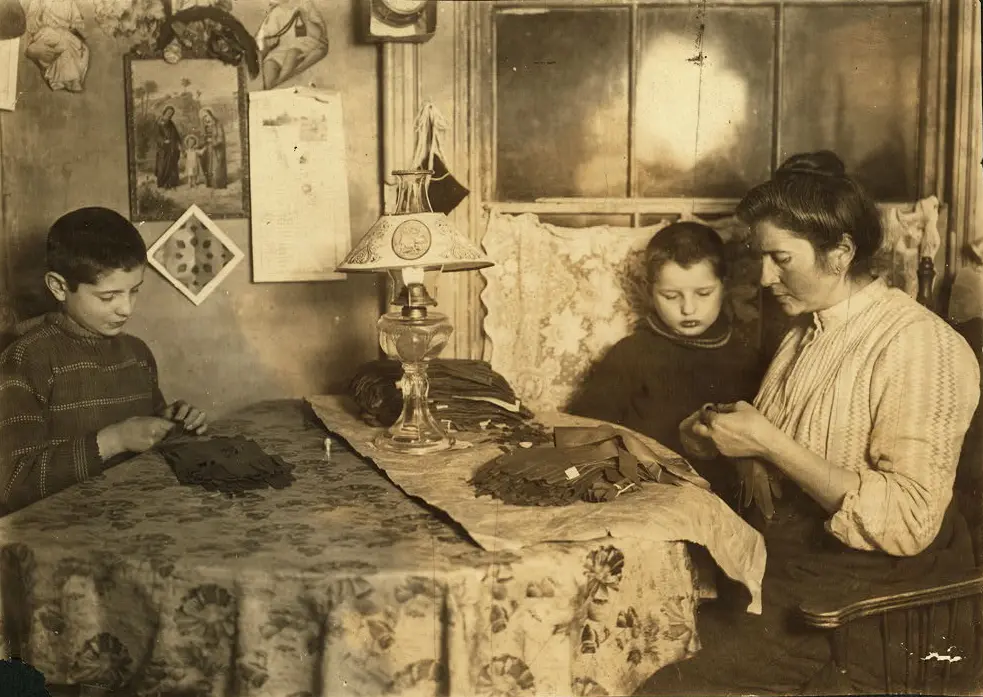
SCENE: The stage is divided unequally into two parts by a curtain. On the left and smaller side of the curtain is a table, a bed, and two chairs. One or two bits of clothing hang on the walls. The ceiling slopes, and the only window is in a recess. There is no fireplace, only a small oil stove. On the bed lies WILLIAM DENGATE half-dressed, in the last stages of Potters' rot. He is so weak that he can hardly lift himself; several untidy books lie on his pillow.
On the right and larger side of the curtain there is a big table, with five or six chairs, two beds, a fireplace, and two windows also in recesses. There is a little fire in the grate. MRS. FIELD and BERNICE are sitting at the table sewing hooks and eyes on to cards with an incredible swiftness. The clock strikes five as the curtain goes up.
WILL DENGATE raises himself on his elbow and listens for a moment—then he speaks.
Bernice! [there is no answer, so he speaks a little louder with evident effort]. Bernice!
[without looking up] What is it, Will?
Is mother there?
No.
What's the time?
[glancing up at the clock] Mercy me! Why, it's just struck five [a pause].
Are you wanting anything, Will?
No, thank you—only mother said she'd be back about five—this is her last day at that job.
[startled] You don't mean ter say——
How much rent does mother owe you, Mrs. Field?
Oh, never bother about that.
I want to know—how much is it?
Five weeks, if you must 'ave it.
Five weeks—that's ten shillings—how she's ever going to pay it I don't know—two days this week is all she's had.
Don't you worry, Will—it's not much of a home, anyway. [WILL sinks back on his bed.]
[lowering her voice] It's all very well, Bernice, you talking like that, but I dunno where to turn next; there's the children to feed, to say nothing of their clothes. Fred's boots are something shameful. And you 'aven't 'ad a new coat—why, not since your uncle gave you that brown linsey; and trade's getting worse every day. I'd turn Mrs. Dengate out, that I would, if it wasn't for Will. I 'aven't the 'art to do it, not with Will lying there fit to die any minit. I 'aven't the art.
Mrs. Dengate'll get another job soon, I expect; she's lots of spunk.
You want more'n that, nowadays. Why, when I married yer pore father—you was a little thing of five then—'e was making 'is thirty shillings a week reg'lar, and by the time the third baby—Fred I mean—was born we 'ad to manage on twenty and less, 'cos of 'is fits, and so it's gone on bad to worse—bad to worse, never bad to better.
Aren't the children coming home?—you said it was five.
O! there's a extry class or something. Don't you remember?—they never think of the pore mothers.
It's better for the children, anyway.
I dunno that—it means less food.
Did you hear any more about the changes at the works to-day?
Can't say as I did. I 'ope it's all talk—if they're going to fetch our work, 'stead of making us take it there, they'll 'ave it out of us some other way.
I hate that walk to the works every morning with the cards—that I do!
It's a bit of a change anyway from sitting 'ere all day and 'alf the night. 'And me them strips, will yer? I've nearly done my last dozen gross.
I never can work so quick as you.
It'll come—You 'aven't been at it so long as me. If I was to turn dotty, my fingers would go on just the same, I believe [she laughs]. Joe coming in to-night?
I suppose he will; he generally does Fridays.
You're a lucky girl. Joe's sure to get on, 'e is; 'e's got spunk if you like. You'll be keeping yer own 'ouse, and I'll be sitting like this sewed to my chair till I'm pulled off same as the 'ooks and eyes—though 'ow I'm going to manage without you beats me.
Joe's not in the marryin' line yet.
That's all very fine. If 'e was to get a good job to-morrow, you'd be off, and I'm not the one to blame you, neither. It's crule work this; but it'd be the work'ouse for all of us, in spite of the children lending a 'and as they do.
[suddenly] Mother, d'you ever wonder whether the workhouse wouldn't be best after all? The children might do better, and you wouldn't have to——
Bernice! well, I never!—to think of your father's daughter sitting there and saying such a thing. The work'ouse indeed!—it'll 'ave to be over my dead body first. The Fields don't go to the work'ouse—no fear! Why yer father's father was a landowner, 'e was! Don't you never go talking to me about the work'ouse again, though I did 'ave a second cousin in it once't.
BERNICE says nothing, but goes on working. MRS. FIELD gathers rage as she thinks over the conversation.
If you want to go and leave me, Bernice, don't you stop for me—I can manage all right. I'm not one to stand in anybody's way, I'm not—so don't consider me.
Haven't I always said I won't leave you till the children are out?
Yes, you 'ave—and I believe you mean it, too; ye're a good girl, Bernice, but don't get talking about the work'ouse no more—it upsets me!
WILL has been listening to the talk in the intervals of his reading, and now joins in, raising himself on his elbow.
There's no more harm in the work'ouse than there is in anything else—it's all hell this life, anyway—what I'm going to do is the only sensible thing.
[as if she were speaking to a child] What's that?
Get out of it—die!
Mrs. Field and BERNICE glance at one another.
Oh, Will; we 'aven't got to that yet; come! Don't talk so silly!
I wonder why it always shocks you so when I talk about dying, Mrs. Field?
Don't answer him, mother, or we'll have his wild talk.
Your 'ead's full of trash from them books. You can talk about what you like, my boy, it won't make no difference.
That's quite true.
There is a knocking at the door. BERNICE looks up, slightly moved, but says nothing.
Come in.
JOE SELDEN enters.
Good evening, Mrs. Field—good evening, Bernice. [He puts his hand on BERNICE'S shoulder for a moment. Neither of the women stops working. Joe throws his cap on the bed with a half angry gesture. He speaks in a dry irritated way.]
At it as usual! You've sat 'ere long enough! Put your hat on and come out for a walk.
I can't.
Why not? [in a lower tone] I've got something particular to say to you.
His tone makes BERNICE glance at him sharply—she almost stops working.
Why, whatever's the matter, Joe?
I must have a talk with you, d'y'hear? I want to talk to you!
But I haven't 'alf done; mother's through with hers, and look at this... [pointing to a pile of unfinished work].
You go out with 'im. Carry my lot to the works and I'll finish yours.... Come on.
[obstinately] No, no, I won't have it, you've done more'n your share to-day, as it is.
Mrs. FIELD hesitates a moment, then she bustles about with her pile of cards.
Crikey I'm late now—I must be off—no time to cut the children's bread and jam. You must see to it, Bernice.
All right.
Mrs. FIELD picks up the bundle of cards which though large is light, and goes out. JOE makes a jerk with his thumb in the direction of the curtain, meaning to ask whether WILL is there. BERNICE replies by nodding her head, upon which Joe comes and sits close to her. BERNICE never leaves off her work for a moment.
[speaking very fast, low, and eagerly] Look here my girl, things have come to a point—I've lost my job.
[dropping her needle and thread] Joe!
Yes;—you don't ask how, or why. You're right! There ain't but one reason nowadays. Trade's slack. No demand for British carpentering, so out we go—half the hands turned down, me among them—that's all right, I don't complain. They're within their rights. I've got a week's wages instead of notice and there you are [he puts his hand in his pocket and pulls out some coins]. But where do I come in? Nobody says I ain't a good workman—I'd like to see the man who dare to. I ain't got no vices—I don't drink nor bet—I'm a steady respectable man I am. But that don't make no difference; I'm fired like the rest!
What are you going to do?
Do? Why there's only one thing to do. Get quit of this blasted country and go to a new one.
[stops work this time] Lord! emigrate, do you mean? Oh Joe! it hasn't come to that, has it?
Yes it 'as, and I'm not sure it ain't a blessing in disguise. I'm sick of this tyrant-ridden country, I am—I want to go to a place where a man's given a chancet that's all I ask for—a chancet.
But ain't it just the same out there?
No, it ain't—there's more room—not so many other people, not so thick on the ground, no damned aristocracy—I've been making inquiries about Canada. Canada seems a decent place. See here, Bernice [he unrolls a coloured advertisement]—they'll give you one 'undred and sixty acres of land free if you want to settle on it, they will—one 'undred and sixty acres—why, that's as big as 'arf Hyde Park. They want us out there, that's the difference. It'd be rough and hard in course at first, till I'd built a house—See these pretty little 'ouses—'omesteads they call 'em—I'll build you one just like this—I know 'ow—and they advance you money for your plant, and if I can raise a little towards the fare they'll advance me a ticket, and you too. I've been to a emigration society already, 'coz I knew things was getting bad, and I'm what they call a suitable case—there's a job I can 'ave on a new railway from the day I land, till I can look about me a bit. It'll be all right and you've got to come with me!
Me?
Yes 'oo else? We're engaged, aren't we?
I can't—I can't leave the others.
Damn the others! We've got to think of ourselves—that's the best way; 'oo ever thinks of us, I should like to know—I know what's what—I've the right to live and the right to work. Look 'ere, Bernice [putting his arm around her], don't be shirty about the sudden way like I've sprung it on you—it isn't sudden to me. I've been thinkin' a long time—and it's much the best for you too. I declare I'm glad to go when I think of getting you out of this 'ell of a life. You're nothing but a slave now.
What's the good of talking? I can't come with you!
WILL, as JOE's voice rises, has begun to listen; he gets deeply interested, drops his book and leans on his elbow.
Why not? That's what I want to know! Why not? You like this sort of life 'ere, I suppose! Think it's jolly don't you to sit sewing 'ooks on to cards day and night—I should like to kill them!
Them? Who?
The damned grasping aristocrats and capitalists. What right 'ave they got to the money, and the land, no more right than you nor me!
I suppose they bought the land.
Bought the land! Not they! Inherited it they did without a drop of sweat! That'll be altered some day. We're moving a bit even 'ere; in Canada every man's equal.
Funny place Canada must be!
JOE is startled, BERNICE only smiles.] [WILL unseen by the other two has begun with some difficulty to get out of bed.
How do, Will?
Wait a minute, I must join in this.
Dang it—we don't want 'im.
Poor Will!
If on'y you'd ha' come out—
WILL has painfully dragged himself to the edge of the curtain and comes round it.
[who does not stop working] Help him, Joe. [JOE goes towards him, but WILL has already dropped into a chair; he pants with exhaustion.]
What's all this about going to Canada?
Well, if you're going to join in I must talk. You 'eard what I said—I'm sick of this blasted country, I am! Look at Bernice! Pretty sight, ain't she? No time to go out, no time to tidy 'er 'air—no time to improve 'er mind.
[laughing a little and putting her hand up to her hair to tidy it] O, my mind! That don't matter.
Yes, it do matter. You've got a mind, I suppose, like I 'ave? Lord knows I don't get much time! Lord knows I work 'ard enough; but it's nothing to what you 'ave. You ought to strike—you ought to scream out you won't put up with it!
It wouldn't do any good; nothin's any good.
You've 'it it! It wouldn't do no good! I must clear out, and Bernice's got to come with me!
[looking at Bernice] Well it may be the way for you and her—I dunno! But it don't help anybody else!
Go on, Will.
You haven't thought about it, Bernice, have you? But I have—you see lying here all day I haven't got anything else to do but read and read, and then think and think. Seems to me everything's gone wrong in the world!
That's right, Will—that's right!
There ought to be a change all the way through.
That's it—no rich—no poor—every man for 'isself. Cut up the big properties and divide 'em round. Don't 'ave no rich nor no poor.
There'll always be rich people and poor people.
You read what 'Enry George says, and Bernard Shaw, and Keir 'Ardie—we're going to change everythin'.
You listen to me, Joe—all that's no good, I tell you—not a bit. You can't put human nature into strait jackets. We're all greedy, and hungry, and cruel—no laws, and no revolutions, and no expropriations ain't going to do the trick—it's a new stomach that's wanted.
You ain't practical—you don't know practical life.
Oh yes, I do. I'm not much younger than you. I've done my turn; why I caught this [slapping himself] working in the potteries—I know well enough! I tell you, England's a hell for people like us! Haven't I lived behind this curtain for months, and thankful to Bernice and her mother for that—haven't I seen Bernice's cheeks get paler and paler, and the children forced to work half the night—it's shameful! it's shameful!
WILL is seized with a sort of paroxysm of excitement.
Don't take on so, Will dear—it's bad for you.
[recovering himself] You're quite right—it won't do no good either.
If I didn't believe we can pull down them capitalists I should—I should go to 'ell—that's all.
Well, that wouldn't be much use either. Why does Bernice have to work on starvation wages, and me lose my life in that other job?—We're supposed to be civilised—in the van of civilisation—but we're not a bit—we're still savages—we just kill anybody who's in our way—same as you want to kill the capitalists, Joe.
In course—serve 'em right—leastways divide up their property.
It would all come back to the same thing in the end. I tell you there's a bloody tyrant who rules this country—his name is Competition. We wriggle and wriggle—but we can't get away from him.
[sullenly] That's just why I want to clear out!
Oh, clear out if you like—What I mean is that you haven't found the cure. What about England? What about all the rest? You go to a country where Competition isn't so full grown, that's about it—but the tyrant's there all the while—after a bit the country fills up, and it's as bad as ever.
Oh dear! oh dear!
Sometimes I think there is a change coming—but it's mighty slow. It'll be a different sort of competition—[he laughs half shyly]—a competition in love and kindness, a competition in givin', a new heart for the world.
Pah!—You'll wait a long time, my boy, if that's what you expect.
[rising from his chair] I don't expect it—I tell you this world's rotten through and through. Go to Canada certainly, take Bernice too if you can—but it won't make things any better really—not really—If I was going to live I'd spend my time talking and talking to everybody—But I'm dying—and I'm glad! I'm sick of this world.—I'm not strong enough for it—like you, Joe, I want to clear out. Even if I was strong I believe I'd want to go—it's all too difficult—too much for me!
[rising] Will! Dear Will—you'll pay for this—come back to bed.
[his voice almost in a scream] I tell you I'd kill myself now, if it wasn't for mother—I'm nothing but a burden to her—and she knows it—but she'd never forgive me if I did away with myself, and it won't be long. Listen to me, Joe and Bernice, and I'm one as knows what he's talking about. The best way out is to die, you take my word for it—die both of you—it's the best way.
[dully] What about the others?—Here, Joe, help me to get him back.
Joe silently helps WILL, and they are both supporting him when Mrs. DENGATE enters on her side of the curtain. She gives a sharp glance round, and then instantly comes round.
[looking at her son's flushed face] Well, I never! I should ha' thought, Bernice Field, as you'd 'a' known better, than let Will get out of bed like this—Come on now—Back you go!
It's all right, mother, I've been enjoying myself.
Roughly but tenderly Mrs. DENGATE helps him back, leaving JOE and BERNICE on their side of the curtain.
Now, Bernice, you're not going to listen to all that rot, I 'ope—you must make up your mind [he catches hold of her]. I want you—Give me a kiss—Come on—What! you're not afraid of me since last Saturday, are you?
BERNICE with a strange kind of repressed passion turns to him, and puts her arms round his neck.
Don't go, Joe, oh don't go. Will said it was no use—don't go and leave me!
I don't want to leave you, I want to take you. 'Ave a little courage, my girl.
Oh! I must finish.
She sits down to the table again and begins to work. JOE curses under his breath, and walks up and down.
You're nothing but a slave! They've ruined you with their blasted competition! I don't believe you mind, no, I don't believe—
The door bursts open, and the three children rush in from school. They go straight to the table and look for food, like little animals.
Mother hadn't time to cut the bread, Bob—you'd better do it.
All right.
He runs to a cupboard in the corner, gets out a stale loaf, and begins to cut hunks which he spreads with a thick gluey jam. Lucy puts the kettle on the fire in a businesslike way, while FRED examines JOE'S pockets surreptitiously.
[suddenly] Why does the lid of the kettle begin to op so?
"Coz it's boiling, stoopid—taike it off!
But why?
She takes the kettle off and fills up the teapot.
[satirically] The water wants to get out, Lucy, there ain't room in the kettle!
He looks at BERNICE pleased with his simile.
Oh! [She replaces the kettle on the fire.] Why it's 'opping just the same. There's lots o' room now.
Taike it off the ob, stoopid, or the bottom'll fall out!
Lucy obeys, but is obviously unsatisfied. The boys sit down to their tea and at once stuff their mouths with the bread and jam.
'ow's Will? [She goes round the curtain, but seeing MRS. DENGATE, who does not give her a very kind look, she retreats hastily.]
[very kindly] Now, Lucy, come along, and eat yer tea—there ain't a minute to lose; you've each got two dozen to finish before you go to bed, or there won't be no jam next week—you must 'urry.
Lucy joins the rest. She sees at once that BERNICE has nothing.
Why, you 'aven't given none to Bernice.
She pours out a cup and puts it beside BERNICE, who does not stop working, but just takes a sip now and then.
Have a drop, Joe?
No, thank you; the sight of them 'ooks and eyes is enough to turn my stomach! [He begins impatiently walking up and down.] 'Ow much do you make in the week, tell me that—all of you—now then—come on—you first, Bernice.
We get ninepence a pack [pointing to one].
'Ow much does it come to in the week?
Sometimes four shillin'—sometimes four-and-six. I have made five with luck.
O, 'ave you?—hours, I suppose, six to ten at night?
About that.
And the kids—What do they make?
It's counted in with mine and mother's.
Four shillin', then—and yer mother?
Oh, mother! she does better—never makes less nor six—often seven.
Ten to eleven shillin's a week. What's yer rent?
Now then, Lucy—hurry up there—get the tea things cleared and set to.
Lucy clears the table very quickly, and then obediently sits down to her work. The children giggle a little, but on the whole they work with great concentration.
[angrily] What's yer rent, I say?
Four shillin'.
Eleven shillin' a week at most; four shillin' rent.
Mrs. Dengate's supposed to pay two.
Does she ever pay?
When she can—but Will—
Oh, I know. What it means is this; you've six to seven shillin' a week for food and clothes and every blessed thing—and there's five mouths to feed, and five bodies to dress, and ten legs, and ten feet, and——
[laughing a little] Oh, don't, Joe.
You beat me, you do—clean—'ow you ever——
Everyone is startled by a knock at the door.
Come in.
Mrs. MUGGLE enters. She is a plump Jewess, and wears a beaded cape.
Mrs. Field live here?
Yes——
Mrs. MUGGLE closes the door after her in a confidential way.
She's out.
[consulting a list] Ow! out is she? When'll she be in?
What do you want?—I'll tell her.
Want—I want to see her. You're 'ook and eye carders, I know! You're on my list. Mrs. Field's gone to take 'er lot to the works, I suppose.
Yes—she'll be back directly.
Pore soul. I pity 'er, I do—working all day and then 'aving to fetch and carry as you might say—crule I call it.
No one answers, but BERNICE for a moment drops her work. She seems to anticipate something disagreeable.
[her voice getting more and more soapy] Well now, that's just what I've looked in about, this fetchin' and carryin'. I'm going to do it for yer in future—see my motor van!
She pushes forward a large, untidy double perambulator, on to which a stack of cardboard sheets is already fastened.] I shall come round twice every day with this, bringing yer stuff and taking what yer've done. I shall paiy you, and I'll collect.
Mother'd rather deal direct with the foreman, I expect.
Oh, she would, would she; well then, she'll 'ave to give up, that's all. I've bought the work, d'you understand? Your work and a lot of other work too, and them that don't like it must lump it, or go without——
Do you mean to say——
I mean to say that the manager will only give you the stuff through me—now do you understand?
[after a pause] Is it the same pay?
[glad to have got to the point] No, my dear, it's not the same paiy; 'ow could it be?—I've got my living to make as well as you—I save you lots, I do—no walks in the 'eat or the wet—I do all that for yer—to say nothing of the time you save—nearly a 'ole 'our—you can't expect all that for nothin' now, can you?
We can't work for less than we get now.
Oh yes, you can! I know what you get very well; ninepence a pack—that's it, isn't it?—ninepence a pack and find your own thread and needles—well, I'm going to take twopence off for each pack—no one can say that's much for all the work and trouble I shall save you—that'll come to about two shillings a week for the lot you do——
BERNICE in her agitation rises, looking from Joe to the CHILDREN and back again.
Two shillings a week off?
Don't you do it, Bernice—stand up to 'er, tell 'er you won't 'ave it—it's blackmail—just dirty blackmail, that's what it is!
[resolutely sitting down to her work] It won't do—we can't work for less.
[laughing] Oh! you can't, can't you—very well, there's lots that can, ha! ha! lots—I'm a just woman, I am—I could get people to do the work for less than I'm offering you, but I'm a just woman, and I says—I'll give the old workers a first chance. That's what I'll do, I says—yer mother won't be such a fool as to throw it up, I know—I'll come back in a few minutes and talk to her—you young ones are feather 'eaded, you don't understand.
MRS. FIELD enters the room while MRS. MUGGLE is speaking. Mrs. MUGGLE pretends not to see her, but raises her voice more and more.
Mrs. Field'll listen to reason, she will; she'll know what it means, not to 'ave the work coming in! She don't want to starve—not she!
[sharply] What's the row, Bernice?
[working feverishly] Ask Joe.
Yes! ask me! I'll tell you. Do you know what it is—the works have chucked you! They've 'anded you over body and soul, bag and baggage, to that grinning 'Ebrew there—she's the middle-woman, she is. She carries the stuff for you and docks you off twopence the pack. Work as you may, you can't make more'n seven shillin' a week after this—that's what it means—Now d'you understand?
[terrified] Don't, Joe—don't—It ain't true; they just told me I should 'ave my work later—but I never thought—say it ain't true, Joe.
[in a sharp shrill voice, dropping his work and jerking his thumb towards Mrs. MUGGLE] You turn 'er out, mother—turn 'er out; she's a blackmailer—Joe said so!
You get on with your work now, and don't waste time—go on, I say.
The boy's quite right, Mrs. Field—are you going to submit to this sort of thing any longer? You've been treated like slaves all this time, now they're going to kick you, same as if you was dogs. Don't you stand it—throw up the job!
[turning to Mrs. MUGGLE, very pale and resolute, but miserably frightened] twopence off each pack, mum; you can't mean that—why, I can't make enough as it is—you can't mean you'll only pay sevenpence a pack?
[fiercely] That's what I do mean then—it's taike it or leave it; there's 'eaps and 'eaps that'll taike the work and glad to at that figure.
[fiercely] Go and find them then—and don't come 'ere no more!
Come, Mrs. Field, be reasonable, my dear; I don't say as how I mightn't rise to sevenpence farthing, even sevenpence ha'penny a gross, just to keep you—you work so well—but more'n that—no—I've got to live too! [Mrs. DENGATE, who has been listening all the while on the other side of the curtain, now comes round it. She stands irresolutely looking from one to the other.]
I've finished my job to-day—my boy'll starve soon—I'll take the work at sevenpence—that is in course if Mrs. Field won't!
She looks uneasily round again. WILL makes a gesture of disapproval, and then leans back and laughs audibly.
[laughing too] There! You see 'ow the land lies now, don't you. Yer own lodger—ha! ha! But now look 'ere, Mrs.—Mrs.—what's yer name?
Mrs. Dengate.
What an outlandish, countrified name—but never mind that—'ave you ever done this 'ook and eye carding before—do you know the trade?
No.
I can't give you the same paiy then—Mrs. Field's a trained and, she is—I've gone a long way to meet Mrs. Field, I 'ave, on'y she don't understand it! you're raw at it, you ain't worth 'arf what she is.
I'd soon learn—I'm quick.
[white with rage] You're quick enough at taking the bread out of other people's mouths!
[whimpering] I'm sure I mean no 'arm; wot's the good of letting the work go if Mrs. Field won't take it?
[angry, her voice rising to a scream] Who said I wouldn't take it? You're a nice one, you are—'old your tongue.
I'm not going to 'old my tongue—I've got my rights as well as you, tho' I do owe you for the rent! Wot's the good of letting the work go, I says, there's 'undreds more like me as'd take it!
Votes for women, I say.
[suddenly surrendering] I don't want no vote—it's work I want—work!—and work I'm going to 'ave, in spite of you, Mrs. Dengate. I'll take your terms, Mrs. Muggle, sevenpence 'alfpenny a gross, though they're crule—and wicked—may God forgive you—[fiercely to the children]: Don't sit idling there now, you little brats—you'll 'ave to work double as 'ard after this—and every morning, too.
Lucy whimpers a little, but all three obediently go on.
[in an oily voice] I'm glad you've seen reason, Mrs. Field—you're wise, as I knew you would be. Now what about your daughter 'ere—she's a good worker, too, I'm told.
Yes, she's a good worker; much too good for the likes of you—Get out of this place, I say, or I'll kick you out! You won't come over me with your soapy slaver. Miss Field refuses your offer—do you hear? She won't 'ave it, she throws up the job! Give it to Mrs. Dengate 'ere—she doesn't mind 'ow much dirt she eats. Give it to 'er [to Mrs. DENGATE, who moves forward] but don't you dare to say a word, you snivelling back-door thief!
[sweetly] I should be sorry to lose you, Miss Field—take a little time to decide. Never be in a 'urry is one of my mottoes—I'll come back when I've been to one or two other people. Don't be in a 'urry—take your time [she edges nearer to the door]. 'Ere's your lot, Mrs. Field [she giggles]. I knew you'd be sensible, so I brought it with me—[She hands Mrs. FIELD a great pile of cardboard and paper]—I shall be back before long. [She goes out. Mrs. FIELD, really quite beside herself, boxes FRED'S ears, shakes BOB, and slaps LUCY.]
'Ow dare you dawdle like this 'ere now, 'aven't you 'eard what's happened?
Bob merely shakes himself. FRED tries to get up, but is pulled down by Bob, who perfectly understands that his Mother is not really unkind; Lucy begins to howl at the top of her voice.
[putting out her hand] It's all right, Lucy dear—don't cry [but Lucy wails on].
Ow, stop yer noise, can't yer! We 'aven't got time for this sort of thing now—'ere, Lucy, come on! I didn't mean to slap yer, but I'm that put out—come 'ere! [The child at once runs to her mother, who sits on a chair and puts LUCY on to her lap. They both cry quietly.]
[suddenly] Look here, Mrs. Field—it may be all right for you to give in—you've no trade union you women—and you're not young, and there's the kids—but Bernice's not going on any longer in this 'ell, I can tell you that! I'm going to Canada to-morrow, and she's coming with me! We'll be married at the Registry in the morning; we're both in the parish—I've got all the papers [he pulls them out of his pocket].
[after a pause of astonishment, deeply offended] And never to say a word to me—well, Bernice, I didn't know as you was so artful—that I didn't—I 'ope you'll be 'appy, I'm sure—but it's that sudden—oh! what shall I do without you—oh. Oh Lordy! Lordy! Oh, Bernice!
She throws her apron over her head, and rocks backwards and forwards crying. BERNICE gets up quickly and goes to her, kneeling before her.
Don't, mother, don't take on so! I didn't know nothing about it—Joe's settled it all—don't cry—I never knew a word till this evening, and I don't know what to do now, I don't really—I don't seem to see how I can leave you and the children [she gives a sort of gulp].
[mollified] You didn't know a word neither? You've not just sprung this on me, Bernice Field, 'ave you now?
No, no, mother!
The CHILDREN get up and run to BERNICE.
Don't go away, Bernice, don't!
[with a sob in his voice] I don't want Bernice to go.
LUCY begins to howl again.
[gradually regaining control of her voice] Now, you children, stop your bellowing! What 'ave you got to cry for, I should like to know. 'Old your tongues. Bernice's going to get married, and we've all got to be very 'appy and jolly. It's a bit sudden, but that don't make no difference—we're going to 'ave a weddin'.
WILL, who has been listening, tries to get out of bed, but is too weak. He cannot keep silent—all at once he holds out his arms, and with a cry, half of love and half of anguish, he calls out.
Bernice! Bernice! come here!
BERNICE jumps up at once, and pushing past Mrs. DENGATE, goes straight to WILL, who puts his arms round her neck and pulls her down to him. He will not let her go for what seems a long minute—not till a fit of coughing obliges him to.
[in a low voice] I can't stop you, Bernice—I can't stop you—it may be better for you—oh, it may—but it ain't the right way out.
I haven't said I will yet—I haven't promised—
Do you love him—Joe, I mean?
I don't know.
If you do, it's different—you've got a light inside of you then. Love's the same thing as dying—it makes you understand, and not mind things hurting—I know—
Joe's been good to me always.
[tenderly] I know he has—he's a good chap, Joe is! [he speaks with great eagerness, stroking and clasping BERNICE'S hands]. But oh, Bernice, I can't think what's to happen to me? If only you could have waited a week or two! I sha'n't last long—but it's blamed hard to say good-bye to you before [he brushes some tears away].
Will, Will—you pull me so hard—
Don't you worry, dear—it doesn't make no difference really—not really—I know that—I've seen through things, and nothing of that sort matters. We can't put it all straight. There's no way except by everybody being different—Not you, Bernice—no not you—you're all love and beauty—and that's why——[he turns his face aside unable to go on].
[in a whisper] What shall I do, Will?—Tell me—quick!
Don't ask me—you mustn't—it's too hard—oh, my dear—go!—it'll be better for you—you'll have children, and there'll be the sun shining.
They hold hands for a moment without speaking, only looking sadly into each other's eyes. In the meanwhile on the other side of the curtain Mrs. FIELD has set to work again, and so have the CHILDREN. She has been carrying on a conversation with JOE, who has sat down in BERNICE'S chair, Mrs. DENGATE still hovering in the background. JOE getting weary, says in an undertone to Mrs. FIELD:
I'm afraid of that there Dengate—he's full of queer notions—he'll be upsetting Bernice—she ain't firm yet.
[nods her head wisely] Will's all right—he's only [taps her forehead significantly]. Bernice—when Will's done congratulating of you—come back!
BERNICE gets up and returns, while WILL lies back with his eyes shut.
Now then, Bernice—here's Joe waiting to know if it's Yes or No.
[twisting her hands] I don't know what to do—I don't know what's right to do.
I'll tell you what's right! Come with the man you've given your word to—you and me can make a life for ourselves out there away from all the others.
Yes—away from all the others? Oh, Will, Will! What am I to do?
You talk a blasted lot too much to that dotty fool in there—what does it matter what 'e thinks about anythink—it's all very fine for 'im—'e's dying 'e is!
Joe's quite right, Bernice—If I was a young woman I'd do the same—I'd come now if it warn't for the kids.
But how can you manage, mother, I don't see as how you can—the pay's cut down and everything.
[with a forced cheerfulness which is really pathetic] I'm sure I don't know, but don't you worry no more about me—Joe's got a good job—you take it on too. I shall work three hours more at night, then Bob 'ere can put in a bit more Sundays and Saturday afternoons, and there won't be you to feed, and you know you always was a big feeder [she laughs]. I'm beginning to think it'll be retrenchment and reform, same as they say on the posters—[more gravely]. We shall get along somehow, on'y you must 'urry up and make your fortunes [her voice breaks], you won't want to have yer brothers and sisters in the workhouse, so you must send me back some 'elp for the children—
[earnestly] That we will, Mrs. Field—If Bernice'll come I promise we'll 'elp you all we can. I shall make much more money there than 'ere—and tho' things do come more expensive I'm told, we'll be able to spare a bit—sure. Come, Bernice, give in!
Very well—
That's right [he puts his arms round her, and hugs her].
[in a tone of excitement] Mother—come here—mother [Mrs. DENGATE goes to him]. This is a regular Bank Holiday. You've got Bernice's work—never mind how, but you've got it—four shillings a week isn't it? not much, but never mind—you've prevented somebody else having it anyway. And now Bernice's going to be married, and we must have a weddin' party. Pull the curtains right back—now, Mrs. Field, lend a hand—put your work away for once, we don't have weddin's every day—we don't have a Bernice getting married very often.
The CHILDREN stop expectantly.
We can't Will—we haven't 'arf done!
Come, Joe, haven't you got a couple of shillings to spare—that would meet the case.
[unwillingly] Yes—I can run to that, but I've got clothes to get [he puts the two shillings down on the table].
Thank you kindly, Joe—but I didn't ought to take it—and there's Bernice too, she ain't fit to be seen—but there! we ain't no time to put her straight before tomorrow, anyway.
Mrs. DENGATE and BERNICE go to the curtain.
That's right, mother—pull them back, quite—I must be in this affair. We're going to have a jolly party! Children—put your work down—I know how things ought to be done at weddin's [he laughs].
BOB, FRED, and LUCY jump up and begin skipping about—they call out.
LUCY, FRED. A party! A party! Will's giving a party!
They run across to his bed—he kisses them all.
Now, children, listen to me—at weddin' parties two or three things always happen, and we're going to make them happen here. First we must drink the bride's health—now quick—what can we do, O—I know—mother! get out the bottle the district visitor lady gave you for me, when I'm bad—brandy it is——
No, Will, not the bottle, it pulls you round it does, and I can't buy you no more.
Never mind that—get it out I say. Now, Bob, you've got a glass, I know, ours is broke—I don't want to drink Bernice's health in a broke glass!
[who has run to fetch it] Here it is, Will.
Mrs. DENGATE very unwillingly has gone to a cupboard and got out a bottle. WILL holds it up to the light.
There's a good lot left—see—[he pours some out into the tumbler]. Now, Bob, a little water please, it would make you splutter to drink it now.
BOB brings the water, and WILL is just about to mix the drink when an idea strikes him.
I know—we'll have it hot! It'll be a lot more cheerful—quick, Fred—the kettle—you were talking about it just now.
BERNICE has been standing with her hand in Joe's, but looking at WILL.
I'll do it—[she goes to the fire—sees that the water is hot, and goes across to WILL'S bed.]
That's right, pour it in—now we must have a lump of sugar and a spoon!
Lucy obediently runs and brings both these.
[stirring] It's ready now, and, crikey, isn't it good just! Come on, mother, Mrs. Field—Joe—I'm going to make a speech first. [His hand and arm tremble, yet he holds the glass up.] Ladies and Gentlemen,—I've got a health to propose. This is to be a loving cup—first the bride will drink—God bless her—she'll stir the waters like the angel at the pool of Bethesda—and after that you'll all be well—Joe's bitter feelings will stop—and Mrs. Field won't worry no more, and mother sha'n't cry even in the dark—the children don't want anything bless them——and I——[he waits a moment].
Yes, Will—What for you?
Well, there'll be rest for me [he laughs], that's all the healing I want. But now, ladies and gentlemen, if Bernice's going to do all this for us, what are we going to give her? We mustn't be behindhand! She's very rich already—beauty?—she's got it—health?—she's got something like it—love? well, all ours belongs to her, doesn't it? So there's nothing left to wish her but happiness. She's going into a new country where the people are just the same—only there's a little more room, and when they hustle each other it doesn't hurt so much. That's it, Joe, isn't it?—and Joe's going to take her, and look after her, and work for her, so that she can keep the red in her lips, and the laugh in her lovely eyes—Let what comes after—come!—Here, Bernice, drink!—it's the loving cup—drink...
BERNICE kneels beside the bed and takes the glass and puts it to her lips. Then she hands it to JOE, who takes a good pull, and wipes his mouth with the back of his hand. The CHILDREN drink next.
[in a low tone] Only a drop, now, Bob—remember, it's Will's medicine.
MRS. FIELD and MRS. DENGATE scarcely do more than touch the liquid; his mother hands the glass back to WILL, who looks at it with a quizzical expression.
Here's health to you, Bernice, here's wealth to you, here's a new life to you in another world——
He begins to cough, then he drinks down all the rest and lies back exhausted, closing his eyes. Something in his tone has profoundly moved even JOE—he shakes himself roughly, and then bends down over BERNICE and puts his arms round her.
I'll be good to you, my girl—I will! Trust yourself to me—and be ready to start to-morrow at ten—The kids shall all come, and see the ship, and see us start—I'll pay for them——
Golly! what a lark!
I want to see the anchor—
Shall we go on the ship, Joe?
They all three jump about to express their pleasure.
My! I hope I sha'n't be sick.
Sick! not you——why the ship's steady same as this room till it starts.
Then the fun begins—[he mimics]—ooop—dooown, ooop—dooown; I seed em at the 'oliday trip last year!
Don't, Bob, you make me feel queer like, just to think of it!
Golly, don't I wish I was going too!
I'm going soon as I'm sixteen.
Taike me too, Fred, won't yer?
[laughing] Just listen to 'em.
[suddenly] 'Ave you got a warm coat, Bernice?—I'm told it can be terrible cold.
I've got my jacket.
[opens his eyes, his cheeks are slightly flushed, and he looks better] Now, children, didn't I tell you there were two or three things which must happen at weddin's—we've drunk the bride's health—now comes the present-giving——
The children look blankly at one another.
[suddenly] There's my shell. I'll give her my shell [He goes to the mantelpiece and picks up a rather large shell, such as can often be found on the beach]. 'Ere, Bernice, it ain't much—but you can 'ear the sea in it—[He puts it to his ear, smiling].
[interested] Can you? Let me try.
He holds the shell up to his ear, and seems to dream for a moment.
So you can—yes—the waves and the wind—all shut in a shell—like us—here, Bernice—here's Bob's present.
I haven't got no shell nor nothing—
'Ere's my comforter what the church gave me last Christmas—[She brings a ragged knitted comforter.]
No, no, Lucy, dear—it keeps you warm, I don't want it.
Bernice, 'ere's yer pore father's picture for yer, it's the only one I've got, 'cept the one in my jet brooch—but you're welcome to it.
Thank you. [She begins to cry a little.]
[cheerfully] Now it's my turn. Mother, get down that old cape of mine which I used to go out in—it's no good to me now, and it'll keep Bernice lovely and warm.
No, Will, I can't—
Oh yes, you can! you're going on the sea—besides, I want something from you—give me that grey shawl of yours. You wrapped me in it once when I was bad—that'll keep me fine and warm indoors—I want it—please.
BERNICE hesitates for a moment.
[with repressed eagerness] The shawl—quick, the shawl.
BERNICE takes the shawl off a hook, and wraps it round WILL. Meanwhile Mrs. DENGATE has got down the cape. She comes and puts it on BERNICE'S shoulders.
[with pride] For all it's a man's, you look fine in it.
BERNICE mechanically pulls the cape up to her neck and stands still, looking almost dazed. The clock begins to strike.
Good Lord! that's six! We've wasted nearly an hour—come on, children, if we're going to 'ave a 'oliday to-morrow we must work late to-night—come on now.
She bustles them back to the table.
[whimpering] I'm tired.
Yes, you may be, we're all tired very often, but you've got to sort them 'ooks and eyes before you go to bed.
Obediently the CHILDREN climb to their chairs and begin to work. BERNICE suddenly gives way—she holds out her arms wildly.
I can't go!—I can't go and leave them all like this—I can't go!
[roughly, catching hold of her wrist] Don't be a fool! It's too late to draw back now.
[wildly] No—No, it isn't—I can't do it, Joe—to think of me on that rolling ship, and them all here starvin' perhaps. Supposing mother falls ill, or anything happens—my heart's going to crack—it's going to crack—I can't go and leave them!
JOE drops her hand and turns away.
Blast you!
You go first, Joe! make some money and send it back. I'll come out to you, I promise, when times are better.
Better! I dare say you will—you and all your family are going to be a drag on me, are you? I'm to have nothing, am I—you're to have my money same as if you was my wife—no fear!—you be my wife and I'll try and do what I can for the rest; but I must 'ave something back—I can't wait for a woman for years and years—it's now or never, my gal—understand that—if I go out alone I go my own way. I shall find someone else there right enough—never you fear—but if you're willing to go, I'm willing to take you and do the best by you.
[moaning] I can't—I can't go now——
There is a knock at the door, and Mrs. MUGGLE enters.
[sweetly] 'Ere I am again, you see, like a bad shillin', 'e 'e 'e [a pause]. Well, what 'ave you decided?
[stepping forward] Give me the work on the same terms as mother, and I'll take it.
[still more sweetly] I'm sorry—but I've been to a lot of places since I was 'ere, and in justice to myself I find I can't offer any more work at sevenpence 'alfpenny. I'm a woman of my word, and I'll stick to my word with Mrs. Field for the present—but I can't give no more work at sevenpence 'alfpenny; your lodger 'ere was ready to take it at sevenpence—it'll 'ave to be sevenpence or none at all.
[dully] All right—give me the stuff.
Mrs. MUGGLE goes to her perambulator, and hands BERNICE a large roll of paper, cardboard, etc.: BERNICE sits down at once.
Mrs. Dengate, there's an old woman downstairs just dead; she wasn't up to much—only did her one pack a day—but there's her work waitin'—it was the walk to the works and back which killed 'er, they do say. She got ninepence—but then she 'ad to walk. You're new at the job, and I do the walk, so you may 'ave it for sixpence if you like.
Sixpence a pack, why, that's 'ardly four bob a week—Lor!
[fiercely] You're not going to argufy with me now, are you?—you're lucky to 'ave the job—I've been asked for it all down the stairs—but I kept it for you, because I knew Mrs. Field here would come to her senses and you would be disappointed.
She begins packing up her things.
I'll do it.
This'll be the price for everyone before long. You mark my words.
[to MRS. DENGATE] Blackleg!
WILL throws back his head and laughs half hysterically. JOE strides up to him.
It's your fault about Bernice, stuffin' her head with your crazy notions; look at her now, back at the old slavery!
Good evening. [She opens the door, wheels her perambulator out, and closes the door behind her.]
You 'aven't got a bit of spunk in you, any of you women! You don't deserve the vote, nor nothin' else. I never see such a pore-spirited lot in my life. I thought Bernice was a cut above this, but she's as bad as the rest. She'd never do in a new country, and I declare I'm more'n 'alf glad she ain't going to try it.
He begins to move towards the door, but the sight of BERNICE stops him. He goes to her, and roughly takes the work out of her hands.
Come with me—don't be a fool—it's now or never—Come with me, or stay here and rot!
I can't go—I can't leave them.
[in a hard tone] Then it's good-bye for ever. You understand that, don't you—'ere's the pin you gave me once, and I'll trouble you for that there brooch I gave you—the stone's good.
BERNICE obediently unfastens the brooch at her throat and lays it on the table, instantly resuming her work.
[with her apron to her eyes] Oh, Bernice, dear! are you sure you're right?
Good-bye. You 'aven't an ounce of pluck or spirit!
No. I haven't.
Well, good-bye, then.
Good-bye.
No one moves. Just as JOE reaches the door WILL lifts himself in bed.
Good-bye, Joe—Good luck! my way's the best, after all! There's no fare to pay where I'm going—ha!—ha!—good-bye.
JOE goes out. MRS. DENGATE to BERNICE.
Can you tell me 'ow to fold these things, my dear?
[moving a little] Come and sit here and watch me—I'll show you.
Thank you, kindly—I'll just draw the curtain first; it's 'igh time Will was asleep.
She draws the curtain which divides the room in two, and sits down by BERNICE.
Sha'n't we see the ship now, mother?
'Old your tongue! Now then, Lucy, don't go to sleep—pass me them cards.
The curtain goes down on the whole family bent over their work.