
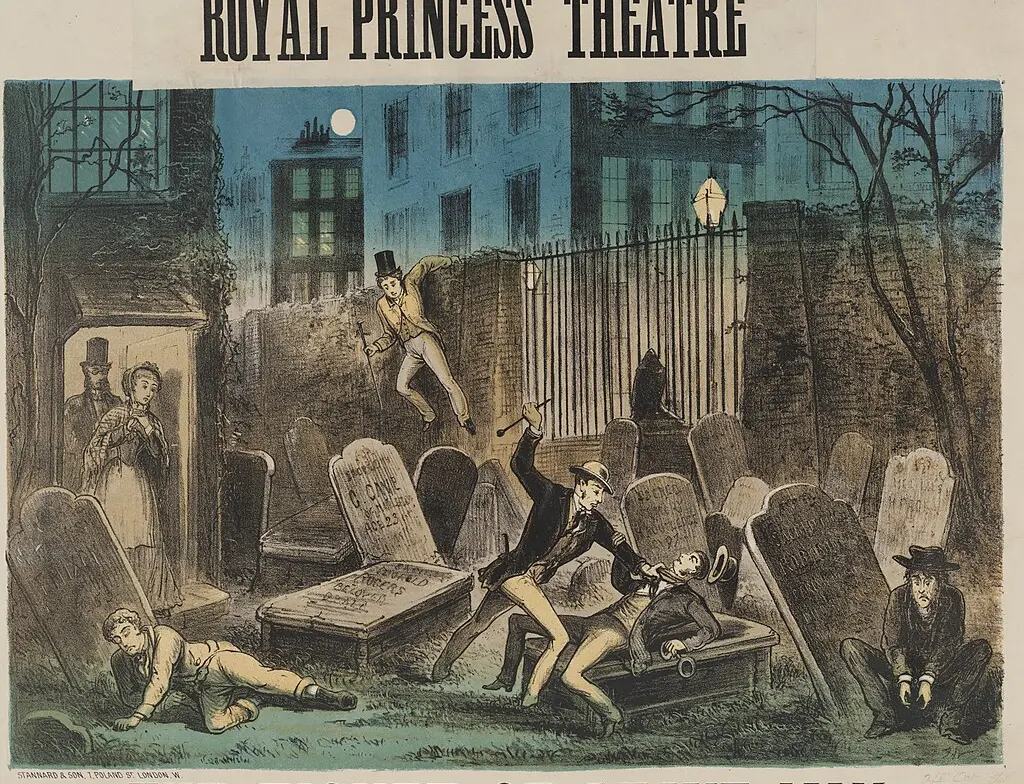
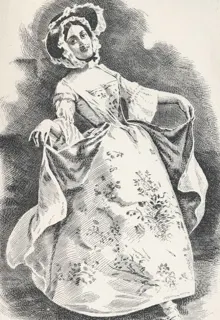
 Masks and Facesby Tom Taylor and Charles ReadeThe great actress Peg Woffington saves a starving playwright and sends a straying husband home to his wife.
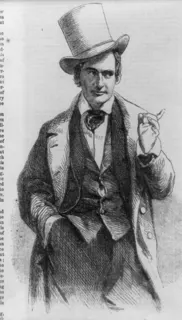 Our American Cousinby Tom TaylorA Vermont backwoodsman comes to claim an English fortune and gives it away to the girl he loves.

Act 1
—The Bellevue Tea Gardens, in the south-west suburbs of London. Summer evening. Front of the tavern with ornamental verandah up L.; arbours along the stage, R. and L., with tables and seats; trees, shrubs, statues, &c., at the back, with ornamental orchestra and concert room.
PARTIES, male and female, seated at the different tables, R. and L.; Waiters serving refreshments. Music heard off. As the curtain rises the parties are heard giving their orders; MALTBY moving about with an eye to the Guests, Waiters, &c.; two Detectives at table, up L. C.
[R] Three hots with——
[serving another table] Yes, sir. Brandy and soda for you, sir.
[L] Tea for four—shrimps and a muffin.
Coming! [serving another party] Pot of half-and-half for you, sir. [At Detectives' table] Two sherry negus, two shillings. [Takes money.]
Maltby. [moving about] Now, James, three teas and a muffin in 5.—Jackson, money in 6. [To a GUEST] Uncommon thirsty weather, sir, uncommon. [to another party] If I might recommend a cobbler for the lady, sir, delicious refreshment for July. Now, James, look after them brandies in 3. [Moves off, L. U. E.
Enter HAWKSHAW, R. 1st E.; he strolls carelessly to the Detectives' table, then in an undertone, and without looking at them.
Hawkshaw. Report.
[in same tone, and without looking at HAWKSHAW] All right.
[same tone] Here's old Moss. Keep an eye on him. [Strolls off, L.]
Enter MOSS, R.; sits at table, R. 1st E.
[to the Waiter] Good evening, James. Four penn'orth of brandy, if you please, James, [sit chair, R.] and a little peppermint. [Coughs, and looks around] Tiger not here yet. [Bell rings.]
[C] The concert bell, ladies and gentlemen—in the Rotunda. [Pointing to the concert room] The first talent—selections from the best classical music, and original nigger melodies. This way.
Exit MALTBY, towards concert room, R.; most of the parties move off, leaving Detectives, and a Guest here and there.
Enter DALTON, C., from L.
[Stirring and sipping his brandy and peppermint] Warm and comfortable. Tiger ought to be here before this. [As he stirs, his eye falls on the spoon; he takes it up, weighs it in his fingers] Uncommon neat article—might take in a good many people—plated, though, plated.
While MOSS is looking at the spoon, DALTON takes his seat at MOSS'S table, unobserved by him.
Dalton. [L. of table, to MOSS] Not worth flimping, eh?
[R. of table, starting, but not recognizing him] Eh, did you speak to me, sir?
What? Don't twig me? Then it is a good get up. [He lifts his hat, and gives him a peculiar look] Eh, Melter?
[recognizing him] What, Tiger!
Stow that. There's no tigers here. My name's Downy; you mind that. John Downy, from Rotherham, jobber and general dealer.
[coming down to DALTON] Now, sir, what can I have the pleasure of ordering you, sir?
My good friend, Mr. Moss, here insists on standing a bottle of sherry.
[in alarm] No, no!
What, you will make it champagne? very well I'm not proud, [to MALTBY] I like it dry, mind, and none of your home-brewed; I buy my rhubarb-juice at the greengrocer's. [Exit MALTBY, L.]
Come, Ti—[DALTON gives him a look, which stops him] A joke's a joke. But a bottle of real champagne at ten and six——
That's serious, eh? Well, I've taken a serious turn; always do when it's low tide here. [Pointing to his pocket.]
Down on your luck, eh?
[shrugs his shoulders] The crushers are getting to know too much; then there's the Nailer's been after me.
What, Hawkshaw, the 'cutest detective in the force?
He's taken his oath on the Bow Street Office testament to be square with me for that Peckham job——[hesitates.]
Ah!
When I spoiled his mate. [Shrugs his shoulders.]
[Shaking his head] Ah, I always said that life preserver of yours would be doing somebody a mischief.
Re-enter MALTBY, L. U. E., with champagne and glasses.
Hush, here's the tipple.
[at back of table uncorking and pouring out] And though I say it there ain't a better bottle opened at Buckingham Palace. Ten and six. Mr. Moss—there's a color—there's a bouquet!
[grumbling as he pays] There ought to be at the price.
[going up] Now, Jackson, take orders in the Rotunda. [Exit MALTBY, L. C.]
[drinking] Ah, tidy swizzle!
And so you're keeping dark, eh?
Yes, pottering about on the sneak, flimping or smashing a little when I get the chance; but the Nailer's too hard on me. There's no picking up a gentlemanly livelihood. Hang me, if I haven't often thought of turning respectable.
No, no; it ain't so bad as that yet. [Looking around and speaking cautiously] Now, I have the beautifulest lot of Bank of England flimsies that ever came out of Birmingham. It's the safest paper to work, and you should have it cheap, dirt cheap, and credit till you'd planted it.
And how about the lagging? If I'm nailed, it's a lifer.
Bless you, I wouldn't have you chance it; but in the high society you keep, you could surely pick up a flat to put off the paper.
I've the very man. I gave him an appointment here, for this evening.
Did you, though! How pat things come about! Who is he?
A Lancashire lad; an only son, he tells me. The old folks spoiled him as long as they lived, left him a few hundreds, and now he's got the collar over his head, and is kicking 'em down, seeing life. [Laughs.] And life in London ain't to be seen without paying at the doors, eh, Melter?
Ha, ha, ha! and you're selling him the bill of the play.
I'm putting him up to a thing or two—cards, skittles, billiards, sporting houses, sparring houses, night houses, casinos—every short cut to the devil, and the bottom of a flat's purse. He's as green as a leek, and as soft as new cheese; no vice, steady to ride or drive, and runs in a snaffle. [Rises.]
[rising] Oh, beautiful, beautiful! [Rubs his hands.] It would be a sin to drop such a beautiful milch cow! Suppose we pumped him in partnership?
Thank you, I know your partnership articles: me all the kicks, and you all the half-pence. But if I can work him to plant a lot of these flimsies of yours, I don't mind; remember, though, I won't go higher than fifteen bob for a fiver.
What, only fifteen bob! and such beauties, too, they'd take in the Bank chairman—fifteen! I'd better chance it myself! Only fifteen—it's robbery.
Take it or leave it. [Takes up the newspaper, and sits at table, L.]
I must take a turn, and think it over. [going, returns] I'll bring you the flimsies. Come, you'll allow me a pound?
Bid me down again, and I stand on ten shillings—now you know. It's like it or lump it. [He returns to his paper.]
[Holding up his hands] Oh, dear! oh dear! What it is to deal with people that have no consciences! [Exit, R. 1st E.]
[heard off, L. U. E] A bottle of champagne, lad, and half a dozen Cabanas—and look sharp!
[Looking up from paper] Here's my pigeon!
Enter BRIERLY, L. U. E.; he looks feverish and dishevelled, and is dressed in an exaggerated sporting style.
[Laying the paper down] Ah, Bob, up to time, as usual.
Brierly. Aye! nobody shall say Bob Brierly craned while he could keep 't going. [Waiter brings champagne and cigars] Here—you—a clean glass for my friend. [Crossing to L. of table, L.
[pointing to MOSS'S bottle] I've had my whack already.
Nay, lad, you can find room for another glass.
Waiter brings another glass—BRIERLY pours out wine.
It puts heart into a chap! [Drinks eagerly.] I've nearly lived on 't this fortnight past.
[R. of table, L., stops his hand] Take care, Bob, or we shall have you in the doctor's hands.
Doctor? Nay; I'm as game as a pebble, and as stell as a tree! [Fills DALTON'S glass with a shaking hand] Curse the glass! Here—drink, man, drink. I can't a-bear drinking single handed. I like company—always did. [Looking round uneasily] And now, I don't know how it is—[Nervously looking down near the table] No, no, it's nothing! Here, have a weed. [Offers cigar.]
I'll take a light from you. [As DALTON lights his cigar at BRIERLY'S, the shaking of BRIERLY'S hand becomes more apparent] Come, come, Master Bob, you're getting shaky—this won't do.
It's that waking—waking. If I could only sleep. [Earnestly.] Oh, man, can't yo' help a chap to a good night's rest? I used to sleep like a top down at Glossop. But in this great big place, since I've been enjoying myself seeing life—I don't know—[passing his hand across his eyes] I don't know how it is—I get no rest—and when I do, it's worse than none—there's great black crawling things about me. [Gulps down a glass of wine] I say, Downy; do yo' know how a chap feels when he's going mad?
I know the symptoms of del. trem. pretty well; sit down, sit down. First and foremost, [puts him a chair] I prescribe a deviled biscuit—I'll doctor one for you. [Calling.] Waiter! a plate of biscuit, toasted hot—butter and cayenne. [BRIERLY hides his head in his hands; aside, looking at him contemptuously] The horrors! ah, he's seen too much of life lately. Bob, are you in cash?
Welly cleaned out; I've written to the lawyer-chap, down at Glossop—him that's got all my property to manage, yo' know—for more brass.
[Aside] Now, if I'd a few of Moss's fivers—here's a chance. You must bank with me till the brass comes. Delighted to lend you a sovereign—five—ten—as much as you want.
Enter MOSS, R. 1st E.
Nay, will yo' though! That's friendly of you. Here's luck—and sink the expense! [He pours out wine, standing in front of table.]
[Aside to DALTON] I've got the flimsies—I'll do it at seven ten.
[Aside] Fork over.
[Aside, giving him a roll of notes] There's fifty to begin with—twenty, a tenner, and four fives. Plant the big 'un first.
Enter HAWKSHAW, C., meets MOSS at back of chair; approaches the table where the Detectives are; one of them nods towards MOSS and DALTON.
Good evening, gentlemen, [crosses in front to L.] you'll find my friend, Mr. Downy, excellent company, sir. Very improving for a young man from the country. [Aside] That's an honestly earned seven-pun-ten! [Exit MOSS, L. 1st E.]
Waiter brings biscuits and cayenne.
Now, for your devil, Master Bob. [As he prepares the biscuit, HAWKSHAW approaches the table and takes up the paper which DALTON has put down; DALTON pushes the biscuit across to BRIERLY.] Try that?
Beg pardon, sir, but if the paper's not in hand——[Sits at back of table, L.]
[rudely, and pocketing the note hastily] Eh, sir?
[Sitting down coolly at the table and unfolding the paper] Papers very dull lately; don't you think so, sir?
[Assuming a country dialect] I never trouble 'em much, sir, except for the Smithfield Market List, in the way of business.
Ah, much my own case. They put a fellow up to the dodges of the town, though; for instance, these cases of bad notes offered at the Bank lately. [Watching him close.]
I never took a bad note in my life.
You've been lucky—in the Smithfield line, too, I think you said. In the jobbing way, may I ask, sir, or in the breeding?
Sometimes one, and sometimes t'other—always ready to turn the nimble shilling.
My own rule.
May I ask your business?
The fancy iron trade. My principle is, to get as much of my stock on other people's hands as I can. From the country, I think?
Yes, Yorkshire.
Ah! I'm Durham myself; and this young gent?
What's that to you? [Pushing away the biscuit.] It's no use—I can't swallow a morsel.
From Lancashire, I see; why, we are quite neighbors when we are at home, and neighbors ought to be neighborly in this overgrown city, so I hope you'll allow me to stand treat; give it a name, gentlemen.
[roughly] Thank you, I never drink with strangers.
They've a saying down in Glossop, where I came from, if you want a welcome, wait to be axed.
Ah, quite right to be cautious about the company you keep, young man. Perhaps I could give you a bit of good advice——
Thank ye; I'm not in the way o' takin' good advice.
Well, don't take bad; and you won't easy find a worse adviser than your thieving companion here.
[firing up] Eh? what do you mean by that?
Not you, sir. [Tapping the champagne bottle.] This gentleman here. He robs people of their brains, their digestion, and their conscience—to say nothing of their money. But since you won't allow me to stand anything——
And wish to keep ourselves to ourselves.
And think your room a deal better than your company—meanin' no offense you know.
[rises and crosses to C] Not in the least. If gentlemen can't please themselves in a public establishment! I'll wish you a very good evening. [Aside.] A plant; I'll keep an eye on 'em! [Exit, R. U. E.]
[aside] I don't half like the look of that fellow. There's something about his eye—I must make out if Moss knows him; Bob, will you excuse me for five minutes?
Don't be long; I can't a-bear my own company.
I've only a word to say to a customer. [Exit L. 1st E.]
HAWKSHAW re-appears C., watches DALTON off, and follows him, L. 2d E., after a moment's interval.
[goes to chair R. of table, L] And I'll try to sleep till he comes back. If I could only sleep without dreaming! I never close my eyes but I'm back at Glossop wi' the old folks at home—'t mother fettlin' about me, as she used when I was a brat—and father stroking my head, and callin' me his bonny boy—noa, noa—I musn't think o' them—not here—or I shall go mad. [Sinking his head in his hands, and sobbing.]
Music—other Guests come in, R. and L., and sit at the other tables.
Enter MALTBY, C., from L.
Now then, James. Jackson take orders. Interval of ten minutes allowed for refreshment. Give your orders, gents, give your orders. The nigger melodists will shortly commence their unrivalled entertainment, preliminary to the orchestral selection from Beethoven's Pastoral Symphony.
Enter MAY EDWARDS, with her guitar, R. U. E.; the Waiters move about, bringing refreshments to tables; MAY goes down, R.
If they'll only let me sing to-night. [Tuning guitar.]
Halloa, halloa! what's this? Oh, it's you, is it, Edwards? Come, I'm glad to see you're about again, but I can't have you cadging here.
Oh, Mr. Maltby, if you'll only allow me to try one song, and go round after it, I'll stop as soon as ever they ring up.
Well, well, you was always a well-behaved girl, so, for once in a way. [Crosses to L.]
Oh, thank you, thank you, and if you should have an opening for me, in the room, sir, when I'm quite strong again—
No chance of it, we're chuck full—a glut of talent; but if I should be able to find room for you in the chorus, and to double Miss Plantagenet when she's in the tantrums, ten shillings a week, and find your own wardrobe, you know—I'm not the man to shrink from a generous action. Now then, Jackson, money in 4. [Exit MALTBY, L. U. E.]
MAY sings; after her song she goes round the tables; all repulse her.
[R] The concert's quite enough, without caterwauling between the acts.
[R] We've no small change, miss. Waiter! bottle pale sherry!
[L] Be off!
[L] Now then, what's the girl gaping at? Can't you take an answer?
[to BRIERLY] Please, sir——
[L] Be off with thee, lass, I'm in no mood for music.
[suppressing her tears] Not a penny!
Stop, lass; [feels in his pocket] not a farden. Where's Downy? Come here, what's 't crying at?
I've not taken anything to-day, and I've not been well lately. [She turns faint and grasps a seat to support herself.]
[rising] Poor thing; here, [places chair] sit thee down; why thee looks welly clemmed. Try and eat a bit. [He gives her a biscuit.]
Thank you, sir, you're very kind. [She tries to swallow, but cannot.] If I had a drink of water.
Wather? [at back of table, L.] Nay, a sup o' this will hearten thee up. [Tries to give her wine from his bottle] Not a drop! [He looks around and sees Waiter crossing from L. to R., bringing a decanter of sherry.] Here, that'll do. [Takes decanter.]
Beg pardon, sir; it's for No. 1.
I'se No. 1.
[R] Holloa, sir! that's my sherry.
No, it's mine.
I'll let you know—[he rises and turns up his cuffs; BRIERLY looks at him.] No, I'll see the landlord. [Exit 1st PARTY, L. U. E.]
There, lass. [Pours out a glass for MAY.] Sup that.
[drinks] It's wine.
Sup it up.
It makes me so warm.
It'll put some heart i' thee. Sup again, thou'llt tune thy pipes like a mavis on that. Now try and eat a bit.
Oh, sir, you're too good.
Good? me! nay——
Enter MALTBY L. U. E., followed by 1st PARTY.
[C., soothingly] Merely a lark, depend upon it. The gentleman will apologize. [To BRIERLY.] The gent who ordered that bottle of sherry——
[L. C] Let him ordther another, I'll pay for it.
The gent can't say fairer. [Calls.] Bottle sherry, Jackson; seven and six, sir.
Here. [Feels in his pockets] Eh? score it down.
We ain't in the habit of scoring, sir; not to strangers.
Then yo'd betther begin; my name's Bob Brierly.
Your name may be Bob Brierly, sir, or Bob Anybody, sir, but when people take wine in this establishment, sir—especially other party's wine—they pay for it.
DALTON re-appears behind, C., from L. U. E.
A tell yo' I'll pay as soon as my friend comes back.
Oh, your friend! A regular case of bilk——
Now yo' take care. [Firing up; the parties gather round from tables.]
[Frightened] Oh, please, sir; please Mr. Maltby.
It's too bad.
Why can't you pay the man?
Police!
[coming forward, L] Halloa! what's all this?
[C., seizing him] Here, Downy, you lend me a sovereign to pay this chap.
Sorry I haven't change, but we'll manage it directly. [To MALTBY] It's all right. I'll be bail for my friend here.
[R] Your word's quite enough, sir. Any friend of Mr. Moss's——
Come, Bob, don't be a fool, take a turn and cool yourself. [Drawing him off; aside] Now to plant the big'un. [Draws him off, L. 1st E.]
[to Guests] Sorry for this disturbance, gents; quite out of keeping with the character of my establishment. [Bell—music, piano.] But the concert is about to re-commence; that way, gents, to the Rotunda. [Guests go off, C.; fiercely to MAY.] This is all along of your cadging, Edwards, sitting down to drink with a promiscuous party.
[R] Oh, I'm so sorry—he never thought—it was all his kindness.
[L., sneeringly] Kindness! much kindness he'd have shown you, if you'd been old and ugly. You ought to be ashamed of yourself.
[indignantly] You ought to be ashamed of yourself! it is cruel in you to insult a helpless and friendless girl like me.
Insult! ho, ho, ha, here's a lark! A half-starved street-singer cheeking me in my own establishment! You'd better apply for an engagement, you had, on the first vacancy. [Looking off] Hollo! what's that? carriage company! Heavy swells on the lark; white ties and pink bonnets! Show the ladies and gentlemen to the Rotunda, Jackson. [Exit, R. C.]
[sinks down at one of the tables, L] I'm foolish to be angry; my bread depends on such as he. Oh, if I could only get away from this weary work! if some kind lady would take me in. I'm quick at my needle; but who'd take me, a vagabond, without a friend to speak for me? I'm all alone in the world now. It's strange how people's life is made for 'em. I see so many girls, nicely dressed, well off, with parents to love and care for 'em. I can't bear it sometimes, to see them, and then think what I am, and what's before me. [Puts her hand to her face.] I'm a silly girl; it's all because I'm so weak from the fever. There's nothing like keeping a good heart. How good he was to me; it was all through me he got into this trouble; but I mustn't think of him. Ah, [looking off, R. 1st E.] there's a pleasant looking party yonder. Come along old friend, you've to earn my supper yet. [Takes her guitar, and exit, R. 1st E.]
Enter GREEN JONES and EMILY ST. EVREMOND, R. U. E.; he wears evening costume: black, white tie, Gibus hat, &c.; she is gaily dressed: pink bonnet, &c.
[speaking as he comes down] Excuse me, Emily! Anything but the Rotunda; if your mama likes the music, let her enjoy it.
I'm sure the music's very nice, Mr. Jones.
Mr. Jones, Miss St. Evremond! What have I done to be kept at arm's length by that chevaux de frise of a mister? was it for this that I thawed the thick-ribbed ice of Mrs. Traddles?
Thick-ribbed ain't a proper word to use to any lady, and I tell you my ma's name ain't Traddles, Mr. Jones; it's the same as mine—St. Evremond; she's changed it at my wish.
I beg pardon of your stern parient, [sits L.] Mrs. St. Evremond, late Traddles; but I repeat, was it to be called Mister Jones that I treated Mrs. St. E. and chyild to the Star and Garter; and her chyild without Mrs. E. to the Trafalgar, where from the moonlit balcony that overhung the fragrant river, we watched together the sunset over the Isle of Dogs?
And very wrong it was of me to go to that whitebait dinner without ma; and preciously she blew me up about it, though I told her you couldn't have treated me with more respect if I'd been a countess, instead of a coryphee.
[L] Emily, you only did me justice. My intentions are honorable. If you are in the ballet, that's no reason you shouldn't be a dear, good girl. You've been a trump of a daughter; I don't see why you shouldn't turn out a trump of a wife. Emily, accept my hand.
[L. C] Nonsense; Green, you don't mean it.
I'm perfectly serious. My hand and my heart, my fortune and my future. Don't stare, Emily. It's as true as that my name is Green. I'm quite in earnest—I am indeed.
Oh! Green, dear, I'm in such agitation. [Rises.]
[L] We will spend a rosy existence. You like life, and I flatter myself I understand it.
And don't I? I call this life: the music and the company, and the singing and the trapeze. I thought the man must break his neck. It was beautiful.
Yes; I like to associate with all classes. "Survey mankind," you know, Emily—"from China"—to earthenware. So when Charley Punter proposed a night at the tea gardens, I sank the swell; and here I am with Emily and her mama. Charley didn't seem to see the parient; but, "Propriety, Charley, my boy," I said, and he submitted with a sigh. And now what will you have? [Re-enter MAY, down R. 1st E.; she begins to sing.] Oh! anything but that. Now do oblige me by shutting up, that's a good girl.
No, no, poor thing. Let her sing; she has a sweet voice.
Flat, decidedly.
[contemptuously] You're another. Give me half a crown for her.
[gives one, she asks by gesture for another] Two? Such a bore! I shall have to change a note at the bar.
You'll have to change a good many notes when we are married. [To MAY.] Come along; you shall have both half crowns.
Exeunt GREEN JONES and EMILY, L. U. E. as MAY is following.
Enter BRIERLY, L. 1st E.
Downy not here? He said I was to bring t' brass to our table.
[recognizes him up C.; comes down] 'Tis he! [Joyously.] Oh, sir, I'm so sorry——
Why, it's t' singing lass. [Crosses to her.] I say, have you seen my friend?
No, sir.
And where's t' landlord. Here's that'll make him civil enough. [Shows a number of sovereigns in his hand.]
Oh, what a lot of money!
Brass for a twenty pound note. I got it changed at t' cigar shop down t' road. He's a good'un is Downy—lends me whatever I want. Here yo' landlord. Hoy!
Enter MALTBY, L. U. E.
Coming! Coming! [Recognizing BRIERLY.] Oh, it's you. [Down R.]
[flinging a half sovereign to MALTBY] There; seven and six for t' wine, and t' other half crown's for t' thrashin' I owe you. [Approaches him threateningly.]
[pocketing the money and retreating] Take care; I'll teach you to insult a respectable licensed victualler. [To MAY, who tries to calm BRIERLY.] And you, too, you tramp; I'll have you locked up for annoying my customers. How do I know my spoons are safe?
Thou cur! [He rushes toward MALTBY, who escapes L. U. E., crying "Police!"]
I cannot bear you should trouble for me, indeed, sir.
[R] Nay, never heed that muck-worm. Come, dry thine eyes. [Concealing her tears.] Thou's too soft for this life o' thine.
[apologetically] It's the fever, I think, sir—I usen't to mind unkind looks and words much once.
Here, take this, [puts money into her hand] and stay thee quiet at home till thou'st i'fettle again.
Two sovereigns! oh, sir. [Cries.]
Nay, thou'lt make better use o' t' brass than me——What, cryin' again! come, come, never heed that old brute; hard words br'ak no bones, yo' know.
It's not his hard words I'm crying for now, sir.
What then?
Your kind ones—they're harder to bear—they sound so strange to me.
Poor thing! heaven help thee—thou mindest me of a sister I lost, she'd eyes like thine, and hair, and much t' same voice, nobbut she favert redder i' t' face, and spoke broader. I'd be glad whiles to have a nice gradely lass like you to talk to.
But where I live, sir, it's a very poor place, and I'm by myself, and——
[hesitates] No, no; you're right; I couldn't come there, but I'm loth to lose sight of yo' too.
Enter DALTON, hastily, from C., down R.
Brierly!
Here's t' change; I've borrowed five o' the twenty.
All right, now let's be off; I've a cab outside.
[to MAY] Mind, if you want a friend, write to Bob Brierly, at the Lancashire Arms, Air street, yo'll not forget.
Never; I'll set it down [aside] in my heart!
Come!
And yo'—tell me yo'r name—will yo'?
May Edwards.
Confound your billing and cooing—come.
As BRIERLY follows DALTON, C., HAWKSHAW and two of the Detectives appear, L.
You're wanted.
[aside] The crushers! Run, Rob!
Music; DALTON attempts to escape; Detectives detain BRIERLY; HAWKSHAW seizes DALTON; in the scuffle, DALTON'S hat and wig are knocked off.
I know you, James Dalton!
[starting] Ah!
Remember the Peckham job.
The Nailer! Hit out, Bob!
BRIERLY has been wrestling with the two Detectives; as DALTON speaks, he knocks one down.
I have. Some o' them garrotin' chaps!
[cries] Help! help! [Wringing her hands.]
A fierce struggle; DALTON escapes from HAWKSHAW and throws him, he draws a pistol, DALTON strikes him down with a life-preserver and makes his escape through the trees; BRIERLY is overpowered and handcuffed; Guests rush in and form tableau.
Act 2
—The room occupied by MAY EDWARDS in MRS. WILLOUGHBY'S house, humbly but neatly furnished; flowers in the window, R. flat; a work-table; stool; door communicating with her bedroom, R.; door leading to the staircase, L.; guitar hanging against wall; needlework on the table.
MAY discovered with a bird-cage on the table, arranging a piece of sugar and groundsel between the bars; sofa, R.; cheffionier, L.; American clock, &c.
There, Goldie, I must give you your breakfast, though I don't care a bit for my own. Ah! you find singing a better trade than I did, you little rogue. I'm sure I shall have a letter from Robert this morning. I've all his letters here. [Taking out a packet from her work-box] How he has improved in his handwriting since the first. [Opening letter] That's more than three years back. Oh! what an old woman I'm getting! It's no use denying it, Goldie. [To her bird] If you'll be quiet, like a good, well-bred canary, I'll read you Robert's last letter. [Reads] "Portland, February 25th, 1860. My own dearest May—[Kissing it.] As the last year keeps slipping away, I think more and more of our happy meeting; but for your love and comfort I think I should have broken down." Goldie, do you hear that? [She kisses the letter] "But now we both see how things are guided for the best. But for my being sent to prison, I should have died before this, a broken-down drunkard, if not worse; and you might still have been earning hard bread as a street singer, or carried from a hospital ward to a pauper's grave." Yes, yes; [shuddering] that's true. "This place has made a man of me, and you have found friends and the means of earning a livelihood. I count the days till we meet. Good-bye and heaven bless you, prays your ever affectionate Robert Brierly." [Kisses the letter frequently] And don't I count the days too? There! [Makes a mark in her pocket almanac.] Another gone! They seem so slow—when one looks forward—and yet they pass so quickly! [Taking up bird-cage.] Come, Goldie, while I work you must sing me a nice song for letting you hear that nice letter. [Hanging up bird-cage; a knock at the door.]
Enter EMILY, L.
[entering] May I come in?
Oh, yes, Mrs. Jones. [Sits to work, R. C.]
St. Evremond, please, Miss Edwards. Jones has changed his name. When people have come down in circumstances, the best way they can do is to keep up their names. [Sits L. C.] I like St. Evremond; it looks well in the bill, and sounds foreign. That's always attractive—and I dress my hair a la Francaise, to keep up the effect. I've brought back the shawl you were kind enough to lend me.
I hope you got the engagement, dear?
[sighs] No; the proprietor said my appearance was quite the thing—good stage face and figure, and all that; you know how those creatures always flatter one; but they hadn't an opening just now in the comic duet and character-dance business.
I'm so sorry; your husband will be so disappointed.
Oh! bless you, he doesn't know what I've been after. I couldn't bear to worrit him, poor fellow! He's had so many troubles. I've been used to rough it—before we came into fortune. [Noise heard overhead, L.; MAY starts.]
What noise is that? It's in your room.
Don't be alarmed—it's only Green; I left him to practice the clog-dance while I went out. He's so clumsy. He often comes down like that in the double shuffles. But he gets on very nicely in the comic duets.
It's very fortunate he's so willing to turn his hand to anything.
Yes; he's willing enough to turn his hand, only he is so slow in turning his legs. Ah, my dear, you're very lucky only having yourself to keep.
I find it hard enough to work sometimes. But after the life I've passed through, it seems paradise.
Oh! I couldn't a-bear it; such a want of excitement! And you that was brought up to a public life too. [Rises] Every night about six, when they begin to light up the gas, I feel so fidgetty, you can't think—I want to be off to the theatre. I couldn't live away from the float, that is, not if I had to work for my living; of course it was very different the three years we had our fortune. [Sighs and gives herself an air of martyrdom.]
I'm afraid Mr. Jones ran through a great deal in a very short time.
Well, we were both fast, dear; and to do Jones justice, I don't think he was the fastest. You see he was used to spending, and I wasn't. It seemed so jolly at first to have everything one liked. [A knock.]
Come in!
Enter GREEN JONES, much dilapidated; he wears a decayed dressing gown and a shocking cap, and carries a pair of clogs in his hand; he throws himself into chair, L.
Your wife's here, Mr. Jones.
St. Evremond, please, dear.
Yes, Montague St. Evremond; that is to be in the paulo-poster-futurum. I thought you would be here, Milly. I saw you come in at the street door. [MAY takes her work.]
Oh, you were watching for me out of the window, I suppose, instead of practicing your pas.
I was allowing my shins an interval of refreshment. I hope, Miss Edwards, you may never be reduced to earn a subsistence by the clog hornpipe, or if you are, that you will be allowed to practice in your stockings. The way I've barked my intractable shins!
Poor dear fellow! There, there! He's a good boy, and he shall have a piece of sugar, he shall. [Kissing him.]
Sugar is all very well, Emily, but I'm satisfied I shall never electrify the British public in this kind of pump. [Showing clog.] The truth is, Miss Edwards, I'm not meant for a star of the ballet; as Emily says, I'm too fleshy.
Stout was the word.
Oh! was it? Anyway, you meant short-winded. My vocation is in the more private walks of existence. If I'd a nice easy light porter's place, now——
Oh, Montague! How can you be so mean-spirited?
Or if there's nothing else open to us but the music halls, I always said we should do better with the performing dogs.
Performing dogs! Hadn't you better come to monkeys at once?
I've a turn for puppies. I'm at home with them. It's the thing I've always been used to, since I was at college. But we're interrupting Miss Edwards. Come along, Emily, if you're at liberty to give your Montague a lesson in the poetry of motion under difficulties. [Showing the clog.] But, oh, remember your Montague has shins, and be as sparing as possible of the double shuffles. [Rises, leaving his clogs.]
You poor, dear, soft-headed, soft-hearted, soft-shinned creature! What would you do without me? [Comes back.] Oh, what a man it is; he has forgotten his dancing pumps, and I'm sure they're big enough. [Exit EMILY and GREEN JONES, L. door.]
[folding up her shawl] How times are changed since she made him give me half-a-crown that dreadful night, when Robert——[sits] I can't bear to think of it, though all has turned out so well. [Enter MRS. WILLOUGHBY, L.] Ah, Mrs. Willoughby, I was expecting a visit from you. I've the week's rent all ready. [Gives her a folded parcel from small box on table.]
Which ready you always was, to the minit, that I will say, my dear. You'll excuse me if I take a chair, [sits, L.] these stairs is trying to an elderly woman—not that I am so old as many that looks younger, which when I'd my front tittivated only last week, Mr. Miggles, that's the hair dresser at 22, he says to me, "Mrs. Willoughby," he says, "forty is what I'd give you with that front," he says. "No, Mr. Miggles," I says, "forty it was once, but will never be again, which trouble is a sharp thorn, and losses is more than time, and a shortness of breath along of a shock three years was last July. No, Mr. Miggles," I says, "fronts can't undo the work of years," I says, "nor yet wigs, Mr. Miggles—which skin-partings equal to yours, I never did see, and that's the truth." [Pauses for breath.]
At all events, Mrs. Willoughby, you're looking very, very well this morning.
Ah, my dear, you are very good to say so, which, if it wasn't for rheumatics and the rates, one a top of another, and them dustmen, which their carts is a mockery, unless you stand beer, and that boy, Sam, though which is the worst, I'm sure is hard to say, only a grandmother's feelings is not to be told, which opodeloc can't be rubbed into the 'eart, as I said to Mrs. Molloy—her that has my first floor front—which she says to me, "Mrs. Willoughby," says she, "nine oils is the thing," she says, "rubbed in warm," says she. "Which it's all very well, Mrs. Molloy," says I, "but how is a lone woman to rub it in the nape of the neck and the small of the back; and Sam that giddy, and distressing me to that degree. No, Mrs. Molloy," I says, "what's sent us we must bear it, and parties that's reduced to let lodgings, can't afford easy chairs," which well I know it, and the truth it is—and me with two beauties in chintz in the front parlor, which I got a bargain at the broker's when the parties was sold up at 24, and no more time to sit down in 'em than if I was a cherybin.
I'm sure you ought to have one, so hard as you've worked all your life, and when Sam gets a situation——
Sam, ah, that boy—I came here about him; hasn't he been here this morning?
No, not yet. I was expecting him—he promised to carry some things home for me.
Ah, Miss Edwards, if you would only talk to him; he don't mind anything I say, no more than if it was a flat-iron, which what that boy have cost me in distress of mind, and clothes, and caps, and breakages, never can be known—and his poor mother, which was the only one I brought up and had five, she says to me, "Mother," she says, "he's a big child," she says, "and he's a beautiful child, but he have a temper of his own;" which, "Mary," I says—she was called Mary, like you, my dear, after her aunt, from which we had expectations, but which was left to the Blind Asylum, and the Fishmongers' Alms Houses, and very like you she was, only she had light hair and blue eyes—"Mary, my dear," I says, "I hope you'll never live to see it," and took she was at twenty-three, sudden, and that boy I've had to mend and wash and do for ever since, and hard lines it is.
I'm sure he loves you very dearly, and has an excellent heart.
Heart, my dear—which I wish it had been his heart I found in his right-'and pocket as I was a mending his best trousers last night, which it was a short pipe, which it is nothing but the truth, and smoked to that degree as if it had been black-leaded, which many's the time when he've come in, I've said, "Sam," I've said, "I smell tobacco," I've said. "Grandmother," he'd say to me, quite grave and innocent, "p'raps it's the chimbley"—and him a child of fifteen, and a short pipe in his right-'and pocket! I'm sure I could have broke my 'eart over it, I could, let alone the pipe, which I flung it into the fire; but a happy moment since is a thing I have not known. [Pauses for breath.]
Oh! he'll get rid of all his bad habits in time. I've broken him in to carry my parcels already.
Yes, indeed! and how you can trust him to carry parcels; but, oh! Miss Edwards, if you'd talk to him, and tell him short pipes is the thief of time, and tobacco's the root of all evil, which Dean Close he've proved it strong enough, I'm sure—and I cut it out of the Weekly Pulpit—and wherever that paper is now. [Rummaging in her pocket; knock at door, L.] That's at your door—which, if you're expecting a caller or a customer. [Rises.]
No; I expect no one—unless it's Sam. [Knock repeated, timidly] Come in. [Lays down her work.]
BRIERLY opens the door, timidly, L.
[doubtfully] Miss Edwards, please?
[R. rushing into his arms] Robert! you here!
[C] My own dear May! [Rushes over to her.]
[R. confused] I'm so glad! But, how is it that you're—how well you look! [Fluttered.]
[L] Eh? well I'm sure!
Oh! you mustn't mind, Mrs. Willoughby; it's Robert.
Oh! Robert! I suppose by the way he's a-goin' on, Robert's your brother—leastways, if he ain't your brother——
Her brother? yes, ma'am; I'm her brother! [Kisses MAY.]
Indeed! and if I might make bold to ask where you come from——
I'm just discharged. [He pauses, MAY giving him a look.]
Discharged! and where from—not your situation, I 'ope.
From Her Majesty's service, if you must know.
[crosses to C] I've not seen him for three years and more. I didn't expect him so soon, Mrs. Willoughby, so it was quite natural the sight of him should startle me.
[L] Which well I know it—not 'avin' had brothers myself, but an uncle that ran away for a soldier, and came back on the parish with a wooden leg, and a shillin' a day pension, and always in arrears for liquor—which the way that man would drink beer!
[R] I should have written to prepare you, but I thought I might be here as soon as my letter, so I jumped into the train at Dorchester, and here I am.
[C] That was very thoughtless of you—no it was very thoughtful and kind of you. But I don't understand—
How I come to be here before the time I told you in my letter? You see, I had full marks and nothing against me, and the regulations——[MAY gives him a look which interrupts him.]
[crosses C. to MRS. WILLOUGHBY] If Sam comes shall I tell him to go down stairs to you, Mrs. Willoughby?
I shall be much obliged to you, my dear——which I know when brothers and sisters meet they'll have a great deal to talk over, and two's company and three's none, is well beknown—and I never was one to stand listenin' when other folks is talkin'—and one thing I may say, as I told Mrs. Molloy only last week, when the first floor had a little tiff with the second pair front about the water—"Mrs. Molloy," I says, "nobody ever heard me put in my oar when I wasn't asked," I says, "and idle chatterin', and gossip," I says, "is a thing that I never was given to, and I ain't a-goin' to begin now," I says, "which good mornin' to you, young man, and a better girl, and a nicer girl, and a harder working girl, than you sister, I 'ope and trust may never darken my doors, [BRIERLY throws open door] which her rent was ever ready to the day. No, my dear, it's the truth, and you needn't blush. [During this last speech BRIERLY gets round to L., and urges her towards door, L.] Thank you, [going to door, L.] I can open the door for myself, young man, [Turns to him] And a very nice looking head you have on your shoulders, though you have had your hair cut uncommon short, which I must say—good mornin', my dear, and anything I can do for you. [Exit, L., but heard still talking till the door below is heard to shut loudly] I'm sure, which nobody can say but I was always ready to oblige, if reduced to let lodgings owing to a sudden shock.
[L] Phew! [Giving a sigh of relief] One would think she'd been on the silent system for a twelvemonth! Now, we're alone at last, May. Let me have a good look at you. I gave you a bit of a squeeze, but I hadn't a good look. [He takes her by the hand.]
[R] Well——
Prettier than ever—you couldn't look better or kinder.
Now sit down, and don't talk nonsense.
Sit down! not I—I've had a good look at you—and I must have a good look at the place. How snug it is! as neat as the cell I've just left. But it wasn't hard to keep that in order—I had only a stool, a basin, and a hammock. Didn't I polish the hammock-hooks neither. One must have a pride in something, you know. But here you've no end of things—a sofa, and a carpet, and chairs, and——[Going round as he speaks.]
Isn't it a nice clock, Robert? and look at the cheffonier! picked that up a bargain—and all out of my own earnings!
It's the cosiest little nest for my bird—you were a singing bird once, you know. [Sees the guitar] And there's the old bread-winner—I'm glad you've not parted with that.
I should be the most ungrateful creature if I did! How many a dinner it's earned for me! how many a week's rent it's paid! But for it I never should have known you, my friend, my brother. Yes, Robert, I wanted to explain to Mrs. Willoughby, when she called you my brother.
So did I. But I felt it was true. [Sits, R. C.] If I'm not your brother born and bred, May, you've been a true sister to me, ever since that night——
[R] Oh, Robert, a kind word was never lost yet. No wonder I clung to you——
Aye, when all stood aloof. In the prison, in the dock, to the van-door. But for you, May, I should have been a desperate man. I might have become all they thought me: a felon, in the company of felons.
Oh, do not look back to that misery—but tell me how you are out so long before your time?
Here's my ticket-of-leave; they've given me every week of my nine months—they hadn't a mark against me—I didn't want to look forward to my discharge—I was afraid to—I worked away; in school, in the quarry-gang first, and in the office afterwards, as if I had to stay there for ever—I wasn't unhappy either—all were good to me. And then I had your letters to comfort me. But when I was sent for to the governor's room yesterday, and told I was a free man, everything swam round and round—I staggered—they had to give me water, or I think I should have fainted like a girl.
Ah, as I felt that night when you gave me the wine.
Poor dear, I remember it, as if it was yesterday. But when I passed out at the gate, not for gang labor, in my prison dress, with my prison mates, under the warder's eye, and the sentry's musket, as I had done so many a weary week—but in my own clothes—un-watched—a free man—free to go where I liked—to do what I liked—speak to whom I liked, [rises] I thought I should have gone crazy—I danced, I sang, I kicked up the pebbles of the Chizzle beach—the boatmen laid hands on me for an escaped lunatic, till I told 'em I was a discharged prisoner, and then they let me pass—but they drew back from me; there was the convict's taint about me—you can't fling that off with the convict's jacket.
But here, no one knows you; you'll get a fresh start now.
I hope so, but it's awfully up-hill work, May; I've heard enough down yonder of all that stands between a poor fellow who has been in trouble, and an honest life. But just let me get a chance.
Oh, if only Mr. Gibson would give you one.
Who's he?
The husband of the lady who was my first and best friend. [BRIERLY looks uneasy] After you, of course, you jealous thing. It was she gave me work—recommended me to her friends—and now I've quite a nice little business. I pay my way—I'm as happy as the day is long—and I'm thinking of taking an apprentice.
[R. C] How I wish I was a lass. [Taking her hand.]
[R] I think I see those great clumsy hands spoiling my work.
You don't want a light porter—eh, May?
No—I've not quite business enough for that yet. If Mr. Gibson would only give you employment. He's something in the city.
No chance of that, May. I must begin lower down, and when I've got a character, then I may reach a step higher, and so creep back little by little to the level of honest men. [Gloomily] There's no help for it.
[putting her hands upon his shoulder] At all events you can wait and look about you a little—you've money coming in, you know.
Me, May?
Yes. You forget those two sovereigns you lent me—I've put away a shilling every week out of my savings—and then there's the interest, you know—ever so much. It's all here. [Goes to table, and coming down on his L., puts a savings-box into his hand] You needn't count it. There'd have been more if you hadn't come so soon.
My good, kind May, do you think I'd touch a farthing of your savings?
Oh, do take it, Robert, or I shall be so unhappy—I've had more pleasure out of that money than any I ever earned, because I thought it would go to help you.
Bless your kind heart! To think of those little fingers working for me—a lusty, big-boned chap like me! Why, May, lass—I've a matter of twenty pounds in brass of my own earnings at Pentonville and Portland—overtime and allowances. The governor paid it over to me, like a man, before I started yesterday—aye, and shook hands with me. God bless him for that.
Twenty pounds! Oh, how small my poor little earnings will look! I was so proud of them, too. [Ruefully.]
Well, keep 'em May—keep 'em to buy your wedding-gown. [Takes her in his arms and kisses her.]
Enter SAM, L.; he gives a significant cough.
Oh! [Startled] Sam!
[hastily] Sam! is it! Confound him! I'll teach him. [Crosses to L. C., sees it is a boy and pauses.]
[L] Now, will you, though? Granny will be uncommon obliged to you. She says I want teaching—don't she? [To MAY.]
[R] How dare you come in like that, Sam, without so much as knocking?
How was I to know you had company? Of course I'd knocked if I'd been aware you'd your young man.
[C] I tell you what, young 'un, if you don't make yourself scarce——
Well, what? [Retreating] If I don't make myself scarce, you'll pitch into me. Just you try it, [squaring] Lanky!—Yah! Hit one of your own size—do. [Squaring.]
Go it, Master Sam! Ha, ha, ha!
My name's not Sam. It's Samivel Willoughby, Esquire, most respectable references given and required, [pulls collar up] as granny says when she advertises the first floor.
Now be off, like a good little chap.
Come, Cheeky! Don't you use bad language. I'm rising fifteen, stand five feet five in my bluchers, and I'm sprouting agin' the summer if I ain't six foot of greens like you.
[crosses to C] Hold your tongue; you're a naughty, impudent little boy.
Come I'm bigger than you are, I'll bet a bob. [Stands on his toes.]
Enter MRS. WILLOUGHBY, L.
Oh, here's that boy at last! which upstairs and downstairs and all along the street, have I been a seekin' of him, [throws him over to L.] which if you'd believe me, Miss Edwards, I left a fourpenny bit in the chany dog-kennel on the mantelpiece downstairs only yesterday mornin' as ever was, which if ever there was a real bit of Dresden, and cost me fourteen-and-six at Hanway Yard in 'appier days, with a black and white spaniel in a wreath of roses and a shepherdess to match, and the trouble I've 'ad to keep that boy's 'ands off it since he was in long clothes—where's that fourpenny-piece, [seizes him] you young villain—which you know you took it.
[L] Well, then, I did—to buy bird's-eye with.
[L. C] Bird's-eye! and him not fifteen—and the only one left of three. [Falls in chair, L. C.]
If you will nobble a fellow's 'bacca, you must take the consequences; and just you mind—it ain't no use a tryin' it on breaking my pipes, granny. I've given up Broselys and started a briar root. [Pulls it out.] It's a stunner.
Oh dear, oh dear! if it ain't enough to melt an 'eart of stone—now fronts I may wear to 'ide my suffering, but my grey 'airs that boy have determined to bring with sorrow to the grave.
What? Cos I smoke? Why there's Jem Miggles smokes, and he's a year younger than me, and he's allowed all the lux'ries of the season—his father is going to take him to see the badger drawn at Jemmy Shaw's one of these days—and his mother don't go into hysterics.
Sam, I'm surprised you should take pleasure in making your grandmother unhappy!
I don't take pleasure—she won't let me; she's always a naggin' and aggravatin' me. Here, dry your eyes, granny, [goes to her] and I'll be a good boy, and I won't go after the rats, and I won't aggravate old Miggles's bullfinches.
And you'll give up that nasty tobacco, and you'll keep your clothes tidy, and not get slidin' down ladders in your Sunday trousers—which moleskins won't stand, let alone mixed woolens.
Best put me in charity leathers at once, with a muffin cap and badge, wouldn't I look stunnin'? Oh, my! [Goes L.]
There, that's just him; always some of his imperent, audacious chaff—I know he gets it from that young Miggles—ready to stop his poor granny's mouth with.
No. [Kisses her.] That's the only way to stop it. Come, I'm goin' to take myself up short, like a jibbin cab hoss, and be a real swell, granny, in white kids, only I'm a waiting till I come into my fortune—you know, that twenty pounds you was robbed of, three years ago.
Which robbery is too good a word for it. It was forgery, aye, and a'most as good as murder—which it might ha' been my death! Yes, my dears, as nice-looking, civil-spoken a young man as you would wish to see—in a white 'at, which I never can forget, and a broad way of speaking—and, "Would you change me a twenty pound note, ma'am," he says; "And it ain't very often," I says, "you could have come into this shop"—which I was in the cigar and periodical line at the time.
[R. C] Where was your shop?
In the Fulham Road, three doors outside the Bellevue Gardens—"And a note is all the same to me," I sez—"if all correct," I sez—and when I looked in that young man's face, I had no more suspicion than I should of either of yours, my dears; so he gave me the note, and he took the sovereigns. And the next thing I saw was a gent, which his name he told me was Hawkshaw, and he were in the police, on'y in plain clothes, and asked to look at the note, and told me it was a bad 'un; and if that man left me on the sofa, in the back shop, or behind the counter, with my feet in a jar of brown rappee, and my head among the ginger beer bottles, is more than I can tell—for fits it was for days and days, and when I worked out of 'em, then I was short of my rent, and the stock sold up, and me ruined.
BRIERLY shows signs of agitation while she is speaking.
And you never recovered your money.
Not a penny, my dear, and if it hadn't been for a kind friend that set me up in my own furniture, in the Fulham Workhouse, I might have been at this moment, leastways St. George's, which that's my legal settlement—and that blessed boy——[Goes L., she cries.]
[gaily] In a suit of grey dittoes, a stepping out with another chap, a big 'un and a little 'un together, like a job lot at an auction, to church of a Sunday, to such a jolly long sermon! shouldn't I like it! [Consolingly and changing his tone.] I say, don't cry, granny; we ain't come to skilly yet. [Gets to C.]
Which if that young man knew the mischief he'd done.
[L] Perhaps he does, and is sorry for it. [They rise; he goes to back.]
[crosses to R., with SAM] Not he, the wretch! What do the likes o' them care for the poor creatures they robs; hangin's too good for 'em, the villains.
[crosses at back to L.; taking his hat, and going] Good-bye, May.
You're not going?
I've a little bit of business that can't wait; some money to pay.
You'll not be long?
No; I'll be back directly. [Aside] Thank heaven, I can make it up to her! [Exit BRIERLY, L. door.]
[aside] Poor fellow! he can't bear it, she little thinks——
You'll excuse me, it's not often I talk about it, Miss Edwards, which it's no use a cryin' over spilt milk, and there's them as tempers the wind to the shorn lamb—and if it wasn't for that boy——
[R] There, she's at me again.
Which if I'd only the means to put him to school, and out of the streets, and clear of that Jim Miggles and them rats——
[R., half crying] Bother the rats!
[crosses to SAM] You see, Sam, how unhappy you make your grandmother.
And don't you see how unhappy she makes me, talkin' of sendin' me to school.
[forcing him to MRS. WILLOUGHBY] Come, kiss her, and promise to be a good boy. Ah, Sam, you don't understand the blessing of having one who loves you as she does.
Then what does she break my pipes for?
Oh, them pipes! [A knock.]
More visitors! What a busy morning this is! Come in!
Enter MR. GIBSON, L.
Miss Edwards—eh?
Yes, sir.
Glad I'm right—I thought it was the third floor front—woman told me down stairs. I'm afraid I pulled the wrong bell.
Looks about him, takes off his hat, gloves, &c.; MAY sets him a chair, L. C.; he sits.
And a nice way Mrs. Molloy would be in if you brought her down to another party's bell, which, askin' your pardon, sir, but was it the first floor as opened the street door?
I don't know. It was a lady in a very broad cap border and still broader brogue.
Which that is the party, sir, as I was a speakin' of; and I do 'ope she didn't fly out, sir, which Mrs. Molloy of a morning, after her tea—she says it's the tea—is that rampageous——
No, no; she was civil enough when I said I wanted Miss Edwards.
Which I do believe, my dear, you've bewitched every soul in the 'ouse, from the kitchens to the attics.
Miss Edwards don't confine her witchcraft to your lodgers, my good lady. She's bewitched my wife, My name's Gibson.
Oh, sir; I've never been able to say what I felt to your good, kind lady; but I hope you will tell her I am grateful.
She knows it by the return you have made. You've showed you deserved her kindness. For fifty people ready to help there's not one worth helping—that's my conclusion. I was telling my wife so this morning, and she insisted that I should come and satisfy myself that she had helped one person at any rate who was able and willing to help herself, [Looks at her.] And a very tidy, nice looking girl you are, [goes up round table and comes down] and a very neat, comfortable room you have, I must say.
[R] Which you can tell your good lady, sir, from me, Miss Edwards' rent were always ready to the days and minits, as I was telling her brother just now.
[R. C] Brother? My wife said you were alone in the world.
I was alone, sir, when she found me. He was [she hesitates] away.
[pointing to SAM, who has put down a chair and is balancing himself acrobatically] Is this the young gentleman? [SAM pitches over with chair, and MRS. WILLOUGHBY lugs him up]
Oh dear no, sir, begging your pardon, which that is my grandson, Samuel Willoughby, the only one of three, and will be fifteen the twenty-first of next April, at eight o'clock in the morning, and a growing boy—which take your cap out of your mouth, Samuel, and stand straight, and let the gentleman see you. [MR. GIBSON, sits L. of table.]
[sulkily] The old gent can see well enough; it don't want a telescope. [Slinks across at back to L.] I ain't a-going to be inspected. I'll mizzle. [Takes flying leap over chair.] [Exit SAM, L.]
[R] Which Miss Edwards' brother is grown up, and only come back this blessed mornin' as ever was, discharged from Her Majesty's service, and five foot nine in his shoes, by the name of Robert—which well he may, for a sweeter complexion——
With a good character, I hope.
Oh, yes; [eagerly] the very best, sir.
Re-enter BRIERLY, L.
[aside] I've done it! I can face her now.
So, [rises] I suppose this is Robert; a likely young fellow.
[L. C] This is Mr. Gibson, Robert, the husband of the lady who was so good to me.
[C] Heaven bless her and you, too, sir, for your kindness to this poor girl, while I was unable to help her.
But now you've got your discharge, she'll have a protector.
I hope so, sir—as long as I live, and can earn a crust—I suppose I shall be able to do that.
What do you mean to do?
Ah, there it is; I wish I knew what I could get to do, sir. There are not many things in the way of work that would frighten me, I think.
That's the spirit I like; your sister speaks well of you, but I shouldn't mind that. It's enough for me that you've come out of [BRIERLY looks startled] Her Majesty's service with a good character. [BRIERLY gives a sigh of relief.] You write a good hand?
MAY goes up and round table; gets letters from box; comes down, L. C.
Tolerably good, sir.
Beautiful, sir; here are some of his letters; look, sir. [Going to show him, but pauses, seeing date of letter] Portland! not this, sir. [Turns page.] This side is better written.
A capital hand. Can you keep accounts?
Yes, sir, I helped to keep the books—yonder.
Re-enter SAM, L. door, comes over rapidly at back, to MRS. WILLOUGHBY.
Holloa, granny, here's a parcel I found for you in the letter-box; ain't it heavy, neither.
[R] For me! [Takes it.] Whatever is it! Eh! money? Oh! Sam, you ha'n't been gone and doin' anything wrong!
[R. C] Bother! Do you think if I had I'd a come to you with the swag?
What's the matter, Mrs. Willoughby?
Sovereigns! real golden sovereigns!
Sovereigns!
Oh, crickey! [Goes up and down in exultation, R.]
[picks up the paper MRS. WILLOUGHBY has let fall] Here's a note—"For Mrs. Willoughby—twenty pound in payment of an old debt."
[who has seated himself and begun to write, rises and comes down] Yes, and no signature. Come, don't faint, old lady! Here, give her a glass of water. [To MAY.]
[recovering] Sovereigns! for me? Oh, sir, let me look at 'em—the beauties—eight, nine, ten, twelve, fifteen, eighteen, twenty! Just the money I lost.
There, granny; I always said we was comin' into our fortune.
[with a sudden flash of doubt] I shouldn't wonder if it was some nasty ring-dropper. Oh! are they Bank of Elegance, or only gilt washed? Which I've seen 'em at London Bridge a sellin' sovereigns at a penny apiece.
[R. C] Oh, no! they're the real thing.
[L] Perhaps it's somebody that's wronged you of the money, and wants to clear his conscience.
[C] Ah! eccentric people will do that sort of thing—even with income tax. Take my advice, old lady—keep the cash.
[R] Which in course a gentleman like you knows best, and I'm sure whoever sent the money, all I wish is, much good may it do him, and may he never know the want of it.
Amen!
Which, first and foremost—there's my silver teapot, I'll have out of pawn this blessed day, and I'll ask Mrs. Molloy to a cup of tea in my best blue chaney, and then this blessed boy shall have a year of finishin' school.
I wish the party had kept his money, I do [MRS. WILLOUGHBY is counting the sovereigns over and over.] I say, Granny, you couldn't spare a young chap a couple of them, could you?
Drat the boy's imperence! Him askin' for sovereigns as natural——Ah! they'll all be for you, Sam, one of these days.
I should like a little in advance.
SAM makes a grab at the sovereigns playfully, and runs at back to L., followed by MRS. WILLOUGHBY, whom he dodges behind a chair; MR. GIBSON writes at table.
[half hysterically, throwing herself into a chair] Oh! Sam, which that boy will be the death of his poor grandmother, he will.
[Jumping over chair-back, on which he perches, gives back money and kisses her] There, granny, it was only a lark.
[admiringly and affectionately] Oh, what a boy you are. [Exeunt MRS. WILLOUGHBY and SAM, L. door.]
[gives note to BRIERLY] Here, young man, bring this note to my office, 25 St. Nicholas lane, at ten o'clock to-morrow. I've discharged my messenger—we'll see if you are fit for the place.
Oh, sir!
There—there—don't thank me. [Crosses to L.] I like gratitude that shows itself in acts like yours to my wife. Let's hope your brother will repay me in the same coin. [Exit R. door.]
Robert, the money has brought us a blessing already. [He takes her in his arms exultingly—music, piano.]
Act 3
—MR. GIBSON'S bill-broking office in Nicholas lane, city; a mahogany railing runs up the stage, separating compartment, L. [in which stand across the stage two large mahogany desks, set round with wire and a brass rail at the top to support books] from the compartment, R., at the side of which, in side flat, R. 2d E., is the door leading to MR. GIBSON'S private office; in front of the compartment, L., runs a mahogany counter, with a place for writing at, divided off, L.; a large iron safe for books in R. flat; another safe, R., near door; door communicating with passage and street, in C. flat; a small desk down stage, R. 1st E.; two windows, L.
As the curtain rises, SAM is discovered carrying the ledgers out of safe, R., through an entrance in the railing to compartment, L., and arranging them on the desks; BRIERLY is discovered at the counter numbering cheques in a cheque-book, L.
[R] There they are, all ship-shape. I say, Bob, if granny could see these big chaps, [whilst carrying ledgers] all full of £ s. d., and me as much at home with them as old Miggles with his toy terriers! [Puts books on desk, and returns to C.]
[L] Only the outsides, Sam—fifty—fifty-one——
Everything must have a beginning. I'm only under messenger, now, at six bob a week; but it's the small end of the wedge. I don't mean to stay running errands and dusting books long, I can tell you. I intend to speculate—I'm in two tips already
Tips?
Yes. [Takes out betting book] I stand to win a fiver on Pollux for the Derby, and a good thing on the Count for the Ascot Cup; they were at Pollux last week, but he's all right again, and the Count's in splendid form, and the stable uncommon sweet on him.
Bring me those pens. [As SAM comes to him with the pens, he comes to C. and catches him by the collar and shakes him] You young rascal!—Now, you mark me, Master Sam. If ever I hear of you putting into a tip again, I'll thrash you within an inch of your life, and then I'll split on you to Mr. Gibson, and he'll discharge you.
Now I call that mean. One city gent interfering with another city gent's amusements.
[bitterly] Amusements! When you've seen as much as I have, you'll know what comes of such amusements, lad.
As if I didn't know well enough already. Lark, lush, and latch-key; a swell rig-out, and lots of ready in the pockets; a drag at Epsom, and a champagne lunch on the hill! Oh, my—ain't it stunning!
Ah! Sam, that's the fancy picture—mine is the true one. Excitement first, then idleness and drink, and then bad companions, sin, shame, and a prison.
Come, I don't want to be preached to in office hours; granny gives me quite enough of that at home; ain't it a bore, just!
Oh, my lad, take my advice, do! Be steady—stick to work and home. It's an awful look out for a young chap adrift in this place, without them sheet-anchors. [Returns to counter, L.]
Oh, I ain't afraid. I cut my eye teeth early. Tips ain't worse than time bargains; and they're business. [Crosses at back to his L.] But don't look glum, Bob, you're the right sort, you are, and sooner than rile you I'll cut tips, burn "Bell's Life," and take to Capel Court and the "Share List," and that's respectable, you know. [Sits on counter.]
[looking over cheque book] You, young rascal! you've made me misnumber my cheque.
Serves you jolly well right, for coming to business on your wedding day.
Oh! I've two hours good before I'm wanted for that.
I say Bob, you don't mean to say you've been to the bank for the petty cash this morning?
Yes.
And didn't leave the notes on the counter?
No.
And didn't have your pocket picked?
No.
Well, you are a cool hand. I've often wondered how the poor chaps in Newgate managed to eat a good breakfast before they're turned off. But a fellow coming to office the morning he's going to be spliced—and when the Governor has given him a holiday, too—by Jove, it beats the Old Bailey by lengths. I hope I shall be as cool when I'm married.
You—you young cock-sparrow.
Yes. I've ordered the young woman I want down at Birmingham. Miss Edwards ain't my style.
No—isn't she though? I'm sorry it's too late to have her altered.
She's too quiet—wants go. I like high action. Now I call Mrs. Jones a splendid woman. Sam Willoughby, Esquire, must have a real tip-top lady. I don't mean to marry till I can go to church with my own brougham.
I suppose that means when you've set up as a crossing sweeper. And now, Sam, till your brougham comes round for you, just trot off to the stationer's and see if Mr. Gibson's new bill-case is ready.
[vaulting over the counter, sees MAY through the glass door, L., off L. 1st E] All right. Here's Miss Edwards a coming in full tog. I twig—I ain't wanted. Quite correct—Samivel is fly. [Puts his finger to his nose and exit, C.]
Enter MAY, L., in wedding dress.
Ah, May, darling! [Takes her by the hand and kisses her.]
[Looking in] I saw you! [Exit, C. D.]
[R] Hang that boy! But never mind his impudence, my own little wife.
Not yet, sir.
In two hours.
There's many a slip between the cup and the lip, you know. But as the clerks aren't come yet, I thought I might just come in and show you——[Displays her dress.]
Your wedding gown!
Yes. It's Mrs. Gibson's present, with such a kind note; and she insists on providing the wedding breakfast; and she's sent in the most beautiful cake, and flowers from their own conservatory. My little room looks so pretty.
It always looks pretty when thou art in it. I shall never miss the sun, even in Nicholas lane, after we are married, darling.
Oh! Robert, won't it be delightful? Me, housekeeper here, and you, messenger, and such a favorite, too! And to think we owe all to these good, kind, generous——There's only one thing I can't get off my mind.
What's that?
Mr. Gibson doesn't know the truth about you. We should have told him before this.
It's hard for a poor chap that's fought clear of the mud, to let go the rope he's holding to and slide back again. I'll tell him when I've been long enough here to try me; only wait a bit.
Perhaps you are right, dear. Sometimes the thought comes like a cloud across me. But you've never said how you like my dress. [Displaying it.]
I couldn't see it for looking at thy bonny face; but it's a grand gown. [Gets round at back to L.]
And my own making! I forgot—Mrs. Jones is come, and Mrs. Willoughby. They're going to church with us, you know; Emily looks so nice; she would so like to see the office, she says, if I might bring her in.
Oh, yes; the place is free to the petticoats till business hours.
[crosses door, L., and calls at door, L] Come in, Emily.
Enter MRS. GREEN JONES, L.
Oh! Mr. Brierly.
While Robert does the honors of the office, I'll go and help Mrs. Willoughby to set out the breakfast. The white service looks so lovely, Robert, and my canary sings as I haven't heard him since I left the old lodgings. He knows there's joy in the wind.
[calling without] Miss Edwards!
There! I'm wanted. I'm coming, Mrs. Willoughby. Oh, dear! If I'd known the trouble it was to be married, I don't think I should have ventured. I'm coming. [Exit L. 1st E.]
[who has been looking about her] I did so want to see an office—a real one, you know. I've seen 'em set on the stage often, but they ain't a bit like the real thing.
They are but dull places. Not this one, though, since May's been housekeeper.
Yes, they are dull, but so respectable—look so like money, you know. I suppose, now, there's no end of money passes here?
A hundred thousand pounds a day, sometimes.
Gracious goodness! All in sovereigns?
Not a farthing—all in cheques and bills. We've a few thousands, that a queer, old fashioned depositor insists on Mr. Gibson keeping here, but except that, and the petty cash, there's no hard money in the place.
Dear me! I thought you city people sat on stools all day shovelling sovereigns about. Not that I could bear to think of Jones sitting on a stool all day, even to shovel about sovereigns, though he always says something in the city would suit him better than the comic duet business. But he doesn't know what's good for him—never did, poor fellow.
Except when he married you.
Well, I don't know about that, but I suppose he would have got through the property without me—he's so much the gentleman, you know.
He's coming to church with us?
Oh, yes! You know he's to give away the bride. But he was obliged to keep an appointment in the city first; so queer for Jones, wasn't it? He wouldn't tell me what it was.
[heard without, L. C] Two-and-six, my man. Very good wait.
Here's your husband!
[looking through door, C] In a cab—and a new coat and waistcoat, and trousers! Oh, Jones! Well, I shan't pay for them.
Enter GREEN JONES, L. C., in a gorgeous new suit.
[speaking off] Now, hand me out those parcels—yah, stupid, give me hold. [Hands in parcels one by one.] Here, bear a hand.
He pitches parcels to BRIERLY, who pitches them on to MRS. GREEN JONES, who deposits them on the counter, L.
[as first bonnet box comes in] Jones! [As second bonnet box comes in.] Green! [As case of eau-de-cologne comes in.] Green Jones! [Glove box comes in] Oh! [Two bouquets in paper are given in] Gracious goodness!
There—all out. Let's see—bonnets, eau-de-cologne, gloves, bouquets—seven ten; two and six the cab—my own togs, five ten—that's thirteen two and six in all.
Jones, are you mad?
Is your principal here, Brierly?
The governor? No, it's not his time yet.
[en attendant] You couldn't advance me thirteen two six, could you?
What! lend you the money? I'm afraid——
[reproachfully] Oh, Jones!
Emily, be calm. It's not the least consequence. They can wait—the shopman, I mean—that is—the two shopmen and cabby.
Oh, he's gone crazy!
The fact is, I've had a windfall. Choker Black has turned up trumps. He was put in the hole in California's a year, had to bolt to Australia—struck an awfully full pocket at the diggings, and is paying off his old ticks like an emperor. He let me in for two thousand, and he has sent me bills for five hundred, as a first installment.
Five hundred! And you've got the money?
I've got the bills on his agent. Here they are. Emily, embrace your husband! [He kisses her.]
[R] I wish you joy—both of you. Mr. Gibson will discount the bills for you as soon as he comes in.
[C] But, I say, cash, you know, no curious sherry—no old masters, or patent filters—I've had rather too much of that sort of thing in my time.
[L., who has been peeping into bonnet box] What a duck of a bonnet!
No, you're not among your old sixty per cent. friends here. We only do good bills at the market rate.
[who has opened glove box] And what loves of gloves!
That's your sort. I feel now the full value of the commercial principle.
Oh, Green! But you'll be careful of the money?
Careful! I'm an altered man. Henceforth I swear—you'll allow me to register a vow in your office?—to devote myself to the virtuous pursuit of money-making. I'm worth five hundred pounds, I've fifteen hundred more coming in. Not one farthing of the money shall go in foolish extravagance.
But how about these things, Jones?
Trifles;—a cadeau de noce for the ladies, and a case of eau-de-cologne for myself. I've been running to seed so long, and want watering so much. [Sprinkles himself with eau-de-cologne.]
Oh dear, Green! I'm afraid you're as great a fool as ever.
Nay, nay, Mrs. Jones—no man's a fool with £500 in his pocket. But here come the clerks; band-boxes and bouquets ain't business-like. You must carry these down to May.
[loading EMILY with the parcels] Beg her acceptance of a bonnet, a bouquet, and a box of Piver's seven and a quarter's; and accept the same yourself, from yours ever affectionately, G. J. [Tries to kiss her over the parcels, but cannot.]
[from over the parcels] Oh, go along with your nonsense! I'll give you one down stairs. [Exit L. 1st E.]
Enter MR. BURTON and MR. SHARPE, clerks, L. C.
Good morning. Governor come yet?
Not yet, Mr. Sharpe; it's getting near his time, though. [CLERKS hang up their hats, coats, &c., and seat themselves at desks, L.]
[to MR. GREEN JONES] Can we do anything for you, sir?
[indicating GREEN JONES] This gentleman's waiting to see Mr. Gibson. Here he is.
Enter MR. GIBSON, L. C.
[rubbing his feet on the mat] Good morning, morning, Mr. Sharpe—good morning, Burton. Well, Robert; didn't expect to find you at the office this morning.
Here's a gentleman waiting for you, sir, on business.
If you'll walk into my room, sir?
Exit GREEN JONES into MR. GIBSON'S room, R. 2d E.
[R] I thought I might as well number the cheques, sir, and go for the petty cash. Somehow, I felt I shouldn't like anything to go wrong to-day.
[C] Well, that's a very proper feeling. I hope May likes my wife's present. She is a first-rate housekeeper; though she did call you her brother, the little rogue—and I've every reason to be satisfied with you.
I'm right proud of that, sir.
You won't mind my giving you a word of advice on your wedding-day? Go on as you've begun—keep a bright eye and an inquiring tongue in your head—learn how business is done—watch the market—and from what I've seen of you the six months you've been here, I shouldn't wonder if I found a better berth than messenger for you one of these days.
Mr. Gibson—sir—I can't thank you—but a look out like that—it takes a man's breath away.
In the city there's no gap between the first round of the ladder and the top of the tree. But that gentleman's waiting. [Pauses; goes to door, R.] By-the-way, I expect a call from a Mr. Hawkshaw.
[starting] Hawkshaw!
Yes, the famous detective. Show him in when he comes. I've a particular appointment with him.
Exit MR. GIBSON into his own room, R. 2d E.
Hawkshaw coming here! The principal witness against me at my trial. Perhaps he won't know me—I'm much changed. But they say, at Portland, he never forgets a face. If he knows me, and tells Mr. Gibson, he'll discharge me—and, to-day, just when we looked to be so happy! It would break May's heart. But why should I stay? I'm free for the day—I will not wait to meet my ruin. [Going up C.]
Enter HAWKSHAW, L. C.
[R. C] Mr. Gibson within?
[L. C] Yes, sir, but he has a gentleman with him.
Take in my name. [Writes on a card with pencil, and gives it to BRIERLY.]
[takes card and crossing to R. sees name on it; aside] Hawkshaw! It is too late! Would you like to look at the paper, sir? [Offers him one from desk.]
[as he takes it, gives a keen look of recognition at BRIERLY, who shrinks under his eye, but represses his agitation by an effort] I've seen you before, I think?
I don't recollect you, sir.
[carelessly] Perhaps I'm wrong—though I've a good memory for faces. Take in my card. [BRIERLY goes off R., with card; sits, L.] It's Dalton's pal; the youngster who got four years for passing forged Bank of England paper, at the Bellevue Tea Gardens. I owe Master Dalton one for that night. Back from Portland, eh! Looks all the better for his schooling. But Portland's an odd shop to take an office messenger from. I wonder if his employer got his character from his last place.
Re-enter BRIERLY, R.
Mr. Gibson will see you in a moment, sir.
Very well. [Gives him a look.]
Re-enter GREEN JONES from MR. GIBSON'S room, R., with cheque.
[to BRIERLY] All right? Market rate—and no old masters. I'll drive to the bank, cash this, settle with those counter-skippers, and rattle back in time to see you turned off. I say—you must allow me to order a little dinner at the "Star and Garter," and drive you down—all right you know. Mail phaeton and pair—your wife and my wife. I want to show you the style G. J. used to do it in. [Goes up.] Now, cabby, pull round. [Speaking loudly.] London Joint Stock Bank—best pace. [Exit GREEN JONES, L. C.]
[aside] He little thinks what may be hanging over me.
[appearing at the door of his room, R] Now, Mr. Hawkshaw, I'm at your service.
[crosses to R., then returning BRIERLY the paper] Cool case of note passing that at Bow street, yesterday. [BRIERLY winces; aside.] It's my man, sure enough. [Exit into GIBSON'S room, R.]
He knows me—I can read it in his face—his voice. He'll tell Mr. Gibson! Perhaps he's telling him now!—I wish I'd spoken to him—but they have no mercy. Oh, if I'd only made a clean breast of it to Mr. Gibson before this!
Enter GIBSON and HAWKSHAW from GIBSON'S room, R.
[to first clerk] Mr. Sharpe, will you go round to the banks and see what's doing? [SHARPE takes his hat and exits L. C.] Mr. Burton, you'll be just in time for morning's clearance.
[getting his hat; aside] By Jove! the governor wants to make a morning's clearance of us, I think. I'm half an hour too soon for the Clearing House. Time for a tip-top game at billiards. [Exit, L. C.]
Robert! [Writing at desk, R.]
Yes, sir.
Before you leave, just step round into Glynn's and get me cash for this. You'll have time enough before you're wanted down stairs, you rascal.
[aside] He knows nothing. [Aloud] I'll be back in five minutes, sir.
As GIBSON is about giving him the cheque, HAWKSHAW, who is standing between GIBSON and BRIERLY, interposes, and takes cheque carelessly.
[R. C] Your messenger, eh?
[R] Yes.
Had him long?
Six months.
Good character?
Never had a steadier, soberer, better-behaved lad in the office.
Had you references with him?
Why, I think I took him mainly on the strength of his own good looks and his sweetheart's. An honest face is the best testimonial after all.
H'm—neither is always to be relied on.
You detectives would suspect your own fathers. Why, how you look at the lad. Come, you've never had him through your hands. [A pause.]
[R. C] No, he's quite a stranger to me. [Turns away.] Here's the cheque, young man. Take care you make no mistake about it.
[aside, going C] Saved! saved! Heaven bless him for those words. [Exit, L. C.]
[aside] Poor devil, he's paid his debt at Portland. [Aloud.] Now, to business. You say a bill drawn by Vanzeller & Co., of Penang, on the London Joint Stock Bank, was presented for discount here, last night, which you know to be a forgery?
Yes. As it was after hours, the clerk told the presenter to call this morning.
Bill-forging is tip-top work. The man who did this job knows what he's about. We mustn't alarm him. What time did the clerk tell him to call?
At eleven.
It's within five minutes. You go to your room. I'll take my place at one of these desks as a clerk, and send the customers in to you. When the forged bill is presented, you come to the door and say, loud enough for me to hear—"Vanzeller & Co., Penang," and leave the rest to me.
[nervously] Hadn't I better have assistance within call?
Oh dear, no—I like to work single handed; but don't be excited. Take it coolly, or you may frighten the bird. [Goes to desk, L.]
Easy to say take it coolly! I haven't been thief-catching all my life. [Exit GIBSON into his room, L.]
Enter MOSS, C., and down C.
[at the counter, getting out his bills] Let me see—Spelter and Wayne. Fifty, ten, three—thirty days after sight. That's commercial. [Examining another bill.] For two hundred at two months—drawn by Captain Crabbs—accepted the Honorable Augustus Greenway: that's a thirty per center. Better try that at another shop. [Takes out another.] Mossop and Mills—good paper—ninety-nine, eight, two—at sixty days. That'll do here.
[at door of his room, R] Mr. Hawkshaw!
H—sh!
Crosses to R., warns him against using his name, but obeys his call, and goes in.
[on hearing name] Hawkshaw! [With a quick glance as HAWKSHAW passes into MR. GIBSON'S room] A detective here! Ware—hawk! [Alarmed, but recovering] Well, it ain't for me—I'm all on the square, now. If bills will go missing—it ain't me that steals 'em; Tiger does that; I am always a bona fide holder for value; I can face any examination, I can. But I should like to know Hawkshaw's little game, and I shouldn't mind spoiling it. [Re-enter HAWKSHAW, R.] Mr. Gibson, if you please?
He's in his office, sir. [As MOSS passes in he recognizes him.] Melter Moss here! Can he be the forger! He heard my name. Dear, dear, to think that a business man like Mr. Gibson should be green enough to call a man like me by his name. [Re-enter MOSS, R.] Here he comes, now for the signal. [Goes to desk, L.]
[coming down with cheques and bill book] All right! Beautiful paper, most of it. One, two of 'em fishy. Well, I'll try them three doors down; they ain't so particular.
[aside] No signal!
[in front of counter, L] If you'll allow me, I'll take a dip of your ink, young man; I've an entry to make in my bill book. [HAWKSHAW pitches him a pen] Thank you. [MOSS writes.]
Enter DALTON, L. C., dressed as a respectable elderly commercial man, in as complete contrast as possible with his appearance in first act; comes down, C.
Mr. Gibson? [Takes out his bill case.]
[at desk, L] You'll find him in his office, sir.
[aside] That's not the young man I saw here yesterday afternoon. [Aloud.] Let me see first that I've got the bill. [Rummages for bill.]
[recognizing DALTON] Tiger here, in his city get up! Oh, oh! If this should be Hawkshaw's little game? I'll drop him a line.
Writes, crosses to C., and passes paper secretly to DALTON, with a significant look, and taking care to keep behind the railing of the counter.
[recognizing him] Moss! [Taking paper, reads.] "Hawkshaw's at that desk." Forewarned, forearmed! [Goes up.]
[goes up C] There, I hope I've spoiled Hawkshaw's little game. [Exit MOSS.]
MR. GIBSON appears at door of office, R.
[about to address HAWKSHAW again] Mr.——
[hastily interrupting him] H—sh! a party wants to see you, sir, if you could step this way for a moment.
Would you oblige me, Mr. Gibson, by looking very particularly at this bill? [Gives it to GIBSON, who comes down.]
[C] "Vanzeller & Co., Penang." [Glances at HAWKSHAW, aside, who crosses and seats himself at desk, R.] He don't stir! "Vanzeller & Co., Penang." [Aside.] Confound it, I haven't made a blunder, have I! "Vanzeller & Co., Penang." [HAWKSHAW prepares handcuffs under the desk.]
Yes, a most respectable firm. But all's not gold that glitters; I thought the paper as safe as you do, but unluckily I burnt my fingers with it once before. You may or may not remember my presenting a bill drawn by the same firm for discount two months ago.
Yes, particularly well.
Well, sir, I have now discovered that was a forgery.
So have I.
And I'm sadly afraid, between you and me——By the way, I hope I may speak safely before your clerk!
Oh, quite.
I'm almost satisfied that this bill is a forgery, too. The other has been impounded, I hear. My object in coming here yesterday was, first to verify, if possible, the forgery in the case of this second bill; and next, to ask your assistance, as you had given value for the first as well as myself, in bringing the forger to justice. [HAWKSHAW looks up as if in doubt.]
Really, sir——
Oh, my dear sir! If we city men don't stand by each other in these rascally cases! But before taking any other step, there is one thing I owe to myself, as well as to you, and that is, to repay you the amount of the first forged bill.
But you said you had given value for it?
The more fool I! But if I am to pay twice, that is no reason you should be a loser. I've a memorandum of the amount here. [Looks at his bill book.] Two hundred and twenty—seven—five. Here are notes—two hundreds—a ten—and two fives—seven—and one—two—three——[Counting out copper.]
Oh! pray, sir, don't trouble yourself about the coppers.
I'm particular in these matters. Excuse me—it's a little peculiarity of mine—[counting out coppers] three—four—five. There, that's off my conscience! But you've not examined the notes. [HAWKSHAW pockets handcuffs.]
Oh, my dear sir. [Putting them up.]
Ah! careless, careless! [Shakes his head.] Luckily, I had endorsed 'em.
Really, sir, I had marked that two hundred and twenty off to a bad debt a month ago. By the way I have not the pleasure of knowing your name.
Wake, sir—Theopilug Wake, of the firm of Wake Bros., shippers and wharfingers, Limehouse and Dock street, Liverpool. We have a branch establishment at Liverpool. Here's our card. [Gives card.]
So far from expecting you to repay the money, I thought you were coming to bleed me afresh with forged bill No. 2, for a forgery it is most certainly.
Quite natural, my dear sir; my dear sir, quite natural; I've no right to feel the least hurt.
And what's more, I had a detective at that desk ready to pounce upon you.
No, really.
You can drop the clerk, now, Mr. Hawkshaw. [HAWKSHAW comes down, R.]
Hawkshaw! Have I the honor to address Mr. Hawkshaw, the detective—the hero of the great gold dust robberies, and the famous Trunk-line transfer forgeries. [Crosses to C.]
I'm the man, sir. I believe——[Modestly.]
Sir, the whole commercial world owes you a debt of gratitude it can never repay. I shall have to ask your valuable assistance in discovering the author of these audacious forgeries.
Have you any clue?
[C] I believe they are the work of a late clerk of ours—who got into gay company, poor lad, and has gone to the bad. He knew the Vanzellers' signature, as they were old correspondents of ours.
[R] Is the lad in London!
He was within a week.
Can you give me a description of him? Age—height—hair—eyes—complexion—last address—haunts—habits—associates—[significantly]—any female connection?
Unluckily I know very little of him personally. My partner, Walter Wake, can supply all the information you want.
Where shall I find him?
Here's our card. We'll take a cab and question him at our office. Or, [as if struck by a sudden thought] suppose you bring him here, so that we may all lay our heads together.
You'll not leave this office till I come back?
If Mr. Gibson will permit me to wait.
I shall feel extremely obliged to you.
You may expect me back in half an hour at farthest—[going up C., returns] egad, sir, you've had a narrow escape. I had the darbies open under the desk. [Showing handcuffs.]
Ha, ha, ha! how very pleasant. [Takes and examines handcuffs curiously.]
But I'll soon be down on this youngster.
If only he hasn't left London.
Bless you—they can't leave London. Like the moths, they turn and turn about the candle till they burn the wings.
Ah! thanks to men like you. How little society is aware of what it owes its detective benefactors.
There's the satisfaction of doing one's duty—and something else now and then.
Ah! a good round reward.
That's not bad; but there's something better than that.
Indeed!
Paying off old scores. Now, if I could only clinch the darbies on Jem Dalton's wrists.
Dalton! What's your grudge against him in particular?
He was the death of my pal—the best mate I ever had—poor Joe Skirrit. [Draws his hands across his eyes.] I shall never work with such another.
Did he murder him?
Not to say murdered him right out. But he spoiled him—gave him a clip on the head with a neddy—a life-preserver. He was never his own man afterwards. He left the force on a pension, but he grew sort of paralyzed, and then got queer in his head. I was sitting with him the week before he died. "Jack," he says—it was Joe and Jack with us—"Jack," he says, "I lay my death at the Tiger's door"—that was the name we had for Dalton in the force.—"You'll look after him, Jack," he says, "for the sake of an old comrade." By——no, I won't say what I said, but I promised him to be even with Jem Dalton, and I'll keep my word.
[C] You know this Dalton?
[R] Know him! He has as many outsides as he has aliases. You may identify him for a felon to-day, and pull your hat off to him, a parson, to-morrow. But I'll hunt him out of all his skins, and my best night's sleep will be the day I've brought Jem Dalton to the dock!
Mr. Hawkshaw, I wish you every success!
But I've other fish to fry now. [Going up, looks at card.] Wake Brothers, Buckle's Wharf, Limehouse. [Exit HAWK., C.]
Ask anybody for our office! [Aside.] And if anybody can tell you I shall be astonished. [Following him up, then returning.]
I'm really ashamed to keep you waiting, sir.
Oh, I can write my letters here, [pointing to the counter] if you don't mind trusting me all alone in your office.
My dear sir, if you were Dalton himself—the redoubtable Tiger—you couldn't steal ledgers and day-books, and there's nothing more valuable here—except, by the way, my queer old depositor, Miss Faddle's, five thousand, that she insists on my keeping here in the office in gold, as she believes neither in banks nor bank-notes. And, talking of notes, I may as well lock up these you so handsomely paid me. [Goes to safe, R.]
Not believe in notes! Infatuated woman! [Aside.] I hope he'll like mine.
[locks safe] I'll leave you to write your letters. [Exit MR. GIBSON into his office, R.]
Phew! [Whistles low.] That's the narrowest shave I ever had. So, Jack Hawkshaw, you'll be even with Jem Dalton yet, will you? You may add this day's work to the score against him. How the old boy swallowed my soft sawder and Brummagem notes! They're beauties! It would be a pity to leave them in his hands—and five thousand shiners p'raps alongside of 'em. Come—I've my wax handy—never travel without my tools. Here goes for a squeeze at the lock of this safe.
Goes to safe, R. and by means of a pick-lock applies wax to the wards of the lock by the key-hole. Music, piano.
Enter BRIERLY, C. from L.
[hangs up hat L] Clerks not returned. Hawkshaw gone? [Sees DALTON at safe.] Holloa! who's this? Tampering with the safe!—Hold hard there! [He seizes DALTON, who turns.]
[aside, R] Brierly! Hands off, young 'un. Don't you know a locksmith when you see him?
[R. C] Gammon! Who are you? How came you here? What are you doing with that safe?
You ask a great deal too many questions.
I'll trouble you to answer 'em.
By what right?
I'm messenger in this office, and I've a right to know who touches a lock here.
You messenger here? Indeed! and suppose I took to asking questions—you mightn't be so keen of answering yourself—Robert Brierly!
You know me!
Yes. And your character from your last place—Port——
[terrified] Hush!
Your hair hasn't grown so fast but I can see traces of the prison-crop.
For mercy's sake!
Silence for silence. Ask me no questions and I'll press for no answers.
You must explain your business here to Mr. Gibson. I suspected you for a thief.
And I know you for a jail-bird. Let's see whose information will go the farthest. There, I'll make you a fair offer, Robert Brierly. Let me pass, and I leave this place without breathing a word to your employer that you're fresh from a sentence of penal servitude for four years. Detain me, and I denounce you for the convict you are! [A knock at the door.]
[without] Mr. Brierly!
Hush! Coming, Mrs. Willoughby.
Is it a bargain?
Go—go—anything to escape this exposure. [Giving him his hat, &c., from counter, L.]
[at door] There's Aby Moss, waiting for me outside. He shall blow the lad to Gibson. He may be useful to us, and I owe him one for spoiling my squeeze. [Exit DALTON, L. C.]
Enter MRS. WILLOUGHBY, L. 1st E.
Which I've to ask pardon for intrudin', not bein' used to an office, and knowin' my place, I 'ope. But it's gettin' on for a quarter past eleven, Mr. Robert, and twelve's the latest they will do it, and the breakfast all set out beautiful—and some parties is a gettin' impatient, which it's no more than natural, bless her, and Sam, that rampagious——But whatever's the matter? You look struck all of a heap like!
Oh, nothing, nothing. It's natural, you know, a man should look queer on his wedding morning. There, go and tell May I'll be with her directly.
Enter SAM, L. 1st E.
Come along, Bob, we're all tired of waiting, especially this child. [Sings nigger song.] Come along!
[admiringly] Oh, that boy! If it ain't enough to make any grandmother's 'eart proud.
Go—go—I'll follow—I've some business matters to attend to.
A nice state for business you're in—I don't think——There, granny. [Looks at him.] This is what comes of getting married! If it ain't an awful warning to a young fellow like me!
Drat your imperence.
But the party's waiting down stairs, and we're wanted to keep 'em in spirits, so come along, granny. [Polkas out with MRS. WILLOUGHBY, L. 1st E.]
Known! Threatened! Spared by Hawkshaw, only to be denounced by this man.
Enter MOSS, L. C.
Mr. Gibson, if you please!
He's in his office, sir—that way. [Points to open door, R.]
I remember the young man now. A convict get himself into a respectable situation. It is a duty one owes to society to put his employer on his guard. [Exit, R.]
Yes—he's gone—I can draw my breath again—I was wrong to let him go. But to have the cup at one's lip, and see it struck away—I couldn't—I couldn't—even the detective had mercy. When we're married, I'll tell Mr. Gibson all.
Re-enter MOSS and MR. GIBSON from his office.
You can question him, sir, if you don't believe me: anyway, I've done my duty, and that's what I look to. [Exit MOSS, L. C.]
[L] Here's the money for the cheque, sir. [GIBSON takes money; BRIERLY is going, L. 1st E.]
[R] Robert.
[L] Sir.
Where are you going?
To dress for church, sir.
Stay here.
Sir!
You have deceived me.
Mr. Gibson——
I know all—your crime—your conviction—your punishment!
Mercy! mercy!
Unhappy young man.
Ah! unhappy you may well call me. I was sentensed, sir, but I was not guilty. It's true, sir, but I don't expect you to believe it—I've worked out my sentence, sir—they hadn't a mark against me at Portland—you may ask'em—here's my ticket-of-leave, sir. You own I've been steady and industrious since I came here. By heaven's help I mean to be so still—indeed I do.
I dare say, but I must think of my own credit and character. If it was buzzed about that I kept a ticket-of-leave man in my employment——
Enter GREEN JONES, C., down R., MAY, EMILY, MRS. WILLOUGHBY and SAM, L. 1st E.
[L] Which, axin your pardon, Mr. Gibson, we're all ready, and the cab is a waitin'——
[L] And the parson getting cold.
[L. C] Robert, why are you not dressed? What is the matter?
Heaven help thee, my poor lass.
You are pale—tremble—are ill—oh, speak! what is it?
Bear up, May. But our marriage—cannot—be—yet—awhile.
The wedding put off! [MAY stands aghast.]
No bonnets!
And no breakfasts.
By Jove!
Here's a go! [Together.]
Am I dreaming! Robert, what does this mean?
It's hard to bear. Keep up your heart—I'm discharged. He knows all.
[to GIBSON] Oh, sir, you couldn't have the heart—say it is not true.
Sorry for it. You have both deceived me; you must both leave the place.
You hear; come, May.
I'll go, sir. It was I deceived you, not he. Only give him a chance——[Music—piano, till end.]
Never heed her, sir. She'd have told you long ago, but I hadn't the heart—my poor lass. Let her bide here, sir—I'll leave the country—I'll list.
Hush, hush, Robert! We were wrong to hide the truth—we are sorely punished; if you've courage to face what's before us, I have.
My brave wench! Thank you for all your kindness, sir. Good-bye, friends. Come, May, we'll go together.
Act 4, Scene 1
Bridgewater Arms; a large gaily-decorated coffee room set out with tables and benches; a bar crosses the corner of room, up L., with gaily painted hogsheads ranged above it; beer engine, &c., at the head of bar, L. C.; door to street in flat, R.; door to parlor, R. 2d E.; curtained windows in flat; a piano, L.; a trap leading to cellar practicable, up stage, C. near the end of the bar; table and three chairs in front, R., table and benches, up L.; table and benches at back, R.
MOSS, with bags of silver, and DALTON, seated at table, R., MALTBY waiting upon them.
[at back of table, R] Pint of sherry. [Putting it down.] Very curious! Yes, Mr. Moss, it's a pleasure to see you, sir, at the Bridgewater Arms; though it ain't the Bellevue Gardens! worse luck!
[R. of table] Ah! ups and downs are the lot of life, Mr. Maltby. You'll let me know when Mr. Tottie comes?
Ah, the sub-contractor for the main sewer in the next street. Such a nuisance! stops all traffic——
But sends you all the navvies. It's here they're taken on, and paid, you know.
Connection not aristocratic, but beery; we do four butts a week at the bar, to say nothing of the concert room up stairs.
[L. of table, R] What, the navvies like music to their malt, do they?
Oh, yes, sir! I introduced the arts from the West End. The roughs adore music, especially selections from the Italian Opera; and as for sentiment and sensation, if you could hear Miss St. Evremond touch them up with the "Maniac's Tear," the new sensation ballad, by a gifted composer, attached to the establishment, and sold at the bar, price one shilling! why, we've disposed of three dozen "Maniac's Tears" on a pay night—astonishing how it goes down!
With the beer?
Enter MRS. GREEN JONES, door in flat, and comes down L.; she wears handsome evening dress under her shawl.
[C., coming forward to her] Here comes Mrs. Jones; gentlemen, this is the great and gifted creature I was alluding to.
[L] Go along with your nonsense!
Miss St. Evremond, the great sensation balladist, formerly of the Nobility's Concerts, and her Majesty's Theatre—[aside] in the ballet.
Proud to make the acquaintance of so gifted an artiste.
You're very obliging, I'm sure. [Taking off her bonnet and shawl, and smoothing her hair; to MALTBY.] How's the room to-night?
Tidy, but nothing to what it will be. It's the navvies' pay night you know.
Navvies! oh, lord! [sighs] to think of Emily St. Evremond wasting her sweetness upon an audience of navigators!
They are not aristocratic, but they are appreciative.
Yes! poor creatures! they do know a good thing when they hear it! [To MALTBY.]
If Miss St. Evremond will oblige us with a ballad——
"The Maniac's Tear."
If these gentlemen wouldn't mind.
On the contrary—we like music; don't we, Moss?
I doat upon it; especially Handel!
But where's the accompanist?
I regret to say the signor is disgracefully screwed!
Oh, never mind, Jones can accompany me! [Going up.] Come in, Green Jones; you're wanted! [MALTBY opens piano.]
Enter GREEN JONES with basket of trotters, door in flat—they both come down, L.
In the trotter line, or the tuneful?
To accompany me on the piano! [She arranges her hair.]
Till you're ready, these gentlemen wouldn't like to try a trotter, would they? A penny a set, and of this morning's boiling—if I might tempt you? They're delicious with a soupçon of pepper.
No, no, Mr. Jones, these are not your style of customers.
Excuse me, Mr. Maltby, I'm aware trotters are not known in good society; but they go down as a relish, even with people accustomed to entrees! I liked 'em as a swell before I was reduced to them as a salesman.
[C., to MRS. GREEN JONES] Perhaps you'd give us the "Maniac's Tear"?
[L. C] I can't do it without letting down my back hair!
[R. C] Oh, down with the back hair, by all means!
You're very kind. Jones! Where's the glass?
JONES procures a hand-glass from basket; EMILY arranges her hair by glass.
[L., seating himself at the piano] One word of preface, gentlemen! It's a sensation ballad! scene—Criminal Ward, Bedlam! Miss St. Evremond is an interesting lunatic—with lucid intervals. She has murdered her husband—[finds basket in his way] Emmy! if you'd just shift those trotters—and her three children, and is supposed to be remonstrating with one of the lunacy commissioners on the cruelty of her confinement!
Music—EMILY sings a sensation ballad, "The Maniac's Tear," accompanied by her husband; all applaud.
[going off] Now—look sharp, Miss St. Evremond. The Wisconsin Warblers are at their last chorus. [Exit MALTBY, L. U. E.]
[to her husband] Bye-bye, dear, till after the concert; you know I can't be seen speaking to you while you carry that basket.
True—in the humble trotter-man who would suspect the husband of the brilliant St. Evremond! There's something romantic in it—I hover round the room—I hear you universally admired—visibly applauded—audibly adored. Oh, agony!
Now, Jones—you are going to be jealous again! I do believe jealousy's at the bottom of those trotters! [Exit MRS. and MR. GREEN JONES, L. 1st E.]
Now's our time—while the fools upstairs are having their ears tickled. You've the tools ready for jumping that crib in St. Nicholas lane?
Yes, but tools ain't enough—I must have a clear stage, and a pal who knows the premises.
I've managed that—nobody sleeps in the place but the old housekeeper and her precious grandson.
He's as sharp as a terrier dog—and can bite, too—a young varmint. If I come across him——[Threateningly.]
No occasion for that—you're so violent. I've made the young man's acquaintance. I've asked him to meet me here to-night for a quiet little game—his revenge, I called it. I'll dose the lad till he's past leaving the place. You drop a hint to the old lady—she'll come to take care of him. The coast will be clear yonder.
And the five thousand shiners will be nailed in the turning of a jemmy. If we had that young Brierly in the job—he knows the way about the place blindfold. But he's on the square, he is—bent on earning an honest livelihood.
But I've blown him wherever he's got work. He must dance to our tune at last!
Ah! if you've got him in hand? Work him into the job, and I'll jump the crib to-night.
He's applied to be taken on at the contract works near here. This is the pay night—Tottie, the subcontractor, is a friend of mine——
He's lucky!
Yes. I find him the cash at twenty per cent. till his certificates are allowed by the engineer. 'T ain't heavy interest, but there's no risk—a word from me, and he'd discharge every navvie in his gang. But I've only to breathe jail-bird, and there's no need of a discharge. The men themselves would work the lad off the job. They are sad roughs, but they've a horror of jail-birds.
Ah! nobody likes the Portland mark, I know that—I've tried the honest dodge, too.
It don't answer.
It didn't with me. I had a friend like you, always after me. Whatever I tried, I was blown as a convict, and hunted out from honest men.
And then you met me—and I was good to you—wasn't I?
Yes. You were very kind.
Always allowed you handsome for the swag you brought, and put you up to no end of good things; and I'll stick by you, my dear—I never drop a friend.
No, till the hangman takes your place at his side. [Presses his elbows to his side in the attitude of a man pinioned.]
Don't be disagreeable my dear—you give me a cold shiver. Hush! here come the navvies.
Enter the NAVIGATORS, noisily, through door in flat, R. C. They seat themselves at their tables, R. and L., calling some for pots of beer some for quarterns of gin. The POTMAN and WAITERS bustle about with MALTBY superintending and taking money. BRIERLY follows. Enter HAWKSHAW door in flat, R. C., disguised as a navvie. He appears flustered with drink; goes to one of the tables, L., and assuming a country dialect, calls swaggeringly.
Gallon 'o beer! maester.
A gallon?
Aye, and another when that's done. I'm in brass to-night and I stand treat. Here, mates, who'll drink? [NAVVIES crowd, with loud acclamation to his table—beer is brought—HAWK to BRI., who is seated L. of table] Come, won't thou drink, my little flannel back?
No, thank you; I've a poor head for liquor, and I've not had my supper yet.
Thou'st sure it's not pride.
Pride? I've no call for pride—I've come to try and get taken on at the works.
Well, thou look'st like a tough 'un. There's cast-iron Jack was smashed in the tunnel this morning. There'll be room for thee if thou canst swing the old anchor.
The old anchor?
Ha, ha! it's easy to see thou'st no banker. Why the pick to be sure—the groundsman's bread-winner. Halloa, mates, keep a drop of grog for Ginger. [Goes back to table.]
Aye, aye!
Here's the old anchor, boys, and long may we live to swing it.
The pick forever. Hip, hip hurrah!
[coming down, R] Mr Tottie's in the parlor, and wishes particularly to see you, Mr. Moss.
I should think he did—say I'm coming. [Exit MALTBY, R.]
[aside to MOSS] You look after the Lancashire lad—yonder he sits—and I'll drop a hint to the old woman. Stay, we'd better work from the old church-yard of St. Nicholas—there's a door opens into it from the crib. I'll hide the tools behind one of the tombstones.
Beautiful! Sacred to the memory of Jem Dalton's Jack-in-the-box! Ha, ha, ha! [Exit MOSS into parlor, R., DALTON by the street door, R., in flat.]
Here, landlord, take your change out of that. [Flings a sovereign on table.] Call for more beer, mates, till I come back. [Exit staggering like a drunken man after DALTON.]
Thou'llt come back, mate?
Aye, aye, boys, directly. [At door.] Contractor's in t' parlor wi' the week's pay.
Here's thy health!
[sing] "For he's a jolly good fellow," &c.
Enter GREEN JONES, L. 1st E.
Emily is bringing down the house in the Maniac. I can't stand it; my feelings as a husband are trampled on! But she's a trump, too—and what a talent! By heaven, if ever I get my head above water again, I won't fool away my money as I have done; no, I'll take a theatre at the West End, and bring out my wife in everything. It will be an immense success; meanwhile 'till the pounds present themselves, let me look after the pence. Trotters, gents, trotters—penny the set, and this morning's boiling. [He goes up among tables.]
Stop 'till we get brass, we'll clear out thy basket. [Exit Navvies, R. door, followed by GREEN JONES.]
Yes, the old anchor is my last chance—I've tried every road to an honest livelihood, and, one after another, they are barred in my face. Everywhere that dreadful word, jail-bird, seems to be breathed in the air about me—sometimes in a letter, sometimes in a hint, sometimes a copy of the newspaper with my trial, and then it's the same story—sorry to part with me—no complaint to make—but can't keep a ticket-of-leave-man. Who can it be that hunts me down this way? Hawkshaw spared me. I've done no man a wrong—poor fellows like me should have no enemies. I wouldn't care for myself, but my poor lass, my brave, true-hearted May; I'm dragging her down along with me. Ah! here she is.
Enter MAY poorly dressed, [she has a can, and some food in a bundle], door in flat, and comes down, L.
[cheerfully] Well, Robert, dear, I said I shouldn't be long; I have brought your supper.
[L] Thank thee, darling—I'm not hungry—thou'st been out after work all the day—eat thyself—thou need'st strength most.
[on his L] Nay, dear, what will become of me if you lose heart? But, if you'll be a good boy, and take your tea [gets around front to R., opens tin and takes bread from bundle] I'll tell you a piece of good news—for you—for both of us.
That will be something new.
I've got a promise of work from the Sailors' Ready Made Clothing Warehouse near here. It won't be much, but it will keep the wolf from the door 'till you get another situation. Have you tried if the contractor here will take you?
Not yet. He's in yonder paying the men. He'll send for me: but I scarcely dare to ask him. Oh, May, lass, I've held on hard to hope, but it feels as it was slipping out of my hand at last.
Robert, dear Robert, grasp it hard; so long as we do what is right, all will come clear at last; we're in kind hands, dear—you know we are.
I begin to doubt it, lass—I do, indeed.
No, no; never doubt that, or my heart will give way, too——
And though that has had courage for both of us. Every blow that has fallen, every door that has been shut between me and an honest livelihood, every time that clean hands have been drawn away from mine, and respectable faces turned aside as I came near them, I've come to thee for comfort, and love, and hope, and I've found them till now.
Oh, yes! what's the good of a sunshine wife? It's hard weather tries us women best, dear; you men ain't half so stout-hearted.
I don't mind the misery so much for myself, 'tis for thee.
I don't complain—do I?
Never! But, nevertheless, I've brought thee to sorrow, and want, and shame. Till I came back to thee thou had'st friends, work and comforts. But since Mr. Gibson discharged us off, the blight that has followed me has reached thee, too, the bravest, honestest, brightest lass that ever doubled a man's joys and halved his burdens. Oh! it's too bad—[rises]—it kills the heart out of me—it makes me mad. [Crosses to R.]
[following him] I tell you, 'twill all come clear at last, if we are only true to ourselves—to each other. I've work promised, and perhaps you may be taken on here. I spy bright days before us, still.
Bright days! I can't see them through the prison cloud that stands like a dark wall between me and honest labor. May, lass, I sometimes think I had better let it all go—run—'list—make a hole in the water, anything that would rid thee of me; thou could'st make thy way alone.
Oh, Robert, that is cruel! nothing others could do to us could hurt me like those words from you; we are man and wife, and we'll take life as man and wife should, hand in hand; where you go, I will go; where you suffer, I will be there to comfort; and when better times come, as come they will, we will thank God for them together.
I'll try to hope.
And you won't heed the black thoughts that come over you when you're alone?
I'll do my best to fight 'em off.
That's a brave dear; I'm only going to the warehouse; I shall be back soon. Good-bye, dearest. Remember, when the clouds are thickest, the sun still shines behind them. [Exit, door in flat.]
Bless that brave bright dear; she puts strength into me, in spite of the devilish doubts that have got their claws about my throat. Yes, I will try once more. [The NAVIGATORS come noisily out of parlor, R., and re-seat themselves at the tables, R. and L.]
Enter MOSS, from parlor, R.
[speaking off] So, all paid at last?
Re-enter DALTON, door in flat, and HAWKSHAW after him.
[down R., to MOSS] All right, the lad's coming. I've tipped the old woman in the office, and planted the tools. [He looks at table, R.]
[crosses to L., then tapping BRIERLY on the shoulder, who starts suddenly] All the gang ha' gotten their brass; Tottie's takin' on men now, my flannel-back. Thou go in, and put on a bold face; Tottie likes chaps as speaks up to him. [HAWKSHAW returns to his mates.]
If this chance fail, God help us both. [Exit into parlor, R. 1st E.]
Navvies at the table clamor and fight, and shout over their drink. MOSS glances at BRIERLY as he passes.
There he goes! [Navvies clamor.]
It would be a pity to let a ticket-of-leave man in among all those nice, sober, well-behaved young men. [Clamor.]
I must blow him again; he must be near the end of his tether, now. [Enter SAM WILLOUGHBY, door in flat, and comes down, C.] Here comes our young friend. [Coaxingly to SAM WILLOUGHBY.] Ah, my dear—so you've come out for a little hanky-panky with old Moss. Sit down. My friend, Mr. Walker. What'll you have.
I don't care—I'm game for anything from sherry to rum-shrub. Suppose we begin with a brandy and soda, to cool the coppers?
[calls] Brandy and soda, Maltby.
I had an awful go in of it last night at the balls, and dropped into a lot of 'em like a three-year-old! [Imitates action of billiard play, with his walking cane for a cue.]
Billiards, too! Lord! what a clever young chap you are. [MALTBY brings soda water and brandy.]
[sits at back of table] Yes, I know a thing or two, [Takes glass.] I wasn't born blind, like a terrier pup, I rayther think—but you promised me my revenge, you old screw. [Drinks.] That's the tipple to steady a chap's hand. Now fork out the pictures, old boy.
[shuffling cards, R] Oh, what a boy you are! What shall it be this time?
A round or two of brag to begin with, and a few deals of blind hookums for a wind up.
As he deals, enter BRIERLY from inner room, R.
Heaven be thanked, another chance yet!
[as BRIERLY passes] Well, my little flannel-back, has he taken you on?
Yes, I'm to come to work to-morrow morning. I'm in Ginger's gang.
I'm Ginger. Come, let's wet thy footing.
My last shilling! [Throws it down.] It's all I have, but you're welcome.
Nay, it shan't be said Ginger Bill ever cleared a chap out, neither. I'll pay for thy footing, and thou'lt stand beer thy first pay-night. Here, measter, a gallon to wet t' new chap's name. Bob, we'll christen thee, 'cause thou hadst but a shillin'—Ha, ha, ha! [Navvies laugh; they all drink.] Here's to Bob's health!
[L. C., recognizing SAM] Sam Willoughby in this place, and over the devil's books, too. Oh! I'm sorry to see this—sorry—sorry. Poor old woman! If she knew!
[calling] Best card! [Showing a card.] First stake!
Stop a minute—ace of diamonds!
First stake to you. Hang it! never mind, [deals] one can't lose much at this game—I go a tizzy. [Puts a stake on cards.]
A shilling.
Five.
I stand.
Ten.
A sovereign! thirty-one! Third stake and the brag. [Shows his cards.] Pair royal—pair—ace of spades. Fork over the shiners.
Oh, dear! oh, dear! I'm ruined—ruined. [Pays sovereign.]
[Calls] Two colds without.
Now, for my deal. [He deals three cards to each; MALTBY brings brandy.]
Best card? First stake. I stand.
I brag. Hang peddling with tizzies—half a crown.
Five. [Moss looks at SAM'S hand, and signals to DAL.]
Ten.
A sovereign.
Oh! Oh! dear, what a boy it is! How much have you got in your pocket?
Lots! I'm paid quarterly now. Had my quarter to-day!—Another cold without. [Calls.] Let's see—I'll hold on. [Draws card.] Thirty-four—overdrawn—confound it! Now let's see your hand. [To DALTON.]
Three pairs—fives, trays, deuces, and the knave of clubs.
Hang it all! How is a man to stand against such cards?
How is a man to stand against such play? He was looking over your cards, and see—[Siezes a card from Moss's lap]—the ace of diamonds! Sam, if you won't believe me, believe your own eyes: you're being cheated, robbed. You old villain—you ought to be ashamed of yourself?
Oh, dear! oh, dear! to say such things to a man at my time of life.
We're not to be bullied.
[threateningly] You give me back my money! [MALTBY comes down.]
I shan't! Here, Mr. Maltby.
Come, be off. I can't have any disturbance here. Mr. Moss is a most respectable man, and his friends are as respectable as he is, and as for you—if you won't leave the room quietly—you must be made to.
Who'll make me? Come on, [squaring] both of you! Stand up to 'em, Bob, I'm not afraid! [Navigators gather round.]
Enter MRS. WILLOUGHBY, door in flat.
[R. C] It's his voice—which well I know it. Oh! Sam, Sam, I've found you at last!
Well, suppose you have—what then?
What then! Oh! dear—oh! dear. And I've run myself into that state of trimmle and perspiration, and if it hadn't been for the gentleman I might have been east and west, and high and low, but it's at the "Bridgewater Arms" you'll find him, he says—and here I have found you sure enough—and you come home with me this minute.
[R] Ah! you'd better go home with the old lady!
[R. C] And if you take my advice, you'll send him to bed without his supper.
[C., MRS. WILLOUGHBY pushing him away] I ain't a going. Now, you give me my money—I'm not going to stand any nonsense.
[R. C] And this is what he calls attending elocution class of a night, and improvin' of his mind—and me a toilin' and a moilin' for him—which I'm his own grandmother, gentlemen, and him the only one of three. [Still holding him.]
It's no use, granny, I'm not a child to be tied to your apron strings—you've no right to be naggin' and aggravatin', and coming after a chap, to make him look small this way. I don't mind—I shan't stir. There! [He flings his cap on the table, sits on it, swinging his legs.]
Oh! dear—oh! dear—he'll break my heart, he will.
[C] Sam, my lad, listen to me, if you won't hearken to her. [Crosses.] A bad beginning makes a bad end, and you're beginning badly; the road you're on leads downwards, and once in the slough at the bottom o't—oh! trust one who knows it—there's no working clear again. You may hold out your hand—you may cry for help—you may struggle hard—but the quicksands are under your foot—and you sink down, down, till they close over your head.
[seated, L] Hear the little flannel-back. He talks like a missionary, he do. [All laugh.]
Go home, my lad—go home with her—be a son to her—love her as she has loved thee—make her old days happy—be sober, be steady, and when you're a grown man, and her chair's empty at t' chimney-corner, you'll mayhap remember this day, and be thankful you took the advice of poor, hunted-down, broken-hearted Bob Brierly.
[who has betrayed signs of feeling while he has been speaking] I don't know—I feel so queer—and—don't look at me. [To MRS. WILLOUGHBY; gets off table, crosses to her.] I've been a regular bad 'un, granny—I'm very sorry—I'll put on the curb—I'll pull up—that is, I'll try.
[rises] Oh! bless him for those words! Bless you! my own dear boy. [Crosses to BRIERLY.] And you, too, Mr. Brierly—which, if the widow's blessing is worth while, it's yours, and many of them. Oh! dear—oh! dear.
Cries; gets out her handkerchief, and in doing so drops her purse and keys; MOSS picks up the purse; MRS. WILLOUGHBY catches his eye as he does so; DALTON unobserved by all picks up the keys.
[passes back to L] Nay, don't thank me. It's late now. Go home—Sam, give her your arm.
Here's your purse, old lady. [Making a final attempt on SAM.] What, you won't stay and make a night of it?
I'll trouble you not to speak to my grandson. If ever an old man was ashamed of his grey hairs, it's you ought to be. Come, Sam.
[aside] Baulked.
No—I didn't give her back her keys.
[turning to MOSS] If I wasn't a going to turn over a new leaf—oh, wouldn't I like to pitch into you! [Exit SAM and MRS. WILLOUGHBY.]
[pretending to be very drunk] And so should I—an old varmint—and so would all of us;—you're bad enough for a tommy shop-keeper.
Aye, that he is—ought to be ashamed of himself.
[crosses to C] And who accuses me? A nice chap, this, to take away honest folk's characters!
Stow that! He's one of us now—a regular blue-stocking. Tottie's taken him on! He's paid his footing—eh, mates?
Aye—aye.
Here's Bob's health, mates.
Aye—aye.
Stop; [goes up C. towards L. table] before you drink that health, best know the man you're drinking to. You're a rough lot, I know, but you're honest men.
Oh, man, if you've a heart——[Rises.]
I owe you one—I always pay my debts. [To Navvies.] You're not felons, nor company for felons—for jail-birds.
Jail-birds!
Aye—jail-birds. Ask him how long it is since he served his four years at Portland. [HAWKSHAW goes up, crosses, and sits quietly at head of table, L.] Look!—he turns pale—his lip falls; he can't deny it! [BRIERLY turns away.]
Who knows, lads—perhaps he's repented.
No—no. [Grumbling.] No jail-bird—convict—no ticket-of-leaver. [They turn away from BRIERLY.]
Aye, mates—it's true I was convicted, but I wasn't guilty. I served my time. I came out an altered man. I tried hard to earn an honest livelihood——[They all turn away.] Don't all turn away from me! Give me a chance—only a chance.
No—no.
Nay, then, my last hope is gone—I can fight no longer! [Throws his head on his hands in despair.]
The Navigators retire up, HAWKSHAW pretending to be very drunk, appears to sleep with head on table. The Navigators drop off, and exit, D. F., one by one.
[to DALTON] Honesty's bowled out at last! It's our game now. [Puts his hand on BRIERLY'S shoulder.] I say my friend——
Eh! [Looking up.] You! The man who told them! [Fiercely.]
[L] Yes—yes; but don't put yourself in a passion.
Only tell me—is it you who have followed me in this way? who have turned all against me? who have kept me from earning honest bread?
Yes.
But why, man, why? I have done you no wrong.
Ask him. [Pointing to DALTON.] He's an old friend of yours.
I don't know him yet—I've seen that face before. Yes, it is—Jem Downy? Thou villain! [He seizes him.] I know thee now. Thou shalt answer to me for all this misery.
Easy does it, Bob. Hands off, and let's take things pleasantly.
Not content with leading me into play, and drink, and devilry—with making me your tool—with sending me to a prison, it's you that have dogged me—have denounced me as a convict.
Of course—you didn't think any but an old friend would have taken such an interest in you.
Did you want to close all roads against me but that which leads to the dock?
Exactly.
Exactly.
You see, when a man's in the mud himself and can't get out of it he don't like to see another fight clear. Come, honest men won't have anything to do with you—best try the black sheep—we ain't proud. [All sit R.] We've a job in hand will be the making of all three. [Fills his glass.] Here, drink, and put some heart into you. [BRIERLY drinks.] That's your sort—a lad of spirit—I said there was real grit in him—didn't I, Mossey?
You always gave him the best of characters.
Is it a bargain?
Yes.
There! Tip us the cracksman's crook—so! [Shakes hands with peculiar grip.]
Enter MAY, door in flat.
[C] Robert—not here? [Sees him.] Ah, there he is. [Going—pauses.] Who are those with him?
Now a caulker to clinch the bargain. [They drink.]
[in pain] Ah! Robert.
You here—lass?
Oh, these petticoats!
You're not wanted here, young woman.
He is my husband, sir. He is not strong—the drink will do him harm.
Ha, ha, ha! Brandy do a man harm! It's mother's milk—take another sip. [Fills BRIERLY'S glass again.] To your girl's good health?
Robert, dear—come with me.
Have you got work?
No—not yet.
No more have I, lass. The man took me on—it was the old story.
Oh, Robert—come!
I shall stay with friends here—thou go home, and don't sit up for me.
[imploring] Robert!
I've my reasons.
Come, are you going.
[MAY clings to him] Stand off, lass. You used to do what I bid you—stand off, I say. [He shakes himself free from her.]
Oh, Robert, Robert! [Staggers back to table, L, and sits.]
[aside] I must—or they'll not trust me.
These men? to what have they tempted him in his despair? They shan't drive me away. [Aside.] I'll watch. [Exit door in flat, after a mute appeal to BRIERLY. The tables have before this been cleared of all the Navvies except HAWKSHAW, who lies with his head on the table as if dead drunk; MOSS rises and goes down, R.]
[re-entering from bar, L. U. E.; shaking HAWK. by the shoulder] Now, my man, we're shutting up the bar.
Shut up. I'm shut up. Good night. [Lets his head fall.]
[coming down] It's no use—he won't go, and I'm wanted in the concert room. [Exit MAL., L. U. E., calling, "Bar closed."]
[to DALTON, suspiciously pointing to HAWK] There's a party——
[rising] Eh? [Shaking HAWK.] Holloa, wake up. [HAWK grunts.]
He's in a deplorable state of intoxication.
Yes, he's got his cargo—no danger in him—now for business. First and foremost no more of this. [Pockets bottle; to BRIERLY.] You've heard the job we have in hand?
Yes, but you have not told me where it is, or why you want my help.
It's old Gibson's office. The five thousand you know—you know where it's kept.
Well.
And you'll take us to it?
Yes.
That's the ticket. Then we may as well start.
Now!
My rule is, never put off till to-morrow the crib I can crack to-day. Besides, you might change your mind.
One has heard of such things.
But——
You crane——
No.
I'll get a cab. [Going.]
And I'll get another; we'd best go single. [Following him.]
No, it wouldn't be polite to leave Mr. Brierly. [Aside.] I don't half trust him—don't let him out of your sight. [Exit door in flat.]
[aside] If he'd only leave me for a moment.
[crosses to front, R.; sitting] He's carried off the bottle, and the bar's shut up, or we might have a little refreshment.
Perhaps, if you went to the landlord——
No, I'd rather stay with you—I like your company, uncommon.
Enter MALTBY, L. U. E., with a wine basket and candle.
Here's Mr. Tottie standing champagne round to the Wisconsin Warblers, and the bar stock all out, and the waiters in bed. I must go down to the cellar myself—very humiliating! [Goes to trap near bar.] What with the light, and what with the liquor—I say, Mr. Moss, if you would lend me a hand.
[aside] I might give him the information. [To MALTBY.] Let me help you, sir. [Goes to trap.]
Then I'll go, too. [MALTBY opens trap.]
The stairs are steep; two's quite enough.
But I'm so fond of your company.
If you'll hold the light. [BRIERLY takes it, and MALTBY goes down.]
[aside] A word'll do it. [Going down; MOSS takes candle from him and gets between him and MALTBY.]
Allow me. The light will do best in the middle. [MOSS descends.]
[from below] Now, then!
[rapidly closes the trap and stands upon it] Now's the time. [Seizes the pen that stands on the bar, and writes, reading as he writes, quickly] "To Mr. Gibson, Peckham. The office will be entered to-night; I'm in it to save the property and secure the robbers—R. Brierly." But who'll take it.
[who has got up and read the letter over his shoulder] I will.
You?
[pulls off his rough cap, wig, and whiskers, and speaks in his own voice] Hawkshaw, the detective. [Gives a pistol.] Take this—I'll be on the look out. [HAWK lets his head fall as DAL. re-appears beckoning at the door, and MOSS re-appears from the trap—closed in.]
Act 4, Scene 2
A street in the city; moonlight. Enter MRS. WILLOUGHBY and SAM, L. She searching her pocket.
You're sure you had 'em at the public.
Certain, sure, my dear, leastwise, I let myself out with the big street door, so I couldn't have left that in the kitchen window, and I'd the little ones all in my pocket, which I noticed a hole in it yesterday—and it's the best Holland, at one and six, and only worn three years, and they ain't dropped into my skirt, and they ain't hanging to my crinoline.
Oh, bother, granny; we can't have a regular Custom House search in the street; let's go back to the public; perhaps they've found t'em.
Enter MR. and MRS. GREEN JONES, L. She with shawl and bonnet; he with his basket and guitar.
There's only one set left; perhaps Providence has sent a customer. Trotters, mum? [To MRS. W.]
[L. C., stopping him] In my company! I'm surprised at you! conceal that basket. [Advancing to MRS. W.] Why, if it isn't Mrs. Willoughby and Sam. Why, don't you know us—the St. Evremonds?
[R. C] Lor bless me—and so it is! and that dear, blessed man that suffered so in his shins—which perseverance is its own reward; and may I ask what Mr. Jones——
Mr. St. Evremond.
Mr. St. Evremond—what's he a doin'?
He's in business.
Yes, as a——[Producing basket.]
[getting between MRS. WILLOUGHBY and the basket] As a sort of a sheep farmer. But whatever are you doing here at this time of night!
Oh, my dear, it's a long story—and if you wears pockets, mend 'em, is my advice—which, which, whether they dropped, or whether they was picked——
[impatiently] We can't get in; granny's lost her keys.
And you haven't a latch? Well, I wouldn't have thought it of you. Where did she lose them?
At the Bridgewater Arms—and the house is shut up now.
I'm engaged there; I don't mind knocking Maltby up—I rather like it. Come along, Jones, it's only a step; [aside to him] conceal that basket! [Exeunt EM., SAM, and MRS. WILLOUGHBY, L. 1st E.]
Emily thinks trotters low; she don't see that even the trotter trade may be elevated by politeness and attention to seasoning. [Exit, L. 1st E.]
Enter DALTON, MOSS and BRIERLY, R.
Come along, Bob. All serene. [Aside.] Where could he have got that six-shooter from? However, I nailed the caps in the cab. Moss, you be crow—two whistles if the coast ain't clear—we'll work the crib. Lucky I nailed the old woman's keys. They'll save tools and time. Give me the glim. [MOSS takes out small lantern and gives it to him.] Now, my lad, [to BRIERLY] take care; I'm a man of few words. The pal who sticks by me, I'll stick by him, till death. But the man who tries to double on me, had better have the hangman looking after him than Jem Dalton. [Exeunt DALTON, BRIERLY and MOSS, L.]
Enter HAWKSHAW, R.
This should be Crampton's beat. [Gives a peculiar whistle, and enter a Detective, R. 1st E.] Take the fastest Hansom you can find; tear down with this to Peckham. [Gives note.] Bring the old gent back to St. Nicholas lane. Say he'll be wanted to make a charge. There's a crib to be jumped. I'm down on 'em. By the bye, lend me your barker. [Detective gives him a pistol, and exit, R. 1st E.] Jem Dalton's a tough customer. I always feel rather ashamed to burn powder. Any fool can blow a man's brains out. [Tries caps and charges.] That lad's true blue after all. I had no idea that he tumbled to their game. He managed that letter uncommonly neat. Now for St. Nicholas Churchyard. When Jem Dalton planted his tools he never thought they'd come up darbies. [Exit L.]
Enter MAY, breathless, R.
I've followed the cab as far as I could. I saw them get out, and lost them at the last turning. If I could only keep them in sight—if he could but hear my voice—Robert! Robert! [Exit L.]
Act 4, Scene 3
The churchyard of St. Nicholas' with tombstones and neglected trees; wall at back, L. C.; up, side of stage, L., an iron railing, supposed to separate the churchyard from the street; in flat, R. C., the wall of MR. GIBSON'S office, with practicable back door.
DALTON and BRIERLY drop over the wall, L. C., followed by MOSS.
Now to transplant the tools! [Gets tools from behind tombstone.] All right. Moss, look alive! Here's the door and the keys. [Exit into office by back door, R. C., followed by BRIERLY.]
[on the look-out] Nice quiet place—I like working in the city; I wish everybody lived out of town, and left their premises in charge of their housekeepers. [MAY is heard, L., singing the refrain of her song.] What's that? That girl! She must have followed us. Here she is.
Enter MAY in the street, L.
[sees MOSS] Oh, sir, you were with him! where is he?
I'm just taking a little walk in my garden before retiring for the night; they've gone on to the Cave of Harmony—first turn on the left; there's a red lamp over the door; you can't miss it.
Oh, thank you—thank you! [Exit L. 2d E.]
That's neat! Trust old Moss when anybody's to be made safe.
HAWKSHAW during the above has dropped over wall at the back, seizes MOSS from behind, stops his mouth with one hand, and handcuffs him, R.
Stir or speak, and you're a dead man!
[appearing at back door] Hang the cloud! I can't see. Moss!
[imitating] All serene!
[coming down] We've done the job. [Calling to BRIERLY.] Now, the box.
[within] I'll bring it. [Comes from door with cash box.]
We'll share at the Pigeons, in Duck Lane. The box! quick!
A word or two first.
We can talk in the cab.
No, here. You were my ruin four years ago.
I've paid you back twice over to-night. Come, the box.
I suffered then for your crime. Ever since you've come between me and honest life—you've broke me down—you've brought me to this.
I suppose you mean you've a right to an extra share of the swag?
No, I mean that you're my prisoner, or you're a dead man. [Seizes him and presents pistol.]
Hands off, you fool!
Nay, then——[Snaps pistol.]
You should have asked me for the caps. Here they are. [Holds them up.]
No matter; armed or unarmed, you don't escape me. [A struggle—DAL. strikes down BRI. as HAWK. rushes from his concealment, R.]
Now, Jem Dalton! It's my turn!
Hawkshaw!
They struggle; HAWKSHAW is forced down on the tombstone and nearly strangled; SAM appears outside the rails, L., springs over them, seizes DALTON by the legs and throws him over; HAWKSHAW rises and puts the handcuffs on DALTON; MAY appears in the street, L.
Robert! Husband!
[over DALTON] Lie still, will you? You're a nice young man! [Crosses to R., looking over MOSS.] You're a pair of nice young men!
Now Jem Dalton! remember poor Joe Skirrett—I promised him I'd do it. I've done it at last.
Enter MR. GIBSON from back door of house, followed by MAY, who has gone round.
This way! Here they are! The safe open! The cash-box gone!
No, saved. [Gives it to him.]
By whom?
The man who is bleeding yonder, Robert Brierly.
My husband—wounded! Oh, mercy! [She kneels over him.]
Thank heaven, he's not dead. I can repay him yet.
Men don't die so easily. He's worth a dozen dead men.
Look—he opens his eyes. Robert, speak to me—it's May—your own wife.
[faintly] Darling, I'm glad you're here. It's only a clip of the head. I'm none the worse. It was all my game to snare those villains. Who's there? Mr. Gibson! You wouldn't trust me, sir, but I was not ungrateful. You see, there may be some good left in a "Ticket-of-Leave-Man," after all. [Tableau.]
HAWK. MAY. BRI. GIBSON. MOSS. DALTON. OFFICERS. SAM.—R. L.