
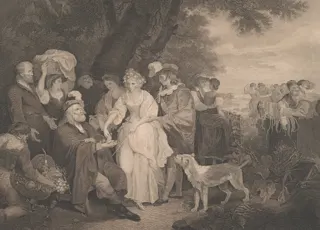
 The Winter's Taleby William ShakespeareA king's sudden jealousy destroys his family, and sixteen years later it is restored.
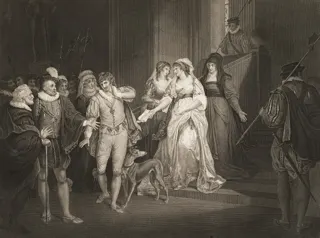 All's Well That Ends Wellby William ShakespeareA doctor's daughter cures a king and wins a husband who runs from her.
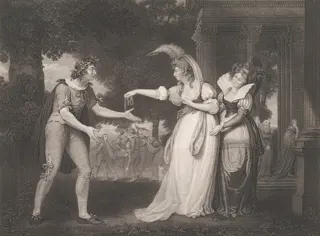 As You Like Itby William ShakespeareBanished cousins in disguise find love and good company in the Forest of Arden.
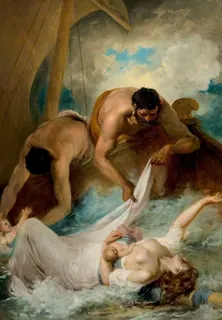 The Comedy of Errorsby William ShakespeareTwo sets of twins, separated at birth, land in the same town on the same day.
Act 1, Scene 1
Athens. Before a temple.
Enter Hymen with a torch burning; a Boy, in a white robe, before, singing and strewing flowers; after Hymen, a Nymph, encompassed in her tresses, bearing a wheaten garland; then Theseus, between two other Nymphs with wheaten chaplets on their heads; then Hippolyta, the bride, led by Pirithous, and another holding a garland over her head, her tresses likewise hanging; after her, Emilia, holding up her train; Artesius and Attendants
[Song] [Music]
Roses, their sharp spines being gone, Not royal in their smells alone, But in their hue. Maiden pinks, of odour faint, Daisies smell-less, yet most quaint, And sweet thyme true. Primrose, first-born child of Ver, Merry spring-time’s harbinger With her bells dim. Oxlips in their cradles growing, Marigolds on deathbeds blowing, Larks’-heels trim. All dear Nature’s children sweet, Lie ’fore bride and bridegroom’s feet, Blessing their sense! [Strewing flowers] Not an angel of the air, Bird melodious, or bird fair, Be absent hence! The crow, the slanderous cuckoo, nor The boding raven, nor chough hoar Nor chatt’ring pie, May on our bride-house perch or sing, Or with them any discord bring, But from it fly!
Enter three Queens, in black, with veils stained, and wearing imperial crowns. The First Queen falls down at the foot of Theseus; the Second falls down at the foot of Hippolyta; the Third before Emilia
For pity’s sake and true gentility’s,
Hear, and respect me!
For your mother’s sake,
And as you wish your womb may thrive with fair ones,
Hear, and respect me!
Now, for the love of him whom Jove hath mark’d
The honour of your bed, and for the sake
Of clear virginity, be advocate
For us and our distresses! This good deed
Shall raze you out o’ the book of trespasses
All you are set down there.
Sad lady, rise.
Stand up.
No knees to me:
What woman I may stead that is distress’d,
Does bind me to her.
What’s your request? deliver you for all.
We are three queens, whose sovereigns fell before
The wrath of cruel Creon; who endure
The beaks of ravens, talons of the kites,
And pecks of crows, in the foul fields of Thebes:
He will not suffer us to burn their bones,
To urn their ashes, nor to take th’ offence
Of mortal loathsomeness from the blest eye
Of holy Phoebus, but infects the winds
With stench of our slain lords. O, pity, duke!
Thou purger of the earth, draw thy fear’d sword
That does good turns to the world; give us the bones
Of our dead kings, that we may chapel them;
And, of thy boundless goodness, take some note
That for our crowned heads we have no roof
Save this, which is the lion’s and the bear’s,
And vault to everything!
Pray you, kneel not:
I was transported with your speech, and suffer’d
Your knees to wrong themselves. I’ve heard the fortunes
Of your dead lords, which gives me such lamenting
As wakes my vengeance and revenge for ’em.
King Capaneus was your lord: the day
That he should marry you, at such a season
As now it is with me, I met your groom
By Mars’s altar; you were that time fair,
Not Juno’s mantle fairer than your tresses,
Nor in more bounty spread her; your wheaten wreath
Was then nor thrash’d nor blasted; Fortune at you
Dimpled her cheek with smiles; Hercules our kinsman—
Then weaker than your eyes—laid by his club;
He tumbled down upon his Nemean hide,
And swore his sinews thaw’d. O, grief and time,
Fearful consumers, you will all devour!
O, I hope some god,
Some god hath put his mercy in your manhood,
Whereto he’ll infuse power, and press you forth
Our undertaker!
O, no knees, none, widow!
Unto the helmeted Bellona use them,
And pray for me, your soldier.—
Troubled I am. [Turns away]
Honour’d Hippolyta,
Most dreaded Amazonian, that hast slain
The scythe-tusk’d boar; that, with thy arm as strong
As it is white, wast near to make the male
To thy sex captive, but that this thy lord—
Born to uphold creation in that honour
First Nature styl’d it in—shrunk thee into
The bound thou wast o’erflowing, at once subduing
Thy force and thy affection; soldieress,
That equally canst poise sternness with pity;
Who now, I know, hast much more power on him
Than e’er he had on thee; who ow’st his strength
And his love too, who is a servant for
The tenor of thy speech; dear glass of ladies,
Bid him that we, whom flaming War doth scorch,
Under the shadow of his sword may cool us;
Require him he advance it o’er our heads;
Speak’t in a woman’s key, like such a woman
As any of us three; weep ere you fail;
Lend us a knee;
But touch the ground for us no longer time
Than a dove’s motion when the head’s pluck’d off;
Tell him, if he i’ the blood-siz’d field lay swoln,
Showing the sun his teeth, grinning at the moon,
What you would do!
Poor lady, say no more:
I had as lief trace this good action with you
As that whereto I’m going, and nev’r yet
Went I so willing, way. My lord is taken
Heart-deep with your distress: let him consider;
I’ll speak anon.
[To Emilia] O, my petition was
Set down in ice, which, by hot grief uncandied,
Melts into drops; so sorrow, wanting form,
Is press’d with deeper matter.
Pray, stand up:
Your grief is written in your cheek.
O, woe!
You cannot read it there; there through my tears,
Like wrinkled pebbles in a glassy stream,
You may behold ’em. Lady, lady, alack!
He that will all the treasure know o’ th’ earth
Must know the centre too; he that will fish
For my least minnow, let him lead his line
To catch one at my heart. O, pardon me!
Extremity, that sharpens sundry wits,
Makes me a fool.
Pray you, say nothing; pray you:
Who cannot feel nor see the rain, being in’t,
Knows neither wet nor dry. If that you were
The ground-piece of some painter, I would buy you
T’instruct me ’gainst a capital grief indeed;—
Such heart-pierc’d demonstration!—but, alas,
Being a natural sister of our sex,
Your sorrow beats so ardently upon me,
That it shall make a counter-reflect ’gainst
My brother’s heart, and warm it to some pity,
Though it were made of stone: pray have good comfort.
Forward to th’ temple! leave not out a jot
O’ the sacred ceremony.
O, this celebration
Will longer last, and be more costly, than
Your suppliant’s war! Remember that your fame
Knolls in th’ ear o’ the world: what you do quickly
Is not done rashly; your first thought is more
Than others’ labour’d meditance; your premeditating
More than their actions; but—O Jove!—your actions,
Soon as they move, as asprayes do the fish,
Subdue before they touch: think, dear duke, think
What beds our slain kings have!
What griefs our beds,
That our dear lords have none!
None fit for the dead!
Those that with cords, knives, drams, precipitance,
Weary of this world’s light, have to themselves
Been death’s most horrid agents, humane grace
Affords them dust and shadow.
But our lords
Lie blistering ’fore the visitating sun,
And were good kings when living.
It is true;
And I will give you comfort,
To give your dead lords graves: the which to do
Must make some work with Creon.
And that work
Presents itself to the doing:
Now ’twill take form; the heats are gone to-morrow;
Then bootless toil must recompense itself
With its own sweat; now he is secure,
Not dreams we stand before your puissance,
Wrinching our holy begging in our eyes,
To make petition clear.
Now you may take him
Drunk with his victory.
And his army full
Of bread and sloth.
Artesius, that best know’st
How to draw out fit to this enterprise
The prim’st for this proceeding, and the number
To carry such a business; forth and levy
Our worthiest instruments; whilst we despatch
This grand act of our life, this daring deed
Of fate in wedlock.
Dowagers, take hands;
Let us be widows to our woes; delay
Commends us to a famishing hope.
Farewell!
We come unseasonably; but when could grief
Cull forth, as unpang’d judgment can, fitt’st time
For best solicitation?
Why, good ladies,
This is a service, whereto I am going,
Greater than any war; it more imports me
Than all the actions that I have foregone,
Or futurely can cope.
The more proclaiming
Our suit shall be neglected: when her arms,
Able to lock Jove from a synod, shall
By warranting moonlight corslet thee, O, when
Her twinning cherries shall their sweetness fall
Upon thy tasteful lips, what wilt thou think
Of rotten kings or blubber’d queens? what care
For what thou feel’st not, what thou feel’st being able
To make Mars spurn his drum? O, if thou couch
But one night with her, every hour in’t will
Take hostage of thee for a hundred, and
Thou shalt remember nothing more than what
That banquet bids thee to!
Though much unlike [kneeling]
You should be so transported, as much sorry
I should be such a suitor; yet I think,
Did I not by th’ abstaining of my joy,
Which breeds a deeper longing, cure their surfeit
That craves a present medicine, I should pluck
All ladies’ scandal on me: therefore, sir,
As I shall here make trial of my prayers,
Either presuming them to have some force,
Or sentencing for aye their vigour dumb,
Prorogue this business we are going about, and hang
Your shield afore your heart, about that neck
Which is my fee, and which I freely lend
To do these poor queens service.
[To Emilia] O, help now!
Our cause cries for your knee.
If you grant not [kneeling]
My sister her petition, in that force,
With that celerity and nature, which
She makes it in, from henceforth I’ll not dare
To ask you anything, nor be so hardy
Ever to take a husband.
Pray, stand up:
I am entreating of myself to do
That which you kneel to have me.—Pirithous,
Lead on the bride: get you and pray the gods
For success and return; omit not anything
In the pretended celebration.—Queens,
Follow your soldier.—[To Artesius] As before, hence you,
And at the banks of Aulis meet us with
The forces you can raise, where we shall find
The moiety of a number, for a business
More bigger look’d.—Since that our theme is haste,
I stamp this kiss upon thy currant lip; [Kisses Hippolyta]
Sweet, keep it as my token.—Set you forward;
For I will see you gone.—[Exit Artesius]
Farewell, my beauteous sister.—Pirithous,
Keep the feast full; bate not an hour on’t.
Sir,
I’ll follow you at heels: the feast’s solemnity
Shall want till your return.
Cousin, I charge you
Budge not from Athens; We shall be returning
Ere you can end this feast, of which, I pray you,
Make no abatement. Once more, farewell all.
Thus dost thou still make good
The tongue o’ the world.
And earn’st a deity
Equal with Mars.
If not above him; for
Thou, being but mortal, mak’st affections bend
To godlike honours; they themselves, some say,
Groan under such a mastery.
As we are men,
Thus should we do; being sensually subdu’d,
We lose our humane title. Good cheer, ladies!
Now turn we towards your comforts. [Flourish. Exeunt]
Act 1, Scene 2
Thebes. The court of the palace.
Enter Palamon, and Arcite
Dear Palamon, dearer in love than blood,
And our prime cousin, yet unharden’d in
The crimes of nature; let us leave the city
Thebes, and the temptings in’t, before we further
Sully our gloss of youth:
And here to keep in abstinence we shame
As in incontinence; for not to swim
I’ th’ aide o’ the current, were almost to sink,
At least to frustrate striving; and to follow
The common stream, ’twould bring us to an eddy
Where we should turn or drown; if labour through,
Our gain but life and weakness.
Your advice
Is cried up with example: what strange ruins,
Since first we went to school, may we perceive
Walking in Thebes! scars and bare weeds,
The gain o’ the martialist, who did propound
To his bold ends honour and golden ingots,
Which, though he won, he had not; and now flurted
By peace, for whom he fought! Who, then, shall offer
To Mars’s so-scorn’d altar? I do bleed
When such I meet, and wish great Juno would
Resume her ancient fit of jealousy,
To get the soldier work, that peace might purge
For her repletion, and retain anew
Her charitable heart, now hard, and harsher
Than strife or war could be.
Are you not out?
Meet you no ruin but the soldier in
The cranks and turns of Thebes? You did begin
As if you met decays of many kinds:
Perceive you none that do arouse your pity,
But the unconsider’d soldier?
Yes; I pity
Decays where’er I find them; but such most
That, sweating in an honourable toil,
Are paid with ice to cool ’em.
’Tis not this
I did begin to speak of; this is virtue
Of no respect in Thebes: I spake of Thebes,
How dangerous, if we will keep our honours,
It is for our residing; where every evil
Hath a good colour; where every seeming good’s
A certain evil; where not to be even jump
As they are here, were to be strangers, and
Such things to be, mere monsters.
’Tis in our power—
Unless we fear that apes can tutor’s—to
Be masters of our manners: what need I
Affect another’s gait, which is not catching
Where there is faith? or to be fond upon
Another’s way of speech, when by mine own
I may be reasonably conceiv’d, sav’d too,
Speaking it truly? why am I bound
By any generous bond to follow him
Follows his tailor, haply so long until
The follow’d make pursuit? or let me know
Why mine own barber is unblest, with him
My poor chin too, for ’tis not scissar’d just
To such a favourite’s glass? what canon is there
That does command my rapier from my hip,
To dangle ’t in my hand, or to go tip-toe
Before the street be foul? Either I am
The fore-horse in the team, or I am none
That draw i’ the sequent trace. These poor slight sores
Need not a plantain; that which rips my bosom,
Almost to th’ heart, ’s—
Our Uncle Creon.
He,
A most unbounded tyrant, whose successes
Makes heaven unfear’d, and villainy assur’d
Beyond its power there’s nothing; almost puts
Faith in a fever, and deifies alone
Voluble chance; who only attributes
The faculties of other instruments
To his own nerves and act; commands men service,
And what they win in’t, boot and glory; one
That fears not to do harm: good, dares not; let
The blood of mine that’s sibbe to him be suck’d
From me with leeches; let them break and fall
Off me with that corruption!
Clear-spirited cousin,
Let’s leave his court, that we may nothing share
Of his loud infamy; for our milk
Will relish of the pasture, and we must
Be vile or disobedient; not his kinsmen
In blood, unless in quality.
Nothing truer:
I think the echoes of his shames have deaf’d
The ears of heavenly justice: widdows’ cries
Descend again into their throats, and have not
Due audience of the gods.—Valerius!
Enter Valerius
The king calls for you; yet be leaden-footed,
Till his great rage be off him: Phoebus when
He broke his whipstock, and exclaim’d against
The horses of the sun, but whisper’d, to
The loudness of his fury.
Small winds shake him!
But what’s the matter?
Theseus—who where he threats appals—hath sent
Deadly defiance to him, and pronounces
Ruin to Thebes; who is at hand to seal
The promise of his wrath.
Let him approach:
But that we fear the gods in him, he brings not
A jot of terror to us: yet what man
Thirds his own worth—the case is each of ours—
When that his action’s dregg’d with mind assur’d
’Tis bad he goes about?
Leave that unreason’d;
Our services stand now for Thebes, not Creon:
Yet, to be neutral to him were dishonour,
Rebellious to oppose; therefore we must
With him stand to the mercy of our fate,
Who hath bounded our last minute.
So we must.—
Is’t said this war’s afoot? or it shall be,
On fail of some condition?
’Tis in motion;
Th’ intelligence of state came in the instant
With the defier.
Let’s to the king; who, were he
A quarter carrier of that honour which
His enemy come in, the blood we venture
Should be as for our health; which were not spent,
Rather laid out for purchase: but, alas!
Our hands advanc’d before our hearts, what will
The fall o’ the stroke do damage?
Let th’ event
That never-erring arbitrator, tell us
When we know all ourselves; and let us follow
The becking of our chance. [Exeunt]
Act 1, Scene 3
Before the gates of Athens.
Enter Pirithous, Hippolyta, and Emilia
No further!
Sir, farewell: repeat my wishes
To our great lord, of whose success I dare not
Make any timorous question; yet I wish him
Excess and overflow of power, an’t might be,
To dare ill-dealing fortune. Speed to him;
Store never hurts good governors.
Though I know
His ocean needs not my poor drops, yet they
Must yield their tribute there. My precious maid,
Those best affections that the heavens infuse
In their best-temper’d pieces, keep enthron’d
In your dear heart!
Thanks, sir. Remember me
To our all-royal brother; for whose speed
The great Bellona I’ll solicit; and
Since, in our terrene state petitions are not
Without gifts understood, I’ll offer to her
What I shall be advis’d she likes. Our hearts
Are in his army, in his tent.
In’s bosom.
We have been soldiers, and we cannot weep
When our friends don their helms, or put to sea,
Or tell of babes broach’d on the lance, or women
That have sod their infants in—and after eat them—
The brine they wept at killing ’em: then, if
You stay to see of us such spinsters, we
Should hold you here for ever.
Peace be to you,
As I pursue this war! which shall be then
Beyond further requiring. [Exit]
How his longing
Follows his friend! since his depart, his sports,
Though craving seriousness and skill, pass’d slightly
His careless execution, where nor gain
Made him regard, or loss consider; but
Playing one business in his hand, another
Directing in his head, his mind nurse equal
To these so differing twins. Have you observ’d him
Since our great lord departed?
With much labour;
And I did love him for’t. They two have cabin’d
In many as dangerous as poor a corner,
Peril and want contending; they have skiff’d
Torrents, whose roaring tyranny and power
I’ the least of these was dreadful; and they have
Fought out together, where death’s self was lodg’d;
Yet fate hath brought them off. Their knot of love
Tied, weav’d, entangled, with so true, so long,
And with a finger of so deep a cunning,
May be out-worn, never undone. I think
Theseus cannot be umpire to himself,
Cleaving his conscience into twain, and doing
Each side like justice, which he loves best.
Doubtless
There is a best, and reason has no manners
To say it is not you. I was acquainted
Once with a time, when I enjoy’d a play-fellow;
You were at wars when she the grave enrich’d,
Who made too proud the bed, took leave of the moon—
Which then look’d pale at parting—when our count
Was each eleven.
’Twas Flavina.
Yes.
You talk of Pirithous’ and Theseus’ love:
Theirs has more ground, is more maturely season’d,
More buckled with strong judgment, and their needs
The one or th’ other may be said to water
Their intertangled roots of love; but I,
And she I sigh and spoke of, were things innocent,
Lov’d for we did, and like the elements
That know not what nor why, yet do effect
Rare issues by their operance, our souls
Did so to one another: what she lik’d
Was then of me approv’d; what not, condemn’d,
No more arraignment; the flower that I would pluck
And put between my breasts, O—then but beginning
To swell about the blossom—she would long
Till she had such another, and commit it
To the like innocent cradle, where, phoenix-like,
They died in perfume; on my head no toy
But was her pattern; her affections—pretty,
Though happily her careless wear—I follow’d
For my most serious decking; had mine ear
Stol’n some new air, or at adventure humm’d one
From musical coinage, why, it was a note
Whereon her spirits would sojourn—rather dwell on—
And sing it in her slumbers: this rehearsal—
Which, every innocent wots well, comes in
Like old importments bastard—has this end,
That the true love ’tween maid, and maid may be
More than in sex dividual.
You’re out of breath;
And this high-speeded pace is but to say,
That you shall never, like the maid Flavina,
Love any that’s call’d man.
I’m sure I shall not.
Now, alack, weak sister,
I must no more believe thee in this point—
Though in’t I know thou dost believe thyself—
Than I will trust a sickly appetite,
That loathes even as it longs. But, sure, my sister,
If I were ripe for your persuasion, you
Have said enough to shake me from the arm
Of the all-noble Theseus; for whose fortunes
I will now in and kneel, with great assurance
That we, more than his Pirithous, possess
The high throne in his heart.
I am not
Against your faith; yet I continue mine. [Cornets. Exeunt]
Act 1, Scene 4
A field before Thebes.
A battle struck within; then a retreat; flourish. Then enter Theseus (victor), Herald, and Attendants. The three Queens meet Theseus, and fall on their faces before him
To thee no star be dark!
Both heaven and earth
Friend thee for ever!
All the good that may
Be wish’d upon thy head, I cry Amen to’t!
Th’ impartial gods, who from the mounted heavens
View us their mortal herd, behold who err,
And in their time chastise. Go, and find out
The bones of your dead lords, and honour them
With treble ceremony: rather than a gap
Should be in their dear rites, we would supply’t.
But those we will depute which shall invest
You in your dignities, and even each thing
Our haste does leave imperfect. So, adieu,
And heaven’s good eyes look on you! [Exeunt Queens]
Palamon and Arcite borne in on hearses
What are those?
Men of great quality, as may be judg’d
By their appointment; some of Thebes have told’s
They’re sisters’ children, nephews to the king.
By th’ helm of Mars, I saw them in the war—
Like to a pair of lions smear’d with prey—
Make lanes in troops aghast: I fix’d my note
Constantly on them; for they were a mark
Worth a god’s view. What was’t that prisoner told me
When I enquir’d their names?
We ’lieve, they’re called
Arcite and Palamon.
’Tis right; those, those.
They are not dead?
Nor in a state of life: had they been taken
When their last hurts were given, ’twas possible
They might have been recover’d; yet they breathe,
And have the name of men.
Then like men use ’em:
The very lees of such, millions of rates
Exceed the wine of others: all our surgeons
Convent in their behoof; our richest balms,
Rather than niggard, waste: their lives concern us
Much more than Thebes is worth: rather than have ’em
Freed of this plight, and in their morning state,
Sound and at liberty, I would ’em dead;
But, forty thousand fold, we had rather have ’em
Prisoners to us than death. Bear ’em speedily
From our kind air—to them unkind—and minister
What man to man may do; for our sake, more:
Since I have known frights, fury, friends’ behests,
Love’s provocations, zeal, a mistress’ task,
Desire of liberty, a fever, madness,
Hath set a mark—which nature could not reach to
Without some imposition—sickness in will,
Or wrestling strength in reason. For our love,
And great Apollo’s mercy, all our best
Their best skill tender!—Lead into the city;
Where, having bound things scatter’d, we will post
To Athens ’for our army. [Flourish. Exeunt; Attendants carrying Palamon and Arcite]
Act 1, Scene 5
Another part of the same, more remote from Thebes.
Enter the Queens with the hearses of their Knights, in a funeral solemnity, etc
Song
Urns and odours bring away! Vapours, sighs, darken the day! Our dole more deadly looks than dying; Balms, and gums, and heavy cheers, Sacred vials fill’d with tears, And clamours through the wild air flying! Come, all sad and solemn shows, That are quick-ey’d pleasure’s foes! We convent naught else but woes: We convent, etc.
This funeral path brings to your household’s grave:
Joy seize on you again! Peace sleep with him!
And this to yours.
Yours this way. Heavens lend
A thousand differing ways to one sure end.
This world’s a city full of straying streets,
And death’s the market-place, where each one meets. [Exeunt severally]
Act 2, Scene 1
Athens. A garden, with a castle in the background.
Enter Gaoler and Wooer
I may depart with little, while I live; something I may cast to you, not much. Alas! the prison I keep, though it be for great ones, yet they seldom come: before one salmon, you shall take a number of minnows. I am given out to be better lined than it can appear to me report is a true speaker: I would I were really that I am delivered to be. Marry, what I have—be it what it will—I will assure upon my daughter at the day of my death.
Sir, I demand no more than your own offer; and I will estate your daughter in what I have promised.
Well, we will talk more of this when the solemnity is past. But have you a full promise of her? when that shall be seen, I tender my consent.
I have, sir. Here she comes.
Enter Gaoler’s Daughter
Your friend and I have chanced to name you here, upon the old business; but no more of that now: so soon as the court-hurry is over, we will have an end of it: i’ the meantime, look tenderly to the two prisoners; I can tell you they are princes.
These strewings are for their chamber. ’Tis pity they are in prison, and ’twere pity they should be out. I do think they have patience to make any adversity ashamed: the prison itself is proud of ’em; and they have all the world in their chamber.
They are famed to be a pair of absolute men.
By my troth, I think fame but stammers ’em; they stand a greise above the reach of report.
I heard them reported in the battle to be the only doers.
Nay, most likely; for they are noble sufferers. I marvel how they would have looked, had they been victors, that with such a constant nobility enforce a freedom out of bondage, making misery their mirth, and affliction a toy to jest at.
Do they so?
It seems to me they have no more sense of their captivity than I of ruling Athens: they eat well, look merrily, discourse of many things, but nothing of their own restraint and disasters. Yet sometime a divided sigh, martyred as ’twere i’ the deliverance, will break from one of them; when the other presently gives it so sweet a rebuke, that I could wish myself a sigh to be so chid, or at least a sigher to be comforted.
I never saw ’em.
The duke himself came privately in the night, and so did they: what the reason of it is, I know not.
Enter Palamon and Arcite, above
Look, yonder they are! that’s Arcite looks out.
No, sir, no; that’s Palamon: Arcite is the lower of the twain; you may perceive a part of him.
Go to! leave your pointing: they would not make us their object: out of their sight!
It is a holiday to look on them. Lord, the diffrence of men! [Exeunt]
Act 2, Scene 2
The same.
Enter Palamon and Arcite, above
How do you, noble cousin?
How do you, sir?
Why, strong enough to laugh at misery,
And bear the chance of war yet. We are prisoners
I fear for ever, cousin.
I believe it;
And to that destiny have patiently
Laid up my hour to come.
O, cousin Arcite,
Where is Thebes now? where is our noble country?
Where are our friends and kindreds? Never more
Must we behold those comforts; never see
The hardy youths strive for the games of honour,
Hung with the painted favours of their ladies,
Like tall ships under sail; then start amongst ’em,
And, as an east wind, leave ’em all behind us
Like lazy clouds, whilst Palamon and Arcite,
Even in the wagging of a wanton leg,
Outstripp’d the people’s praises, won the garlands,
Ere they have time to wish ’em ours. O, never
Shall we two exercise, like twins of honour,
Our arms again, and feel our fiery horses
Like proud seas under us! Our good swords now—
Better the red-ey’d god of war ne’er wore—
Ravish’d our sides, like age, must run to rust,
And deck the temples of those gods that hate us;
These hands shall never draw ’em out like lightning,
To blast whole armies, more!
No, Palamon,
Those hopes are prisoners with us: here we are,
And here the graces of our youths must wither,
Like a too-timely spring; here age must find us,
And, which is heaviest, Palamon, unmarried;
The sweet embraces of a loving wife,
Loaden with kisses, arm’d with thousand Cupids,
Shall never clasp our necks; no issue know us,
No figures of ourselves shall we e’er see,
To glad our age, and like young eagles teach ’em
Boldly to gaze against bright arms, and say
“Remember what your fathers were, and conquer!”
The fair-ey’d maids shall weep our banishments,
And in their songs curse ever-blinded Fortune,
Till she for shame see what a wrong she has done
To youth and nature: this is all our world;
We shall know nothing here but one another;
Hear nothing but the clock that tells our woes;
The vine shall grow, but we shall never see it;
Summer shall come, and with her all delights,
But dead-cold winter must inhabit here still.
’Tis too true, Arcite. To our Theban hounds,
That shook the aged forest with their echoes,
No more now must we holla; no more shake
Our pointed javelins, whilst the angry swine
Flies like a Parthian quiver from our rages,
Struck with our well-steel’d darts: all valiant uses—
The food and nourishment of noble minds—
In us two here shall perish; we shall die—
Which is the curse of honour—lastly,
Children of grief and ignorance.
Yet, cousin,
Even from the bottom of these miseries,
From all that fortune can inflict upon us,
I see two comforts rising, two mere blessings,
If the gods please, to hold here a brave patience,
And the enjoying of our griefs together.
Whilst Palamon is with me, let me perish
If I think this our prison!
Certainly
’Tis a main goodness, cousin, that our fortunes
Were twinn’d together: ’tis most true, two souls
Put in two noble bodies, let ’em suffer
The gall of hazard, so they grow together,
Will never sink; they must not, say they could:
A willing man dies sleeping, and all’s done.
Shall we make worthy uses of this place,
That all men hate so much?
How, gentle cousin?
Let’s think this prison holy sanctuary,
To keep us from corruption of worse men:
We’re young, and yet desire the ways of honour;
That, liberty and common conversation,
The poison of pure spirits, might, like women,
Woo us to wander from. What worthy blessing
Can be, but our imaginations
May make it ours? and here being thus together,
We are an endless mine to one another;
We’re one another’s wife, ever begetting
New births of love; we’re father, friends, acquaintance;
We are, in one another, families;
I am your heir, and you are mine; this place
Is our inheritance; no hard oppressor
Dare take this from us: here, with a little patience,
We shall live long, and loving; no surfeits seek us;
The hand of war hurts none here, nor the seas
Swallow their youth. Were we at liberty,
A wife might part us lawfully, or business;
Quarrels consume us; envy of ill men
Crave our acquaintance; I might sicken, cousin,
Where you should never know it, and so perish
Without your noble hand to close mine eyes,
Or prayers to the gods: a thousand chaunces,
Were we from hence, would sever us.
You’ve made me—
I thank you, cousin Arcite—almost wanton
With my captivity: what a misery
It is to live abroad, and everywhere!
’Tis like a beast, methinks: I find the court here,
I’m sure, a more content; and all those pleasures
That woo the wills of men to vanity
I see through now; and am sufficient
To tell the world ’tis but a gaudy shadow,
That old Time, as he passes by, takes with him.
What had we been, old in the court of Creon,
Where sin is justice, lust and ignorance
The virtues of the great ones? Cousin Arcite,
Had not the loving gods found this place for us,
We had died as they do, ill old men, unwept,
And had their epitaphs, the people’s curses.
Shall I say more?
I’d hear you still.
Ye shall.
Is there record of any two that lov’d
Better than we do, Arcite?
Sure, there cannot.
I do not think it possible our friendship
Should ever leave us.
Till our deaths it cannot;
And after death our spirits shall be led
To those that love eternally. Speak on, sir.
Enter Emilia and her Woman below
This garden has a world of pleasures in’t.
What flower is this?
’Tis call’d Narcissus, madam.
That was a fair boy certain, but a fool,
To love himself: were there not maids enough?
Pray, forward.
Yes.
Or were they all hard-hearted?
They could not be to one so fair.
Thou wouldst not.
I think I should not, madam.
That’s a good wench!
But take heed to your kindness though!
Why, madam?
Men are mad things.
Will ye go forward, cousin?
Canst not thou work such flowers in silk, wench?
Yes.
I’ll have a gown full of ’em; and of these;
This is a pretty colour: will’t not do
Rarely upon a skirt, wench?
Dainty, madam.
Cousin, cousin! how do you, sir? why, Palamon?
Never till now I was in prison, Arcite.
Why, what’s the matter, man?
Behold, and wonder!
By heaven, she is a goddess!
Ha!
Do reverence;
She is a goddess, Arcite!
Of all flowers,
Methinks, a rose is best.
Why, gentle madam?
It is the very emblem of a maid:
For when the west wind courts her gently,
How modestly she blows, and paints the sun
With her chaste blushes! when the north comes near her,
Rude and impatient, then, like chastity,
She locks her beauties in her bud again,
And leaves him to base briers.
Yet, good madam,
Sometimes her modesty will blow so far
She falls for it: a maid,
If she have any honour, would be loath
To take example by her.
Thou art wanton.
She’s wondrous fair!
She’s all the beauty extant!
The sun grows high; let’s walk in. Keep these flowers;
We’ll see how near art can come near their colours,
I’m wondrous merry-hearted; I could laugh now.
I could lie down, I’m sure.
And take one with you?
That’s as we bargain, madam.
Well, agree then. [Exeunt Emilia and Woman]
What think you of this beauty?
’Tis a rare one.
Is’t but a rare one?
Yes, a matchless beauty.
Might not a man well lose himself, and love her?
I cannot tell what you have done; I have,
Beshrew mine eyes for’t! Now I feel my shackles.
You love her, then?
Who would not?
And desire her?
Before my liberty.
I saw her first.
That’s nothing.
But it shall be.
I saw her too.
Yes; but you must not love her.
I will not, as you do, to worship her,
As she is heavenly and a blessed goddess;
I love her as a woman, to enjoy her:
So both may love.
You shall not love at all.
Not love at all! who shall deny me?
I, that first saw her; I, that took possession
First with mine eye of all those beauties in her
Reveal’d to mankind. If thou lovest her,
Or entertain’st a hope to blast my wishes,
Thou art a traitor, Arcite, and a fellow
False as thy title to her: friendship, blood,
And all the ties between us, I disclaim,
If thou once think upon her!
Yes, I love her;
And if the lives of all my name lay on it,
I must do so; I love her with my soul.
If that will lose ye, farewell, Palamon!
I say again, I love; and, in loving her, maintain
I am as worthy and as free a lover,
And have as just a title to her beauty,
As any Palamon, or any living
That is a man’s son.
Have I call’d thee friend?
Yes, and have found me so. Why are you mov’d thus?
Let me deal coldly with you: am not I
Part of your blood, part of your soul? you’ve told me
That I was Palamon, and you were Arcite.
Yes.
Am not I liable to those affections,
Those joys, griefs, angers, fears, my friend shall suffer?
Ye may be.
Why, then, would you deal so cunningly,
So strangely, so unlike a noble kinsman,
To love alone? Speak truly; do you think me
Unworthy of her sight?
No; but unjust
If thou pursue that sight.
Because another
First sees the enemy, shall I stand still,
And let mine honour down, and never charge?
Yes, if he be but one.
But say that one
Had rather combat me?
Let that one say so,
And use thy freedom: else, if thou pursu’st her,
Be as that cursed man that hates his country,
A branded villain.
You are mad.
I must be,
Till thou art worthy, Arcite; it concerns me;
And, in this madness, if I hazard thee,
And take thy life, I deal but truly.
Fie, sir!
You play the child extremely: I will love her,
I must, I ought to do so, and I dare;
And all this justly.
O, that now, that now
Thy false self and thy friend had but this fortune,
To be one hour at liberty, and grasp
Our good swords in our hands! I’d quickly teach thee
What ’twere to filch affection from another!
Thou art baser in it than a cutpurse:
Put but thy head out of this window more,
And, as I have a soul, I’ll nail thy life to’t!
Thou dar’st not, fool; thou canst not; thou art feeble:
Put my head out! I’ll throw my body out,
And leap the garden, when I see her next,
And pitch between her arms, to anger thee.
No more! the keeper’s coming: I shall live
To knock thy brains out with my shackles.
Do!
Enter Gaoler
By your leave, gentlemen.
Now, honest keeper?
Lord Arcite, you must presently to the duke:
The cause I know not yet.
I’m ready, keeper.
Prince Palamon, I must awhile bereave you
Of your fair cousin’s company.
And me too,
Even when you please, of life. [Exeunt Gaoler and Arcite] Why is he sent for?
It may be, he shall marry her; he’s goodly,
And like enough the duke hath taken notice
Both of his blood and body. But his falsehood!
Why should a friend be treacherous? if that
Get him a wife so noble and so fair,
Let honest men ne’er love again. Once more
I would but see this fair one.—Blessed garden,
And fruit and flowers more blessed, that still blossom
As her bright eyes shine on ye! Would I were,
For all the fortune of my life hereafter,
Yon little tree, yon blooming apricock!
How I would spread, and fling my wanton arms
In at her window! I would bring her fruit
Fit for the gods to feed on; youth and pleasure,
Still as she tasted, should be doubled on her;
And if she be not heavenly, I would make her
So near the gods in nature, they should fear her;
And then I’m sure she would love me.
Reenter Gaoler
How now, keeper!
Where’s Arcite?
Banish’d. Prince Pirithous
Obtain’d his liberty; but never more,
Upon his oath and life, must he set foot
Upon this kingdom.
[Aside] He’s a blessed man!
He shall see Thebes again, and call to arms
The bold young men that, when he bids ’em charge,
Fall on like fire: Arcite shall have a fortune,
If he dare make himself a worthy lover,
Yet in the field to strike a battle for her;
And if he lose her then, he’s a cold coward:
How bravely may he bear himself to win her,
If he be noble Arcite, thousand ways!
Were I at liberty, I would do things
Of such a virtuous greatness, that this lady,
This blushing virgin, should take manhood to her,
And seek to ravish me.
My lord, for you
I have this charge too—
To discharge my life?
No; but from this place to remove your lordship:
The windows are too open.
Devils take ’em
That are so envious to me! Pr’ythee, kill me.
And hang for’t afterward?
By this good light,
Had I a sword, I’d kill thee.
Why, my lord?
Thou bring’st such pelting scurvy news continually,
Thou art not worthy life. I will not go.
Indeed, you must, my lord.
May I see the garden?
No.
Then I’m resolved I will not go.
I must
Constrain you, then; and, for you’re dangerous,
I’ll clap more irons on you.
Do, good keeper:
I’ll shake ’em so, ye shall not sleep;
I’ll make ye a new morris. Must I go?
There is no remedy.
[Aside] Farewell, kind window;
May rude wind never hurt thee!—O my lady,
If ever thou hast felt what sorrow was,
Dream how I suffer!—Come, now bury me. [Exeunt]
Act 2, Scene 3
The country near Athens.
Enter Arcite
Banish’d the kingdom? ’tis a benefit,
A mercy, I must thank ’em for; but banish’d
The free enjoying of that face I die for,
O, ’twas a studied punishment, a death
Beyond imagination! such a vengeance,
That, were I old and wicked, all my sins
Could never pluck upon me. Palamon,
Thou hast the start now; thou shalt stay, and see
Her bright eyes break each morning ’gainst thy window,
And let in life into thee; thou shalt feed
Upon the sweetness of a noble beauty,
That nature ne’er exceeded, nor ne’er shall—
Good gods, what happiness has Palamon!
Twenty to one, he’ll come to speak to her;
And, if she be as gentle as she’s fair,
I know she’s his; he has a tongue will tame
Tempests, and make the wild rocks wanton. Come what can come,
The worst is death; I will not leave the kingdom:
I know mine own is but a heap of ruins,
And no redress there. If I go, he has her.
I am resolv’d: another shape shall make me,
Or end my fortunes; either way, I’m happy:
I’ll see her, and be near her, or no more.
Enter four Country-people, and one with a garland before them
My masters, I’ll be there, that’s certain.
And I’ll be there.
And I.
Why, then, have with ye, boys! ’tis but a chiding:
Let the plough play to-day; I’ll tickle’t out
Of the jades’ tails to-morrow.
I am sure
To have my wife as jealous as a turkey:
But that’s all one: I’ll go through, let her mumble.
Clap her aboard to-morrow night, and stoa her,
And all’s made up again.
Ay, do but put
A feskue in her fist, and you shall see her
Take a new lesson out, and be a good wench.
Do we all hold against the Maying?
Hold!
What should ail us?
Arcas will be there.
And Sennois,
And Rycas; and three better lads ne’er danc’d
Under green tree; and ye know what wenches, ha!
But will the dainty domine, the schoolmaster,
Keep touch, do you think? for he does all, ye know.
He’ll eat a hornbook, ere he fail: go to!
The matter is too far driven between
Him and the tanner’s daughter, to let slip now;
And she must see the duke, and she must dance too.
Shall we be lusty?
All the boys in Athens
Blow wind i’ the breech on us: and here I’ll be,
And there I’ll be, for our town, and here again,
And there again: ha, boys, heigh for the weavers!
This must be done i’ the woods.
O, pardon me!
By any means; our thing of learning says so;
Where he himself will edify the duke
Most parlously in our behalfs: he’s excellent i’ the woods;
Bring him to the plains, his learning makes no cry.
We’ll see the sports; then every man to’s tackle!
And, sweet companions, let’s rehearse by any means,
Before the ladies see us, and do sweetly,
And God knows what may come on’t.
Content: the sports
Once ended, we’ll perform. Away, boys, and hold!
By your leaves, honest friends; pray you, whither go you?
Whither! why, what a question’s that!
Yes, ’tis a question
To me that know not.
To the games, my friend.
Where were you bred, you know it not?
Not far, sir.
Are there such games to-day?
Yes, marry, are there;
And such as you never saw: the duke himself
Will be in person there.
What pastimes are they?
Wrestling and running.—’Tis a pretty fellow.
Thou wilt not go along?
Not yet, sir.
Well, sir,
Take your own time.—Come, boys.
My mind misgives me
This fellow has a vengeance trick o’ the hip;
Mark how his body’s made for’t
I’ll be hang’d though,
If he dare venture; hang him, plum-porridge!
He wrestle? he roast eggs! Come, let’s be gone, lads. [Exeunt Countrymen]
This is an offer’d opportunity
I durst not wish for. Well I could have wrestled,
The best men call’d it excellent; and run
Swifter than wind upon a field of corn,
Curling the wealthy ears, nev’r flew. I’ll venture,
And in some poor disguise be there: who knows
Whether my brows may not be girt with garlands,
And happiness prefer me to a place
Where I may ever dwell in sight of her? [Exit]
Act 2, Scene 4
Athens. A room in the prison.
Enter Gaoler’s Daughter
Why should I love this gentleman? ’tis odds
He never will affect me: I am base,
My father the mean keeper of his prison,
And he a prince: to marry him is hopeless,
To be his whore is witless. Out upon’t!
What pushes are we wenches driven to,
When fifteen once has found us! First, I saw him;
I, seeing, thought he was a goodly man;
He has as much to please a woman in him—
If he please to bestow it so—as ever
These eyes yet look’d on: next I pitied him;
And so would any young wench, o’ my conscience,
That ever dream’d, or vow’d her maidenhead
To a young handsome man: then I lov’d him,
Extremely lov’d him, infinitely lov’d him;
And yet he had a cousin, fair as he too;
But in my heart was Palamon, and there,
Lord, what a coil he keeps! To hear him
Sing in an evening, what a heaven it is!
And yet his songs are sad ones. Fairer spoken
Was never gentleman: when I come in
To bring him water in a morning, first
He bows his noble body, then salutes me thus,
“Fair, gentle maid, good morrow: may thy goodness
Get thee a happy husband!” Once he kiss’d me;
I lov’d my lips the better ten days after:
Would he would do so every day! He grieves much,
And me as much to see his misery:
What should I do, to make him know I love him?
For I would fain enjoy him say I ventur’d
To set him free? what says the law, then? Thus much
For law, or kindred! I will do it;
And this night or to-morrow he shall love me. [Exit]
Act 2, Scene 5
An open place in Athens.
A short flourish of cornets, and shouts within. Enter Theseus, Hippolyta, Pirithous, Emilia; Arcite, as a Countryman, wearing a garland; and Country-people
You have done worthily; I have not seen,
Since Hercules, a man of tougher sinews:
Whate’er you are, you run the best, and wrestle,
That these times can allow.
I’m proud to please you.
What country bred you?
This; but far off, prince.
Are you a gentleman?
My father said so;
And to those gentle uses gave me life.
Are you his heir?
His youngest, sir.
Your father,
Sure, is a happy sire then. What proves you?
A little of all noble qualities:
I could have kept a hawk, and well have holla’d
To a deep cry of dogs; I dare not praise
My feat in horsemanship, yet they that knew me
Would say it was my best piece; last and greatest,
I would be thought a soldier.
You are perfect.
Upon my soul, a proper man!
He is so.
How do you like him, lady?
I admire him:
I have not seen so young a man so noble—
If he say true—of his sort.
Believe,
His mother was a wondrous handsome woman;
His face methinks goes that way.
But his body
And fiery mind illustrate a brave father.
Mark how his virtue, like a hidden sun,
Breaks through his baser garments!
He’s well got, sure.
What made you seek this place, sir?
Noble Theseus,
To purchase a name, and do my ablest service
To such a well-found wonder as thy worth;
For only in thy court, of all the world,
Dwells fair-ey’d Honour.
All his words are worthy.
Sir, we are much indebted to your travel,
Nor shall you lose your wish.—Pirithous,
Dispose of this fair gentleman.
Thanks, Theseus.—
Whate’re you are, you’re mine; and I shall give you
To a most noble service—to this lady,
This bright young virgin: pray, observe her goodness:
You’ve honour’d her fair birthday with your virtues,
And, as your due, you’re hers; kiss her fair hand, sir.
Sir, you’re a noble giver.—[To Emilia] Dearest beauty,
Thus let me seal my vow’d faith. [Kisses her hand] When your servant—
Your most unworthy creature—but offends you,
Command him die, he shall.
That were too cruel.
If you deserve well, sir, I shall soon see it:
You’re mine; and somewhat better than your rank I’ll use you.
I’ll see you furnish’d: and because you say
You are a horseman, I must needs entreat you
This afternoon to ride; but ’tis a rough one.
I like him better, prince; I shall not, then,
Freeze in my saddle.
Sweet, you must be ready—
And you, Emilia—and you, friend—and all—
To-morrow by the sun, to do observance
To flowery May, in Dian’s wood.—Wait well, sir,
Upon your mistress.—Emily, I hope
He shall not go afoot.
That were a shame, sir,
While I have horses.—Take your choice; and what
You want at any time, let me but know it:
If you serve faithfully, I dare assure you
You’ll find a loving mistress.
If I do not,
Let me find that my father ever hated—
Disgrace and blows.
Go, lead the way; you’ve won it;
It shall be so: you shall receive all dues
Fit for the honour you have won; ’twere wrong else.—
Sister, beshrew my heart, you have a servant,
That, if I were a woman, would be master:
But you are wise.
I hope too wise for that, sir. [Flourish. Exeunt]
Act 2, Scene 6
Athens. Before the prison.
Enter Gaoler’s Daughter
Let all the dukes and all the devils roar,
He is at liberty: I’ve ventur’d for him;
And out I’ve brought him to a little wood
A mile hence: I have sent him, where a cedar,
Higher than all the rest, spreads like a plane,
Fast by a brook; and there he shall keep close,
Till I provide him files and food; for yet
His iron bracelets are not off. O Love,
What a stout-hearted child thou art! My father
Durst better have endur’d cold iron than done it.
I love him beyond love and beyond reason,
Or wit, or safety; I have made him know it:
I care not: I am desperate; if the law
Find me, and then condemn me for’t, some wenches,
Some honest-hearted maids, will sing my dirge,
And tell to memory my death was noble,
Dying almost a martyr. That way he takes,
I purpose is my way too: sure he cannot
Be so unmanly as to leave me here:
If he do, maids will not so easily
Trust men again: and yet he has not thank’d me
For what I’ve done; no, not so much as kiss’d me;
And that, methinks, is not so well; nor scarcely
Could I persuade him to become a freeman,
He made such scruples of the wrong he did
To me and to my father. Yet, I hope,
When he considers more, this love of mine
Will take more root within him: let him do
What he will with me, so he use me kindly;
For use me so he shall, or I’ll proclaim him,
And to his face, no man. I’ll presently
Provide him necessaries, and pack my clothes up,
And where there is a patch of ground I’ll venture,
So he be with me: by him, like a shadow,
I’ll ever dwell. Within this hour the whoobub
Will be all o’er the prison: I am then
Kissing the man they look for. Farewell, father!
Get many more such prisoners and such daughters,
And shortly you may keep yourself. Now to him! [Exit]
Act 3, Scene 1
A forest near Athens.
Cornets in sundry places; noises and hollaing as of people a-Maying. Enter Arcite
The duke has lost Hippolyta; each took
A several land. This is a solemn rite
They owe bloom’d May, and the Athenians pay it
To th’ heart of ceremony. O Queen Emilia,
Fresher than May, sweeter
Than her gold buttons on the boughs, or all
Th’ enamell’d knacks o’ the mead or garden! yea,
We challenge to the bank of any nymph,
That makes the stream seem flowers; thou, O jewel
O’ the wood, o’ the world, hast likewise bless’d a place
With thy sole presence! In thy rumination
That I, poor man, might eftsoons come between,
And chop on some cold thought! thrice-blessed chance,
To drop on such a mistress, expectation
Most guiltless on’t. Tell me, O Lady Fortune—
Next after Emily my sovereign—how far
I may be proud? She takes strong note of me,
Hath made me near her, and this beauteous morn,
The prim’st of all the year, presents me with
A brace of horses; two such steeds might well
Be by a pair of kings back’d, in a field
That their crowns’ titles tried. Alas, alas,
Poor cousin Palamon, poor prisoner! thou
So little dream’st upon my fortune, that
Thou think’st thyself the happier thing, to be
So near Emilia; me thou deem’st at Thebes,
And therein wretched, although free: but if
Thou knew’st my mistress breath’d on me, and that
I ear’d her language, liv’d in her eye, O coz,
What passion would enclose thee!
Enter Palamon out of a bush, with his shackles: he bends his fist at Arcite
Traitor kinsman!
Thou shouldst perceive my passion, if these signs
Of prisonment were off me, and this hand
But owner of a sword. By all oaths in one,
I, and the justice of my love, would make thee
A confess’d traitor! O thou most perfidious
That ever gently look’d! the void’st of honour
That e’er bore gentle token! falsest cousin
That ever blood made kin! call’st thou her thine?
I’ll prove it in my shackles, with these hands
Void of appointment, that thou liest, and art
A very thief in love, a chaffy lord,
Nor worth the name of villain! Had I a sword,
And these house-clogs away—
Dear cousin Palamon—
Cozener Arcite, give me language such
As thou hast show’d me feat!
Not finding in
The circuit of my breast any gross stuff
To form me like your blazon, holds me to
This gentleness of answer: ’tis your passion
That thus mistakes; the which, to you being enemy,
Cannot to me be kind. Honour and honesty
I cherish and depend on, howsoe’er
You skip them in me; and with them, fair coz,
I’ll maintain my proceedings. Pray, be pleas’d
To show in generous terms your griefs, since that
Your question’s with your equal, who professes
To clear his own way with the mind and sword
Of a true gentleman.
That thou durst, Arcite!
My coz, my coz, you have been well advertis’d
How much I dare: you’ve seen me use my sword
Against th’ advice of fear. Sure, of another
You would not hear me doubted, but your silence
Should break out, though i’ the sanctuary.
Sir,
I’ve seen you move in such a place, which well
Might justify your manhood; you were call’d
A good knight and a bold: but the whole week’s not fair,
If any day it rain. Their valiant temper
Men lose when they incline to treachery;
And then they fight like compell’d bears, would fly
Were they not tied.
Kinsman, you might as well
Speak this, and act it in your glass, as to
His ear which now disdains you.
Come up to me:
Quit me of these cold gyves, give me a sword,
Though it be rusty, and the charity
Of one meal lend me; come before me then,
A good sword in thy hand, and do but say
That Emily is thine, I will forgive
The trespass thou hast done me, yea, my life,
If then thou carry’t; and brave souls in shades,
That have died manly, which will seek of me
Some news from earth, they shall get none but this,
That thou art brave and noble.
Be content,
Again betake you to your hawthorn-house:
With counsel of the night, I will be here
With wholesome viands; these impediments
Will I file off; you shall have garments, and
Perfumes to kill the smell o’ the prison; after,
When you shall stretch yourself, and say but, “Arcite,
I am in plight,” there shall be at your choice
Both sword and armour.
O you heavens, dares any
So noble bear a guilty business? none
But only Arcite; therefore none but Arcite
In this kind is so bold.
Sweet Palamon—
I do embrace you and your offer: for
Your offer do’t I only, sir; your person,
Without hypocrisy, I may not wish
More than my sword’s edge on’t. [Wind horns of cornets]
You hear the horns:
Enter your musite, lest this match between’s
Be cross’d ere met. Give me your hand; farewell:
I’ll bring you every needful thing: I pray you,
Take comfort, and be strong.
Pray, hold your promise,
And do the deed with a bent brow: most certain
You love me not: be rough with me, and pour
This oil out of your language. By this air,
I could for each word give a cuff; my stomach
Not reconcil’d by reason.
Plainly spoken!
Yet pardon me hard language: when I spur
My horse, I chide him not; content and anger
In me have but one face. [Wind horns] Hark, sir! they call
The scatter’d to the banquet: you must guess
I have an office there.
Sir, your attendance
Cannot please heaven; and I know your office
Unjustly is achiev’d.
I’ve a good title,
I am persuaded: this question sick between’s,
My bleeding must be cur’d. I am a suitor
That to your sword you will bequeath this plea,
And talk of it no more.
But this one word:
You’re going now to gaze upon my mistress;
For note you, mine she is—
Nay, then—
Nay, pray you—
You talk of feeding me to breed me strength;
You’re going now to look upon a sun
That strengthens what it looks on; there you have
A vantage o’er me: but enjoy it till
I may enforce my remedy. Farewell. [Exeunt severally]
Act 3, Scene 2
Another part of the forest.
Enter Gaoler’s Daughter
He has mistook the brake I meant; is gone
After his fancy. ’Tis now well-nigh morning;
No matter: would it were perpetual night,
And darkeness lord o’ the world!—Hark! ’tis a wolf:
In me hath grief slain fear, and, but for one thing,
I care for nothing, and that’s Palamon:
I reck not if the wolves would jaw me, so
He had this file. What if I holla’d for him?
I cannot holla: if I whooped, what then?
If he not answer’d, I should call a wolf,
And do him but that service. I have heard
Strange howls this live-long night: why may’t not be
They have made prey of him? he has no weapons;
He cannot run; the jingling of his gyves
Might call fell things to listen, who have in them
A sense to know a man unarm’d, and can
Smell where resistance is. I’ll set it down
He’s torn to pieces; they howl’d many together,
And then they fed on him: so much for that!
Be bold to ring the bell; how stand I, then?
All’s charr’d when he is gone. No, no, I lie;
My father’s to be hang’d for his escape;
Myself to beg, if I priz’d life so much
As to deny my act; but that I would not,
Should I try death by dozens.—I am mop’d:
Food took I none these two days—
Sipp’d some water; I’ve not clos’d mine eyes,
Save when my lids scour’d off their brine. Alas,
Dissolve my life! let not my sense unsettle,
Lest I should drown, or stab, or hang myself!
O state of nature, fail together in me,
Since thy best props are warp’d!—So, which way now?
The best way is the next way to a grave:
Each errant step beside is torment. Lo,
The moon is down, the crickets chirp, the screeching owl
Calls in the dawn! all offices are done,
Save what I fail in: but the point is this,
An end, and that is all. [Exit]
Act 3, Scene 3
The same part of the forest as in scene I.
Enter Arcite, with meat, wine, files, etc
I should be near the place.—Hoa, Cousin Palamon!
Enter Palamon
Arcite?
The same: I’ve brought you food and files.
Come forth and fear not; here’s no Theseus.
Nor none so honest, Arcite.
That’s no matter:
We’ll argue that hereafter. Come, take courage;
You shall not die thus beastly: here, sir, drink;
I know you’re faint; then I’ll talk further with you.
Arcite, thou mightst now poison me.
I might;
But I must fear you first. Sit down; and, good, now,
No more of these vain parleys: let us not,
Having our ancient reputation with us,
Make talk for fools and cowards. To your health! [Drinks]
Do.
Pray, sit down, then; and let me entreat you,
By all the honesty and honour in you,
No mention of this woman! ’twill disturb us;
We shall have time enough.
Well, sir, I’ll pledge you. [Drinks]
Drink a good hearty draught; it breeds good blood, man.
Do not you feel it thaw you?
Stay; I’ll tell you
After a draught or two more.
Spare it not;
The duke has more, coz. Eat now.
Yes. [Eats]
I’m glad
You have so good a stomach.
I am gladder
I have so good meat to’t.
Is’t not mad lodging
Here in the wild woods, cousin?
Yes, for them
That have wild consciences.
How tastes your victuals?
Your hunger needs no sauce, I see.
Not much:
But if it did, yours is too tart, sweet cousin.
What is this?
Venison.
’Tis a lusty meat.
Give me more wine: here, Arcite, to the wenches
We’ve known in our days! The lord-steward’s daughter;
Do you remember her?
After you, coz.
She lov’d a black-hair’d man.
She did so: well, sir?
And I have heard some call him Arcite; and—
Out with it, faith!
She met him in an arbour:
What did she there, coz? play o’ the virginals?
Something she did, sir.
Made her groan a month for’t;
Or two, or three, or ten.
The marshal’s sister
Had her share too, as I remember, cousin,
Else there be tales abroad: you’ll pledge her?
Yes.
A pretty brown wench ’tis: there was a time
When young men went a-hunting, and a wood,
And a broad beech; and thereby hangs a tale.—
Heigh-ho!
For Emily, upon my life! Fool,
Away with this strain’d mirth! I say again,
That sigh was breath’d for Emily: base cousin,
Dar’st thou break first?
You’re wide.
By heaven and earth,
There’s nothing in thee honest.
Then I’ll leave you:
You are a beast now.
As thou mak’st me, traitor.
There’s all things needful—files, and shirts, and perfumes:
I’ll come again some two hours hence, and bring
That that shall quiet all.
A sword and armour?
Fear me not. You are now too foul; farewell:
Get off your trinkets; you shall want nought.
Sirrah—
I’ll hear no more. [Exit]
If he keep touch, he dies for’t. [Exit]
Act 3, Scene 4
Another part of the forest.
Enter Gaoler’s Daughter
I am very cold; and all the stars are out too,
The little stars, and all that look like aglets:
The sun has seen my folly. Palamon!
Alas, no! he’s in heaven.—Where am I now?—
Yonder’s the sea, and there’s a ship; how’t tumbles!
And there’s a rock lies watching under water;
Now, now, it beats upon it; now, now, now,
There’s a leak sprung, a sound one; how they cry!
Spoon her before the wind, you’ll lose all else;
Up with a course or two, and tack about, boys:
Good night, good night; ye’re gone.—I’m very hungry:
Would I could find a fine frog! he would tell me
News from all parts o’ the world; then would I make
A careck of a cockle-shell, and sail
By east and north-east to the king of Pigmies,
For he tells fortunes rarely. Now, my father,
Twenty to one, is truss’d up in a trice
To-morrow morning: I’ll say never a word. [Sings]
For I’ll cut my green coat a foot above my knee;
And I’ll clip my yellow locks an inch below mine e’e:
Hey, nonny, nonny, nonny.
He s’ buy me a white cut, forth for to ride,
And I’ll go seek him through the world that is so wide:
Hey nonny, nonny, nonny.
O for a prick now, like a nightingale,
To put my breast against! I shall sleep like a top else. [Exit]
Act 3, Scene 5
Another part of the forest.
Enter Gerrold, four Countrymen as Morris-dancers, another as the Bavian, five Wenches, and a Taborer
Fie, fie!
What tediosity and disensanity
Is here among ye! Have my rudiments
Been labour’d so long with ye, milk’d unto ye,
And, by a figure, even the very plum-broth
And marrow of my understanding laid upon ye,
And do you still cry “Where,” and “How,” and “Wherfore?”
You most coarse freeze capacities, ye jane judgements,
Have I said “Thus let be,” and “There let be,”
And “Then let be,” and no man understand me?
Proh Deum, medius fidius, ye are all dunces!
For why here stand I; here the duke comes; there are you,
Close in the thicket; the duke appears; I meet him,
And unto him I utter learned things
And many figures; he hears, and nods, and hums,
And then cries “Rare!” and I go forward; at length
I fling my cap up; mark there! then do you,
As once did Meleager and the boar,
Break comely out before him, like true lovers
Cast yourselves in a body decently,
And sweetly, by a figure, trace and turn, boys.
And sweetly we will do it, Master Gerrold.
Draw up the company. Where’s the taborer?
Why, Timothy!
Here, my mad boys; have at ye!
But I say where’s their women?
Here’s Friz and Maudlin.
And little Luce with the white legs, and bouncing Barbary.
And freckled Nell, that never fail’d her master.
Where be your ribands, maids? swim with your bodies,
And carry it sweetly and deliverly;
And now and then a favour and a frisk.
Let us alone, sir.
Where’s the rest o’ the music?
Dispers’d as you commanded.
Couple, then,
And see what’s wanting. Where’s the Bavian?
My friend, carry your tail without offence
Or scandal to the ladies; and be sure
You tumble with audacity and manhood;
And when you bark, do it with judgement.
Yes, sir.
Quo usque tandem? here’s a woman wanting.
We may go whistle; all the fat’s i’ the fire.
We have,
As learned authors utter, wash’d a tile;
We have been fatuus, and labour’d vainly.
This is that scornful piece, that scurvy hilding,
That gave her promise faithfully she would
Be here, Cicely the sempster’s daughter:
The next gloves that I give her shall be dog-skin;
Nay, an she fail me once—You can tell, Arcas,
She swore, by wine and bread, she would not break.
An eel and woman,
A learned poet says, unless by the tail
And with thy teeth thou hold, will either fail.
In manners this was false position.
A fire ill take her! does she flinch now?
What
Shall we determine, sir?
Nothing;
Our business is become a nullity,
Yea, and a woful and a piteous nullity.
Now, when the credit of our town lay on it,
Now to be frampal, now to piss o’ the nettle!
Go thy ways; I’ll remember thee, I’ll fit thee!
Enter Gaoler’s Daughter, and sings
The George, holla! came from the south,
From the coast of Barbary-a;
And there he met with brave gallants of war,
By one, by two, by three-a.
Well hail’d, well hail’d, you jolly gallants!
And whither now are you bound-a?
O, let me have your company
Till I come to the Sound-a!
There was three fools fell out about an howlet:
The one said it was an owl;
The other he said nay;
The third he said it was a hawk,
And her bells were cut away.
There’s a dainty mad woman, master,
Come i’ the nick; as mad as a March hare:
If we can get her dance, we’re made again;
I warrant her she’ll do the rarest gambols.
A mad woman! we are made, boys.
And are you mad, good woman?
I’d be sorry else.
Give me your hand.
Why?
I can tell your fortune:
You are a fool. Tell ten. I’ve pos’d him. Buzz!
Friend, you must eat no white bread; if you do,
Your teeth will bleed extremely. Shall we dance, ho?
I know you; you’re a tinker; sirrah tinker,
Stop no more holes but what you should.
Dii boni!
A tinker, damsel!
Or a conjurer:
Raise me a devil now, and let him play
Qui passa o’ the bells and bones.
Go, take her,
And fluently persuade her to a peace;
Et opus exegi, quod nec Jovis ira, nec ignis—
Strike up, and lead her in.
Come, lass, let’s trip it.
I’ll lead.
Do, do. [Horns winded within]
Persuasively and cunningly; away, boys!
I hear the horns: give me some meditation,
And mark your cue. [Exeunt all except Gerrold] Pallas inspire me!
Enter Theseus, Pirithous, Hippolyta, Emilia, Arcite, and Train
This way the stag took.
Stay and edify.
What have we here?
Some country sport, upon my life, sir.
Well, sir, go forward; we will edify.—
Ladies, sit down: we’ll stay it.
Thou doughty duke, all hail! All hail, sweet ladies!
This is a cold beginning.
If you but favour, our country pastime made is.
We are a few of those collected here,
That ruder tongues distinguish villager;
And, to say verity and not to fable,
We are a merry rout, or else a rable.
Or company, or, by a figure, choris,
That ’fore thy dignity will dance a morris.
And I, that am the rectifier of all,
By title poedagogus, that let fall
The birch upon the breeches of the small ones,
And humble with a ferula the tall ones,
Do here present this machine, or this frame:
And, dainty duke, whose doughty dismal fame
From Dis to Daedalus, from post to pillar,
Is blown abroad, help me, thy poor well-willer,
And, with thy twinkling eyes, look right and straight
Upon this mighty morr—of mickle weight—
Is—now comes in, which being glu’d together
Makes morris, and the cause that we came hether,
The body of our sport, of no small study.
I first appear, though rude and raw and muddy,
To speak, before thy noble grace, this tenner;
At whose great feet I offer up my penner:
The next, the Lord of May and Lady bright,
The Chambermaid and Servingman, by night
That seek out silent hanging: then mine Host
And his fat spouse, that welcomes to their cost
The galled traveller, and with a beck’ning
Informs the tapster to inflame the reck’ning:
Then the beast-eating Clown, and next the Fool,
The Bavian, with long tail and eke long tool;
Cum multis aliis that make a dance:
Say “Ay,” and all shall presently advance.
Ay, ay, by any means, dear domine.
Produce.
Intrate, filii; come forth, and foot it.
Reenter the school, the Bavian, five Wenches, and the Taborer, with the Gaoler’s Daughter, and others. They dance a morris
Ladies, if we have been merry,
And have pleas’d ye with a derry,
And a derry, and a down,
Say the schoolmaster’s no clown.
Duke, if we have pleas’d thee too,
And have done as good boys should do,
Give us but a tree or twain
For a Maypole, and again,
Ere another year run out,
We’ll make thee laugh, and all this rout.
Take twenty, domine.—How does my sweetheart?
Never so pleas’d, sir.
’Twas an excellent dance; and for a preface,
I never heard a better.
Schoolmaster, I thank you.—
One see ’em all rewarded.
And here’s something [Gives money]
To paint your pole withal.
Now to our sports again.
May the stag thou hunt’st stand long,
And thy dogs be swift and strong!
May they kill him without lets,
And the ladies eat his dowsets! [Exeunt Theseus, Pirithous, Hippolyta, Emilia, Arcite, and Train. Horns winded as they go out]
Come, we’re all made. Dii Deoeque omnes!
Ye have danc’d rarely, wenches. [Exeunt]
Act 3, Scene 6
The same part of the forest as scene III.
Enter Palamon from the bush
About this hour my cousin gave his faith
To visit me again, and with him bring
Two swords and two good armours: if he fail,
He’s neither man nor soldier. When he left me,
I did not think a week could have restor’d
My lost strength to me, I was grown so low
And crest-fall’n with my wants: I thank thee, Arcite,
Thou’rt yet a fair foe; and I feel myself
With this refreshing, able once again
To outdure danger. To delay it longer
Would make the world think, when it comes to hearing,
That I lay fatting like a swine, to fight,
And not a soldier: therefore, this blest morning
Shall be the last; and that sword he refuses,
If it but hold, I kill him with; ’tis justice:
So, love and fortune for me!
Enter Arcite, with armours and swords
O, good morrow.
Good morrow, noble kinsman.
I have put you
To too much pains, sir.
That too much, fair cousin,
Is but a debt to honour and my duty.
Would you were so in all, sir! I could wish ye
As kind a kinsman as you force me find
A beneficial foe, that my embraces
Might thank ye, not my blows.
I shall think either,
Well done, a noble recompense.
Then I shall quit you.
Defy me in these fair terms, and you show
More than a mistress to me: no more anger,
As you love anything that’s honourable:
We were not bred to talk, man; when we’re arm’d,
And both upon our guards, then let our fury,
Like meeting of two tides, fly strongly from us;
And then to whom the birthright of this beauty
Truly pertains—without upbraidings, scorns,
Despisings of our persons, and such poutings,
Fitter for girls and school-boys—will be seen,
And quickly, yours or mine. Will’t please you arm, sir?
Or, if you feel yourself not fitting yet,
And furnish’d with your old strength, I’ll stay, cousin,
And every day discourse you into health,
As I am spar’d: your person I am friends with;
And I could wish I had not said I lov’d her,
Though I had died; but, loving such a lady,
And justifying my love, I must not fly from’t.
Arcite, thou art so brave an enemy,
That no man but thy cousin’s fit to kill thee:
I’m well and lusty; choose your arms.
Choose you, sir.
Wilt thou exceed in all, or dost thou do it
To make me spare thee?
If you think so, cousin,
You are deceiv’d; for, as I am a soldier,
I will not spare you.
That’s well said.
You’ll find it.
Then, as I am an honest man, and love
With all the justice of affection,
I’ll pay thee soundly. This I’ll take.
That’s mine, then.
I’ll arm you first. [Proceeds to put on Palamon’s armour]
Do. Pray thee, tell me, cousin,
Where gott’st thou this good armour?
’Tis the duke’s;
And, to say true, I stole’t. Do I pinch you?
No.
Is’t not too heavy?
I have worn a lighter;
But I shall make it serve.
I’ll buckle’t close.
By any means.
You care not for a grand-guard?
No, no; we’ll use no horses: I perceive
You’d fain be at that fight.
I am indifferent.
Faith, so am I. Good cousin, thrust the buckle
Through far enough.
I warrant you.
My casque now.
Will you fight bare-arm’d?
We shall be the nimbler.
But use your gauntlets though: those are o’ the least;
Pr’ythee, take mine, good cousin.
Thank you, Arcite.
How do I look? am I fall’n much away?
Faith, very little; love has us’d you kindly.
I’ll warrant thee I’ll strike home.
Do, and spare not.
I’ll give you cause, sweet cousin.
Now to you, sir.
Methinks this armour’s very like that, Arcite,
Thou wor’st that day the three kings fell, but lighter.
That was a very good one; and that day,
I well remember, you outdid me, cousin;
I never saw such valour: when you charg’d
Upon the left wing of the enemy,
I spurr’d hard to come up, and under me
I had a right good horse.
You had indeed;
A bright bay, I remember.
Yes. But all
Was vainly labour’d in me; you outwent me,
Nor could my wishes reach you: yet a little
I did by imitation.
More by virtue;
You’re modest, cousin.
When I saw you charge first,
Methought I heard a dreadful clap of thunder
Break from the troop.
But still before that flew
The lightning of your valour. Stay a little:
Is not this piece too straight?
No, no; ’tis well.
I would have nothing hurt thee but my sword;
A bruise would be dishonour.
Now I’m perfect.
Stand off, then.
Take my sword; I hold it better.
I thank ye. No, keep it; your life lies on it:
Here’s one, if it but hold, I ask no more
For all my hopes. My cause and honour guard me!
And me my love! [They bow several ways; then advance, and stand] Is there aught else to say?
This only, and no more. Thou art mine aunt’s son,
And that blood we desire to shed is mutual;
In me thine, and in thee mine: my sword
Is in my hand, and, if thou killest me,
The gods and I forgive thee: if there be
A place prepar’d for those that sleep in honour,
I wish his weary soul that falls may win it.
Fight bravely, cousin: give me thy noble hand.
Here, Palamon: this hand shall never more
Come near thee with such friendship.
I commend thee.
If I fall, curse me, and say I was a coward;
For none but such dare die in these just trials.
Once more, farewell, my cousin.
Farewell, Arcite. [They fight. Horns winded within: they stand]
Lo, cousin, lo! our folly has undone us.
Why?
This is the duke, a-hunting as I told you;
If we be found, we’re wretched; O, retire,
For honour’s sake and safety, presently
Into your bush again, sir; we shall find
Too many hours to die in. Gentle cousin,
If you be seen, you perish instantly
For breaking prison; and I, if you reveal me,
For my contempt: then all the world will scorn us,
And say we had a noble difference,
But base disposers of it.
No, no, cousin;
I will no more be hidden, nor put off
This great adventure to a second trial:
I know your cunning and I know your cause:
He that faints now, shame take him! Put thyself
Upon thy present guard—
You are not mad?
Or I will make th’ advantage of this hour
Mine own; and what to come shall threaten me,
I fear less than my fortune. Know, weak cousin,
I love Emilia; and in that I’ll bury
Thee, and all crosses else.
Then, come what can come,
Thou shalt know, Palamon, I dare as well
Die, as discourse or sleep: only this fears me,
The law will have the honour of our ends.
Have at thy life!
Look to thine own well, Arcite. [They fight. Horns winded within]
Enter Theseus, Hippolyta, Emilia, Pirithous, and Train
What ignorant and mad malicious traitors
Are you, that, ’gainst the tenor of my laws,
Are making battle, thus like knights appointed,
Without my leave, and officers of arms?
By Castor, both shall die.
Hold thy word, Theseus:
We’re certainly both traitors, both despisers
Of thee and of thy goodness: I am Palamon,
That cannot love thee, he that broke thy prison;
Think well what that deserves: and this is Arcite;
A bolder traitor never trod thy ground,
A falser ne’er seemed friend: this is the man
Was begg’d and banish’d: this is he contemns thee
And what thou dar’st do; and in this disguise,
Against thy own edict, follows thy sister,
That fortunate bright star, the fair Emilia;
Whose servant—if there be a right in seeing,
And first bequeathing of the soul to—justly
I am; and, which is more, dares think her his.
This treachery, like a most trusty lover,
I call’d him now to answer: if thou be’st,
As thou art spoken, great and virtuous,
The true decider of all injuries,
Say “Fight again!” and thou shalt see me, Theseus,
Do such a justice thou thyself wilt envy:
Then take my life; I’ll woo thee to’t.
O heaven,
What more than man is this!
I’ve sworn.
We seek not
Thy breath of mercy, Theseus: ’tis to me
A thing as soon to die as thee to say it,
And no more mov’d. Where this man calls me traitor,
Let me say thus much: if in love be treason,
In service of so excellent a beauty,
As I love most, and in that faith will perish,
As I have brought my life here to confirm it,
As I have serv’d her truest, worthiest,
As I dare kill this cousin that denies it,
So let me be most traitor, and ye please me.
For scorning thy edict, duke, ask that lady
Why she is fair, and why her eyes command me
Stay here to love her; and, if she say “traitor,”
I am a villain fit to lie unburied.
Thou shalt have pity of us both, O Theseus,
If unto neither thou show mercy; stop,
As thou art just, thy noble ear against us;
As thou art valiant: for thy cousin’s soul,
Whose twelve strong labours crown his memory,
Let’s die together, at one instant, duke;
Only a little let him fall before me,
That I may tell my soul he shall not have her.
I grant your wish; for, to say true, your cousin
Has ten times more offended, for I gave him
More mercy than you found, sir, your offences
Being no more then his.—None here speak for ’em;
For, ere the sun set, both shall sleep for ever.
Alas, the pity!—Now or never, sister,
Speak, not to be denied: that face of yours
Will bear the curses else of after ages
For these lost cousins.
In my face, dear sister,
I find no anger to ’em, nor no ruin;
The misadventure of their own eyes kill ’em:
Yet that I will be woman and have pity,
My knees shall grow to the ground but I’ll get mercy.
Help me, dear sister: in a deed so virtuous
The powers of all women will be with us.—
Most royal brother—[They kneel]
Sir, by our tie of marriage—
By your own spotless honour—
By that faith,
That fair hand, and that honest heart you gave me—
By that you would have pity in another,
By your own virtues infinite—
By valour,
By all the chaste nights I have ever pleas’d you—
These are strange conjurings.
Nay, then, I’ll in too:—[Kneels]
By all our friendship, sir, by all our dangers,
By all you love most, wars, and this sweet lady—
By that you would have trembled to deny
A blushing maid—
By your own eyes, by strength,
In which you swore I went beyond all women,
Almost all men, and yet I yielded, Theseus—
To crown all this, by your most noble soul,
Which cannot want due mercy, I beg first.
Next, hear my prayers.
Last, let me entreat, sir.
For mercy.
Mercy.
Mercy on these princes.
Ye make my faith reel: say I felt
Compassion to ’em both, how would you place it?
Upon their lives; but with their banishments.
You’re a right woman, sister; you have pity,
But want the understanding where to use it.
If you desire their lives, invent a way
Safer than banishment: can these two live,
And have the agony of love about ’em,
And not kill one another? every day
They’d fight about you; hourly bring your honour
In public question with their swords. Be wise, then,
And here forget ’em; it concerns your credit
And my oath equally; I’ve said they die:
Better they fall by the law than one another.
Bow not my honour.
O my noble brother,
That oath was rashly made, and in your anger;
Your reason will not hold it: if such vows
Stand for express will, all the world must perish.
Beside, I have another oath ’gainst yours,
Of more authority, I’m sure more love;
Not made in passion neither, but good heed.
What is it, sister?
Urge it home, brave lady.
That you would ne’er deny me anything
Fit for my modest suit and your free granting:
I tie you to your word now; if ye fall in’t,
Think how you maim your honour—
For now I’m set a-begging, sir, I’m deaf
To all but your compassion—how their lives
Might breed the ruin of my name, opinion!
Shall anything that loves me perish for me?
That were a cruel wisedom: do men proyne
The straight young boughs that blush with thousand blossoms,
Because they may be rotten? O Duke Theseus,
The goodly mothers that have groan’d for these,
And all the longing maids that ever lov’d,
If your vow stand, shall curse me and my beauty,
And in their funeral songs for these two cousins
Despise my cruelty, and cry woe-worth me,
Till I am nothing but the scorn of women.
For heaven’s sake save their lives, and banish ’em.
On what conditions?
Swear ’em never more
To make me their contention or to know me,
To tread upon thy dukedom, and to be,
Wherever they shall travel, ever strangers
To one another.
I’ll be cut to pieces
Before I take this oath: forget I love her?
O all ye gods, dispise me, then. Thy banishment
I not mislike, so we may fairly carry
Our swords and cause along; else, never trifle,
But take our lives, duke: I must love, and will;
And for that love must and dare kill this cousin,
On any piece the earth has.
Will you, Arcite,
Take these conditions?
He’s a villain, then.
These are men!
No, never, duke; ’tis worse to me than begging,
To take my life so basely. Though I think
I never shall enjoy her, yet I’ll preserve
The honour of affection, and die for her,
Make death a devil.
What may be done? for now I feel compassion.
Let it not fall again, sir.
Say, Emilia,
If one of them were dead, as one must, are you
Content to take the other to your husband?
They cannot both enjoy you: they are princes
As goodly as your own eyes, and as noble
As ever fame yet spoke of: look upon ’em,
And, if you can love, end this difference;
I give consent.—Are you content too, princes?
With all our souls.
He that she refuses
Must die, then.
Any death thou canst invent, duke.
If I fall from that mouth, I fall with favour,
And lovers yet unborn shall bless my ashes.
If she refuse me, yet my grave will wed me,
And soldiers sing my epitaph.
Make choice, then.
I cannot, sir; they’re both too excellent:
For me, a hair shall never fall of these men.
What will become of ’em?
Thus I ordaine it;
And, by mine honour, once again it stands,
Or both shall die.—You shall both to your country;
And each, within this month, accompanied
With three fair knights, appear again in this place,
In which I’ll plant a pyramid; and whether,
Before us that are here, can force his cousin
By fair and knightly strength to touch the pillar,
He shall enjoy her; th’ other lose his head,
And all his friends; nor shall he grudge to fall,
Nor think he dies with interest in this lady.
Will this content ye?
Yes.—Here, cousin Arcite,
I’m friends again till that hour.
I embrace ye.
Are you content, sister?
Yes; I must, sir;
Else both miscarry.
Come, shake hands again, then;
And take heed, as you’re gentlemen, this quarrel
Sleep till the hour prefix’d, and hold your course.
We dare not fail thee, Theseus.
Come, I’ll give ye
Now usage like to princes and to friends.
When ye return, who wins, I’ll settle here;
Who loses, yet I’ll weep upon his bier. [Exeunt]
Act 4, Scene 1
Athens. A room in the prison.
Enter Gaoler and First Friend
Hear you no more? was nothing said of me
Concerning the escape of Palamon?
Good sir, remember.
Nothing that I heard;
For I came home before the business
Was fully ended: yet I might perceive,
Ere I departed, a great likelihood
Of both their pardons; for Hippolyta
And fair-ey’d Emily upon their knees
Begg’d with such handsome pity, that the duke
Methought stood staggering whether he should follow
His rash oath, or the sweet compassion
Of those two ladies; and to second them,
That truly noble Prince Pirithous,
Half his own heart, set in too, that I hope
All shall be well: neither heard I one question
Of your name or his scape.
Pray heaven, it hold so!
Enter Second Friend
Be of good comfort, man: I bring you news,
Good news.
They’re welcome.
Palamon has clear’d you,
And got your pardon, and discover’d how
And by whose means he escap’d, which was your daughter’s,
Whose pardon is procur’d too; and the prisoner—
Not to be held ungrateful to her goodness—
Has given a sum of money to her marriage,
A large one, I’ll assure you.
Ye’re a good man,
And ever bring good news.
How was it ended?
Why, as it should be; they that never begg’d
But they prevail’d, had their suits fairly granted:
The prisoners have their lives.
I knew ’twould be so.
But there be new conditions, which you’ll hear of
At better time.
I hope they’re good.
They’re honourable:
How good they’ll prove, I know not.
’Twill be known.
Enter Wooer
Alas, sir, where’s your daughter?
Why do you ask?
O, sir, when did you see her?
How he looks!
This morning.
Was she well? was she in health, sir?
When did she sleep?
These are strange questions.
I do not think she was very well; for, now
You make me mind her, but this very day
I ask’d her questions, and she answer’d me
So far from what she was, so childishly,
So sillily, as if she were a fool,
An innocent; and I was very angry.
But what of her, sir?
Nothing but my pity:
But you must know it, and as good by me
As by another that less loves her.
Well, sir?
Not right?
Not well?
No, sir; not well:
’Tis too true, she is mad.
It cannot be.
Believe, you’ll find it so.
I half suspected
What you have told me; the gods comfort her!
Either this was her love to Palamon,
Or fear of my miscarrying on his scape,
Or both.
’Tis likely.
But why all this haste, sir?
I’ll tell you quickly. As I late was angling
In the great lake that lies behind the palace,
From the far shore, thick set with reeds and sedges,
As patiently I was attending sport,
I heard a voice, a shrill one; and attentive
I gave my ear; when I might well perceive
’Twas one that sung, and, by the smallness of it,
A boy or woman. I then left my angle
To his own skill, came near, but yet perceiv’d not
Who made the sound, the rushes and the reeds
Had so encompass’d it: I laid me down,
And listen’d to the words she sung; for then,
Through a small glade cut by the fishermen,
I saw it was your daughter.
Pray, go on, sir.
She sung much, but no sense; only I heard her
Repeat this often, “Palamon is gone,
Is gone to the wood to gather mulberries;
I’ll find him out to-morrow.”
Pretty soul!
“His shackles will betray him, he’ll be taken;
And what shall I do then? I’ll bring a bevy,
A hundred black-ey’d maids that love as I do,
With chaplets on their heads of daffodillies,
With cherry lips, and cheeks of damask roses,
And all we’ll dance an antic ’fore the duke,
And beg his pardon.” Then she talk’d of you, sir;
That you must lose your head to-morrow morning,
And she must gather flowers to bury you,
And see the house made handsome. Then she sung
Nothing but “Willow, willow, willow;” and between
Ever was, “Palamon, fair Palamon,”
And “Palamon was a tall young man.” The place
Was knee-deep where she sat; her careless tresses
A wreath of bulrush rounded; about her stuck
Thousand fresh water-flowers of several colours;
That methought she appear’d like the fair nymph
That feeds the lake with waters, or as Iris
Newly dropt down from heaven. Rings she made
Of rushes that grew by, and to ’em spoke
The prettiest posies—“Thus our true love’s tied,”
“This you may loose, not me,” and many a one;
And then she wept, and sung again, and sigh’d,
And with the same breath smil’d, and kiss’d her hand.
Alas, what pity ’tis!
I made in to her:
She saw me, and straight sought the flood; I sav’d her,
And set her safe to land: when presently
She slipt away, and to the city made,
With such a cry, and swiftness, that, believe me,
She left me far behind her. Three or four
I saw from far off cross her, one of ’em
I knew to be your brother; where she stay’d,
And fell, scarce to be got away: I left them with her,
And hither came to tell you. Here they are.
Enter Gaoler’s Brother, Daughter, and others
[Sings]
May you never more enjoy the light, etc.
Is not this a fine song?
O, a very fine one!
I can sing twenty more.
I think you can.
Yes, truly, can I; I can sing “The Broom,”
And “Bonny Robin.” Are not you a tailor?
Yes.
Where’s my wedding-gown?
I’ll bring’t to-morrow.
Do, very rarely; I must be abroad else,
To call the maids and pay the minstrels;
For I must lose my maidenhead by cock-light;
’Twill never thrive else. [Sings]
O fair, O sweet, etc.
You must even take it patiently.
’Tis true.
Good even, good men. Pray, did you ever hear
Of one young Palamon?
Yes, wench, we know him.
Is’t not a fine young gentleman?
’Tis love!
By no mean cross her; she is then distemper’d
Far worse than now she shows.
Yes, he’s a fine man.
O, is he so? You have a sister?
Yes.
But she shall never have him, tell her so,
For a trick that I know: y’had best look to her,
For, if she see him once, she’s gone; she’s done,
And undone in an hour. All the young maids
Of our town are in love with him: but I laugh at ’em,
And let ’em all alone; is’t not a wise course?
Yes.
There is at least two hundred now with child by him—
There must be four; yet I keep close for all this,
Close as a cockle; and all these must be boys—
He has the trick on’t; and at ten years old
They must be all gelt for musicians,
And sing the wars of Theseus.
This is strange.
As ever you heard: but say nothing.
No.
They come from all parts of the dukedome to him;
I’ll warrant ye, he had not so few last night
As twenty to dispatch; he’ll tickle’t up
In two hours, if his hand be in.
She’s lost,
Past all cure.
Heaven forbid, man!
Come hither; you’re a wise man.
Does she know him?
No; would she did!
You’re master of a ship?
Yes.
Where’s your compass?
Here.
Set it to the north;
And now direct your course to the wood, where Palamon
Lies longing for me; for the tackling
Let me alone: come, weigh, my hearts, cheerly!
Owgh, owgh, owgh! ’tis up, the wind is fair:
Top the bowling; out with the main-sail:
Where’s your whistle, master?
Let’s get her in.
Up to the top, boy!
Where’s the pilot?
Here.
What kenn’st thou?
A fair wood.
Bear for it, master:
Tack about! [Sings]
When Cynthia with her borrow’d light, etc. [Exeunt]
Act 4, Scene 2
Athens. A room in the palace.
Enter Emilia with two pictures
Yet I may bind those wounds up, that must open
And bleed to death for my sake else: I’ll choose,
And end their strife: two such young handsome men
Shall never fall for me: their weeping mothers,
Following the dead-cold ashes of their sons,
Shall never curse my cruelty. Good heaven,
What a sweet face has Arcite! If wise Nature,
With all her best endowments, all those beauties
She sows into the births of noble bodies,
Were here a mortal woman, and had in her
The coy denials of young maids, yet doubtless
She would run mad for this man: what an eye—
Of what a fiery sparkle and quick sweetness,
Has this young prince! here Love himself sits smiling!—
Just such another, wanton Ganymede
Set Jove a-fire with, and enforc’d the god
Snatch up the goodly boy and set him by him,
A shining constellation: what a brow,
Of what a spacious majesty, he carries,
Arch’d like the great-ey’d Juno’s, but far sweeter,
Smoother than Pelops’ shoulder! Fame and honour,
Methinks, from hence, as from a promontory
Pointed in heaven, should clap their wings, and sing
To all the under-world, the loves and fights
Of gods, and such men near ’em. Palamon
Is but his foil; to him, a mere dull shadow:
He’s swarth and meagre, of an eye as heavy
As if he had lost his mother; a still temper,
No stirring in him, no alacrity;
Of all this sprightly sharpness, not a smile;—
Yet these that we count errors, may become him:
Narcissus was a sad boy, but a heavenly.
O, who can find the bent of woman’s fancy?
I am a fool, my reason is lost in me;
I have no choice, and I have lied so lewdly
That women ought to beat me. On my knees
I ask thy pardon, Palamon; thou art alone,
And only beautiful; and these the eyes,
These the bright lamps of beauty, that command
And threaten Love; and what young maid dare cross ’em?
What a bold gravity, and yet inviting,
Has this brown manly face! O Love, this only
From this hour is complexion. Lie there, Arcite;
Thou art a changeling to him, a mere gipsy,
And this the noble body. I am sotted,
Utterly lost; my virgin’s faith has fled me,
For, if my brother but even now had ask’d me
Whether I lov’d, I had run mad for Arcite;
Now if my sister, more for Palamon.—
Stand both together.—Now, come, ask me, brother;—
Alas, I know not!—Ask me now, sweet sister;—
I may go look!—What a mere child is fancy,
That, having two fair gauds of equal sweetness,
Cannot distinguish, but must cry for both!
Enter a Gentleman
How now, sir!
From the noble duke your brother,
Madam, I bring you news: the knights are come.
To end the quarrel?
Yes.
Would I might end first!
What sins have I committed, chaste Diana,
That my unspotted youth must now be soil’d
With blood of princes, and my chastity
Be made the altar where the lives of lovers—
Two greater and two better never yet
Made mothers joy—must be the sacrifice
To my unhappy beauty?
Enter Theseus, Hippolyta, Pirithous, and Attendants
Bring ’em in
Quickly by any means; I long to see ’em.—
Your two contending lovers are return’d,
And with them their fair knights: now, my fair sister,
You must love one of them.
I had rather both,
So neither for my sake should fall untimely.
Who saw ’em?
I a while.
And I.
Enter Messenger
From whence come you, sir?
From the knights.
Pray, speak,
You that have seen them, what they are.
I will, sir,
And truly what I think. Six braver spirits
Than these the’ve brought—if we judge by th’ outside—
I never saw nor read of. He that stands
In the first place with Arcite, by his seeming
Should be a stout man, by his face a prince—
His very looks so say him; his complexion
Nearer a brown than black; stern, and yet noble,
Which shows him hardy, fearless, proud of dangers;
The circles of his eyes show fire within him,
And as a heated lion so he looks;
His hair hangs long behind him, black and shining
Like ravens’ wings; his shoulders broad and strong;
Arm’d long and round; and on his thigh a sword
Hung by a curious baldrick, when he frowns
To seal his will with; better, o’ my conscience,
Was never soldier’s friend.
Thou’st well describ’d him.
Yet a great deal short,
Methinks, of him that’s first with Palamon.
Pray, speak him, friend.
I guess he is a prince too,
And, if it may be, greater; for his show
Has all the ornament of honour in’t:
He’s somewhat bigger than the knight he spoke of,
But of a face far sweeter; his complexion
Is, as a ripe grape, ruddy; he has felt,
Without doubt, what he fights for, and so apter
To make this cause his own; in’s face appears
All the fair hopes of what he undertakes;
And when he’s angry, then a settled valour,
Not tainted with extremes, runs through his body,
And guides his arm to brave things; fear he cannot,
He shows no such soft temper; his head’s yellow,
Hard-hair’d, and curl’d, thick-twin’d, like ivy-tods,
Not to undo with thunder; in his face
The livery of the warlike maid appears,
Pure red and white, for yet no beard has blest him;
And in his rolling eyes sits Victory,
As if she ever meant to court his valour;
His nose stands high, a character of honour,
His red lips, after fights, are fit for ladies.
Must these men die too?
When he speaks, his tongue
Sounds like a trumpet; all his lineaments
Are as a man would wish ’em, strong and clean;
He wears a well-steel’d axe, the staff of gold;
His age some five-and-twenty.
There’s another,
A little man, but of a tough soul, seeming
As great as any; fairer promises
In such a body yet I never look’d on.
O, he that’s freckle-fac’d?
The same, my lord:
Are they not sweet ones?
Yes, they’re well.
Methinks,
Being so few and well-dispos’d, they show
Great and fine art in nature. He’s white-hair’d,
Not wanton-white, but such a manly colour
Next to an aborne; tough and nimble-set,
Which shows an active soul; his arms are brawny,
Lin’d with strong sinews; to the shoulder-piece
Gently they swell, like women new-conceiv’d,
Which speaks him prone to labour, never fainting
Under the weight of arms; stout-hearted, still,
But, when he stirs, a tiger; he’s gray-ey’d,
Which yields compassion where he conquers; sharp
To spy advantages, and where he finds ’em,
He’s swift to make ’em his; he does no wrongs,
Nor takes none; he’s round-fac’d, and when he smiles
He shows a lover, when he frowns, a soldier;
About his head he wears the winner’s oak,
And in it stuck the favour of his lady;
His age some six-and-thirty; in his hand
He bears a charging-staff, emboss’d with silver.
Are they all thus?
They’re all the sons of honour.
Now, as I have a soul, I long to see ’em.—
Lady, you shall see men fight now.
I wish it,
But not the cause, my lord: they would show
Bravely about the titles of two kingdoms:
’Tis pity Love should be so tyrannous.—
O my soft-hearted sister, what think you?
Weep not, till they weep blood, wench: it must be.
You’ve steel’d ’em with your beauty.—Honour’d friend,
To you I give the field; pray, order it
Fitting the persons that must use it.
Yes, sir.
Come, I’ll go visit ’em: I cannot stay—
Their fame has fir’d me so—till they appear.
Good friend, be royal.
There shall want no bravery.
Poor wench, go weep; for whosoever wins,
Loses a noble cousin for thy sins. [Exeunt]
Act 4, Scene 3
Athens. A room in the prison.
Enter Gaoler, Wooer, and Doctor
Her distraction is more at some time of the moon than at other some, is it not?
She is continually in a harmless distemper; sleeps little; altogether without appetite, save often drinking; dreaming of another world and a better; and what broken piece of matter soe’er she’s about, the name Palamon lards it; that she farces every business withal, fits it to every question.—Look, where she comes; you shall perceive her behaviour.
Enter Gaoler’s Daughter
I have forgot it quite; the burden on’t, was Down-a, down-a; and penned by no worse man than Giraldo, Emilia’s schoolmaster: he’s as fantastical, too, as ever he may go upon’s legs; for in the next world will Dido see Palamon, and then will she be out of love with Aeneas.
What stuff’s here! poor soul!
Even thus all day long.
Now for this charm that I told you of. You must bring a piece of silver on the tip of your tongue, or no ferry: then, if it be your chance to come where the blessed spirits—as there’s a sight now!—we maids that have our livers perished, cracked to pieces with love, we shall come there, and do nothing all day long but pick flowers with Proserpine; then will I make Palamon a nosegay; then let him—mark me—then—
How prettily she’s amiss! note her a little further.
Faith, I’ll tell you; sometime we go to barley-break, we of the blessed. Alas, ’tis a sore life they have i’ th’ other place, such burning, frying, boiling, hissing, howling, chattering, cursing! O, they have shrewd measure! Take heed: if one be mad, or hang, or drown themselves, thither they go; Jupiter bless us! and there shall we be put in a caldron of lead and usurers’ grease, amongst a whole million of cut-purses, and there boil like a gammon of bacon that will never be enough.
How her brain coins!
Lords and courtiers that have got maids with child, they are in this place; they shall stand in fire up to the navel, and in ice up to the heart, and there th’ offending part burns, and the deceiving part freezes; in troth, a very grievous punishment, as one would think, for such a trifle: believe me, one would marry a leprous witch to be rid on’t, I’ll assure you.
How she continues this fancy! ’Tis not an engraffed madness, but a most thick and profound melancholy.
To hear there a proud lady and a proud city-wife howl together! I were a beast, an I’d call it good sport: one cries, “O, this smoke!” th’ other, “This fire!” one cries, “O, that ever I did it behind the arras!” and then howls; th’ other curses a suing fellow and her garden-house. [Sings]
I will be true, my stars, my fate, etc. [Exit]
What think you of her, sir?
I think she has a perturbed mind, which I cannot minister to.
Alas, what then?
Understand you she ever affected any man ere she beheld Palamon?
I was once, sir, in great hope she had fixed her liking on this gentleman, my friend.
I did think so too; and would account I had a great pen’worth on’t, to give half my state, that both she and I at this present stood unfeinedly on the same terms.
That intemperate surfeit of her eye hath distemper’d the other senses: they may return and settle again to execute their preordained faculties; but they are now in a most extravagant vagary. This you must do: confine her to a place where the light may rather seem to steal in than be permitted. Take upon you, young sir, her friend, the name of Palamon; say you come to eat with her, and to commune of love; this will catch her attention, for this her mind beats upon; other objects, that are inserted ’tween her mind and eye, become the pranks and friskins of her madness: sing to her such green songs of love as she says Palamon hath sung in prison; come to her, stuck in as sweet flowers as the season is mistress of, and thereto make an addition of some other compounded odours, which are grateful to the sense; all this shall become Palamon, for Palamon can sing, and Palamon is sweet, and every good thing: desire to eat with her, carve her, drink to her, and still among intermingle your petition of grace and acceptance into her favour: learn what maids have been her companions and play-feres; and let them repair to her with Palamon in their mouths, and appear with tokens, as if they suggested for him. It is a falsehood she is in, which is with falsehoods to be combated. This may bring her to eat, to sleep, and reduce what’s now out of square in her into their former law and regiment: I have seen it approved, how many times I know not; but to make the number more I have great hope in this. I will, between the passages of this project, come in with my appliance. Let us put it in execution; and hasten the success, which, doubt not, will bring forth comfort. [Exeunt]
Act 5, Scene 1
Athens. Three altars prepared, and inscribed severally to Mars, Venus, and Diana.
A flourish. Enter Theseus, Pirithous, Hippolyta, and Attendants
Now let ’em enter, and before the gods
Tender their holy prayers: let the temples
Burn bright with sacred fires, and the altars
In hallow’d clouds commend their swelling incense
To those above us: let no due be wanting:
They have a noble work in hand, will honour
The very powers that love ’em.
Sir, they enter.
A flourish of cornets. Enter Palamon, Arcite, and their Knights
You valiant and strong-hearted enemies,
You royal germane foes, that this day come
To blow that nearness out that flames between ye,
Lay by your anger for an hour, and dove-like
Before the holy altars of your helpers,
The all-fear’d gods, bow down your stubborn bodies:
Your hire is more than mortal; so your help be!
And, as the gods regard ye, fight with justice:
I’ll leave you to your prayers, and betwixt ye
I part my wishes.
Honour crown the worthiest! [Exit Theseus and his Train]
The glass is running now that cannot finish
Till one of us expire: think you but thus,
That, were there aught in me which strove to show
Mine enemy in this business, were’t one eye
Against another, arm oppress’d by arm,
I would destroy th’ offender; coz, I would,
Though parcel of myself: then from this gather
How I should tender you.
I am in labour
To push your name, your ancient love, our kindred,
Out of my memory; and i’ the selfsame place
To seat something I would confound: so hoist we
The sails, that must these vessels port even where
The heavenly lymiter pleases.
You speak well.
Before I turn, let me embrace thee, cousin:
This I shall never do again.
One farewell!
Why, let it be so: farewell, coz!
Farewell, sir! [They embrace.—Exeunt Palamon and his Knights]
Knights, kinsmen, lovers, yea, my sacrifices,
True worshippers of Mars, whose spirit in you
Expels the seeds of fear, and th’ apprehension
Which still is farther off it, go with me
Before the god of our profession: there
Require of him the hearts of lions, and
The breath of tigers, yea, the fierceness too,
Yea, the speed also—to go on, I mean,
Else wish we to be snails: you know my prize
Must be dragg’d out of blood; force and great feat
Must put my garland on, where she sticks
The queen of flowers; our intercession, then,
Must be to him that makes the camp a cestron
Brimm’d with the blood of men; give me your aid,
And bend your spirits towards him. [They advance to the altar of Mars, and fall on their faces; then kneel]
Thou mighty one, that with thy power hast turn’d
Green Neptune into purple; whose approach
Comets prewarn; whose havoc in vast field
Unearth’d skulls proclaim; whose breath blows down
The teeming Ceres’ foyzon; who dost pluck
With hand armipotent from forth blue clouds
The mason’d turrets; that both mak’st and break’st
The stony girths of cities; me thy pupil,
Young’st follower of thy drum, instruct this day
With military skill, that to thy laud
I may advance my streamer, and by thee
Be styl’d the lord o’ the day;—give me, great Mars,
Some token of thy pleasure. [Here they fall on their faces as formerly, and there is heard clanging of armour, with a short thunder, as the burst of a battle, whereupon they all rise and bow to the altar]
O great corrector of enormous times,
Shaker of o’er-rank states, thou grand decider
Of dusty and old titles, that heal’st with blood
The earth when it is sick, and cur’st the world
O’ the pluresie of people; I do take
Thy signs auspiciously, and in thy name
To my design march boldly.—Let us go. [Exeunt]
Reenter Palamon and his Knights
Our stars must glister with new fire, or be
To-day extinct; our argument is love,
Which if the goddess of it grant, she gives
Victory too: then blend your spirits with mine,
You, whose free nobleness do make my cause
Your personal hazard: to the goddess Venus
Commend we our proceeding, and implore
Her power unto our party. [They advance to the alter of Venus, and fall on their faces; then kneel]
Hail, sovereign queen of secrets, who hast power
To call the fiercest tyrant from his rage,
And weep unto a girl; that hast the might
Even with an eye-glance to choke Mars’s drum,
And turn th’ alarm to whispers; that canst make
A cripple flourish with his crutch, and cure him
Before Apollo; that may’st force the king
To be his subject’s vassal, and induce
Stale gravity to dance; the poul’d bach’lor—
Whose youth, like wonton boys through bonfires,
Have skipt thy flame—at seventy thou canst catch,
And make him, to the scorn of his hoarse throat,
Abuse young lays of love: what godlike power
Hast thou not power upon? to Phoebus thou
Add’st flames, hotter than his; the heavenly fires
Did scorch his mortal son, thine him: the huntress
All moist and cold, some say, began to throw
Her bow away, and sigh: take to thy grace
Me, thy vow’d soldier, who do bear thy yoke
As ’twere a wreath of roses, yet is heavier
Than lead itself, stings more than nettles: I
Have never been foul mouth’d against thy law;
Ne’er reveal’d secret, for I knew none—would not,
Had I kenn’d all that were; I never practis’d
Upon man’s wife, nor would the libels read
Of liberal wits; I never at great feasts
Sought to betray a beauty, but have blush’d
At simpering sirs that did; I have been harsh
To large confessors, and have hotly ask’d them,
If they had mothers? I had one, a woman,
And women ’twere they wrong’d: I knew a man
Of eighty winters—this I told them—who
A lass of fourteen brided; ’twas thy power
To put life into dust; the aged cramp
Had screw’d his square foot round,
The gout had knit his fingers into knots,
Torturing convulsions from his globy eyes
Had almost drawn their spheres, that what was life
In him seem’d torture; this anatomy
Had by his young fair fere a boy, and I
Believ’d it was his, for she swore it was,
And who would not believe her? Brief, I am
To those that prate, and have done, no companion;
To those that boast, and have not, a defier;
To those that would, and cannot, a rejoicer:
Yea, him I do not love, that tells close offices
The foulest way, nor names concealments in
The boldest language; such a one I am,
And vow that lover never yet made sigh
Truer than I. O, then, most soft sweet goddess,
Give me the victory of this question, which
Is true love’s merit, and bless me with a sign
Of thy great pleasure. [Here music is heard, and doves are seen to flutter: they fall again upon their faces, then on their knees]
O thou that from eleven to ninety reign’st
In mortal bosoms, whose chase is this world,
And we in herds thy game, I give thee thanks
For this fair token; which being laid unto
Mine innocent true heart, arms in assurance
My body to this business.—Let us rise,
And bow before the goddess: time comes on. [They bow, then exeunt]
Still music of records. Enter Emilia in white, her hair about her shoulders, and wearing a wheaten wreath; one in white holding up her train, her hair stuck with flowers; one before her carrying a silver hind, in which is conveyed incense and sweet odours, which being set upon the altar of Diana, her Maids standing aloof, she sets fire to it; then they curtsy and kneel
O sacred, shadowy, cold, and constant queen,
Abandoner of revels, mute, contemplative,
Sweet, solitary, white as chaste, and pure
As wind-fann’d snow, who to thy female knights
Allow’st no more blood than will make a blush,
Which is their order’s robe; I here, thy priest,
Am humbled ’fore thine altar: O, vouchsafe,
With that thy rare green eye—which never yet
Beheld thing maculate—look on thy virgin;
And, sacred silver mistress, lend thine ear—
Which nev’r heard scurril term, into whose port
Nev’r entered wanton sound—to my petition,
Season’d with holy fear. This is my last
Of vestal office; I’m bride-habited,
But maiden-hearted: a husband I have ’pointed,
But do not know him; out of two I should
Choose one, and pray for his success; but I
Am guiltless of election: of mine eyes
Were I to lose one—they are equal precious—
I could doom neither; that which perish’d should
Go to’t unsentenc’d: therefore, most modest queen,
He, of the two pretenders, that best loves me
And has the truest title in’t, let him
Take off my wheaten garland, or else grant
The file and quality I hold I may
Continue in thy band. [Here the hind vanishes under the altar, and in the place ascends a rose-tree, having one rose upon it]
See what our general of ebbs and flows
Out from the bowels of her holy altar
With sacred act advances; but one rose!
If well inspir’d, this battle shall confound
Both these brave knights, and I, a virgin flower,
Must grow alone, unpluck’d. [Here is heard a sudden twang of instruments, and the rose falls from the tree, which vanishes under the altar]
The flower is fall’n, the tree descends.—O mistress,
Thou here dischargest me; I shall be gather’d,
I think so; but I know not thine own will:
Unclasp thy mystery.—I hope she’s pleas’d;
Her signs were gracious. [They curtsy, and exeunt]
Act 5, Scene 2
Athens. A room in the prison.
Enter Doctor, Gaoler, and Wooer in the habit of Palamon
Has this advice I told you done any good upon her?
O, very much; the maids that kept her company
Have half persuaded her that I am Palamon;
Within this half-hour she came smiling to me,
And ask’d me what I’d eat, and when I’d kiss her:
I told her presently, and kiss’d her twice.
’Twas well done: twenty times had been far better;
For there the cure lies mainly.
Then she told me
She’d watch with me to-night, for well she knew
What hour my fit would take me.
Let her do so;
And when your fit comes, fit her home, and presently.
She would have me sing.
You did so?
No.
’Twas very ill done, then;
You should observe her every way.
Alas,
I have no voice, sir, to confirm her that way!
That’s all one, if ye make a noise:
If she entreat again, do anything;
Lie with her, if she ask you.
Hoa, there, doctor!
Yes, in the way of cure.
But first, by your leave,
I’ the way of honesty.
That’s but a niceness;
Ne’er cast your child away for honesty:
Cure her first this way; then, if she’ll be honest,
She has the path before her.
Thanke ye, doctor.
Pray, bring her in,
And let’s see how she is.
I will, and tell her
Her Palamon stays for her: but, doctor,
Methinks you are i’ the wrong still. [Exit]
Go, go;
You fathers are fine fools: her honesty!
And we should give her physic till we find that—
Why, do you think she is not honest, sir?
How old is she?
She’s eighteen.
She may be;
But that’s all one, ’tis nothing to our purpose:
Whate’er her father says, if you perceive
Her mood inclining that way that I spoke of,
Videlicet, the way of flesh—you have me?
Yes, very well, sir.
Please her appetite,
And do it home; it cures her, ipso facto,
The melancholy humour that infects her.
I am of your mind, doctor.
You’ll find it so. She comes: pray, humour her.
Reenter Gaoler, with Daughter and Maid
Come; your love Palamon stays for you, child,
And has done this long hour, to visit you.
I thank him for his gentle patience;
He’s a kind gentleman, and I’m much bound to him.
Did you ne’er see the horse he gave me?
Yes.
How do you like him?
He’s a very fair one.
You never saw him dance?
No.
I have often:
He dances very finely, very comely;
And, for a jig, come cut and long tail to him;
He turns ye like a top.
That’s fine indeed.
He’ll dance the morris twenty mile an hour,
And that will founder the best hobby-horse,
If I have any skill, in all the parish;
And gallops to the tune of “Light o’ Love:”
What think you of this horse?
Having these virtues,
I think he might be brought to play at tennis.
Alas, that’s nothing.
Can he write and read too?
A very fair hand; and casts himself th’ accounts
Of all his hay and provender; that hostler
Must rise betime that cozens him. You know
The chestnut mare the duke has?
Very well.
She’s horribly in love with him, poor beast;
But he is like his master, coy and scornful.
What dowry has she?
Some two hundred bottles,
And twenty strike of oats; but he’ll ne’er have her:
He lisps in’s neighing, able to entice
A miller’s mare; he’ll be the death of her.
What stuff she utters!
Make curtsy; here your love comes.
Pretty soul,
How do ye? That’s a fine maid; there’s a curtsy!
Yours to command, i’ the way of honesty.
How far is’t now to th’ end o’ the world, my masters?
Why, a day’s journey, wench.
Will you go with me?
What shall we do there, wench?
Why, play at stool-ball:
What is there else to do?
I am content,
If we shall keep our wedding there.
’Tis true;
For there, I will assure you, we shall find
Some blind priest for the purpose, that will venture
To marry us, for here they’re nice and foolish;
Besides, my father must be hang’d to-morrow,
And that would be a blot i’ the business.
Are not you Palamon?
Do not you know me?
Yes; but you care not for me: I have nothing
But this poor petticoat and two coarse smocks.
That’s all one; I will have you.
Will you surely?
Yes, by this fair hand, will I.
We’ll to bed, then.
Even when you will. [Kisses her]
O, sir, you’d fain be nibbling.
Why do you rub my kiss off?
’Tis a sweet one,
And will perfume me finely ’gainst the wedding.
Is not this your cousin Arcite?
Yes, sweetheart;
And I am glad my cousin Palamon
Has made so fair a choice.
Do you think he’ll have me?
Yes, without doubt.
Do you think so too?
Yes.
We shall have many children.—Lord, how y’are grown!
My Palamon I hope will grow, too, finely,
Now he’s at liberty: alas, poor chicken,
He was kept down with hard meat and ill lodging;
But I’ll kiss him up again.
Enter Messenger
What do you here? you’ll lose the noblest sight
That e’er was seen.
Are they i’ the field?
They are:
You bear a charge there too.
I’ll away straight.—
I must even leave you here.
Nay, we’ll go with you;
I will not lose the sight.
How did you like her?
I’ll warrant you, within these three or four days
I’ll make her right again.—You must not from her,
But still preserve her in this way.
I will.
Let’s get her in.
Come, sweet, we’ll go to dinner;
And then we’ll play at cards.
And shall we kiss too?
A hundred times.
And twenty?
Ay, and twenty.
And then we’ll sleep together?
Take her offer.
Yes, marry, will we.
But you shall not hurt me.
I will not, sweet.
If you do, love, I’ll cry. [Exeunt]
Act 5, Scene 3
A part of the forest near Athens, and near the place appointed for the combat.
Flourish. Enter Theseus, Hippolyta, Emilia, Pirithous, and Attendants
I’ll no step further.
Will you lose this sight?
I had rather see a wren hawk at a fly,
Than this decision: every blow that falls
Threats a brave life; each stroke laments
The place whereon it falls, and sounds more like
A bell than blade: I will stay here—
It is enough my hearing shall be punish’d
With what shall happen, ’gainst the which there is
No deafing, but to hear—not taint mine eye
With dread sights it may shun.
Sir, my good lord,
Your sister will no further.
O, she must:
She shall see deeds of honour in their kind,
Which sometime show well, pencill’d: nature now
Shall make and act the story, the belief
Both seal’d with eye and ear. You must be present;
You are the victor’s meed, the price and garland
To crown the question’s title.
Pardon me;
If I were there, I’d wink.
You must be there;
This trial is as ’twere i’ the night, and you
The only star to shine.
I am extinct:
There is but envy in that light, which shows
The one the other. Darkness, which ever was
The dam of Horror, who does stand accurs’d
Of many mortal millions, may even now,
By casting her black mantle over both,
That neither could find other, get herself
Some part of a good name, and many a murder
Set off whereto she’s guilty.
You must go.
In faith, I will not.
Why, the knights must kindle
Their valour at your eye: know, of this war
You are the treasure, and must needs be by
To give the service pay.
Sir, pardon me;
The title of a kingdom may be tried
Out of itself.
Well, well, then, at your pleasure:
Those that remain with you could wish their office
To any of their enemies.
Farewell, sister:
I’m like to know your husband ’fore yourself,
By some small start of time: he whom the gods
Do of the two know best, I pray them he
Be made your lot. [Exeunt all except Emilia and some of the Attendants]
Arcite is gently visag’d; yet his eye
Is like an engine bent, or a sharp weapon
In a soft sheath; mercy and manly courage
Are bedfellows in his visage. Palamon
Has a most menacing aspect; his brow
Is grav’d, and seems to bury what it frowns on;
Yet sometimes ’tis not so, but alters to
The quality of his thoughts; long time his eye
Will dwell upon his object; melancholy
Becomes him nobly; so does Arcite’s mirth;
But Palamon’s sadness is a kind of mirth,
So mingled as if mirth did make him sad,
And sadness merry; those darker humours that
Stick misbecomingly on others, on him
Live in fair dwelling. [Cornets; trumpets sound as to a charge, within]
Hark, how yon spurs to spirit do incite
The princes to their proof! Arcite may win me
And yet may Palamon wound Arcite to
The spoiling of his figure. O, what pity
Enough for such a chance! If I were by,
I might do hurt; for they would glance their eyes
Toward my seat, and in that motion might
Omit a ward, or forfeit an offence,
Which crav’d that very time: it is much better
I am not there; O, better never born
Than minister to such harm. [Cornets; and a great cry of “A Palamon!” within] What is the chance?
The cry’s “A Palamon!”
Then he has won. ’Twas ever likely:
He look’d all grace and success, and he is
Doubtless the prim’st of men. I pry’thee, run
And tell me how it goes. [Shouts; cornets; and cry of “A Palamon!” within]
Still “Palamon!”
Run and inquire. [Exit First Servant] Poor servant, thou hast lost:
Upon my right side still I wore thy picture,
Palamon’s on the left: why so, I know not;
I had no end in’t else; chance would have it so:
On the sinister side the heart lies; Palamon
Had the best-boding chance. [Another cry, and shout, and cornets, within] This burst of clamour
Is sure the end o’ the combat.
Reenter First Servant
They said that Palamon had Arcite’s body
Within an inch o’ the pyramid, that the cry
Was general “A Palamon!” but anon
Th’ assistants made a brave redemption, and
The two bold tytlers at this instant are
Hand to hand at it.
Were they metamorphos’d
Both into one—O, why? there were no woman
Worth so compos’d a man: their single share,
Their nobleness peculiar to them, gives
The prejudice of disparity, values shortness
To any lady breathing. [Cornets; and cry of “Arcite, Arcite!” within] More exulting?
“Palamon” still?
Nay, now the sound is “Arcite.”
I pr’ythee, lay attention to the cry;
Set both thine ears to the business. [Cornets; and a great shout, and cry of “Arcite, victory!” within]
The cry is
“Arcite!” and “victory!” Hark: “Arcite, victory!”
The combat’s consummation is proclaim’d
By the wind-instruments.
Half-sights saw
That Arcite was no babe: God’s lid, his richness
And costliness of spirit look’d through him; it could
No more be hid in him than fire in flax,
Than humble banks can go to law with waters
That drift-winds force to raging. I did think
Good Palamon would miscarry; yet I knew not
Why I did think so: our reasons are not prophets,
When oft our fancies are. They’re coming off:
Alas, poor Palamon! [Cornets within]
Reenter Theseus, Hippolyta, Pirithous, with Arcite as victor, Attendants, etc
Lo, where our sister is in expectation,
Yet quaking and unsettled.—Fairest Emily,
The gods, by their divine arbitrament,
Have given you this knight: he is a good one
As ever struck at head. Give me your hands:
Receive you her, you him; be plighted with
A love that grows as you decay.
Emily,
To buy you I have lost what’s dearest to me,
Save what is bought; and yet I purchase cheaply,
As I do rate your value.
O lov’d sister,
He speaks now of as brave a knight as e’er
Did spur a noble steed: surely, the gods
Would have him die a bach’lor, lest his race
Should show i’ the world too godlike: his behaviour
So charm’d me, that methought Alcides was
To him a sow of lead: if I could praise
Each part of him to th’ all I’ve spoke, your Arcite
Did not lose by’t; for he that was thus good
Encounter’d yet his better. I have heard
Two emulous Philomels beat the ear o’ the night
With their contentious throats, now one the higher,
Anon the other, then again the first,
And by-and-by out-breasted, that the sense
Could not be judge between ’em: so it far’d
Good space between these kinsmen; till heavens did
Make hardly one the winner.—Wear the garland
With joy that you have won.—For the subdu’d,
Give them our present justice, since I know
Their lives but pinch ’em; let it here be done.
The scene’s not for our seeing: go we hence,
Right joyful, with some sorrow.—Arm your prize;
I know you will not lose her.—Hippolyta,
I see one eye of yours conceives a tear,
The which it will deliver.
Is this winning?
O all you heavenly powers, where is your mercy?
But that your wills have said it must be so,
And charge me live to comfort this unfriended,
This miserable prince, that cuts away
A life more worthy from him than all women,
I should and would die too.
Infinite pity,
That four such eyes should be so fix’d on one,
That two must needs be blind for’t!
So it is. [Flourish. Exeunt]
Act 5, Scene 4
The same; a block prepared.
Enter Palamon and his Knights pinioned, Gaoler, Executioner, etc., and Guard
There’s many a man alive that hath outliv’d
The love o’ the people; yea, i’ the selfsame state
Stands many a father with his child: some comfort
We have by so considering; we expire,
And not without men’s pity; to live, still
Have their good wishes; we prevent
The loathsome misery of age, beguile
The gout and rheum, that in lag hours attend
For gray approachers; we come towards the gods,
Young and unwapper’d, not halting under crimes
Many and stale; that, sure, shall please the gods
Sooner than such, to give us nectar with ’em,
For we are more clear spirits. My dear kinsmen,
Whose lives for this poor comfort are laid down,
You’ve sold ’em too too cheap.
What ending could be
Of more content? O’er us the victors have
Fortune, whose title is as momentary
As to us death is certain; a grain of honour
They not o’erweigh us.
Let us bid farewell;
And with our patience anger tottering Fortune,
Who, at her certain’st, reels.
Come; who begins?
Even he that led you to this banquet shall
Taste to you all.—Ah, ha, my friend, my friend!
Your gentle daughter gave me freedom once;
You’ll see’t done now for ever: pray, how does she?
I heard she was not well; her kind of ill
Gave me some sorrow.
Sir, she’s well restor’d,
And to be married shortly.
By my short life,
I am most glad on’t; ’tis the latest thing
I shall be glad of; pr’ythee, tell her so;
Commend me to her, and, to piece her portion,
Tender her this. [Gives purse]
Nay, let’s be offerers all.
Is it a maid?
Verily, I think so;
A right good creature, more to me deserving
That I can ’quite or speak of.
Commend us to her. [Giving their purses]
The gods requite you all, and make her thankful!
Adieu; and let my life be now as short
As my leave-taking.
Lead, couragious cousin.
We’ll follow cheerfully. [Palamon lays his head on the block. A great noise, and cry of “Run, save, hold!” within]
Enter Messenger in haste
Hold, hold! O, hold, hold, hold!
Enter Pirithous in haste
Hold, hoa! it is a cursed haste you made,
If you have done so quickly.—Noble Palamon,
The gods will show their glory in a life
That thou art yet to lead.
Can that be, when
Venus I’ve said, is false? How do things fare?
Arise, great sir, and give the tidings ear [Palamon rises]
That are most dearly sweet and bitter.
What
Hath wak’d us from our dream?
List, then. Your cousin
Mounted upon a steed that Emily
Did first bestow on him—a black one, owing
Not a hair-worth of white, which some will say
Weakens his price, and many will not buy
His goodness with this note; which superstition
Here finds allowance—on this horse is Arcite
Trotting the stones of Athens, which the calkins
Did rather tell than trample; for the horse
Would make his length a mile, if’t pleas’d his rider
To put pride in him: as he thus went counting
The flinty pavement, dancing as ’twere to the music
His own hoofs made—for, as they say, from iron
Came music’s origin—what envious flint,
Cold as old Saturn, and like him possess’d
With fire malevolent, darted a spark,
Or what fierce sulphur else, to this end made
I comment not; the hot horse, hot as fire,
Took toy at this, and fell to what disorder
His power could give his will, bounds, comes on end,
Forgets school-doing, being therein train’d,
And of kind manage; pig-like he whines
At the sharp rowel, which he frets at rather
Than any jot obeys; seeks all foul means
Of boisterous and rough jadry, to dis-seat
His lord that kept it bravely: when nought serv’d,
When neither curb would crack, girth break, nor differing plunges
Disroot his rider whence he grew, but that
He kept him ’tween his legs, on his hind hoofs
… on end he stands,
That Arcite’s legs, being higher than his head,
Seem’d with strange art to hand: his victor’s wreath
Even then fell off his head; and presently
Backward the jade comes o’er, and his full poise
Becomes the rider’s load. Yet is he living;
But such a vessel ’tis that floats but for
The surge that next approaches: he much desires
To have some speech with you. Lo, he appears.
Enter Theseus, Hippolyta, Emilia, Arcite in a chair
O miserable end of our alliance!
The gods are mighty.—Arcite, if thy heart,
Thy worthy, manly heart, be yet unbroken,
Give me thy last words; I am Palamon,
One that yet loves thee dying.
Take Emilia,
And with her all the world’s joy. Reach thy hand:
Farewell; I’ve told my last hour. I was false,
Yet never treacherous: forgive me, cousin.—
One kiss from fair Emilia. [Kisses her]—’Tis done:
Take her. I die.
Thy brave soul seek Elysium!
I’ll close thine eyes, prince; blessed souls be with thee!
Thou art a right good man; and, while I live,
This day I give to tears.
And I to honour.
In this place first you fought; even very here
I sunder’d you: acknowledge to the gods
Our thanks that you are living.
His part is play’d, and, though it were too short,
He did it well; your day is lengthen’d, and
The blissful dew of heaven does arrowze you:
The powerful Venus well hath grac’d her altar,
And given you your love; our master Mars
Hath vouch’d his oracle, and to Arcite gave
The grace of the contention: so the deities
Have show’d due justice.—Bear this hence.
O cousin,
That we should things desire, which do cost us
The loss of our desire! that naught could buy
Dear love but loss of dear love!
Never fortune
Did play a subtler game: the conquer’d triumphs,
The victor has the loss; yet in the passage
The gods have been most equal. Palamon,
Your kinseman hath confess’d the right o’ the lady
Did lie in you; for you first saw her, and
Even then proclaim’d your fancy; he restor’d her,
As your stol’n jewel, and desir’d your spirit
To send him hence forgiven: the gods my justice
Take from my hand, and they themselves become
The executioners. Lead your lady off;
And call your lovers from the stage of death,
Whom I adopt my friends. A day or two
Let us look sadly, and give grace unto
The funeral of Arcite; in whose end
The visages of bridegrooms we’ll put on,
And smile with Palamon; for whom an hour,
But one hour since, I was as dearly sorry
As glad of Arcite, and am now as glad
As for him sorry.—O you heavenly charmers,
What things you make of us! For what we lack
We laugh, for what we have are sorry; still
Are children in some kind. Let us be thankful
For that which is, and with you leave dispute
That are above our question.—Let’s go off,
And bear us like the time. [Flourish. Exeunt]