
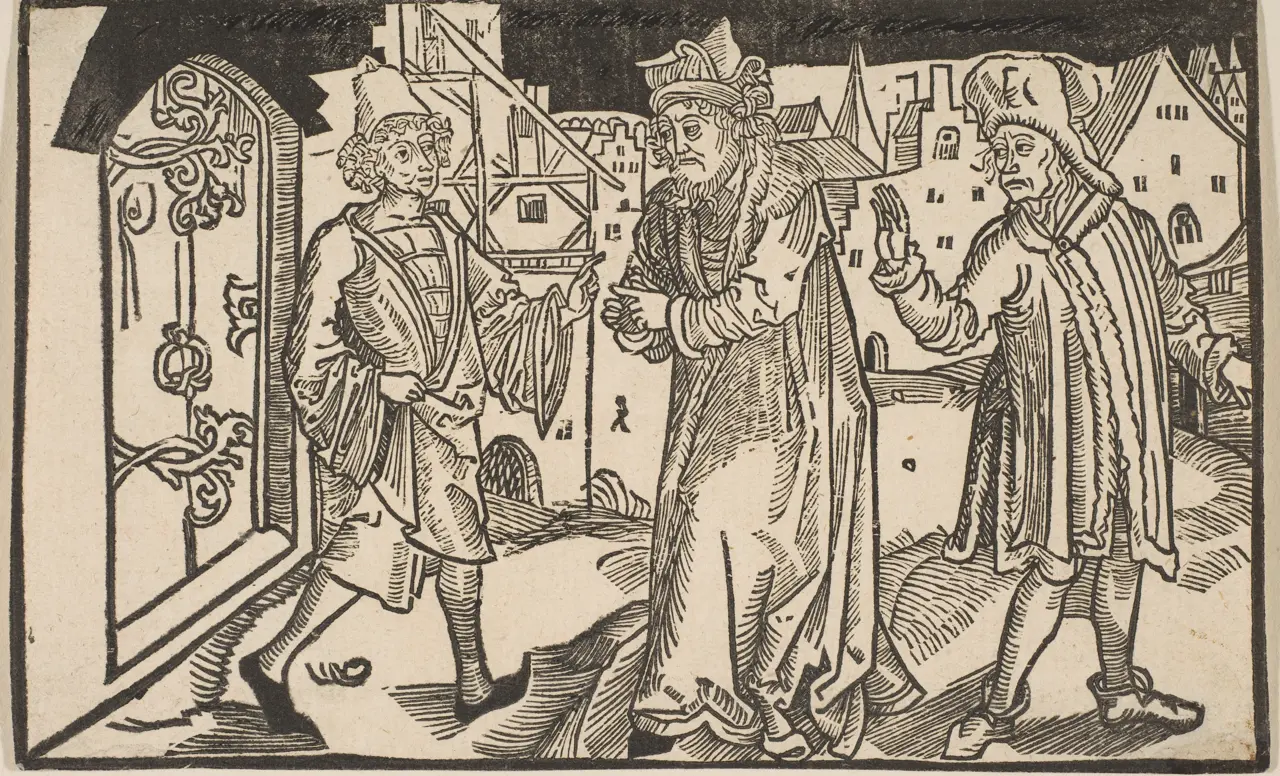
 The Brothersby TerenceTwo brothers, one strict and one easy-going, bring up a son each by their own methods.
 The Eunuchby TerenceA young man disguises himself as a eunuch to get into a courtesan's house, where the girl he wants is kept.
 Phormioby TerenceWith two old men abroad, their sons fall in love, and a quick-witted parasite finds the money and the way out.
Prologue
The poet, when first he applied his mind to writing, thought that the only duty which devolved on him was, that the Plays he should compose might please the public. But he perceives that it has fallen out entirely otherwise; for he is wasting his labor in writing Prologues, not for the purpose of relating the plot, but to answer the slanders of a malevolent old Poet. Now I beseech you, give your attention to the thing which they impute as a fault. Menander composed the Andrian and the Perinthian. He who knows either of them well, will know them both; they are in plot not very different, and yet they have been composed in different language and style. What suited, he confesses he has transferred into the Andrian from the Perinthian, and has employed them as his own. These parties censure this proceeding; and on this point they differ from him, that Plays ought not to be mixed up together. By being thus knowing, do they not show that they know nothing at all? For while they are censuring him, they are censuring Nævius, Plautus, and Ennius, whom our Poet has for his precedents; whose carelessness he prefers to emulate, rather than the mystifying carefulness of those parties. Therefore, I advise them to be quiet in future, and to cease to slander; that they may not be made acquainted with their own misdeeds. Be well disposed, then; attend with unbiased mind, and consider the matter, that you may determine what hope is left; whether the Plays which he shall in future compose anew, are to be witnessed, or are rather to be driven off the stage.
Act 1, Scene 1
Enter SIMO and SOSIA, followed by SERVANTS carrying provisions.
[to the Servants.] Do you carry those things away in-doors; begone. [Beckoning to SOSIA.] Sosia, just step here; I want a few words with you.
Consider it as said; that these things are to be taken care of, I suppose.
No, it’s another matter.
What is there that my ability can effect for you more than this?
There’s no need of that ability in the matter which I have in hand; but of those qualities which I have ever known as existing in you, fidelity and secrecy.
I await your will.
Since I purchased you, you know that, from a little child, your servitude with me has always been easy and light. From a slave I made you my freedman; for this reason, because you served me with readiness. The greatest recompense that I possessed, I bestowed upon you.
I bear it in mind.
I am not changed.
If I have done or am doing aught that is pleasing to you, Simo, I am glad that it has been done; and that the same has been gratifying to you, I consider sufficient thanks. But this is a cause of uneasiness to me; for the recital is, as it were, a censure to one forgetful of a kindness. But tell me, in one word, what it is that you want with me.
I’ll do so. In the first place, in this affair I give you notice: this, which you suppose to be such, is not a real marriage.
Why do you pretend it then?
You shall hear all the matter from the beginning; by that means you’ll be acquainted with both my son’s mode of life and my own design, and what I want you to do in this affair. For after he had passed youthfulness, Sosia, and had obtained free scope of living, [for before, how could you know or understand his disposition, while youthful age, fear, and a master were checking him?]
That’s true.
What all young men, for the most part, do,-- devote their attention to some particular pursuit, either to training horses or dogs for hunting, or to the philosophers; in not one of these did he engage in particular beyond the rest, and yet in all of them in a moderate degree. I was pleased.
Not without reason; for this I deem in life to be especially advantageous; that one do nothing to excess.
Such was his mode of life; readily to bear and to comply with all; with whomsoever he was in company, to them to resign himself; to devote himself to their pursuits; at variance with no one; never preferring himself to them. Thus most readily you may acquire praise without envy, and gain friends.
He has wisely laid down his rule of life; for in these days obsequiousness begets friends; sincerity, dislike.
Meanwhile, three years ago, a certain woman from Andros removed hither into this neighborhood, driven by poverty and the neglect of her relations, of surpassing beauty and in the bloom of youth.
Ah! I’m afraid that this Andrian will bring some mischief.
At first, in a modest way, she passed her life with thriftiness and in hardship, seeking a livelihood with her wool and loom. But after an admirer made advances, promising her a recompense, first one and then another; as the disposition of all mankind has a downward tendency from industry toward pleasure, she accepted their proposals, and then began to trade upon her beauty. Those who then were her admirers, by chance, as it often happens, took my son thither that he might be in their company. Forthwith I said to myself, “He is surely caught; he is smitten.” In the morning I used to observe their servant-boys coming or going away; I used to make inquiry, “Here, my lad, tell me, will you, who had Chrysis yesterday?” for that was the name of the Andrian [touching SOSIA on the arm].
I understand.
Phædrus, or Clinias, or Niceratus, they used to say; for these three then loved her at the same time. “Well now, what did Pamphilus do?” “What? He gave his contribution; he took part in the dinner.” Just so on another day I made inquiry, but I discovered nothing whatever that affected Pamphilus. In fact, I thought him sufficiently proved, and a great pattern of continence; for he who is brought into contact with dispositions of that sort, and his feelings are not aroused even under such circumstances, you may be sure that he is already capable of undertaking the governance of his own life. This pleased me, and every body with one voice began to say all kinds of flattering things, and to extol my good fortune, in having a son endowed with such a disposition. What need is there of talking? Chremes, influenced by this report, came to me of his own accord, to offer his only daughter as a wife to my son, with a very large portion. It pleased me; I betrothed him; this was the day appointed for the nuptials.
What then stands in the way? Why should they not take place?
You shall hear. In about a few days after these things had been agreed on, Chrysis, this neighbor, dies.
Bravo! You’ve made me happy. I was afraid for him on account of Chrysis.
Then my son was often there, with those who had admired Chrysis; with them he took charge of the funeral; sorrowful, in the mean time, he sometimes wept with them in condolence. Then that pleased me. Thus I reflected: “He by reason of this slight intimacy takes her death so much to heart; what if he himself had wooed her? What will he do for me his father?” All these things I took to be the duties of a humane disposition and of tender feelings. Why do I detain you with many words? Even I myself, for his sake, went forth to the funeral, as yet suspecting no harm.
Ha! what is this?
You shall know. She is brought out; we proceed. In the mean time, among the females who were there present, I saw by chance one young woman of beauteous form.
Very likely.
And of countenance, Sosia, so modest, so charming, that nothing could surpass. As she appeared to me to lament beyond the rest, and as she was of a figure handsome and genteel beyond the other women, I approached the female attendants; I inquired who she was. They said that she was the sister of Chrysis. It instantly struck my mind: “Ay, ay, this is it; hence those tears, hence that sympathy.”
How I dread what you are coming to!
The funeral procession meanwhile advances; we follow; we come to the burying-place. She is placed upon the pile; they weep. In the mean time, this sister, whom I mentioned, approached the flames too incautiously, with considerable danger. There, at that moment, Pamphilus, in his extreme alarm, discovers his well-dissembled and long-hidden passion; he runs up, clasps the damsel by the waist. “My Glycerium,” says he, “what are you doing? Why are you going to destroy yourself?” Then she, so that you might easily recognize their habitual attachment, weeping, threw herself back upon him-- how affectionately!
What do you say?
I returned thence in anger, and hurt at heart: and yet there was not sufficient ground for reproving him. He might say; “What have I done? How have I deserved this, or offended, father? She who wished to throw herself into the flames, I prevented; I saved her.” The defense is a reasonable one.
You judge aright; for if you censure him who has assisted to preserve life, what are you to do to him who causes loss or misfortune to it?
Chremes comes to me next day, exclaiming: “Disgraceful conduct!”-- that he had ascertained that Pamphilus was keeping this foreign woman as a wife. I steadfastly denied that to be the fact. He insisted that it was the fact. In short, I then left him refusing to bestow his daughter.
Did not you then reprove your son?
Not even this was a cause sufficiently strong for censuring him.
How so? Tell me.
“You yourself, father,” he might say, “have prescribed a limit to these proceedings. The time is near, when I must live according to the humor of another; meanwhile, for the present allow me to live according to my own.”
What room for reproving him, then, is there left?
If on account of his amour he shall decline to take a wife, that, in the first place, is an offense on his part to be censured. And now for this am I using my endeavors, that, by means of the pretended marriage, there may be real ground for rebuking him, if he should refuse; at the same time, that if that rascal Davus has any scheme, he may exhaust it now, while his knaveries can do no harm: who, I do believe, with hands, feet, and all his might, will do every thing; and more for this, no doubt, that he may do me an ill turn, than to oblige my son.
For what reason?
Do you ask? Bad heart, bad disposition. Whom, however, if I do detect-- But what need is there of talking? If it should turn out, as I wish, that there is no delay on the part of Pamphilus, Chremes remains to be prevailed upon by me; and I do hope that all will go well. Now it’s your duty to pretend these nuptials cleverly, to terrify Davus; and watch my son, what he’s about, what schemes he is planning with him.
’Tis enough; I’ll take care; now let’s go in-doors.
You go first; I’ll follow. [SOSIA goes into the house of SIMO.]
[to himself.] There’s no doubt but that my son doesn’t wish for a wife; so alarmed did I perceive Davus to be just now, when he heard that there was going to be a marriage. But the very man is coming out of the house. [Stands aside.]
Act 1, Scene 2
Enter DAVUS from the house of SIMO.
[aloud to himself.] I was wondering if this matter was to go off thus; and was continually dreading where my master’s good humor would end; for, after he had heard that a wife would not be given to his son, he never uttered a word to any one of us, or took it amiss.
[apart, overhearing him.] But now he’ll do so: and that, I fancy, not without heavy cost to you.
[to himself.] He meant this, that we, thus unsuspecting, should be led away by delusive joy; that now in hope, all fear being removed, we might during our supineness be surprised, so that there might be no time for planning a rupture of the marriage. How clever!
[apart.] The villain! what does he say?
[overhearing him, to himself.] It’s my master, and I didn’t see him.
Davus.
Well, what is it?
Just step this way to me.
[to himself.] What does he want?
What are you saying?
About what?
Do you ask the question? There’s a report that my son’s in love.
The public troubles itself about that, of course.
Will you attend to this, or not?
Certainly, I will, to that.
But for me to inquire now into these matters, were the part of a severe father. For what he has done hitherto, doesn’t concern me at all. So long as his time of life prompted to that course, I allowed him to indulge his inclination: now this day brings on another mode of life, demands other habits. From this time forward, I do request, or if it is reasonable, I do entreat you, Davus, that he may now return to the right path.
[aside.] What can this mean?
All who are intriguing take it ill to have a wife given them.
So they say.
And if any one has adopted a bad instructor in that course, he generally urges the enfeebled mind to pursuits still more unbecoming.
I’faith, I do not comprehend.
No? Ha
No-- I am Davus, not Œdipus.
Of course then, you wish me to speak plainly in what further I have to say.
Certainly, by all means.
If I this day find out that you are attempting any trickery about this marriage, to the end that it may not take place; or are desirous that in this matter it should be proved how knowing you are; I’ll hand you over, Davus, beaten with stripes, to the mill, even to your dying day, upon this condition and pledge, that if ever I release you, I shall grind in your place. Now, do you understand this? Or not yet even this?
Yes, perfectly: you have now spoken so plainly upon the subject, you have not used the least circumlocution.
In any thing would I more willingly allow myself to be imposed upon than in this matter.
Fair words, I entreat.
You are ridiculing me: you don’t at all deceive me. I give you warning, don’t act rashly, and don’t say you were not warned. Take care. [Shaking his stick, goes into the house.]
Act 1, Scene 3
DAVUS alone.
[to himself.] Assuredly, Davus, there’s no room for slothfulness or inactivity, so far as I’ve just now ascertained the old man’s mind about the marriage; which if it is not provided against by cunning, will be bringing either myself or my master to ruin. What to do, I am not determined; whether I should assist Pamphilus or obey the old man. If I desert the former, I fear for his life; if I assist him, I dread the other’s threats, on whom it will be a difficult matter to impose. In the first place, he has now found out about this amour; with hostile feelings he watches me, lest I should be devising some trickery against the marriage. If he discovers it, I’m undone; or even if he chooses to allege any pretext, whether rightfully or wrongfully, he will consign me headlong to the mill. To these evils this one is besides added for me. This Andrian, whether she is his wife, or whether his mistress, is pregnant by Pamphilus. It is worth while to hear their effrontery; for it is an undertaking worthy of those in their dotage, not of those who dote in love; whatever she shall bring forth, they have resolved to rear; and they are now contriving among themselves a certain scheme, that she is a citizen of Attica. There was formerly a certain old man of this place, a merchant; he was shipwrecked off the Isle of Andros; he died. They say that there, the father of Chrysis, on that occasion, sheltered this girl, thrown on shore, an orphan, a little child. What nonsense! To myself at least it isn’t very probable; the fiction pleases them, however. But Mysis is coming out of the house. Now I’ll betake myself hence to the Forum, that I may meet with Pamphilus, lest his father should take him by surprise about this matter. (Exit.
Act 1, Scene 4
Enter MYSIS from the house of GLYCERIUM.
[speaking at the door to Archylis within.] I’ve heard you already, Archylis; you request Lesbia to be fetched. Really, upon my faith, she is a wine-bibbing and a rash woman, and not sufficiently trustworthy for you to commit to her care a female at her first delivery; is she still to be brought? [She receives an answer from within, and comes forward.] Do look at the inconsiderateness of the old woman; because she is her pot-companion. Ye Gods, I do entreat you, give her ease in her delivery, and to that woman an opportunity of making her mistakes elsewhere in preference. But why do I see Pamphilus so out of spirits? I fear what it may be. I’ll wait, that I may know whether this sorrow portends any disaster. [Stands apart.]
Act 1, Scene 5
Enter PAMPHILUS, wringing his hands.
[to himself.] Is it humane to do or to devise this? Is this the duty of a father?
[apart.] What does this mean?
[to himself.] O, by our faith in the Gods! what is, if this is not, an indignity? He had resolved that he himself would give me a wife to-day; ought I not to have known this beforehand? Ought it not to have been mentioned previously?
[apart.] Wretched me! What language do I hear?
[to himself.] What does Chremes do? He who had declared that he would not intrust his daughter to me as a wife; because he himself sees me unchanged he has changed. Thus perversely does he lend his aid, that he may withdraw wretched me from Glycerium. If this is effected, I am utterly undone. That any man should be so unhappy in love, or so unfortunate as I am! Oh, faith of Gods and men! shall I by no device be able to escape this alliance with Chremes? In how many ways am I contemned, and held in scorn? Every thing done, and concluded! Alas! once rejected I am sought again; for what reason? Unless perhaps it is this, which I suspect it is: they are rearing some monster, and as she can not be pushed off upon any one else, they have recourse to me.
[apart.] This language has terrified wretched me with apprehension.
[to himself.] But what am I to say about my father? Alas! that he should so thoughtlessly conclude an affair of such importance! Passing me in the Forum just now, he said, “Pamphilus, you must be married to-day: get ready; be off home.” He seemed to me to say this: “Be off this instant, and go hang yourself.” I was amazed; think you that I was able to utter a single word, or any excuse, even a frivolous, false, or lame one? I was speechless. But if any one were to ask me now what I would have done, if I had known this sooner, why, I would have done any thing rather than do this. But now, what course shall I first adopt? So many cares beset me, which rend my mind to pieces; love, sympathy for her, the worry of this marriage; then, respect for my father, who has ever, until now, with such an indulgent disposition, allowed me to do whatever was agreeable to my feelings. Ought I to oppose him? Ah me! I am in uncertainty what to do.
[apart.] I’m wretchedly afraid how this uncertainty is to terminate. But now there’s an absolute necessity, either for him to speak to her, or for me to speak to him about her. While the mind is in suspense, it is swayed by a slight impulse one way or the other.
[overhearing her.] Who is it speaking here? [Seeing her.] Mysis? Good-morrow to you.
Oh! Good-morrow to you, Pamphilus.
How is she?
Do you ask? She is oppressed with grief, and on this account the poor thing is anxious, because some time ago the marriage was arranged for this day. Then, too, she fears this, that you may forsake her.
Ha! could I attempt that? Could I suffer her, poor thing, to be deceived on my account? She, who has confided to me her affection, and her entire existence? She, whom I have held especially dear to my feelings as my wife? Shall I suffer her mind, well and chastely trained and tutored, to be overcome by poverty and corrupted? I will not do it.
I should have no fear if it rested with yourself alone; but whether you may be able to withstand compulsion
Do you deem me so cowardly, so utterly ungrateful, inhuman, and so brutish, that neither intimacy, nor affection, nor shame, can move or admonish me to keep faith?
This one thing I know, that she is deserving that you should not forget her.
Forget her? Oh Mysis, Mysis, at this moment are those words of Chrysis concerning Glycerium written on my mind. Now at the point of death, she called me; I went to her; you had withdrawn; we were alone; she began: “My dear Pamphilus, you see her beauty and her youth; and it is not unknown to you to what extent both of these are now of use to her, in protecting both her chastity and her interests. By this right hand I do entreat you, and by your good Genius, by your own fidelity, and by her bereft condition, do not withdraw yourself from her, or forsake her; if I have loved you as my own brother, or if she has always prized you above all others, or has been obedient to you in all things. You do I give to her as a husband, friend, protector, father. This property of mine do I intrust to you, and commit to your care.” She placed her in my hands; that instant, death came upon her. I accepted her; having accepted, I will protect her.
So indeed I hope. [Moving.]
But why are you leaving her?
I’m going to fetch the midwife.
Make all haste. And-- do you hear?-- take care, and not one word about the marriage, lest that too should add to her illness.
I understand. (Exeunt severally.
Act 2, Scene 1
Enter CHARINUS and BYRRHIA.
How say you, Byrrhia? Is she to be given in marriage to Pamphilus to-day?
It is so.
How do you know?
I heard it just now from Davus at the Forum.
Woe unto wretched me! As, hitherto, until now, my mind has been racked amid hope and fear; so, since hope has been withdrawn, wearied with care, it sinks overwhelmed.
By my troth, Charinus, since that which you wish can not come to pass, prithee, do wish that which can.
I wish for nothing else but Philumena.
Alas! How much better were it for you to endeavor to expel that passion from your mind, than to be saying that by which your desire is to no purpose still more inflamed.
We all, when we are well, with ease give good advice to the sick. If you were in my situation, you would think otherwise.
Well, well, just as you like.
[looking down the side scene.] But I see Pamphilus; I’m determined I’ll try every thing before I despair.
[aside] What does he mean?
I will entreat his own self; I will supplicate him; I will disclose to him my love. I think that I shall prevail upon him to put off the marriage for some days at least; in the mean time, something will turn up, I trust.
That something is nothing.
Byrrhia, how seems it to you? Shall I accost him?
Why not? Should you not prevail, that at least he may look upon you as a gallant ready provided for him, if he marries her.
Away with you to perdition with that vile suggestion, you rascal!
Act 2, Scene 2
Enter PAMPHILUS.
I espy Charinus. [Accosting him.] Good-morrow!
O, good-morrow. Pamphilus, I’m come to you, seeking hope, safety, counsel, and assistance.
I’faith, I have neither time for counsel, nor resources for assistance. But what’s the matter now?
To-day you are going to take a wife?
So they say.
Pamphilus, if you do that, you behold me this day for the last time.
Why so?
Ah me! I dread to tell it; prithee, do you tell it, Bvrrhia.
I’ll tell it.
What is it?
He’s in love with your betrothed.
Assuredly he’s not of my way of thinking. Come now, tell me, have you had any more to do with her, Charinus?
Oh Pamphilus, nothing.
How much I wish you had.
Now, by our friendship and by my affection, I do beseech you, in the first place, not to marry her.
For my own part I’ll use my endeavors.
But if that can not be, or if this marriage is agreeable to you
Agreeable to me?
Put it off for some days at least, while I go elsewhere, that I may not be witness.
Now listen, once for all: I think it, Charinus, to be by no means the part of an ingenuous man, when he confers nothing, to expect that it should be considered as an obligation on his part. I am more desirous to avoid this match, than you to gain it.
You have restored me to life.
Now, if you can do any thing, either you yourself, or Byrrhia here, manage, fabricate, invent, contrive some means, whereby she may be given to you; this I shall aim at, how she may not be given to me.
I am satisfied.
Most opportunely I perceive Davus, on whose advice I have depended.
[turning to BYRRHIA.] But you, i’faith, tell me nothing, except those things which there is no need for knowing. [Pushing him away.] Get you gone from here.
Certainly I will, and with all my heart. (Exit.
Act 2, Scene 3
Enter DAVUS in haste.
[not seeing PAMPHILUS and CHARINUS.] Ye gracious Gods, what good news I bring! But where shall I find Pamphilus, that I may remove the apprehension in which he now is, and fill his mind with joy--?
[apart to PAMPHILUS.] He’s rejoiced about something, I don’t know what.
[apart.] It’s of no consequence; he hasn’t yet heard of these misfortunes.
[to himself.] For I do believe now, if he has already heard that a marriage is prepared for him
[apart.] Don’t you hear him?
[to himself.] He is seeking me distractedly all the city over. But where shall I look for him? Or in which direction now first to betake me
[apart to PAMPHILUS.] Do you hesitate to accost him?
[to himself.] I have it. [Moving on.]
Davus, come here! Stop!
Who’s the person that’s-- [Turning round.] O Pamphilus, you are the very man I’m looking for. Well done, Charinus! both in the nick of time: I want you both.
Davus, I’m undone!
Nay but, do hear this.
I’m utterly ruined!
I know what you are afraid of.
I’faith, my life indeed is really in danger.
[to CHARINUS.] And what you are afraid of, I know.
My marriage
As if I did not know it?
This day
Why keep dinning me with it, when I know it all? [To PAMPHILUS.] This are you afraid of, lest you should marry her; and you [to CHARINUS,] lest you should not marry her.
You understand the matter.
That’s the very thing.
And that very thing is in no danger; trust me for that.
I do entreat you, release wretched me as soon as possible from this apprehension.
Well, then, I will release you; Chremes is not going to give you his daughter at present.
How do you know?
You shall know. Your father just now laid hold of me; he said that a wife was to be given you to-day, and many other things as well, which just now I haven’t time to relate. Hastening to you immediately, I ran on to the Forum that I might tell you these things. When I didn’t find you, I ascended there to a high place. I looked around; you were nowhere. There by chance I saw Byrrhia, his servant [pointing to CHARINUS]. I inquired of him; he said he hadn’t seen you. This puzzled me. I considered what I was to do. As I was returning in the mean time, a surmise from the circumstances themselves occurred to me: “How now,-- a very small amount of good cheer; he out of spirits; a marriage all of a sudden; these things don’t agree.”
But to what purpose this?
I forthwith betook myself to the house of Chremes. When I arrived there-- stillness before the door; then I was pleased at that.
You say well.
Proceed.
I stopped there. In the mean time I saw no one going in, no one going out; no matron at the house, no preparation, no bustle. I drew near; looked in
I understand; a considerable indication.
Do these things seem to accord with a wedding?
I think not, Davus.
Think, do you say? You don’t view it rightly; the thing is certain. Besides, coming away from there I saw the servant-boy of Chremes carrying some vegetables and little fishes, an obol’s worth, for the old man’s dinner.
This day, Davus, have I been delivered by your means.
And yet not at all.
Why so? Surely he will not give her to him, after all this. [Pointing to PAMPHILUS.]
You silly fellow! as though it were a necessary consequence that if he doesn’t give her to him you should marry her: unless, indeed, you look about you; unless you entreat and make court to the old man’s friends.
You advise well. I’ll go; although, upon my faith, this hope has often eluded me already. Farewell! (Exit.
Act 2, Scene 4
PAMPHILUS and DAVUS.
What then does my father mean? Why does he thus make pretense?
I’ll tell you. If now he were angry with you, because Chremes will not give you a wife, he would seem to himself to be unjust, and that not without reason, before he has ascertained your feelings as to the marriage, how they are disposed. But if you refuse to marry her, in that case he will transfer the blame to you; then such disturbances will arise.
I will submit to any thing from him.
He is your father, Pamphilus. It is a difficult matter. Besides, this woman is defenseless. No sooner said than done; he will find some pretext for driving her away from the city.
Driving her away?
Aye, and quickly too.
Tell me then, Davus, what am I to do?
Say that you will marry her.
[starting.] Ha!
What’s the matter?
What, am I to say so?
Why not?
Never will I do it.
Don’t say so.
Don’t attempt to persuade me.
Consider what will be the result of it.
That I shall be deprived of the one, and fixed with the other.
Not so. In fact, I think it will be thus: Your father will say: “I wish you to marry a wife to-day.” You reply: “I’ll marry her.” Tell me, how can he raise a quarrel with you? Thus you will cause all the plans which are now arranged by him to be disarranged, without any danger; for this is not to be doubted, that Chremes will not give you his daughter. Therefore do not hesitate in those measures which you are taking, on this account, lest he should change his sentiments. Tell your father that you consent; so that although he may desire it, he may not be able to be angry at you with reason. For that which you rely on, I will easily refute; “No one,” you think, “will give a wife to a person of these habits.” But he will find a beggar for you, rather than allow you to be corrupted by a mistress. If, however, he shall believe that you bear it with a contented mind, you will render him indifferent; at his leisure he will look out for another wife for you; in the mean time something lucky may turn up.
Do you think so?
It really is not a matter of doubt.
Consider to what you are persuading me.
Nay, but do be quiet.
Well, I’ll say it; but, that he mayn’t come to know that she has had a child by me, is a thing to be guarded against; for I have promised to bring it up.
Oh, piece of effrontery.
She entreated me that I would give her this pledge, by which she might be sure she should not be deserted.
It shall be attended to; but your father’s coming. Take care that he doesn’t perceive that you are out of spirits.
Act 2, Scene 5
Enter SIMO, at a distance.
[apart to himself.] I’ve come back to see what they are about, or what scheme they are hatching.
[to PAMPHILUS.] He has no doubt at present but that you’ll refuse to marry. Having considered his course, he’s come from a retired spot somewhere or other; he hopes that he has framed a speech by which to disconcert you; do you take care, then, to be yourself.
If I am only able, Davus.
Trust me for that, Pamphilus, I tell you; your father will never this day exchange a single word with you, if you say that you will marry.
Act 2, Scene 6
Enter BYRRHIA, unperceived, at a distance behind SIMO.
[apart to himself.] My master has ordered me, leaving my business, to keep an eye on Pamphilus to-day, what he is doing with regard to the marriage. I was to learn it; for that reason, I have now followed him [pointing to SIMO] as he came hither. Himself, as well, I see standing with Davus close at hand; I’ll note this.
[apart to himself.] I see that both of them are here.
[in a low voice to PAMPHILUS.] Now then, be on your guard.
Pamphilus!
[in a low voice.] Look round at him as though taken unawares.
[turning round sharply.] What, my father!
[in a low voice.] Capital!
I wish you to marry a wife to-day, as I was saying.
[apart.] Now I’m in dread for our side, as to what he will answer.
Neither in that nor in any thing else shall you ever find any hesitation in me.
[apart.] Hah!
[in a low voice to PAMPHILUS.] He is struck dumb.
[apart.] What a speech!
You act as becomes you, when that which I ask I obtain with a good grace.
[aside to PAMPHILUS.] Am I right?
My master, so far as I learn, has missed his wife.
Now, then, go in-doors, that you mayn’t be causing delay when you are wanted.
I’ll go. [Goes into the house.]
[apart.] Is there, in no case, putting trust in any man? That is a true proverb which is wont to be commonly quoted, that “all had rather it to be well for themselves than for another.” I remember noticing, when I saw her, that she was a young woman of handsome figure; wherefore I am the more disposed to excuse Pamphilus, if he has preferred that he himself, rather than the other, should embrace her in his slumbers. I’ll carry back these tidings, that, in return for this evil he may inflict evil upon me. (Exit.
Act 2, Scene 7
SIMO and DAVUS.
[aside, coming away from the door of the house.] He now supposes that I’m bringing some trick to bear against him, and that on that account I’ve remained here.
What does he say, Davus?
Just as much as nothing.
What, nothing? Eh?
Nothing at all.
And yet I certainly was expecting something.
It has turned out contrary to your expectations. [Aside.] I perceive it; this vexes the man.
Are you able to tell me the truth?
I? Nothing more easy.
Is this marriage at all disagreeable to him, on account of his intimacy with this foreign woman?
No, faith; or if at all, it is a two or three days’ annoyance this-- you understand. It will then cease. Moreover, he himself has thought over this matter in a proper way.
I commend him.
While it was allowed him, and while his years prompted him, he intrigued; even then it was secretly. He took precaution that that circumstance should never be a cause of disgrace to him, as behooves a man of principle; now that he must have a wife, he has set his mind upon a wife.
He seemed to me to be somewhat melancholy in a slight degree.
Not at all on account of her, but there’s something he blames you for.
What is it, pray?
It’s a childish thing.
What is it?
Nothing at all.
Nay but, tell me what it is.
He says that you are making too sparing preparations.
What, I?
You. --He says that there has hardly been fare provided to the amount of ten drachmæ. --“Does he seem to be bestowing a wife on his son? Which one now, in preference, of my companions shall I invite to the dinner?” And, it must be owned, you really are providing too parsimoniously-- I do not commend you.
Hold your tongue.
[aside.] I’ve touched him up.
I’ll see that these things are properly done. [DAVUS goes into the house.] What’s the meaning of this? What does this old rogue mean? But if there’s any knavery here, why, he’s sure to be the source of the mischief. [Goes into his house.]
Act 3, Scene 1
Enter SIMO and DAVUS from the house of the former. MYSIS and LESBIA are coming toward the house of GLYCERIUM.
[not seeing SIMO and DAVUS.] Upon my faith, the fact is really as you mentioned, Lesbia, you can hardly find a man constant to a woman.
[apart to DAVUS.] This maid-servant comes from the Andrian.
[apart to SIMO.] What do you say?
[apart to DAVUS.] It is so.
But this Pamphilas
[apart to DAVUS.] What is she saying?
Has proved his constancy.
[apart.] Hah!
[apart to himself.] I wish that either he were deaf, or she struck dumb.
For the child she brings forth, he has ordered to be brought up.
[apart.] O Jupiter! What do I hear! It’s all over, if indeed this woman speaks the truth.
You mention a good disposition on the part of the young man.
A most excellent one. But follow me in-doors, that you mayn’t keep her waiting.
I’ll follow. [MYSIS and LESBIA go into GLYCERIUM’S house.]
Act 3, Scene 2
SIMO and DAVUS.
[aside.] What remedy now shall I find for this mishap?
[to himself aloud.] What does this mean? Is he so infatuated? The child of a foreign woman? Now I understand; ah! scarcely even at last, in my stupidity, have I found it out.
[aside to himself.] What does he say he has found out?
[aside.] This piece of knavery is being now for the first time palmed upon me by this fellow; they are pretending that she’s in labor, in order that they may alarm Chremes.
[exclaiming from within her house.] Juno Lucina, grant me thine aid, save me, I do entreat thee!
Whew! so sudden? What nonsense! As soon as she has heard that I’m standing before the door, she makes all haste. These incidents, Davus, have not been quite happily adapted by you as to the points of time.
By me?
Are your scholars forgetful?
I don’t know what you are talking about.
[aside.] If he at the real marriage of my son had taken me off my guard, what sport he would have made of me. Now it is at his own risk; I’m sailing in harbor.
Act 3, Scene 3
Re-enter LESBIA from the house of GLYCERIUM.
[speaking to ARCHYLIS at the door, and not seeing SIMO and DAVUS.] As yet, Archylis, all the customary symptoms which ought to exist toward recovery, I perceive in her. Now, in the first place, take care and let her bathe; then, after that, what I ordered to be given her to drink, and as much as I prescribed, do you administer: presently I will return hither. [To herself aloud.] By all that’s holy, a fine boy has been born to Pamphilus. I pray the Gods that he may survive, since the father himself is of a good disposition, and since he has hesitated to do an injustice to this most excellent young woman. (Exit.
Act 3, Scene 4
SIMO and DAVUS.
Even this, who is there that knows you that would not believe that it originated in you?
Why, what is this?
She didn’t order in their presence what was requisite to be done for the woman lying in; but after she has come out, she bawls from the street to those who are in the house. O Davus, am I thus trifled with by you? Or pray, do I seem to you so very well suited to be thus openly imposed upon by your tricks? At all events it should have been with precaution; that at least I might have seemed to be feared if I should detect it.
[aside.] Assuredly, upon my faith, it’s he that’s now deceiving himself, not I.
I gave you warning, I forbade you with threats to do it. Have you been awed? What has it availed? Am I to believe you now in this, that this woman has had a child by Pamphilus?
[aside.] I understand where he’s mistaken; and I see what I must do.
Why are you silent?
What would you believe? As though word had not been brought you that thus it would happen.
Any word brought to me?
Come now, did you of your own accord perceive that this was counterfeited?
I am being trifled with.
Word has been brought you; for otherwise how could this suspicion have occurred to you?
How? Because I knew you.
As though you meant to say that this has been done by my contrivance.
Why, I’m sure of it, to a certainty.
Not yet even do you know me sufficiently, Simo, what sort of person I am.
I, not know you!
But if I begin to tell you any thing, at once you think that deceit is being practiced upon you in guile; therefore, upon my faith, I don’t dare now even to whisper.
This one thing I am sure of, that no person has been delivered here. [Pointing to GLYCERIUM’S house.]
You have discovered that? Still, not a bit the less will they presently be laying the child here before the door. Of this, then, I now warn you, master, that it will happen, that you may be aware of it. Don’t you hereafter be saying that this was done through the advice or artifices of Davus. I wish this suspicion of yours to be entirely removed from myself.
How do you know that?
I’ve heard so, and I believe it: many things combine for me to form this conjecture. In the first place then, she declared that she was pregnant by Pamphilus; that has been proved to be false. Now, when she sees that preparations are being made for the wedding at our house, the maid-servant is directly sent to fetch the midwife to her, and to bring a child at the same time. Unless it is managed for you to see the child, the marriage will not be at all impeded.
What do you say to this? When you perceived that they were adopting this plan, why didn’t you tell Pamphilus immediately?
Why, who has induced him to leave her, but myself? For, indeed, we all know how desperately he loved her. Now he wishes for a wife. In fine, do you intrust me with that affair; proceed however, as before, to celebrate these nuptials, just as you are doing, and I trust that the Gods will prosper this matter.
Very well; be off in-doors; wait for me there, and get ready what’s necessary to be prepared. [DAVUS goes into the house.] He hasn’t prevailed upon me even now altogether to believe these things, and I don’t know whether what he has said is all true; but I deem it of little moment; this is of far greater importance to me-- that my son himself has promised me. Now I’ll go and find Chremes; I’ll ask him for a wife for my son; if I obtain my request, at what other time rather than to-day should I prefer these nuptials taking place? For as my son has promised, I have no doubt but that if he should prove unwilling, I can fairly compel him. And look! here’s Chremes himself, just at the very time.
Act 3, Scene 5
Enter CHREMES.
I greet you, Chremes.
O, you are the very person I was looking for.
And I for you.
You meet me at a welcome moment. Some persons have been to me, to say that they had heard from you, that my daughter was to be married to your son to-day; I’ve come to see whether they are out of their senses or you.
Listen; in a few words you shall learn both what I want of you, and what you seek to know.
I am listening; say what you wish.
By the Gods, I do entreat you, Chremes, and by our friendship, which, commencing with our infancy, has grown up with our years, and by your only daughter and by my own son (of preserving whom the entire power lies with you), that you will assist me in this matter; and that, just as this marriage was about to be celebrated, it may be celebrated.
O, don’t importune me; as though you needed to obtain this of me by entreaty. Do you suppose I am different now from what I was formerly, when I promised her? If it is for the advantage of them both that it should take place, order her to be sent for. But if from this course there would result more harm than advantage for each, this I do beg of you, that you will consult for their common good, as though she were your own daughter, and I the father of Pamphilus.
Nay, so I intend, and so I wish it to be, Chremes; and I would not ask it of you, did not the occasion itself require it.
What is the matter?
There is a quarrel between Glycerium and my son.
[ironically] I hear you.
So much so, that I’m in hopes they may be separated.
Nonsense!
It really is so.
After this fashion, i’faith, I tell you, “the quarrels of lovers are the renewal of love.”
Well-- this I beg of you, that we may prevent it. While an opportunity offers, and while his passion is cooled by affronts, before the wiles of these women and their tears, craftily feigned, bring back his love-sick mind to compassion, let us give him a wife. I trust, Chremes, that, when attached by intimacy and a respectable marriage, he will easily extricate himself from these evils.
So it appears to you; but I do not think that either he can possibly hold to her with constancy, or that I can put up with it if he does not.
How then can you be sure of that, unless you make the experiment?
But for that experiment to be made upon a daughter is a serious thing
Why look, all the inconvenience in fine amounts to this-- possibly, which may the Gods forfend, a separation may take place. But if he is reformed, see how many are the advantages: in the first place, you will have restored a son to your friend; you will obtain a sure son-in-law for yourself, and a husband for your daughter.
What is one to say to all this? If you feel persuaded that this is beneficial, I don’t wish that any advantage should be denied you.
With good reason, Chremes, have I always considered you a most valuable friend.
But how say you----?
What?
How do you know that they are now at variance?
Davus himself, who is privy to all their plans, has told me so; and he advises me to expedite the match as fast as I can. Do you think he would do so, unless he was aware that my son desired it? You yourself as well shall presently hear what he says. [Goes to the door of his house and calls.] Halloo there! Call Davus out here. Look, here he is; I see him just coming out.
Act 3, Scene 6
Enter DAVUS from the house.
I was coming to you.
Why, what’s the matter?
Why isn’t the bride sent for? It’s now growing late in the day.
Do you hear me? I’ve been for some time not a little apprehensive of you, Davus, lest you should do that which the common class of servants is in the habit of doing, namely, impose upon me by your artifices; because my son is engaged in an amour.
What, I do that?
I fancied so; and therefore, fearing that, I concealed from you what I shall now mention.
What?
You shall know; for now I almost feel confidence in you.
Have you found out at last what sort of a person I am?
The marriage was not to have taken place.
How? Not to have taken place?
But I was making pretense, that I might test you all.
[affecting surprise.] What is it you tell me?
Such is the fact.
Only see! I was not able to discover that. Dear me! what a cunning contrivance!
Listen to this. Just as I ordered you to go from here into the house, he [pointing to CHREMES] most opportunely met me.
[aside.] Ha! Are we undone, then?
I told him what you just now told me.
[aside.] Why, what am I to hear?
I begged him to give his daughter, and with difficulty I prevailed upon him.
[aside.] Utterly ruined!
[overhearing him speaking.] Eh-- What was it you said?
Extremely well done, I say.
There’s no delay on his part now.
I’ll go home at once; I’ll tell her to make due preparation, and bring back word here. (Exit.
Now I do entreat you, Davus, since you by yourself have brought about this marriage for me
I myself, indeed!
Do your best still to reform my son.
Troth, I’ll do it with all due care.
Do it now, while his mind is agitated.
You may be at ease.
Come then; where is he just now?
A wonder if he isn’t at home.
I’ll go to him; and what I’ve been telling you, I’ll tell him as well. [Goes into his house.]
Act 3, Scene 7
DAVUS alone.
[to himself.] I’m a lost man! What reason is there why I shouldn’t take my departure straightway hence for the mill? There’s no room left for supplicating; I’ve upset every thing now; I’ve deceived my master; I’ve plunged my master’s son into a marriage; I’ve been the cause of its taking place this very day, without his hoping for it, and against the wish of Pamphilus. Here’s cleverness for you! But, if I had kept myself quiet, no mischief would have happened. [Starting.] But see, I espy him; I’m utterly undone! Would that there were some spot here for me, from which I might this instant pitch myself headlong! [Stands apart.]
Act 3, Scene 8
Enter PAMPHILUS in haste from SIMO’S house.
Where is he? The villain, who this day-- I’m ruined; and I confess that this has justly befallen me, for being such a dolt, so devoid of sense; that I should have intrusted my fortunes to a frivolous slave! I am suffering the reward of my folly; still he shall never get off from me unpunished for this.
[apart.] I’m quite sure that I shall be safe in future, if for the present I get clear of this mishap.
But what now am I to say to my father? Am I to deny that I am ready, who have just promised to marry? With what effrontery could I presume to do that? I know not what to do with myself.
[apart.] Nor I with myself, and yet I’m giving all due attention to it. I’ll tell him that I will devise something, in order that I may procure some respite in this dilemma.
[Catching sight of him.] Oho!
[apart.] I’m seen.
[sneeringly.] How now, good sir, what are you about? Do you see how dreadfully I am hampered by your devices?
Still, I’ll soon extricate you.
You, extricate me?
Assuredly, Pamphilus.
As you have just done, I suppose.
Why no, better, I trust.
What, am I to believe you, you scoundrel? You, indeed, make good a matter that’s all embarrassment and ruin! Just see, in whom I’ve been placing reliance-- you who this day from a most happy state have been and plunged me into a marriage. Didn’t I say that this would be the case?
You did say so.
What do you deserve?
The cross. But allow me a little time to recover myself; I’ll soon hit upon something.
Ah me! not to have the leisure to inflict punishment upon you as I desire! for the present conjuncture warns me to take precautions for myself, not to be taking vengeance on you. (Exeunt.
Act 4, Scene 1
Enter CHARINUS, wringing his hands.
[to himself.] Is this to be believed or spoken of; that malice so great could be inborn in any one as to exult at misfortunes, and to derive advantage from the distresses of another! Oh, is this true? Assuredly, that is the most dangerous class of men, in whom there is only a slight degree of hesitation at refusing; afterward, when the time arrives for fulfilling their promises, then, obliged, of necessity they discover themselves. They are afraid, and yet the circumstances compel them to refuse. Then, in that case, their very insolent remark is, “Who are you? What are you to me? What should I give up to you what’s my own? Look you, I am the most concerned in my own interests.” But if you inquire where is honor, they are not ashamed. Here, where there is occasion, they are not afraid; there, where there is no occasion, they are afraid. But what am I to do? Ought I not to go to him, and reason with him upon this outrage, and heap many an invective upon him? Yet some one may say, “you will avail nothing.” Nothing? At least I shall have vexed him, and have given vent to my own feelings.
Act 4, Scene 2
Enter PAMPHILUS and DAVUS.
Charinus, unintentionally I have ruined both myself and you, unless the Gods in some way befriend us.
Unintentionally, is it! An excuse has been discovered at last. You have broken your word.
How so, pray?
Do you expect to deceive me a second time by these speeches?
What does this mean?
Since I told you that I loved her, she has become quite pleasing to you. Ah wretched me! to have judged of your disposition from my own.
You are mistaken.
Did this pleasure appear to you not to be quite complete, unless you tantalized me in my passion, and lured me on by groundless hopes? --You may take her.
I, take her? Alas! you know not in what perplexities, to my sorrow, I am involved, and what vast anxieties this executioner of mine [pointing to DAVUS] has contrived for me by his devices.
What is it so wonderful, if he takes example from yourself?
You would not say that if you understood either myself or my affection.
I’m quite aware [ironically]; you have just now had a dispute with your father, and he is now angry with you in consequence, and has not been able to-day to prevail upon you to marry her.
No, not at all,-- as you are not acquainted with my sorrows, these nuptials were not in preparation for me; and no one was thinking at present of giving me a wife.
I am aware; you have been influenced by your own inclination.
Hold; you do not yet know all.
For my part, I certainly do know that you are about to marry her.
Why are you torturing me to death? Listen to this. He [pointing to DAVUS] never ceased to urge me to tell my father that I would marry her; to advise and persuade me, even until he compelled me.
Who was this person?
Davus.
Davus! For what reason?
I don’t know; except that I must have been under the displeasure of the Gods, for me to have listened to him.
Is this the fact, Davus?
It is the fact.
[starting.] Ha! What do you say, you villain? Then may the Gods send you an end worthy of your deeds. Come now, tell me, if all his enemies had wished him to be plunged into a marriage, what advice but this could they have given?
I have been deceived, but I don’t despair.
[ironically.] I’m sure of that.
This way it has not succeeded; we’ll try another. Unless, perhaps, you think that because it failed at first, this misfortune can not now possibly be changed for better luck.
Certainly not; for I quite believe that if you set about it, you will be making two marriages for me out of one.
I owe you this, Pamphilus, in respect of my servitude, to strive with hands and feet, night and day; to submit to hazard of my life, to serve you. It is your part, if any thing has fallen out contrary to expectation, to forgive me. What I was contriving has not succeeded; still, I am using all endeavors; or, do you yourself devise something better, and dismiss me.
I wish to; restore me to the position in which you found me.
I’ll do so.
But it must be done directly.
But the door of Glycerium’s house here makes a noise.
That’s nothing to you.
[assuming an attitude of meditation.] I’m in search of
[ironically.] Dear me, what, now at last?
Presently I’ll give you what I’ve hit upon.
Act 4, Scene 3
Enter MYSIS from the house of GLYCERIUM.
[calling at the door to GLYCERIUM within.] Now, wherever he is, I’ll take care that your own Pamphilus shall be found for you, and brought to you by me; do you only, my life, cease to vex yourself.
Mysis.
[turning round.] Who is it? Why, Pamphilus, you do present yourself opportunely to me. My mistress charged me to beg of you, if you love her, to come to her directly; she says she wishes to see you.
[aside.] Alas! I am undone; this dilemma grows apace! [To DAVUS.] For me and her, unfortunate persons, now to be tortured this way through your means; for I am sent for, because she has discovered that my marriage is in preparation.
From which, indeed, how easily a respite could have been obtained, if he [pointing to DAVUS] had kept himself quiet.
[ironically to CHARINUS.] Do proceed; if he isn’t sufficiently angry of his own accord, do you irritate him.
[to PAMPHILUS.] Aye faith, that is the case; and for that reason, poor thing, she is now in distress.
Mysis, I swear by all the Gods that I will never forsake her; not if I were to know that all men would be my enemies in consequence. Her have I chosen for mine; she has fallen to my lot; our feelings are congenial; farewell they, who wish for a separation between us; nothing but Death separates her from me.
I begin to revive.
Not the responses of Apollo are more true than this. If it can possibly be contrived that my father may not believe that this marriage has been broken off through me, I could wish it. But if that can not be, I will do that which is easily effected, for him to believe that through me it has been caused. What do you think of me?
That you are as unhappy as myself.
[placing his finger on his forehead.] I’m contriving an expedient.
You are a clever hand; if you do set about any thing.
Assuredly, I’ll manage this for you.
There’s need of it now.
But I’ve got it now.
What is it?
For him [pointing to PAMPHILUS] I’ve got it, not for you, don’t mistake.
I’m quite satisfied.
What will you do? Tell me.
I’m afraid that this day won’t be long enough for me to execute it, so don’t suppose that I’ve now got leisure for relating it; do you betake yourself off at once, for you are a hinderance to me.
I’ll go and see her. [Goes into the house of GLYCERIUM.]
[to CHARINUS.] What are you going to do? Whither are you going from here?
Do you wish me to tell you the truth?
No, not at all; [aside] he’s making the beginning of a long story for me.
What will become of me?
Come now, you unreasonable person, are you not satisfied that I give you a little respite, by putting off his marriage?
But yet, Davus
What then?
That I may marry her
Absurd.
Be sure to come hither [pointing in the direction of his house] to my house, if you can effect any thing.
Why should I come? I can do nothing for you.
But still, if any thing
Well, well, I’ll come.
If you can; I shall be at home. (Exit.
Act 4, Scene 4
MYSIS and DAVUS.
Do you, Mysis, remain here a little while, until I come out.
For what reason?
There’s a necessity for so doing.
Make haste.
I’ll be here this moment, I tell you. [He goes into the house of GLYCERIUM.]
Act 4, Scene 5
MYSIS alone.
[to herself.] That nothing can be secure to any one! Ye Gods, by our trust in you! I used to make sure that this Pamphilus was a supreme blessing for my mistress; a friend, a protector, a husband secured under every circumstance; yet what anguish is she, poor thing, now suffering through him? Clearly there’s more trouble for her now than there was happiness formerly. But Davus is coming out.
Act 4, Scene 6
Enter DAVUS from the house of GLYCERIUM with the child.
My good sir, prithee, what is that? Whither are you carrying the child?
Mysis, I now stand in need of your cunning being brought into play in this matter, and of your address.
Why, what are you going to do?
[holding out the child.] Take it from me directly, and lay it down before our door.
Prithee, on the ground?
[pointing.] Take some sacred herbs from the altar here, and strew them under it.
Why don’t you do it yourself?
That if perchance I should have to swear to my master that I did not place it there, I may be enabled to do so with a clear conscience.
I understand; have these new scruples only just now occurred to you, pray?
Bestir yourself quickly, that you may learn what I’m going to do next. [MYSIS lays the child at SIMO’S door.] Oh Jupiter!
[starting up.] What’s the matter?
The father of the intended bride is coming in the middle of it all. The plan which I had first purposed I now give up.
I don’t understand what you are talking about.
I’ll pretend too that I’ve come in this direction from the right. Do you take care to help out the conversation by your words, whenever there’s necessity.
I don’t at all comprehend what you are about; but if there’s any thing in which you have need of my assistance, as you understand the best, I’ll stay, that I mayn’t in any way impede your success. [DAVUS retires out of sight.]
Act 4, Scene 7
Enter CHREMES on the other side of the stage, going toward the house of SIMO.
[to himself.] After having provided the things necessary for my daughter’s nuptials, I’m returning, that I may request her to be sent for. [Seeing the child.] But what’s this? I’faith, it’s a child. [Addressing MYSIS.] Woman, have you laid that here [pointing to the child]?
[aside, looking out for DAVUS.] Where is he?
Don’t you answer me?
[looking about, to herself.] He isn’t any where to be seen. Woe to wretched me! the fellow has left me and is off.
[coming forward and pretending not to see them.] Ye Gods, by our trust in you! what a crowd there is in the Forum! What a lot of people are squabbling there! [Aloud.] Then provisions are so dear. [Aside.] What to say besides, I don’t know. [CHREMES passes by MYSIS, and goes to a distance at the back of the stage.]
Pray, why did you leave me here alone?
[pretending to start on seeing the child.] Ha! what story is this? How now, Mysis, whence comes this child? Who has brought it here?
Are you quite right in your senses, to be asking me that?
Whom, then, ought I to ask, as I don’t see any one else here?
[apart to himself.] I wonder whence it has come.
Are you going to tell me what I ask?
Pshaw!
[in a whisper.] Step aside to the right. [They retire on one side.]
You are out of your senses; didn’t you your own self?
[in a low voice.] Take you care not to utter a single word beyond what I ask you. Why don’t you say aloud whence it comes?
[in a loud voice.] From our house.
[affecting indignation.] Heyday, indeed! it really is a wonder if a woman, who is a courtesan, acts impudently.
[apart.] So far as I can learn, this woman belongs to the Andrian.
Do we seem to you such very suitable persons for you to be playing tricks with us in this way?
[apart.] I came just in time.
Make haste then, and take the child away from the door here: [in a low voice] stay there; take care you don’t stir from that spot.
[aside.] May the Gods confound you! you do so terrify poor me.
[in a loud voice.] Is it to you I speak or not?
What is it you want?
[aloud.] What-- do you ask me again? Tell me, whose child have you been laying here? Let me know.
Don’t you know?
[in a low voice.] Have done with what I know; tell me what I ask.
[aloud.] It belongs to your people.
[aloud.] Which of our people?
[aloud.] To Pamphilus.
[affecting surprise in a loud tone.] How? What-- to Pamphilus?
[aloud.] How now-- is it not so?
[apart.] With good reason have I always been averse to this match, it’s clear.
[calling aloud.] O abominable piece of effrontery!
Why are you bawling out so?
[aloud.] What, the very one I saw being carried to your house yesterday evening?
O you impudent fellow!
[aloud.] It’s the truth. I saw Canthara stuffed out beneath her clothes.
I’faith, I thank the Gods that several free women were present at the delivery.
[aloud.] Assuredly she doesn’t know him, on whose account she resorts to these schemes. Chremes, she fancies, if he sees the child laid before the door, will not give his daughter; i’faith, he’ll give her all the sooner.
[apart.] I’faith, he’ll not do so.
[aloud.] Now therefore, that you may be quite aware, if you don’t take up the child, I’ll roll it forthwith into the middle of the road; and yourself in the same place I’ll roll over into the mud.
Upon my word, man, you are not sober.
[aloud.] One scheme brings on another. I now hear it whispered about that she is a citizen of Attica
[apart.] Ha!
[aloud.] And that, constrained by the laws, he will have to take her as his wife.
Well now, pray, is she not a citizen?
[apart.] I had almost fallen unawares into a comical misfortune. [Comes forward.]
Who’s that, speaking? [Pretending to look about.] O Chremes, you have come in good time. Do listen to this.
I have heard it all already.
Prithee, did you hear it? Here’s villainy for you! she [pointing at MYSIS] ought to be carried off hence to the torture forthwith. [To MYSIS, pointing at CHREMES.] This is Chremes himself; don’t suppose that you are trifling with Davus only.
Wretched me! upon my faith I have told no untruth, my worthy old gentleman.
I know the whole affair. Is Simo within?
He is. [CHREMES goes into SIMO’S house.]
Act 4, Scene 8
DAVUS and MYSIS.
[DAVUS attempting to caress her.] Don’t touch me, villain. [Moving away.] On my word, if I don’t tell Glycerium all this....
How now, simpleton, don’t you know what has been done?
How should I know?
This is the bride’s father. It couldn’t any other way have been managed that he should know the things that we wanted him to know.
You should have told me that before.
Do you suppose that it makes little difference whether you do things according to impulse, as nature prompts, or from premeditation?
Act 4, Scene 9
Enter CRITO, looking about him.
[to himself.] It was said that Chrysis used to live in this street, who preferred to gain wealth here dishonorably to living honestly as a poor woman in her own country: by her death that property has descended to me by law. But I see some persons of whom to make inquiry. [Accosting them.] Good-morrow to you.
Prithee, whom do I see? Isn’t this Crito, the kinsman of Chrysis? It is he.
O Mysis, greetings to you.
Welcome to you, Crito.
Is Chrysis then----? Alas!
Too truly. She has indeed left us poor creatures quite heart-broken.
How fare you here, and in what fashion? Pretty well?
What, we? Just as we can, as they say; since we can’t as we would.
How is Glycerium? Has she discovered her parents yet?
I wish she had.
What, not yet? With no favorable omen did I set out for this place; for, upon my faith, if I had known that, I never would have moved a foot hither. She was always said to be, and was looked upon as her sister; what things were hers she is in possession of; now for me to begin a suit at law here, the precedents of others warn me, a stranger, how easy and profitable a task it would be for me. At the same time, I suppose that by this she has got some friend and protector; for she was pretty nearly a grown-up girl when she left there. They would cry out that I am a sharper; that, a pauper, I’m hunting after an inheritance; besides, I shouldn’t like to strip the girl herself.
O most worthy stranger! I’faith, Crito, you still adhere to your good old-fashioned ways.
Lead me to her, since I have come hither, that I may see her.
By all means. [They go into the house of GLYCERIUM.]
[to himself.] I’ll follow them; I don’t wish the old man to see me at this moment. [He follows MYSIS and CRITO.]
Act 5, Scene 1
Enter CHREMES and SIMO from the house of SIMO.
Enough already, enough, Simo, has my friendship toward you been proved. Sufficient hazard have I begun to encounter; make an end of your entreaties, then. While I’ve been endeavoring to oblige you, I’ve almost fooled away my daughter’s prospects in life.
Nay but, now in especial, Chremes, I do beg and entreat of you, that the favor, commenced a short time since in words, you’ll now complete by deeds.
See how unreasonable you are from your very earnestness; so long as you effect what you desire, you neither think of limits to compliance, nor what it is you request of me; for if you did think, you would now forbear to trouble me with unreasonable requests.
What unreasonable requests?
Do you ask? You importuned me to promise my daughter to a young man engaged in another attachment, averse to the marriage state, to plunge her into discord and a marriage of uncertain duration; that through her sorrow and her anguish I might reclaim your son. You prevailed; while the case admitted of it I made preparations. Now it does not admit of it; you must put up with it; they say that she is a citizen of this place; a child has been born; do cease to trouble us.
By the Gods, I do conjure you not to bring your mind to believe those whose especial interest it is that he should be as degraded as possible. On account of the marriage, have all these things been feigned and contrived. When the reason for which they do these things is removed from them, they will desist.
You are mistaken: I myself saw the servant-maid wrangling with Davus.
[sneeringly.] I am aware.
With an appearance of earnestness, when neither at the moment perceived that I was present there.
I believe it; and Davus a short time since forewarned me that this would be the case; and I don’t know how I forgot to tell it you to-day, as I had intended.
Act 5, Scene 2
Enter DAVUS from the house of GLYCERIUM.
[aloud at the door, not seeing SIMO and CHREMES.] Now then, I bid you set your minds at ease.
[to SIMO.] See you, there’s Davus.
From what house is he coming out?
[to himself.] Through my means, and that of the stranger
[overhearing.] What mischief is this?
[to himself.] I never did see a more opportune person, encounter, or occasion.
The rascal! I wonder who it is he’s praising?
All the affair is now in a safe position.
Why do I delay to accost him?
[to himself, catching sight of SIMO.] It’s my master; What am I to do?
[accosting him.] O, save you, good sir!
[affecting surprise.] Hah! Simo! O, Chremes, my dear sir, all things are now quite ready in-doors.
[ironically.] You have taken such very good care.
Send for the bride when you like.
Very good: [ironically] of course, that’s the only thing that’s now wanting here. But do you answer me this, what business had you there? [Pointing to the house of GLYCERIUM.]
What, I?
Just so.
I?
Yes, you.
I went in just now.
As if I asked how long ago!
Together with your son.
What, is Phamphilus in there? [Aside.] To my confusion, I’m on the rack [To DAVUS.] How now? Didn’t you say that there was enmity between them, you scoundrel?
There is.
Why is he there, then?
Why do you suppose he is? [Ironically.] Quarreling with her, of course.
Nay but, Chremes, I’ll let you now hear from me a disgraceful piece of business. An old man, I don’t know who he is, has just now come here; look you, he is a confident and shrewd person; when you look at his appearance, he seems to be a person of some consequence. There is a grave sternness in his features, and something commanding in his words.
What news are you bringing, I wonder?
Why nothing but what I heard him mention.
What does he say then?
That he knows Glycerium to be a citizen of Attica.
[going to his door.] Ho there! Dromo, Dromo!
Act 5, Scene 3
Enter DROMO hastily from the house.
What is it?
Dromo!
Hear me.
If you add a word-- Dromo!
Hear me, pray.
[to SIMO.] What do you want?
[pointing to DAVUS.] Carry him off on your shoulders in-doors as fast as possible.
Whom?
Davus.
For what reason?
Because I choose. [To DROMO.] Carry him off, I say.
What have I done?
Carry him off.
If you find that I have told a lie in any one matter, then kill me.
I’ll hear nothing. I’ll soon have you set in motion.
What? Although this is the truth.
In spite of it. [To DROMO.] Take care he’s kept well secured; and, do you hear? Tie him up hands and feet together. Now then, be off; upon my faith this very day, if I live, I’ll teach you what hazard there is in deceiving a master, and him in deceiving a father. [DROMO leads DAVUS into the house.]
Oh, don’t be so extremely vexed.
O Chremes, the dutifulness of a son! Do you not pity me? That I should endure so much trouble for such a son! [Goes to the door of GLYCERIUM’S house.] Come, Pamphilus, come out, Pamphilus! have you any shame left?
Act 5, Scene 4
Enter PAMPHILUS in haste from GLYCERIUM’S house.
Who is it that wants me? [Aside.] I’m undone! it’s my father.
What say you, of all men, the--?
Oh! rather speak about the matter itself, and forbear to use harsh language.
As if any thing too severe could now be possibly said against him. Pray, do you say that Glycerium is a citizen
So they say.
So they say! Unparalleled assurance! does he consider what he says? Is he sorry for what he has done? Does his countenance, pray, at all betray any marks of shame? That he should be of mind so weak, as, without regard to the custom and the law of his fellow-citizens, and the wish of his own father, to be anxious, in spite of every thing, to have her, to his own utter disgrace!
Miserable that I am!
Ha! have you at last found that out only just now, Pamphilus? Long since did that expression, long since, when you made up your mind, that what you desired must be effected by you at any price; from that very day did that expression aptly befit you. But yet why do I torment myself? Why vex myself? Why worry my old age with this madness? Am I to suffer the punishment for his offenses? Nay then, let him have her, good-by to him, let him pass his life with her.
My father
How, “my father?” As if you stood in any need of this father. Home, wife, and children, provided by you against the will of your father! People suborned, too, to say that she is a citizen of this place! You have gained your point.
Father, may I say a few words?
What can you say to me?
But, Simo, do hear him.
I, hear him? Why should I hear him, Chremes?
Still, however, do allow him to speak.
Well then, let him speak: I allow him.
I own that I love her; if that is committing a fault, I own that also. To you, father, do I subject myself. Impose on me any injunction you please; command me. Do you wish me to take a wife? Do you wish me to give her up? As well as I can, I will endure it. This only I request of you, not to think that this old gentleman has been suborned by me. Allow me to clear myself, and to bring him here before you.
To bring him here?
Do allow me, father.
He asks what’s reasonable; do give him leave.
Allow me to obtain thus much of you.
I allow it. I desire any thing, so long as I find, Chremes, that I have not been deceived by him. [PAMPHILUS goes into the house of GLYCERIUM.]
For a great offense, a slight punishment ought to satisfy a father.
Act 5, Scene 5
Re-enter PAMPHILUS with CRITO.
[to PAMPHILUS, as he is coming out.] Forbear entreating. Of these, any one reason prompts me to do it, either your own sake, or the fact that it is the truth, or that I wish well for Glycerium herself.
[starting.] Do I see Crito of Andros? Surely it is he.
Greetings to you, Chremes.
How is it that, so contrary to your usage, you are at Athens?
So it has happened. But is this Simo?
It is he.
Simo, were you asking for me?
How now, do you say that Glycerium is a citizen of this place?
Do you deny it?
[ironically.] Have you come here so well prepared?
For what purpose?
Do you ask? Are you to be acting this way with impunity? Are you to be luring young men into snares here, inexperienced in affairs, and liberally brought up, by tempting them, and to be playing upon their fancies by making promises?
Are you in your senses?
And are you to be patching up amours with Courtesans by marriage?
[aside.] I’m undone! I fear that the stranger will not put up with this.
If, Simo, you knew this person well, you would not think thus; he is a worthy man.
He, a worthy man! To come so opportunely to-day just at the very nuptials, and yet never to have come before? [Ironically.] Of course, we must believe him, Chremes.
[aside.] If I didn’t dread my father, I have something, which, in this conjuncture, I could opportunely suggest to him.
[sneeringly, to CHREMES.] A sharper!
[starting.] Hah!
It is his way, Crito; do excuse it.
Let him take heed how he behaves. If he persists in saying to me what he likes, he’ll be hearing things that he don’t like. Am I meddling with these matters or interesting myself? Can you not endure your troubles with a patient mind? For as to what I say, whether it is true or false what I have heard, can soon be known. A certain man of Attica, a long time ago, his ship being wrecked, was cast ashore at Andros, and this woman together with him, who was then a little girl; he, in his destitution, by chance first made application to the father of Chrysis
[ironically.] He’s beginning his tale.
Let him alone.
Really, is he to be interrupting me in this way?
Do you proceed.
He who received him was a relation of mine. There I heard from him that he was a native of Attica. He died there.
His name?
The name, in such a hurry!
Phania.
[starting.] Hah! I shall die!
I’faith, I really think it was Phania; this I know for certain, he said that he was a citizen of Rhamnus.
O Jupiter!
Many other persons in Andros have heard the same, Chremes.
[aside.] I trust it may turn out as I hope. [To CRITO.] Come now, tell me, what did he then say about her? Did he say she was his own daughter?
No.
Whose then?
His brother’s daughter.
She certainly is mine.
What do you say?
What is this that you say?
[aside.] Prick up your ears, Pamphilus.
Why do you suppose so?
That Phania was my brother.
I knew him, and I am aware of it.
He, flying from the wars, and following me to Asia, set out from here. At the same time he was afraid to leave her here behind; since then, this is the first time I have heard what became of him.
[aside.] I am scarcely myself, so much has my mind been agitated by fear, hope, joy, and surprise at this so great, so unexpected blessing.
Really, I am glad for many reasons that she has been discovered to be a citizen.
I believe it, father.
But there yet remains one difficulty with me, which keeps me in suspense.
[aside.] You deserve to be ----, with your scruples, you plague. You are seeking a knot in a bulrush.
[to CHREMES.] What is that?
The names don’t agree.
Troth, she had another when little.
What was it, Crito? Can you remember it?
I’m trying to recollect it.
[aside.] Am I to suffer his memory to stand in the way of my happiness, when I myself can provide my own remedy in this matter? I will not suffer it. [Aloud.] Hark you, Chremes, that which you are trying to recollect is “Pasibula.”
The very same.
That’s it.
I’ve heard it from herself a thousand times.
I suppose, Chremes, that you believe that we all rejoice at this discovery.
So may the Gods bless me, I do believe it.
What remains to be done, father?
The event itself has quite brought me to reconcilement.
O kind father! With regard to her as a wife, since I have taken possession of her, Chremes will not offer any opposition.
The plea is a very good one, unless perchance your father says any thing to the contrary.
Of course, I agree.
Then be it so.
Her portion, Pamphilus, is ten talents.
I am satisfied.
I’ll hasten to my daughter. Come now, [beckoning] along with me, Crito; for I suppose that she will not know me. [They go into GLYCERIUM’S house.]
[To PAMPHILUS.] Why don’t you order her to be sent for hither, to our house?
Well thought of; I’ll at once give charge of that to Davus.
He can’t do it.
How so?
Because he has another matter that more nearly concerns himself, and of more importance.
What, pray?
He is bound.
Father, he is not rightly bound.
But I ordered to that effect.
Prithee, do order him to be set at liberty.
Well, be it so.
But immediately.
I’m going in.
O fortunate and happy day! [SIMO goes into his house.]
Act 5, Scene 6
Enter CHARINUS, at a distance.
[apart to himself.] I’m come to see what Pamphilus is about; and look, here he is.
[to himself.] Some one perhaps might imagine that I don’t believe this to be true; but now it is clear to me that it really is true. I do think that the life of the Gods is everlasting, for this reason, because their joys are their own. For immortality has been obtained by me, if no sorrow interrupts this delight. But whom in particular could I wish to be now thrown in my way, for me to relate these things to?
[apart to himself.] What means this rapture?
[to himself.] I see Davus. There is no one in the world whom I would choose in preference; for I am sure that he of all people will sincerely rejoice in my happiness.
Act 5, Scene 7
Enter DAVUS.
[to himself.] Where is Pamphilus, I wonder?
Here he is, Davus.
[turning round.] Who’s that?
’Tis I, Pamphilus; you don’t know what has happened to me.
No really; but I know what has happened to myself.
And I too.
It has fallen out just like human affairs in general, that you should know the mishap I have met with, before I the good that has befallen you.
My Glycerium has discovered her parents.
O, well done!
[apart, in surprise.] Hah!
Her father is an intimate friend of ours.
Who?
Chremes.
You do tell good news.
And there’s no hinderance to my marrying her at once.
[apart.] Is he dreaming the same that he has been wishing for when awake?
Then about the child, Davus.
O, say no more; you are the only person whom the Gods favor.
[apart.] I’m all right if these things are true. I’ll accost them. [Comes forward.]
Who is this? Why, Charinus, you meet me at the very nick of time.
That’s all right.
Have you heard--?
Every thing; come, in your good fortune do have some regard for me. Chremes is now at your command; I’m sure that he’ll do every thing you wish.
I’ll remember you; and because it is tedious for us to wait for him until he comes out, follow me this way; he is now in-doors at the house of Glycerium; do you, Davus, go home; send with all haste to remove her thence. Why are you standing there? Why are you delaying?
I’m going. [PAMPHILUS and CHARINUS go into the house of GLYCERIUM. DAVUS then comes forward and addresses the Audience.] Don’t you wait until they come out from there; she will be betrothed within: if there is any thing else that remains, it will be transacted in-doors. Grant us your applause.