
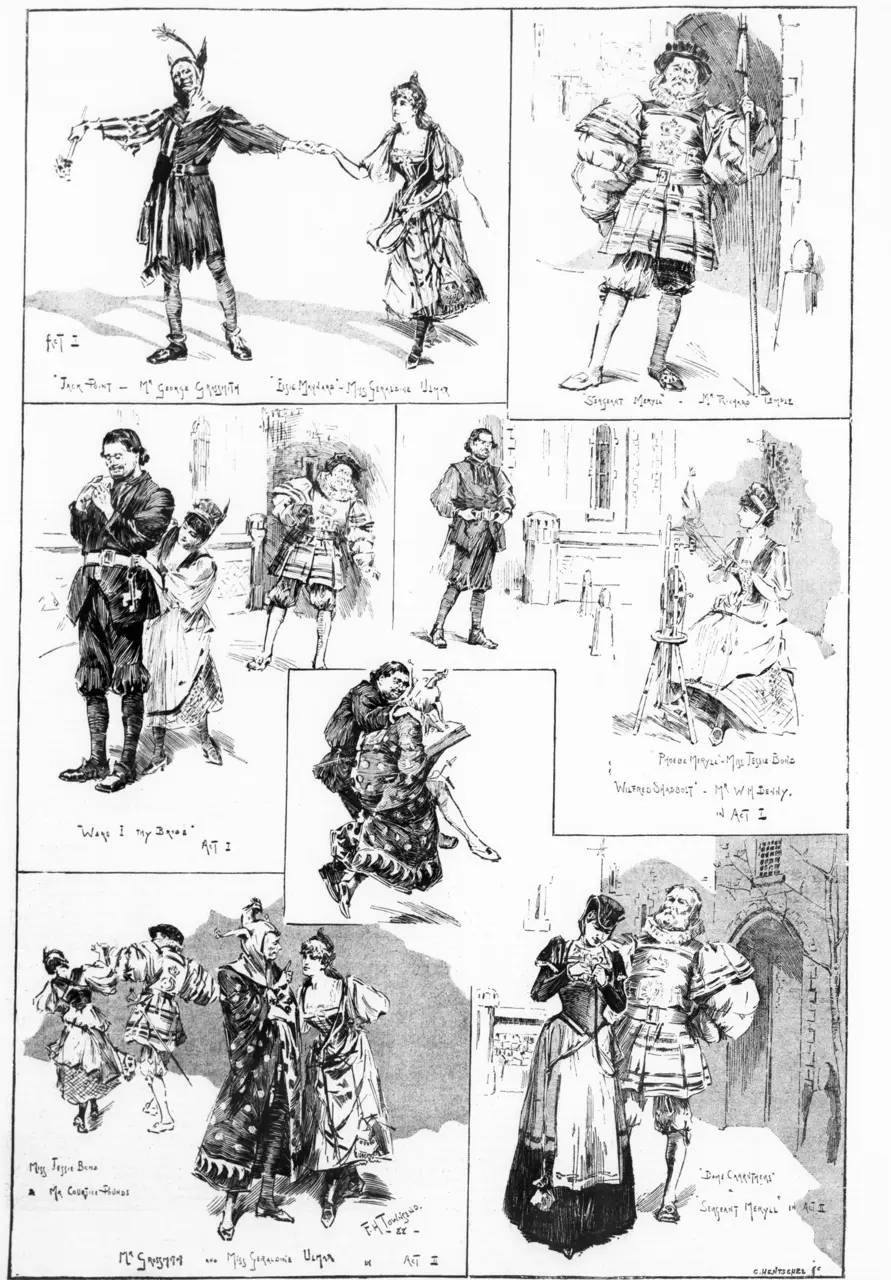
 Engagedby W. S. GilbertA young man proposes to every woman he meets, and Scotland's marriage laws catch up with him.
 The Gondoliersby W. S. Gilbert and Arthur SullivanOne of two gondolier brothers is the King of Barataria, but nobody knows which, and the king was married as a baby.
 H.M.S. Pinaforeby W. S. Gilbert and Arthur SullivanA captain's daughter loves a common sailor, though the First Lord of the Admiralty means to marry her.
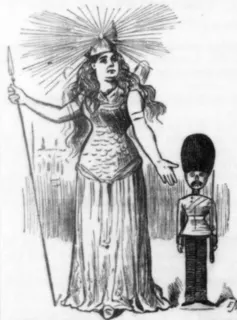 Iolantheby W. S. Gilbert and Arthur SullivanA shepherd who is a fairy down to the waist loves a Ward in Chancery, whom the Lord Chancellor and the House of Lords all want to marry.
Act 1, Scene 1
Tower Green
Phoebe discovered spinning.
Introduction and Song: When maiden loves, she sits and sighs
When maiden loves, she sits and sighs,
She wanders to and fro;
Unbidden tear-drops fill her eyes,
And to all questions she replies,
With a sad "Heigh-ho!"
'Tis but a little word—"Heigh-ho!"
So soft, 'tis scarcely heard—"Heigh-ho!"
An idle breath—
Yet life and death
May hang upon a maid's "Heigh-ho!"
When maiden loves, she mopes apart,
As owl mopes on a tree;
Although she keenly feels the smart,
She cannot tell what ails her heart,
With its sad "Ah, me!"
'Tis but a foolish sigh—"Ah, me!"
Born but to droop and die—"Ah, me!"
Yet all the sense
Of eloquence
Lies hidden in a maid's "Ah, me!"
Yet all the sense
Of eloquence
Lies hidden in a maid's "Ah, me!"
"Ah, me!", "Ah, me!"
Yet all the sense
Of eloquence
Lies hidden in a maid's "Ah, me!"
PHOEBE weeps
Enter WILFRED
Mistress Meryll!
[looking up] Eh! Oh! it's you, is it? You may go away,if you like. Because I don't want you, you know.
Haven't you anything to say to me?
Oh yes! Are the birds all caged? The wild beasts all littered down? All the locks, chains, bolts, and bars in good order? Is the Little Ease sufficiently comfortable? The racks, pincers, and thumbscrews all ready for work? Ugh! you brute!
These allusions to my professional duties are in doubtful taste. I didn't become a head-jailer because
I like head-jailing. I didn't become an assistant-tormentor because I like assistant-tormenting. We can't all be sorcerers, you know. [PHOEBE is annoyed]
Ah! you brought that upon yourself.
Colonel Fairfax is not a sorcerer. He's a man of science and an alchemist.
Well, whatever he is, he won't be one for long, for he's to be beheaded to-day for dealings with the devil. His master nearly had him last night, when the fire broke out in the Beauchamp [pronounced Bee'cham]
Tower.
Oh! how I wish he had escaped in the confusion! But take care; there's still time for a reply to his petition for mercy.
Ah! I'm content to chance that. This evening at half-past seven— ah! [Gesture of chopping off a head]
You're a cruel monster to speak so unfeelingly of the death of a young and handsome soldier.
Young and handsome! How do you know he's young and handsome?
Because I've seen him every day for weeks past taking his exercise on the Beauchamp [pronounced Bee'cham]
Tower.
Curse him!
There, I believe you're jealous of him, now. Jealous of a man I've never spoken to! Jealous of a poor soul who's to die in an hour!
I am! I'm jealous of everybody and everything. I'm jealous of the very words I speak to you— because they reach your ears— and I mustn't go near 'em!
How unjust you are! Jealous of the words you speak to me! Why, you know as well as I do that I don't even like them.
You used to like 'em.
I used to pretend I like them. It was mere politeness to comparative strangers.
Exit PHOEBE, with spinning wheel
I don't believe you know what jealousy is! I don't believe you know how it eats into a man's heart— and disorders his digestion— and turns his interior into boiling lead. Oh, you are a heartless jade to trifle with the delicate organization of the human interior.
Optional Song: When jealous torments
When jealous torments rack my soul,
My agonies I can't control,
Oh, better sit on red hot coal
Than love a heartless jade.
The red hot coal will hurt no doubt,
But red hot coals in time die out,
But jealousy you can not rout,
Its fires will never fade.
It's much less painful on the whole
To go and sit on red hot coal
'Til you're completely flayed,
Or ask a kindly friend to crack
Your wretched bones upon the rack
Than love a heartless jade,
Than love a heartless jade.
The kerchief on your neck of snow
I look on as a deadly foe,
It goeth where I dare not go
And stops there all day long.
The belt that holds you in its grasp
Is to my peace of mind a rasp,
It claspeth what I can not clasp,
Correct me if I'm wrong.
It's much less painful on the whole
To go and sit on red hot coal
'Til you're completely flayed,
Or ask a kindly friend to crack
Your wretched bones upon the rack
Than love a heartless jade,
Than love a heartless jade.
The bird that breakfasts on your lip,
I would I had him in my grip,
He sippeth where I dare not sip,
I can't get over that.
The cat you fondle soft and sly,
He layeth where I dare not lie.
We're not on terms, that cat and I.
I do not like that cat.
It's much less painful on the whole
To go and sit on red hot coal
'Til you're completely flayed,
Or ask a kindly friend to crack
Your wretched bones upon the rack
Than love a heartless jade,
Than love a heartless jade.
Or ask a kindly friend to crack
Your wretched bones upon the rack
Than love a heartless jade.
Exit WILFRED. Enter people excitedly, followed by YEOMEN of the Guard with SERGEANT MERYLL at rear.
Double Chorus: Tower warders, Under orders
Tower warders,
Under orders,
Gallant pikemen, valiant sworders!
Brave in bearing,
Foemen scaring,
In their bygone days of daring!
Ne'er a stranger
There to danger—
Each was o'er the world a ranger;
To the story
Of our glory
Each a bold, a bold contributory!
In the autumn of our life,
Here at rest in ample clover,
We rejoice in telling over
Our impetuous May and June.
In the evening of our day,
With the sun of life declining,
We recall without repining
All the heat of bygone noon,
We recall without repining
All the heat,
We recall, recall
All of bygone noon.
This the autumn of our life,
This the evening of our day;
Weary we of battle strife,
Weary we of mortal fray.
But our year is not so spent,
And our days are not so faded,
But that we with one consent,
Were our loved land invaded,
Still would face a foreign foe,
As in days of long ago,
Still would face a foreign foe,
As in days of long ago,
As in days of long ago,
As in days of long ago.
Still would face a foreign foe,
As in days of long ago.
Tower warders,
Under orders,
Gallant pikemen, valiant sworders!
Brave in bearing, Foemen scaring,
In their bygone days of daring!
Tower warders,
Under orders,
Gallant pikemen,
Valiant sworders
Brave in bearing,
Foemen scaring,
In their bygone days of daring!
Ne'er a stranger
There to danger
Each was o'er the world a ranger:
To the story
Of our glory
Each a bold,
A bold contributory.
To the story
Of our glory
Each a bold contributory!
Each a bold contributory!
This the autumn of our life
This the evening of our day;
Weary we of battle strife,
Weary we of mortal fray.
This the autumn of our life.
This the evening of our day,
This the evening of our day.
Exit CROWD. Manent YEOMEN. Enter DAME CARRUTHERS.
A good day to you!
Good day, Dame Carruthers. Busy to-day?
Busy, aye! the fire in the Beauchamp [pronounced Bee'cham] last night has given me work enough. A dozen poor prisoners— Richard Colfax, Sir Martin Byfleet,
Colonel Fairfax, Warren the preacher-poet, and half-a-score others— all packed into one small cell, not six feet square. Poor Colonel Fairfax, who's to die to-day, is to be removed to no. 14 in the Cold Harbour that he may have his last hour alone with his confessor; and I've to see to that.
Poor gentleman! He'll die bravely. I fought under him two years since, and he valued his life as it were a feather!
He's the bravest, the handsomest, and the best young gentleman in England! He twice saved my father's life; and it's a cruel thing, a wicked thing, and a barbarous thing that so gallant a hero should lose his head— for it's the handsomest head in England!
For dealings with the devil. Aye! if all were beheaded who dealt with him, there'd be busy things on Tower
Green.
You know very well that Colonel Fairfax is a student of alchemy— nothing more, and nothing less; but this wicked Tower, like a cruel giant in a fairy-tale, must be fed with blood, and that blood must be the best and bravest in England, or it's not good enough for the old Blunderbore. Ugh!
Silence, you silly girl; you know not what you say. I was born in the old keep, and I've grown grey in it, and, please God, I shall die and be buried in it; and there's not a stone in its walls that is not as dear tome as my right hand.
Song with Chorus: When our gallant Norman foes
When our gallant Norman foes
Made our merry land their own,
And the Saxons from the Conqueror were flying,
At his bidding it arose,
In its panoply of stone,
A sentinel unliving and undying.
Insensible, I trow,
As a sentinel should be,
Though a queen to save her head should
come a-suing,
There's a legend on its brow
That is eloquent to me,
And it tells of duty done and duty doing.
The screw may twist and the rack may turn,
And men may bleed and men may burn,
O'er London town and its golden hoard
I keep my silent watch and ward!
The screw may twist and the rack may turn,
O'er London town and all its hoard,
And men may bleed and men may burn,
O'er London town and all its hoard,
O'er London town and its golden hoard
I keep my silent watch and ward!
Within its wall of rock
The flower of the brave
Have perished with a constancy unshaken.
From the dungeon to the block,
From the scaffold to the grave,
Is a journey many gallant hearts have taken.
And the wicked flames may hiss
Round the heroes who have fought
For conscience and for home in all its beauty,
But the grim old fortalice
Takes little heed of aught
That comes not in the measure of its duty.
The screw may twist and the rack may turn,
And men may bleed and men may burn,
O'er London town and its golden hoard
I keep my silent watch and ward!
The screw may twist and the rack may turn,
O'er London town and all its hoard,
And men may bleed and men may burn,
O'er London town and all its hoard,
O'er London town and its golden hoard
I keep my silent watch and ward!
Exeunt all but PHOEBE. Enter SERGEANT MERYLL.
Father! Has no reprieve arrived for the poor gentleman?
No, my lass; but there's one hope yet. Thy brother
Leonard, who, as a reward for his valour in saving his standard and cutting his way through fifty foes who would have hanged him, has been appointed a Yeoman of the Guard, will arrive to-day; and as he comes straight from Windsor, where the Court is, it may be— it may be— that he will bring the expected reprieve with him.
Oh, that he may!
Amen to that! For the Colonel twice saved my life, and
I'd give the rest of my life to save his! And wilt thou not be glad to welcome thy brave brother, with the fame of whose exploits all England is a-ringing?
Aye, truly, if he brings the reprieve.
And not otherwise?
Well, he's a brave fellow indeed, and I love brave men.
All brave men?
Most of them, I verily believe! But I hope Leonard will not be too strict with me— they say he is a very dragon of virtue and circumspection! Now, my dear old father is kindness itself, and——
And leaves thee pretty well to thine own ways, eh?
Well, I've no fears for thee; thou hast a feather-brain, but thou'rt a good lass.
Yes, that's all very well, but if Leonard is going to tell me that I may not do this and I may not do that, and I must not talk to this one, or walk with that one, but go through the world with my lips pursed up and my eyes cats down, like a poor nun who has renounced mankind— why, as I have not renounced mankind, and don't mean to renounce mankind, I won't have it— there!
Nay, he'll not check thee more than is good for thee,
Phoebe! He's a brave fellow, and bravest among brave fellows, and yet it seems but yesterday that he robbed the Lieutenant's orchard.
Optional Song: A laughing boy
A laughing boy but yesterday,
A merry urchin blithe and gay,
Whose joyous shout came ringing out
Unchecked by care or sorrow.
Today a warrior all sunbrown,
When deeds of soldierly renown
Are not the boast of London town,
A veteran tomorrow, today a warrior,
A veteran tomorrow!
When at my Leonard's deeds sublime,
A soldier's pulse beats double time,
And grave hearts thrill as brave hearts will
At tales of martial glory.
I burn with flush of pride and joy,
A pride unbittered by alloy,
To find my boy, my darling boy,
The theme of song and story,
To find my darling boy
The theme of song and story!
To find my boy, my darling boy,
The theme of song and story!
Enter LEONARD MERYLL
Father!
Leonard! my brave boy! I'm right glad to see thee, and so is Phoebe!
Aye— hast thou brought Colonel Fairfax's reprieve?
Nay, I have here a despatch for the Lieutenant, but no reprieve for the Colonel!
Poor gentleman! poor gentleman!
Aye, I would I had brought better news. I'd give my right hand— nay, my body— my life, to save his!
Dost thou speak in earnest, my lad?
Aye, father— I'm no braggart. Did he not save thy life? and am I not his foster-brother?
Then hearken to me. Thou hast come to join the Yeomen of the Guard!
Well?
None has seen thee but ourselves?
And a sentry, who took scant notice of me.
Now to prove thy words. Give me the despatch and get thee hence at once! Here is money, and I'll send thee more. Lie hidden for a space, and let no one know.
I'll convey a suit of Yeoman's uniform to the
Colonel's cell— he shall shave off his beard, so that none shall know him, and I'll own him as my son, the brave Leonard Meryll, who saved his flag and cut his way through fifty foes who thirsted for his life. He will be welcomed without question by my brother-
Yeomen, I'll warrant that. Now, how to get access to the Colonel's cell? [To PHOEBE] The key is with they sour-faced admirer, Wilfred Shadbolt.
[demurely] I think— I say, I think— I can get anything
I want from Wilfred. I think— mind I say, I think— you may leave that to me.
Then get thee hence at once, lad— and bless thee for this sacrifice.
And take my blessing, too, dear, dear Leonard!
And thine. eh? Humph! Thy love is newborn; wrap it up carefully, lest it take cold and die.
Trio: Alas! I waver to and fro
Alas! I waver to and fro!
Dark danger hangs upon the deed!
Dark danger hangs upon the deed!
The scheme is rash and well may fail;
But ours are not the hearts that quail,
The hands that shrink, the cheeks that pale
In hours of need!
No, ours are not the hearts that quail,
The hands that shrink, the cheeks that pale
The hands that shrink, the cheeks that pale
In hours of need!
The air I breathe to him I owe:
My life is his— I count it naught!
That life is his— so count it naught!
And shall I reckon risks I run
When services are to be done
To save the life of such an one?
Unworthy thought! Unworthy thought!
And shall we reckon risks we run
To save the life of such an one?
Unworthy thought! Unworthy thought!
We may succeed— who can foretell?
May heav'n help our hope—
May heav'n help our hope,
farewell!
May heav'n help our hope,
Help our hope,
farewell!
LEONARD embraces MERYLL and PHOEBE, and then exits. PHOEBE weeping.
[goes up to PHOEBE] Nay, lass, be of good cheer, we may save him yet.
Oh! see, after— they bring the poor gentleman from the
Beauchamp! [pronounced Bee'cham] Oh, father! his hour is not yet come?
No, no— they lead him to the Cold Harbour Tower to await his end in solitude. But softly— the Lieutenant approaches! He should not see thee weep.
Enter FAIRFAX, guarded by YEOMEN. The LIEUTENANT enters, meeting him.
Halt! Colonel Fairfax, my old friend, we meet but sadly.
Sir, I greet you with all good-will; and I thank you for the zealous acre with which you have guarded me from the pestilent dangers which threaten human life outside. In this happy little community, Death, when he comes, doth so in punctual and business-like fashion; and, like a courtly gentleman, giveth due notice of his advent, that one may not be taken unawares.
Sir, you bear this bravely, as a brave man should.
Why, sir, it is no light boon to die swiftly and surely at a given hour and in a given fashion! Truth to tell, I would gladly have my life; but if that may not be, I have the next best thing to it, which is death. Believe me, sir, my lot is not so much amiss!
[aside to MERYLL] Oh, father, father, I cannot bear it!
My poor lass!
Nay, pretty one, why weepest thou? Come, be comforted.
Such a life as mine is not worth weeping for. [sees MERYLL] Sergeant Meryll, is it not? [to LIEUTENANT]
May I greet my old friend? [Shakes MERYLL's hand; MERYLL begins to weep] Why, man, what's all this? Thou and I have faced the grim old king a dozen times, and never has his majesty come to me in such goodly fashion. Keep a stout heart, good fellow— we are soldiers, and we know how to die, thou and I. Take my word for it, it is easier to die well than to live well— for, in sooth, I have tried both.
Ballad: Is life a boon
Is life a boon?
If so, it must befall
That Death, whene'er he call,
Must call too soon.
Though fourscore years he give,
Yet one would pray to live
Another moon!
What kind of plaint have I,
Who perish in July,
who perish in July?
I might have had to die,
Perchance, in June!
I might have had to die,
Perchance, in June!
Is life a thorn?
Then count it not a whit!
Nay, count it not a whit!
Man is well done with it;
Soon as he's born
He should all means essay
To put the plague away;
And I, war-worn,
Poor captured fugitive,
My life most gladly give—
I might have had to live,
Another morn!
I might have had to live,
Another morn!
At the end, PHOEBE is led off, weeping, by MERYLL.
And now, Sir Richard, I have a boon to beg. I am in this strait for no better reason than because my kinsman, Sir Clarence Poltwhistle, one of the
Secretaries of State, has charged me with sorcery, in order that he may succeed in my estate, which devolves to him provided I die unmarried.
As thou wilt most surely do.
Nay, as I will most surely not do, by your worship's grace! I have a mind to thwart this good cousin of mine.
How?
By marrying forthwith, to be sure!
But heaven ha' mercy, whom wouldst thou marry?
Nay, I am indifferent on that score. Coming Death hath made of me a true and chivalrous knight, who holds all womankind in such esteem that the oldest, and the meanest, and the worst-favoured of them is good enough for him. So, my good Lieutenant, if thou wouldst serve a poor soldier who has but an hour to live, find me the first that comes— my confessor shall marry us, and her dower shall be my dishonoured name and a hundred crowns to boot. No such poor dower for an hour of matrimony!
A strange request. I doubt that I should be warranted in granting it.
There never was a marriage fraught with so little of evil to the contracting parties. In an hour she'll be a widow, and I— a bachelor again for aught I know!
Well, I will see what can be done, for I hold thy kinsman in abhorrence for the scurvy trick he has played thee.
A thousand thanks, good sir; we meet again in this spot in an hour or so. I shall be a bridegroom then, and your worship will wish me joy. Till then, farewell. [To GUARD] I am ready, good fellows.
Exit with GUARD into Cold Harbour Tower
He is a brave fellow, and it is a pity that he should die. Now, how to find him a bride at such short notice? Well, the task should be easy! [Exit]
Enter JACK POINT and ELSIE MAYNARD, pursued by a CROWD of men and women. POINT and ELSIE are much terrified; POINT, however, assuming an appearance of self-possession.
Chorus: Here's a man of jollity
Here's a man of jollity,
Jibe, joke, jollify!
Give us of your quality,
Come, fool, follify!
If you vapour vapidly,
River runneth rapidly,
Into it we fling
Bird who doesn't sing!
Give us an experiment
In the art of merriment;
Into it we throw
Cock who doesn't crow!
Banish your timidity,
And with all rapidity
Give us quip and quiddity—
Willy-nilly, O!
River none can mollify;
Into it we throw
Fool who doesn't follify,
Cock who doesn't crow!
Banish your timidity,
And with all rapidity
Give us quip and quiddity—
Willy-nilly, O!
[alarmed] My masters, I pray you bear with us, and we will satisfy you, for we are merry folk who would make all merry as ourselves. For, look you, there is humour in all things, and the truest philosophy is that which teaches us to find it and to make the most of it.
[struggling with 1ST CITIZEN] Hands off, I say, unmannerly fellow! [she boxes his ears]
[to 1ST CITIZEN] Ha! Didst thou hear her say, "Hands off"?
Aye, I heard her say it, and I felt her do it! What then?
Thou dost not see the humour of that?
Nay, if I do, hang me!
Thou dost not? Now, observe. She said, "Hands off!
"Whose hands? Thine. Off whom? Off her. Why? Because she is a woman. Now, had she not been a woman, thine hands had not been set upon her at all. So the reason for the laying on of hands is the reason for the taking off of hands, and herein is contradiction contradicted! It is the very marriage of pro with con; and no such lopsided union either, as times go, for pro is not more unlike con than man is unlike woman— yet men and women marry every day with none to say,
"Oh, the pity of it!" but I and fools like me! Now wherewithal shall we please you? We can rhyme you couplet, triolet, quatrain, sonnet,rondolet, ballade, what you will. Or we can dance you saraband, gondolet, carole, pimpernel, or Jumping Joan.
Let us give them the singing farce of the Merryman and his Maid— therein is song and dance too.
Aye, the Merryman and his Maid!
Duet: I have a song to sing, O
I have a song to sing, O!
Sing me your song, O!
It is sung to the moon
By a love-lorn loon,
Who fled from the mocking throng, O!
It's a song of a merryman, moping mum,
Whose soul was sad, and whose glance was glum,
Who sipped no sup, and who craved no crumb,
As he sighed for the love of a ladye.
Heighdy! heighdy!
Misery me—lack-a-day-dee!
He sipped no sup, and he craved no crumb,
As he sighed for the love of a ladye!
I have a song to sing, O!
Sing me your song, O!
It is sung with the ring
Of the songs maids sing
Who love with a love life-long, O!
It's the song of a merrymaid, peerly proud,
Who loved a lord, and who laughed aloud
At the moan of the merryman, moping mum,
Whose soul was sad, and whose glance was glum,
Who sipped no sup, and who craved no crumb,
As he sighed for the love of a ladye!
Heighdy! heighdy!
Misery me—lack-a-day-dee!
He sipped no sup, and he craved no crumb,
As he sighed for the love of a ladye!
I have a song to sing, O!
Sing me your song, O!
It is sung to the knell
Of a churchyard bell,
And a doleful dirge, ding dong, O!
It's a song of a popinjay, bravely born,
Who turned up his noble nose with scorn
At the humble merrymaid, peerly proud,
Who loved a lord, and who laughed aloud
At the moan of the merryman, moping mum,
Whose soul was sad, and whose glance was glum,
Who sipped no sup, and who craved no crumb,
As he sighed for the love of a ladye!
Heighdy! heighdy!
Misery me—lack-a-day-dee!
He sipped no sup, and he craved no crumb,
As he sighed for the love of a ladye!
I have a song to sing, O!
Sing me your song, O!
It is sung with a sigh
And a tear in the eye,
For it tells of a righted wrong, O!
It's a song of the merrymaid, once so gay,
Who turned on her heel and tripped away
From the peacock popinjay, bravely born,
Who turned up his noble nose with scorn
At the humble heart that he did not prize:
So she begged on her knees, with downcast eyes,
For the love of the merryman, moping mum,
Whose soul was sad, and whose glance was glum,
Who sipped no sup, and who craved no crumb,
As he sighed for the love of a ladye!
Heighdy! heighdy!
Misery me—lack-a-day-dee!
His pains were o'er, and he sighed no more,
For he lived in the love of a ladye!
Heighdy! heighdy!
Misery me—lack-a-day-dee!
His pains were o'er, and he sighed no more,
For he lived in the love of a ladye!
Well sung and well danced!
A kiss for that, pretty maid!
Aye, a kiss all round. [CROWD gathers around her]
[drawing dagger] Best beware! I am armed!
Back, sirs— back! This is going too far.
Thou dost not see the humour of it, eh? Yet there is humour in all things— even in this. [Trying to kiss her]
Help! Help!
Enter LIEUTENANT with GUARD. CROWD falls back
What is the pother?
Sir, we sang to these folk, and they would have repaid us with gross courtesy, but for your honour's coming.
[to CROWD] Away with ye! Clear the rabble.
GUARDS push CROWD off, and go off with them
Now, my girl, who are you, and what do you here?
May it please you, sir, we are two strolling players,
Jack Point and I, Elsie Maynard, at your worship's service. We go from fair to fair, singing, and dancing, and playing brief interludes; and so we make a poor living.
You two, eh? Are ye man and wife?
No, sir; for though I'm a fool, there is a limit to my folly. Her mother, old Bridget Maynard, travels with us [for Elsie is a good girl], but the old woman is a-bed with fever, and we have come here to pick up some silver to buy an electuary for her.
Hark ye, my girl! Your mother is ill?
Sorely ill, sir.
And needs good food, and many things that thou canst not buy?
Alas! sir, it is too true.
Wouldst thou earn an hundred crowns?
An hundred crowns! They might save her life!
Then listen! A worthy but unhappy gentleman is to be beheaded in an hour on this very spot. For sufficient reasons, he desires to marry before he dies, and he hath asked me to find him a wife. Wilt thou be that wife?
The wife of a man I have never seen!
Why, sir, look you, I am concerned in this; for though
I am not yet wedded to Elsie Maynard, time works wonders, and there's no knowing what may be in store for us. Have we your worship's word for it that this gentleman will die to-day?
Nothing is more certain, I grieve to say.
And that the maiden will be allowed to depart the very instant the ceremony is at an end?
The very instant. I pledge my honour that it shall be so.
An hundred crowns?
An hundred crowns!
For my part, I consent. It is for Elsie to speak.
Trio: How say you, maiden, will you wed
How say you, maiden, will you wed
A man about to lose his head?
For half an hour
You'll be his wife,
And then the dower
Is your for life.
A headless bridegroom why refuse?
If truth the poets tell,
Most bridegrooms, 'ere they marry,
Lose both head and heart as well!
A strange proposal you reveal,
It almost makes my senses reel.
Alas! I'm very poor indeed,
And such a sum I sorely need.
My mother, sir, is like to die.
This money life may bring.
Bear this in mind, I pray,
If I consent to do this thing!
Though as a general rule of life
I don't allow my promised wife,
My lovely bride that is to be,
To marry anyone but me,
Yet if the fee is promptly paid,
And he, in well-earned grave,
Within the hour is duly laid,
Objection I will waive!
Yes, objection I will waive!
Temptation, oh, temptation,
Were we, I pray, intended
To shun, what e'er our station,
Your fascinations splendid;
Or fall, whene'er we view you,
Head over heels into you?
Head over heels, Head over heels,
Head over heels into you!
Head over heels, Head over heels,
Head over heels, Right into you!
Head over heels, Head over heels, etc.
Temptation, oh, temptation!
During this, the LIEUTENANT has whispered to WILFRED [who has entered]. WILFRED binds ELSIE's eyes with a kerchief, and leads her into the Cold Harbour Tower
And so, good fellow, you are a jester?
Aye, sir, and like some of my jests, out of place.
I have a vacancy for such an one. Tell me, what are your qualifications for such a post?
Marry, sir, I have a pretty wit. I can rhyme you extempore; I can convulse you with quip and conundrum;I have the lighter philosophies at my tongue's tip; I can be merry, wise, quaint, grim, and sardonic, one by one, or all at once; I have a pretty turn for anecdote; I know all the jests— ancient and modern— past, present, and to come; I can riddle you from dawn of day to set of sun, and, if that content you not, well on to midnight and the small hours. Oh, sir, a pretty wit, I warrant you— a pretty, pretty wit!
Song: I've jibe and joke
I've jibe and joke
And quip and crank
For lowly folk
And men of rank.
I ply my craft
And know no fear.
But aim my shaft
At prince or peer.
At peer or prince— at prince or peer,
I aim my shaft and know no fear!
I've wisdom from the East and from the West,
That's subject to no academic rule;
You may find it in the jeering of a jest,
Or distil it from the folly of a fool.
I can teach you with a quip, if I've a mind;
I can trick you into learning with a laugh;
Oh, winnow all my folly, folly, folly, and
you'll find
A grain or two of truth among the chaff!
Oh, winnow all my folly, folly, folly, and
you'll find
A grain or two of truth among the chaff!
I can set a braggart quailing with a quip,
The upstart I can wither with a whim;
He may wear a merry laugh upon his lip,
But his laughter has an echo that is grim.
When they're offered to the world in merry
guise,
Unpleasant truths are swallowed with a will,
For he who'd make his fellow,
fellow, fellow creatures wise
Should always gild the philosophic pill!
For he who'd make his fellow,
fellow, fellow creatures wise
Should always gild the philosophic pill!
And how came you to leave your last employ?
Why, sir, it was in this wise. My Lord was the
Archbishop of Canterbury, and it was considered that one of my jokes was unsuited to His Grace's family circle. In truth, I ventured to ask a poor riddle, sir— Wherein lay the difference between His Grace and poor Jack Point? His Grace was pleased to give it up, sir. And thereupon I told him that whereas His Grace was paid 10,000 a year for being good, poor Jack Point was good— for nothing. 'Twas but a harmless jest, but it offended His Grace, who whipped me and set me in the stocks for a scurril rogue, and so we parted. I had as lief not take post again with the dignified clergy.
But I trust you are very careful not to give offence.
I have daughters.
Sir, my jests are most carefully selected, and anything objectionable is expunged. If your honour pleases, I will try then first on your honour's chaplain.
Can you give me an example? Say that I had sat me down hurriedly on something sharp?
Sir, I should say that you had sat down on the spur of the moment.
Humph! I don't think much of that. Is that the best you can do?
It has always been much admired, sir, but we will try again.
Well, then, I am at dinner, and the joint of meat is but half cooked.
Why then, sir, I should say that what is underdone cannot be helped.
I see. I think that manner of thing would be somewhat irritating.
At first, sir, perhaps; but use is everything, and you would come in time to like it.
We will suppose that I caught you kissing the kitchen wench under my very nose.
Under her very nose, good sir— not under yours! That is where I would kiss her. Do you take me? Oh, sir, a pretty wit— a pretty, pretty wit!
The maiden comes. Follow me, friend, and we will discuss this matter at length in my library.
I am your worship's servant. That is to say, I trust
I soon shall be. But, before proceeding to a more serious topic, can you tell me, sir, why a cook's brain-pan is like an overwound clock?
A truce to this fooling— follow me.
Just my luck; my best conundrum wasted!
Exeunt LIEUTENANT and POINT. Enter ELSIE from Tower, led by WILFRED, who removes the bandage from her eyes, and exits.
Recitative and Song: 'Tis done! I am a bride
'Tis done! I am a bride! Oh, little ring,
That bearest in thy circlet all the gladness
That lovers hope for, and that poets sing,
What bringest thou to me but gold and sadness?
A bridegroom all unknown, save in this wise,
To-day he dies! To-day, alas, he dies!
Though tear and long-drawn sigh
Ill fit a bride,
No sadder wife than I
The whole world wide!
Ah me! Ah me!
Yet maids there be
Who would consent to lose
The very rose of youth,
The flow'r of life,
To be, in honest truth,
A wedded wife,
No matter whose!
No matter whose!
Ah me! what profit we,
O maids that sigh,
Though gold, though gold should live
If wedded love must die?
Ere half an hour has rung,
A widow I!
Ah, heaven, he is too young,
Too brave to die!
Ah me! Ah me!
Yet wives there be
So weary worn, I trow,
That they would scarce complain,
So that they could
In half an hour attain
To widowhood,
No matter how!
No matter how!
O weary wives
Who widowhood would win,
Rejoice, rejoice, that ye have time
To weary in.
O weary wives
Who widowhood would win,
Rejoice, rejoice, rejoice,
that ye have time
O weary, weary wives, rejoice!
Exit ELSIE as WILFRED re-enters.
[looking after ELSIE] 'Tis an odd freak for a dying man and his confessor to be closeted alone with a strange singing girl. I would fain have espied them, but they stopped up the keyhole. My keyhole!
Enter PHOEBE with SERGEANT MERYLL. MERYLL remains in the background, unobserved by WILFRED.
[aside] Wilfred— and alone!
Now what could he have wanted with her? That's what puzzles me!
[aside] Now to get the keys from him.
Aloud] Wilfred— has no reprieve arrived?.
None. Thine adored Fairfax is to die.
Nay, thou knowest that I have naught but pity for the poor condemned gentleman.
I know that he who is about to die is more to thee than I, who am alive and well.
Why, that were out of reason, dear Wilfred. Do they not say that a live ass is better than a dead lion?
No, I didn't mean that!
Oh, they say that, do they?
It's unpardonably rude of them, but I believe they put it in that way. Not that it applies to thee, who art clever beyond all telling!
Oh yes, as an assistant-tormentor.
Nay, as a wit, as a humorist, as a most philosophic commentator on the vanity of human resolution.
PHOEBE slyly takes bunch of keys from WILFRED's waistband and hands them to MERYLL, who enters the Tower, unnoticed by WILFRED.
Truly, I have seen great resolution give way under my persuasive methods [working with a small thumbscrew].
In the nice regulation of a thumbscrew— in the hundredth part of a single revolution lieth all the difference between stony reticence and a torrent of impulsive unbosoming that the pen can scarcely follow.
Ha! ha! I am a mad wag.
[with a grimace] Thou art a most light-hearted and delightful companion, Master Wilfred. Thine anecdotes of the torture-chamber are the prettiest hearing.
I'm a pleasant fellow an' I choose. I believe I am the merriest dog that barks. Ah, we might be passing happy together—
Perhaps. I do not know.
For thou wouldst make a most tender and loving wife.
Aye, to one whom I really loved. For there is a wealth of love within this little heart— saving up for— I wonder whom? Now, of all the world of men, I wonder whom? To think that he whom I am to wed is now alive and somewhere! Perhaps far away, perhaps close at hand! And I know him not! It seemeth that I am wasting time in not knowing him.
Now say that it is I— nay! suppose it for the nonce.
Say that we are wed— suppose it only— say that thou art my very bride, and I thy cherry, joyous, bright, frolicsome husband— and that, the day's work being done, and the prisoners stored away for the night, thou and I are alone together— with a long, long evening before us!
[with a grimace] It is a pretty picture— but I scarcely know. It cometh so unexpectedly— and yet—and yet— were I thy bride—
Aye!— wert thou my bride—?
Oh, how I would love thee!
Song: Were I thy bride
Were I thy bride,
Then all the world beside
Were not too wide
To hold my wealth of love—
Were I thy bride!
Upon thy breast
My loving head would rest,
As on her nest
The tender turtle dove—
Were I thy bride!
This heart of mine
Would be one heart with thine,
And in that shrine
Our happiness would dwell—
Were I thy bride!
And all day long
Our lives should be a song:
No grief, no wrong
Should make my heart rebel—
Were I thy bride!
The silvery flute,
The melancholy lute,
Were night-owl's hoot
To my low-whispered coo—
Were I thy bride!
The skylark's trill
Were but discordance shrill
To the soft thrill
Of wooing as I'd woo—
Were I thy bride!
MERYLL re-enters; gives keys to PHOEBE, who replaces them at WILFRED's girdle, unnoticed by him. Exit MERYLL.
The rose's sigh
Were as a carrion's cry
To lullaby
Such as I'd sing to thee,
Were I thy bride!
A feather's press
Were leaden heaviness to my caress.
But then, of course, you see,
I'm not thy bride.
Exit PHOEBE
No, thou'rt not— not yet! But, Lord, how she woo'd; I should be no mean judge of wooing, seeing that I have been more hotly woo'd than most men. I have been woo'd by maid, widow, and wife. I have been woo'd boldly, timidly, tearfully, shyly— by direct assault, by suggestion, by implication, by inference, and by innuendo. But this wooing is not of the common order; it is the wooing of one who must needs me, if she die for it!
Exit WILFRED. Enter SERGEANT MERRILL, cautiously, from Tower.
[looking after them] The deed is, so far, safely accomplished. The slyboots, how she wheedled him! What a helpless ninny is a love-sick man! He is but as a lute in a woman's hands— she plays upon him whatever tune she will. But the Colonel comes. I' faith, he's just in time, for the Yeomen parade here for his execution in two minutes!
Enter FAIRFAX, without beard and moustache, and dressed in Yeoman's uniform.
My good and kind friend, thou runnest a grave risk for me!
Tut, sir, no risk. I'll warrant none here will recognise you. You make a brave Yeoman, sir! So— this ruff is too high; so— and the sword should hang thus.
Here is your halbert, sir; carry it thus. The Yeomen come. Now, remember, you are my brave son, Leonard
Meryll.
If I may not bear mine own name, there is none other
I would bear so readily.
Now, sir, put a bold face on it, for they come.
Finale of Act I: Oh, Sergeant Meryll, is it true
Enter YEOMEN of the Guard
Oh, Sergeant Meryll, is it true—
The welcome news we read in orders?
Thy son, whose deeds of derring-do
Are echoed all the country through,
Has come to join the Tower Warders?
If so, we come to meet him,
That we may fitly greet him,
And welcome his arrival here
With shout on shout and cheer on cheer,
Hurrah! Hurrah! Hurrah!
Ye Tower warders, nursed in war's alarms,
Suckled on gunpowder, and weaned on glory,
Behold my son, whose all-subduing arms
Have formed the theme of many a song and story!
Forgive his aged father's pride; nor jeer
His aged father's sympathetic tear!
[Pretending to weep]
Leonard Meryll!
Leonard Meryll!
Dauntless he in time of peril!
Man of power,
Knighthood's flower,
Welcome to the grim old Tower,
To the Tower, welcome thou!
Forbear, my friends, and spare me this ovation,
I have small claim to such consideration;
The tales that of my prowess are narrated
Have been prodigiously exaggerated,
prodigiously exaggerated!
'Tis ever thus!
Wherever valor true is found,
True modesty will there abound.
Didst thou not, oh, Leonard Meryll!
Standard lost in last campaign,
Rescue it at deadly peril—
Bear it safely back again?
Leonard Meryll, at his peril,
Bore it safely back again!
Didst thou not, when prisoner taken,
And debarred from all escape,
Face, with gallant heart unshaken,
Death in most appalling shape?
Leonard Meryll, faced his peril,
Death in most appalling shape!
[aside] Truly I was to be pitied,
Having but an hour to live,
I reluctantly submitted,
I had no alternative!
[aloud] Oh! the tales that are narrated
Of my deeds of derring-do
Have been much exaggerated,
Very much exaggerated,
Scarce a word of them is true!
Scarce a word of them is true!
They are not exaggerated,
Not at all exaggerated,
Could not be exaggerated,
Ev'ry word of them is true!
3RD YEOMAN [optional] You, when brought to execution,
Like a demigod of yore,
With heroic resolution
Snatched a sword and killed a score.
[optional] Leonard Meryll, Leonard Meryll
Snatched a sword and killed a score!
4TH YEOMAN [optional] Then escaping from the foemen,
Boltered with the blood you shed,
You, defiant, fearing no men,
Saved your honour and your head!
[optional] Leonard Meryll, Leonard Meryll
Saved his honour and his head.
[optional] True, my course with judgement
shaping,
Favoured, too, by lucky star,
I succeeded in escaping
Prison-bolt and prison bar!
[optional] Oh! the tales that are narrated
Of my deeds of derring-do
Have been much exaggerated,
Very much exaggerated,
Scarce a word of them is true!
Scarce a word of them is true!
[optional] They are not exaggerated,
Not at all exaggerated,
Could not be exaggerated,
Ev'ry word of them is true!
Enter PHOEBE. She rushes to FAIRFAX. Enter WILFRED.
Leonard!
[puzzled] I beg your pardon?
Don't you know me? I'm little Phoebe!
[still puzzled] Phoebe? Is this Phoebe?
What! little Phoebe?
[aside] Who the deuce may she be?
It can't be Phoebe, surely?
Yes, 'tis Phoebe—
Your sister Phoebe! Your own little sister!
Aye, he speaks the truth; 'Tis Phoebe!
[pretending to recognise her] Sister Phoebe!
Oh, my brother!
Why, how you've grown!
I did not recognize you!
So many years! Oh, brother!
Oh, my sister!
Oh, brother!/Oh, sister!
Aye, hug him, girl!
There are three thou mayst hug—
Thy father and thy brother and— myself!
Thyself, forsooth?
And who art thou thyself?
Good sir, we are betrothed.
FAIRFAX turns inquiringly to PHOEBE
Or more or less—
But rather less than more!
To thy fond care
I do commend thy sister.
Be to her
An ever-watchful guardian— eagle-eyed!
And when she feels [as sometimes she does feel]
Disposed to indiscriminate caress,
Be thou at hand to take those favours from her!
Be thou at hand to take those favours from her!
Yes, yes.
Be thou at hand to take those favours from me!
To thy fraternal care
Thy sister I commend;
From every lurking snare
Thy lovely charge defend;
And to achieve this end,
Oh! grant, I pray, this boon—
Oh! grant this boon
She shall not quit my sight;
From morn to afternoon—
From afternoon to night—
From sev'n o'clock to two—
From two to eventide—
From dim twilight to 'lev'n at night,
From dim twilight to 'lev'n at night
She shall not quit my side!
From morn to afternoon—
From afternoon to 'lev'n at night
She shall not quit thy side!
So amiable I've grown,
So innocent as well,
That if I'm left alone
The consequences fell
No mortal can foretell.
So grant, I pray, this boon—
Oh! grant this boon
I shall not quit thy sight:
From morn to afternoon—
From afternoon to night—
From sev'n o'clock to two—
From two to eventide—
From dim twilight to 'lev'n at night
From dim twilight to 'lev'n at night
I shall not quit thy side!
From morn to afternoon—
From afternoon to 'lev'n at night
She shall not quit thy side!
With brotherly readiness,
For my fair sister's sake,
At once I answer "Yes"—
That task I undertake—
My word I never break.
I freely grant that boon,
And I'll repeat my plight.
From morn to afternoon— [kiss]
From afternoon to night— [kiss]
From sev'n o'clock to two— [kiss]
From two to evening meal— [kiss]
From dim twilight to 'lev'n at night,
From dim twilight to 'lev'n at night,
That compact I will seal. [kiss]
From morn to afternoon,
From afternoon to 'lev'n at night
He freely grants that boon.
The bell of St. Peter's begins to toll. The CROWD enters; the block is brought on to the stage, and the HEADSMAN takes his place. The YEOMEN of the Guard form up. The LIEUTENANT enters and takes his place, and tells off FAIRFAX and two others to bring the prisoner to execution. WILFRED, FAIRFAX, and TWO YEOMEN exeunt to Tower.
The prisoner comes to meet his doom;
The block, the headsman, and the tomb.
The funeral bell begins to toll;
May Heav'n have mercy on his soul!
May Heav'n have mercy on his soul!
Oh, Mercy, thou whose smile has shone
So many a captive heart upon;
Of all immured within these walls,
To-day the very worthiest falls!
Oh, Mercy, thou whose smile has shone
So many a captive heart upon;
Of all immured within these walls,
The very worthiest falls.
Oh, Mercy, Oh, Mercy!
Enter FAIRFAX and TWO YEOMEN from Tower in great excitement.
My lord! I know not how to tell
The news I bear!
I and my comrades sought the pris'ner's cell—
He is not there!
He is not there!
They sought the pris'ner's cell—
he is not there!
As escort for the prisoner
We sought his cell, in duty bound;
The double gratings open were,
No prisoner at all we found!
We hunted high, we hunted low,
We hunted here, we hunted there—
The man we sought with anxious care
Had vanished into empty air!
The man we sought with anxious care
Had vanished into empty air!
Exit LIEUTENANT
Now, by my troth, the news is fair,
The man has vanished into air!
As escort for the prisoner
We/they sought his cell in duty bound;
The double gratings open were,
No prisoner at all we/they found,
We/they hunted high, we/they hunted low,
We/they hunted here, we/they hunted there,
The man we/they sought with anxious care
Had vanished into empty air!
The man we/they sought with anxious care
Had vanished into empty air!
Enter WILFRED, followed by LIEUTENANT
Astounding news! The pris'ner fled!
[To WILFRED] Thy life shall forfeit be instead!
WILFRED is arrested
My lord, I did not set him free,
I hate the man— my rival he!
The pris'ner gone— I'm all agape!
Thy life shall forfeit be instead!
Who could have helped him to escape?
My lord, I did not set him free!
Indeed I can't imagine who!
I've no idea at all, have you?
Enter JACK POINT
Of his escape no traces lurk,
Enchantment must have been at work!
[aside to POINT] What have I done? Oh, woe is me!
Indeed I can't imagine who!
I've no idea at all, have you?
I am his wife, and he is free!
Oh, woe is you? Your anguish sink!
Oh, woe is me, I rather think!
Oh, woe is me, I rather think!
Yes, woe is me, I rather think!
Whate'er betide
You are his bride,
And I am left
Alone— bereft!
Yes, woe is me, I rather think!
Yes, woe is me, I rather think!
Yes, woe is me, Yes, woe is me, Yes, woe is me,
Yes, woe is me, I rather think!
All frenzied with despair I/they rave,
The grave is cheated of its due.
Who is, who is the misbegotten knave
Who hath contrived this deed to do?
Let search, let search
Be made throughout the land,
Or his/my vindictive anger dread—
A thousand marks, a thousand marks
he'll/I'll hand
Who brings him here, alive or dead,
Who brings him here, alive or dead!
A thousand marks, a thousand marks,
Alive, alive or dead
Alive, alive or dead
Who brings him here, alive, alive, or dead.
At the end, ELSIE faints in FAIRFAX's arms; all the YEOMEN and CROWD rush off the stage in different directions, to hunt for the fugitive, leaving only the HEADSMAN on the stage, and ELSIE insensible in FAIRFAX's arms.
Act 2, Scene 1
The same— Moonlight
Two days have elapsed.
WOMEN and YEOMEN of the Guard discovered.
Chorus and Solo: Night has spread her pall once more
Night has spread her pall once more,
And the pris'ner still is free:
Open is his dungeon door,
Useless now his dungeon key.
He has shaken off his yoke—
How, no mortal man can tell!
Shame on loutish jailor-folk—
Shame on sleepy sentinel!
Enter DAME CARRUTHERS and KATE
Warders are ye?
Whom do ye ward?
Warders are ye?
Whom do ye ward?
Bolt, bar, and key,
Shackle and cord,
Fetter and chain,
Dungeon and stone,
All are in vain—
Prisoner's flown!
Spite of ye all, he is free— he is free!
Whom do ye ward? Pretty warders are ye!
Pretty warders are ye!
Whom do ye ward?
Spite of ye all, he is free— he is free!
Whom do ye ward?
Pretty warders are ye!
Up and down, and in and out,
Here and there, and round about;
Ev'ry chamber, ev'ry house,
Ev'ry chink that holds a mouse,
Ev'ry crevice in the keep,
Where a beetle black could creep,
Ev'ry outlet, ev'ry drain,
Have we searched, but all in vain, all in vain.
Warders are ye?
Whom do ye ward?
Ev'ry house, ev'ry chink, ev'ry drain,
Warders are ye?
Whom do ye ward?
Ev'ry chamber, ev'ry outlet,
Have we searched, but all in vain.
Night has spread her pall once more,
And the pris'ner still is free:
Warders are we? Whom do we ward?
Whom do we ward?
Warders are we? Whom do we ward?
Whom do we ward?
Open is his dungeon door,
Useless his dungeon key!
Spite of us all, he is free, he is free!
Pretty warders are we, he is free!
Spite of us all, he is free, he is free!
Open is his dungeon door,
Spite of us all, he is free, he is free!
Pretty warders are we, he is free! He is free!
He is free! He is free!
Pretty warders are ye,
He is free! He is free!
Pretty warders are ye/we!
Exeunt all.
Enter JACK POINT, in low spirits, reading from a huge volume
[reads] "The Merrie Jestes of Hugh Ambrose, No.
7863.The Poor Wit and the Rich Councillor. A certayne poor wit, being an-hungered, did meet a well-fed councillor.'Marry, fool,' quothe the councillor, 'whither away?' 'In truth,' said the poor wag, 'in that I have eaten naught these two dayes, I do wither away, and that right rapidly!' The Councillor laughed hugely, and gave him a sausage." Humph! the councillor was easier to please than my new master the
Lieutenant. I would like to take post under that councillor. Ah! 'tis but melancholy mumming when poor heart-broken, jilted Jack Point must needs turn to
Hugh Ambrose for original light humour!
Enter WILFRED, also in low spirits.
[sighing] Ah, Master Point!
[changing his manner] Ha! friend jailer! Jailer that wast— jailer that never shalt be more! Jailer that jailed not, or that jailed, if jail he did, so unjailery that 'twas but jerry-jailing, or jailing in joke— though no joke to him who, by unjailerlike jailing, did so jeopardise his jailership. Come, take heart, smile, laugh, wink, twinkle, thou tormentor that tormentest none— thou racker that rackest not— thou pincher out of place— come, take heart, and be merry, as I am!— [aside, dolefully]— as I am!
Aye, it's well for thee to laugh. Thou hast a good post, and hast cause to be merry.
[bitterly] Cause? Have we not all cause? Is not the world a big butt of humour, into which all who will may drive a gimlet? See, I am a salaried wit; and is there aught in nature more ridiculous? A poor, dull, heart-broken man, who must needs be merry, or he will be whipped; who must rejoice, lest he starve; who must jest you, jibe you, quip you, crank you, wrack you, riddle you, from hour to hour, from day to day, from year to year, lest he dwindle, perish, starve, pine,and die! Why, when there's naught else to laugh at, I laugh at myself till I ache for it!
Yet I have often thought that a jester's calling would suit me to a hair.
Thee? Would suit thee, thou death's head and cross-bones?
Aye, I have a pretty wit— a light, airy, joysome wit, spiced with anecdotes of prison cells and the torture chamber. Oh, a very delicate wit! I have tried it on many a prisoner, and there have been some who smiled.
Now it is not easy to make a prisoner smile. And it should not be difficult to be a good jester, seeing that thou are one.
Difficult? Nothing easier. Nothing easier. Attend, and
I will prove it to thee!
No. 14. Oh! a private buffoon is a light-hearted loon [Song]
Point
Oh! a private buffoon is a light-hearted loon,
If you listen to popular rumour;
From morning to night he's so joyous and bright,
And he bubbles with wit and good humour!
He's so quaint and so terse,
Both in prose and in verse;
Yet though people forgive his transgression,
There are one or two rules that all family fools
Must observe, if they love their profession.
There are one or two rules,
Half-a-dozen, maybe,
That all family fools,
Of whatever degree,
Must observe if they love their profession.
If you wish to succeed as a jester, you'll need
To consider each person's auricular:
What is all right for B would quite scandalize C
For C is so very particular;
And D may be dull, and E's very thick skull
Is as empty of brains as a ladle;
While F is F sharp, and will cry with a carp,
That he's known your best joke from his cradle!
When your humour they flout,
You can't let yourself go;
And it does put you out
When a person says, "Oh!
I have known that old joke from my cradle!"
If your master is surly, from getting up early
And tempers are short in the morning,
An inopportune joke is enough to provoke
Him to give you, at once, a month's warning.
Then if you refrain, he is at you again,
For he likes to get value for money:
He'll ask then and there, with an insolent stare,
"If you know that you're paid to be funny?"
It adds to the tasks
Of a merryman's place,
When your principal asks,
With a scowl on his face,
If you know that you're paid to be funny?
Comes a Bishop, maybe, or a solemn D.D.—
Oh, beware of his anger provoking!
Better not pull his hair—
Don't stick pins in his chair;
He won't understand practical joking.
If the jests that you crack have an orthodox smack,
You may get a bland smile from these sages;
But should it, by chance, be imported from France,
Half-a-crown is stopped out of your wages!
It's a general rule,
Tho' your zeal it may quench,
If the Family Fool
Makes a joke that's too French,
Half-a-crown is stopped out of his wages!
Though your head it may rack with a bilious attack,
And your senses with toothache you're losing,
And you're mopy and flat—
they don't fine you for that
If you're properly quaint and amusing!
Though your wife ran away with a soldier that day,
And took with her your trifle of money;
Bless your heart, they don't mind—
they're exceedingly kind—
They don't blame you—as long as you're funny!
It's a comfort to feel
If your partner should flit,
Though you suffer a deal,
They don't mind it a bit—
They don't blame you—so long as you're funny!
And so thou wouldst be a jester eh?
Aye!
Now, listen! My sweetheart, Elsie Maynard, was secretly wed to this Fairfax half an hour ere he escaped.
She did well.
She did nothing of the kind, so hold thy peace and perpend. Now, while he liveth she is dead to me and I to her, and so, my jibes and jokes notwithstanding, I am the saddest and the sorriest dog in England!
Thou art a very dull dog indeed.
Now, if thou wilt swear that thou didst shoot this
Fairfax while he was trying to swim across the river— it needs but the discharge of an arquebus on a dark night— and that he sank and was seen no more, I'll make thee the very Archbishop of jesters, and that in two days'time! Now, what sayest thou?
I am to lie?
Heartily. But thy lie must be a lie of circumstance, which I will support with the testimony of eyes, ears,and tongue.
And thou wilt qualify me as a jester?
As a jester among jesters. I will teach thee all my original songs, my self-constructed riddles, my own ingenious paradoxes; nay, more, I will reveal to thee the source whence I get them. Now, what sayest thou?
Why, if it be but a lie thou wantest of me, I hold it cheap enough, and I say yes, it is a bargain!
Duet: Hereupon we're both agreed
Hereupon we're both agreed,
All that we two
Do agree to
We'll secure by solemn deed,
To prevent all
Error mental.
You on Elsie are to call
With a story
Grim and gory;
How this Fairfax died, and all
I declare to
You're to swear to.
I to swear to!
I declare to,
I to swear to!
I declare to,
I to swear to,/I declare to,
You declare to,/You're to swear to,
I to swear to,/I declare to.
Tell a tale of cock and bull,
Of convincing detail full
Tale tremendous,
Heav'n defend us!
What a tale of cock and bull!
In return for your/my own part
You are/I am making, undertaking
To instruct me/you in the art
Art amazing, wonder raising
Of a jester, jesting free.
Proud position—
High ambition!
And a lively one I'll be,
Wag-a-wagging,
Never flagging!
Wag-a-wagging,
Never flagging,
Wag-a-wagging,
Never flagging,
Never flagging,/Wag-a-wagging,
Wag-a-wagging,/Never flagging,
Never flagging,/Wag-a-wagging!
Tell a tale of cock and bull,
Of convincing detail full
Tale tremendous,
Heav'n defend us!
What a tale of cock and bull!
What a tale of cock,
What a tale of bull!
What a tale of cock,
What a tale of bull!
What a tale of cock and bull,
Cock and bull, cock and bull,
Heav'n defend us!
What a tale of cock and bull!
Exeunt together.
Enter FAIRFAX
Two days gone, and no news of poor Fairfax. The dolts!
They seek him everywhere save within a dozen yards of his dungeon. So I am free! Free, but for the cursed haste with which I hurried headlong into the bonds of matrimony with— Heaven knows whom! As far as I remember, she should have been young; but even had not her face been concealed by her kerchief, I doubt whether, in my then plight, I should have taken much note of her. Free? Bah! The Tower bonds were but a thread of silk compared with these conjugal fetters which I, fool that I was, placed upon mine own hands.
From the one I broke readily enough— how to break the other!
Ballad: Free from his fetters grim
Free from his fetters grim—
Free to depart;
Free both in life and limb—
In all but heart!
Bound to an unknown bride
For good and ill;
Ah, is not one so tied
A pris'ner still, a pris'ner still?
Ah, is not one so tied
A pris'ner still?
Free, yet in fetters held
Till his last hour,
Gyves that no smith can weld,
No rust devour!
Although a monarch's hand
Had set him free,
Of all the captive band
The saddest he, the saddest he!
Of all the captive band
The saddest, saddest he!
Enter SERGEANT MERYLL
Well, Sergeant Meryll, and how fares thy pretty charge,Elsie Maynard?
Well enough, sir. She is quite strong again, and leaves us to-night.
Thanks to Dame Carruthers' kind nursing, eh?
Aye, deuce take the old witch! Ah, 'twas but a sorry trick you played me, sir, to bring the fainting girl to me. It gave the old lady an excuse for taking up her quarters in my house, and for the last two years
I've shunned her like the plague. Another day of it and she would have married me! [Enter DAME CARRUTHERS and KATE] Good Lord, here she is again! I'll e'en go.
[Going]
Nay, Sergeant Meryll, don't go. I have something of grave import to say to thee.
[aside] It's coming.
[laughing] I'faith, I think I', not wanted here.
[Going]
Nay, Master Leonard, I've naught to say to thy father that his son may not hear.
[aside] True. I'm one of the family; I had forgotten!
'Tis about this Elsie Maynard. A pretty girl, Master
Leonard.
Aye, fair as a peach blossom— what then?
She hath a liking for thee, or I mistake not.
With all my heart. She's as dainty a little amid as you'll find in a midsummer day's march.
Then be warned in time, and give not thy heart to her.
Oh, I know what it is to give my heart to one who will have none of it!
[aside] Aye, she knows all about that.
[Aloud] And why is my boy to take heed of her? She's
a good girl, Dame Carruthers.
Good enough, for aught I know. But she's no girl.
She's a married woman.
A married woman! Tush, old lady— she's promised to
Jack Point, the Lieutenant's new jester.
Tush in thy teeth, old man! As my niece Kate sat by her bedside to-day, this Elsie slept, and as she slept she moaned and groaned, and turned this way and that way— and, "How shall I marry one I have never seen?" quoth she— then, "An hundred crowns!" quoth she— then,"Is it certain he will die in an hour?" quoth she— then, "I love him not, and yet I am his wife," quoth she! Is it not so, Kate?
Aye, aunt, 'tis even so.
Art thou sure of all this?
Aye, sir, for I wrote it all down on my tablets.
Now, mark my words: it was of this Fairfax she spake, and he is her husband, or I'll swallow my kirtle!
[aside] Is it true, sir?
[aside to MERYLL] True? Why, the girl was raving!
[Aloud] Why should she marry a man who had but an hour to live?
Marry? There be those who would marry but for a minute, rather than die old maids.
[aside] Aye, I know one of them!
Quartet: Strange adventure
Strange adventure! Maiden wedded
To a groom she's never seen—
Never, never, never seen!
Groom about to be beheaded,
In an hour on Tower Green!
Tower, Tower, Tower Green!
Groom in dreary dungeon lying,
Groom as good as dead, or dying,
For a pretty maiden sighing—
Pretty maid of seventeen!
Seven— seven— seventeen!
Strange adventure that we're trolling:
Modest maid and gallant groom—
Gallant, gallant, gallant groom!—
While the funeral bell is tolling,
Tolling, tolling, Bim-a-boom!
Bim-a, Bim-a, Bim-a-boom!
Modest maiden will not tarry;
Though but sixteen year she carry,
She must marry, she must marry,
Though the altar be a tomb—
Tower— Tower— Tower tomb!
Tower tomb! Tower tomb!
Though the altar be a tomb!
Tower, Tower, Tower tomb!
Exeunt DAME CARRUTHERS, MERYLL, and KATE.
So my mysterious bride is no other than this winsome
Elsie! By my hand, 'tis no such ill plunge in
Fortune's lucky bag! I might have fared worse with my eyes open! But she comes. Now to test her principles. 'Tis not every husband who has a chance of wooing his own wife!
Enter ELSIE
Mistress Elsie!
Master Leonard!
So thou leavest us to-night?
Yes. Master Leonard. I have been kindly tended, and I almost fear I am loth to go.
And this Fairfax. Wast thou glad when he escaped?
Why, truly, Master Leonard, it is a sad thing that a young and gallant gentleman should die in the very fullness of his life.
Then when thou didst faint in my arms, it was for joy at his safety?
It may be so. I was highly wrought, Master Leonard, and I am but a girl, and so, when I an highly wrought,
I faint.
Now, dost thou know, I am consumed with a parlous jealousy?
Thou? And of whom?
Why, of this Fairfax, surely!
Of Colonel Fairfax?
Aye. Shall I be frank with thee? Elsie— I love thee, ardently, passionately! [ELSIE alarmed and surprised]
Elsie, I have loved thee these two days— which is a long time— and I would fain join my life to thine!
Master Leonard! Thou art jesting!
Jesting? May I shrivel into raisins if I jest! I love thee with a love that is a fever— with a love that is a frenzy— with a love that eateth up my heart! What sayest thou? Thou wilt not let my heart be eaten up?
[aside] Oh, mercy! What am I to say?
Dost thou love me, or hast thou been insensible these two days?
I love all brave men.
Nay, there is love in excess. I thank heaven there are many brave men in England; but if thou lovest them all, I withdraw my thanks.
I love the bravest best. But, sir, I may not listen—
I am not free— I— I am a wife!
Thou a wife? Whose? His name? His hours are numbered—nay, his grave is dug and his epitaph set up!
Come, his name?
Oh, sir! keep my secret— it is the only barrier that
Fate could set up between us. My husband is none other than Colonel Fairfax!
The greatest villain unhung! The most ill-favoured, ill-mannered, ill-natured, ill-omened, ill-tempered dog in Christendom!
It is very like. He is naught to me— for I never saw him. I was blindfolded, and he was to have died within the hour; and he did not die— and I am wedded to him, and my heart is broken!
He was to have died, and he did not die? The scoundrel! The perjured, traitorous villain! Thou shouldst have insisted on his dying first, to make sure. 'Tis the only way with these Fairfaxes.
I now wish I had!
[aside] Bloodthirsty little maiden!
[Aloud] A fig for this Fairfax! Be mine— he will never know— he dares not show himself; and if he dare, what art thou to him? Fly with me, Elsie— we will be married tomorrow, and thou shalt be the happiest wife in England!
Master Leonard! I am amazed! Is it thus that brave soldiers speak to poor girls? Oh! for shame, for shame! I am wed— not the less because I love not my husband. I am a wife, sir, and I have a duty, and— oh, sir!— thy words terrify me— they are not honest— they are wicked words, and unworthy thy great and brave heart! Oh,shame upon thee! shame upon thee!
Nay, Elsie, I did but jest. I spake but to try thee—
Shot heard
Enter SERGEANT MERYLL hastily
Scene: Hark! What was that, sir
Elsie, Phoebe, Dame Carruthers, Fairfax. Wilfred, Point,
Lieutenant, Sergeant
Hark! What was that, sir?
Why, an arquebus—
Fired from the wharf, unless I much mistake.
Strange— and at such an hour! What can it mean!
Enter CHORUS excitedly
Now what can that have been—
A shot so late at night,
Enough to cause a fright!
What can the portent mean?
Are foemen in the land?
Is London to be wrecked?
What are we to expect?
What danger is at hand?
Let us understand
What danger is at hand!
LIEUTENANT enters, also POINT and WILFRED
Who fired that shot? At once the truth declare?
My lord, 'twas I— to rashly judge forebear!
My lord, 'twas he— to rashly judge forebear!
Like a ghost his vigil keeping—
Or a spectre all-appalling—
I beheld a figure creeping—
I should rather call it crawling—
He was creeping—
He was crawling—
He was creeping, creeping—
Crawling!
He was creeping—
He was crawling—
He was creeping, creeping—
Crawling!
Not a moment's hesitation—
I myself upon him flung,
With a hurried exclamation
To his draperies I hung;
Then we closed with one another
In a rough-and-tumble smother;
Col'nel Fairfax and no other
Was the man to whom I clung!
Col'nel Fairfax and no other,
Was the man to whom he clung!
After mighty tug and tussle—
It resembled more a struggle—
He, by dint of stronger muscle—
Or by some infernal juggle—
From my clutches quickly sliding—
I should rather call it slipping—
With a view, no doubt, of hiding—
Or escaping to the shipping—
With a gasp, and with a quiver—
I'd describe it as a shiver—
Down he dived into the river,
And, alas, I cannot swim.
It's enough to make one shiver,
With a gasp, and with a quiver,
Down he dived into the river;
It was very brave of him!
Ingenuity is catching;
With the view my King of pleasing,
Arquebus from sentry snatching—
I should rather call it seizing—
With an ounce or two of lead
I dispatched him through the head!
With an ounce or two of lead
He dispatched him through the head!
I discharged it without winking,
Little time I lost in thinking,
Like a stone I saw him sinking—
I should say a lump of lead.
He discharged it without winking,
Little time he lost in thinking.
Like a stone I saw him sinking—
I should say a lump of lead.
Like a stone, my boy, I said—
Like a heavy lump of lead.
Like a stone, my boy, I said—
Like a heavy lump of lead.
Anyhow, the man is dead,
Whether stone or lump of lead!
Anyhow, the man is dead,
Whether stone or lump of lead!
Arquebus from sentry seizing,
With the view his King of pleasing,
Arquebus from sentry seizing,
With the view his King of pleasing,
Wilfred shot him through the head,
And he's very, very dead!
And it matters very little
Whether stone or lump of lead,
It is very, very certain that
he's very, very dead!
The river must be dragged— no time be lost;
The body must be found, at any cost.
To this attend without undue delay;
So set to work with what dispatch ye may!
Exit LIEUTENANT
Yes, yes,
We'll set to work with what dispatch we may!
Men raise WILFRED, and carry him off on their shoulders.
Hail the valiant fellow who
Did this deed of derring-do!
Honours wait on such an one;
By my head, 'twas bravely done,
'twas bravely done!
Now, by my head, 'twas bravely done!
Exeunt all but ELSIE, POINT, FAIRFAX, and PHOEBE.
[to ELSIE, who is weeping] Nay, sweetheart, be comforted. This Fairfax was but a pestilent fellow, and, as he had to die, he might as well die thus as any other way. 'Twas a good death.
Still, he was my husband, and had he not been, he was nevertheless a living man, and now he is dead; and so, by your leave, my tears may flow unchidden, Master
Point.
And thou didst see all this?
Aye, with both eyes at once— this and that. The testimony of one eye is naught— he may lie. But when it is corroborated by the other, it is good evidence that none may gainsay. Here are both present in court, ready to swear to him!
But art thou sure it was Colonel Fairfax? Saw you his face?
Aye, and a plaguey ill-favoured face too. A very hang-dog face— a felon face— a face to fright the headsman himself, and make him strike awry. Oh, a plaguey, bad face, take my word for it. [PHOEBE and FAIRFAX laugh]
How they laugh! "Tis ever thus with simple folk— an accepted wit has but to say "Pass the mustard," and they roar their ribs out!
[aside] If ever I come to life again, thou shalt pay for this, Master Point!
Now, Elsie, thou art free to choose again, so behold me: I am young and well-favoured. I have a pretty wit.
I can jest you, jibe you, quip you, crank you, wrack you, riddle you—
Tush, man, thou knowest not how to woo. 'Tis not to be done with time-worn jests and thread-bare sophistries; with quips, conundrums, rhymes, and paradoxes. 'Tis an art in itself, and must be studied gravely and conscientiously.
Trio: A man who would woo a fair maid
A man who would woo a fair maid,
Should 'prentice himself to the trade;
And study all day,
In methodical way,
How to flatter, cajole, and persuade.
He should 'prentice himself at fourteen,
And practise from morning to e'en;
And when he's of age,
If he will, I'll engage,
He may capture the heart of a queen,
the heart of a queen!
It is purely a matter of skill,
Which all may attain if they will.
But every Jack
He must study the knack
If he wants to make sure of his Jill!
If he wants to make sure of his Jill!
If he's made the best use of his time,
His twig he'll so carefully lime
That every bird
Will come down at his word,
Whatever its plumage and clime.
He must learn that the thrill of a touch
May mean little, or nothing, or much;
It's an instrument rare,
To be handled with care,
And ought to be treated as such,
Ought to be treated as such.
It is purely a matter of skill,
Which all may attain if they will:
But every Jack,
He must study the knack
If he wants to make sure of his Jill!
If he wants to make sure of his Jill!
Then a glance may be timid or free;
It will vary in mighty degree,
From an impudent stare
To a look of despair
That no maid without pity can see!
And a glance of despair is no guide—
It may have its ridiculous side;
It may draw you a tear
Or a box on the ear;
You can never be sure till you've tried!
Never be sure till you've tried!
It is purely a matter of skill,
Which all may attain if they will:
But every Jack,
He must study the knack
If he wants to make sure of his Jill,
If he wants to make sure of his Jill!
But every Jack,
He must study the knack,
But every Jack,
Must study the knack
If he wants to make sure of his Jill!
Yes, every Jack,
Must study the knack
If he wants to make sure of his Jill!
[aside to POINT] Now, listen to me— 'tis done thus—
[aloud] Mistress Elsie, there is one here who, as thou knowest, loves thee right well!
[aside] That he does— right well!
He is but a man of poor estate, but he hath a loving, honest heart. He will be a true and trusty husband to thee, and if thou wilt be his wife, thou shalt lie curled up in his heart, like a little squirrel in its nest!
[aside] 'Tis a pretty figure. A maggot in a nut lies closer, but a squirrel will do.
He knoweth that thou wast a wife— an unloved and unloving wife, and his poor heart was near to breaking. But now that thine unloving husband is dead, and thou art free, he would fain pray that thou wouldst hearken unto him, and give him hope that thou wouldst one day be his!
[alarmed] He presses her hands— and whispers in her ear! Ods bodikins, what does it mean?
Now, sweetheart, tell me— wilt thou be this poor goodfellow's wife?
If the good, brave man— is he a brave man?
So men say.
[aside] That's not true, but let it pass.
If the brave man will be content with a poor, penniless, untaught maid—
[aside] Widow— but let that pass.
I will be his true and loving wife, and that with my heart of hearts!
My own dear love! [Embracing her]
[in great agitation] Why, what's all this? Brother— brother— it is not seemly!
[also alarmed, aside] Oh, I can't let that pass!
[Aloud] Hold, enough, Master Leonard! An advocate should have his fee, but methinks thou art over-paying thyself!
Nay, that is for Elsie to say. I promised thee I would show thee how to woo, and herein lies the proof of the virtue of my teaching. Go thou, and apply it elsewhere! [PHOEBE bursts into tears]
Quartet: When a wooer goes a-wooing
When a wooer Goes a-wooing,
Naught is truer Than his joy.
Maiden hushing All his suing—
Boldly blushing, bravely coy!
Bravely coy! Boldly blushing—
Boldly blushing, bravely coy!
Oh, the happy days of doing!
Oh, the sighing and the suing!
When a wooer goes a-wooing,
Oh the sweets that never cloy!
[weeping] When a brother leaves his sister
For another, sister weeps,
Tears that trickle,
Tears that blister—
'Tis but mickle Sister reaps!
Oh, the doing and undoing,
Oh, the sighing and the suing,
When a brother goes a-wooing,
And a sobbing sister weeps!
When a jester Is outwitted,
Feelings fester, Heart is lead!
Food for fishes Only fitted,
Jester wishes He was dead!
Food for fishes Only fitted,
Jester wishes He was dead!
Oh, the doing and undoing,
Oh, the sighing and the suing,
When a jester goes a-wooing,
And he wishes he was dead!
Oh, the doing and undoing,
Oh, the sighing and the suing,
When a jester goes a-wooing,
And he wishes he was dead,
And he wishes he was dead!
Exeunt all but PHOEBE, who remains weeping.
And I helped that man to escape, and I've kept his secret, and pretended that I was his dearly loving sister, and done everything I could think of to make folk believe I was his loving sister, and this is his gratitude! Before I pretend to be sister to anybody again, I'll turn nun, and be sister to everybody— one as much as another!
Enter WILFRED
In tears, eh? What a plague art thou grizzling for now?
Why am I grizzling? Thou hast often wept for jealousy— well, 'tis for jealousy I weep now. Aye, yellow, bilious, jaundiced jealousy. So make the most of that,
Master Wilfred.
But I have never given thee cause for jealousy. The
Lieutenant's cook-maid and I are but the merest gossips!
Jealous of thee! Bah! I'm jealous of no craven cock-on-a-hill, who crows about what he'd do an he dared!
I am jealous of another and a better man than thou— set that down, Master Wilfred. And he is to marry
Elsie Maynard, the pale little fool— set that down
Master Wilfred— and my heart is wellnigh broken!
There, thou hast it all! Make the most of it!
The man thou lovest is to marry Elsie Maynard? Why, that is no other than thy brother, Leonard Meryll!
[aside] Oh, mercy! what have I said?
Why, what matter of brother is this, thou lying little jade? Speak! Who is this man whom thou hast called brother, and fondled, and coddled, and kissed!— with my connivance, too! Oh Lord! with my connivance! Ha! should it be this Fairfax! [PHOEBE starts] It is! It is this accursed Fairfax! It's Fairfax! Fairfax, who—
Whom thou hast just shot through the head, and who lies at the bottom of the river!
A— I— I may have been mistaken. We are but fallible mortals, the best of us. But I'll make sure— I'll make sure. [Going]
Stay— one word. I think it cannot be Fairfax— mind, I say I think— because thou hast just slain Fairfax. But whether he be Fairfax or no Fairfax, he is to marry
Elsie— and— and— as thou hast shot him through the head, and he is dead, be content with that, and I will be thy wife!
Is that sure?
Aye, sure enough, for there's no help for it! Thou art a very brute— but even brutes must marry, I suppose.
My beloved. [Embraces her]
[aside] Ugh!
Enter LEONARD MERYLL, hastily
Phoebe, rejoice, for I bring glad tidings. Colonel
Fairfax's reprieve was signed two days since, but it was foully and maliciously kept back by Secretary
Poltwhistle, who designed that it should arrive after the Colonel's death. It hath just come to hand, and it is now in the Lieutenant's possession!
Then the Colonel is free? Oh, kiss me, kiss me, my dear! Kiss me, again, and again!
[dancing with fury] Ods bobs, death o' my life! Art thou mad? Am I mad? Are we all mad?
Oh, my dear— my dear, I'm well nigh crazed with joy!
[Kissing LEONARD]
Come away from him, thou hussy— thou jade— thou kissing, clinging cockatrice! And as for thee, sir, devil take thee, I'll rip thee like a herring for this! I'll skin thee for it! I'll cleave thee to the chine! I'll— oh! Phoebe! Phoebe! Who is this man?
Peace, fool. He is my brother!
Another brother! Are there any more of them? Produce them all at once, and let me know the worst!
This is the real Leonard, dolt; the other was but his substitute. The real Leonard, I say— my father's own son.
How do I know this? Has he "brother" writ large on his brow? I mistrust thy brothers! Thou art but a false jade!
Exit LEONARD.
Now, Wilfred, be just. Truly I did deceive thee before— but it was to save a precious life— and to save it, not for me, but for another. They are to be wed this very day. Is not this enough for thee? Come—
I am thy Phoebe— thy very own— and we will be wed in
a year— or two— or three, at the most. Is not that enough for thee?
Enter SERGEANT MERYLL, excitedly, followed by DAME CARRUTHERS, who listens, unobserved.
Phoebe, hast thou heard the brave news?
[still in WILFRED's arms] Aye, father.
I'm nigh mad with joy! [Seeing WILFRED] Why, what's all this?
Oh, father, he discovered our secret thorough my folly, and the price of his silence is—
Phoebe's heart.
Oh, dear, no— Phoebe's hand.
It's the same thing!
Is it?
Exeunt WILFRED and PHOEBE.
[looking after them] "Tis pity, but the Colonel had to be saved at any cost, and as thy folly revealed our secret, thy folly must e'en suffer for it!
DAME CARRUTHERS comes down] Dame Carruthers!.
So this is a plot to shield this arch-fiend, and I have detected it. A word from me, and three heads besides his would roll from their shoulders!
Nay, Colonel Fairfax is reprieved.
[Aside] Yet, if my complicity in his escape were known! Plague on the old meddler! There's nothing for it—
[aloud]— Hush, pretty one! Such bloodthirsty words ill become those cherry lips!
[Aside] Ugh!
[bashfully] Sergeant Meryll!
Why, look ye, chuck— for many a month I've— I've thought to myself— "There's snug love saving up in that middle-aged bosom for some one, and why not for thee— that's me— so take heart and tell her— that's thee— that thou— that's me— lovest her— thee— and— and— well,I'm a miserable old man, and I've done it— and that's me!" But not a word about Fairfax! The price of thy silence is—
Meryll's heart?
No, Meryll's hand.
It's the same thing!
Is it?
Duet: Rapture, rapture
Rapture, rapture
When love's votary,
Flushed with capture,
Seeks the notary,
Joy and jollity
Then is polity;
Reigns frivolity!
Rapture, rapture!
Joy and jollity
Then is polity;
Reigns frivolity!
Rapture, rapture!
Doleful, doleful!
When humanity
With its soul full
Of satanity,
Courting privity,
Down declivity
Seeks captivity!
Doleful, doleful!
Courting privity,
Down declivity
Seeks captivity!
Doleful, doleful!
Joyful, joyful!
When virginity
Seeks, all coyful,
Man's affinity;
Fate all flowery,
Bright and bowery,
Is her dowery!
Joyful, joyful!
Fate all flowery,
Bright and bowery,
Is her dowery!
Joyful, joyful!
Ghastly, ghastly!
When man, sorrowful,
Firstly, lastly,
Of to-morrow full,
After tarrying,
Yields to harrying—
Goes a-marrying.
Ghastly, ghastly!
Joyful, joyful!
Ghastly, ghastly!
Joyful, joyful!
Ghastly, ghastly!
Joyful, joyful!
Joyful, joyful, joyful!
Rapture, rapture
When love's votary,
Flushed with capture,
Seeks the notary,
Joy and jollity
Then is polity;
Reigns frivolity!
Rapture, rapture!
Joy and jollity
Then is polity;
Reigns frivolity!
Rapture, rapture!
Rapture, rapture!
Rapture, rapture,
Rapture, rapture!
Joy and jollity
Then is polity;
Reigns frivolity!
Rapture, rapture!
Ghastly, ghastly!
Ghastly, ghastly,ghastly!
Doleful, doleful!
When humanity
With its soul full
Of satanity,
Courting privity,
Down declivity
Seeks captivity!
Doleful, doleful!
Courting privity,
Down declivity
Seeks captivity!
Doleful, doleful!
Doleful, doleful!
Doleful, doleful,
Doleful, doleful!
Courting privity,
Down declivity
Seeks captivity!
Doleful, doleful!
Exeunt DAME and SERGEANT MERYLL.
Finale of Act Ii: Comes the pretty young bride
Enter YEOMEN and WOMEN
Comes the pretty young bride,
a-blushing, timidly shrinking—
Set all thy fears aside—
cheerily, pretty young bride!
Brave is the youth to whom thy lot
thou art willingly linking!
Flower of valour he—
loving as loving can be!
Brightly thy summer is shining,
Brightly thy summer is shining,
Fair as the dawn, as the dawn of the day;
Take him, be true to him—
Tender his due to him—
Honour him, honour him, love and obey!
Enter DAME, PHOEBE, and ELSIE as Bride
'Tis said that joy in full perfection
Comes only once to womankind—
That, other times, on close inspection,
Some lurking bitter we shall find.
If this be so, and men say truly,
My day of joy has broken duly
With happiness my/her soul is cloyed—
With happiness is cloyed—
With happiness my/her soul is cloyed—
This is my/her joy-day
unalloyed, unalloyed,
This is my/her joy-day unalloyed!
Yes, yes, with happiness her soul is cloyed!
This is her joy-day unalloyed!
Flourish. Enter LIEUTENANT
Hold, pretty one! I bring to thee
News— good or ill, it is for thee to say.
Thy husband lives— and he is free,
And comes to claim his bride this very day!
No! No! recall those words— it cannot be!
all four blocks below sung at once
Oh, day of terror!
Oh, day of terror!
Day of terror!
Day of tears!
Day of terror!
Day of tears!
Who is the man who,
In his pride,
Claims thee as his bride?
Day of terror!
Day of tears!
Oh, day of terror!
Oh, day of terror!
The man to whom thou art allied
Appears to claim thee as his bride.
The man to whom thou art allied
And claim me as his bride.
Day of terror!
Day of tears!
Come, dry these unbecoming tears,
Most joyful tidings greet thine ears,
Come, dry these unbecoming tears,
Most joyful tidings greet thine ears,
The man to whom thou art allied
Appears to claim thee as his bride.
The man to whom thou art allied
Appears to claim thee as his bride.
Oh, Leonard,
Oh,Leonard,
Come thou to my side,
And claim me as thy loving bride!
Day of terror!
Day of tears!
Flourish. Enter COLONEL FAIRFAX, handsomely dressed,and attended by other Gentlemen
[sternly] All thought of Leonard
Meryll set aside.
Thou art mine own! I claim thee as my bride.
Thou art his own!
Alas! he claims thee as his bride.
A suppliant at thy feet I fall;
Thine heart will yield to pity's call!
Mine is a heart of massive rock,
Unmoved by sentimental shock!
Thy husband he!
[aside] Leonard, my loved one— come to me.
They bear me hence away!
But though they take me far from thee,
My heart is thine for aye!
My bruised heart,
My broken heart,
Is thine, my own, for aye!
Is thine, is thine, my own,
Is thine, for aye!
[To FAIRFAX] Sir, I obey!
I am thy bride;
But ere the fatal hour
I said the say
That placed me in thy pow'r
Would I had died!
Sir, I obey!
I am thy bride!
Looks up and recognizes FAIRFAX
Leonard!
My own!
Ah! [Embrace]
With happiness my soul is cloyed,
This is our joy-day unalloyed!
Yes, yes!
With happiness their souls are cloyed,
This is their joy-day unalloyed!
With happiness their souls are cloyed,
This is their joy-day unalloyed,
Their joy-day unalloyed, unalloyed!
Enter JACK POINT
Oh, thoughtless crew!
Ye know not what ye do!
Attend to me, and shed a tear or two—
For I have a song to sing, O!
Sing me your song, O!
It is sung to the moon
By a love-lorn loon,
Who fled from the mocking throng, O!
It's a song of a merryman, moping mum,
Whose soul was sad, and whose glance was glum,
Who sipped no sup, and who craved no crumb,
As he sighed for the love of a ladye.
Heighdy! heighdy!
Misery me—lack-a-day-dee!
He sipped no sup, and he craved no crumb,
As he sighed for the love of a ladye!
I have a song to sing, O!
What is your song, O!
It is sung with the ring
Of the songs maids sing
Who love with a love life-long, O!
It's the song of a merrymaid, peerly proud,
[optional— nestling near,]
Who loved her lord, and who laughed aloud
[optional— but dropped a tear]
At the moan of the merryman, moping mum,
Whose soul was sad, and whose glance was glum,
Who sipped no sup, and who craved no crumb,
As he sighed for the love of a ladye!
Heighdy! heighdy!
Misery me—lack-a-day-dee!
He sipped no sup, and he craved no crumb,
As he sighed for the love of a ladye!
Heighdy! heighdy!
Misery me—lack-a-day-dee!
He sipped no sup, and he craved no crumb,
As he sighed for the love of a ladye!
Heighdy! heighdy!
Heighdy! heighdy!
Heighdy! heighdy!
FAIRFAX embraces ELSIE as POINT falls insensible at their feet.