
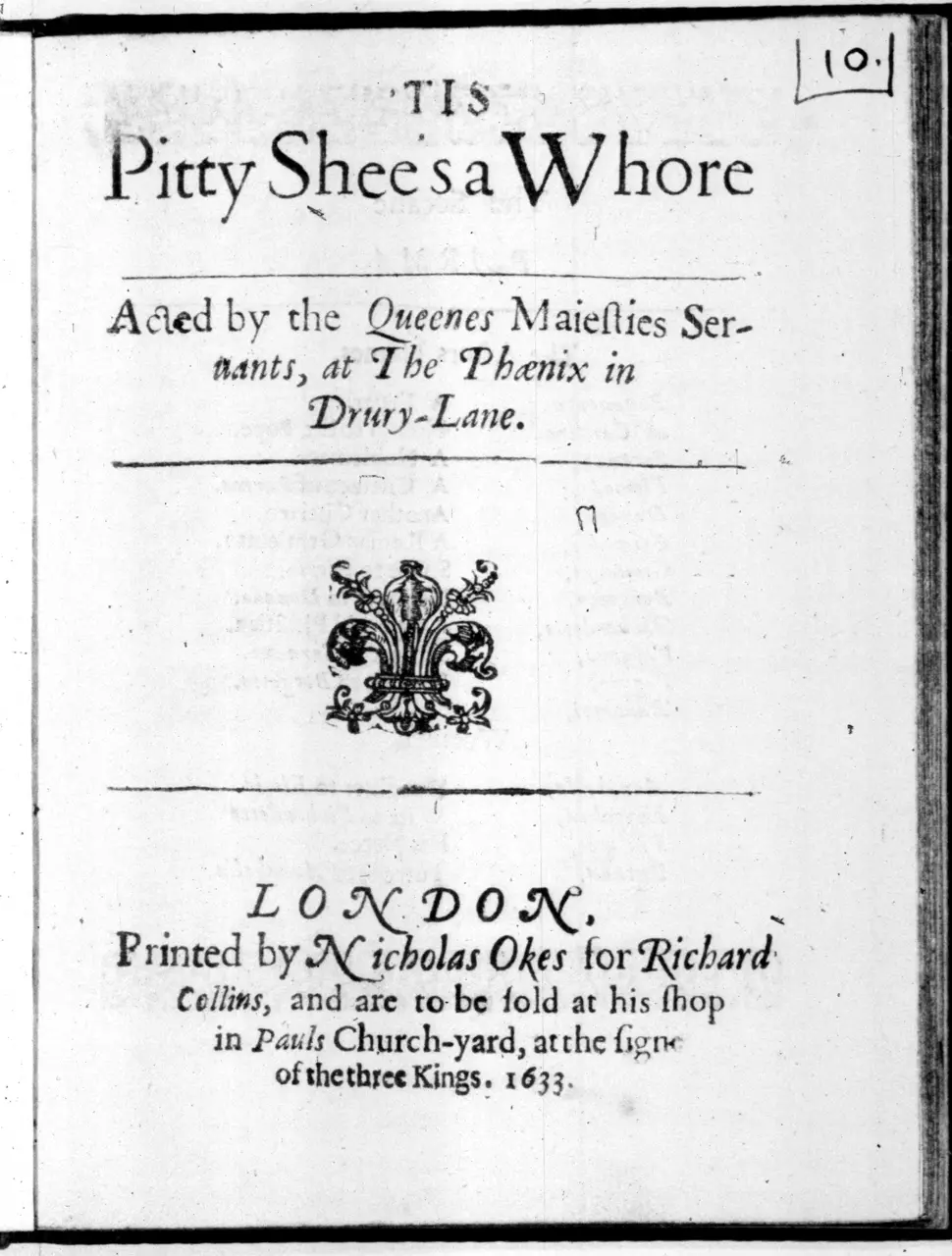
Act 1, Scene 1
Friar BONAVENTURA'S Cell.
Enter FRIAR and GIOVANNI.
Dispute no more in this; for know, young man,
These are no school-points; nice philosophy
May tolerate unlikely arguments,
But Heaven admits no jest: wits that presumed
On wit too much, by striving how to prove
There was no God with foolish grounds of art,
Discovered first the nearest way to hell,
And filled the world with devilish atheism.
Such questions, youth, are fond: far better 'tis
To bless the sun than reason why it shines;
Yet He thou talk'st of is above the sun.
No more! I may not hear it.
Gentle father,
To you I have unclasped my burdened soul,
Emptied the storehouse of my thoughts and heart,
Made myself poor of secrets; have not left
Another word untold, which hath not spoke
All what I ever durst or think or know;
And yet is here the comfort I shall have?
Must I not do what all men else may,—love?
Yes, you may love, fair son.
Must I not praise
That beauty which, if framed anew, the gods
Would make a god of, if they had it there,
And kneel to it, as I do kneel to them?
Why, foolish madman,—
Shall a peevish sound,
A customary form, from man to man,
Of brother and of sister, be a bar
'Twixt my perpetual happiness and me?
Say that we had one father; say one womb—
Curse to my joys!—gave both us life and birth;
Are we not therefore each to other bound
So much the more by nature? by the links
Of blood, of reason? nay, if you will have't,
Even of religion, to be ever one,
One soul, one flesh, one love, one heart, one all?
Have done, unhappy youth! for thou art lost.
Shall, then, for that I am her brother born,
My joys be ever banished from her bed?
No, father; in your eyes I see the change
Of pity and compassion; from your age,
As from a sacred oracle, distils
The life of counsel: tell me, holy man,
What cure shall give me ease in these extremes?
Repentance, son, and sorrow for this sin:
For thou hast moved a Majesty above
With thy unrangèd almost blasphemy.
O, do not speak of that, dear confessor!
Art thou, my son, that miracle of wit
Who once, within these three months, wert esteemed
A wonder of thine age throughout Bononia?
How did the University applaud
Thy government, behaviour, learning, speech,
Sweetness, and all that could make up a man!
I was proud of my tutelage, and chose
Rather to leave my books than part with thee;
I did so:—but the fruits of all my hopes
Are lost in thee, as thou art in thyself.
O, Giovanni! hast thou left the schools
Of knowledge to converse with lust and death?
For death waits on thy lust. Look through the world,
And thou shalt see a thousand faces shine
More glorious than this idol thou ador'st:
Leave her, and take thy choice, 'tis much less sin;
Though in such games as those they lose that win.
It were more ease to stop the ocean
From floats and ebbs than to dissuade my vows.
Then I have done, and in thy wilful flames
Already see thy ruin; Heaven is just.
Yet hear my counsel.
As a voice of life.
Hie to thy father's house; there lock thee fast
Alone within thy chamber; then fall down
On both thy knees, and grovel on the ground;
Cry to thy heart; wash every word thou utter'st
In tears—and if't be possible—of blood:
Beg Heaven to cleanse the leprosy of lust
That rots thy soul; acknowledge what thou art,
A wretch, a worm, a nothing; weep, sigh, pray
Three times a-day and three times every night:
For seven days' space do this; then, if thou find'st
No change in thy desires, return to me:
I'll think on remedy. Pray for thyself
At home, whilst I pray for thee here.—Away!
My blessing with thee! we have need to pray.
All this I'll do, to free me from the rod
Of vengeance; else I'll swear my fate's my god.
Exeunt.
Act 1, Scene 2
The Street before FLORIO'S House.
Enter GRIMALDI and VASQUES, with their swords drawn.
Come, sir, stand to your tackling; if you prove craven, I'll make you run quickly.
Thou art no equal match for me.
Indeed, I never went to the wars to bring home news; nor cannot play the mountebank for a meal's meat, and swear I got my wounds in the field. See you these gray hairs? they'll not flinch for a bloody nose. Wilt thou to this gear?
Why, slave, thinkest thou I'll balance my reputation with a cast-suit? Call thy master; he shall know that I dare—
Scold like a cot-quean;—that's your profession. Thou poor shadow of a soldier, I will make thee know my master keeps servants thy betters in quality and performance. Comest thou to fight or prate?
Neither, with thee. I am a Roman and a gen tleman; one that have got mine honour with expense of blood.
You are a lying coward and a fool. Fight, or by these hilts, I'll kill thee:—brave my lord!—you'll fight?
Provoke me not, for if thou dost—
Have at you!
They fight; GRIMALDI is worsted.
Enter FLORIO, DONADO, and SORANZO, from opposite sides.
What mean these sudden broils so near my doors?
Have you not other places but my house
To vent the spleen of your disordered bloods?
Must I be haunted still with such unrest
As not to eat or sleep in peace at home?
Is this your love, Grimaldi? Fie! 'tis naught.
And, Vasques, I may tell thee, 'tis not well
To broach these quarrels; you are ever forward
In seconding contentions.
Enter ANNABELLA and PUTANA above.
What's the ground?
That, with your patience, signiors, I'll resolve:
This gentleman, whom fame reports a soldier,—
For else I know not,—rivals me in love
To Signior Florio's daughter; to whose ears
He still prefers his suit, to my disgrace;
Thinking the way to recommend himself
Is to disparage me in his report:—
But know, Grimaldi, though, may be, thou art
My equal in thy blood, yet this bewrays
A lowness in thy mind, which, wert thou noble,
Thou wouldst as much disdain as I do thee
For this unworthiness:—and on this ground
I willed my servant to correct his tongue,
Holding a man so base no match for me.
And had not your sudden coming prevented us, I had let my gentleman blood under the gills:—I should have wormed you, sir, for running mad.
I'll be revenged, Soranzo.
On a dish of warm broth to stay your stomach—do, honest innocence, do! spoon-meat is a wholesomer diet than a Spanish blade.
Remember this!
I fear thee not, Grimaldi.
Exit GRIMALDI.
My Lord Soranzo, this is strange to me,
Why you should storm, having my word engaged;
Owing her heart, what need you doubt her ear?
Losers may talk by law of any game.
Yet the villany of words, Signior Florio, may be such as would make any unspleened dove choleric. Blame not my lord in this.
Be you more silent:
I would not for my wealth, my daughter's love
Should cause the spilling of one drop of blood.
Vasques, put up, let's end this fray in wine. [Exeunt.]
How like you this, child? here's threatening, challenging, quarrelling, and fighting on every side; and all is for your sake: you had need look to yourself, charge; you'll be stolen away sleeping else shortly.
But, tutoress, such a life gives no content
To me; my thoughts are fixed on other ends.
Would you would leave me!
Leave you! no marvel else; leave me no leaving, charge; this is love outright. Indeed, I blame you not; you have choice fit for the best lady in Italy.
Pray do not talk so much.
Take the worst with the best, there's Grimaldi the soldier, a very well-timbered fellow. They say he is a Roman, nephew to the Duke Montferrato; they say he did good service in the wars against the Milanese; but, 'faith, charge, I do not like him, an't be for nothing but for being a soldier: not one amongst twenty of your skirmishing captains but have some privy maim or other that mars their standing upright. I like him the worse, he crinkles so much in the hams: though he might serve if there were no more men, yet he's not the man I would choose.
Fie, how thou pratest.
As I am a very woman, I like Signior Soranzo well; he is wise, and what is more, rich; and what is more than that, kind; and what is more than all this, a nobleman: such a one, were I the fair Annabella myself, I would wish and pray for. Then he is bountiful; besides, he is handsome, and, by my troth, I think, wholesome,—and that's news in a gallant of three-and-twenty; liberal, that I know; loving, that you know; and a man sure, else he could never ha' purchased such a good name with Hippolita, the lusty widow, in her husband's lifetime: an 'twere but for that report, sweetheart, would 'a were thine! Commend a man for his qualities, but take a husband as he is a plain, sufficient, naked man: such a one is for your bed, and such a one is Signior Soranzo, my life for't.
Sure the woman took her morning's draught too soon.
Enter BERGETTO and POGGIO.
But look, sweetheart, look what thing comes now! Here's another of your ciphers to fill up the number: O, brave old ape in a silken coat! Observe.
Didst thou think, Poggio, that I would spoil my new clothes, and leave my dinner, to fight?
No, sir, I did not take you for so arrant a baby.
I am wiser than so: for I hope, Poggio, thou never heardst of an elder brother that was a coxcomb; didst, Poggio?
Never, indeed, sir, as long as they had either land or money left them to inherit.
Is it possible, Poggio? O, monstrous! Why, I'll undertake with a handful of silver to buy a headful of wit at any time: but, sirrah, I have another purchase in hand; I shall have the wench, mine uncle says. I will but wash my face and shift socks, and then have at her, i'faith!—Mark my pace, Poggio!
Passes over the stage, and exit.
Sir,—I have seen an ass and a mule trot the Spanish pavin with a better grace, I know not how often. [Aside, and follows him.]
This idiot haunts me too.
Ay, ay, he needs no description. The rich magnifico that is below with your father, charge, Signior Donado his uncle, for that he means to make this, his cousin, a golden calf, thinks that you will be a right Israelite, and fall down to him presently: but I hope I have tutored you better. They say a fool's bauble is a lady's playfellow; yet you, having wealth enough, you need not cast upon the dearth of flesh, at any rate. Hang him, innocent!
GIOVANNI passes over the stage.
But see, Putana, see! what blessèd shape
Of some celestial creature now appears!—
What man is he, that with such sad aspéct
Walks careless of himself?
Where?
Look below.
O, 'tis your brother, sweet.
Ha!
'Tis your brother.
Sure, 'tis not he; this is some woful thing
Wrappèd up in grief, some shadow of a man.
Alas, he beats his breast and wipes his eyes,
Drowned all in tears: methinks I hear him sigh:
Let's down, Putana, and partake the cause.
I know my brother, in the love he bears me,
Will not deny me partage in his sadness.—
My soul is full of heaviness and fear. [Aside.]
Exit above with PUTANA.
Act 1, Scene 3
A Hall in FLORIO'S House.
Enter GIOVANNI.
Lost! I am lost! my fates have doomed my death:
The more I strive, I love; the more I love,
The less I hope: I see my ruin certain.
What judgment or endeavours could apply
To my incurable and restless wounds,
I throughly have examined, but in vain.
O, that it were not in religion sin
To make our love a god, and worship it!
I have even wearied Heaven with prayers, dried up
The spring of my continual tears, even starved
My veins with daily fasts: what wit or art
Could counsel, I have practised; but, alas,
I find all these but dreams, and old men's tales,
To fright unsteady youth; I'm still the same:
Or I must speak, or burst. 'Tis not, I know,
My lust, but 'tis my fate that leads me on.
Keep fear and low faint-hearted shame with slaves!
I'll tell her that I love her, though my heart
Were rated at the price of that attempt.—
O me! she comes.
Enter ANNABELLA and PUTANA.
Brother!
[Aside] If such a thing
As courage dwell in men, ye heavenly powers,
Now double all that virtue in my tongue!
Why, brother,
Will you not speak to me?
Yes: how d'ye, sister?
Howe'er I am, methinks you are not well.
Bless us! Why are you so sad, sir?
Let me entreat you, leave us a while, Putana.—
Sister, I would be private with you.
Withdraw, Putana.
I will.—If this were any other company for her, I should think my absence an office of some credit: but I will leave them together. [Aside, and exit.]
Come, sister, lend your hand: let's walk together!
I hope you need not blush to walk with me;
Here's none but you and I.
How's this?
I'faith,
I mean no harm.
Harm?
No, good faith.
How is't with ye?
[Aside] I trust he be not frantic.—
I am very well, brother.
Trust me, but I am sick; I fear so sick 'Twill cost my life.
Mercy forbid it! 'tis not so, I hope.
I think you love me, sister.
Yes, you know
I do.
I know't, indeed.—You're very fair.
Nay, then I see you have a merry sickness.
That's as it proves. The poets feign, I read,
That Juno for her forehead did exceed
All other goddesses; but I durst swear
Your forehead exceeds hers, as hers did theirs.
'Troth, this is pretty!
Such a pair of stars
As are thine eyes would, like Promethean fire,
If gently glanced, give life to senseless stones.
Fie upon ye!
The lily and the rose, most sweetly strange,
Upon your dimpled cheeks do strive for change:
Such lips would tempt a saint; such hands as those
Would make an anchorite lascivious.
D'ye mock me or flatter me?
If you would see a beauty more exact
Than art can counterfeit or nature frame,
Look in your glass, and there behold your own.
O, you are a trim youth!
Here! [Offers his dagger to her.]
What to do?
And here's my breast; strike home!
Rip up my bosom; there thou shalt behold
A heart in which is writ the truth I speak.
Why stand ye?
Are you earnest?
Yes, most earnest.
You cannot love?
Whom?
Me. My tortured soul
Hath felt affliction in the heat of death.
O, Annabella, I am quite undone!
The love of thee, my sister, and the view
Of thy immortal beauty have untuned
All harmony both of my rest and life.
Why d'ye not strike?
Forbid it, my just fears!
If this be true, 'twere fitter I were dead.
True, Annabella! 'tis no time to jest.
I have too long suppressed the hidden flames
That almost have consumed me: I have spent
Many a silent night in sighs and groans;
Ran over all my thoughts, despised my fate,
Reasoned against the reasons of my love,
Done all that smoothed-cheeked virtue could advise;
But found all bootless: 'tis my destiny
That you must either love, or I must die.
Comes this in sadness from you?
Let some mischief
Befall me soon, if I dissemble aught.
You are my brother Giovanni.
You
My sister Annabella; I know this,
And could afford you instance why to love
So much the more for this; to which intent
Wise nature first in your creation meant
To make you mine; else't had been sin and foul
To share one beauty to a double soul.
Nearness in birth and blood doth but persuade
A nearer nearness in affection.
I have asked counsel of the holy church,
Who tells me I may love you; and 'tis just
That, since I may, I should; and will, yes, will.
Must I now live or die?
Live; thou hast won
The field, and never fought: what thou hast urged
My captive heart had long ago resolved.
I blush to tell thee,—but I'll tell thee now,—
For every sigh that thou hast spent for me
I have sighed ten; for every tear shed twenty:
And not so much for that I loved, as that
I durst not say I loved, nor scarcely think it.
Let not this music be a dream, ye gods,
For pity's sake, I beg ye!
On my knees, [She kneels.]
Brother, even by our mother's dust, I charge you,
Do not betray me to your mirth or hate:
Love me or kill me, brother.
On my knees, [He kneels.]
Sister, even by my mother's dust, I charge you,
Do not betray me to your mirth or hate:
Love me or kill me, sister.
You mean good sooth, then?
In good troth, I do;
And so do you, I hope: say, I'm in earnest.
I'll swear it, I.
And I; and by this kiss,—
[Kisses her.]
Once more, yet once more: now let's rise [They rise],—by this,
I would not change this minute for Elysium.
What must we now do?
What you will.
Come, then;
After so many tears as we have wept,
Let's learn to court in smiles, to kiss, and sleep.
Exeunt.
Act 1, Scene 4
A Street.
Enter FLORIO and DONADO.
Signior Donado, you have said enough,
I understand you; but would have you know
I will not force my daughter 'gainst her will.
You see I have but two, a son and her;
And he is so devoted to his book,
As I must tell you true, I doubt his health:
Should he miscarry, all my hopes rely
Upon my girl. As for worldly fortune,
I am, I thank my stars, blessed with enough.
My care is, how to match her to her liking:
I would not have her marry wealth, but love
And if she like your nephew, let him have her.
Here's all that I can say.
Sir, you say well,
Like a true father; and, for my part, I,
If the young folks can like,—'twixt you and me,—
Will promise to assure my nephew presently
Three thousand florins yearly during life,
And after I am dead my whole estate.
'Tis a fair proffer, sir; meantime your nephew
Shall have free passage to commence his suit:
If he can thrive, he shall have my consent.
So for this time I'll leave you, signior. [Exit.]
Well,
Here's hope yet, if my nephew would have wit;
But he is such another dunce, I fear
He'll never win the wench. When I was young,
I could have done't, i'faith; and so shall he,
If he will learn of me; and, in good time,
He comes himself.
[Enter BERGETTO and POGGIO.]
How now, Bergetto, whither away so fast?
O, uncle, I have heard the strangest news that ever came out of the mint!—Have I not, Poggio?
Yes, indeed, sir.
What news, Bergetto?
Why, look ye, uncle, my barber told me just now that there is a fellow come to town who undertakes to make a mill go without the mortal help of any water or wind, only with sand-bags: and this fellow hath a strange horse, a most excellent beast, I'll assure you, uncle, my barber says; whose head, to the wonder of all Christian people, stands just behind where his tail is,—Is't not true, Poggio?
So the barber swore, forsooth.
And you are running thither?
Ay, forsooth, uncle.
Wilt thou be a fool still? Come, sir, you shall not go: you have more mind of a puppet-play than on the business I told ye. Why, thou great baby, wilt never have wit? wilt make thyself a May-game to all the world?
Answer for yourself, master.
Why, uncle, should I sit at home still, and not go abroad to see fashions like other gallants?
To see hobby-horses! What wise talk, I pray, had you with Annabella, when you were at Signior Florio's house?
O, the wench,—Ud's sa'me, uncle, I tickled her with a rare speech, that I made her almost burst her belly with laughing.
Nay, I think so; and what speech was't?
What did I say, Poggio?
Forsooth, my master said, that he loved her almost as well as he loved parmasent; and swore—I'll be sworn for him—that she wanted but such a nose as his was, to be as pretty a young woman as any was in Parma.
O, gross!
Nay, uncle:—then she asked me whether my father had any more children than myself; and I said "No; 'twere better he should have had his brains knocked out first."
This is intolerable.
Then said she, "Will Signior Donado, your uncle, leave you all his wealth?"
Ha! that was good; did she harp upon that string?
Did she harp upon that string! ay, that she did. I answered, "Leave me all his wealth! why, woman, he hath no other wit; if he had, he should hear on't to his everlasting glory and confusion: I know," quoth I, "I am his white-boy, and will not be gulled:" and with that she fell into a great smile, and went away. Nay, I did fit her.
Ah, sirrah, then I see there is no changing of nature. Well, Bergetto, I fear thou wilt be a very ass still.
I should be sorry for that, uncle.
Come, come you home with me: since you are no better a speaker, I'll have you write to her after some courtly manner, and enclose some rich jewel in the letter.
Ay, marry, that will be excellent.
Peace, innocent!
Once in my time I'll set my wits to school:
If all fail, 'tis but the fortune of a fool.
Poggio, 'twill do, Poggio. [Exeunt.]
Act 2, Scene 1
An Apartment in FLORIO'S House.
Enter GIOVANNI and ANNABELLA.
Come, Annabella,—no more sister now,
But love, a name more gracious,—do not blush,
Beauty's sweet wonder, but be proud to know
That yielding thou hast conquered, and inflamed
A heart whose tribute is thy brother's life.
And mine is his. O, how these stol'n contents
Would print a modest crimson on my cheeks,
Had any but my heart's delight prevailed!
I marvel why the chaster of your sex
Should think this pretty toy called maidenhead
So strange a loss, when, being lost, 'tis nothing,
And you are still the same.
'Tis well for you;
Now you can talk.
Music as well consists
In the ear as in the playing.
O, you're wanton!
Tell on't, you're best; do.
Thou wilt chide me, then.
Kiss me:—so! Thus hung Jove on Leda's neck,
And sucked divine ambrosia from her lips.
I envy not the mightiest man alive;
But hold myself in being king of thee,
More great than were I king of all the world.
But I shall lose you, sweetheart.
But you shall not.
You must be married, mistress.
Yes! to whom?
Some one must have you.
You must.
Nay, some other.
Now, prithee do not speak so: without jesting
You'll make me weep in earnest.
What, you will not!
But tell me, sweet, canst thou be dared to swear
That thou wilt live to me, and to no other?
By both our loves I dare; for didst thou know,
My Giovanni, how all suitors seem
To my eyes hateful, thou wouldst trust me then.
Enough, I take thy word: sweet, we must part:
Remember what thou vow'st; keep well my heart.
Will you be gone?
I must.
When to return?
Soon.
Look you do.
Farewell.
Go where thou wilt, in mind I'll keep thee here.
And where thou art, I know I shall be there
[Exit GIOVANNI.]
Guardian!
Enter PUTANA.
Child, how is't, child? well, thank Heaven, ha!
O guardian, what a paradise of joy
Have I passed over!
Nay, what a paradise of joy have you passed under! Why, now I commend thee, charge. Fear nothing, sweetheart: what though he be your brother? your brother's a man, I hope; and I say still, if a young wench feel the fit upon her, let her take any body, father or brother, all is one.
I would not have it known for all the world.
Nor I, indeed; for the speech of the people: else 'twere nothing.
[Within] Daughter Annabella!
O me, my father!—Here, sir!—Reach my work.
[Within] What are you doing?
So: let him come now.
Enter FLORIO, followed by RICHARDETTO as a Doctor of Physic, and PHILOTIS with a lute.
So hard at work! that's well; you lose no time.
Look, I have brought you company; here's one,
A learnèd doctor lately come from Padua,
Much skilled in physic; and, for that I see
You have of late been sickly, I entreated
This reverend man to visit you some time.
You're very welcome, sir.
I thank you, mistress.
Loud fame in large report hath spoke your praise
As well for virtue as perfection:
For which I have been bold to bring with me
A kinswoman of mine, a maid, for song
And music one perhaps will give content:
Please you to know her.
They are parts I love.
And she for them most welcome.
Thank you, lady.
Sir, now you know my house, pray make not strange;
And if you find my daughter need your art,
I'll be your pay-master.
Sir, what I am
She shall command.
Sir, you shall bind me to you.—
Daughter, I must have conference with you
About some matters that concern us both.—
Good Master Doctor, please you but walk in,
We'll crave a little of your cousin's cunning:
I think my girl hath not quite forgot
To touch an instrument; she could have done't:
We'll hear them both.
I'll wait upon you, sir. [Exeunt.]
Act 2, Scene 2
A Room in SORANZO'S House.
Enter SORANZO with a book.
[Reads] "Love's measure is extreme, the comfort pain,
The life unrest, and the reward disdain."
What's here? look't o'er again.—'Tis so; so writes
This smooth, licentious poet in his rhymes:
But, Sannazar, thou liest; for, had thy bozom
Felt such oppression as is laid on mine,
Thou wouldst have kissed the rod that made thee smart.—
To work, then, happy Muse, and contradict
What Sannazar hath in his envy writ. [Writes.]
"Love's measure is the mean, sweet his annoys,
His pleasures life, and his reward all joys."
Had Annabella lived when Sannazar
Did, in his brief Encomium, celebrate
Venice, that queen of cities, he had left
That verse which gained him such a sum of gold,
And for one only look from Annabel
Had writ of her and her diviner cheeks.
O, how my thoughts are—
[Within] Pray, forbear; in rules of civility, let me give notice on't: I shall be taxed of my neglect of duty and service.
What rude intrusion interrupts my peace?
Can I be no where private?
[Within] Troth, you wrong your modesty.
What's the matter, Vasques? who is't?
Enter HIPPOLITA and VASQUES.
'Tis I;
Do you know me now? Look, perjured man, on her
Whom thou and thy distracted lust have wronged.
Thy sensual rage of blood hath made my youth
A scorn to men and angels; and shall I
Be now a foil to thy unsated change?
Thou know'st, false wanton, when my modest fame
Stood free from stain or scandal, all the charms
Of hell or sorcery could not prevail
Against the honour of my chaster bosom.
Thine eyes did plead in tears, thy tongue in oaths,
Such and so many, that a heart of steel
Would have been wrought to pity, as was mine:
And shall the conquest of my lawful bed,
My husband's death, urged on by his disgrace,
My loss of womanhood, be ill-rewarded
With hatred and contempt? No: know, Soranzo,
I have a spirit doth as much distaste
The slavery of fearing thee, as thou
Dost loathe the memory of what hath passed.
Nay, dear Hippolita,—
Call me not dear,
Nor think with supple words to smooth the grossness
Of my abuses: 'tis not your new mistress,
Your goodly madam-merchant, shall triumph
On my dejection; tell her thus from me,
My birth was nobler and by much more free.
You are too violent.
You are too double
In your dissimulation. Seest thou this,
This habit, these black mourning weeds of care?
'Tis thou art cause of this; and hast divorced
My husband from his life, and me from him,
And made me widow in my widowhood.
Will you yet hear?
More of thy perjuries?
Thy soul is drowned too deeply in those sins;
Thou need'st not add to the number.
Then I'll leave you;
You're past all rules of sense.
And thou of grace.
Fie, mistress, you are not near the limits of reason: if my lord had a resolution as noble as virtue itself, you take the course to unedge it all.—Sir, I beseech you do not perplex her; griefs, alas, will have a vent: I dare undertake Madam Hippolita will now freely hear you.
Talk to a woman frantic!—Are these the fruits of your love?
They are the fruits of thy untruth, false man!
Didst thou not swear, whilst yet my husband lived,
That thou wouldst wish no happiness on earth
More than to call me wife? didst thou not vow,
When he should die, to marry me? for which
The devil in my blood, and thy protests,
Caused me to counsel him to undertake
A voyage to Ligorne, for that we heard
His brother there was dead, and left a daughter
Young and unfriended, who, with much ado,
I wished him to bring hither: he did so,
And went; and, as thou know'st, died on the way.
Unhappy man, to buy his death so dear,
With my advice! yet thou, for whom I did it,
Forgett'st thy vows, and leav'st me to my shame.
Who could help this?
Who! perjured man, thou couldst,
If thou hadst faith or love.
You are deceived:
The vows I made, if you remember well,
Were wicked and unlawful; 'twere more sin
To keep them than to break them: as for me,
I cannot mask my penitence. Think thou
How much thou hast digressed from honest shame
In bringing of a gentleman to death
Who was thy husband; such a one as he,
So noble in his quality, condition,
Learning, behaviour, entertainment, love,
As Parma could not show a braver man.
You do not well; this was not your promise.
I care not; let her know her monstrous life.
Ere I'll be servile to so black a sin,
I'll be a curse.—Woman, come here no more;
Learn to repent, and die; for, by my honour,
I hate thee and thy lust: you've been too foul. [Exit.]
[Aside] This part has been scurvily played.
How foolishly this beast contemns his fate,
And shuns the use of that which I more scorn
Than I once loved, his love! But let him go;
My vengeance shall give comfort to his woe. [Going.]
Mistress, mistress, Madam Hippolita! pray, a word or two.
With me, sir?
With you, if you please.
What is't?
I know you are infinitely moved now, and you think you have cause: some I confess you have, but sure not so much as you imagine.
Indeed!
O, you were miserably bitter, which you followed even to the last syllable; 'faith, you were somewhat too shrewd: by my life, you could not have took my lord in a worse time since I first knew him; to-morrow you shall find him a new man.
Well, I shall wait his leisure.
Fie, this is not a hearty patience; it comes sourly from you: 'troth, let me persuade you for once.
[Aside] I have it, and it shall be so; thanks, opportunity!—Persuade me! to what?
Visit him in some milder temper. O, if you could but master a little your female spleen, how might you win him!
He will never love me. Vasques, thou hast been a too trusty servant to such a master, and I believe thy reward in the end will fall out like mine.
So perhaps too.
Resolve thyself it will. Had I one so true, so truly honest, so secret to my counsels, as thou hast been to him and his, I should think it a slight acquittance, not only to make him master of all I have, but even of myself.
O, you are a noble gentlewoman!
Wilt thou feed always upon hopes? well, I know thou art wise, and seest the reward of an old servant daily, what it is.
Beggary and neglect.
True; but, Vasques, wert thou mine, and wouldst be private to me and my designs, I here protest, myself and all what I can else call mine should be at thy dispose.
[Aside] Work you that way, old mole? then I have the wind of you.—I were not worthy of it by any desert that could lie within my compass: if I could—
What then?
I should then hope to live in these my old years with rest and security.
Give me thy hand: now promise but thy silence,
And help to bring to pass a plot I have,
And here, in sight of heaven, that being done,
I make the lord of me and mine estate.
Come, you are merry; this is such a happiness that I can neither think or believe.
Promise thy secrecy, and 'tis confirmed.
Then here I call our good genii for witnesses, whatsoever your designs are, or against whomsoever, I will not only be a special actor therein, but never disclose it till it be effected.
I take thy word, and, with that, thee for mine;
Come, then, let's more confer of this anon.—
On this delicious bane my thoughts shall banquet;
Revenge shall sweeten what my griefs have tasted.
Aside, and exit with VASQUES.
Act 2, Scene 3
The Street.
Enter RICHARDETTO and PHILOTIS.
Thou seest, my lovely niece, these strange mishaps,
How all my fortunes turn to my disgrace;
Wherein I am but as a looker-on,
Whiles others act my shame, and I am silent.
But, uncle, wherein can this borrowed shape
Give you content?
I'll tell thee, gentle niece:
Thy wanton aunt in her lascivious riots
Lives now secure, thinks I am surely dead
In my late journey to Ligorne for you,—
As I have caused it to be rumoured out.—
Now would I see with what an impudence
She gives scope to her loose adultery,
And how the common voice allows hereof:
Thus far I have prevailed.
Alas, I fear
You mean some strange revenge.
O, be not troubled;
Your ignorance shall plead for you in all:
But to our business.—What! you learned for certain
How Signor Florio means to give his daughter
In marriage to Soranzo?
Yes, for certain.
But how find you young Annabella's love
Inclined to him?
For aught I could perceive,
She neither fancies him or any else.
There's mystery in that, which time must show.
She used you kindly?
Yes.
And craved your company?
Often.
'Tis well; it goes as I could wish.
I am the doctor now; and as for you,
None knows you: if all fail not, we shall thrive.—
But who comes here? I know him; 'tis Grimaldi,
A Roman and a soldier, near allied
Unto the Duke of Montferrato, one
Attending on the nuncio of the pope
That now resides in Parma; by which means
He hopes to get the love of Annabella.
Enter GRIMALDI.
Save you, sir.
And you, sir.
I have heard
Of your approvèd skill, which through the city
Is freely talked of, and would crave your aid.
For what, sir?
Marry, sir, for this—
But I would speak in private.
Leave us, cousin. [Exit PHILOTIS.]
I love fair Annabella, and would know
Whether in art there may not be receipts
To move affection.
Sir, perhaps there may;
But these will nothing profit you.
Not me?
Unless I be mistook, you are a man
Greatly in favour with the cardinal.
What of that?
In duty to his grace,
I will be bold to tell you, if you seek
To marry Florio's daughter, you must first
Remove a bar 'twixt you and her.
Who's that?
Soranzo is the man that hath her heart;
And while he lives, be sure you cannot speed.
Soranzo! what, mine enemy? is't he?
Is he your enemy?
The man I hate
Worse than confusion; I will to him straight.
Nay, then, take mine advice,
Even for his grace's sake the cardinal:
I'll find a time when he and she do meet,
Of which I'll give you notice; and, to be sure
He shall not 'scape you, I'll provide a poison
To dip your rapier's point in: if he had
As many heads as Hydra had, he dies.
But shall I trust thee, doctor?
As yourself;
Doubt not in aught. [Exit GRIMALDI.]—Thus shall the fates decree
By me Soranzo falls, that ruined me. [Exit.]
Act 2, Scene 4
Another part of the Street.
Enter DONADO with a letter, BERGETTO, and POGGIO.
Well, sir, I must be content to be both your secretary and your messenger myself. I cannot tell what this letter may work; but, as sure as I am alive, if thou come once to talk with her, I fear thou wilt mar whatsoever I make.
You make, uncle! why, am not I big enough to carry mine own letter, I pray?
Ay, ay, carry a fool's head o' thy own! why, thou dunce, wouldst thou write a letter, and carry it thyself?
Yes, that I would, and read it to her with my own mouth; for you must think, if she will not believe me myself when she hears me speak, she will not believe another's handwriting. O, you think I am a blockhead, uncle. No, sir, Poggio knows I have indited a letter myself; so I have.
Yes, truly, sir; I have it in my pocket.
A sweet one, no doubt; pray let's see't.
I cannot read my own hand very well, Poggio; read it, Poggio.
Begin.
[Reads] "Most dainty and honey-sweet mistress; I could call you fair, and lie as fast as any that loves you; but my uncle being the elder man, I leave it to him, as more fit for his age and the colour of his beard. I am wise enough to tell you I can bourd where I see occasion; or if you like my uncle's wit better than mine you shall marry me; if you like mine better than his, I will marry you, in spite of your teeth. So, commending my best parts to you, I rest
Yours upwards and downwards, or you may choose,
Bergetto."
Ah, ha! here's stuff, uncle!
Here's stuff indeed—to shame us all. Pray, whose advice did you take in this learned letter?
None, upon my word, but mine own,
And mine, uncle, believe it, nobody's else; 'twas mine own brain, I thank a good wit for't.
Get you home, sir, and look you keep within doors till I return.
How! that were a jest indeed! I scorn it, i'faith.
What! you do not?
Judge me, but I do now.
Indeed, sir, 'tis very unhealthy.
Well, sir, if I hear any of your apish running to motions and fopperies, till I come back, you were as good no; look to't. [Exit.]
Poggio, shall's steal to see this horse with the head in's tail?
Ay, but you must take heed of whipping.
Dost take me for a child, Poggio? Come, honest Poggio. [Exeunt.]
Act 2, Scene 5
Friar BONAVENTURA'S Cell.
Enter Friar and GIOVANNI.
Peace! thou hast told a tale whose every word
Threatens eternal slaughter to the soul;
I'm sorry I have heard it: would mine ears
Had been one minute deaf, before the hour
That thou cam'st to me! O young man, castaway,
By the religious number of mine order,
I day and night have waked my agèd eyes
Above my strength, to weep on thy behalf;
But Heaven is angry, and be thou resolved
Thou art a man remarked to taste a mischief.
Look for't; though it come late, it will come sure,
Father, in this you are uncharitable;
What I have done I'll prove both fit and good.
It is a principle which you have taught,
When I was yet your scholar, that the frame
And composition of the mind doth follow
The frame and composition of the body:
So, where the body's furniture is beauty,
The mind's must needs be virtue; which allowed,
Virtue itself is reason but refined,
And love the quintessence of that: this proves,
My sister's beauty being rarely fair
Is rarely virtuous; chiefly in her love,
And chiefly in that love, her love to me:
If hers to me, then so is mine to her;
Since in like causes are effects alike.
O ignorance in knowledge! Long ago,
How often have I warned thee this before!
Indeed, if we were sure there were no Deity,
Nor Heaven nor Hell, then to be led alone
By Nature's light—as were philosophers
Of elder times—might instance some defence.
But 'tis not so: then, madman, thou wilt find
That Nature is in Heaven's positions blind.
Your age o'errules you; had you youth like mine,
You'd make her love your heaven, and her divine.
Nay, then I see thou'rt too far sold to hell:
It lies not in the compass of my prayers
To call thee back, yet let me counsel thee;
Persuade thy sister to some marriage.
Marriage! why, that's to damn her; that's to prove
Her greedy variety of lust.
O, fearful! if thou wilt not, give me leave
To shrive her, lest she should die unabsolved.
At your best leisure, father: then she'll tell you
How dearly she doth prize my matchless love;
Then you will know what pity 'twere we two
Should have been sundered from each other's arms.
View well her face, and in that little round
You may observe a world of variety;
For colour, lips; for sweet perfumes, her breath;
For jewels, eyes; for threads of purest gold,
Hair; for delicious choice of flowers, cheeks;
Wonder in every portion of that form.
Hear her but speak, and you will swear the spheres
Make music to the citizens in Heaven.
But, father, what is else for pleasure framed
Lest I offend your ears, shall go unnamed.
The more I hear, I pity thee the more,
That one so excellent should give those parts
All to a second death. What I can do
Is but to pray; and yet—I could advise thee,
Wouldst thou be ruled.
In what?
Why leave her yet;
The throne of mercy is above your trespass;
Yet time is left you both—
To embrace each other,
Else let all time be struck quite out of number:
She is like me, and I like her, resolved.
No more! I'll visit her.—This grieves me most,
Things being thus, a pair of souls are lost. [Exeunt.]
Act 2, Scene 6
A Room in FLORIO'S House.
Enter FLORIO, DONADO, ANNABELLA, and PUTANA.
Where's Giovanni?
Newly walked abroad,
And, as I heard him say, gone to the friar,
His reverend tutor.
That's a blessèd man,
A man made up of holiness: I hope
He'll teach him how to gain another world.
Fair gentlewoman, here's a letter sent
To you from my young cousin; I dare swear
He loves you in his soul: would you could hear
Sometimes what I see daily, sighs and tears,
As if his breast were prison to his heart!
Receive it, Annabella.
Alas, good man! [Takes the letter.]
What's that she said?
An't please you, sir, she said, "Alas, good man!" Truly I do commend him to her every night before her first sleep, because I would have her dream of him; and she hearkens to that most religiously.
Sayest so? God-a'-mercy, Putana! there's something for thee [Gives her money]: and prithee do what thou canst on his behalf; 'shall not be lost labour, take my word for't.
Thank you most heartily, sir: now I have a feeling of your mind, let me alone to work.
Guardian,—
Did you call?
Keep this letter.
Signior Florio, in any case bid her read it instantly.
Keep it! for what? pray, read it me hereright.
I shall, sir. [She reads the letter.]
How d'ye find her inclined, signior?
Troth, sir, I know not how; not all so well
As I could wish.
Sir, I am bound to rest your cousin's debtor.
The jewel I'll return; for if he love,
I'll count that love a jewel.
Mark you that?
Nay, keep them both, sweet maid.
You must excuse me,
Indeed I will not keep it.
Where's the ring,
That which your mother, in her will, bequeathed,
And charged you on her blessing not to give 't
To any but your husband? send back that.
I have it not.
Ha! have it not! where is't?
My brother in the morning took it from me,
Said he would wear't to day.
Well, what do you say
To young Bergetto's love? are you content to
Match with him? speak.
There is the point, indeed.
[Aside] What shall I do? I must say something now.
What say? why d'ye not speak?
Sir, with your leave—
Please you to give me freedom?
Yes, you have it.
Signior Donado, if your nephew mean
To raise his better fortunes in his match,
The hope of me will hinder such a hope:
Sir, if you love him, as I know you do,
Find one more worthy of his choice than me:
In short, I'm sure I shall not be his wife.
Why, here's plain dealing; I commend thee for't;
And all the worst I wish thee is, Heaven bless thee!
Your father yet and I will still be friends:—
Shall we not, Signior Florio?
Yes; why not?
Look, here your cousin comes.
Enter BERGETTO and POGGIO.
[Aside] O, coxcomb! what doth he make here?
Where's my uncle, sirs?
What's the news now?
Save you, uncle, save you!—You must not think I come for nothing, masters.—And how, and how is't? what, you have read my letter? ah, there I—tickled you, i'faith.
[Aside to BERGETTO] But 'twere better you had tickled her in another place.
Sirrah sweetheart, I'll tell thee a good jest; and riddle what 'tis.
You say you'll tell me.
As I was walking just now in the street, I met a swaggering fellow would needs take the wall of me; and because he did thrust me, I very valiantly called him rogue. He hereupon bade me draw; I told him I had more wit than so; but when he saw that I would not, he did so maul me with the hilts of his rapier, that my head sung whilst my feet capered in the kennel.
[Aside] Was ever the like ass seen!
And what did you all this while?
Laugh at him for a gull, till I saw the blood run about mine ears, and then I could not choose but find in my heart to cry; till a fellow with a broad beard—they say he is a new-come doctor—called me into his house, and gave me a plaster, look you, here 'tis:—and, sir, there was a young wench washed my face and hands most excellently; i' faith, I shall love her as long as I live for't.—Did she not, Poggio?
Yes, and kissed him too.
Why, la, now, you think I tell a lie, uncle, I warrant.
Would he that beat thy blood out of thy head had beaten some wit into it! for I fear thou never wilt have any.
O, uncle, but there was a wench would have done a man's heart good to have looked on her.—By this light, she had a face methinks worth twenty of you, Mistress Annabella.
[Aside] Was ever such a fool born!
I am glad she liked you sir.
Are you so? by my troth, I thank you, forsooth.
Sure, 'twas the doctor's niece, that was last day with us here.
'Twas she, 'twas she.
How do you know that, simplicity?
Why, does not he say so? if I should have said no, I should have given him the lie, uncle, and so have deserved a dry beating again: I'll none of that.
A very modest well-behaved young maid
As I have seen.
Is she indeed?
Indeed she is, if I have any judgment.
Well, sir, now you are free: you need not care for sending letters now; you are dismissed, your mistress here will none of you.
No! why, what care I for that? I can have wenches enough in Parma for half-a-crown a-piece:—cannot I, Poggio?
I'll warrant you, sir.
Signior Florio,
I thank you for your free recourse you gave
For my admittance: and to you, fair maid,
That jewel I will give you 'gainst your marriage.—
Come, will you go, sir?
Ay, marry, will I.—Mistress, farewell, mistress;
I'll come again to-morrow; farewell, mistress.
Exeunt DONADO, BERGETTO, and POGGIO.
Enter GIOVANNI.
Son, where have you been? what, alone, alone still?
I would not have it so; you must forsake
This over-bookish humour. Well, your sister
Hath shook the fool off.
'Twas no match for her.
'Twas not indeed; I meant it nothing less;
Soranzo is the man I only like:—
Look on him, Annabella.—Come, 'tis supper-time,
And it grows late. [Exit.]
Whose jewel's that?
Some sweetheart's.
So I think.
A lusty youth,
Signior Donado, gave it me to wear
Against my marriage.
But you shall not wear it:
Send it him back again.
What, you are jealous?
That you shall know anon, at better leisure.
Welcome sweet night! the evening crowns the day.
Exeunt.
Act 3, Scene 1
A Room in DONADO'S House.
Enter BERGETTO and POGGIO.
Does my uncle think to make me a baby still? No, Poggio; he shall know I have a sconce now.
Ay, let him not bob you off like an ape with an apple.
'Sfoot, I will have the wench, if he were ten uncles, in despite of his nose, Poggio.
Hold him to the grindstone, and give not a jot of ground: she hath in a manner promised you already.
True, Poggio; and her uncle, the doctor, swore I should marry her.
He swore; I remember.
And I will have her, that's more: didst see the codpiece-point she gave me and the box of marmalade?
Very well; and kissed you, that my chops watered at the sight on't. There's no way but to clap-up a marriage in hugger-mugger.
I will do't; for I tell thee, Poggio, I begin to grow valiant methinks, and my courage begins to rise.
Should you be afraid of your uncle?
Hang him, old doting rascal! no: I say I will have her.
Lose no time; then.
I will beget a race of wise men and constables that shall cart whores at their own charges; and break the duke's peace ere I have done myself. Come away.
Exeunt.
Act 3, Scene 2
A Room in FLORIO'S House.
Enter FLORIO, GIOVANNI, SORANZO, ANNABELLA, PUTANA, and VASQUES.
My Lord Soranzo, though I must confess
The proffers that are made me have been great
In marriage of my daughter, yet the hope
Of your still rising honours have prevailed
Above all other jointures: here she is;
She knows my mind; speak for yourself to her,—
And hear, you, daughter, see you use him nobly:
For any private speech I'll give you time.—
Come, son, and you the rest; let them alone;
Agree they as they may.
I thank you, sir.
[Aside to ANNABELLA] Sister, be not all woman; think on me.
Vasques,—
My lord?
Attend me without.
Exeunt all but SORANZO and ANNABELLA.
Sir, what's your will with me?
Do you not know
What I should tell you?
Yes; you'll say you love me.
And I will swear it too; will you believe it?
'Tis no point of faith.
Enter GIOVANNI in the Gallery above.
Have you not will to love?
Not you.
Whom then?
That's as the fates infer.
[Aside] Of those I'm regent now.
What mean you, sweet?
To live and die a maid.
O, that's unfit.
[Aside] Here's one can say that's but a woman's note.
Did you but see my heart, then would you swear—
That you were dead.
[Aside] That's true, or somewhat near it.
See you these true love's tears?
No.
[Aside] Now she winks.
They plead to you for grace.
Yet nothing speak.
O, grant my suit!
What is it?
To let me live—
Take it.
Still yours.
That is not mine to give.
[Aside] One such another word would kill his hopes.
Mistress, to leave those fruitless strifes of wit,
Know I have loved you long and loved you truly:
Not hope of what you have, but what you are,
Hath drawn me on; then let me not in vain
Still feel the rigour of your chaste disdain;
I'm sick, and sick to the heart.
Help, aqua-vitæ!
What mean you?
Why, I thought you had been sick.
Do you mock my love?
[Aside] There, sir, she was too nimble.
[Aside] 'Tis plain she laughs at me.—These scornful taunts
Neither become your modesty or years.
You are no looking-glass: or if you were,
I'd dress my language by you.
[Aside] I'm confirmed.
To put you out of doubt, my lord, methinks
Your common sense should make you understand
That if I loved you, or desired your love,
Some way I should have given you better taste:
But since you are a nobleman, and one
I would not wish should spend his youth in hopes,
Let me advise you to forbear your suit,
And think I wish you well, I tell you this.
Is't you speak this?
Yes, I myself; yet know,—
Thus far I give you comfort,—if mine eyes
Could have picked out a man amongst all those
That sued to me to make a husband of,
You should have been that man: let this suffice;
Be noble in your secrecy and wise.
[Aside] Why, now I see she loves me.
One word more.
As ever virtue lived within your mind,
As ever noble courses were your guide,
As ever you would have me know you loved me,
Let not my father know hereof by you:
If I hereafter find that I must marry,
It shall be you or none.
I take that promise.
O, O my head!
What's the matter? not well?
O, I begin to sicken!
Heaven forbid!
Aside, and exit from above.
Help, help, within there, ho!
[Re-enter FLORIO, GIOVANNI, and PUTANA.]
Look to your daughter, Signior Florio.
Hold her up, she swoons.
Sister, how d'ye?
Sick,—brother, are you there?
Convey her to her bed instantly, whilst I send for a physician: quickly, I say.
Alas, poor child! [Exeunt all but SORANZO.]
Re-enter VASQUES.
My lord,—
O, Vasques, now I doubly am undone
Both in my present and my future hopes!
She plainly told me that she could not love,
And thereupon soon sickened; and I fear
Her life's in danger.
[Aside] By'r lady, sir, and so is yours, if you knew all.—'Las, sir, I am sorry for that: may be 'tis but the maid's-sickness, an over-flux of youth; and then, sir, there is no such present remedy as present marriage. But hath she given you an absolute denial?
She hath, and she hath not; I'm full of grief:
But what she said I'll tell thee as we go. [Exeunt.]
Act 3, Scene 3
Another Room in the same.
Enter GIOVANNI and PUTANA.
O, sir, we are all undone, quite undone, utterly undone, and shamed for ever! your sister, O, your sister!
What of her? for Heaven's sake, speak; how does she?
O, that ever I was born to see this day!
She is not dead, ha? is she?
Dead! no, she is quick; 'tis worse, she is with child. You know what you have done; Heaven forgive ye! 'tis too late to repent now, Heaven help us!
With child? how dost thou know't?
How do I know't! am I at these years ignorant what the meanings of qualms and water-pangs be? of changing of colours, queasiness of stomachs, pukings, and another thing that I could name? Do not, for her and your credit's sake, spend the time in asking how, and which way, 'tis so: she is quick, upon my word: if you let a physician see her water, you're undone.
But in what case is she?
Prettily amended: 'twas but a fit, which I soon espied, and she must look for often henceforward.
Commend me to her, bid her take no care;
Let not the doctor visit her, I charge you;
Make some excuse, till I return.—O, me!
I have a world of business in my head.—
Do not discomfort her.—
How do these news perplex me!—If my father
Come to her, tell him she's recovered well;
Say 'twas but some ill diet—d'ye hear, woman?
Look you to't.
I will, sir. [Exeunt.]
Act 3, Scene 4
Another Room in the same.
Enter FLORIO and RICHARDETTO.
And how d'ye find her, sir?
Indifferent well;
I see no danger, scarce perceive she's sick,
But that she told me she had lately eaten
Melons, and, as she thought, those disagreed
With her young stomach.
Did you give her aught?
An easy surfeit-water, nothing else.
You need not doubt her health: I rather think
Her sickness is a fulness of the blood,—
You understand me?
I do; you counsel well;
And once, within these few days, will so order 't
She shall be married ere she know the time.
Yet let not haste, sir, make unworthy choice;
That were dishonour.
Master Doctor, no;
I will not do so neither: in plain words,
My Lord Soranzo is the man I mean.
A noble and a virtuous gentleman.
As any is in Parma. Not far hence
Dwells Father Bonaventure, a grave friar,
Once tutor to my son: now at his cell
I'll have 'em married.
You have plotted wisely.
I'll send one straight to speak with him to-night.
Soranzo's wise; he will delay no time.
It shall be so.
Enter Friar and GIOVANNI.
Good peace be here and love!
Welcome, religious friar; you are one
That still bring blessing to the place you come to.
Sir, with what speed I could, I did my best
To draw this holy man from forth his cell
To visit my sick sister; that with words
Of ghostly comfort, in this time of need,
He might absolve her, whether she live or die.
'Twas well done, Giovanni; thou herein
Hast showed a Christian's care, a brother's love.
Come, father, I'll conduct you to her chamber,
And one thing would entreat you.
Say on, sir.
I have a father's dear impression
And wish, before I fall into my grave,
That I might see her married, as 'tis fit:
A word from you, grave man, will win her more
Than all our best persuasions.
Gentle sir,
All this I'll say, that Heaven may prosper her. [Exeunt.]
Act 3, Scene 5
A Room in RICHARDETTO'S House.
Enter GRIMALDI.
Now if the doctor keep his word, Soranzo,
Twenty to one you miss your bride. I know
'Tis an unnoble act, and not becomes
A soldier's valour; but in terms of love,
Where merit cannot sway, policy must:
I am resolved, if this physician—
Play not on both hands, then Soranzo falls.
Enter RICHARDETTO.
You're come as I could wish; this very night
Soranzo, 'tis ordained, must be affied
To Annabella, and, for aught I know,
Married.
How!
Yet your patience:—
The place, 'tis Friar Bonaventure's cell.
Now I would wish you to bestow this night
In watching thereabouts; 'tis but a night:
If you miss now, to-morrow I'll know all.
Have you the poison?
Here 'tis, in this box:
Doubt nothing, this will do't; in any case,
As you respect your life, be quick and sure.
I'll speed him.
Do.—Away; for 'tis not safe
You should be seen much here. Ever my love!
And mine to you. [Exit.]
So! if this hit, I'll laugh and hug revenge;
And they that now dream of a wedding-feast
May chance to mourn the lusty bridegroom's ruin.
But to my other business.—Niece Philotis!
Enter PHILOTIS.
Uncle?
My lovely niece!
You have bethought ye?
Yes,—and, as you counselled,
Fashioned my heart to love him: but he swears
He will to-night be married: for he fears
His uncle else, if he should know the drift,
Will hinder all, and call his coz to shrift.
To-night! why, best of all: but, let me see—
Ay—ha! yes, so it shall be—in disguise
We'll early to the friar's; I have thought on't.
Uncle, he comes.
Enter BERGETTO and POGGIO.
Welcome, my worthy coz.
Lass, pretty lass, come buss, lass!—A-ha, Poggio! [Kisses her.]
[Aside] There's hope of this yet.—
You shall have time enough; withdraw a little;
We must confer at large.
Have you not sweetmeats or dainty devices for me?
You shall have enough, sweetheart.
Sweetheart! mark that, Poggio.—By my troth, I cannot choose but kiss thee once more for that word, "sweetheart."—Poggio, I have a monstrous swelling about my stomach. whatsoever the matter be.
You shall have physic for't, sir.
Time runs apace.
Time's a blockhead.
Be ruled: when we have done what's fit to do,
Then you may kiss your fill, and bed her too. [Exeunt.]
Act 3, Scene 6
ANNABELLA'S Chamber.
A table with wax lights; ANNABELLA at confession before the Friar; she weeps and wrings her hands.
I'm glad to see this penance; for, believe me,
You have unripped a soul so foul and guilty,
As, I must tell you true, I marvel how
The earth hath borne you up: but weep, weep on,
These tears may do you good; weep faster yet,
Whiles I do read a lecture.
Wretched creature!
Ay, you are wretched, miserably wretched,
Almost condemned alive. There is a place,—
List, daughter!—in a black and hollow vault,
Where day is never seen; there shines no sun,
But flaming horror of consuming fires,
A lightless sulphur, choked with smoky fogs
Of an infected darkness: in this place
Dwell many thousand thousand sundry sorts
Of never-dying deaths: there damnèd souls
Roar without pity; there are gluttons fed
With toads and adders; there is burning oil
Poured down the drunkard's throat; the usurer
Is forced to sup whole draughts of molten gold;
There is the murderer for ever stabbed,
Yet can he never die; there lies the wanton
On racks of burning steel, whiles in his soul
He feels the torment of his raging lust.
Mercy! O, mercy!
There stand these wretched things
Who have dreamed out whole years in lawless sheets
And secret incests, cursing one another.
Then you will wish each kiss your brother gave
Had been a dagger's point; then you shall hear
How he will cry, "O, would my wicked sister
Had first been damned, when she did yield to lust!"—
But soft, methinks I see repentance work
New motions in your heart: say, how is't with you?
Is there no way left to redeem my miseries?
There is, despair not; Heaven is merciful,
And offers grace even now. 'Tis thus agreed:
First, for your honour's safety, that you marry
My Lord Soranzo; next, to save your soul,
Leave off this life, and henceforth live to him.
Ay me!
Sigh not; I know the baits of sin
Are hard to leave; O, 'tis a death to do't:
Remember what must come. Are you content?
I am.
I like it well; we'll take the time.—
Who's near us there?
Enter FLORIO and GIOVANNI.
Did you call, father?
Is Lord Soranzo come?
He stays below.
Have you acquainted him at full?
I have,
And he is overjoyed.
And so are we.
Bid him come near.
[Aside] My sister weeping! Ha!
I fear this friar's falsehood.—I will call him. [Exit.]
Daughter, are you resolved?
Father, I am.
Re-enter GIOVANNI with SORANZO and VASQUES.
My Lord Soranzo, here
Give me your hand; for that I give you this.
Joins their hands.
Lady, say you so too?
I do, and vow
To live with you and yours.
Timely resolved:
My blessing rest on both! More to be done,
You may perform it on the morning sun. [Exeunt.]
Act 3, Scene 7
The Street before the Monastery.
Enter GRIMALDI with his rapier drawn and a dark lantern.
'Tis early night as yet, and yet too soon
To finish such a work; here I will lie
To listen who comes next. [He lies down.]
Enter BERGETTO and PHILOTIS disguised, followed at a short distance by RICHARDETTO and POGGIO.
We are almost at the place, I hope, sweetheart.
[Aside] I hear them near, and heard one say "sweetheart."
'Tis he; now guide my hand, some angry justice,
Home to his bosom!—Now have at you, sir!
Stabs BERGETTO and exit.
O, help, help! here's a stitch fallen in my guts:
O for a flesh-tailor quickly!—Poggio!
What ails my love?
I am sure I cannot piss forward and backward, and yet I am wet before and behind.—Lights! lights! ho, lights!
Alas, some villain here has slain my love!
O, Heaven forbid it!—Raise up the next neighbours
Instantly, Poggio, and bring lights. [Exit POGGIO.]
How is't, Bergetto? slain! It cannot be;
Are you sure you're hurt?
O, my belly seethes like a porridge-pot! Some cold water, I shall boil over else; my whole body is in a sweat, that you may wring my shirt; feel here.—Why, Poggio!
Re-enter POGGIO with Officers and lights.
Here. Alas, how do you?
Give me a light.—What's here? all blood!—O, sirs,
Signior Donado's nephew now is slain.
Follow the murderer with all the haste
Up to the city, he cannot be far hence:
Follow, I beseech you.
Follow, follow, follow! [Exeunt.]
Tear off thy linen, coz, to stop his wounds.—
Be of good comfort, man.
Is all this mine own blood? nay, then, good night with me.—Poggio, commend me to my uncle, dost hear? bid him, for my sake, make much of this wench.—O, I am going the wrong way sure, my belly aches so.—O, farewell, Poggio!—O, O! [Dies.]
O, he is dead!
How! dead!
He's dead indeed;
'Tis now too late to weep: let's have him home,
And with what speed we may find out the murderer.
O, my master! my master! my master!
Exeunt.
Act 3, Scene 8
A Room in HIPPOLITA'S House.
Enter VASQUES and HIPPOLITA.
Betrothed?
I saw it.
And when's the marriage-day?
Some two days hence.
Two days! why, man, I would but wish two hours
To send him to his last and lasting sleep;
And, Vasques, thou shalt see I'll do it bravely.
I do not doubt your wisdom, nor, I trust, you my secrecy; I am infinitely yours.
I will be thine in spite of my disgrace.—
So soon? O wicked man, I durst be sworn
He'd laugh to see me weep.
And that's a villanous fault in him.
No, let him laugh; I'm armed in my resolves:
Be thou still true.
I should get little by treachery against so hopeful a preferment as I am like to climb to.
Even to—my bosom, Vasques. Let my youth
Revel in these new pleasures: if we thrive,
He now hath but a pair of days to live. [Exeunt.]
Act 3, Scene 9
The Street before the Cardinal's Gates.
Enter FLORIO, DONADO, RICHARDETTO, POGGIO, and Officers.
'Tis bootless now to show yourself a child,
Signior Donado; what is done, is done:
Spend not the time in tears, but seek for justice.
I must confess somewhat I was in fault
That had not first acquainted you what love
Passed 'twixt him and my niece; but, as I live,
His fortune grieves me as it were mine own.
Alas, poor creature! he meant no man harm,
That I am sure of.
I believe that too.
But stay, my masters: are you sure you saw
The murderer pass here?
An it please you, sir, we are sure we saw a ruffian, with a naked weapon in his hand all bloody, get into my lord cardinal's grace's gate; that we are sure of; but for fear of his grace—bless us!—we durst go no farther.
Know you what manner of man he was?
Yes, sure, I know the man; they say he is a soldier; he that loved your daughter, sir, an't please ye; 'twas he for certain.
Grimaldi, on my life!
Ay, ay, the same.
The cardinal is noble; he no doubt
Will give true justice.
Knock some one at the gate.
I'll knock, sir. [Knocks.]
[Within] What would ye?
We require speech with the lord cardinal
About some present business: pray inform
His grace that we are here.
Enter the Cardinal, followed by GRIMALDI.
Why, how now, friends! what saucy mates are you
That know nor duty nor civility?
Are we a person fit to be your host;
Or is our house become your common inn,
To beat our doors at pleasure? What such haste
Is yours, as that it cannot wait fit times?
Are you the masters of this commonwealth,
And know no more discretion? O, your news
Is here before you; you have lost a nephew,
Donado, last night by Grimaldi slain:
Is that your business? well, sir, we have knowledge on't;
Let that suffice.
In presence of your grace,
In thought I never meant Bergetto harm:
But, Florio, you can tell with how much scorn
Soranzo, backed with his confederates,
Hath often wronged me; I to be revenged,—
For that I could not win him else to fight,—
Had thought by way of ambush to have killed him,
But was unluckily therein mistook;
Else he had felt what late Bergetto did:
And though my fault to him were merely chance,
Yet humbly I submit me to your grace, [Kneeling.]
To do with me as you please.
Rise up, Grimaldi.—[He rises.]
You citizens of Parma, if you seek
For justice, know, as nuncio from the pope,
For this offence I here receive Grimaldi
Into his holiness' protection:
He is no common man, but nobly born,
Of princes' blood, though you, Sir Florio,
Thought him too mean a husband for your daughter.
If more you seek for, you must go to Rome,
For he shall thither: learn more wit, for shame.—
Bury your dead.—Away, Grimaldi; leave 'em!
Exeunt Cardinal and GRIMALDI.
Is this a churchman's voice? dwells justice here?
Justice is fled to Heaven, and comes no nearer.
Soranzo!—was't for him? O, impudence!
Had he the face to speak it, and not blush?
Come, come, Donado, there's no help in this,
When cardinals think murder's not amiss.
Great men may do their wills, we must obey;
But Heaven will judge them for't another day. [Exeunt.]
Act 4, Scene 1
A Room in FLORIO'S House.
A banquet set out; hautboys. Enter the Friar, GIOVANNI, ANNABELLA, PHILOTIS, SORANZO, DONADO, FLORIO, RICHARDETTO, PUTANA, and VASQUES.
These holy rites performed, now take your times
To spend the remnant of the day in feast:
Such fit repasts are pleasing to the saints,
Who are your guests, though not with mortal eyes
To be beheld.—Long prosper in this day,
You happy couple, to each other's joy!
Father, your prayer is heard; the hand of goodness
Hath been a shield for me against my death:
And, more to bless me, hath enriched my life
With this most precious jewel; such a prize
As earth hath not another like to this.—
Cheer up, my love:—and, gentlemen my friends,
Rejoice with me in mirth: this day we'll crown
With lusty cups to Annabella's health.
[Aside] O torture! were the marriage yet undone,
Ere I'd endure this sight, to see my love
Clipt by another, I would dare confusion,
And stand the horror of ten thousand deaths.
Are you not well, sir?
Prithee, fellow, wait;
I need not thy officious diligence.
Signior Donado, come, you must forget
Your late mishaps, and drown your cares in wine.
Vasques!
My lord?
Reach me that weighty bowl.
Here, brother Giovanni, here's to you;
Your turn come next, though now a bachelor;
Here's to your sister's happiness and mine!
Drinks and offers him the bowl.
I cannot drink.
What!
'Twill indeed offend me.
Pray, do not urge him, if he be not willing.
Hautboys.
How now! what noise is this?
O, sir, I had forgot to tell you; certain young maidens of Parma, in honour to Madam Annabella's marriage, have sent their loves to her in a Masque, for which they humbly crave your patience and silence.
We are much bound to them; so much the more
As it comes unexpected: guide them in.
[Enter HIPPOLITA, followed by Ladies in white robes with garlands of willows, all masked. Music and a dance.]
Thanks, lovely virgins! now might we but know
To whom we've been beholding for this love,
We shall acknowledge it.
Yes, you shall know. [Unmasks.]
What think you now?
Hippolita!
'Tis she;
Be not amazed; nor blush, young lovely bride;
I come not to defraud you of your man:
'Tis now no time to reckon-up the talk
What Parma long hath rumoured of us both:
Let rash report run on; the breath that vents it
Will, like a bubble, break itself at last.
But now to you, sweet creature; lend's your hand;—
Perhaps it hath been said that I would claim
Some interest in Soranzo, now your lord;
What I have right to do, his soul knows best:
But in my duty to your noble worth,
Sweet Annabella, and my care of you,—
Here, take, Soranzo, take this hand from me;
I'll once more join what by the holy church
Is finished and allowed.—Have I done well?
You have too much engaged us.
One thing more.
That you may know my single charity,
Freely I here remit all interest
I e'er could claim, and give you back your vows;
And to confirm't,—reach me a cup of wine,—
[VASQUES gives her a poisoned cup.]
My Lord Soranzo, in this draught I drink
Long rest t'ye! [She drinks].—[Aside to VASQUES] Look to it, Vasques.
[Aside to HIPPOLITA] Fear nothing.
Hippolita, I thank you; and will pledge
This happy union as another life.—
Wine, there!
You shall have none; neither shall you pledge her.
How!
Know now, Mistress She-devil, your own mischievous treachery hath killed you; I must not marry you.
Villain!
What's the matter?
Foolish woman, thou art now like a firebrand that hath kindled others and burnt thyself:—troppo sperar, inganna,—thy vain hope hath deceived thee; thou art but dead; if thou hast any grace, pray.
Monster!
Die in charity, for shame.—This thing of malice, this woman, had privately corrupted me with promise of marriage, under this politic reconciliation, to poison my lord, whiles she might laugh at his confusion on his marriage-day. I promised her fair; but I knew what my reward should have been, and would willingly have spared her life, but that I was acquainted with the danger of her disposition; and now have fitted her a just payment in her own coin: there she is, she hath yet——and end thy days in peace, vile woman; as for life, there's no hope; think not on't.
Wonderful justice!
Heaven, thou art righteous.
O, 'tis true;
I feel my minute coming. Had that slave
Kept promise,—O, my torment!—thou this hour
Hadst died, Soranzo;—heat above hell-fire!—
Yet, ere I pass away,—cruel, cruel flames!—
Take here my curse amongst you: may thy bed
Of marriage be a rack unto thy heart,
Burn blood, and boil in vengeance;—O, my heart,
My flame's intolerable!—mayst thou live
To father bastards; may her womb bring forth
Monsters,—and die together in your sins,
Hated, scorned, and unpitied!—O, O! [Dies.]
Was e'er so vile a creature!
Here're the end
Of lust and pride.
It is a fearful sight.
Vasques, I know thee now a trusty servant,
And never will forget thee.—Come, my love,
We'll home, and thank the heavens for this escape.—
Father and friends, we must break up this mirth;
It is too sad a feast.
Bear hence the body.
[Aside to GIOVANNI] Here's an ominous change!
Mark this, my Giovanni, and take heed!—
I fear the event: that marriage seldom's good
Where the bride-banquet so begins in blood. [Exeunt.]
Act 4, Scene 2
A Room in RICHARDETTO'S House.
Enter RICHARDETTO and PHILOTIS.
My wretched wife, more wretched in her shame
Than in her wrongs to me, hath paid too soon
The forfeit of her modesty and life.
And I am sure, my niece, though vengeance hover,
Keeping aloof yet from Soranzo's fall,
Yet he will fall, and sink with his own weight.
I need not now—my heart persuades me so—
To further his confusion; there is One
Above begins to work: for, as I hear,
Debates already 'twixt his wife and him
Thicken and run to head; she, as 'tis said,
Slightens his love, and he abandons hers:
Much talk I hear. Since things go thus, my niece,
In tender love and pity of your youth,
My counsel is, that you should free your years
From hazard of these woes by flying hence
To fair Cremona, there to vow your soul
In holiness, a holy votaress:
Leave me to see the end of these extremes.
All human worldly courses are uneven;
No life is blessèd but the way to Heaven.
Uncle, shall I resolve to be a nun?
Ay, gentle niece; and in your hourly prayers
Remember me, your poor unhappy uncle.
Hie to Cremona now, as fortune leads,
Your home your cloister, your best friends your beads:
Your chaste and single life shall crown your birth:
Who dies a virgin lives a saint on earth.
Then farewell, world, and worldly thoughts, adieu!
Welcome, chaste vows; myself I yield to you. [Exeunt.]
Act 4, Scene 3
A Chamber in SORANZO'S House.
Enter SORANZO unbraced, and dragging in ANNABELLA.
Come, strumpet, famous whore! were every drop
Of blood that runs in thy adulterous veins
A life, this sword—dost see't?—should in one blow
Confound them all. Harlot, rare, notable harlot,
That with thy brazen face maintain'st thy sin,
Was there no man in Parma to be bawd
To your loose cunning whoredom else but I?
Must your hot itch and plurisy of lust,
The heyday of your luxury, be fed
Up to a surfeit, and could none but I
Be picked out to be cloak to your close tricks,
Your belly sports? Now I must be the dad
To all that gallimaufry that is stuffed
In thy corrupted bastard-bearing womb!
Say, must I?
Beastly man! why, 'tis thy fate.
I sued not to thee; for, but that I thought
Your over-loving lordship would have run
Mad on denial, had ye lent me time,
I would have told ye in what case I was:
But you would needs be doing.
Whore of whores!
Darest thou tell me this?
O, yes; why not?
You were deceived in me; 'twas not for love
I chose you, but for honour: yet know this,
Would you be patient yet, and hide your shame,
I'd see whether I could love you.
Excellent quean!
Why, art thou not with child?
What needs all this,
When 'tis superfluous? I confess I am.
Tell me by whom.
Soft! 'twas not in my bargain.
Yet somewhat, sir, to stay your longing stomach,
I am content t' acquaint you with; the man,
The more than man, that got this sprightly boy,—
For 'tis a boy, and therefore glory, sir,
Your heir shall be a son—
Damnable monster!
Nay, an you will not hear, I'll speak no more.
Yes, speak, and speak thy last.
A match! a match!
This noble creature was in every part
So angel-like, so glorious, that a woman
Who had not been but human, as was I,
Would have kneeled to him, and have begged for love.—
You! why, you are not worthy once to name
His name without true worship, or, indeed,
Unless you kneeled, to hear another name him.
What was he called?
We are not come to that;
Let it suffice that you shall have the glory
To father what so brave a father got.
In brief, had not this chance fall'n out as't doth,
I never had been troubled with a thought
That you had been a creature:—but for marriage,
I scarce dream yet of that.
Tell me his name.
Alas, alas, there's all! will you believe?
What?
You shall never know.
How!
Never: if
You do, let me be cursed!
Not know it, strumpet! I'll rip up thy heart,
And find it there.
Do, do.
And with my teeth
Tear the prodigious lecher joint by joint.
Ha, ha, ha! the man's merry.
Dost thou laugh?
Come, whore, tell me your lover, or, by truth,
I'll hew thy flesh to shreds; who is't?
[Sings] Che morte più dolce che morire per amore?
Thus will I pull thy hair, and thus I'll drag
Thy lust-be-lepered body through the dust.
[Hales her up and down.]
Yet tell his name.
[Sings] Morendo in grazia dee morire senza dolore.
Dost thou triumph? The treasures of the earth
Shall not redeem thee; were there kneeling kings
Did beg thy life, or angels did come down
To plead in tears, yet should not all prevail
Against my rage: dost thou not tremble yet?
At what? to die! no, be a gallant hangman;
I dare thee to the worst: strike, and strike home;
I leave revenge behind, and thou shalt feel't.
Yet tell me ere thou diest, and tell me truly,
Knows thy old father this?
No, by my life.
Wilt thou confess, and I will spare thy life?
My life! I will not buy my life so dear.
I will not slack my vengeance.
Draws his sword.
Enter VASQUES.
What d'ye mean, sir?
Forbear, Vasques; such a damnèd whore
Deserves no pity.
Now the gods forfend!
And would you be her executioner, and kill her in your rage too? O, 'twere most unmanlike. She is your wife: what faults have been done by her before she married you were not against you: alas, poor lady, what hath she committed, which any lady in Italy, in the like case, would not? Sir, you must be ruled by your reason, and not by your fury; that were unhuman and beastly.
She shall not live.
Come, she must. You would have her confess the author of her present misfortunes, I warrant ye; 'tis an unconscionable demand, and she should lose the estimation that I, for my part, hold of her worth, if she had done it: why, sir, you ought not, of all men living, to know it. Good sir, be reconciled: alas, good gentlewoman!
Pish, do not beg for me; I prize my life
As nothing; if the man will needs be mad,
Why, let him take it.
Vasques, hear'st thou this?
Yes, and commend her for it; in this she shows the nobleness of a gallant spirit, and beshrew my heart, but it becomes her rarely.—[Aside to SORANZO] Sir, in any case, smother your revenge; leave the scenting-out your wrongs to me: be ruled, as you respect your honour, or you mar all.—[Aloud] Sir, if ever my service were of any credit with you, be not so violent in your distractions: you are married now; what a triumph might the report of this give to other neglected suitors! 'Tis as manlike to bear extremities as godlike to forgive.
O, Vasques, Vasques, in this piece of flesh,
This faithless face of hers, had I laid up
The treasure of my heart!—Hadst thou been virtuous,
Fair, wicked woman, not the matchless joys
Of life itself had made me wish to live
With any saint but thee: deceitful creature,
How hast thou mocked my hopes, and in the shame
Of thy lewd womb even buried me alive!
I did too dearly love thee.
[Aside to SORANZO] This is well; follow this temper with some passion: be brief and moving; 'tis for the purpose.
Be witness to my words thy soul and thoughts;
And tell me, didst not think that in my heart
I did too superstitiously adore thee?
I must confess I know you loved me well.
And wouldst thou use me thus! O Annabella,
Be thou assured, whoe'er the villain was
That thus hath tempted thee to this disgrace,
Well he might lust, but never loved like me:
He doted on the picture that hung out
Upon thy cheeks to please his humorous eye;
Not on the part I loved, which was thy heart,
And, as I thought, thy virtues.
O, my lord!
These words wound deeper than your sword could do.
Let me not ever take comfort, but I begin to weep myself, so much I pity him: why, madam, I knew, when his rage was over-past, what it would come to.
Forgive me, Annabella. Though thy youth
Hath tempted thee above thy strength to folly,
Yet will not I forget what I should be,
And what I am—a husband; in that name
Is hid divinity: if I do find
That thou wilt yet be true, here I remit
All former faults, and take thee to my bosom.
By my troth, and that's a point of noble charity.
Sir, on my knees,—
Rise up, you shall not kneel.
Get you to your chamber; see you make no show
Of alteration; I'll be with you straight:
My reason tells me now that "'tis as common
To err in frailty as to be a woman."
Go to your chamber. [Exit ANNABELLA.]
So! this was somewhat to the matter: what do you think of your heaven of happiness now, sir?
I carry hell about me; all my blood
Is fired in swift revenge.
That may be; but know you how, or on whom? Alas, to marry a great woman, being made great in the stock to your hand, is a usual sport in these days; but to know what ferret it was that hunted your cony-berry,—there's the cunning.
I'll make her tell herself, or—
Or what? you must not do so; let me yet persuade your sufferance a little while: go to her, use her mildly; win her, if it be possible, to a voluntary, to a weeping tune: for the rest, if all hit, I will not miss my mark. Pray, sir, go in: the next news I tell you shall be wonders.
Delay in vengeance gives a heavier blow. [Exit.]
Ah, sirrah, here's work for the nonce! I had a suspicion of a bad matter in my head a pretty whiles ago; but after my madam's scurvy looks here at home, her waspish perverseness and loud fault-finding, then I remembered the proverb, that "where hens crow, and cocks hold their peace, there are sorry houses." 'Sfoot, if the lower parts of a she-tailor's cunning can cover such a swelling in the stomach, I'll never blame a false stitch in a shoe whiles I live again. Up, and up so quick? and so quickly too? 'twere a fine policy to learn by whom: this must be known; and I have thought on't:—
[Enter PUTANA in tears.]
Here's the way, or none.—What, crying, old mistress! alas, alas, I cannot blame ye; we have a lord, Heaven help us, is so mad as the devil himself, the more shame for him.
O, Vasques, that ever I was born to see this day! Doth he use thee so too sometimes, Vasques?
Me? why he makes a dog of me: but if some were of my mind, I know what we would do. As sure as I am an honest man, he will go near to kill my lady with unkindness: say she be with child, is that such a matter for a young woman of her years to be blamed for?
Alas, good heart, it is against her will full sore.
I durst be sworn all his madness is for that she will not confess whose 'tis, which he will know; and when he doth know it, I am so well acquainted with his humour, that he will forget all straight. Well, I could wish she would in plain terms tell all, for that's the way, indeed.
Do you think so?
Foh, I know't; provided that he did not win her to 't by force. He was once in a mind that you could tell, and meant to have wrung it out of you; but I somewhat pacified him for that: yet, sure, you know a great deal.
Heaven forgive us all! I know a little, Vasques.
Why should you not? who else should? Upon my conscience, she loves you dearly; and you would not betray her to any affliction for the world.
Not for all the world, by my faith and troth, Vasques.
'Twere pity of your life if you should; but in this you should both relieve her present discomforts, pacify my lord, and gain yourself everlasting love and preferment.
Dost think so, Vasques?
Nay, I know't; sure 'twas some near and entire friend.
'Twas a dear friend indeed; but—
But what? fear not to name him; my life between you and danger: 'faith, I think 'twas no base fellow.
Thou wilt stand between me and harm?
'Ud's pity, what else? you shall be rewarded too, trust me.
'Twas even no worse than her own brother.
Her brother Giovanni, I warrant ye!
Even he, Vasques; as brave a gentleman as ever kissed fair lady. O, they love most perpetually.
A brave gentleman indeed! why, therein I commend her choice.—[Aside] Better and better.—You are sure 'twas he?
Sure; and you shall see he will not be long from her too.
He were to blame if he would: but may I believe thee?
Believe me! why, dost think I am a Turk or a Jew? No, Vasques, I have known their dealings too long to belie them now.
Where are you there? within, sirs!
Enter Banditti.
How now! what are these?
You shall know presently.—Come, sirs, take me this old damnable hag, gag her instantly, and put out her eyes, quickly, quickly!
Vasques! Vasques!—
Gag her, I say; 'sfoot, d'ye suffer her to prate? what d'ye fumble about? let me come to her. I'll help your old gums, you toad-bellied bitch! [They gag her.] Sirs, carry her closely into the coal-house, and put out her eyes instantly; if she roars, slit her nose: d'ye hear, be speedy and sure. [Exeunt Banditti with PUTANA.] Why, this is excellent and above expectation—her own brother! O, horrible! to what a height of liberty in damnation hath the devil trained our age! her brother, well! there's yet but a beginning; I must to my lord, and tutor him better in his points of vengeance: now I see how a smooth tale goes beyond a smooth tail.—But soft! what thing comes next? Giovanni! as I would wish: my belief is strengthened, 'tis as firm as winter and summer.
Enter GIOVANNI.
Where's my sister?
Troubled with a new sickness, my lord; she's somewhat ill.
Took too much of the flesh, I believe.
Troth, sir, and you, I think, have e'en hit it: but my virtuous lady—
Where's she?
In her chamber; please you visit her; she is alone. [GIOVANNI gives him money.] Your liberality hath doubly made me your servant, and ever shall, ever.
[Exit GIOVANNI.]
[Re-enter SORANZO.] Sir, I am made a man; I have plied my cue with cunning and success: I beseech you let's be private.
My lady's brother's come; now he'll know all.
Let him know't; I have made some of them fast enough. How have you dealt with my lady?
Gently, as thou hast counselled; O, my soul
Runs circular in sorrow for revenge:
But, Vasques, thou shalt know—
Nay, I will know no more, for now comes your turn to know: I would not talk so openly with you.—[Aside] Let my young master take time enough, and go at pleasure; he is sold to death, and the devil shall not ransom him.—Sir, I beseech you, your privacy.
No conquest can gain glory of my fear. [Exeunt.]
Act 5, Scene 1
The Street before SORANZO'S House.
ANNABELLA appears at a window above.
Pleasures, farewell, and all ye thriftless minutes
Wherein false joys have spun a weary life!
To these my fortunes now I take my leave. Thou, precious Time, that swiftly rid'st in post
Over the world, to finish-up the race
Of my last fate, here stay thy restless course,
And bear to ages that are yet unborn
A wretched, woeful woman's tragedy!
My conscience now stands up against my lust
With depositions charactered in guilt,
[Enter Friar below.]
And tells me I am lost: now I confess
Beauty that clothes the outside of the face
Is cursèd if it be not clothed with grace.
Here like a turtle mewed-up in a cage,
Unmated, I converse with air and walls,
And descant on my vile unhappiness.
O, Giovanni, thou hast had the spoil
Of thine own virtues and my modest fame,
Would thou hadst been less subject to those stars
That luckless reigned at my nativity!
O, would the scourge due to my black offence
Might pass from thee, that I alone might feel
The torment of an uncontrollèd flame!
Friar [Aside.] What's this I hear?
That man, that blessèd friar,
Who joined in ceremonial knot my hand
To him whose wife I now am, told me oft
I trod the path to death, and showed me how.
But they who sleep in lethargies of lust
Hug their confusion, making Heaven unjust;
And so did I.
Friar [Aside.] Here's music to the soul!
Forgive me, my good genius, and this once
Be helpful to my ends: let some good man
Pass this way, to whose trust I may commit
This paper, double-lined with tears and blood;
Which being granted, here I sadly vow
Repentance, and a leaving-of that life
I long have died in.
Lady, Heaven hath heard you,
And hath by providence ordained that I
Should be his minister for your behoof.
Ha, what are you?
Your brother's friend, the friar;
Glad in my soul that I have lived to hear
This free confession 'twixt your peace and you.
What would you, or to whom? fear not to speak.
Is Heaven so bountiful? then I have found
More favour than I hoped. Here, holy man:
[Throws down a letter.]
Commend me to my brother; give him that,
That letter; bid him read it, and repent.
Tell him that I, imprisoned in my chamber,
Barred of all company, even of my guardian,—
Who gives me cause of much suspect,—have time
To blush at what hath passed; bid him be wise,
And not believe the friendship of my lord:
I fear much more than I can speak: good father,
The place is dangerous, and spies are busy.
I must break off. You'll do't?
Be sure I will,
And fly with speed. My blessing ever rest
With thee, my daughter; live, to die more blest! [Exit.]
Thanks to the heavens, who have prolonged my breath
To this good use! now I can welcome death.
Withdraws from the window.
Act 5, Scene 2
A Room in SORANZO'S House.
Enter SORANZO and VASQUES.
Am I to be believed now? first marry a strumpet, that cast herself away upon you but to laugh at your horns, to feast on your disgrace, riot in your vexations, cuckold you in your bride-bed, waste your estate upon panders and bawds!—
No more, I say, no more!
A cuckold is a goodly tame beast, my lord.
I am resolved; urge not another word;
My thoughts are great, and all as resolute
As thunder: in mean time I'll cause our lady
To deck herself in all her bridal robes;
Kiss her, and fold her gently in my arms.
Begone,—yet, hear you, are the banditti ready
To wait in ambush.
Good sir, trouble not yourself about other business than your own resolution: remember that time lost cannot be recalled.
With all the cunning words thou canst, invite
The states of Parma to my birthday's feast:
Haste to my brother-rival and his father,
Entreat them gently, bid them not to fail.
Be speedy, and return.
Let not your pity betray you till my coming back; think upon incest and cuckoldry.
Revenge is all the ambition I aspire;
To that I'll climb or fall: my blood's on fire. [Exeunt.]
Act 5, Scene 3
A Room in FLORIO'S House.
Enter GIOVANNI.
Busy opinion is an idle fool,
That, as a school-rod keeps a child in awe,
Frights the unexperienced temper of the mind:
So did it me, who, ere my precious sister
Was married, thought all taste of love would die
In such a contract; but I find no change
Of pleasure in this formal law of sports.
She is still one to me, and every kiss
As sweet and as delicious as the first
I reaped, when yet the privilege of youth
Entitled her a virgin. O, the glory
Of two united hearts like hers and mine!
Let poring book-men dream of other worlds;
My world and all of happiness is here,
And I'd not change it for the best to come:
A life of pleasure is elysium.
[Enter Friar.]
Father, you enter on the jubilee
Of my retired delights: now I can tell you,
The hell you oft have prompted is nought else
But slavish and fond superstitious fear;
And I could prove it too—
Thy blindness slays thee:
Look there, 'tis writ to thee. [Gives him the letter.]
From whom?
Unrip the seals and see;
The blood's yet seething hot, that will anon
Be frozen harder than congealèd coral.—
Why d'ye change colour, son?
'Fore Heaven, you make
Some petty devil factor 'twixt my love
And your religion-maskèd sorceries.
Where had you this?
Thy conscience, youth, is seared,
Else thou wouldst stoop to warning.
'Tis her hand,
I know't; and 'tis all written in her blood.
She writes I know not what. Death! I'll not fear
An armèd thunderbolt aimed at my heart.
She writes, we are discovered:—Pox on dreams
Of low faint-hearted cowardice!—discovered?
The devil we are! which way is't possible?
Are we grown traitors to our own delights?
Confusion take such dotage! 'tis but forged:
This is your peevish chattering, weak old man!
[Enter VASQUES.]
Now, sir, what brings you?
My lord, according to his yearly custom, keeping this day a feast in honour of his birthday, by me invites you thither. Your worthy father, with the pope's reverend nuncio, and other magnificoes of Parma, have promised their presence: will't please you to be of the number?
Yes, tell him I dare come.
"Dare come!"
So I said; and tell him more, I will come.
These words are strange to me.
Say, I will come.
You will not miss?
Yet more! I'll come, sir. Are you answered?
So I'll say.—My service to you. [Exit.]
You will not go, I trust.
Not go! for what?
O, do not go: this feast, I'll gage my life,
Is but a plot to train you to your ruin.
Be ruled, you shall not go.
Not go! stood Death
Threatening his armies of confounding plagues,
With hosts of dangers hot as blazing stars,
I would be there: not go! yes, and resolve
To strike as deep in slaughter as they all;
For I will go.
Go where thou wilt: I see
The wildness of thy fate draws to an end,
To a bad fearful end. I must not stay
To know thy fall: back to Bononia I
With speed will haste, and shun this coming blow.—
Parma, farewell; would I had never known thee,
Or aught of thine!—Well, young man, since no prayer
Can make thee safe, I leave thee to despair. [Exit.]
Despair, or tortures of a thousand hells;
All's one to me: I have set up my rest.
Now, now, work serious thoughts on baneful plots;
Be all a man, my soul; let not the curse
Of old prescription rend from me the gall
Of courage, which enrols a glorious death:
If I must totter like a well-grown oak,
Some under-shrubs shall in my weighty fall
Be crushed to splits; with me they all shall perish!
Exit.
Act 5, Scene 4
A Hall in SORANZO'S House.
Enter SORANZO, VASQUES with masks, and Banditti.
You will not fail, or shrink in the attempt?
I will undertake for their parts.—Be sure, my masters, to be bloody enough, and as unmerciful as if you were preying upon a rich booty on the very mountains of Liguria: for your pardons trust to my lord; but for reward you shall trust none but your own pockets.
We'll make a murder.
Here's gold [Gives them money]; here's more; want nothing; what you do
Is noble, and an act of brave revenge:
I'll make ye rich, banditti, and all free.
Liberty! liberty!
Hold, take every man a vizard [Gives them masks]: when ye are withdrawn, keep as much silence as you can possibly. You know the watchword; till which be spoken, move not; but when you hear that, rush in like a stormy flood; I need not instruct ye in your own profession.
No, no, no.
In, then: your ends are profit and preferment: away! [Exeunt Banditti.]
The guests will all come, Vasques?
Yes, sir. And now let me a little edge your resolution: you see nothing is unready to this great work, but a great mind in you; call to your remembrance your disgraces, your loss of honour, Hippolita's blood, and arm your courage in your own wrongs; so shall you best right those wrongs in vengeance, which you may truly call your own.
'Tis well: the less I speak, the more I burn.
And blood shall quench that flame.
Now you begin to turn Italian. This beside:—when my young incest-monger comes, he will be sharp set on his old bit: give him time enough, let him have your chamber and bed at liberty; let my hot hare have law ere he be hunted to his death, that, if it be possible, he post to hell in the very act of his damnation.
It shall be so; and see, as we would wish,
He comes himself first.
[Enter GIOVANNI.]
Welcome, my much-loved brother:
Now I perceive you honour me; you're welcome.
But where's my father?
With the other states,
Attending on the nuncio of the pope,
To wait upon him hither. How's my sister?
Like a good housewife, scarcely ready yet;
You're best walk to her chamber.
If you will.
I must expect my honourable friends;
Good brother, get her forth.
You're busy, sir. [Exit.]
Even as the great devil himself would have it! let him go and glut himself in his own destruction.—[Flourish.] Hark, the nuncio is at hand: good sir, be ready to receive him.
Enter Cardinal, FLORIO, DONADO, RICHARDETTO, and Attendants.
Most reverend lord, this grace hath made me proud,
That you vouchsafe my house; I ever rest
Your humble servant for this noble favour.
You are our friend, my lord: his holiness
Shall understand how zealously you honour
Saint Peter's vicar in his substitute:
Our special love to you.
Signiors, to you
My welcome, and my ever best of thanks
For this so memorable courtesy.—
Pleaseth your grace walk near?
My lord, we come
To celebrate your feast with civil mirth,
As ancient custom teacheth: we will go.
Attend his grace there!—Signiors, keep your way.
Exeunt.
Act 5, Scene 5
ANNABELLA'S Bed-chamber in the same.
ANNABELLA richly dressed and GIOVANNI discovered lying on a bed.
What, changed so soon! hath your new sprightly lord
Found out a trick in night-games more than we
Could know in our simplicity? Ha! is't so?
Or does the fit come on you, to prove treacherous
To your past vows and oaths?
Why should you jest
At my calamity, without all sense
Of the approaching dangers you are in?
What danger's half so great as thy revolt?
Thou art a faithless sister, else thou know'st,
Malice, or any treachery beside,
Would stoop to my bent brows: why, I hold fate
Clasped in my fist, and could command the course
Of time's eternal motion, hadst thou been
One thought more steady than an ebbing sea.
And what? you'll now be honest, that's resolved?
Brother, dear brother, know what I have been,
And know that now there's but a dining-time
'Twixt us and our confusion: let's not waste
These precious hours in vain and useless speech.
Alas, these gay attires were not put on
But to some end; this sudden solemn feast
Was not ordained to riot in expense;
I, that have now been chambered here alone,
Barred of my guardian or of any else,
Am not for nothing at an instant freed
To fresh access. Be not deceived, my brother;
This banquet is an harbinger of death
To you and me; resolve yourself it is,
And be prepared to welcome it.
Well, then;
The schoolmen teach that all this globe of earth
Shall be consumed to ashes in a minute.
So I have read too.
But 'twere somewhat strange
To see the waters burn: could I believe
This might be true, I could believe as well
There might be hell or Heaven.
That's most certain.
A dream, a dream! else in this other world
We should know one another.
So we shall.
Have you heard so?
For certain.
But d'ye think
That I shall see you there?—You look on me.—
May we kiss one another, prate or laugh,
Or do as we do here?
I know not that.
But, brother, for the present, what d'ye mean
To free yourself from danger? some way think
How to escape: I'm sure the guests are come.
Look up, look here; what see you in my face?
Distraction and a troubled conscience.
Death, and a swift repining wrath:—yet look;
What see you in mine eyes?
Methinks you weep.
I do indeed: these are the funeral tears
Shed on your grave; these furrowed-up my cheeks
When first I loved and knew not how to woo.
Fair Annabella, should I here repeat
The story of my life, we might lose time.
Be record all the spirits of the air,
And all things else that are, that day and night,
Early and late, the tribute which my heart
Hath paid to Annabella's sacred love
Hath been these tears, which are her mourners now!
Never till now did Nature do her best
To show a matchless beauty to the world,
Which in an instant, ere it scarce was seen,
The jealous Destinies required again.
Pray, Annabella, pray! Since we must part,
Go thou, white in thy soul, to fill a throne
Of innocence and sanctity in Heaven.
Pray, pray, my sister!
Then I see your drift.—
Ye blessèd angels, guard me!
So say I.
Kiss me. If ever after-times should hear
Of our fast-knit affections, though perhaps
The laws of conscience and of civil use
May justly blame us, yet when they but know
Our loves, that love will wipe away that rigour
Which would in other incests be abhorred.
Give me your hand: how sweetly life doth run
In these well-coloured veins! how constantly
These palms do promise health! but I could chide
With Nature for this cunning flattery.
Kiss me again:—forgive me.
With my heart.
Farewell!
Will you be gone?
Be dark, bright sun,
And make this mid-day night, that thy gilt rays
May not behold a deed will turn their splendour
More sooty than the poets feign their Styx!—
One other kiss, my sister.
What means this?
To save thy fame, and kill thee in a kiss.
[Stabs her.]
Thus die, and die by me, and by my hand!
Revenge is mine; honour doth love command.
O, brother, by your hand!
When thou art dead
I'll give my reasons for't; for to dispute
With thy—even in thy death—most lovely beauty,
Would make me stagger to perform this act,
Which I most glory in.
Forgive him, Heaven—and me my sins! Farewell,
Brother unkind, unkind—Mercy, great Heaven!
O, O! [Dies.]
She's dead, alas, good soul! The hapless fruit
That in her womb received its life from me
Hath had from me a cradle and a grave.
I must not dally. This sad marriage-bed,
In all her best, bore her alive and dead.
Soranzo, thou hast missed thy aim in this:
I have prevented now thy reaching plots,
And killed a love, for whose each drop of blood
I would have pawned my heart.—Fair Annabella,
How over-glorious art thou in thy wounds,
Triumphing over infamy and hate!—
Shrink not, courageous hand, stand up, my heart,
And boldly act my last and greater part!
The scene closes.
Act 5, Scene 6
A Banqueting-room in the same.
A banquet set out. Enter the Cardinal, FLORIO, DONADO, SORANZO, RICHARDETTO, VASQUES, and Attendants.
[Aside to SORANZO] Remember, sir, what you have to do; be wise and resolute.
[Aside to VASQUES] Enough: my heart is fixed.—Pleaseth your grace
To taste these coarse confections: though the use
Of such set entertainments more consists
In custom than in cause, yet, reverend sir,
I am still made your servant by your presence.
And we your friend.
But where's my brother Giovanni?
Enter GIOVANNI with a heart upon his dagger.
Here, here, Soranzo! trimmed in reeking blood,
That triumphs over death, proud in the spoil
Of love and vengeance! Fate, or all the powers
That guide the motions of immortal souls,
Could not prevent me.
What means this?
Son Giovanni!
[Aside] Shall I be forestalled?
Be not amazed: if your misgiving hearts
Shrink at an idle sight, what bloodless fear
Of coward passion would have seized your senses,
Had you beheld the rape of life and beauty
Which I have acted!—My sister, O, my sister!
Ha! what of her?
The glory of my deed
Darkened the mid-day sun, made noon as night.
You came to feast, my lords, with dainty fare:
I came to feast too; but I digged for food
In a much richer mine than gold or stone
Of any value balanced; 'tis a heart,
A heart, my lords, in which is mine entombed:
Look well upon't; d'ye know't?
[Aside] What strange riddle's this?
'Tis Annabella's heart, 'tis:—why d'ye startle?—
I vow 'tis hers: this dagger's point ploughed up
Her fruitful womb, and left to me the fame
Of a most glorious executioner.
Why, madman, art thyself?
Yes, father; and, that times to come may know
How, as my fate, I honoured my revenge,
List, father; to your ears I will yield up
How much I have deserved to be your son.
What is't thou say'st?
Nine moons have had their changes
Since I first throughly viewed and truly loved
Your daughter and my sister,
How!—Alas, my lords,
He is a frantic madman!
Father, no.
For nine months' space in secret I enjoyed
Sweet Annabella's sheets; nine months I lived
A happy monarch of her heart and her.—
Soranzo, thou know'st this: thy paler cheek
Bears the confounding print of thy disgrace;
For her too-fruitful womb too soon bewrayed
The happy passage of our stol'n delights,
And made her mother to a child unborn.
Incestuous villain!
O, his rage belies him.
It does not, 'tis the oracle of truth;
I vow it is so.
I shall burst with fury,—
Bring the strumpet forth!
I shall, sir. [Exit.]
Do, sir.—Have you all no faith
To credit yet my triumphs? Here I swear
By all that you call sacred, by the love
I bore my Annabella whilst she lived,
These hands have from her bosom ripped this heart.
[Re-enter VASQUES.]
Is't true, or no, sir?
'Tis most strangely true.
Cursèd man!—Have I lived to— [Dies.]
Hold up, Florio.—
Monster of children! see what thou hast done,
Broke thy old father's heart.—Is none of you
Dares venture on him?
Let 'em!—O, my father,
How well his death becomes him in his griefs!
Why, this was done with courage: now survives
None of our house but I, gilt in the blood
Of a fair sister and a hapless father.
Inhuman scorn of men, hast thou a thought
T' outlive thy murders? [Draws.]
Yes, I tell thee, yes;
For in my fists I bear the twists of life.
Soranzo, see this heart, which was thy wife's;
Thus I exchange it royally for thine. [They fight.]
And thus, and thus! [SORANZO falls.]
Now brave revenge is mine.
I cannot hold any longer.—You, sir, are you grown insolent in your butcheries? have at you!
Come, I am armed to meet thee. [They fight.]
No! will it not be yet? if this will not, another shall. Not yet? I shall fit you anon.—Vengeance!
The Banditti rush in.
Welcome! come more of you; whate'er you be,
I dare your worst. [They surround and wound him.]
O, I can stand no longer! feeble arms,
Have you so soon lost strength? [Falls.]
Now you are welcome, sir!—[Aside to Banditti.] Away, my masters, all is done; shift for yourselves, your reward is your own; shift for yourselves.
Away, away! [Exeunt.]
How d'ye, my lord?—See you this? [Pointing to GIOVANNI.] How is't?
Dead; but in death well pleased that I have lived
To see my wrongs revenged on that black devil.
O, Vasques, to thy bosom let me give
My last of breath; let not that lecher live.
O! [Dies.]
The reward of peace and rest be with him, my ever dearest lord and master!
Whose hand gave me this wound?
Mine, sir; I was your first man: have you enough?
I thank thee; thou hast done for me
But what I would have else done on myself.
Art sure thy lord is dead?
O, impudent slave!
As sure as I am sure to see thee die.
Think on thy life and end, and call for mercy.
Mercy! why, I have found it in this justice.
Strive yet to cry to Heaven.
O, I bleed fast!
Death, thou'rt a guest long looked for; I embrace
Thee and thy wounds: O, my last minute comes!
Where'er I go, let me enjoy this grace,
Freely to view my Annabella's face. [Dies.]
Strange miracle of justice!
Raise up the city; we shall be murdered all!
You need not fear, you shall not: this strange task being ended, I have paid the duty to the son which I have vowed to the father.
Speak, wretched villain, what incarnate fiend
Hath led thee on to this?
Honesty, and pity of my master's wrongs: for know, my lord, I am by birth a Spaniard, brought forth my country in my youth by Lord Soranzo's father, whom whilst he lived I served faithfully: since whose death I have been to this man as I was to him. What I have done was duty, and I repent nothing, but that the loss of my life had not ransomed his.
Say, fellow, know'st thou any yet unnamed
Of counsel in this incest?
Yes, an old woman, sometimes guardian to this murdered lady.
And what's become of her?
Within this room she is! whose eyes, after her confession, I caused to be put out, but kept alive, to confirm what from Giovanni's own mouth you have heard. Now, my lord, what I have done you may judge of; and let your own wisdom be a judge in your own reason.
Peace!—First this woman, chief in these effects,
My sentence is, that forthwith she be ta'en
Out of the city, for example's sake,
There to be burnt to ashes.
'Tis most just.
Be it your charge, Donado, see it done.
I shall.
What for me? if death, 'tis welcome: I have been honest to the son, as I was to the father.
Fellow, for thee, since what thou didst was done
Not for thyself, being no Italian,
We banish thee for ever; to depart
Within three days: in this we do dispense
With grounds of reason, not of thine offence.
'Tis well: this conquest is mine, and I rejoice that a Spaniard outwent an Italian in revenge. [Exit.]
Take up these slaughtered bodies, see them buried;
And all the gold and jewels, or whatsoever,
Confiscate by the canons of the church,
We seize upon to the pope's proper use.
[Discovers himself] Your grace's pardon: thus long I lived disguised,
To see the effect of pride and lust at once
Brought both to shameful ends.
What! Richardetto, whom we thought for dead?
Sir, was it you—
Your friend.
We shall have time
To talk at large of all: but never yet
Incest and murder have so strangely met.
Of one so young, so rich in nature's store,
Who could not say, 'Tis Pity she's a Whore?
Exeunt.