
Duologue from Coriolanus by William Shakespeare
Coriolanus and Volumnia: “Thou art my warrior”
Banished from Rome, Coriolanus has joined its enemies and brought their army to the city gates. His mother Volumnia comes to the camp with his wife and young son to beg him to spare Rome.
- 4 min 15 sec
- Dramatic
- Coriolanus: Man, 30 to 45
- Volumnia: Woman, 55 to 70
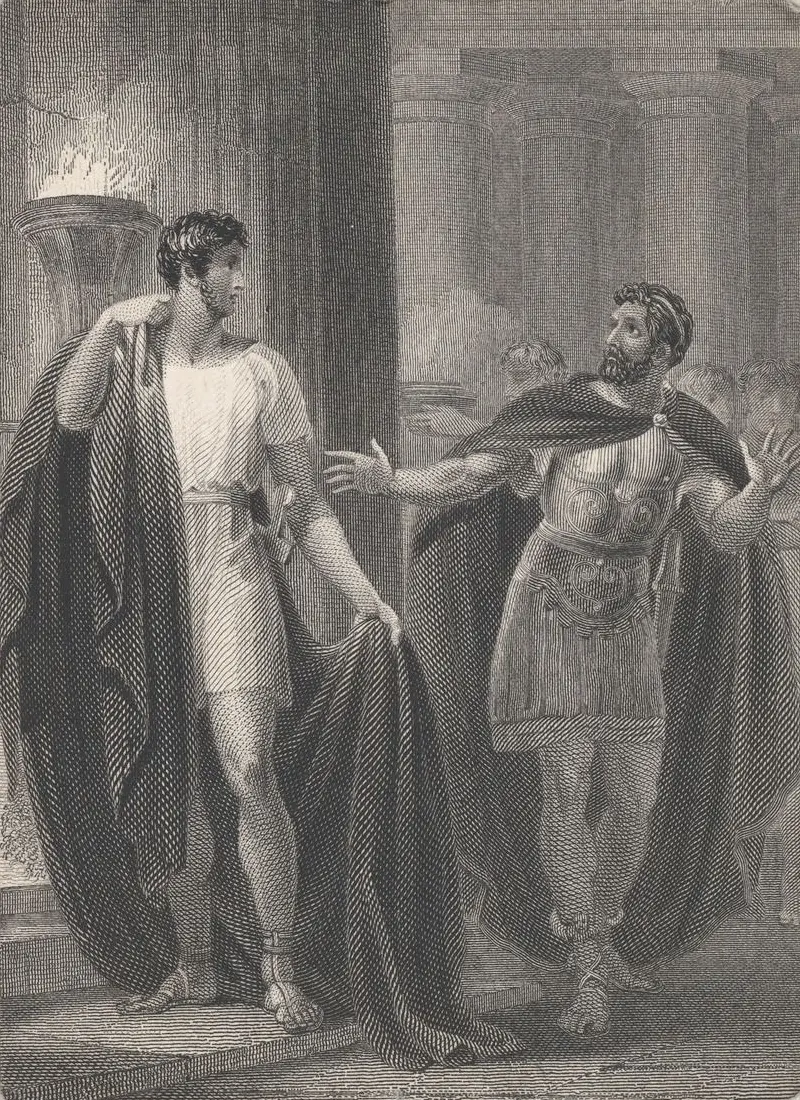

Act 5, Scene 3The tent of Coriolanus
Of thy deep duty more impression show
Than that of common sons.
O, stand up blest!
Whilst, with no softer cushion than the flint,
I kneel before thee; and unproperly
Show duty, as mistaken all this while
Between the child and parent.
Kneels
What is this?
Your knees to me? to your corrected son?
Then let the pebbles on the hungry beach
Fillip the stars; then let the mutinous winds
Strike the proud cedars 'gainst the fiery sun;
Murdering impossibility, to make
What cannot be, slight work.
Thou art my warrior;
I holp to frame thee. Do you know this lady?
The noble sister of Publicola,
The moon of Rome, chaste as the icicle
That's curdied by the frost from purest snow
And hangs on Dian's temple: dear Valeria!
This is a poor epitome of yours,
Which by the interpretation of full time
May show like all yourself.
The god of soldiers,
With the consent of supreme Jove, inform
Thy thoughts with nobleness; that thou mayst prove
To shame unvulnerable, and stick i' the wars
Like a great sea-mark, standing every flaw,
And saving those that eye thee!
Your knee, sirrah.
That's my brave boy!
Even he, your wife, this lady, and myself,
Are suitors to you.
I beseech you, peace:
Or, if you'ld ask, remember this before:
The thing I have forsworn to grant may never
Be held by you denials. Do not bid me
Dismiss my soldiers, or capitulate
Again with Rome's mechanics: tell me not
Wherein I seem unnatural: desire not
To ally my rages and revenges with
Your colder reasons.
O, no more, no more!
You have said you will not grant us any thing;
For we have nothing else to ask, but that
Which you deny already: yet we will ask;
That, if you fail in our request, the blame
May hang upon your hardness: therefore hear us.
Aufidius, and you Volsces, mark; for we'll
Hear nought from Rome in private. Your request?
Should we be silent and not speak, our raiment
And state of bodies would bewray what life
We have led since thy exile. Think with thyself
How more unfortunate than all living women
Are we come hither: since that thy sight,
which should
Make our eyes flow with joy, hearts dance
with comforts,
Constrains them weep and shake with fear and sorrow;
Making the mother, wife and child to see
The son, the husband and the father tearing
His country's bowels out. And to poor we
Thine enmity's most capital: thou barr'st us
Our prayers to the gods, which is a comfort
That all but we enjoy; for how can we,
Alas, how can we for our country pray.
Whereto we are bound, together with thy victory,
Whereto we are bound? alack, or we must lose
The country, our dear nurse, or else thy person,
Our comfort in the country. We must find
An evident calamity, though we had
Our wish, which side should win: for either thou
Must, as a foreign recreant, be led
With manacles thorough our streets, or else
triumphantly tread on thy country's ruin,
And bear the palm for having bravely shed
Thy wife and children's blood. For myself, son,
I purpose not to wait on fortune till
These wars determine: if I cannot persuade thee
Rather to show a noble grace to both parts
Than seek the end of one, thou shalt no sooner
March to assault thy country than to tread--
Trust to't, thou shalt not--on thy mother's womb,
That brought thee to this world.
More duologues for a woman and a man
 Romeo and Juliet: “Thou know'st the mask of night is on my face”Romeo and Juliet · 3 min 15 sec · Dramatic
 Beatrice and Benedick: “Kill Claudio”Much Ado About Nothing · 4 min 15 sec · Comic
 Orsino and Viola: “She never told her love”Twelfth Night · 2 min 45 sec · Dramatic
 Macbeth and Lady Macbeth: “We will proceed no further in this business”Macbeth · 3 min 15 sec · Dramatic