
Duologue from Cyrano de Bergerac by Edmond Rostand
Cyrano and Roxane: “Well, I love him”
Cyrano, poet and swordsman, has loved his cousin Roxane for years, but believes his enormous nose makes him impossible to love. She has asked to see him alone, and he dares to hope she means to say she loves him.
- 3 min 15 sec
- Dramatic
- Cyrano: Man, 30 to 45
- Roxane: Woman, 18 to 25
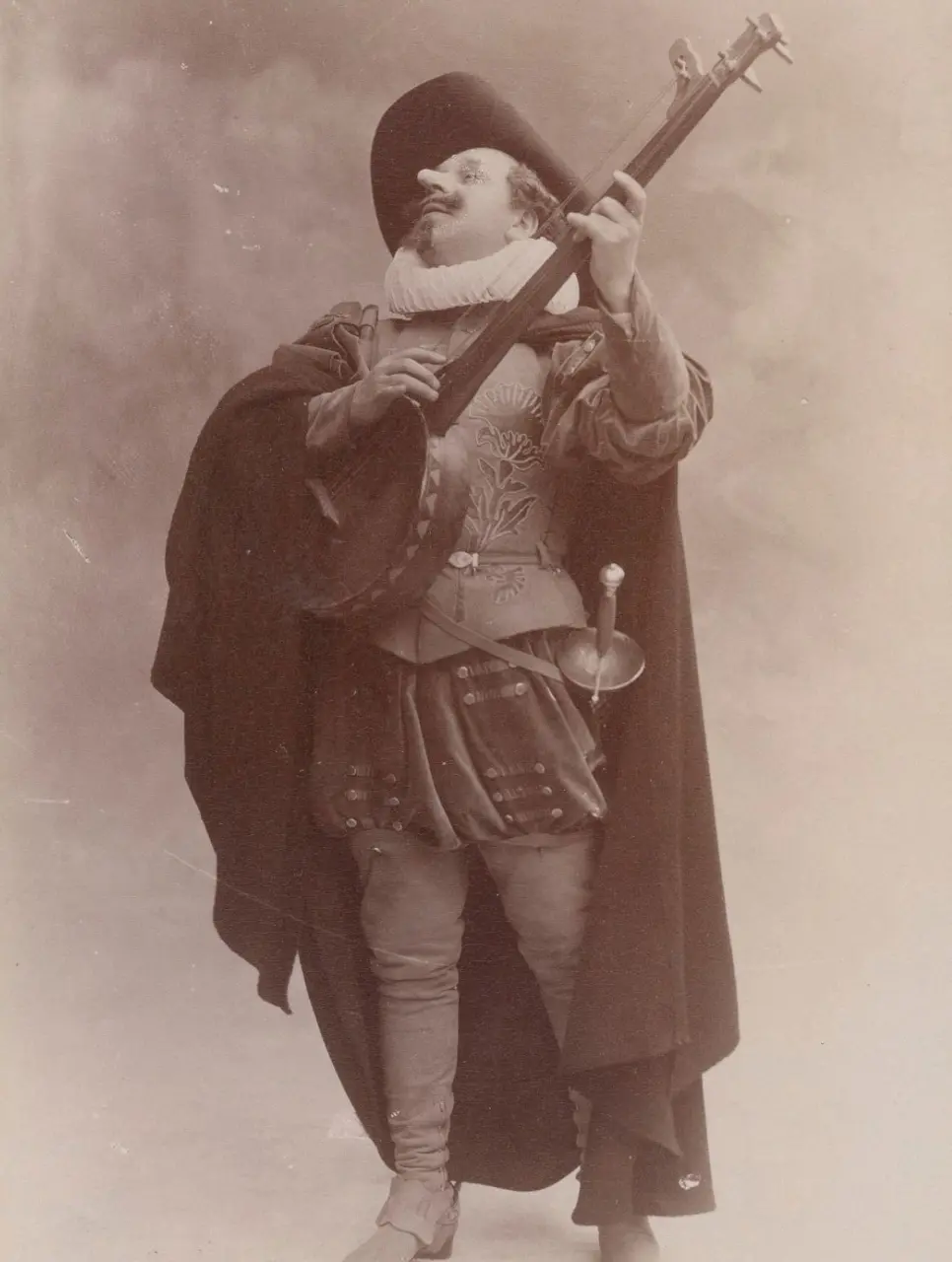
Act 2The Bakery of the Poets
Until you finish them.
[Down to ROXANE]
Blessed above all others be the hour
When you remembered to remember me,
And came to tell me... what?
[Takes off her mask] First let me thank you
Because... That man... that creature, whom your sword
Made sport of yesterday—His patron, one—
De Guiche?—
—who thinks himself in love with me
Would have forced that man upon me for—a husband—
I understand—so much the better then!
I fought, not for my nose, but your bright eyes.
And then, to tell you—but before I can
Tell you—Are you, I wonder, still the same
Big brother—almost—that you used to be
When we were children, playing by the pond
In the old garden down there—
I remember—
Every summer you came to Bergerac!...
You used to make swords out of bulrushes—
Your dandelion-dolls with golden hair—
And those green plums—
And those black mulberries—
In those days, you did everything I wished!
Roxane, in short skirts, was called Madeleine.
Was I pretty?
Oh—not too plain!
Sometimes
When you had hurt your hand you used to come
Running to me—and I would be your mother,
And say—Oh, in a very grown-up voice:
[She takes his hand.]
“Now, what have you been doing to yourself?
Let me see—”
[She sees the hand—starts.]
Oh!—
Wait—I said Let me see!
Still—at your age! How did you do that?
Playing
With the big boys, down by the Porte de Nesle.
[Sits at a table and wets her handkerchief in a glass of water] Come here to me.
—Such a wise little mother!
And tell me, while I wash this blood away,
How many you—played with?
Oh, about a hundred.
Tell me.
No. Let me go. Tell me what you
Were going to tell me—if you dared?
[Still holding his hand] I think
I do dare—now. It seems like long ago
When I could tell you things. Yes—I dare... Listen:
I... love someone.
Ah!...
Someone who does not know.
Ah!...
At least—not yet.
Ah!...
But he will know
Some day.
Ah!...
A big boy who loves me too,
And is afraid of me, and keeps away,
And never says one word.
Ah!...
Let me have
Your hand a moment—why how hot it is!—
I know. I see him trying...
Ah!...
There now!
Is that better?—
[She finishes bandaging the hand with her handkerchief.]
Besides—only to think—
(This is a secret.) He is a soldier too,
In your own regiment—
Ah!...
Yes, in the Guards,
Your company too.
Ah!...
And such a man!—
He is proud—noble—young—brave—beautiful—
[Turns pale; rises] Beautiful!—
What’s the matter?
[Smiling] Nothing—this—
My sore hand!
Well, I love him. That is all.
Oh—and I never saw him anywhere
Except the Comedie.
You have never spoken?—
Only our eyes...
Why, then—How do you know?—
People talk about people; and I hear
Things... and I know.
You say he is in the Guards:
His name?
Baron Christian de Neuvillette.
He is not in the Guards.
Yes. Since this morning.
Captain Carbon de Castel-Jaloux.
So soon!...
So soon we lose our hearts!—
But, my dear child,—
More duologues for a woman and a man
 Romeo and Juliet: “Thou know'st the mask of night is on my face”Romeo and Juliet · 3 min 15 sec · Dramatic
 Beatrice and Benedick: “Kill Claudio”Much Ado About Nothing · 4 min 15 sec · Comic
 Orsino and Viola: “She never told her love”Twelfth Night · 2 min 45 sec · Dramatic
 Macbeth and Lady Macbeth: “We will proceed no further in this business”Macbeth · 3 min 15 sec · Dramatic