
Duologue from Othello by William Shakespeare
Iago and Othello: “O, beware, my lord, of jealousy”
Desdemona has just left Othello, after pleading for Cassio. Iago, alone with his general, begins to hint, and won't say what he means.
- 4 min 30 sec
- Dramatic
- Iago: Man, 28 to 45
- Othello: Man, 35 to 55
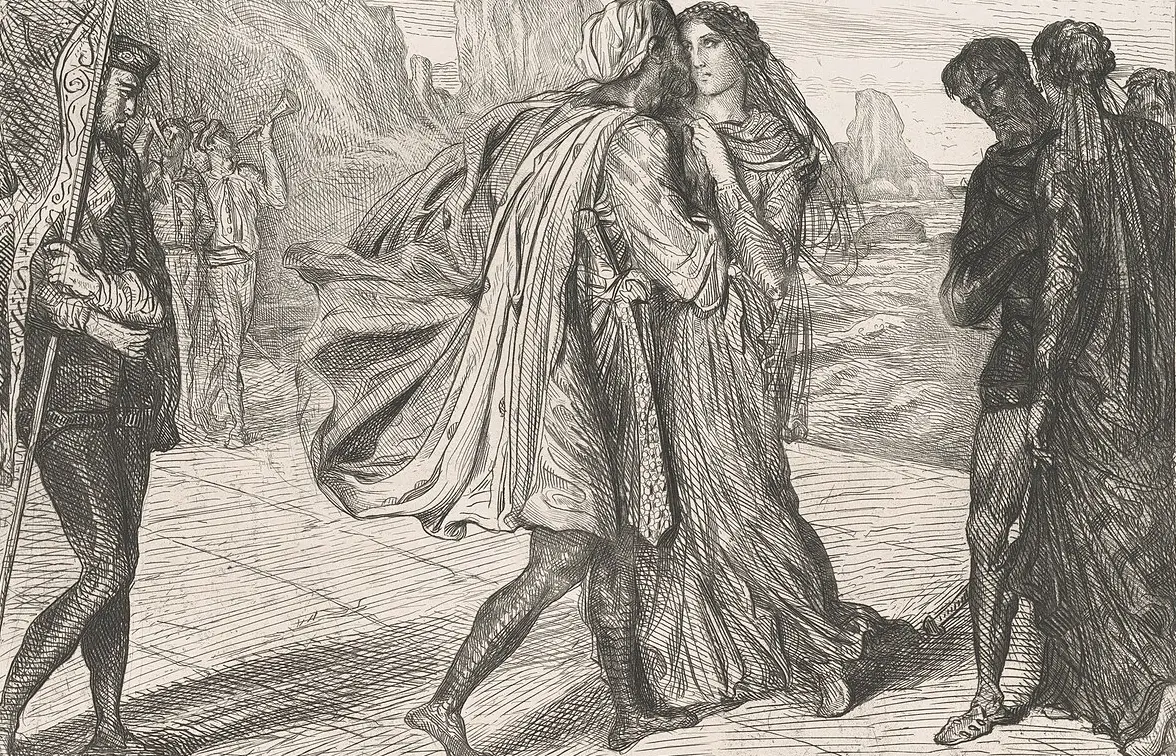

Act 3, Scene 3The garden of the castle
My noble lord--
What dost thou say, Iago?
Did Michael Cassio, when you woo'd my lady,
Know of your love?
He did, from first to last: why dost thou ask?
But for a satisfaction of my thought;
No further harm.
Why of thy thought, Iago?
I did not think he had been acquainted with her.
O, yes; and went between us very oft.
Indeed!
Indeed! ay, indeed: discern'st thou aught in that?
Is he not honest?
Honest, my lord!
Honest! ay, honest.
My lord, for aught I know.
What dost thou think?
Think, my lord!
Think, my lord!
By heaven, he echoes me,
As if there were some monster in his thought
Too hideous to be shown. Thou dost mean something:
I heard thee say even now, thou likedst not that,
When Cassio left my wife: what didst not like?
And when I told thee he was of my counsel
In my whole course of wooing, thou criedst 'Indeed!'
And didst contract and purse thy brow together,
As if thou then hadst shut up in thy brain
Some horrible conceit: if thou dost love me,
Show me thy thought.
My lord, you know I love you.
I think thou dost;
And, for I know thou'rt full of love and honesty,
And weigh'st thy words before thou givest them breath,
Therefore these stops of thine fright me the more:
For such things in a false disloyal knave
Are tricks of custom, but in a man that's just
They are close delations, working from the heart
That passion cannot rule.
For Michael Cassio,
I dare be sworn I think that he is honest.
I think so too.
Men should be what they seem;
Or those that be not, would they might seem none!
Certain, men should be what they seem.
Why, then, I think Cassio's an honest man.
Nay, yet there's more in this:
I prithee, speak to me as to thy thinkings,
As thou dost ruminate, and give thy worst of thoughts
The worst of words.
Good my lord, pardon me:
Though I am bound to every act of duty,
I am not bound to that all slaves are free to.
Utter my thoughts? Why, say they are vile and false;
As where's that palace whereinto foul things
Sometimes intrude not? who has a breast so pure,
But some uncleanly apprehensions
Keep leets and law-days and in session sit
With meditations lawful?
Thou dost conspire against thy friend, Iago,
If thou but think'st him wrong'd and makest his ear
A stranger to thy thoughts.
I do beseech you--
Though I perchance am vicious in my guess,
As, I confess, it is my nature's plague
To spy into abuses, and oft my jealousy
Shapes faults that are not--that your wisdom yet,
From one that so imperfectly conceits,
Would take no notice, nor build yourself a trouble
Out of his scattering and unsure observance.
It were not for your quiet nor your good,
Nor for my manhood, honesty, or wisdom,
To let you know my thoughts.
What dost thou mean?
Good name in man and woman, dear my lord,
Is the immediate jewel of their souls:
Who steals my purse steals trash; 'tis something, nothing;
'Twas mine, 'tis his, and has been slave to thousands:
But he that filches from me my good name
Robs me of that which not enriches him
And makes me poor indeed.
By heaven, I'll know thy thoughts.
You cannot, if my heart were in your hand;
Nor shall not, whilst 'tis in my custody.
Ha!
O, beware, my lord, of jealousy;
It is the green-eyed monster which doth mock
The meat it feeds on; that cuckold lives in bliss
Who, certain of his fate, loves not his wronger;
But, O, what damned minutes tells he o'er
Who dotes, yet doubts, suspects, yet strongly loves!
O misery!
More duologues for two men
 Brutus and Cassius: “That you have wrong'd me doth appear in this”Julius Caesar · 2 min 45 sec · Dramatic
 Falstaff and Hal: “Now, Hal, what time of day is it, lad?”Henry IV, Part 1 · 4 min 15 sec · Comic
 Antipholus and Dromio: “She is spherical, like a globe”The Comedy of Errors · 4 min 45 sec · Comic
 Algernon and Jack: “How are you, my dear Ernest?”The Importance of Being Earnest · 4 min · Comic