
Duologue from Candida by George Bernard Shaw
Marchbanks and Candida: “Every poet that ever lived has put that thought into a sonnet”
Late in the evening, the young poet Marchbanks has been reading poetry to Candida by the fire. He would rather talk about her.
- 3 min 45 sec
- Comic
- Marchbanks: Man, 18 to 22
- Candida: Woman, 30 to 40
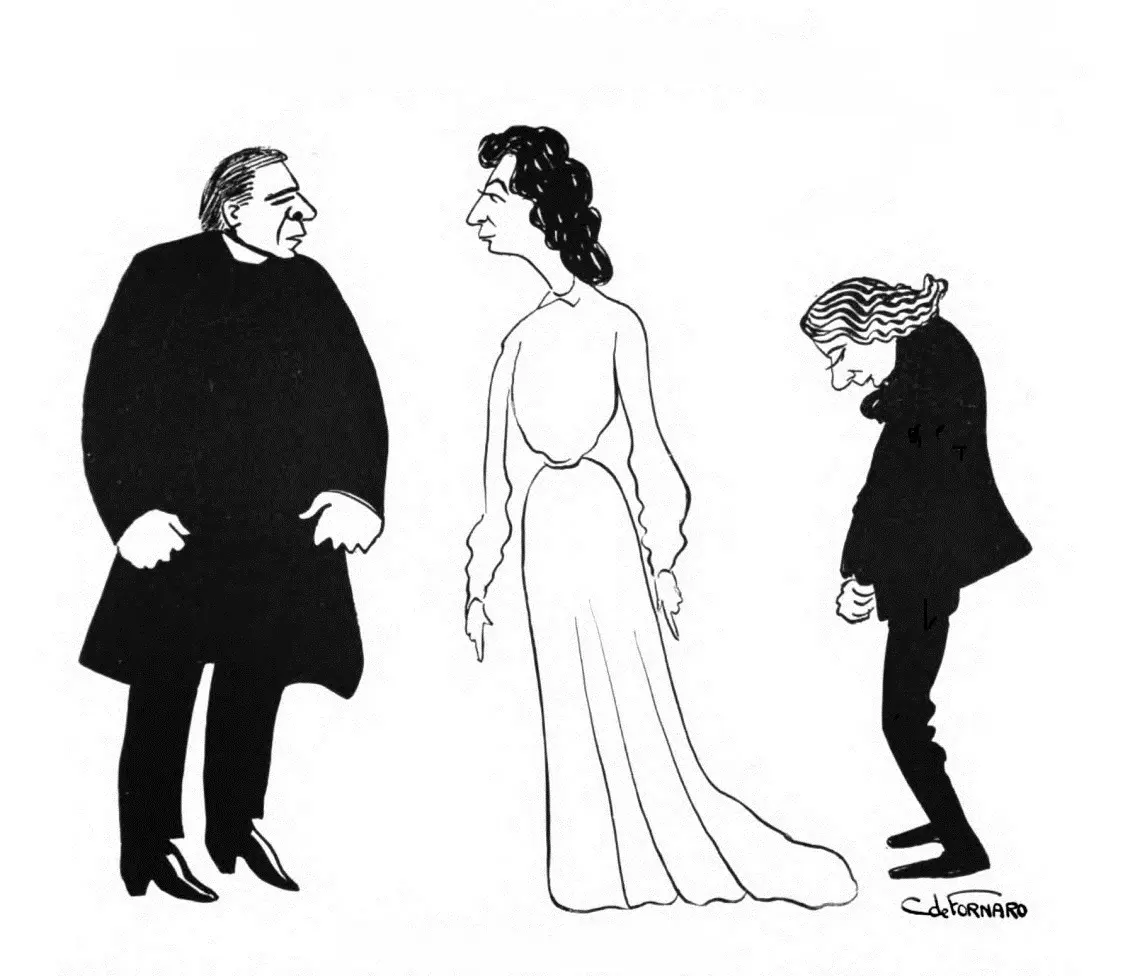

Act 3
[breaking off in his recitation] : Every poet that ever lived has put that thought into a sonnet. He must: he can't help it. [He looks to her for assent, and notices her absorption in the poker.] Haven't you been listening? [No response.] Mrs. Morell!
[starting] Eh?
Haven't you been listening?
[with a guilty excess of politeness] Oh, yes. It's very nice. Go on, Eugene. I'm longing to hear what happens to the angel.
[crushed--the manuscript dropping from his hand to the floor] I beg your pardon for boring you.
But you are not boring me, I assure you. Please go on. Do, Eugene.
I finished the poem about the angel quarter of an hour ago. I've read you several things since.
[remorsefully] I'm so sorry, Eugene. I think the poker must have fascinated me. [She puts it down.]
It made me horribly uneasy.
Why didn't you tell me? I'd have put it down at once.
I was afraid of making you uneasy, too. It looked as if it were a weapon. If I were a hero of old, I should have laid my drawn sword between us. If Morell had come in he would have thought you had taken up the poker because there was no sword between us.
[wondering] What? [With a puzzled glance at him.] I can't quite follow that. Those sonnets of yours have perfectly addled me. Why should there be a sword between us?
[evasively] Oh, never mind. [He stoops to pick up the manuscript.]
Put that down again, Eugene. There are limits to my appetite for poetry--even your poetry. You've been reading to me for more than two hours--ever since James went out. I want to talk.
[rising, scared] No: I mustn't talk. [He looks round him in his lost way, and adds, suddenly] I think I'll go out and take a walk in the park. [Making for the door.]
Nonsense: it's shut long ago. Come and sit down on the hearth-rug, and talk moonshine as you usually do. I want to be amused. Don't you want to?
[in half terror, half rapture] Yes.
Then come along. [She moves her chair back a little to make room. He hesitates; then timidly stretches himself on the hearth-rug, face upwards, and throws back his head across her knees, looking up at her.]
Oh, I've been so miserable all the evening, because I was doing right. Now I'm doing wrong; and I'm happy.
[tenderly amused at him] Yes: I'm sure you feel a great grown up wicked deceiver--quite proud of yourself, aren't you?
[raising his head quickly and turning a little to look round at her] Take care. I'm ever so much older than you, if you only knew. [He turns quite over on his knees, with his hands clasped and his arms on her lap, and speaks with growing impulse, his blood beginning to stir.] May I say some wicked things to you?
[without the least fear or coldness, quite nobly, and with perfect respect for his passion, but with a touch of her wise-hearted maternal humor] No. But you may say anything you really and truly feel. Anything at all, no matter what it is. I am not afraid, so long as it is your real self that speaks, and not a mere attitude--a gallant attitude, or a wicked attitude, or even a poetic attitude. I put you on your honor and truth. Now say whatever you want to.
[the eager expression vanishing utterly from his lips and nostrils as his eyes light up with pathetic spirituality] Oh, now I can't say anything: all the words I know belong to some attitude or other--all except one.
What one is that?
[softly, losing himself in the music of the name] Candida, Candida, Candida, Candida, Candida. I must say that now, because you have put me on my honor and truth; and I never think or feel Mrs. Morell: it is always Candida.
Of course. And what have you to say to Candida?
Nothing, but to repeat your name a thousand times. Don't you feel that every time is a prayer to you?
Doesn't it make you happy to be able to pray?
Yes, very happy.
Well, that happiness is the answer to your prayer. Do you want anything more?
[in beatitude] No: I have come into heaven, where want is unknown.
More duologues for a woman and a man
 Romeo and Juliet: “Thou know'st the mask of night is on my face”Romeo and Juliet · 3 min 15 sec · Dramatic
 Beatrice and Benedick: “Kill Claudio”Much Ado About Nothing · 4 min 15 sec · Comic
 Orsino and Viola: “She never told her love”Twelfth Night · 2 min 45 sec · Dramatic
 Macbeth and Lady Macbeth: “We will proceed no further in this business”Macbeth · 3 min 15 sec · Dramatic