
Duologue from The Taming of the Shrew by William Shakespeare
Petruchio and Katharina: “Good morrow, Kate; for that's your name, I hear”
Petruchio has agreed with her father to marry Katharina, sight unseen, for her dowry. Their first meeting is a battle of wits.
- 4 min 15 sec
- Comic
- Petruchio: Man, 25 to 40
- Katharina: Woman, 20 to 30
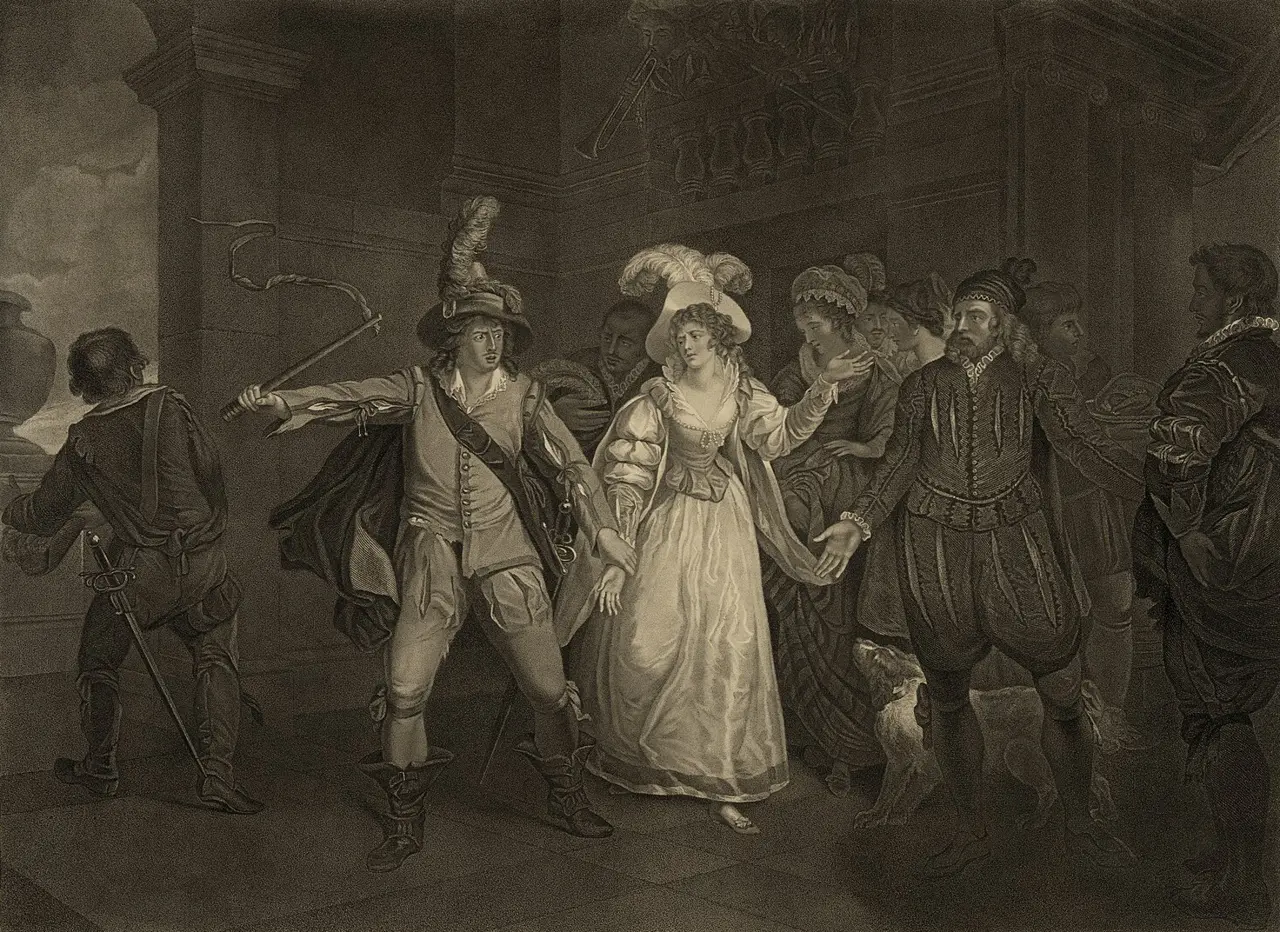

Act 2, Scene 1Padua. A room in BAPTISTA'S house
Good morrow, Kate; for that's your name, I hear.
Well have you heard, but something hard of hearing:
They call me Katharina that do talk of me.
You lie, in faith; for you are call'd plain Kate,
And bonny Kate and sometimes Kate the curst;
But Kate, the prettiest Kate in Christendom
Kate of Kate Hall, my super-dainty Kate,
For dainties are all Kates, and therefore, Kate,
Take this of me, Kate of my consolation;
Hearing thy mildness praised in every town,
Thy virtues spoke of, and thy beauty sounded,
Yet not so deeply as to thee belongs,
Myself am moved to woo thee for my wife.
Moved! in good time: let him that moved you hither
Remove you hence: I knew you at the first
You were a moveable.
Why, what's a moveable?
A join'd-stool.
Thou hast hit it: come, sit on me.
Asses are made to bear, and so are you.
Women are made to bear, and so are you.
No such jade as you, if me you mean.
Alas! good Kate, I will not burden thee;
For, knowing thee to be but young and light--
Too light for such a swain as you to catch;
And yet as heavy as my weight should be.
Should be! should--buzz!
Well ta'en, and like a buzzard.
O slow-wing'd turtle! shall a buzzard take thee?
Ay, for a turtle, as he takes a buzzard.
Come, come, you wasp; i' faith, you are too angry.
If I be waspish, best beware my sting.
My remedy is then, to pluck it out.
Ay, if the fool could find it where it lies,
Who knows not where a wasp does
wear his sting? In his tail.
In his tongue.
Whose tongue?
Yours, if you talk of tails: and so farewell.
What, with my tongue in your tail? nay, come again,
Good Kate; I am a gentleman.
That I'll try.
She strikes him
I swear I'll cuff you, if you strike again.
So may you lose your arms:
If you strike me, you are no gentleman;
And if no gentleman, why then no arms.
A herald, Kate? O, put me in thy books!
What is your crest? a coxcomb?
A combless cock, so Kate will be my hen.
No cock of mine; you crow too like a craven.
Nay, come, Kate, come; you must not look so sour.
It is my fashion, when I see a crab.
Why, here's no crab; and therefore look not sour.
There is, there is.
Then show it me.
Had I a glass, I would.
What, you mean my face?
Well aim'd of such a young one.
Now, by Saint George, I am too young for you.
Yet you are wither'd.
'Tis with cares.
I care not.
Nay, hear you, Kate: in sooth you scape not so.
I chafe you, if I tarry: let me go.
No, not a whit: I find you passing gentle.
'Twas told me you were rough and coy and sullen,
And now I find report a very liar;
For thou are pleasant, gamesome, passing courteous,
But slow in speech, yet sweet as spring-time flowers:
Thou canst not frown, thou canst not look askance,
Nor bite the lip, as angry wenches will,
Nor hast thou pleasure to be cross in talk,
But thou with mildness entertain'st thy wooers,
With gentle conference, soft and affable.
Why does the world report that Kate doth limp?
O slanderous world! Kate like the hazel-twig
Is straight and slender and as brown in hue
As hazel nuts and sweeter than the kernels.
O, let me see thee walk: thou dost not halt.
More duologues for a woman and a man
 Romeo and Juliet: “Thou know'st the mask of night is on my face”Romeo and Juliet · 3 min 15 sec · Dramatic
 Beatrice and Benedick: “Kill Claudio”Much Ado About Nothing · 4 min 15 sec · Comic
 Orsino and Viola: “She never told her love”Twelfth Night · 2 min 45 sec · Dramatic
 Macbeth and Lady Macbeth: “We will proceed no further in this business”Macbeth · 3 min 15 sec · Dramatic