
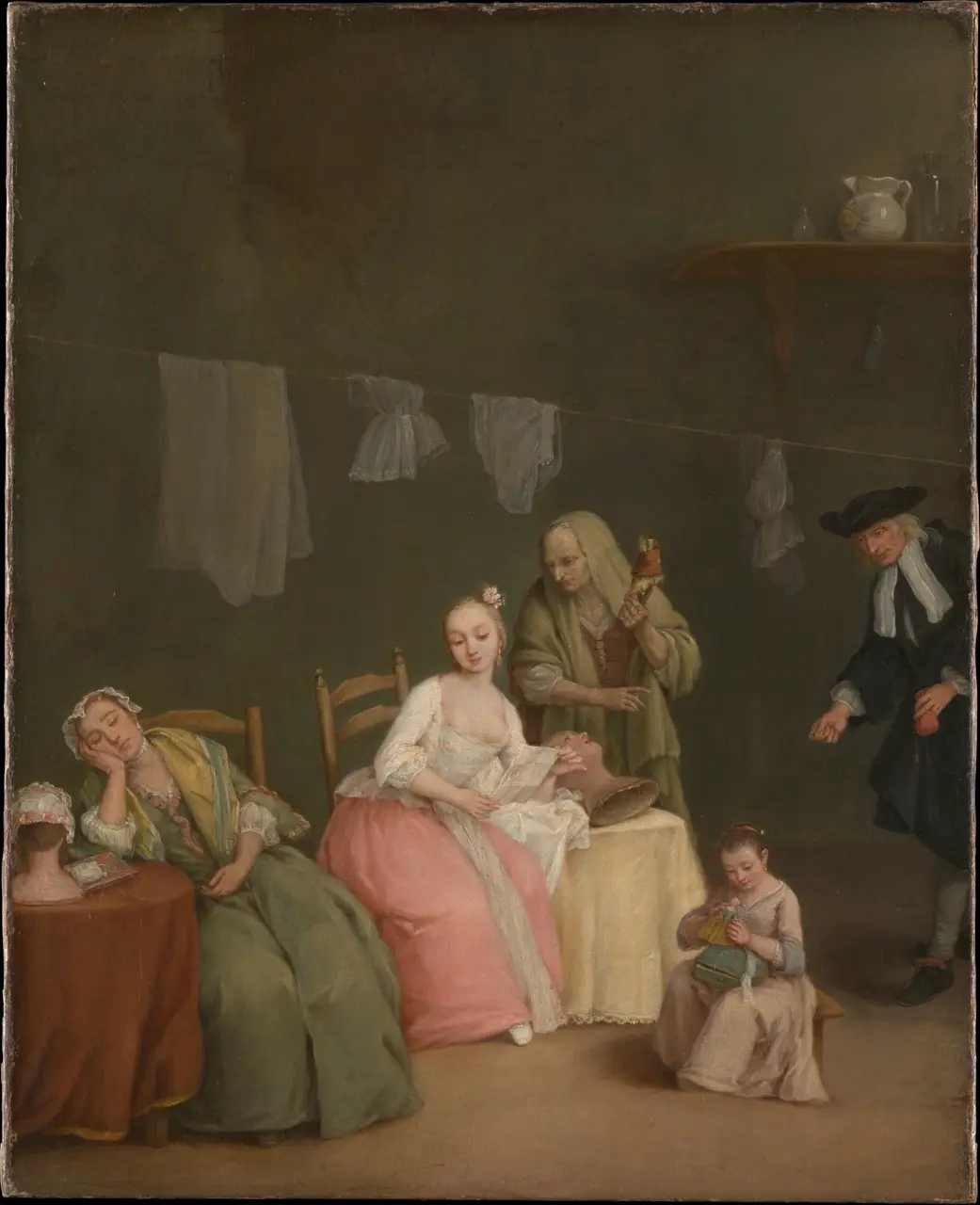
 The Fanby Carlo GoldoniA fan bought as a lover's gift passes from hand to hand through a village, setting everyone at odds.
 The Spendthrift Miserby Carlo GoldoniA miser who wants to be thought magnificent spends lavishly on show and grudges every penny he must.
 The Beneficent Bearby Carlo GoldoniA gruff old man who growls at everyone turns out to have the kindest heart in Paris.
Act 1, Scene 1
Gascoigne, packing his master's trunk.
Enter Marianna.
May I wish good-morning to Monsieur Gascoigne?
Yes, my sweet Marianna, I thank you for your good-morning, but good-night would be more agreeable to me from your lips.
From what I see, I should rather wish you a pleasant journey.
Oh, my precious jewel, such a melancholy departure must be followed by a most doleful journey!
Then you are sorry to go?
How can you doubt it? After having enjoyed your delightful society for six months, can I leave you without the deepest sorrow?
And who forces you to do what is so disagreeable?
Do you not know? My master.
Masters are not wanting at the Hague, and you can easily find one who will give you better wages than a poor French officer, a prisoner of war, and a man in every way roughly used by fortune.
Pardon me, such language does not become so good a girl as you are. I have for many years had the honour of serving my excellent master; his father, I may say, recommended me to him; I have attended him in the war, and have not shunned danger to show my fidelity. He is poor, but never man had a better heart. Were he promoted, I am sure I should share his good fortune. Would you desire me to abandon him, and let him return to France without me?
You speak like the worthy fellow you are; but I cannot conceal my affection for you.
Dear Marianna, I am as much distressed as you are, but I hope to see you again, and then to be able to say, Here I am, I can support you, and, if you wish it, I am yours.
Heaven grant it! But why is the Lieutenant in such haste to depart? My master is fond of his company, and I think the daughter not less so than the father.
Too true; and that is his reason for going.
What! does he dislike people to be fond of him?
Ah, my Marianna, my poor master is desperately in love with your young mistress; he leads the most wretched life in the world; he knows their love for each other is increasing every day, and, as they can no longer hide it, he fears for himself, and for Mademoiselle Giannina. Your master is rich, and mine is poor. Monsieur Philibert has this only daughter, and will not give her to a younger son, a soldier; one, in short, who would have to live on her means. The Lieutenant, though poor, is a man of honour; he respects the obligations of hospitality, of friendship, of good faith; he fears he may be overcome and seduced by love, and that he in turn may seduce his mistress from her duty. This being the case, he does violence to his feelings, sacrifices love to principle, and is resolved to go.
I admire his heroic conduct, but could not imitate it.
We must exert self-control.
You can do so more easily than I.
Indeed, a man's resolution is stronger than a woman's.
Say rather his affections are weaker.
So far as regards me, you are wrong.
I look at acts, not words.
What can I do to convince you of my love?
Monsieur Gascoigne does not need me for a teacher.
Do you wish me to marry you before I go?
That would, indeed, remove all doubt.
But then I should have to leave you.
And could you have the heart to abandon me?
Oh, you might go with me!
That would be much better.
To encounter so many hardships?
In truth, that would not suit me so well.
Should I remain here with you, would that satisfy you?
Perfectly.
For how long?
A year at least.
And after a year, would you let me go?
Yes, a year after our marriage, if you found it easy to do so.
I daresay you would let me go after a month.
I know better.
I am sure of it.
Let us try.
My master is coming; another time we will talk it over.
Ah, Monsieur Gascoigne, this conversation has unnerved me; do what you please, I trust to you.--[Aside.] Indeed, I know not what I say. [Exit.]
If I had not more sense than she, the folly would have been committed before now.
Enter De la Cotterie.
[To himself.] Oh, Heaven! how wretched I am! how unfortunate!
The trunk, sir, is packed.
Ah, Gascoigne! I am in despair.
Alas! what misfortune has happened?
The worst that could befall me.
Our troubles seldom come alone.
Mine is alone, but so great that I cannot support it.
I suppose you allude to your love?
Yes; but it has increased to such a degree that I have no longer firmness enough to resist it.
What if the lady is unconcerned at your departure, and does not love you as you imagine she does?
On the contrary, she is more affectionate, and more devoted to me than ever. Oh, God! what will my despair drive me to? I saw her weep.
Well, this is bad enough, but I thought it was something much worse.
Inhuman! unfeeling! vile plebeian soul! can you imagine anything worse in the world than the tears of a tender-hearted, distressed lady, who accuses me of cruelty, who makes my resolution waver, and puts to a severe trial my honour, my reputation, and my friendship?
I am not conscious of deserving so harsh a reproof; this is a just recompense for ten years' service.
Ah! put yourself in my place, and then, if you can, condemn my transports. My wounds, my blood, my being a prisoner of war, which prevents my promotion, the narrowness of my fortune, all appear nothing in comparison with the love which inflames my soul. The excellent principles of the young lady prevented her from assuring me that I possessed her heart, and in consequence I resolved to leave her. Ah! at the moment of taking leave, tears and sobs prevented her from speaking, and they proved her love was equal to mine. My wretchedness is extreme; my resolution seems barbarous; and now, frantic with love, reason appears to desert me.
Take time, sir; remain here. Monsieur Philibert is the best man in the world; in Holland they pride themselves on their hospitality, and our host takes the greatest interest in you, and in your health. You are not perfectly cured, and this is a good reason for not going.
I will think over what you say; very little would change my determination.
With your leave I will at once unpack the trunk. [Unpacking.]
[Apart.] What will they say if I remain after having taken my leave?
[Apart.] Marianna will not be sorry for this.
[Apart.] If I allege I am unwell, my sadness will make it appear so.
[Apart.] Nor indeed am I.
But the longer I remain, the more my love increases; and what remedy can there be for it? what hope is there for my desperate passion?
Time accomplishes wonders. [Still unpacking.]
How much better to meet death at once than to live in such torture!
My master will be obliged to me.
What shall I do?
The trunk is unpacked, sir.
Who told you to unpack it?
I said I was going to do it, and you did not forbid me.
Blockhead! put up the clothes. I shall go.
Well, whatever happens, let them remain now.
Do not make me angry.
I will put them up this evening.
Do it at once, and order the post-horses at twelve o'clock.
And the tears of Mademoiselle?
Wretch! have you the heart to torment me?
My poor master!
Indeed, I am an object of compassion.
Let us stay.
No.
Shall I pack up the things, then?
Yes.
How I pity him! [Putting the clothes in the trunk.]
Can I leave this house without seeing her again?
While he continues in this state of mind, we shall never be done.
By leaving her, I fear my love will not leave me.
Alas, poor master! [Looking out.] What do I see?
What is the matter? Why do you stop?
I am going on, sir.
You are confused?
A little.
What are you looking at?
Nothing.
Oh, Heaven! Mademoiselle Giannina! What an encounter! What do you advise me to do?
I do not know; any course is dangerous.
Do not leave me.
I will not.
I will go away.
As you please.
I cannot.
I pity you.
Why does she stop? Why does she not come in?
She is afraid of disturbing you.
No; it is because you are here.
Then I will go. [Going.]
Stay.
I will remain, then.
Have you the snuff-box? bring it.
I will go for it. [Exit.]
Hear me! where are you going? Poor me! Gascoigne! [Calls.]
Enter Giannina.
Are you in want of anything?
Excuse me, I want my servant.
If yours is not here, there are others. Do you want any one?
No, I thank you; my trunk must be packed up.
And are you disturbed in this manner about so trifling an affair? do you fear there will not be time? Perhaps you are already expecting horses? If the air of this country is not favourable to your health, or rather if you are tired of us, I will myself hasten forward your departure.
Mademoiselle, have compassion on me; do not add to my suffering.
If I knew the cause of your suffering, instead of increasing, I would endeavour to diminish it.
Seek the cause in yourself; there is no need for me to tell you.
Then you go away on my account?
Yes, it is on your account that I am compelled to hasten my departure.
Have I become so odious in your sight?
Oh, Heaven! you never appeared to me so lovely; your eyes never beamed with so much tenderness.
Ah, were this true, you would not be so anxious to go.
If I loved only the beauty of your person, I should yield to the strength of my attachment, which bids me stay with you; but I love you for your virtues; I see your peace of mind is in danger, and in return for the kindness you have shown me, I mean to sacrifice the dearest hopes of my life.
I do not believe you have so little resolution as not to be able to control your passion, and you do me injustice if you think I cannot resist the inclinations of my heart. I own my love for you without a blush: this virtuous love, I feel, will never leave me, and I cannot persuade myself a man is less able than I am to sustain with glory the conflict of his passions. I can love you without danger; it is happiness enough for me to see you. You, on the contrary, by determining to depart, go in quest of more easy enjoyment, and show that your obstinacy prevails over your love. It is said hope always comforts the lover. He who will not use the means proves he cares but little for the end, and, if you go, you will still suffer the tortures of disappointed desire; you will act either with culpable weakness, or unfeeling indifference. Whatever cause hurries you away, go, proud of your resolution, but be at least ashamed of your cruelty.
Ah, no, Mademoiselle! do not tax me with ingratitude, do not accuse me of cruelty. I thought, by my departure, to do you an act of kindness. If I am wrong, pardon me. If you command it, I will remain.
No; my commands shall never control your inclination; follow the dictates of your own heart.
My heart tells me to remain.
Then obey it without fear, and, if your courage does not fail, rely on my constancy.
What will your father say to my change of mind?
He is almost as much grieved at your departure as I am; he is not satisfied about your recovery; and whether it is the consequence of your wound, or of mental affliction, the surgeons do not believe your health is re-established, and my father thinks it too soon for you to undertake the journey. He loves and esteems you, and would be much pleased at your remaining.
Has he any suspicion of my love for you? and that it is mutual?
Our conduct has given him no cause for suspicion.
Can it be possible it has never passed through his mind that I, an open, frank man, and a soldier, might be captivated by the beauty and merit of his daughter?
A man like my father is not inclined to suspicion; the cordiality with which he received you as a guest in his family, assures him he may rely on the correct conduct of an officer of honour; and his knowledge of my disposition makes him perfectly easy: he does not deceive himself in regard to either of us. A tender passion has arisen in our hearts, but we will neither depart from the laws of virtue, nor violate his confidence.
Is there no hope his goodness may make him agree to our marriage?
My hope is that in time it will; the obstacles do not arise from motives of interest, but from the customs of our nation. Were you a merchant of Holland, poor, with only moderate expectations, you would immediately obtain my hand, and a hundred thousand florins for an establishment; but an officer, who is a younger son, is considered among us as a wretched match, and were my father inclined to give his consent, he would incur the severe censure of his relations, his friends, and indeed of the public.
But I cannot flatter myself with the prospect of being in a better condition.
In the course of time circumstances may occur that may prove favourable to our union.
Do you reckon among these the death of your father?
Heaven grant that the day may be distant! but then I should be my own mistress.
And do you wish me to remain in your house as long as he lives?
No, Lieutenant; stay here as long as your convenience permits, but do not appear so anxious to go while there are good reasons for your remaining. Our hopes do not depend on the death of my father, but I have reasons to flatter myself our attachment in the end may be rewarded. Our love we must not relinquish, but avail ourselves of every advantage that occasion may offer.
Adorable Giannina, how much am I indebted to your kindness! Dispose of me as you please; I am entirely yours; I will not go unless you order me to do so. Persuade your father to bear with my presence, and be certain that no place on earth is so agreeable to me as this.
I have only one request to make.
May you not command?
Have regard for one defect which is common to lovers;--do not, I entreat you, give me any cause for jealousy.
Am I capable of doing so?
I will tell you. Mademoiselle Costanza, in the last few days, has visited our house more frequently than usual; her eyes look tenderly on you, and she manifests rather too much sympathy for your misfortunes. You are of a gentle disposition, and, to own the truth, I sometimes feel uneasy.
Henceforth I will use the greatest caution, that she may indulge no hopes, and that you may be at ease.
But so conduct yourself, that neither my jealousy nor your love for me shall be remarked.
Ah, would to Heaven, Mademoiselle, our troubles were at an end!
We must bear them, to deserve good fortune.
Yes, dearest, I bear all with this delightful hope. Permit me now to inquire for my servant, to get him to countermand the horses.
Were they ordered?
Yes, indeed.
Unkind one!
Pardon me.
Let the order be countermanded before my father knows it.
My hope and my comfort! may Heaven be propitious to our wishes, and reward true love and virtuous constancy. [Exit.]
I never could have believed it possible for me to be brought to such a step; that I should, of my own accord, use language and contrive means to detain him. But unless I had done so, in a moment he would have been gone, and I should have died immediately afterwards. But here comes my father; I am sorry he finds me in our visitor's room. Thank Heaven, the Lieutenant is gone out! All appearance of sorrow must vanish from my face.
Enter Philibert.
My daughter, what are you doing in this room?
Curiosity, sir, brought me here.
And what excites your curiosity?
To see a master who understands nothing of such things, and an awkward servant endeavouring to pack up a trunk.
Do you know when he goes away?
He intended going this morning, but, in walking across the room, his legs trembled so, that I fear he will not stand the journey.
I think his present disease has deeper roots than his wound.
Yet only one hurt has been discovered by the surgeons.
Oh, there are wounds which they know nothing of.
Every wound, however slight, makes its mark.
Eh! there are weapons that give an inward wound.
Without breaking the skin?
Certainly.
How do these wounds enter?
By the eyes, the ears, the touch.
You must mean by the percussion of the air.
Air! no, I mean flame.
Indeed, sir, I do not comprehend you.
You do not choose to comprehend me.
Do you think I have any mischievous design in my head?
No; I think you a good girl, wise, prudent, who knows what the officer suffers from, and who, from a sense of propriety, appears not to know it.
[Aside.] Poor me! his manner of talking alarms me.
Giannina, you seem to me to blush.
What you say, sir, of necessity makes me blush. I now begin to understand something of the mysterious wound of which you speak; but, be it as it may, I know neither his disease nor the remedy.
My daughter, let us speak plainly. Monsieur de la Cotterie was perfectly cured a month after he arrived here; he was apparently in health, ate heartily, and began to recover his strength; he had a good complexion, and was the delight of our table and our circle. By degrees he grew sad, lost his appetite, became thin, and his gaiety was changed to sighs. I am something of a philosopher, and suspect his disease is more of the mind than of the body, and, to speak still more plainly, I believe he is in love.
It may be as you say; but I think, were he in love, he would not be leaving.
Here again my philosophy explains everything. Suppose, by chance, the young lady of whom he is enamoured were rich, dependent on her father, and could not encourage his hopes; would it be strange if despair counselled him to leave her?
[Aside.] He seems to know all.
And this tremor of the limbs, occurring just as he is to set out, must, I should say, viewed philosophically, arise from the conflict of two opposing passions.
[Aside.] I could imprecate his philosophy!
In short, the benevolence of my character, hospitality, to which my heart is much inclined, humanity itself, which causes me to desire the good of my neighbours, all cause me to interest myself in him; but I would not wish my daughter to have any share in this disease.
Ah, you make me laugh! Do I look thin and pale? am I melancholy? What says your philosophy to the external signs of my countenance and of my cheerfulness.
I am suspended between two opinions: you have either the power of self-control, or are practising deception.
Have you ever found me capable of deception?
Never, and for that reason I cannot believe it now.
You have determined in your own mind that the officer is in love, which is very likely; but I am not the only person he may be suspected of loving.
As the Lieutenant leaves our house so seldom, it is fair to infer his disease had its origin here.
There are many handsome young ladies who visit us, and one of them may be his choice.
Very true; and, as you are with them, and do not want wit and observation, you ought to know exactly how it is, and to relieve me from all suspicion.
But if I have promised not to speak of it?
A father should be excepted from such a promise.
Yes, certainly, especially if silence can cause him any pain.
Come, then, my good girl, let us hear.--[Aside.] I am sorry I suspected her.
[Aside.] I find myself obliged to deceive him.--Do you know, sir, that poor Monsieur de la Cotterie loves to madness Mademoiselle Costanza?
What! the daughter of Monsieur Riccardo?
The same.
And does the girl return his affection?
With the greatest possible ardour.
And what obstacle prevents the accomplishment of their wishes?
Why, the father of the girl will hardly consent to give her to an officer who is not in a condition to maintain her reputably.
A curious obstacle, truly. And who is this Monsieur Riccardo, that he has such rigorous maxims? He is nothing but a broker, sprung from the mud, grown rich amid the execrations of the people. Does he think to rank himself among the merchants of Holland? A marriage with an officer would be an honour to his daughter, and he could not better dispose of his ill-got wealth.
It seems, then, if you were a broker, you would not refuse him your daughter?
Assuredly not.
But, being a Dutch merchant, the match does not suit you?
No, certainly not; not at all--you know it very well.
So I thought.
I must interest myself in behalf of Monsieur de la Cotterie.
In what manner, sir?
By persuading Monsieur Riccardo to give him his daughter.
I would not advise you to meddle in the affair.
Let us hear what the Lieutenant will say.
Yes, you should hear him first.--[Aside.] I must give him warning beforehand.
Do you think he will set out on his journey immediately?
I know he has already ordered his horses.
I will send directly to see.
I will go myself, sir.--[Aside.] I must take care not to make matters worse. [Exit.]
[Alone.] I feel I have done injustice to my daughter in distrusting her; it is a happiness to me to be again certain of her sincerity. There may be some concealed deception in her words, but I will not believe her so artful; she is the daughter of a man who loves truth, and never departs from it, even in jest. Everything she tells me is quite reasonable: the officer may be in love with Mademoiselle Costanza; the absurd pride of the father considers the match as far below what his daughter is entitled to. I will, if possible, bring about the marriage by my mediation. On the one hand, we have nobility reduced in circumstances; on the other, a little accidental wealth; these fairly balance one another, and each party will find the alliance advantageous.
Enter Marianna.
Isn't my mistress here, sir?
She is just gone.
By your leave. [Going.]
Why are you in such haste?
I am going to find my mistress.
Have you anything of consequence to say to her?
A lady has asked for her.
Who is she?
Mademoiselle Costanza.
Oh! is Mademoiselle Costanza here?
Yes; and I suspect, by her coming at this unusual hour, that it is something extraordinary that brings her here.
I know what this extraordinary something is. [Smiling.] Say to Mademoiselle Costanza, that, before going to my daughter's room, I will thank her to let me see her here.
You shall be obeyed, sir.
Is the officer in?
No, sir, he is gone out.
As soon as he returns, ask him to come to me in this room.
Yes, sir. Do you think he will go away to-day?
I am sure he will not.
Indeed, his health is so bad, that it would be dangerous for him to proceed on his journey.
He shall remain with us, and he shall get well.
My dear master, you alone have the power of restoring him to health.
I? How! do you know what is the Lieutenant's disease?
I know it; but do you, sir?
I know everything.
Who told you?
My daughter.
Indeed! [With an expression of surprise.]
Why are you surprised? Would not my daughter be wrong to conceal the truth from her father?
Certainly; she has acted most wisely.
Now we can find the remedy.
In truth, it is an honourable love.
Most honourable.
The Lieutenant is an excellent young man.
Most excellent.
It is his only misfortune that he is not rich.
A handsome fortune with his wife would indeed make his situation more comfortable.
If the father is satisfied, no one has a right to complain.
A father with an only child, when he finds an opportunity of marrying her respectably, ought to be pleased to avail himself of it.
May God bless you! these are sentiments worthy of so good a man. I am delighted both for the officer and the young lady.--[Aside.] And not less so for myself, as my beloved Gascoigne may now remain with me. [Exit.]
Enter Mademoiselle Costanza.
[To himself.] Good actions deserve praise, and every person of sense will approve of what I am doing.
Here I am, sir, at your commands.
Ah, Mademoiselle Costanza! it gives me great pleasure to see you.
You are very kind.
I am gratified at your friendship for my daughter.
She deserves it, and I love her with all my heart.
Ah, do not say with all your heart!
Why not? are you not convinced I love her sincerely?
Sincerely, I believe, but not with all your heart.
Why should you doubt it?
Because, if you loved my daughter with all your heart, there would be none of it left for any one else.
You make me laugh; and who should have a part of it?
Ah, Mademoiselle, we understand!
Indeed, I do not understand.
Now let us dismiss Lady Modesty, and introduce Lady Sincerity.
[Aside.] I cannot discover what he is aiming at.
Tell me, have you come on purpose to visit my daughter?
Yes, sir.
No, Mademoiselle.
For what, then?
Know I am an astrologer. I am visited by a certain spirit that tells me everything, and hence I have learnt this: Mademoiselle Costanza has come not to visit those who stay, but those who go away.
[Aside.] I suspect there is some truth in what the spirit says.
What! are you puzzled how to answer?
I will answer you frankly: if I have come to show civility to your guest, I do not perceive I deserve reproof.
Reproof! on the contrary, praise; acts of civility ought not to be omitted--especially when dictated by a more tender feeling.
You seem to be in a humour for jesting this morning.
And you seem to be out of spirits; but I lay a wager I can cheer you up.
Indeed?
Without fail.
And how?
With two words.
And what are those fine words?
You shall hear them. Come this way--a little nearer. The Lieutenant is not going away. Does not your heart leap at this unexpected news?
For mercy's sake! Monsieur Philibert, do you believe me in love?
Say no, if you can.
No; I can say it.
Swear to it.
Oh, I will not swear for such a trifle.
You wish to hide the truth from me, as if I had not the power of serving you, or was unwilling to do so, and of serving the poor young man too, who is so unhappy.
Unhappy, for what?
On account of you.
On account of me?
Yes, you; we are in the dark, so that his love for you is in a manner hidden, and every one does not know that his despair sends him away.
Despair for what?
Because your father, from pride and avarice, will not consent to give you to him: this, my girl, is the whole affair.
It appears that you know more of it than I do.
You know, and do not choose to know. I make allowance for your modesty; but when a gentleman speaks to you, when a man of my character exerts himself in your behalf, you ought to lay aside modesty and open your heart freely.
You take me so by surprise, I am embarrassed what answer to make.
Let us end this conversation. Tell me, like an honest girl as you are, do you not love Monsieur de la Cotterie?
You force me to own it.
[Aside.] Thank Heaven! so my daughter spoke the truth.--And he loves you with an equal affection.
Of that, sir, I know nothing.
If you do not know it, I tell you so; he loves you to perdition.
[Aside.] Can it be possible? and he has never declared it to me!
And I have undertaken to persuade your father.
But does my father know I am in love with the officer?
He certainly ought to know.
He has never mentioned it to me.
Oh, your father will soon come and talk with you on the subject.
He has never objected to my coming here, where I meet the officer.
He knows that you are visiting in an honourable house; no greater liberty would be allowed you here than is proper for a modest young lady. In a word, are you willing that I should manage the affair?
Entirely willing.
Bravo! this is enough; and what would it avail you to deny with your lips what your looks proclaim? the flame that burns in your heart sparkles in your eyes.
You have a most penetrating glance.
Ah, here comes the officer.
By your leave, sir.
Where are you going?
To Mademoiselle Giannina.
Remain here, if you will.
Oh no, sir, excuse me--your servant.--[Aside.] I am overjoyed! I know not in what world I am! [Exit.]
Philibert, alone.
How amusing these girls are! Boldness and modesty are mingled in so strange a manner, that it is a pleasure to observe them. Here is an instance of love to devotion, and if it succeeds it will be owing to my daughter's intervention.
Enter De la Cotterie.
They told me, sir, that you asked for me.
Have you seen Mademoiselle Giannina?
No, sir, I have not seen her.
I am sorry that you appear so melancholy.
One whose health is bad cannot be expected to look cheerful.
Do you not know I am a physician, and have the skill to cure you?
I did not know that you were skilled in the medical art.
Well, my friend, capacities often exist where they are not suspected.
Why, then, have you not prescribed for me before now?
Because I did not sooner know the nature of your disease.
Do you think you know it now?
Yes, certainly--indubitably.
If you are learned in the medical art, sir, you know much better than I do how fallacious and how little to be relied on are all the symptoms that seem to indicate the causes of disease.
The indications of your disease are so infallible, that I am confident there is no mistake, and on condition that you trust to my friendship, you shall soon have reason to be content.
And by what process do you propose to cure me?
My first prescription shall be for you to abandon all intention of going away, and to take the benefit of this air, which will speedily restore you to health.
On the contrary, I fear this air is most injurious to me.
Do you not know that even from hemlock a most salutary medicine is extracted?
I am not ignorant of the late discoveries, but your allusion covers some mystery.
No, my friend; so far as mystery is concerned, each of us is now acting his part; but let us speak without metaphor. Your disease arises from love, and you think to find a remedy by going away, whereas it is an act of mere desperation. You carry the arrow in your heart, and hope to be relieved; but the same hand which placed it there must draw it out.
Your discourse, sir, is altogether new to me.
Why pretend not to understand me! Speak to me as a friend who loves you, and takes the same interest in you as if you were his son. Consider: by dissembling you may destroy your happiness for ever. My attachment to you arises from a knowledge of your merit, and from your having spent several months with me; besides, I should be mortified for you to have contracted in my house an unhappy passion; and therefore I most zealously interfere in your favour, and am anxious to find a remedy for you.
My dear friend, how have you discovered the origin of my unhappiness?
Shall I say the truth?--my daughter revealed it to me.
Heavens! had she the courage to disclose it?
Yes, after a little persuasion she told me everything.
Oh, by the friendship you possess for me, have pity on my love!
I have pity on you; I know what human frailty is at your age, and the violence of passion.
I confess I ought not to have encouraged my affection, and concealed it from such a friend.
This is the only complaint I have to make. You have not treated me with that unreserved confidence which I think I was entitled to.
I had not the courage.
Well, Heaven be praised! There is yet time. I know the girl loves you, for she told me so herself.
And what do you say to it, sir?
I approve of the marriage.
You overwhelm me with joy.
You see I am the good physician who understands the disease and knows the remedy.
I can hardly feel assured of this great happiness.
Why not?
I thought the narrowness of my fortune an insuperable obstacle.
Family and merit on your side are equal to a rich dower on the other.
Your kindness to me is unequalled.
But my kindness has yet done nothing; now it shall be my endeavour to provide for your happiness.
This will depend entirely on your own good heart.
We must exert ourselves to overcome the difficulties.
And what are the difficulties?
The consent of the father of the girl.
My friend, it seems you are making game of me; from the way you spoke just now, I thought all obstacles were removed.
But I have not mentioned it to him yet.
To whom have you not mentioned it?
To the father of the girl.
Oh, Heavens! and who is the father of the girl?
Good! You do not know him? you do not know the father of Mademoiselle Costanza, that horrid savage, Monsieur Riccardo, who has grown rich by usury, and has no idol but his money?
[Aside.] I shall go mad! Thus end all my hopes.
Riccardo does not visit at my house, you never go out, so it is not surprising you do not know him.
[Aside.] Ah! I am obliged to dissemble, not to disclose my love at a moment so unpropitious.
But how did you know the father would not give you his daughter if you did not know him?
I had reasons for thinking so, and for my despair there is no remedy.
Am I not your physician?
All your attention will be unavailing.
Leave it to me; I will go immediately to find Monsieur Riccardo, and I flatter myself
No, sir, do not.
It seems the prospect of success turns your head; just now you were all joy. Whence arises this sudden change?
I am certain it will end unfortunately.
Such despondency is unworthy of you, and unjust to me.
Do not add to my unhappiness by your interference.
Are you afraid the father will be obstinate? let me try.
By no means; I am altogether opposed to it.
And I am altogether for it, and will speak to him.
I shall leave the Hague; I shall go in a few minutes.
You will not treat me with so much incivility.
Enter Giannina.
What, sirs, is the cause of this altercation?
Monsieur de la Cotterie acts towards me with a degree of ingratitude that is anything but agreeable.
Is it possible he can be capable of this?
Ah, Mademoiselle, I am a most unfortunate man!
I may say he does not know his own mind. He confessed his passion, and, when I offered to assist him, fell into transports; and then, when I promised to obtain the hand of Mademoiselle Costanza for him, he got furious, and threatened to go away.
I am surprised the Lieutenant should still speak of leaving us.
Would you have me stay and entertain such hopes? [Ironically.]
I would have you stay, and entertain a mistress who loves you. With my father's permission, you shall hear what Mademoiselle Costanza has just said of you.
May I not hear it?
Impossible; my friend directed me to tell it to him alone.
[Aside.] I shall hear all from my daughter when we are by ourselves.
[Apart to De la Cotterie] I have contrived to make my father believe you were in love with Mademoiselle Costanza. As you love me, say it is so, and talk no more of going away.
[Aside.] Oh, the stratagems of love!
Will you still persist in your obstinacy?
Ah, no, sir; I rely on your kindness.
Do you desire me to speak to Monsieur Riccardo?
Do what you please.
Are you still anxious to go?
I promise you to remain here.
[Aside.] What magic words have wrought this change? I am curious to hear them.
Pardon, I pray you, my strange conduct.
Willingly; the actions of lovers are often extravagant. Tell me, Giannina, is Mademoiselle Costanza gone?
No, sir; she is waiting in my room.
Go, Lieutenant, and keep her company for a little while.
I would rather not, sir.
Go, go.--[Aside to De la Cotterie.] Listen! Wait for me in the antechamber; I will be there presently.
I shall obey you, sir. [Exit.]
[Aside.] The power of words!--Well, what did you say to him?
I told him to go to his mistress; that she expected him.
But the first time you spoke to him?
I said that Mademoiselle Costanza had hope she could persuade her father.
Why did you not tell him so openly, before me?
Things said in private often make the greatest impression.
Perhaps so.
By your leave. [Going.]
Where are you going?
To encourage this timid gentleman.
Yes, by all means; I recommend him to you.
Doubt not I shall take good care of him. [Exit.]
My girl has a good heart, and mine is like hers.
Act 2, Scene 1
The chamber of Mademoiselle Giannina.
Mademoiselle Costanza, alone, seated.
Who would ever have thought Monsieur de la Cotterie had such a liking for me? It is true he has always treated me with politeness, and been ready to converse with me; but I cannot say I have observed any great signs of love. Now I have always loved him, but have not had courage enough to show it. I flatter myself he too loves me, and for the same reason conceals it; in truth a modest officer is a strange animal, and it is hard to believe in its existence. Monsieur Philibert must have reasons for what he says, and I am well pleased to think him not mistaken, especially as I have no evidence that he is so. Here comes my handsome soldier--but Mademoiselle Giannina is with him; she never permits us to be alone together for a moment. I have some suspicion she is my rival.
Enter Mademoiselle Giannina and De la Cotterie.
Keep your seat, Mademoiselle; excuse me for having left you alone for a little while. I know you will be kind enough to forgive me, and I bring some one with me, who, I am sure, will secure your pardon.
Though surely in your own house and with a real friend such ceremony is needless, your company is always agreeable. I desire you will put yourself to no inconvenience.
Do you hear, Lieutenant? You see we Dutch are not without wit.
This is not the first time I have observed it.
Monsieur de la Cotterie is in a house that does honour to our country, and if he admires ladies of wit, he need not go out of it.
You are too polite, Mademoiselle.
I simply do justice to merit.
Let us not dispute about our merits, but rather leave it to the Lieutenant to decide.
If you wish a decision, you must choose a better judge.
A partial one, indeed, cannot be a good judge.
And to say nothing of partiality, he feels under obligations to you as the mistress of the house.
Oh, in France, the preference is always given to the guest: is it not so, Lieutenant?
It is no less the custom in Holland, than in my own country.
That is to say, the greater the merit, the greater the distinction with which they are treated.
On that principle you would be treated with the most distinction.
[Aside.] I shall get into trouble if this conversation continues.
By your leave, Mademoiselle.
Why do you leave us so soon?
I am engaged to my aunt; I promised to dine with her to-day, and it is not amiss to go early.
Oh, it is too early; your aunt is old, and you will perhaps still find her in bed.
[Aside.] Do not prevent her from going.
He begs me to detain you.
I am overpowered by your politeness. [Curtseying.]--[Aside.] Her amusement is to torment me.
[To Costanza] What say you, my friend, have I not a good heart?
I must praise your kindness to me.
[To De la Cotterie] And do you, too, own you are under obligations to me?
Yes, certainly, I have reason to be grateful to you; you, who know my feelings, must be conscious of the great favour you do me. [Ironically.]
[To Costanza] You hear him? he is delighted.
My dear friend, as you have such a regard for me, and take so much interest in him, allow me to speak freely to you. Your worthy father has told me a piece of news that overwhelms me with joy and surprise. If all he has told me be true, I pray you, Monsieur De la Cotterie, to confirm it.
This is just what I anticipated; but as your conversation cannot be brief, and your aunt expects you, had you not better defer it to another opportunity?
[Aside.] Heaven grant I may not be still more involved!
A few words are all I ask.
Come, Lieutenant, take courage, and say all in a few words.
Indeed, I have not the courage.
No, my dear, it is impossible to express in a few words the infinite things he has to say to you.
It will be enough if he says but one word.
And what is that?
That he really loves me.
Pardon me; the Lieutenant is too polite to speak of love to one young lady in the presence of another; but I can, by going away, give you an opportunity of conversing together, and so remove all obstacles to an explanation. [Going.]
Stay, Mademoiselle!
Yes, and mortify me no more. Be assured I should never have spoken with the boldness I have done, had you not led me to do so. I do not comprehend your meaning; there is an inconsistency in your conduct; but, be it as it may, time will bring the truth to light. And now permit me to take leave.
My dear friend, pardon my inattention to you on first coming. You are mistress to go or remain as you please.
Enter Philibert.
What delightful company! But why are you on your feet? why do you not sit down?
Costanza is just going.
[To Costanza] Why so soon?
Her aunt expects her.
No, my dear young lady, do me the favour to remain; we may want you, and in affairs of this kind moments are often precious. I have sent to your father, to say I desire to have a conversation with him; I am certain he will come. We will have a private interview, and, however little he may be inclined to give his consent, I shall press him so as not to leave him time to repent; if we agree, I will call you both immediately into my room.
[Aside.] Our situation is becoming more critical every moment.
[To De la Cotterie] You seem to me to be agitated.
It is the excess of joy.
[To Costanza] And what effect has hope on you?
I have more fear than hope.
Rely on me. For the present, be content to remain here; and, as we do not know exactly when your father will come, stay to dinner with us.
She cannot stay, sir.
Why not?
Because she promised her aunt to dine with her to-day.
[Aside.] I see she does not wish me to remain.
The aunt who expects you is your father's sister?
Yes, sir.
I know her; she is my particular friend. Leave it to me. I will get you released from the engagement, and, as soon as Monsieur Riccardo comes here, I will send word to her where you are, and she will be satisfied.
I am grateful, Monsieur Philibert, for your great kindness; permit me for a moment to see my aunt, who is not well. I will soon return, and avail myself of your politeness.
Very well; come back quickly.
Good morning to you; you will soon see me again.
Good-bye.--[Aside.] If she does not come back I shall not break my heart.
Adieu, my dear.--One moment. Lieutenant, for a man who has been in the wars, you do not seem quite as much at your ease as you should be.
Why do you say so, sir?
Because you are letting Mademoiselle go away without taking notice of her--without one word of civility.
Indeed, he has said but few.
[To Philibert] I ought not to abuse the privilege you have given me.
[Aside.] I understand.--Giannina, a word with you.
Yes, sir?
[Aside to Giannina] It is not right for a young lady to thrust herself between two lovers in this manner; on account of you, they cannot speak two words to each other.
[To Philibert] They spoke in whispers together.
[To De la Cotterie] Well, if you have anything to say to her
There will be time enough, sir.
[To Giannina] Attend to me.
[Aside to De la Cotterie] At least assure me of your affection.
[Aside to Costanza] Excuse me, Mademoiselle. [Giannina coughs aloud.] [Aside.] I am exceedingly embarrassed.
[Loud enough for all to hear.] Is it possible you will not say once that you love me?
[To Costanza, with asperity] How many times do you want him to tell you so? Did he not say so before me?
[To Giannina, with asperity] No meddling, I tell you.
Do not disturb yourself, Mademoiselle; to see clearly here is not easy. I wish you all a good morning. Adieu, Lieutenant.--[Aside.] He is worried by this troublesome girl. [Exit.]
[To Giannina] I am not pleased with your ways.
My dear father, let me amuse myself a little. I, who am so free from love, like sometimes to vex these lovers. As it was I who discovered their passion for each other, they are under obligations to me for their approaching happiness; hence they may pardon my jokes.
You girls are the devil! but the time will come, my daughter, when you will know how trying to lovers are these little teasing ways. You are now old enough, and the first good offer that presents itself, be prepared to accept it. What says Monsieur de la Cotterie! Am I not right?
Quite right.
Monsieur Quite Right, that is for me to decide, not for you.
Are you averse to being married?
If I could find a husband to my taste
I shall be pleased if he is to your taste--to mine he certainly must be; the fortune I intend for you will make you equal to the best match in Holland.
The father of Mademoiselle Costanza says the same.
Do you compare Monsieur Riccardo with me? or do you compare yourself to the daughter of a broker? You vex me when you talk so. I will hear no more.
But I do not say
I'll hear no more. [Exit.]
Ah, my Giannina, our affairs are worse than ever. How much better not to have taken such a step!
Who could have foreseen my father would involve himself as he has done?
I see no remedy but my immediate departure.
Such weakness I did not expect.
Then I may be forced to marry Mademoiselle Costanza.
Do so, if you have the heart.
Or shall the whole mystery be explained?
It would be a most unhandsome act, to expose me to the shame of having contrived such a deception.
Then do you suggest some plan.
All I can say is this: think no more of going away. As to marrying Mademoiselle Costanza, it is absurd; to discover our plot preposterous. Resolve, then, on some plan to secure at the same time our love, our reputation, and our happiness. [Exit.]
Excellent advice! but among so many things not to be done, where shall we find what is to be done? Alas! nothing remains but absolute despair. [Exit.]
Act 2, Scene 2
Enter Monsieur Philibert, alone.
I can never believe Monsieur Riccardo refuses to come here; he knows who I am, and that it is to his interest not to offend one who can do him either good or harm. He must remember I lent him ten thousand florins when he commenced business, but there are persons who easily forget benefits, and regard neither friends nor relations, when they can no longer make use of them.
Enter Marianna.
If I do not interrupt you, Monsieur Philibert, I would say something to you.
I am now at leisure.
I would speak to you of an affair of my own.
Well, be quick, for I am expecting company.
I will tell you in two words: with your permission, I would get married.
Get married, then! much good may it do you!
But this is not all, sir. I am a poor girl, and have now lived ten years in your family; with what attention and fidelity I have served you, you know. I ask you, not for the value of the thing, but as a mark of your favour, to make me a small present.
Well, I will do something for you as a recompense for your faithful services. Have you found a husband?
Yes, sir.
Bravo! I am glad of it. And you tell me of it after it is all arranged?
Pardon me, sir; I should not do so now, but accident has led me to an engagement with a young man of small means, which makes me come to you.
I will lay a wager it is the servant of the officer with whom you are in love.
You are right, sir.
And are you willing to travel all over the world with him?
I am in hopes he will live here, if his master marries, as they say
Yes, it is likely he will get married.
No one should know better than you, sir.
I am most anxious to see him happy.
As that is the case, sir, I consider it as though it were already done.
There may be difficulties in the way, but I hope to overcome them.
There are none, I think, on the part of the young lady.
No; she is much in love with him.
That is evident.
And when do you propose to be married?
If it please you, sir, at the same time my young lady is married.
What young lady?
My mistress, your daughter.
If you wait till then, you will have time enough.
Do you think her marriage will be long delayed?
Good! Before talking of her marriage, the husband must be found.
Why, is there not a husband?
A husband! not that I know of.
You do not know?
Poor me! I know nothing of it. Tell me what you know, and do not hide the truth.
You astonish me! Is she not to marry Monsieur de la Cotterie? Did you not tell me so yourself, and that you were pleased at it?
Blockhead! Did you suppose I would give my daughter to a soldier--the younger son of a poor family? to one who has not the means of supporting her in the way she has been accustomed to from her birth?
Did you not say just now that Monsieur de la Cotterie was about to be married, and that you were most anxious for his happiness?
To be sure I did.
And, pray, who is he to marry, if not Mademoiselle Giannina?
Blockhead! Are there no girls at the Hague but her?
He visits at no other house.
And does nobody come here?
I do not perceive that he pays attention to any one but my young mistress.
Blockhead! Don't you know Mademoiselle Costanza?
A blockhead cannot know everything.
Has my daughter made you her confidant?
She always speaks of the officer with the greatest esteem, and expresses much pity for him.
And did you believe her pity proceeded from love?
I did.
Blockhead!
I know, too, he wanted to go away, because he was in despair
Well?
Fearing her father would not give his consent.
Excellent!
And are you not that father?
Are there no other fathers?
You gave me to understand they were to be married.
How absurd is your obstinacy!
I will venture my head I am right.
You should understand your mistress better, and respect her more than to think so.
Indeed, it is an honourable love.
Begone directly!
I see no great harm in it.
Here comes some one--Monsieur Riccardo. Go quickly.
You are too rough, sir.
Blockhead!
We shall see who is the blockhead, I or
You or I the blockhead?
I--or that man passing along the street. [Exit.]
Impertinent! whether she gets married or not, she shall stay no longer in my house. To have such an opinion of my daughter! Giannina is not capable of it; no, not capable.
Enter Monsieur Riccardo.
Your servant, Monsieur Philibert.
Good day to you, Monsieur Riccardo. Excuse me if I have put you to any inconvenience.
Have you any commands for me?
I wish to have some conversation with you. Pray be seated.
I can spare but a few moments.
Are you much engaged just now?
Yes, indeed; among other things, I am harassed by a number of people about the case of the smugglers who have been arrested.
I have heard of it. Are these poor people still in prison?
Yes; and I wish they may remain there until their house is utterly ruined.
And have you the heart to bear the tears of their children?
Had they not the heart to violate the laws of the customs--to defraud the revenue? I wish I could catch them oftener; do you not know that smugglers on conviction pay all costs?
[Aside.] Oh! his vile employment.
Well, what have you to say to me?
Monsieur Riccardo, you have a daughter to marry.
Yes, and a plague to me she is.
Does her being in your house put you to any inconvenience?
No; but the thought of providing for her when she marries does.
[Aside.] How contemptible!--If she wishes to marry, you must provide for her.
I shall do so; I shall be obliged to do so; but on one of two conditions: without a fortune, if she marries to please herself,--with one, if to please me.
I have a proposal to make to you.
Let me hear it, but be quick.
Do you know a certain French officer who is a guest in my house?
Do you propose him for my daughter?
Say I did, would you have any objection?
An officer, and a Frenchman! He shall have my daughter neither with nor without a fortune.
Are you, then, opposed to the French and the military?
Yes, to both equally; much more so if they are united in the same person. I hate the French, because they are not friends to commerce and industry, as we are; they care for nothing but suppers, the theatre, and amusement. With soldiers I have no reason to be pleased; I know how much I lose by them. They contend we contractors are obliged to maintain their infantry--their horse; and when they are in quarters, they waste a whole arsenal full of money.
The French officer of whom I speak is an honourable man; he has no vice, and is moreover of a noble family.
Is he rich?
He is a younger son.
If he is not rich, I value but little his nobility, and still less his profession.
My dear friend, let us speak confidentially. A man like you, blessed with a large fortune, can never better employ fifty or sixty thousand florins, than by bestowing them on his daughter, when she marries so worthy a man.
On this occasion, I would not give ten livres.
And to whom will you give your daughter?
If I am to dispose of so large a sum of money, I wish to place it in one of the best houses in Holland.
You will never do so.
I shall never do so?
No, never.
Why not?
Because the respectable houses in Holland have no occasion to enrich themselves in this manner.
You esteem this French officer highly?
Most highly.
Why not then give him your own daughter?
Why not? Because--because I do not choose.
And I do not choose to give him mine.
There is some difference between you and me.
I do not perceive in what it consists.
We know very well how you began.
But we do not know how you will end.
Your language is too arrogant.
Were we not in your house, it should be stronger.
I will let you know who I am.
I am not afraid of you.
Go; we will speak of this again.
Yes, again.--[Aside.] If he ever falls into my hands--if I catch him in the least evasion of the revenue laws--I swear I will destroy him. [Exit.]
A rascal! a brute without civility! an impertinent fellow!
Enter De la Cotterie.
[Aside.] Their conference, ending in an altercation, makes me hope he has refused his daughter.
[Aside.] I am not I, if I do not let him see
Monsieur
An ill-tempered, worthless
Are these compliments intended for me, sir?
Pardon me; I am carried away by my anger.
Who has offended you?
That insolent fellow, Monsieur Riccardo.
And has he refused his consent to the marriage?
[Aside.] I am sorry I must bring this new trouble on the poor Lieutenant.
[Aside.] Heaven be praised! fortune at last aids me.
My friend, never give way to resentment--to impatience of temper.
Tell me the truth; does he refuse his daughter?
A man in this world ought to be prepared for any event.
I am impatient to hear the truth.
[Aside.] Ah! if I tell him, he will drop down dead.
[Aside.] This suspense is intolerable.
[Aside] Yet he must know.
By your leave, sir. [Going.]
Stay a moment.--[Aside.] If he goes, there is danger he will destroy himself from despair.
Why not tell me at once what he said to you?
Control yourself. Do not give way to despair, because an avaricious, presumptuous, ignorant father refuses to marry his daughter respectably. There is a way to manage it in spite of him.
No, sir; when the father refuses, it is not proper for me to persist.
Well, what do you mean to do?
To go far away, and to sacrifice my love to honour, duty, and universal quiet.
And have you the heart to abandon a girl who loves you?--to leave her a prey to despair?--soon to receive the sad intelligence of her illness, perhaps of her death!
Ah, Monsieur Philibert, your words will kill me! if you knew their force, you would be cautious how you used them.
My words will conduct you to joy, to peace, to happiness.
Ah, no! rather to sorrow and destruction.
It is strange that a man of spirit like you should be so easily discouraged.
If you knew my case, you would not talk so.
I know it perfectly, but do not consider it desperate. The girl loves you--you love her passionately. This will not be the first marriage between young persons that has taken place without the consent of parents.
Do you approve of my marrying the daughter without the consent of the father?
Yes--in your case--considering the circumstances, I do approve of it. If the father is rich, you are of a noble family. You do him honour by the connection; he provides for your interest by a good dowry.
But, sir, how can I hope for any dowry when I marry his daughter in this manner? The father, offended, will refuse her the least support.
When it is done, it is done. He has but this only child; his anger may last a few days, and then he must do what so many others have done: he will receive you as his son-in-law, and perhaps make you master of his house.
And may I hope for this?
Yes, if you have courage.
I do not want courage; the difficulty lies in the means.
There is no difficulty in the means. Hear my suggestions. Mademoiselle Costanza must now be at her aunt's. Do what I tell you. Give up your dinner to-day, as I shall do mine on your account. Go and find her. If she loves you in earnest, persuade her to show her love by her actions. If the aunt is favourable to your designs, ask her protection, and then, if the girl consents, marry her.
And if the injured father should threaten to send me to prison?
Carry her with you into France.
With what means? With what money?
Wait a moment. [Goes and opens a bureau.]
[Aside.] Oh, Heavens! how unconscious is he that he is encouraging me to an enterprise, of which the injury may fall on his own head!
Take this. Here are a hundred guineas in gold, and four hundred more in notes: these five hundred guineas will serve you for some time; accept them from my friendship. I think I can make the father of the girl return them to me.
Sir, I am full of confusion
What confuses you? I am astonished at you! you want spirit; you want courage. Go quickly, and do not lose a moment. In the meantime, I will observe the movements of Monsieur Riccardo, and if there is any danger of his surprising you, I will find persons to keep him away. Let me know what happens, either in person or by note. My dear friend, you seem already to have recovered your spirits. I rejoice for your sake. May fortune be propitious to you!--[Aside.] I am anxious to see Monsieur Riccardo in a rage--in despair. [Closes the bureau.]
[Aside.] He gives me counsel, and money to carry it into effect. What shall I resolve on? what plan shall I follow? Take fortune on the tide; and he can blame no one but himself, who, contriving a stratagem against another, falls into his own snare. [Exit.]
Monsieur Philibert, alone.
In truth, I feel some remorse of conscience for the advice and aid I have given. I remember, too, that I have a daughter, and I would not have such an injury done to me. Nature tells us, and the law commands, not to do to others what we should not wish done to us. But I am carried along by several reasons; a certain gentleness of disposition inclining me to hospitality, to friendship, makes me love the Lieutenant, and take almost the same interest in him as if he were my son. The marriage appears to me to be a suitable one, the opposition of Monsieur Riccardo unjust, and his severity to his daughter tyranny. Add to all this the uncivil treatment I have received from him, the desire to be revenged, and the pleasure of seeing his pride humbled. Yes, if I lose the five hundred guineas, I shall have the satisfaction of seeing my friend made happy, and Monsieur Riccardo mortified.
Enter Mademoiselle Costanza.
Here I am, sir.
[Disturbed.] What brings you here?
Did you not send for me?
[As before.] Have you seen Monsieur de la Cotterie?
No, sir, I have not seen him.
Return at once to your aunt's.
Do you drive me from your house?
No, I do not drive you away, but I advise you I entreat. Go quickly, I tell you.
I wish to know the reason.
You shall know it when you are at your aunt's.
Has anything new occurred?
Yes, there is something new.
Tell me what it is.
Monsieur de la Cotterie will tell you.
Where is he?
At your aunt's.
The Lieutenant has not been there.
He is this moment gone there.
What for?
Return; then you will know it.
Have you spoken to my father?
Yes; ask your husband that is to be.
My husband!
Yes, your husband.
Monsieur de la Cotterie?
Monsieur de la Cotterie.
May I rely on it?
Go directly to your aunt's.
Please tell me what has happened.
Time is precious; if you lose time, you lose your husband.
Ah me! I will run with all speed; would that I had wings to my feet. [Exit.]
Enter Mademoiselle Giannina.
Two words from the Lieutenant are worth more than a thousand from me.
Is what Monsieur de la Cotterie has told me true, sir?
What has he told you?
That you advised him to marry the girl without the consent of her father.
Did he tell you this in confidence?
Yes, sir.
[Aside.] I am displeased at his indiscretion.
And that you gave him five hundred guineas to aid him in the scheme.
[Aside.] Imprudent! I am almost sorry I did so.
Your silence confirms it; it is true, then?
Well, what do you say to it?
Nothing, sir. It is enough for me to know you did it. Your humble servant, sir.
Where are you going?
To amuse myself.
In what manner?
With the marriage of Monsieur de la Cotterie.
But it has not taken place yet.
I hope it soon will.
Be cautious--mention it to no one.
Never fear; it will be known as soon as it is over. You will have the credit of contriving it, and I shall be most happy when it is done. [Exit.]
[Alone.] I hope she will not imitate this bad example; but there is no danger. She is a good girl, and, like me, can distinguish between cases, and understands what is proper; and as I know how she has been brought up, under my own care, I have no apprehensions such a misfortune may befall me.
Act 3, Scene 1
Philibert and Marianna.
Excuse me for interrupting you again.
I suppose you have some new piece of nonsense?
I hope you will not again call me blockhead.
Not unless you utter more absurdities.
I have only to tell you I am just going to be married, and to bespeak your kindness.
Then you have determined to marry before your mistress?
No, sir; she is to be married to-day, and I shall be married to-morrow.
And you do not wish me to call you blockhead?
You still persist in concealing it from me?
Concealing what?
The marriage of my young lady.
Are you out of your senses?
Now, to show you I am not so foolish, I will own a fault I have committed, from curiosity. I stood behind the hangings, and heard Monsieur de la Cotterie talking with your daughter, and it is fixed on that they are to be married privately this evening, and you have given five hundred guineas on account of her portion.
On account of her portion! [Laughing.]
Yes, I think on account of her portion; I saw the guineas with my own eyes.
Yes, you are foolish, more foolish, most foolish.
[Aside.] He vexes me so I hardly know what to do.
The Lieutenant, however, has acted very improperly; he ought not to have mentioned it to my daughter, especially when there was danger of being overheard.
If you hide it from me for fear I shall make it public, you do wrong to my discretion.
Your discretion, indeed! you conceal yourself, listen to what people are talking about, misunderstand them, and then report such nonsense.
I was wrong to listen, I admit; but as to misunderstanding, I am sure I heard right.
You will force me to say or do something not very pleasant.
Well, well! where did Mademoiselle Giannina go just now?
Where did she go?
Did she not go out with Monsieur de la Cotterie?
Where?
I heard they went to Madame Gertrude's.
To my sister's?
Yes, sir.
Giannina may have gone there, not the Lieutenant.
I know they went out together, sir.
The Lieutenant may have accompanied her; my sister's house is near the place where he was to go; my daughter might choose to be at hand to hear the news. I know all; everything goes on well, and I say again you are a blockhead.
[Aside.] This is too bad; I can scarcely keep my temper.
See who is in the hall--I hear some one.
[Aside.] Oh, it will be excellent if a trick has been played on the old gentleman! but it is impossible. [Exit.]
[Alone.] Heaven grant it may end well! The imprudence of the Lieutenant might have ruined the plot, but young persons are subject to these indiscretions. I fortunately had sense enough when I was a young man, and have more now I am old.
Enter Gascoigne.
Your servant, Monsieur Philibert.
Good-day, my friend. What news have you?
My master sends his best compliments.
Where is the Lieutenant? What is he doing? How go his affairs?
I believe this note will give you full information.
Let us see. [Opens it.]
[Aside.] As he does not send me away, I will remain here.
[To himself.] There is a paper enclosed, which seems to be written by my daughter. Let us first know what my friend says.
[Aside.] Marianna is listening behind the hangings; she is as curious as I am.
[Reading.] "Monsieur: Your advice has encouraged me to a step which I should not have had the boldness to venture on, however urged by the violence of my love." Yes, indeed, he wanted courage. "I have carried Mademoiselle to a respectable and secure house, that is to say, to her aunt's." He must have met Costanza, and they have gone together. I did well to send her quickly; all my own work! "The tears of the girl softened the good old lady, and she assented to our marriage." Excellent, excellent! it could not be better done. "Orders were given for a notary to be called in, and the marriage service was performed in the presence of two witnesses." Admirable--all has gone on well. "I cannot express to you my confusion, not having the courage to ask anything but your kind wishes; the rest will be added in the writing of your daughter, whom you will more readily pardon. I kiss your hand." What does he want of me that he has not the courage to ask, and gets my daughter to intercede? Let me read the enclosed. He must have gone immediately to my sister's, to let Giannina know when the marriage was over. Well, what says my daughter? "Dear father." She writes well--a good mercantile hand; she is a fine girl, God bless her. "Permit me, through this letter, to throw myself at your feet, and to ask your pardon." Oh, Heavens! what has she done? "Informed by yourself of the advice you had given to Monsieur de la Cotterie, and of the money you furnished him with to carry it into execution, I have yielded to my affection, and married the Lieutenant." Oh, infamous! Deceiver! traitress! abandoned! They have killed me!
Enter Marianna.
What has happened, sir?
Help me! support me! for Heaven's sake do not leave me!
How can such a blockhead help you?
You are right; laugh at me--abuse me--show me no mercy. I deserve it all, and I give you full liberty to do so.
No; I feel compassion for you.
I am not worthy of your compassion.
Do not, sir, abandon yourself to despair; my master is an honourable gentleman, of a noble family.
He has ruined my daughter; he has destroyed my hopes.
You are able to provide handsomely for him.
And shall my estate go in this way?
Pardon me, sir; the same arguments you urged to convince Monsieur Riccardo may serve to convince yourself.
Ah, traitor! do you amuse yourself at my folly?
Gascoigne speaks to the purpose, and you have no right to complain of him. [With warmth.]
Yes, insult me, rejoice at my disgrace!
I have pity on you, blinded as you are by anger.
Condemn yourself for the fruits of your own bad advice.
Why deceive me? why make me believe the love of the officer was for Mademoiselle Costanza?
Because love is full of stratagems, and teaches lovers to conceal their passion, and to contrive schemes for their own happiness.
And if Monsieur Riccardo had agreed to the marriage of his daughter, what a figure I should have made in the affair!
My master never asked you to interfere for him.
No, but he let me do it.
Say, rather, that you did not understand him.
In short, they have betrayed and cheated me; the conduct of my daughter is treacherous, and that of the Lieutenant infamous.
You should speak more respectfully, sir, of an officer.
Remember, soldiers swear swords.
Yes, that is right; all he has to do now is to kill me.
My master has no such cruel design; you will soon see him come to ask your pardon.
I do not wish to see him at all.
Your daughter, then, shall come instead of him.
Name her not to me.
Your own flesh and blood, sir!
Ungrateful! she was my love--my only joy.
What is done cannot be undone.
I know it, insolent--I know it too well.
Do not be offended with me, sir.
Have compassion on him, his anger overpowers him. My poor master! he hoped to marry his daughter to a man of his own choice--to have her always near him--to see his grandchildren around him--to delight in their caresses, and to instruct them himself.
All my hopes are gone; no consolation is left for me.
Do you think, sir, your excellent son-in-law, a worthy Frenchman, and a good soldier, cannot provide grandchildren for you?
Not a year shall pass, but you will see the finest boy in the world gambolling around your feet.
My hatred for the father will make me hate the child.
Oh, the sense of consanguinity will cause you to forget every injury.
You have one only daughter in the world; can you have the heart to abandon her--never to see her more?
My anguish of mind will kill me. [Covers his face with his hands.]
Gascoigne!
What do you say?
Do you understand me? [Makes a sign for him to go out.]
I understand.
Now is the time.
So it may prove.
What do you say?
I am telling Gascoigne to go away, to disturb you no longer, and not to abuse your patience.
Yes, let him leave me.
Your servant, sir. Excuse me, if, after having committed such an offence in your house, you see me no more. My master, as things appear at present, will be forced to leave this, and to carry his wife to France. Have you no message to your poor daughter?
Do you think he will go away so soon?
He told me, if he received no kind answer from you, to order horses immediately.
It is a great grief to a father never to see his daughter again.
Is your master a barbarian? is he so ungrateful? Could I have done more for him? And he has used me with the greatest inhumanity; to seduce the heart of my daughter, and the whole time to conceal it from me.
He would willingly have brought her to you before now, but for the fear of your resentment.
Perfidious! I have to applaud him for his handsome action,--I have to be grateful for his treachery; he shuns the reproaches of an offended father,--he cannot bear to hear himself called traitor.
I understand; by your leave. [Going.]
Tell him he must never dare to come in my presence; I do not wish to see him,--I do not desire it.
[Aside.] I understand perfectly; nature never fails. [Exit.]
[Aside.] Matters will soon be accommodated.
[To himself.] My own injury! this is good!--to my own injury!
To turn your thoughts from this subject, sir, may I now speak to you concerning my own affairs?
I need nothing else to torment me but for you to talk of your marriage. I hate the very word, and never wish to hear it again while I live.
It seems, then, you want the world to come to an end.
For me it is ended.
My poor master! and where will your estate go--your riches?
May the devil take them!
You would die rich, and let your daughter live in want?
Poor unhappy girl!
And would you carry this hatred in your bosom, and feel remorse at your death?
Be silent, devil! torture me no more.
Enter Mademoiselle Costanza.
Monsieur Philibert, you have made sport of me.
[Aside.] This was wanting to complete all.
I have been waiting two hours, and no one has appeared.
[Aside.] I know not what answer to make.
Did you not urge me to return to my aunt's, telling me the Lieutenant would be there?
My young lady, you shall hear how it was. The Lieutenant had to go to the aunt's,--and to the aunt's he went. There he was to have an understanding with Mademoiselle,--and he had an understanding with Mademoiselle. But the poor gentleman mistook the house: instead of going to Aunt Hortensia's he found himself at Aunt Gertrude's, and instead of marrying Mademoiselle Costanza, he has married Mademoiselle Giannina.
Can it be possible they have laughed at and deceived me in this manner? Speak, Monsieur Philibert; tell me truly what has been done, and do not suppose me patient enough to submit to such an injury.
Oh, if I submit to it, you must submit too.
And what have you to submit to?
On your account I have been accessory to the ruin of my daughter.
On my account?
Yes; the machine I contrived for you has fallen on my own head.
Fortunately my master's skull is reasonably thick.
I understand nothing of all this.
I will tell you plainly and distinctly the whole affair. Know then
Enter Monsieur Riccardo.
[To Costanza.] What are you doing here?
[To himself.] Another torment!
Sir, you have never forbidden my coming here.
Well, now I forbid it. I know what you have come for; I know your love for the foreigner, and your schemes against my authority and your own honour.
[To Riccardo, with asperity.] You know nothing. If you knew as much as I do, you would not speak so.
I speak so in consequence of what you told me this morning, and no light matter it is; enough to make me forbid my daughter's coming to your house.
Are you afraid they will marry her against your wishes?
I may well fear it.
Listen to me: if she does not marry my master, there is nobody else here for her to marry.
Where is the Frenchman--the officer?
Shall I tell him, sir?
Ah! he will hear it soon enough.
Know, then, the officer has presumed to marry my young mistress.
Ah! [With surprise.]
Oh! [With vexation.]
This is the wrong I apprehended. Ah, my father, resent the insult they have offered to me! They have made use of me to accomplish their designs; they have flattered me to expose me to ridicule; and the injury I have received is an insult to our family.
Yes, I will resent the insult they have offered to me. You I will send to a convent; and Monsieur Philibert makes amends for his offence by his own shame.
[Aside.] Quite right--I deserve yet more.
[Aside.] Wretched me! to what am I brought by my passion, my wretchedness, and disobedience!
My dear friend, excuse my impatient manner. I acknowledge the injustice I have done you, and Heaven punishes me rightly for my improper intentions. Ah, Monsieur Riccardo, I have lost my daughter!--I contrived my own disgrace!
Lost! she is only married--not entirely lost.
I fear I shall never see her again. Who knows but that monster has already carried her away? I gave him five hundred guineas to carry away my heart--my daughter--my only daughter--my love--my only love! Ah, could I embrace her once more! I wish to know if she is gone; I want to see her again. If she is gone, I will kill myself with my own hand. [Going, meets his daughter.]
Enter Mademoiselle Giannina, and a little after, De la Cotterie.
Ah, dearest father!
Ah, most ungrateful daughter!
For mercy's sake, pardon me! [Throws herself on her knees.]
Do you deserve pardon?
Your anger is most just.
[Aside.] I shall not survive it; I must die.
Both are to be pitied.
[Aside.] I shall be revenged if her father refuses to forgive her.
Rise.
I will not rise without your pardon.
How could you have the heart to cause me so great an affliction?
Ah, sir, your advice
Not a word of it! torture me no more; never mention again my own folly and weakness. Rise; on that condition I pardon you.
Oh, dearest father! [Rises.]
[Aside.] She obtains forgiveness on easy terms.
Ah, sir, let your grace extend
Do not speak to me of your husband!
Oh, give him a place in your heart, or I shall be forced to leave you.
Perfidious! to talk so to your father!
Conjugal duty will oblige me to take this step.
Oh, hard fate of a father! but it is just--I deserve more.
My friend, the act is done, there is no remedy. I advise you to be reconciled to him before your curious mishap is known throughout the whole city.
[To Costanza] I entreat you, Mademoiselle--I entreat you not to make it known, for the sake of my honour and reputation. [To Marianna.] I tell you not to speak of it. My daughter, mention it to no one.
No, for the love of Heaven, let nobody hear of it. Quick! let everything be settled before any one leaves this room. Quick, my dear husband, come here; throw yourself at my father's feet, ask his pardon, kiss his hand; and do you pardon him, receive him for a son-in-law and for a son. Quick! hush! that no one may hear of it. [She rapidly does everything as she says it.]
[Aside.] I am confounded; I know not what to say.
He has not the firmness to resist the sight of his ungrateful daughter. [Exit.]
Have I your pardon, sir?
Do you think you deserve it?
For Heaven's sake, say no more! We must take care that nobody shall know what has happened. My father is anxious to save the honour of his family; and, above all things, I charge you never to urge in your justification that he advised the scheme, and gave you five hundred guineas to carry it into execution.
[To Giannina, with asperity.] I commanded you not to mention it.
I was only informing my husband of your commands.
Well, Monsieur Philibert, are you reconciled?
What can I do? I am constrained by necessity, by affection, by my own kind disposition, to be reconciled to them. You are husband and wife, you are in my house, remain here, and may Heaven bless you!
Oh, perfect happiness!
I hope, sir, you will never repent of your pardon and kindness to me.
Hush! quick! that nobody may know it.
What now?
Hush! quick! There is a little affair of mine to be finished. Gascoigne is to be my husband, with the permission of our masters.
[To his master.] By your leave, sir. [Gives her his hand.]
Hush! quick! that nobody may know it.
Against your marriage nothing can be said; mine may be condemned. I confess that I have exceeded the limits of duty, that I have been wanting in respect to my father, and have exposed to hazard my own honour and the reputation of my family. Those who now see me happy, and not punished, must be cautious not to follow a bad example; let them rather say it has pleased Heaven to mortify the father, and not that the daughter is exempt from remorse and regret. Most kind spectators, let the moral of this representation be a warning to families, and may whatever enjoyment you derive from it be consistent with the principles of duty and of virtue.