
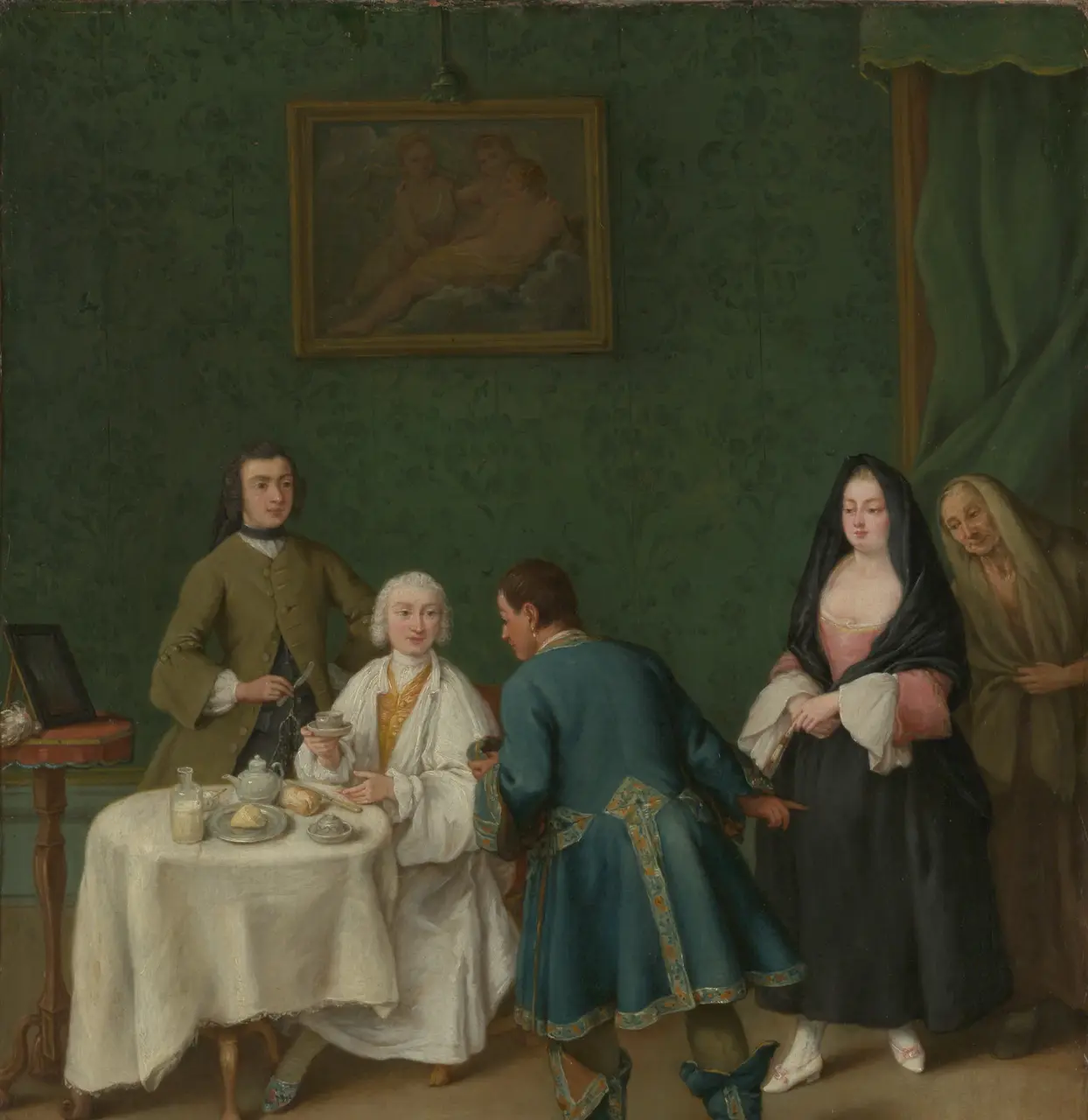
 The Beneficent Bearby Carlo GoldoniA gruff old man who growls at everyone turns out to have the kindest heart in Paris.
 A Curious Mishapby Carlo GoldoniA rich merchant helps a penniless officer elope with a young lady, not knowing she is his own daughter.
 The Fanby Carlo GoldoniA fan bought as a lover's gift passes from hand to hand through a village, setting everyone at odds.
Act 1, Scene 1
Count.
At last I am determined to marry. How! I marry! I, who have always avoided expense! I, who have detested all intercourse with ladies! Well, in this case, I am hurried away in my own despite. Ambition has induced me to obtain a title; therefore, should I die without children, my money is lost! and children themselves will but bring trouble! [Calls.] Frontino!
Act 1, Scene 2
Enter Frontino.
Here, sir!
Hark ye!
I have found a tailor, sir, as you ordered me; and a tailor of the first notoriety.
Will he come directly?
Very soon. He was obliged first to wait on a duke. I was lucky enough to find him at home when he was about to step into his coach.
His coach?
Yes, sir.
His own coach? His own horses?
Beyond all doubt. A superb carriage, and excellent nags.
O Lord! He's too rich. Is he in repute?
In the greatest. He works for the first families in Paris.
But his honesty?
On that subject I have nothing to say. But why, Signor Count, did you not employ your own tailor?
Fie! My own tailor on such an occasion! I have need of several suits; and, as they must be grand, magnificent, and made to perfection, shall I, if any one should ask who is my tailor, shall I answer, "Signor Taccone," whose name nobody knows?
Then, sir, from what I hear, you are soon to be married?
So soon, that this very day, and in this very house, I am to sign the contract: I have therefore called you to give the necessary orders. On this occasion, I shall have a large company to dine with me, and must have such a dinner--in short, brilliant! grand! splendid! Not that I would satiate the indiscreet, or gorge my guests; but I would surprise, by an air of grandeur--you know what I mean?
Yes, sir, tolerably well; but to do all this will not be quite so easy. I must inquire whether the cook
No, no, Frontino; I would not have you dependent on the caprice of a cook. Take the direction of everything upon yourself. I know your talents, the readiness of your wit, and your zeal for your master's interest. There is not in the whole world a man like Frontino! You can work miracles; and on such an occasion will surpass yourself.
[Aside.] Ha! his usual mode. Coaxing me when he wants me; but afterwards
Here is a list of the guests whom I have invited. My sister lives in this house, and my future spouse and her mother have the adjoining apartments. Here is a note of the other guests. We shall be thirty at table. Hasten to them all, and get a positive answer from each, that, in case of refusals, other persons may be invited.
Thirty guests! Do you know, sir, how much a dinner for thirty will
Perfectly; and will employ your discretion to combine economy and magnificence.
For example, you gave a supper a few nights ago to three gentlemen, and
Ay, that was a trifle; at present I would be talked of.
But this trifling supper you thought so dear that
Lose no time in useless words.
You threw the account in my face, and have not yet
Here is my sister. Begone!
[Aside.] O Lord! what will become of me? This time, friend Frontino, by way of recompense, prepare yourself to be kicked out of doors. [Exit.]
Act 1, Scene 3
Enter Dorimene.
Good morning, dear sister; how do you do?
Perfectly well. How are you?
Never better. Fortunate and happy man! I am to possess a bride of high birth and merit.
Then you are determined in favour of Eleonora?
Ay, sweet sister! She is your relation; you proposed her to me, and I therefore have reason to give her the preference.
[Ironically.] Her and her portion of one hundred thousand crowns, with as much more perhaps at the death of her mother.
You will allow, sister, that such conditions are not to be despised.
True; but you, who are so
I understand you. A man like me, having sacrificed a considerable sum to obtain a title, should have endeavoured to marry into an illustrious family. I have thought much, and combated long this reigning inclination, but I know the prejudices of the old nobility; I must have paid dearly for the pompous honour of such an alliance.
That is not what I wish to say.
I am determined to marry the charming Eleonora.
But if the charming Eleonora should feel no love for you?
My dear sister, I do not think myself a person to be despised.
But inclinations are capricious.
Has Eleonora told you she cannot love me?
She has not precisely told me, but I have great reason to doubt it.
[To himself, vexed.] This is a little strange.
Why are you angry? If you take in ill part
No, no; you mistake me. Speak freely and sincerely.
You know the confidence you have placed in me. Having discoursed together concerning this family, I wrote to Madame Araminta, inviting her and her daughter to pass a few days at Paris.
And they have been a fortnight with you. This I know must give trouble, and bring expense; and as you have done it for my sake--I--my duty--my obligations are eternal.
By no means, brother. The expense is trifling, and the inconvenience small. I love this family, and, beside being related to my husband, am greatly interested in its behalf. Eleonora is the best girl on earth, and her mother is no less respectable. A good heart, economical, and to the most exact economy she unites prudence and regularity of conduct.
Excellent; and so has been the education of her daughter. But now tell me
Sincerely, brother, in my opinion, Eleonora loves you neither much nor little.
On what do you found this strange suspicion?
I will tell you. When your name is mentioned, she looks down and gives no answer.
Bashfulness.
When she hears or sees you coming, she is in a tremor, and wishes to hide herself.
At her age that is not extraordinary.
When this marriage is mentioned, the tears are in her eyes.
The tears of a child? Can anything be more equivocal?
And though so equivocal and so full of doubt, will you dare to marry her?
Certainly, without the least difficulty.
It seems you love her to distraction.
I love--I do not know how much.
You have scarcely seen her twice.
Is not that enough to a feeling heart like mine?
Ah, brother, I know you.
Your penetration is a little too quick.
I do not wish that you should hereafter have to reproach me.
Yonder is Frontino.
If you have business
[With affected kindness.] Will you go?
We shall meet again soon. I only wish you to think a little on what I have said, and before you marry
Fear nothing, dear sister. Do me the pleasure to dine with me to-day. I will send to invite Madame Araminta and her daughter. We shall have many guests. The notary will be here after dinner, and the contract will be signed.
To-day?
No doubt: Madame Araminta has pledged her word.
[Ironically.] I give you joy.--[Aside.] I will never suffer Eleonora to sacrifice herself for my sake. If I could but truly understand her heart--I will try. [Exit.]
Act 1, Scene 4
The Count, and then Frontino.
Poor girl! A little too diffident of me. Does not think me capable of subduing a tender and inexperienced heart! Besides, she carries her delicacy rather too far: in marriages of convenience, not the heart, but family interest is consulted. Well, Frontino, what have you to say?
The tailor is come, sir.
Where is he?
At the door, sending away his coach, and giving orders to his servants.
His servants?
Yes, sir.
Apropos: that reminds me that you must write immediately to my country steward, that he may send me six handsome youths, tall, well made, the best he can find on the estate, that the tailor may take their measure for liveries.
Six clowns in liveries!
Yes, to honour my wedding. Tell the steward that all the time they stay here, their country wages shall be continued, besides having their board. You know this sort of people take care not to overload their plates.
Never fear, sir, they will not die of indigestion.
Hold. Take the key of the closet where the plate is kept; let it be displayed, and all brought on the table.
But, sir, your plate is so antique, and so black--it will be necessary at least to have it new polished.
Oh, silver is always silver. Here comes the tailor, I suppose.
Yes, sir. Enter, Signor, enter.
Act 1, Scene 5
To them the Tailor.
I am the most humble servant of your most illustrious lordship.
Come near, sir. I was impatient to see you. I want four suits for myself, and twelve liveries for my servants.
It will do me honour to serve you, and have no doubt but it shall please you.
My master pays well.
I have the honour of knowing him. Who is it that does not know the illustrious Count Casteldoro?
The occasion requires all possible display of splendour.
I will show you stuffs of gold and silver.
No, no; I do not wish to look as if caparisoned in gilded leather. The dresses must be noble and rich, but nothing with a shining ground.
You prefer embroidery?
I do; four embroidered suits, but in the best possible taste, the patterns rich and delicate.
[Aside.] Hey-day! I do not know my master.
Rich, but light embroidery?
No, sir: Spanish point--ample, massive, and of the best workmanship; well designed, splendid, but nothing that shines.
Everything that you can desire. Shall I take your measure?
Yes--on one condition.
What is it?
[Aside.] Ay, let us hear the condition.
You must tack on the embroidery slightly, that it may not be spoiled. I would have no buttons of false diamonds. I shall wear my four suits each of them twice during the first eight days of my nuptials, so that your embroidery will still be new, and may again be sold as such. You must now tell me what you will charge for the cloth, the making, and the use of your ornaments.
[Aside.] Yes, yes, he is still himself.
But first concerning the liveries.
With your permission, I wish to have the honour of speaking to you in private.
[Angrily to the Tailor] If I must not stay, I can go.
By no means. Frontino is part of the family: you may speak before him.
[To the Tailor] You see, sir! Hem!
No, friend; I did not mean you, but--look to see if we have no listeners. [Slily gives Frontino a crown.]
[Aside.] A crown! It is long since I had so much.
Sir, I comprehend the nature of your project. You are not naturally inclined to pomp; but, sagacious and prudent as you are, you willingly sacrifice to appearance and convenience. I esteem myself most fortunate in having the honour to serve you. I admire gentlemen who think like you, and laugh at those who ruin themselves, while I give them every aid in my power, that they may be ruined in style. In me you have discovered the only man fit for your purpose: set your heart at rest; I have the means to satisfy you.
[Aside.] If I do not mistake, this is a most smooth-tongued, artful--[Aloud.] Well, then, you will make my four suits!
Pardon me, sir, your idea is not practicable. I could not avoid paying extremely dear for the embroidery; and my delicate conscience would never permit me to sell it again as new.
[Aside.] His delicate conscience! Why did he come to me?
I will confide a secret to you which I have treasured jealously; for, were it known, I cannot tell you how much it would prejudice my character and credit. I, who am the court-tailor, tailor to the principal nobility of Paris, I secretly, and under a borrowed name, carry on a flourishing trade in old clothes.
An old clothesman keep his coach?
Which is maintained by that very means.
[To the Count] You see, sir, I have found you a man of sincerity; a man whose heart is as open as his face; a man who merits all your confidence.
[Aside.] I perceive.--[Aloud.] Should I find this to be to my interest?
I will show you two dozen of most magnificent suits, all new, that never were worn but once or twice at the most.
Will they be known again?
No danger of that; everything that enters my magazine assumes a new face. I export the most splendid samples that France produces, and I import the spoils and riches of the principal cities in Europe. You shall see suits the most superb, and stuffs of the greatest rarity. It is a pity you will have neither gold nor silver.
Nay, should it be anything of uncommon beauty and taste, gold and silver would not offend me.
To be sure, if the streets were to be paved with gold, we must walk.
But the price.
See, admire, and select; act just as you please.--[Aside.] I have found the very man I wished for.--I will soon be back, dear sir.--[Aside.] Paris is the place; everything a man wants is there to be found.
Have you by chance anything that will sit genteel, and make me look like a gentleman's gentleman?
[Aside.] I will clothe you from head to foot, only be my friend.
Your friend! On such conditions, who could refuse?
Act 2, Scene 1
Dorimene and Eleonora.
Come here, my dear Eleonora; I wish to speak to you alone. My brother, I believe, is gone out. [Looks out.] He is not in his cabinet.
[Aside.] What can she have to say? She has a friendship for me, but I believe her interest is more for her brother. I can expect no consolation.
We are alone, and may speak freely. Permit me first to observe that within these few days you have had a serious, melancholy air, which seems but little to suit your expectations.
It is natural to me, Madame; more or less, I am always so.
Excuse me; but on your arrival at Paris you had no such gloomy expression. You are entirely changed, and certainly not without cause.
But really there is no such change.
My good young friend, you conceal the truth, and want confidence in me. Be a little more just, and rest assured that, though I proposed a marriage between you and my brother, no foolish ambition makes me wish it should succeed at the expense of your heart. Tell me openly what are your wishes; speak freely, and you shall see whether I am your friend.
[Aside.] If I durst, but--No, no.
Have you any dislike to my brother?
I have not long had the honour of his acquaintance, Madame.
His age, for example, may seem a little too great when compared with your own.
The age of a man does not appear to me a thing of great importance.
You perhaps think that my brother is rather too economical.
You know, Madame, I have been educated in economy.
If so, my dear Eleonora, to my great satisfaction, I have been entirely mistaken, and you will be perfectly happy with my brother.
I!--Do you think so?
No doubt; it cannot be otherwise. I have questioned you with the best intentions, and you have answered--sincerely, as I must believe.
Oh, certainly.
Then be at peace; your heart tells me you will be happy.
[Affected.] My heart, Madame!
Your heart.
Ah! I do not understand my own heart.
Why are you so much moved?
[Looking off the stage.] Did not some one call me?
Called? Where? By whom?
[Going.] Perhaps my mother--perhaps somebody
No, no; pray stay. Your mother knows you are with me, and therefore cannot be in fear. I have something more to say to you.
[Aside.] How difficult to disguise my feelings!
Remember, your heart has told me
[Timorously.] What, Madame?
You are in love with another.
[Confused.] I, Madame!
You; your blushes confirm it.
[Aside.] Heavens! have I betrayed myself?--[Aloud.] You will not tell this to my mother? I shall be lost!
No, no; fear nothing. Though you have discovered that you cannot confide in me, I love you tenderly, and am incapable of giving you needless pain. Here your mother comes; let us consider between ourselves.
Ah, Madame! [Embracing.]
Act 2, Scene 2
Enter Araminta.
Well, child; I fear you are troublesome.
Pardon me, but
We are friends, and I entreated her to keep me company.
You are kinder to her than she deserves. I cannot understand her; she is become so melancholy and dull.
The air of Paris may not agree with her.
Do you think so? Since she left the place of her education, she is no longer the same. Nothing pleases, nothing diverts her. Music, reading, and drawing are all forsaken. I have spared no expense, and have taken no little delight in perceiving her progress; while, at present, I am equally surprised to see her thus negligent. I willingly incur expense for any good purpose; but no one can be more angry than I am at squandering money.
[Aside.] It is very true. I no longer know myself.
Nay, Madame.
If she wishes to return to her retirement, why not say so?
Oh, no, Madame; she has no such wish.
But why, then, child, are you so gloomy, so indolent? You are soon to be married, and to direct a family; this requires activity, attention, and order, as you may see by my example. I am busy from morning to evening, here and there, going, coming, helping, commanding, and sometimes obliged to find fault; but, by these means, all goes well.
[Aside.] I hoped to do the same, but all my hopes are flown!
Oh, Madame, when your daughter's heart shall be at ease
At ease! What does she want? Is not the marriage contract to be signed to-day?
Here comes my brother! He can best inform you
[Aside.] How miserable am I!
Act 2, Scene 3
Enter the Count and a Jeweller.
I am happy, ladies, to find you together. I came purposely to ask your advice.
On what subject? Ladies are sometimes excellent advisers.
[To the Jeweller] Show your case of jewels.
[Aside.] Jewels! He may well ask advice in such articles; it is easy to be cheated.
[Presenting the case to Dorimene] Please examine if there can be purer and more perfect diamonds.
Pray give me your opinion.
I think them admirable! What say you, Eleonora?
[With indifference.] I do not understand such things.
I do--show them to me. Though I never wore any diamonds, trade has made me well acquainted with them. [Taking the case.] These are fine, indeed! Perfectly assorted, and of a beautiful water. What is their price?
Oh, that is a secret between ourselves. [To the Jeweller.] Is it not?
My lord--I have nothing to say.
[Aside.] So much the worse; the Count will be the more easily imposed upon. He comes to ask advice, and then refuses to hear it.
[Apart, to the Jeweller] My good friend, will you trust your diamonds with me three or four days?
[To the Count] If the ladies think them good, and well chosen, I should prefer
Nay, friend; jewels of this value must not be purchased without reflection. Knowing me, you cannot be afraid.
By no means! They are at your service.
Be pleased to return at the end of the week. I know the price, and you shall then have the money or the diamonds.
I am much obliged to you, Signor. [Exit.]
Act 2, Scene 4
[Aside.] Excellent! just as I wished!--[To Eleonora.] Will you do me the favour, Madame, to wear the jewels I have the honour to present you, at least for to-day.
To-day?
It is the day on which we are to sign the contract, and we shall have thirty persons at table.
Thirty!
At least, Madame.
[Aside.] He will ruin himself! But I will hear more.
[Presenting the case to Dorimene] Dear sister, let me request you to take this case, and to kindly be present at the toilet of this lady, to assist in arranging the diamonds. Will you do me the pleasure, charming Eleonora, to accept my sister's aid?
[Coldly.] My mamma never wears diamonds.
Do not be silly, child. I did not wear diamonds, because my husband was too prudent to indulge in such expenses; but, if the Count think differently, complaisance requires your acquiescence.
But, you know, mamma
Oh, I know--I know, child! You do not know good breeding. Accept them gratefully.
[Aside.] Unhappy me!--[To the Count.] Signor--I am greatly obliged.
[Apart to the Count] Are you satisfied with such a cold manner?
Perfectly.
Have you no dissatisfaction; no fears?
Not the least.
[Aside.] What a singular man is my brother?
Act 2, Scene 5
Enter Frontino.
Here is a letter, sir.
With your permission, ladies.
By all means. [To Dorimene.] Let us examine the jewels a little.
[To himself, having read the letter.] The marquis comes at an ill time! After a dinner of thirty guests, I must give him a supper! He asks it with so little ceremony too! How can it be managed?
What is the matter, brother?
[Affecting cheerfulness.] Nothing, nothing. I have just received news which gives me pleasure. The Marquis del Bosco is arrived, and coming to sup with me this evening.
[Agitated.] What do I hear?
I know the Marquis; his county seat is not three miles distant from mine.
You will see him this evening, with the Marchioness his daughter, and the Chevalier his son.
[Still more agitated.] The Chevalier! O Heaven!
I hope they will be in time to be present, when we sign the contract.
[Still aside.] Fatal trial! How shall I support it?
What is the matter, daughter?
Nothing--not much--a sudden giddiness.
[To Araminta] For Heaven's sake, take care of--[To Frontino.] Don't go.
The open air will revive her.
Let us walk into the garden.
By all means.
Is the door open, brother?
No; but here is the key.
[Aside.] He will trust it to nobody, but has it always in his pocket.--Come, Eleonora.--[Aside.] This may be a proper opportunity. [Retiring with Eleonora.]
[To Araminta] I hope, Madame, this attack is trifling; but the young lady should not be exposed to the least danger. If you think proper, we will defer the dinner of to-day, and have a supper instead.
Just as you please--but your dinners and suppers--I have much to say to you on such subjects. My daughter may want me; I will return presently.
Act 2, Scene 6
[Earnestly.] Hark ye, Frontino! send messengers immediately, to inform the guests I have invited that, instead of dinner, I entreat them to honour me with their company at supper.
So, so! But it will be difficult to find them all, so late in the day.
No matter. Those who may come to dinner must be told of the change. They will return to supper, or not, as they please.
Yes, Signor.--[Aside.] Admirable! quite in character! [Exit.]
This visit comes at a lucky time! Nothing could be more fortunate.
Act 2, Scene 7
Enter Araminta
Well, dear Madame? Eleonora?
All, I hope, will be well.
Then I shall be happy; for health should be our first care. I have sent round to the guests, with an invitation to supper this evening.
Thirty persons at supper!
I hope so, Madame.
Permit me to speak openly, and tell you all I think.
You cannot give me greater pleasure.
Is it not extreme folly to assemble thirty persons, twenty of whom, at least, will make a jest of you?
A jest of me?
Beyond all doubt. Do not think I am avaricious; thank heaven, that is not my defect; but I cannot endure to see money squandered.
But, on such a day, and under such circumstances.
Are they your relations, whom you have invited?
By no means. A select company; the nobility! the literati! the magistracy! all persons of distinction.
Worse and worse! Vanity, ostentation, folly! My good friend, you do not know the value of money.
[Smiles.] I do not know the value of money!
Alas, you do not! Your sister made me believe you were economical; had I known the truth, I should never have married my daughter to a spendthrift.
So you think me a spendthrift!
I first perceived it by the considerable sum you threw away in the purchase of a title; which sacrifice to vanity has no beneficial end.
How! Are you not aware the rank I have acquired will impress a character of respect on myself, your daughter, and our descendants?
Quite the reverse. I would have rather given my daughter to you, as Signor Anselmo Colombani, a well-known merchant, than to the Count of Casteldoro, a newly-made nobleman.
But, Madame
Your ancestors have saved what you will scatter.
Scatter! I! You are mistaken, Madame. You do not know me.
Oh yes, yes. I saw the manner in which, without any knowledge of diamonds, or asking the least advice, you were led away by the jeweller.
Oh, with respect to the diamonds
Ah, ay! I know your answer. They are to decorate the Countess of Casteldoro. And who is the Countess of Casteldoro? My daughter, Signor, has been well educated, but with no such expectations. Everything has been done in abundance, that could contribute to convenience, decency, and information; but nothing to pomp and vanity. The ornaments of my daughter ever will be modesty, obedience, and that self-respect which she could not but acquire from such an education.
[A little moved.] But, Madame
[Very warmly.] But, Signor--[softening]--I ask your pardon--Perhaps you may think me too warm; but I see you hurried into a gulf of expense that makes me tremble. My daughter's happiness is concerned: I give her a hundred thousand crowns in marriage.
[Somewhat haughtily.] Am I not able to settle an equal sum upon her?
Yes, at present. But wealth will diminish; and especially when we have the vanity to be profuse, grand, and magnificent.
I once more assure you, Madame, you do not know me.
Signor, had you been a different person, I had conceived an excellent plan. My annual income is five-and-twenty thousand livres: I might have lived with you and my daughter, and the two families might have become one; but, at present, Heaven preserve me from taking such a step!
[Aside.] She will drive me mad!--[To Araminta.] Pray hear me. [Whispering and cunningly.] You mistake my character. Few people indeed understand economy so well as I do, as you will soon be convinced. I willingly close with your proposal, and
By no means! You try in vain to persuade me against conviction. Respecting my daughter--I have promised--we shall see--but for myself it is different. Not all the gold on earth should induce me to make such an arrangement, with a man who does not know the use of money, but lets it slip through his fingers faster than flour through a sieve. [Exit.]
This is admirable! I never imagined I should pass for a prodigal. [Exit.]
Act 3, Scene 1
The Count and Frontino.
Frontino.
Signor?
Go and inquire how Eleonora is.
One of your guests is without, and desires to speak with you.
Who is he?
The young gentleman who lately read you a comedy written by himself.
Oh! Signor Giacinto. Bid him enter.
Please to come in, Signor. [Exit.]
Act 3, Scene 2
Enter Giacinto.
Good morning, Signor Giacinto. I am very sorry that the messenger, sent by me, did not find you at home; he came to inform you that an accident has caused me to put off the dinner, but that I hoped to see you at supper.
It is just the same to me, Signor. Meanwhile, permit me the honour to
I hope to see you without fail this evening.
I am infinitely obliged to you; but, having now the good fortune to find you alone, and at leisure, I wish to lay before you certain alterations made in the dedicatory epistle; as I have nothing so much at heart as your satisfaction.
Well, Signor Giacinto, since you are absolutely resolved to dedicate your comedy to me, I have thought--it would be best to inform you--of certain particulars respecting myself. Not from vanity--oh no! Heaven preserve me from that!--but solely to give an opportunity to your eloquence, and lustre to your work.
You see, Signor, I have made a good use of the materials which you have so kindly furnished; but I have done something more.
Have you mentioned my pictures?
Oh yes.
And my library?
Certainly.
Including the books which I told you I intend to purchase?
But--Signor--a catalogue of books in a dedication
Where is the difficulty? You may say, in a note at the bottom of the page, the Count of Casteldoro possesses a superb library, of not less than ten thousand volumes. A man of wit, like you, knows how to take advantage of everything. The supper of this evening, for example, may furnish some new ideas--something animated, witty, poetical.
That may be possible; but I have been employed on a subject more essential: I have written your genealogy.
[Coldly.] My genealogy? No, no, friend. I have no taste for that science. You might, I grant, say things that should happen to do me honour; but I am an enemy to vanity, and would prefer reticence, especially on the question of genealogy.
As you please; but I have made discoveries that have cost me much time and study, of which I thought you might wish to be informed.
[With curiosity.] Discoveries that relate to me?
That relate to you, Signor.
My dear Signor Giacinto, let me hear.
Your true family name is not Colombani.
I grant it may have been changed.
Do me the favour to listen. The great Columbus, who discovered America, and who was ennobled by the king of Spain, had two brothers, and various relations. Now, in looking through authors to discover annotations for my Life of Petrarch, I found that one of the relations of Christopher Columbus went from Genoa, his native place, to the city of Avignon, in France. By corruption of the termination, I find the name of Colombo or Columbus, has been changed to Colombani; and I demonstrate, beyond all doubt, that you are a descendant of that ancient, illustrious family.
[Much pleased.] You have demonstrated it?
Here are my proofs. [Presenting papers.]
[Receiving them.] From the little I can now recollect, I believe you are right. Ay, ay; it might be. I do not love ostentation, as you perceive, but I shall be highly pleased if your discovery can do yourself honour; I therefore have not the courage to forbid the publication. Have you presented your comedy to the comedians?
Yes, Signor.
And they certainly received it with approbation?
On the contrary, Signor, it has been peremptorily refused.
Refused!
You have heard it read: does it deserve such a reward?
If the comedy be good, why is it refused? Their interest should oblige them to accept it, with thanks.
What can be expected from such ignorant judges? But I will have my revenge! It shall be printed! The public shall decide!
Bravo! You are right; have it printed. It might not be greatly successful on the stage, but in the closet it will delight. Your sale will be prodigious.
Since you approve and encourage me, Signor, would you but have the goodness to pass your word for the expense of printing, and
[With a determined tone.] There is no need of that. Apply to a good bookseller; let him have his profits, and he will answer for the whole.
To speak the truth, Signor, I have in vain applied to more than one. At last, a bookseller has agreed that, if the Count of Casteldoro will make himself responsible, he will undertake to publish it on my account.
How! Have you mentioned my name?
I could not avoid it.
You have done very ill. Should it be known that I take an interest in the comedy, it would be said I did so because of the dedication; and I should then appear ridiculous. Drop all thoughts of the press at present; a more favourable opportunity may occur.
But, Signor
Act 3, Scene 3
Enter Frontino.
Well, Frontino, what answer?
The young lady is rather better, Signor.
Rather better! But is she well enough to--I will go and inquire myself.--[To Giacinto.] You see, Signor, a young lady is ill in my house, and the supper must be deferred. Another time. [Going.]
Then if the manuscript be useless, Signor
True; it shall be returned. [Going.]
I beg you to recollect the time and trouble it has cost me.
[Returning the manuscript.] Very right! You are fond of your own works: I am glad they give you satisfaction, and cannot but thank you for any labour taken on my account. Whenever I can serve you, pray command me.
Infinitely obliged to the generosity of Signor Count Casteldoro.--[Aside.] What ingratitude! Sordid fellow! He shall pay for this, or I am mistaken. [Exit.]
One guest the less. But I must inquire after Eleonora. [Going.]
[Without.] Ho, there! Is nobody to be found?
This is Fiorillo, the servant of the Marquis.
Act 3, Scene 4
Enter Fiorillo, in a travelling dress.
[Bows.] Signor Count, my master, the Marquis del Bosco, is coming. I rode before, as you perceive, to inform you that his carriage will soon arrive.
[Coldly.] Arrive! What, here? And in his coach? Does he come to make any stay?
No, Signor. To-morrow morning he must be gone to Versailles; for he has affairs at court.
[Aside.] I am glad of it!--[Aloud, pompously.] I hope the Marquis will do me the honour to remain with me to-night, in company with his son, the Chevalier. With respect to the Marchioness--I'll speak to my sister, and hope she may also be accommodated, as becomes her rank.
The Marchioness del Bosco does not come with her father; she is with the Countess d'Orimon, her aunt, and is to remain at her house.
[Aside.] So much the better.--[Aloud.] That is unfortunate. I hope, however, I shall have the pleasure of seeing her. [Exit.]
Act 3, Scene 5
Frontino and Fiorillo.
Your master, like your kitchen, smells well!
We are to have a magnificent supper to-night; no less than thirty guests.
Indeed! Your master is superb. A rare service! Much to eat, and little to do! Then, as to wages, you will make your fortune, Frontino!
Fortune! I can't say--perhaps!
You have been long with this master.
Very true; I have an attachment to him.
And so have I to mine, but without the hope of saving a farthing in his service. If it were not for the profits of the card-tables, I should certainly leave him.
Then you have much play?
A great deal.
And no less profit?
Hum--tolerable; but not equal to you.
I! Shall I speak plain to a fellow-servant? I have little wages, and no tips.
Then you are foolish, Frontino. In Paris, so clever a fellow as yourself may find a hundred services, in which he might profit in a hundred different ways.
Do you know any one?
Certainly; but you are attached to your master?
To part with him would not break my heart.
If he pays so ill, he does not like you.
That's a mistake; I am his prime minister and favourite.
What do you mean? Were he miserly, so be it; but a generous
Generous! You little know my master.
How so? A supper for thirty guests
Ah, did you know what it will cost me!
You! Cost you!
Me. Grumbled at, cross-questioned, put to the torture, almost afraid of my life, when I give in my bill. I tremble but to think of it!
So, so! Very different with us; our master is easily satisfied, and always gay and good-humoured. He has an odd manner of speaking, indeed, and never tells you more than half what he means. He has favourite words, which, right or wrong, he always uses. Everybody laughs at him, and he laughs at himself.
I wish I had such a master!
The worst of it is, he is poor, and seldom has any money.
Yet you say he plays?
Very true; he always finds money for that. I hear a coach.
Which way does he
[At the window.] Be quiet! Yes, they are here.
I want to hear more.
Run and tell your master.
[Aside.] I shall hear it all; he can't hold his tongue. [Exit.]
Frontino is a good fellow, but he talks too much; that's his fault.
Act 3, Scene 6
Enter the Marquis.
Where is he? Where is the Count?
His servant is gone to tell him you are here.
Go, go; see--Good, good, excellent!--His servant?
Will soon be back.
Meanwhile--My horses--Nothing to eat--Poor devils--They have done--Good, good, excellent! You might go and see
Yes, at once.--[Aside and going.] I defy all the servants in the world to understand him as I do. [Exit.]
Act 3, Scene 7
Enter the Chevalier.
My dear father! How can I thank you for all your kindness?
Say no more--father to be sure--But with you, in truth--You are strange sometimes.
Most true! Had you not discovered my passion, I scarcely should have dared to own it.
Keen eyes--Why not, dear boy? Why not? and then I know that Eleonora--Do you know her mother?
I am slightly acquainted with her, but not enough to speak on such a subject.
A lady that--Are you at least sure of the daughter?
Perfectly. I have met her at her cousins, and--we have corresponded.
Good, good, excellent! We shall want--The Count is my friend.
And I am acquainted with his sister, Madame Dorimene. I will beg her to entreat for me. Here comes the Count.
Act 3, Scene 8
Enter the Count.
Pardon me, Marquis, but
Ah, Count! Good day--Good day--Your health--Mine--you see--splendidly well, at your service.
Still the same! Always courteous!
Oh, I ... Good, good; excellent!
And you, Chevalier?
Always your humble servant.
Is the Marchioness with you?
My daughter? She has come with--You know her aunt?
Yes, I have the pleasure of knowing her, and will call and pay the ladies my respects--I hope to have the honour of their company at supper.
Always obliging--Good, good, excellent!--Ought to apologise--Come suddenly--No ceremony, I beg.
None on earth. I shall only give you my ordinary supper.
Good, good, excellent! Family meals--friendly.
Your apartments are here, on the right. They tell me you go to Versailles to-morrow.
Yes--because
I am sorry to lose you so soon: but, as I was saying, these apartments shall be yours.
Permit me, Signor Count, to pay my respects to your sister.
You will do me an honour, and give her pleasure.
[To his father.] Have I your leave, sir?
Certainly.--[Aside.] Poor fellow! He is--but when I was like him--yes, I did as he does.
We may all go together, if you please.
Ha!--[Aside.] No; must not spoil sport.--[Aloud.] Go by himself.
[Going.] I know my way.
You will meet a young lady there, with whom perhaps you are acquainted.
[Eager to go.] Indeed? So much the better!
I have something to tell you concerning her, which perhaps you do not know
[Aside.] Too well! I am on the rack!
But which you will be glad to hear.
[Aside.] Heavens! Perhaps Eleonora may have discovered our passion to her mother--I rush to see. [Exit.]
Act 3, Scene 9
Count and the Marquis.
[Looking round.] Now we are alone--Have you time?
I am at your disposal.
You are my friend.
The title does me honour.
Good, good, excellent!
[Aside.] He is sometimes very ridiculous.
I should like to beg you--but--a friend, unceremoniously, freely.
[Aside.] I bet he wants to borrow money.
You know my family
Perfectly.
I have two children, and must think--a daughter too--Good, good, excellent!--The Chevalier is at an age--you understand me?
I believe I do. You are seriously thinking of establishing your family, which is highly commendable. And, talking of establishments, I think it but right in me to inform you of my approaching marriage.
Oh, oh!--that way inclined--you too--Good, good, excellent!
I am this day to sign the contract, and think myself fortunate that you, Signor Marquis, will be present, and
Very happy--but, at the same time, if you would be so kind
You well know, Signor Marquis, the various expenses of these occasions; they are endless. To own the truth, I find my pocket empty.
Good, good, excellent!
Good! I find it exceedingly ill.
Listen--You are the friend of Madame Araminta.
True; and she, for example, is remarkably rich; she might be of service to your house.
Precisely so--my very thought--would you but speak to her, but without--What is her daughter's name?
Eleonora.
True--bad memory--Eleonora.
[Aside.] If I had not a great deal of penetration, I could never guess what he means.--[Aloud.] I will speak privately to Madame Araminta.
Ay, but--in a particular manner--so that--you understand me?
I will speak with all possible caution, and hope she will comply--provided she has good security.
By Jove! If she gives me--I have not--I am not--but--my estates
What sum do you wish?
I heard that--ay--a hundred thousand crowns--quite satisfied!--would not wish for more!
[Aside.] A hundred thousand crowns! the loan is too great! She will scarcely consent to that.
When will you speak? Because when I have a project--no sooner said than done--it is in my nature.
I will inform her to-day.
And you hope she--Good, good, excellent!
I think Madame Araminta will comply, if possible; first out of regard to yourself, and next to me, who am on the point of becoming her son-in-law.
Ha!--what?--you?
I am to marry her daughter.
Marry!--when?--that true?--that possible?
Why so excessively surprised, Signor Marquis? Do you see any reason to the contrary?
I--no--[Aside.] My son!--Fine affair!--Stupid folly!
Madame Araminta intends indeed to give a hundred thousand crowns with her daughter, but do you think she will therefore not have so large a sum to lend you?
Lend me!--Zounds!--Lend me!
Act 3, Scene 10
The Chevalier, making signs of disappointment and silence to the Marquis, enters and goes off without being seen by the Count.
But, if you please, I will speak to her.
[To the Chevalier] Yes, yes, I understand.
[Supposing the answer was to himself.] And will tell her
By no means--don't think--no, no.
Yes and no! I do not understand you, Signor.
Lend me!--to me?--I am--it is true--but then I am not--Good, good, excellent!--I am not
If you will excuse me, I have business. Those are your apartments.--[Aside.] I never met such a ridiculous man. [Exit.]
The devil take him--he doesn't know what he is talking of. [Exit.]
Act 4, Scene 1
The Chevalier and Fiorillo.
While my father rests, I will visit my sister; tell him this, when he wakes.
Yes, Signor.
Do you know whether the Count is at home?
Yes; I saw him just now going to speak with Madame Dorimene.
[Aside.] Surely he is not a rival to be feared. At least, I am secure of the heart of Eleonora, and will not yet despair of gaining her mother. [Exit.]
So, young gentleman! I see how it is with you. I pretty well guess your intentions, and how they are thwarted. Ay, ay, I shall have enough to satisfy the curiosity of Frontino. [Sits down near the door of his master's rooms.]
Act 4, Scene 2
Enter Count.
[Not seeing Fiorillo] I am tired, bored! Nothing but indifference; and, instead of perfect satisfaction, something like contempt. A man like me, who had but to choose! so advantageous a marriage! [Seeing Fiorillo.] Is the Marquis at home?
Yes, Signor; being rather fatigued with travelling, he is taking a nap.
[Aside.] How amiable is his daughter! How charming! I felt affected and confused at the courtesy and kindness with which she and her aunt received me. The visit made me cheerful, happy, and reconciled to myself. What difference between the politeness of these ladies and the common and trivial manner of Araminta and her daughter; who neither understand civility nor good breeding. Ah! were the young Marchioness but as rich as she is handsome and engaging--who knows? I have a thought--should her father but be reasonable and easy to manage--Here he comes.
Act 4, Scene 3
Enter the Marquis.
[Rubbing his eyes and calling.] Fiorillo!
Signor?
My son?
He is gone out.
Why did not he--where is he gone?
To visit the Marchioness, his sister.
I too wish--my coach!
The horses, Signor
[Angry.] Good, good, excellent! My coach!
I will go and see. [Exit.]
Act 4, Scene 4
The Count and the Marquis.
Do you wish to go out, Signor Marquis?
See my daughter--much to say--tell her--Good, good, excellent!
I have just had that honour. It was long since I had seen her. She fully answers the charming promise of her childhood; her sweetness has increased with her years, and the progress of her talents is wonderful. Permit me to congratulate you on possessing such a treasure.
Oh, Count--ay, ay; a good girl. She has not, let us confess it--but--character, manners--good, good, excellent!
With such talents, so much merit, and blooming eighteen, you should think of a husband for her.
No doubt. For my part, I--apropos: what has just passed--what did you mean to say when--Did you not say lend me?
It appears to me that you suddenly changed your opinion.
I tell you, no--it was not so. You have not--And yet I spoke plainly.
In any case, Signor Marquis, I shall be happy to serve you. I have not spoken to Madame Araminta; for, to own the truth, I am not quite pleased with her daughter. I begin to feel a certain dislike.
Oh, oh!--That means--Well, why not?
I have done everything to gain their esteem and friendship. A house so richly furnished, carriages and horses the most rare, diamonds worth a hundred thousand livres
Is it possible?
'Tis true; they were shown. Madame Araminta was amazed.
Grand!--Superb!--Good, good, excellent!
Injustice and ingratitude have been my reward.
Good, good, excellent!
[Aside.] Curse the phrase!
[Aside.] In that case--if Eleonora--if my son--[Aloud.] If so, Signor Count--candour--frankly and freely tell them--You understand me? Cut matters short.
Had I paid these attentions to a lady of rank and merit, I should have acted much more wisely.
Ay, ay--if--certainly.
Do you think a man of rank and fashion, a man like yourself for example, would refuse me the hand of his daughter?
On the contrary. A person of worth--a person that--oh, what do you mean? Certainly not.
Signor Marquis, you encourage me.
Oh, I--If so--I'll go this moment!
Where, signor?
To my daughter. [Calls.] Fiorillo!
And may I hope?
[Calls louder.] Fiorillo!
Act 4, Scene 5
Enter Fiorillo
My coach.
The coachman is not here, Signor.
How so? [To the Count.] Can you lend me--? Soon return.
It is not a hundred yards; you can easily walk.
Walk!--Hundred yards!--Enough--Adieu--Soon be back. [Going.] Diamonds! A hundred thousand livres! [Exit with Fiorillo.]
Act 4, Scene 6
The Count, then Frontino.
Courage! The Marquis is enraptured; the daughter's won. All goes well. But I must not lose sight of--[Calls.] Frontino! No, no; she must not get possession of the jewels. Frontino! I say!
[Entering.] I was busy in planning the dessert.
Go immediately, and tell my sister I beg her to come here; I have something interesting to communicate. And add, but in a whisper, that I request she will bring me the jewels which I committed to her care.
But the supper, signor? I must be everywhere, and look to all!
True. Is everything prepared?
According to your wishes; two essentials excepted.
Which are----?
Coffee and liqueurs.
Liqueurs inflame the blood.
But coffee?
Blockhead! Coffee at night! It prevents sleep.
Surely, Signor!--Not give coffee! Forfeit your character as a liberal host, for such a trifling expense?
Go, Mr. Liberality; do what I bid you.
[Aside.] No coffee! I would rather pay for it out of my own pocket. Yet no; he would even swear I had filched the money from other articles. [Exit.]
Act 4, Scene 7
Count alone.
Dreadful! Luxury is come to such a height! Thank Heaven, I have not spent one farthing from whim or caprice. I always pay money with prudence and circumspection. I do not yet know the character of the Marchioness; but, being once the Countess of Casteldoro, I will teach her my method; which is to esteem myself, and to despise and laugh at other people.
Act 4, Scene 8
Enter Dorimene.
I am told you want me, brother.
Pardon this liberty. Where are the diamonds?
Here. Do you want them back?
[Taking them.] Yes, yes; you shall know why.
You need not take the trouble to tell me, for it is not possible to persuade Eleonora to accept them.
So much the worse for her; she will repent. I have a secret to tell you.
You know how greatly I am interested in your happiness.
I have seen the Marchioness del Bosco, and have great reason to believe that, whenever I please, I may obtain her hand.
Indeed! What will the Marquis say?
Oh, he will say, "Good, good, excellent!" I am sure of him.
You know the disorder of his affairs. Will you marry her without a portion?
Oh, no. Thank Heaven, I have not lost my wits.
What will you do, then?
Listen and learn. First, let me tell you, I am neither blind nor foolish. I perceive the affections of Eleonora are given to another, and I do not think I am greatly mistaken when I suppose the Chevalier her favourite. Omitting to notice the impertinence of father and son, in visiting me under the mask of friendship, I must tell you it may contribute to aid my project, which is this. Let you and me persuade Madame Araminta to give her daughter, with a hundred thousand crowns, to the Chevalier, on condition that his father receive the money, and that he redeem all his mortgages. I will request the Marchioness, his daughter, from him; with these said lands, and, by this means, the son and daughter will both be gratified, and the Marquis will not disburse a guinea. What say you, sister; is not the plan a good one?
Well imagined, but difficult to execute.
Do not fear; all will be right. The Marquis is gone purposely in search of his daughter. I will join them, and I have no doubt all will be concluded this very day. These jewels--may be of--Sister, you shall see wonders. [Exit.]
What does he mean? But, if every one be made happy, I shall be the same.
Act 4, Scene 9
Enter Eleonora.
[At the door, timidly.] Are you alone, Signora?
I am, my dear; come in.
My mother is busy, writing
Have you anything to tell me?
Forgive my curiosity; have you taken away the jewels.
Yes; the Count asked for them. Are you vexed?
On the contrary, delighted.
Then you are averse to diamonds?
Not at all; but--You know my secret.
There are things in expectation, my dear
What, what? Ease my heart, if possible.
My brother feels you do not love him.
That I can easily believe.
And suspects the Chevalier.
Heavens! He will tell my mother!
Your mother, my dear, must and ought to know it; and you ought to conquer your inclinations.
Conquer! Oh, it is not possible!
I love you, as you know, but cannot
[Suddenly, and looking off.] Ha! I must go.
What is the matter?
[Going.] Don't you see the Chevalier?
Yes, yes; you are right. Begone!
[Aside, and slowly going.] I die to stay.
Act 4, Scene 10
Enter the Chevalier.
Signora--[Discovering Eleonora.] Heavens! does Eleonora see me, and yet go? [His eyes fixed on Eleonora.]
Your pleasure, Signor? [Turns and sees Eleonora not gone.] Young lady, your mother expects you.
[Timidly.] Pardon me, I would speak one word.
Well, speak. Make haste!
[Gradually approaching.] The jewels will not be returned?
I do not fear the return of the jewels.
Ladies, if I incommode you, I'll be gone.
[A little angry.] As you please, Signor.
[Going slowly aside.] This treatment is severe.
[Ironically.] Well, Mademoiselle, have you anything more to say?
No, Signora; but--What offence has the Chevalier committed?
Really, my dear, you make me smile.
I--I cannot smile.
[Returning after looking into his fathers apartment.] My father is not there.
You will find him at your aunt's.
I just came from there; my aunt and sister are gone out.
[More angry.] Young lady!
[Mortified and curtseying; her eyes fixed on the Chevalier] Pardon me.
[Ironically.] Excellent, upon my word!
Act 4, Scene 11
Enter Araminta.
[Surprised, aside.] Ah, ha!--[Aloud.] The milliner is waiting, daughter: go and look at what she has brought. [Exit Eleonora, mortified.]
Pray stay, Chevalier: I would speak with you.
Ay, pray do; it is right I should justify myself before you. I see, Madame, that you know something of what is going on; but I assure you I am no party concerned, and that, although this meeting was accidental, I am sorry it should have occurred.
[Kindly taking her hand.] I know you, Madame.
I am sorry, ladies, if my presence
[Softly to Dorimene] Be so kind as to follow my daughter. Poor child! I vex her sometimes, but I love her dearly! Try to console her.
Most willingly, madam. [Exit.]
Act 4, Scene 12
Araminta and the Chevalier.
I did not think, Signora, that my conduct
Let us speak plainly, Signor. What are your pretensions to my daughter?
Oh, could I but hope to merit her hand
Nothing could be desired better than you: your birth, character, and conduct are all in your favour: and I should think it an honour to call you my son. Permit me only to say that the affairs of your family
I own it. My father is the best of men, but has been greatly misled.
Then, being sensible of this truth, you, better than any person, should be aware of the confusion and distress which might be brought on a young woman, of a good family, and with no contemptible fortune. Would you willingly expose this fortune to the evident danger of being ill managed, and soon dissipated?
Hear me but a moment; I will speak frankly. I have spent some years in the army, which I have been obliged to quit, because I could not properly support my birth and military rank. Returning home, I have lived privately, without complaint, and concealing my situation. A family friend, interesting himself in my behalf, suggested that a proper marriage might enable me to appear again at my post, and thus excited me to mix with the world, and declare my purpose. I heard of you, Madame, of your daughter's merit, and of the fortune which she was to have. I saw her, and was so enraptured by her charms and mental qualities, that every interested motive instantly ceased, and love alone took possession of my heart. I then, indeed, wished I were rich, and deeply felt the distress of my family. My friends saw my distress, pitied me, would not forsake me, spoke of your goodness, and encouraged me respectfully to declare myself and my hopes. I listened to their advice, or rather to love; and hoped that gratitude and respect would, some time, acquire for me a daughter's love, and a kind mother's consent.
I approve your candour; yet, do not hope I can give you my daughter, though I am greatly affected by your situation, and disposed to favour you, as far as prudence will permit.
Your goodness consoles me; but, O heavens! do you refuse me that precious gift, your daughter?
You must not hope to have her, Signor. It may be ten years before you are in a state to marry. Live in freedom, and leave my daughter to her destiny. If you approve it, thus much I offer. I will lend you the sum necessary to purchase military rank, and even a regiment; depending for repayment upon circumstances, and your word of honour.
I may die, Madame.
And I may lose my money; but not the recollection of having done justice to merit, and a worthy gentleman.
Noble generosity! Yet--your daughter
I speak absolutely--you must not think of her.
Surely it is possible that love and constancy
Let us see, what sum will you want? You have friends?
A few.
I may increase the number. Let us retire where we can speak more freely.
Wherever you please. [Calls.] Fiorillo!
Poor youth! The victim of his father's imbecility. [Exit.]
Act 4, Scene 13
Enter Fiorillo.
Listen, Fiorillo! Tell my father--Here he comes. I have not time to speak to him. Say I am with Madame Dorimene. [Exit.]
With the ladies! He is unusually gay. Perhaps his affairs have taken a lucky turn.
Act 4, Scene 14
Enter the Marquis.
Well, the coachman--A rascal!--Returned yet?
The coachman is not to blame, Signor.
How so? I am--Good, good, excellent!--Had they gone out?
Who, Signor?
My daughter, and--What did the dog say?--Yes, at once--To the devil!
You should not be angry, Signor. I met him loaded like a porter: his horses were hungry and restive, he went to buy corn.
How? Very fine--The Count--The stables
Ah, yes, none can be finer; but without a single oat, nor dares the coachman buy any, without an express order from his master. Oh, the miser!
Who? Who? Good, good, excellent! A miser!
There is not such another on earth.
Who, I say? Blockhead! Fool! The Count--a man!--Go, go, numskull!
Everybody I have spoken with, in the house and out of the house, servants, tradesmen, or neighbours, all say the same. Nay, Frontino, his chief favourite, can stay with him no longer.
How! Could it be?--He refused me his coach?
From avarice. He walks, for fear of tiring his horses.
But--a hundred thousand livres in diamonds!
Do you mean the jewels he has showed to his bride
Well?
And which he will never pay for. Frontino told me they were not bought, but borrowed.
Borrowed! Damn! Good, good, excellent!--an underhand miser--hypocrite! Damn, damn! A fellow--odious--despicable--My daughter?--Oaf! Sup with him?--Great feast--No oats for the horses--Go and see the poor beasts.
Not that way, Signor. The stables are in the other court.
Double court--No corn--Great palace--No oats for his horses! [Exeunt.]
Act 5, Scene 1
The Count and Frontino.
Make haste! Place and light those candles, that there may be a splendid illumination!
But I want help, Signor.
Pshaw! Thy activity and talents, Frontino, are quite sufficient.
[Aside.] So much for compliments.
I am vexed at again not finding the Marchioness and her aunt at home. Surely they will come to supper. See how the candles waste; shut the doors and windows.
The evening is so warm!
No matter; do as I bid you.
[Aside.] He has odd modes of saving.
I feel myself quite animated. The supper grand! The illumination grand! The--Some of my guests, and those not mean ones, will acknowledge and do justice to my dessert. I grant the expense is great; but expense, if it is properly incurred, can be borne once in a while.--[To Frontino.] Should any one ask for me, I am here with the Marquis.--[To himself.] Let me but finish affairs with him, and the difficulty with his daughter will be but little.
Act 5, Scene 2
Frontino, and then Fiorillo.
[Calls.] Fiorillo!
[Entering.] Here am I. What do you want?
[Giving him a light.] Help me to light the candles.
Willingly. [Both lighting and chatting at the same time.]
Gently! gently! Mind how you turn that chandelier; the candles are only short bits fastened on coloured sticks.
Do not fear. I hope we shall sup together?
Should anything be left. The dishes are large; the contents small.
We shall have a bottle at least?
Zounds! if we have, I must pay for it.
Among so many, how can one be missed?
I will tell you. The Count has a certain number of coloured pellets in his pocket. He draws them out one by one as the bottles are emptied.
Oh, the devil!
[Seeing the Count return.] Hush!
Act 5, Scene 3
Enter the Count.
[Angry and aside.] Could such a thing be expected? A man of my rank and riches? Rudeness so great! Contempt so visible! Tell me his daughter is not for me! Will not come to supper, and then to sneer and laugh at me! He too!--so weak and foolish! Talk of nothing but oats; a reiteration of oats, oats!--[To Fiorillo haughtily.] Your master wants you. Go!
I have had the honour of helping my comrade, Signor.
Have the complaisance now to help yourself, and be gone. [Exit Fiorillo.]
Act 5, Scene 4
The Count and Frontino.
[Aside.] We shall have bad weather; there is something new in the wind.
[To himself.] What a blockhead was I! Absurd design! Is not money worth more than ruined antiquity? Oh yes! I will marry the captious beauty; marry her in despite of her and of myself. No more attentions; no more respectfulness; no more complaisance for any one.--[To Frontino.] Put out the lights.
Put them out, Signor?
Do as you are bid! Make haste!
Very pretty! [Begins to extinguish.]
[Aside.] Deceive me! Laugh at me! Once more for Madame Araminta.--[To Frontino.] Will you never have done? [Puts out some candles with his hat.]
But the supper? Everything ready.
How many dishes?
I have brought out all the silver, as you ordered; and large and small, though most of the last, there will be forty.
[Putting out a candle.] They will last forty days.
But, Signor
Silence babbler! [Puts out the last, and they are in the dark.]
So, here we are, and here we may stay.
Why did you put out the last candle?
I do not think it was I, Signor.
Go for a light.
Nay, but how to find the door.
Stop! stop! I hear somebody.
Act 5, Scene 5
The stage dark. Enter Fiorillo.
What can this mean? All in total darkness! Perhaps there will be no supper?
[Aside to the Count] I think it is Fiorillo.
[Softly, and holding Frontino by the arm.] Stay where you are, and speak as if I were gone.--[Aside.] I may make some discovery.
[Stumbling on Frontino] Who is there?
'Tis I.
Frontino! Why have you put out the lights?
Because--because it was too early.
'Sblood! Your master is a miser indeed.
How? Jackanapes! My master a miser!
Why, you told me so yourself.
Ah, rascal! [Shaking Frontino.]
Oh, the liar! I capable of
Hold your tongue, and listen patiently. I have thought of a way by which you may crib a bottle of wine, in spite of the pellets.
Vile cheat! What are you talking about?
Really, my dear Frontino, you are no longer the same. Change thus in a minute! You speak as if your master were here.
I speak as I have always spoken. I love my master, obey my master, respect my master, and--and--he's a gentleman.
[Shaking him with great anger.] Scoundrel!
And all you have said of his avarice is false?
Villain! [Shaking Frontino till he falls.]
What now? Where are you? What has fallen? [Exit the Count, feeling till he finds the door.]
Act 5, Scene 6
Frontino and Fiorillo, then the Count.
[Aside.] The devil take you!--[Feeling about.] Where are you, Signor?
Who are you talking to?
Signor, where are you?
Hey-day! You have taken a cup already, my friend.
Ah! ah! Here he comes. God help my poor back.
[Entering with a candle, speaks softly.] Traitor! Dog!--[Aloud.] Hark you, Frontino!
[Afraid.] Ye--ye--yes!
[Aside.] If we were alone!--[Aloud.] Go and tell Madame Araminta I wish to speak to her, either in her room or my own.
Yes, Signor.--[Aside.]--I will not trust his looks.--[To the Count.] Do not think
[Disdainfully.] Deliver your message.
[Aside.] I see how it is. You must pack off, my friend Frontino. [Exit.]
Act 5, Scene 7
The Count and Fiorillo.
You have a faithful servant there, Signor.
You do not know him, friend. An ungrateful fellow, to whom I have been kind and generous in vain. A professed liar! I discovered him, gave him warning; and, to revenge himself, the rascal speaks ill of me. [Going with the light he brought.]
Excuse me; this room is dark: permit me to light another candle.
Certainly. I can't tell why they were all put out.
Frontino is a good servant, and knows how to manage.
[Aside.] The hound! I would send him to the devil if I could find a servant for as little wages. [Exit.]
Act 5, Scene 8
Fiorillo and the Marquis.
If I had not got this light, here I might have stayed.
[Entering.] I should like to know--? [To Fiorillo.] Did you not say--? Tell him to come here.
Who, Signor?
My son.
Yes.--[Aside.] He is not always to be understood.--[Aloud.] First suffer me to light a candle.
Another--I love--Good, good, excellent! See clear. [Lights a third himself.]
Some one may come to put them out.
Out! Who?
[Laughing.] The illustrious Count! [Exit.]
True! Without a grain of oats!
Act 5, Scene 9
Enter Araminta.
[Speaking as she enters.] He is in his room. Marquis, your obedient
Humble servant.--All well? All well?
At your service.
Good, good, excellent! I wished to--My son will tell you.
Your son, my daughter, and Dorimene, have so stunned and tormented me that I can hear no more.
If so, Madame--But--you know me--I have not--Very true; but--my property--my estates--Forest, lordship, seven springs--High lands, low--Pasture, arable--A barony. Good, good, excellent! Two millions, Madame!
What matter your millions? My husband made a fortune from nothing; you, with millions, are ruined! He took care of his own affairs; I managed the house. But permit me to say, Signor Marquis, in your family all has been disorder.
The Marchioness, heaven bless her! was a little too fond--Poor woman! Always lost. For my part--the chase--good hounds--fine horses--Then--my son--Good, good, excellent! Oh, a brave boy!--Who, some day or other--our estates--our lands
Had I the management of them, they would soon free themselves.
Good, good, excellent! Take--act--give 'em up--Oh, with all my heart!
Surely you do not imagine, Signor Marquis, that it becomes me to be an agent?
No; I did not say that. You are still--I am not old--Understand me.
You are jesting.
Jest when I--? Good, good, excellent!
I have no intention to marry; and, if I had, it would not be vain titles, but happiness that I should seek.
Right--if you--no one interfere--mistress of everything--carte blanche. Good, good, excellent!
Carte blanche?
Without restriction.
Act 5, Scene 10
Enter the Chevalier.
My father sent for me.
You see, Madame! only son--good youth.
I know it, and know his merit.
Ah, Madame!--[To the Marquis.] Did you, sir, know the kindness, the liberality, with which this lady overwhelmed me, how you would be surprised!
All is concluded? Eleonora--thine? [Overjoyed.]
Not too fast, Signor Marquis; I have told you how tenderly I love her, and that I will not risk either her happiness or her fortune.
But--speak, boy--our affairs--Good, good, excellent! Speak the truth; this lady may--as for me--here I am--my heart, my hand, carte blanche.
To which, dear father, I willingly subscribe. I leave everything to your discretion. [Flying to the side scene.] Approach, dear Eleonora; conquer your fears; join your prayers to ours, and move the heart of a mother, who doubts only through delicacy.
Enter Eleonora and Dorimene, who remains in the background.
[Falling at her mother's feet.] Oh, my mother! you know my heart, and how religiously I have always obeyed your commands. You would unite me to a man whom I can never love; virtuous affection has taken possession of my soul. I ought to have told you, but fear and respect forbade me; yet my feelings, however ardent, I was determined should be sacrificed to obedience to that affection which I have ever felt for you, and that tender attachment in which I have been educated. Ah, do not force me to a marriage I detest! and which will render me the most disconsolate and wretched woman on earth.
[Aside.] Poor child! Did she know my heart!
[Wiping his eyes.] Now--if--Good, good, excellent!
Be it so on one condition. The carte blanche
[Presenting his hand.] Sign it--pray accept
Your hand?
My dear mother, your superintending prudence and goodness will secure our felicity.
Oh yes. Your orders shall be respected; your example the rule for our conduct; your advice our guide.
[Aside.] My child! my child!
[Still tenderly presenting his hand.] Madame!
[Cheerfully.] Signor Marquis--I am yours.
And I--Good, good, excellent!
[Coming forward.] Permit me, ladies and gentlemen, to say I have thus far been silent, being desirous to promote this young lady's happiness; but I think you will remember my brother ought to be, in some degree, consulted in this affair.
Heavens! what say you, Madame?
My daughter should have been his, had he been less of a spendthrift.
I would have given him mine if he had not been a miser.
[Sees the Count coming.] Oh, my mother!
Fear nothing--I'll speak--Yes, I--quite clearly--Good, good, excellent!
Act 5, Scene 11
Enter the Count, and afterwards Frontino.
[Aside.] She is here; now is the time to oblige her to determine.--[To Araminta.] I sent a request, Madame
I was coming, but was stopped by the Marquis.
Yes, Signor Count, I have to inform you
Pardon me, Signor; I have business with this lady.--[To Araminta.] The notary will soon be here, and we must sign the contract.
And do you still persist in claiming my daughter? Have you not renounced her?
No, Signora. My design, of which my sister may have informed you, was to propose conditions honourable to all parties; but these the Marquis disapproves.
Hear me speak. You asked me--yes--I would have--why not? But--be so kind--Good, good, excellent! No anger--a hundred thousand livres, diamonds, and not a grain of oats!
Why do you thus reiterate oats? I cannot understand; can you, ladies?
[To the Count] Your coachman, brother, may have refused
[To the Marquis] How! have your horses not been fed? If so, am I responsible for my coachman's error? Must I be thought a miser--I!--[Aside.] My servants have babbled, and I shall lose my reputation.
[Entering to the Count] Persons without are asking for you, signor.
[Aside.] My supper guests perhaps; the moment is favourable to the support of my honour.--[Aloud.] Is the notary among them?
Yes, Signor.
Bid him come in. Show the other persons into the card-room. Let the house be illuminated and the supper served. [Exit Frontino.]
Good, good, excellent!
The last.
Enter the Notary, the Jeweller, Giacinto, and others.
[To the Notary] Signor, please to read the contract, that it may be signed. So, Signor Giacinto, you have discovered that my bride is better, and that the supper will take place.
No, Signor, I have made no such discovery. But I have discovered some literary gentlemen, who, since I am not enabled to print my comedy and your genealogy, will publish the genealogy at their own expense, with all necessary and some remarkable annotations.
[Enraged.] I understand the insult. [Dissembling.] Have you the genealogy in your pocket?
Here it is, Signor.
[Receiving and concealing the MS.] Signor--I have a proper esteem for talents--they have ever been encouraged and recompensed by me.--[Aside.] A mercenary scoundrel!--[Whispers Giacinto.] Accept these five-and-twenty louis, and let me hear no more.--[Tears the paper.] [Exit Giacinto.]
[Aside.] What a man! He would quickly have scattered my daughter's fortune.
[To the Notary] Once more, the contract.
[Advancing with a bow.] Signor Count.
How now! What do you want?
Permission to speak.
[Softly to the Jeweller] I desired you to come in a week.
'Tis true. But hearing you are this evening to be affianced, permit me to observe that, after my jewels have been seen
Ay, ay.--[Vexed and aside.] The rascal knows what he is about.--[Privately returns the jewels and angrily whispers] Here, take your diamonds, and trouble me no more. [Exit Jeweller.]
[Entering.] The supper is ready; must it be served?
Wait till I call you. Once more, the contract; with your leave, madam, we will read it, that it may be signed.
Signor, while I was a widow the power was my own, but now I am once more married.
Married! Who is your husband, Madame!
Good, good, excellent! Yes, signor, 'tis I.
[Aside.] Here is a blow! Oh, all hopes are gone!--[Aloud.] Then Eleonora
I love my daughter too much to willingly part with her; once to-day you have refused her hand, which I shall now give to
Good, good, excellent!--To my son.
[To Dorimene indignantly.] I am derided, sister, disdained.
I warned you, brother, yet you would persist. Be prudent; you are in the presence of many people; do not risk your reputation.
[Aside.] Very true. Come what will, I must dissemble. --[Aloud.] You're happily come, ladies and gentlemen, to witness the signing of a contract between--the--Chevalier del Bosco and this young lady.--[Aside.] My tongue is parched; I have not the power to proceed.--[Aloud.] The honour of contributing to this--ceremony--is mine.--[Aside.] Oh that the house were on fire!--[Aloud.] Let us walk into the library till the supper is ready.
Long live the spendthrift!
And down with the miser! [Exeunt omnes.]