
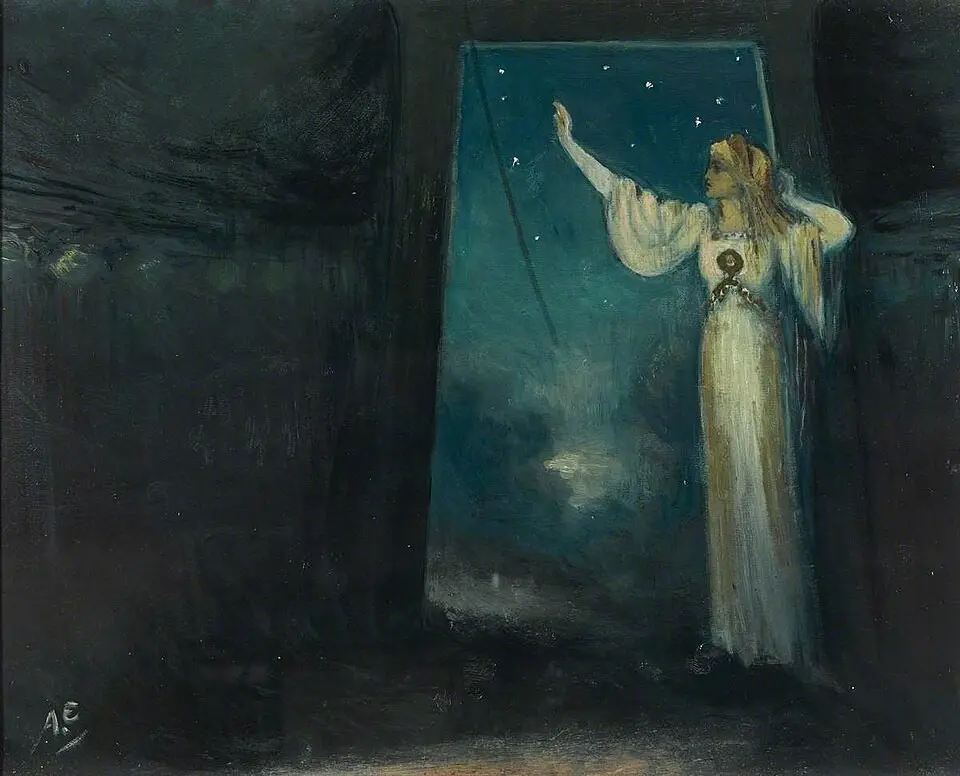
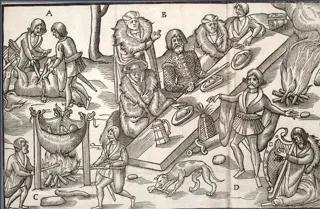
 The King's Thresholdby W. B. YeatsA poet starves himself on the king's steps because the poets have lost their place at the royal table.
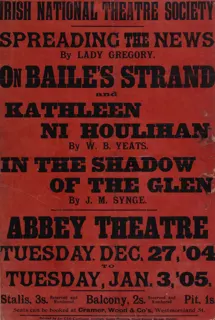 On Baile's Strandby W. B. YeatsCuchulain swears obedience to the High King and then, not knowing, kills his own son.

The play
A Guest-house in a wood. It is a rough house of timber; through the doors and some of the windows one can see the great spaces of the wood, the sky dimming, night closing in. But a window to the left shows the thick leaves of a coppice; the landscape suggests silence and loneliness. There is a door to right and left, and through the side windows one can see anybody who approaches either door, a moment before he enters. In the centre, a part of the house is curtained off; the curtains are drawn. There are unlighted torches in brackets on the walls. There is, at one side, a small table with a chessboard and chessmen upon it, and a wine flagon and loaf of bread. At the other side of the room there is a brazier with a fire; two women, with musical instruments beside them, crouch about the brazier: they are comely women of about forty. Another woman, who carries a stringed instrument, enters hurriedly; she speaks, at first standing in the doorway.
I HAVE a story right, my wanderers,
That has so mixed with fable in our songs,
That all seemed fabulous. We are come, by chance,
Into King Conchubar’s country, and this house
Is an old guest-house built for travellers
From the seashore to Conchubar’s royal house,
And there are certain hills among these woods,
And there Queen Deirdre grew.
That famous queen
Who has been wandering with her lover, Naisi,
And none to friend but lovers and wild hearts?
Going nearer to the brazier.
Some dozen years ago, King Conchubar found
A house upon a hillside in this wood,
And there a comely child with an old witch
To nurse her, and there’s nobody can say
If she were human, or of those begot
By an invisible king of the air in a storm
On a king’s daughter, or anything at all
Of who she was or why she was hidden there
But that she’d too much beauty for good luck.
He went up thither daily, till at last
She put on womanhood, and he lost peace,
And Deirdre’s tale began. The King was old.
A month or so before the marriage day,
A young man, in the laughing scorn of his youth,
Naisi, the son of Usnach, climbed up there,
And having wooed, or, as some say, been wooed,
Carried her off.
The tale were well enough
Had it a finish.
Hush! I have more to tell;
But gather close that I may whisper it:
I speak of terrible, mysterious ends—
The secrets of a king.
There’s none to hear!
I have been to Conchubar’s house, and followed up
A crowd of servants going out and in
With loads upon their heads: embroideries
To hang upon the walls, or new-mown rushes
To strew upon the floors, and came at length
To a great room.
Be silent; there are steps!
Enter FERGUS, an old man, who moves about from door to window excitedly through what follows.
You are musicians by these instruments,
And if as seems—for you are comely women—
You can praise love, you’ll have the best of luck,
For there’ll be two, before the night is in,
That bargained for their love, and paid for it
All that men value. You have but the time
To weigh a happy music with the sad;
To find what is most pleasing to a lover,
Before the son of Usnach and his queen
Have passed this threshold.
Deirdre and her man!
I thought to find a message from the king,
And ran to meet it. Is there no messenger
From Conchubar to Fergus, son of Rogh?
I was to have found a message in this house.
Are Deirdre and her lover tired of life?
You are not of this country, or you’d know
That they are in my charge, and all forgiven.
We have no country but the roads of the world.
Then you should know that all things change in the world,
And hatred turns to love and love to hate,
And even kings forgive.
An old man’s love
Who casts no second line, is hard to cure;
His jealousy is like his love.
And that’s but true.
You have learned something in your wanderings.
He was so hard to cure, that the whole court,
But I alone, thought it impossible;
Yet after I had urged it at all seasons,
I had my way, and all’s forgiven now;
And you shall speak the welcome and the joy
That I lack tongue for.
Yet old men are jealous.
[going to door] I am Conchubar’s near friend, and that weighed somewhat,
And it was policy to pardon them.
The need of some young, famous, popular man
To lead the troops, the murmur of the crowd,
And his own natural impulse, urged him to it.
They have been wandering half-a-dozen years.
And yet old men are jealous.
[coming from door] Sing the more sweetly
Because, though age is arid as a bone,
This man has flowered. I’ve need of music, too;
If this gray head would suffer no reproach,
I’d dance and sing—and dance till the hour ran out,
Because I have accomplished this good deed.
Look there—there at the window, those dark men,
With murderous and outlandish-looking arms—
They’ve been about the house all day.
Dark-faced MEN with strange barbaric dress and arms pass by the doors and windows. They pass one by one and in silence.
[looking after them] What are you?
Where do you come from, who is it sent you here?
They will not answer you.
They do not hear.
Forgive my open speech, but to these eyes
That have seen many lands, they are such men
As kings will gather for a murderous task,
That neither bribes, commands, nor promises
Can bring their people to.
And that is why
You harped upon an old man’s jealousy.
A trifle sets you quaking. Conchubar’s fame
Brings merchandise on every wind that blows.
They may have brought him Libyan dragon-skin,
Or the ivory of the fierce unicorn.
If these be merchants, I have seen the goods
They have brought to Conchubar, and understood
His murderous purpose.
Murderous, you say?
Why, what new gossip of the roads is this?
But I’ll not hear.
It may be life or death.
There is a room in Conchubar’s house, and there—
Be silent, or I’ll drive you from the door.
There’s many a one that would do more than that,
And make it prison, or death, or banishment
To slander the High King.
Suddenly restraining himself and speaking gently.
He is my friend;
I have his oath, and I am well content.
I have known his mind as if it were my own
These many years, and there is none alive
Shall buzz against him, and I there to stop it.
I know myself, and him, and your wild thought
Fed on extravagant poetry, and lit
By such a dazzle of old fabulous tales
That common things are lost, and all that’s strange
Is true because ’twere pity if it were not.
Going to the door again.
Quick! quick! your instruments! they are coming now.
I hear the hoofs a-clatter. Begin that song;
But what is it to be? I’d have them hear
A music foaming up out of the house
Like wine out of a cup. Come now, a verse
Of some old time not worth remembering,
And all the lovelier because a bubble.
Begin, begin, of some old king and queen,
Of Lugaidh Redstripe or another; no, not him,
He and his lady perished wretchedly.
[singing] ‘Why is it,’ Queen Edain said,
‘If I do but climb the stair....’
Ah! that is better.... They are alighted now.
Shake all your cockscombs, children; these are lovers.
FERGUS goes out.
‘Why is it,’ Queen Edain said,
‘If I do but climb the stair
To the tower overhead,
When the winds are calling there,
Or the gannets calling out,
In waste places of the sky,
There’s so much to think about,
That I cry, that I cry?’
But her goodman answered her:
‘Love would be a thing of naught
Had not all his limbs a stir
Born out of immoderate thought;
Were he anything by half,
Were his measure running dry.
Lovers, if they may not laugh,
Have to cry, have to cry.’
DEIRDRE, NAISI, and FERGUS have been seen for a moment through the windows, but now they have entered. NAISI lays down shield and spear and helmet, as if weary. He goes to the door opposite to the door he entered by. He looks out on to the road that leads to CONCHUBAR’S house. If he is anxious, he would not have FERGUS or DEIRDRE notice it. Presently he comes from the door, and goes to the table where the chessboard is.
[together] But is Edain worth a song
Now the hunt begins anew?
Praise the beautiful and strong;
Praise the redness of the yew;
Praise the blossoming apple-stem.
But our silence had been wise.
What is all our praise to them,
That have one another’s eyes?
You are welcome, lady.
Conchubar has not come.
Were the peace honest, he’d have come himself
To prove it so.
Being no more in love,
He stays in his own house, arranging where
The curlew and the plover go, and where
The speckled heath-cock in a golden dish.
But there’s no messenger.
He’ll come himself
When all’s in readiness and night closed in;
But till that hour, these birds out of the waste
Shall put his heart and mind into the music.
There’s many a day that I have almost wept
To think that one so delicately made
Might never know the sweet and natural life
Of women born to that magnificence,
Quiet and music, courtesy and peace.
I have found life obscure and violent,
And think it ever so; but none the less
I thank you for your kindness, and thank these
That put it into music.
Your house has been
The hole of the badger or the den of the fox;
But all that’s finished, and your days will pass
From this day out where life is smooth on the tongue,
Because the grapes were trodden long ago.
If I was childish, and had faith in omens,
I’d rather not have lit on that old chessboard
At my home-coming.
There’s a tale about it—
It has been lying there these many years—
Some wild old sorrowful tale.
It is the board
Where Lugaidh Redstripe and that wife of his,
Who had a seamew’s body half the year,
Played at the chess upon the night they died.
I can remember now a tale of treachery,
A broken promise and a journey’s end;
But it were best forgot.
If the tale is true,
When it was plain that they had been betrayed,
They moved the men, and waited for the end,
As it were bedtime, and had so quiet minds
They hardly winked their eyes when the sword flashed.
She never could have played so, being a woman,
If she had not the cold sea’s blood in her.
I have heard that th’ ever-living warn mankind
By changing clouds, and casual accidents,
Or what seem so.
If there had been ill luck
In lighting on this chessboard of a sudden,
This flagon that stood on it when we came
Has made all right again, for it should mean
All wrongs forgiven, hospitality
For bitter memory, peace after war,
While that loaf there should add prosperity.
Deirdre will see the world, as it were, new-made,
If she’ll but eat and drink.
The flagon’s dry,
Full of old cobwebs, and the bread is mouldy,
Left by some traveller gone upon his way
These many weeks.
No one to welcome us,
And a bare house upon the journey’s end.
Is that the welcome that a king spreads out
For those that he would honour?
Hush! no more.
You are King Conchubar’s guest, being in his house.
You speak as women do that sit alone,
Marking the ashes with a stick till they
Are in a dreamy terror. Being a queen,
You should have too calm thought to start at shadows.
Come, let us look if there’s a messenger
From Conchubar’s house. A little way without
One sees the road for half a mile or so,
Where the trees thin or thicken.
When those we love
Speak words unfitting to the ear of kings,
Kind ears are deaf.
Before you came
I had to threaten these that would have weighed
Some crazy phantasy of their own brain
Or gossip of the road with Conchubar’s word.
If I had thought so little of mankind
I never could have moved him to this pardon.
I have believed the best of every man,
And find that to believe it is enough
To make a bad man show him at his best,
Or even a good man swing his lantern higher.
NAISI and FERGUS go out. The last words are spoken as they go through the door. One can see them through part of what follows, either through door or window. They move about, talking or looking along the road towards CONCHUBAR’S house.
If anything lies heavy on your heart,
Speak freely of it, knowing it is certain
That you will never see my face again.
You’ve been in love?
If you would speak of love,
Speak freely. There is nothing in the world
That has been friendly to us but the kisses
That were upon our lips, and when we are old
Their memory will be all the life we have.
There was a man that loved me. He was old;
I could not love him. Now I can but fear.
He has made promises, and brought me home;
But though I turn it over in my thoughts,
I cannot tell if they are sound and wholesome,
Or hackles on the hook.
I have heard he loved you,
As some old miser loves the dragon-stone
He hides among the cobwebs near the roof.
You mean that when a man who has loved like that
Is after crossed, love drowns in its own flood,
And that love drowned and floating is but hate.
And that a king who hates, sleeps ill at night,
Till he has killed, and that, though the day laughs,
We shall be dead at cockcrow.
You have not my thought.
When I lost one I loved distractedly,
I blamed my crafty rival and not him,
And fancied, till my passion had run out,
That could I carry him away with me,
And tell him all my love, I’d keep him yet.
Ah! now I catch your meaning, that this king
Will murder Naisi, and keep me alive.
’Tis you that put that meaning upon words
Spoken at random.
Wanderers like you,
Who have their wit alone to keep their lives,
Speak nothing that is bitter to the ear
At random; if they hint at it at all
Their eyes and ears have gathered it so lately
That it is crying out in them for speech.
We have little that is certain.
Certain or not,
Speak it out quickly, I beseech you to it;
I never have met any of your kind,
But that I gave them money, food, and fire.
There are strange, miracle-working, wicked stones,
Men tear out of the heart and the hot brain
Of Libyan dragons.
The hot Istain stone,
And the cold stone of Fanes, that have power
To stir even those at enmity to love.
They have so great an influence, if but sewn
In the embroideries that curtain in
The bridal bed.
O Mover of the stars
That made this delicate house of ivory,
And made my soul its mistress, keep it safe.
I have seen a bridal bed, so curtained in,
So decked for miracle in Conchubar’s house,
And learned that a bride’s coming.
And I the bride?
Here is worse treachery than the seamew suffered,
For she but died and mixed into the dust
Of her dear comrade, but I am to live
And lie in the one bed with him I hate.
Where is Naisi? I was not alone like this
When Conchubar first chose me for his wife;
I cried in sleeping or waking and he came,
But now there is worse need.
[entering with FERGUS] Why have you called?
I was but standing there, without the door.
[going to the other door] The horses are still saddled, follow me,
And hurry to our ships, and get us gone.
Stopping her and partly speaking to her, partly to FERGUS.
There’s naught to fear; the king’s forgiven all.
She has the heart of a wild bird that fears
The net of the fowler or the wicker cage,
And has been ever so. Although it’s hard,
It is but needful that I stand against you,
And if I did not you’d despise me for it,
As women do the husbands that they lead
Whether for good or evil.
I have heard
Monstrous, terrible, mysterious things,
Magical horrors and the spells of wizards.
Why, that’s no wonder, you’ve been listening
To singers of the roads that gather up
The tales of the whole world, and when they weary
Imagine new, or lies about the living,
Because their brains are ever upon fire.
Is then the king that sends no messenger,
And leaves an empty house before a guest,
So clear in all he does that no dim word
Can light us to a doubt?
However dim,
Speak it, for I have known King Conchubar
Better than my own heart, and I can quench
Whatever words have made you doubt him.
No,
I cannot weigh the gossip of the roads
With a king’s word, and were the end but death,
I may not doubt him.
Naisi, I must speak.
Let us begone, this house is no fit place,
Being full of doubt—Deirdre is right.
To DEIRDRE, who has gone towards the door she had entered by.
No, no,
Not by that door that opens on the path
That runs to the seashore, but this that leads
To Conchubar’s house. We’ll wait no messenger,
But go to his well-lighted house, and there
Where the rich world runs up into a wick
And that burns steadily, because no wind
Can blow upon it, bring all doubts to an end.
The table has been spread by this, the court
Has ridden from all sides to welcome you
To safety and to peace.
Safety and peace!
I had them when a child, but never since.
Men blame you that you have stirred a quarrel up
That has brought death to many. I have poured
Water upon the fire, but if you fly
A second time the house is in a blaze
And all the screaming household can but blame
The savage heart of beauty for it all;
And Naisi that but helped to tar the wisp
Be but a hunted outlaw all his days.
I will be blamed no more! there’s but one way.
I’ll spoil this beauty that brought misery
And houseless wandering on the man I loved,
And so buy peace between him and the king.
These wanderers will show me how to do it,
To clip my hair to baldness, blacken my skin
With walnut juice, and tear my face with briars.
Oh! that wild creatures of the woods had torn
This body with their claws.
What is your meaning?
What are you saying? That he loves you still?
Whatever were to happen to this face,
I’d be myself; and there’s not any way
But this way to bring trouble to an end.
Answer me—does King Conchubar still love—
Does he still covet you?
Tell out the plot,
The plan, the network, all the treachery,
And of the bridal chamber and the bed,
The magical stones, the wizard’s handiwork.
Take care of Deirdre, if I die in this,
For she must never fall into his hands,
Whatever the cost.
Where would you go to, Naisi?
I go to drag the truth from Conchubar,
Before his people, in the face of his army,
And if it be as black as you have made it,
To kill him there.
You never would return;
I’d never look upon your face again.
Oh, keep him, Fergus; do not let him go,
But hold him from it. You are both wise and kind.
When you were all but Conchubar’s wife, I took you;
He tried to kill me, and he would have done it
If I had been so near as I am now.
And now that you are mine, he has planned to take you.
Should I be less than Conchubar, being a man?
Dark-faced MESSENGER comes into the house, unnoticed.
Supper is on the table; Conchubar
Is waiting for his guests.
All’s well, again!
All’s well! all’s well! You cried your doubts so loud,
That I had almost doubted.
I would have killed him,
And he the while but busy in his house
For the more welcome.
The message is not finished.
Come quickly. Conchubar will laugh, that I—
Although I held out boldly in my speech—
That I, even I—
Wait, wait! He is not done.
That am so great a friend, have doubted him.
Deirdre, and Fergus, son of Rogh, are summoned;
But not the traitor that bore off the queen.
It is enough that the king pardon her,
And call her to his table and his bed.
So, then, it’s treachery.
I’ll not believe it.
Tell Conchubar to meet me in some place
Where none can come between us but our swords.
I have done my message; I am Conchubar’s man;
I take no message from a traitor’s lips.
He goes.
No, but you must; and I will have you swear
To carry it unbroken.
He follows MESSENGER out.
He has been suborned.
I know King Conchubar’s mind as it were my own;
I’ll learn the truth from him.
He is about to follow NAISI, but DEIRDRE stops him.
No, no, old man,
You thought the best, and the worst came of it;
We listened to the counsel of the wise,
And so turned fools. But ride and bring your friends.
Go, and go quickly. Conchubar has not seen me;
It may be that his passion is asleep,
And that we may escape.
But I’ll go first,
And follow up that Libyan heel, and send
Such words to Conchubar, that he may know
At how great peril he lays hands upon you.
NAISI enters.
The Libyan, knowing that a servant’s life
Is safe from hands like mine, but turned and mocked.
I’ll call my friends, and call the reaping-hooks,
And carry you in safety to the ships.
My name has still some power. I will protect,
Or, if that is impossible, revenge.
Goes out by other door.
Who is calm, like a man who has passed beyond life.
The crib has fallen and the birds are in it;
There is not one of the great oaks about us
But shades a hundred men.
Let’s out and die,
Or break away, if the chance favour us.
They would but drag you from me, stained with blood.
Their barbarous weapons would but mar that beauty,
And I would have you die as a queen should—
In a death chamber. You are in my charge.
We will wait here, and when they come upon us,
I’ll hold them from the doors, and when that’s over,
Give you a cleanly death with this grey edge.
I will stay here; but you go out and fight.
Our way of life has brought no friends to us,
And if we do not buy them leaving it,
We shall be ever friendless.
What do they say?
That Lugaidh Redstripe and that wife of his
Sat at this chessboard, waiting for their end.
They knew that there was nothing that could save them,
And so played chess as they had any night
For years, and waited for the stroke of sword.
I never heard a death so out of reach
Of common hearts, a high and comely end:
What need have I, that gave up all for love,
To die like an old king out of a fable,
Fighting and passionate? What need is there
For all that ostentation at my setting?
I have loved truly and betrayed no man.
I need no lightning at the end, no beating
In a vain fury at the cage’s door.
To MUSICIANS.
Had you been here when that man and his queen
Played at so high a game, could you have found
An ancient poem for the praise of it?
It should have set out plainly that those two,
Because no man and woman have loved better,
Might sit on there contentedly, and weigh
The joy comes after. I have heard the seamew
Sat there, with all the colour in her cheeks,
As though she’d say: ‘There’s nothing happening
But that a king and queen are playing chess.’
He’s in the right, though I have not been born
Of the cold, haughty waves. My veins are hot.
But though I have loved better than that queen,
I’ll have as quiet fingers on the board.
Oh, singing women, set it down in a book
That love is all we need, even though it is
But the last drops we gather up like this;
And though the drops are all we have known of life,
For we have been most friendless—praise us for it
And praise the double sunset, for naught’s lacking,
But a good end to the long, cloudy day.
Light torches there and drive the shadows out,
For day’s red end comes up.
A MUSICIAN lights a torch in the fire and then crosses before the chess-players, and slowly lights the torches in the sconces. The light is almost gone from the wood, but there is a clear evening light in the sky, increasing the sense of solitude and loneliness.
Make no sad music.
What is it but a king and queen at chess?
They need a music that can mix itself
Into imagination, but not break
The steady thinking that the hard game needs.
During the chess, the MUSICIANS sing this song.
Love is an immoderate thing
And can never be content,
Till it dip an ageing wing,
Where some laughing element
Leaps and Time’s old lanthorn dims.
What’s the merit in love-play,
In the tumult of the limbs
That dies out before ’tis day,
Heart on heart, or mouth on mouth,
All that mingling of our breath,
When love-longing is but drouth
For the things come after death?
During the last verses DEIRDRE rises from the board and kneels at NAISI’S feet.
I cannot go on playing like that woman
That had but the cold blood of the sea in her veins.
It is your move. Take up your man again.
Do you remember that first night in the woods
We lay all night on leaves, and looking up,
When the first grey of the dawn awoke the birds,
Saw leaves above us. You thought that I still slept,
And bending down to kiss me on the eyes,
Found they were open. Bend and kiss me now,
For it may be the last before our death.
And when that’s over, we’ll be different;
Imperishable things, a cloud or a fire.
And I know nothing but this body, nothing
But that old vehement, bewildering kiss.
CONCHUBAR comes to the door.
Children, beware!
[laughing] He has taken up my challenge;
Whether I am a ghost or living man
When day has broken, I’ll forget the rest,
And say that there is kingly stuff in him.
Turns to fetch spear and shield, and then sees that CONCHUBAR has gone.
He came to spy upon us, not to fight.
A prudent hunter, therefore, but no king.
He’d find if what has fallen in the pit
Were worth the hunting, but has come too near,
And I turn hunter. You’re not man, but beast.
Go scurry in the bushes, now, beast, beast,
For now it’s topsy-turvy, I upon you.
He rushes out after CONCHUBAR.
You have a knife there thrust into your girdle.
I’d have you give it me.
No, but I dare not.
No, but you must.
If harm should come to you,
They’d know I gave it.
[snatching knife] There is no mark on this
To make it different from any other
Out of a common forge.
Goes to the door and looks out.
You have taken it,
I did not give it you; but there are times
When such a thing is all the friend one has.
The leaves hide all, and there’s no way to find
What path to follow. Why is there no sound?
She goes from door to window.
Where would you go?
To strike a blow for Naisi,
If Conchubar call the Libyans to his aid.
But why is there no clash? They have met by this!
Listen. I am called far-seeing. If Conchubar win,
You have a woman’s wile that can do much,
Even with men in pride of victory.
He is in love and old. What were one knife
Among a hundred?
[going towards them] Women, if I die,
If Naisi die this night, how will you praise?
What words seek out? for that will stand to you;
For being but dead we shall have many friends.
All through your wanderings, the doors of kings
Shall be thrown wider open, the poor man’s hearth
Heaped with new turf, because you are wearing this
[Gives MUSICIAN a bracelet.]
To show that you have Deirdre’s story right.
Have you not been paid servants in love’s house
To sweep the ashes out and keep the doors?
And though you have suffered all for mere love’s sake
You’d live your lives again.
Even this last hour.
CONCHUBAR enters with dark-faced men.
One woman and two men; that is a quarrel
That knows no mending. Bring the man she chose
Because of his beauty and the strength of his youth.
The dark-faced men drag in NAISI entangled in a net.
I have been taken like a bird or a fish.
He cried ‘Beast, beast!’ and in a blind-beast rage
He ran at me and fell into the nets,
But we were careful for your sake, and took him
With all the comeliness that woke desire
Unbroken in him. I being old and lenient—
I would not hurt a hair upon his head.
What do you say? Have you forgiven him?
He is but mocking us. What’s left to say
Now that the seven years’ hunt is at an end?
He never doubted you until I made him,
And therefore all the blame for what he says
Should fall on me.
But his young blood is hot,
And if we’re of one mind, he shall go free,
And I ask nothing for it, or, if something,
Nothing I could not take. There is no king
In the wide world that, being so greatly wronged,
Could copy me, and give all vengeance up.
Although her marriage-day had all but come,
You carried her away; but I’ll show mercy.
Because you had the insolent strength of youth
You carried her away; but I’ve had time
To think it out through all these seven years.
I will show mercy.
You have many words.
I will not make a bargain; I but ask
What is already mine. You may go free
If Deirdre will but walk into my house
Before the people’s eyes, that they may know
When I have put the crown upon her head
I have not taken her by force and guile.
The doors are open, and the floors are strewed,
And in the bridal chamber curtains sewn
With all enchantments that give happiness,
By races that are germane to the sun,
And nearest him, and have no blood in their veins—
For when they’re wounded the wound drips with wine—
Nor speech but singing. At the bridal door
Two fair king’s daughters carry in their hands
The crown and robe.
Oh, no! Not that, not that.
Ask any other thing but that one thing.
Leave me with Naisi. We will go away
Into some country at the ends of the earth.
We’ll trouble you no more. You will be praised
By everybody if you pardon us.
‘He is good, he is good,’ they’ll say to one another;
‘There’s nobody like him, for he forgave
Deirdre and Naisi.’
Do you think that I
Shall let you go again, after seven years
Of longing and of planning here and there,
And trafficking with merchants for the stones
That make all sure, and watching my own face
That none might read it?
[to NAISI] It’s better to go with him.
Why should you die when one can bear it all?
My life is over; it’s better to obey.
Why should you die? I will not live long, Naisi.
I’d not have you believe I’d long stay living;
Oh no, no, no! You will go far away.
You will forget me. Speak, speak, Naisi, speak,
And say that it is better that I go.
I will not ask it. Do not speak a word,
For I will take it all upon myself.
Conchubar, I will go.
And do you think
That, were I given life at such a price,
I would not cast it from me? O, my eagle!
Why do you beat vain wings upon the rock
When hollow night’s above?
It’s better, Naisi.
It may be hard for you, but you’ll forget.
For what am I, to be remembered always?
And there are other women. There was one,
The daughter of the King of Leodas;
I could not sleep because of her. Speak to him;
Tell it out plain, and make him understand.
And if it be he thinks I shall stay living,
Say that I will not.
Would I had lost life
Among those Scottish kings that sought it of me,
Because you were my wife, or that the worst
Had taken you before this bargaining!
O eagle! if you were to do this thing,
And buy my life of Conchubar with your body,
Love’s law being broken, I would stand alone
Upon the eternal summits, and call out,
And you could never come there, being banished.
[kneeling to CONCHUBAR] I would obey, but cannot. Pardon us.
I know that you are good. I have heard you praised
For giving gifts; and you will pardon us,
Although I cannot go into your house.
It was my fault. I only should be punished.
Unseen by DEIRDRE, NAISI is gagged.
The very moment these eyes fell on him,
I told him; I held out my hands to him;
How could he refuse? At first he would not—
I am not lying—he remembered you.
What do I say? My hands?—No, no, my lips—
For I had pressed my lips upon his lips—
I swear it is not false—my breast to his;
CONCHUBAR motions; NAISI, unseen by DEIRDRE, is taken behind the curtain.
Until I woke the passion that’s in all,
And how could he resist? I had my beauty.
You may have need of him, a brave, strong man,
Who is not foolish at the council board,
Nor does he quarrel by the candle-light
And give hard blows to dogs. A cup of wine
Moves him to mirth, not madness.
She stands up.
What am I saying?
You may have need of him, for you have none
Who is so good a sword, or so well loved
Among the common people. You may need him,
And what king knows when the hour of need may come?
You dream that you have men enough. You laugh.
Yes; you are laughing to yourself. You say,
‘I am Conchubar—I have no need of him.’
You will cry out for him some day and say,
‘If Naisi were but living’——[She misses NAISI.] Where is he?
Where have you sent him? Where is the son of Usna?
Where is he, O, where is he?
She staggers over to the MUSICIANS. The EXECUTIONER has come out with sword on which there is blood; CONCHUBAR points to it. The MUSICIANS give a wail.
The traitor who has carried off my wife
No longer lives. Come to my house now, Deirdre,
For he that called himself your husband’s dead.
O, do not touch me. Let me go to him.
Pause.
King Conchubar is right. My husband’s dead.
A single woman is of no account,
Lacking array of servants, linen cupboards,
The bacon hanging—and King Conchubar’s house
All ready, too—I’ll to King Conchubar’s house.
It is but wisdom to do willingly
What has to be.
But why are you so calm?
I thought that you would curse me and cry out,
And fall upon the ground and tear your hair.
[laughing] You know too much of women to think so;
Though, if I were less worthy of desire,
I would pretend as much; but, being myself,
It is enough that you were master here.
Although we are so delicately made,
There’s something brutal in us, and we are won
By those who can shed blood. It was some woman
That taught you how to woo: but do not touch me,
For I’ll go with you and do all your will
When I have done whatever’s customary.
We lay the dead out, folding up the hands,
Closing the eyes, and stretching out the feet,
And push a pillow underneath the head,
Till all’s in order; and all this I’ll do
For Naisi, son of Usna.
It is not fitting.
You are not now a wanderer, but a queen,
And there are plenty that can do these things.
Motioning CONCHUBAR away.
No, no. Not yet. I cannot be your queen
Till the past’s finished, and its debts are paid.
When a man dies and there are debts unpaid,
He wanders by the debtor’s bed and cries,
There’s so much owing.
You are deceiving me.
You long to look upon his face again.
Why should I give you now to a dead man
That took you from a living?
He makes a step towards her.
In good time.
You’ll stir me to more passion than he could,
And yet, if you are wise, you’ll grant me this:
That I go look upon him that was once
So strong and comely and held his head so high
That women envied me. For I will see him
All blood-bedabbled and his beauty gone.
It’s better, when you’re beside me in your strength,
That the mind’s eye should call up the soiled body,
And not the shape I loved. Look at him, women.
He heard me pleading to be given up,
Although my lover was still living, and yet
He doubts my purpose. I will have you tell him
How changeable all women are. How soon
Even the best of lovers is forgot,
When his day’s finished.
No; but I will trust
The strength you have spoken of, and not your purpose.
[almost with a caress] I’ll have this gift—the first that I have asked.
He has refused. There is no sap in him,
Nothing but empty veins. I thought as much.
He has refused me the first thing I have asked—
Me, me, his wife. I understand him now;
I know the sort of life I’ll have with him;
But he must drag me to his house by force.
If he refuse [she laughs], he shall be mocked of all.
They’ll say to one another, ‘Look at him
That is so jealous that he lured a man
From over sea, and murdered him, and yet
He trembled at the thought of a dead face!’
She has her hand upon curtain.
How do I know that you have not some knife,
And go to die upon his body?
Have me searched,
If you would make so little of your queen.
It may be that I have a knife hid here
Under my dress. Bid one of these dark slaves
To search me for it.
Pause.
Go to your farewells, queen.
Now strike the wire, and sing to it awhile,
Knowing that all is happy, and that you know
Within what bride-bed I shall lie this night,
And by what man, and lie close up to him,
For the bed’s narrow, and there outsleep the cockcrow.
[She goes behind the curtain.]
They are gone, they are gone. The proud may lie by the proud.
Though we were bidden to sing, cry nothing loud.
They are gone, they are gone.
Whispering were enough.
Into the secret wilderness of their love.
A high, grey cairn. What more is to be said?
Eagles have gone into their cloudy bed.
Shouting outside. FERGUS enters. Many men with scythes and sickles and torches gather about the doors. The house is lit with the glare of their torches.
Where’s Naisi, son of Usna, and his queen?
I and a thousand reaping-hooks and scythes
Demand him of you.
You have come too late.
I have accomplished all. Deirdre is mine;
She is my queen, and no man now can rob me.
I had to climb the topmost bough and pull
This apple among the winds. Open the curtain,
That Fergus learn my triumph from her lips.
The curtain is drawn back. The MUSICIANS begin to keen with low voices.
No, no; I’ll not believe it. She is not dead—
She cannot have escaped a second time!
King, she is dead; but lay no hand upon her.
What’s this but empty cage and tangled wire,
Now the bird’s gone? but I’ll not have you touch it.
You are all traitors, all against me—all.
And she has deceived me for a second time.
And every common man may keep his wife,
But not the King.
Loud shouting outside: ‘Death to Conchubar!’ ‘Where is Naisi?’ etc. The dark-skinned men gather round CONCHUBAR and draw their swords; but he motions them away.
I have no need of weapons,
There’s not a traitor that dare stop my way.
Howl, if you will; but I, being king, did right
In choosing her most fitting to be queen,
And letting no boy lover take the sway.