
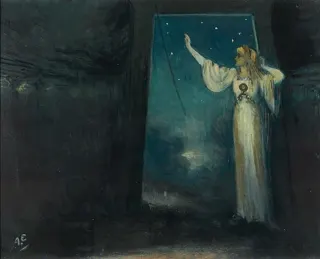
 Deirdreby W. B. YeatsDeirdre and Naisi come home trusting the High King who wanted her, and walk into his trap.
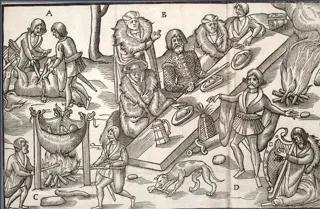 The King's Thresholdby W. B. YeatsA poet starves himself on the king's steps because the poets have lost their place at the royal table.

The play
A great hall at Dundealgan, not ‘Cuchulain’s great ancient house’ but an assembly house nearer to the sea. A big door at the back, and through the door misty light as of sea mist. There are many chairs and one long bench. One of these chairs, which is towards the front of the stage, is bigger than the others. Somewhere at the back there is a table with flagons of ale upon it and drinking-horns. There is a small door at one side of the hall. A FOOL and BLIND MAN, both ragged, come in through the door at the back. The BLIND MAN leans upon a staff.
WHAT a clever man you are though you are blind! There’s nobody with two
eyes in his head that is as clever as you are. Who but you could have
thought that the henwife sleeps every day a little at noon? I would
never be able to steal anything if you didn’t tell me where to look
for it. And what a good cook you are! You take the fowl out of my hands
after I have stolen it and plucked it, and you put it into the big pot
at the fire there, and I can go out and run races with the witches
at the edge of the waves and get an appetite, and when I’ve got it,
there’s the hen waiting inside for me, done to the turn.
Who is feeling about with his stick.
Done to the turn.
Putting his arm round BLIND MAN’S neck.
Come now, I’ll have a leg and you’ll have a leg, and we’ll draw lots
for the wish-bone. I’ll be praising you, I’ll be praising you, while
we’re eating it, for your good plans and for your good cooking. There’s
nobody in the world like you, Blind Man. Come, come. Wait a minute. I
shouldn’t have closed the door. There are some that look for me, and I
wouldn’t like them not to find me. Don’t tell it to anybody, Blind Man.
There are some that follow me. Boann herself out of the river and Fand
out of the deep sea. Witches they are, and they come by in the wind,
and they cry, ‘Give a kiss, Fool, give a kiss,’ that’s what they cry.
That’s wide enough. All the witches can come in now. I wouldn’t have
them beat at the door and say: ‘Where is the Fool? Why has he put a
lock on the door?’ Maybe they’ll hear the bubbling of the pot and come
in and sit on the ground. But we won’t give them any of the fowl. Let
them go back to the sea, let them go back to the sea.
Feeling legs of big chair with his hands.
Ah! [Then, in a louder voice as he feels the back of it.] Ah—ah—
Why do you say ‘Ah-ah’?
I know the big chair. It is to-day the High King Conchubar is coming.
They have brought out his chair. He is going to be Cuchulain’s master
in earnest from this day out. It is that he’s coming for.
He must be a great man to be Cuchulain’s master.
So he is. He is a great man. He is over all the rest of the kings of
Ireland.
Cuchulain’s master! I thought Cuchulain could do anything he liked.
So he did, so he did. But he ran too wild, and Conchubar is coming
to-day to put an oath upon him that will stop his rambling and make him
as biddable as a house-dog and keep him always at his hand. He will sit
in this chair and put the oath upon him.
How will he do that?
You have no wits to understand such things. [The BLIND MAN has got into the chair.] He will sit up in this chair and he’ll say: ‘Take the
oath, Cuchulain. I bid you take the oath. Do as I tell you. What are
your wits compared with mine, and what are your riches compared with
mine? And what sons have you to pay your debts and to put a stone over
you when you die? Take the oath, I tell you. Take a strong oath.’
Crumpling himself up and whining.
I will not. I’ll take no oath. I want my dinner.
Hush, hush! It is not done yet.
You said it was done to a turn.
Did I, now? Well, it might be done, and not done. The wings might be
white, but the legs might be red. The flesh might stick hard to the
bones and not come away in the teeth. But, believe me, Fool, it will be
well done before you put your teeth in it.
My teeth are growing long with the hunger.
I’ll tell you a story—the kings have story-tellers while they are
waiting for their dinner—I will tell you a story with a fight in it, a
story with a champion in it, and a ship and a queen’s son that has his
mind set on killing somebody that you and I know.
Who is that? Who is he coming to kill?
Wait, now, till you hear. When you were stealing the fowl, I was lying
in a hole in the sand, and I heard three men coming with a shuffling
sort of noise. They were wounded and groaning.
Go on. Tell me about the fight.
There had been a fight, a great fight, a tremendous great fight. A
young man had landed on the shore, the guardians of the shore had asked
his name, and he had refused to tell it, and he had killed one, and
others had run away.
That’s enough. Come on now to the fowl. I wish it was bigger. I wish it
was as big as a goose.
Hush! I haven’t told you all. I know who that young man is. I heard the
men who were running away say he had red hair, that he had come from
Aoife’s country, that he was coming to kill Cuchulain.
Nobody can do that.
To a tune.
Cuchulain has killed kings,
Kings and sons of kings,
Dragons out of the water,
And witches out of the air,
Banachas and Bonachas and people of the woods.
Hush! hush!
Still singing.
Witches that steal the milk,
Fomor that steal the children,
Hags that have heads like hares,
Hares that have claws like witches,
All riding a-cockhorse
Spoken.
Out of the very bottom of the bitter black north.
Hush, I say!
Does Cuchulain know that he is coming to kill him?
How would he know that with his head in the clouds? He doesn’t care for
common fighting. Why would he put himself out, and nobody in it but
that young man? Now, if it were a white fawn that might turn into a
queen before morning—
Come to the fowl. I wish it was as big as a pig; a fowl with goose
grease and pig’s crackling.
No hurry, no hurry. I know whose son it is. I wouldn’t tell anybody
else, but I will tell you,—a secret is better to you than your dinner.
You like being told secrets.
Tell me the secret.
That young man is Aoife’s son. I am sure it is Aoife’s son, it flows
in upon me that it is Aoife’s son. You have often heard me talking of
Aoife, the great woman-fighter Cuchulain got the mastery over in the
north?
I know, I know. She is one of those cross queens that live in hungry
Scotland.
I am sure it is her son. I was in Aoife’s country for a long time.
That was before you were blinded for putting a curse upon the wind.
There was a boy in her house that had her own red colour on him
and everybody said he was to be brought up to kill Cuchulain, that
she hated Cuchulain. She used to put a helmet on a pillar-stone
and call it Cuchulain and set him casting at it. There is a step
outside—Cuchulain’s step.
CUCHULAIN passes by in the mist outside the big door.
Where is Cuchulain going?
He is going to meet Conchubar that has bidden him to take the oath.
Ah, an oath, Blind Man. How can I remember so many things at once? Who
is going to take an oath?
Cuchulain is going to take an oath to Conchubar who is High King.
What a mix-up you make of everything, Blind Man. You were telling me
one story, and now you are telling me another story.... How can I get
the hang of it at the end if you mix everything at the beginning?
Wait till I settle it out. There now, there’s Cuchulain [he points to one foot], and there is the young man [he points to the other foot] that is coming to kill him, and Cuchulain doesn’t know. But
where’s Conchubar? [Takes bag from side.] That’s Conchubar with all
his riches—Cuchulain, young man, Conchubar—And where’s Aoife? [Throws up cap.] There is Aoife, high up on the mountains in high hungry
Scotland. Maybe it is not true after all. Maybe it was your own making
up. It’s many a time you cheated me before with your lies. Come to the
cooking-pot, my stomach is pinched and rusty. Would you have it to be
creaking like a gate?
I tell you it’s true. And more than that is true. If you listen to what
I say, you’ll forget your stomach.
I won’t.
Listen. I know who the young man’s father is, but I won’t say. I would
be afraid to say. Ah, Fool, you would forget everything if you could
know who the young man’s father is.
Who is it? Tell me now quick, or I’ll shake you. Come, out with it, or
I’ll shake you.
A murmur of voices in the distance.
Wait, wait. There’s somebody coming.... It is Cuchulain is coming.
He’s coming back with the High King. Go and ask Cuchulain. He’ll tell
you. It’s little you’ll care about the cooking-pot when you have asked
Cuchulain that....
BLIND MAN goes out by side door.
I’ll ask him. Cuchulain will know. He was in Aoife’s country. [Goes up stage.] I’ll ask him. [Turns and goes down stage.] But, no. I
won’t ask him, I would be afraid. [Going up again.] Yes, I will ask
him. What harm in asking? The Blind Man said I was to ask him. [Going down.] No, no. I’ll not ask him. He might kill me. I have but killed
hens and geese and pigs. He has killed kings. [Goes up again almost to big door.] Who says I’m afraid? I’m not afraid. I’m no coward. I’ll
ask him. No, no, Cuchulain, I’m not going to ask you.
He has killed kings,
Kings and the sons of kings,
Dragons out of the water,
And witches out of the air,
Banachas and Bonachas and people of the woods.
FOOL goes out by side door, the last words being heard outside. CUCHULAIN and CONCHUBAR enter through the big door at the back. While they are still outside, CUCHULAIN’S voice is heard raised in anger. He is a dark man, something over forty years of age. CONCHUBAR is much older and carries a long staff, elaborately carved, or with an elaborate gold handle.
Because I have killed men without your bidding
And have rewarded others at my own pleasure,
Because of half a score of trifling things
You’d lay this oath upon me, and now—and now
You add another pebble to the heap.
And I must be your man, well-nigh your bondsman,
Because a youngster out of Aoife’s country
Has found the shore ill-guarded.
He came to land
While you were somewhere out of sight and hearing,
Hunting or dancing with your wild companions.
He can be driven out. I’ll not be bound.
I’ll dance or hunt, or quarrel or make love,
Wherever and whenever I’ve a mind to.
If time had not put water in your blood,
You never would have thought it.
I would leave
A strong and settled country to my children.
And I must be obedient in all things;
Give up my will to yours; go where you please;
Come when you call; sit at the council-board
Among the unshapely bodies of old men.
I whose mere name has kept this country safe,
I that in early days have driven out
Maeve of Cruachan and the northern pirates,
The hundred kings of Sorcha, and the kings
Out of the Garden in the East of the World.
Must I, that held you on the throne when all
Had pulled you from it, swear obedience
As if I were some cattle-raising king?
Are my shins speckled with the heat of the fire,
Or have my hands no skill but to make figures
Upon the ashes with a stick? Am I
So slack and idle that I need a whip
Before I serve you?
No, no whip, Cuchulain,
But every day my children come and say:
‘This man is growing harder to endure.
How can we be at safety with this man
That nobody can buy or bid or bind?
We shall be at his mercy when you are gone;
He burns the earth as if he were a fire,
And time can never touch him.’
And so the tale
Grows finer yet; and I am to obey
Whatever child you set upon the throne,
As if it were yourself!
Most certainly.
I am High King, my son shall be High King;
And you for all the wildness of your blood,
And though your father came out of the sun,
Are but a little king and weigh but light
In anything that touches government,
If put into the balance with my children.
It’s well that we should speak our minds out plainly,
For when we die we shall be spoken of
In many countries. We in our young days
Have seen the heavens like a burning cloud
Brooding upon the world, and being more
Than men can be now that cloud’s lifted up,
We should be the more truthful. Conchubar,
I do not like your children—they have no pith,
No marrow in their bones, and will lie soft
Where you and I lie hard.
You rail at them
Because you have no children of your own.
I think myself most lucky that I leave
No pallid ghost or mockery of a man
To drift and mutter in the corridors,
Where I have laughed and sung.
That is not true,
For all your boasting of the truth between us;
For, there is no man having house and lands,
That have been in the one family
And called by the one name for centuries,
But is made miserable if he know
They are to pass into a stranger’s keeping,
As yours will pass.
The most of men feel that,
But you and I leave names upon the harp.
You play with arguments as lawyers do,
And put no heart in them. I know your thoughts,
For we have slept under the one cloak and drunk
From the one wine cup. I know you to the bone.
I have heard you cry, aye in your very sleep,
‘I have no son,’ and with such bitterness
That I have gone upon my knees and prayed
That it might be amended.
For you thought
That I should be as biddable as others
Had I their reason for it; but that’s not true,
For I would need a weightier argument
Than one that marred me in the copying,
As I have that clean hawk out of the air
That, as men say, begot this body of mine
Upon a mortal woman.
Now as ever
You mock at every reasonable hope,
And would have nothing, or impossible things.
What eye has ever looked upon the child
Would satisfy a mind like that?
I would leave
My house and name to none that would not face
Even myself in battle.
Being swift of foot,
And making light of every common chance,
You should have overtaken on the hills
Some daughter of the air, or on the shore
A daughter of the Country-under-Wave.
I am not blasphemous.
Yet you despise
Our queens, and would not call a child your own,
If one of them had borne him.
I have not said it.
Ah! I remember I have heard you boast,
When the ale was in your blood, that there was one
In Scotland, where you had learnt the trade of war,
That had a stone-pale cheek and red-brown hair.
And that although you had loved other women,
You’d sooner that fierce woman of the camp
Bore you a son than any queen among them.
You call her a ‘fierce woman of the camp,’
For having lived among the spinning-wheels,
You’d have no woman near that would not say,
‘Ah! how wise!’ ‘What will you have for supper?’
‘What shall I wear that I may please you, sir?’
And keep that humming through the day and night
Forever. A fierce woman of the camp!
But I am getting angry about nothing.
You have never seen her. Ah! Conchubar, had you seen her
With that high, laughing, turbulent head of hers
Thrown backward, and the bow-string at her ear,
Or sitting at the fire with those grave eyes
Full of good counsel as it were with wine,
Or when love ran through all the lineaments
Of her wild body—although she had no child,
None other had all beauty, queen, or lover,
Or was so fitted to give birth to kings.
There’s nothing I can say but drifts you farther
From the one weighty matter. That very woman—
For I know well that you are praising Aoife—
Now hates you and will leave no subtilty
Unknotted that might run into a noose
About your throat, no army in idleness
That might bring ruin on this land you serve.
No wonder in that, no wonder at all in that.
I never have known love but as a kiss
In the mid-battle, and a difficult truce
Of oil and water, candles and dark night,
Hillside and hollow, the hot-footed sun,
And the cold, sliding, slippery-footed moon—
A brief forgiveness between opposites
That have been hatreds for three times the age
Of this long-’stablished ground.
Listen to me.
Aoife makes war on us, and every day
Our enemies grow greater and beat the walls
More bitterly, and you within the walls
Are every day more turbulent; and yet,
When I would speak about these things, your fancy
Runs as it were a swallow on the wind.
Outside the door in the blue light of the sea mist are many old and young KINGS; amongst them are three WOMEN, two of whom carry a bowl full of fire. The third, in what follows, puts from time to time fragrant herbs into the fire so that it flickers up into brighter flame.
Look at the door and what men gather there—
Old counsellors that steer the land with me,
And younger kings, the dancers and harp-players
That follow in your tumults, and all these
Are held there by the one anxiety.
Will you be bound into obedience
And so make this land safe for them and theirs?
You are but half a king and I but half;
I need your might of hand and burning heart,
And you my wisdom.
Going near to door.
Nestlings of a high nest,
Hawks that have followed me into the air
And looked upon the sun, we’ll out of this
And sail upon the wind once more. This king
Would have me take an oath to do his will,
And having listened to his tune from morning,
I will no more of it. Run to the stable
And set the horses to the chariot-pole,
And send a messenger to the harp-players.
We’ll find a level place among the woods,
And dance awhile.
Cuchulain, take the oath.
There is none here that would not have you take it.
You’d have me take it? Are you of one mind?
All, all, all, all!
Do what the High King bids you.
There is not one but dreads this turbulence
Now that they’re settled men.
Are you so changed,
Or have I grown more dangerous of late?
But that’s not it. I understand it all.
It’s you that have changed. You’ve wives and children now,
And for that reason cannot follow one
That lives like a bird’s flight from tree to tree.—
It’s time the years put water in my blood
And drowned the wildness of it, for all’s changed,
But that unchanged.—I’ll take what oath you will:
The moon, the sun, the water, light, or air,
I do not care how binding.
On this fire
That has been lighted from your hearth and mine;
The older men shall be my witnesses,
The younger, yours. The holders of the fire
Shall purify the thresholds of the house
With waving fire, and shut the outer door,
According to the custom; and sing rhyme
That has come down from the old law-makers
To blow the witches out. Considering
That the wild will of man could be oath-bound,
But that a woman’s could not, they bid us sing
Against the will of woman at its wildest
In the shape-changers that run upon the wind.
CONCHUBAR has gone on to his throne.
They sing in a very low voice after the first few words so that the others all but drown their words.
May this fire have driven out
The shape-changers that can put
Ruin on a great king’s house
Until all be ruinous.
Names whereby a man has known
The threshold and the hearthstone,
Gather on the wind and drive
The women, none can kiss and thrive,
For they are but whirling wind,
Out of memory and mind.
They would make a prince decay
With light images of clay,
Planted in the running wave;
Or, for many shapes they have,
They would change them into hounds,
Until he had died of his wounds,
Though the change were but a whim;
Or they’d hurl a spell at him,
That he follow with desire
Bodies that can never tire,
Or grow kind, for they anoint
All their bodies, joint by joint,
With a miracle-working juice
That is made out of the grease
Of the ungoverned unicorn.
But the man is thrice forlorn,
Emptied, ruined, wracked, and lost,
That they follow, for at most
They will give him kiss for kiss;
While they murmur, ‘After this
Hatred may be sweet to the taste.’
Those wild hands that have embraced
All his body can but shove
At the burning wheel of love,
Till the side of hate comes up.
Therefore in this ancient cup
May the sword-blades drink their fill
Of the homebrew there, until
They will have for masters none
But the threshold and hearthstone.
Speaking, while they are singing.
I’ll take and keep this oath, and from this day
I shall be what you please, my chicks, my nestlings.
Yet I had thought you were of those that praised
Whatever life could make the pulse run quickly,
Even though it were brief, and that you held
That a free gift was better than a forced.—
But that’s all over.—I will keep it, too.
I never gave a gift and took it again.
If the wild horse should break the chariot-pole,
It would be punished. Should that be in the oath?
Two of the WOMEN, still singing, crouch in front of him holding the bowl over their heads. He spreads his hands over the flame.
I swear to be obedient in all things
To Conchubar, and to uphold his children.
We are one being, as these flames are one:
I give my wisdom, and I take your strength.
Now thrust the swords into the flame, and pray
That they may serve the threshold and the hearthstone
With faithful service.
The KINGS kneel in a semicircle before the two WOMEN and CUCHULAIN, who thrusts his sword into the flame. They all put the points of their swords into the flame. The third WOMAN is at the back near the big door.
O pure, glittering ones
That should be more than wife or friend or mistress,
Give us the enduring will, the unquenchable hope,
The friendliness of the sword!—
The song grows louder, and the last words ring out clearly. There is a loud knocking at the door, and a cry of ‘Open! open!’
Some king that has been loitering on the way.
Open the door, for I would have all know
That the oath’s finished and Cuchulain bound,
And that the swords are drinking up the flame.
The door is opened by the third WOMAN, and a YOUNG MAN with a drawn sword enters.
I am of Aoife’s army.
The KINGS rush towards him. CUCHULAIN throws himself between.
Put up your swords.
He is but one. Aoife is far away.
I have come alone into the midst of you
To weigh this sword against Cuchulain’s sword.
And are you noble? for if of common seed,
You cannot weigh your sword against his sword
But in mixed battle.
I am under bonds
To tell my name to no man; but it’s noble.
But I would know your name and not your bonds.
You cannot speak in the Assembly House,
If you are not noble.
Answer the High King!
I will give no other proof than the hawk gives—
That it’s no sparrow!
He is silent for a moment, then speaks to all.
Yet look upon me, kings.
I, too, am of that ancient seed, and carry
The signs about this body and in these bones.
To have shown the hawk’s grey feather is enough,
And you speak highly, too. Give me that helmet.
I’d thought they had grown weary sending champions.
That sword and belt will do. This fighting’s welcome.
The High King there has promised me his wisdom;
But the hawk’s sleepy till its well-beloved
Cries out amid the acorns, or it has seen
Its enemy like a speck upon the sun.
What’s wisdom to the hawk, when that clear eye
Is burning nearer up in the high air?
Looks hard at YOUNG MAN; then comes down steps and grasps YOUNG MAN by shoulder.
Hither into the light.
To CONCHUBAR.
The very tint
Of her that I was speaking of but now.
Not a pin’s difference.
To YOUNG MAN.
You are from the North
Where there are many that have that tint of hair—
Red-brown, the light red-brown. Come nearer, boy,
For I would have another look at you.
There’s more likeness—a pale, a stone-pale cheek.
What brought you, boy? Have you no fear of death?
Whether I live or die is in the gods’ hands.
That is all words, all words; a young man’s talk.
I am their plough, their harrow, their very strength;
For he that’s in the sun begot this body
Upon a mortal woman, and I have heard tell
It seemed as if he had outrun the moon;
That he must follow always through waste heaven,
He loved so happily. He’ll be but slow
To break a tree that was so sweetly planted.
Let’s see that arm. I’ll see it if I choose.
That arm had a good father and a good mother,
But it is not like this.
You are mocking me;
You think I am not worthy to be fought.
But I’ll not wrangle but with this talkative knife.
Put up your sword; I am not mocking you.
I’d have you for my friend, but if it’s not
Because you have a hot heart and a cold eye,
I cannot tell the reason.
[To CONCHUBAR.] He has got her fierceness,
And nobody is as fierce as those pale women.
But I will keep him with me, Conchubar,
That he may set my memory upon her
When the day’s fading.—You will stop with us,
And we will hunt the deer and the wild bulls;
And, when we have grown weary, light our fires
Between the wood and water, or on some mountain
Where the shape-changers of the morning come.
The High King there would make a mock of me
Because I did not take a wife among them.
Why do you hang your head? It’s a good life:
The head grows prouder in the light of the dawn,
And friendship thickens in the murmuring dark
Where the spare hazels meet the wool-white foam.
But I can see there’s no more need for words
And that you’ll be my friend from this day out.
He has come hither not in his own name
But in Queen Aoife’s, and has challenged us
In challenging the foremost man of us all.
Well, well, what matter?
You think it does not matter;
And that a fancy lighter than the air,
A whim of the moment has more matter in it.
For having none that shall reign after you,
You cannot think as I do, who would leave
A throne too high for insult.
Let your children
Re-mortar their inheritance, as we have,
And put more muscle on.—I’ll give you gifts,
But I’d have something too—that arm-ring, boy.
We’ll have this quarrel out when you are older.
There is no man I’d sooner have my friend
Than you, whose name has gone about the world
As if it had been the wind; but Aoife’d say
I had turned coward.
I will give you gifts
That Aoife’ll know, and all her people know,
To have come from me. [Showing cloak.]
My father gave me this.
He came to try me, rising up at dawn
Out of the cold dark of the rich sea.
He challenged me to battle, but before
My sword had touched his sword, told me his name,
Gave me this cloak, and vanished. It was woven
By women of the Country-under-Wave
Out of the fleeces of the sea. O! tell her
I was afraid, or tell her what you will.
No; tell her that I heard a raven croak
On the north side of the house, and was afraid.
Some witch of the air has troubled Cuchulain’s mind.
No witchcraft. His head is like a woman’s head
I had a fancy for.
A witch of the air
Can make a leaf confound us with memories.
They run upon the wind and hurl the spells
That make us nothing, out of the invisible wind.
They have gone to school to learn the trick of it.
No, no—there’s nothing out of common here;
The winds are innocent.—That arm-ring, boy.
If I’ve your leave I’ll take this challenge up.
No, give it me, High King, for this wild Aoife
Has carried off my slaves.
No, give it me,
For she has harried me in house and herd.
I claim this fight.
[together] And I! And I! And I!
Back! back! Put up your swords! Put up your swords!
There’s none alive that shall accept a challenge
I have refused. Laegaire, put up your sword!
No, let them come. If they’ve a mind for it,
I’ll try it out with any two together.
That’s spoken as I’d have spoken it at your age.
But you are in my house. Whatever man
Would fight with you shall fight it out with me.
They’re dumb, they’re dumb. How many of you would meet
[Draws sword.]
This mutterer, this old whistler, this sandpiper,
This edge that’s greyer than the tide, this mouse
That’s gnawing at the timbers of the world,
This, this—— Boy, I would meet them all in arms
If I’d a son like you. He would avenge me
When I have withstood for the last time the men
Whose fathers, brothers, sons, and friends I have killed
Upholding Conchubar, when the four provinces
Have gathered with the ravens over them.
But I’d need no avenger. You and I
Would scatter them like water from a dish.
We’ll stand by one another from this out.
Here is the ring.
No, turn and turn about.
But my turn’s first because I am the older.
Spreading out cloak.
Nine queens out of the Country-under-Wave
Have woven it with the fleeces of the sea
And they were long embroidering at it.—Boy,
If I had fought my father, he’d have killed me.
As certainly as if I had a son
And fought with him, I should be deadly to him;
For the old fiery fountains are far off
And every day there is less heat o’ the blood.
In a loud voice.
No more of this. I will not have this friendship.
Cuchulain is my man, and I forbid it.
He shall not go unfought, for I myself—
I will not have it.
You lay commands on me?
Seizing CONCHUBAR.
You shall not stir, High King. I’ll hold you there.
Witchcraft has maddened you.
[shouting] Yes, witchcraft! witchcraft!
Some witch has worked upon your mind, Cuchulain.
The head of that young man seemed like a woman’s
You’d had a fancy for. Then of a sudden
You laid your hands on the High King himself!
And laid my hands on the High King himself?
Some witch is floating in the air above us.
Yes, witchcraft, witchcraft! Witches of the air! [To YOUNG MAN.]
Why did you? Who was it set you to this work?
Out, out! I say, for now it’s sword on sword!
But ... but I did not.
Out, I say, out, out!
YOUNG MAN goes out followed by CUCHULAIN. The KINGS follow them out with confused cries, and words one can hardly hear because of the noise. Some cry, ‘Quicker, quicker!’ ‘Why are you so long at the door?’ ‘We’ll be too late!’ ‘Have they begun to fight?’ and so on; and one, it may be, ‘I saw him fight with Ferdia!’ Their voices drown each other. The three women are left alone.
I have seen, I have seen!
What do you cry aloud?
The ever-living have shown me what’s to come.
How? Where?
In the ashes of the bowl.
While you were holding it between your hands?
Speak quickly!
I have seen Cuchulain’s roof-tree
Leap into fire, and the walls split and blacken.
Cuchulain has gone out to die.
O! O!
Who could have thought that one so great as he
Should meet his end at this unnoted sword!
Life drifts between a fool and a blind man
To the end, and nobody can know his end.
Come, look upon the quenching of this greatness.
The other two go to the door, but they stop for a moment upon the threshold and wail.
No crying out, for there’ll be need of cries
And knocking at the breast when it’s all finished.
The WOMEN go out. There is a sound of clashing swords from time to time during what follows.
Enter the FOOL dragging the BLIND MAN.
You have eaten it, you have eaten it! You have left me nothing but the
bones.
He throws BLIND MAN down by big chair.
O, that I should have to endure such a plague! O, I ache all over! O,
I am pulled to pieces! This is the way you pay me all the good I have
done you!
You have eaten it! You have told me lies. I might have known you had
eaten it when I saw your slow, sleepy walk. Lie there till the kings
come. O, I will tell Conchubar and Cuchulain and all the kings about
you!
What would have happened to you but for me, and you without your wits?
If I did not take care of you, what would you do for food and warmth?
You take care of me! You stay safe, and send me into every kind of
danger. You sent me down the cliff for gulls’ eggs while you warmed
your blind eyes in the sun; and then you ate all that were good for
food. You left me the eggs that were neither egg nor bird. [BLIND MAN tries to rise; FOOL makes him lie down again.] Keep quiet now, till
I shut the door. There is some noise outside—a high vexing noise,
so that I can’t be listening to myself. [Shuts the big door.] Why
can’t they be quiet! why can’t they be quiet! [BLIND MAN tries to get away.] Ah! you would get away, would you! [Follows BLIND MAN and brings him back.] Lie there! lie there! No, you won’t get away! Lie
there till the kings come. I’ll tell them all about you. I will tell it
all. How you sit warming yourself, when you have made me light a fire
of sticks, while I sit blowing it with my mouth. Do you not always make
me take the windy side of the bush when it blows, and the rainy side
when it rains?
Oh, good Fool! listen to me. Think of the care I have taken of you. I
have brought you to many a warm hearth, where there was a good welcome
for you, but you would not stay there; you were always wandering about.
The last time you brought me in it was not I who wandered away, but
you that got put out because you took the crubeen out of the pot when
nobody was looking. Keep quiet, now!
[rushing in] Witchcraft! There is no witchcraft on the earth, or among the witches
of the air, that these hands cannot break.
Listen to me, Cuchulain. I left him turning the fowl at the fire. He
ate it all, though I had stolen it. He left me nothing but the feathers.
Fill me a horn of ale!
I gave him what he likes best. You do not know how vain this fool is.
He likes nothing so well as a feather.
He left me nothing but the bones and feathers. Nothing but the
feathers, though I had stolen it.
Give me that horn! Quarrels here, too! [Drinks.] What is there
between you two that is worth a quarrel? Out with it!
Where would he be but for me? I must be always thinking—thinking to get
food for the two of us, and when we’ve got it, if the moon is at the
full or the tide on the turn, he’ll leave the rabbit in the snare till
it is full of maggots, or let the trout slip back through his hands
into the stream.
The FOOL has begun singing while the BLIND MAN is speaking.
[singing] When you were an acorn on the tree-top,
Then was I an eagle cock;
Now that you are a withered old block,
Still am I an eagle cock.
Listen to him, now. That’s the sort of talk I have to put up with day
out, day in.
The FOOL is putting the feathers into his hair. CUCHULAIN takes a handful of feathers out of a heap the FOOL has on the bench beside him, and out of the FOOL’S hair, and begins to wipe the blood from his sword with them.
He has taken my feathers to wipe his sword. It is blood that he is
wiping from his sword.
Goes up to door at back and throws away feathers.
They are standing about his body. They will not awaken him, for all his
witchcraft.
It is that young champion that he has killed. He that came out of
Aoife’s country.
He thought to have saved himself with witchcraft.
That blind man there said he would kill you. He came from Aoife’s
country to kill you. That blind man said they had taught him every kind
of weapon that he might do it. But I always knew that you would kill
him.
[to the BLIND MAN] You knew him, then?
I saw him, when I had my eyes, in Aoife’s country.
You were in Aoife’s country?
I knew him and his mother there.
He was about to speak of her when he died.
He was a queen’s son.
What queen? what queen? [Seizes BLIND MAN, who is now sitting upon the bench.] Was it Scathach? There were many queens. All the rulers there
were queens.
No, not Scathach.
It was Uathach, then? Speak! speak!
I cannot speak; you are clutching me too tightly. [CUCHULAIN lets him go.] I cannot remember who it was. I am not certain. It was some queen.
He said a while ago that the young man was Aoife’s son.
She? No, no! She had no son when I was there.
That blind man there said that she owned him for her son.
I had rather he had been some other woman’s son. What father had he? A
soldier out of Alba? She was an amorous woman—a proud, pale, amorous
woman.
None knew whose son he was.
None knew! Did you know, old listener at doors?
No, no; I knew nothing.
He said awhile ago that he heard Aoife boast that she’d never but the
one lover, and he the only man that had overcome her in battle.
Pause.
Somebody is trembling, Fool! The bench is shaking. Why are you
trembling? Is Cuchulain going to hurt us? It was not I who told you,
Cuchulain.
It is Cuchulain who is trembling. It is Cuchulain who is shaking the
bench.
It is his own son he has slain.
’Twas they that did it, the pale, windy people.
Where? where? where? My sword against the thunder!
But no, for they have always been my friends;
And though they love to blow a smoking coal
Till it’s all flame, the wars they blow aflame
Are full of glory, and heart-uplifting pride,
And not like this. The wars they love awaken
Old fingers and the sleepy strings of harps.
Who did it, then? Are you afraid? Speak out!
For I have put you under my protection,
And will reward you well. Dubthach the Chafer?
He’d an old grudge. No, for he is with Maeve.
Laegaire did it! Why do you not speak?
What is this house? [Pause.] Now I remember all.
Comes before CONCHUBAR’S chair, and strikes out with his sword, as if CONCHUBAR was sitting upon it.
’Twas you who did it—you who sat up there
With your old rod of kingship, like a magpie
Nursing a stolen spoon. No, not a magpie,
A maggot that is eating up the earth!
Yes, but a magpie, for he’s flown away.
Where did he fly to?
He is outside the door.
Outside the door?
Between the door and the sea.
Conchubar, Conchubar! the sword into your heart!
He rushes out. Pause. FOOL creeps up to the big door and looks after him.
He is going up to King Conchubar. They are all about the young man. No,
no, he is standing still. There is a great wave going to break, and
he is looking at it. Ah! now he is running down to the sea, but he is
holding up his sword as if he were going into a fight. [Pause.] Well
struck! well struck!
What is he doing now?
O! he is fighting the waves!
He sees King Conchubar’s crown on every one of them.
There, he has struck at a big one! He has struck the crown off it; he
has made the foam fly. There again, another big one!
Where are the kings? What are the kings doing?
They are shouting and running down to the shore, and the people are
running out of the houses. They are all running.
You say they are running out of the houses? There will be nobody left
in the houses. Listen, Fool!
There, he is down! He is up again. He is going out into the deep water.
There is a big wave. It has gone over him. I cannot see him now. He has
killed kings and giants, but the waves have mastered him, the waves
have mastered him!
Come here, Fool!
The waves have mastered him.
Come here!
The waves have mastered him.
Come here, I say!
Coming towards him, but looking backward towards the door.
What is it?
There will be nobody in the houses. Come this way; come quickly! The
ovens will be full. We will put our hands into the ovens.
They go out.