
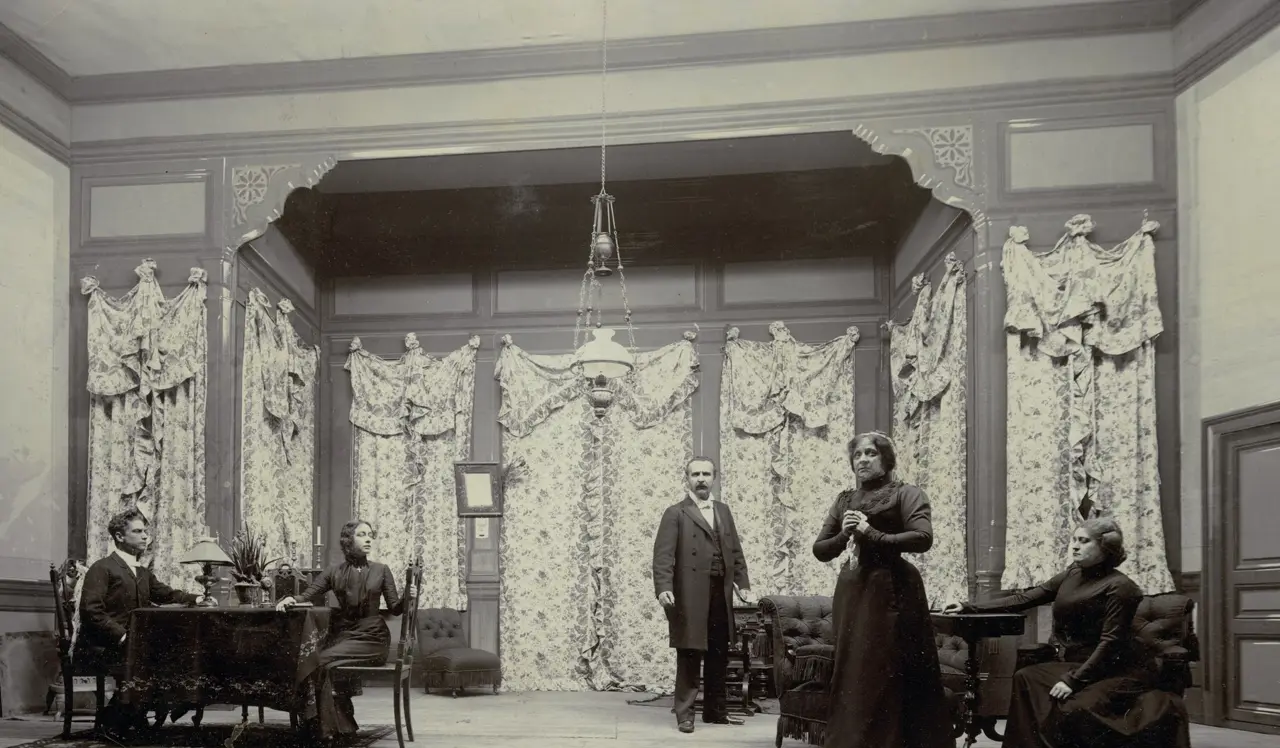
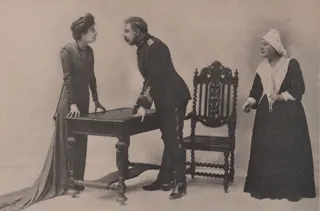
 The Fatherby August StrindbergA cavalry captain and his wife fight over their daughter's future, and she makes him doubt the child is his.
 The Linkby August StrindbergA baron and his wife come to a country court to agree their separation, and end up fighting over their son.
 Lucky Pehrby August StrindbergA young man kept in a church tower is given a ring that grants every wish, and goes out to find happiness.
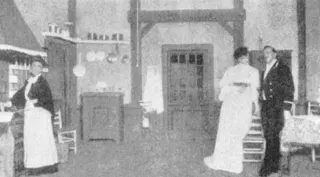 Miss Juliaby August StrindbergOn Midsummer Eve, a count's daughter and her father's valet play a dangerous game across the line between them.
Act 1
AFTERNOON OF HOLY THURSDAY.
Music played before rise of curtain: "Sieben Worte des Erlösers" [Seven Last Words from the Cross], Haydn.
Introduction: Maestoso Adagio.
Scene: An enclosed veranda, entirely glass at the back, fitted up as a living room. At centre is a large door leading to a small garden with a picket fence and a gate opening on to the street. The door and windows at the back are hung with yellow flowered chintz curtains, which can be drawn. A small mirror hangs on window-frame at left of centre door; below it a date calendar. At right is a door leading to the kitchen; at left a door leading to other rooms. Up right centre is a writing table on which are books, writing materials and a telephone. Down at right is a sewing table with a lamp and two easy chairs. At the left, above the door, is a sideboard and a parlor stove; a dining table with chairs at left centre. From the ceiling hangs a lamp. From the windows is seen a view of the street, and a house on the hill surrounded by a garden which slopes toward the city; at back of garden are seen tree-tops in spring bloom. A church spire looms above the trees. A street lamp with incandescent burners is opposite the gate.
Time: The present.
A sunbeam falls obliquely across room, from left to right, touching one of the chairs at sewing table. On the other chair, which is in shadow, Christina is seated. She is running a tape through a pair of newly laundered draw-curtains. Elis comes in with overcoat unbuttoned and carrying a large bundle of documents, which he lays upon the writing table.
Good afternoon, my friend.
Good day, Elis.
[Glancing around] Storm-windows out—floor scoured—clean curtains. Yes, spring is here again! They have chopped up the ice-pavement, and the sallow down by the river is in bloom. Yes, it is spring now, and I can hang up my winter coat. Do you know, it is as heavy [weighing it in his hand] as if it had absorbed all the winter's hardships—the sweat of anguish and the dust of the schoolroom—Ah! [He hangs up coat on wall, left.]
And now you are having a holiday.
Easter Holiday: Five glorious days in which to revel—to breathe—to forget! See, the sun has come back! It went away in November—I remember the day it disappeared back of the brewery, opposite. Oh, this winter—this long winter!
[With a motion toward kitchen door] Softly, softly!
I'll be quiet, and I ought to be glad that it is over. Oh, the good sun! [Rubbing his hands as if laving them.] I want to bathe in sunshine—wash myself in light, after all this black filth!
Softly, softly!
Do you know, I believe that peace is returning and that the misfortunes have exhausted themselves—
What makes you think so?
Because—when I passed by the Cathedral, a while ago, a white dove came circling down; she lit on the pavement and dropped a branch she carried in her bill, right at my feet.
Did you observe what kind of branch it was?
Olive it could hardly have been; but I think it was an emblem of peace, and just now I feel a blissful, sunny calm—Where's mother?
[With a glance toward kitchen door] In the kitchen.
[Closing his eyes and speaking in hushed tones] I can hear that it is spring. Do you know how I can tell? Mostly by the axles on the wagon wheels—but what have we here? The bullfinch is singing, the hammers are sounding on the wharf, and I smell the fresh paint from the steamboats—
Can you sense it all the way here?
Here?—True, we are here; but I was there—up there in the North, where our home lies. How did I ever come to this dreadful city, where all the people hate one another, and where one is always alone? It was the bread that drew us. But, beside the bread lay the misfortunes—father's crooked dealings and little sister's illness. Tell me—do you know if mother has been permitted to visit father in prison?
I think she has been there even to-day.
What did she say?
Nothing. She talked of other matters.
Yet one thing is settled: After the trial came certainty, and a singular calm—when the newspapers had finished with their reports of the proceedings. One year has gone by; in one year he'll be out, and then we can begin all over!
I admire your patience in tribulation.
Don't! Admire nothing in me, for I possess only faults. Now you know it—if you would only believe it!
If you suffered for your own failings, yes; but you suffer for the mistakes of others.
What are you sewing upon?
The kitchen draw-curtains, dearie.
Looks like a bridal veil. In the autumn you are to be my bride, Christina. True, is it not?
Yes; but first, let us think of the summer.
Yes, summer! [Taking out a check book.] You see that the money is already in bank. When school closes, we shall go North to our own province—to Mälaren! The cottage stands there, ready—as it stood in our childhood; the lindens are still there; the punt lies under the willow down by the river. Oh, that it were summer, so I could bathe in the sea! This family dishonor has submerged me, body and soul, and I long for a sea to cleanse me!
Have you heard anything from sister Eleonora?
Yes. She is restless, poor child, and writes letters that wring my heart. She wants to come home, naturally, but the superintendent of the Asylum is afraid to let her go, for she does things which lead to prison. I feel conscience-stricken at times because I voted for her commitment.
My dear friend, you assume the blame for everything. But in this instance, it has surely been a mercy that she was cared for, poor unhappy child!
What you say is true, and things seem best as they are. She is as comfortable as can be. When I think of how she went about here, casting a shadow over every semblance of pleasure; of how her fate depressed us, like a nightmare—tortured us to despair—I am selfish enough to feel a certain relief, akin to joy. And the greatest misfortune I can imagine at this moment would be to see her step inside these doors. Just that contemptible am I!
Just that human are you.
I suffer all the same at the thought of her distress, and father's.
Some persons seem to be born for suffering—
Poor you, who happened into this family, doomed from the start—and damned!
Elis, you do not know whether these are trials or chastisements.
What they are for you, I know not. Surely you are not accountable to any one but yourself.
Tears in the morning, joy in the evening—Elis, perhaps I can help you—
Do you know if mother has a white muffler?
[Uneasy] Are you going somewhere?
I'm going to dine out. Peter, as you know, gave a disputation yesterday, and to-day he gives a dinner.
Would you go to that dinner?
You mean that I should stay away because he proved to be a very ungrateful pupil.
I cannot deny that his disloyalty shocked me; after promising to quote your thesis, he appropriated it without mentioning the source—
Alas! that is so common; but I am happy in the consciousness that "this have I done."
Has he invited you?
Come to think of it, no! It's rather strange, considering that he has gone about and talked of this dinner for several years, as though my presence was a foregone conclusion. If I am not invited now, it is an intentional affront. What matter! This is not the first time—nor yet the last! [Pause.]
Benjamin is late. Do you think he will pass his examination?
I certainly hope so!—In Latin, surely, with honors.
Fine boy, Benjamin!
Uncommonly so, but something of a dreamer. You know, of course, why he is here with us?
It is because—
Because my father embezzled his funds in equity—like those of so many others. You see, Christina, this is the terrible part of it: At school I have to face all these poor, defrauded, fatherless lads who must suffer the humiliation of being charity pupils; and the light in which they regard me, you can imagine. I must continually think of their misery in order to pardon their cruelty.
I believe your father is much better off than you.
Much!
Elis, we should think of the summer and not of the past.
Yes, of the summer!—Do you know, I was awakened last night by the students' singing. They sang: "Yes, I'm coming! Happy winds, take my greetings to the country. To the birds say, that I love them; to birch and linden, lake and mountain, say that I would see them once again—see them now as in my childhood!" [Rising.] Shall I ever see them again? Shall I ever get away from this dreadful city—from Mount Ebal, the accursed, and once more behold Gerizim? [Seats himself by the door.]
Yes, yes, you shall!
But think you that I shall see my birches and lindens as I saw them before? Think you not that the same black pall will spread over them that has veiled the landscape and the life down here ever since that day?—[Pointing to chair, which is now in shadow.] You see, the sun has gone away!
It will come back—only to stay the longer.
True; the days are lengthening and the shadows shortening.
We are going toward the light, Elis, believe me.
Sometimes I think so, and when I think of the past and compare it with the present, I feel happy. This time last year you were not sitting here, for then you had gone from me, and had broken our engagement. Do you know that that was the darkest shadow of all. I literally died, inch by inch; but when you came again—I lived! Do you remember why you went?
No, I do not; and it occurs to me now that there was no reason for it. I felt an irresistible impulse to go, so I went—as in a dream. When I saw you again, I awoke, and was happy.
And now we must never be parted; for if you were to go from me now, I should die in earnest! Mother is coming—say nothing. Shield her in her world of illusions, where she lives fancying father a martyr and all his victims scoundrels.
Fru Heyst comes on from kitchen, wearing a kitchen apron and paring an apple. She speaks pleasantly and somewhat artlessly.
Good afternoon, children. How will you have your apple soup—hot or cold?
Cold, little mother.
That's right, my boy! You always know what you want, and speak up; but Christina doesn't. This Elis learned from his father. He always knew what he wanted and what he was about—and that folks can't tolerate. Therefore it turned out badly for him. But his day is coming; then he'll get justice and the others will get their deserts!—Wait—what was I going to tell you—? Oh, yes—do you know that Lindquist has moved to town?—Lindquist—the biggest scoundrel of them all!
[Agitated, rises] Is he here?
Yes; he lives across the way.
Then one must see him pass by every day—This too!
Only let me talk to him once, and he will never come again, or show his face! I know his little peculiarities. Well, Elis, how did Peter get on?
Very well.
I can readily believe that. When do you think of debating?
When I can afford to, mother.
When you can afford to? But that's no answer! And Benjamin—has he passed his examination?
We don't know as yet, but he will be here shortly.
I don't quite like Benjamin, for he goes about with an air—as though he had rights; but we'll cure him of that. A good boy, all the same—Oh, by the by, there's a parcel for you, Elis. [Steps into kitchen and returns promptly with parcel.]
Fancy, how well mother keeps track of everything, and knows what is going on! Sometimes I think she is not as artless as she pretends to be.
Here is the parcel. Lina took it in.
A gift! I'm afraid of gifts since I received that box of cobble stones—[He lays parcel on table.]
Now I'm going back into the kitchen. Won't it be too cold with the door open?
Not at all, mother.
You mustn't hang your overcoat there, Elis; it looks so untidy! Well, Christina, will my draw-curtains be ready soon?
In a few minutes, mother.
Yes, I do like that boy, Peter; he is my favorite! Aren't you going to the dinner, Elis?
Why, to be sure I am!
Then why should you go and say that you wanted your apple soup cold, when you are to dine out? There's nothing determined about you, Elis; but there is about Peter. Now, close the doors if it grows chilly, so you won't catch cold.
Good old soul!—And it's always Peter—Is it her meaning to tease you about Peter?
Me?
You know, of course, that old ladies are up to such games—whims and fancies only.
What kind of gift did you receive?
[Tearing off paper] A birch branch.
From whom?
Giver anonymous—No, the birch is innocent enough, and I shall put it in water so that it will blossom, like Aaron's rod. Birch—as in my childhood—So Lindquist is here.
What about him?
Our heaviest debt is to him.
But you don't owe him anything?
Yes, we do—one for all and all for one; the family name is dishonored so long as there is debt.
Change names.
Christina!
[Lays down work, which is finished] Thanks, Elis! I only wished to try you.
But you mustn't tempt me!—Lindquist is a poor man and needs his money. Wherever my father has been, it is like a battle field, with dead and wounded; and mother believes that he is the victim!—Don't you want to go for a stroll?
And look for the sun?—Gladly!
Can you understand this: The Redeemer suffered for our iniquities, yet we continue to pay? No one pays for me.
But if someone paid for you, would you understand then?
Yes, then I should understand. Hush! Here comes Benjamin. Can you see if he looks happy?
He walks so slowly—now he stops at the fountain—and washes his eyes—
Even this—!
Wait a bit—
Tears, tears!
Patience!
Enter Benjamin. He is gentle and respectful, but looks disheartened. He carries a few books and a portfolio.
How did it go with your Latin?
Badly!
May I see your examination papers? What have you done?
I dashed off the indicative, although I knew it should have been the conjunctive—
Then you are lost! But how could you?
I can't explain it. I knew how it ought to be, wanted to do the right thing, and did the wrong thing. [Dejected, he sits down at table.]
[Drops into chair at writing table and reads in Benjamin's portfolio] Yes, here you have the indicative.—Ye gods!
[Forced] Better luck next time! Life is long—terribly long!
It is that!
[Mournfully, but without bitterness] And it must all come upon you at once. You were my best pupil, so what can I expect from the others? My standing as tutor goes for naught, and I shall have no more classes. Thus everything falls through. [To Benjamin.] Don't be so cut up; it's not your fault.
Elis, courage, courage, for pity's sake!
Where shall I find it?
Where you found it before.
It's not the same now. I seem to be in disgrace—
It is a grace to suffer without blame. Don't let impatience delude you. Stand the test; for it is only a test—I feel it so.
Can a year for Benjamin become shorter than three hundred and sixty-five days?
Yes; for a cheerful mind shortens time.
[Laughing] Blow on the wound and it will heal up, we say to children.
Be a child, then, and I'll say it. Think of mother—how well she bears everything.
Give me your hand, I'm sinking! [Christina extends hand.] Your hand trembles—
No, I can't feel that it does.
You are not the strong woman you appear to be.
I feel no weakness—
Then why can't you give me a little strength?
I have none to spare.
[Looking out through the window] Do you know who is coming this way?
[Glances through window, then drops to knees, crushed] This is too much!
The creditor—he who can seize our effects at any time—Lindquist, who came here that he might sit, like the spider in the centre of the web, to watch the flies—
Fly!
No, I shall not fly.—Now, when you are weak, I am strong. He is coming up the street and his cruel eyes have already sighted the prey.
Step aside at least!
No; now he amuses me.—He appears to brighten, as though he saw the game in the trap.—Come along, you!—He is counting the steps to the gate and sees by the open door that we are at home. He meets someone and stops to chatter.—He is talking about us, for he looks this way—
Just so he doesn't meet mother here, for with a hasty word she might make him relentless.—Prevent it, Elis!
Now he shakes his cane, as if protesting that here at least mercy shall not come before justice—He buttons his overcoat to show that as yet we have not stripped the clothes off his body—I can tell by the movement of his lips what he is saying. What shall I answer him—"My lord, you are right, take all, it belongs to you?"
That is the only thing to be said.
Now he laughs, but good-naturedly—not wickedly. Perhaps he's not so bad after all, although he wants his money. If he would only come now and stop his infernal chatter!—The cane is in motion again—they always have canes—these persons with outstanding debts—and leather-galoshes that say "vitch, vitch," like whips in the air. [He presses Christina's hand to his heart.] Do you feel how my heart beats? I hear it myself, in the right ear, like the thump, thump of a propeller on an ocean liner.—Ah, now he has said farewell!—and now for the galoshes: "Vitch, vitch," like the Easter birch rod.—He wears watch charms.—Then he can't be so poverty-stricken. They always wear charms of carbuncle, like old flesh carved from their neighbor's back.—Hark, the galoshes! "Vipers, vipers, vitch!" Look out!—He sees me—[bowing toward street]. He nods first—and smiles; he waves his hand—and—and—[sinks down at writing table and weeps]. He passed by!
God be praised!
[Rising] He passed by—but he'll come back.—Let us go out into the sunshine.
And the dinner with Peter?
As I'm not invited, I'll keep aloof. For that matter, why should I break in upon the merriment? To meet a faithless friend?—I should only suffer for his behavior so that I could not feel offended by mine own.
Thank you for staying with us.
I much prefer it, as you know. Shall we walk?
Yes—this way. [Goes off at door left.]
[Pats Benjamin on the head in passing] Courage, lad! [Benjamin buries his face in his hands. Elis takes birch branch from dining table and places it back of mirror.] It was no olive branch the dove brought—it was birch. [Goes out.]
Eleonora enters at door centre. She is a girl of sixteen, with a braid down her back. She carries a potted yellow Easter lily and, without seeing or seeming to see Benjamin, takes a water bottle from the sideboard and waters the plant, places it on dining table, then sits down at table opposite Benjamin, regards him, and unconsciously imitates his movements. Benjamin, astonished, stares at her.
[Pointing at flower] Do you know what this is?
[Simply and childishly] It's an Easter lily, that much I know; but who are you?
[Pleasantly, but with a note of sadness] And who are you?
My name is Benjamin, and I lodge here with Fru Heyst.
Oh, do you? My name is Eleonora, and I am a daughter of this house.
How strange that they never speak of you!
One does not speak of the dead.
The dead!
I am legally dead, for I have committed a terrible wrong.
You?
Yes; I have embezzled trust funds—which was of no great consequence, for ill-gotten gains should perish—but that my old father got the blame and was sent to prison, that, you see, can never be pardoned.
How strangely and prettily you speak!—It has never occurred to me that my inheritance might have been dishonestly acquired.
One must not bind people, one must free them.
You have freed me from the worry of being defrauded.
You are a ward, then?
Yes, and it is my ill-luck to be compelled to stay with these poor people and live out their debt.
You mustn't use hard words, for then I'll go my way; I am so sensitive that I can't bear anything harsh. Meanwhile—you suffer this on my account?
On your father's account.
It is all one, for he and I are one and the same person—[pause]. I have been very ill—Why are you so sad?
I have had a stroke of bad luck.
Shall you grieve over that? "The rod and reproof give wisdom, and he that hateth reproof shall die." What was your bad luck?
I failed to pass in my Latin examination, although I was absolutely certain—
So you were absolutely certain—so certain that you could have laid a wager on passing—?
And I did it, too!
I thought as much. You see, it turned out thus because you were so certain.
Do you think that was the cause of it?
Of course it was. "Pride goeth before a fall."
I'll remember that next time.
Now you are thinking right; and "the sacrifices which are pleasing unto God, are a broken spirit and a contrite heart."
Are you pious?
Yes.
A believer, I mean.
Yes, I mean just that, so if you speak evil of God, my benefactor, I shall not sit at the same table with you.
How old are you?
For me there is neither time nor space; I am everywhere and at any time. I am in my father's prison and in my brother's school room; I am in my mother's kitchen and in my sister's shop, far away in America. When all goes well with my sister and she can sell, I feel her joy, and when it goes badly, I suffer; but I suffer most when she does wrong. Benjamin—You are named Benjamin because you are the youngest of my friends—yes, all mankind are my friends. Will you let me adopt you, that I may suffer for you, too?
I do not wholly understand your words, but I seem to catch the drift of your thoughts and, from now on, I wish all that you wish!
To begin, then, will you stop judging people—even those who are convicted criminals?
Yes, but I must have a reason for it; I have read philosophy you see.
Oh, have you! Then you shall help me interpret this, from a great philosopher: "They who hate the righteous, shall be adjudged criminally guilty."
Which, according to all logic means that one may be doomed to commit crime—
And that the crime itself is a punishment.
It is certainly deep. One might think it was Kant or Schopenhauer—
I don't know them.
In whose writings have you read it?
In Holy Writ.
Really? Are such things to be found there?
What an ignorant and neglected child you are! If I could only train you!
Little you!
But there is certainly nothing bad in you; if anything, you look good. What is the name of your Latin teacher?
Professor Algren.
[Rising] I shall remember that.—Oh! now my father fares very badly—they are cruel to him. [Stands still, as if she were listening.] Do you hear the rasping in the telephone wires?—Those are the hard words which the pretty, soft red copper cannot bear.—When people slander one another in the telephone, the copper wails and laments—[with severity] and every word is written in the Book—and at the end of time comes the reckoning.
How severe you are!
Not I, not I! How would I dare be? I—I? [She goes over to the stove, opens the door and takes out some torn scraps of white letter paper. Benjamin rises and looks curiously at the scraps, which Eleonora arranges on dining table.]
[To herself] Why are people so thoughtless as to put their secrets into empty stoves! Wherever I am, I go at once to the stove; but I never misuse my knowledge—I wouldn't dare to, for that brings suffering. [Reading.] Why, what is this?
It's a letter from Peter, the Senior Wrangler, who makes an appointment with Christina. I have suspected this for some time.
[Placing her hand over the papers] Well, what have you suspected? Speak out, you wicked man, who think only evil! This letter holds nothing but good, for I know Christina, who is to be my sister-in-law. This meeting will ward off a misfortune from brother Elis. Promise me that you will be silent, Benjamin?
I don't think I should dare speak of this.
What mistakes people make who have secrets—They think themselves wise, and are fools.—But what was I doing over there?
Yes, why are you curious?
You see, that is my malady: I must know all, or I become uneasy.
Know all?
It is a failing which I cannot overcome.—All the same, I know what the starlings say!
But they can't speak?
Have you never heard starlings that were taught to speak?
That were taught—yes.
Well, then, starlings can learn to speak. Now, there are some who teach themselves, or are automatons—they sit and listen, without our knowing it, of course, and then they repeat. I heard a pair of them, just before I came in, that sat in a walnut tree and chattered.
How droll you are! But what did they say?
"Peter!" said one. "Judas!" said the other—"You're another!" said the first—"Fy, fy!" said the second. Have you marked that the nightingales sing only in the deaf mutes' garden, close by?
Yes, that is known; but why do they do so?
Because those who have ears do not hear what the nightingales say, but the deaf mutes hear it.
Tell me some more stories!
Yes, if you are good.
How good?
You must never measure words with me and never say: "Thus you said then, and then you said thus." Shall we talk more about birds? There is a wicked bird called the rat-buzzard, who, as one can hear by his name, lives upon rats. And since he is a bad bird, it has to be very difficult for him to catch rats. That is why he can say only one word, and it sounds as when the cat says "mieou." Now, when the buzzard says "mieou" the rats run and hide, so he is very often without food because he's bad. Want to hear more—or shall I talk about flowers? When I was ill, I had to take a drug made from henbane, which has the peculiar quality of turning the eye into a magnifying glass.—Belladonna, on the other hand, makes one see everything diminished—and now I see farther than others, for I can see the stars in broad daylight.
But the stars are not out?
How amusing you are! The stars are always out. Now I sit facing north, looking at Cassiopæ, which resembles a W, and sits in the centre of the "Milky Way." Can you see it?
No, I can not!
Now bear this in mind, that one person can see what another cannot, therefore be not so certain of your eyes. I was going to speak of the flower on the table: It is an Easter lily which belongs in Switzerland, and has a chalice that has absorbed sunshine; therefore it is yellow, and soothes suffering. As I came along, I saw it in a florist's window and wanted to present it to brother Elis. When I was about to enter the shop, I found the door locked—it is evidently Confirmation Day to-day. As I had to have the flower, I took out my keys and tried them. Fancy! My door-key fitted—I walked in. Do you understand the silent language of flowers? Each fragrance expresses many, many thoughts; these thoughts assailed me, and, with my magnified eye, I looked into their workshops, which no one has seen, and they spoke to me of their sorrows brought upon them by the stupid gardener—I do not say cruel, for he is only thoughtless. Then I laid a krona, with my card, upon the counter, took the flower and walked out.
How thoughtless! But think if they should miss the flower, and do not find the money?
That never occurred to me!
A coin can disappear so easily, and if only your card is found, you are lost!
Surely no one thinks that I would take anything—
[Regards her steadily] No?
[Scrutinizes him as she rises] Ah! I know what you mean—"Like father, like child." How thoughtless of me! What—no! What is to be, will be. [Seats herself.] Let it come, then!
Can't one adjust this matter?
Hush! and talk of something else—Professor Algren! Poor Elis! poor all of us! But it is Passion Week and we must suffer. There's a concert to-morrow—Haydn's "Last words from the Cross"—"Mother, behold thy Son!" [She buries her face in her hands, and weeps.]
What sort of illness have you had?
"This illness is not unto death, but for the glory of God! When I looked for good, then evil came unto me; and when I waited for light there came darkness." What was your childhood like, Benjamin?
I don't know.—Stupid, as I recall it—and yours?
I never had any. I was born old. I knew all at my birth, and when I learned anything it was just like remembering. I knew the thoughtlessness and ignorance of men when I was only four years old; therefore they were cruel toward me.
All that you say I, too, seem to have thought.
I daresay you have. What made you suppose that my coin might be lost at the florist's?
Because the exasperating thing always has to happen.
So you, also, have observed this.—Hush! someone is coming. [Glancing up stage.] I hear Elis' step. What joy! The best friend I have on earth! [She becomes apprehensive.] But he's not expecting me, and he won't be glad to see me—indeed he won't! Benjamin, Benjamin, show a smiling face and a cheerful spirit when my poor brother comes! I'll step in here so that you may prepare him for my arrival. But no hard words; they hurt so. Do you hear? Give me your hand! [Benjamin puts forth his hand. Eleonora kisses him on the head.] There! Now you are my little brother. God bless and keep you! [She exits left and, in passing, she pats the sleeve of Elis' coat affectionately.] Poor Elis!
Elis enters at centre door looking troubled. Fru Heyst comes on from kitchen.
Why, there's mother!
Was it you? I fancied I heard a strange voice.
I have some news to tell you. I met the attorney on the street.
Well?
The case will now go to the higher courts, and in order to save time, I must read through all the official records of the trial.
You'll soon do that.
[Indicating documents on writing table] Ah, I thought it was over! And now I must worry through this entire passion-story—all the accusations, all the testimony, all the evidence over again!
Yes, but then he will be acquitted by the higher courts.
No, mother; he has confessed.
Yes; but that can be a "technical error" the attorney said when last I talked with him.
He said that to comfort you.
Aren't you going to the dinner?
No.
So you have changed your mind again!
Yes.
That sort of thing is bad.
I know it, but I'm tossed like a straw between breakers.
I thought just now that I heard a strange voice—one known to me; but I must have heard wrongly. [Pointing to overcoat.] That coat shouldn't hang there, I told you! [Exits right. Elis crossing to left sees the Easter lily.]
[To Benjamin] Where did that flower come from?
A young lady brought it.
Lady! What does this mean? Who was it?
It was—
Was it—my sister?
Yes.
[Sinks down into a chair at table. Pause] Did you speak with her?
Yes indeed!
O God! is it not enough yet? Was she cross to you?
She? No, she was kind, oh, so kind!
Strange! Did she speak of me? Was she very angry with me?
On the contrary, she said that you were her best and only friend on earth—
What an extraordinary change!
And when she went she patted your coat—there, on the sleeve.
Went—where did she go?
[Pointing toward door at left] In there.
She is there now?
Yes.
You look so pleased and happy, Benjamin!
She talked to me so beautifully—
What did she talk about?
She told stories, and then there was a good deal about religion—
[Rising] Which made you happy?
Yes.
Poor Eleonora! who is so unhappy herself, and yet can bring joy to others. [Moving slowly toward left.] God forgive me!
Act 2
GOOD FRIDAY.
Music played before this act: "Seven Last Words from the Cross" [Haydn]. Largo No. I, "Pater dimitti illis."
Scene: Same as act one. Curtains drawn, light from street lamp shining through them; hanging lamp lit. On dining table is a small paraffin lamp lighted. Fire in the stove. Elis and Christina seated at sewing table, idle. At dining table, facing each other, sit Eleonora and Benjamin, reading. Eleonora has a shawl drawn across her shoulders. All are dressed in black; Elis and Benjamin wear white cravats. Spread out on writing table are the documents of the trial; on sewing table is the Easter lily and on writing table stands an old clock. Now and then can be seen on the curtain the shadow of a passer-by.
[Speaking in an undertone to Christina] Good Friday! But how insufferably long! The snow is spread over the pavement, like straw in front of the house of the dying. Every sound is hushed, save the bass notes from the organ, which can be heard all the way here.
Mother must have gone to Vespers.
Yes, for she dared not appear at High Mass—the stares of the people wound her.
These people are a queer lot! They demand that we shall keep aloof; they deem it fitting and proper.
Perhaps they are right—
Because of one person's misstep, the whole family is outlawed.
Such is life! [Eleonora pushes lamp toward Benjamin, so that he will see better.]
[To Elis] Isn't that a pretty picture! And they get on so well together.
How fortunate that Eleonora is so tranquil.—If it will only last!
Why shouldn't it?
Because—happiness doesn't usually last very long. I fear everything this day! [Benjamin cautiously pushes lamp toward Eleonora, that she may see better.] Have you observed how changed Benjamin is? The old sullen defiance has given way to a calm submissiveness.
How sweet she is!—Her whole being radiates an indefinable charm.
And she brings with her an angel of peace that moves about, unseen, breathing a tender calm. Even mother appeared calm when she saw her—a calm which I had not expected.
Do you think she has entirely recovered?
Yes, if only this oversensitiveness were gone. Now she is reading the story of the Crucifixion, and, at times, she weeps.
I remember how we always did this at school on Wednesdays during Lent.
Don't speak so loud; her hearing is very acute.
Not now—she is so far away.
Have you marked that Benjamin's features have taken on a certain air of dignity and breeding?
Suffering has done that. Joy makes everything commonplace.
Perhaps it is love, rather. Don't you think those children—
Hush, hush, hush! Mustn't touch the butterfly's wings, for then she'll fly away!
They are probably gazing at each other and only pretend to be reading: for they turn no leaves as I can hear.
Hush!
See, now she cannot control herself—[Eleonora rises, walks over to Benjamin and places her shawl over his shoulders. He protests mildly at first, then yields. Eleonora goes back to her place, seats herself and pushes lamp toward Benjamin.]
Poor Eleonora! She doesn't know how well she means.
[Rising] Now I'll return to my documents.
Can you see any purpose in this reading?
One only—to keep up mother's hope. Although I, too, only pretend that I'm reading, yet there are words that pierce my eyes like thorns—Statements of witnesses; figures; father's admissions—thus: "The defendant with tears confessed—" So many tears, so many tears! And these papers, with their seals, that suggest counterfeit bank notes, or prison locks; the strings and the red seals are like the Saviour's five wounds; and the sentences which never end, the everlasting pangs—this is Good Friday penance! Yesterday the sun shone; yesterday we traveled to the country—in our thoughts—Christina, suppose we have to stay here all summer!
Then we should save a good deal of money—but it would be disappointing.
I should never live through it! I have spent three summers here, and it's like a grave. It is midday now, and one sees the long gray streets winding, like trenches—not a human being, not a horse, not a dog anywhere! But up from the drains come the rats, whilst the cats are off on their summer cruises. The few persons who are left in town, sit gazing into reflex-mirrors at their neighbor's clothes. "See, he is wearing his winter clothing!"—and at their neighbor's run-down heels, and their neighbor's faults.—And from the quarters of the poor, the maimed and decrepit who, until now, were in seclusion, come crawling out—creatures without noses and ears, wicked wretches, and unfortunates. They sit on the great promenade, exactly as if they had conquered the city, where but lately pretty, well-dressed children played, cheered on by tender and encouraging words from their beautiful mothers. Now the place is infested with a ragged horde who curse and torment each other.—I recall a Midsummer's Day two years ago—
Elis, Elis, look ahead—ahead!
Is it brighter there?
Let us think it.
[Sits down at writing table] If it would only stop snowing—so one could go for a stroll!
Dear heart! Last evening you wished the dark days back, that we might escape people's glances. "The darkness is so soothing; so charitable," you said. "It is like drawing a blanket over one's head."
You see, then, that the misery is just as great whichever way you look at it—[reading in documents]. The worst things in the whole procedure are the personal questions regarding father's mode of living. Here it says that we held "grand receptions," one witness declares that he "drank!" No, this is too much! I can't bear more—yet I must read on—to the end. Are you cold?
No; but it is not warm here!—Is Lina not at home?
She is at Holy Communion, as you know.
Surely mother will be home soon?
When she comes from without, I am always fearful, for she hears so much and sees so much—and everything is bad!
There seems to be an unusual melancholy in your family.
And therefore none but melancholy persons have cared to associate with us; the happy have shunned us.
Mother came in just now by the kitchen door.
Don't be impatient with her, Christina.
Ah, no! For her it is hardest! But I don't understand her.
She hides her humiliation as best she can, and therefore she is incomprehensible. Poor mother!
Fru Heyst comes in dressed in black, carrying a prayer book and a handkerchief.
Good evening, children.
All speak except Benjamin, who simply nods.] Good evening, mother dear.
You are all in black, as though you were in mourning! [Silence.]
Is it still snowing?
Yes, there's a heavy fall of wet snow.—It's cold in here. [She goes up to Eleonora and pats her.] Well, my chick, you are reading and studying, I see. [To Benjamin.] But you don't hurt yourself studying! [Eleonora takes her mother's hands and kisses them.] [Fru Heyst, repressing her emotion.] There, my child! There, there!
You were at Vespers, mamma?
Yes; so was the Perpetual Curate, and I don't like him.
Did you run across any one you knew?
It would have been better had I not!
Then I know whom—
Lindquist. And he came straight up to me—
How heartless!
He wanted to know how we were—and imagine my indignation when he asked if he might call this evening!
On a holy day?
I was speechless! He took my silence as consent. [Pause.] He may be here at any moment.
Here? Now?
He said that he wanted to leave a paper, which was of import.
He wants to take the furniture.
But he looked so queer—I couldn't make him out.
Then let him come. He has the law on his side and we've got to submit. We must receive him properly when he comes.
Only let me escape the sight of him!
You can stay in your room.
But he can't have the furniture! How should we manage to exist, if he were to take everything? One can't live in empty rooms!
"The foxes have holes and the birds have nests—" There are homeless creatures who live in the forest—
Knaves should live there—not honest folk!
[At writing table] Mother, I'm reading now.
Have you found any errors?
No; I don't believe there are any.
Why, I have only just left the District Attorney, and he said that there might be a technical error—a disqualified witness, an unproved assertion or a contradiction. You can't be reading carefully—
Yes, mother, but it is so painful—
Listen to me! I met the Magistrate a moment ago—and what I told you is true—then he mentioned a robbery which occurred in town yesterday, in broad daylight. [Benjamin and Eleonora give a start.]
A robbery? Here in town?—Where?
It is supposed to have happened at the florist's in Cloister street—but the whole proceeding was most extraordinary. These are the facts, presumably: The shopkeeper closed his place to attend church, where his son—or daughter perhaps—was to be confirmed. When he got back, around three o'clock—or four maybe—but that's unimportant—the shop door was open, and flowers were missing—quantities of flowers—a yellow tulip in particular.
A tulip? Had it been a lily, I should be alarmed.
No, it was a tulip—that's absolutely certain. Meanwhile, the police are active now—[Eleonora has risen—as if about to speak, but Benjamin goes up to her and whispers something.] Fancy, committing a robbery on Holy Thursday, when the young folks are being confirmed! Nothing but scallawags—the whole community! That is why they put innocent people in prison.
Is no one suspected?
No. But it was an odd sort of thief, for he took no money from the cash drawer.
Oh, that this day were over!
And if Lina would only come! Oh, I heard about Peter's dinner yesterday. The Governor himself was there.
That amazes me, for Peter was always regarded as being against the Governor's party.
He has probably changed his mind now.
He is not called Peter for fun, it seems!
What have you against the Governor?
He is a hinderer. He hinders everything. He hindered the Folk-High-Schools; hindered practice at arms; innocent cycling; the beautiful Vacation Colonies and—he has hindered me!
I don't understand—but no matter. Meanwhile, the Governor made a speech and Peter thanked him—
—Touched, I daresay, and denied his master saying: "I do not know this man"—And again the cock crew. Was the Governor named Pontius, surnamed Pilate? [Eleonora moves, as if to speak, but controls herself.]
You mustn't be so bitter, Elis! Human beings are human, and one has to put up with them.
Hush! I hear Lindquist coming.
Can you hear his step in the snow?
I hear the rap, rap of his cane on the stones—and his leather galoshes. Go, mother!
No, now I want to stay. I've got something to say to him.
Mother, dear, please go! It would be too painful.—
"May the day be accursed wherein I was born!"
Mustn't curse!
[With lofty dignity] "Is not destruction rather to the wicked, and a strange punishment to the workers of iniquity?"
[With a cry of anguish] Mother!
"My God, why hast thou forsaken me!"—Oh, my children! [Goes out left.]
[Listening to sounds from without] He stops.—Maybe he thinks it unseemly, or too brutal? Surely one who could write such dreadful letters would not think thus! They were always written on blue paper, and now I cannot look at a blue letter without shuddering.
What do you intend to say? What shall you propose?
I don't know. I have lost all presence of mind—all power to reflect. Shall I fall at his feet and beg for mercy? Can you hear him? I hear only the throbbing of the blood in my ears.
Let us imagine the worst that can happen.—He takes everything—
Then along comes the landlord and demands security, which I cannot get.—He will want security when the furniture does not stand here as surety for the rent.
[Who has been peeping through the curtain] He is no longer there; he has gone.
Ah!—Do you know that mother's apathetic submissiveness pains me more than her anger?
Her submissiveness is only assumed or fancied. There was somewhat of the lioness' roar in her last words. Did you see how tall she became?
Fancy! as I think of Lindquist at this moment, I see him as a good-natured giant who only wants to frighten children. Why did that come to me just now?
Thoughts come and go—
How fortunate that I was not at the dinner yesterday! I should certainly have made a speech against the Governor and spoiled everything for myself, and for the rest of us. It was a great stroke of fortune.
You see!
Thanks for the advice. You knew your friend Peter!
My friend Peter?
I meant—mine. See, now he is here again! Woe to us! [On the curtain appears the shadow of a man, who advances hesitatingly. The shadow gradually increases and becomes giantlike. Great suspense.] The giant! See the giant, who wants to swallow us!
Why, this is like the fairy-tales—something to laugh at.
I can't laugh any more. [Shadow gradually decreases until it disappears.]
Then look at the cane, and you'll have to laugh.
He's gone. Now I want to breathe, for now he will not come before to-morrow.—Ah!
And to-morrow the sun will be shining—for it is Resurrection Eve; the snow will be gone and the birds will be singing!
Say some more things of that sort. I can see all that you picture.
If you could only look into my heart: if you could know my thoughts—my good intentions—my inmost prayers! Elis, Elis, as I now—[Checks herself.]
What is it? Tell me!
As I now beg one thing of you—
Speak!
It is a test. Think of it as a test, Elis.
Test, testing?—Well—
Let me—no, I dare not.—It may fail! [Eleonora all attention.]
Why do you torture me?
I shall regret it—I know.—Let come what may! Elis, allow me to go to the concert this evening.
What concert?
Haydn's "Last Words from the Cross," at the Cathedral.
With whom?
With Alice—
And—?
And Peter.
With Peter!
Now you are frowning! I'm sorry, but it is too late.
Yes, it is rather late—but explain yourself!
I prepared you for this—which I cannot explain; therefore I asked for your implicit confidence.
[Gently] Go! I have faith in you, but I suffer all the same because you seek the traitor's company.
I understand; but this is simply a test—
—Which I cannot stand!
You must!
I want to, but can't. You shall go, nevertheless.
Your hand!
[Taking her proffered hand] There! [Telephone rings.] [Elis at the 'phone.] Hello! No answer—Hello! My own voice answers. Who's there? How strange!—I hear my own words, like an echo.
Such things can happen.
Hello!—It's uncanny. [He rings off.] Go now, Christina, without explanations or particulars; I'll stand the test.
If you do, it will be well for us.
I'll do it. [Christina crosses to right.] Why do you go that way?
My wraps are out there. So, farewell for the present. [She goes out.]
Farewell, my friend—[pause] forever! [He rushes out left.]
God help us, what have I done now! The police are searching for the offender; if I am discovered—poor mother and Elis!
[Childishly] Eleonora, you must say that I did it.
You! Can you bear another's guilt, you child?
That's easy enough to do, when one knows one is innocent.
One should never deceive.
Let me telephone to the florist and tell him the facts.
No; I have done wrong and I must be punished with unrest. I awakened their fear of robbery, and I ought to be frightened.
But if the police should come—
That would be hard—but it has to be—Oh, that this day were over! [She takes up the clock from the table and moves the hands.] Good clock, go a little faster! Tick-tack, ping ping—now it is eight.—Ping, ping, ping,—now it is nine—ten—eleven—twelve—and now it is Easter Eve! The sun will soon be up, and then we shall write on the Easter eggs. I'll write like this: "Behold, the adversary hath desired you, that he may sift you as wheat; but I have prayed for thee—"
Why torture yourself so, Eleonora?
What, I torture myself? Think, Benjamin, of all the flowers in bloom—the blue anemones, the white snow-drops—that have to stand out in the snow day and night, to freeze in the darkness! Think what they must suffer! Night time is the hardest, for then it is dark and they are afraid of darkness. They can't run away, so they stand there, waiting for the dawn. All—all things suffer, but the flowers most. And the birds of passage that have come, where shall they sleep to-night?
[Naïvely] They sit in hollow trees, you know.
Surely there are not enough hollow trees for all? I have seen only two in the parks hereabouts, and the owls, who kill the little birds, live in those. Poor Elis, who thinks that Christina has deserted him! But I know that she is coming back.
If you know it, then why don't you tell him?
Because Elis must suffer—all must suffer on Good Friday, to remind them of Christ's sufferings on the cross. [Sound of a police whistle is heard from the street.] [Eleonora, with a start.] What was that?
Don't you know?
No.
The police—
Ah!—It sounded like that when they came to take father.—Then I was ill—and now they are coming to take me!
[Placing himself before centre door and facing Eleonora] No, they can't take you! I shall protect you, Eleonora.
That's very good of you, Benjamin, but you mustn't do it.
[Peeping through curtains] There are two of them! [Eleonora tries to get past Benjamin, but he quietly restrains her.] Not you, Eleonora!—for then I shouldn't care to live any longer!
Go sit down in your chair, child; go sit down. [Benjamin reluctantly obeys.] [Eleonora looks through curtain without attempting to conceal herself.] It was only two little boys. "Oh, we of little faith!" Do you think God so cruel when I did no wrong—only acted thoughtlessly? It served me right! Why did I doubt?
But to-morrow he will come who wants to take the furniture—
He may come, and we can go—from everything!—from all the old furniture which father has been accumulating for us, and which I have seen ever since I was a little child. One should not own anything that binds one to earth. Go out on the stony highways and wander with bleeding feet, for that way leads upwards, therefore it is difficult—
There you go, torturing yourself again!
Let me! But do you know what I find hardest to part with? It is the old clock over there. That was here when I was born, and it has measured my hours and my days. [She lifts clock from the table.] Hear how it beats, exactly like a heart. It stopped on the hour that grandfather died—for it was here even then. Farewell, little clock, may you soon stop again! Do you know that it used to hasten when we had ill-luck in the house—as though it wanted to get past the evil, for our sakes, of course. But when the times were bright, it slowed down, that we might enjoy them all the longer. It was the good clock. But we had a bad one too. It has to hang in the kitchen now. The bad clock couldn't tolerate music, and as soon as Elis touched the piano, it began striking. Not I alone, but all noticed it; and that is why it has to stand in the kitchen. Lina does not like it, either, for it isn't quiet at night, and she can't boil eggs by it because they always become hard-boiled, she says. Now you are laughing!
How can I help it!
You're a good boy, Benjamin, but you must be serious. Think of the birch rod behind the mirror.
But you are so amusing that I have to laugh.—Why weep all the time?
If one can't weep in the vale of tears, where else shall one weep?
Hm!
You would rather laugh all day, and you have paid for it, too! I like you only when you are serious—bear that in mind.
Do you think we shall come out of all this, Eleonora?
Most of it will right itself, when Good Friday is over, but not all. To-day the rod; to-morrow the Easter eggs. To-day snow; to-morrow thaw. To-day death; to-morrow Resurrection.
How wise you are!
Oh, I feel already that it has cleared for beautiful weather; that the snow is melting. To-morrow the violets will bloom by the south wall. The clouds have lifted—I feel it in my breathing. Oh, I know so well when the way to Heaven is open! Draw aside the curtains, Benjamin, I want God to see us! [He rises obediently; moonlight streams into the room.] Look, the full moon! It is the Paschal moon. And now you know that the sun is still with us, although the moon gives the light.
Act 3
EASTER EVE.
Music before rise of curtain: "Seven Last Words from the Cross" [Haydn]. No. 5, Adagio.
Scene: Same as first and second acts, but with curtains drawn back. Landscape outside subdued by a grayish atmosphere. Centre doors closed; a fire in the stove. As curtain rises, Eleonora is seen sitting before the stove holding toward the fire a bunch of blue anemones. Benjamin enters from door at right.
Where have you been all this time, Benjamin?
Surely I wasn't gone a great while!
I have been longing for you!
And where have you been, Eleonora?
I have been at the market place, where I bought some blue anemones. Now I am warming them. They were frozen, poor things!
Where's the sun?
Behind the mists. There are no clouds to-day, only sea-mists—for they smell salty—
Did you notice that the birds were still alive out there?
Yes; and not one falls to the ground unless God wills it. But there were dead birds at the market place. [Elis comes on from right.]
Has the paper come?
No, Elis. [Elis crosses, when he has reached the centre of the stage, Christina comes on from left.]
[Taking no notice of Elis] Has the paper come?
No, it has not come. [Christina crosses to right, past Elis who goes out left. They do not glance at each other.] Ugh! how cold it became! Hatred has entered the house. So long as there was love here, one could endure all; but now—ugh, how cold!
Why do they ask for the paper?
Don't you understand? It will be in there.
What?
The whole thing—the theft, the police, and more besides—
[Enters at door right] Has the paper come?
No, mother dear.
[Speaking as she goes out right] Let me know as soon as it comes.
The paper, the paper!—Oh, if only the printing presses had gone to pieces; if the editor had been taken ill.—No, one must not say such things! I was with father last night—
Last night?
Yes, in my dreams—and then I was with sister, in America. Day before yesterday she sold thirty dollars worth, and earned five.
Is that little or much?
It is rather much.
[Knowingly] Did you meet a friend at the market place?
Why do you ask? You mustn't play the fox with me, Benjamin! You want to know my secrets, but you sha'n't.
And you think that you'll learn mine in this way!
Do you hear the buzzing in the telephone wires? Ah! now the paper is out and people are telephoning:—"Have you read it?"—"I have—" "Isn't it dreadful?"
What is dreadful?
This whole existence is dreadful! But we must be content. Think of Elis and Christina! They are fond of each other and hate each other, equally, and the thermometer drops whenever they pass through the room. She was at the concert yesterday, and to-day they do not speak. Why, why?
Because your brother is jealous.
Don't voice that word! What do you know about it, for that matter, save that it is a disease and, consequently, a punishment. One should not touch evil, for then it comes back at one. Only look at Elis! Have you noticed how changed he is since he began reading those papers?
About the trial?
Yes. Is it not as though all the evil in them had penetrated into his soul and was now flashing through his features—his glances? This Christina feels and, as a protection against his evil thoughts, she makes of herself an armor of ice. Oh, those dreadful papers! If I could only burn them! Cruelty and treachery and revenge are all through them. My child, you must keep the evil and the impure from you—both from your lips and from your heart.
How well you take note of everything!
Do you know what awaits me in case Elis and the others learn that it was I who purchased the Easter Lily in that unusual manner?
What will they do to you?
They will send me back there, where the sun never shines; where the walls are white and bare; where one hears only weeping and wailing; where I have wasted one year of my life!
Where do you mean?
—Where one is tortured worse than in prison; where the lost live; where unrest has its abode; where despair keeps vigil day and night—and whence none return!
Worse than in prison—where?
In prison one is sentenced, but there one is doomed. In prison one is examined and heard, but there one is unheard. Poor Easter lily! you were the cause of it. I meant so well, and did so ill!
Why not go to the florist and say, it was thus and so? You are just like a lamb about to be slaughtered.
When it knows it is to be slaughtered, it does not complain or try to escape. What else can it do? [Elis comes on from right, with a letter in his hand.]
Hasn't the paper come yet?
No, brother.
[Speaking out into kitchen] Lina, run out and buy a paper! [Fru Heyst comes on right; Eleonora and Benjamin terrified.] [Elis to Eleonora and Benjamin.] Run out a moment, like good children! [Both go out left.]
Did you get a letter?
Yes.
From the Asylum?
Yes.
What do they wish?
They demand the return of Eleonora.
They can't have her; she is my child!
And my sister!
Then, what do you mean?
I don't know—I can't think—
But I can! Eleonora, the child of sorrow, has come back with joy, but not the joy of this world! Her unrest has been turned into peace, which she shares. Sane or not, for me she is wise; for she understands how to bear the burdens of life better than I—than we.—For the matter of that, am I sane, Elis? Was I sane when I believed my husband guiltless? I knew, of course, that he was convicted upon actual material evidence—that he himself admitted. And you, Elis, are you in your right mind when you do not see that Christina loves you?—when you think that she hates you?
It's a curious way of loving!
No, it is not! Your coldness chills her to the heart, and it is you who hate. But you are in the wrong; that is why you suffer.
How can I be in the wrong! Didn't she go with my faithless friend last evening?
She did, and with your consent. But why did she go? You should surmise that.
But I can't!
Very well! You deserve all that you are getting. [Kitchen door opens; a hand is seen holding out a paper, which Fru Heyst takes and gives to Elis.]
This is the only real misfortune! With her here, we could weather the rest; but now the last support is snatched away—and now I fall!
Fall, but fall right—then you can raise yourself later.—Anything new in the paper?
I don't know; I'm afraid of the paper to-day.
Give it me, and I'll read it.
No—wait a second!
What do you fear? What do you anticipate?
The very worst!
That has happened already, so many times! Oh, child, if you knew my life; if you had been present when I saw your father go down, step by step, without my being able to warn all those upon whom he was bringing misfortune! When he fell, I felt equally guilty, for I was cognizant of the crime. Had not the Judge been a sensible man who understood my position as wife, I too would have been punished.
What was the cause of father's downfall? I have never been able to fathom it.
Pride—the stumbling block by which we all fall.
But why should we who are innocent suffer for his fault?
Be silent! [Pause, during which she takes the paper and reads.] What does this mean? Didn't I say it was a yellow tulip, among other things, that was missing?
Yes, that I distinctly remember.
But here it says—an Easter lily!
[Startled] Does it say that?
[Sinks back in chair] It was Eleonora!—O God, my God!
So it is not over, it seems!
Prison or the Asylum!
It is impossible that she did it—impossible!
Now the family name must go forth again to be dishonored—
Is she suspected?
It says that suspicion points in a certain direction—it is pretty plain where—
I will speak to her.
Speak gently, for I can bear no more! Recovered and lost again!—Speak to her! [She goes out right.]
Ah! [He crosses to the door at left and calls.] Eleonora, my child! Come, let me talk to you!
[Coming on with hair unbraided] I was just arranging my hair—
Never mind! Tell me, little sister, where you got this flower?
I took it—
O God!
[Overcome, her head droops and she clasps her hands on her breast] But I laid the money beside—
So you paid for it!
Yes and no. How provoking!—but I have done no wrong. I meant well—do you believe me?
I believe you, sister; but the press doesn't know that you are innocent.
Dear heart, then I must suffer for this too! [Her head bends lower, so that her hair falls over her eyes.] What would they do to me now? Let them do it.
[Frantically rushing on from left] No, you sha'n't touch her! She has done no wrong—I know it; for it was I, I, I who did it!
Don't believe what he's saying—it was I!
What am I to believe; whom shall I believe?
Me! Me!
No, me, me!
Let me go to the police—
Hush, hush!
No, I want to go, I want to go—
Hush, children!—Mother is coming.
Fru Heyst comes on greatly excited. She takes Eleonora in her arms and kisses her.
Child, child, my precious child! You are with me, and you shall stay with me!
You kiss me, mother! You haven't done this in many years—why now?
Because now—because the florist is outside and asks to be pardoned for causing us so much annoyance. The lost coin is found, and your good name—
[Rushes into Elis' arms and kisses him, then she clasps Benjamin's neck and kisses him on the brow] You dear, good child! You wanted to suffer for me! How could you?
[Shyly] Because I like you so much, Eleonora!
Bundle yourselves up, children, and go out into the garden. It's clearing.
Ah, it's clearing! Come, Benjamin. [She takes him by the hand and they go out, hand in hand.]
May we cast the birch rod on the fire now?
Not yet! There is still a little matter to be settled—
Lindquist?
He is outside; but he seems very strange, and unaccountably mild. What a pity that he is so wordy, and talks so much about himself!
Now, that I have seen a sunbeam, I am not afraid to meet the giant. Let him come!
But don't irritate him—Providence has placed our fate in his hands, "and the meek"—well, you know where the proud go!
I know—hark! the galoshes: Vipers, vipers, vitch! Does he intend to come in with them—why not? These are his carpets, and his furniture—
Elis, think of us! [Goes out right.]
I do, mother.
Lindquist enters from door at right of stage. He is an elderly and serious-looking man, with a repellent appearance. His hair is gray. He wears a toupee and close-cropped side-whiskers. He has on horn-bowed spectacles and on watch chain are hung large charms of carbuncle. He is dressed in black, with overcoat on; he holds a high silk hat in his hand. He wears top boots and leather galoshes that creak. As he steps into the room, he stares curiously at Elis, and pauses.
Lindquist is my name.
[On the defensive] Herr Heyst is mine. Please be seated. [Lindquist sits down on chair to right of sewing table and looks Elis square in the eye. Pause.]
How can I serve you?
[Pompously] Hm!—I had the honor last evening of intimating my intended visit, but upon second thought, I deemed it unsuitable to discuss business matters on a holiday—
We are very grateful—
We are not grateful! Oh, by the by, [pause] day before yesterday I made a casual call at the Governor's. [He pauses to see what sort of impression his last word makes upon Elis.] Do you know the Governor?
[Indifferently] I haven't the honor!
Then you shall have the honor. We spoke of your father—
I daresay—
[Takes out a paper which he lays on the table] And there I got this paper.
I have long been expecting this; but before we go any further, may I be allowed to ask a question?
[Curtly] As you please.
Why don't you place this paper in the Executors' hands, then we might at least be spared this painful and long-drawn-out execution?
Indeed, young man!
Young or not, I ask no charity—only justice.
Hm!—No charity, no charity? Look at that paper, which I laid at the end of the table—Now it goes back into my pocket! Justice, then—justice only. Listen, old friend! Once upon a time I was robbed, robbed of my money in a most unpleasant manner. Then, when I wrote you a kind and inoffensive letter asking how much time you required, you replied uncivilly, treating me like a usurer, although I was the plundered party, while you belonged to the robber gang. Inasmuch as I was the more sensible, I was obliged to answer your insolent epithets with a polite, but incisive one. You know my blue paper—eh? I can set seals on it when I choose—but I do not always choose. [He glances round about.]
If you please, the furniture is at your disposal.
I wasn't looking at the furniture; I wanted to see if your mother was here. She, presumably, loves justice as much as you do?
I hope so!
Good!—Do you know that if your highly-prized justice had had its way, your mother, as accessory to the crime, would have been felled by human justice?
Oh, no!
Oh, yes! and it is not too late yet.
My mother!
[Takes out another blue paper and lays it on the table] Look! now I lay this paper here, and it is actually blue—as yet, there are no seals.
Great God!—My mother? All things come back to you!
Yes, my young lover of justice, all things come back to us—all! Suppose I were to put this question to myself: You, Anders Johann Lindquist, born in poverty and dragged up amid privation, and to labor, have you the right in your old age to deprive yourself and your children—mark! your children—of the support which you by industry, solicitude and self-denial—mark! self-denial—have saved, penny by penny? What must you, Anders Johann Lindquist, do, if you wish to be just? You plundered no one. But if you think it a bit rough that you were plundered, you can no longer remain in the community, for no one wants to receive the pitiless man who asks the return of his own. You see, then, that there is a charity which is contrary to justice and above it—namely, mercy.
You are right, take all! It's yours.
I have the right, but dare not use it.
I shall think of your children, and not murmur.
Good! Then we'll put the blue paper away.—Now we will go a step farther.
Pardon me, but do they really intend to prosecute my mother?
We'll go a step beyond that first. So you do not know the Governor personally?
No, and I don't care to know him!
[Takes out the paper again and waves it] Not so fast, not so fast! The Governor, you see, was a friend of your father's in his youth, and he wants to become acquainted with you. All things come back to you, all things. Won't you call on the Governor?
No!
The Governor—
Let us change the subject.
You must be civil to me, young man, for I am defenseless, since you have public sympathy on your side and I have only justice. What have you against the Governor? He doesn't take kindly to cycling and Folk-High-Schools—these are some of his little idiosyncrasies. We need not exactly respect the idiosyncrasies, but we can pass them by—pass them by and confine ourselves to the main points, as man to man. In the larger issues of life, we must take each other, with faults and weaknesses, swallow each other, hide and hair.—Go to the Governor!
Never!
Is that the kind of man you are?
[Conclusively] Yes, that kind!
[Rises and begins to pace the floor] That's worse and worse! I shall begin at the other end. A revengeful person proposes to conduct the suit against your mother. You can prevent it.
How?
Go to the Governor.
No!
[Stepping up to Elis and taking him by the shoulders] Then you are the most contemptible human being I ever met in my life! And now I shall go to your mother myself.
Don't!
Will you call on the Governor, then?
Yes.
Say it again—and louder!
Yes!
Now that point is clear. [Presenting blue paper.] There's the document. [Elis accepts the paper without glancing at it.] Now we come to point number two, which was really number one.—Shall we be seated? [They seat themselves as before.] See! If we only meet half way, we can cover the ground in no time. Number two: This is my claim on your home.—Oh, no illusions! for I neither can nor wish to give away my family's common property. I shall exact the last copper of my claim.
I understand that.
[Sharply] Oh, you understand that, do you?
I meant no offense.
I apprehend. [He pushes back spectacles and looks hard at Elis.] "Mad wolf"—"Browbeater"—"The giant in the Skinnervik Mountains, who does not eat children—only frightens them." I'll frighten you till you are clean out of your senses! I'll have the worth of every stick of furniture—I have the inventory in my pocket, and if one peg is missing, you go to jail, young man! Oh, I can devour women and children when I'm provoked, as for public sentiment—bah!—I'll simply move to another town. [Elis is nonplussed.] You had a friend named Peter, Peter Holmblad. He was an orator and a linguist; but you wanted to turn him into some kind of oracle. Well, he was faithless—twice the cock crew.—Am I right? [Elis is silent.] Human nature is unreliable—like matter and our thoughts. Peter was faithless, I don't dispute that, nor do I defend him on that score. But the human heart is fathomless, and gold and dross are intermingled there. Peter was a faithless friend, but a friend nevertheless.
A treacherous—
Treacherous, perhaps, but a friend all the same. This treacherous friend has unwittingly rendered you a great service.
This also!
[Moving closer to Elis] All things come back to us—all!
All the evil, yes; and the good is recompensed with evil.
Not always. The good also comes back to us, believe me!
I must, I daresay, or you will torture the life out of me.
Not life—but pride and hatred I shall squeeze out of you!
Continue—
Peter has done you a service, I said.
I don't care to accept favors from that man.
Are we there again! Hear this: Through the mediations of your friend Peter, the Governor was persuaded to intercede in your mother's behalf; therefore you must write a letter to Peter and thank him. Promise?
No. To any one else in the world, but not to him!
[Drawing closer] I shall have to squeeze you again, then.—You have money deposited in the bank.
How does that concern you? I'm not liable for my father's debts.
You're not!—No? Were you not feasting with the others when my children's money was being squandered in this house? Answer!
I cannot deny it.
And, seeing that the furniture does not cover the debt in full, you will at once make out a check for the balance.—You know the sum.
[Baffled] This too!
This too.—Be good enough to write! [Elis takes out a check-book and goes over to the writing table.] Make it payable to person or bearer.
This will not cover the amount due.
Then you can go out and borrow the rest. Every penny must be paid!
[Handing check to Lindquist] There. It is all I possess—my summer and my bride! More I cannot give you.
Then you must borrow, I said.
Impossible!
Then you will have to find security.
There is no one who cares to become surety for a Heyst.
As ultimatum, I shall present two alternatives: Thank Peter, or out with whole sum.
I don't wish to have any dealings with Peter.
Then you are the meanest person I know. By an act of common politeness, you can save your mother's home and your fiancée's competence, and you won't do it. There must be some motive back of this which you don't reveal—Why do you hate Peter?
Kill me, but don't torture me any longer!
You are jealous of him. [Elis shrugs his shoulders.] Thus the case stands. [Lindquist rises and walks up and down.] Have you read the morning paper?
Yes, unhappily!
The whole paper?
No, not all of it.
Then you don't know that Peter is engaged?
I didn't know it.
Nor to whom?—Guess!
How—
He is engaged to Miss Alice; it was arranged yesterday at a certain concert, where your betrothed consented to act as intermediary.
Why so secret?
Haven't two young persons the right to keep their heart secrets from you?
And for their happiness I must suffer these pangs?
Certainly. Others have suffered to bring you happiness—your mother; your father; your sweetheart; your sister—sit down, and I'll tell you a story.—It's very short. [Elis seats himself reluctantly.] It happened about forty years ago. When a youth, I came to the Capitol—alone, unknown and inexperienced—to seek employment. I had only one riksdaler to my name. The night was dark, and as I knew of no cheap hotel, I questioned passers-by. None replied. When I was in the depths, a man stepped up to me and asked why I was weeping—I wept, evidently. I told him my straits. He turned out of his way, accompanied me to a hotel, and comforted me with cheering words. As I stepped into a passageway, the glass door of a shop swung open; it caught my elbow—and the glass was broken. The rowdy shopkeeper held me responsible and demanded payment, otherwise he would call the police, he said. Imagine my distress with a night on the street in prospect! The kind-hearted stranger, who had witnessed the performance, took the trouble to call an officer, and rescued me. This man was your father. Thus, everything comes back to us—even the good. And, for your father's sake, I have wiped out the debt. Accept this paper and keep the check. [Rising.] As it is hard for you to say thanks, I'll go at once as I find it rather painful to be thanked. [Going toward centre door.] Instead, go immediately to your mother and relieve her anxiety. [Elis rushes off, right.] [Centre door opens; Eleonora and Benjamin come on. They are calm, but serious. They stop, terrified, when they see Lindquist.] Well, well, youngsters, step along and don't be frightened! Do you know who I am? [In assumed voice.] I am the giant in the Skinnervik Mountains, who frightens children—Boo, boo! But I'm not so dangerous! Come here, Eleonora! [He takes her head between his hands and looks into her eyes.] You have your father's good eyes; and he was a good man—but weak. [Kissing her on the forehead.] There!
Oh, he speaks well of father! Can any one think well of him?
I can—ask brother Elis!
Then you cannot wish us any harm.
No, you precious child!
Help us, then!
Child, I cannot help your father escape his punishment, nor help Benjamin out of his failure to pass in Latin, but the other matter is already helped. Life doesn't give everything—and nothing gratis; therefore you must help me. Will you?
Poor me! What can I do?
What date is this? Look and see.
[Taking down date calendar] It is the sixteenth.
Good! Before the twentieth you shall have made brother Elis call on the Governor and write a letter to Peter.
Is that all?
Oh, you child! But if he fails to do so, the giant will come and say boo!
Why must the giant come and frighten the children?
So the children will be good.
True—and the giant is right. [Kissing his sleeve.] Thank you, good giant!
You should say Herr Lindquist.—Oh, I know who he is!
No, that is so usual—
Good-by to you, children. Now you may cast the birch rod on the fire.
No, it must remain where it is, for the children are so forgetful.
How well you know the children, little one! [He goes.]
Now we can go to the country, Benjamin—in two months! Oh, if they would only go fast! [She tears leaflets from date calendar and scatters them in the stream of sunshine, which comes pouring into the room.] See, how the days fly! April—May—June—and the sun shines on all of them.—Look! Now you must thank God, who helped us so that we can get to the country.
[Timidly] May I say it silently?
Yes, you may say it silently, for now the clouds have passed, and it can be heard up there.
Christina has come on from left and paused; Elis and Fru Heyst enter from right; Elis and Christina, with pleasant mien, walk toward each other, but curtain falls before they meet.