
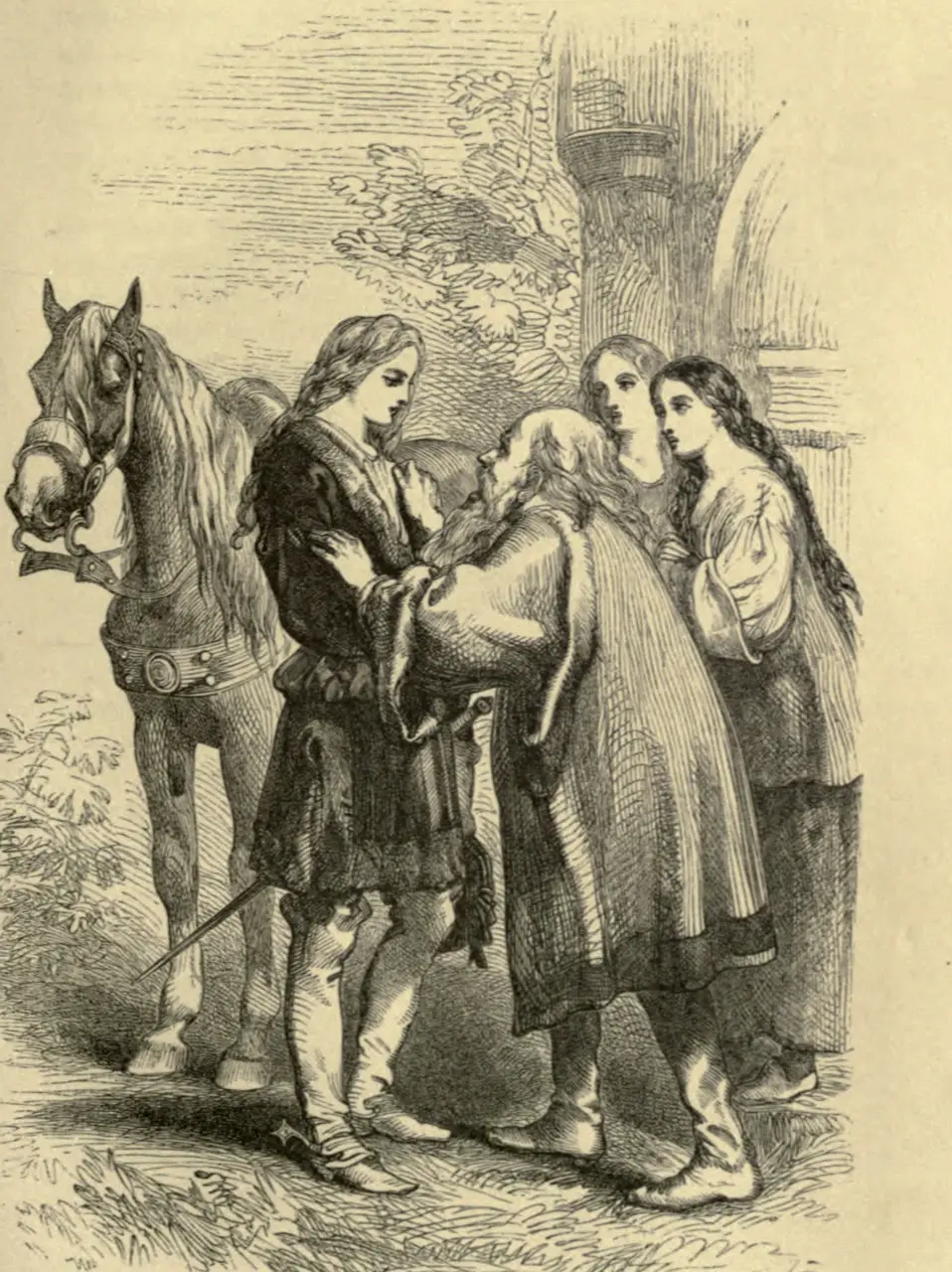
 The Island of Jewelsby J. R. PlanchéA princess bewitched to look hideous agrees to marry a king she may not see, then cannot resist a peep.
 The Sleeping Beauty in the Woodby J. R. PlanchéA fairy left off the christening list curses a princess with a spindle, and a whole court sleeps for a hundred years.
 Beauty and the Beastby J. R. PlanchéA bankrupt alderman picks a rose in a monster's garden, and his youngest daughter goes to be eaten in his place.
Act 1, Scene 1
A Market Cross—The House and Garden of BARON DUNOVER
HERALDS and POPULACE discovered—BARON DUNOVER and his three DAUGHTERS—Grand flourish.
King Alfourite thus maketh proclamation—
Whereas, without the slightest provocation,
The Emperor Matapa, in two battles,
Has drubb’d our troops and stole our goods and chattels,
It is decreed that forthwith every man
Who has got arms shall bear them if he can:
And if he can’t, he must produce the stumpy,
And not by no manner of means look grumpy.
Turn out, or fork out—fight or pay you must!
Up with your banners, or down with your dust.
Before the throne your purse or person fling,
Within three days—unless you wish to swing!
A special edict—so “Long live the King!”
CHORUS—“Norma.”
Well! if this isn’t a precious go,
We should be glad what is to know;
Fight or be fined, unless you’ve a mind
Just to be hang’d for treason!
Pray, sir, excuse the liberty,
But is not this some joke?
No!
Soon you will find it’s Hobson’s choice
Brave Volunteers—you must enroll!
Or pay your duty to the King—
So settle which you please on.
Well, I’d as soon be hang’d as fall
Fighting for any reason!
So to secure his capital,
We must reduce our own. [Exeunt HERALD and POPULACE]
What’s to be done? Alas! the heavy day!
Too old to fight and much too poor to pay.
Bear arms I can’t—indeed, opposed to strife,
I never could bear arms in all my life!
A tender youth, the task of drilling bored me—
A carpet knight, the least exertion floored me!
A cripple now, to Court I can’t stump down,
And to stump up, I haven’t half-a-crown.
I have no son my substitute to be—
My family consists of daughters three,
All grown-up girls, whose fortunes are their charms:
So that I haven’t e’en a child in arms!
How to ’scape hanging—hang me if I know!
My dearest father, pray don’t take on so;
Meet like a man your fortune, good or ill!
Or if you can’t, why then your daughter will!
What! like a man?
Aye, sister, like a man:
The only way that help him now I can.
A coat and waistcoat I intend to sport,
And be my father’s deputy at Court.
You?
You?
With gratitude I’m almost mute!
What, daughter! you become my substitute?
But should they make you fight?
To fight I’m willing.
I’ve oft been told that I look very killing.
You storm a fortress?
Or besiege a town?
Before one I can easily sit down.
You mount a breach?
Oh, sir, experience teaches,—
I mean at once to mount a pair of breaches!
[aside] So, so,—but two can play, miss, at this game.
Why should this forward chit have all the fame?
I’m quite as bold as she is, I’ll be bound,
And will shew legs with her for twenty pound!
[aside] In male attire should I not cut a figure?
I’m taller than Myrtina—aye, and bigger!
I don’t much fancy handling sword or dagger,
But I’d engage as like a man to swagger!
[aside] To get a suit I’ll pawn the table spoons! [Exit into house]
[aside] I’ll spout the tea-pot and buy pantaloons! [Exit into house]
[to MYRTINA] Fortune your filial piety will bless,
But what, my darling, will you do for dress?
Why, there’s your old Court suit, papa, you know,
All the gold lace was stripp’d off long ago,
But still the cloth’s not much the worse for wear,
And there’s enough of it, and some to spare!
Grant me that suit.
Your suit is granted. You
Shall have my sword—that’s quite as good as new,
For I have never drawn it since I bought it!
Yes—once by chance—when ’twixt my legs I caught it.
Talking of legs—you’ll add your boots, of course?
Yes, and my spurs—would I could add my horse.
So of your wardrobe give me quick the key.
BARON gives key, and MYRTINA enters house and returns with the suit, which the BARON examines during his solo.
How dull without her this old house will be.
DUET—Air—“Row gently here, my Gondolier.”
When you, my dear,
Are gone, dull here
The days will seem to glide;
But let us hear,
By post, my dear,
Whate’er may you betide.
My doublet take,—[aside] ’Tis quite as well—
The skirts are gone, I see:
For now no tails it has to tell
Of where it went with me!
Now rest thee here,
My father dear,
Hush! hush! for up I go,
To put a light
Silk pair of tight
Etcæteras on below.
Oh, if I look, in male attire,
But half as well as he
I saw one night dance on the wire,
What an angel I shall be! [Exeunt into house]
Act 1, Scene 2
The Fairies’ Haunt—A Picturesque Glen
FAIRIES discovered dancing “Le Danois Quadrille”—A FAIRY BAND, à la Colinet, seated on a bank, and the QUEEN OF THE FAIRIES attended.
Chorus to the Quadrille, “Le Danois.”
Here in our human shape,
We pass the summer day quadrilling
Like mortals, whom we ape,
Into the fashion falling.
No more in “Fairy Ring”
Would well-bred Fay to dance be willing;
“Grande Ronde” is now the thing—
When such a figure calling.
Here, ’tis “Pastorale,”
“La Trenise,” “Finale,”
All “L’Eté,”
’Tis “Balancez,”
Or “Promenade,” till Pistolet
Pops off—and off pop we—
To music thrilling,
Led by the humming bee,
Our Elfin Colinet!
Break off!—my fairy nose a mortal smells!
Creep into acorn-cups and cowslip-bells!
Make yourselves scarce!
Music—FAIRIES disperse and vanish into flowers, &c.—one sticks fast.
How now, you clumsy lout!
Is that the way you pull a flower about?
A pretty fairy ’pon my word. Pray who
D’ye think’s to sleep in that rose after you?
Crumpling the leaves in this untidy way! [putting them to rights]
Now, get you in, you naughty, naughty fay! [beating him]
And here—whose wing is this? Pray hold it up!
You can’t be cramp’d for room sure in that cup!
I’m quite ashamed of you, I do declare!
You’re not a morsel like the elves you were,
But that your dress from common habits varies,
No soul on earth could fancy you were fairies!
As I’m your Queen, by my stop watch, I’ve reckon’d,
You’ve ta’en to vanish more than half a second!
Who is’t that comes?—a girl in male attire!
She needs my aid—does she deserve’t?—I’ll try her. [music—FAIRY QUEEN retires behind trees]
Enter PERTINA, in boy’s clothes.
Of Miss Myrtina I have got the start—
I feel convinced that I can play my part!
In dress and manner I am quite the beau,
No one would take me for a girl, I know!
Music—Trees open and discover FAIRY QUEEN dressed as an old Shepherdess, bending over some broken ground.
Oh, dear! oh, dear!—what shall I do?—oh, dear!
Heyday!—why what old beldame have we here
[advances] Oh, noble sir,—for you can be no less,
Help an old woman who’s in great distress.
My lamb has fallen into this ditch, and I
Can’t get it out,—help me, or it will die!
I help to pull a sheep out of a ditch?
D’ye take me for a butcher, you old witch!
I take you for a pert, hard-hearted girl!
Oh, you need not your false moustaches twirl!
You feign to be a man,—why, who with eyes
Could fail to see through such a poor disguise?
Discover’d!—Shame!—I’ll try to bluster. Zoons!
Oh, come—no airs—who pawned her father’s spoons? [PERTINA shrieks and runs out]
Ha, ha, ha, ha! I think that was a twister!
Another step—aye—this must be a sister. [music]
Enter FLIRTINA.
I’ve stolen out by the back door—what sport!
In this dress I shall cut out all the Court.
Alack-a-day! alack-a-day!
How now?
What do you mean by making such a row?
Oh, sir, my lamb has fallen into this pool,
And will be drowned!
Well, serve you right, old fool!
Why don’t you take more care?
[advances] Alack, good youth,
Lend me a helping hand.
Who, I, forsooth?
Do I look like a clown for such work fit? [looks at her legs]
You look like what you are—a vain young chit,
A silly girl, as any one can see.
[aside] Provoking!—can they really? It can’t be!
[aloud] Harkey, old hag——
Take care what you’re about.
Who put her father’s tea-pot up the spout? [FLIRTINA shrieks and runs out]
Ha, ha, ha, ha! So much for t’other!—stay—
Here comes a third—let’s hear what she will say.
Music—Enter MYRTINA, as FORTUNIO.
This is the road, I think—I hope to get
Clear of this wood before the sun shall set,
Or wicked wags will sneer, and say delighted,
A would-be knight was in a wood benighted;
So let me speed.
O dear, what shall I do?
Hey-day, some poor old soul, in trouble too!
I can’t pass on and leave her sobbing so;
What is the matter, Goody, may I know?
Bless thy kind heart, young man; my pretty sheep
Has fallen into the water.
Well, don’t weep.
’Tis still alive; and I have little doubt,
By hook or crook, that we can get it out.
Here, lend a hand. [a chord]
[appearing in her own shape] I will, but it shall be
To help you, charming girl, as you would me.
Be not alarmed, I am your friend, sweet maid;
Although discovered, you are not betrayed.
I know your errand, and its motive pure,
And will assist your fortune to secure.
Of many things I see you stand in need:
A better wardrobe, and a gallant steed. [stamps—music—a leather trunk rises]
Lo! in this Turkey leather trunk you’ll find
Cash, jewels, arms, and dresses to your mind;
You’ve but to stamp, wherever you may be,
And at your feet this trunk you’re sure to see.
Now for a horse. [waves her wand—Music—part of the wood opens, and discovers a horse, richly caparisoned] Behold one in a trice,
Perfect in all his paces, free from vice,
And warranted to carry a lady; never
In fairy land was known a horse so clever.
He knows all things, past, present, and to come,
And eats but once a week!
The poor dear dumb——
Dumb!—he can speak; whole sentences can say,
While common steeds can only utter “Nay.”
Taught elocution by a necromancer,
No horse your purpose half so well could answer.
Well, I have oft heard mention of a stalking-horse,
But never till this hour of a talking horse.
Pray, may I ask what name he answers to?
Comrade.
Dear Comrade, tell me how d’ye do.
I’m pretty well, I thank ye; how are you?
Charming! delightful! what articulation!
Without the slightest lisp or hesitation!
I should have thought a horse had spoken hoarser.
His language is not course, though he’s a courser.
And, apropos of names, your own should be
Fortunio, since you’ve a friend in me.
Of proper names ’twould be the one most proper;
But who is that man yonder, with a chopper?
A woodman, who cuts down five hundred trees
And carries them upon his back with ease.
You’d better hire him.
Surely, if I can. [music]
Enter STRONGBACK.
Harkye, d’ye want a porter’s place, young man?
I don’t much mind. What wages, sir, give you?
Whate’er you please.
Well, I think—that will do.
To carry messages you won’t refuse?
I’ll carry anything on earth you choose.
Your name is——
Strongback.
Strongback, you’re my man.
Your carrier pigeon or your Pickford’s van.
Here comes another gifted fellow.
Pray,
Why has he tied his legs in that queer way?
Because his speed is swifter than the wind,
And when he hunts he leaves the game behind,
Unless with ribbons he his legs can fetter.
Shall I engage him?
Yes—you can’t do better. [music]
Enter LIGHTFOOT, his legs tied with ribbons.
Young man, I want a running footman; say—
Will you take service?
Yes, and bless the day,
For I’m in great distress.
How came you so?
[whispering] Outran the constable; lived fast, you know.
Well, you shall have a quarter in advance.
Oh, sir, to serve you I’d run any chance.
Yonder’s a man who may be useful, too.
Why does he bind his eyes?
The less to view.
His name is Marksman, and whene’er he fires,
He kills more game than any one requires;
For objects full five leagues off he can see.
Oh dear, but that may very awkward be;
I’m bound for Court, you know, and who can tell
What mischief he may make who sees so well?
Oh, but he never talks of what he sees;
He’s too sharp-sighted.
Then my mind’s at ease. [music]
Enter MARKSMAN, his eyes bandaged.
An archer blindfold—why you must be Cupid!
Indeed, sir, I’m not anything so stupid.
[aside to FAIRY] “Sir!” He can’t see that I’m a girl, that’s clear.
[aside] He can; but sees you wouldn’t one appear.
Well, as your sight’s so good, pray can you see
Any objection, friend, to serving me?
[taking bandage from eyes] None in the least.
Then we’re agreed. And now,
[to FAIRY] Madam, I’ll make you my most grateful bow.
Stay! you have but three servants.
Need I more?
You must have seven; here come the other four.
The first, who on the ground himself is throwing,
Has ears so fine he hears what grass is growing.
He’s still more dangerous, unless discreeter;
So good a watch may make a bad repeater.
Oh, you may trust him. There’s the second, blowing
To set yon mills, full six miles off, a-going.
A famous fellow he, the wind to raise,
So often done by puffing, now-a-days. [music]
Enter FINE-EAR and BOISTERER.
The other two will make your suite complete;
One any given quantity can eat,
The other drink the sea dry, if you please.
Mercy! and ought I to engage both these?
You’ll want them.
Well, they’ll be expensive pages;
I think I’d better put them on board wages. [music]
Enter GORMAND and TIPPLER, and are engaged by FORTUNIO.
For each you’ll find a sumptuous livery
Within this trunk.
Indeed; but where’s the key?
In Comrade’s ear you’ll see a ribbon green.
[finding it] I’ve got it! [opens trunk—the SERVANTS take out liveries and a rich dress for FORTUNIO, sword, jewels, &c., during chorus]
Now to Court—see and be seen!
music—FAIRIES re-appear in all directions
CHORUS—“Oberon.”
Speed, mortal, speed! Seven soon will chime,
You’ll just arrive in pudding time!
a bank on one side changes to a car, in which the FAIRY QUEEN ascends, and as FORTUNIO puts his foot in the stirrup to mount the horse, the scene closes on the tableau
Act 1, Scene 3
Chamber in the Palace of KING ALFOURITE
Enter KING, leading the PRINCESS, attended by his MINISTER, a LORD-IN-WAITING, and FLORIDA, lady’s maid to the PRINCESS.
Hang out our banners on the outward walls!
The cry is still they come.
Yet no one calls,
Even to say they can’t come.
Not a soul
Has yet appeared who will his name enroll,
Nor who will pay his money; all hang back.
They should all hang together, in a crack.
Hang all my subjects! that would be too cruel.
We must have patience.
Yes, and water gruel,
For that ’twill come to. Neither men nor money
To carry on the war! A mighty funny
Figure you’ll cut! Oh, Minister of State,
How long d’ye think a monarch ought to wait
Before he puts himself into a passion,
When he’s fobb’d off in this rebellious fashion?
Madam, I think his gracious Majesty
Is far too patient.
So do I——
And I.
And I. If I were you, my royal liege,
The very lives out of the rogues I’d squeege!
That would be screwing them a deal too tight.
No, no; you’re all four wrong, I’m Al-four-ite!
Aye, joke, that’s right, whilst ruin’s o’er you hovering;
You’ll change your note, sir, when they change their sovereign.
Let’s change the subject, if not your opinions.
I’d hang the rebels up in strings.
Like inions!
My people are my children.
Yes, and purely
You’ll spoil them.
Better than despoil them, surely.
In short, the proclamation was too strong.
Too weak, in short, as you will find ere long.
Patience, I say. Still hope I fondly nourish.
Nothing within your realm will ever flourish. [trumpet without]
D’ye call that nothing? Sure, that flourished bravely.
Enter a PAGE.
Good news, or bad, that thou com’st in so gravely?
Fortunio, a young and noble knight,
Craves audience of the great King Alfourite.
Desire the gentleman to walk upstairs.
“Walk up!”—such jargon showmen use at fairs.
[to PAGE] Let him approach. [Exit PAGE]
Consider, sir, your state.
I do, and think it very bad of late.
You’re so undignified! I blush for you.
Sister, you’ve dignity enough for two.
Enter FORTUNIO, richly attired.
[aside] Oh, Gemini! Oh, what a nice young man!
[to PRINCESS] Look, madam.
I am, looking through my fan.
[kneeling] Sire, for my father ’tis my humble wish, a
Substitute, to serve in your militia.
[raising him] Most sensible of your polite attention.
Do you take snuff? [offering pinch]
[aside] Amazing condescension!
Fine weather——
[bowing] Very.
Have you seen the comet?
No, sire. [aside] But feel as if I’d just dropp’d from it.
Oh, Florida, I’m captivated quite!
In all my days I ne’er saw such a knight.
[aside] The finest knight that ever I did see.
If she’s in love with him, good night to me.
[aside] I’ve lost my heart, as sure as anything!
I never saw a king so good-looking.
[aside] No age could ever boast a youth so pretty;
That he is not a girl ’tis quite a pity.
If I could find a fair one half so fair,
I’d marry her to-morrow, I declare.
Brother, I’m sure you couldn’t have the heart
To see this stripling to the wars depart.
He’s much too young and handsome. [to FORTUNIO] You shall be
Groom of the Bedchamber, Sir Knight, to me.
Nay, he shall office in my household take,
Fortunio Lord Treasurer we make.
Lord Treasurer! for such an office, sure——
[aside to him] Fear not, at present ’tis a sinecure.
Ah! then indeed, if there is nought to do,
I may be quite as capable as you.
Your duty you will learn in half a minute;
’Tis but to hold a purse—there’s nothing in it.
You’ll eat your mutton with us, sir, to-day,
And crack a bottle in a friendly way.
I crack a bottle! Sire, I’d venture, but
I fear I couldn’t without being cut;
And now-a-days, save at some public spread,
Wine’s never suffered to get in one’s head.
No, times are changed; I think it quite provoking
That in my reign there is so little soaking!
Song—KING—Air—“The days that we went gipsying.”
Oh, the days that we got tipsy in—a long time ago,
Were certainly the jolliest a man could ever know!
We drank champagne from glasses long, and hock from goblets green,
And nothing like a cup of tea was ever to be seen.
All night we passed the wine, nor dreamed of hyson or pekoe
In the days that we got tipsy in—a long time ago.
Oh, those were days of bumper toasts. or salt-and-water fine,
Broil’d bones and devil’d biscuits, three-times-three and nine-times-nine!
When underneath the table you were bound your guest to land,
And no man rose to go—till he was sure he couldn’t stand!
Tea-totallers we’d none to preach ’gainst brandy or bordeaux,
In the days that we got tipsy in—a long time ago.
How changed, alas! the fashion now—to booze you’ve scarce begun,
When clattering comes the coffee-tray and all your drinking’s done;
Or John informs the gentlemen “he’s taken up the tea;”
And ’twould be voted vulgar quite if drunk a man should be.
A plague upon such sober times—I often sigh “Heigho!”
For the days that we got tipsy in—a long time ago.
Exit KING, attended by MINISTER and LORD-IN-WAITING—PRINCESS dismisses FLORIDA, and detains FORTUNIO.
Stay, gentle youth, and hear a Princess own
A secret—for her breast too mighty grown!
For ten long tedious minutes have I striven
To quell the pangs by which my heart is riven;
But such prodigious efforts fail at length—
The constant struggle is beyond my strength.
I love! nor care though all the world should know it;
And, in the words of our immortal poet,
Exclaim, “If you love me as I love you,
“No knife shall cut our love in two!”
[aside] Pooh—pooh!
[aloud] Madam, respectfully I must decline.
D’ye mean to say, then, that you won’t be mine?
I am too much beneath your Royal Highness.
Madness! Despair! Yet this may be but shyness.
Duo—AIR—“Au clair de la Lune.”
Sir, you can’t refuse me,
Treason it would be!
Madam, pray excuse me,
There we don’t agree.
Honour you I can, but
Wed you—there’s the rub!
I am not a marrying man, but
I’ll name it at the club.
[aside] Yield, O Love, thy crown up,
And thy hearted throne!
In this virgin bosom
Hate now reigns alone!
[together] If all your hairs were lives,
Young Mr. What-you-call,
You’ll find my great revenge
Has stomach for them all!
[aside] [together] If she don’t grow more tender,
I “Police” must call;
That I’m a nice young woman
She don’t think at all. [Exeunt PRINCESS and FORTUNIO]
Act 1, Scene 4
Court-yard of the Palace
In the centre a large basin of water with jet d’eau; the Royal Stables; the Royal Gardens—At back, terrace, with balustrade, beyond which is seen the open country; sunset—Dinner bell rings.
Enter FORTUNIO.
There’s the first dinner-bell, as I’m a sinner;
I scarcely shall have time to dress for dinner.
Enter CITIZENS and PEASANTRY, male and female
Chorus—AIR—“The Campbells are coming.”
The dragon is coming! oh! oh! oh! oh!
The dragon is coming! oh! oh! oh! oh!
The dragon is coming—we really ar’n’t humming,
The dragon is coming! oh! oh! oh! oh!
His mouth is wider than any church door,
And three miles off you may hear him roar!
The terrible glutton eats men like mutton,
And hasn’t a notion when he should give o’er!
The dragon is coming! oh! oh! oh! oh!
A dragon coming! Mercy on us! When?
Most likely, sir, a little after ten;
That is about the time he likes to sup.
How pleasant! Has he eaten many up?
Whole parishes, and lick’d them clean as plates;
And all the toll-men at the turnpike gates.
His monstrous appetite’s beyond belief,
Sir, he has eaten even Tariff beef.
If you have any doubts, you’ve but to stay!
He’ll clear them all up if he comes this way.
Enter KING and PRINCESS, attended.
One woe doth tread upon another’s heel,
Uncommon woe distracts the public weal.
War of my subjects has destroyed the best,
And now a dragon will devour the rest!
[aside] Oh, vengeance! Now’s my time! [aloud] No, brother, no;
Fortunio has volunteered to go
And slay this monster——
I! Well; did you ever?
Upon my word, I never, no I never!
He is so modest, it is quite distressing;
Indeed, he only wants a little pressing.
If you would be so kind, upon the nation
You would confer the greatest obligation;
And if, by any chance, I could return——
Sir, that’s exactly what I wish to learn.
If I saw any chance of my returning,
I shouldn’t so much mind——
[aside to KING] For fame he’s burning.
[aloud] We’ll go to dinner whilst you do the job,
And keep some hot for you upon the hob.
Thou’lt not say “No,”—thy Sovereign supplicates thee;
Go, be our champion! “Go where glory waits thee!” [music—Exeunt all but FORTUNIO]
Fine words, I grant, and easy ones to utter,
But such, the proverb says, “No parsnips butter.”
Now this is all that wicked woman’s doing,
Because I wouldn’t listen to her wooing.
What’s to be done? Why the first thing, of course,
Take an opinion of my learned horse.
Comrade, my friend, just look out of your stable,
And answer me one question, if you’re able. [the horse, COMRADE, puts his head out of the stable-door]
Is it the Corn Question? Because I’m gifted
To speak on one I’ve seen so often sifted.
No.
I but joked, for may I draw a wagon,
If you have not been asked to kill the dragon.
You’re right.
Well, you must do it.
Cool, I vow.
Will you be kind enough to tell me how?
Call Fine-ear.
Fi——
Enter FINE-EAR.
There is no need to bawl,
I heard, sir, you were just about to call.
What can I do to serve you?
Say how near
The dragon is.
[listening] As well as I can hear,
About seven leagues, and, it may be, a quarter.
Let Tippler, then, drink up that pond of water,
And Strongback bring as much wine as will fill it,
And when the dragon’s dead drunk you can kill it.
Sagacious creature! Tippler, Strongback, speed!
Enter TIPPLER and STRONGBACK.
Here, master.
Your assistance much I need.
[to TIPPLER] Drink this pond dry.
Is that all—in a minute! [goes to pond and begins to drink]
[to STRONGBACK] Bring as much wine here as you can put in it.
Yes, sir. [going]
You’ll want a cart.
A cart—for what?
For such a job I’d scorn to use a knot. [Exit]
There, sir—I’ve mopp’d that up without a wink.
What shall I give you?
What you please to drink.
Music—Re-enter STRONGBACK laden with hogsheads of wine.
I think I’ve brought enough to fill the pond;
At all events there’s no more wine in bond. [roar without]
Make haste, make haste, for surely by that roar,
The dragon’s nearer by some leagues.
Yes—Four.
Then to our posts—he’ll do the other three
In a hop, step, and jump, immediately.
Quartette—FORTUNIO, STRONGBACK, TIPPLER, and COMRADE—Air—“Master Poll,” Midas.
Master Drag,
In spite of his brag,
We’ll buffet away from the plain, sir!
And I will fight
With all my might,
And I with all my mane, sir!
And I’ll have a rap,
Though he may snap,
And kick up a wounded racket!
I’ll hack!
I’ll whack!
I’ll crack!
Good lack!
How we’ll pepper his scaly old jacket!
In spite of his teeth,
Above and beneath,
I’ll make him his jaw to hold, sir!
And teach him to dance
At the end of my lance,
As St. George did the dragon of old, sir!
As soon as he’s dead,
I’ll cut off his head!
Before ’twould be rather rash, sir!
I’ll dare!
I’ll tear!
I’ll bear!
Oh, rare!
And I warrant we’ll settle his hash, sir!
melo-dramatic music—it has become night, and moonlight—FORTUNIO and SERVANTS conceal themselves—enter the DRAGON—he sniffs the wine and commences drinking immediately, shews symptoms of intoxication, staggers, reels and falls
Now, master, now!
Enter FORTUNIO and his SERVANTS armed.
[stabbing the DRAGON] “Dead for a ducat, dead.”
I’ll tell the tale—whilst you cut off the head! [exit—FORTUNIO cuts off the DRAGON’S head, and sticks it on the top of his spear]
[taking up the body] I’ll bear his body—it’s no load to brag on.
Mind—it’s down hill.
No fear—I’ve got the drag-on.
Shouts without—Re-enter TIPPLER, with the rest of FORTUNIO’S suite—CITIZENS, PEASANTRY, &c., the KING, the PRINCESS, NOBLES, &c., forming a procession à la “Masaniello”
CHORUS—“Masaniello.”
Come, fill to the brim every flagon,
And dance while a leg’s left to wag on!
E’en Warwick’s old Guy
But a coward seems nigh,
To the hero who conquer’d the dragon.
they pass round the stage, and FORTUNIO comes to a halt before the KING
[aside] Confusion!—conqueror! the dragon slain!
[shewing the head to the KING] “Thus perish all that gives Alonzo pain.”
We can’t find words to speak our thanks.
Then don’t.
[aside] I cannot bear this triumph—and I won’t.
Money I’ve none; and so may truly say,
“More is thy due than more than all can pay.”
But kings, you know, of honour are the fount,
And therefore freely honours you shall count—
Aye, though you’re nine at whist! Yon monster, there,
In your own arms we give you leave to bear;
And, to prove all the gratitude we feel,
We’ll pass a patent under our great seal,
Declaring, henceforth, ’tis our royal will,
That none but you shall dare a dragon kill!
That is, indeed, a privilege most gracious!
But, brother, on a deed much more audacious
This youth is bent.
Indeed—what—which—when—how?
You’ll never guess.
[aside] What is she after now?
His great ambition, brother, is to go
Ambassador to our most deadly foe;
He vows, without an army or a navy,
He’ll force the Emperor to cry “Peccavi!”
[aside] Good gracious me! I go their deadly foe to!
Where does that wicked woman think she’ll go to?
Since I can give him nothing, ’tis but just
I should refuse him nothing—go he must.
But, sire——
No thanks, we still shall be your debtor.
And so the sooner you set off the better!
FINALE—“Cruda Sorte.”
Is she determined to make me a martyr?
Does she suppose me Van Amburgh or Carter?
First fight a dragon, then go catch a Tartar,
Is out of the frying-pan into the fire.
If to his courage he don’t fall a martyr,
He may depend on the first vacant Garter!
Fight with a dragon, then go catch a Tartar!
’Tis really much more than he ought to desire.
O Etiquette! to your laws he’s a martyr,
He daren’t contradict, though he knows what she’s arter,
First fight a dragon, then go catch a Tartar,
Is out of the frying-pan into the fire!
Never was hero more handsome or smarter,
Braver he is than Van Amburgh or Carter,
First fight a dragon, then go catch a Tartar!
He certainly next will the Thames set on fire! [Tableau]
END OF ACT THE FIRST.
Act 2, Scene 1
Hall of Audience in the Palace of the EMPEROR MATAPA—Large gates
The EMPEROR discovered seated on his Throne, attended by his COURT, CHAMBERLAIN, OFFICERS, and GUARD—The PRINCESS VOLANTE and her attendant LADIES.
Daughter, we’re dull—we’ve got the devils blue!
Dance and amuse us, as you ought to do! [VOLANTE dances]
Enough, we’re sleepy—sing, and let your numbers
Wrap our imperial soul in gentle slumbers!
[CHORUS—“Away with Melancholy”—(only a few bars] sung discordantly, which are interrupted by EMPEROR.]
Silence—odds bobs, unless you’ll all be swinging.
Great sir—you bade us sing——
D’ye call that singing?
It may be for the million!—hurly-burling!
I wouldn’t hear it for a million sterling!
So peace! or by the hangman’s shears bereft
You shall not have an ear for music left.
Great sir, your servants tremble and obey.
They’d better!
Enter OFFICER.
Well, what have you got to say?
Most mighty Emperor—King Alfourite—
Ha! what of him? Does he again shew fight?
An envoy from his court has just arrived,
Who craves an audience.
Is the fool nine-lived,
That thus he ventures into our dominions?
Perhaps——
Perhaps!—who asked for your opinions?
Go, hang the fellow instantly—— [OFFICER going]
No—stay! [OFFICER returns]
We fain would hear what he has got to say,
Which, if we hang him first, he cannot tell.
Let him approach!—after will do as well.
Music—Enter FORTUNIO with his seven SERVANTS.
Now speak, young shaver—what’s the news with thee?
Thus, after greeting, speaks my King by me—
To you, who’ve borrow’d all his treasure——
Borrow’d!
A strange beginning!
Don’t you be so forrard!
Go on, young gentleman, you shall be heard.
Borrow’d, I think you said.
That was my word.
I thought it not polite to use a stronger.
His Majesty can’t do without it longer,
And therefore sends me, in a civil way,
To tell you he must have it back to-day!
What follows if we disallow of this?
His Majesty will take it much amiss.
On this fool’s errand have you come alone?
I’ve seven servants with me, of my own. [all the SERVANTS bow]
You are a pleasant man for a small party!
Our wrath is smothered by our laughter hearty.
General laugh—EMPEROR checks them; laughs—they again echo him.
My Lord Ambassador, you’ve had your jest,
’Tis now our turn—we grant your small request,
On one condition—find, within this hour,
A man who, for his breakfast, shall devour
All the new bread baked in this town to-day.
Agreed. [aside] Here’s luck!
Do you know what you say?
Most perfectly.
Oh, very well, we’ll see.
Take heed; if but a crumb uneaten be,
Into a red-hot oven I will thrust ye,
And bake ye all, alive!
How very crusty!
[to OFFICER] Go, pile the bread up in the Palace-court;
Here, from our throne, we will behold the sport.
Exit OFFICER with some GUARDS—the EMPEROR retires up, with his suite
Well, I am pretty easy on this head.
Gormand [GORMAND advances], I hope you haven’t breakfasted.
Why, sir, I ate a round of beef at ten,
But haven’t made a meal I don’t know when.
Can you eat all the new bread in this city?
Lord! If I couldn’t, sir, ’twould be a pity—
And all the stale besides, just to complete it.
The job’s to get one’s bread, sir, not to eat it.
You’re sure?
Don’t be alarmed, sir, it’s all right;
A round of beef just whets my appetite.
I joy to hear you say so. I declare
Bread’s rising very fast in yonder square.
’Twill fall much faster, sir, when I fall on it.
I hope so, for our lives depend upon it.
[looking out] They’re bringing rolls and twists—all smoking hot.
They can’t bring such a twist as I have got. [the CHAMBERLAIN advances]
The celebrated Duet, “Tell me where is Fancy Bread.” Arranged for Three Voices, by an Irish Composer. FORTUNIO, CHAMBERLAIN, and GORMAND.
Tell me, tell me,
Tell me, tell me,
New, dy’e fancy bread?
Smoking hot, from oven red—
Or prefer you stale instead?
Reply, reply, reply.
’Tis all the same, sir, in my eye—
On both I’ve fed, and fancy size
In the loaf is all I prize.
’Tis all the same, sir, in his eye, &c.
Let them bring all the stale as well,
I’ll / He’ll Go at it, ding, dong, bell!
The gates at the back are opened, and several enormous piles of loaves are seen in the court-yard, on a large table or platform.
There is the bread—now where’s your man?
He’s here.
Why, fellow, can you all that table clear?
I’ll do my best your Majesty to please,
But if you would just add——
Ha!
A little cheese.
Dost mock us, villain? Eat all that, or die!
Oh, sir, it’s quite a pleasure to comply. [music—GORMAND devours the bread]
[Chorus—EMPEROR and COURTIERS—(Corelli] ]
What a gulp! oh, goodness, gracious!
Never wolf was so voracious!
Quartern loaves like pills to swallow!
Here’s a chap beats Dando hollow!
Only see,
Goodness gracious!
How capacious
Must his bread-room be!
Down he crams ’em, smoking hot,
What a famous twist he’s got!
During this chorus GORMAND demolishes all the heaps of bread
There’s not a crumb left! will you please examine?
Confound the cormorant, he’d breed a famine.
Bravo, dear Gormand, well may it be said
That you have proved yourself a thorough-bred!
I should have had the cheese, sir, I declare;
The last batch was light-weight—and that’s not fair.
Now, great Matapa, I your promise claim—
Restore the treasure——
No!
Oh fie, for shame!
A monarch pledge his word—and not stick to it?
Why, who the deuce had dreamed that he could do it!
Yet you’d have baked us had he chanced to fail;
Oh, sir, your Justice bears a sliding scale!
I was but joking——
Sir, a bet’s a bet,
I’ll ask the Jockey Club——
One moment yet—
Find me a man can drink up all the water,
And one who in a race can beat my daughter;
And to restore your royal master’s treasure,
We’ll make a point—of full imperial measure!
We swear!
By what?
The Great Bear—whose relation
We have the honour to be.
A declaration
No one can doubt who knows your Majesty;
You are as like a great bear as can be!
By our celestial brother, Ursa Major,
We swear this time that if we lose our wager,
We’ll pay!
Be witness all, then; ’tis a bet!
Tippler!—[TIPPLER advances]—Your whistle if you’d like to wet,
There’s a canal, five fountains, and a tank
To drain——
With pleasure, sir; but when I’ve drank
The water, I shall finish with the wine.
[aside] Eh, zounds! if that’s the case, he’ll finish mine!
My choice old port!—my fine Duff Gordon sherry!
An awkward customer this fellow—very! [TIPPLER going]
[aloud] Hold! this condition we will not exact.
We had forgotten an important fact!
Our doctors here, despising drug and pill,
Cure by cold water every mortal ill!
And should this man possess such powers of suction,
His faculty would doom ours to destruction!
Therefore, my Lord Ambassador, we think
We’d better drop this question of the drink;
And ’stead of losing all the running water,
Just stand to win upon our running daughter!
Content—will’t please you name the time and place.
The Orange Walk—in half-an-hour——
The race—
P.P.?
Of course, P.P.
Sweepstakes—off-sweeping
All the King’s plates and gold cups in your keeping.
Flourish and march—Exeunt EMPEROR and FORTUNIO, with their trains.
Act 2, Scene 2
Another Apartment in the Palace
Enter FORTUNIO and his seven SERVANTS.
Lightfoot, I need not tell you ’tis your part
To beat the Princess.
Give me a fair start—
I’ll beat the arrow from friend Marksman’s bow.
You’ll want a proper dress to run in though. [stamps—the trunk rises—giving him the key]
Look in the trunk,—you’ll find one, I dare say.
The very thing. [pulling out a scarlet jacket and hose] Your lordship’s colours, pray——
Go hence and dress, for you’ve no time to waste.
Sir, if I can make anything, ’tis haste. [Exit]
Sir, may we crave a word?
I’m all attention.
Lightfoot has hit upon a rare invention.
What is’t?
A flying steam coach!
Ha!—indeed!
Built on a principle that must succeed.
Just like a bird—with body, wings, and tail.
Or like a fish——
Aye—very like a whale.
You think we’re joking, sir.
In truth I do.
Sir, it’s in print——
Oh—then it must be true,
Or else I should have said, with all humility,
’Twas flying in the face of probability.
We’ve formed a joint-stock company.
So, so.
Boisterer can puff off anything, you know.
And Strongback carries on the whole affair,
And all the onus will with pleasure bear.
Marksman will see the way clear through the sky.
And Fine-ear tell folks when the coach is nigh.
Gormand and Tippler?
Why, sir, we all think,
As they can nothing do but eat and drink,
They ought to be directors, and together
Meet upon board days, and discuss the weather.
I fear your scheme will end in smoke.
Aye, so
I heard them say of gas some years ago.
Faith, you’re right there, and who on earth shall say
We may not one day skim the milky way?
Still, in these times of quackery and puffing,
The greatest goose may get his fill of stuffing.
Song—FORTUNIO—Air—“March, March.”
Quack, quack, nothing like quackery,
Humbug, my friends, of the day is the order!
Quack, quack, any gimcrackery
Now will go off with a puff, for the Border.
Pretenders abounding, trumpeters sounding
Every man his own honour and glory;
Truth you’re quite right to prize, if you don’t wish to rise,
But if you do you must get up a story.
Quack, quack, &c.
Come to the Chambers of Clement’s or Gray’s Inn,
Come to the Solons who rule in “the Row,”
Come to the ball where the heiress is blazing,
You will find humbug from Bond Street to Bow.
Bills, yellow, green, and red, flutter above your head,
Each of some miracle hangs the recorder;
New projects every day melting your cash away,
Till you’re obliged to pop over the Border.
Quack, quack, &c. [Exeunt]
Act 2, Scene 3
A Long Walk lined with orange-trees
The winning post and the Judge’s chair, with a bell above it—A set piece crosses the stage, over which the runners pass and descend out of view; beyond, the course is continued in perspective, and the figures pass rapidly along grooves up and down.
Enter the EMPEROR, leading the PRINCESS VOLANTE, attired for the race, and followed by the EMPEROR’S Court, LORD CHAMBERLAIN, OFFICERS, GUARDS, &c.—FORTUNIO, with LIGHTFOOT, attired for the race, and followed by the other six SERVANTS.
This is the spot, the centre of the grove,
Here stands the winning post. In yon alcove
The judge’s chair, where seated I shall be.
The daughter to Matapa here you see,
Fresh as a four-year old—of matchless speed.
Her make and beauty nothing can exceed.
Yonder is my antagonist no doubt.
Fortunio names Lightfoot.
Trot him out! [LIGHTFOOT advances and bows]
A scarlet runner, by his legs——
Alack,
Red legs are rarer on the turf than black.
Come! clear the course. [bell rings]
Fair daughter, what d’ye say
To some of our imperial Tokay
Before you start?
A glass I’ll not decline,
To run a race nought helps like racy wine!
Some Tokay for her Highness.
And for me.
For thee!
It is but fair.
So let it be!
Give him a bumper! Harkye!
To PAGE and whispers—PAGE bows and goes out—returns with goblet which he hands to LIGHTFOOT.
I misdoubt!
They’ll doctor him! [to LIGHTFOOT] Take care what you’re about.
Our Chamberlain shall start you when you’re ready.
Come on then——
[aside] Well that stuff is rather heady!
[aloud] Where do we start from?
Yonder in the hollow.
Then lead the way.
And keep it?
That don’t follow!
Now, Lightfoot, mind you run for your existence!
Once round the course, remember, and a distance.
Music—The EMPEROR takes his seat in the Judge’s chair—Bell rings—CHAMBERLAIN stands on the ridge and drops a flag—VOLANTE and LIGHTFOOT ascend the slope at the back of the stage and disappear behind it.
They’re off! they’re off!
I’ll bet a thousand to one
’Gainst Lightfoot.
Sir, I take you.
Done, sir.
Done.
VOLANTE and LIGHTFOOT re-appear running, VOLANTE rather in advance.
The Princess makes the running.
All my own is.
Six to four on her Highness.
Done, in ponies. [Exeunt VOLANTE and LIGHTFOOT]
Lightfoot is holding in.
A pretty race!
Lightfoot is beaten!
He can’t live the pace.
They’re out of sight.
And will be so, until
They reach the walk a-top of yonder hill;
But as my daughter runs five miles a minute,
It won’t be long before you see her in it.
Bell rings as the figure of PRINCESS is seen at the top of the hill.
And there she is——
Alone, as I’m a sinner!
Hurrah! I’ll bet my crown I’ll name the winner.
No takers.
The figure descends the hill rapidly, and disappears behind the rise of the stage.
Where on earth can Lightfoot be?
Listen, good Fine-ear; Marksman, haste and see.
Where’er he is, he’s fast asleep, for I
Can hear him snore.
Ha! there the rogue I spy,
Stretched out beneath a tree, full three miles off.
Of all the empire I shall be the scoff!
Our lives are forfeit, too! Asleep! plague take him!
Nay, don’t despair, good master, this shall wake him. [lets fly an arrow]
What have you done?
[looking out] Just touched his ear, I vow.
He’s up and off.
The figure of LIGHTFOOT appears at the top of the hill, and descends with incredible swiftness, disappearing behind the rise in the stage.
He comes! He’ll beat her now!
PRINCESS appears on the ridge of the stage, closely followed by LIGHTFOOT.
Blue! Blue wins easy!
and his MEN. [as LIGHTFOOT appears] Scarlet, go it, Scarlet!
Volante!
LIGHTFOOT bounds by PRINCESS and passes the post.
and his MEN. Lightfoot! Lightfoot!
[coming out of the chair] Curse the varlet!
Won in a canter.
Scarlet?—I’m done brown!
Take care again, sir, how you bet your crown.
The knowing ones are done this time, I say.
There’ll be long faces upon settling day.
O Lightfoot, what a time to sleep you chose!
I felt so drowsy, I laid down to doze,
Thinking by sleep refreshed to run the quicker!
I ne’er was overtaken, save by liquor!
It was a narrow ’scape for me, ’tis clear.
Mine was an arrow ’scape, sir! just look here. [shews MARKSMAN’S arrow sticking in his ear]
Your Majesty no longer can refuse.
Our Majesty can do whate’er we choose.
But ’tis a debt of honour, we admit;
And therefore we to pay it do think fit.
But in our Court no longer shall you tarry;
So as much treasure as one man can carry
We do permit you from our stores to bear.
One man?
We’ve said it. Take more if you dare!
I humbly take my leave.
You shew your sense.
Strongback, you hear the Emperor’s order.
Hence!
[to CHAMBERLAIN] You, sir, look after them and see it done.
[to FORTUNIO] I’ll carry, sir, enough for any one. [music—Exeunt FORTUNIO and ATTENDANTS, with CHAMBERLAIN]
I’m so provoked, papa, that I could cry;
At Tattersall’s the favourite was I.
I’m so enraged, Volante, I could roar!
I never knew you be behind before.
Beneath a tree, asleep I left him, fast;
How could he manage to be first at last?
Enter CHAMBERLAIN, hastily.
Where is the Emperor? Oh, sire, sire, sire!
Now what’s the matter? Is the town on fire?
No, sire, but all your palace sacked and plundered
Of gold and silver statues full five hundred—
The costly mirrors and the massive plate—
The jewelled harness and the coach of state—
Treasure untold, in bullion, bars, and cash—
All by one man are carried off—slap-dash!
All by one man? Impossible! No, no!
Let me endure your wrath if ’tis not so.
I saw him move the goods.
If thou dost lie,
Upon the next tree shall thon hang as high
As they can swing thee. If the truth it be,
I care not if, instead, they tuck up me.
Is this a time to stand and stare about?
You rogues and vagabonds—arm—arm, and out!
If this which he avouches doth appear,
We may write up “Unfurnished lodgings here.”
Ring the alarum bell until it crack!
At least we’ll have our coach and harness back.
Exeunt EMPEROR, PRINCESS, CHAMBERLAIN, &c.—alarum bell, &c.
Act 2, Scene 4
The Banks of a River
Music—Enter STRONGBACK, carrying an enormous pile of treasure of every description on his shoulders, followed by FORTUNIO and his other SERVANTS.
Run, Strongback; we’re pursued—’tis my belief.
Yes, master, I can hear them call “Stop thief.”
Now is the time your aerial coach to try.
It’s built—we’ve only got to make it fly!
A trifle merely—yet I almost doubt
If we can wait whilst that is brought about.
Here comes the Emperor with all his guard!
What’s to be done?
I’ll breathe a little hard;
And they’ll be so completely blown,—I doubt
Their running an inch further on this route.
Dear friend, to you we’ll owe our preservation,
And wait your coming at the railway station!
Music—Exeunt FORTUNIO and all but BOISTERER.
Enter EMPEROR and GUARDS.
Upon them!—charge!
[BOISTERER blows, and they are all whirled off stage]
Oh, here’s a precious breeze! [as he goes]
That is the “puff direct,” sir, if you please. [Exit]
Act 2, Scene 5
Interior of KING ALFOURITE’S Palace, as in the First Act
Enter KING and MINISTER.
Talk not of comfort to a wretch like me!
My Court is now a Court of Bankruptcy.
Not Mr. Lover, who, as you’re aware,
Audits accounts of every Irish heir—
Which, for arithmetic, his fame advances,
Could find a cure for my impaired finances.
Song—KING—Air—“I love her, how I love her.”
E’en Lover! Samuel Lover!
Though he’s a dab at L. S. D.
’Twould puzzle to discover
One penny in my treasury.
A tyrant beyond measure
Has walked off all my treasure;
And thinks it quite a pleasure,
To have so diddled me.
Enter LIGHTFOOT.
Hail to your Majesty.
You come to use
Your tongue—your office quickly—what’s your news?
Great news, great King. My Lord Fortunio’s near,
With all your treasure!
Enter PRINCESS.
What is this I hear?
With all my treasure!
Sire, the truth to tell,
You’ll find some of the Emperor’s as well.
We hadn’t time to pick and choose, in fact;
So took it as it came.
Judicious act!
[aside] What, of my vengeance am I baulked again?
How is he coming?
By a special train.
I saw him start, and then ran on before
To give you notice. [shouts without] Hark, he’s at the door!
Conduct him to our presence—quickly—fly! [Exeunt MINISTER and LIGHTFOOT]
[aside] I’ll crush him yet, or know the reason why.
He comes! he comes! With shouts the people greet him!
Don’t stand there, sister, let us haste to meet him.
It is not meet we should; he wants your crown,
So pull him up before he pulls you down.
Fortunio false! then never man was true!
Some wicked wag has sure been hoaxing you.
I tell you, brother, I can prove his guilt.
He was a gentleman on whom I built
An absolute trust.
And so did I until
He dared propose your Majesty to kill,
And marry me!
And marry you! Alack,
He must, then, be a monomaniac!
Brother!
I mean that such prodigious vanity
Is the best proof of the young man’s insanity.
I tell you he’s a foe you must beware of.
Let him be taken, pray, the greatest care of;
For though he might not run his sovereign through,
He may be mad enough to marry you.
But wherefore spoke you not of this before?
I was in hopes he would return no more;
But he’s come back, laden with fame and treasure,
And all the people’s heads he’ll turn with pleasure,
And they’ll dethrone you and crown him instead,
Unless you puzzle them to find his head.
Ah, me! I haven’t got the heart to do it.
Then leave the whole to me—I’ll pull you through it. [Exeunt]
Act 2, Scene 6
The Royal Gardens—Night
The recovered treasure is pitched at the back of the stage, and occupies the whole centre of the scene—STRONGBACK and the other SERVANTS discovered—Enter FORTUNIO.
There, sir, I’ve pitched the whole load in the garden,
For there’s no other place will hold it.
Pardon
Me, friend, but I am full of grief and care;
I cannot find my Comrade anywhere.
Your horse?—is he not in the stable?
No.
And I am on the rack! My Comrade, ho!
Answer! you can, unless you are a corse.
“My horse! my horse! a kingdom for my horse!”
Enter KING and PRINCESS attended by MINISTER, and followed by two GUARDS.
The Princess!
Aye, you tremble, and with reason.
Sir, I accuse Fortunio of high treason.
Arrest him, gentlemen. [the GUARDS seize him]
Arrest! pray stay;
At Court it seems, this is a collar day.
’Tis shameful, sire——
Almost as bad, young mister,
As kill a king and marry with his sister.
As kill a king?
Aye, traitor! ’twas my word.
And marry with his sister?—how absurd!
Since it has come to this, I must speak out.
Madam, pray tell me, for I almost doubt—
Are you a lady?
Do you hear him, brother?
Because, if you are one,—why I’m another.
A lady!
Yes, a female woman, daughter
Of Baron Dunover.
I always thought her
Too pretty for a man—unless ’twas me—
“The fair, the chaste, the inexpressive she!”
Exposed—defeated! I shall burst with spite!
Oh! [falls in MINISTER’S arms]
Sire!—She’s choking!
Verdict—Serve her right. [MINISTER carries out PRINCESS]
[to FORTUNIO] A crown you merit.
Half a one, I’d rather.
Will you share mine?
Sir, you must ask my father.
Oh, let us fly to seek him!
[without] There’s no need.
Music—the pile of treasure gradually opens, and discovers a magnificent Fairy Chariot, drawn by twenty-four sheep with golden fleeces, in which is the FAIRY—In front of the chariot is COMRADE.
He to your union has with joy agreed;
And I have hastened, in my own post-carriage,
To give consent and lustre to your marriage.
[aside] A carriage drawn by four-and-twenty sheep
With golden fleeces!—That’s the flock to keep!
They shall be yours—the dower of your bride.
[aside] She heard me. [aloud] Madam, I’m quite horrified.
Oh, no apologies! They’re ewes and rams,
And will breed millions.
Oh, the precious lambs!
[to FORTUNIO] Had you not helped me, all this had been marr’d.
But kindly actions ever meet reward.
FINALE—Air—“Here’s to the maiden.”
Here then our curtain we hasten to drop,—
Our folly indulgently view, sirs;
Don’t for a moment to criticise stop,
For that would be folly in you, sirs.
Let the piece pass,
One of its class
At Easter may find an excuse with the mass.
Let the piece pass, &c.
CURTAIN.