
 The Sleeping Beauty in the Woodby J. R. PlanchéA fairy left off the christening list curses a princess with a spindle, and a whole court sleeps for a hundred years.
 Beauty and the Beastby J. R. PlanchéA bankrupt alderman picks a rose in a monster's garden, and his youngest daughter goes to be eaten in his place.
 Fortunio, and His Seven Gifted Servantsby J. R. PlanchéThe youngest of three sisters goes to war in her brother's place, dressed as a knight and served by seven men with miraculous gifts.
Act 1, Scene 1
Grand Ball Room in the Palace of the King and Queen of Pharitale
THE KING, QUEEN, PRINCESS BELLOTTA, PRINCE PRETTIPHELLO, COUNT MERECHO and COURT enter 3 E.L.H. after Dance—Grand Flourish.
Was ever King so full of joy as we?
Was ever Queen so blest as happy me?
Had ever Prince a bride so wond’rous fair?
Had ever Princess spouse so debonair?
Your loyal subjects being asked if ever,
Unanimously answer—no, they never!
Such unanimity is quite enchanting!
What, to complete our happiness is wanting?
Enter USHER, announcing E.L.H.
The Princess Laidronetta!
How!
Who?
What?
Ye gods! our other daughter, is she not?
Too true, of sweet Bellotta the twin-sister!
How was it, that till now you never missed her?
[c] Absent so long—residing at a distance,
I’d really quite forgotten her existence.
And so had I!
And I!
And I completely!
She’s heard about the wedding, and discreetly
Sends, as befits her, to congratulate,
[L. H] Her Royal Highness, sire, is at the gate,
At the gate!
[R. C] What gate?
Our gate?
That gate?
Zounds!
Shall we admit her?
Not for fifty pounds!
Was she not packed off, ere she was thirteen,
Because she was too ugly to be seen?
She may’nt be now, although she was before so.
Humph! What say you? [to USHER]
My liege she’s rather more so!
You hear! she’d scare us all out of our senses.
I would’nt answer for the consequences!
She’s very amiable, or used to be.
Well, let her show her amiability,
By taking herself off without delay!
Give her our love, and beg she’ll go away.
I could’nt bear to see her, that I could’nt!
I’d see her further first, and then I would’nt. [Exit USHER, 2 D. L. H.]
And I should be inclined to doubt my sight,
For how could child of yours be such a fright? [to QUEEN]
She was so like her father!
Madam!
’Ere
The Fairy changed her!
That’s another affair!
My curiosity your language stirs,
I doat on fairy stories, tell me her’s.
The task is painful, as you may suppose,
But at your highness’s request, here goes!
Once on a time—
Of course it so begins.
Our royal spouse presented us with twins,
Two beauteous girls, their mother quite delighted
A dozen fairies instantly invited,
To give the little darlings all the graces
According to the custom in such cases.
But when the day arrived—-
Alack the day!
I know exactly what you are going to say—
You had forgotten one.
The most cantankerous!
The Fairy Magotine, with malice rancorous
Came down the chimney—
At the fatal minute,
Flew to the cradle,
One sweet babe was in it!
And shrieked out, overturning nurse and flunkey
“To mortal eyes seem uglier than a monkey!”
The other fairies all cried “shame,” perfidious!”
But all in vain, the child appeared quite hideous.
While Magotine whisked laughing thro’ the casement,
Leaving us dumb with horror and amazement!
And could your fairy friends no gifts bestow
On the poor victim to console you?
No!
They did their best, kind creatures, I admit,
One gave her common sense, another wit,
Good-nature—love of truth—respect for duty—
But nothing to atone for want of beauty!
To give a princess only common sense!
Wit’s well enough,
At other folks expense!
But then good nature robs it of its sting,
And love of truth’s a very dangerous thing!
Duty is not so bad, you will agree.
Re-enter USHER, 1 E. L. H.
Particularly when ’tis paid to me!
And apropos of duty, what reply
Made Laidronetta?
But a heavy sigh,
And turned her from the palace gate with speed
Alas! poor wench!
That’s dutiful indeed!
Send her a slice of cake with wedding cards,
And of white penny ribbon twenty yards,
For wedding favours,
Well papa, I vow,
It’s her fault if she’s not well favour’d now.
Plague on the wench, she’s given us all the vapours,
Let’s dance them off! Play up you cat-gut scrapers!
AIR—“Drin Drin,” the Row Polka.
Come dance and sing—
Play up you cat-gut scrapers!
Sound wind and string,
It don’t much matter how.
Strike everything to which we can cut capers!
Let the walls ring,
With the glorious row!
Din! din! a thund’ring din,
Dancing the New Row Polka in!
Din! din! a thund’ring din,
Is “stunning” you’ll allow!
At the finish of solo and chorus, KING, QUEEN, and Court polk off, 1 E. L. H. When is performed grand “Row Polka,” by the Corps de Ballet. The ball-room changing to
Act 1, Scene 2
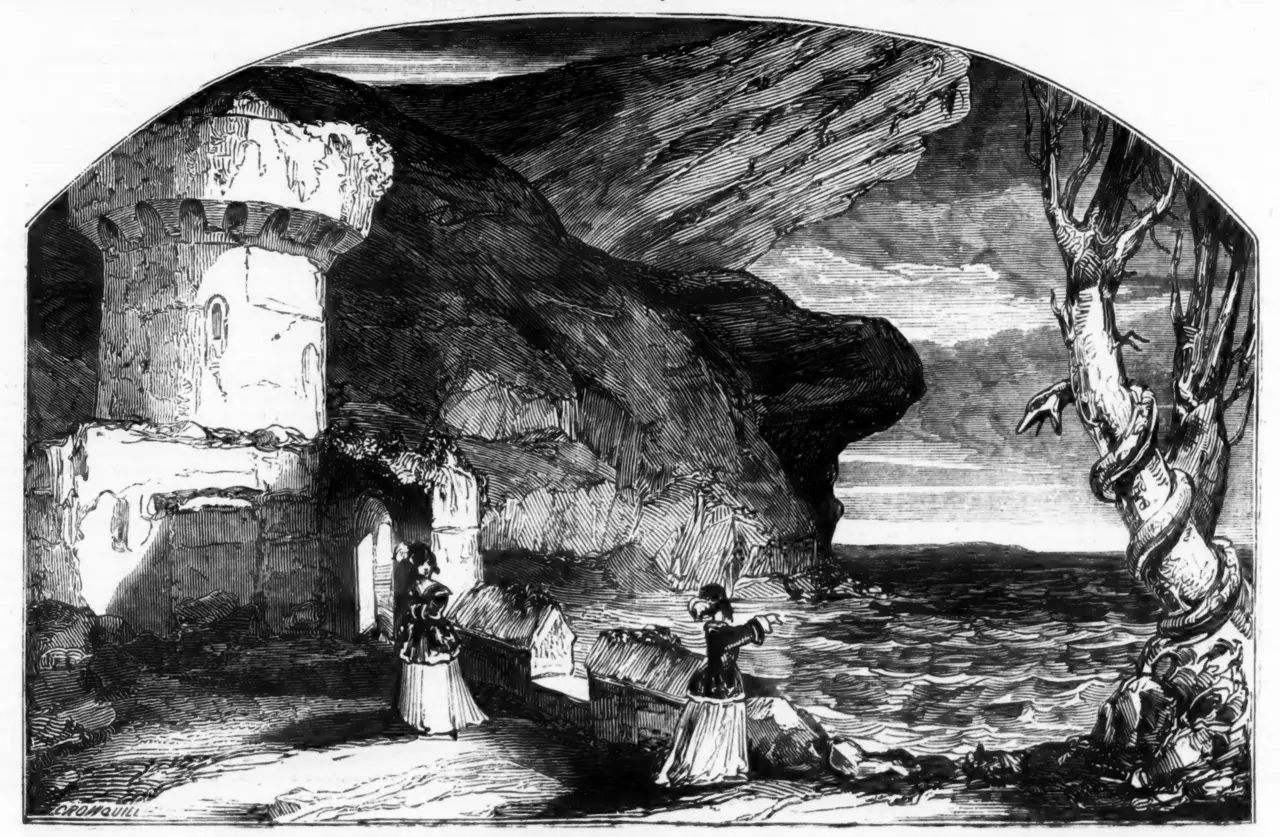
A Lonely Tower on the Sea Shore
On the L.H. 3 E. a Large Tree. A Bank on R.H. 2 E.—Music.
Enter PRINCESS LAIDRONETTA, FIDELIA, and Attendants in travelling dresses, 3 E.L.H.
[R. H] At home once more, and thank the stars I say.
Attendants exeunt, R. H. 2 E.
How fares your highness? speak, dear madam, pray!
You hav’nt said a word the whole way back
But sighed as tho’ your heart was fit to crack.
Fidelia! am I really such a fright,
That my own mother can not bear my sight?
Oh! I’ve no patience, madam, with them all.
How can they have the impudence to call
Your highness ugly!
Nay, I don’t pretend
To be a beauty,—I will not defend
The colour of my hair, which, though to me,
It looks like brown—
Is red, as red can be!
But what of that? I think red hair quite charming.
Then I am told, I have a squint—alarming!
Alarming! stuff, I don’t see the objection,
To having eyes which look in each direction
At the same time,—such power of observation
Is requisite to persons in your station.
Princesses who would know of things the facts,
Should have an eye to see behind their backs.
Have I a mouth so wide, and teeth so black?
A bottle nose—a hump upon my back?
Ears like an elephant’s? It seems absurd!
But I cannot perceive them upon my word!
Madam, to speak the truth, I see them all,
But still your highness cannot ugly call;
There’s such a sweet expression in your features,
To me you seem the lovliest of creatures!
Ah! dear Fidelia, it is your affection,
That makes you tolerate each imperfection;
And I admit, ourselves we’re prone to see
Not as we are; but as we wish to be.
Therefore no doubt I’m hideous—every other
Creature might fly from me, but my own mother!
Its infamous—she ought to be ashamed!
Alas! she’s to be pitied, more than blamed.
It was a spiteful fairy I’ve been told,
Cast this spell on me, scarcely a month old.
AIR—“My Mother dear.”
I heard it in my childhood,
That I remember well,
For often in the nursery,
They Fairy tales would tell.
As how the wicked Magotine,
Had cast a spell on me.
When I was in my cradle,
Or on my nurse’s knee.
My nursey dear—it turned quite queer,
My good old nursey dear!
The Fairy was offended,
I think I heard it said,
Because my mother asked some other
Fairy friend instead.
Some magic words she mumbled,
That made me plain to see,
In other’s eyes, although I own
Its not so plain to me!
My nursey dear—it turned quite queer,
My good old nursey dear!
Your mother, my good nurse, it quite upset her
Of that sad shock she never got the better;
And but for you, my foster-sister kind,
No friend on earth, should I have left behind.
No one to love me!
A large Serpent is seen coiled about a tree.
Yes, dear Princess, me!
Who spoke? [Turns] Oh! horrible! round yonder tree
A serpent!
Fly!
Fear roots me to the spot!
Sweet gentle Laidronetta, tremble not.
Nor fancy your’s a solitary case,
Time was, when I possessed a handsome face;
And may again, if you compassion take,
On your devoted, but unhappy snake.
Help! murder!
Enter ATTENDANTS, SERPENT disappears.
What’s the matter?
Oh! look there!
A serpent!
I can’t see one anywhere.
Coiled round that tree!
I hear the coil you make
But cannot see the coil of any snake!
As I stood here I saw him!
Fancy surely!
My lady’s fainted, and I’m very poorly.
Hunt for the serpent, near us there must be one,
See it you must, unless it be the sea one!
Exeun ATTENDANTS, 2 & 3 E. L. H.
Madam come to yourself, and with your friend.
[Reviving] Oh, my Fidelia, what may this portend!
I never knew that serpents talked like men!
Men talk like serpents, madam, now and then.
With double tongues to match their double faces,
More venomous than serpents in some cases.
What did the horrid creature say? My fears
Closer than cotton filled up both my ears.
So mine did mine, like mistress, ma’am, like maid,
I never heard a syllable it said.
Why then perhaps it never spoke at all!
And yet methinks on me I heard it call.
Whether it did or not, I can’t refrain
From hoping it may never call again! [A fancy boat appears]
Ah! What gay bark is this that heaves in sight?
A bark! Ugh, lud! I thought it was a bite!
With gold and colours all bedizened o’er,
Fidelia! See, its running right ashore!
A splendid boat approaches landing-place.
And nobody on board it!
Not a soul,
Not even a hand to bear a-hand!
How droll!
So droll, it must be what they call a Funny?
Let’s get into it!
Not for any money!
Why not? The sea is calm, quite clear the sky!
It’s not quite clear ’twill be so by and bye.
Suppose a storm springs up all in a minute.
We can spring out, as quick as we spring in it!
What in the water?
No, upon the land!
You can’t suppose I wish to quit the strand!
I’ll not put off to sea in any weather!
Put off your purpose, madam, altogether.
In that craft there is witchcraft, I suspect,
Of which I’m reckless, so I can’t be wrecked.
If you’re afraid, the boat you need’nt nigh go!
No, madam! wheresoever you go, I go.
Come, then, we go to see the boat you know,
Not in a boat to go to sea—ah, no!
DUO—“Love Launched a Fairy Boat”
Give me a pleasure boat,
On a fine day up the river:
But on the Sea to float,
I the pleasure can’t diskiver.
Though glorious gales
Might fill the sails,
And speed our transit merrily,
I know with me
The Song would be,
“Sic transit gloria,” verily.
Then if the sea grew dark,
And the waves all in a lather,
I beg leave to remark,
That on shore I would be—rather.
When stormy gales,
Rend all the sails,
And pumps are working wearily,
I’ve always found,
To be on ground,
Was more agreable, verily
Give me a pleasure boat, &c.
They enter the boat—the sails instantly fill, and carry the boat out to sea. The stage darkens—violent storm, the scene begins to move and gradually changes to a Wild Rocky Coast. The boat is seen in the distance tossed by the waves—it is driven on a rock, strikes and goes to pieces. Presently the SERPENT appears approaching the rocks, and returns bearing the insensible form of LAIDRONETTA, with whom he reaches the shore, and enters a cavern.
FIDELIA appears among rocks, R. H.
[Advancing] Hung be the heavens with black of deepest dye.
And one great mourning warehouse make the sky!
Comets, at whom the bumpkin trembling gazes,
Pluck from your fiery tails a bunch of blazes,
And whip the naughty little stars like winking,
Who in the briny ocean caused our sinking!
My mistress, my poor mistress! drown’d no doubt,
I saw her by the billows tossed about.
Whilst on a reef of barren rock hard by,
They left me—literally high and dry!
No one to see my clothes would have a notion.
That I’ve been twenty minutes in the ocean.
I scarcely can persuade myself its true,
But what the dickens am I now to do?
A female Alexander Selkirk, thrown
Out of a situation—left—alone;
Where of a family there’s not a trace.
In which a lady’s maid could get a place.
Servant of all-work, to myself I’m bound,
Where there’s no tea and sugar to be found.
No wages to receive, however small,
No followers, no sunday out at all.
AIR.—“In Questo Semplice.”
O! cruel destiny, how could you do so;
In single blessedness here am I doomed to stay,
Worse off a great deal than Robinson Crusoe.
He’d a man Friday, to whom he could say,
Ri, tol, fol, lol de rol, &c.
Bad Mr. Boreas, how could you blow so,
Putting the pipe out of Neptune and Co. so?
Sending our smack ashore,
Where not a blackamoor,
On his own bones can a serenade play,
Ri, tol, fol lol de rol, &c.
LAIDRONETTA appears at the entrance of the Cavern, L. H.
Fidelia!
Ah! my mistress! safe and sound!
Oh! madam, are you certain you’re not drown’d
By no means certain, in a maze am I!
And if not drown’d can only wonder why!
Believe you are not, gentle mistress mine.
And I’ll believe so too.
Well, I incline,
To that opinion. But suppose we say
We are alive, how shall we keep so, eh?
There’s nothing grows upon this rocky shelf,
And we can’t live upon the rock itself.
’Twould be hard living. that I must confess.
And hardly worth our living for, I guess.
Better at once the cruel sea had swallowed us,
Or the Green Serpent which has hither followed us.
Hither! you don’t say so!
Into yon cave,
Washed by some friendly or unfriendly wave;
When to myself I came before me lay,
The same Green Serpent we beheld to-day;
Coiled in a corner with its fiery eyes,
Fixed upon me, as on its lawful prize!
Oh! horrible! and you?
I scream’d a scream!
Like Molly Brown, and found ’twas all a dream.
As she did.
No, but off the horrid snake
Glided, with all the speed that it could make.
All fancy, dearest madam, I maintain,
Proceeding from the heat oppressed brain.
I doubt our having been upon the deep,
Or in it, only walking in our sleep,
And would’nt undertake to swear, I vow,
That these are rocks which frown around us now.
The Scene changes to a Magnificent Palace composed entirely of the precious metals and stones.—Music.
Why there! even as I’m speaking, ma’am, behold!
They change to walls of silver and of gold!
Gardens and fountains all with jewels bright,
They must belong to some Arabian Knight!
Have we been wrecked upon Tom Tittler’s ground?
Or have we some new California found?
Or are we still asleep, as sure you would be?
At all events don’t scream, in case we should be,
I would’nt wake from such a pleasant nap!
We must have fallen asleep in Fortune’s lap!
My fears are gone, my heart may here at ease be
There’s something moving. Mercy what can these be?
Enter a company of Guards, all composed of Jewels, and followed by a train of Courtiers, &c. of similar materials, led by LORD CARBUNCLE, L. H. 2 E. Music.
Hail! to the lovely Princess, whom kind fate
Has brought at length into this precious state!
Lovely! Your speech is meant, sure, in derision,
Or you enjoy but an imperfect vision.
I’m thought a scarecrow in my father’s court.
Nay, madam, now you make of us your sport,
Or, in your land they are no judge of beauty,
To whose fair Queen we come to pay our duty.
Pray drop of flattery this fulsome tone!
Upon the honour of a precious stone!
That should be honor bright!
I do not flatter!
Be witness for me all!
Well, well, no matter
Venus or Gorgon I would fain be told!
Who owns the gorgeous palace we behold?
King Emerald.
And the isle beneath his sway?
We call the Isle of Jewels.
Well you may!
I would be to his majesty presented,
Alas! At present we’re the bliss prevented.
Of seeing our beloved sovereign’s face.
Is he a jewel kept then in a case
’Neath lock and key?
As sovereign I presume,
He now and then must hold a drawing-room?
At least a levee?
Don’t he take the air?
Or go in state to dine with the Lord Mayor?
Or open Parliament in person?
No!
Not now, but very soon we hope that—
Oh!
He’s absent on some secret expedition?
Or sick, or sulky?
Ladies, with permission,
We’ll change the conversation. I’m commanded
To thank you, on our coast for having landed.
No thanks on that account can be our due,
It was the waves obliged us, not we you.
Next to request you’ll condescend to make
This house your home, for its poor master’s sake.
Poor master! Oh, then, now I see the thing,
This monarch, madam, is some Railway King.
With other people’s gold who ran these walls up,
And left whoever pleased to pay the calls up!
Could such a company as this deceive me?
They’ll let you in for all they can, believe me!
You should be all rich jewels that I view!
If you are false?
Then never gem was true!
Allow me to present the Lady Pearl—
Lord Ruby—Lord Chief Baron Onyx—Earl
Topaz—Miss Turquoise—and Miss Sapphire, two
Ladies who pride themselves on being blue—
Miss Amethyst—Miss Garnet—ladies both
In waiting.
[aside] For some time I’ll take my oath?
Ladies in waiting! You’ve a queen then here?
Only since your arrival madam.
Dear!
You don’t insinuate—
Mere fact I’m stating,
I leave my king to be insinuating. [Flourish]
That flourish speaks him nigh!
I thought you said
He was not to be seen, alive or dead?
Nor is he, but unseen, he’ll gaze on you,
And enter into conversation too!
With me! Where? when?
Enter Slaves carrying a closed litter, which they place in centre of Stage, L. H. 2 E.—Music.
Now, from this throne of amber
He has an audience, but no presence chamber.
In private he your highness would receive,
And so respectfully we take our leave.
Fidelia may remain?
She means to do so
Whether she may or not!
If it please you so. [Exeunt all but LAIDRONETTA and FIDELIA, 2 E. L. H.]
Fidelia, I’m getting rather nervous!
To think the King is there and can observe us.
I suppose he’ll speak first?
He ought, no doubt,
What think you will the King’s speech be about?
About the same, ma’am, that King’s speeches are
In general—nothing in particular. [Music]
Hark! from that symphony, I guess the King,
Has had it set to music, and will sing
His speech:
A bright idea that I call,
For then the words can’t signify at all,
AIR.—“Will you love me then as now?”
Do you think that you could love me,
Without knowing what I’m like?
Will you undertake to wed me,
And a bargain blindly strike?
Will you marry me to-morrow,
And if not, why not? and when?
Will you love then as now, or,
Will you love me now and then?
As I’m alive, a downright declaration,
He’s popped the question, without hesitation!
How can I him address?
Reporters teach,
The address is but the echo of the speech.
But in this case he pays me his addresses.
Excuse me, sweetest princess, but time presses,
And I can on no ceremony stand,
Except the one which gives to me your hand.
If that rare gift on me you will bestow,
The power of Magotine, our mutual foe,
Expires; but if I sue in vain, to-morrow
I shall be doomed to seven more years of sorrow,
And you will lose the only chance remaining,
Of all your charms in the world’s eyes regaining.
Good gracious! I don’t know, sir, what to say.
She really can’t be hurried in this way!
Fancy I’ll marry one I’ve never seen.
Although an Emerald, you can’t be so green.
Prudence commands me look before I leap,
Permit us but to have the slightest peep!
Impossible! To break the spell, I must
Be taken, for a husband upon trust.
If you’ve a heart to lead, you win a double,
If not, you lose your King, and mark but trouble!
I have a heart—you touch it to the quick—
And when in doubt, Hoyle tells us win the trick.
So I am yours, but mind, on one condition,
That you obtain my Pa and Ma’s permission.
Without their sanction I will never marry,
My Diamond cutter the dispatch shall carry,
And bring them hither both, without delay!
To-morrow, sweet, shall be our wedding day!
Re-enter LORD CARBUNCLE and four slaves. who Exeunt with Litter, R. H. 2 E., leaving FIDELIA and LAIDRONETTA.
Engaged! I’m actually engaged, I vow!
Well, you have been and gone and done it now,
He flung himself upon my generosity,
To have refused would have been an atrocity!
Before you’re generous though you should be just
The proverb’s musty, and what must be must [Shouts without.]
Re-enter LORD CARBUNCLE, L H, 2. E., Attendants, Guards, &c.
What caused that shout?
The news of your election,
They’re all enraptured with their King’s selection
Each jewel sparkles with excess of joy,
In our gold’s happiness there’s no alloy.
Balls, banquets, and all sorts of festal doings,
Are to commemorate these happy wooings;
And, in the first place, if it would’nt bore you,
There is a ballet to be played before you,
By some rare gems of art, slaves of the King.
The ballet by all means!
“The plays the thing!”
What is the argument—there’s no offence in’t!
I hope you’ll find a great deal of good sense in’t.
Sense in a ballet!
Aye! and moral too!
A moral ballet will be something new!
It is the tale of Cupid and of Psyche,
And how she paid for peeping.
[Starting] Eh!
[aside] Oh! crikey!
I take the hint—as Queen engaged this morning,
How not to lose her place, he gives her warning. [Music.—They take their seats, R H.]
BALLET OF CUPID and PSYCHE.
Venus appears upon her neglected altar, and invokes the vengeance of Cupid upon Pysche, to whom the Nymphs have transferred the homage due to the Queen of Beauty. Cupid promises to destroy Pysche, and prepares his most deadly shaft for her destruction. Psyche enters surrounded by the Nymphs, who place her on the pedestal of Venus, and pay her the same adoration they formerly paid to the goddess Cupid advances to avenge his mother, but is struck by the beauty of Psyche, becomes enamoured of her and breaks his arrow. The Nymphs depart with Psyche in triumph. Cupid summons Zephyr, and commands him to bear off Psyche from her companions. He then hastens the approach of Night—Zephyr returns, bearing Psyche asleep. She awakes and wonders whither she has been transported—Starts at the whispered words of Cupid—listens timidly to the declarations of his passion, and gradually acknowledges the influence of Love. Tableau, the well-known group of Cupid and Psyche. Psyche expresses a wish to behold her lover, but Cupid intimates that it would cause her destruction, and warns her not to attempt it. He departs, and it becomes light. Psyche deplores the absence of her lover. Her sisters enter, to whom she narrates her adventure. They question her as to the person who has obtained her affection. She declares her ignorance of his name or features. They insinuate, that he is a monster, who will devour her—one brings her a lamp, the other a dagger, and counsel her to watch till he sleeps, and then kill him. Night returns, and with it Cupid. Awaiting Psyche, he reclines on a couch of roses, and slumber steals upon him. Psyche enters cautiously, shading the lamp with her hand, she approaches the couch, and draws her dagger to strike the monster. The light reveals to her the God of Love. Astonished and enraptured, she holds the lamp over him, gazing on his features, when a drop of oil is supposed to fall on the shoulder of Cupid, and he awakes and discovers Psyche with the dagger in her grasp. He upbraids her with the neglect of his warning. She implores his forgiveness. He is obdurate and flies from her. Thunder and lightning. Psyche abandoned by Cupid, falls prostrate in despair. Venus enters with her repentant votaries, and ascends her pedestal. The Nymphs kneel awe stricken around her. Cupid appears deprecating the anger of Venus, who triumphantly points to the insensible form of Psyche.—TABLEAU.
END OF FIRST ACT.
Act 2, Scene 1
Aqua-Marine or Sea-Water-Gate of the Palace Gardens in the Island of Jewels
Enter LAIDRONETTA, L. H.
AIR.—“Where the Bee sucks.”
Worth a Jew’s eye, now am I,
On a couch of Pearls I lie,
Served by Gems. Oh gemini!
Won’t I make the gold dust fly,
’Mongst the whole set, merrily!
Merrily, merrily, shall I reign now,
Over the Jewels around me that bow.
After the song exit LAIDRONETTA, L. H., Arrival of the Diamond Cutter with the KING and QUEEN of PHARITALE, PRINCE PRETTIPHELLO, PRINCESS BELLOTTA, COUNT MERECO and Suite, they are received on landing by the PRINCESS LAIDRONETTA and the Officers of State.
My royal parents, thus on duteous knee
Rise, daughter—for you’re on the rise we see!
And as I view this world of wealth and splendour,
I feel my heart is growing vastly tender!
And all the father in my soul awaking,
Tells me, too much of you I can’t be making.
I never saw a girl improved so greatly!
Her highness has acquired an air so stately!
That slight cast in her eye is rather pleasing!
At such a nose, there needn’t be much sneesing.
Her hair, though red, has got that touch of gold,
Which in the works of Titian we behold.
And though, perhaps, high shouldered rather, there
Is no hump’d back!
Hump’d back! and if there were,
With all those dazzling diamonds hung about,
I should just like to know who’d find it out?
[aside] Love’s blind, but love of gain must blinder be.
For none so blind as those who will not see!
Daughter, forget our strange neglect of yore,
We never knew what you were worth before.
AIR.—“Thy Father away!”
Thy Father I am!—I admit the fond claim,
I feel, ’pon my honour, I’ve been much to blame;
Injustice I’ve done you—but pardon the sin—
Your Father you found! [aside] when he heard af your tin
Obedience now, sir, is indeed a pleasure!
Henceforth, we shall account you quite a treasure.
And to my marriage then, you give consent?
Who could object to such a settlement?
But where’s my son-in-law, that is to be?
I’m all impatience such a prince to see!
Alas! until we’re married, Fate denies,
That he should shew himself to mortal eyes.
Until you’re married! you don’t mean that you
Have never seen him?
Sir, indeed I do!
Of course then. from his portrait you decided
As usual “in such case, made and provided?”
I’ve seen no portrait of him!
Goodness me!
Upon his coin, his head at least must be!
There is no coinage in this island.
No!
No money going, that’s a precious go!
Can it be possible, a golden nation,
And not one sovereign seen in circulation.
Is it all a trick, you make this mighty splash on,
Or is the tally system here in fashion?
Or do these noble rubies and carbuncles,
Visit alternately each other’s uncles?
The currency is gold dust and seed pearl;
[aside] Aha! Egad! there’s gumption in the girl.
She cares not for her husband’s physiognomy—
She looks to the “political economy!”
He flings his gold-dust in her eyes, and she,
Having see’d pearl enough, nought else would see.
[Aloud] It matters not, when folks are rich as Jews,
They may indulge in any whim they choose.
And after all, they ask you in the city,
“Is a man good?” they don’t say, “Is he pretty?”
When Desdemona made her bargain blind,
She “saw Othello’s visage in his mind.”
But the young lady can’t be in the wrong box,
Who sees her husband’s image in his strong box. [Retires up.]
[aside] Her set of Diamonds make my fingers itch.
My husband’s handsome, but by no means rich.
[To PRINCE.] To think that fright should get so great a catch,
I cannot bear it, let us spoil the match?
[To LAIDRONETTA.] Sister, a word with you;
Ten, if you please!
I marvel you can be so much at ease
About this marriage. I don’t like this mystery,
And would knew more of this King Emerald’s history,
With all his wealth I wonder you don’t wince
At wedding an invisible Prince,
Who may turn out a monster!
Sure you joke!
You’re buying here a green pig in a poke!
A green pig! What a sight my eyes to set afore!
Nay, I but used that phrase by way of metaphor.
A green pig, sir, I never met afore,
Although I started once from the “Blue Boar.”
And now I start to think I may, incog,
Go rsahly the entire verdant hog!
Aye, think of that, although at random said,
I may have hit the right nail on the head.
And only fancy, should it prove that this King,
Stood in his shoes but four feet of pork griskin.
That you. when through his gammon, made a fair rib,
Should find yourself sold for a bacon spare-rib!
Horrible thought, my jaw with terror drops!
Fancy his cheeks a huge pair of Bath chops!
A spouse with tusks, pig’s trotters for his toes
And who can wear a ring, but through his nose!
No more—no more—the die is cast, and I
Must stand. and will, the hazard of
The stye! [Retires up.]
[aside] Their every word a dagger in me digs!
To a fine market you have brought your pigs.
But I have done, upon this match absurd,
“From this time forth, I never will speak word.”
Her highness seems much moved.
Not much—not much.
[To BELLOTTA] What have you said your sister thus to touch,
I gave her some advice, sir, nothing more.
Advice, nine times in ten’s a horrid bore!
A horrid boar! You touch her now more nearly
Upon my honor she looks very queerly!
What is the matter with you, Laidronetta?
I felt a little faint, but now I’m better.
You must have frightened her she turned so pale
About her husband is there any tale?
I fear there is.
[To BELLOTTA] Unfold it, if you know!
Pardon me, sir, I do but fancy so.
Fancy a fiddlestick! In such a nation,
Why waste your time in dangerous speculation?
With banks all made of bullion, if you’re wise,
Don’t speculate, but promptly realize!
My very counsel, sir, wed I would not,
If I were she, till I knew who and what?
What signifies “Who’s who?” She gets a lot
Of gold, and that proves she does know what’s what.
Why shirk in proper form his bride to meet?
Is the gem false? The Sovereign counterfeit?
What’s his estate, both personal and real?
Is he a beau, or but a beau ideal?
Make a mere nobody of such a King!
It’s treason to imagine such a thing!
His conduct, in this case, quite orthodox is,
Monarchs are married frequently by proxies.
A question of the hand, and not the heart, is
Such jobs, between the high contracting parties
[To LAIDRONETTA.] Daughter, until the nuptial hour arrive,
About this grand metropolis we’ll drive
And see the lions, whilst we take the air,
Up Silver Street, and all round Golden Square. [Exeunt all but LAIDRONETTA.]
Farewell, who knows if we shall meet again?
I feel a faint cold fear thrill through each vein,
That almost freezes up the heart of life!
Of a green pig must I become the wife?
I’ll call them back again to comfort me—
Pa, pa, pooh! pooh! small comfort would be
Must I, perforce, be married to this monster?
No, no, this shall forbid the banns! [Draws a dagger.]
Enter FIDELIA, R. H.
With conster-
Nation I see my princess in a pucker!
Where shall I fly, for safety or for succour?
Won’t they consent, then? Is your father flint,
Your mother marble?
No, I’ve had a hint
So horrible, it shakes my very soul!
My husband, girl—
In riches don’t he roll?
I might say wallow!
Ah! I fear you might!
Wallow, indeed, she harps my fears aright.
Then for reports, why need you care two figs?
You’ll have no end of money, please the pigs.
The pigs! ah, me!
Her tears still faster trickle!
What is the matter is King Emerald fickle?
Alas! good wench, the danger is much greater,
You don’t say so—oh! then I guess!—the traitor
Whilst you accepted him, without misgiving,
Has got a wife, and seven brats all living.
No; no; you’ll never guess—therefore. be mute,
Whilst I disclose to you—he is a brute
I fear, but not of that peculiar kind.
Oh! madam, such reports you mustn’t mind.
The man has got a temper I dare say,
Is rather fond of having his own way;
To his opinions obstinately wedded,
Some husbands are remarkably pig-headed.
That’s it, Fidelia! should I by ill-luck,
Marry a pig!
I stare like one that’s stuck.
A green pig, that would make a showman’s fortune,
At half a hog a head, shown at hogsnorton!
You cannot this believe in sober sadness?
I do!
Oh! this is very moonstruck madness.
But to dispel your fears, no time is fitter,
Behold! this way they bear the royal litter.
Litter! each word goes to my very heart!
Let you and I a moment stand apart.
And when to be unseen we’re safe and certain,
Steal out, and take one peep behind the curtain.
But you forget the warning and the fate of Psyche!
Ma’am, the difference is great.
Her curiosity was very stupid,
E’en in the dark, she ought to have known Cupid.
Besides, she for a monster first mistook him,
And therefore had no right to overlook him!
But with a gentleman you thought you treated,
If he’s four footed, your hand is forfeited;
And you possess a right, as daylight clear,
To prove you’ve got the wrong pig by the ear! [They retire.—Music.]
Enter Slaves, bearing the litter closely curtained, as before, attended by LORD CARBUNCLE—He makes a sign to the Slaves, who set down the litter under the trees and exeunt
[Advancing] Hail, great Carbuncle!
Pray don’t make a din,
What, is his precious majesty within?
He is and dozing.
Dozing at this hour?
Yes, every day we bear him to this bower,
After his lunch, to take a short siesta,
Fanned by the gentle gale, a soft sou-wester.
[aside] Sou-wester! Humph, the quarter is suspicious,
For what is in the wind—but most propitious
The Royal nap. [Makes signs to LAIDRONETTA.]
The wink to me she’s tipping!
[To CARBUNCLE] Would you gather me a golden pippin?
With pleasure. [Exit R. H.]
[To LAIDRONETTA] Now, one peep, what-e’er it cost.
They withdraw the curtain, and discover the GREEN SERPENT.
[Shrieking] Ah! the green serpent.
Murder! [Exit L. H.]
Treason! [Exit R. H.]
Lost!
Rash Laidronetta! Ah, what hast thou done?
By Magotine again the game is won.
Farewell, perhaps for ever! [Disappears—Thunder—Lightning.]
The FAIRY MAGOTINE appears, L. H. 2 E.
Ha! ha! ha!
Well done, Princess, brava! bravissima!
I scarcely hoped to triumph so completely
Now I can satisfy my vengeance sweetly.
Enter KING, QUEEN, PRINCE, BELLOTTA and COUNT.
Who’s kicked this precious row up in the sky,
And put their finger in the world’s great eye?
What, is the bride ready to go to church?
No, for the bridegroom’s left her in the lurch.
The Fairy Magotine!
Aye, madam, me,
An uninvited guest again you see.
Sweep, ye wild hurricanes, these grimcrack shores,
And turn these fortune hunters out of doors.
Storm—The KING, QUEEN, PRINCE, BELLOTTA and COUNT fly in terror, L. H.
I, with my captive, to my caves Basaltic,
Girt by the stormy billows of the Baltic.
The Scene changes to
Act 2, Scene 2
Basaltic Cavern
For seven long years, at least, here must you be
My captive and my slave.
Ah! woe is me.
What have I done to merit such a fate?
You are the daughter of a Queen I hate!
Of vengeance have you not had “quantum suff,”
Made me a scarecrow to all mortals,
Stuff!
The other Fairies with such virtues deck’d you,
My spell was scarcely able to affect you.
Men’s eyes alone obeyed my magic arts,
Your goodness gave you power o’er their hearts;
E’en on a serpent it could make impression,
And but for this most lucky indiscretion
You and that vile insinuating viper
Had danced for joy, whilst I had paid the piper.
How was your happiness by ours affected?
King Emerald with scorn my hand rejected,
And I, in you, a favored rival see.
I’m sure you’re welcome to him quite for me.
He’s frightened me almost out of my senses.
But he loves you, and that the worst offence is.
I’ve got you now though, both beneath my thumb,
And I will work you for seven years to come.
Here, spin this tangled spider’s web, and make
A net of it, that’s strong enough to take
A salmon with—I want some fish for dinner.
Madam, although a spinster, I’m no spinner,
But I will do the best that’s in my power,
When will you want it, ma’am?
In half an hour.
AIR.—“Pray Goody.”
Pray, madam, please to calculate, unless the clock be wrong,
But thirty minutes, half-an-hour supplies,
Remember spiders’ webs are weak and fishing nets are strong,
And Salmons much larger than Flies.
Slimy, grimy work, I can’t bear nigh me.
Fun you’re making—sure you’re taking out of me a rise,
Pray, madam, please to calculate, &c.
No matter! For each thread you break, a day
Longer within this cave you’ll have to stay. [Exit R. H.]
In half an hour, impossible!
The FAIRY BENEVOLENTIA appears.
Nay, try,
To love there’s no impossibility!
My goodness gracious, who is this fair dame?
One of your dozen Godmothers—my name
Benevolentia. To my gift you owe,
The kindly heart, that melts at others woe.
And as to pity, love is near akin,
Pity this wretched snake, and fearless spin.
The GREEN SERPENT is seen.
The Snake again. Thou guileful monster, hence. [Serpent retires.]
Guileful! How so? His love was no pretence.
Each syllable he spoke, you’ve found too true,
For breach of promise he might well sue you.
Your word was pledged to take him upon trust,
For better or for worse.
Own that I must.
But he is so much worse than I believed him
He’d have been better had you not deceived him
Prove by compassion, you’ve your fault repented,
And Magotine may yet be circumvented.
If I have wronged him, I apologize,
I would’nt hurt a worm of any size!
Enough! Spin web, weave net, in half a minute,
And Magotine herself we may catch in it!
The web disappears from spindle, and the net is seen hanging on the wall.
Adieu! Remember, love should love be won by,
And the best rule is, “do as you’d be done by.” [Disappears.]
Well, when the poet wrote “nil admirari,”
He certainly had never known a Fairy.
Or else, as but too frequently the fact is,
He preached to others, what he could’nt practice.
The web is spun, and a strong net made of it,
And I am to receive the whole net profit!
Such liberality what can surpass?
The poor Snake, too, was no snake in the grass.
But though of fearful aspect and dimensions,
A serpent of most honourable intentions!
Under a great mistake he oft may labour,
Who, from appearances, condemns his neighbour.
Enter FAIRY MAGOTINE, R. H.
So, how gets on the work? The time is nigh!
How often have you snapped the thread? reply!
Not once—the whole web I found nothing frail in
And there’s a net that you may catch a whale in!
A whale! That’s very like a whale, forsooth! [Seeing net.]
[aside] Furies and fire! why she speaks the truth.
Can she have made these meshes single-fisted,
Or has she been by some sly elf assisted?
[Aloud.] Upon my word, you are so vastly clever,
To find some job for you I must endeavour.
Worthy your ingenuity. What ho!
Cast me those iron shoes up from below!
An Elf rises holding a pair of iron shoes
Screw her feet into them!
The Elves obey. LAIDRONETTA screams.
Oh fie! don’t squall!
Pride must be pinched, a shoe can’t be too small.
Now bring a mill-stone, from the ruins nigh,
And round her neck the pretty bauble tie!
A mill-stone is brought, and fastened round her neck.
There! for your journey now you are equipped
So take this pitcher, by you to be dipped
In the pure water of the silver fountain,
Which plays up on the top of the steel mountain.
Fill with a quart of it this broken jug,
And bring it here, with your own ugly mug.
Hence
But the road?
Your iron shoes will show—
The cunning soles no other way will go!
DUETTINO.—“Macbeth.”
So right about, obey the spell,
And bear the pitcher to the well.
[Looking at the hole in it] If truth be in proverbial lore,
It must have been there oft before.
’Tis idle at your shoes to flinch,
You’ll find them useful at a pinch.
I know ’tis bootless to entreat,
And they put on their metal, both my feet. [Exit LAIDRONETTA, R. H.]
Now! either like the rest, her crown she’ll crack,
Or bring the water I so long for, back!
A few drops only o’er my person sprinkled,
I shall no more with age be bent and wrinkled.
But the possessor of a face and form,
Which must the stony heart of Emerald warm.
How I shall laugh if my spell prove strongest. [Exit R. H.]
The FAIRY BENEVOLENTIA appears, and takes down the net.
The proverb says, “Those who laugh last, laugh longest!”
SONG.
AIR.—“Farwell to the Mountain.”
The well on yon Mountain,
Of steel in the vale,
Is fed by a fountain
Which never can fail!
The Water of Truth,
With its magical spell.
Is the pure draught you draw
From the depths of that well.
A well by whose virtue
All falsehood is shown,
Is one which by some folks
Is well let alone.
The step must be firm,
And the heart nobly swell,
Of the mortal who travels
The path to that well!
The well on yon mountains
Of steel in the vale,
Is fed by a fountain.
Which never can fail,
False Magotine’s malice.
Its pure draught shall quell,
And kindness shall conquer,
And true love fare well! [Exit with net.]
Act 2, Scene 3
Rocky Pass, and Foot of the Steel Mountain.—Storm raging
Enter PRINCE PRETIPHELLO and BELLOTTA.
Oh fortune! well may mortals call you fickle!
You’re Prettiphello’s in a pretty pickle?
Papa and Ma are in the same sweet mess,
The same ejectment, and the same distress,
Have thrown us on this parish, quite unknown,
Too poor to have a union of its own,
It serves us right, my sister would declare,
For having broken up her union there.
Not that we even overcharged the picture,
The green boar turned out a green boaconstrictor!
I’d rather, were I forced a choice to make,
Pig with a pig, than go snacks with a snake!
As to the King, who thought such wealth to sack,
The blow has given his cranium quite a crack,
His talk is all of money. but so queer,
I really think he must have seen King Lear.
Enter KING, QUEEN, and COUNT.
Blow winds and crack your cheeks, the clouds go spout!
To raise the wind, and get a good blow out.
Rain cats and dogs, or pitchforks perpendicular,
The sky’s not mine, and need’nt be particular.
I tax not you, ye elements, you pay
No duty under schedules D or A,
You owe me no subscription. Funds may fall,
It makes no difference to you at all.
Gracious, papa! don’t stand here if you please,
Things that love night, love not such nights as these.
Persuade him to move on Prince Prettiphello.
Are you aware, sir, you have no umbrella? [Rain.]
A thought has struck me, rather entertaining,
I am a King more rained upon, than reigning.
My wits are going fast!
I fear ’tis so!
Take comfort, ma’am, there are so few to go,
Would that our loss was nothing more, alas!
What, have his daughters brought him to this pass?
He has no daughters, sir.
’Sdeath! don’t tell fibs!
He must have one who won’t down with the dibs,
Although she’s made of money! Nothing I know,
Bothers your gig so much, as want of rhino!
His head’s quite turned with losing all that pelf,
For coining they can’t touch the King himself.
Here’s a dry cavern, if he would but cross over.
I’d talk a word or two with this philosopher!
What is the price of stocks!
Mine are but low,
Suppose you just walk in, some here may know.
A famous dodge! For ninety millions draw
A bill at sight, upon my son in law,
And then—bolt—bolt—bolt—bolt.
Exeunt KING into Cavern, followed by QUEEN, &c. L. H.
Enter FIDELIA, L. H.
After my mistress all night I’ve been jogging,
Tho’ it’s a night you’d not turn a dog in;
And I begin to fear I’ve missed my way,
Tho’ where I want to go to, I can’t say—
But I suppose my lady is somewhere,
And I am quite determined to go there?
AIR—“Trab, Trab.”
To find my mistress dear, I
Put forward my best foot,
Till both have grown so weary,
I’ve no best first to put!
But whether best or not,
While any foot I’ve got
I’ll tramp, tramp, tramp, like Jetty Treftz,
And trot, trot, trot, trot!
Of legs I’ve not the worst pair,
Perhaps that e’er were seen,
Besides they are the first pair
On which, as yet, I’ve been
But give in, I would not,
Though on my last I’d got.
I’d tramp, tramp, tramp, &c.
Here’s some one coming, who perchance may guide me,
I thought no mortal could be out beside me.
Enter LAIDRONETTA, L. H.
Well, I can’t say I’d take this walk by choice!
Out and alas, it is my lady’s voice!
Fidelia?
Oh! what words my joy can measure
This is, indeed, an unexpected pleasure!
But what’s this stone about your neck I see?
About a hundred weight, it seems to me.
And on your feet, what horrid clogs to use!
You wouldn’t much like standing in my shoes.
Off with both shoes and stone.
I can’t, they’re spell bound,
And so am I, to seek a magic well, bound,
Upon the summit of the steep Steel Hill,
And with its water, this old pitcher fill.
This pitcher! Why ’tis cracked, and so must he
Who sent you on this crazy errand, be.
Not he—the person’s feminine in gender,
For the vindictive Magotine’s the sender!
The serpent’s tale was true, I now my folly see,
And feel that honesty’s the safest policy.
I was your counsel, I will share your sentence.
Enter FAIRY BENEVOLENTIA.
Nay, for too late can never come repentance,
When ’tis sincere.
A fairy for a shilling!
To hold the serpent harmless, are you willing.
Too happy!
The Moon appears, and by her light the Steel Mountain is seen at the back of the stage
Then behold the steep Steel Hill,
Up which no human Jack or mortal Jill,
Ever yet went to fetch a pail of water,
But Jack fell down, and Jill came tumbling after.
But upon this occasion, I will show,
To what lengths snakes, who are in love, can go. [Waves her wand—the Serpent appears.]
Stand and unfold thyself, and never stop,
Till made a winding staircase to the top.
The Serpent glides up the side of the Mountain, forming a succession of coils like steps to the summit.
Is there alive a more obliging adder,
To make his scaly back a scaling ladder!
For the Sea Serpent he might well be shown!
The greatest stretch of kindness ever known.
To such extent when friendship is displayed,
Lawyers would call it, “an extent in aid!”
Now boldly up, and in the well dip thrice
The broken jug—but take a friend’s advice,
Don’t drink or touch a drop of water, till
You’ve got in safety once more down the hill.
MUSIC—LAIDRONETTA ascends the coils of the Serpent, and disappears at the top of the mountain
AIR.—“Such a Getting Up Stairs.”
Such a getting up stairs and a-playing on the serpent,
Such a getting up stairs I never did see!
The course is clear, the ruck must yield,
She backs her favourite ’gainst the field,
She’ll win the cup, full to the brim!
I must own—“all along of him!”
Such a getting up stairs, &c.
LAIDRONETTA descends, divested of the mill-stone and iron shoes, and bearing a golden vase in her hand, apparently full of water.
[To SNAKE] A thousand thanks, I hope I didn’t hurt you.
Oh! madam [To Fairy.] of this spring behold the virtue—
The first dip that I took into the well,
Down with a splash the heavy millstone fell;
The second dip, off went my iron shoes;
And at the third, the broken earthen cruse
Changed in an instant, to this vase of gold,
And down I’ve brought it full as it will hold!
The water in it has a wond’rous charm,
And as you use it, works for good or harm.
Apply it outwardly. and all will see,
That you’re as handsome as you need to be;
But taken inwardly, with all your heart,
’Twill to yon Serpent happiness impart.
Choose, you can do whichever you like best,
Seem yourself beautiful or make him blest.
Upon my word a puzzling situation!
No, I decide, ma’am, without hesitation.
[To SNAKE.] Since I can serve you, here’s my service to you;
Your health, poor Snake, and much good may it do you. [Drinks.]
Well done! Such actions beautiful must make you
In all men’s eyes, and none will hence mistake you.
The SERPENT disappears—The Scene changes to a Magnificent Fairy Garden, and KING EMERALD appears surrounded by his Court.
Behold your spouse, love him perhaps you can.
Oh, gemimi! a jewel of a man!
Enter FAIRY MAGOTINE, R. H., with her Elves.
My patience is exhausted! Where’s this jade?
How now! What’s here to do? False stars! betrayed!
The charm dissolved! the serpent cast his skin!
He has jumped out and you may now jump in.
Malicious hag, who snares for others set.
Be as you should be, caught in your own net! [Puts the net over MAGOTINE]
And by your own bad spirits, live tormented!
MAGOTINE and her Elves sink.
[To LAIDRONETTA] By Hymen now your bliss shall be cemented.
Share with King Emerald his island throne,
A richer jewel it could never own.
Your selfish kin, for your sake, I forgive,
Approach!
Enter KING, QUEEN, BELLOTTA, PRINCE, and COUNT.
And mark this maxim, while you live—
If mortals would be happy here below,
The surest way is making others so!
FINALE.—“Crown Diamonds.”
As jewels once they’d hearts of stone,
But now restored to flesh and bone—
They tremble least from wrath or whim,
Your breath should all their lustre dim.
We tried to make ’em precious fine,
Don’t from ’em all take out the shine,
Our poor stage diamonds don’t disdain,
And if you cut ’em, come again!
Paste though they may appear,
To some great Pit-diamond here—
Let then your pretty dear
Children entertain!
The purest gem may have a flaw,
Perfection none yet ever saw,
Though all that glitters isn’t gold,
To pass for such the mass is bold.
Then let the candour gain applause,
Of Jewels who confess their flaws,
I own my gilt, nay more admit,
I mean your gold to pay for it!
Paste though they may appear, &c.
Brilliant Discovery of the Crown Jewels.
[TABLEAU—FINIS.]