
 Ruy Blasby Victor HugoA lackey who loves the Queen of Spain is made a great lord, as his master's revenge.
Act 1, Scene 1
THE KING
Saragossa. A chamber. Night: a lamp on the table.
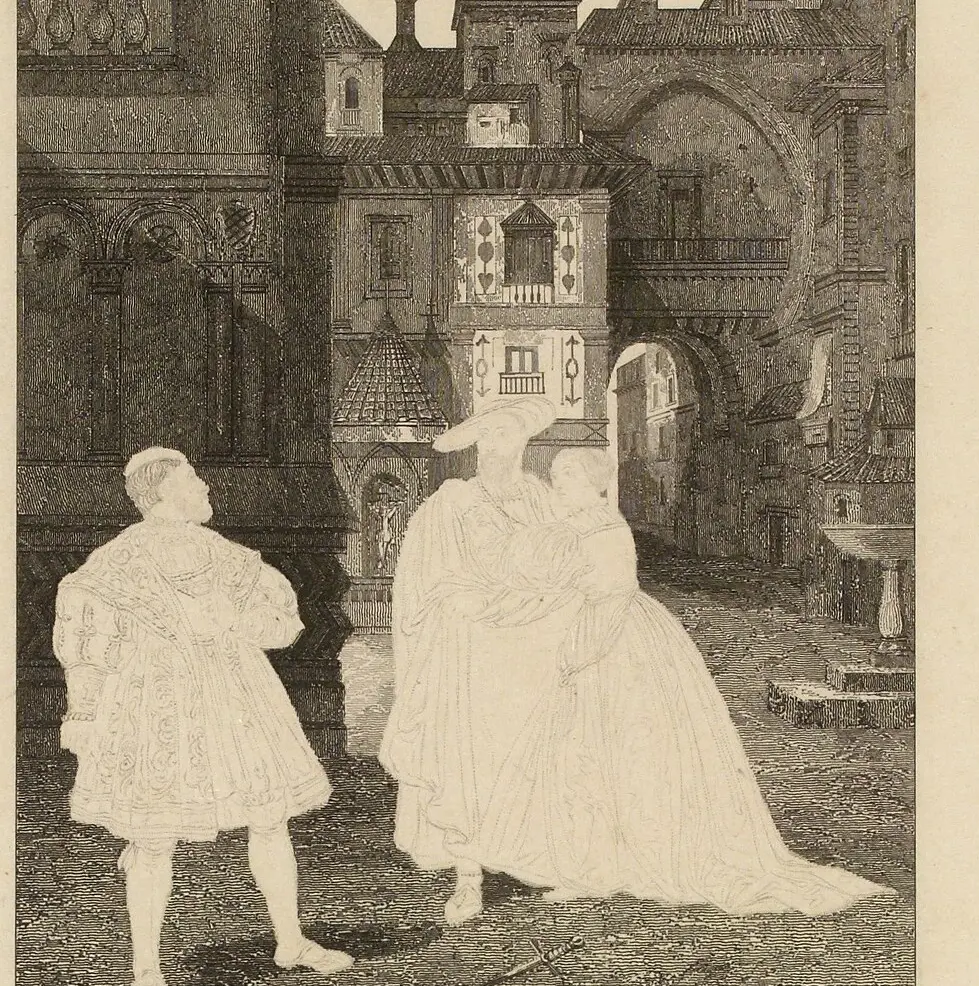
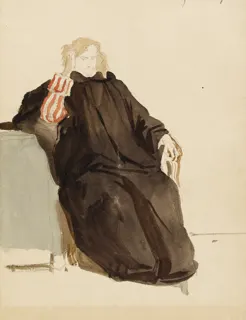
Doña Josefa Duarte, an old woman dressed in black, with body of her dress worked in jet in the fashion of Isabella the Catholic. Don Carlos.
Doña Josefa, alone. She draws the crimson curtains of the window, and puts some armchairs in order. A knock at a little secret door on the right. She listens. A second knock.
Can it be he already? [Another knock.]
'T is, indeed,
At th' hidden stairway. [A fourth knock.]
I must open quick.
She opens the concealed door. Don Carlos enters, his face muffled in his cloak, and his hat drawn over his brows.
Good evening to you, sir!
She ushers him in. He drops his cloak and reveals a rich dress of silk and velvet in the Castilian style of 1519. She looks at him closely, and recoils astonished.
What now?—not you,
Signor Hernani! Fire! fire! Help, oh help!
[seizing her by the arm] But two words more, Duenna, and you die!
He looks at her intently. She is frightened into silence.
Is this the room of Doña Sol, betrothed
To her old uncle, Duke de Pastrana?
A very worthy lord he is—senile,
White-hair'd and jealous. Tell me, is it true
The beauteous Doña loves a smooth-faced youth,
All whiskerless as yet, and sees him here
Each night, in spite of envious care? Tell me,
Am I informed aright?
She is silent. He shakes her by the arm.
Will you not speak?
You did forbid me, sir, to speak two words.
One will suffice. I want a yes, or no.
Say, is thy mistress Doña Sol de Silva?
Yes, why?
No matter why. Just at this hour
The venerable lover is away?
He is.
And she expects the young one now?
Yes.
Oh, that I could die!
Yes.
Say, Duenna,
Is this the place where they will surely meet?
Yes.
Hide me somewhere here.
You?
Yes, me.
Why?
No matter why.
I hide you here!
Yes, here.
No, never!
[drawing from his girdle a purse and a dagger] Madam, condescend to choose
Between a purse and dagger.
[taking the purse] Are you then
The devil?
Yes, Duenna.
[opening a narrow cupboard in the wall] Go—go in.
[examining the cupboard] This box!
[shutting up the cupboard] If you don't like it, go away.
[re-opening cupboard] And yet! [Again examining it.]
Is this the stable where you keep
The broom-stick that you ride on?
He crouches down in the cupboard with difficulty.
Oh! oh! oh!
[joining her hands and looking ashamed] A man here!
[from the cupboard, still open] And was it a woman then
Your mistress here expected?
Heavens! I hear
The step of Doña Sol! Sir, shut the door!
Quick—quick!
She pushes the cupboard door, which closes.
[from the closed cupboard] Remember, if you breathe a word
You die!
[alone] Who is this man? If I cry out,
Gracious! there's none to hear. All are asleep
Within the palace walls—Madam and I
Excepted. Pshaw! the other'll come. He wears
A sword; 'tis his affair. And Heav'n keep us
From powers of hell. [Weighing the purse in her hand.]
At least no thief he is.
Enter Doña Sol in white. Doña Josefa hides the purse.
Act 1, Scene 2
Doña Josefa; Don Carlos, hidden; Doña Sol: afterwards Hernani.
Josefa!
Madam?
I some mischief dread,
For 'tis full time Hernani should be here.
Noise of steps at the secret door.
He's coming up; go—quick! at once, undo
Ere he has time to knock.
Josefa opens the little door. Enter Hernani in large cloak and large hat; underneath, costume of mountaineer of Aragon—gray, with a cuirass of leather; a sword, a dagger, and a horn at his girdle.
[going to him] Hernani! Oh!
Ah, Doña Sol! it is yourself at last
I see—your voice it is I hear. Oh, why
Does cruel fate keep you so far from me?
I have such need of you to help my heart
Forget all else!
[touching his clothes] Oh! Heav'ns! your cloak is drench'd!
The rain must pour!
I know not.
And the cold—
You must be cold!
I feel it not.
Take off
This cloak then, pray.
Doña, beloved, tell me,
When night brings happy sleep to you, so pure
And innocent—sleep that half opes your mouth,
Closing your eyes with its light finger-touch—
Does not some angel show how dear you are
To an unhappy man, by all the world
Abandoned and repulsed?
Sir, you are late;
But tell me, are you cold?
Not near to you.
Ah! when the raging fire of jealous love
Burns in the veins, and the true heart is riven
By its own tempest, we feel not the clouds
O'erhead, though storm and lightning they fling forth!
Come, give me now the cloak, and your sword too.
[his hand on his sword] No. 'Tis my other love, faithful and pure.
The old Duke, Doña Sol—your promised spouse,
Your uncle—is he absent now?
Oh, yes;
This hour to us belongs.
And that is all!
Only this hour! and then comes afterwards!—
What matter! For I must forget or die!
Angel! one hour with thee—with whom I would
Spend life, and afterwards eternity!
Hernani!
It is happiness to know
The Duke is absent. I am like a thief
Who forces doors. I enter—see you—rob
An old man of an hour of your sweet voice
And looks. And I am happy, though, no doubt
He would deny me e'en one hour, although
He steals my very life.
Be calm.
Giving the cloak to the Duenna.
Josefa!
This wet cloak take and dry it. [Exit Josefa.]
She seats herself, and makes a sign for Hernani to draw near.
Now come here.
[without appearing to hear her] The Duke, then, is not in the mansion now?
How grand you look!
He is away?
Dear one,
Let us not think about the Duke.
Madam,
But let us think of him, the grave old man
Who loves you—who will marry you! How now?
He took a kiss from you the other day.
Not think of him!
Is't that which grieves you thus?
A kiss upon my brow—an uncle's kiss—
Almost a father's.
No, not so; it was
A lover's, husband's, jealous kiss. To him—
To him it is that you will soon belong.
Think'st thou not of it! Oh, the foolish dotard,
With head drooped down to finish out his days!
Wanting a wife, he takes a girl; himself
Most like a frozen spectre. Sees he not,
The senseless one! that while with one hand he
Espouses you, the other mates with Death!
Yet without shudder comes he 'twixt our hearts!
Seek out the grave-digger, old man, and give
Thy measure.
Who is it that makes for you
This marriage? You are forced to it, I hope?
They say the king desires it.
King! this king!
My father on the scaffold died condemned
By his; and, though one may have aged since then—
For e'en the shadow of that king, his son,
His widow, and for all to him allied,
My hate continues fresh. Him dead, no more
We count with; but while still a child I swore
That I'd avenge my father on his son.
I sought him in all places—Charles the King
Of the Castiles. For hate is rife between
Our families. The fathers wrestled long
And without pity, and without remorse,
For thirty years! Oh; 'tis in vain that they
Are dead; their hatred lives. For them no peace
Has come; their sons keep up the duel still.
Ah! then I find 'tis thou who hast made up
This execrable marriage! Thee I sought—
Thou comest in my way!
You frighten me!
Charged with the mandate of anathema,
I frighten e'en myself; but listen now:
This old, old man, for whom they destine you,
This Ruy de Silva, Duke de Pastrana,
Count and grandee, rich man of Aragon,
In place of youth can give thee, oh! young girl,
Such store of gold and jewels that your brow
Will shine 'mong royalty's own diadems;
And for your rank and wealth, and pride and state,
Queens many will perhaps envy you. See, then,
Just what he is. And now consider me.
My poverty is absolute, I say.
Only the forest, where I ran barefoot
In childhood, did I know. Although perchance
I too can claim illustrious blazonry,
That's dimm'd just now by rusting stain of blood.
Perchance I've rights, though they are shrouded still,
And hid 'neath ebon folds of scaffold cloth,
Yet which, if my attempt one day succeeds,
May, with my sword from out their sheath leap forth.
Meanwhile, from jealous Heaven I've received
But air, and light, and water—gifts bestowed
On all. Now, wish you from the Duke, or me,
To be delivered? You must choose 'twixt us,
Whether you marry him, or follow me.
You, I will follow!
'Mong companions rude,
Men all proscribed, of whom the headsman knows
The names already. Men whom neither steel
Nor touch of pity softens; each one urged
By some blood feud that's personal. Wilt thou
Then come? They'd call thee mistress of my band,
For know you not that I a bandit am?
When I was hunted throughout Spain, alone
In thickest forests, and on mountains steep,
'Mong rocks which but the soaring eagle spied,
Old Catalonia like a mother proved.
Among her hills—free, poor, and stern—I grew;
And now, to-morrow if this horn should sound,
Three thousand men would rally at the call.
You shudder, and should pause to ponder well.
Think what 'twill prove to follow me through woods
And over mountain paths, with comrades like
The fiends that come in dreams! To live in fear,
Suspicious of a sound, of voices, eyes:
To sleep upon the earth, drink at the stream,
And hear at night, while nourishing perchance
Some wakeful babe, the whistling musket balls.
To be a wanderer with me proscribed,
And when my father I shall follow—then,
E'en to the scaffold, you to follow me!
I'll follow you.
The Duke is wealthy, great
And prosperous, without a stain upon
His ancient name. He offers you his hand,
And can give all things—treasures, dignities,
And pleasure——
We'll set out to-morrow. Oh!
Hernani, censure not th' audacity
Of this decision. Are you angel mine
Or demon? Only one thing do I know,
That I'm your slave. Now, listen: wheresoe'er
You go, I go—pause you or move I'm yours.
Why act I thus? Ah! that I cannot tell;
Only I want to see you evermore.
When sound of your receding footstep dies
I feel my heart stops beating; without you
Myself seems absent, but when I detect
Again the step I love, my soul comes back,
I breathe—I live once more.
[embracing her] Oh! angel mine!
At midnight, then, to-morrow, clap your hands
Three times beneath my window, bringing there
Your escort. Go! I shall be strong and brave.
Now know you who I am?
Only my lord.
Enough—what matters else?—I follow you.
Not so. Since you, a woman weak, decide
To come with me, 'tis right that you should know
What name, what rank, what soul, perchance what fate
There hides beneath the low Hernani here.
Yes, you have willed to link yourself for aye
With brigand—would you still with outlaw mate?
[opening the cupboard] When will you finish all this history?
Think you 'tis pleasant in this cupboard hole?
Hernani recoils, astonished. Doña Sol screams and takes refuge in Hernani's arms, looking at Don Carlos with frightened gaze.
[his hand on the hilt of his sword] Who is this man?
Oh, heavens, help!
Be still,
My Doña Sol! you'll wake up dangerous eyes.
Never—whatever be—while I am near,
Seek other help than mine.
[To Don Carlos.] What do you here?
I?—Well, I am not riding through the wood,
That you should ask.
He who affronts, then jeers,
May cause his heir to laugh.
Each, Sir, in turn.
Let us speak frankly. You the lady love,
And come each night to mirror in her eyes
Your own. I love her too, and want to know
Who 'tis I have so often seen come in
The window way, while I stand at the door.
Upon my word, I'll send you out the way
I enter.
As to that we'll see. My love
I offer unto Madam. Shall we then
Agree to share it? In her beauteous soul
I've seen so much of tenderness, and love,
And sentiment, that she, I'm very sure,
Has quite enough for ardent lovers twain.
Therefore to-night, wishing to end suspense
On your account, I forced an entrance, hid,
And—to confess it all—I listened too.
But I heard badly, and was nearly choked;
And then I crumpled my French vest—and so,
By Jove! come out I must!
Likewise my blade
Is not at ease, and hurries to leap out.
[bowing] Sir, as you please.
[drawing his sword] Defend yourself!
Don Carlos draws his sword.
Oh, Heaven!
Be calm, Señora.
[to Don Carlos] Tell me, Sir, your name.
Tell me yours!
It is a fatal secret,
Kept for my breathing in another's ear,
Some day when I am conqueror, with my knee
Upon his breast, and dagger in his heart.
Then tell to me this other's name.
To thee
What matters it? On guard! Defend thyself!
They cross swords. Doña Sol falls trembling into a chair. They hear knocks at the door.
[rising in alarm] Oh Heavens! there's some one knocking at the door!
The champions pause. Enter Josefa, at the little door, in a frightened state.
[to Josefa] Who knocks in this way?
[to Doña Sol] Madame, a surprise!
An unexpected blow. It is the Duke
Come home.
[clasping her hands] The Duke! Then every hope is lost!
[looking round] Gracious! the stranger out! and swords, and fighting!
Here's a fine business!
The two combatants sheathe their swords. Don Carlos draws his cloak round him, and pulls his hat down on his forehead. More knocking.
What is to be done?
More knocking.
[without] Doña Sol, open to me.
Doña Josefa is going to the door, when Hernani stops her.
Do not open.
[pulling out her rosary] Holy St. James! now draw us through this broil!
More knocking.
[pointing to the cupboard] Let's hide!
What! in the cupboard?
Yes, go in;
I will take care that it shall hold us both.
Thanks. No; it is too good a joke.
[pointing to secret door] Let's fly
That way.
Good night! But as for me I stay
Here.
Fire and fury, Sir, we will be quits
For this. [To Doña Sol.] What if I firmly barr'd the door?
[to Josefa] Open the door.
What is it that he says?
[to Josefa, who hesitates bewildered] Open the door, I say.
More knocking. Josefa opens the door, trembling.
Oh, I shall die!
Act 1, Scene 3
The same, with Don Ruy Gomez de Silva, in black; white hair and beard. Servants with lights.
My niece with two men at this hour of night!
Come all! The thing is worth exposing here.
[To Doña Sol.] Now by St. John of Avila, I vow
That we three with you, madam, are by two
Too many. [To the two young men.] My young Sirs, what do you here?
When we'd the Cid and Bernard—giants both
Of Spain and of the world—they travelled through
Castile protecting women, honoring
Old men. For them steel armor had less weight
Than your fine velvets have for you. These men
Respected whitened beards, and when they loved,
Their love was consecrated by the Church.
Never did such men cozen or betray,
For reason that they had to keep unflawed
The honor of their house. Wished they to wed,
They took a stainless wife in open day,
Before the world, with sword, or axe, or lance
In hand. But as for villains such as you,
Who come at eve, peeping behind them oft,
To steal away the honor of men's wives
In absence of their husbands, I declare,
The Cid, our ancestor, had he but known
Such men, he would have plucked away from them
Nobility usurped, have made them kneel,
While he with flat of sword their blazon dashed.
Behold what were the men of former times
Whom I, with anguish, now compare with these
I see to-day! What do you here? Is it
To say, a white-haired man's but fit for youth
To point at when he passes in the street,
And jeer at there? Shall they so laugh at me,
Tried soldier of Zamora? At the least
Not yours will be that laugh.
But Duke——
Be still!
What! You have sword and lance, falcons, the chase,
And songs to sing 'neath balconies at night,
Festivals, pleasures, feathers in your hats,
Raiment of silk—balls, youth, and joy of life;
But wearied of them all, at any price
You want a toy, and take an old man for it.
Ah, though you've broke the toy, God wills that it
In bursting should be flung back in your face!
Now follow me!
Most noble Duke——
Follow—
Follow me, sirs. Is this alone a jest?
What! I've a treasure, mine to guard with care,
A young girl's character, a family's fame.
This girl I love—by kinship to me bound,
Pledged soon to change her ring for one from me.
I know her spotless, chaste, and pure. Yet when
I leave my home one hour, I—Ruy Gomez
De Silva—find a thief who steals from me
My honor, glides unto my house. Back, back,
Make clean your hands, oh base and soulless men,
Whose presence, brushing by, must serve to taint
Our women's fame! But no, 'tis well. Proceed.
Have I not something more? [Snatches off his collar.]
Take, tread it now
Beneath your feet. Degrade my Golden Fleece.
Throws off his hat.
Pluck at my hair, insult me every way,
And then, to-morrow through the town make boast
That lowest scoundrels in their vilest sport
Have never shamed a nobler brow, nor soiled
More whitened hair.
My lord——
[to his servants] A rescue! grooms!
Bring me my dagger of Toledo, axe,
And dirk. [To the young men.]
Now follow—follow me—ye two.
[stepping forward a little] Duke, this is not the pressing thing just now;
First we've to think of Maximilian dead,
The Emperor of Germany.
Opens his cloak, and shows his face, previously hidden by his hat.
Jest you!
Heavens, the King!
The King!
The King of Spain!
[gravely] Yes, Charles, my noble Duke, are thy wits gone?
The Emperor, my grandsire, is no more.
I knew it not until this eve, and came
At once to tell it you and counsel ask,
Incognito, at night, knowing you well
A loyal subject that I much regard.
The thing is very simple that has caused
This hubbub.
Don Ruy Gomez sends away servants by a sign, and approaches Don Carlos. Doña Sol looks at the King with fear and surprise. Hernani from a corner regards him with flashing eyes.
But oh, why was it the door
Was not more quickly opened?
Reason good.
Remember all your escort. When it is
A weighty secret of the state I bear
That brings me to your palace, it is not
To tell it to thy servants.
Highness, oh!
Forgive me, some appearances——
Good father,
Thee Governor of the Castle of Figuere
I've made. But whom thy governor shall I make?
Oh, pardon——
'Tis enough. We'll say no more
Of this. The Emperor is dead.
Your Highness's
Grandfather dead!
Ay! Duke, you see me here
In deep affliction.
Who'll succeed to him?
A Duke of Saxony is named. The throne
Francis the First of France aspires to mount.
Where do the Electors of the Empire meet?
They say at Aix-la-Chapelle, or at Spire,
Or Frankfort.
But our King, whom God preserve!
Has he not thought of Empire?
Constantly.
To you it should revert.
I know it, Duke.
Your father was Archduke of Austria.
I hope 'twill be remembered that you are
Grandson to him, who but just now has changed
Th' imperial purple for a winding-sheet.
I am, besides, a citizen of Ghent.
In my own youth your grandfather I saw.
Alas! I am the sole survivor now
Of all that generation past. All dead!
He was an Emperor magnificent
And mighty.
Rome is for me.
Valiant, firm,
And not tyrannical, this head might well
Become th' old German body.
He bends over the King's hands and kisses them.
Yet so young.
I pity you indeed, thus plunged in such
A sorrow.
Ah! the Pope is anxious now
To get back Sicily—the isle that's mine;
'Tis ruled that Sicily cannot belong
Unto an Emperor; therefore it is
That he desires me Emperor to be made;
And then, to follow that, as docile son
I give up Naples too. Let us but have
The Eagle, and we'll see if I allow
Its wings to be thus clipp'd!
What joy 'twould be
For this great veteran of the throne to see
Your brow, so fit, encircled by his crown!
Ah, Highness, we together weep for him,
The Christian Emperor, so good, so great!
The Holy Father's clever. He will say—
This isle unto my States should come; 'tis but
A tatter'd rag that scarce belongs to Spain.
What will you do with this ill-shapen isle
That's sewn upon the Empire by a thread?
Your Empire is ill-made; but quick, come here,
The scissors bring, and let us cut away!—
Thanks, Holy Father, but if I have luck
I think that many pieces such as this
Upon the Holy Empire will be sewn!
And if some rags from me are ta'en, I mean
With isles and duchies to replace them all.
Console yourself, for we shall see again
The dead more holy and more great. There is
An Empire of the Just.
Francis the First
Is all ambition. The old Emperor dead,
Quick he'll turn wooing. Has he not fair France
Most Christian? 'Tis a place worth holding fast.
Once to King Louis did my grandsire say—
If I were God, and had two sons, I'd make
The elder God, the second, King of France.
to Don Ruy Gomez.
Think you that Francis has a chance to win?
He is a victor.
There'd be all to change—
The golden bull doth foreigners exclude.
In a like manner, Highness, you would be
Accounted King of Spain.
But I was born
A citizen of Ghent.
His last campaign
Exalted Francis mightily.
The Eagle
That soon perchance upon my helm will gleam
Knows also how to open out its wings.
And knows your Highness Latin?
Ah, not much.
A pity that. The German nobles like
The best those who in Latin speak to them.
With haughty Spanish they will be content,
For trust King Charles, 'twill be of small account,
When masterful the voice, what tongue, it speaks.
To Flanders I must go. Your King, dear Duke,
Must Emperor return. The King of France
Will stir all means. I must be quick to win.
I shall set out at once.
Do you then go,
Oh Highness, without clearing Aragon
Of those fresh bandits who, among the hills,
Their daring insolence show everywhere?
To the Duke d'Arcos I have orders given
That he should quite exterminate the band.
But is the order given to its Chief
To let the thing be done?
Who is this Chief—
His name?
I know not. But the people say
That he's an awkward customer.
Pshaw! I know
That now he somewhere in Galicia hides;
With a few soldiers, soon we'll capture him.
Then it was false, the rumor which declared
That he was hereabouts?
Quite false. Thou canst
Accommodate me here to-night.
[bowing to the ground] Thanks! Thanks!
Highness! [He calls his servants.]
You'll do all honor to the King,
My guest.
The servants re-enter with lights. The Duke arranges them in two rows to the door at the back. Meanwhile Doña Sol approaches Hernani softly. The King observes them.
[to Hernani] To-morrow, midnight, without fail
Beneath my window clap your hands three times.
[softly] To-morrow night.
[aside] To-morrow!
Aloud to Doña Sol, whom he approaches with politeness.
Let me now
Escort you hence, I pray.
He leads her to the door. She goes out.
[his hand in his breast on dagger hilt] My dagger true!
[coming back, aside] Our man here has the look of being trapp'd.
He takes Hernani aside.
I've crossed my sword with yours; that honor, sir,
I've granted you. For many reasons I
Suspect you much, but to betray you now
Would shame the king; go therefore freely. E'en
I deign to aid your flight.
[coming back, and pointing to Hernani] This lord—who's he?
One of my followers, who'll soon depart.
They go out with servants and lights, the Duke preceding with waxlight in his hand.
Act 1, Scene 4
Hernani alone.
One of thy followers! I am, oh King!
Well said. For night and day and step by step
I follow thee, with eye upon thy path
And dagger in my hand. My race in me
Pursues thy race in thee. And now behold
Thou art my rival! For an instant I
'Twixt love and hate was balanced in the scale.
Not large enough my heart for her and thee;
In loving her oblivious I became
Of all my hate of thee. But since 'tis thou
That comes to will I should remember it,
I recollect. My love it is that tilts
Th' uncertain balance, while it falls entire
Upon the side of hate. Thy follower!
'Tis thou hast said it. Never courtier yet
Of thy accursed court, or noble, fain
To kiss thy shadow—not a seneschal
With human heart abjured in serving thee;
No dog within the palace, trained the King
To follow, will thy steps more closely haunt
And certainly than I. What they would have,
These famed grandees, is hollow title, or
Some toy that shines—some golden sheep to hang
About the neck. Not such a fool am I.
What I would have is not some favor vain,
But 'tis thy blood, won by my conquering steel—
Thy soul from out thy body forced—with all
That at the bottom of thy heart was reached
After deep delving. Go—you are in front—
I follow thee. My watchful vengeance walks
With me, and whispers in mine ear. Go where
Thou wilt I'm there to listen and to spy,
And noiselessly my step will press on thine.
No day, shouldst thou but turn thy head, oh King,
But thou wilt find me, motionless and grave,
At festivals; at night, should'st thou look back,
Still wilt thou see my flaming eyes behind.
Exit by the little door.
Act 2, Scene 1
THE BANDIT
Saragossa. A square before the Palace of Silva. On the left the high walls of the Palace, with a window and a balcony. Below the window a little door. To the right, at the back, houses of the street. Night. Here and there are a few windows still lit up, shining in the front of the houses.
Don Carlos, Don Sancho Sanchez de Zuniga Comte de Monterey, Don Matias Centurion Marquis d'Almuñan, Don Ricardo de Roxas Lord of Casapalma.
All four arrive, Don Carlos at the head, hats pulled down, and wrapped in long cloaks, which their swords inside raise up.
[looking up at the balcony] Behold! We're at the balcony—the door.
My heart is bounding.
Pointing to the window, which is dark.
Ah, no light as yet.
He looks at the windows where light shines.
Although it shines just where I'd have it not,
While where I wish for light is dark.
Your Highness,
Now let us of this traitor speak again.
And you permitted him to go!
'Tis true.
And he, perchance, was Major of the band.
Were he the Major or the Captain e'en,
No crown'd king ever had a haughtier air.
Highness, his name?
[his eyes fixed on the window] Muñoz—— Fernan——
With gesture of a man suddenly recollecting.
A name
In i.
Perchance Hernani?
Yes.
'Twas he.
The chief, Hernani!
Cannot you recall
His speech?
Oh, I heard nothing in the vile
And wretched cupboard.
Wherefore let him slip
When there you had him?
[turning round gravely and looking him in the face] Count de Monterey,
You question me!
The two nobles step back, and are silent.
Besides, it was not he
Was in my mind. It was his mistress, not
His head, I wanted. Madly I'm in love
With two dark eyes, the loveliest in the world,
My friends! Two mirrors, and two rays! two flames!
I heard but of their history these words:
"To-morrow come at midnight." 'Twas enough.
The joke is excellent! For while that he,
The bandit lover, by some murd'rous deed
Some grave to dig, is hindered and delayed,
I softly take his dove from out its nest.
Highness, 'twould make the thing far more complete
If we, the dove in gaining, killed the kite.
Count, 'tis most capital advice. Your hand
Is prompt.
[bowing low] And by what title will it please
The King that I be Count?
'Twas a mistake.
[to Don Sancho] The King has called me Count.
Enough—enough!
[to Don Ricardo.]
I let the title fall; but pick it up.
[bowing again] Thanks, Highness.
A fine Count—Count by mistake!
The King walks to the back of the stage, watching eagerly the lighted windows. The two lords talk together at the front.
[to Don Sancho] What think you that the King will do, when once
The beauty's taken?
[looking sideways at Don Ricardo] Countess she'll be made;
Lady of honor afterwards, and then,
If there's a son, he will be King.
How so?—
My Lord! a bastard! Let him be a Count.
Were one His Highness, would one choose as king
A Countess' son?
He'd make her Marchioness
Ere then, dear Marquis.
Bastards—they are kept
For conquer'd countries. They for viceroys serve.
Don Carlos comes forward.
[looking with vexation at the lighted windows] Might one not say they're jealous eyes that watch?
Ah! there are two which darken; we shall do.
Weary the time of expectation seems—
Sirs, who can make it go more quickly?
That
Is what we often ask ourselves within
The palace.
'Tis the thing my people say
Again with you. [The last window light is extinguished.]
The last light now is gone.
[Turning towards the balcony of Doña Sol, still dark.]
Oh, hateful window! When wilt thou light up?
The night is dark; come, Doña Sol, and shine
Like to a star! [to Don Ricardo].
Is 't midnight yet?
Almost.
Ah! we must finish, for the other one
At any moment may appear.
A light appears in Doña Sol's chamber. Her shadow is seen through the glass.
My friends!
A lamp! and she herself seen through the pane!
Never did daybreak charm me as this sight.
Let's hasten with the signal she expects.
We must clap hands three times. An instant more
And you will see her. But our number, perhaps,
Will frighten her. Go, all three out of sight
Beyond there, watching for the man we want.
'Twixt us, my friends, we'll share the loving pair,
For me the girl—the brigand is for you.
Best thanks.
If he appear from ambuscade,
Rush quickly, knock him down, and, while the dupe
Recovers from the blow, it is for me
To carry safely off the darling prize.
We'll laugh anon. But kill him not outright,
He's brave, I own;—killing's a grave affair.
The lords bow and go. Don Carlos waits till they are quite gone, then claps his hands twice. At the second time the window opens, and Doña Sol appears on the balcony.
Act 2, Scene 2
Don Carlos. Doña Sol.
[from the balcony] Hernani, is that you?
[aside] The devil! We must
Not parley! [He claps his hands again.]
I am coming down.
She closes the window, and the light disappears. The next minute the little door opens, and she comes out, the lamp in her hand, and a mantle over her shoulders.
Hernani!
Don Carlos pulls his hat down on his face, and hurries towards her.
[letting her lamp fall] Heavens! 'Tis not his footstep!
She attempts to go back, but Don Carlos runs to her and seizes her by the arm.
Doña Sol!
'Tis not his voice! Oh, misery!
What voice
Is there that thou could'st hear that would be more
A lover's? It is still a lover here,
And King for one.
The King!
Ah! wish, command,
A kingdom waits thy will; for he whom thou
Hast vanquish'd is the King, thy lord—'tis Charles,
Thy slave!
[trying to escape from him] To the rescue! Help, Hernani! Help!
Thy fear is maidenly, and worthy thee.
'Tis not thy bandit—'tis thy King that holds
Thee now!
Ah, no. The bandit's you. Are you
Not 'shamed? The blush unto my own cheek mounts
For you. Are these the exploits to be noised
Abroad? A woman thus at night to seize!
My bandit's worth a hundred of such kings!
I do declare, if man were born at level
Of his soul, and God made rank proportional
To his heart, he would be king and prince, and you
The robber be!
[trying to entice her] Madam!——
Do you forget
My father was a Count?
And you I'll make
A Duchess.
[repulsing him] Cease! All this is shameful;—go!
She retreats a few steps.
Nothing, Don Carlos, can there 'twixt us be.
My father for you freely shed his blood.
I am of noble birth, and heedful ever
Of my name's purity. I am too high
To be your concubine—too low to be
Your wife.
Princess!
Carry to worthless girls,
King Charles, your vile addresses. Or, if me
You treat insultingly, I'll show you well
That I'm a woman, and a noble dame.
Well, then but come, and you shall share my throne,
My name—you shall be Queen and Empress——
No.
It is a snare. Besides, I frankly speak,
Since, Highness, it concerns you. I avow
I'd rather with my king, Hernani, roam,
An outcast from the world and from the law—
Know thirst and hunger, wandering all the year,
Sharing the hardships of his destiny—
Exile and warfare, mourning hours of terror,
Than be an Empress with an Emperor!
Oh, happy man is he!
What! poor, proscribed!
'Tis well with him, though poor, proscribed he be,
For he's beloved!—an angel watches him!
I'm desolate. You hate me, then?
I love
You not.
[seizing her violently] Well, then, it matters not to me
Whether you love me, or you love me not!
You shall come with me—yes, for that my hand's
The stronger, and I will it! And we'll see
If I for nothing am the King of Spain
And of the Indies!
[struggling] Highness! Pity me!
You're King, you only have to choose among
The Countesses, the Duchesses, the great
Court ladies, all have love prepared to meet
And answer yours; but what has my proscribed
Received from niggard fortune? You possess
Castile and Aragon—Murcia and Léon,
Navarre, and still ten kingdoms more. Flanders,
And India with the mines of gold you own,
An empire without peer, and all so vast
That ne'er the sun sets on it. And when you,
The King, have all, would you take me, poor girl,
From him who has but me alone.
She throws herself on her knees. He tries to draw her up.
Come—come!
I cannot listen. Come with me. I'll give
Of Spain a fourth part unto thee. Say, now,
What wilt thou? Choose.
[struggling in his arms] For mine own honor's sake
I'll only from your Highness take this dirk.
She snatches the poignard from his girdle.
Approach me now but by a step!
The beauty!
I wonder not she loves a rebel now.
He makes a step towards her. She raises the dirk.
Another step, I kill you—and myself.
He retreats again. She turns and cries aloud.
Hernani! Oh, Hernani!
Peace!
One step,
And all is finished.
Madam, to extremes
I'm driven. Yonder there I have three men
To force you—followers of mine.
[coming suddenly behind him] But one
You have forgotten.
The King turns, and sees Hernani motionless behind him in the shade, his arms crossed under the long cloak which is wrapped round him, and the brim of his hat raised up. Doña Sol makes an exclamation and runs to him.
Act 2, Scene 3
Don Carlos, Doña Sol, Hernani.
[motionless, his arms still crossed, and his fiery eyes fixed on the King] Heaven my witness is,
That far from here it was I wished to seek him.
Hernani! save me from him.
My dear love,
Fear not.
Now what could all my friends in town
Be doing, thus to let pass by the chief
Of the Bohemians? Ho! Monterey!
Your friends are in the hands of mine just now,
So call not on their powerless swords; for three
That you might claim, sixty to me would come
Each one worth four of yours. So let us now
Our quarrel terminate. What! you have dared
To lay a hand upon this girl! It was
An act of folly, great Castilian King,
And one of cowardice!
Sir Bandit, hold!
There must be no reproach from you to me!
He jeers! Oh, I am not a king; but when
A king insults me, and above all jeers,
My anger swells and surges up, and lifts
Me to his height. Take care! When I'm offended,
Men fear far more the reddening of my brow
Than helm of king. Foolhardy, therefore, you
If still you're lured by hope. [Seizes his arm.]
Know you what hand
Now grasps you? Listen. 'Twas your father who
Was death of mine. I hate you for it. You
My title and my wealth have taken. You
I hate. And the same woman now we love.
I hate—hate—from my soul's depths you I hate.
That's well.
And yet this night my hate was lull'd.
Only one thought, one wish, one want I had—
'Twas Doña Sol! And I, absorbed in love,
Came here to find you daring against her
To strive, with infamous design! You—you,
The man forgot—thus in my pathway placed!
I tell you, King, you are demented! Ah!
King Charles, now see you're taken in the snare
Laid by yourself: and neither flight nor help
For thee is possible. I hold thee fast,
Besieged, alone, surrounded by thy foes,
Bloodthirsty ones, what wilt thou do?
[proudly] Dare you
To question me!
Pish! pish! I would not wish
An arm obscure should strike thee. 'Tis not so
My vengeance should have play. 'Tis I alone
Must deal with thee. Therefore defend thyself.
He draws his sword.
I am your lord, the King. Strike! but no duel.
Highness, thou may'st remember yesterday
Thy sword encountered mine.
I yesterday
Could do it. I your name knew not, and you
Were ignorant of my rank. Not so to-day.
You know who I am, I who you are now.
Perchance.
No duel. You can murder. Do.
Think you that kings to me are sacred? Come,
Defend thyself.
You will assassinate
Me then?
Hernani falls back. The King looks at him with eagle eyes.
Ah! bandits, so you dare to think
That your most vile brigades may safely spread
Through towns—ye blood-stained, murderous, miscreant crew—
But that you'll play at magnanimity!
As if we'd deign th' ennobling of your dirks
By touch of our own swords—we victims duped.
No, crime enthralls you—after you it trails.
Duels with you! Away! and murder me.
Hernani, morose and thoughtful, plays for some instants with the hilt of his sword, then turns sharply towards the King and snaps the blade on the pavement.
Go, then.
The King half turns towards him and looks at him haughtily.
We shall have fitter meetings. Go.
Get thee away.
'Tis well. I go, Sir, soon
Unto the Ducal Palace. I, your King,
Will then employ the magistrate. Is there
Yet put a price upon your head?
Oh, yes.
My master, from this day I reckon you
A rebel, trait'rous subject; you I warn.
I will pursue you everywhere, and make
You outlaw from my kingdom.
That I am
Already.
That is well.
But France is near
To Spain. There's refuge there.
But I shall be
The Emperor of Germany, and you
Under the empire's ban shall be.
Ah, well!
I still shall have the remnant of the world,
From which to brave you—and with havens safe
O'er which you'll have no power.
But when I've gained
The world?
Then I shall have the grave.
Your plots
So insolent I shall know how to thwart.
Vengeance is lame, and comes with lagging steps,
But still it comes.
[with a half laugh of disdain] For touch of lady whom
The bandit loves!
[with flashing eyes] Dost thou remember, King,
I hold thee still? Make me not recollect
Oh, future Roman Cæsar, that despised
I have thee in my all too loyal hand,
And that I only need to close it now
To crush the egg of thy Imperial Eagle!
Then do it.
Get away.
He takes off his cloak, and throws it on the shoulders of the King.
Go, fly, and take
This cloak to shield thee from some knife I fear
Among our ranks. [The King wraps himself in the cloak.]
At present safely go,
My thwarted vengeance for myself I keep.
It makes 'gainst every other hand thy life
Secure.
And you who've spoken thus to me
Ask not for mercy on some future day.
Exit Don Carlos.
Act 2, Scene 4
Hernani. Doña Sol.
[seizing Hernani's hand] Now let us fly—be quick.
It well becomes
You, loved one, in the trial hour to prove
Thus strong, unchangeable, and willing e'en
To th' end and depth of all to cling to me;
A noble wish, worthy a faithful soul!
But Thou, oh God, dost see that to accept
The joy that to my cavern she would bring—
The treasure of a beauty that a king
Now covets—and that Doña Sol to me
Should all belong—that she with me should 'bide,
And all our lives be joined—that this should be
Without regret, remorse—it is too late.
The scaffold is too near.
What is't you say?
This King, whom to his face just now I braved,
Will punish me for having dared to show
Him mercy. He already, perhaps, has reached
His palace, and is calling round him guards
And servants, his great lords, his headsmen——
Heavens!
Hernani! Oh, I shudder. Never mind,
Let us be quick and fly together then.
Together! No; the hour has passed for that.
Alas! When to my eyes thou didst reveal
Thyself, so good and generous, deigning e'en
To love me with a helpful love, I could
But offer you—I, wretched one!—the hills,
The woods, the torrents, bread of the proscribed,
The bed of turf, all that the forest gives;
Thy pity then emboldened me—but now
To ask of thee to share the scaffold! No,
No, Doña Sol. That is for me alone.
And yet you promised even that!
[falling on his knees] Angel!
At this same moment, when perchance from out
The shadow Death approaches, to wind up
All mournfully a life of mournfulness,
I do declare that here a man proscribed,
Enduring trouble great, profound—and rock'd
In blood-stained cradle—black as is the gloom
Which spreads o'er all my life, I still declare
I am a happy, to-be-envied man,
For you have loved me, and your love have owned!
For you have whispered blessings on my brow
Accursed!
[leaning over his head] Hernani!
Praiséd be the fate
Sweet and propitious that for me now sets
This flower upon the precipice's brink! [Raising himself.]
'Tis not to you that I am speaking thus;
It is to Heaven that hears, and unto God.
Let me go with you.
Ah, 'twould be a crime
To pluck the flower while falling in the abyss.
Go: I have breathed the perfume—'tis enough.
Remould your life, by me so sadly marred.
This old man wed; 'tis I release you now.
To darkness I return. Be happy thou—
Be happy and forget.
No, I will have
My portion of thy shroud. I follow thee.
I hang upon thy steps.
[pressing her in his arms] Oh, let me go
Alone! Exiled—proscribed—a fearful man
Am I.
He quits her with a convulsive movement, and is going.
[mournfully, and clasping her hands] Hernani, do you fly from me!
[returning] Well, then, no, no. You will it, and I stay.
Behold me! Come into my arms. I'll wait
As long as thou wilt have me. Let us rest,
Forgetting them. [He seats her on a bench.]
Be seated on this stone.
He places himself at her feet.
The liquid light of your eyes inundates
Mine own. Sing me some song, such as sometimes
You used at eve to warble, with the tears
In those dark orbs. Let us be happy now,
And drink; the cup is full. This hour is ours,
The rest is only folly. Speak and say,
Enrapture me. Is it not sweet to love,
And know that he who kneels before you loves?
To be but two alone? Is it not sweet
To speak of love in stillness of the night
When nature rests? Oh, let me slumber now,
And on thy bosom dream. Oh, Doña Sol,
My love, my darling! [Noise of bells in the distance.]
[starting up frightened] Tocsin!—dost thou hear?
The tocsin!
[still kneeling at her feet] Eh! No, 'tis our bridal bell
They're ringing.
The noise increases. Confused cries. Lights at all the windows, on the roofs, and in the streets.
Rise—oh, fly—great God! the town
Lights up!
[half rising] A torchlight wedding for us 'tis!
The nuptials these of Death, and of the tombs!
Noise of swords and cries.
[lying down on the stone bench] Let us to sleep again.
[rushing in, sword in hand] The runners, sir.
The alcadés rush out in cavalcades
With mighty force. Be quick—my Captain,—quick.
Hernani rises.
[pale] Ah, thou wert right!
Oh, help us!
[to Mountaineer] It is well—
I'm ready. [Confused cries outside.]
Death to the bandit!
[to Mountaineer] Quick, thy sword——
[To Doña Sol.]
Farewell!
'Tis I have been thy ruin! Oh,
Where canst thou go? [Pointing to the little door.]
The door is free. Let us
Escape that way.
Heavens! Desert my friends!
What dost thou say?
These clamors terrify.
Remember, if thou diest I must die.
[holding her in his arms] A kiss!
Hernani! Husband! Master mine!
[kissing her forehead] Alas! it is the first!
Perchance the last!
Hernani exit. She falls on the bench.
Act 3, Scene 1
THE OLD MAN
The Castle of Silva. In the midst of the Mountains of Aragon.
The gallery of family portraits of Silva; a great hall of which these portraits—surrounded with rich frames, and surmounted by ducal coronets and gilt escutcheons—form the decoration. At the back a lofty gothic door. Between the portraits complete panoplies of armor of different centuries.
Doña Sol, pale, and standing near a table.
Don Ruy Gomez de Silva, seated in his great carved oak chair.
At last the day has come!—and in an hour
Thou'lt be my Duchess, and embrace me! Not
Thine Uncle then! But hast thou pardoned me?
That I was wrong I own. I raised thy blush,
I made thy cheek turn pale. I was too quick
With my suspicions—should have stayed to hear
Before condemning; but appearances
Should take the blame. Unjust we were. Certes
The two young handsome men were there. But then—
No matter—well I know that I should not
Have credited my eyes. But, my poor child,
What would'st thou with the old?
[seriously, and without moving] You ever talk
Of this. Who is there blames you?
I myself,
I should have known that such a soul as yours
Never has galants; when 'tis Doña Sol,
And when good Spanish blood is in her veins.
Truly, my Lord, 'tis good and pure; perchance
'Twill soon be seen.
[rising, and going towards her] Now list. One cannot be
The master of himself, so much in love
As I am now with thee. And I am old
And jealous, and am cross—and why? Because
I'm old; because the beauty, grace, or youth
Of others frightens, threatens me. Because
While jealous thus of others, of myself
I am ashamed. What mockery! that this love
Which to the heart brings back such joy and warmth,
Should halt, and but rejuvenate the soul,
Forgetful of the body. When I see
A youthful peasant, singing blithe and gay,
In the green meadows, often then I muse—
I, in my dismal paths, and murmur low:
"Oh, I would give my battlemented towers,
And ancient ducal donjon, and my fields
Of corn, and all my forest lands, and flocks
So vast which feed upon my hills, my name
And all my ancient titles—ruins mine,
And ancestors who must expect me soon,
All—all I'd give for his new cot, and brow
Unwrinkled. For his hair is raven black,
And his eyes shine like yours. Beholding him
You might exclaim: A young man this! And then
Would think of me so old." I know it well.
I am named Silva. Ah, but that is not
Enough; I say it, see it. Now behold
To what excess I love thee. All I'd give
Could I be like thee—young and handsome now!
Vain dream! that I were young again, who must
By long, long years precede thee to the tomb.
Who knows?
And yet, I pray you, me believe,
The frivolous swains have not so much of love
Within their hearts as on their tongues. A girl
May love and trust one; if she dies for him,
He laughs. The strong-winged and gay-painted birds
That warble sweet, and in the thicket trill,
Will change their loves as they their plumage moult.
They are the old, with voice and color gone,
And beauty fled, who have the resting wings
We love the best. Our steps are slow, and dim
Our eyes. Our brows are furrowed,—but the heart
Is never wrinkled. When an old man loves
He should be spared. The heart is ever young,
And always it can bleed. This love of mine
Is not a plaything made of glass to shake
And break. It is a love severe and sure,
Solid, profound, paternal,—strong as is
The oak which forms my ducal chair. See then
How well I love thee—and in other ways
I love thee—hundred other ways, e'en as
We love the dawn, and flowers, and heaven's blue!
To see thee, mark thy graceful step each day,
Thy forehead pure, thy brightly beaming eye,
I'm joyous—feeling that my soul will have
Perpetual festival!
Alas!
And then,
Know you how much the world admires, applauds,
A woman, angel pure, and like a dove,
When she an old man comforts and consoles
As he is tott'ring to the marble tomb,
Passing away by slow degrees as she
Watches and shelters him, and condescends
To bear with him, the useless one, that seems
But fit to die? It is a sacred work
And worthy of all praise—effort supreme
Of a devoted heart to comfort him
Unto the end, and without loving perhaps,
To act as if she loved. Ah, thou to me
Wilt be this angel with a woman's heart
Who will rejoice the old man's soul again
And share his latter years, and by respect
A daughter be, and by your pity like
A sister prove.
Far from preceding me,
'Tis likely me you'll follow to the grave.
My lord, because that we are young is not
A reason we should live. Alas! I know
And tell you, often old men tarry long,
And see the young go first, their eyes shut fast
By sudden stroke, as on a sepulchre
That still was open falls the closing stone.
Oh cease, my child, such saddening discourse,
Or I shall scold you. Such a day as this
Sacred and joyous is. And, by-the-by,
Time summons us. Are you not ready yet
For chapel when we're called? Be quick to don
The bridal dress. Each moment do I count.
There is abundant time.
Oh no, there's not.
Enter a Page.
What want you?
At the door, my lord, a man—
A pilgrim—beggar—or I know not what,
Is craving here a shelter.
Let him in
Whoever he may be. Good enters with
The stranger that we welcome. What's the news
From th' outside world? What of the bandit chief
That filled our forests with his rebel band?
Hernani, Lion of the mountains, now
Is done for.
[aside] God!
[to the Page] How so?
The troop's destroyed.
The King himself has led the soldiers on.
Hernani's head a thousand crowns is worth
Upon the spot; but now he's dead, they say.
[aside] What! Without me, Hernani!
And thank Heaven!
So he is dead, the rebel! Now, dear love,
We can rejoice; go then and deck thyself,
My pride, my darling. Day of double joy.
Oh, mourning robes! [Exit DoRa Sol.]
[to the Page] The casket quickly send
That I'm to give her. [He seats himself in his chair.]
'Tis my longing now
To see her all adorned Madonna like.
With her bright eyes, and aid of my rich gems,
She will be beautiful enough to make
A pilgrim kneel before her. As for him
Who asks asylum, bid him enter here,
Excuses from us offer; run, be quick.
The Page bows and exit.
'Tis ill to keep a guest long waiting thus.
The door at the back opens. Hernani appears disguised as a Pilgrim. The Duke rises.
Act 3, Scene 2
Don Ruy Gomez. Hernani.
Hernani pauses at the threshold of the door.
My lord, peace and all happiness be yours!
[saluting him with his hand] To thee be peace and happiness, my guest!
Hernani enters. The Duke reseats himself.
Art thou a pilgrim?
[bowing] Yes.
No doubt you come
From Armillas?
Not so. I hither came
By other road, there was some fighting there.
Among the troop of bandits, was it not?
I know not.
What's become of him—the chief
They call Hernani? Dost thou know?
My lord,
Who is this man?
Dost thou not know him then?
For thee so much the worst! Thou wilt not gain
The good round sum. See you a rebel he
That has been long unpunished. To Madrid
Should you be going, perhaps you'll see him hanged
I go not there.
A price is on his head
For any man who takes him.
[aside] Let one come!
Whither, good pilgrim, goest thou?
My lord,
I'm bound for Saragossa.
A vow made
In honor of a Saint, or of Our Lady?
Yes, of Our Lady, Duke.
Of the Pillar?
Of the Pillar.
We must be soulless quite
Not to acquit us of the vows we make
Unto the Saints. But thine accomplished, then
Hast thou not other purposes in view?
Or is to see the Pillar all you wish?
Yes. I would see the lights and candles burn,
And at the end of the dim corridor
Our Lady in her glowing shrine, with cope
All golden—then would satisfied return.
Indeed, that's well. Brother, what is thy name?
Mine, Ruy de Silva is.
[hesitating] My name——
You can
Conceal it if you will. None here has right
To know it. Cam'st thou to asylum ask?
Yes, Duke.
Remain, and know thou'rt welcome here.
For nothing want; and as for what thou'rt named,
But call thyself my guest. It is enough
Whoever thou may'st be. Without demur
I'd take in Satan if God sent him me.
The folding doors at the back open. Enter Doña Sol in nuptial attire. Behind her Pages and Lackeys, and two women carrying on a velvet cushion a casket of engraved silver, which they place upon a table, and which contains a jewel case, with Duchess's coronet, necklaces, bracelets, pearls, and diamonds in profusion. Hernani, breathless and scared, looks at Doña Sol with flaming eyes without listening to the Duke.
Act 3, Scene 3
The Same: Doña Sol, Pages, Lackeys, Women.
[continuing] Behold my blessed Lady—to have prayed
To her will bring thee happiness.
He offers his hand to Doña Sol, still pale and grave.
Come then,
My bride. What! not thy coronet, nor ring!
[in a voice of thunder] Who wishes now a thousand golden crowns
To win?
All turn to him astonished. He tears off his Pilgrim's robe, and crushes it under his feet, revealing himself in the dress of a Mountaineer.
I am Hernani.
[joyfully] Heavens! Oh,
He lives!
[to the Lackeys] See! I'm the man they seek.
To the Duke.
You wished
To know my name—Diego or Perez?
No, no! I have a grander name—Hernani.
Name of the banished, the proscribed. See you
This head? 'Tis worth enough of gold to pay
For festival. [To the Lackeys.]
I give it to you all.
Take; tie my hands, my feet. But there's no need,
The chain that binds me's one I shall not break.
[aside] Oh misery!
Folly! This my guest is mad—
A lunatic!
Your guest a bandit is.
Oh, do not heed him.
What I say is truth.
A thousand golden crowns—the sum is large.
And, sir, I will not answer now for all
My people.
And so much the better, should
A willing one be found. [To the Lackeys.]
Now seize, and sell me!
[frying to silence him] Be quiet, or they'll take you at your word.
Friends, this your opportunity is good.
I tell you, I'm the rebel—the proscribed
Hernani!
Silence!
I am he!
[in a low voice to him] Be still!
[half turning to Doña Sol] There's marrying here! My spouse awaits me too.
To the Duke.
She is less beautiful, my Lord, than yours,
But not less faithful. She is Death. [To the Lackeys.]
Not one
Of you has yet come forth!
[in a low voice] For pity's sake!
[to the Lackeys] A thousand golden crowns. Hernani here!
This is the demon!
[to a young Lackey] Come! thou'lt earn this sum,
Then rich, thou wilt from lackey change again
To man. [To the other Lackeys, who do not stir.]
And also you—you waver. Ah,
Have I not misery enough?
My friend,
To touch thy life they'd peril each his own.
Wert thou Hernani, or a hundred times
As bad, I must protect my guest,—were e'en
An Empire offered for his life—against
The King himself; for thee I hold from God.
If hair of thine be injured, may I die. [To Doña Sol.]
My niece, who in an hour will be my wife,
Go to your room. I am about to arm
The Castle—shut the gates. [Exit, followed by servants.]
[looking with despair at his empty girdle] Not e'en a knife!
Doña Sol, after the departure of the Duke, takes a few steps, as if to follow her women, then pauses, and when they are gone, comes back to Hernani with anxiety.
Act 3, Scene 4
Hernani. Doña Sol.
Hernani looks at the nuptial jewel-case with a cold and apparently indifferent gaze; then he tosses back his head, and his eyes light up.
Accept my 'gratulations! Words tell not
How I'm enchanted by these ornaments.
He approaches the casket.
This ring is in fine taste,—the coronet
I like,—the necklace shows surpassing skill.
The bracelet's rare—but oh, a hundred times
Less so than she, who 'neath a forehead pure
Conceals a faithless heart. [Examining the casket again.]
What for all this
Have you now given? Of your love some share?
But that for nothing goes! Great God! to thus
Deceive, and still to live and have no shame!
Looking at the jewels.
But after all, perchance, this pearl is false,
And copper stands for gold, and glass and lead
Make out sham diamonds—pretended gems!
Are these false sapphires and false jewels all?
If so, thy heart is like them, Duchess false,
Thyself but only gilded. [He returns to the casket.]
Yet no, no!
They all are real, beautiful, and good,
He dares not cheat, who stands so near the tomb.
Nothing is wanting.
He takes up one thing after another.
Necklaces are here,
And brilliant earrings, and the Duchess' crown
And golden ring. Oh marvel! Many thanks
For love so certain, faithful and profound.
The precious box!
[She goes to the casket, feels in it, and draws forth a dagger] You have not reached its depths.
This is the dagger which, by kindly aid
Of patron saint, I snatched from Charles the King
When he made offer to me of a throne,
Which I refused for you, who now insult me.
[falling at her feet] Oh, let me on my knees arrest those tears,
The tears that beautify thy sorrowing eyes.
Then after thou canst freely take my life.
I pardon you, Hernani. In my heart
There is but love for you.
And she forgives—
And loves me still! But who can also teach
Me to forgive myself, that I have used
Such words? Angel, for heaven reserved, say where
You trod, that I may kiss the ground.
My love!
Oh no, I should to thee be odious.
But listen. Say again—I love thee still!
Say it, and reassure a heart that doubts.
Say it, for often with such little words
A woman's tongue hath cured a world of woes.
[absorbed, and without hearing him] To think my love had such short memory!
That all these so ignoble men could shrink
A heart, where his name was enthroned, to love
By them thought worthier.
Alas! I have
Blasphemed! If I were in thy place I should
Be weary of the furious madman, who
Can only pity after he has struck.
I'd bid him go. Drive me away, I say,
And I will bless thee, for thou hast been good
And sweet. Too long thou hast myself endured,
For I am evil; I should blacken still
Thy days with my dark nights. At last it is
Too much; thy soul is lofty, beautiful,
And pure; if I am evil, is't thy fault?
Marry the old duke then, for he is good
And noble. By the mother's side he has
Olmédo, by his father's Alcala.
With him be rich and happy by one act.
Know you not what this generous hand of mine
Can offer thee of splendor? Ah, alone
A dowry of misfortune, and the choice
Of blood or tears. Exile, captivity
And death, and terrors that environ me.
These are thy necklaces and jewelled crown.
Never elated bridegroom to his bride
Offered a casket filled more lavishly,
But 'tis with misery and mournfulness.
Marry the old man—he deserves thee well!
Ah, who could ever think my head proscribed
Fit mate for forehead pure? What looker-on
That saw thee calm and beautiful, me rash
And violent—thee peaceful, like a flower
Growing in shelter, me by tempests dash'd
On rocks unnumber'd—who could dare to say
That the same law should guide our destinies?
No, God, who ruleth all things well, did not
Make thee for me. No right from Heav'n above
Have I to thee; and I'm resigned to fate.
I have thy heart; it is a theft! I now
Unto a worthier yield it. Never yet
Upon our love has Heaven smiled; 'tis false
If I have said thy destiny it was.
To vengeance and to love I bid adieu!
My life is ending; useless I will go,
And take away with me my double dream,
Ashamed I could not punish, nor could charm.
I have been made for hate, who only wished
To love. Forgive and fly me, these my prayers
Reject them not, since they will be my last.
Thou livest—I am dead. I see not why
Thou should'st immure thee in my tomb.
Ingrate!
Mountains of old Aragon! Galicia!
Estremadura! Unto all who come
Around me I bring misery! Your sons,
The best, without remorse I've ta'en to fight,
And now behold them dead! The bravest brave
Of all Spain's sons lie, soldier-like, upon
The hills, their backs to earth, the living God
Before; and if their eyes could ope they'd look
On heaven's blue. See what I do to all
Who join me! Is it fortune any one
Should covet? Doña Sol, oh! take the Duke,
Take hell, or take the King—all would be well,
All must be better than myself, I say.
No longer have I friend to think of me,
And it is fully time that thy turn comes,
For I must be alone. Fly from me then,
From my contagion. Make not faithful love
A duty of religion! Fly from me,
For pity's sake. Thou think'st me, perhaps, a man
Like others, one with sense, who knows the end
At which he aims, and acts accordingly.
Oh, undeceive thyself. I am a force
That cannot be resisted—agent blind
And deaf of mournful mysteries! A soul
Of misery made of gloom. Where shall I go?
I cannot tell. But I am urged, compelled
By an impetuous breath and wild decree;
I fall, and fall, and cannot stop descent.
If sometimes breathless I dare turn my head,
A voice cries out, "Go on!" and the abyss
Is deep, and to the depths I see it red
With flame or blood! Around my fearful course
All things break up—all die. Woe be to them
Who touch me. Fly, I say! Turn thee away
From my so fatal path. Alas! without
Intending I should do thee ill.
Great God!
My demon is a formidable one.
But there's a thing impossible to it—
My happiness. For thee is happiness.
Therefore go seek another lord, for thou
Art not for me. If Heaven, that my fate
Abjures, should smile on me, believe it not:
It would be irony. Marry the Duke!
'Twas not enough to tear my heart, but you
Must break it now! Ah me! no longer then
You love me!
Oh! my heart—its very life
Thou art! The glowing hearth whence all warmth comes
Art thou! Wilt thou then blame me that I fly
From thee, adored one?
No, I blame thee not,
Only I know that I shall die of it.
Die! And for what? For me? Can it then be
That thou should'st die for cause so small?
[bursting into tears] Enough.
She falls into a chair.
[seating himself near her] And thou art weeping; and 'tis still my fault!
And who will punish me? for thou I know
Wilt pardon still! Who, who can tell thee half
The anguish that I suffer when a tear
Of thine obscures and drowns those radiant eyes
Whose lustre is my joy. My friends are dead!
Oh, I am crazed—forgive me—I would love
I know not how. Alas! I love with love
Profound. Weep not—the rather let us die!
Oh that I had a world to give to thee!
Oh, wretched, miserable man I am!
[throwing herself on his neck] You are my lion, generous and superb!
I love you.
Ah, this love would be a good
Supreme, if we could die of too much love!
Thou art my lord! I love thee and belong
To thee!
[letting his head fall on her shoulder] How sweet would be a poignard stroke
From thee!
[entreatingly] Fear you not God will punish you
For words like these?
[still leaning on her shoulder] Well, then, let Him unite us!
I have resisted; thou would'st have it thus.
While they are in each other's arms, absorbed and gazing with ecstasy at each other, Don Ruy Gomez enters by the door at the back of the stage. He sees them, and stops on the threshold as if petrified.
Act 3, Scene 5
Hernani. Doña Sol. Don Ruy Gomez.
[motionless on the threshold, with arms crossed] And this is the requital that I find
Of hospitality!
Oh Heavens—the Duke!
Both turn as if awakening with a start.
[still motionless] This then's the recompense from thee, my guest?
Good duke, go see if all thy walls be high,
And if the door is closed, and archer placed
Within his tower, and go the castle round
Thyself for us; seek in thine arsenal
For armor that will fit—at sixty years
Resume thy battle-harness—and then see
The loyalty with which we will repay
Such service! Thou for us do thus, and we
Do this for thee! Oh, blessed saints of Heaven!
Past sixty years I've lived, and met sometimes
Unbridled souls; and oft my dirk have drawn
From out its scabbard, raising on my path
The hangman's game birds: murd'rers I have seen
And coiners, traitorous varlets poisoning
Their masters; and I've seen men die without
A prayer, or sight of crucifix. I've seen
Sforza and Borgia; Luther still I see,
But never have I known perversity
So great that feared not thunder bolt, its host
Betraying! 'Twas not of my age—such foul
Black treason, that at once could petrify
An old man on the threshold of his door,
And make the master, waiting for his grave,
Look like his statue ready for his tomb.
Moors and Castilians! Tell me, who's this man?
He raises his eyes and looks round on the portraits on the wall.
Oh you, the Silvas who can hear me now,
Forgive if, in your presence by my wrath
Thus stirr'd, I say that hospitality
Was ill advised.
[rising] Duke——
Silence!
He makes three steps into the hall looking at the portraits of the Silvas.
Sacred dead!
My ancestors! Ye men of steel, who know
What springs from heav'n or hell, reveal, I say,
Who is this man? No, not Hernani he,
But Judas is his name—oh, try to speak
And tell me who he is! [Crossing his arms.]
In all your days
Saw you aught like him? No.
My lord—
[still addressing the portraits] See you
The shameless miscreant? He would speak to me,
But better far than I you read his soul.
Oh, heed him not! he is a knave—he'd say
That he foresaw that in the tempest wild
Of my great wrath I brooded o'er some deed
Of gory vengeance shameful to my roof.
A sister deed to that they call the feast
Of Seven Heads. He'll tell you he's proscribed,
He'll tell you that of Silva they will talk
E'en as of Lara. Afterwards he'll say
He is my guest and yours. My lords, my sires,
Is the fault mine? Judge you between us now.
Ruy Gomez de Silva, if ever 'neath
The heavens clear a noble brow was raised,
If ever heart was great and soul was high,
Yours are, my lord; and oh, my noble host,
I, who now speak to you, alone have sinn'd.
Guilty most damnably am I, without
Extenuating word to say. I would
Have carried off thy bride—dishonor'd thee.
'Twas infamous. I live; but now my life
I offer unto thee. Take it. Thy sword
Then wipe, and think no more about the deed.
My lord, 'twas not his fault—strike only me.
Be silent, Doña Sol. This hour supreme
Belongs alone to me; nothing I have
But it. Let me explain things to the Duke.
Oh, Duke, believe the last words from my mouth,
I swear that I alone am guilty. But
Be calm and rest assured that she is pure,
That's all. I guilty and she pure. Have faith
In her. A sword or dagger thrust for me.
Then throw my body out of doors, and have
The flooring washed, if you should will it so.
What matter?
Ah! I only am the cause
Of all; because I love him.
Don Ruy turns round trembling at these words, and fixes on Doña Sol a terrible look. She throws herself at his feet.
Pardon! Yes,
My lord, I love him!
Love him—you love him!
To Hernani.
Tremble! [Noise of trumpets outside. Enter a Page.]
What is this noise?
It is the King,
My lord, in person, with a band complete
Of archers, and his herald, who now sounds.
Oh God! This last fatality—the King!
[to the Duke] He asks the reason why the door is closed,
And order gives to open it.
Admit
The King. [The Page bows and exit.]
He's lost!
Don Ruy Gomez goes to one of the portraits—that of himself and the last on the left; he presses a spring, and the portrait opens out like a door, and reveals a hiding-place in the wall. He turns to Hernani.
Come hither, sir.
My life
To thee is forfeit; and to yield it up
I'm ready. I thy prisoner am.
He enters the recess. Don Ruy again presses the spring, and the portrait springs back to its place looking as before.
My lord,
Have pity on him!
[entering] His Highness the King!
Doña Sol hurriedly lowers her veil. The folding-doors open. Enter Don Carlos in military attire, followed by a crowd of gentlemen equally armed with halberds, arquebuses, and cross-bows.
Act 3, Scene 6
Don Ruy Gomez, Doña Sol veiled, Don Carlos and Followers.
Don Carlos advances slowly, his left hand on the hilt of his sword, his right hand in his bosom, and looking at the Duke with anger and defiance. The Duke goes before the King and bows low. Silence. Expectation and terror on all. At last the King, coming opposite the Duke, throws back his head haughtily.
How comes it then, my cousin, that to-day
Thy door is strongly barr'd? By all the Saints
I thought your dagger had more rusty grown,
And know not why, when I'm your visitor,
It should so haste to brightly shine again
All ready to your hand.
Don Ruy Gomez attempts to speak, but the King continues with an imperious gesture.
Late in the day
It is for you to play the young man's part!
Do we come turban'd? Tell me, are we named
Boabdil or Mahomet, and not Charles,
That the portcullis 'gainst us you should lower
And raise the drawbridge?
[bowing] Highness——
[to his gentlemen] Take the keys
And guard the doors.
Two officers exeunt. Several others arrange the soldiers in a triple line in the hall from the King to the principal door. Don Carlos turns again to the Duke.
Ah! you would wake to life
Again these crushed rebellions. By my faith,
If you, ye Dukes, assume such airs as these
The King himself will play his kingly part,
Traverse the mountains in a warlike mode,
And in their battlemented nests will slay
The lordlings!
[drawing himself up] Ever have the Silvas been,
Your Highness, loyal.
[interrupting him] Without subterfuge
Reply, or to the ground I'll raze thy towers
Eleven! Of extinguished fire remains
One spark—of brigands dead the chief survives,
And who conceals him? It is thou, I say!
Hernani, rebel-ringleader, is here,
And in thy castle thou dost hide him now.
Highness, it is quite true.
Well, then, his head
I want—or if not, thine. Dost understand,
My cousin?
Well, then, be it so. You shall
Be satisfied.
Doña Sol hides her face in her hands and sinks into the arm-chair.
[a little softened] Ah! you repent. Go seek
Your prisoner.
The Duke crosses his arms, lowers his head, and remains some moments pondering. The King and Doña Sol, agitated by contrary emotions, observe him in silence. At last the Duke looks up, goes to the King, takes his hand, and leads him with slow steps towards the oldest of the portraits, which is where the gallery commences to the right of the spectator.
[pointing out the old portrait to the King] This is the eldest one,
The great forefather of the Silva race,
Don Silvius our ancestor, three times
Was he made Roman consul.
Passing to the next portrait.
This is he
Don Galceran de Silva—other Cid!
They keep his body still at Toro, near
Valladolid; a thousand candles burn
Before his gilded shrine. 'Twas he who freed
Leon from tribute o' the hundred virgins.
Passing to another.
Don Blas—who, in contrition for the fault
Of having ill-advised the king, exiled
Himself of his own will. [To another.]
This Christoval!
At fight of Escalon, when fled on foot
The King Don Sancho, whose white plume was mark
For general deadly aim, he cried aloud,
Oh, Christoval! And Christoval assumed
The plume, and gave his horse. [To another.]
This is Don Jorge,
Who paid the ransom of Ramire, the King
Of Aragon.
[crossing his arms and looking at him from head to foot] By heavens now, Don Ruy,
I marvel at you! But go on.
Next comes
Don Ruy Gomez Silva, he was made
Grand Master of St. James, and Calatrava.
His giant armor would not suit our heights.
He took three hundred flags from foes, and won
In thirty battles. For the King Motril
He conquer'd Antequera, Suez,
Nijar; and died in poverty. Highness,
Salute him.
He bows, uncovers, and passes to another portrait. The King listens impatiently, and with increasing anger.
Next him is his son, named Gil,
Dear to all noble souls. His promise worth
The oath of royal hands. [To another.]
Don Gaspard this,
The pride alike of Mendocé and Silva.
Your Highness, every noble family
Has some alliance with the Silva race.
Sandoval has both trembled at, and wed
With us. Manrique is envious of us: Lara
Is jealous. Alencastre hates us. We
All dukes surpass, and mount to Kings.
Tut! tut!
You're jesting.
Here behold Don Vasquez, called
The Wise. Don Jayme surnamed the Strong. One day
Alone he stopped Zamet and five score Moors.
I pass them by, and some the greatest.
At an angry gesture of the King he passes by a great number of portraits, and speedily comes to the three last at the left of the audience.
This,
My grandfather, who lived to sixty years,
Keeping his promised word even to Jews.
To the last portrait but one.
This venerable form my father is,
A sacred head. Great was he, though he comes
The last. The Moors had taken prisoner
His friend Count Alvar Giron. But my sire
Set out to seek him with six hundred men
To war inured. A figure of the Count
Cut out of stone by his decree was made
And dragged along behind the soldiers, he,
By patron saint, declaring that until
The Count of stone itself turned back and fled,
He would not falter; on he went and saved
His friend.
I want my prisoner.
This was
A Gomez de Silva. Imagine—judge
What in this dwelling one must say who sees
These heroes——
Instantly—my prisoner!
[He bows low before the King, takes his hand, and leads him to the last portrait, which serves for the door of Hernani's hiding-place. Doña Sol watches him with anxious eyes. Silence and expectation in all] This portrait is my own. Mercy! King Charles!
For you require that those who see it here
Should say, "This last, the worthy son of race
Heroic, was a traitor found, that sold
The life of one he sheltered as a guest!"
Joy of Doña Sol. Movement of bewilderment in the crowd. The King disconcerted moves away in anger, and remains some moments with lips trembling and eyes flashing.
Your Castle, Duke, annoys me, I shall lay
It low.
Thus, Highness, you'd retaliate,
Is it not so?
For such audacity
Your towers I'll level with the ground, and have
Upon the spot the hemp-seed sown.
I'd see
The hemp spring freely up where once my towers
Stood high, rather than stain should eat into
The ancient name of Silva. [To the portraits.]
Is 't not true?
I ask it of you all.
Now, Duke, this head,
'Tis ours, and thou hast promised it to me.
I promised one or other. [To the portraits.]
Was 't not so?
I ask you all? [Pointing to his head.]
This one I give. [To the King.]
Take it.
Duke, many thanks; but 'twould not do. The head
I want is young; when dead the headsman must
Uplift it by the hair. But as for thine,
In vain he'd seek, for thou hast not enough
For him to clutch.
Highness, insult me not.
My head is noble still, and worth far more
Than any rebel's poll. The head of Silva
You thus despise!
Give up Hernani!
Have spoken, Highness.
[to his followers] Search you everywhere
From roof to cellar, that he takes not wing——
My keep is faithful as myself; alone
It shares the secret which we both shall guard
Right well.
I am the King!
Out of my house,
Demolished stone by stone, they'll only make
My tomb,—and nothing gain.
Menace I find
And prayer alike are vain. Deliver up
The bandit, Duke, or head and castle both
Will I beat down.
I've said my word.
Well, then.
Instead of one head I'll have two.
To the Duke d'Alcala.
You, Jorge,
Arrest the Duke.
[she plucks off her veil and throws herself between the King, the Duke, and the Guards] King Charles, an evil king
Are you!
Good heavens! Is it Doña Sol
I see?
Highness! Thou hast no Spaniard's heart!
[confused] Madam, you are severe upon the King.
He approaches her, and speaks low.
'Tis you have caused the wrath that's in my heart.
A man approaching you perforce becomes
An angel or a monster. Ah, when we
Are hated, swiftly we malignant grow!
Perchance, if you had willed it so, young girl,
I'd noble been—the lion of Castile;
A tiger I am made by your disdain.
You hear it roaring now. Madam, be still!
Doña Sol looks at him. He bows.
However, I'll obey. [Turning to the Duke.]
Cousin, may be
Thy scruples are excusable, and I
Esteem thee. To thy guest be faithful still,
And faithless to thy King. I pardon thee.
'Tis better that I only take thy niece
Away as hostage.
Only!
Highness! Me!
Yes, you.
Alone! Oh, wondrous clemency!
Oh, generous conqueror, that spares the head
To torture thus the heart! What mercy this!
Choose 'twixt the traitor and the Doña Sol;
I must have one of them.
The master you!
Don Carlos approaches Doña Sol to lead her away. She flies towards the Duke.
Save me, my lord! [She pauses.—Aside.]
Oh misery! and yet
It must be so. My Uncle's life, or else
The other's!—rather mine! [To the King.]
I follow you.
[aside] By all the Saints! the thought triumphant is!
Ah, in the end you'll soften, princess mine!
Doña Sol goes with a grave and steady step to the casket, opens it, and takes from it the dagger, which she hides in her bosom. Don Carlos comes to her and offers his hand.
What is 't you're taking thence?
Oh, nothing!
Is 't
Some precious jewel?
Yes.
[smiling] Show it to me.
Anon you'll see it.
She gives him her hand and prepares to follow him. Don Ruy Gomez, who has remained motionless and absorbed in thought, advances a few steps crying out.
Heavens, Doña Sol!
Oh, Doña Sol! Since he is merciless,
Help! walls and armor come down on us now!
He runs to the King.
Leave me my child! I have but her, oh King!
[dropping Doña Sol's hand] Then yield me up my prisoner.
The Duke drops his head, and seems the prey of horrible indecision. Then he looks up at the portraits with supplicating hands before them.
Oh, now
Have pity on me all of you!
He makes a step towards the hiding-place, Doña Sol watching him anxiously. He turns again to the portraits.
Oh hide
Your faces! They deter me.
He advances with trembling steps towards his own portrait, then turns again to the King.
Is't your will?
Yes.
The Duke raises a trembling hand towards the spring.
Oh God!
No!
He throws himself on his knees before the King.
In pity take my life!
Thy niece!
[rising] Take her, and leave me honor then.
[seizing the hand of the trembling Doña Sol] Adieu, Duke.
Till we meet again!
He watches the King, who retires slowly with Doña Sol. Afterwards he puts his hand on his dagger.
May God
Shield you!
He comes back to the front of the stage panting, and stands motionless, with vacant stare, seeming neither to see nor hear anything, his arms crossed on his heaving chest. Meanwhile the King goes out with Doña Sol, the suite following two by two according to their rank. They speak in a low voice among themselves.
[aside] Whilst thou go'st joyous from my house,
Oh, King, my ancient loyalty goes forth
From out my bleeding heart.
He raises his head, looks all round, and sees that he is alone. Then he takes two swords from a panoply by the wall, measures them, and places them on a table. This done, he goes to the portrait, touches the spring, and the hidden door opens.
Act 3, Scene 7
Don Ruy Gomez. Hernani.
Come out.
Hernani appears at the door of the hiding-place. Don Ruy Gomez points to the two swords on the table.
Now choose.
Choose, for Don Carlos has departed now,
And it remains to give me satisfaction.
Choose, and be quick. What, then! trembles thy hand?
A duel! Oh, it cannot be, old man,
'Twixt us.
Why not? Is it thou art afraid?
Or that thou art not noble? So or not,
All men who injure me, by hell I count
Noble enough to cross their swords with mine.
Old man——
Come forth, young man, to slay me, else
To be the slain.
To die, ah yes! Against
My will thyself hast saved me, and my life
Is yours. I bid you take it.
This you wish?
To the portraits.
You see he wills it. [To Hernani.]
This is well. Thy prayer
Now make.
It is to thee, my lord, the last
I make.
Pray to the other Lord.
No, no,
To thee. Strike me, old man—dagger or sword—
Each one for me is good—but grant me first
One joy supreme. Duke, let me see her ere
I die.
See her!
Or at the least I beg
That you will let me hear her voice once more—
Only this one last time!
Hear her!
Ah well,
My lord, I understand thy jealousy,
But death already seizes on my youth.
Forgive me. Grant me—tell me that without
Beholding her, if it must be, I yet
May hear her speak, and I will die to-night.
I'll grateful be to hear her. But in peace
I'd calmly die, if thou wouldst deign that ere
My soul is freed, it sees once more the soul
That shines so clearly in her eyes. To her
I will not speak. Thou shalt be there to see,
My father, and canst slay me afterwards.
[pointing to the recess still open] Oh, Saints of Heaven! can this recess then be
So deep and strong that he has nothing heard?
No, I have nothing heard.
I was compelled
To yield up Doña Sol or thee.
To whom?
The King.
Madman! He loves her.
Loves her! He!
He takes her from us! He our rival is!
Curses be on him! Vassals! all to horse—
To horse! Let us pursue the ravisher!
Listen! The vengeance that is sure of foot
Makes on its way less noise than this would do.
To thee I do belong. Thou hast the right
To slay me. Wilt thou not employ me first
As the avenger of thy niece's wrongs?
Let me take part in this thy vengeance due;
Grant me this boon, and I will kiss thy feet,
If so must be. Let us together speed
The King to follow. I will be thine arm.
I will avenge thee, Duke, and afterwards
The life that's forfeit thou shalt take.
And then,
As now, thou'lt ready be to die?
Yes, Duke.
By what wilt thou swear this?
My father's head.
Of thine own self wilt thou remember it?
[giving him the horn which he takes from his girdle] Listen! Take you this horn, and whatsoe'er
May happen—what the place, or what the hour—
Whenever to thy mind it seems the time
Has come for me to die, blow on this horn
And take no other care; all will be done.
[offering his hand] Your hand! [They press hands.]
To the portraits.
And all of you are witnesses.
Act 4, Scene 1
THE TOMB
The vaults which enclose the Tomb of Charlemagne at Aix-la-Chapelle. Great arches of Lombard architecture, with semicircular columns, having capitals of birds and flowers. At the right a small bronze door, low and curved. A single lamp suspended from the crown of the vault shows the inscription: CAROLVS MAGNVS. It is night. One cannot see to the end of the vaults, the eye loses itself in the intricacy of arches, steps, and columns which mingle in the shade.
Don Carlos, Don Ricardo de Roxas, Comte de Casapalma, lanterns in hand, and wearing large cloaks and slouched hats.
[hat in hand] This is the place.
Yes, here it is the League
Will meet; they that together in my power
So soon shall be. Oh, it was well, my lord
Of Trèves th' Elector—it was well of you
To lend this place; dark plots should prosper best
In the dank air of catacombs, and good
It is to sharpen daggers upon tombs.
Yet the stake's heavy—heads are on the game,
Ye bold assassins, and the end we'll see.
By heaven, 'twas well a sepulchre to choose
For such a business, since the road will be
Shorter for them to traverse. [To Don Ricardo.]
Tell me now
How far the subterranean way extends?
To the strong fortress.
Farther than we need.
And on the other side it reaches quite
The Monastery of Altenheim.
Ah, where
Lothaire was overcome by Rodolf. Once
Again, Count, tell me o'er their names and wrongs.
Gotha.
Ah, very well I know why 'tis
The brave Duke is conspirator: he wills
For Germany, a German Emperor.
Hohenbourg.
Hohenbourg would better like
With Francis hell, than Heaven itself with me.
Gil Tellez Giron.
Castile and our Lady!
The scoundrel!—to be traitor to his king!
One evening it is said that you were found
With Madame Giron. You had just before
Made him a baron; he revenges now
The honor of his dear companion.
This, then, the reason he revolts 'gainst Spain?
What name comes next?
The Reverend Vasquez,
Avila's Bishop.
Pray does he resent
Dishonor of his wife!
Then there is named
Guzman de Lara, who is discontent,
Claiming the collar of your order.
Ah!
Guzman de Lara! If he only wants
A collar he shall have one.
Next the Duke
Of Lutzelbourg. As for his plans, they say—
Ah! Lutzelbourg is by the head too tall.
Juan de Haro—who Astorga wants.
These Haros! Always they the headsman's pay
Have doubled.
That is all.
Not by my count.
These make but seven.
Oh, I did not name
Some bandits, probably engaged by Trèves
Or France.
Men without prejudice of course,
Whose ready daggers turn to heaviest pay,
As truly as the needle to the pole.
However, I observed two sturdy ones
Among them, both new comers—one was young,
The other old.
Their names?
Don Ricardo shrugs his shoulders in sign of ignorance.
Their age then say?
The younger may be twenty.
Pity then.
The elder must be sixty, quite.
One seems
Too young—the other, over old; so much
For them the worse 'twill be. I will take care—
Myself will help the headsman, be there need.
My sword is sharpened for a traitor's block,
I'll lend it him if blunt his axe should grow,
And join my own imperial purple on
To piece the scaffold cloth, if it must be
Enlarged that way. But shall I Emperor prove?
The College at this hour deliberates.
Who knows? Francis the First, perchance, they'll name,
Or else their Saxon Frederick the Wise.
Ah, Luther, thou art right to blame the times
And scorn such makers-up of royalty,
That own no other rights than gilded ones.
A Saxon heretic! Primate of Trèves,
A libertine! Count Palatine, a fool!
As for Bohemia's king, for me he is.
Princes of Hesse, all smaller than their states!
The young are idiots, and the old debauched,
Of crowns a plenty—but for heads we search
In vain! Council of dwarfs ridiculous,
That I in lion's skin could carry off
Like Hercules; and who of violet robes
Bereft, would show but heads more shallow far
Than Triboulet's. See'st thou I want three votes
Or all is lost, Ricardo? Oh! I'd give
Toledo, Ghent, and Salamanca too,
Three towns, my friend, I'd offer to their choice
For their three voices—cities of Castile
And Flanders. Safe I know to take them back
A little later on.
Don Ricardo bows low to the King, and puts on his hat.
You cover, Sir!
Sire, you have called me thou [bowing again].
And thus I'm made
Grandee of Spain.
[aside] Ah, how to piteous scorn
You rouse me! Interested brood devour'd
By mean ambition. Thus across my plans
Yours struggle. Base the Court where without shame
The King is plied for honors, and he yields,
Bestowing grandeur on the hungry crew. [Musing.]
God only, and the Emperor are great,
Also the Holy Father! for the rest,
The king and dukes, of what account are they?
I trust that they your Highness will elect.
Highness—still Highness! Oh, unlucky chance!
If only King I must remain.
[aside] By Jove,
Emperor or King, Grandee of Spain I am.
When they've decided who shall be the one
They choose for Emperor of Germany,
What sign is to announce his name?
The guns.
A single firing will proclaim the Duke
Of Saxony is chosen Emperor;
Two if 'tis Francis; for your Highness three.
And Doña Sol! I'm crossed on every side.
If, Count, by turn of luck, I'm Emperor made,
Go seek her; she by Cæsar might be won.
[smiling] Your Highness pleases.
[haughtily] On that subject peace!
I have not yet inquired what's thought of me.
But tell me when will it be truly known
Who is elected?
In an hour or so,
At latest.
Ah, three votes; and only three!
But first this trait'rous rabble we must crush.
And then we'll see to whom the Empire falls,
He counts on his fingers and stamps his foot.
Always by three too few! Ah, they hold power.
Yet did Cornelius know all long ago:
In Heaven's ocean thirteen stars he saw
Coming full sail towards mine, all from the north.
Empire for me—let's on! But it is said,
On other hand, that Jean Trithème Francis
Predicted! Clearer should I see my fate
Had I some armament the prophecy
To help. The Sorcerer's predictions come
Most true when a good army—with its guns
And lances, horse and foot, and martial strains,
Ready to lead the way where Fate alone
Might stumble—plays the midwife's part to bring
Fulfilment of prediction. That's worth more
Than our Cornelius Agrippa or
Trithème. He, who by force of arms expounds
His system, and with sharpen'd point of lance
Can edge his words, and uses soldiers' swords
To level rugged fortune—shapes events
At his own will to match the prophecy.
Poor fools! who with proud eyes and haughty mien
Only look straight to Empire, and declare
"It is my right!" They need great guns in files
Whose burning breath melts towns; and soldiers, ships,
And horsemen. These they need their ends to gain
O'er trampled peoples. Pshaw! at the cross roads
Of human life, where one leads to a throne
Another to perdition, they will pause
In indecision,—scarce three steps will take
Uncertain of themselves, and in their doubt
Fly to the Necromancer for advice
Which road to take. [To Don Ricardo.]
Go now, 'tis near the time
The trait'rous crew will meet. Give me the key.
[giving key of tomb] Sire, 'twas the guardian of the tomb, the Count
De Limbourg, who to me confided it,
And has done everything to pleasure you.
Do all, quite all that I commanded you.
[bowing] Highness, I go at once.
The signal then
That I await is cannon firing thrice?
Don Ricardo bows and exit.
Don Carlos falls into a deep reverie, his arms crossed, his head drooping: afterwards he raises it, and turns to the tomb.
Act 4, Scene 2
[alone] Forgive me, Charlemagne! Oh, this lonely vault
Should echo only unto solemn words.
Thou must be angry at the babble vain
Of our ambition at your monument.
Here Charlemagne rests! How can the sombre tomb
Without a rifting spasm hold such dust!
And art thou truly here, colossal power,
Creator of the world? And canst thou now
Crouch down from all thy majesty and might?
Ah, 'tis a spectacle to stir the soul
What Europe was, and what by thee 'twas made.
Mighty construction with two men supreme
Elected chiefs to whom born kings submit.
States, duchies, kingdoms, marquisates and fiefs—
By right hereditary most are ruled,
But nations find a friend sometimes in Pope
Or Cæsar; and one chance another chance
Corrects; thus even balance is maintained
And order opens out. The cloth-of-gold
Electors, and the scarlet cardinals.
The double, sacred 'senate, unto which
Earth bends, are but paraded outward show,
God's fiat rules it all. One day He wills
A thought, a want, should burst upon the world,
Then grow and spread, and mix with every thing,
Possess some man, win hearts, and delve a groove
Though kings may trample on it, and may seek
To gag;—only that they some morn may see
At diet, conclave, this the scorned idea,
That they had spurned, all suddenly expand
And soar above their heads, bearing the globe
In hand, or on the brow tiara. Pope
And Emperor, they on earth are all in all,
A mystery supreme dwells in them both,
And Heaven's might, which they still represent,
Feasts them with kings and nations, holding them
Beneath its thunder-cloud, the while they sit
At table with the world served out for food.
Alone they regulate all things on earth,
Just as the mower manages his field.
All rule and power are theirs. Kings at the door
Inhale the odor of their savory meats,
Look through the window, watchful on tip-toe,
But weary of the scene. The common world
Below them groups itself on ladder rungs.
They make and all unmake. One can release,
The other surely strike. The one is Truth,
The other Might. Each to himself is law.
And is, because he is. When—equals they
The one in purple, and the other swathed
In white like winding-sheet—when they come out
From Sanctuary, the dazzled multitude
Look with wild terror on these halves of God,
The Pope and Emperor. Emperor! oh, to be
Thus great! Oh, anguish, not to be this Power
When beats the heart with dauntless courage fill'd!
Oh, happy he who sleeps within this tomb!
How great, and oh! how fitted for his time!
The Pope and Emperor were more than men,
In them two Romes in mystic Hymen joined
Prolific were, giving new form and soul
Unto the human race, refounding realms
And nations, shaping thus a Europe new,
And both remoulding with their hands the bronze
Remaining of the great old Roman world.
What destiny! And yet 'tis here he lies?
Is all so little that we come to this!
What then? To have been Prince and Emperor,
And King—to have been sword, and also law;
Giant, with Germany for pedestal—
For title Cæsar—Charlemagne for name:
A greater to have been than Hannibal
Or Attila—as great as was the world.
Yet all rests here! For Empire strive and strain
And see the dust that makes an Emperor!
Cover the earth with tumult, and with noise,
Know you that one day only will remain—
Oh, madd'ning thought—a stone! For sounding name
Triumphant, but some letters 'graved to serve
For little children to learn spelling by.
How high so e'er ambition made thee soar,
Behold the end of all! Oh, Empire, power,
What matters all to me! I near it now
And like it well. Some voice declares to me
Thine—thine—it will be thine. Heavens, were it so!
To mount at once the spiral height supreme
And be alone—the key-stone of the arch,
With states beneath, one o'er the other ranged,
And kings for mats to wipe one's sandall'd feet!
To see 'neath kings the feudal families,
Margraves and Cardinals, and Doges—Dukes,
Then Bishops, Abbés—Chiefs of ancient clans,
Great Barons—then the soldier class and clerks,
And know yet farther off—in the deep shade
At bottom of th' abyss there is Mankind—
That is to say a crowd, a sea of men,
A tumult—cries, with tears, and bitter laugh
Sometimes. The wail wakes up and scares the earth,
And reaches us with leaping echoes, and
With trumpet tone. Oh, citizens, oh, men!
The swarm that from the high church towers seems now
To sound the tocsin! [Musing.]
Wondrous human base
Of nations, bearing on your shoulders broad
The mighty pyramid that has two poles,
The living waves that ever straining hard
Balance and shake it as they heave and roll,
Make all change place, and on the highest heights
Make stagger thrones, as if they were but stools.
So sure is this, that ceasing vain debates
Kings look to Heaven! Kings look down below,
Look at the people!—Restless ocean, there
Where nothing's cast that does not shake the whole;
The sea that rends a throne, and rocks a tomb—
A glass in which kings rarely look but ill.
Ah, if upon this gloomy sea they gazed
Sometimes, what Empires in its depths they'd find!
Great vessels wrecked that by its ebb and flow
Are stirr'd—that wearied it—known now no more!
To govern this—to mount so high if called,
Yet know myself to be but mortal man!
To see the abyss—if not that moment struck
With dizziness bewildering every sense.
Oh, moving pyramid of states and kings
With apex narrow,—woe to timid step!
What shall restrain me? If I fail when there
Feeling my feet upon the trembling world,
Feeling alive the palpitating earth,
Then when I have between my hands the globe
Have I the strength alone to hold it fast,
To be an Emperor? Oh, God, 'twas hard
And difficult to play the kingly part.
Certes, no man is rarer than the one
Who can enlarge his soul to duly meet
Great Fortune's smiles, and still increasing gifts.
But I! Who is it that shall be my guide,
My counsellor, and make me great?
Falls on his knees before the tomb.
'Tis thou,
Oh, Charlemagne! And since 'tis God for whom
All obstacles dissolve, who takes us now
And puts us face to face—from this tomb's depths
Endow me with sublimity and strength.
Let me be great enough to see the truth
On every side. Show me how small the world
I dare not measure—me this Babel show
Where, from the hind to Cæsar mounting up,
Each one, complaisant with himself, regards
The next with scorn that is but half restrained.
Teach me the secret of thy conquests all,
And how to rule. And show me certainly
Whether to punish, or to pardon, be
The worthier thing to do.
Is it not fact
That in his solitary bed sometimes
A mighty shade is wakened from his sleep,
Aroused by noise and turbulence on earth;
That suddenly his tomb expands itself,
And bursts its doors—and in the night flings forth
A flood of light? If this be true indeed,
Say, Emperor! what can after Charlemagne
Another do! Speak, though thy sovereign breath
Should cleave this brazen door. Or rather now
Let me thy sanctuary enter lone!
Let me behold thy veritable face.
And not repulse me with a freezing breath.
Upon thy stony pillow elbows lean,
And let us talk. Yes, with prophetic voice
Tell me of things which make the forehead pale,
And clear eyes mournful. Speak, and do not blind
Thine awe-struck son, for doubtlessly thy tomb
Is full of light. Or if thou wilt not speak,
Let me make study in the solemn peace
Of thee, as of a world, thy measure take,
Oh giant, for there's nothing here below
So great as thy poor ashes. Let them teach,
Failing thy spirit. [He puts the key in the lock.]
Let us enter now. [He recoils.]
Oh, God, if he should really whisper me!
If he be there and walks with noiseless tread,
And I come back with hair in moments bleached!
I'll do it still. [Sound of footsteps.]
Who comes? who dares disturb
Besides myself the dwelling of such dead!
The sound comes nearer.
My murderers! I forgot! Now enter we.
He opens the door of the tomb, which shuts upon him.
Enter several men walking softly, disguised by large cloaks and hats.
Act 4, Scene 3
The Conspirators.
They take each others' hands, going from one to another and speaking in a low tone.
[who alone carries a lighted torch] Ad augusta.
Per angusta.
The Saints
Shield us.
The dead assist us.
Guard us, God!
Noise in the shade.
Who's there?
Ad augusta
Per angusta.
Enter fresh Conspirators—noise of footsteps.
[to Third] See! there is some one still to come.
Who's there?
[in the darkness] Ad augusta.
Per angusta.
Enter more Conspirators, who exchange signs with their hands with the others.
'Tis well.
All now are here. Gotha, to you it falls
To state the case. Friends, darkness waits for light.
The Conspirators sit in a half circle on the tombs. The First Conspirator passes before them, and from his torch each one lights a wax taper which he holds in his hand. Then the First Conspirator seats himself in silence on a tomb a little higher than the others in the centre of the circle.
[rising] My friends! This Charles of Spain, by mother's side
A foreigner, aspires to mount the throne
Of Holy Empire.
But for him the grave.
[throwing down his light and crushing it with his foot] Let it be with his head as with this flame.
So be it.
Death unto him.
Let him die.
Let him be slain.
German his father was.
His mother Spanish.
Thus you see that he
Is no more one than other. Let him die.
Suppose th' Electors at this very hour
Declare him Emperor!
Him! oh, never him!
What signifies? Let us strike off the head,
The Crown will fall.
But if to him belongs
The Holy Empire, he becomes so great
And so august, that only God's own hand
Can reach him.
All the better reason why
He dies before such power august he gains.
He shall not be elected.
Not for him
The Empire.
Now, how many hands will't take
To put him in his shroud?
One is enough.
How many strokes to reach his heart?
But one.
Who, then, will strike?
All! All!
The victim is
A traitor proved. They would an Emperor choose,
We've a high-priest to make. Let us draw lots.
All the Conspirators write their names on their tablets, tear out the leaf, roll it up, and one after another throw them into the urn on one of the tombs. Afterwards the First Conspirator says,
Now let us pray.
All kneel, the First Conspirator rises and says,
Oh, may the chosen one
Believe in God, and like a Roman strike,
Die as a Hebrew would, and brave alike
The wheel and burning pincers, laugh at rack,
And fire, and wooden horse, and be resigned
To kill and die. He might have all to do.
He draws a parchment from the urn.
What name?
[in low voice] Hernani!
[coming out from the crowd of Conspirators] I have won, yes won!
I hold thee fast! Thee I've so long pursued
With vengeance.
[piercing through the crowd and taking Hernani aside] Yield—oh yield this right to me.
Not for my life! Oh, Signor, grudge me not
This stroke of fortune—'tis the first I've known.
You nothing have! I'll give you houses, lands,
A hundred thousand vassals shall be yours
In my three hundred villages, if you
But yield the right to strike to me.
No—no.
Old man, thy arm would strike less sure a blow.
Back! I have strength of soul, if not of arm.
Judge not the sword by the mere scabbard's rust.
[To Hernani.]
You do belong to me.
My life is yours,
As his belongs to me.
[drawing the horn from his girdle] I yield her up,
And will return the horn.
[he trembles] What life! my life
And Doña Sol! No, I my vengeance choose.
I have my father to revenge—yet more,
Perchance I am inspired by God in this.
I yield thee Her—and give thee back the horn!
No!
Boy, reflect.
Oh, Duke, leave me my prey.
My curses on you for depriving me
Of this my joy.
[to Hernani] Oh, brother, ere they can
Elect him—'twould be well this very night
To watch for Charles.
Fear nought, I know the way
To kill a man.
May every treason fall
On traitor, and may God be with you now.
We Counts and Barons, let us take the oath
That if he fall, yet slay not, we go on
And strike by turn unflinching till Charles dies.
[drawing their swords] Let us all swear.
[to First Conspirator] My brother, let's decide
On what we swear.
[taking his sword by the point and raising it above his head] By this same cross.
[raising their swords] And this
That he must quickly die impenitent.
They hear a cannon fired afar off. All pause and are silent. The door of the tomb half opens, and Don Carlos appears at the threshold. A second gun is fired, then a third. He opens wide the door and stands erect and motionless without advancing.
Act 4, Scene 4
The Conspirators and Don Carlos. Afterwards Don Ricardo; Signors, Guards, the King of Bohemia, the Duke of Bavaria, afterwards Doña Sol.
Fall back, ye gentlemen—the Emperor hears.
All the lights are simultaneously extinguished. A profound silence. Don Carlos advances a step in the darkness, so dense, that the silent, motionless Conspirators can scarcely be distinguished.
Silence and night! From darkness sprung, the swarm
Into the darkness plunges back again!
Think ye this scene is like a passing dream,
And that I take you, now your lights are quenched,
For men's stone figures seated on their tombs?
Just now, my statues, you had voices loud,
Raise, then, your drooping heads, for Charles the Fifth
Is here. Strike. Move a pace or two and show
You dare. But no, 'tis not in you to dare.
Your flaming torches, blood-red 'neath these vaults,
My breath extinguished; but now turn your eyes
Irresolute, and see that if I thus
Put out the many, I can light still more.
He strikes the iron key on the bronze door of the tomb. At the sound all the depths of the cavern are filled with soldiers bearing torches and halberts. At their head the Duke d'Alcala, the Marquis d'Almuñan, etc.
Come on, my falcons! I've the nest—the prey.
To Conspirators.
I can make blaze of light, 'tis my turn now,
Behold! [To the Soldiers.]
Advance—for flagrant is the crime.
[looking at the Soldiers] Ah, well! At first I thought 'twas Charlemagne,
Alone he seemed so great—but after all
'Tis only Charles the Fifth.
[to the Duke d'Alcala] Come, Constable
Of Spain, [To Marquis d'Almuñan.]
And you Castilian Admiral,
Disarm them all.
The Conspirators are surrounded and disarmed.
[hurrying in and bowing almost to the ground] Your Majesty!
Alcadé
I make you of the palace.
[again bowing] Two Electors,
To represent the Golden Chamber, come
To offer to your Sacred Majesty
Congratulations now.
Let them come forth.
Aside to Don Ricardo.
The Doña Sol.
Ricardo bows and exit. Enter with flambeaux and flourish of trumpets the King of Bohemia and the Duke of Bavaria, both wearing cloth of gold, and with crowns on their heads. Numerous followers. German nobles carrying the banner of the Empire, the double-headed Eagle, with the escutcheon of Spain in the middle of it. The Soldiers divide, forming lines between which the Electors pass to the Emperor, to whom they bow low. He returns the salutation by raising his hat.
Most Sacred Majesty
Charles, of the Romans King, and Emperor,
The Empire of the world is in your hands—
Yours is the throne to which each king aspires!
The Saxon Frederick was elected first,
But he judged you more worthy, and declined.
Now then receive the crown and globe, oh King—
The Holy Empire doth invest you now,
Arms with the sword, and you indeed are great.
The College I will thank on my return.
But go, my brother of Bohemia,
And you Bavarian cousin.—Thanks: but now
I do dismiss you—I shall go myself.
Oh! Charles, our ancestors were friends. My Sire
Loved yours, and their two fathers were two friends—
So young! exposed to varied fortunes! say,
Oh Charles, may I be ranked a very chief
Among thy brothers? I cannot forget
I knew you as a little child.
Ah, well—
King of Bohemia, you presume too much.
He gives him his hand to kiss, also the Duke of Bavaria, both bow low.
Depart. [Exeunt the two Electors with their followers.]
Long live the Emperor!
[aside] So 'tis mine,
All things have helped, and I am Emperor—
By the refusal though of Frederick
Surnamed the Wise!
Enter Doña Sol led by Ricardo.
What, Soldiers!—Emperor!
Hernani! Heavens, what an unlooked-for chance!
Ah! Doña Sol!
[aside to Hernani] She has not seen me.
Doña Sol runs to Hernani, who makes her recoil by a look of disdain.
Madam!
[drawing the dagger from her bosom] I still his poignard have!
[taking her in his arms] My dearest one!
Be silent all. [To the Conspirators.]
Is't you remorseless are?
I need to give the world a lesson now,
The Lara of Castile, and Gotha, you
Of Saxony—all—all—what were your plans
Just now? I bid you speak.
Quite simple, Sire,
The thing, and we can briefly tell it you.
We 'graved the sentence on Belshazzar's wall.
He takes out a poignard and brandishes it.
We render unto Cæsar Cæsar's due.
Silence!
To Don Ruy Gomez.
And you! You too are traitor, Silva!
Which of us two is traitor, Sire?
[turning towards the Conspirators] Our heads
And Empire—all that he desires he has.
To the Emperor.
The mantle blue of kings encumbered you;
The purple better suits—it shows not blood.
[to Don Ruy Gomez] Cousin of Silva, this is felony,
Attaining your baronial rank. Think well,
Don Ruy—high treason!
Kings like Roderick
Count Julians make.
[to the Duke d'Alcala] Seize only those who seem
The nobles,—for the rest!——
Don Ruy Gomez, the Duke de Lutzelbourg, the Duke of Gotha, Don Juan de Haro, Don Guzman de Lara, Don Tellez Giron, the Baron of Hohenbourg separate themselves from the group of Conspirators, among whom is Hernani. The Duke d'Alcala surrounds them with guards.
[aside] Ah, he is saved!
[coming from among the Conspirators] I claim to be included! [To Don Carlos.]
Since to this
It comes, the question of the axe—that now
Hernani, humble churl, beneath thy feet
Unpunished goes, because his brow is not
At level with thy sword—because one must
Be great to die, I rise. God, who gives power,
And gives to thee the sceptre, made me Duke
Of Segorbé and Cardona, Marquis too
Of Monroy, Albaterra's Count, of Gor
Viscount, and Lord of many places, more
Than I can name. Juan of Aragon
Am I, Grand Master of Avis—the son
In exile born, of murder'd father slain
By king's decree, King Charles, which me proscribed,
Thus death 'twixt us is family affair;
You have the scaffold—we the poignard hold.
Since heaven a Duke has made me, and exile
A mountaineer,—since all in vain I've sharpen'd
Upon the hills my sword, and in the torrents
Have tempered it, [He puts on his hat.]
[To the Conspirators.]
Let us be covered now,
Us the Grandees of Spain. [They cover.]
[To Don Carlos.]
Our heads, oh! King,
Have right to fall before thee covered thus.
[To the Prisoners.]
Silva, and Haro—Lara—men of rank
And race make room for Juan of Aragon.
Give me my place, ye Dukes and Counts—my place.
To the Courtiers and Guards.
King, headsmen, varlets—Juan of Aragon
Am I. If all your scaffolds are too small
Make new ones. [He joins the group of Nobles.]
Heavens!
I had forgotten quite
This history.
But they who bleed remember
Far better. Th' evil that wrong-doer thus
So senselessly forgets, forever stirs
Within the outraged heart.
Therefore, enough
For me to bear this title, that I'm son
Of sires, whose power dealt death to ancestors
Of yours!
[falling on her knees before the Emperor] Oh, pardon—pardon! Mercy, Sire,
Be pitiful, or strike us both, I pray,
For he my lover is, my promised spouse,
In him it is alone I live—I breathe;
Oh, Sire, in mercy us together slay.
Trembling—oh Majesty!—I trail myself
Before your sacred knees. I love him, Sire,
And he is mine—as Empire is your own.
Have pity! [Don Carlos looks at her without moving.]
Oh what thought absorbs you?
Cease.
Rise—Duchess of Segorbé—Marchioness
Of Monroy—Countess Albaterra—and [To Hernani.]
Thine other names, Don Juan?
Who speaks thus,
The King?
No, 'tis the Emperor.
Just Heav'n!
[pointing to her] Duke Juan, take your wife.
[his eyes raised to heaven, Doña Sol in his arms] Just God!
[to Don Ruy Gomez] My cousin,
I know the pride of your nobility,
But Aragon with Silva well may mate.
[bitterly] 'Tis not a question of nobility.
[looking with love on Doña Sol and still holding her in his arms] My deadly hate is vanishing away.
Throws away his dagger.
[aside, and looking at them] Shall I betray myself? Oh, no—my grief,
My foolish love would make them pity cast
Upon my venerable head. Old man
And Spaniard! Let the hidden fire consume,
And suffer still in secret. Let heart break
But cry not;—they would laugh at thee.
[still in Hernani's arms] My Duke!
Nothing my soul holds now but love!
Oh, joy!
[aside, his hand in his bosom] Stifle thyself, young heart so full of flame,
Let reign again the better thoughts which thou
So long hast troubled. Henceforth let thy loves,
Thy mistresses, alas!—be Germany
And Flanders—Spain [looking at the banner].
The Emperor is like
The Eagle his companion, in the place
Of heart, there's but a 'scutcheon.
Cæsar you!
Don Juan, of your ancient name and race
Your soul is worthy [pointing to Doña Sol].
Worthy e'en of her.
Kneel, Duke.
Hernani kneels. Don Carlos unfastens his own Golden Fleece and puts it on Hernani's neck.
Receive this collar.
Don Carlos draws his sword and strikes him three times on the shoulder.
Faithful be,
For by St. Stephen now I make thee Knight.
He raises and embraces him.
Thou hast a collar softer and more choice;
That which is wanting to my rank supreme,—
The arms of loving woman, loved by thee.
Thou wilt be happy—I am Emperor. [To Conspirators.]
Sirs, I forget your names. Anger and hate
I will forget. Go—go—I pardon you.
This is the lesson that the world much needs.
Glory to Charles!
[to Don Carlos] I only suffer then!
And I!
But I have not like Majesty
Forgiven!
Who is't has worked this wondrous change?
[Nobles, Soldiers, Conspirators] Honor to Charles the Fifth, and Germany!
[turning to the tomb] Honor to Charlemagne! Leave us now together.
Exeunt all.
Act 4, Scene 5
Don Carlos [alone].
He bends towards the tomb.
Art thou content with me, oh, Charlemagne!
Have I the kingship's littleness stripped off?
Become as Emperor another man?
Can I Rome's mitre add unto my helm?
Have I the right the fortunes of the world
To sway? Have I a steady foot that safe
Can tread the path, by Vandal ruins strewed,
Which thou hast beaten by thine armies vast?
Have I my candle lighted at thy flame?
Did I interpret right the voice that spake
Within this tomb? Ah, I was lost—alone
Before an Empire—a wide howling world
That threatened and conspired! There were the Danes
To punish, and the Holy Father's self
To compensate—with Venice—Soliman,
Francis, and Luther—and a thousand dirks
Gleaming already in the shade—snares—rocks;
And countless foes; a score of nations, each
Of which might serve to awe a score of kings
Things ripe, all pressing to be done at once.
I cried to thee—with what shall I begin?
And thou didst answer—Son, by clemency!
Act 5, Scene 1
THE NUPTIALS
Saragossa. A terrace of the palace of Aragon. At the back a flight of steps leading to the garden. At the right and left, doors on to a terrace which shows at the back of the stage a balustrade surmounted by a double row of Moorish arches, above and through which are seen the palace gardens, fountains in the shade, shrubberies and moving lights, and the Gothic and Arabic arches of the palace illuminated. It is night. Trumpets afar off are heard. Masks and Dominoes, either singly or in groups, cross the terrace here and there. At the front of the stage a group of young lords, their masks in their hands, laugh and chat noisily.
Don Sancho Sanchez de Zuniga, Comte de Monteret, Don Matias Centurion, Marquis d'Almuñan, Don Ricardo de Roxas, Comte de Casapalma, Don Francisco de Sotomayor, Comte de Valalcazar, Don Garcie Suarez de Carbajal, Comte de Penalver.
Now to the bride long life—and joy—I say!
[looking to the balcony] All Saragossa at its windows shows.
And they do well. A torch-light wedding ne'er
Was seen more gay than this, nor lovelier night,
Nor handsomer married pair.
Kind Emp'ror!
When we went with him in the dark that night
Seeking adventure, Marquis, who'd have thought
How it would end?
[interrupting] I, too, was there. [To the others.]
Now list.
Three galants, one a bandit, his head due
Unto the scaffold; then a Duke, a King,
Adoring the same woman, all laid siege
At the same time. The onset made—who won?
It was the bandit.
Nothing strange in that,
For love and fortune, in all other lands
As well as Spain, are sport of the cogg'd dice.
It is the rogue who wins.
My fortune grew
In seeing the love-making. First a Count
And then Grandee, and next an Alcadé
At court. My time was well spent, though without
One knowing it.
Your secret, sir, appears
To be the keeping close upon the heels
O' the King.
And showing that my conduct's worth
Reward.
And by a chance you profited.
What has become of the old Duke? has he
His coffin ordered?
Marquis, jest not thus
At him! For he a haughty spirit has;
And this old man loved well the Doña Sol.
His sixty years had turned his hair to gray,
One day has bleached it.
Not again, they say,
Has he been seen in Saragossa.
Well?
Wouldst thou that to the bridal he should bring
His coffin?
What's the Emperor doing now?
The Emperor is out of sorts just now,
Luther annoys him.
Luther!—subject fine
For care and fear! Soon would I finish him
With but four men-at-arms!
And Soliman
Makes him dejected.
Luther—Soliman
Neptune—the devil—Jupiter! What are
They all to me? The women are most fair,
The masquerade is splendid, and I've said
A hundred foolish things!
Behold you now
The chief thing.
Garcie's not far wrong, I say.
Not the same man am I on festal days.
When I put on the mask in truth I think
Another head it gives me.
[apart to Don Matias] Pity 'tis
That all days are not festivals!
Are those
Their rooms?
[with a nod of his head] Arrive they will, no doubt, full soon.
Dost think so?
Most undoubtedly!
'Tis well.
The bride is lovely!
What an Emperor!
The rebel chief, Hernani, to be pardoned—
Wearing the Golden Fleece! and married too!
Ah, if the Emperor had been by me
Advised, the gallant should have had a bed
Of stone, the lady one of down.
[aside to Don Matias] How well
I'd like with my good sword this lord to smash,
A lord made up of tinsel coarsely joined;
Pourpoint of Count filled out with bailiff's soul!
[drawing near] What are you saying?
[aside to Don Sancho] Count, no quarrel here!
[To Don Ricardo.]
He was reciting one of Petrarch's sonnets
Unto his lady love.
Have you not seen
Among the flowers and women, and dresses gay
Of many hues, a figure spectre-like,
Whose domino all black, upright against
A balustrade, seems like a spot upon
The festival?
Yes, by my faith!
Who is't?
By height and mien I judge that it must be——
The Admiral—the Don Prancasio.
Oh, no.
He has not taken off his mask.
There is no need; it is the Duke de Soma,
Who likes to be observed. 'Tis nothing more.
No; the Duke spoke to me.
Who then can be
This Mask? But see—he's here.
Enter a Black Domino, who slowly crosses the back of the stage. All turn and watch him without his appearing to notice them.
If the dead walk,
That is their step.
[approaching the Black Domino] Most noble Mask——
[The Black Domino stops and turns. Garcie recoils.]
I swear,
Good Sirs, that I saw flame shine in his eyes.
If he's the devil he'll find one he can
Address.
He goes to the Black Domino, who is still motionless.
Ho, Demon! comest thou from hell?
I come not thence—'tis thither that I go.
He continues his walk and disappears at the balustrade of the staircase. All watch him with a look of horrified dismay.
Sepulchral is his voice, as can be heard.
Pshaw! What would frighten elsewhere, at a ball
We laugh at.
Silly jesting 'tis!
Indeed,
If Lucifer is come to see us dance,
Waiting for lower regions, let us dance!
Of course its some buffoonery.
We'll know
To-morrow.
[to Don Matias] Look now what becomes of him,
I pray you!
[at the balustrade of the terrace] Down the steps he's gone. That's all.
A pleasant jester he! [Musing.] 'Tis strange.
[to a lady passing] Marquise,
Let us pray dance this time.
He bows and offers his hand.
You know, dear sir,
My husband will my dances with you all
Count up.
All the more reason. Pleased is he
To count, it seems, and it amuses him.
He calculates—we dance.
The lady gives her hand and they exeunt.
[thoughtfully] In truth, 'tis strange!
Behold the married pair! Now silence all!
Enter Hernani and Doña Sol hand in hand. Doña Sol in magnificent bridal dress. Hernani in black velvet and with the Golden Fleece hanging from his neck. Behind them a crowd of Masks and of ladies and gentlemen who form their retinue. Two Halberdiers in rich liveries follow them, and four pages precede them. Everyone makes way for them and bows as they approach. Flourish of trumpets.
Act 5, Scene 2
The Same. Hernani, Doña Sol, and retinue.
[saluting] Dear friends!
[advancing and bowing] Your Excellency's happiness
Makes ours.
[looking at Doña Sol] Now, by James, 'tis Venus' self
That he is leading.
Happiness is his!
[to Don Matias] 'Tis late now, let us leave.
All salute the married pair and retire—some by the door, others by the stairway at the back.
[escorting them] Adieu!
[who has remained to the last, and pressing his hand] Be happy!
Exit Don Sancho.
Hernani and Doña Sol remain alone. The sound of voices grows fainter and fainter till it ceases altogether. During the early part of the following scene the sound of trumpets grows fainter, and the lights by degrees are extinguished—till night and silence prevail.
Act 5, Scene 3
Hernani. Doña Sol.
At last they all are gone.
[seeking to draw her to his arms] Dear love!
[drawing back a little] Is't late?—
At least to me it seems so.
Angel dear,
Time ever drags till we together are.
This noise has wearied me. Is it not true,
Dear Lord, that all this mirth but stifling is
To happiness?
Thou sayest truly, Love,
For happiness is serious, and asks
For hearts of bronze on which to 'grave itself.
Pleasure alarms it, flinging to it flowers;
Its smile is nearer tears than mirth.
Thy smile's
Like daylight in thine eyes.
Hernani seeks to lead her to the door.
Oh, presently.
I am thy slave; yes, linger if thou wilt,
Whate'er thou dost is well. I'll laugh and sing
If thou desirest that it should be so.
Bid the volcano stifle flame, and 'twill
Close up its gulfs, and on its sides grow flowers,
And grasses green.
How good you are to me,
My heart's Hernani!
Madam, what name's that?
I pray in pity speak it not again!
Thou call'st to mind forgotten things. I know
That he existed formerly in dreams,
Hernani, he whose eyes flashed like a sword,
A man of night and of the hills, a man
Proscribed, on whom was seen writ everywhere
The one word vengeance. An unhappy man
That drew down malediction! I know not
The man they called Hernani. As for me,
I love the birds and flowers, and woods—and song
Of nightingale. I'm Juan of Aragon,
The spouse of Doña Sol—a happy man!
Happy am I!
What does it matter now,
The rags I left behind me at the door!
Behold, I to my palace desolate
Come back. Upon the threshold-sill there waits
For me an Angel; I come in and lift
Upright the broken columns, kindle fire,
And ope again the windows; and the grass
Upon the courtyard I have all pluck'd up;
For me there is but joy, enchantment, love.
Let them give back my towers, and donjon-keep,
My plume, and seat at the Castilian board
Of Council, comes my blushing Doña Sol,
Let them leave us—the rest forgotten is.
Nothing I've seen, nor said, nor have I done.
Anew my life begins, the past effacing.
Wisdom or madness, you I have and love,
And you are all my joy!
How well upon
The velvet black the golden collar shows!
You saw it on the King ere now on me.
I did not notice. Others, what are they
To me? Besides, the velvet is it, or
The satin? No, my Duke, it is thy neck
Which suits the golden collar. Thou art proud
And noble, my own Lord. [He seeks to lead her indoors.]
Oh, presently,
A moment! See you not, I weep with joy?
Come look upon the lovely night.
She goes to the balustrade.
My Duke,
Only a moment—but the time to breathe
And gaze. All now is o'er, the torches out,
The music done. Night only is with us.
Felicity most perfect! Think you not
That now while all is still and slumbering,
Nature, half waking, watches us with love?
No cloud is in the sky. All things like us
Are now at rest. Come, breathe with me the air
Perfumed by roses. Look, there is no light,
Nor hear we any noise. Silence prevails.
The moon just now from the horizon rose
E'en while you spoke to me; her trembling light
And thy dear voice together reached my heart.
Joyous and softly calm I felt, oh, thou
My lover! And it seemed that I would then
Most willingly have died.
Ah, who is there
Would not all things forget when listening thus
Unto this voice celestial! Thy speech
But seems a chaunt with nothing human mixed,
And as with one, who gliding down a stream
On summer eve, sees pass before his eyes
A thousand flowery plains, my thoughts are drawn
Into thy reveries!
This silence is
Too deep, and too profound the calm. Say, now,
Wouldst thou not like to see a star shine forth
From out the depths—or hear a voice of night,
Tender and sweet, raise suddenly its song?
[smiling] Capricious one! Just now you fled away
From all the songs and lights.
Ah yes, the ball!
But yet a bird that in the meadow sings,
A nightingale in moss or shadow lost,
Or flute far off. For music sweet can pour
Into the soul a harmony divine,
That like a heavenly choir wakes in the heart
A thousand voices! Charming would it be!
They hear the sound of a horn from the shade.
My prayer is heard.
[aside, trembling] Oh, miserable man!
An angel read my thought—'twas thy good angel
Doubtless?
[bitterly] Yes, my good angel! [Aside.]
There, again!
[smiling] Don Juan, I recognize your horn.
Is't so?
The half this serenade to you belongs?
The half, thou hast declared it.
Ah, the ball
Detestable! Far better do I love
The horn that sounds from out the woods! And since
It is your horn 'tis like your voice to me.
The horn sounds again.
[aside] It is the tiger howling for his prey!
Don Juan, this music fills my heart with joy.
[drawing himself up and looking terrible] Call me Hernani! call me it again!
For with that fatal name I have not done.
[trembling] What ails you?
The old man!
Oh God, what looks!
What is it ails you?
That old man who in
The darkness laughs. Can you not see him there?
Oh, you are wand'ring! Who is this old man?
The old man!
On my knees I do entreat
Thee, say what is the secret that afflicts
Thee thus?
I swore it!
Swore!
[aside] What have I said?
Oh, let me spare her. [Aloud.]
I—nought. What was it
I said?
You said———
No, no, I was disturbed——
And somewhat suffering I am. Do not
Be frightened.
You need something? Order me,
Thy servant. [The horn sounds again.]
[aside] Ah, he claims! he claims the pledge!
He has my oath. [Feeling for his dagger.]
Not there. It must be done!
Ah!———
Suff'rest thou so much?
'Tis an old wound
That I thought healed—it has reopened now. [Aside.]
She must be got away. [Aloud.]
My best beloved,
Now listen; there's a little box that in
Less happy days I carried with me——
Ah,
I know what 'tis you mean. Tell me your wish.
It holds a flask of an elixir which
Will end my sufferings.—Go!
I go, my Lord.
Exit by the door to their apartments.
Act 5, Scene 4
[alone] This, then, is how my happiness must end!
Behold the fatal finger that doth shine
Upon the wall! My bitter destiny
Still jests at me.
He falls into a profound yet convulsive reverie. Afterwards he turns abruptly.
Ah, well! I hear no sound.
Am I myself deceiving?——
The Mask in black domino appears at the balustrade of the steps. Hernani stops petrified.
Act 5, Scene 5
Hernani. The Mask.
"Whatsoe'er
May happen, what the place, or what the hour,
Whenever to thy mind it seems the time
Has come for me to die—blow on this horn
And take no other care. All will be done."
This compact had the dead for witnesses.
Is it all done?
[in a low voice] 'Tis he!
Unto thy home
I come, I tell thee that it is the time.
It is my hour. I find thee hesitate.
Well then, thy pleasure say. What wouldest thou
Of me?
I give thee choice 'twixt poison draught
And blade. I bear about me both. We shall
Depart together.
Be it so.
Shall we
First pray?
What matter?
Which of them wilt thou?
The poison.
Then hold out your hand.
He gives a vial to Hernani, who pales at receiving it.
Now drink,
That I may finish.
Hernani lifts the vial to his lips, but recoils.
Oh, for pity's sake
Until to-morrow wait! If thou has heart
Or soul, if thou are not a spectre just
Escaped from flame, if thou art not a soul
Accursed, forever lost; if on thy brow
Not yet has God inscribed His "never." Oh,
If thou hast ever known the bliss supreme
Of loving, and at twenty years of age
Of wedding the beloved; if ever thou
Hast clasped the one thou lovedst in thine arms,
Wait till to-morrow. Then thou canst come back!
Childish it is for you to jest this way!
To-morrow! why, the bell this morning toll'd
Thy funeral! And I should die this night,
And who would come and take thee after me!
I will not to the tomb descend alone,
Young man, 'tis thou must go with me!
Well, then,
I say thee nay; and, demon, I from thee
Myself deliver. I will not obey.
As I expected. Very well. On what
Then didst thou swear? Ah, on a trifling thing,
The mem'ry of thy father's head. With ease
Such oath may be forgotten. Youthful oaths
Are light affairs.
My father!—father! Oh
My senses I shall lose!
Oh, no—'tis but
A perjury and treason.
Duke!
Since now
The heirs of Spanish houses make a jest
Of breaking promises, I'll say Adieu!
He moves as if to leave.
Stay!
Then——
Oh cruel man! [He raises the vial.]
Thus to return
Upon my path at heaven's door!
Re-enter Doña Sol without seeing the Mask, who is standing erect near the balustrade of the stairway at the back of the stage.
Act 5, Scene 6
The Same. Doña Sol.
I've failed
To find that little box.
[aside] Oh God! 'tis she!
At such a moment here!
What is't, that thus
I frighten him,—e'en at my voice he shakes!
What hold'st thou in thy hand? What fearful thought!
What hold'st thou in thy hand? Reply to me.
The Domino unmasks, she utters a cry in recognizing Don Ruy.
'Tis poison!
Oh, great Heaven!
[to Hernani] What is it
That I have done to thee? What mystery
Of horror? I'm deceived by thee, Don Juan!
Ah, I had thought to hide it all from thee.
My life I promised to the Duke that time
He saved it. Aragon must pay this debt
To Silva.
Unto me you do belong,
Not him. What signify your other oaths?
[To Don Ruy Gomez.]
My love it is which gives me strength, and, Duke,
I will defend him against you and all
The world.
[unmoved] Defend him if you can against
An oath that's sworn.
What oath?
Yes, I have sworn.
No, no; naught binds thee; it would be a crime,
A madness, an atrocity—no, no,
It cannot be.
Come, Duke.
Hernani makes a gesture to obey. Doña Sol tries to stop him.
It must be done.
Allow it, Doña Sol. My word was pledged
To the Duke, and to my father now in heaven!
[to Don Ruy Gomez] Better that to a tigress you should go
And snatch away her young, than take from me
Him whom I love. Know you at all what is
This Doña Sol? Long time I pitied you,
And, in compassion for your age, I seemed
The gentle girl, timid and innocent,
But now see eyes made moist by tears of rage.
She draws a dagger from her bosom.
See you this dagger? Old man imbecile!
Do you not fear the steel when eyes flash threat?
Take care, Don Ruy! I'm of thy family.
Listen, mine Uncle! Had I been your child
It had been ill for you, if you had laid
A hand upon my husband!
She throws away the dagger, and falls on her knees before him.
At thy feet
I fall! Mercy! Have pity on us both.
Alas! my lord, I am but woman weak,
My strength dies out within my soul, I fail
So easily; 'tis at your knees I plead,
I supplicate—have mercy on us both!
Doña Sol!
Oh, pardon! With us Spaniards
Grief bursts forth in stormy words, you know it.
Alas! you used not to be harsh! My uncle,
Have pity, you are killing me indeed
In touching him! Mercy, have pity now,
So well I love him!
[gloomily] You love him too much!
Thou weepest!
No, my love, no, no, it must
Not be. I will not have you die. [To Don Ruy.]
To-day
Be merciful, and I will love you well,
You also.
After him; the dregs you'd give
The remnants of your love, and friendliness.
Still less and less.—Oh, think you thus to quench
The thirst that now devours me? [Pointing to Hernani.]
He alone
Is everything. For me kind pityings!
With such affection, what, pray, could I do?
Fury! 'tis he would have your heart, your love,
And be enthroned, and grant a look from you
As alms; and if vouchsafed a kindly word
'Tis he would tell you—say so much, it is
Enough,—cursing in heart the greedy one
The beggar, unto whom he's forced to fling
The drops remaining in the emptied glass.
Oh, shame! derision! No, we'll finish. Drink!
He has my promise, and it must be kept.
Proceed.
Hernani raises the vial to his lips. Doña Sol throws herself on his arm.
Not yet. Deign both of you to hear me.
The grave is open and I cannot wait.
A moment only—Duke, and my Don Juan,
Ah! both are cruel! What is it I ask?
An instant! that is all I beg from you.
Let a poor woman speak what's in her heart,
Oh, let me speak——
I cannot wait.
My Lord,
You make me tremble! What then have I done?
His crime is rending him.
[still holding his arm] You see full well
I have a thousand things to say.
[to Hernani] Die—die
You must.
[still hanging on his arm] Don Juan, when all's said indeed
Thou shalt do what thou wilt. [She snatches the vial.]
I have it now!
She lifts the vial for Hernani and the old man to see.
Since with two women I have here to deal,
It needs, Don Juan, that I elsewhere go
In search of souls. Grave oaths you took to me,
And by the race from which you sprang. I go
Unto your father, and to speak among
The dead. Adieu.
He moves as if to depart. Hernani holds him back.
Stay, Duke. [To Doña Sol.]
Alas! I do
Implore thee. Wouldst thou wish to see in me
A perjured felon only, and e'erwhere
I go "a traitor" written on my brow?
In pity give the poison back to me.
'Tis by our love I ask it, and our souls
Immortal——
[sadly] And thou wilt? [She drinks.]
Now take the rest.
[aside] 'Twas then for her!
[returning the half-emptied vial to Hernani] I tell thee, take.
[to Don Ruy] See'st thou,
Oh miserable man!
Grieve not for me,
I've left thy share.
[taking the vial] Oh God!
Not thus would'st thou
Have left me mine. But thou! not thine the heart
Of Christian wife! Thou knowest not to love
As Silvas do—but I've drunk first—made sure.
Now drink it, if thou wilt!
What hast thou done,
Unhappy one?
'Twas thou who willed it so.
It is a frightful death!
No—no—why so?
This philtre leads unto the grave.
And ought
We not this night to rest together? Does
It matter in what bed?
My father, thou
Thyself avengest upon me, who did
Forget thee! [He lifts the vial to his mouth.]
[throwing herself on him] Heavens, what strange agony!
Ah, throw this philtre far from thee! My reason
Is wand'ring. Stop! Alas! oh, my Don Juan,
This drug is potent, in the heart it wakes
A hydra with a thousand tearing teeth
Devouring it. I knew not that such pangs
Could be! What is the thing? 'tis liquid fire.
Drink not! For much thou'dst suffer.
[to Don Ruy] Ah, thy soul
Is cruel! Could'st thou not have found for her
Another drug? [He drinks and throws the vial away.]
What dost thou?
What thyself
Hast done.
Come to my arms, young lover, now.
They sit down close to each other.
Does one not suffer horribly?
No, no.
These are our marriage rites! But for a bride
I'm very pale, say am I not?
Ah me!
Fulfilled is now the fatal destiny!
Oh misery and despair to know her pangs!
Be calm. I'm better.—Towards new brighter light
We now together open out our wings.
Let us with even flight set out to reach
A fairer world. Only a kiss—a kiss! [They embrace.]
Oh, agony supreme!
[in a feeble voice] Oh bless'd be Heav'n
That will'd for me a life by spectres followed,
And by abysses yawning circled still,
Yet grants, that weary of a road so rough,
I fall asleep my lips upon thy hand.
How happy are they!
[in voice growing weaker and weaker] Come—come, Doña Sol,
All's dark. Dost thou not suffer?
[in a voice equally faint] Nothing now.
Oh, nothing.
Seest thou not fires in the gloom?
Not yet.
[with a sigh] Behold——[He falls.]
[raising the head, which falls again] He's dead!
[dishevelled and half raising herself on the seat] Oh no, we sleep.
He sleeps. It is my spouse that here you see.
We love each other—we are sleeping thus.
It is our bridal. [In a failing voice.]
I entreat you not
To wake him, my Lord Duke of Meudocé,
For he is weary. [She turns round the face of Hernani.]
Turn to me, my love.
She falls back.
More near—still closer——
Dead! Oh, I'm damn'd!
He kills himself.