
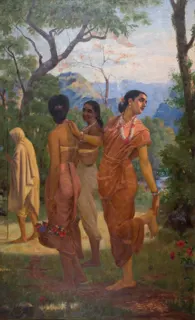
 Shakuntalaby KalidasaA king falls in love with a hermit girl, marries her in secret and, under a curse, forgets her.
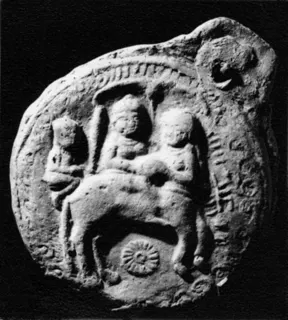 Vikrama and Urvasiby KalidasaA mortal king loves a nymph of heaven, and loses her when she strays into a forest where women may not go.
Prologue
Nándí.
May that lord who, though established in sole supremacy, and bestowing great blessings upon his votaries, himself wears the garment of skin; who, though his body is united with that of his beloved, is at the head of ascetics whose minds are averted from outward objects; in whom there is no arrogance, though he supports the whole world with his eight forms, may he, I say, remove our state of darkness in order that we may behold the perfect way. Here ends the Nándí.
Enter the Manager.
[Looking towards the curtain] Actor, come here for a moment.
Enter Actor.
Sir, here I am.
I have received the following order from the spectators: "You must act at this spring festival a play named Málavikágnimitra, composed by Kálidása;" therefore let the music be begun.
Not so, I pray. Why do the spectators pass over the compositions of famous poets, like the honoured bards Bhása, Saumilla, and others, and do such great honour to the work of Kálidása, a modern poet?
Ah! your remark is wanting in critical acumen. Every old poem is not good because it is old; nor is every new poem to be blamed because it is new; sound critics, after examination, choose one or the other, the blockhead must have his judgment guided by reliance upon his neighbours.
The honourable spectators are the best judges.
Then make haste. I long to perform the order of the spectators which I received some time ago with bowed head, even as this servant of the Queen Dháriní, skilful in attendance, longs to perform her order.
Exeunt Actors.
End of the Introductory dialogue.
Act 1
Enter a female servant.
I am ordered by the Queen Dháriní to ask the teacher of dancing, the noble Ganadása, what degree of proficiency Málaviká has attained in the dance called Chalita, in which she has for a long time been instructed. Therefore, let me enter the music-hall. [With these words she walks round.]
Enter another female servant, with an ornament in her hand.
[Having seen the second] Hola! Kaumudiká! Why are you in such a brown study that, though you pass close to me, you do not cast a glance in my direction?
Why, bless my soul, here is Vakulávaliká. My friend, I was contemplating this beautiful ring of the Queen's with a snake-stone seal, which I have just brought from the jeweller's, and so I came to merit your reproof.
[Observing it] Your gaze was rivetted on a thing worth looking at. By means of this ring, from which a stream of rays breaks forth, the extremity of your hand appears, as it were, adorned with flowers.
Come now, where are you going?
I am going by the orders of the Queen to ask the noble Ganadása, the teacher of dancing, what sort of pupil Málaviká has shewn herself.
Friend, though kept out of the way by such an employment, she has certainly been seen by the king; has she not?
Yes, the girl was seen at the Queen's side in a picture.
How did that come about?
Listen! The Queen had gone to the hall of painting, and was looking at a picture of the drawing-master's on which the hues of the colouring were still fresh; at that very moment in came the king.
What happened then?
Then, after the customary salutation, the king sat down on the same seat with the queen, and beholding Málaviká in the midst of the queen's attendants and very near to her, he asked the queen.
What, I pray?
"What is the name of this extraordinarily beautiful girl standing near you in the painting?"
Admiration naturally follows forms of surpassing loveliness. What happened then?
Then the king finding that no attention was paid to his question, and becoming suspicious, began to importune the queen again and again. Then the princess Vasulakshmí said—Sir, this is Málaviká.
That is child-nature all over. Tell me what happened next.
What else than this? Málaviká is now kept with especial care out of the range of the king's eyes.
Come now, go and do your errand. I too will give the ring to the queen.
Exit Kaumudiká.
[Walking round and looking about] Here is the teacher of dancing, the noble Ganadása, coming out of the music-hall: let me shew myself.
Enter Ganadása.
Although every one of course thinks most of his own hereditary lore, still the importance I attach to dancing is not without foundation, how can it be? Sages say that this is a pleasing sacrificial feast to the eyes of the gods, being developed in two different ways by Çiva in his body which is blended with that of Umá, in it is seen the behaviour of men arising from the three qualities, and distinguished by various sentiments; dancing is the one chief amusement of human beings, though their tastes are different.
[Advancing] Reverend sir, I salute thee.
My good girl, may you live long.
Noble sir, the queen wishes to know whether your pupil Málaviká is not very troublesome to teach.
Let the queen be informed that Málaviká is exceedingly clever and intelligent; whatever movement expressive of sentiment is taught by me to her in the way of acting, that the girl, as it were, teaches to me in return by the admirable way in which she executes it.
[To herself] I seem to see her cutting out Irávatí. [Aloud.] Your pupil may be already considered a success since her instructor is so well satisfied with her.
My good girl, you know people like her are hard to find, so I must ask you, whence such a choice attendant was brought to the Queen.
The Queen has a brother of inferior caste, Vírasena by name, he has been placed by the king in command of a frontier fortress on the banks of the Mandákiní. He sent this girl as a present to his sister, thinking her just the sort of person to learn accomplishments.
[To himself] From her distinguished appearance I conjecture that she is of high birth. [Aloud.] My good girl, I am certainly destined to become famous, for the skill of the teacher, when communicated to a worthy object, attains greater excellence, as the water of a cloud, when dropped into a sea-shell, acquires the nature of a pearl.
Well, where is your pupil?
Having just now taught her the five-limb movement I told her to rest, and so she has gone to the window that commands a view of the artificial lake, and is enjoying the delightful breeze.
Then, sir, give me leave to depart, in order that I may stimulate her zeal by informing her that her teacher is satisfied with her.
Go and see your friend. I, too, as I have got an interval of leisure, will go home.
Exeunt Ganadása and Vakulávaliká.
Here ends the Vishkambhaka.
Then the king is discovered with his retinue standing apart, and attended by the minister seated behind him with a letter in his hand.
[Looking at the Minister who has read the letter] Váhatava, what does the king of Vidarbha mean?
To destroy himself.
I want to hear his dispatch at once.
He has on the present occasion sent the following answer: "My royal brother has informed me, that my cousin, Prince Mádhavasena, who had promised to enter into a matrimonial alliance with my royal brother, while proceeding to his court, was on the way attacked by one of my wardens of the marches and taken prisoner. This man, with his wife and sister, I am required to set free out of regard for my royal brother. Now my royal brother knows well enough what is the custom of kings with respect to sovereigns of equal birth; therefore, he should be impartial in this matter: as for the prince's sister she disappeared in the confusion of the capture: I will do my utmost to find her. Anyhow my royal brother can certainly ensure Mádhavasena's being set at liberty. Mark the condition. If my royal brother will set my brother-in-law free, the Maurya minister, whom he has imprisoned, then I will immediately release Mádhavasena from confinement." These are the contents of the letter.
What? does the foolish fellow presume to bargain with me about an exchange of services? Váhatava! the king of Vidarbha is my natural enemy, and sets himself in opposition to me: therefore give orders, as before determined, to the avenging army under the command of Vírasena to root him up, inasmuch as he is numbered among my foes.
As the king commands.
Or what do you think about it yourself?
Your Highness speaks in accordance with the treatises on policy. For an enemy that has but lately entered upon his kingdom, because he has not taken root in the hearts of his subjects, is easy to extirpate, like a tree that is unsteady, because it has been only lately planted.
So may the saying of the wise compilers of treatises prove true. For this purpose let the general be ordered to put his troops in motion.
It shall be done.
Exit Minister.
The retinue remain standing round the king in such an arrangement as the nature of their respective duties requires.
Enter the Vidúshaka.
His Highness gave me the following commission: "Gautama, devise some expedient by which I may see face to face Málaviká whose picture I beheld by accident." Well I have done so, and will now inform him of the fact. [He walks round.]
[Seeing the Vidúshaka] Here is another minister come to me who superintends another department of my affairs.
May your highness prosper.
[Nodding his head] Sit down here.
The Vidúshaka takes a seat.
Has the eye of your wisdom been employed in devising a means of attaining our object?
Means indeed! rather ask about the successful accomplishment of my commission.
What do you mean?
[Whispers in his ear] This is what I mean.
Excellent, my friend! A clever start! We hope for good luck in this enterprise, though success in it is difficult to attain. For it is the man with allies that is able to accomplish an undertaking surrounded with obstacles, even one who has the use of his eyes cannot without a light perceive an object in the darkness.
A truce to excessive boasting. In the presence of the king himself shall be decided which of us is superior and which inferior.
Friend, a blossom has budded on your tree of policy.
You shall see fruit also on it, I promise you.
Then enter the Chamberlain.
Your majesty, the minister begs to inform you that your orders have been carried out. But here are Haradatta and Ganadása, the two professors of acting, each eager for victory over the other, wishing to have an interview with your majesty, like two dramatic passions incarnate in bodily form.
Introduce them.
As the king commands. [Going out and returning with them.]
[Looking at the king] Ye gods! Awful is the majesty of the king. For he is not unfamiliar to me, and he is not stern of manner, nevertheless I approach his side with trembling; though the same, he appears every moment new to my eyes, even like the mighty ocean.
Great indeed is the splendour that resides in this hero. For though my entrance has been permitted by the guards appointed to wait at the door, and though I am advancing towards the king with the attendant that is always about his throne, by the effulgence of his majesty, that repels my gaze, I am, as it were, without words denied access after all.
Here is the king, approach, gentlemen.
[Advancing] May the king be victorious.
Welcome, gentlemen. [Looking round at the attendants.] Seats for these gentlemen.
They sit down on chairs brought by the attendants.
What is the meaning of this, that you two professors have come here at a time when you ought to be teaching your pupils?
Listen, king! I learned the art of dramatic acting from a good teacher. I have given lessons in the art. I have been favoured by the king and the queen.
I know it well.
I, a man with such antecedents, have been taunted by this Haradatta in the presence of the principal men of the court in these words: "This man is not as good as the dust on my feet."
King! This man was first engaged in abuse of me. He said, "in truth, there is the same difference between your reverence and myself that there is between the ocean and a puddle;" therefore let your Highness examine him and me in theoretical knowledge and in practical skill. Your Highness is able to discern the difference between us and to decide our case.
A fair proposal.
An excellent idea! The king should listen to us with the utmost attention.
Stop a minute, the queen may suspect partiality in this matter; therefore, the case had better be tried in the presence of the queen accompanied by the learned Kauçikí.
The king's suggestion is good.
As seems good to the king.
Maudgalya, summon the queen together with the revered saint Kauçikí, taking care to inform them of this occurrence.
As the king commands. [With these words he goes out, and returns with the queen accompanied by the Parivrájiká or female Buddhist ascetic.]
This way, this way, Queen Dháriní.
[Looking at the Parivrájiká] Reverend madam, what do you think of the quarrel between Ganadása and Haradatta?
Cease fearing that your protegé will be defeated, Ganadása cannot be surpassed by any one.
Even if this be true, still the favour of the king gives his rival the advantage.
Ah! consider also that you have a right to the title of queen. While the fire attains extreme brilliancy from the assistance of the sun, on the other hand the moon also acquires greatness when favoured by the night.
Look! look! Here is the queen arrived, preceded by the match-maker, the learned Kauçikí.
I see her, who indeed, decked with the auspicious ornaments, accompanied by Kauçikí in the dress of an ascetic, shines like the three Vedas incarnate accompanied by the knowledge of the Supreme Soul.
[Advancing] May the king be victorious!
Reverend lady, I salute thee.
Mayest thou be for a hundred years the husband of Dháriní and the earth, the support of living creatures!
May my husband be victorious!
Welcome to the queen! [Looking towards the Parivrájiká.] Reverend lady, take a seat.
They all sit down in due order.
Reverend lady, a dispute about superiority in skill has arisen between Ganadása and Haradatta, now you must occupy the position of judge in this matter.
Spare your taunts. When a town is accessible, do men go to a village to get jewels tested?
Not so, not so. You are indeed "the learned Kauçikí," whereas the queen and I are partial with respect to these men, Haradatta and Ganadása.
The king's remark is just. Reverend lady, you are impartial, you ought to decide between us in the question of excellence or deficiency.
Therefore let the case be opened.
King, the art of dancing is a matter of practice chiefly, what is the use of a verbal controversy?
What does the queen think?
If you ask me, the whole dispute between these two professors is annoying to me.
The queen ought not to allow me to be beaten by one who is only my equal.
Queen, let us see the contest of the two rams. What is the use of giving them a salary for nothing?
You do certainly take delight in squabbles.
No, fair one. But when two infuriated elephants are quarreling, how can there be tranquillity until one or the other is conquered?
Surely you have seen the skill of the two professors exhibited by themselves in person.
Of course, I have.
Then what more can they now bring forward by way of proof?
That is the very point I wish to speak about. One man can perform excellently in person, another possesses to a remarkable degree the power of communicating his skill; he who possesses both excellences, should be placed at the head of teachers.
Gentlemen, you have heard the reverend lady's speech; this is the gist of it. The question must be decided by examining into your skill in teaching.
It suits me admirably.
King, it is so determined.
But when an unskilful pupil disgraces the instruction of a teacher, the teacher is sure to be blamed.
Queen! It is fitting that it should be so.
The reception of an unpromising pupil shows a want of discernment in the teacher.
What is the meaning of this? [Looking at Ganadása, aside.] Cease from fulfilling the desire of this husband of mine, which will only increase the ardour of his passion. Desist from your useless attempt.
Your highness speaks wisely. Ganadása! As you have begun to give instruction in music, and are eating the sweetmeats offered to Sarasvatí, what do you want with a contest in which you may easily be defeated?
In truth, this is the meaning of the queen's speech. But listen to a saying which is à propos on the present occasion. The man who shrinks from a contest, because he possesses an appointment, and patiently endures disparagement from a rival,—the man whose learning is merely a means of obtaining a livelihood,—him they call a huckster that traffics in knowledge.
Your pupil was but lately handed over to you, so it is unbecoming to exhibit knowledge that is not as yet firmly implanted.
It is for that very reason that I am so importunate.
Then exhibit both of you your skill in instruction to the reverend lady alone.
That is not fair; even an omniscient person, when giving judgment alone, is apt to make a mistake.
[Aside] You fool of a Parivrájiká! Do you wish to lull me to sleep when I am wide awake? [She turns away in a pet.]
The king calls the attention of the Parivrájiká to the queen.
[Looking] Why dost thou, Oh moon-faced one, turn away thy countenance from the king without reason, for matrons, even when all-powerful with their husbands, wait for some cause before they fall out with them?
Rather is it with good reason. She thinks that she must uphold the side she favours. [Turning towards Ganadása.] I congratulate you on the fact that the queen has saved you by pretending to be angry. All people, even the well trained, become clever by instruction.
Listen, queen! You hear what people think of the matter. Accordingly, now that I wish to exhibit in a contest my power of communicating skill in acting, if you do not permit me, all I can say is, I am left in the lurch by you. [He rises from his seat.]
[To herself] What resource have I left? [Aloud.] You have authority, sir, over your pupil.
I have been afraid for a long time without reason. [Looking at the king.] The queen has given her permission, therefore let the king give his orders as to what piece of acting I shall exhibit my power of instruction in.
Act whatever the reverend lady commands.
The queen has something upon her mind. I am therefore afraid.
Speak boldly, I shall still be mistress of my own attendant.
Say that you will be mistress of me also.
Come, reverend lady, speak your mind.
King, people talk of a dance called chalita, made up of four movements; let us see the skill of both the two professors exhibited with reference to that one performance, then we shall be able to estimate the difference of these two gentlemen with respect to teaching power.
As your reverence commands.
Then go both of you into the play-house, and having made ready the orchestral arrangements, send a messenger to His Highness. Or better still, the mere sound of the drum will rouse us up.
So be it! [He rises up.]
Ganadása looks at the queen.
No, I am not hostile to your success, Ganadása.
Both the teachers go away.
Come here a moment, you two professors.
[Turning round] Here we are.
I speak in my capacity as judge. Let the two pupils enter without their theatrical dresses, in order to display the elegance of movement of all their limbs.
It was not necessary to give us this advice.
Exeunt the two professors.
[Looking at the king] If my husband shows as much skill in devising expedients in the other affairs of his kingdom, the result will surely be splendid.
Cease to put an invidious construction on my conduct. Indeed, this was not brought about by me, oh sagacious one, it is ordinarily the case that people who pursue the same science are jealous of one another's fame.
A drum is heard behind the scenes. All listen.
Ah the orchestra has begun. For that note of the drum, which resembles the cry of a peacock, delights the mind, deep resounding, beginning with the high-pitched middle tone,—of the drum, I say, answered by the pea-fowl with necks erect, suspecting that it is the thunder of a rain-cloud.
Queen! let us be punctual.
[To herself] Oh the indecorous behaviour of my husband.
All rise up.
[Aside to the king] Come, walk calmly and slowly, lest the queen find you inconsistent with yourself.
Though I endeavour to be calm, the sound of the music of the drum makes me hasten, like the noise of my own desire descending the path of fulfilment.
Exeunt omnes.
Act 2
Then are seen, after the orchestral arrangements have been completed, the king, with his friend, seated on a throne, Dháriní, and the retinue in order of rank.
Reverend Madam! which of the two professors shall first exhibit to us the skill which he has infused into his pupil?
Even supposing their attainments to be equal, Ganadása ought, surely, to be preferred on account of his being the elder.
Well, Maudgalya, go and tell these gentlemen this, and then go about your business.
As the king commands.
King, there is a composition of Çarmisthá, consisting of four parts with a pause in the middle, your Highness ought to hear attentively one-fourth of it performed with appropriate gestures.
Professor! I am most respectfully attentive.
Exit Ganadása.
[Aside to Vidúshaka] Friend, my eye, eager to behold her who is behind the scenes, through impatience seems to be endeavouring to draw up the curtain.
[Aside] Ha! the honey of your eyes is approaching, but the fly is near, therefore look on with caution.
Then Málaviká enters, with the teacher of dancing contemplating the elegance of her limbs.
[Aside] Look, your highness. Her beauty does not fall short of the picture.
[Aside] Friend, my mind anticipated that her beauty could not possibly come up to that represented in the picture, but now I think that the painter, by whom she was taken, studied his model but carelessly.
My dear child, dismiss your timidity, be composed.
Oh, the perfection of her beauty in every posture! For her face has long eyes and the splendour of an autumn moon, and her two arms are gracefully curved at the shoulders, her chest is compact, having firm and swelling breasts, her sides are as it were planed off, her waist may be spanned by the hand, her hips slope elegantly, her feet have crooked toes, her body is like the ideal conceived in the mind of the teacher of dancing.
Málaviká having gone through the prelude sings the composition consisting of four parts.
My beloved is hard to obtain, be thou without hope with respect to him, oh my heart! Ha! the outer corner of my left eye throbs somewhat; how is this man, seen after a long time, to be obtained? My lord, consider that I am devoted to thee with ardent longing. [As she sings she goes through a pantomime expressive of the sentiment.]
[Aside] Ha! ha! this lady has made use of the composition in four parts for the purpose of flinging herself at your head.
My friend, this is the state of the hearts of both of us. Certainly she, by singing "know that I am devoted to thee," and accompanying the words with expressive action pointing at her own body, seeing no other way of telling her love owing to the neighbourhood of Dháriní, addressed herself to me under the pretence of courting a beautiful youth.
Málaviká at the end of her song makes as if she would leave the stage.
Stop, lady! you have forgotten something by neglecting the proper order; I will ask about it if you please.
My dear child, stop a minute, you will have your knowledge made more accurate.
Málaviká turns round and stands still.
[To himself] Ah! her beauty gains fresh splendour in every posture. For her standing attitude, in which she is placing on her hip her left hand, the bracelet of which clings motionless at the wrist, and making her other hand hang down loosely like the branch of a çyámá-tree, and casting down her eye on the inlaid pavement on which she is pushing about a flower with her toe, an attitude in which the upper part of her body is upright, is more attractive even than her dancing.
I fear the noble Ganadása is taking to heart the speech of Gautama.
Queen, say not so. By the help of the king Gautama is enabled to become sharp-sighted; observe, even a stupid person becomes clever by association with the wise, as turbid water is made clear by contact with the mud-dispersing fruit. [Looking at the Vidúshaka.] We are waiting for your lordship's decision.
Ask the Parivrájiká who witnessed the performance, afterwards I will mention the omission which I observed.
Reverend lady, be pleased to give your opinion according to your own observation as to whether the performance was a success or a failure.
All was blameless, and in accordance with the rules of art: for the meaning was completely expressed by her limbs which were full of language, the movement of her feet was in perfect time, she exactly represented the sentiments; the acting was gentle, based upon the different forms of feeling; in the successive exhibition of their various shades emotion trod on the heels of emotion; it was a vivid picture of a series of passions.
What does his majesty think?
Ganadása, I have become less confident about the success of my protegé.
Then I am in truth a professor of dancing. Wise men know that the teaching of a teacher is faultless, when it does not become black in your presence, even as gold that is tested in the fire.
I must congratulate you, sir, on being so fortunate as to give satisfaction to your judge.
But the queen's favour is the cause of my good fortune. [Looking towards the Vidúshaka.] Gautama, now say what you have in your mind.
The first time that skill is exhibited, a complimentary gift must be previously offered to the Bráhman, but you forgot about that.
Ha! ha! an umpire thoroughly conversant with acting.
They all laugh. Even Málaviká cannot suppress a smile.
[To himself] My eye has perceived in its full splendour its appropriate object, since it has seen the smiling face of the almond-eyed one, with the brightness of its teeth half displayed, like an opening lotus with the filaments of the flower partially visible.
Great Bráhman, this indeed is not a rehearsal in the tiring-room, otherwise how could we have omitted to honour you who are worthy of honour?
I indeed like a timid chátaka asked for a drink of water when the heaven was rebellowing with rainless clouds.
Exactly so.
It follows that those people who expect to derive any benefit from giving satisfaction to the learned are a set of fools. If the reverend lady has found the performance meritorious, I will bestow this evidence of her satisfaction upon Málaviká. [So speaking he draws off a bracelet from the king's wrist.]
Stop! why do you give away the ornament before you have become acquainted with a different kind of merit?
Because it belongs to some one else, of course.
[Looking towards Ganadása, the teacher of dancing] Noble Ganadása, in truth your pupil has exhibited her proficiency.
My dear child, now leave the theatre.
Málaviká departs with her teacher.
Here ends my power to help your majesty.
Have done with this limiting of your power. For, now I consider her disappearance behind the curtain to be like the obscuration of the prosperity of my two eyes, like the end of the great feast of my heart, like the closing of the door of joy.
Bravo! You are like a man sick of poverty, desiring a medicine administered by the physician.
[Entering] King! have the goodness now to look at my exhibition.
[To himself] My object in being a spectator is now at an end. [Aloud, putting a severe strain upon his politeness.] Haradatta, we are indeed anxious to behold it.
I am highly favoured.
A bard chants behind the scenes.
Victory to the king! The sun has climbed up to the zenith, for the geese rest with closed eyes in the shade of the leaves of the lotuses of the ornamental water; the pigeons shun on account of the extreme heat the sloping roofs of the palace which they ordinarily frequent, the peacock desirous of drinking the particles of water continually flung out, flies to the revolving water-wheel, the sun blazes with all his rays at once, as thou with all thy princely qualities.
Oh! Ho! the time of bathing and eating has arrived for your majesty. The physicians say that it is bad for your highness to be kept waiting past the appointed hour.
Haradatta! what do you say?
It is no time for me to speak.
[Looking towards Haradatta] Then we will see your skill in teaching exhibited to-morrow.
As the king commands.
Exit Haradatta.
Let my husband perform the mid-day ceremonies.
Lady! let the arrangements for eating and drinking be hurried on with special vigour.
[Rising up] Health to your majesty!
Exit with the Queen, who is accompanied by her attendants.
Ha! not only in beauty but in artistic skill is Málaviká unmatched.
The Creator, by furnishing her, who is so naturally beautiful, with attractive accomplishments, prepared an arrow of love steeped in poison. Why should I say more? You must think upon me.
You ought also to take thought for my comfort. Surely the inside of my stomach burns like a cauldron in the market-place.
Of course. But exert yourself for the sake of your friend.
I have pledged my word. But it depends upon the will of another, whether one can see the lady Málaviká. She is like the moon-light obscured by clouds. As for your majesty, you amuse me by asking that your wishes may be accomplished, having become quite distressed like a bird hovering round the shop of a butcher, desirous of meat, but afraid to venture.
Friend, how can I help being distressed, since my heart is averse to the society of all the beauties of my harem, and that fair-eyed one has become the only object of my affection?
Exeunt omnes.
Act 3
Enter an attendant of the Parivrájiká.
I have received the following order from the reverend lady: "Samádhimatiká, get me a citron and bring it here that I may present it as a token of respect to the king." So I will go and look for Madhukariká, the keeper of the pleasure-garden. [Walking round and looking.] Ah! there she stands contemplating a golden Açoka-tree. So I will go and salute her.
Enter the keeper of the garden.
[Going up to her] Madhukariká! Is your duty of looking after the shrubbery going on well?
Why, here is Samádhimatiká. Welcome to you, my friend.
Listen! The reverend lady commands—"The lord of wealth must not be approached by people like myself with empty hands, therefore I wish to honour him with the gift of a citron."
Surely, here is a citron near you. Tell me, which of the two professors of music, who were quarrelling with one another about their respective merits as teachers, did the reverend lady approve of, after beholding the performances of their pupils?
Both of them are thoroughly acquainted with the science of dancing, and clever in execution. But the teaching power of Ganadása was ranked the higher of the two on account of the admirable qualities of his pupil.
Well, is there any gossip going about with regard to Málaviká?
Certainly. The king is desperately in love with her, but in order to spare the feelings of Queen Dháriní, he makes no use of his power to behold the object of his desire. Málaviká, too, in these days is seen to be fading like a jasmine-garland that has been worn and thrown away. More than that I do not know. Give me leave to depart.
Take the citron hanging on this branch.
[Pretending to take it] Ah! may you obtain, for your readiness to oblige my saintly mistress, a far more glorious fruit than this.
[Advancing] Friend! we will go together. I also will give the queen information about this golden Açoka-tree, which is delaying to burst into blossom because it waits to be touched by the foot of a beautiful woman.
Quite proper. Indeed, it is your duty.
Exeunt.
Here ends the Interlude.
Enter the king in a love-sick state, and the Vidúshaka.
My body may be thin as it has not the joy of embracing the beloved; my eye may be filled with tears because she is not seen by it even for a moment; but thou, my heart, art not separated for a single instant from that antelope-eyed one; why then dost thou suffer agony, when thy consolation is ever near thee?
Let your Highness cease giving way to tears and abandoning all self-restraint; I have seen Vakulávaliká, Málaviká's dear friend, and I have given her that message which your Highness entrusted to me.
What did she say then?
"Inform the king that I am favoured by having that duty entrusted to me. But that unfortunate girl being guarded by the queen more carefully than before, like the jewel guarded by a snake, is not easily to be got at; nevertheless I will do my best."
Oh revered God of Love, child of fancy, having directed my longing to objects unfortunately surrounded with obstacles, thou dost smite me so sorely that I cannot live much longer. [With an expression of astonishment.] What proportion is there between this soul-torturing agony and thy bow to all appearances so harmless? That "sweet and bitter in a breath," of which we hear so much, is surely seen in thee, oh God of Desire!
I tell you of a truth that I have devised an expedient for ensuring the end we wish to attain; therefore, royal sir, regain your composure.
Well, where shall I manage to get through the rest of the day with a mind averse to my usual occupations?
Surely, Irávatí sent you this very day some red Kuravaka blossoms indicative of the first appearance of spring, and on the ground of the recent advent of that season made this request by the mouth of Nipuniká, "I wish to enjoy a ride in the swing in company with my husband." Your Highness, too, promised to gratify her; therefore, let us go to the pleasure-grounds.
This is impossible.
How so?
My friend, women are by nature discerning. Now that my heart is devoted to another, how will your friend help perceiving it, even when I am caressing her? Therefore, I see clearly that it is better to interrupt my accustomed familiarity, for I know many excuses for breaking it off, than to go through the form of shewing regard to sharp-sighted women, even if with more empressement than before, supposing it be void of passion.
You ought not suddenly to throw behind your back your invariable courtesy to the ladies of your harem.
[Reflecting] Then shew me the way to the pleasure-grounds.
This way, this way, your Highness.
Both walk round.
The spring by means of these finger-like shoots, agitated by the wind, as it were, beckons on your Highness to enter this pleasure-ground.
[Having perceived that something is touching him] Surely the Spring is noble in his sympathy. Observe, my friend, he, as it were, compassionately asking by the notes of love-intoxicated cuckoos, agreeable to the ear, how I manage to bear the torture of my passion, has made the southern wind fragrant with mango-blossoms to play upon my body, like the palm of a hand frequently stroking me.
Enter, that you may obtain tranquillity of mind.
Both enter the garden.
Oh! my friend, look carefully around you. Surely the presiding goddess of the pleasure-grove, desiring to allure you, has donned a robe of spring flowers that puts to shame the adornment of a young lady.
Indeed, I behold it with astonishment. The red dye of the bimba-like lip is surpassed in excellence by the splendour of the red Açoka; the Kuravaka-flower, dark-blue, white, and red, transcends the painting on the forehead; the ornament of the spot between the eye-brows is surpassed by the tilaka-blossoms having bees clinging to them like collyrium; the goddess of Vernal Beauty seems to laugh to scorn the art of adorning the face as practised by women.
Both of them admire the beauty of the garden.
Enter Málaviká in a state of agitation.
I am ashamed of myself for being in love with the king, whose heart I do not know. How can I tell the circumstance to my dear friend? I do not know for how long a time love will bring me into this irremediably severe suffering. [Having advanced some steps.] Where am I going now? [After reflecting.] Ah! I received this order from the queen: "Having had a fall from a swing, owing to the carelessness of Gautama, I cannot move my feet, therefore do thou perform the ceremony of fertilizing the golden Açoka-tree; if in five nights from this time it displays flowers, I will [she stops speaking and heaves a sigh] bestow on thee a boon which will gratify thy desires." Well I have come first to the place where I am to perform this duty. While I am waiting till Vakulávaliká comes after me with the pigment for the feet, I will for a moment weep undisturbed. [She walks round.]
Ha! ha! here is treacle offered you, now that you are confused with drinking rum.
Ah! What is that?
There stands Málaviká at no great distance, somewhat insufficiently adorned, with the complexion of one afflicted; and alone.
[Delighted] What! Málaviká?
Certainly.
Now my life may find support. Hearing from you that my beloved is near, my distracted heart once more revives, like the heart of a traveller longing for water when he learns from the cry of the sárasa that a tree-bordered river is near. Well! Where is the lady?
Here she is coming in this very direction, having emerged from the midst of a row of trees.
My friend I behold her. Broad in her bimba-like hips, thin in the waist, swelling in the bosom, she—my life—is coming hither. My friend, the lady is in a different state from what she was in before; for she, with her cheeks pale like the stalk of a reed, and but few ornaments, appears like the jasmine-creeper having its leaves developed by the spring, and with only a few flowers.
She, too, like your Highness, must be slightly affected with love-sickness.
It is only friendship that sees that.
This Açoka, that is waiting to be touched by the foot of a beautiful woman, and has not assumed its robe of flowers, imitates me in my state of longing expectation, therefore let me sit down on this slab of rock cool with the shade of the tree, and refresh myself.
Did your Highness hear? The lady said "I am in a state of longing."
Even this much does not make me think you a man of unerring insight. For the wind from the Malaya mountain, laden with the pollen of the kuravaka flowers, accompanied with drops of water issuing from the opening folds of the buds, produces longing in the mind even without definite cause.
Málaviká sits down.
My friend, come this way, let us hide behind the creeper.
I think I see Irávatí in the distance.
But when he sees a cluster of lotuses, the elephant does not care for the alligator. [He stands gazing.]
Cease, my heart, from entertaining a wish which is sure to be futile. Why dost thou torture me?
The Vidúshaka looks at the king.
My beloved, observe the perverseness of love. Thou dost not reveal any cause of thy pining, nor is conjecture invariably to be relied upon, nevertheless, beautiful one, I consider myself the theme of all these lamentations.
Now your Highness may be free from anxiety, for here comes Vakulávaliká alone, she to whom I gave the message of love.
I wonder whether she will remember my petition.
What! do you suppose that that daughter of a female slave will forget such a weighty message from your Highness? Why, even I at the present moment have not forgotten it.
Enter Vakulávaliká, with the pigment for the feet in her hand.
Is my friend happy?
Ah! here is Vakulávaliká come. Welcome my friend, sit down.
Ha! On the present occasion you are charged with the appropriate duty of making the Açoka-tree bloom, therefore give me one of your feet, that I may paint it with lac, and put the anklet on it.
[To herself] Heart! cease rejoicing, because this office has devolved upon me. How can I now free myself from this misery? Never mind! This painting will certainly be my funeral adornment.
Why do you hesitate? Indeed, the queen is anxious that that golden Açoka-tree should put forth flowers.
What! is all this preparation for the sake of fulfilling the longing of the Açoka?
Why, do you not know that the queen would not, without reason, cause her to be adorned with the ornaments of the harem?
[Holds out her foot] Come, do not hurt me this time.
Why, you are as dear to me as my own body. [She pretends to begin the painting of Málaviká's foot.]
Friend! observe the moist streak of colour placed upon the extremity of my darling's foot, like the first peeping forth of the bud of the tree of love consumed by Çiva.
Truly, the duty imposed upon the lady is well suited to such a foot.
Sir, you have spoken the exact truth. The girl deserves to smite two things with this point of her foot, of the hue of a young bud, on which the gleam of the nails flashes white, both the Açoka that has not yet flowered as longing for the ceremony of the dohada, and her lover standing with bowed head, having recently committed an offence.
You will have an opportunity of offending the lady.
I accept the omen, the word of a Bráhman must come true.
Enter Irávatí in a state of intoxication, and her attendant.
Nipuniká, my girl, I have often heard that intoxication is an especial ornament to women. Do you think that this popular saying is true?
It was formerly a mere popular saying; now it has become true.
Cease your flattering speeches. How did you discover, on the present occasion, that the king had gone on before me to the house in which the swing is?
I inferred it from his unfailing affection for you, his queen.
No more of that adulation, speak as if you were an indifferent person.
The noble Gautama told me, being desirous of a spring-gift. Let your Highness come quickly.
[Walking round as well as her state will permit] Oh! my heart urges me on to behold my husband, though I am overpowered with intoxication, but my feet will not advance on the path.
Now, indeed, we have arrived at the summer-house where the swing is.
But, Nipuniká, I do not see my husband in it.
You must look carefully. The king must be hidden in some thicket or other, meaning to play your Highness a trick. Let us for our part repair to this slab of rock under the Açoka tree which is overgrown by the Priyangu creeper.
Irávatí does so.
[Walking round and looking] Observe, your Highness! While seeking for the sprout of the mango, we are bitten by red ants.
What does that mean?
Here is Vakulávaliká adorning the foot of Málaviká in the shade of the Açoka tree.
[Exhibiting signs of fear] This is not a proper place for Málaviká. What conjecture do you form?
I conjecture that the queen whose feet have been injured by a fall from a swing has appointed Málaviká to perform the ceremony of the dohada for the Açoka tree, otherwise how could she have permitted her attendant to wear this pair of anklets which she herself uses?
It is certainly a great honour to her.
Why do you not search for your husband?
Girl, my feet refuse to go forward. My mind is distracted: I will, in the mean time, arrive at certainty with respect to my suspicions. [Observing Málaviká, to herself.] Not without reason is my mind despondent.
[Calling attention to Málaviká's foot] Are you pleased with the way in which the lines of colour are arranged on your foot?
As it is on my own foot, I am ashamed to praise your handiwork. Tell me who instructed you in this artistic accomplishment.
In this I am a pupil of the king.
Hasten now to get the teacher's complimentary present.
I am glad to see that you are not conceited.
Having obtained feet worthy of displaying my skill upon, I shall become conceited now. [Looking at the colour, to herself.] I have accomplished my commission. [Aloud.] My friend, I have finished painting one of your feet. It is only necessary to breathe on it. Besides, this place is windy.
My friend, observe, observe. Now there has arrived an admirable opportunity for me to do her a service by fanning with the breath of my mouth her foot, the dye on which is wet.
Why do you regret that you cannot avail yourself of it? You will soon be able to enjoy this privilege for a long time.
Your foot shews like a red lotus. May you certainly repose upon the bosom of the king.
Irávatí looks Nipuniká in the face.
I say Amen to this prayer.
Ah! you are saying what you have no business to say.
I said exactly what it is my business to say.
Surely you love me, do you not?
I am not the only person who loves you.
Who else then loves me?
Why, the king of course, who always has an eye for good qualities.
You are saying what is false. That fortune is not mine.
Is it really not yours? It is seen in the emaciated and slightly pale limbs of the king.
The wench gives her answer as if she had got it all up beforehand.
Regulate your conduct according to the maxim of the good, that love must be tested by love.
What are you chattering there at your own sweet will?
No indeed, these are but the words of the king, full of affection, transmitted through me.
Ah! thinking of the queen, I shall not be able to do as I would with my heart.
Foolish girl! Do you suppose a mango-shoot is not to be plucked to ornament the ear, containing as it does in itself the whole essence of the manifestation of spring, just because it has bees clinging to it?
Well, do you help me to the utmost, wicked woman.
I am a garland of Vakula flowers which becomes more fragrant by rubbing.
Bravo! Vakulávaliká, Bravo! By means of the conversation which was artfully commenced as soon as she knew the state of Málaviká's mind, and in which she gave the proper answer on her friend's reproaching her, she has got Málaviká into her power; it is quite right that the lives of lovers have been made dependant upon female go-betweens.
Observe, my girl. Vakulávaliká has induced Málaviká to take the step.
Queen! Suggestion produces desire even in one free from passion.
Not without reason indeed was my heart apprehensive. Now that I have got at the facts, I will proceed to think about the matter.
Here is your second foot with its decoration completed. Now I will put the anklets on both. [She pretends to put on the anklets.] Come now rise up. Perform the duty imposed on you by the queen of causing the Açoka to blossom.
You heard the words "imposed by the queen." Well, let it pass for the present.
Here stands in front of you, flushed, ready for enjoyment,——.
[Delighted] What? the king?
[Smiling] No! not the king, but this cluster of buds hanging on a bough of the Açoka, make an ear-ornament of it.
Did your Highness hear?
So much as this is enough for lovers. I do not approve of the union, even if successfully brought about, of two lovers, one of whom is ardent, and the other indifferent; it is better that an equally enamoured pair should even pine away hopeless of mutual happiness.
Málaviká, having made an ear-ornament of Açoka-buds, in a playful manner puts forth her foot to strike the tree.
Observe, my friend. Having taken from the Açoka-tree a shoot for her ear she presents to it her foot; since the two have exchanged similar gifts, I consider myself defrauded of my rights.
Well, you are not in fault; this Açoka must be devoid of good qualities, if it should be slow in putting forth flowers, now that it has been blessed by such a foot.
Oh Açoka! if after having been honoured by the slender-waisted one with this foot of hers, soft as a young lotus, loud-tinkling with noisy anklets, you are not immediately endowed with flowers, in vain do you nurse a desire shared by sportive lovers. Friend, I wish to present myself, taking a favourable opportunity of joining in the conversation.
Come along! I will make fun of her.
Both enter.
Queen! here is the king appearing on the scene.
This is exactly what my heart anticipated at the outset.
[Advancing] My lady, it is not proper conduct on your part to strike with your left foot an Açoka-tree belonging to my dear friend.
[In a state of trepidation] Ah! here is the king.
Vakulávaliká! Why did not you, as you knew the state of the case, restrain the lady from committing such an impropriety?
Málaviká shows fear.
Queen, see what the noble Gautama has undertaken.
How else could a low Bráhman like him make a livelihood?
Sir! this lady is executing an order of the queen's. In this transgression she is only the instrument of another. Let the king be appeased. [She makes Málaviká prostrate herself, and falls prostrate at the same time.]
If this is the case, you are not guilty. My good girl, rise up. [He takes her by the hand and raises her up.]
Quite right. In this matter you ought to show respect for the queen.
Oh! charming one, do you not now feel pain in your left foot soft as the filament of a lotus, which you placed on the hard trunk of the tree? What say you beautiful girl [?]
Málaviká looks ashamed.
[Spitefully] Ah! my husband has a heart as soft as fresh butter.
Come Vakulávaliká, let us inform the queen that we have performed her command.
Then ask the king to give you leave to depart.
My good girl, you may go. But hear first my supplication, which has now an opportunity of making itself known.
Listen attentively! Let the king be pleased to speak.
This person for a long time has not been able to put forth such a blossom of happiness; with the nectar of your touch satisfy also the longing of this man devoted to you alone.
[Suddenly approaching] Satisfy it, satisfy it; no doubt the Açoka shows flowers, but this tree does not only display flowers, it bears fruit also.
All are confused on beholding Irávatí.
[Aside] My friend, what resource is there now?
What other than taking to our heels?
Vakulávaliká! you have begun well. Málaviká! grant the request of my husband.
Let the queen have compassion on us. Who are we that we should attract the affection of the king?
Exeunt Vakulávaliká and Málaviká.
Oh the faithlessness of men! I indeed relying upon your deceitful speech—unsuspicious like the deer that is attracted by the whistle of the hunter—did not anticipate this.
[Aside] Make some defence. Being a burglar caught in the act you ought to say that you came here to put down house-breaking.
Beautiful one! I had no object with Málaviká. Because you delayed, I amused myself as well as I could.
You are to be depended on, are you not? I did not know that my husband had obtained such an agreeable means of passing the time. Otherwise I should never have presumed to annoy you by this intrusion.
Do not repel by your speeches the courtesy of the king. If mere conversation with the attendants of our royal mistress when met by chance is to be considered a crime—why, of course, you know best, and we must acquiesce.
Well, conversation let it be called. How long am I to torture myself about nothing? [She goes off in a passion, and though her feet are entangled by her girdle, keeps progressing as well as she can.]
Beautiful one, neglect of your devoted admirer is not becoming.
Traitor, your heart is not to be relied on.
With the word "traitor," oh dear one, let your scorn of me, who am so familiar with you, come to an end; you do not dismiss your anger even though entreated by your girdle lying prostrate at your feet.
Even this cursed girdle sides with you. [She takes up the girdle and endeavours to strike the king with it.]
This lady in a passion, raining tears, prepares to strike me, terrible criminal that I am, with the cord of her golden girdle fallen unexpectedly from her bimba-like hips, as a row of thunder-clouds to strike the Vindhya mountain with a streak of lightning.
What? Do you offend against me again? [Raising her hand with the girdle in it.]
Why do you withdraw the scourge lifted against me the malefactor, oh curly-haired one! You increase your fascinations, and still you are angry with your slave here. [To himself.] Surely, now I am forgiven. [Falls at her feet.]
These indeed are not the feet of Málaviká, that will gratify your longing for a caress. [She departs with her attendant.]
Come! rise up, rise up, you have found favour.
[Rising up and not seeing Irávatí] What? is the dear one really gone?
I am glad to say she has gone without forgiving this impropriety. Therefore let us flee rapidly before she returns like Mars retrogressing to his mansion in the zodiac.
Oh the inconsistency of love! Now that my mind is taken captive by my beloved, I consider Irávatí's rejection of my humble supplication a veritable service; for, as she is angry, I may neglect her, though she is so attached to me.
Both walk round and exeunt.
Act 4
Enter the King in a state of anxiety and a female door-keeper.
[To himself] May the tree of love which took root by my interest in Málaviká when her name reached my ear, which, when she came within range of my eyes, put forth the shoot of passion, which at the touch of her hand may be said to have blossomed as my hair stood erect from delight—may that tree, I say, cause me, the weary one, to taste the flavour of its fruit. [Aloud.] Friend Gautama!
Victory to your highness! Gautama is not in attendance.
Of course. I remember I sent him to find out what has become of Málaviká.
[Entering] Victory to the king!
Jayasená! Find out where the queen Dháriní is, or how she is being solaced in the present painful state of her foot.
As the king commands.
Exit Door-keeper.
Friend, what is the state of the lady, your friend?
Pretty much that of a cuckoo in the claws of the cat.
[Despondently] What do you mean?
Indeed the wretched girl has been thrown into the subterranean storehouse as if into the mouth of death, by order of that fiery-eyed one.
No doubt, because she heard of her meeting with me.
Of course.
Gautama! who was such an enemy of mine as to make the queen angry?
Listen, Sir! The Parivrájiká tells me, as a fact, that yesterday the lady Irávatí went to ask after the health of the queen, whose foot is disabled with pain. Thereupon she was asked by the queen "Why have I not seen my beloved lately?" She answered—"little is the regard he pays to you, do you not know that he is the beloved of your maid?"
Alas! this prelude makes the queen suspect Málaviká without further explanation.
Then she being pressed informed the queen with regard to your misdemeanour.
Ah! The unforgiving character of the lady! Tell me what happened next.
What happened next! Why Málaviká and Vakulávaliká, with fetters on them, are enjoying a residence in the infernal regions where a ray of the sun is never seen, like two snake-maidens.
Alas! The sweet-voiced cuckoo and the bee, the companions of the unfolded mango-bud, have been driven into the trunk by unseasonable rain, accompanied by a strong east-wind. Friend, can there be an opening here for any stratagem.
How can there be? For Mádhaviká, who presides over the store-house, received this order from the queen, "you are not to let out that baggage of a Málaviká, until you see the seal of my ring."
[Sighing] Friend! What remedy can we adopt in this matter?
[Reflecting] There is an expedient even here.
Of what kind?
[Looking meaningly at the king] Some one may be listening to our conversation unseen. So I will whisper it in your ear. [Embracing him, and whispering in his ear.] This is what I intend.
Happily conceived! let it be put in execution, and may it be successful.
[Entering] King! The queen is reclining upon a couch exposed to a free current of air, having her foot tended by her maids with their hands full of red sandal-wood, and being herself amused with stories by the Parivrájiká.
This is an appropriate occasion for me to visit her.
Then go, Sir. In the meanwhile I will provide myself with some present that I may not approach the queen empty handed.
Before you go, inform Jayasená of our plan.
[Whispers in her ear] This it is, my good lady.
Jayasená! Show me the way to the couch where the queen is reclining in the open air.
Then are discovered the queen reclining upon a couch, and the Parivrájiká with the attendants in order of precedence.
Revered madam! That was a capital story. What happened next?
[With a meaning look] I will tell you more presently. His majesty the king has arrived.
Ah! my husband! [She endeavours to stand up.]
Stop! Stop! Do not distress yourself to show respect to me. You ought not, oh soft-voiced one, to give pain to your foot unused to the absence of anklets, which is resting on the golden footstool,—and to me at the same time.
Victory to the king!
Victory to my husband.
[Inclining reverently to the Parivrájiká and sitting down] Queen! Is the pain now endurable?
Thank you, there is some improvement.
Enter the Vidúshaka in a state of alarm, with his finger tied up with his sacrificial cord.
Alas! Alas! I have been bitten by a snake.
All of them are horrified.
Alas! Where have you been wandering?
I went to the pleasure-grove to gather the customary bouquet, because I was about to visit the queen—save me! save me!
Alas! Alas! I have become the cause of a Bráhman's life being in jeopardy.
Then, as I stretched out my hand to pluck a cluster of Açoka-flowers, Death in the form of a snake came out of the trunk and bit me on the finger. Here, indeed, are the two marks of the teeth. [He shows them the bite.]
The best remedy for that is said to be excision of the bitten part; let that remedy be adopted in this case. The excision of the bite, or its cauterization, or the letting of blood from the wound; these are the prescribed expedients for saving the lives of men who are bitten by snakes.
Now it is time for the poison-doctors to do their work. Jayasená, let Dhruvasiddhi be quickly brought.
As the king commands.
Exit Door-keeper.
Alas! I am seized by cruel death.
Do not be alarmed. A bite may sometimes be free from venom.
How can I help fearing? My limbs are convulsed.
He pretends that the poison is beginning to take effect.
[Advancing] Alas! Alas! The poor creature is attacked with cramps. Support him! Support him!
The attendants support him in a state of great trepidation.
[Looking towards the king] Ah! I have been your dear companion from childhood: take that into consideration and undertake the maintenance and protection of my helpless mother.
Do not be afraid. The doctor will cure you in a moment. Be calm.
Enter Door-keeper.
King! Dhruvasiddhi desires that Gautama be brought to him.
Then cause him to be carried by the Chamberlain into the presence of the doctor.
Very well.
[Looking towards the queen] Lady! Whether I live or die, pardon all the faults that I may have committed against thee to oblige the king.
May you live to a good old age.
Exeunt Vidúshaka and Door-keeper.
The poor fellow is naturally timid. He does not believe that even Dhruvasiddhi will be successful in curing him, though he is rightly named the "infallible doctor."
Enter Door-keeper.
Victory to the king! Dhruvasiddhi directs that some snake-stone seal or other should be looked for to put on a pitcher of water.
Here is a stone with a snake-stone seal. Afterwards give it back into my hand. [With these words she gives it to the door-keeper.]
Jayasená! When the cure is accomplished bring the healing talisman back quickly.
As the king commands.
Exit Door-keeper.
My heart tells me, Gautama has recovered from the effects of the poison.
So be it.
[Entering] Victory to the king! The violence of the poison has ceased, and Gautama is as well again as ever.
It is a great blessing that I am clear of blame.
This minister Váhatava sends the following message. There are many of the king's affairs which I should like to talk over with him. Therefore I beg to be favoured with an interview.
Go, my husband, and may you be successful in your affairs.
Queen, this place is exposed to the sun, and cold treatment is recommended as best for this complaint; therefore let your couch be removed to another spot.
Come, my girls, carry out the king's orders.
Very well.
Exeunt Queen, the Parivrájiká and attendants.
Jayasená, lead me to the pleasure-grounds by a secret path.
Let the king come this way.
Jayasená, has Gautama accomplished his purpose?
Certainly.
Though I all along thought the device wonderfully well adapted for effecting our object, my heart is doubtful about the result, and timidly apprehensive.
Enter Vidúshaka.
Victory to the king! Your Majesty's auspicious affairs have turned out prosperously.
Jayasená, do you also return to your duties.
As the king commands.
Exit Jayasená.
My friend, Mádhaviká is a bit of a vixen. Did she not hesitate at all?
How could she possibly hesitate after seeing the queen's signet ring?
I do not speak with reference to the signet ring. But she naturally ought to have asked what was the cause of the liberation of those two prisoners in that way, and why the queen passed over all her own servants and commissioned you to take the message.
Of course, I was asked these questions. But with my usual presence of mind I answered:—"The king has been told by the astrologers that his star is threatened with misfortune, and that therefore he had better release all the prisoners in his kingdom. When the queen Dháriní heard this, she wishing to spare Irávatí's feelings ordered me to release the prisoners and give out that the king wanted them set at liberty." Thereupon Mádhaviká granted my request, saying that all was as it should be.
[Embracing the Vidúshaka] Friend, I see that you love me. For not only by force of intellect does one see how to forward the interests of one's friends, the narrow path which leads to the attainment of success is discovered by affection also.
Let your highness make haste. I put Málaviká with her friend in the lake summer-house and came immediately to meet you.
I will go and pay my respects to her there. Go on in front.
Come, Sir, here is the lake summer-house.
[Anxiously] Here comes Chandriká, the maid of your friend Irávatí, with her hands engaged in gathering flowers. Let us slip this way a minute and hide behind the wall.
Thieves and lovers must avoid the moonlight. [Both do as the king said.]
Gautama! Do you suppose your friend is awaiting me? Come, let us go to this window, and look in. [They stand looking in.]
Then are discovered Málaviká and Vakulávaliká.
Hola! Prostrate yourself before the king, who is to be seen at your side behind you.
I guess Vakulávaliká is showing her my picture.
[Joyfully] I salute you. [Looking at the door, with a melancholy expression.] Where is the king! Alas! you are deceiving me.
My friend, I am delighted with the lady's joy and despondency both. For the lovely-faced one's face presented in a moment the two appearances of the lotus, that which it wears when the sun is rising, and that which it assumes when he is setting.
Surely this is only a picture of the king.
[Prostrating themselves before the picture] Victory, victory to the king!
Ha! Before, when I was standing face to face with the king, I was not as completely satisfied with beholding his beauty as I am now. I have obtained a good view of the king now that I have seen him in a picture.
Did you hear? The lady says that you look much better in the picture than you did when she saw you in bodily presence. To no purpose do you wear the pride of youth as a casket carries a store of gems.
My friend, women though full of curiosity are naturally bashful. Observe; though they desire to study completely the features of men they have an interview with for the first time, still the almond-eyed ones do not allow their gaze to fall full upon the beloved objects.
Who is this with face slightly averted, that the king is looking at with an affectionate glance?
Surely, this is Irávatí at his side.
Friend, he seems to me rather rude to neglect all the queens, and rivet his gaze on her face alone.
[To herself] So she treats the king's picture as if it were the original, and exhibits jealousy towards it. Good! I will have some fun out of her. [Aloud.] She is the king's sweet-heart.
Then why do I give myself any trouble now? [She turns away pettishly.]
Look, my friend, at the face of your friend Málaviká. As she turned away angrily from this quarter her face, the frontal mark of which was channelled by her frowns, and the lower lip of which was quivering, she seemed to exhibit the coquettish expression which was taught her by her instructor as appropriate in fits of anger on account of the fault of a lover.
Be prepared now to propitiate her.
Here too is the noble Gautama, shewing her respect. [She again shows a desire to look in another direction.]
[Preventing Málaviká from so doing] Surely you are not angry now.
If you think I am going to be angry for long, I hereby re-call my anger.
[Entering] Oh lotus-eyed one, why art thou angry with me on account of an action represented in a picture? Surely I am here in presence of thee, a slave devoted to thee alone.
Victory to the king!
[To herself] What? did I show anger towards the king's portrait? [With bashful face folds her hands in a suppliant attitude.]
The king appears to be distracted with love.
Why do you seem so apathetic?
Because your friend is so untrustworthy.
Do not distrust the lady.
Listen! She appears in a dream directly in front of my eyes, and immediately vanishes; when she has come within the grasp of my arms, she suddenly darts forth again, though she is a weak woman; how can my mind repose any trust in her while I am thus afflicted with the pain of love arising from a delusive union?
Friend, often has the king been deceived, so now show yourself a person to be trusted.
But, my friend, I, unlucky woman that I am, found union with the king hard to obtain even in a dream.
King, give her an answer.
What is the use of giving her an answer? I have given myself to your friend in presence of the fire of love; I am not her master, but her servant in secret.
I am highly honoured by this favourable answer.
[Walking round with an air of agitation] Vakulávaliká! Here is a deer coming to browse upon the shoots of the young Açoka-tree, let us therefore drive it off.
Very well. [She starts off.]
You must be on the lookout to guard us also.
Noble Gautama, I will remain in some lurking-place, do you guard the door.
That is quite proper.
Exit Vakulávaliká.
In the meanwhile I will lie down upon this crystal slab. Oh! how pleasant to the feel is this delicious stone. [He falls asleep.]
Málaviká looks bashful.
Dismiss your bashfulness, Oh beautiful one, now that I, who for a long time have been devoted to thee, am become like the Mango-tree, do thou assume the part of the Atimukta creeper.
Through fear of the queen I cannot do what my heart approves.
Oh! there is no ground for fear.
The king, who is now so fearless, has been seen by me in much the same state as myself on beholding the queen.
Politeness indeed, Oh Bimba-lipped one, is an invariable characteristic of lovers, nevertheless such life as I possess, Oh almond-eyed one, is entirely dependent upon the hope of thy favour.
Enter Irávatí and Nipuniká.
Nipuniká, my girl, did Chandriká really tell you that she saw the noble Gautama alone on the terrace of the lake summer-house?
Otherwise how should I have dared to tell your Highness so?
Then let us go there in order to enquire after the health of my husband's dear friend rescued from imminent peril, and——
Your Highness seems to have something further to say.
And also to apologize to the picture of the king.
Why do you not endeavour to gain over the king himself?
Silly girl, a husband whose heart is devoted to another is no better than the picture of a husband. My present object is only to atone for my want of proper respect.
This way, your Highness.
They walk round.
Enter a Female Servant.
Victory to your highness! The queen says:—"This is not a proper occasion for me to show jealousy, and it was only in order to increase the great respect in which you are held that I put Málaviká in fetters together with her friend; if you give me leave to gratify my husband by setting them at liberty, I will do so. Let me know your wish."
Nágariká, give the queen this message from me. Who am I that I should commission the queen to execute my wishes? She has shewn great condescension towards me in punishing her attendants. What other person in the world honours me with favourable notice?
I will do so.
Exit.
[Walking round and looking] Your Highness, here is Gautama reclining in perfect confidence on the threshold of the lake summer-house, and sleeping like an ox in the market.
That is very strange. It can hardly be the case that any effects of the poison still remain.
The expression of his face is tranquil. Moreover, he has been treated by Dhruvasiddhi. Therefore we need not fear that any harm will befall him.
[Beginning to talk in his sleep] Lady Málaviká——
Did your Highness hear? To whose party does this low fellow belong? This miserable glutton who eagerly catches at any talk about eating, and who being hospitably treated has filled his belly with complimentary sweetmeats given by our faction, is now talking in his sleep about Málaviká.
[Continues to talk in his sleep] May you cut out Irávatí.
Did you hear? Out upon it! I will hide behind the pillar and frighten with this stick of mine, which is crooked like a snake, this scoundrelly Bráhman, who is so much afraid of serpents.
Indeed, the treacherous rogue deserves some misfortune.
Nipuniká pitches her stick on to the body of the Vidúshaka.
[Waking up suddenly] Woe is me! A snake has fallen upon me.
[Rushing up immediately] Friend do not be afraid, do not be afraid!
[Following him] Sir, do not rush out so heedlessly, he says there is a snake there.
Alas! Alas! Here is the king running out of the house.
[Laughing] Why it is only a stick after all. But I was thinking that I had received the just reward of my presumption in imitating the bite of a serpent with ketakí-thorns.
Enter Vakulávaliká hurriedly.
Where is the snake? Do not advance, oh king! In this direction I believe I see a serpent——a serpent crooked in its going.
[Advancing towards the king] Did you find your mid-day meeting as delicious as you expected?
All are confused on beholding Irávatí.
This is an extraordinary form of salutation.
Allow me also to congratulate you, Vakulávaliká, on the way in which you have made good your promise of acting as a go-between.
Let your Highness have compassion on us. Does Indra forget the earth because the frogs croak?
Queen, do not go on in this way. Merely on beholding you the king forgot your previous rejection of his humble prostration, but you refuse to be reconciled even now.
What can I do now that I am angry?
You see that "anger without cause" is a part that does not suit you. For, fair one, when did your face without cause pass even for a moment into the power of anger? Tell me, how shall the night have the circle of the moon obscured by Ráhu, except at the appointed time?
The phrase "without cause" was appropriately used by my husband. Now that my good fortune has passed to another, I should make myself ridiculous if I were ever to be angry again.
Your notion is a mistaken one. But I so far agree with you that I really see no ground for anger. For it was in obedience to the precept that on festival days attendants ought not to be imprisoned, even if they have committed a fault, that I caused these girls to be set at liberty; and they came to tender me their respectful thanks.
Nipuniká, go and inform the Queen that I have detected her partiality.
Very well.
[To himself] Alas, a misfortune has happened. The house-pigeon, after escaping from confinement, has fallen into the beak of the kite.
Enter Nipuniká.
Queen, on the way I happened to meet with Mádhaviká, and she informed me that it came about in this way. [Whispers in the Queen's ear.]
[To herself] I understand it all now. That scoundrelly Bráhman unaided has devised the plan of taking the fortress. [Looking towards the Vidúshaka, aloud.] This is all the policy of that minister versed in the treatises on love.
Policy! Lady, if I ever read one syllable of policy, may I even forget the gáyatrí.
[To himself] How on earth can I extricate myself from this embarrassing situation?
Enter Jayasená in a state of excitement.
King! the princess Vasulakshmí, while running after her ball, was terribly frightened by a brown ape, and even now though sitting on the lap of the Queen she still trembles like a spray in the breeze, and does not recover her natural spirits.
What! timid creatures children are.
Let the King hasten to console her. Take care that the distraction which the fright has produced does not increase.
I will soon bring her to her senses. [Walks round rapidly.]
Bravo! brown monkey! Well done! You have got your caste-fellow out of a nice scrape.
Exeunt King with his friend, Irávatí and the female door-keeper.
Alas! my heart trembles when I think of the Queen. I do not know what I shall have to endure next.
Wonderful! Wonderful! Before the five nights have elapsed from the time of the ceremony, the golden Açoka is covered all over with blossoms. I will go and inform the Queen.
Both are delighted on hearing this.
Let my dear friend take comfort. The Queen is known to keep her promises.
Well then, let us follow the keeper of the pleasure-grove close at the heels.
So be it.
Exeunt.
Act 5
Enter Madhukariká, the female keeper of the garden.
I have thrown up a low wall round the gold Açoka-tree on which the usual ceremony was performed; now let me inform the Queen that I have accomplished her commission. [Walking round.] Ah! Destiny ought to take pity on Málaviká. And the Queen who is angry with her will be inclined to shew her favour on account of this incident of the Açoka's putting forth flowers. I wonder now where the Queen is. Here is Sárasaka, the hunch-back that belongs to the Queen's household, coming out of the court with a kind of leather trunk in his hand, sealed with a lac seal. I will ask him.
Enter the hunch-back as described.
[Advancing] Sárasaka! where are you going?
Madhukariká, here is one month's accumulation of the regular daily dole that must be given to Bráhmans who have acquired sacred lore, and are performing an auspicious ceremony; I am therefore going to transfer it to the hands of the reverend chaplain.
For what reason?
Ever since the Queen heard that the Prince Vasumitra was appointed by the general to guard the sacrificial horse, she has been bestowing on those worthy of a dole a present of eighteen gold pieces in order to secure him long life.
That is as it should be. But where is the Queen?
She is sitting on a throne in the Auspicious Hall, and is listening to a letter sent from Vidarbha by her brother Vírasena, which is being read out by the scribes.
Well, what is the news about the King of Vidarbha?
The King of Vidarbha has been reduced to submission by the King's victorious army commanded by Vírasena, and his relation Mádhavasena has been delivered from captivity, accordingly he has sent as a present to the King some valuable waggon-loads of jewels, and some attendants, principally accomplished maidens; he has also despatched an ambassador who is to have an interview with his Highness to-morrow.
Go and perform your commission, I for my part will go and see the Queen.
Here ends the Introductory Scene.
Enter the Female Door-keeper.
The Queen has given me the following order:—Inform my husband that I desire to behold in his company the splendour of the flowering of the Açoka-tree. Let me now wait for the King who has gone to the tribunal of justice.
Two Bards behind the scenes.
We hail the King who by means of his avenging force tramples upon the heads of his enemies.
While thou, Oh! bestower of boons, dost delightsomely spend the spring in gardens on the banks of the Vidiçá, in which the cuckoos utter pleasing notes, like the comely-limbed god of love, in the meanwhile the enemy of thee, whose army is so mighty, has been caused to bow together with the trees on the banks of the Varadá, which served as the hooks for fastening thy victorious elephants.
The victories of both of you over the Krathakaiçikas are celebrated in song by godlike sages from pure love of heroism, of thee who by means of thy avenging armies didst take away the glory of the King of Vidarbha, and of Krishna, who by main force carried off Rukminí with his four arms strong as clubs.
Here is the King coming in this direction, his setting forth being announced by shouts of victory; I for my part will step a little out of his direct course, and put myself under this arch of the main terrace.
Enter the King with his friend.
When I consider that union with my beloved is hard to attain, and on the other hand now that I have heard that the King of Vidarbha has been subdued by my forces, my heart, like a lotus struck with rain-drops in the full blaze of the sun, suffers pain, and at the same time enjoys pleasure.
As far as I am able to see, your Highness will certainly be exceedingly delighted soon.
Friend, how can that take place?
It is a fact that a short time ago the Queen Dháriní said to the learned Kauçikí—Reverend Lady, since you pride yourself upon your skill in cosmetic, give a specimen on the person of Málaviká of the style of wedding adornment followed in Vidarbha. Accordingly, Málaviká is magnificently decorated. Perhaps the Queen may gratify your desire.
Friend! this is indeed quite probable on account of the former actions of Queen Dháriní, whose continual deferential regard for me renders her free from jealousy.
[Coming forward] Victory to the King. The Queen sends this message. May my undertaking be rendered successful by the King's condescending to behold the beauty of the flowers of the golden Açoka.
Of course the Queen is there.
Undoubtedly. Having dismissed the ladies of the harem, who have been gratified by being honoured in accordance with their merits, she is waiting for the King, accompanied by her own personal attendants, headed by Málaviká.
[Delighted, looking at the Vidúshaka] Jayasená, go on in front.
[Looking about] My friend the spring seems to have pretty well recovered his youth in the pleasure-grove.
Your remark is quite true. The youth of the spring that we see before our eyes, which causes the mango-tree to bend with the immense quantity of kuravaka fruits scattered over it, and is approaching its full development, fills the minds with longing thoughts.
Lo, here is the golden Açoka, which seems, so to speak, to be robed with clusters of flowers.
Indeed, this tree was right in delaying to produce flowers. For it now displays an unrivalled splendour of blossom. Look! The flowers from all the Açoka trees that first exhibited the power of spring, have, as it were, been transferred to this, now that its longing has been satisfied.
Come, be of good cheer! Now that we have come in sight, the Queen is getting the consent of Málaviká, who is standing by her side.
Look, friend, the Queen is rising up at my approach out of respect, waited upon by my beloved, like the earth attended by the good fortune of Kings, wanting only the lotus-fan.
Then are discovered Dháriní, Málaviká, the Parivrájiká, and attendants in order of rank.
I know the reason of my festal attire. Nevertheless, my heart trembles like water in the leaf of a lotus. Moreover, my left eye throbs.
Ah! undoubtedly the lady Málaviká looks exceedingly splendid in this wedding dress.
I see her decorated with ornaments. Clothed in a short silk dress, and with scanty ornaments, she seems to me like a night in the month Chaitra, when the moon is about to rise, with the lunar mansions free from mists.
[Advancing towards him] Victory to my husband!
May your Highness be prosperous.
May the King be victorious.
Reverend lady, I salute thee.
May you have the success you desire.
[Smiling] Husband, I have turned this Açoka-tree into a bower whither you may resort with the young ladies of your harem.
Come, my friend, a great favour has been conferred upon you.
[With an expression of bashfulness, walking round the Açoka-tree] This Açoka-tree really deserves to be made by the Queen the object of such favours, as it showed contempt for the command of the goddess of vernal beauty, and testified its respect for your exertions by bursting into flower.
Come, be confident, and look at this blooming young——.
What lady?
I refer to the splendour of the golden Açoka's flowers.
All sit down.
[Looking at Málaviká, to himself] Alas! I am at present separated though near. I am like the bird named Chakraváka, my dear one is like its mate; Dháriní, who does not permit our union, is like the night.
Enter Chamberlain.
Victory to the King! The minister sends word by me that in that present sent from Vidarbha were included two accomplished maidens, who were not introduced at first because they represented themselves to be fatigued with the journey. At present they are in a fit state to appear before the King; may he therefore be pleased to issue an order upon the subject.
Introduce them.
As the King commands. [He goes out and returns with them.] This way, this way, young ladies.
[Aside] Ah Rajaniká! My inner self rejoices on entering this splendid court.
Jyotsniká! I have exactly the same feeling. You know well that there is a proverbial saying to the effect that the state of the heart foretells approaching joy or sorrow.
I hope we may find it true on the present occasion.
Here stands the King with the Queen. Advance ladies.
Both advance.
Málaviká and the Parivrájiká seeing these two attendants, interchange glances.
[Prostrating themselves] Victory to the King! Victory to the Queen!
Welcome to you! Sit down here.
Both sit down.
Ladies, to what accomplishment do you devote yourselves?
We are well versed in music.
Queen, take one of these ladies.
Málaviká! Which would you like to have to accompany you in singing?
[Looking at Málaviká] Ah! the princess! [They prostrate themselves and weep with her.]
All look on bewildered.
What do you mean?
Listen king! This is Málaviká, the younger sister of the prince Mádhavasena, who was rescued from prison by you having subdued with your avenging army the king of Vidarbha.
So she is a princess. I have in fact been defiling sandalwood by using it as a slipper.
Then how was the lady reduced to her present state?
[Sighing, to herself] By the appointment of destiny.
Let the King listen. When our Prince Mádhavasena came into the power of his kinsman, this lady was secretly carried off by his minister, the noble Sumati, attendants like us being left behind.
I have heard this before. What happened next?
This is all we can tell. We do not know what happened afterwards.
What happened afterwards, I, wretched woman that I am, will now relate.
Princess! The voice which we hear seems to be that of the noble Kauçikí.
It is indeed she.
It is difficult to distinguish the noble Kauçikí in the dress of an ascetic. We two salute the revered lady.
Happiness to you both.
What! Are these friends of yours?
Certainly.
Then immediately tell us the rest of your story.
[With emotion] Listen then. Know that Mádhavasena's minister Sumati was my elder brother.
We understand. Pray proceed.
He carried off together with me this lady, whose brother was reduced to such a condition, and, with the intention of marrying her to your Highness, associated herself with a caravan that was going to the Vaidiça country.
And then?
And at the end of a day's journey those merchants being exhausted with the toil of the march encamped in a forest to rest.
What next?
Then there appeared, striking terror by its first onset, a host of yelling brigands, whose breasts were crossed by the quiver-strap, wearing as a plume peacock-tails that hung down to their ears, bow in hand.
Málaviká shews signs of fear.
Do not be afraid, the reverend lady is speaking of something that is past and gone.
Then what happened?
Then those warriors who had been engaged by the leader of the caravan, after joining battle for a moment with the robbers, were put to flight by them.
Reverend lady, the sequel which we have now to hear is, I know, tragic.
Then that brother of mine, endeavouring to rescue from the ruffians this lady, who was terrified at the onslaught of the enemy,——my brother, I say, who was so dear to his lord, paid with his dear life his debt to his lord.
Alas! our protector is dead.
That is of course the cause why this condition has befallen the princess.
The Parivrájiká sheds tears.
This is the lot of mortals in this transient life. You must not lament for your brother, who shewed that he had not eaten his master's salt to no purpose.
Then I fainted and by the time I had recovered consciousness this lady was out of sight.
Terrible are the sufferings which this revered lady has had to undergo.
Then I burned the body of my brother, and as the sorrow of my widowhood was renewed, I came into your country and assumed these two red garments.
This way of life is a suitable one for pious people. What happened next?
Then this lady came from the power of the foresters into that of Vírasena, and was sent by Vírasena to the Queen, and so was seen by me when I obtained admission into the Queen's palace. This is the end of my tale.
[To herself] I wonder what the King will say now.
Alas! calamities bring humiliation. For this lady having a right to the title of Queen has been treated like a slave, which is much the same as if one were to use a garment of woven silk for the purposes of a bathing-cloth.
Reverend lady! You did wrong in not telling me that Málaviká was of noble birth.
Heaven forefend! I had a good reason for adopting concealment.
What was that reason?
This lady, while her father was still alive, was told in my presence by a certain infallible divine person, who had assumed a mortal form, that she would have to endure for one year only the position of a slave, and would then obtain a husband of equal rank. Seeing that that sure prophecy with respect to her was indubitably being fulfilled by her continuing in your service, I waited for the appointed time, and I believe I acted rightly.
You did right to wait patiently.
Enter Chamberlain.
King! The minister sends the following message, which I was prevented from delivering before by another matter arising; "we have considered what ought to be done with reference to Vidarbha, I should like now to hear the King's opinion."
Maudgalya, I wish to establish the two cousins Yajnasena and Mádhavasena as joint rulers: let them rule separate divisions, the north and south banks of the Varadá, as the moon and sun between them rule the night and day.
King! I will announce this decision to the council of ministers.
The King dismisses him by a movement of his finger.
Exit Chamberlain.
[Aside to Málaviká] Princess, I congratulate you on the fact that the Prince will be established in half of the kingdom.
I ought to think it a great matter that he has been rescued from mortal peril.
Enter Chamberlain.
Victory to the King! The minister sends this message to his Sovereign. The King's plan is auspicious. This is what the ministers also thought. Those two Kings upbearing the fortune of their superior lord divided between them, as the horses upbear the weight of the charioteer, will remain firm in their allegiance to thee, not being distracted by mutual attacks.
Tell the council then to send the General Vírasena written instructions to this effect.
I will do so.
Exit Chamberlain. He enters again with a letter accompanied by a present.
The King's order has been performed. But this letter has arrived from the Commander-in-Chief King Pushpamitra together with a present. Let the King look at it.
The King quickly advancing puts the present in a respectful manner upon his head, and hands it to the attendants, and then pretends to open the letter.
Ah! my heart is fixed on the contents of that letter. I shall hear, after news of the health of my father-in-law, how Vasumitra has been going on. The Commander-in-Chief has appointed my son to an office of trust.
[Sitting down proceeds to read] May it be well with thee! From the sacrificial enclosure the Commander-in-Chief Pushpamitra sends this message to his son Agnimitra, who is in the territory of Vidiçá, affectionately embracing him. Be it known unto thee that I having been consecrated for the Rájasúya sacrifice, let loose free from all check or curb a horse which was to be brought back after a year, appointing Vasumitra as its defender, girt with a guard of a hundred Rájpúts. This very horse wandering on the right bank of the Indus was claimed by a cavalry squadron of the Yavanas. Then there was a fierce struggle between the two hosts. [The Queen exhibits signs of despondency.] What! did such an encounter actually take place? [He proceeds to read the rest.] Then Vasumitra, the mighty bowman, having overcome his foes, rescued by force my excellent horse, which they were endeavouring to carry off.
Now my heart has a weight lifted off it.
[Reading the rest of the letter] Accordingly, I will now sacrifice, having had my horse brought back to me by my grand-son, even as Ançumat brought back the horse to Sagara. Therefore, you must dismiss anger from your mind, and without delay come with my daughters-in-law to behold the sacrifice.
I congratulate the royal couple on being exalted by the triumph of their son. [Looking towards the Queen.] By your husband you have been placed at the head of famous wives of heroes, but this title of mother of heroes has come to you from your son.
Lady, I am pleased that the son takes after his father.
Maudgalya, indeed the young elephant has imitated the lord of the herd.
Not even by such a display of valour does he produce astonishment in our minds, whose lofty irresistible origin thou art, as Aurva is of the fire that consumes water.
Maudgalya, let all the prisoners in my dominions be set at liberty beginning with the brother-in-law of Yajnasena.
Jayasená, go and inform Irávatí and the other ladies of the harem of my son's victory.
I will do so. [She sets off.]
Come here a moment.
[Returning] Here I am.
[Aside] Tell Irávatí from me what I promised Málaviká when I appointed her to perform the ceremony of fertilizing the Açoka, and her birth also; and conciliate her by reminding her that she must not cause me to deviate from truth.
I will do so. [She goes out, and again returns.] Queen, I have become the casket that holds the jewels of the ladies of the harem, owing to their giving me presents in honour of the victory of your son.
What is there astonishing in that? of course this triumph is theirs as much as mine.
[Aside] Moreover, Irávatí says "what the Queen is pleased to suggest is quite fitting. It is not proper to change your original resolution."
Reverend lady, I desire your permission to bestow Málaviká on my husband, for whom she was originally destined by the noble Sumati.
Now too, as before, you have full power over her.
[Taking Málaviká by the hand] Let my husband receive the lady Málaviká as a fitting reward for the good tidings he has given me.
The King remains silent and abashed.
[Smiling] Come, why does my husband despise me?
Lady, it is a common saying that every new bridegroom is bashful. [The King looks at the Vidúshaka.] Or rather the King wishes his royal consort to bestow the title of Queen on Málaviká before he receives her.
The title of Queen became hers by the mere fact of her being born a princess, then what is the use of repetition?
Say not so, oh noble one, for even though sprung from a mine, jewels are not worthy, until polished, of union with gold.
Forgive me, reverend lady, for having neglected the respect due to her while I was thinking of the fact of her high birth. Jayasená, quickly go and bring a silken veil for her.
[Going out and re-entering with a silken veil in her hand] Queen, here it is.
[Investing Málaviká with a veil] Let my husband now receive her.
Queen your order leaves me without the power of making a reply.
Ha! she is received as a wife.
Dear me, how indulgent the Queen is towards you, Sir.
The Queen looks towards the attendants.
[Approaching Málaviká] Victory to the Queen!
The Queen looks towards the Parivrájiká.
This conduct is not astonishing in thee, inasmuch as good women who love their husbands shew obedience to them even by making to themselves rivals, for rivers carry hundreds of brooks along with them to the sea.
Enter Nipuniká.
Victory to the King! Irávatí sends the following message:—I offended on that occasion by shewing a want of respect towards my lord, he has now obtained his wish, he ought also to honour me.
Nipuniká! My husband will certainly grant your request.
As the Queen commands.
King, I wish to pay my respects to Mádhavasena, who has obtained his object by thus becoming a connexion of yours, if you will shew me so much favour as to give me leave to depart.
Reverend lady, you ought not to leave us now that you have accomplished your object.
Reverend lady, I will send in my letters complimentary messages from you to Mádhavasena.
I am deeply obliged by the kindness of you both.
Let my husband deign to inform me what other service I can render him.
What more can you do than you have already done? But let this also be my lot. Do thou, oh fair one, always look upon me with propitious countenance, so much do I desire for the sake of thy rival, and it is my wish that the six calamities, and death and other misfortunes may not befall my subjects, no, not while I, Agnimitra, am their protector.
Here ends the Fifth Act.