
 Philoctetesby SophoclesThe Greeks need the bow of a man they abandoned on a desert island, and send a boy to trick him out of it.
 The Trachinian Maidensby SophoclesA wife tries to win back her husband's love with a charm, not knowing what it will do.
 Aiasby SophoclesDenied the armour of Achilles, a great warrior sets out to kill his commanders, and wakes to his shame.
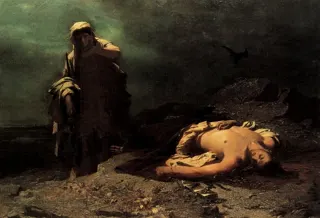 Antigoneby SophoclesA young woman buries her brother against the king's law, and pays with her life.
The play
OEDIPUS, ANTIGONE.
Antigone, child of the old blind sire,
What land is here, what people? Who to-day
Shall dole to Oedipus, the wandering exile,
Their meagre gifts? Little I ask, and less
Receive with full contentment; for my woes,
And the long years ripening the noble mind,
Have schooled me to endure.--But, O my child,
If thou espiest where we may sit, though near
Some holy precinct, stay me and set me there,
Till we may learn where we are come. 'Tis ours
To hear the will of strangers and to obey.
Woe-wearied father, yonder city's wall
That shields her, looks far distant; but this ground
Is surely sacred, thickly planted over
With olive, bay and vine, within whose bowers
Thick-fluttering song-birds make sweet melody.
Here then repose thee on this unhewn stone.
Thou hast travelled far to-day for one so old.
Seat me, my child, and be the blind man's guard.
Long time hath well instructed me in that.
Now, canst thou tell me where we have set our feet?
Athens I know, but not the nearer ground.
Ay, every man that met us in the way
Named Athens.
Shall I go, then, and find out
The name of the spot?
Yes, if 'tis habitable.
It is inhabited. Yet I need not go.
I see a man even now approaching here.
How? Makes he towards us? Is he drawing nigh?
He is close beside us. Whatsoe'er thou findest
Good to be spoken, say it. The man is here.
Enter an Athenian.
O stranger, learning from this maid, who sees
Both for herself and me, that thou art come
With timely light to clear our troubled thought
Ere thou ask more, come forth from where thou sittest!
Ye trench on soil forbidden human tread.
What soil? And to what Power thus consecrate?
None may go near, nor dwell there. 'Tis possessed
By the dread sisters, children of Earth and Night.
What holy name will please them, if I pray?
'All seeing Gentle Powers' the dwellers here
Would call them. But each land hath its own rule.
And gently may they look on him who now
Implores them, and will never leave this grove!
What saying is this?
The watchword of my doom.
Yet dare I not remove thee, till the town
Have heard my purpose and confirm the deed.
By Heaven, I pray thee, stranger, scorn me not,
Poor wanderer that I am, but answer me.
Make clear thy drift. Thou'lt get no scorn from me.
Then, pray thee, tell me how ye name the place
Where now I sit.
The region all around
Is sacred. For 'tis guarded and possessed
By dread Poseidon, and the Titan mind
That brought us fire--Prometheus. But that floor
Whereon thy feet are resting, hath been called
The brazen threshold of our land, the stay
Of glorious Athens, and the neighbouring fields
Are fain to honour for their patron-god
Thee, O Colonos, first of Knights, whose name [Pointing to a statue]
They bear in brotherhood and own for theirs.
Such, friend, believe me, is this place, not praised
In story, but of many a heart beloved.
Then is the land inhabited of men?
By men, who name them from Colonos there.
Have they a lord, or sways the people's voice?
Lord Theseus, child of Aegeus, our late king.
Will some one of your people bring him hither?
Wherefore? What urgent cause requires his presence?
He shall gain mightily by granting little.
Who can gain profit from the blind?
The words
These lips shall utter, shall be full of sight.
Well, thou look'st nobly, but for thy hard fate.
This course is safe. Thus do. Stay where I found thee,
Till I go tell the neighbour townsmen here
Not of the city, but Colonos. They
Shall judge for thee to abide or to depart. [Exit]
Tell me, my daughter, is the man away?
He is gone, father. I alone am near.
Speak what thou wilt in peace and quietness.
Dread Forms of holy Fear, since in this land
Your sanctuary first gave my limbs repose,
Be not obdurate to my prayer, nor spurn
The voice of Phoebus, who that fateful day,
When he proclaimed my host of ills to come,
Told me of rest after a weary time,
Where else but here? 'When I should reach my bourne,
And find repose and refuge with the Powers
Of reverend name, my troubled life should end
With blessing to the men who sheltered me,
And curses on their race who banished me
and sent me wandering forth.' Whereof he vouched me
Sure token, or by earthquake, or by fire
From heaven, or thundrous voices. And I know
Some aery message from your shrine hath drawn me
With winged whisper to this grove. Not else
Had ye first met me coming, nor had I
Sate on your dread unchiselled seat of stone,
With dry cold lips greeting your sober shrine.
Then give Apollo's word due course, and give
Completion to my life, if in your sight
These toils and sorrows past the human bound
Seem not too little. Kindly, gentle powers,
Offspring of primal darkness, hear my prayer!
Hear it, Athenai, of all cities queen,
Great Pallas' foster-city! Look with ruth
On this poor shadow of great Oedipus,
This fading semblance of his kingly form.
Be silent now. There comes an aged band
With jealous looks to know thine errand here.
I will be silent, and thine arm shall guide
My footstep under covert of the grove
Out of the path, till I make sure what words
These men will utter. Warily to observe
Is the prime secret of the prudent mind. [Exeunt]
[entering] Keep watch! Who is it? Look! 1
Where is he? Vanished! Gone! Oh where?
Most uncontrolled of men!
Look well, inquire him out,
Search keenly in every nook!
--Some wanderer is the aged wight,
A wanderer surely, not a native here.
Else never had he gone within
The untrodden grove
Of these--unmarried, unapproachable in might,
--Whose name we dare not breathe,
But pass their shrine
Without a look, without a word,
Uttering the unheard voice of reverential thought.
But now, one comes, they tell, devoid of awe,
Whom, peering all around this grove
I find not, where he abideth.
[behind] Behold me! For I 'see by sound,'
As mortals say.
Oh, Oh!
With horror I see him, with horror hear him speak.
Pray you, regard me not as a transgressor!
Defend us, Zeus! Who is that aged wight?
Not one of happiest fate,
Or enviable, O guardians of this land!
'Tis manifest; else had I not come hither
Led by another's eyes, not moored my bark
On such a slender stay.
Alas! And are thine eyes 2
Sightless? O full of misery,
As thou look'st full of years!
But not, if I prevail,
Shalt thou bring down this curse.
Thou art trespassing. Yet keep thy foot
From stumbling in that verdant, voiceless dell,
Where running water as it fills
The hallowed bowl,
Mingles with draughts of honey. Stranger, hapless one!
Avoid that with all care.
Away! Remove!
Distance impedes the sound. Dost hear,
Woe-burdened wanderer? If aught thou carest to bring
Before our council, leave forbidden ground,
And there, where all have liberty,
Speak,--but till then, avaunt thee!
Daughter, what must I think, or do?
My sire!
We must conform us to the people's will,
Yielding ere they compel.
Give me thy hand.
Thou hast it.
Strangers, let me not
Be wronged, when I have trusted you
And come from where I stood!
Assure thee, from this seat
No man shall drag thee off against thy will.
Farther?
Advance thy foot.
Yet more?
Assist him onward
Maiden, thou hast thy sight.
Come, follow, this way follow with thy darkened steps,
Father, the way I am leading thee.
Content thee, sojourning in a strange land,
O man of woe!
To eschew whate'er the city holds in hate,
And honour what she loves!
Then do thou lead me, child,
Where with our feet secure from sin
We may be suffered both to speak and hear.
Let us not war against necessity.
There! From that bench of rock
Go not again astray.
Even here?
Enough, I tell thee.
May I sit?
Ay, crouch thee low adown
Crooking thy limbs, upon the stone.
Father, this task is mine
Sink gently down into thy resting-place,
Woe is me!
Supporting on this loving hand
Thy reverend aged form.
Woe, for my cruel fate! [OEDIPUS is seated]
Now thou unbendest from thy stubborn ways,
O man of woe!
Declare, what mortal wight thou art,
That, marked by troublous fortune, here art led.
What native country, shall we learn, is thine?
O strangers, I have none!
But do not
What dost thou forbid, old sir?
Do not, oh, do not ask me who I am,
Nor probe me with more question.
What dost thou mean?
My birth is dreadful.
Tell it forth.
What should I utter, O my child? Woe is me!
Thy seed, thy father's name, stranger, pronounce!
Alas! What must I do? My child!
Since no resource avails thee, speak!
I will. I cannot hide it further.
Ye are long about it. Haste thee!
Know ye of one
Begotten of Laius?
Horror! Horror! Oh!
Derived from Labdacus?
O Heaven!
Fate-wearied Oedipus?
Art thou he?
Fear not my words.
Oh! Oh!
Unhappy me!
Oh!
Daughter, what is coming?
Away! Go forth. Leave ye the land. Begone!
And where, then, is the promise thou hast given?
No doom retributive attends the deed
That wreaks prevenient wrong.
Deceit, matched with deceit, makes recompense
Of evil, not of kindness. Get thee forth!
Desert that seat again, and from this land
Unmooring speed thee away, lest on our state
Thou bring some further bale!
Monody.
O strangers, full of reverent care!
Since ye cannot endure my father here,
Aged and blind,
Because ye have heard a rumour of the deeds
He did unknowingly,--yet, we entreat you.
Strangers, have pity on me, the hapless girl,
Who pray for mine own sire and for none else,
--Pray, looking in your eyes with eyes not blind.
As if a daughter had appeared to you.
Pleading for mercy to the unfortunate.
We are in your hands as in the hand of God,
Helpless. O then accord the unhoped for boon!
By what is dear to thee, thy veriest own,
I pray thee,--chattel or child, or holier name!
Search through the world, thou wilt not find the man
Who could resist the leading of a God.
Daughter of Oedipus, be well assured
We view with pity both thy case and his,
But fear of Heavenly wrath confines our speech
To that we have already said to you.
What profit lives in fame and fair renown
By unsubstantial rumour idly spread?
When Athens is extolled with peerless praise
For reverence, and for mercy!--She alone
The sufferer's shield, the exile's comforter!
What have I reaped hereof? Ye have raised me up
From yonder seat, and now would drive me forth
Fearing a name! For there is nought in me
Or deeds of mine to make you fear. My life
Hath more of wrong endured than of wrong done,
Were it but lawful to disclose to you
Wherefore ye dread me,--not my sin but theirs,
My mother's and my sire's. I know your thought.
Yet never can ye fasten guilt on me,
Who, though I had acted with the clear'st intent,
Were guiltless, for my deed requited wrong.
But as it was, all blindly I went forth
On that dire road, while they who planned my death
Planned it with perfect knowledge. Therefore, sirs,
By Heaven I pray you, as ye have bid me rise,
Protect your suppliant without fail; and do not
In jealous reverence for the blessed Gods
Rob them of truest reverence, but know this:
God looks upon the righteousness of men
And their unrighteousness, nor ever yet
Hath one escaped who wrought iniquity.
Take part, then, with the Gods, nor overcloud
The golden fame of Athens with dark deeds;
But as ye have pledged your faith to shelter me,
Defend me and rescue, not rejecting me
Through mere abhorrence of my ruined face.
For on a holy mission am I come,
Sent with rich blessings for your neighbours here.
And when the head and sovereign of your folk
Is present, ye shall learn the truth at full.
Till then, be gracious to me, and not perverse.
Thy meaning needs must strike our hearts with awe,
Old wanderer! so weighty are the words
That body it forth. Therefore we are content
The Lord of Athens shall decide this case.
And where is he who rules this country, sirs?
He keeps his father's citadel. But one
Is gone to fetch him, he who brought us hither.
Think you he will consider the blind man,
And come in person here to visit him?
Be sure he will,--when he hath heard thy name.
And who will carry that?
'Tis a long road;
But rumour from the lips of wayfarers
Flies far and wide, so that he needs must hear;
And hearing, never doubt but he will come.
So noised in every land hath been thy name,
Old sovereign,--were he sunk in drowsiness,
That sound would bring him swiftly to thy side.
Well, may he come to bless his city and me!
When hath not goodness blessed the giver of good?
O Heavens! What shall I say, what think, my father?
Daughter Antigone, what is it?
I see
A woman coming toward us, mounted well
On a fair Sicilian palfrey, and her face
With brow-defending hood of Thessaly
Is shadowed from the sun. What must I think?
Is it she or no? Can the eye so far deceive?
It is. 'Tis not. Unhappy that I am,
I know not.--Yes, 'tis she. For drawing near
She greets me with bright glances, and declares
Beyond a doubt, Ismene's self is here.
What say'st thou, daughter?
That I see thy child,
My sister. Soon her voice will make thee sure.
Enter ISMENE.
Father and sister!--names for ever dear!
Hard hath it been to find you, yea, and hard
I feel it now to look on you for grief.
Child, art thou here?
Father! O sight of pain!
Offspring and sister!
Woe for thy dark fate!
Hast thou come, daughter?
On a troublous way.
Touch me, my child!
I give a hand to both.
To her and me?
Three linked in one sad knot.
Child, wherefore art thou come?
In care for thee.
Because you missed me?
Ay, and to bring thee tidings,
With the only slave whom I could trust.
And they,
Thy brethren, what of them? Were they not there
To take this journey for their father's good?
Ask not of them. Dire deeds are theirs to day.
How in all points their life obeys the law
Of Egypt, where the men keep house and weave
Sitting within doors, while the wives abroad
Provide with ceaseless toil the means of life.
So in your case, my daughters, they who should
Have ta'en this burden on them, bide at home
Like maidens, while ye take their place, and lighten
My miseries by your toil. Antigone,
E'er since her childhood ended, and her frame
Was firmly knit, with ceaseless ministry
Still tends upon the old man's wandering,
Oft in the forest ranging up and down
Fasting and barefoot through the burning heat
Or pelting rain, nor thinks, unhappy maid,
Of home or comfort, so her father's need
Be satisfied. And thou, that camest before,
Eluding the Cadmeans, and didst tell me
What words Apollo had pronounced on me.
And when they banished me, stood'st firm to shield me,
What news, Ismene, bring'st thou to thy sire
To day? What mission sped thee forth? I know
Thou com'st not idly, but with fears for me.
Father, I will not say what I endured
In searching out the place that sheltered thee.
To tell it o'er would but renew the pain.
But of the danger now encompassing
Thine ill starred sons,--of that I came to speak.
At first they strove with Creon and declared
The throne should be left vacant and the town
Freed from pollution,--paying deep regard
In their debate to the dark heritage
Of ruin that o'ershadowed all thy race.
Far different is the strife which holds them now,
Since some great Power, joined to their sinful mind,
Incites them both to seize on sovereign sway.
Eteocles, in pride of younger years,
Robbed elder Polynices of his right,
Dethroned and banished him. To Argos then
Goes exiled Polynices, and obtains
Through intermarriage a strong favouring league,
Whose word is, 'Either Argos vanquishes
The seed of Cadmus or exalts their fame'
This, father, is no tissue of empty talk,
But dreadful truth, nor can I tell where Heaven
Is to reveal his mercy to thy woe.
And hadst thou ever hoped the Gods would care
For mine affliction, and restore my life?
I hope it now since this last oracle.
What oracle hath been declared, my child?
That they shall seek thee forth, alive or dead,
To bring salvation to the Theban race.
Who can win safety through such help as mine?
'Tis said their victory depends on thee.
When shrunk to nothing, am I indeed a man?
Yea, for the Gods uphold thee, who then destroyed.
Poor work, to uphold in age who falls when young!
Know howsoe'er that Creon will be here
For this same end, ere many an hour be spent.
For what end, daughter? Tell me in plain speech.
To set thee near their land, that thou may'st be
Beyond their borders, but within their power.
What good am I, thus lying at their gate?
Thine inauspicious burial brings them woe.
There needs no oracle to tell one that.
And therefore they would place thee near their land,
Where thou may'st have no power upon thyself.
Say then, shall Theban dust o'ershadow me?
The blood of kindred cleaving to thy hand,
Father, forbids thee.
Never, then, henceforth,
Shall they lay hold on me!
If that be true,
The brood of Cadmus shall have bale.
What cause
Having appeared, will bring this doom to pass?
Thy wrath, when they are marshalled at thy tomb.
From whom hast thou heard this?
Sworn messengers
Brought such report from Delphi's holy shrine.
Hath Phoebus so pronounced my destiny?
So they declare who brought the answer back.
Did my sons hear?
They know it, both of them.
Villains, who, being informed of such a word,
Turned not their thoughts toward me, but rather chose
Ambition and a throne!
It wounds mine ear
To hear it spoken, but the news I bring
Is to that stern effect.
Then I pray Heaven
The fury of their fate-appointed strife
May ne'er be quenched, but that the end may come
According to my wish upon them twain
To this contention and arbitrament
Of battle which they now assay and lift
The threatening spear! So neither he who wields
The sceptred power should keep possession still,
Nor should his brother out of banishment
Ever return:--who, when their sire--when I
Was shamefully thrust from my native land,
Checked not my fall nor saved me, but, for them,
I was driven homeless and proclaimed an exile.
Ye will tell me 'twas in reason that the State
Granted this boon to my express desire.
Nay; for in those first hours of agony,
When my heart raged, and it seemed sweetest to me
To die the death, and to be stoned with stones,
No help appeared to yield me that relief.
But after lapse of days, when all my pain
Was softened, and I felt that my hot spirit
Had run to fierce excess of bitterness
In wreaking mine offence--then, then the State
Drove me for ever from the land, and they,
Their father's sons, who might have saved their father,
Cared not to help him, but betrayed by them,
For lack of one light word, I wandered forth
To homeless banishment and beggary.
But these weak maidens to their nature's power
Have striven to furnish me with means to live
And dwell securely, girded round with love.
My sons have chosen before their father's life
A lordly throne and sceptred sovereignty.
But never shall they win me to their aid,
Nor shall the Theban throne for which they strive
Bring them desired content. That well I know,
Comparing with my daughter's prophecies
Those ancient oracles which Phoebus once
Spake in mine ear. Then let them send to seek me
Creon, or who is strongest in their State.
For if ye, strangers, will but add your might
To the protection of these awful Powers,
The guardians of your soil, to shelter me,
Ye shall acquire for this your State a saviour
Mighty to save, and ye shall vex my foes.
Thou art worthy of all compassion, Oedipus,
Thyself and these thy daughters. Now, moreover
Since thou proclaim'st thyself our country's saviour
I would advise thee for the best.
Kind sir,
Be my good guide. I will do all thou biddest.
Propitiate then these holy powers, whose grove
Received thee when first treading this their ground.
What are the appointed forms? Advise me, sirs.
First see to it that from some perennial fount
Clean hands provide a pure drink-offering.
And when I have gotten this unpolluted draught?
You will find bowls, formed by a skilful hand,
Whose brims and handles you must duly wreathe.
With leaves or flocks of wool, or in what way?
With tender wool ta'en from a young ewe-lamb.
Well, and what follows to complete the rite?
Next, make libation toward the earliest dawn.
Mean'st thou from those same urns whereof thou speakest?
From those three vessels pour three several streams,
Filling the last to the brim.
With what contents
Must this be filled? Instruct me.
Not with wine,
But water and the treasure of the bee.
And when leaf-shadowed Earth has drunk of this,
What follows?
Thou shalt lay upon her then
From both thy hands a row of olive-twigs
Counting thrice nine in all--and add this prayer
That is the chief thing,--that I long to hear.
As we have named them Gentle, so may they
From gentle hearts accord their suppliant aid;
Be this thy prayer, or whoso prays for thee,
Spoken not aloud, but so that none may hear;
And in departing, turn not. This being done,
I can stand by thee without dread. But else,
I needs must fear concerning thee.
My daughters,
Have ye both heard our friends who inhabit here?
Yea, father; and we wait for thy command.
I cannot go. Two losses hinder me,
Two evils, want of strength and want of sight.
Let one of you go and perform this service.
One soul, methinks, in paying such a debt
May quit a million, if the heart be pure.
Haste, then, to do it. Only leave me not
Untended. For I cannot move alone
Nor without some one to support me and guide.
I will be ministrant. But let me know
Where I must find the place of offering.
Beyond this grove. And, stranger maid, if aught
Seem wanting, there is one at hand to show it.
Then to my task. Meantime, Antigone,
Watch by our sire. We must not make account
Of labour that supplies a parent's need. [Exit]
Thy long since slumbering woe I would not wake again,
But yet I long to learn.
What hidden lore?
The pain
That sprang against thy life with spirit-mastering force.
Ah, sirs, as ye are kind, re-open not that source
Of unavoided shame.
Friend, we would hear the tale
Told truly, whose wide voice doth hourly more prevail.
Misery!
Be not loth!
O bitterness!
Consent.
For all thou didst require we gave to thy content.
Oh, strangers, I have borne an all-too-willing brand,
Yet not of mine own choice.
Whence? We would understand.
Nought knowing of the curse she fastened on my head
Thebe in evil bands bound me.
Thy mother's bed,
Say, didst thou fill? mine ear still echoes to the noise.
'Tis death to me to hear, but, these, mine only joys,
Friends, are my curse.
O Heaven!
The travail of one womb
Hath gendered all you see, one mother, one dark doom.
How? Are they both thy race, and
Sister branches too,
Nursed at the self-same place with him from whom they grew.
O horror!
Ay, not one, ten thousand charged me then!
O sorrow!
Never done, an ever-sounding strain.
O crime!
By me ne'er wrought.
But how?
The guerdon fell.
Would I had earned it not from those I served too well.
But, hapless, didst thou slay
What seek ye more to know?
Thy father?
O dismay! Ye wound me, blow on blow.
Thy hand destroyed him.
Yes. Yet lacks there not herein
A plea for my redress.
How canst thou clear that sin?
I'll tell thee. For the deed, 'twas proved mine,--Oh 'tis true!
Yet by Heaven's law I am freed:--I wist not whom I slew.
Enough. For lo! where Aegeus' princely son,
Theseus, comes hither, summoned at thy word.
Enter THESEUS.
From many voices in the former time
Telling thy cruel tale of sight destroyed
I have known thee, son of Laius, and to-day
I know thee anew, in learning thou art here.
Thy raiment, and the sad change in thy face,
Proclaim thee who thou art, and pitying thee,
Dark-fated Oedipus, I fain would hear
What prayer or supplication thou preferrest
To me and to my city, thou and this
Poor maid who moves beside thee. Full of dread
Must be that fortune thou canst name, which I
Would shrink from, since I know of mine own youth,
How in strange lands a stranger as thou art
I bore the brunt of perilous circumstance
Beyond all others; nor shall any man,
Like thee an alien from his native home,
Find me to turn my face from succouring him.
I am a man and know it. To-morrow's good
Is no more mine than thine or any man's.
Thy noble spirit, Theseus, in few words
Hath made my task of utterance brief indeed.
Thou hast told aright my name and parentage
And native city. Nought remains for me
But to make known mine errand, and our talk
Is ended.
Tell me plainly thy desire.
I come to offer thee this woe-worn frame,
As a free boon,--not goodly in outward view.
A better gift than beauty is that I bring.
What boon dost thou profess to have brought with thee?
Thou shalt know by and by,--not yet awhile.
When comes the revelation of thine aid?
When I am dead, and thou hast buried me.
Thou cravest the last kindness. What's between
Thou dost forget or else neglect.
Herein
One word conveys the assurance of the whole.
You sum up your petition in brief form.
Look to it. Great issues hang upon this hour.
Mean'st thou in this the fortune of thy sons
Or mine?
I mean the force of their behest
Compelling my removal hence to Thebes.
So thy consent were sought, 'twere fair to yield.
Once I was ready enough. They would not then.
Wrath is not wisdom in misfortune, man!
Nay, chide not till thou knowest.
Inform me, then!
I must not speak without just grounds.
O Theseus,
I am cruelly harassed with wrong heaped on wrong.
Mean'st thou that prime misfortune of thy birth?
No. That hath long been rumoured through the world.
What, then, can be thy grief? If more than that,
'Tis more than human.
Here is my distress:
I am made an outcast from my native land
By mine own offspring. And return is barred
For ever to the man who slew his sire.
How then should they require thee to go near,
And yet dwell separate?
The voice of Heaven
Will drive them to it.
As fearing what reverse
Prophetically told?
Destined defeat
By Athens in the Athenian land.
What source
Of bitterness 'twixt us and Thebes can rise?
Dear son of Aegeus, to the Gods alone
Comes never Age nor Death. All else i' the world
Time, the all subduer, merges in oblivion.
Earth and men's bodies weaken, fail, and perish.
Faith withers, breach of faith springs up and glows
And neither men nor cities that are friends
Breathe the same spirit with continuing breath.
Love shall be turned to hate, and hate to love
With many hereafter, as with some to-day.
And though, this hour, between great Thebes and thee
No cloud be in the heaven, yet moving Time
Enfolds a countless brood of days to come,
Wherein for a light cause they shall destroy
Your now harmonious league with severing war,
Even where my slumbering form, buried in death,
Coldly shall drink the life blood of my foes,
If Zeus be Zeus, and his son Phoebus true.
I would not speak aloud of mysteries.
Then let me leave where I began. Preserve
Thine own good faith, and thou shalt never say,
Unless Heaven's promise fail me, that for nought
Athens took Oedipus to dwell with her.
My lord, long since the stranger hath professed
Like augury of blessings to our land.
And who would dare reject his proffered good?
Whose bond with us of warrior amity
Hath ne'er been sundered,--and to day he comes
A God-sent suppliant, whose sacred hand
Is rich with gifts for Athens and for me.
In reverent heed whereof I ne'er will scorn
The boon he brings, but plant him in our land.
And if it please our friend to linger here,
Ye shall protect him:--if to go with me
Best likes thee, Oedipus,--ponder, and use
Thy preference. For my course shall join with thine.
Ye Heavens, reward such excellence!
How, then?
Is it thy choice now to go home with me?
Yea, were it lawful. But in this same spot
What wouldst thou do? I'll not withstand thy will.
I must have victory o'er my banishers.
Thy dwelling with us, then, is our great gain?
Yes, if thou fail me not, but keep thy word.
Nay, fear not me! I will aye be true to thee.
I will not bind thee, like a knave, with oaths.
Oaths were no stronger than my simple word.
What will ye do, then?
What is that thou fearest?
They will come hither.
Thy guards will see to that.
Beware, lest, if you leave me
Tell not me,
I know my part.
Terror will have me speak.
Terror and I are strangers.
But their threats!
Thou canst not know
I know that none shall force
Thee from this ground against thy will. Full oft
Have threatening words in wrath been voluble,
Yet, when the mind regained her place again,
The threatened evil vanished. So to-day
Bold words of boastful meaning have proclaimed
Thy forcible abduction by thy kin.
Yet shall they find [I know it] the voyage from Thebes,
On such a quest, long and scarce navigable.
Whate'er my thought, if Phoebus sent thee forth,
I would bid thee have no fear. And howsoe'er,
My name will shield thee from all injury.
Friend! in our land of conquering steeds thou art come
To this Heaven-fostered haunt, Earth's fairest home,
Gleaming Colonos, where the nightingale
In cool green covert warbleth ever clear,
True to the clustering ivy and the dear
Divine, impenetrable shade,
From wildered boughs and myriad fruitage made,
Sunless at noon, stormless in every gale.
Wood-roving Bacchus there, with mazy round,
And his nymph nurses range the unoffended ground.
And nourished day by day with heavenly dew
Bright flowers their never-failing bloom renew,
From eldest time Deo and Cora's crown
Full-flowered narcissus, and the golden beam
Of crocus, while Cephisus' gentle stream
In runnels fed by sleepless springs
Over the land's broad bosom daily brings
His pregnant waters, never dwindling down.
The quiring Muses love to seek the spot
And Aphrodite's golden car forsakes it not.
Here too a plant, nobler than e'er was known
On Asian soil, grander than yet hath grown
In Pelops' mighty Dorian isle, unsown,
Free, self-create, the conquering foeman's fear,
The kind oil-olive, silvery-green,
Chief nourisher of childish life, is seen
To burgeon best in this our mother-land.
No warrior, young, nor aged in command,
Shall ravage this, or scathe it with the spear;
For guardian Zeus' unslumbering eye
Beholds it everlastingly,
And Athens' grey-eyed Queen, dwelling for ever near.
Yet one more praise mightier than all I tell
O'er this my home, that Ocean loves her well,
And coursers love her, children of the wave
To grace these roadways Prince Poseidon first
Framed for the horse, that else had burst
From man's control, the spirit taming bit
And the trim bark, rowed by strong arms, doth flit
O'er briny seas with glancing motion brave
Lord of the deep! by that thy glorious gift
Thou hast established our fair town
For ever in supreme renown
The Sea nymphs' plashing throng glide not more smoothly swift.
O land exalted thus in blessing and praise,
Now is thy time to prove these brave words true.
What hath befallen, my daughter?
Here at hand,
Not unaccompanied, is Creon, father.
Dear aged friends, be it yours now to provide
My safety and the goal of my desire!
It shall be so. Fear nought. I am old and weak,
But Athens in her might is ever young.
Enter CREON.
Noble inhabiters of Attic ground
I see as 'twere conceived within your eyes
At mine approach some new engendered fear
Nay, shrink not, nor let fall one fretful word.
I bring no menace with me, for mine age
Is feeble, and the state whereto I come
Is mighty,--none in Hellas mightier,
That know I well. But I am sent to bring
By fair persuasion to our Theban plain
The reverend form of him now present here.
Nor came this mission from one single will,
But the commands of all my citizens
Are on me, seeing that it becomes my birth
To mourn his sorrows most of all the state
Thou, then, poor sufferer, lend thine ear to me
And come. All Cadmus' people rightfully
Invite thee with one voice unto thy home,
I before all,--since I were worst of men,
Were I not pained at thy misfortunes, sir,
--To see thee wandering in the stranger's land
Aged and miserable, unhoused, unfed,
Singly attended by this girl, whose fall
To such a depth of undeserved woe
I could not have imagined! Hapless maid!
Evermore caring for thy poor blind head,
Roving in beggary, so young, with no man
To marry her,--a mark for all mischance.
O misery, what deep reproach I have laid
On thee and me and our whole ill-starred race!
But who can hide evil that courts the day?
Thou, therefore, Oedipus, without constraint,
[By all the Gods of Cadmus' race I pray thee]
Remove this horror from the sight of men
By coming to the ancestral city and home
Of thy great sires,--bidding a kind farewell
To worthiest Athens, as is meet. But Thebes,
Thy native land, yet more deserves thy love.
Thou unabashed in knavery, who canst frame
For every cause the semblance of a plea
Pranked up with righteous seeming, why again
Would'st thou contrive my ruin, and attempt
To catch me where I most were grieved being caught?
Beforetime, when my self-procured woes
Were plaguing me, and I would fain have rushed
To instant banishment, thou wouldst not then
Grant this indulgence to my keen desire.
But when I had fed my passion to the full,
And all my pleasure was to live at home,
Then 'twas thy cue to expel and banish me,
Nor was this name of kindred then so dear.
Now once again, when thou behold'st this city
And people joined in friendly bands with me,
Thou wouldst drag me from my promised resting-place,
Hiding hard policy with courtly show.
Strange kindness, to love men against their will!
Suppose, when thou wert eager in some suit,
No grace were granted thee, but all denied,
And when thy soul was sated, then the boon
Were offered, when such grace were graceless now;
--Poor satisfaction then were thine, I ween!
Even such a gift thou profferest me to-day,
Kind in pretence, but really full of evil.
These men shall hear me tell thy wickedness.
Thou comest to take me, not unto my home,
But to dwell outlawed at your gate, that so
Your Thebe may come off untouched of harm
From her encounter with Athenian men.
Ye shall not have me thus. But you shall have
My vengeful spirit ever in your land
Abiding for destruction,--and my sons
Shall have this portion in their father's ground,
To die thereon. Know I not things in Thebes
Better than thou? Yea, for 'tis mine to hear
Safer intelligencers,--Zeus himself,
And Phoebus, high interpreter of Heaven.
Thou bring'st a tongue suborned with false pretence,
Sharpened with insolence;--but in shrewd speech
Thou shalt find less of profit than of bane.
This thou wilt ne'er believe. Therefore begone!
Let me live here. For even such life as mine
Were not amiss, might I but have my will.
Which of us twain, believ'st thou, in this talk
Hath more profoundly sinned against thy peace?
If thou prevail'st with these men present here
Even as with me, I shall be well content.
Unhappy man, will not even Time bring forth
One spark of wisdom to redeem thine age?
Thou art a clever talker. But I know
No just man who in every cause abounds
With eloquent speech.
'Tis not to abound in speech,
When one speaks fitting words in season.
Oh!
As if thy words were few and seasonable!
Not in the dotard's judgement.
Get thee gone!
I speak their mind as well--and dog not me
Beleaguering mine appointed dwelling-place!
These men shall witness--for thy word is naught;
And for thy spiteful answer to thy friends,
If once I seize thee
Who shall seize on me
Without the will of my protectors here?
Well, short of that, thou shalt have pain, I trow.
What hast thou done, that thou canst threaten thus?
One of thy daughters I have sent in charge.
This other, I myself will quickly take.
Oh, cruel!
Soon thou'lt have more cause to cry.
Hast thou my child?
I will have both ere long.
Dear friends, what will ye do? Will ye forsake me?
Will you not drive the offender from your land?
Stranger, depart at once! Thou hast done wrong,
And wrong art doing.
[to attendants] Now then, lead her away
By force, if she refuse to go with you.
Ah me! unhappy! Whither shall I flee?
What aid of God or mortal can I find?
What dost thou, stranger?
I will lay no hand
On him, but on my kinswoman.
Alas!
Lords of Colonos, will ye suffer it?
Thou art transgressing, stranger.
Nay, I stand
Within my right.
How so?
I take mine own.
Athens to aid!
Stranger, forbear! What dost thou?
Let go, or thou shalt try thy strength with us.
Unhand me!
Not while this intent is thine.
If you harm me, you will have war with Thebes.
Did I not tell you this would come?
Release
The maid with speed.
Command where you have power.
Leave hold, I say!
Away with her, say I!
Come hither, neighbours, come!
My city suffers violence. Wrongful men
Are hurting her with force. Come hither to me!
Unhappy, I am dragged away,--O strangers!
Where art thou, O my child?
I go away
Against my will.
Reach forth thy hands, my daughter!
I cannot.
Off with her!
Alas, undone! [Exit ANTIGONE, guarded]
Thou shalt not have these staves henceforth to prop
Thy roaming to and fro. Take thine own way!
Since thou hast chosen to thwart thy nearest kin,
Beneath whose orders, though a royal man,
I act herein,--and thine own native land.
The time will surely come when thou shalt find
That in this deed and all that thou hast done
In opposition to their friendly will,
Thou hast counselled foolishly against thy peace,
Yielding to anger, thy perpetual bane. [Going]
Stranger, stand where thou art!
Hands off, I say!
Thou shalt not go, till thou restore the maids.
Soon, then, my city shall retain from you
A weightier cause of war. I will lay hands
Not on the maidens only.
What wilt thou do?
Oedipus I will seize and bear away.
Great Heaven forfend!
It shall be done forthwith,
Unless the ruler of this land prevent me.
O shameless utterance! Wilt thou lay thy hold
On me?
Be silent! Speak no more!
No more?
May these dread Goddesses not close my lips
To this one prayer of evil against thee,
Thou villain, who, when I have lost mine eyes,
Bereavest me of all that I had left
To make my darkness light! Therefore I pray,
For this thy wrongful act, may He in heaven
Whose eye sees all things, Helios, give to thee
Slowly to wither in an age like mine!
Men of this land, bear witness to his rage!
They see us both, and are aware that I
Repay thee but with words for deeds of wrong.
No longer will I curb my wrath. Though lonely
And cumbered by mine age, I will bear off
This man!
Me miserable!
How bold thou art,
If standing here thou think'st to do this thing!
I do.
Then Athens is to me no city.
Slight men prevail o'er strength in a just cause.
Hear ye his words?
He shall not make them good.
Be witness, Zeus!
Zeus knows more things than thou.
Is not this violence?
Violence you must bear.
Come, chieftain of our land!
Come hither with all speed. They pass the bound.
Enter THESEUS.
Wherefore that shouting? Daunted by what fear
Stayed ye me sacrificing to the God
Who guards this deme Colonos? Let me know
What cause so hastened my reluctant foot.
Dear friend [I know thy voice addressing us],
One here hath lately done me cruel wrong.
Who is the wrong-doer, say, and what the deed?
This Creon, whom thou seest, hath torn away
Two children that were all in all to me.
Can this be possible?
Thou hear'st the truth.
Then one of you run to the altar-foot
Hard by, and haste the people from the rite,
Horsemen and footmen at the height of speed
To race unto the parting of the roads
Where travellers from both gorges wont to meet.
Lest there the maidens pass beyond our reach
And I be worsted by this stranger's might
And let him laugh at me. Be swift! Away!
--For him, were I as wroth as he deserves,
He should not go unpunished from my hand.
But now he shall be ruled by the same law
He thought to enforce. Thou goest not from this ground
Till thou hast set these maids in presence here;
Since by thine act thou hast disgraced both me
And thine own lineage and thy native land,
Who with unlicensed inroad hast assailed
An ancient city, that hath still observed
Justice and equity, and apart from law
Ratifies nothing; and, being here, hast cast
Authority to the winds, and made thine own
Whate'er thou wouldst, bearing it off perforce,
Deeming of me forsooth as nothing worth,
And of my city as one enslaved to foes
Or void of manhood. Not of Thebe's will
Come such wild courses. It is not her way
To foster men in sin, nor would she praise
Thy doing, if she knew that thou hast robbed
Me and the gods, dragging poor suppliant wights
From their last refuge at thy will--I would not,
Had I perchance set foot within thy land,
Even were my cause most righteous, have presumed,
Without consent of him who bore chief sway,
To seize on any man, but would have known
How men should act who tread on foreign soil.
Thou bring'st disgrace on thine own mother state
All undeservedly, and the lapse of years
Hath left thee aged, but not wise--Again
I bid those maids now to be brought with speed,
Unless thou would'st be made a sojourner
In Athens by compulsion. This I speak
Not with my lips alone, but from my will.
Stranger, dost thou perceive? Thy parentage
Is owned as noble, but thine evil deeds
Are blazoned visibly.
Great Aegeus' son!
Not as misprising this thy city's strength
In arms, or wisdom in debate, I dared
This capture, but in simple confidence
Thy citizens would not so envy me
My blood relations, as to harbour them
Against my will,--nor welcome to their hearths
A man incestuous and a parricide,
The proved defiler of his mother's bed
Such was the mount of Ares that I knew,
Seat of high wisdom, planted in their soil,
That suffers no such lawless runaways
To haunt within the borders of your realm.
Relying on that I laid my hands upon
This quarry, nor had done so, were it not
That bitterly he cursed myself and mine.
That moved me to requital, since even Age
Still bears resentment, till the power of death
Frees men from anger, as from all annoy.
Being sovereign here thou wilt do thy pleasure. I,
Though I have justice on my side, am weak
Through being alone. Yet if you meddle with me,
Old as I am, you'll find me dangerous.
O boldness void of shame! Whom dost thou think
Thy obloquy most harms, this aged head
Or thine, who hast thus let pass thy lips the crimes
I have borne unwittingly. So Heaven was pleased
To wreak some old offence upon our race.
Since in myself you will find no stain of sin
For which such ruinous error 'gainst myself
And mine own house might be the recompense.
Tell me, I pray thee, if a word from Heaven
Came to my father through the oracle
That he should die by his son's hand,--what right
Hast thou to fasten that reproach on me,
The child not yet begotten of my sire,
An unborn nothing, unconceived? Or if,
Born as I was to misery, I encountered
And killed my father in an angry fray,
Nought knowing of what I did or whom I slew,
What reason is't to blame the unwitting deed?
And, oh, thou wretch! art not ashamed to force me
To speak that of my mother, thine own sister,
Which I will speak, for I will not keep silence,
Since thou hast been thus impious with thy tongue.
She was my mother, oh, the bitter word!
Though neither knew it, and having borne me, she
Became the mother of children to her son,
An infamous birth! Yet this I know, thy crime
Of speech against us both is voluntary.
But all involuntary was my deed
In marriage and is this mine utterance now.
No,--that shall not be called a bosom-sin,
Nor shall my name be sullied with the deed,
Thy tongue would brand on me, against my sire.
For answer me one question. If to-day,
Here, now, one struck at thee a murderous stroke,
At thee, the righteous person,--wouldst thou ask
If such assailant were thy sire, or strike
Forthwith? Methinks, as one who cares to live,
You would strike before you questioned of the right,
Or reasoned of his kindred whom you slew.
Such was the net that snared me: such the woes
Heaven drew me to fulfil. My father's spirit,
Came he to life, would not gainsay my word.
But thou, to whom, beneath the garb of right,
No matter is too dreadful or too deep
For words, so rail'st on me, in such a presence.
Well thou dost flatter the great name of Theseus,
And Athens in her glory stablished here,
But midst thy fulsome praises thou forgettest
How of all lands that yield the immortal Gods
Just homage of true piety, this land
Is foremost. Yet from hence thou would'st beguile
Me, the aged suppliant. Nay, from hence thou would'st drag
Myself with violence, and hast reft away
My children. Wherefore I conjure these powers,
With solemn invocation and appeal,
To come and take my part, that thou may'st know
What men they are who guard this hallowed realm.
My lord, the stranger deserves well. His fate
Is grievous, but the more demands our aid.
Enough of words. The captors and their prey
Are hasting;--we, they have wronged, are standing still.
I am powerless here. What dost thou bid me do?
Lead us the way they are gone. I too must be
Thine escort, that if hereabout thou hast
Our maidens, thou mayest show them to my sight.
But if men flee and bear them, we may spare
Superfluous labour. Others hotly urge
That business, whom those robbers shall not boast
Before their Gods to have 'scaped out of this land.
Come, be our guide! Thou hast and hast not. Fortune
Hath seized thee seizing on thy prey. So quickly
Passes the gain that's got by wrongful guile.
Nay, thou shalt have no helper. Well I wot
Thou flew'st not to this pitch of truculent pride
Alone, or unsupported by intrigue;
But thy bold act hath some confederate here.
This I must look into, nor let great Athens
Prove herself weaker than one single man.
Hast caught my drift? Or is my voice as vain
Now, as you thought it when you planned this thing?
I will gainsay nought of what thou utterest here.
But once in Thebes, I too shall know my course.
Threaten, but go! Thou, Oedipus, remain
In quietness and perfect trust that I,
If death do not prevent me, will not rest
Till I restore thy children to thy hand.
Soon shall the wheeling foes
Clash with the din of brazen-throated War.
Would I were there to see them close,
Be the onset near or far!
Whether at Daphne's gorge to Phoebus dear,
Or by the torch-lit shore
Where kind maternal powers for evermore
Guard golden mysteries of holy fear
To nourish mortal souls
Whose voice the seal of silent awe controls
Imprinted by the Eumolpid minister.
There, on that sacred way,
Shall the divinest head
Of royal Theseus, rouser of the fray,
And those free maids, in their two squadrons led,
Meet in the valorous fight
That conquers for the right.
Else, by the snow-capped rock,
Passing to westward, they are drawing nigh
The tract beyond the pasture high
Where Oea feeds her flock.
The riders ride, the rattling chariots flee
At racing speed.--'Tis done!
He shall be vanquished. Our land's chivalry
Are valiant, valiant every warrior son
Of Theseus.--On they run?
Frontlet and bridle glancing to the light,
Forward each steed is straining to the fight,
Forward each eye and hand
Of all that mounted band,
Athena's knighthood, champions of her name
And his who doth the mighty waters tame,
Rhea's son that from of old
Doth the Earth with seas enfold.
Strive they? Or is the battle still to be?
An eager thought in me
Is pleading, 'Soon must they restore
The enduring maid, whose kinsmen vex her sore!'
To-day shall Zeus perform his will.
The noble cause wins my prophetic skill.
Oh! had I wings, and like a storm-swift dove
Poised on some aery cloud might there descry
The conflict from above,
Scouring the region with mine eye!
Sovran of Heaven, all-seeing Zeus, afford
Unto this nation's lord
Puissance to crown the fair emprise,
Thou, and all-knowing Pallas, thy dread child!
Apollo, huntsman of the wild,
--Thou and thy sister, who doth still pursue
Swift many-spotted stags,--arise, arise,
With love we pray you, be our champions true!
Yea, both together come
To aid our people and our home!
Ah! wanderer friend, thou wilt not have to accuse
Thy seer of falsehood. I behold the maids
This way once more in safe protection brought.
Where? Is it true? How say you?
Father, father!
Oh that some God would give thee once to see
The man whose royal virtue brings us hither!
My daughters, are ye there?
Saved by the arm
Of Theseus and his most dear ministers.
Come near me, child, and let your father feel
The treasure he had feared for ever gone.
Not hard the boon which the heart longs to give.
Where are ye, where?
Together we draw near.
Loved saplings of a solitary tree!
A father's heart hides all.
Staves of mine age!
Forlorn supporters of an ill-starred life!
I have all I love; nor would the stroke of death
Be wholly bitter, with you standing by.
Press close to either side of me, my children;
Grow to your sire, and ye shall give me rest
From mine else lonely, hapless, wandering life.
And tell your tale as briefly as ye may,
Since at your age short speaking is enough.
Here is our saviour. He shall tell thee all,
And shorten labour both for us and thee.
Think it not strange, dear friend, that I prolong
The unhoped-for greeting with my children here.
Full well I know, the joy I find in them
Springs from thee only, and from none beside.
Thou, thou alone hast saved them. May the Gods
Fulfil my prayer for thee and for thy land!
Since only in Athens, only here i' the world,
Have I found pious thought and righteous care,
And truth in word and deed. From a full heart
And thankful mind I thus requite thy love,
Knowing all I have is due to none but thee.
Extend to me, I pray thee, thy right hand,
O King, that I may feel thee, and may kiss,
If that be lawful, thy dear head! And yet
What am I asking? How can one like me
Desire of thee to touch an outlawed man,
On whose dark life all stains of sin and woe
Are fixed indelibly? I will not dare
No, nor allow thee!--None but only they
Who have experience of such woes as mine
May share their wretchedness. Thou, where thou art
Receive my salutation, and henceforth
Continue in thy promised care of me
As true as to this moment thou hast proved.
I marvel not at all if mere delight
In these thy daughters lengthened thy discourse,
Or led thee to address them before me.
That gives me not the shadow of annoy.
Nor am I careful to adorn my life
With words of praise, but with the light of deeds.
And thou hast proof of this. For I have failed
In nought of all I promised, aged King!
Here stand I with thy children in full life
Unharmed in aught the foe had threatened them.
And now why vaunt the deeds that won the day,
When these dear maids will tell them in thine ear?
But let me crave thy counsel on a thing
That crossed me as I came. Small though it seem
When told, 'tis worthy of some wonder, too.
Be it small or great, men should not let things pass.
What is it, O son of Aegeus? Let me hear,
I am wholly ignorant herein.
We are told
One, not thy townsman, but of kin to thee,
Hath come in unawares, and now is found
Kneeling at great Poseidon's altar, where
I sacrificed, what time ye called me hither.
What countryman, and wherefore suppliant there?
One thing alone I know. He craves of thee
Some speech, they say, that will not hold thee long.
His kneeling there imports no trivial suit.
All he desires, they tell me, is to come,
Have speech with thee, and go unharmed away.
Who can he be that kneels for such a boon?
Think, if at Argos thou a kinsman hast
Who might desire to obtain so much of thee.
Dear friend! Hold there! No more!
What troubles thee?
Ask it not of me!
What? Speak plainly forth.
Thy words have shown me who the stranger is.
And who is he that I should say him nay?
My son, O King,--hateful to me, whose tongue
Least of the world I could endure to hear.
What pain is there in hearing? Canst thou not
Hear, and refuse to do what thou mislikest?
My Lord, I have come to loathe his very voice.
I pray thee, urge me not to yield in this.
Think that the God must be considered too,
The right of suppliants may compel thy care.
Father, give ear, though I be young that speak.
Yield to the scruple of the King, who claims
This reverence for his people's God, and yield
To us who beg our brother may come near.
Take heart! He will not force thee from thy will.
What harm can come of hearkening? Wisdom's ways
Reveal themselves through words. He is thy son.
Whence, were his heartless conduct against thee
Beyond redemption impious, O my sire,
Thy vengeance still would be unnatural.
Oh let him!--Others have had evil sons
And passionate anger, but the warning voice
Of friends hath charmed their mood. Then do not thou
Look narrowly upon thy present griefs,
But on those ancient wrongs thou didst endure
From father and from mother. Thence thou wilt learn
That evil passion ever ends in woe.
Thy sightless eyes are no light argument
To warn thee through the feeling of thy loss.
Relent and hear us! 'Tis a mere disgrace
To beg so long for a just boon. The King
Is kind to thee. Be generous in return.
Child, your dear pleading to your hard request
Hath won me. Let this be as ye desire.
Only, my lord, if he is to come near,
Let no man's power molest my liberty.
I need no repetition, aged friend,
Of that request. Vaunt will I not, but thou
Be sure, if Heaven protect me, thou art free.
Who, loving life, hath sought
To outlive the appointed span,
Shall be arraigned before my thought
For an infatuate man.
Since the added years entail
Much that is bitter,--joy
Flies out of ken, desire doth fail,
The longed-for moments cloy.
But when the troublous life,
Be it less or more, is past,
With power to end the strife
Comes rescuing Death at last.
Lo! the dark bridegroom waits! No festal choir
Shall grace his destined hour, no dance, no lyre!
Far best were ne'er to be,
But, having seen the day,
Next best by far for each to flee
As swiftly as each may,
Yonder from whence he came:
For once let Youth be there
With her light fooleries, who shall name
The unnumbered brood of Care?
No trial spared, no fall!
Feuds, battles, murders, rage,
Envy, and last of all,
Despised, dim, friendless age!
Ay, there all evils, crowded in one room,
Each at his worst of ill, augment the gloom.
Such lot is mine, and round this man of woe, II
--As some grey headland of a northward shore
Bears buffets of all-wintry winds that blow,
New storms of Fate are bursting evermore
In thundrous billows, borne
Some from the waning light,
Some through mid-noon, some from the rising morn,
Some from the realm of Night.
Ah! Who comes here? Sure 'tis the Argive man
Approaching hitherward, weeping amain.
And, father, it is he!
Whom dost thou mean?
The same our thoughts have dwelt on all this while,
Polynices. He is here.
What shall I do?
I stand in doubt which first I should lament,
My own misfortune or my father's woe,
Whom here I find an outcast in his age
With you, my sisters, in the stranger land,
Clothed in such raiment, whose inveterate filth
Horridly clings, wasting his reverend form,
While the grey locks over the eye-reft brow
Wave all unkempt upon the ruffling breeze.
And likewise miserable appears the store
He bears to nourish that time-wasted frame.
Wretch that I am! Too late I learn the truth,
And here give witness to mine own disgrace,
Which is as deep as thy distress. Myself
Declare it. Ask not others of my guilt.
But seeing that Zeus on his almighty throne
Keeps Mercy in all he doth to counsel him,
Thou, too, my father, let her plead with thee!
The evil that is done may yet be healed;
It cannot be augmented. Art thou silent?
O turn not from me, father! Speak but once!
Wilt thou not answer, but with shame dismiss me
Voiceless, nor make known wherefore thou art wroth?
O ye his daughters, one with me in blood,
Say, will not ye endeavour to unlock
The stern lips of our unrelenting sire?
Let him not thus reject in silent scorn
Without response the suppliant of Heaven!
Thyself, unhappy one, say why thou camest.
Speech ofttimes, as it flows, touching some root
Of pity or joy, or even of hate, hath stirred
The dumb to utterance.
I will tell my need:
First claiming for protector the dread God
From whose high altar he who rules this land
Hath brought me under safe-guard of his power,
Scatheless to speak and hear and go my way.
His word, I am well assured, will be made good,
Strangers, by you, and by my sisters twain,
And by our sire.--Now let me name mine errand.
I am banished, father, from our native land,
Because, being elder-born, I claimed to sit
Upon thy sovereign throne. For this offence
Eteocles, thy younger son, exiled me,
Not having won the advantage in debate
Or trial of manhood, but through guileful art
Gaining the people's will. Whereof I deem
Thy Fury the chief author; and thereto
Prophetic voices also testify.
For when I had come to Dorian Argolis,
I raised, through marriage with Adrastus' child,
An army bound in friendly league with me,
Led by the men who in the Apian land
Hold first pre-eminence and honour in war,
With whose aid levying all that mighty host
Of seven battalions, I have deeply sworn
Either to die, or drive from Theban ground
Those who such wrongs have wrought. So far, so well.
But why come hither? Father, to crave thine aid
With earnest supplication for myself
And for my firm allies, who at this hour,
Seven leaders of seven bands embattled there,
Encompass Thebe's plain. Amphiaraus,
Foremost in augury, foremost in war,
First wields his warlike spear. Next, Oeneus' son,
Aetolian Tydeus; then Eteoclus
Of Argive lineage; fourth, Hippomedon,
Sent by his father Talaues, and the fifth
Is Capancus, who brags he will destroy
Thebe with desolating fire. The sixth,
Parthonopaeus, from the Arcadian glen
Comes bravely down, swift Atalanta's child,
Named from his mother's lingering maidenhood
Ere she conceived him. And the seventh am I,
Thy son, or if not thine, but the dire birth
Of evil Destiny, yet named thy son,
Who lead this dauntless host from Argolis
Against the Theban land. Now one and all
We pray thee on our knees, conjuring thee
As thou dost love these maids and thine own life,
My father, to forgive me, ere I go
To be revenged upon my brother there
Who drave me forth and robbed me of my throne.
If aught in prophecy deserves belief,
'Tis certain, whom thou favourest, those shall win.
Now by the wells whereof our fathers drank
And by the Gods they worshipped, hear our prayer,
Grant this petition: since alike in woe,
Alike in poverty and banishment,
Partakers of one destiny, thou and I
Cringe to the stranger for a dwelling place.
Whilst he at home, the tyrant, woe is me,
Laughs at us both in soft luxurious pride.
Whose might, so thou wilt favour my design,
I will lightly scatter in one little hour;
And plant thee in thy Theban palace home
Near to myself, hurling the usurper forth.
All this with thy consent I shall achieve,
But without thee, I forfeit life and all.
For his sake who hath brought him, Oedipus,
Say what is meet, and let him go in peace.
Ay, were it not the lord of all this land
Theseus, that brought him to me and desired
He might hear words from me,--never again
Had these tones fallen upon his ear. But now
That boon is granted him: he shall obtain,
Ere he depart, such utterance of my tongue,
As ne'er shall give him joy,--ne'er comfort thee,
Villain, who when possessed of the chief power
Which now thy brother holds o'er Theban land,
Didst banish me, thy father, who stand here,
To live in exile, clothed with such attire,
That moves thy tears now that thine own estate
Is fallen into like depth of struggling woe.
But tears are bootless. Howsoe'er I live,
I must endure, and hold thee still my murderer.
'Tis thou hast girt me round with misery,
'Tis thou didst drive me forth, and driven by thee
I beg my bread, a wandering sojourner.
Yea, had these daughters not been born to me
To tend me, I were dead, for all thou hast done.
They have rescued, they have nursed me. They are men,
Not women, in the strength of ministry.
Ye are another's, not my sons--For this
The eye of Destiny pursues thee still
Eager to light on thee with instant doom
If once that army move toward the town
Of ancient Thebes,--the town, no dearer name,
'City' or 'Country' shall beseem thy lip
Till ye both fall, stained with fraternal gore
Long since I launched that curse against you twain
Which here again I summon to mine aid,
That ye may learn what duty children owe
To a parent, nor account it a light thing
That ye were cruel sons to your blind sire.
These maidens did not so. Wherefore my curse
Prevails against thy prayer for Thebe's throne,
If ancient Zeus, the eternal lawgiver,
Have primal Justice for his counsellor.
Begone, renounced and fatherless for me,
And take with thee, vilest of villanous men,
This imprecation:--Vain be thine attempt
In levying war against thy father's race,
Frustrate be thy return to Argos' vale:
Die foully by a fratricidal hand
And foully slay him who hath banished thee!
Further, I bid the horror breathing gloom
Tartarean, of the vault that holds my sire,
To banish thee from that last home: I invoke
The Spirits who haunt this ground, and the fierce God
Who hath filled you both with this unnatural hate.
Go now with all this in thine ears, and tell
The people of Cadmus and thy firm allies
In whom thou trustest, what inheritance
Oedipus hath divided to his sons.
'Tis pity for thee, prince, to have come at all;
And now we bid thee go the way thou camest.
Alas! Vain enterprise, and hope undone!
Oh, my poor comrades! To what fatal end
I led you forth from Argos, woe is me!
I may not tell it you,--no, nor return.
In silence I must go to meet my doom.
Daughters of this inexorable sire,
Since now ye have heard his cruel curse on me,
Ah! in Heaven's name, my sisters, do not you
Treat me despitefully, but if, one day,
Our father's execration is fulfilled
And ye shall be restored to Theban ground,
Grace me with funeral honours and a tomb!
So shall this ample praise which ye receive
For filial ministration, in that day
Be more than doubled through your care for me.
Brother, I beg thee, listen to my prayer!
Dearest Antigone, speak what thou wilt.
Turn back thy host to Argos with all speed,
And ruin not thyself and Thebe too.
Impossible. If once I shrink for fear,
No longer may I lead them to the war.
But why renew thy rage? What benefit
Comes to thee from o'erturning thine own land?
'Tis shameful to remain in banishment,
And let my brother mock my right of birth.
Then seest thou not how true unto their aim
Our father's prophecies of mutual death
Against you both are sped?
He speaks his wish.
'Tis not for me to yield.
O me, unhappy!
But who that hears the deep oracular sound
Of his dark words, will dare to follow thee?
They will not hear of danger from my mouth.
Wise generals tell of vantage, not of bale.
Art thou then so resolved, O brother mine?
I am. Retard me not! I must attend
To my dark enterprise, blasted and foiled
Beforehand by my father's angry curse.
But as for you, Heaven prosper all your way,
If ye will show this kindness in my death,
For nevermore in life shall ye befriend me!
Nay, cling to me no longer. Fare ye well.
Ye will behold my living form no more.
O misery!
Bewail me not.
And who
That saw thee hurrying forth to certain death
Would not bewail thee, brother?
If Fate wills,
Why, I must die.
Nay, but be ruled by me.
Give me not craven counsel.
Woe is me,
To lose thee!
Heaven hath power to guide the event
Or thus or otherwise. Howe'er it prove,
I pray that ye may ne'er encounter ill.
All men may know, ye merit nought but good.
[Exit. The sky is overcast--a storm is threatened]
New trouble, strange trouble, deep laden with doom,
From the sight-bereft stranger seems dimly to loom!
Or peers Fate through the gloom?
She will move toward her mark or through shining or shade;
Since no purpose of Gods ever idly was made.
Time sees the fulfilment, who lifteth to-day
What was lowly, and trampleth the lofty to clay.
Thunder! Heavens! what a sound!
My children! Would but some one in the place
Haste hither Theseus, noblest among men!
Wherefore, my father? What is thy desire?
These winged thunders of the Highest will soon
Bear me away to the Unseen. Send quickly!
Again, yonder crash through the fire-startled air
Wing'd from Zeus, rushes down, till my thin locks of hair,
Stiff with fear, upward stare.
My soul shrinks and cowers, for yon gleam from on high
Darts again! Ne'er in vain hath it leapt from the sky,
But flies forth amain to what task Zeus hath given.
I fear the unknown fatal edict of Heaven!
Lightning glares all around!
My daughters, the divinely promised end
Here unavoidably descends on me.
How dost thou know it? By what certain sign?
I know it perfectly. Let some one go
With speed to bring the lord of Athens hither.
Great Heaven, how above me, beside me, around,
Peals redoubled the soul-thrilling sound!
O our God, to this land, to our mother, if aught
Thou wouldst send with some darkness of destiny fraught,
Smile gently once more! With the good let me bear
What of fortune soe'er,
Taste no cup, touch no food, the doomed sinner may share.
Zeus, to thee, Lord, I cry!
Is the King coming? Will he find me alive,
My daughters, and with reason undisturbed?
Say wherefore dost thou crave with such desire
The clearness of an undistracted mind?
I would fully render from a grateful soul
The boon I promised, when I gained my suit.
[looking towards Athens] Come, my chief! come with speed! Or, if haply at hand,
On the height where the curved altars stand,
Thou art hallowing with oxen in sacrifice slain
Yonder shrine of Poseidon, dread lord of the main,
Hie thee hither! Be swift! The blind stranger intends
To thee, to thy friends,
To thy city, for burdens imposed, just amends.
Haste thee, King! Hear our cry!
Enter THESEUS.
Why sounds again from hence your joint appeal,
Wherein the stranger's voice is loudly heard?
Is it some lightning-bolt new-fallen from Zeus,
Or cloud-born hail that is come rattling down?
From Heavens so black with storm nought can surprise.
Prince, thou art come to my desire. Some God
Hath happily directed this thy way.
What is befallen? Son of Laius, tell!
My path slopes downward, and before my death
I would confirm to Athens and to thee
My promised boon.
What sign dost thou perceive
That proves thine end so near?
The Gods themselves
With herald voices are proclaiming it,
Nought failing of the fore-appointed signs.
What are these tokens, aged monarch, say?
The loud continual thunder, and the darts
That flash in volleys from the unconquered hand.
I may not doubt thee; for thy speech, I feel,
Hath ample witness of prophetic power.
What must I do?
I will instruct thee now,
Aegeus' great son! in rites that shall remain
An ageless treasure to thy countrymen.
I will presently, with no man guiding me,
Conduct thee to the spot, where I must die.
This is thy secret, not to be revealed
To any one of men, or where 'tis hid
Or whereabout it lies. So through all time
This neighbouring mound shall yield thee mightier aid
Than many a shield and help of alien spears.
More shalt thou learn, too sacred to divulge,
When yonder thou art come thyself alone.
Since to none other of these citizens
Nor even unto the children of my love
May I disclose it. 'Tis for thee to keep
Inviolate while thou livest, and when thy days
Have ending, breathe it to the foremost man
Alone, and he in turn unto the next
Successively. So shalt thou ever hold
Athens unravaged by the dragon brood.
Cities are numberless, and any one
May lightly insult even those who dwell secure.
For the eye of Heaven though late yet surely sees
When, casting off respect, men turn to crime.
Erechtheus' heir! let that be far from thee!
A warning needless to a man so wise!
Now go we--for this leading of the God
Is urgent--to the place, nor loiter more.
This way, my children! follow me! For I
Am now your guide, as ye were mine. Come on!
Nay, touch me not, but leave me of myself
To find the holy sepulchre, wherein
This form must rest beneath Athenian soil.
Come this way! Come! This way are leading me
Guide Hermes and the Queen of realms below.
O Light, all dark to me! In former time
Bright seemed thy shining! Now thy latest ray
Sheds vital influence o'er this frame. I go
To hide the close of my disastrous life
With Hades. Kind Athenian friend, farewell!
May'st thou, thy followers, and this glorious land
Be happy, and in your endless happiness
Remember him who blessed you in his death. [Exeunt]
Prince of the Powers Unseen, 1
Durst we with prayers adore
Thee and thy viewless Queen,
Your aid, Aidoneus, would our lips implore!
By no harsh-sounding doom
Let him we love descend,
With calm and cloudless end,
In deep Plutonian dwelling evermore
To abide among the people of the tomb!
Long worn with many an undeserved woe,
Just Gods will give thee glory there below.
Dread Forms, who haunt this floor, 2
And thou, the Unconquered Beast,
That hugely liest at rest
By the dim shining adamantine door,
--Still from thy cavernous lair
Gnarling, so legends tell,
A tameless guard of Hell,
Mayest thou this once thy vigilance forbear,
And leave large room for him now entering there.
Hear us, great Son of Darkness and the Deep;
On thee we call, God of the dreamless sleep!
Enter Messenger.
Athenian citizens, my briefest tale
Were to say singly, Oedipus is gone;
But to describe the scene enacted yonder
Craves no brief speech, nor was the action brief.
Then he is gone! Poor man!
Know it once for all,
He hath left eternally the light of day.
Poor soul! What? Ended he with peace divine?
Ay, there is the main marvel. How he moved
From hence, thou knowest, for thou too wert here,
And saw'st that of his friends none guided him,
But he they loved was leader to them all.
Now, when he came to the steep pavement, rooted
With adamant foundation deep in Earth,
On one of many paths he took his stand
Near the stone basin, where Peirithoues
And Theseus graved their everlasting league.
There, opposite the mass of Laurian ore,
Turned from the hollow pear-tree and the tomb
Of marble, he sate down, and straight undid
His travel-soiled attire, then called aloud
On both his children, and bade some one fetch
Pure water from a running stream. And they,
Hasting together to the neighbouring hill
Of green Demeter, goddess of the Spring,
Brought back their sire's commission speedily,
And bathed, and clothed him with the sacred robe.
When he was satisfied, and nothing now
Remained undone of all he bade them do,
The God of darkness thundered, and the maids
Stood horror-stricken on hearing; then together
Fell at their father's knees and wept and wailed
Loudly and long with beating of the breast.
He, when that sound of sorrow pierced his ear,
Caressed them in his arms and said:--'My daughters,
From this day forth you have no more a father.
All that was mine is ended, and no longer
Shall ye continue your hard ministry
Of labour for my life.--And yet, though hard,
Not unendurable, since all the toil
Was rendered light through love, which ye can never
Receive on earth so richly, as from him
Bereaved of whom ye now shall live forlorn.'
Such was the talk, mingled with sobs and crying,
As each clung fast to each. But when they came
To an end of weeping and those sounds were stilled,
First all was silent; then a sudden voice
Hurried him onward, making each man's hair
Bristle on end with force of instant fear.
Now here, now there, not once but oftentimes,
A God called loudly, 'Oedipus, Oedipus!
Why thus delay our going? This long while
We are stayed for and thou tarriest. Come away!'
He, when he knew the summons of the God,
Gave word for royal Theseus to go near;
And when he came, said: 'Friend for ever kind,
Reach thy right hand, I pray thee [that first pledge]
To these my children:--daughters, yours to him!
And give thy sacred word that thou wilt never
Betray these willingly: but still perform
All that thou mayest with true thought for their good.'
He, with grand calmness like his noble self,
Promised on oath to keep this friendly bond.
And when he had done so, Oedipus forthwith
Stroking his children with his helpless hands
Spake thus:--'My daughters, you must steel your hearts
To noble firmness, and depart from hence,
Nor ask to see or hear forbidden things.
Go, go at once! Theseus alone must stay
Sole rightful witness of these mysteries.'
Those accents were the last we all might hear.
Then, following the two maids, with checkless tears
And groans we took our way. But by and by,
At distance looking round, we saw,--not him,
Who was not there,--but Theseus all alone
Holding his hand before his eyes, as if
Some apparition unendurable
Had dazed his vision. In a little while,
We marked him making reverence in one prayer
To the Earth, and to the home of Gods on high.
But by what fate He perished, mortal man,
Save Theseus, none can say. No lightning-flash
From heaven, no tempest rising from the deep,
Caused his departure in that hour, but either
Some messenger from heaven, or, from beneath,
The lower part of Earth, where comes no pain,
Opening kindly to receive him in.
Not to be mourned, nor with a tearful end
Of sickness was he taken from the Earth,
But wondrously, beyond recorded fate.
If any deem my words unwise, I care not
In that man's judgement to be counted wise.
Where are those maidens and their escort? Say.
They are not far off, but here. The voice of weeping
Betokens all too plainly their approach.
Alas!
How manifold, the inheritance of woe
Drawn from the troubled fountain of our birth!
Indelible, ineradicable grief!
For him erewhile
We had labour infinite and unrelieved,
And now in his last hour we have to tell
Of sights and sorrows beyond thought.
How then?
Friends, ye might understand.
Speak. Is he gone?
Gone! Even as heart could wish, had wishes power.
How else, when neither war, nor the wide sea
Encountered him, but viewless realms enwrapt him,
Wafted away to some mysterious doom?
Whence on our hearts a horror of night is fallen.
Woe 's me! For whither wandering shall we find
Hard livelihood, by land or over sea?
I know not. Let dark Hades take me off
To lie in death with mine age honoured sire!
Death were far better than my life to be.
Noblest of maidens, ye must learn to bear
Meekly the sending of the Gods. Be not
On fire with grief. Your state is well assured.
If to be thus is well, then may one long
For evil to return. Things nowise dear
Were dear to me, whiles I had him to embrace.
O father! loved one! that art wearing now
The eternal robe of darkness underground,
Old as thou wert, think not this maid and I
Will cease from loving thee!
He met his doom.
He met the doom he longed for.
How was that?
In the strange land where he desired to die
He died. He rests in shadow undisturbed;
Nor hath he left a tearless funeral.
For these mine eyes, father, unceasingly
Mourn thee with weeping, nor can I subdue
This ever-mounting sorrow for thy loss.
Ah me! Would thou hadst not desired to die
Here among strangers, but alone with thee
There, in the desert, I had seen thee die!
Unhappy me! What destiny, dear girl,
Awaits us both, bereaved and fatherless?
His end was fortunate. He rests in peace.
Dear maidens, then desist from your complaint.
Sorrow is swift to overtake us all.
Thither again, dear girl, let us go speedily!
Say, for what end?
Desire possesses me
Whereof?
To see the darksome dwelling-place
Of whom?
Woe is me! Of him, our sire!
But how
Can this be lawful? Seest thou not?
How say'st thou?
Why this remonstrance?
Seest thou not, again,
He hath no grave and no man buried him.
Take me but where he lies. Then slay me there.
Ah! woe is me, doubly unfortunate,
Forlorn and destitute, whither henceforth
For wretched comfort must we go?
Fear nought,
Dear maidens!
Where shall we find refuge?
Here,
Long since, your refuge is secure.
How so?
No harm shall touch you.
I know that.
What then
Further engrosseth thee?
How to get home
I know not.
Seek not for it.
Weariness
O'erweighs me.
Hath it not before oppressed thee?
Before, it vexed me; now it overwhelms.
A mighty sea of misery is your lot.
Woe is me! O Zeus! And whither must we go?
Unto what doom doth my Fate drive me now?
Children, lament no longer. 'Tis not well
To mourn 'mongst those with whom the honoured dead
Hath left the heirloom of his benison.
Enter THESEUS.
Theseus, behold us falling at thy feet.
What boon, my children, are ye bent to obtain?
Our eyes would see our father's burial-place.
'Tis not permitted to go near that spot.
O Athens' sovereign lord, what hast thou said?
Dear children, 'twas your father's spoken will
That no man should approach his resting-place,
Nor human voice should ever violate
The mystery of the tomb wherein he lies.
He promised, if I truly kept this word,
My land would evermore be free from harm.
The power which no man may transgress and live,
The oath of Zeus, bore witness to our troth.
His wishes are enough. Then, pray thee, send
An escort to convey us to our home,
Primeval Thebes, if so we may prevent
The death that menaces our brethren there.
That will I; and in all that I may do
To prosper you and solace him beneath,
Who even now passes to eternity,
I must not falter. Come, lament no more.
His destiny hath found a perfect end.