
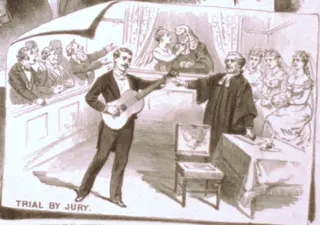
 Trial by Juryby W. S. Gilbert and Arthur SullivanA jilted bride sues for breach of promise, and the Judge falls for her himself.
 The Yeomen of the Guardby W. S. Gilbert and Arthur SullivanA colonel condemned to die in the Tower marries a strolling singer blindfold, then escapes and woos her in disguise.
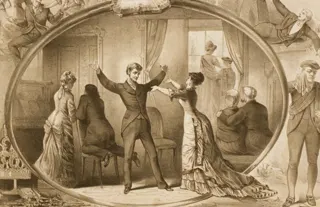 Engagedby W. S. GilbertA young man proposes to every woman he meets, and Scotland's marriage laws catch up with him.
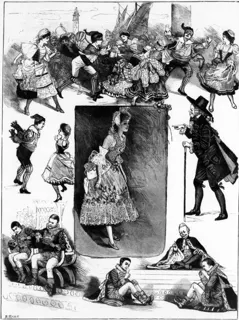 The Gondoliersby W. S. Gilbert and Arthur SullivanOne of two gondolier brothers is the King of Barataria, but nobody knows which, and the king was married as a baby.

Act 1, Scene 1
Date--1844
SCENE.--The Garden of a pretty Country Villa, The house is new, and the garden shows signs of having been recently laid out; the shrubs are small, and the few trees about are moderate in size; small creepers are trained against the house; an open country in the distance; a little bridge over a stream forms the entrance to the garden.
WILCOX is discovered seated on edge of garden wheelbarrow, preparing his “bass” for tying up plants; he rises and comes down with sycamore sapling in his hand; it is carefully done up in matting, and has a direction label attached to it.
[reading the label]. “For Miss Northcott, with Mr. Spreadbrow’s kindest regards.” “Acer Pseudo Platanus.” Ay, Ay! sycamore, I suppose, though it ain’t genteel to say so. Humph! sycamores are common enough in these parts; there ain’t no call, as I can see, to send a hundred and twenty mile for one. Ah, Mr. Spreadbrow, no go--no go; it ain’t to be done with “Acer Pseudo Platanuses.” Miss Jenny’s sent better men nor you about their business afore this, and as you’re agoin’ about your’n of your own free will to-night, and a good long way too, why I says, no go, no go! If I know Miss Jenny, she’s a good long job, and you’ve set down looking at your work too long; and now that it’s come to going, you’ll need to hurry it; and Miss Jenny ain’t a job to be hurried over, bless her. Take another three months, and I don’t say there mightn’t be a chance for you; but it’ll take all that--ah, thank goodness, it’ll take all that!
Enter JENNY from behind the house, prepared for gardening.
Well, Wilcox, what have you got there? [He touches his forehead and gives her the sycamore] Not my sycamore?
Yes, miss; Mr. Spreadbrow left it last night as the mail passed.
Then he’s returned already? Why, he was not expected for a week, at least.
He returned quite sudden last night, and left this here plant, with a message that he would call at twelve o’clock to-day, miss.
I shall be very glad to see him. So this is really a shoot of the dear old tree!
Come all the way from Lunnon, too. There’s lots of ’em hereabouts, miss; I could ha’ got you a armful for the asking.
Yes, I dare say; but this comes from the dear old house at Hampstead.
Do it, now?
You remember the old sycamore on the lawn where Mr. Spreadbrow and I used to sit and learn our lessons years ago?--well, this is a piece of it. And as Mr. Spreadbrow was going to London, I asked him to be so kind as to call, and tell the new people, with his compliments, that he wanted to cut a shoot from it for a young lady who had a very pleasant recollection of many very happy hours spent under it. It was an awkward thing for a nervous young gentleman to do, and it’s very kind of him to have done it. [Gives back the plant, which he places against upper porch of house] So he’s coming this morning?
Yes, miss, to say good-bye.
[busies herself at stand of flowers]. Good-bye! “How d’ye do?” you mean.
No, miss, good-bye. I hear Mr. Spreadbrow’s off to Ingy.
Yes; I believe he is going soon.
Soon? Ah, soon enough! He joins his ship at Southampton to-night--so he left word yesterday.
To-night? No; not for some weeks yet? [Alarmed]
To-night, miss. I had it from his own lips, and he’s coming to-day to say good-bye.
[aside]. To-night!
And a good job too, say I, though he’s a nice young gentleman too.
I don’t see that it’s a good job.
I don’t want no young gentleman hanging about here, miss. I know what they comes arter;--they comes arter the flowers.
The flowers? What nonsense!
No, it ain’t nonsense. The world’s a haphazard garden where common vegetables like me, and hardy annuals like my boys, and sour crabs like my old ’ooman, and pretty delicate flowers like you and your sisters grow side by side. It’s the flowers they come arter.
Really, Wilcox, if papa don’t object I don’t see what you have to do with it.
No, your pa don’t object; but I can’t make your pa out, miss. Walk off with one of his tuppenny toolips and he’s your enemy for life. Walk off with one of his darters and he settles three hundred a year on you. Tell ’ee what, miss; if I’d a family of grown gals like you, I’d stick a conservatory label on each of them--“Please not to touch the specimens!”--and I’d take jolly good care they didn’t.
At all events, if Mr. Spreadbrow is going away to-night, you need not be alarmed on my account. I am a flower that is not picked in a minute.
Well said, miss! And as he is going, and as you won’t see him no more, I don’t mind saying that a better-spoken young gentleman I don’t know. A good, honest, straightfor’ard young chap he is--looks you full in the face with eyes that seem to say, “I’m a open book--turn me over--look me through and through--read every page of me, and if you find a line to be ashamed on, tell me of it, and I’ll score it through.”
[demurely], I dare say Mr. Spreadbrow is much as other young men are.
As other young men? No, no--Lord forbid, miss! Come--say a good word for him, miss, poor young gentleman. He’s said many a good word of you, I’ll go bail.
Of me?
[takes ladder which is leaning against the house and places it against upper porch of house, and, going a little way up it, speaks this speech from it, JENNY remains seated] Ay. Why, only Toosday, when I was at work again the high road, he rides up on his little bay ’oss, and he stands talking to me over the hedge and straining his neck to catch a sight of you at a window; that was Toosday. “Well, Wilcox,” says he, “it’s a fine day!”--it rained hard Toosday, but it’s always a fine day with him. “How’s Miss Northcott?” says he. “Pretty well, sir,” says I. “Pretty she always is; and well she ought to be if the best of hearts and the sweetest of natures will do it!” Well, I knew that, so off I goes to another subject, and tries to interest him in drainage, and subsoils, and junction pipes; but no, nothin’ would do for him, but he must bring the talk back to you. So at last I gets sick of it, and I up and says: “Look ye here, Mr. Spreadbrow,” says I, “I’m only the gardener. This is Toosday, and Miss Northcott’s pa’s in the study, and I dessay he’ll be happy to hear what you’ve got to say about her.” Lord, it’d ha’ done your heart good to see how he flushed up as he stuck his spurs into the bay and rode off fifteen miles to the hour. [Laughing] That was Toosday.
[very angrily]. He had no right to talk about me to a servant.
[coming down from ladder]. But, bless you, don’t be hard on him, he couldn’t help it, miss. But don’t you be alarmed, he’s going away to-night, for many and many a long year, and you won’t never be troubled with him again. He’s going with a heavy heart, take my word for it, and I see his eyes all wet, when he spoke about saying good-bye to you; he’d the sorrow in his throat, but he’s a brave lad, and he gulped it down, though it was as big as an apple. [Ring] There he is. Soothe him kindly, miss--don’t you be afraid, you’re safe enough--he’s a good lad, and he can’t do no harm now. [Exit WILCOX.
What does he want to go to-day for? he wasn’t going for three months. He could remain if he liked; India has gone on very well without him for five thousand years: it could have waited three months longer; but men are always in such a hurry. He might have told me before--he would have done so if he really, really liked me! I wouldn’t have left him--yes I would--but then that’s different. Well, if some people can go, some people can remain behind, and some other people will be only too glad to find some people out of their way!
Enter SPREADBROW, followed by WILCOX.
[suddenly changes her manner, rises and crosses]. Oh, Mr. Spreadbrow, how-d’ye-do? Quite well? I’m so glad! Sisters quite well? That’s right--how kind of you to think of my tree! So you are really and truly going to India to-night? That is sudden!
Yes, very sudden--terribly sudden. I only heard of my appointment two days ago, in London, and I’m to join my ship to-night. It’s very sudden indeed--and--and I’ve come to say good-bye.
Good-bye. [Offering her hand]
Oh, but not like that, Jenny! Are you in a hurry?
Oh dear no, I thought you were; won’t you sit down? [They sit] And so your sisters are quite well?
Not very; they are rather depressed at my going so soon. It may seem strange to you, but they will miss me.
I’m sure they will. I should be terribly distressed at your going--if I were your sister. And you’re going for so long!
I’m not likely to return for a great many years.
[with a little suppressed emotion]. I’m so sorry we shall not see you again. Papa will be very sorry.
More sorry than you will be?
Well, no, I shall be very sorry, too--very, very sorry--there!
How very kind of you to say so.
We have known each other so long--so many years, and we’ve always been good friends, and it’s always sad to say good-bye for the last time [he is delighted] to anybody! [he relapses]. It’s so very sad when one knows for certain that it must be the last time.
I can’t tell you how happy I am to hear you say it’s so sad. But [hopefully] my prospects are not altogether hopeless, there’s one chance for me yet. I’m happy to say I’m extremely delicate, and there’s no knowing, the climate may not agree with me, and I may be invalided home! [very cheerfully].
Oh! but that would be very dreadful.
Oh, yes, of course it would be dreadful in one sense; but it--it would have its advantages. [Looking uneasily at WILCOX, who is hard at work] Wilcox is hard at work, I see.
Oh, yes, Wilcox is hard at work. He is very industrious.
Confoundedly industrious! He is working in the sun without his hat. [Significantly]
Poor fellow.
Isn’t it injudicious, at his age?
Oh, I don’t think it will hurt him.
I really think it will. [He motions to her to send him away]
Do you? Wilcox, Mr. Spreadbrow is terribly distressed because you are working in the sun.
That’s mortal good of him. [Aside, winking] They want me to go. All right; he can’t do much harm now. [Aloud] Well, sir, the sun is hot, and I’ll go and look after the cucumbers away yonder, right at the other end of the garden. [WILCOX going--SPREADBROW is delighted]
No, no, no!--don’t go away! Stop here, only put on your hat. That’s what Mr. Spreadbrow meant. [WILCOX puts on his hat] There, now are you happy?
I suppose it will soon be his dinner-time?
Oh, he has dined. You have dined, haven’t you, Wilcox?
Oh, yes, miss, I’ve dined, thank ye kindly.
Yes; he has dined! Oh! I quite forgot!
What?
I must interrupt you for a moment, Wilcox; I quite forgot that I promised to send some flowers to Captain Dampier this afternoon. Will you cut them for me?
Yes, miss, [knowingly]. Out of the conservatory, I suppose, miss? [WILCOX going, SPREADBROW again delighted]
No, these will do. [Pointing to open-air flower beds--SPREADBROW again disappointed] Stop, on second thoughts perhaps you had better take them out of the conservatory, and cut them carefully--there’s no hurry.
[aside] I understand! Well, poor young chap, let him be, let him be; he’s going to be turned off to-night, and his last meal may as well be a hearty one. [Exit WILCOX.
[rises in great delight]. How good of you--how very kind of you!
To send Captain Dampier some flowers?
[much disappointed]. Do you really want to send that fellow some flowers?
To be sure I do. Why should I have asked Wilcox to cut them?
I thought--I was a great fool to think so--but I thought it might have been because we could talk more pleasantly alone.
I really wanted some flowers; but, as you say, we certainly can talk more pleasantly alone. [She busies herself with preparing the sycamore]
I’ve often thought that nothing is such a check on--pleasant conversation--as the presence of--of--a gardener--who is not interested in the subject of conversation.
[gets the tree, and cuts off the matting with which it is bound with garden scissors which she has brought with her from the table]. Oh, but Wilcox is very interested in everything that concerns you. Do let me call him back.
No, no; not on my account!
He and I were having quite a discussion about you when you arrived. [Digging a hole for tree]
About me?
Yes; indeed we almost quarrelled about you.
What, was he abusing me then?
Oh, no; he was speaking of you in the highest terms.
[much taken aback]. Then--you were abusing me!
N--no, not exactly that; I--I didn’t agree with all he said--[he is much depressed, she notices this] at least, not openly.
[hopefully]. Then you did secretly?
I shan’t tell you.
Why?
Because it will make you dreadfully vain. There!
[delighted]. Very--very dreadfully vain? [he takes her hand].
Very dreadfully vain indeed. Don’t! [Withdraws her hand. During this she is digging the hole, kneeling on the edge of the flower bed; he advances to her and kneels on edge of bed near her]
Do you know it’s most delightful to hear you say that? It’s without exception the most astonishingly pleasant thing I’ve ever heard in the whole course of my life! [Sees the sycamore] Is that the tree I brought you? [Rises from his knees]
Yes. I’m going to plant it just in front of the drawing-room window, so that I can see it whenever I look out. Will you help me? [He prepares to do so; she puts it into the hole] Is that quite straight? Hold it up, please, while I fill in the earth. [He holds it while she fills in the earth; gradually his hand slips down till it touches hers] It’s no use, Mr. Spreadbrow, our both holding it in the same place! [He runs his hand up the stem quickly]
I beg your pardon--very foolish of me.
Very.
I’m very glad there will be something here to make you think of me when I’m many many thousand miles away, Jenny. For I shall be always thinking of you.
Really, now that’s very nice! It will be so delightful, and so odd to know that there’s somebody thinking about me right on the other side of the world!
[sighing]. Yes. It will be on the other side of the world!
But that’s the delightful part of it--right on the other side of the world! It will be such fun!
Fun!
Of course, the farther you are away the funnier it will seem. [He is approaching her again] Now keep on the other side of the world. It’s just the distance that gives the point to it. There are dozens and dozens of people thinking of me close at hand. [She rises]
[taking her hand]. But not as I think of you, Jenny--dear, dear Jenny--not as I’ve thought of you for years and years, though I never dared tell you so till now. I can’t bear to think that anybody else is thinking of you kindly, earnestly, seriously, as I think of you.
[earnestly]. You may be quite sure, Harry, quite, quite sure that you will be the only one who is thinking of me kindly, seriously, and earnestly [he is delighted] in India. [He relapses--she withdraws her hand]
And when this tree, that we have planted together, is a big tree, you must promise me that you will sit under it every day, and give a thought now and then to the old playfellow who gave it to you.
A big tree! Oh, but this little plant will never live to be a big tree, surely?
Yes, if you leave it alone, it grows very rapidly.
Oh, but I’m not going to have a big tree right in front of the drawing-room window! It will spoil the view, it will be an eyesore. We had better plant it somewhere else.
[bitterly]. No, let it be, you can cut it down when it becomes an eyesore. It grows very rapidly, but it will, no doubt, have lost all interest in your eyes long before it becomes an eyesore.
But Captain Dampier says that a big tree in front of a window checks the current of fresh air.
Oh, if Captain Dampier says so, remove it.
Now don’t be ridiculous about Captain Dampier; I’ve a very great respect for his opinion on such matters.
I’m sure you have. You see a great deal of Captain Dampier, don’t you?
Yes, and we shall see a great deal more of him; he’s going to take the Grange next door.
[bitterly]. That will be very convenient.
[demurely]. Very.
[jealously]. You seem to admire Captain Dampier very much.
I think he is very good-looking. Don’t you?
He’s well enough--for a small man.
Perhaps he’ll grow.
Is Captain Dampier going to live here always?
Yes, until he marries.
[eagerly]. Is--is he likely to marry?
I don’t know. [Demurely] Perhaps he may.
But whom--whom?
[bashfully]. Haven’t you heard? I thought you knew!
[excitedly]. No, no, I don’t know; I’ve heard nothing. Jenny--dear Jenny--tell me the truth, don’t keep anything from me, don’t leave me to find it out; it will be terrible to hear of it out there; and, if you have ever liked me--and I’m sure you have--tell me the whole truth at once!
[bashfully]. Perhaps, as an old friend, I ought to have told you before; but indeed, indeed I thought you knew. Captain Dampier is engaged to be married to--to--my cousin Emmie.
[intensely relieved]. To your cousin Emmie. Oh, thank you, thank you, thank you! Oh, my dear, dear Jenny, do--do let me take your hand. [Takes her hand and shakes it enthusiastically]
Are you going?
No. [Releasing it--much cast down] I was going to ask you to do me a great favour, and I thought I could ask it better if I had hold of your hand. I was going to ask you if you would give me a flower--any flower, I don’t care what it is.
[affecting surprise]. A flower? Why, of course I will. But why?
[earnestly]. That I may have a token of you and of our parting wherever I go; that I may possess an emblem of you that I shall never--never part with, that I can carry about with me night and day wherever I go, throughout my whole life.
[apparently much affected, crosses slowly, stoops and takes up large geranium in pot]. Will this be too big?
[disconcerted]. But I mean a flower--only a flower.
Oh, but do have a bunch! Wilcox shall pick you a beauty.
No, no; I want you to pick it for me. I don’t care what it is--a daisy will do--if you pick it for me!
What an odd notion! [Crossing to flower-stand, and picking a piece of mignonette--he puts down flower-pot by bed] There! [picking a flower and giving it to him] will that do?
I can’t tell you how inestimably I shall prize this flower. I will keep it while I live, and whatever good fortune may be in store for me, nothing can ever be so precious in my eyes.
I had no idea you were so fond of flowers. Oh, do have some more!
No, no--but--you must let me give you this in return; I brought it for you, Jenny dear--dear Jenny! Will you take it from me? [Takes a rose from his button-hole, and offers it]
[amused and surprised]. Oh yes! [Takes it and puts it down on the table carelessly--he notices this with much emotion]
Well, I’ve got to say good-bye; there’s no reason why it shouldn’t be said at once. [Holding out his hand] Good-bye, Jenny!
[cheerfully]. Good-bye! [He stands for a moment with her hand in his--she crosses to porch]
Haven’t--haven’t you anything to say to me?
[after thinking it over]. No, I don’t think there’s anything else. No--nothing. [She leans against the porch--he stands over her]
Jenny, I’m going away to-day, for years and years, or I wouldn’t say what I’m going to say--at least not yet. I’m little more than a boy, Jenny; but if I were eighty, I couldn’t be more in earnest--indeed I couldn’t! Parting for so many years is like death to me; and if I don’t say what I’m going to say before I go, I shall never have the pluck to say it after. We were boy and girl together, and--and I loved you then--and every year I’ve loved you more and more; and now that I’m a man, and you are nearly a woman, I--I--Jenny dear--I’ve nothing more to say!
How you astonish me!
Astonish you? Why, you know that I loved you.
Yes, yes; as a boy loves a girl--but now that I am a woman it’s impossible that you can care for me.
Impossible--because you are a woman!
You see it’s so unexpected.
Unexpected?
Yes. As children it didn’t matter, but it seems so shocking for grown people to talk about such things. And then, not gradually, but all at once--in a few minutes. It’s awful!
Oh, Jenny, think. I’ve no time to delay--my having to go has made me desperate. One kind word from you will make me go away happy: without that word, I shall go in unspeakable sorrow. Jenny, Jenny, say one kind word!
[earnestly]. Tell me what to say?
It must come from you, my darling; say whatever is on your lips--whether for good or ill--I can bear it now.
Well, then: I wish you a very very pleasant voyage--and I hope you will be happy and prosperous--and you must take great care of yourself--and you can’t think how glad I shall be to know that you think of me, now and then, in India. There!
Is that all?
Yes, I think that’s all. [Reflectively] Yes--that’s all.
Then--[with great emotion which he struggles to suppress] there’s nothing left but to say good-bye--[Music in orchestra till end of Act, “Good-bye, Sweetheart”]--and I hope you will always be happy, and that, when you marry, you will marry a good fellow who will--who will--who will---- Good-bye! [Exit, rapidly.
JENNY watches him out--sits down, leaving the gate open--hums an air gaily--looks round to see if he is coming back--goes on humming--takes up the flower he has given her--plays with it--gradually falters, and at last bursts into tears, laying her head on the table over the flower he has given her, and sobbing violently.
Act 2, Scene 1
SCENE.--The same as in Act I., with such additions and changes as may be supposed to have taken place in thirty years. The house, which was bare in Act I., is now entirely covered with Virginia and other creepers; the garden is much more fully planted than in Act I., and trees that were small in Act I. are tall and bushy now; the general arrangement of the garden is the same, except that the sycamore planted in Act I. has developed into a large tree, the boughs of which roof in the stage; the landscape has also undergone a metamorphosis, inasmuch as that which was open country in Act I. is now covered with picturesque semi-detached villas, and there are indications of a large town in the distance. The month is September, and the leaves of the Virginia creepers wear their autumn tint
JENNY discovered seated on a bench at the foot of the tree, and RUTH is standing by her side, holding a skein of cotton, which JENNY is winding. JENNY is now a pleasant-looking middle-aged lady.
Have you any fault to find with poor Tom?
No, miss, I’ve no fault to find with Tom. But a girl can’t marry every young man she don’t find fault with, can she now, miss?
Certainly not, Ruth. But Tom seems to think you have given him some cause to believe that you are fond of him.
[bridling up] It’s like his impudence, miss, to say so! Fond of him indeed!
He hasn’t said so, Ruth, but I’m quite sure he thinks so. I have noticed of late that you have taken a foolish pleasure in playing fast and loose with poor Tom, and this has made him very unhappy--very unhappy indeed; so much so that I think it is very likely that he will make up his mind to leave my service altogether.
[piqued] Oh, miss, if Tom can make up his mind to go, I’m sure I wouldn’t stand in his way for worlds.
But I think you would be sorry if he did.
Oh yes, miss, I should be sorry to part with Tom!
Then I think it’s only right to tell you that the foolish fellow talks about enlisting for a soldier, and if he does it at all, he will do it to-night.
[with some emotion] Oh, miss, for that, I do like Tom very much indeed; but if he wants to ’list, of course he’s his own master, and if he’s really fond of me, what does he want to go and ’list for? [Going to cry] One would think he would like to be where he could talk to me, and look at me--odd times! I’m sure I don’t want Tom to go and ’list!
Then take the advice of an old lady, who knows something of these matters, and tell him so before it’s too late--you foolish, foolish girl! Ah, Ruth, I’ve no right to be hard on you! I’ve been a young and foolish girl like yourself in my time, and I’ve done many thoughtless things that I’ve learnt to be very sorry for. I’m not reproaching you--but I’m speaking to you out of the fulness of my experience, and take my word for it, if you treat poor Tom lightly, you may live to be very sorry for it too! [Taking her hand] There, I’m not angry with you, my dear, but if I’d taken the advice I’m giving you, I shouldn’t be a lonely old lady at a time of life when a good husband has his greatest value. [Ring] Go and see who’s at the gate!
Exit JENNY. RUTH goes to the gate, wiping her eyes on her apron--she opens it.
Enter SPREADBROW [now SIR HENRY].
My dear, is this Mr. Braybrook’s?
Yes, sir.
Is he at home?
No, sir, he is not; but mistress is.
Will you give your mistress my card? [Feeling for his card-case] Dear me, I’ve left my cards at home! Never mind--will you tell your mistress that a gentleman will be greatly indebted to her, if she will kindly spare him a few minutes of her time? Do you think you can charge yourself with that message?
Mistress is in the garden, sir; I’ll run and tell her, if you’ll take a seat. [Exit RUTH.
That’s a good girl! [He sits on seat] I couldn’t make up my mind to pass the old house without framing an excuse to take a peep at it. [Looks round] Very nice--very pretty--but, dear me, on a very much smaller scale than I fancied. Remarkable changes in thirty years! [Rises and walks round trees, looking about] Why, the place is a town, and a railway runs right through it. And this is really the old garden in which I spent so many pleasant hours? Poor little Jenny!--I wonder what’s become of her? Pretty little girl, but with a tendency to stoutness; if she’s alive, I’ll be bound she’s fat. So this is Mr. Braybrook’s, is it? I wonder who Braybrook is--I don’t remember any family of that name hereabouts. [Looking off] This, I suppose, is Mrs. Braybrook. Now, how in the world am I to account for my visit?
Enter JENNY--she curtsies formally, he bows.
I beg your pardon, I hardly know how to explain this intrusion. Perhaps I had better state my facts, they will plead my apology:--I am an old Indian civilian, who, having returned to England after many years’ absence, is whiling away a day in his native place, and amusing himself with polishing old memories--bright enough once, but sadly tarnished--sadly tarnished!
Indeed? May I hope that you have succeeded?
Indifferently well--indifferently well. The fact is, I hardly know where I am, for all my old landmarks are swept away; I assure you I am within the mark, when I say that this house is positively the only place I can identify.
The town has increased very rapidly of late.
Rapidly! When I left, there were not twenty houses in the place, but [politely] that was long before your time. I left a village, I find a town--I left a beadle, I find a mayor and corporation--I left a pump, I find a statue to a borough member. The inn is a “Palace Hotel Company--” the alms-house a county jail--the pound is a police station, and the common a colony of semi-detached bungalows! Everything changed, including myself--everything new, except myself--ha, ha!
I shall be glad to offer you any assistance in my power, I should be a good guide, for I have lived here thirty-two years!
Thirty-two years! is it possible? Then surely I ought to know you? [He feels for his glasses] My name is Spreadbrow--Sir Henry Spreadbrow!
Spreadbrow! [Putting on spectacles] Is it possible? Why, my very dear old friend [offering both her hands], don’t you recollect me?
[he puts on his double eye-glass, takes both her hands]. God bless me!--is it possible?--and this is really you!--you don’t say so! Dear me, dear me! Well, well, well! I assure you I am delighted, most unaffectedly delighted, to renew our friendship! [Shaking hands again, they sit under tree and look at each other curiously]
Not changed a bit! My dear Jane, you really must allow me. [They shake hands again] And now tell me, how is Mr. Braybrook?
[rather surprised]. Oh, Mr. Braybrook is very well; I expect him home presently; he will be very glad to see you, for he has often heard me speak of you.
Has he indeed? It will give me the greatest--the very greatest possible pleasure, believe me [very emphatically], to make his acquaintance.
[still surprised at his emphatic manner]. I’m sure he will be delighted.
Now tell me all about yourself. Any family?
[puzzled]. I beg your pardon?
Any family?
Mr. Braybrook?
Well--yes.
Mr. Braybrook is a bachelor.
A bachelor? Then let me understand--am I not speaking to Mrs. Braybrook?
No, indeed you are not! Ha, ha! [much amused]. Mr. Braybrook is my nephew; the place belongs to him now.
Oh! then, my dear Jane, may I ask who you are?
I am not married.
Not married!
No; I keep house for my nephew.
Why, you don’t mean to sit there and look me in the face and tell me, after thirty years, that you are still Jane Northbrook?
[rather hurt at the mistake]. Northcott.
Northcott, of course. I beg your pardon--I should have said Northcott. And you are not Mrs. Braybrook? You are not even married! Why, what were they about--what were they about? Not married! Well, now, do you know, I am very sorry to hear that. I am really more sorry and disappointed than I can tell you. [She looks surprised and rather hurt] You’d have made an admirable wife, Jane, and an admirable mother. I can’t tell you how sorry I am to find that you are still Jane Northbrook--I should say, Northcott.
The same in name--much changed in everything else. [Sighing]
Changed? Not a bit--I won’t hear of it. I knew you the moment I saw you! We are neither of us changed. Mellowed perhaps--a little mellowed, but what of that? Who shall say that the blossom is pleasanter to look upon than the fruit? Not I for one, Jane--not I for one.
Time has dealt very kindly with us, but we’re old folks now, Henry Spreadbrow. [Rises]
I won’t allow it, Jane--I won’t hear it. [Rises] What constitutes youth? A head of hair? Not at all; I was as bald as an egg at five and twenty--babies are always bald. Eyesight? Some people are born blind. Years? Years are an arbitrary impertinence. Am I an old man or you an old woman, because the earth contrives to hurry round the sun in three hundred and sixty-five days? Why, Saturn can’t do it in thirty years. If I had been born on Saturn I should be two years old, ma’am--a public nuisance in petticoats. Let us be thankful that I was not born on Saturn. No--no, as long as I can ride to cover twice a week, walk my five and twenty miles without turning a hair, go to bed at twelve, get up at six, turn into a cold tub and like it, I’m a boy, Jane--a boy--a boy!
And you are still unmarried?
I? Oh dear, yes--very much so. No time to think of marriage. Plenty of opportunity, mind, but no leisure to avail myself of it. I’ve had a bustling time of it, I assure you, Jane, working hard at the Bar and on the Bench, with some success--with some success; [sits again] and now that I’ve done my work, I throw myself back in my easy-chair, fold my hands, cross my legs, and prepare to enjoy myself. Life is before me, and I’m going to begin it. Ha, ha! And so we are really Jane Northcott still?
Still Jane Northcott.
I’m indignant to hear it--I assure you that I am positively indignant to hear it. You would have made some fellow so infernally happy; [rises] I’m sorry for that fellow’s sake--I don’t know him, but still I am sorry. Ah, I wish I had remained in England. I do wish, for the very first time since I left it, that I had remained in England.
Indeed! And why?
Why? Because I should have done my best to remove that reproach from society. I should indeed, Jane! Ha, ha! After all, it don’t much matter, for you wouldn’t have had me. Oh yes! you had no idea of it; but, do you know, I’ve a great mind to tell you--I will tell you. Do you know, I was in love with you at one time. Boy and girl, you know--boy and girl. Ha, ha! you’d no idea of it, but I was!
[in wonder]. Oh yes; I knew it very well.
[much astonished]. You knew it? You knew that I was attached to you!
Why, of course I did!
Did you, indeed! Bless me, you don’t say so! Now that’s amazingly curious. Leave a woman alone to find that out! It’s instinctive, positively instinctive. Now, my dear Jane, I’m a very close student of human nature, and in pursuit of that study I should like above all things to know by what signs you detected my secret admiration for you. [Takes her hand]
Why, bless the man! There was no mystery in the matter! You told me all about it!
I told you all about it?
Certainly you did--here, in this garden.
That I admired you--loved you?
Most assuredly! Surely you’ve not forgotten it. [He drops her hand] I haven’t.
I remember that I had the impertinence to be very fond of you. I forgot that I had the impertinence to tell you so. I remember it now. I made a fool of myself. I remember it by that. I told you that I adored you, didn’t I?--that you were as essential to me as the air I breathed--that it was impossible to support existence without you--that your name should be the most hallowed of earthly words, and so forth. Ha, ha! my dear Jane, before I’d been a week on board I was saying the same thing to a middle-aged governess whose name has entirely escaped me. [She has exhibited signs of pleasure during the earlier part of this speech, and disappointment at the last two lines] What fools we make of ourselves!
And of others!
Oh, I meant it, Jane; I meant every word I said to you.
And the governess?
And the governess! I would have married you, Jane.
And the governess?
And the governess! I’d have married her, if she had accepted me--but she didn’t. Perhaps it was as well--she was a widow with five children--I cursed my destiny at the time, but I’ve forgiven it since. I talked of blowing out my brains. I’m glad I didn’t do it, as I’ve found them useful in my profession. Ha! ha! [Looking round; JENNY stands watching him] The place has changed a good deal since my time--improved--improved--we’ve all three improved. I don’t quite like this tree, though--it’s in the way. What is it? A kind of beech, isn’t it?
No, it’s a sycamore.
Ha! I don’t understand English trees--but it’s a curious place for a big tree like this, just outside the drawing-room window. Isn’t it in the way?
It is rather in the way.
I don’t like a tree before a window, it checks the current of fresh air--don’t you find that?
It does check the current of fresh air.
Then the leaves blow into the house in autumn, and that’s a nuisance--and besides, it impedes the view.
It is certainly open to these objections.
Then cut it down, my dear Jane. Why don’t you cut it down?
Cut it down! I wouldn’t cut it down for worlds. That tree is identified in my mind with many happy recollections.
Remarkable the influence exercised by associations over a woman’s mind. Observe--you take a house, mainly because it commands a beautiful view. You apportion the rooms principally with reference to that view. You lay out your garden at great expense to harmonize with that view, and, having brought that view into the very best of all possible conditions for the full enjoyment of it, you allow a gigantic and wholly irrelevant tree to block it all out for the sake of the sentimental ghost of some dead and gone sentimental reality! Take my advice and have it down. If I had had anything to do with it, you would never have planted it. I shouldn’t have allowed it!
You had so much to do with it that it was planted there at your suggestion.
At mine? Never saw it before in my life.
We planted it together thirty years ago--the day you sailed for India.
It appears to me that that was a very eventful day in my career. We planted it together! I have no recollection of having ever planted a gigantic sycamore anywhere. And we did it together! Why, it would take a dozen men to move it.
It was a sapling then--you cut it for me.
[suddenly and with energy]. From the old sycamore in the old garden at Hampstead! Why, I remember; I went to London expressly to get it for you. [Laughing--sitting on her left] And the next day I called to say good-bye, and I found you planting it, and I helped; and as I was helping I found an opportunity to seize your hand. [Does so] I grasped it--pressed it to my lips--[does so], and said, “My dear, dear Jenny” [he drops her hand suddenly], and so forth. Never mind what I said--but I meant it--I meant it! [Laughs heartily--she joins him, but her laughter is evidently forced--eventually she shows signs of tears, which he doesn’t notice] It all comes back with a distinctness which is absolutely photographic. I begged you to give me a flower--you gave me one--a sprig of geranium.
Mignonette.
Was it mignonette? I think you’re right--it was mignonette. I seized it--pressed it to my trembling lips--placed it next my fluttering heart, and swore that come what might I would never, never part with it!--I wonder what I did with that flower!--And then I took one from my button hole--begged you to take it--you took it, and--ha, ha, ha!--you threw it down carelessly on the table, and thought no more about it, you heartless creature--ha, ha, ha! Oh, I was very angry! I remember it perfectly; it was a camellia.
[half crying aside]. Not a camellia, I think.
Yes, a camellia, a large white camellia.
I don’t think it was a camellia; I rather think it was a rose.
Nonsense, Jane--come, come, you hardly looked at it, miserable little flirt that you were; and you pretend, after thirty years, to stake your recollection of the circumstance against mine? No, no, Jane, take my word for it, it was a camellia.
I’m sure it was a rose!
No, I’m sure it was a camellia.
[in tears]. Indeed--indeed, it was a rose. [Produces a withered rose from a pocket-book--he is very much impressed--looks at it and at her, and seems much affected]
Why, Jane, my dear Jane, you don’t mean to say that this is the very flower?
That is the very flower! [Rising]
Strange! You seemed to attach no value to it when I gave it to you, you threw it away as something utterly insignificant; and when I leave, you pick it up, and keep it for thirty years! [Rising] My dear Jane, how like a woman!
And you seized the flower I gave you--pressed it to your lips, and swore that wherever your good or ill fortune might carry you, you would never part with it; and--and you quite forgot what became of it! My dear Harry, how like a man!
I was deceived, my dear Jane--deceived! I had no idea that you attached so much value to my flower.
We were both deceived, Henry Spreadbrow.
Then is it possible that in treating me as you did, Jane, you were acting a part?
We were both acting parts--but the play is over, and there’s an end of it. [With assumed cheerfulness] Let us talk of something else.
No, no, Jane, the play is not over--we will talk of nothing else--the play is not nearly over. [Music in orchestra, “John Anderson my Jo.”] My dear Jane--[rising and taking her hand], my very dear Jane--believe me, for I speak from my hardened old heart, so far from the play being over, the serious interest is only just beginning. [He kisses her hand--they walk towards the house]