
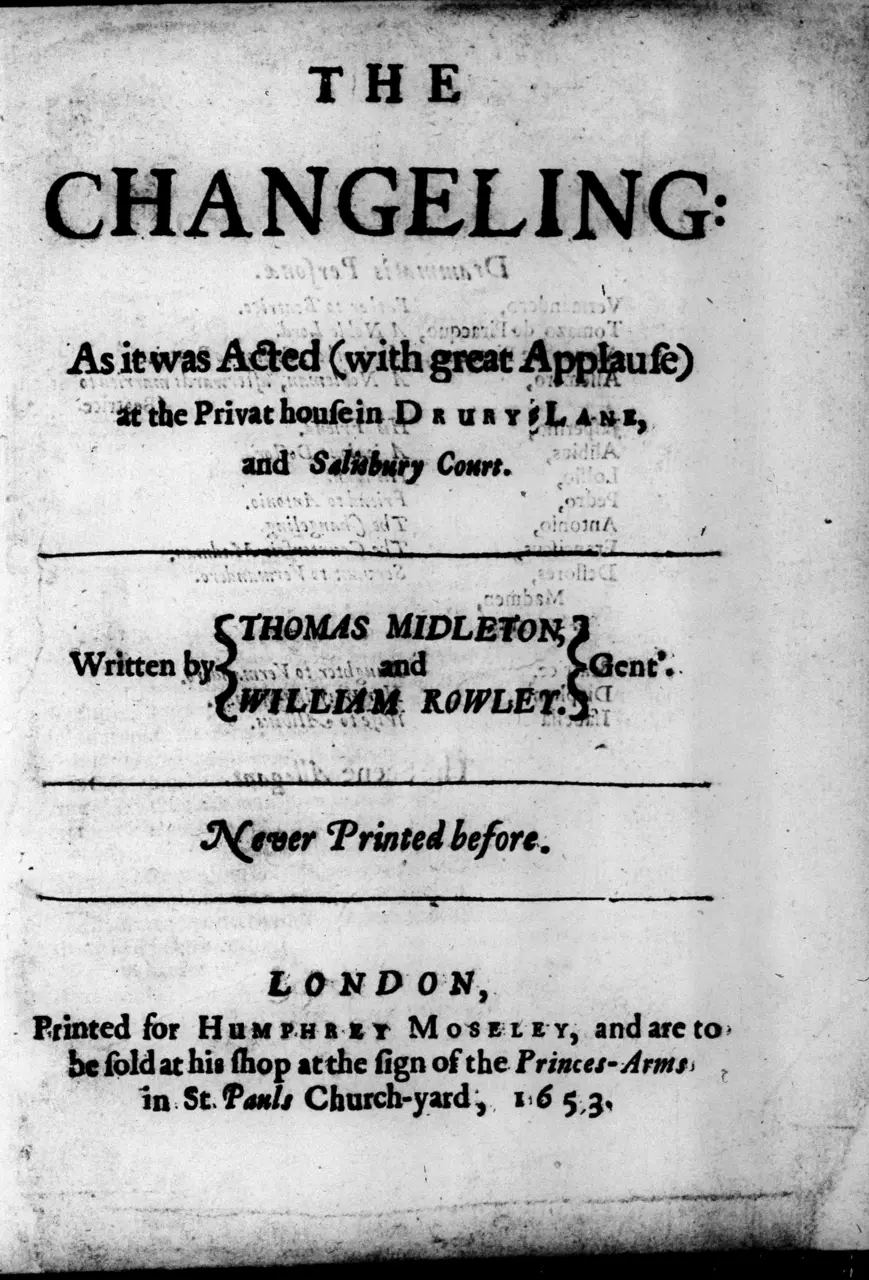
 The Revenger's Tragedyby Thomas MiddletonA man who has kept his poisoned betrothed's skull for nine years takes service as a pander at a corrupt court, and turns its lusts into his weapons.
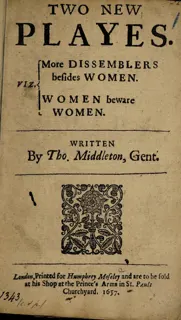 Women Beware Womenby Thomas MiddletonIn Florence, a duke takes a young factor's wife, and a worldly widow's schemes bring every family to ruin.
Act 1, Scene 1
Enter ALSEMERO.
’T was in the temple where I first beheld her,
And now again the same: what omen yet
Follows of that? None but imaginary.
Why should my hopes or fate be timorous?
The place is holy, so is my intent:
I love her beauties to the holy purpose;
And that, methinks, admits comparison
With man’s first creation, the place blessed,
And is his right home back, if he achieve it.
The church hath first begun our interview,
And that ’s the place must join us into one;
So there ’s beginning and perfection too.
Enter JASPERINO.
O sir, are you here? Come, the wind ’s fair with you;
You ’re like to have a swift and pleasant passage.
Sure, you’re deceived, friend, ’t is contrary,
In my best judgment.
What, for Malta?
If you could buy a gale amongst the witches,
They could not serve you such a lucky pennyworth
As comes a’ God’s name.
Even now I observ’d
The temple’s vane to turn full in my face;
I know it is against me.
Against you?
Then you know not where you are.
Not well, indeed.
Are you not well, sir?
Yes, Jasperino,
Unless there be some hidden malady
Within me, that I understand not.
And that
I begin to doubt, sir. I never knew
Your inclinations to travels at a pause
With any cause to hinder it, till now.
Ashore you were wont to call your servants up,
And help to trap your horses for the speed;
At sea I ’ve seen you weigh the anchor with ’em,
Hoist sails for fear to lose the foremost breath,
Be in continual prayers for fair winds;
And have you chang’d your orisons?
No, friend;
I keep the same church, same devotion.
Lover I ’m sure you’re none; the stoic was
Found in you long ago; your mother nor
Best friends, who have set snares of beauty, ay,
And choice ones too, could never trap you that way.
What might be the cause?
Lord, how violent
Thou art! I was but meditating of
Somewhat I heard within the temple.
Is this
Violence? ’T is but idleness compar’d
With your haste yesterday.
I ’m all this while
A-going, man.
Enter Servants.
Backwards, I think, sir. Look,
Your servants.
The seamen call; shall we board your trunks?
No, not to-day.
’T is the critical day, it seems, and the sign in Aquarius.
We must not to sea to-day; this smoke will bring forth fire.
Keep all on shore; I do not know the end,
Which needs I must do, of an affair in hand
Ere I can go to sea.
Well, your pleasure.
Let him e’en take his leisure too; we are safer on land.
[Exeunt Servants]
Enter BEATRICE, DIAPHANTA, and Servants ALSEMERO accosts BEATRICE and then kisses her.
[Aside] How now? The laws of the Medes are chang’d sure;
salute a woman! He kisses too; wonderful! Where learnt he this?
and does it perfectly too. In my conscience, he ne’er rehearst it
before. Nay, go on; this will be stranger and better news at Valencia
than if he had ransom’d half Greece from the Turk.
You are a scholar, sir?
A weak one, lady.
Which of the sciences is this love you speak of?
From your tongue I take it to be music.
You ’re skilful in it, can sing at first sight.
And I have show’d you all my skill at once;
I want more words to express me further,
And must be forc’d to repetition;
I love you dearly.
Be better advis’d, sir:
Our eyes are sentinels unto our judgments,
And should give certain judgment what they see;
But they are rash sometimes, and tell us wonders
Of common things, which when our judgments find,
They can then check the eyes, and call them blind.
But I am further, lady; yesterday
Was mine eyes’ employment, and hither now
They brought my judgment, where are both agreed.
Both houses then consenting, ’t is agreed;
Only there wants the confirmation
By the hand royal; that ’s your part, lady.
Oh, there ’s one above me, sir.—[Aside] For five days past
To be recall’d! Sure mine eyes were mistaken;
This was the man was meant me. That he should come
So near his time, and miss it!
We might have come by the carriers from Valencia, I see,
and sav’d all our sea-provision; we are at farthest sure. Methinks I
should do something too;
I meant to be a venturer in this voyage.
Yonder’s another vessel, I ’ll board her;
If she be lawful prize, down goes her topsail.
[Accosts DIAPHANTA]
Enter DE FLORES.
Lady, your father——
Is in health, I hope.
Your eye shall instantly instruct you, lady;
He ’s coming hitherward.
What needed then
Your duteous preface? I had rather
He had come unexpected; you must stall
A good presence with unnecessary blabbing;
And how welcome for your part you are,
I ’m sure you know.
[Aside] Will ’t never mend, this scorn,
One side nor other? Must I be enjoin’d
To follow still whilst she flies from me? Well,
Fates, do your worst, I ’ll please myself with sight
Of her at all opportunities,
If but to spite her anger. I know she had
Rather see me dead than living; and yet
She knows no cause for ’t but a peevish will.
You seem’d displeas’d, lady, on the sudden.
Your pardon, sir, ’t is my infirmity;
Nor can I other reason render you
Than his or hers, of some particular thing
They must abandon as a deadly poison,
Which to a thousand other tastes were wholesome;
Such to mine eyes is that same fellow there,
The same that report speaks of the basilisk.
This is a frequent frailty in our nature;
There ’s scarce a man amongst a thousand found
But hath his imperfection: one distastes
The scent of roses, which to infinites
Most pleasing is and odoriferous;
One oil, the enemy of poison;
Another wine, the cheerer of the heart
And lively refresher of the countenance.
Indeed this fault, if so it be, is general;
There ’s scarce a thing but is both lov’d and loath’d:
Myself, I must confess, have the same frailty.
And what may be your poison, sir? I ’m bold with you.
What might be your desire, perhaps; a cherry.
I am no enemy to any creature
My memory has, but yon gentleman.
He does ill to tempt your sight, if he knew it.
He cannot be ignorant of that, sir,
I have not spar’d to tell him so; and I want
To help myself, since he ’s a gentleman
In good respect with my father, and follows him.
He ’s out of his place then now. [They talk apart]
I am a mad wag, wench.
So methinks; but for your comfort, I can tell you, we have a
doctor in the city that undertakes the cure of such.
Tush, I know what physic is best for the state of mine own
body.
’T is scarce a well-govern’d state, I believe.
I could show thee such a thing with an ingredient that we two
would compound together, and if it did not tame the maddest
blood i’ th’ town for two hours after, I ’ll ne’er profess physic
again.
A little poppy, sir, were good to cause you sleep.
Poppy? I ’ll give thee a pop i’ th’ lips for that first, and
begin there. Poppy is one simple indeed, and cuckoo (what-you-call
’t) another. I ’ll discover no more now: another time I ’ll show thee
all. [Exit]
Enter VERMANDERO and Servants.
My father, sir.
O Joanna, I came to meet thee.
Your devotion ’s ended?
For this time, sir.—
[Aside] I shall change my saint, I fear me; I find
A giddy turning in me.—Sir, this while
I am beholding to this gentleman,
Who left his own way to keep me company,
And in discourse I find him much desirous
To see your castle. He hath deserv’d it, sir,
If ye please to grant it.
With all my heart, sir.
Yet there ’s an article between; I must know
Your country; we use not to give survey
Of our chief strengths to strangers; our citadels
Are plac’d conspicuous to outward view,
On promonts’ tops, but within our secrets.
A Valencian, sir.
A Valencian?
That ’s native, sir. Of what name, I beseech you?
Alsemero, sir.
Alsemero? Not the son
Of John de Alsemero?
The same, sir.
My best love bids you welcome.
He was wont
To call me so, and then he speaks a most
Unfeign’d truth.
O sir. I knew your father;
We two were in acquaintance long ago,
Before our chins were worth iulan down,
And so continued till the stamp of time
Had coin’d us into silver. Well, he ’s gone;
A good soldier went with him.
You went together in that, sir.
No, by Saint Jacques, I came behind him;
Yet I ’ve done somewhat too: an unhappy day
Swallowed him at last at Gibraltar,
In fight with those rebellious Hollanders.
Was it not so?
Whose death I had reveng’d,
Or followed him in fate, had not the late league
Prevented me.
Ay, ay, ’t was time to breathe.—
O Joanna, I should ha’ told thee news;
I saw Piracquo lately.
[Aside] That ’s ill news.
He ’s hot preparing for this day of triumph:
Thou must be a bride within this sevennight.
[Aside] Ha!
Nay, good sir, be not so violent; with speed
I cannot render satisfaction
Unto the dear companion of my soul,
Virginity, whom I thus long have liv’d with,
And part with it so rude and suddenly.
Can such friends divide, never to meet again,
Without a solemn farewell?
Tush, tush! there ’s a toy.
[Aside] I must now part, and never meet again
With any joy on earth.—Sir, your pardon;
My affairs call on me.
How, sir? By no means:
Not chang’d so soon, I hope? You must see my castle,
And her best entertainment, e’er we part;
I shall think myself unkindly us’d else.
Come, come, let ’s on; I had good hope your stay
Had been a while with us in Alicant;
I might have bid you to my daughter’s wedding.
[Aside] He means to feast me, and poisons me beforehand.—
I should be dearly glad to be there, sir,
Did my occasions suit as I could wish.
I shall be sorry if you be not there
When it is done, sir; but not so suddenly.
I tell you, sir, the gentleman ’s complete,
A courtier and a gallant, enricht
With many fair and noble ornaments;
I would not change him for a son-in-law
For any he in Spain, the proudest he,
And we have great ones, that you know.
He ’s much
Bound to you, sir.
He shall be bound to me
As fast as this tie can hold him; I ’ll want
My will else.
[Aside] I shall want mine, if you do it.
But come, by the way I ’ll tell you more of him.
[Aside] How shall I dare to venture in his castle,
When he discharges murderers at the gate?
But I must on, for back I cannot go.
[Aside] Not this serpent gone yet? [Drops a glove]
Look, girl, thy glove ’s fallen.
Stay, stay; De Flores, help a little.
Exeunt VERMANDERO, ALSEMERO, and Servants.
Here, lady. [Offers her the glove]
Mischief on your officious forwardness;
Who bade you stoop? They touch my hand no more:
There! For t’ other’s sake I part with this;
[Takes off and throws down the other glove]
Take ’em, and draw thine own skin off with ’em!
[Exit with DIAPHANTA and Servants]
Here ’s a favour come with a mischief now! I know
She had rather wear my pelt tann’d in a pair
Of dancing pumps, than I should thrust my fingers
Into her sockets here. I know she hates me,
Yet cannot choose but love her. No matter,
If but to vex her, I will haunt her still;
Though I get nothing else, I ’ll have my will. [Exit]
Act 1, Scene 2
Enter ALIBIUS and LOLLIO.
Lollio, I must trust thee with a secret,
But thou must keep it.
I was ever close to a secret, sir.
The diligence that I have found in thee,
The care and industry already past,
Assures me of thy good continuance.
Lollio, I have a wife.
Fie, sir, ’t is too late to keep her secret; she ’s known to
be married all the town and country over.
Thou goest too fast, my Lollio. That knowledge
I allow no man can be barr’d it;
But there is a knowledge which is nearer,
Deeper, and sweeter, Lollio.
Well, sir, let us handle that between you and I.
’T is that I go about, man. Lollio,
My wife is young.
So much the worse to be kept secret, sir.
Why, now thou meet’st the substance of the point;
I am old, Lollio.
No, sir, ’t is I am old Lollio.
Yet why may not this concord and sympathize?
Old trees and young plants often grow together,
Well enough agreeing.
Ay, sir, but the old trees raise themselves higher and broader
than the young plants.
Shrewd application! There ’s the fear, man;
I would wear my ring on my own finger;
Whilst it is borrowed, it is none of mine,
But his that useth it.
You must keep it on still then, if it but lie by, one or other
will be thrusting into ’t.
Thou conceiv’st me, Lollio; here thy watchful eye
Must have employment; I cannot always be
At home.
I dare swear you cannot.
I must look out.
I know ’t, you must look out; ’t is every man’s case.
Here, I do say, must thy employment be;
To watch her treadings, and in my absence
Supply my place.
I ’ll do my best, sir; yet surely I cannot
see who you should have cause to be jealous
of.
Thy reason for that, Lollio? It is
A comfortable question.
We have but two sorts of people in the
house, and both under the whip, that ’s fools
and madmen; the one has not wit enough to
be knaves, and the other not knavery enough
to be fools.
Ay, those are all my patients, Lollio;
I do profess the cure of either sort;
My trade, my living ’t is; I thrive by it;
But here ’s the care that mixes with my thrift:
The daily-visitants, that come to see
My brain-sick patients, I would not have
To see my wife. Gallants I do observe
Of quick enticing eyes, rich in habits,
Of stature and proportion very comely:
These are most shrewd temptations, Lollio.
They may be easily answered, sir; if
they come to see the fools and madmen, you
and I may serve the turn, and let my mistress
alone; she ’s of neither sort.
’T is a good ward; indeed, come they to see
Our madmen or our fools, let ’em see no more
Than what they come for; by that consequent
They must not see her; I ’m sure she ’s no fool.
And I ’m sure she ’s no madman.
Hold that buckler fast; Lollio, my trust
Is on thee, and I account it firm and strong.
What hour is ’t, Lollio?
Towards belly-hour, sir.
Dinner-time? Thou mean’st twelve o’clock?
Yes, sir, for every part has his hour: we wake at six and
look about us, that ’s eye hour; at seven we should pray, that ’s
knee-hour: at eight walk, that’s leg-hour; at nine gather flowers and
pluck a rose, that ’s nose-hour; at ten we drink, that ’s
mouth-hour; at eleven lay about us for victuals, that ’s hand-hour;
at twelve go to dinner, that ’s belly-hour.
Profoundly, Lollio! It will be long
Ere all thy scholars learn this lesson, and
I did look to have a new one ent’red;—stay,
I think my expectation is come home.
Enter PEDRO, and ANTONIO disguised like an idiot.
Save you, sir; my business speaks itself:
This sight takes off the labour of my tongue.
Ay, ay, sir, it is plain enough, you mean
Him for my patient.
And if your pains prove but commodious, to give but some
little strength to his sick and weak part of nature in him, these
are [gives him money] but patterns to show you of the whole
pieces that will follow to you, beside the charge of diet, washing,
and other necessaries, fully defrayed.
Believe it, sir, there shall no care be wanting.
Sir, an officer in this place may deserve something. The
trouble will pass through my hands.
’T is fit something should come to your hands then, sir.
[Gives him money]
Yes, sir, ’t is I must keep him sweet, and read to him:
what is his name?
His name is Antonio; marry, we use but half to him, only Tony.
Tony, Tony, ’t is enough, and a very good name for a
fool.—What ’s your name, Tony?
He, he, he! well, I thank you, cousin; he, he, he!
Good boy! hold up your head.—He can laugh; I perceive by that
he is no beast.
Well, sir,
If you can raise him but to any height,
Any degree of wit; might he attain,
As I might say, to creep on but all four
Towards the chair of wit, or walk on crutches,
’T would add an honour to your worthy pains,
And a great family might pray for you,
To which he should be heir, had he discretion
To claim and guide his own. Assure you, sir,
He is a gentleman.
Nay, there ’s nobody doubted that; at first sight I knew him
for a gentleman, he looks no other yet.
Let him have good attendance and sweet lodging.
As good as my mistress lies in, sir; and as you allow us
time and means, we can raise him to the higher degree of discretion.
Nay, there shall no cost want, sir.
He will hardly be stretcht up to the wit of a magnifico.
O no, that ’s not to be expected; far shorter will be enough.
I ’ll warrant you I ’ll make him fit to bear office in five
weeks; I ’ll undertake to wind him up to the wit of constable.
If it be lower than that, it might serve turn.
No, fie; to level him with a head-borough, beadle,
or watchman, were but little better than he is. Constable I ’ll
able him; if he do come to be a justice afterwards, let
him thank the keeper: or I ’ll go further with you; say I do bring
him up to my own pitch, say I make him as wise as myself.
Why, there I would have it.
Well, go to; either I ’ll be as arrant a fool as he, or he
shall be as wise as I, and then I think ’t will serve his turn.
Nay, I do like thy wit passing well.
Yes, you may; yet if I had not been a fool, I had had
more wit than I have too. Remember what state you found me in.
I will, and so leave you. Your best cares, I beseech you.
[Exit PEDRO]
Take you none with you, leave ’em all with us.
O, my cousin ’s gone! cousin, cousin, O!
Peace, peace, Tony; you must not cry, child, you must be whipt
if you do; your cousin is here still; I am your cousin, Tony.
He, he! then I ’ll not cry, if thou be’st my cousin; he, he,
he!
I were best try his wit a little, that I may know what form to
place him in.
Ay, do, Lollio, do.
I must ask him easy questions at first.—Tony, how many
true fingers has a tailor on his right hand?
As many as on his left, cousin.
Good: and how many on both?
Two less than a deuce, cousin.
Very well answered. I come to you again, cousin Tony; how many
fools goes to a wise man?
Forty in a day sometimes, cousin.
Forty in a day? How prove you that?
All that fall out amongst themselves, and go to a lawyer to be
made friends.
A parlous fool! he must sit in the fourth form at least. I
perceive that.—I come again, Tony; how many knaves make an
honest man?
I know not that, cousin.
No, the question is too hard for you. I ’ll tell you, cousin;
there ’s three knaves may make an honest man,—a sergeant, a
jailor, and a beadle; the sergeant catches him, the jailor holds him,
and the beadle lashes him; and if he be not honest then, the hangman
must cure him.
Ha, ha, ha! that ’s fine sport, cousin.
This was too deep a question for the fool, Lollio.
Yes, this might have serv’d yourself, though I say ’t.—Once
more and you shall go play, Tony.
Ay, play at push-pin, cousin; ha, he!
So thou shalt: say how many fools are here——
Two, cousin; thou and I.
Nay, you ’re too forward there, Tony. Mark my question; how
many fools and knaves are here; a fool before a knave, a fool behind
a knave, between every two fools a knave; how many fools, how many
knaves?
I never learnt so far, cousin.
Thou puttest too hard questions to him, Lollio.
I ’ll make him understand it easily.—Cousin, stand there.
Ay, cousin.
Master, stand you next the fool.
Well, Lollio.
Here ’s my place. Mark now, Tony, there’s a fool before a
knave.
That ’s I, cousin.
Here ’s a fool behind a knave, that ’s I; and between us two
fools there is a knave, that ’s my master, ’t is but we three, that’s
all.
We three, we three, cousin.
Madmen within
[within] Put ’s head i’ th’ pillory, the bread ’s too
little.
[within] Fly, fly, and he catches the swallow.
[within] Give her more onion, or the devil put the rope
about her crag.
You may hear what time of day it is, the chimes of Bedlam goes.
Peace, peace, or the wire comes!
[within] Cat whore, cat whore! her permasant, her
permasant!
Peace, I say!—Their hour ’s come, they must be fed, Lollio.
There ’s no hope of recovery of that Welsh madman; was undone
by a mouse that spoil’d him a permasant; lost his wits for ’t.
Go to your charge, Lollio; I ’ll to mine.
Go you to your madmen’s ward, let me alone with your fools.
And remember my last charge, Lollio. [Exit]
Of which your patients do you think I am? Come, Tony, you
must amongst your school-fellows now; there ’s pretty scholars
amongst ’em, I can tell you; there ’s some of ’em at stultus,
stulta, stultum.
I would see the madmen, cousin, if they would not bite me.
No, they shall not bite thee, Tony.
They bite when they are at dinner, do
they not, coz?
They bite at dinner, indeed, Tony. Well, I hope to get credit
by thee; I like thee the best of all the scholars that ever I
brought up, and thou shalt prove a wise man, or I ’ll prove a fool
myself. [Exeunt]
Act 2, Scene 1
Enter BEATRICE and JASPERINO severally.
O sir, I ’m ready now for that fair service
Which makes the name of friend sit glorious on you!
Good angels and this conduct be your guide!
[Giving a paper]
Fitness of time and place is there set down, sir.
The joy I shall return rewards my service. [Exit]
How wise is Alsemero in his friend!
It is a sign he makes his choice with judgment;
Then I appear in nothing more approv’d
Than making choice of him; for ’t is a principle,
He that can choose
That bosom well who of his thoughts partakes,
Proves most discreet in every choice he makes.
Methinks I love now with the eyes of judgment,
And see the way to merit, clearly see it.
A true deserver like a diamond sparkles;
In darkness you may see him, that ’s in absence,
Which is the greatest darkness falls on love;
Yet is he best discern’d then
With intellectual eyesight. What ’s Piracquo,
My father spends his breath for? And his blessing
Is only mine as I regard his name,
Else it goes from me, and turns head against me,
Transform’d into a curse. Some speedy way
Must be rememb’red. He ’s so forward too,
So urgent that way, scarce allows me breath
To speak to my new comforts.
Enter DE FLORES.
[Aside] Yonder ’s she;
Whatever ails me, now a-late especially,
I can as well be hang’d as refrain seeing her;
Some twenty times a day, nay, not so little,
Do I force errands, frame ways and excuses,
To come into her sight; and I ’ve small reason for ’t,
And less encouragement, for she baits me still
Every time worse than other; does profess herself
The cruellest enemy to my face in town;
At no hand can abide the sight of me,
As if danger or ill-luck hung in my looks.
I must confess my face is bad enough,
But I know far worse has better fortune,
And not endur’d alone, but doted on;
And yet such pick-hair’d faces, chins like witches’,
Here and there five hairs whispering in a corner,
As if they grew in fear one of another,
Wrinkles like troughs, where swine-deformity swills
The tears of perjury, that lie there like wash
Fallen from the slimy and dishonest eye,—
Yet such a one plucks sweets without restraint,
And has the grace of beauty to his sweet.
Though my hard fate has thrust me out to servitude,
I tumbled into th’ world a gentleman.
She turns her blessed eye upon me now,
And I ’ll endure all storms before I part with ’t.
[Aside] Again?
This ominous ill-fac’d fellow more disturbs me
Than all my other passions.
[Aside] Now ’t begins again:
I ’ll stand this storm of hail, though the stones pelt me.
Thy business? What ’s thy business?
[Aside] Soft and fair!
I cannot part so soon now.
[Aside] The villain ’s fixt.—
Thou standing toad-pool——
[Aside] The shower falls amain now.
Who sent thee? What ’s thy errand? Leave my sight!
My lord your father, charg’d me to deliver
A message to you.
What, another since?
Do ’t, and be hang’d then; let me be rid of thee.
True service merits mercy.
What ’s thy message?
Let beauty settle but in patience,
You shall hear all.
A dallying, trifling torment!
Signor Alonzo de Piracquo, lady,
Sole brother to Tomaso de Piracquo——
Slave, when wilt make an end?
Too soon I shall.
What all this while of him?
The said Alonzo,
With the foresaid Tomaso——
Yet again?
Is new alighted.
Vengeance strike the news!
Thou thing most loath’d, what cause was there in this
To bring thee to my sight?
My lord your father
Charg’d me to seek you out.
Is there no other
To send his errand by?
It seems ’t is my luck
To be i’ th’ way still.
Get thee from me!
So:—
[Aside] Why, am not I an ass to devise ways
Thus to be rail’d at? I must see her still!
I shall have a mad qualm within this hour again,
I know ’t; and, like a common Garden-bull,
I do but take breath to be lugg’d again.
What this may bode I know not; I’ll despair the less,
Because there ’s daily precedents of bad faces
Belov’d beyond all reason. These foul chops
May come into favour one day ’mongst [their] fellows.
Wrangling has prov’d the mistress of good pastime;
As children cry themselves asleep, I ha’ seen
Women have chid themselves a-bed to men. [Exit]
I never see this fellow but I think
Of some harm towards me; danger ’s in my mind still;
I scarce leave trembling of an hour after.
The next good mood I find my father in,
I ’ll get him quite discarded. O, I was
Lost in this small disturbance, and forgot
Affliction’s fiercer torrent that now comes
To bear down all my comforts!
Enter VERMANDERO, ALONZO, and TOMASO.
You ’re both welcome,
But an especial one belongs to you, sir,
To whose most noble name our love presents
Th’ addition of a son, our son Alonzo.
The treasury of honour cannot bring forth
A title I should more rejoice in, sir.
You have improv’d it well.—Daughter, prepare;
The day will steal upon thee suddenly.
[Aside] Howe’er, I will be sure to keep the night,
If it should come so near me.
[BEATRICE and VERMANDERO talk apart]
Alonzo.
Brother?
In troth I see small welcome in her eye.
Fie, you are too severe a censurer
Of love in all points, there ’s no bringing on you.
If lovers should mark everything a fault,
Affection would be like an ill-set book,
Whose faults might prove as big as half the volume.
That ’s all I do entreat.
It is but reasonable;
I ’ll see what my son says to ’t.—Son Alonzo,
Here is a motion made but to reprieve
A maidenhead three days longer; the request
Is not far out of reason, for indeed
The former time is pinching.
Though my joys
Be set back so much time as I could wish
They had been forward, yet since she desires it,
The time is set as pleasing as before.
I find no gladness wanting.
May I ever
Meet it in that point still! You ’re nobly welcome, sirs.
[Exit with BEATRICE]
So; did you mark the dulness of her parting now?
What dulness? Thou art so exceptious still!
Why, let it go then; I am but a fool
To mark your harms so needfully.
Where ’s the oversight?
Come, your faith ’s cozened in her, strongly cozened.
Unsettle your affection with all speed
Wisdom can bring it to; your peace is ruin’d else.
Think what a torment ’t is to marry one
Whose heart is leapt into another’s bosom:
If ever pleasure she receive from thee,
It comes not in thy name, or of thy gift;
She lies but with another in thine arms,
He the half-father unto all thy children
In the conception; if he get ’em not,
She helps to get ’em for him; and how dangerous
And shameful her restraint may go in time to,
It is not to be thought on without sufferings.
You speak as if she lov’d some other, then.
Do you apprehend so slowly?
Nay, an that
Be your fear only, I am safe enough.
Preserve your friendship and your counsel, brother,
For times of more distress; I should depart
An enemy, a dangerous, deadly one,
To any but thyself, that should but think
She knew the meaning of inconstancy,
Much less the use and practice: yet we ’re friends.
Pray, let no more be urg’d; I can endure
Much, till I meet an injury to her,
Then I am not myself. Farewell, sweet brother;
How much we ’re bound to Heaven to depart lovingly. [Exit]
Why, here is love’s tame madness; thus a man
Quickly steals into his vexation. [Exit]
Act 2, Scene 2
Enter DIAPHANTA and ALSEMERO.
The place is my charge; you have kept your hour,
And the reward of a just meeting bless you!
I hear my lady coming. Complete gentleman,
I dare not be too busy with my praises,
They’re dangerous things to deal with. [Exit]
This goes well;
These women are the ladies’ cabinets,
Things of most precious trust are lockt into ’em.
Enter BEATRICE.
I have within mine eye all my desires.
Requests that holy prayers ascend Heaven for,
And brings ’em down to furnish our defects,
Come not more sweet to our necessities
Than thou unto my wishes.
We ’re so like
In our expressions, lady, that unless I borrow
The same words, I shall never find their equals.
How happy were this meeting, this embrace,
If it were free from envy! This poor kiss
It has an enemy, a hateful one,
That wishes poison to ’t. How well were I now,
If there were none such name known as Piracquo,
Nor no such tie as the command of parents!
I should be but too much bless’d.
One good service
Would strike off both your fears, and I ’ll go near ’t too,
Since you are so distrest. Remove the cause,
The command ceases; so there’s two fears blown out
With one and the same blast.
Pray, let me find you, sir:
What might that service be, so strangely happy?
The honourablest piece about man, valour:
I ’ll send a challenge to Piracquo instantly.
How? Call you that extinguishing of fear,
When ’t is the only way to keep it flaming?
Are not you ventured in the action,
That ’s all my joys and comforts? Pray, no more, sir.
Say you prevail’d, you ’re danger’s and not mine then;
The law would claim you from me, or obscurity
Be made the grave to bury you alive.
I ’m glad these thoughts come forth; O, keep not one
Of this condition, sir! Here was a course
Found to bring sorrow on her way to death;
The tears would ne’er ha’ dried, till dust had chok’d ’em.
Blood-guiltiness becomes a fouler visage;—
[Aside] And now I think on one; I was to blame,
I ha’ marr’d so good a market with my scorn;
’T had been done questionless: the ugliest creature
Creation fram’d for some use: yet to see
I could not mark so much where it should be!
Lady——
[Aside] Why, men of art make much of poison,
Keep one to expel another. Where was my art?
Lady, you hear not me.
I do especially, sir.
The present times are not so sure of our side
As those hereafter may be; we must use ’em then
As thrifty folks their wealth, sparingly now,
Till the time opens.
You teach wisdom, lady.
Within there! Diaphanta!
Re-enter DIAPHANTA.
Do you call, madam?
Perfect your service, and conduct this gentleman
The private way you brought him.
I shall, madam.
My love ’s as firm as love e’er built upon.
[Exit with DIAPHANTA]
Enter DE FLORES.
[Aside] I ’ve watcht this meeting, and do wonder much
What shall become of t’ other; I ’m sure both
Cannot be serv’d unless she transgress; haply
Then I ’ll put in for one; for if a woman
Fly from one point, from him she makes a husband,
She spreads and mounts then like arithmetic;
One, ten, a hundred, a thousand, ten thousand,
Proves in time sutler to an army royal.
Now do I look to be most richly rail’d at,
Yet I must see her.
[Aside] Why, put case I loath’d him
As much as youth and beauty hates a sepulchre,
Must I needs show it? Cannot I keep that secret,
And serve my turn upon him? See, he ’s here—
De Flores.
[Aside] Ha, I shall run mad with joy!
She call’d me fairly by my name De Flores,
And neither rogue nor rascal.
What ha’ you done
To your face a’ late? You ’ve met with some good physician;
You ’ve prun’d yourself, methinks: you were not wont
To look so amorously.
Not I;—
[Aside] ’T is the same physnomy, to a hair and pimple,
Which she called scurvy scarce an hour ago:
How is this?
Come hither; nearer, man.
[Aside] I ’m up to the chin in Heaven!
Turn, let me see;
Faugh, ’t is but the heat of the liver, I perceive ’t;
I thought it had been worse.
[Aside] Her fingers toucht me!
She smells all amber.
I ’ll make a water for you shall cleanse this
Within a fortnight.
With your own hands, lady?
Yes, mine own, sir; in a work of cure
I ’ll trust no other.
[Aside] ’T is half an act of pleasure
To hear her talk thus to me.
When we ’re us’d
To a hard face, it is not so unpleasing;
It mends still in opinion, hourly mends;
I see it by experience.
[Aside] I was blest
To light upon this minute; I ’ll make use on’t.
Hardness becomes the visage of a man well;
It argues service, resolution, manhood,
If cause were of employment.
’T would be soon seen
If e’er your ladyship had cause to use it;
I would but wish the honour of a service
So happy as that mounts to.
We shall try you.—
O my De Flores!
[Aside] How ’s that? She calls me hers
Already! My De Flores!—You were about
To sigh out somewhat, madam?
No, was I?
I forgot,—O!——
There ’t is again, the very fellow on’t.
You are too quick, sir.
There ’s no excuse for ’t now; I heard it twice, madam;
That sigh would fain have utterance: take pity on ’t,
And lend it a free word. ’Las, how it labours
For liberty! I hear the murmur yet
Beat at your bosom.
Would creation——
Ay, well said, that is it.
Had form’d me man!
Nay, that ’s not it.
O, ’t is the soul of freedom!
I should not then be forc’d to marry one
I hate beyond all depths; I should have power
Then to oppose my loathings, nay, remove ’em
For ever from my sight.
[Aside] O blest occasion!——
Without change to your sex you have your wishes;
Claim so much man in me.
In thee, De Flores?
There is small cause for that.
Put it not from me,
It is a service that I kneel for to you. [Kneels]
You are too violent to mean faithfully.
There ’s horror in my service, blood, and danger;
Can those be things to sue for?
If you knew
How sweet it were to me to be employed
In any act of yours, you would say then
I fail’d, and us’d not reverence enough
When I receive[d] the charge on ’t.
[Aside] This is much,
Methinks; belike his wants are greedy; and
To such gold tastes like angel’s food. Rise.
I ’ll have the work first.
[Aside] Possible his need
Is strong upon him.—There ’s to encourage thee; [Gives money]
As thou art forward, and thy service dangerous,
Thy reward shall be precious.
That I ’ve thought on;
I have assur’d myself of that beforehand,
And know it will be precious; the thought ravishes!
Then take him to thy fury!
I thirst for him.
Alonzo de Piracquo.
[rising] His end ’s upon him;
He shall be seen no more.
How lovely now
Dost thou appear to me! Never was man
Dearlier rewarded.
I do think of that.
Be wondrous careful in the execution.
Why, are not both our lives upon the cast?
Then I throw all my fears upon thy service.
They ne’er shall rise to hurt you.
When the deed ’s done,
I ’ll furnish thee with all things for thy flight;
Thou may’st live bravely in another country.
Ay, ay;
We ’ll talk of that hereafter.
[Aside] I shall rid myself
Of two inveterate loathings at one time,
Piracquo, and his dog-face. [Exit]
O my blood!
Methinks I feel her in mine arms already;
Her wanton fingers combing out this beard,
And, being pleased, praising this bad face.
Hunger and pleasure, they ’ll commend sometimes
Slovenly dishes, and feed heartily on ’em.
Nay, which is stranger, refuse daintier for ’em:
Some women are odd feeders.—I am too loud.
Here comes the man goes supperless to bed,
Yet shall not rise to-morrow to his dinner.
Enter ALONZO.
De Flores.
My kind, honourable lord?
I ’m glad I ha’ met with thee.
Sir?
Thou canst show me
The full strength of the castle?
That I can, sir.
I much desire it.
And if the ways and straits
Of some of the passages be not too tedious for you,
I’ll assure you, worth your time and sight, my lord.
Pooh, that shall be no hindrance.
I ’m your servant, then.
’Tis now near dinner-time; ’gainst your lordship’s rising
I ’ll have the keys about me.
Thanks, kind De Flores.
[Aside] He ’s safely thrust upon me beyond hopes.
[Exeunt severally]
Act 3, Scene 1
Enter ALONZO and DE FLORES. [In the act-time DE FLORES hides a naked rapier] behind a door.
Yes, here are all the keys; I was afraid, my lord,
I ’d wanted for the postern, this is it.
I ’ve all, I ’ve all, my lord: this for the sconce.
’Tis a most spacious and impregnable fort.
You ’ll tell me more, my lord. This descent
Is somewhat narrow, we shall never pass
Well with our weapons, they ’ll but trouble us.
Thou sayest true.
Pray, let me help your lordship.
’T is done: thanks, kind De Flores.
Here are hooks, my lord,
To hang such things on purpose.
[Hanging up his own sword and that of ALONZO]
Lead, I ’ll follow thee. [Exeunt]
Act 3, Scene 2
Enter ALONZO and DE FLORES.
All this is nothing; you shall see anon
A place you little dream on.
I am glad
I have this leisure; all your master’s house
Imagine I ha’ taken a gondola.
All but myself, sir,—[aside] which makes up my safety.
My lord, I ’ll place you at a casement here
Will show you the full strength of all the castle.
Look, spend your eye awhile upon that object.
Here’s rich variety, De Flores.
Yes, sir.
Goodly munition.
Ay, there’s ordnance, sir,
No bastard metal, will ring you a peal like bells
At great men’s funerals. Keep your eye straight, my lord:
Take special notice of that sconce before you,
There you may dwell awhile.
[Takes the rapier which he had hid behind the door]
I am upon ’t.
And so am I. [Stabs him]
De Flores! O De Flores!
Whose malice hast thou put on?
Do you question
A work of secrecy? I must silence you. [Stabs him]
O, O, O!
I must silence you. [Stabs him]
So here ’s an undertaking well accomplish’d.
This vault serves to good use now: ha, what ’s that
Threw sparkles in my eye? O, ’t is a diamond
He wears upon his finger: ’t was well found;
This will approve the work. What, so fast on?
Not part in death? I ’ll take a speedy course then,
Finger and all shall off. [Cuts off the finger] So, now I ’ll
clear
The passages from all suspect or fear. [Exit with body]
Act 3, Scene 3
Enter ISABELLA and LOLLIO.
Why, sirrah, whence have you commission
To fetter the doors against me?
If you keep me in a cage, pray, whistle to me,
Let me be doing something.
You shall be doing, if it please you; I ’ll whistle to
you, if you ’ll pipe after.
Is it your master’s pleasure, or your own,
To keep me in this pinfold?
’T is for my master’s pleasure, lest being taken in another
man’s corn, you might be pounded in another place.
’T is very well, and he ’ll prove very wise.
He says you have company enough in the house, if you please to
be sociable, of all sorts of people.
Of all sorts? Why, here ’s none but fools and madmen.
Very well: and where will you find any other, if you should go
abroad? There ’s my master and I to boot too.
Of either sort one, a madman and a fool.
I would ev’n participate of both then if I were as you; I know
you’re half mad already, be half foolish too.
You’re a brave saucy rascal! Come on, sir,
Afford me then the pleasure of your bedlam.
You were commending once to-day to me
Your last-come lunatic; what a proper
Body there was without brains to guide it,
And what a pitiful delight appear’d
In that defect, as if your wisdom had found
A mirth in madness; pray, sir, let me partake,
If there be such a pleasure.
If I do not show you the handsomest, discreetest madman,
one that I may call the understanding madman, then say I am a fool.
Well, a match, I will say so.
When you have had a taste of the madman, you shall, if you
please, see Fool’s College, o’ th’ [other] side. I seldom lock
there; ’t is but shooting a bolt or two, and you are amongst ’em.
[Exit. Enter presently] Come on, sir; let me see how handsomely you
’ll behave yourself now.
Enter FRANCISCUS.
How sweetly she looks! O, but there’s a wrinkle in her brow
as deep as philosophy. Anacreon, drink to my mistress’ health, I’ll
pledge it. Stay, stay, there ’s a spider in the cup! No, ’t is but a
grape-stone; swallow it, fear nothing, poet; so, so, lift higher.
Alack, alack, it is too full of pity
To be laught at! How fell he mad? Canst thou tell?
For love, mistress. He was a pretty poet, too, and that set
him forwards first; the muses then forsook him; he ran mad for a
chambermaid, yet she was but a dwarf neither.
Hail, bright Titania!
Why stand’st thou idle on these flow’ry banks?
Oberon is dancing with his Dryades;
I ’ll gather daisies, primrose, violets,
And bind them in a verse of poesy.
[holding up a whip] Not too near! You see your danger.
O, hold thy hand, great Diomede!
Thou feed’st thy horses well, they shall obey thee:
Get up, Bucephalus kneels. [Kneels]
You see how I awe my flock; a shepherd has not his dog at more
obedience.
His conscience is unquiet; sure that was
The cause of this: a proper gentleman!
Come hither, Aesculapius; hide the poison.
Well, ’t is hid. [Hides the whip]
Didst thou ne’er hear of one Tiresias,
A famous poet?
Yes, that kept tame wild geese.
That ’s he; I am the man.
No?
Yes; but make no words on ’t. I was a man
Seven years ago.
A stripling, I think, you might.
Now I’m a woman, all feminine.
I would I might see that!
Juno struck me blind.
I’ll ne’er believe that; for a woman, they say, has an eye
more than a man.
I say she struck me blind.
And Luna made you mad: you have two trades to beg with.
Luna is now big-bellied, and there ’s room
For both of us to ride with Hecate;
I’ll drag thee up into her silver sphere,
And there we’ll kick the dog—and beat the bush—
That barks against the witches of the night;
The swift lycanthropi that walks the round,
We ’ll tear their wolvish skins, and save the sheep.
[Attempts to seize LOLLIO]
Is ’t come to this? Nay, then, my poison comes forth
again. [Showing the whip] Mad slave, indeed, abuse your keeper!
I prithee, hence with him, now he grows dangerous.
[sings]
Sweet love, pity me,
Give me leave to lie with thee.
No, I’ll see you wiser first. To your own kennel!
No noise, she sleeps; draw all the curtains round,
Let no soft sound molest the pretty soul
But love, and love creeps in at a mouse-hole.
I would you would get into your hole! (Exit
FRANCISCUS.)—Now, mistress, I will bring you another
sort; you shall be fool’d another while. [Exit, and brings in ANTONIO]—Tony, come hither, Tony: look who ’s yonder, Tony.
Cousin, is it not my aunt?
Yes, ’t is one of ’em, Tony.
He, he! how do you, uncle?
Fear him not, mistress, ’tis a gentle nigget; you may
play with him, as safely with him as with his bauble.
How long hast thou been a fool?
Ever since I came hither, cousin.
Cousin? I’m none of thy cousins, fool.
O, mistress, fools have always so much wit as to claim their
kindred.
[within] Bounce, bounce! he falls, he falls!
Hark you, your scholars in the upper room
Are out of order.
Must I come amongst you there?—Keep you the fool, mistress;
I’ll go up and play left-handed Orlando amongst the madmen. [Exit]
Well, sir.
’T is opportuneful now, sweet lady! nay,
Cast no amazing eye upon this change.
Ha!
This shape of folly shrouds your dearest love,
The truest servant to your powerful beauties,
Whose magic had this force thus to transform me.
You ’re a fine fool indeed!
O, ’t is not strange!
Love has an intellect that runs through all
The scrutinous sciences; and, like a cunning poet,
Catches a quantity of every knowledge,
Yet brings all home into one mystery,
Into one secret that he proceeds in.
You ’re a parlous fool.
No danger in me; I bring nought but love
And his soft-wounding shafts to strike you with.
Try but one arrow; if it hurt you, I
Will stand you twenty back in recompense. [Kisses her]
A forward fool too!
This was love’s teaching:
A thousand ways he fashion’d out my way,
And this I found the safest and the nearest,
To tread the galaxia to my star.
Profound withal! certain you dream’d of this,
Love never taught it waking.
Take no acquaintance
Of these outward follies, there ’s within
A gentleman that loves you.
When I see him,
I ’ll speak with him; so, in the meantime, keep
Your habit, it becomes you well enough.
As you ’re a gentleman, I ’ll not discover you;
That ’s all the favour that you must expect.
When you are weary, you may leave the school,
For all this while you have but play’d the fool.
Re-enter LOLLIO.
And must again.—He, he! I thank you, cousin;
I ’ll be your valentine to-morrow morning.
How do you like the fool, mistress?
Passing well, sir.
Is he not witty, pretty well, for a fool?
If he holds on as he begins, he ’s like
To come to something.
Ay, thank a good tutor. You may put him to ’t; he begins to
answer pretty hard questions.—Tony, how many is five times six?
Five times six is six times five.
What arithmetician could have answer’d better? How many is one
hundred and seven?
One hundred and seven is seven hundred and one, cousin.
This is no wit to speak on!—Will you be rid of the fool now?
By no means; let him stay a little.
[within] Catch there, catch the last couple in
hell!
Again! must I come amongst you?
Would my master were come home! I am not
able to govern both these wards together. [Exit]
Why should a minute of love ’s hour be lost?
Fie, out again! I had rather you kept
Your other posture; you become not your tongue
When you speak from your clothes.
How can he freeze
Lives near so sweet a warmth? Shall I alone
Walk through the orchard of th’ Hesperides,
And, cowardly, not dare to pull an apple?
Enter LOLLIO above.
This with the red cheeks I must venture for. [Attempts to kiss her]
Take heed, there ’s giants keep ’em.
[Aside] How now, fool, are you good at that? Have you read
Lipsius? He ’s past Ars Amandi; I believe I must put
harder questions to him, I perceive that.
You ’re bold without fear too.
What should I fear,
Having all joys about me? Do you smile,
And love shall play the wanton on your lip,
Meet and retire, retire and meet again;
Look you but cheerfully, and in your eyes
I shall behold mine own deformity,
And dress myself up fairer. I know this shape
Becomes me not, but in those bright mirrors
I shall array me handsomely.
[Cries of madmen are heard within,] some as birds others as beasts.
Cuckoo, cuckoo! [Exit above]
What are these?
Of fear enough to part us;
Yet are they but our schools of lunatics,
That act their fantasies in any shapes,
Suiting their present thoughts: if sad, they cry;
If mirth be their conceit, they laugh again:
Sometimes they imitate the beasts and birds,
Singing or howling, braying, barking; all
As their wild fancies prompt ’em.
Enter LOLLIO.
These are no fears.
But here ’s a large one, my man.
Ha, he! that ’s fine sport, indeed, cousin.
I would my master were come home! ’T is too much for one
shepherd to govern two of these flocks; nor can I believe that
one churchman can instruct two benefices at once; there
will be some incurable mad of the one side, and very fools on the
other.—Come, Tony.
Prithee, cousin, let me stay here still.
No, you must to your book now; you have play’d sufficiently.
Your fool has grown wondrous witty.
Well, I ’ll say nothing: but I do not think but he will put
you down one of these days.
[Exit with ANTONIO]
Here the restrained current might make breach,
Spite of the watchful bankers. Would a woman stray,
She need not gad abroad to seek her sin,
It would be brought home one ways or [an]other:
The needle’s point will to the fixed north;
Such drawing arctics womens’ beauties are.
Re-enter LOLLIO.
How dost thou, sweet rogue?
How now?
Come, there are degrees; one fool may be better
than another.
What’s the matter?
Nay, if thou giv’st thy mind to fool’s flesh, have at thee!
You bold slave, you!
I could follow now as t’ other fool did:
“What should I fear,
Having all joys about me? Do you but smile,
And love shall play the wanton on your lip,
Meet and retire, retire and meet again;
Look you but cheerfully, and in your eyes
I shall behold my own deformity,
And dress myself up fairer. I know this shape
Becomes me not—”
And so as it follows: but is not this the most foolish way? Come,
sweet rogue; kiss me, my little Lacedaemonian; let me feel how thy
pulses beat. Thou hast a thing about thee would do a man pleasure,
I’ll lay my hand on ’t.
Sirrah, no more! I see you have discovered
This love’s knight errant, who hath made adventure
For purchase of my love: be silent, mute,
Mute as a statue, or his injunction
For me enjoying, shall be to cut thy throat;
I ’ll do it, though for no other purpose; and
Be sure he ’ll not refuse it.
My share, that ’s all;
I ’ll have my fool’s part with you.
No more! Your master.
Enter ALIBIUS.
Sweet, how dost thou?
Your bounden servant, sir.
Fie, fie, sweetheart, no more of that.
You were best lock me up.
In my arms and bosom, my sweet Isabella,
I ’ll lock thee up most nearly.—Lollio,
We have employment, we have task in hand.
At noble Vermandero’s, our castle’s captain,
There is a nuptial to be solemnis’d—
Beatrice-Joanna, his fair daughter, bride,—
For which the gentleman hath bespoke our pains,
A mixture of our madmen and our fools,
To finish, as it were, and make the fag
Of all the revels, the third night from the first;
Only an unexpected passage over,
To make a frightful pleasure, that is all,
But not the all I aim at. Could we so act it,
To teach it in a wild distracted measure,
Though out of form and figure, breaking time’s head,
It were no matter, ’t would be heal’d again
In one age or other, if not in this:
This, this, Lollio, there ’s a good reward begun,
And will beget a bounty, be it known.
This is easy, sir, I ’ll warrant you: you
have about you fools and madmen that can
dance very well; and ’t is no wonder, your best
dancers are not the wisest men; the reason is,
with often jumping they jolt their brains
down into their feet, that their wits lie more in
their heels than in their heads.
Honest Lollio, thou giv’st me a good reason,
And a comfort in it.
You ’ve a fine trade on ’t.
Madmen and fools are a staple commodity.
O wife, we must eat, wear clothes, and live.
Just at the lawyer’s haven we arrive,
By madmen and by fools we both do thrive. [Exeunt]
Act 3, Scene 4
Enter VERMANDERO, BEATRICE, ALSEMERO, and JASPERINO.
Valencia speaks so nobly of you, sir,
I wish I had a daughter now for you.
The fellow of this creature were a partner
For a king’s love.
I had her fellow once, sir,
But Heaven has married her to joys eternal;
’T were sin to wish her in this vale again.
Come, sir, your friend and you shall see the pleasures
Which my health chiefly joys in.
I hear
The beauty of this seat largely [commended].
It falls much short of that.
[Exit with ALSEMERO and JASPERINO]
So, here ’s one step
Into my father’s favour; time will fix him;
I ’ve got him now the liberty of the house.
So wisdom, by degrees, works out her freedom;
And if that eye be dark’ned that offends me,—
I wait but that eclipse,—this gentleman
Shall soon shine glorious in my father’s liking,
Through the refulgent virtue of my love.
Enter DE FLORES.
[Aside] My thoughts are at a banquet; for the deed,
I feel no weight in’t; ’t is but light and cheap
For the sweet recompense that I set down for’t.
De Flores?
Lady?
Thy looks promise cheerfully.
All things are answerable, time, circumstance,
Your wishes, and my service.
Is it done, then?
Piracquo is no more.
My joys start at mine eyes; our sweet’st delights
Are evermore born weeping.
I’ve a token for you.
For me?
But it was sent somewhat unwillingly;
I could not get the ring without the finger.
[Producing the finger and ring]
Bless me, what hast thou done?
Why, is that more
Than killing the whole man? I cut his heart-strings;
A greedy hand thrust in a dish at court,
In a mistake hath had as much as this.
’T is the first token my father made me send him.
And I [have] made him send it back again
For his last token. I was loth to leave it,
And I’m sure dead men have no use of jewels;
He was as loth to part with ’t, for it stuck
As if the flesh and it were both one substance.
At the stag’s fall, the keeper has his fees;
’T is soon appli’d, all dead men’s fees are yours, sir.
I pray, bury the finger, but the stone
You may make use on shortly; the true value,
Take ’t of my truth, is near three hundred ducats.
’T will hardly buy a capcase for one’s
conscience though,
To keep it from the worm, as fine as ’t is.
Well, being my fees, I’ll take it;
Great men have taught me that, or else my merit
Would scorn the way on ’t.
It might justly, sir.
Why, thou mistak’st, De Flores; ’t is not given
In state of recompense.
No, I hope so, lady;
You should soon witness my contempt to’t then.
Prithee,—thou look’st as if thou wert offended.
That were strange, lady; ’t is not possible
My service should draw such a cause from you.
Offended! Could you think so? That were much
For one of my performance, and so warm
Yet in my service.
’T were misery in me to give you cause, sir.
I know so much, it were so; misery
In her most sharp condition.
’T is resolv’d then;
Look you, sir, here’s three thousand golden florins;
I have not meanly thought upon thy merit.
What! Salary? Now you move me.
How, De Flores?
Do you place me in the rank of verminous fellows,
To destroy things for wages? Offer gold
For the life-blood of man? Is anything
Valued too precious for my recompense?
I understand thee not.
I could ha’ hir’d
A journeyman in murder at this rate,
And mine own conscience might have [slept at ease],
And have had the work brought home.
[Aside] I’m in a labyrinth;
What will content him? I’d fain be rid of him.
I’ll double the sum, sir.
You take a course
To double my vexation, that’s the good you do.
[Aside] Bless me, I’m now in worse plight than I was;
I know not what will please him.—For my fear’s sake,
I prithee, make away with all speed possible;
And if thou be’st so modest not to name
The sum that will content thee, paper blushes not,
Send thy demand in writing, it shall follow thee;
But, prithee, take thy flight.
You must fly too, then.
I?
I’ll not stir a foot else.
What’s your meaning?
Why, are not you as guilty? In, I’m sure,
As deep as I; and we should stick together.
Come, your fears counsel you but ill; my absence
Would draw suspect upon you instantly;
There were no rescue for you.
[Aside] He speaks home!
Nor is it fit we two, engag’d so jointly,
Should part and live asunder.
How now, sir?
This shows not well.
What makes your lip so strange?
This must not be ’twixt us.
The man talks wildly!
Come, kiss me with a zeal now.
[Aside] Heaven, I doubt him!
I will not stand so long to beg ’em shortly.
Take heed, De Flores, of forgetfulness,
’T will soon betray us.
Take you heed first;
Faith, you’re grown much forgetful, you’re to blame in’t.
[Aside] He’s bold, and I am blam’d for’t.
I have eas’d you
Of your trouble, think on it; I am in pain,
And must be eas’d of you; ’t is a charity,
Justice invites your blood to understand me.
I dare not.
Quickly!
O, I never shall!
Speak it yet further off, that I may lose
What has been spoken, and no sound remain on ’t;
I would not hear so much offence again
For such another deed.
Soft, lady, soft!
The last is not yet paid for. O, this act
Has put me into spirit; I was as greedy on ’t
As the parcht earth of moisture, when the clouds weep.
Did you not mark, I wrought myself into ’t,
Nay, su’d and kneel’d for ’t? Why was all that pains took?
You see I ’ve thrown contempt upon your gold;
Not that I want it [not], for I do piteously,
In order I ’ll come unto ’t, and make use on ’t,
But ’t was not held so precious to begin with,
For I place wealth after the heels of pleasure;
And were not I resolv’d in my belief
That thy virginity were perfect in thee,
I should but take my recompense with grudging,
As if I had but half my hopes I agreed for.
Why, ’t is impossible thou canst be so wicked,
Or shelter such a cunning cruelty.
To make his death the murderer of my honour!
Thy language is so bold and vicious,
I cannot see which way I can forgive it
With any modesty.
Pish! you forget yourself;
A woman dipt in blood, and talk of modesty!
O misery of sin! would I ’d been bound
Perpetually unto my living hate
In that Piracquo, than to hear these words!
Think but upon the distance that creation
Set ’twixt thy blood and mine, and keep thee there.
Look but into your conscience, read me there;
’T is a true book, you ’ll find me there your equal.
Pish! fly not to your birth, but settle you
In what the act has made you; you ’re no more now.
You must forget your parentage to me;
You ’re the deed’s creature; by that name
You lost your first condition, and I challenge you,
As peace and innocency has turn’d you out,
And made you one with me.
With thee, foul villain!
Yes, my fair murd’ress. Do you urge me,
Though thou writ’st maid, thou whore in thy affection?
’T was chang’d from thy first love, and that ’s a kind
Of whoredom in thy heart; and he ’s chang’d now
To bring thy second on, thy Alsemero,
Whom, by all sweets that ever darkness tasted,
If I enjoy thee not, thou ne’er enjoy’st!
I ’ll blast the hopes and joys of marriage,
I ’ll confess all; my life I rate at nothing.
De Flores!
I shall rest from all love’s plagues then;
I live in pain now; that shooting eye
Will burn my heart to cinders.
O sir, hear me!
She that in life and love refuses me,
In death and shame my partner she shall be.
[kneeling] Stay, hear me once for all; I make thee master
Of all the wealth I have in gold and jewels;
Let me go poor unto my bed with honour,
And I am rich in all things!
Let this silence thee:
The wealth of all Valencia shall not buy
My pleasure from me;
Can you weep Fate from its determin’d purpose?
So soon may you weep me.
Vengeance begins;
Murder, I see, is followed by more sins.
Was my creation in the womb so curst,
It must engender with a viper first?
[raising her] Come, rise and shroud your blushes
in my bosom;
Silence is one of pleasure’s best receipts:
Thy peace is wrought for ever in this yielding.
’Las! how the turtle pants! Thou ’lt love anon
What thou so fear’st and faint’st to venture on. [Exeunt]
Act 4, Scene 1
Dumb show.
Enter Gentlemen, VERMANDERO meeting them with action of wonderment at the flight of PIRACQUO. Enter ALSEMERO with JASPERINO and gallants: VERMANDERO points to him, the gentlemen seeming to applaud the choice. ALSEMERO, JASPERINO, and GENTLEMEN; BEATRICE the bride following in great state, accompanied with DIAPHANTA, ISABELLA, and other gentlewomen: DE FLORES after all, smiling at the accident: ALONZO’S ghost appears to DE FLORES in the midst of his smile, startles him, showing him the hand whose finger he had cut off. They pass over in great solemnity.
Enter BEATRICE.
This fellow has undone me endlessly;
Never was bride so fearfully distrest.
The more I think upon th’ ensuing night,
And whom I am to cope with in embraces,
One [who ’s] ennobled both in blood and mind,
So clear in understanding,—that’s my plague now—
Before whose judgment will my fault appear
Like malefactors’ crimes before tribunals.
There is no hiding on ’t, the more I dive
Into my own distress. How a wise man
Stands for a great calamity! There’s no venturing
Into his bed, what course soe’er I light upon,
Without my shame, which may grow up to danger.
He cannot but in justice strangle me
As I lie by him; as a cheater use me;
’T is a precious craft to play with a false die
Before a cunning gamester. Here ’s his closet;
The key left in ’t, and he abroad i’ th’ park!
Sure ’t was forgot; I ’ll be so bold as look in ’t. [Opens closet]
Bless me! a right physician’s closet ’t is,
Set round with vials; every one her mark too.
Sure he does practise physic for his own use,
Which may be safely call’d your great man’s wisdom.
What manuscript lies here? “The Book of Experiment,
Call’d Secrets in Nature.” So ’tis: ’t is so.
[Reads] “How to know whether a woman be with child or no.”
I hope I am not yet; if he should try though!
Let me see [reads] “folio forty-five,” here ’t is,
The leaf tuckt down upon ’t, the place suspicious.
[Reads] “If you would know whether a woman be with child or not,
give her two spoonfuls of the white water in glass C——”
Where ’s that glass C? O yonder, I see ’t now—
[Reads] “and if she be with child, she sleeps full twelve hours
after; if not, not:”
None of that water comes into my belly;
I ’ll know you from a hundred; I could break you now,
Or turn you into milk, and so beguile
The master of the mystery; but I ’ll look to you.
Ha! that which is next is ten times worse:
[Reads] “How to know whether a woman be a maid or not:”
If that should be appli’d, what would become of me?
Belike he has a strong faith of my purity,
That never yet made proof; but this he calls
[Reads] “A merry slight, but true experiment; the author
Antonius Mizaldus. Give the party you suspect the quantity of
a spoonful of the water in the glass M, which, upon her that
is a maid, makes three several effects; ’t will make her
incontinently gape, then fall into a sudden sneezing, last into
a violent laughing; else, dull, heavy, and lumpish.”
Where had I been?
I fear it, yet ’t is seven hours to bed-time.
Enter DIAPHANTA.
Cuds, madam, are you here?
Seeing that wench now,
A trick comes in my mind; ’t is a nice piece
Gold cannot purchase. [Aside]—I come hither, wench,
To look my lord.
Would I had such a cause
To look him too!—Why, he ’s i’ th’ park, madam.
There let him be.
Ay, madam, let him compass
Whole parks and forests, as great rangers do,
At roosting-time a little lodge can hold ’em.
Earth-conquering Alexander, that thought the world
Too narrow for him, in th’ end had but his pit-hole.
I fear thou art not modest, Diaphanta.
Your thoughts are so unwilling to be known, madam.
’T is ever the bride’s fashion, towards bed-time,
To set light by her joys, as if she ow’d ’em not.
Her joys? Her fears thou wouldst say.
Fear of what?
Art thou a maid, and talk’st so to a maid?
You leave a blushing business behind;
Beshrew your heart for ’t!
Do you mean good sooth, madam?
Well, if I ’d thought upon the fear at first,
Man should have been unknown.
Is ’t possible?
I ’d give a thousand ducats to that woman
Would try what my fear were, and tell me true
To-morrow, when she gets from ’t; as she likes,
I might perhaps be drawn to ’t.
Are you in earnest?
Do you get the woman, then challenge me,
And see if I ’ll fly from ’t; but I must tell you
This by the way, she must be a true maid,
Else there ’s no trial, my fears are not her’s else.
Nay, she that I would put into your hands, madam,
Shall be a maid.
You know I should be sham’d else,
Because she lies for me.
’T is a strange humour!
But are you serious still? Would you resign
Your first night’s pleasure, and give money too?
As willingly as live.—[Aside] Alas, the gold
Is but a by-bet to wedge in the honour!
I do not know how the world goes abroad
For faith or honesty; there ’s both requir’d in this.
Madam, what say you to me, and stray no further?
I ’ve a good mind, in troth, to earn your money.
You are too quick, I fear, to be a maid.
How? Not a maid? Nay, then you urge me, madam;
Your honourable self is not a truer,
With all your fears upon you——
[Aside] Bad enough then.
Than I with all my lightsome joys about me.
I ’m glad to hear ’t. Then you dare put your honesty
Upon an easy trial.
Easy? Anything.
I ’ll come to you straight. [Goes to the closet]
She will not search me, will she,
Like the forewoman of a female jury?
Glass M: ay, this is it. [Brings vial] Look, Diaphanta,
You take no worse than I do. [Drinks]
And in so doing,
I will not question what it is, but take it. [Drinks]
[Aside] Now if th’ experiment be true, ’t will praise itself,
And give me noble ease: begins already; [DIAPHANTA gapes]
There ’s the first symptom; and what haste it makes
To fall into the second, there by this time!
[DIAPHANTA sneezes]
Most admirable secret! on the contrary,
It stirs not me a whit, which most concerns it.
Ha, ha, ha!
[Aside] Just in all things, and in order
As if ’t were circumscrib’d; one accident
Gives way unto another.
Ha, ha, ha!
How now, wench?
Ha, ha, ha! I ’m so, so light
At heart—ha, ha, ha!—so pleasurable!
But one swig more, sweet madam.
Ay, to-morrow,
We shall have time to sit by ’t.
Now I ’m sad again.
[Aside] It lays itself so gently too!—Come, wench.
Most honest Diaphanta I dare call thee now.
Pray, tell me, madam, what trick call you this?
I ’ll tell thee all hereafter; we must study
The carriage of this business.
I shall carry ’t well,
Because I love the burthen.
About midnight
You must not fail to steal forth gently,
That I may use the place.
O, fear not, madam,
I shall be cool by that time. The bride’s place,
And with a thousand ducats! I ’m for a justice now,
I bring a portion with me; I scorn small fools. [Exeunt]
Act 4, Scene 2
Enter VERMANDERO and Servant.
I tell thee, knave, mine honour is in question,
A thing till now free from suspicion,
Nor ever was there cause. Who of my gentlemen
Are absent? Tell me, and truly, how many, and who?
Antonio, sir, and Franciscus.
When did they leave the castle?
Some ten days, since, sir; the one intending to
Briamata, th’ other for Valencia.
The time accuses ’em; a charge of murder
Is brought within my castle-gate, Piracquo’s murder;
I dare not answer faithfully their absence.
A strict command of apprehension
Shall pursue ’em suddenly, and either wipe
The stain off clear, or openly discover it.
Provide me winged warrants for the purpose. [Exit Servant]
See, I am set on again.
Enter TOMASO.
I claim a brother of you.
You ’re too hot;
Seek him not here.
Yes, ’mongst your dearest bloods,
If my peace find no fairer satisfaction.
This is the place must yield account for him,
For here I left him; and the hasty tie
Of this snatcht marriage gives strong testimony
Of his most certain ruin.
Certain falsehood!
This is the place indeed; his breach of faith
Has too much marr’d both my abused love,
The honourable love I reserv’d for him,
And mockt my daughter’s joy; the prepar’d morning
Blusht at his infidelity; he left
Contempt and scorn to throw upon those friends
Whose belief hurt ’em. O, ’t was most ignoble
To take his flight so unexpectedly,
And throw such public wrongs on those that lov’d him!
Then this is all your answer?
’T is too fair
For one of his alliance; and I warn you
That this place no more see you. [Exit]
Enter DE FLORES.
The best is,
There is more ground to meet a man’s revenge on.—
Honest De Flores?
That ’s my name indeed.
Saw you the bride? Good sweet sir, which way took she?
I ’ve blest mine eyes from seeing such a false one.
[Aside] I ’d fain get off, this man’s not for my company;
I smell his brother’s blood when I come near him.
Come hither, kind and true one; I remember
My brother lov’d thee well.
O, purely, dear sir!—
[Aside] Methinks I ’m now again a-killing on him,
He brings it so fresh to me.
Thou canst guess, sirrah—
[An] honest friend has an instinct of jealousy—
At some foul guilty person.
Alas! sir,
I am so charitable, I think none
Worse than myself! You did not see the bride then?
I prithee, name her not: is she not wicked?
No, no; a pretty, easy, round-packt sinner,
As your most ladies are, else you might think
I flatter’d her; but, sir, at no hand wicked,
Till they ’re so old their chins and noses meet,
And they salute witches. I ’m call’d, I think, sir.—
[Aside] His company ev’n overlays my conscience. [Exit]
That De Flores has a wondrous honest heart!
He ’ll bring it out in time, I ’m assur’d on ’t.
O, here ’s the glorious master of the day’s joy!
’T will not be long till he and I do reckon.—
[Enter ALSEMERO]
Sir.
You ’re most welcome.
You may call that word back;
I do not think I am, nor wish to be.
’T is strange you found the way to this house, then.
Would I ’d ne’er known the cause! I ’m none of those, sir,
That come to give you joy, and swill your wine;
’T is a more precious liquor that must lay
The fiery thirst I bring.
Your words and you
Appear to me great strangers.
Time and our swords
May make us more acquainted. This the business:
I should have had a brother in your place;
How treachery and malice have dispos’d of him,
I ’m bound to inquire of him which holds his right,
Which never could come fairly.
You must look
To answer for that word, sir.
Fear you not,
I ’ll have it ready drawn at our next meeting.
Keep your day solemn; farewell, I disturb it not;
I ’ll bear the smart with patience for a time. [Exit]
’T is somewhat ominous this; a quarrel ent’red
Upon this day; my innocence relieves me,
[Enter JASPERINO]
I should be wondrous sad else.—Jasperino,
I ’ve news to tell thee, strange news.
I ha’ some too,
I think as strange as yours. Would I might keep
Mine, so my faith and friendship might be kept in ’t!
Faith, sir, dispense a little with my zeal,
And let it cool in this.
This puts me on,
And blames thee for thy slowness.
All may prove nothing,
Only a friendly fear that leapt from me, sir.
No question, ’t may prove nothing; let ’s partake it though.
’T was Diaphanta’s chance—for to that wench
I pretend honest love, and she deserves it—
To leave me in a back part of the house,
A place we chose for private conference.
She was no sooner gone, but instantly
I heard your bride’s voice in the next room to me;
And lending more attention, found De Flores
Louder than she.
De Flores! Thou art out now.
You ’ll tell me more anon.
Still I ’ll prevent thee,
The very sight of him is poison to her.
That made me stagger too; but Diaphanta
At her return confirm’d it.
Diaphanta!
Then fell we both to listen, and words past
Like those that challenge interest in a woman.
Peace: quench thy zeal, ’t is dangerous to thy bosom.
Then truth is full of peril.
Such truths are.
O, were she the sole glory of the earth,
Had eyes that could shoot fire into king’s breasts,
And toucht, she sleeps not here! Yet I have time,
Though night be near, to be resolv’d hereof;
And, prithee, do not weigh me by my passions.
I never weigh’d friend so.
Done charitably!
That key will lead thee to a pretty secret, [Giving key]
By a Chaldean taught me, and I have
My study upon some. Bring from my closet
A glass inscrib’d there with the letter M,
And question not my purpose.
It shall be done, sir. [Exit]
How can this hang together? Not an hour since
Her woman came pleading her lady’s fears,
Deliver’d her for the most timorous virgin
That ever shrunk at man’s name, and so modest,
She charg’d her weep out her request to me,
That she might come obscurely to my bosom.
Enter BEATRICE.
[Aside] All things go well; my woman ’s preparing yonder
For her sweet voyage, which grieves me to lose;
Necessity compels it; I lose all, else.
[Aside] Pish! modesty’s shrine is set in yonder forehead:
I cannot be too sure though.—My Joanna!
Sir, I was bold to weep a message to you;
Pardon my modest fears.
The dove ’s not meeker;
[Aside] She ’s abus’d, questionless.
[Re-enter JASPERINO with vial]
O, are you come, sir?
[Aside] The glass, upon my life! I see the letter.
Sir, this is M. [Giving vial]
’T is it.
[Aside] I am suspected.
How fitly our bride comes to partake with us!
What is ’t, my lord?
No hurt.
Sir, pardon me,
I seldom taste of any composition.
But this, upon my warrant, you shall venture on.
I fear ’t will make me ill.
Heaven forbid that.
[Aside] I ’m put now to my cunning: th’ effects I know,
If I can now but feign ’em handsomely. [Drinks]
It has that secret virtue, it ne’er mist, sir,
Upon a virgin.
Treble-qualitied? [BEATRICE gapes and sneezes]
By all that ’s virtuous it takes there! proceeds!
This is the strangest trick to know a maid by.
Ha, ha, ha!
You have given me joy of heart to drink, my lord.
No, thou hast given me such joy of heart,
That never can be blasted.
What ’s the matter, sir?
[Aside] See now ’t is settled in a melancholy;
Keeps both the time and method.—My Joanna,
Chaste as the breath of Heaven, or morning’s womb,
That brings the day forth! thus my love encloses thee. [Exeunt]
Act 4, Scene 3
Enter ISABELLA and LOLLIO.
O Heaven! is this the [waning] moon?
Does love turn fool, run mad, and all at once?
Sirrah, here ’s a madman, akin to the fool too,
A lunatic lover.
No, no, not he I brought the letter from?
Compare his inside with his out, and tell me.
The out ’s mad, I’m sure of that; I had a taste on ’t. [Reads letter] “To the bright Andromeda, chief chambermaid to the Knight
of the Sun, at the sign of Scorpio, in the middle region, sent
by the bellows-mender of Aeolus. Pay the post.” This is stark madness!
Now mark the inside. [Takes the letter and reads] “Sweet
lady, having now cast off this counterfeit cover of a madman, I
appear to your best judgment a true and faithful lover of your
beauty.”
He is mad still.
[reads] “If any fault you find, chide those perfections
in you which have made me imperfect; ’t is the same sun that
causeth to grow and enforceth to wither——”
O rogue!
[reads] “Shapes and transhapes, destroys and builds again.
I come in winter to you, dismantled of my proper ornaments; by
the sweet splendour of your cheerful smiles, I spring and live a
lover.”
Mad rascal still!
[reads] “Tread him not under foot, that shall appear
an honour to your bounties. I remain—mad till I speak with you, from
whom I expect my cure, yours all, or one beside himself, FRANCISCUS.”
You are like to have a fine time on ’t. My master and I
may give over our professions; I do not think but you can cure fools
and madmen faster than we, with little pains too.
Very likely.
One thing I must tell you, mistress: you perceive that I
am privy to your skill; if I find you minister once, and set up the
trade, I put in for my thirds; I shall be mad or fool else.
The first place is thine, believe it, Lollio,
If I do fall.
I fall upon you.
So.
Well, I stand to my venture.
But thy counsel now; how shall I deal with ’em?
[Why,] do you mean to deal with ’em?
Nay, the fair understanding, how to use ’em.
Abuse ’em! That’s the way to mad the fool, and make a
fool of the madman, and then you use ’em kindly.
’T is easy, I ’ll practise; do thou observe it.
The key of thy wardrobe.
There [gives key]; fit yourself for ’em, and I ’ll fit ’em
both for you.
Take thou no further notice than the outside. [Exit]
Not an inch; I ’ll put you to the inside.
Enter ALIBIUS.
Lollio, art there? Will all be perfect, think’st thou?
To-morrow night, as if to close up the
Solemnity, Vermandero expects us.
I mistrust the madmen most; the fools will do well enough; I
have taken pains with them.
Tush! they cannot miss; the more absurdity,
The more commends it, so no rough behaviours
Affright the ladies; they ’re nice things, thou know’st.
You need not fear, sir; so long as we
are there with our commanding pizzles, they ’ll
be as tame as the ladies themselves.
I ’ll see them once more rehearse before
they go.
I was about it, sir: look you to the madmen’s morris, and let
me alone with the other. There is one or two that I mistrust their
fooling; I ’ll instruct them, and then they shall rehearse the
whole measure.
Do so; I ’ll see the music prepar’d: but, Lollio,
By the way, how does my wife brook her restraint?
Does she not grudge at it?
So, so; she takes some pleasure in the house, she would abroad
else. You must allow her a little more length, she ’s kept too short.
She shall along to Vermandero’s with us,
That will serve her for a month’s liberty.
What ’s that, on your face, sir?
Where, Lollio? I see nothing.
Cry you mercy, sir, ’t is your nose; it
show’d like the trunk of a young elephant.
Away, rascal! I ’ll prepare the music, Lollio. [Exit]
Do, sir, and I ’ll dance the whilst.—
Tony, where art thou, Tony?
Enter ANTONIO.
Here, cousin; where art thou?
Come, Tony, the footmanship I taught you.
I had rather ride, cousin.
Ay, a whip take you! but I ’ll keep you out; vault in: look
you, Tony; fa, la, la, la, la. [Dances]
Fa, la, la, la, la. [Sings and dances]
There, an honour.
Is this an honour, coz?
Yes, an it please your worship.
Does honour bend in the hams, coz?
Marry does it, as low as worship, squireship, nay,
yeomanry itself sometimes, from whence it first stiffened: there
rise, a caper.
Caper after an honour, coz?
Very proper, for honour is but a caper, rises as fast and
high, has a knee or two, and falls to th’ ground again. You can
remember your figure, Tony?
Yes, cousin; when I see thy figure, I can remember mine.
[Exit LOLLIO]
Re-enter ISABELLA, dressed as a madwoman.
Hey, how he treads the air! Shough, shough, t’ other
way! he burns his wings else. Here ’s wax enough below, Icarus,
more than will be cancelled these eighteen moons. He ’s down, he ’s
down! what a terrible fall he had!
Stand up, thou son of Cretan Daedalus,
And let us tread the lower labyrinth;
I ’ll bring thee to the clue.
Prithee, coz, let me alone.
Art thou not drown’d?
About thy head I saw a heap of clouds
Wrapt like a Turkish turban; on thy back
A crookt chameleon-colour’d rainbow hung
Like a tiara down unto thy hams.
Let me suck out those billows in thy belly;
Hark, how they roar and rumble in the straits!
Bless thee from the pirates!
Pox upon you, let me alone!
Why shouldst thou mount so high as Mercury,
Unless thou hadst reversion of his place?
Stay in the moon with me, Endymion,
And we will rule these wild rebellious waves,
That would have drown’d my love.
I ’ll kick thee, if
Again thou touch me, thou wild unshapen antic;
I am no fool, you bedlam!
But you are, as sure as I am, mad.
Have I put on this habit of a frantic,
With love as full of fury, to beguile
The nimble eye of watchful jealousy,
And am I thus rewarded?
Ha! dearest beauty!
No, I have no beauty now,
Nor never had but what was in my garments.
You a quick-sighted lover! Come not near me:
Keep your caparisons, you ’re aptly clad;
I came a feigner, to return stark mad. [Exit]
Stay, or I shall change condition,
And become as you are.
Re-enter LOLLIO.
Why, Tony, whither now? Why, fool——
Whose fool, usher of idiots? You coxcomb!
I have fool’d too much.
You were best be mad another while then.
So I am, stark mad; I have cause enough;
And I could throw the full effects on thee,
And beat thee like a fury.
Do not, do not; I shall not forbear the gentleman under the
fool, if you do. Alas! I saw through your fox-skin before now! Come,
I can give you comfort; my mistress loves you; and there is as
arrant a madman i’ th’ house as you are a fool, your rival, whom she
loves not. If after the masque we can rid her of him, you earn her
love, she says, and the fool shall ride her.
May I believe thee?
Yes, or you may choose whether you will or no.
She ’s eas’d of him; I ’ve a good quarrel on ’t.
Well, keep your old station yet, and be quiet.
Tell her I will deserve her love. [Exit]
And you are like to have your desert.
Enter FRANCISCUS.
[sings] “Down, down, down, a-down a-down,”—and then with
a horse-trick
To kick Latona’s forehead, and break her bowstring.
This is t’ other counterfeit: I ’ll put him out of his
humour. [Aside. Takes out a letter and reads] “Sweet lady, having
now cast this counterfeit cover of a madman, I appear to your best
judgment a true and faithful lover of your beauty.” This is pretty
well for a madman.
Ha! what ’s that?
[reads] “Chide those perfections in you which have made me
imperfect.”
I am discover’d to the fool.
I hope to discover the fool in you ere I have done with
you. [Reads] “Yours all, or one beside himself, FRANCISCUS.” This
madman will mend sure.
What do you read, sirrah?
Your destiny, sir; you ’ll be hang’d for this trick, and
another that I know.
Art thou of counsel with thy mistress?
Next her apron-strings.
Give me thy hand.
Stay, let me put yours in my pocket first. [Putting letter into his pocket] Your hand is true, is it not? It will
not pick? I partly fear it, because I think it does lie.
Not in a syllable.
So if you love my mistress so well as you have handled the
matter here, you are like to be cur’d of your madness.
And none but she can cure it.
Well, I ’ll give you over then, and she shall cast your water
next.
Take for thy pains past. [Gives him money]
I shall deserve more, sir, I hope. My mistress loves you, but
must have some proof of your love to her.
There I meet my wishes.
That will not serve, you must meet her enemy and yours.
He ’s dead already.
Will you tell me that, and I parted but now with him?
Show me the man.
Ay, that ’s a right course now; see him before you kill him,
in any case; and yet it needs not go so far neither. ’T is but a fool
that haunts the house and my mistress in the shape of an idiot;
bang but his fool’s coat well-favouredly, and ’t is well.
Soundly, soundly!
Only reserve him till the masque be past; and if you find
him not now in the dance yourself, I ’ll show you. In, in! my
master! [Dancing]
He handles him like a feather. Hey! [Exit]
Enter ALIBIUS.
Well said: in a readiness, Lollio?
Yes, sir.
Away then, and guide them in, Lollio:
Entreat your mistress to see this sight.
Hark, is there not one incurable fool
That might be begg’d? I ’ve friends.
I have him for you,
One that shall deserve it too.
Good boy, Lollio! [The madmen and fools dance]
’T is perfect: well, fit but once these strains,
We shall have coin and credit for our pains. [Exeunt]
Act 5, Scene 1
Enter BEATRICE: a clock strikes one.
One struck, and yet she lies by ’t!
O my fears!
This strumpet serves her own ends, ’t is apparent now,
Devours the pleasure with a greedy appetite,
And never minds my honour or my peace,
Makes havoc of my right. But she pays dearly for ’t;
No trusting of her life with such a secret
That cannot rule her blood to keep her promise;
Beside, I ’ve some suspicion of her faith to me,
Because I was suspected of my lord,
And it must come from her. [Striks two] Hark! by my horrors,
Another clock strikes two!
Enter DE FLORES.
Pist! where are you?
De Flores?
Ay. is she not come from him yet?
As I ’m a living soul, not!
Sure the devil
Hath sow’d his itch within her. Who would trust
A waiting-woman?
I must trust somebody.
Push! they ’re termagants;
Especially when they fall upon their masters
And have their ladies’ first fruits; they ’re mad whelps,
You cannot stave ’em off from game royal: then
You are so rash and hardy, ask no counsel;
And I could have helpt you to a ’pothecary’s daughter
Would have fall’n off before eleven, and thank[t] you too.
O me, not yet! this whore forgets herself.
The rascal fares so well: look, you’re undone;
The day-star, by this hand! See Phosphorus plain yonder.
Advise me now to fall upon some ruin;
There is no counsel safe else.
Peace! I ha ’t now,
For we must force a rising, there’s no remedy.
How? take heed of that.
Tush! be you quiet, or else give over all.
Prithee, I ha’ done then.
This is my reach: I ’ll set
Some part a-fire of Diaphanta’s chamber.
How? Fire, sir? That may endanger the whole house.
You talk of danger when your fame ’s on fire?
That ’s true; do what thou wilt now.
Push! I aim
At a most rich success strikes all dead sure.
The chimney being a-fire, and some light parcels
Of the least danger in her chamber only,
If Diaphanta should be met by chance then
Far from her lodging, which is now suspicious,
It would be thought her fears and affrights then
Drove her to seek for succour; if not seen
Or met at all, as that ’s the likeliest,
For her own shame she ’ll hasten towards her lodging;
I will be ready with a piece high-charg’d,
As ’t were to cleanse the chimney, there ’t is proper now
But she shall be the mark.
I ’m forc’d to love thee now,
’Cause thou provid’st so carefully for my honour.
’Slid, it concerns the safety of us both,
Our pleasure and continuance.
One word now,
Prithee; how for the servants?
I ’ll despatch them,
Some one way, some another in the hurry,
For buckets, hooks, ladders; fear not you,
The deed shall find its time; and I ’ve thought since
Upon a safe conveyance for the body too:
How this fire purifies wit! Watch you your minute.
Fear keeps my soul upon ’t, I cannot stray from ’t.
Enter ALONZO’S Ghost.
Ha! what art thou that tak’st away the light
Betwixt that star and me? I dread thee not.—
’T was but a mist of conscience; all ’s clear again. [Exit]
Who ’s that, De Flores? Bless me, it slides by!
[Exit Ghost]
Some ill thing haunts the house; ’t has left behind it
A shivering sweat upon me; I ’m afraid now.
This night hath been so tedious! O this strumpet!
Had she a thousand lives, he should not leave her
Till he had destroy’d the last. List! O my terrors!
[Struck three o’clock]
Three struck by St. Sebastian’s!
Fire, fire, fire!
Already? How rare is that man’s speed!
How heartily he serves me! his face loathes one;
But look upon his care, who would not love him?
The east is not more beauteous than his service.
Fire, fire, fire!
Re-enter DE FLORES: Servants pass over: bell rings.
Away, despatch! hooks, buckets, ladders! that ’s well
said.
The fire-bell rings; the chimney works, my charge;
The piece is ready. [Exit]
Here ’s a man worth loving!
[Enter DIAPHANTA]
O you’re a jewel!
Pardon frailty, madam;
In troth, I was so well. I ev’n forgot myself.
You ’ve made trim work!
What?
Hie quickly to your chamber;
Your reward follows you.
I never made
So sweet a bargain. [Exit]
Enter ALSEMERO.
O my dear Joanna,
Alas! art thou risen too? I was coming,
My absolute treasure!
When I mist you,
I could not choose but follow.
Thou ’rt all sweetness:
The fire is not so dangerous.
Think you so, sir?
I prithee, tremble not; believe me, ’t is not.
Enter VERMANDERO and JASPERINO.
O bless my house and me!
My lord your father.
Re-enter DE FLORES with a gun.
Knave, whither goes that piece?
To scour the chimney. [Exit]
O, well said, well said!
That fellow ’s good on all occasions.
A wondrous necessary man, my lord.
He hath a ready wit; he ’s worth ’em all, sir;
Dog at a house of fire; I ha’ seen him singed ere now.—
[The piece goes off]
Ha, there he goes!
’T is done!
Come, sweet, to bed now;
Alas! thou wilt get cold.
Alas! the fear keeps that out!
My heart will find no quiet till I hear
How Diaphanta, my poor woman, fares;
It is her chamber, sir, her lodging chamber.
How should the fire come there?
As good a soul as ever lady countenanc’d,
But in her chamber negligent and heavy:
She scapt a mine twice.
Twice?
Strangely twice, sir.
Those sleepy sluts are dangerous in a house,
An they be ne’er so good.
Re-enter DE FLORES.
O poor virginity,
Thou hast paid dearly for ’t!
Bless us, what ’s that?
A thing you all knew once, Diaphanta’s burnt.
My woman! O my woman!
Now the flames
Are greedy of her; burnt, burnt, burnt to death, sir!
O my presaging soul!
Not a tear more!
I charge you by the last embrace I gave you
In bed, before this rais’d us.
Now you tie me;
Were it my sister, now she gets no more.
Enter Servant.
How now?
All danger ’s past; you may now take
Your rests, my lords; the fire is throughly quencht.
Ah, poor gentlewoman, how soon was she stifled!
De Flores, what is left of her inter,
And we as mourners all will follow her.
I will entreat that honour to my servant
Ev’n of my lord himself.
Command it, sweetness.
Which of you spied the fire first?
’T was I, madam.
And took such pains in ’t too? A double goodness!
’T were well he were rewarded.
He shall be.—
De Flores, call upon me.
And upon me, sir.
[Exeunt all except DE FLORES]
Rewarded? Precious! here ’s a trick beyond me.
I see in all bouts, both of sport and wit,
Always a woman strives for the last hit. [Exit]
Act 5, Scene 2
Enter TOMASO.
I cannot taste the benefits of life
With the same relish I was wont to do.
Man I grow weary of, and hold his fellowship
A treacherous bloody friendship; and because
I ’m ignorant in whom my wrath should settle,
I must think all men villains, and the next
I meet, whoe’er he be, the murderer
Of my most worthy brother. Ha! what ’s he?
[DE FLORES passes over the stage]
O, the fellow that some call honest De Flores;
But methinks honesty was hard bested
To come there for a lodging; as if a queen
Should make her palace of a pest-house.
I find a contrariety in nature
Betwixt that face and me; the least occasion
Would give me game upon him; yet he ’s so foul
One would scarce touch [him] with a sword he lov’d
And made account of; so most deadly venomous,
He would go near to poison any weapon
That should draw blood on him; one must resolve
Never to use that sword again in fight
In way of honest manhood that strikes him;
Some river must devour it; ’t were not fit
That any man should find it. What, again?
[Re-enter DE FLORES]
He walks a’ purpose by, sure, to choke me up,
T’ infect my blood.
My worthy noble lord!
Dost offer to come near and breathe upon me? [Strikes him]
A blow! [Draws]
Yea, are you so prepar’d?
I ’ll rather like a soldier die by th’ sword,
Than like a politician by thy poison. [Draws]
Hold, my lord, as you are honourable!
All slaves that kill by poison are still cowards.
[Aside] I cannot strike; I see his brother’s wounds
Fresh bleeding in his eye, as in a crystal.—
I will not question this, I know you ’re noble;
I take my injury with thanks given, sir,
Like a wise lawyer, and as a favour
Will wear it for the worthy hand that gave it.—
[Aside] Why this from him that yesterday appear’d
So strangely loving to me?
O, but instinct is of a subtler strain!
Guilt must not walk so near his lodge again;
He came near me now. [Exit]
All league with mankind I renounce for ever,
Till I find this murderer; not so much
As common courtesy but I ’ll lock up;
For in the state of ignorance I live in,
A brother may salute his brother’s murderer,
And wish good speed to th’ villain in a greeting.
Enter VERMANDERO, ALIBIUS, and ISABELLA.
Noble Piracquo!
Pray, keep on your way, sir;
I ’ve nothing to say to you.
Comforts bless you, sir;
I ’ve forsworn compliment, in troth I have, sir;
As you are merely man, I have not left
A good wish for you, nor for any here.
Unless you be so far in love with grief,
You will not part from ’t upon any terms,
We bring that news will make a welcome for us.
What news can that be?
Throw no scornful smile
Upon the zeal I bring you, ’t is worth more, sir.
Two of the chiefest men I kept about me
I hide not from the law of your just vengeance.
Ha!
To give your peace more ample satisfaction,
Thank these discoverers.
If you bring that calm,
Name but the manner I shall ask forgiveness in
For that contemptuous smile [I threw] upon you;
I ’ll perfect it with reverence that belongs
Unto a sacred altar. [Kneels]
[raising him] Good sir, rise;
Why, now you overdo as much a’ this hand
As you fell short a’ t’ other.—Speak, Alibius.
’T was my wife’s fortune, as she is most lucky
At a discovery, to find out lately,
Within our hospital of fools and madmen,
Two counterfeits slipt into these disguises,
Their names Franciscus and Antonio.
Both mine, sir, and I ask no favour for ’em.
Now that which draws suspicion to their habits,
The time of their disguisings agrees justly
With the day of the murder.
O blest revelation!
Nay, more, nay, more, sir—I ’ll not spare mine own
In way of justice—they both feign’d a journey
To Briamata, and so wrought out their leaves;
My love was so abus’d in ’t.
Time ’s too precious
To run in waste now; you have brought a peace
The riches of five kingdoms could not purchase.
Be my most happy conduct; I thirst for ’em:
Like subtle lightning will I wind about ’em,
And melt their marrow in ’em. [Exeunt]
Act 5, Scene 3
Enter ALSEMERO and JASPERINO.
Your confidence, I ’m sure, is now of proof;
The prospect from the garden has show’d
Enough for deep suspicion.
The black mask
That so continually was worn upon ’t
Condemns the face for ugly ere ’t be seen,
Her despite to him, and so seeming bottomless.
Touch it home then; ’t is not a shallow probe
Can search this ulcer soundly; I fear you ’ll find it
Full of corruption. ’T is fit I leave you,
She meets you opportunely from that walk;
She took the back door at his parting with her. [Exit]
Did my fate wait for this unhappy stroke
At my first sight of woman? She is here.
Enter BEATRICE.
Alsemero!
How do you?
How do I?
Alas, sir! how do you? You look not well.
You read me well enough; I am not well.
Not well, sir? Is ’t in my power to better you?
Yes.
Nay, then you ’re cur’d again.
Pray, resolve me one question, lady.
If I can.
None can so sure: are you honest?
Ha, ha, ha! that ’s a broad question, my lord.
But that ’s not a modest answer, my lady.
Do you laugh? My doubts are strong upon me.
’T is innocence that smiles, and no rough brow
Can take away the dimple in her cheek.
Say I should strain a tear to fill the vault,
Which would you give the better faith to?
’T were but hypocrisy of a sadder colour,
But the same stuff; neither your smiles nor tears
Shall move or flatter me from my belief:
You are a whore!
What a horrid sound it hath!
It blasts a beauty to deformity;
Upon what face soever that breath falls,
It strikes it ugly. O, you have ruin’d
What you can ne’er repair again?
I ’ll all
Demolish, and seek out truth within you,
If there be any left; let your sweet tongue
Prevent your heart’s rifling; there I ’ll ransack
And tear out my suspicion.
You may, sir;
It is an easy passage; yet, if you please,
Show me the ground whereon you lost your love;
My spotless virtue may but tread on that
Before I perish.
Unanswerable;
A ground you cannot stand on; you fall down
Beneath all grace and goodness when you set
Your ticklish heel on ’t. There was a visor
Over that cunning face, and that became you;
Now Impudence in triumph rides upon ’t.
How comes this tender reconcilement else
’Twixt you and your despite, your rancorous loathing,
De Flores? he that your eye was sore at sight of,
He ’s now become your arm’s supporter, your
Lip’s saint!
Is there the cause?
Worse, your lust’s devil,
Your adultery!
Would any but yourself say that,
’T would turn him to a villain!
It was witnest
By the counsel of your bosom, Diaphanta.
Is your witness dead then?
’T is to be fear’d
It was the wages of her knowledge; poor soul,
She liv’d not long after the discovery.
Then hear a story of not much less horror
Than this your false suspicion is beguil’d with;
To your bed’s scandal I stand up innocence,
Which even the guilt of one black other deed
Will stand for proof of; your love has made me
A cruel murd’ress.
Ha!
A bloody one;
I have kist poison for it, strokt a serpent:
That thing of hate, worthy in my esteem
Of no better employment, and him most worthy
To be so employ’d, I caus’d to murder
That innocent Piracquo, having no
Better means than that worst to assure
Yourself to me.
O, the place itself e’er since
Has crying been for vengeance! The temple,
Where blood and beauty first unlawfully
Fir’d their devotion and quencht the right one;
’T was in my fears at first, ’t will have it now:
O, thou art all deform’d!
Forget not, sir,
It for your sake was done. Shall greater dangers
Make the less welcome?
O, thou should’st have gone
A thousand leagues about to have avoided
This dangerous bridge of blood! Here we are lost.
Remember, I am true unto your bed.
The bed itself ’s a charnel, the sheets shrouds
For murdered carcasses. It must ask pause
What I must do in this; meantime you shall
Be my prisoner only: enter my closet;
[Exit BEATRICE into closet]
I ’ll be your keeper yet. O, in what part
Of this sad story shall I first begin? Ha!
This same fellow has put me in.—De Flores!
Enter DE FLORES.
Noble Alsemero!
I can tell you
News, sir; my wife has her commended to you.
That ’s news indeed, my lord; I think she would
Commend me to the gallows if she could,
She ever lov’d me so well; I thank her.
What ’s this blood upon your band, De Flores?
Blood! no, sure ’t was washt since.
Since when, man?
Since t’ other day I got a knock
In a sword-and-dagger school; I think ’t is out.
Yes, ’t is almost out, but ’t is perceiv’d though.
I had forgot my message; this it is,
What price goes murder?
How, sir?
I ask you, sir;
My wife ’s behindhand with you, she tells me,
For a brave bloody blow you gave for her sake
Upon Piracquo.
Upon? ’T was quite through him sure:
Has she confest it?
As sure as death to both of you;
And much more than that.
It could not be much more;
’T was but one thing, and that—she is a whore.
It could not choose but follow. O cunning devils!
How should blind men know you from fair-fac’d saints?
[within] He lies! the villain does belie me!
Let me go to her, sir.
Nay, you shall to her.—
Peace, crying crocodile, your sounds are heard;
Take your prey to you;—get you into her, sir:
[Exit DE FLORES into closet]
I ’ll be your pander now; rehearse again
Your scene of lust, that you may be perfect
When you shall come to act it to the black audience,
Where howls and gnashings shall be music to you.
Clip your adulteress freely, ’t is the pilot
Will guide you to the mare mortuum,
Where you shall sink to fathoms bottomless.
Enter VERMANDERO, TOMASO, ALIBIUS, ISABELLA, FRANCISCUS, and ANTONIO.
O Alsemero! I ’ve a wonder for you.
No, sir, ’t is I, I have a wonder for you.
I have suspicion near as proof itself
For Piracquo’s murder.
Sir, I have proof,
Beyond suspicion of Piracquo’s murder.
Beseech you, hear me; these who have been disguis’d
E’er since the deed was done.
I have two other
That were more close disguis’d than your two could be
E’er since the deed was done.
You ’ll hear me—these mine own servants——
Hear me—those nearer than your servants
That shall acquit them, and prove them guiltless.
That may be done with easy truth, sir.
How is my cause bandied through your delays!
’T is urgent in [my] blood and calls for haste.
Give me a brother [or] alive or dead;
Alive, a wife with him; if dead, for both
A recompense for murder and adultery.
[within] O, O, O!
Hark! ’t is coming to you.
[within] Nay, I ’ll along for company.
[within] O, O!
What horrid sounds are these?
Come forth, you twins
Of mischief!
Re-enter DE FLORES, bringing in BEATRICE wounded.
Here we are: if you have any more
To say to us, speak quickly, I shall not
Give you the hearing else; I am so stout yet,
And so, I think, that broken rib of mankind.
A host of enemies ent’red my citadel
Could not amaze like this: Joanna! Beatrice! Joanna!
O, come not near me, sir, I shall defile you!
I that was of your blood was taken from you,
For your better health; look no more upon ’t,
But cast it to the ground regardlessly,
Let the common sewer take it from distinction.
Beneath the stars, upon yon meteor [Pointing to DE FLORES]
Ever hung my fate ’mongst things corruptible;
I ne’er could pluck it from him; my loathing
Was prophet to the rest, but ne’er believ’d.
Mine honour fell with him, and now my life.—
Alsemero, I ’m a stranger to your bed;
Your bed was coz’ned on the nuptial night,—
For which your false bride died.
Diaphanta?
Yes, and the while I coupled with your mate
At barley-break; now we are left in hell.
We are all there, it circumscribes us here.
I lov’d this woman in spite of her heart:
Her love I earn’d out of Piracquo’s murder.
Ha! my brother’s murderer?
Yes, and her honour’s prize
Was my reward; I thank life for nothing
But that pleasure; it was so sweet to me,
That I have drunk up all, left none behind
For any man to pledge me.
Horrid villain!
Keep life in him for future tortures.
No!
I can prevent you; here ’s my pen-knife still;
It is but one thread more [stabbing himself],
and now ’t is cut.—
Make haste, Joanna, by that token to thee,
Canst not forget, so lately put in mind;
I would not go to leave thee far behind. [Dies]
Forgive me, Alsemero, all forgive!
’T is time to die when ’t is a shame to live. [Dies]
O, my name ’s ent’red now in that record
Where till this fatal hour ’t was never read.
Let it be blotted out; let your heart lose it,
And it can never look you in the face,
Nor tell a tale behind the back of life
To your dishonour. Justice hath so right
The guilty hit, that innocence is quit
By proclamation, and may joy again.—
Sir, you are sensible of what truth hath done;
’T is the best comfort that your grief can find.
Sir, I am satisfied; my injuries
Lie dead before me; I can exact no more,
Unless my soul were loose, and could o’ertake
Those black fugitives that are fled from hence,
To take a second vengeance; but there are wraths
Deeper than mine, ’t is to be fear’d, about ’em.
What an opacous body had that moon
That last chang’d on us! Here is beauty chang’d
To ugly whoredom; here servant-obedience
To a master-sin, imperious murder;
I, a suppos’d husband, chang’d embraces
With wantonness,—but that was paid before.—
Your change is come too, from an ignorant wrath
To knowing friendship.—Are there any more on ’s?
Yes, sir, I was chang’d too from a little ass as I was to a
great fool as I am; and had like to ha’ been chang’d to the gallows,
but that you know my innocence always excuses me.
I was chang’d from a little wit to be stark mad,
Almost for the same purpose.
Your change is still behind,
But deserve best your transformation:
You are a jealous coxcomb, keep schools of folly,
And teach your scholars how to break your own head.
I see all apparent, wife, and will change now
Into a better husband, and ne’er keep
Scholars that shall be wiser than myself.
Sir, you have yet a son’s duty living,
Please you, accept it; let that your sorrow,
As it goes from your eye, go from your heart.
Man and his sorrow at the grave must part.
Epilogue
All we can do to comfort one another,
To stay a brother’s sorrow for a brother,
To dry a child from the kind father’s eyes,
Is to no purpose, it rather multiplies:
Your only smiles have power to cause relive
The dead again, or in their rooms to give
Brother a new brother, father a child;
If these appear, all griefs are reconcil’d. [Exeunt omnes]