
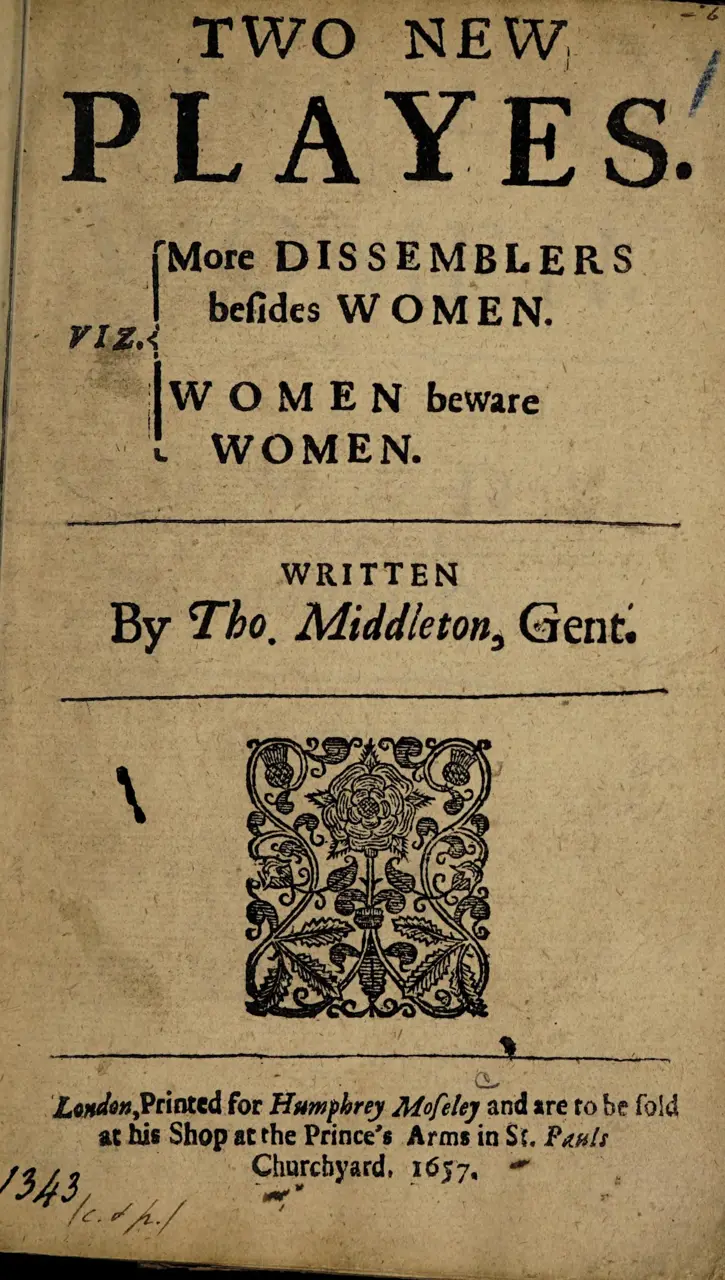
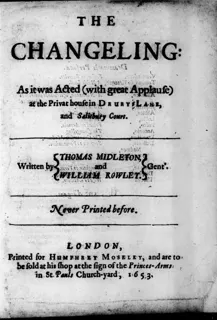
 The Changelingby Thomas Middleton and William RowleyA governor's daughter hires her father's hated servant to kill the man she's promised to, and he names his price.
 The Revenger's Tragedyby Thomas MiddletonA man who has kept his poisoned betrothed's skull for nine years takes service as a pander at a corrupt court, and turns its lusts into his weapons.
Act 1, Scene 1
An outer room in the house of Leantio’s Mother
Enter Leantio, Bianca, and Mother
Thy sight was never yet more precious to me;
Welcome, with all th' affection of a mother,
That comfort can express from natural love!
Since thy birth-joy—a mother’s chiefest gladness,
After sh’as undergone her curse of sorrows—
Thou wast not more dear to me than this hour
Presents thee to my heart: welcome again!
’Las, poor affectionate soul, how her joys speak to me!
I have observ’d it often, and I know it is
The fortune commonly of knavish children
To have the loving’st mothers. [Aside]
What’s this gentlewoman?
O, you have nam’d the most unvalu’dst purchase
That youth of man had ever knowledge of!
As often as I look upon that treasure,
And know it to be mine—there lies the blessing—
It joys me that I ever was ordain’d
To have a being, and to live ’mongst men;
Which is a fearful living, and a poor one,
Let a man truly think on’t:
To have the toil and griefs of fourscore years
Put up in a white sheet, tied with two knots;
Methinks it should strike earthquakes in adulterers,
When even the very sheets they commit sin in
May prove, for aught they know, all their last garments.
O what a mark were there for women then!
But beauty, able to content a conqueror
Whom earth could scarce content, keeps me in compass:
I find no wish in me bent sinfully
To this man’s sister, or to that man’s wife;
In love’s name let ’em keep their honesties,
And cleave to their own husbands,—tis their duties:
Now when I go to church I can pray handsomely,
Nor come like gallants only to see faces,
As if lust went to market still on Sundays.
I must confess I'm guilty of one sin, mother,
More than I brought into the world with me,
But that I glory in; ’tis theft, but noble
As ever greatness yet shot up withal.
How’s that?
Never to be repented, mother,
Though sin be death; I had died, if I had not sinn’d;
And here’s my masterpiece; do you now behold her!
Look on her well, she’s mine; look on her better;
Now say if’t be not the best piece of theft
That ever was committed? and I've my pardon for’t,—
’Tis seal’d from heaven by marriage.
Married to her!
You must keep counsel, mother, I'm undone else;
If it be known, I've lost her; do but think now
What that loss is,—life’s but a trifle to’t.
From Venice, her consent and I have brought her
From parents great in wealth, more now in rage;
But let storms spend their furies; now we’ve got
A shelter o’er our quiet innocent loves,
We are contented: little money sh’as brought me;
View but her face, you may see all her dowry,
Save that which lies lock’d up in hidden virtues,
Like jewels kept in cabinets.
You’re to blame,
If your obedience will give way to a check,
To wrong such a perfection.
How?
Such a creature,
To draw her from her fortune, which, no doubt,
At the full time might have prov’d rich and noble;
You know not what you’ve done; my life can give you
But little helps, and my death lesser hopes;
And hitherto your own means has but made shift
To keep you single, and that hardly too:
What ableness have you to do her right then
In maintenance fitting her birth and virtues?
Which every woman of necessity looks for,
And most to go above it, not confin’d
By their conditions, virtues, bloods, or births,
But flowing to affections, wills, and humours.
Speak low, sweet mother; you’re able to spoil as many
As come within the hearing; if it be not
Your fortune to mar all, I have much marvel.
I pray do not you teach her to rebel,
When she is in a good way to obedience;
To rise with other women in commotion
Against their husbands for six gowns a-year,
And so maintain their cause, when they’re once up,
In all things else that require cost enough.
They’re all of ’em a kind of spirits soon rais’d,
But not so soon laid, mother; as, for example,
A woman’s belly is got up in a trice,—
A simple charge ere’t be laid down again:
So ever in all their quarrels and their courses;
And I'm a proud man I hear nothing of ’em,
They’re very still, I thank my happiness,
And sound asleep, pray let not your tongue wake ’em:
If you can but rest quiet, she’s contented
With all conditions that my fortunes bring her to;
To keep close, as a wife that loves her husband;
To go after the rate of my ability,
Not the licentious swing of her own will,
Like some of her old school-fellows; she intends
To take out other works in a new sampler,
And frame the fashion of an honest love,
Which knows no wants, but, mocking poverty,
Brings forth more children, to make rich men wonder
At divine providence, that feeds mouths of infants,
And sends them none to feed, but stuffs their rooms
With fruitful bags, their beds with barren wombs.
Good mother, make not you things worse than they are
Out of your too much openness; pray take heed on’t,
Nor imitate the envy of old people,
That strive to mar good sport because they’re perfect:
I would have you more pitiful to youth,
Especially to your own flesh and blood.
I'll prove an excellent husband, here’s my hand,
Lay in provision, follow my business roundly,
And make you a grandmother in forty weeks.
Go, pray salute her, bid her welcome cheerfully.
[saluting Bianca] Gentlewoman, thus much is a debt of courtesy,
Which fashionable strangers pay each other
At a kind meeting: then there’s more than one
Due to the knowledge I have of your nearness;
I'm bold to come again, and now salute you
By the name of daughter, which may challenge more
Than ordinary respect.
Why, this is well now,
And I think few mothers of threescore will mend it. [Aside]
What I can bid you welcome to, is mean,
But make it all your own; we’re full of wants,
And cannot welcome worth.
Now this is scurvy,
And spoke as if a woman lack’d her teeth;
These old folks talk of nothing but defects,
Because they grow so full of ’em themselves. [Aside]
Kind mother, there is nothing can be wanting
To her that does enjoy all her desires:
Heaven send a quiet peace with this man’s love,
And I'm as rich as virtue can be poor,
Which were enough after the rate of mind
To erect temples for content plac’d here.
I have forsook friends, fortunes, and my country,
And hourly I rejoice in’t. Here’s my friends,
And few is the good number.—Thy successes,
Howe’er they look, I will still name my fortunes;
Hopeful or spiteful, they shall all be welcome:
Who invites many guests has of all sorts,
As he that traffics much drinks of all fortunes,
Yet they must all be welcome, and us’d well.
I'll call this place the place of my birth now,
And rightly too, for here my love was born,
And that’s the birthday of a woman’s joys.
You have not bid me welcome since I came.
That I did questionless.
No, sure—how was’t?
I've quite forgot it.
Thus. [Kisses her]
O, sir,’tis true,
Now I remember well; I've done thee wrong,
Pray take’t again, sir. [Kisses him]
How many of these wrongs
Could I put up in an hour, and turn up the glass
For twice as many more!
Will’t please you to walk in, daughter?
Thanks, sweet mother;
The voice of her that bare me is not more pleasing. [Exit with Mother]
Though my own care and my rich master’s trust
Lay their commands both on my factorship,
This day and night I'll know no other business
But her and her dear welcome. ’Tis a bitterness
To think upon to-morrow! that I must leave
Her still to the sweet hopes of the week’s end;
That pleasure should be so restrain’d and curb’d
After the course of a rich work-master,
That never pays till Saturday night! marry,
It comes together in a round sum then,
And does more good, you’ll say. O fair-ey’d Florence,
Didst thou but know what a most matchless jewel
Thou now art mistress of, a pride would take thee,
Able to shoot destruction through the bloods
Of all thy youthful sons! but ’tis great policy
To keep choice treasures in obscurest places;
Should we shew thieves our wealth, ’twould make ’em bolder;
Temptation is a devil will not stick
To fasten upon a saint; take heed of that:
The jewel is cas’d up from all men’s eyes;
Who could imagine now a gem were kept
Of that great value under this plain roof?
But how in times of absence? what assurance
Of this restraint then? Yes, yes, there’s one with her:
Old mothers know the world; and such as these,
When sons lock chests, are good to look to keys. [Exit]
Act 1, Scene 2
A garden attached to Fabricio’s house
Enter Guardiano, Fabricio, and Livia
What, has your daughter seen him yet? know you that?
No matter, she shall love him.
Nay, let’s have fair play;
He has been now my ward some fifteen year,
And ’tis my purpose, as time calls upon me,
By custom seconded and such moral virtues,
To tender him a wife. Now, sir, this wife
I'd fain elect out of a daughter of yours;
You see my meaning’s fair: if now this daughter
So tender’d,—let me come to your own phrase, sir,—
Should offer to refuse him, I were hansell’d.—
Thus am I fain to calculate all my words
For the meridian of a foolish old man,
To take his understanding. [Aside]—What do you answer, sir?
I say still, she shall love him.
Yet again?
And shall she have no reason for this love?
Why, do you think that women love with reason?
I perceive fools are not at all hours foolish,
No more than wise men wise. [Aside]
I had a wife,
She ran mad for me; she had no reason for’t,
For aught I could perceive.—What think you, lady sister?
’Twas a fit match that, being both out of their wits;
A loving wife, it seem’d
She strove to come as near you as she could. [Aside]
And if her daughter prove not mad for love too,
She takes not after her; nor after me,
If she prefer reason before my pleasure.—
You’re an experienc’d widow, lady sister,
I pray, let your opinion come amongst us.
I must offend you then, if truth will do’t,
And take my niece’s part, and call’t injustice
To force her love to one she never saw:
Maids should both see and like, all little enough;
If they love truly after that, ’tis well.
Counting the time, she takes one man till death;
That’s a hard task, I tell you; but one may
Inquire at three years' end amongst young wives,
And mark how the game goes.
Why, is not man
Tied to the same observance, lady sister,
And in one woman?
’Tis enough for him;
Besides, he tastes of many sundry dishes
That we poor wretches never lay our lips to,
As obedience forsooth, subjection, duty, and such kickshaws,
All of our making, but serv’d in to them;
And if we lick a finger then sometimes,
We’re not to blame, your best cooks often use it.
Thou’rt a sweet lady, sister, and a witty.
A witty! O the bud of commendation,
Fit for a girl of sixteen! I am blown, man;
I should be wise by this time; and, for instance,
I've buried my two husbands in good fashion,
And never mean more to marry.
No! why so, lady?
Because the third shall never bury me:
I think I'm more than witty. How think you, sir?'
I have paid often fees to a counsellor
Has had a weaker brain.
Then I must tell you
Your money was soon parted.
Light her now, brother.
Where is my niece? let her be sent for straight,
If you have any hope ’twill prove a wedding;
’Tis fit, i’faith, she should have one sight of him,
And stop upon’t, and not be join’d in haste,
As if they went to stock a new-found land.
Look out her uncle, and you’re sure of her,
Those two are ne’er asunder; they’ve been heard
In argument at midnight; moonshine nights
Are noondays with them; they walk out their sleeps,
Or rather at those hours appear like those
That walk in ’em, for so they did to me.
Look you, I told you truth; they’re like a chain,—
Draw but one link, all follows.
Enter Hippolito and Isabella
O affinity,
What piece of excellent workmanship art thou!
’Tis work clean wrought, for there’s no lust but love in’t,
And that abundantly; when in stranger things
There is no love at all but what lust brings.
On with your mask! for ’tis your part to see now,
And not be seen: go to, make use of your time;
See what you mean to like; nay, and I charge you,
Like what you see: do you hear me? there’s no dallying;
The gentleman’s almost twenty, and ’tis time
He were getting lawful heirs, and you a-breeding on ’em.
Good father——
Tell not me of tongues and rumours:
You’ll say the gentleman is somewhat simple;
The better for a husband, were you wise,
For those that marry fools live ladies' lives.
On with the mask! I'll hear no more: he’s rich;
The fool’s hid under bushels.
Not so hid neither
But here’s a foul great piece of him, methinks;
What will he be when he comes altogether?
Enter the Ward with a trap-stick, and Sordido
Beat him?
I beat him out o' the field with his own cat-stick,
Yet gave him the first hand.
O strange!
I did it;
Then he set jacks on me.
What, my lady’s tailor?
Ay, and I beat him too.
Nay, that’s no wonder,
He’s us’d to beating.
Nay, I tickled him
When I came once to my tippings.
Now you talk on ’em,
There was a poulterer’s wife made a great complaint
Of you last night to your guardianer, that you struck
A bump in her child’s head as big as an egg.
An egg may prove a chicken, then in time
The poulterer’s wife will get by’t: when I am
In game, I'm furious; came my mother’s eyes
In my way, I would not lose a fair end; no,
Were she alive, but with one tooth in her head,
I should venture the striking out of that:
I think of nobody when I'm in play,
I am so earnest. Coads me, my guardianer!
Prithee, lay up my cat and cat-stick safe.
Where, sir? i' the chimney-corner?
Chimney-corner!
Yes, sir; your cats are always safe i' the chimney-corner,
Unless they burn their coats.
Marry, that I am afraid on!
Why, then, I will bestow your cat i' the gutter,
And there she’s safe, I'm sure.
If I but live
To keep a house, I'll make thee a great man,
If meat and drink can do’t. I can stoop gallantly,
And pitch out when I list; I'm dog at a hole:
I mar’l my guardianer does not seek a wife for me;
I protest I'll have a bout with the maids else,
Or contract myself at midnight to the larder-woman,
In presence of a fool or a sack-posset.
Ward!
I feel myself after any exercise
Horribly prone: let me but ride, I'm lusty;
A cock-horse, straight, i’faith!
Why, Ward, I say!
I'll forswear eating eggs in moonshine nights;
There’s ne’er a one I eat but turns into a cock
In four-and-twenty hours; if my hot blood
Be not took down in time, sure ’twill crow shortly.
Do you hear, sir? follow me, I must new-school you.
School me? I scorn that now, I am past schooling:
I'm not so base to learn to write and read;
I was born to better fortunes in my cradle.
Exeunt. Guardiano, the Ward, and Sordido
How do you like him, girl? this is your husband:
Like him, or like him not, wench, you shall have him,
And you shall love him.
O, soft there, brother! though you be a justice,
Your warrant cannot be serv’d out of your liberty;
You may compel, out of the power of father,
Things merely harsh to a maid’s flesh and blood;
But when you come to love, there the soil alters,
You’re in another country, where your laws
Are no more set by than the cacklings
Of geese in Rome’s great Capitol.
Marry him she shall then,
Let her agree upon love afterwards. [Exit]
You speak now, brother, like an honest mortal
That walks upon th' earth with a staff; you were up
I' the clouds before; you would command love,
And so do most old folks that go without it.—
My best and dearest brother, I could dwell here;
There is not such another seat on earth,
Where all good parts better express themselves.
You’ll make me blush anon.
’Tis but like saying grace before a feast then,
And that’s most comely; thou art all a feast,
And she that has thee a most happy guest.
Prithee, cheer up thy niece with special counsel. [Exit]
I would ’twere fit to speak to her what I would; but
’Twas not a thing ordain’d, heaven has forbid it;
And ’tis most meet that I should rather perish
Than the decree divine receive least blemish.
Feed inward, you my sorrows, make no noise,
Consume me silent, let me be stark dead
Ere the world know I'm sick. You see my honesty;
If you befriend me, so. [Aside]
Marry a fool!
Can there be greater misery to a woman
That means to keep her days true to her husband,
And know no other man? so virtue wills it.
Why, how can I obey and honour him,
But I must needs commit idolatry?
A fool is but the image of a man,
And that but ill made neither. O the heartbreakings
Of miserable maids, where love’s enforc’d!
The best condition is but bad enough;
When women have their choices, commonly
They do but buy their thraldoms, and bring great portions
To men to keep ’em in subjection;
As if a fearful prisoner should bribe
The keeper to be good to him, yet lies in still,
And glad of a good usage, a good look sometimes.
Byrlady, no misery surmounts a woman’s;
Men buy their slaves, but women buy their masters;
Yet honesty and love make all this happy,
And, next to angels', the most bless’d estate.
That providence, that has made every poison
Good for some use, and sets four warring elements
At peace in man, can make a harmony
In things that are most strange to human reason.
O, but this marriage! [Aside]—What, are you sad too, uncle?
Faith, then there’s a whole household down together:
Where shall I go to seek my comfort now,
When my best friend’s distress’d? what is’t afflicts you, sir?
Faith, nothing but one grief, that will not leave me,
And now ’tis welcome; every man has something
To bring him to his end, and this will serve,
Join’d with your father’s cruelty to you,—
That helps it forward.
O, be cheer’d, sweet uncle!
How long has ’t been upon you? I ne’er spied it;
What a dull sight have I! how long, I pray, sir?
Since I first saw you, niece, and left Bologna.
And could you deal so unkindly with my heart,
To keep it up so long hid from my pity?
Alas! how shall I trust your love hereafter?
Have we pass’d through so many arguments,
And miss’d of that still, the most needful one?
Walk’d out whole nights together in discourses,
And the main point forgot? we’re to blame both;
This is an obstinate, wilful forgetfulness,
And faulty on both parts: let’s lose no time now;
Begin, good uncle, you that feel ’t; what is it?
You of all creatures, niece, must never hear on’t,
’Tis not a thing ordain’d for you to know.
Not I, sir? all my joys that word cuts off;
You made profession once you lov’d me best,
’Twas but profession.
Yes, I do’t too truly,
And fear I shall be chid for’t. Know the worst then;
I love thee dearlier than an uncle can.
Why, so you ever said, and I believ’d it.
So simple is the goodness of her thoughts,
They understand not yet th' unhallow’d language
Of a near sinner; I must yet be forc’d,
Though blushes be my venture, to come nearer.— [Aside]
As a man loves his wife, so love I thee.
What’s that?
Methought I heard ill news come toward me,
Which commonly we understand too soon,
Then over-quick at hearing; I'll prevent it,
Though my joys fare the harder, welcome it:
It shall ne’er come so near mine ear again.
Farewell all friendly solaces and discourses;
I'll learn to live without ye, for your dangers
Are greater than your comforts. What’s become
Of truth in love, if such we cannot trust,
When blood, that should be love, is mix’d with lust? [Exit]
The worst can be but death, and let it come;
He that lives joyless, every day’s his doom. [Exit]
Act 1, Scene 3
Street before the house of Leantio’s Mother
Enter Leantio
Methinks I'm even as dull now at departure,
As men observe great gallants the next day
After a revel; you shall see ’em look
Much of my fashion, if you mark ’em well.
’Tis even a second hell to part from pleasure
When man has got a smack on’t: as many holydays
Coming together make your poor heads idle
A great while after, and are said to stick
Fast in their fingers' ends,—even so does game
In a new-married couple; for the time
It spoils all thrift, and indeed lies a-bed
T' invent all the new ways for great expenses. [Bianca and Mother appear above]
See, and she be not got on purpose now
Into the window to look after me!
I've no power to go now, and I should be hang’d;
Farewell all business; I desire no more
Than I see yonder: let the goods at key
Look to themselves; why should I toil my youth out?
It is but begging two or three year sooner,
And stay with her continually: is’t a match?
O, fie, what a religion have I leap’d into!
Get out again, for shame! the man loves best
When his care’s most, that shews his zeal to love:
Fondness is but the idiot to affection,
That plays at hot-cockles with rich merchants' wives,
Good to make sport withal when the chest’s full,
And the long warehouse cracks. ’Tis time of day
For us to be more wise; ’tis early with us;
And if they lose the morning of their affairs,
They commonly lose the best part of the day:
Those that are wealthy, and have got enough,
’Tis after sunset with ’em; they may rest,
Grow fat with ease, banquet, and toy, and play,
When such as I enter the heat o' the day,
And I'll do’t cheerfully.
I perceive, sir,
You’re not gone yet; I've good hope you’ll stay now.
Farewell; I must not.
Come, come, pray return;
To-morrow, adding but a little care more,
Will despatch all as well, believe me ’twill, sir.
I could well wish myself where you would have me;
But love that’s wanton must be rul’d awhile
By that that’s careful, or all goes to ruin:
As fitting is a government in love
As in a kingdom; where ’tis all mere lust,
’Tis like an insurrection in the people,
That, rais’d in self-will, wars against all reason;
But love that is respective for increase
Is like a good king, that keeps all in peace.
Once more, farewell.
But this one night, I prithee!
Alas, I'm in for twenty, if I stay,
And then for forty more! I've such luck to flesh,
I never bought a horse but he bore double.
If I stay any longer, I shall turn
An everlasting spendthrift: as you love
To be maintain’d well, do not call me again,
For then I shall not care which end goes forward.
Again, farewell to thee.
Since it must, farewell too. [Exit Leantio]
Faith, daughter, you’re to blame; you take the course
To make him an ill husband, troth you do;
And that disease is catching, I can tell you,
Ay, and soon taken by a young man’s blood,
And that with little urging. Nay, fie, see now,
What cause have you to weep? would I had no more,
That have liv’d threescore years! there were a cause,
And ’twere well thought on. Trust me, you’re to blame;
His absence cannot last five days at utmost:
Why should those tears be fetch’d forth? cannot love
Be even as well express’d in a good look,
But it must see her face still in a fountain?
It shews like a country maid dressing her head
By a dish of water: come, ’tis an old custom
To weep for love.
Enter several Boys, several Citizens, and an Apprentice
Now they come, now they come!
The duke!
The states!
How near, boy?
I' the next street, sir, hard at hand.
You, sirrah, get a standing for your mistress,
The best in all the city.
I have’t for her, sir;
’Twas a thing I provided for her over-night,
’Tis ready at her pleasure.
Fetch her to’t then:
Away, sir! [Exeunt Boys, Citizens, and Apprentice]
What’s the meaning of this hurry?
Can you tell, mother?
What a memory
Have I! I see by that years come upon me:
Why, ’tis a yearly custom and solemnity,
Religiously observ’d by the Duke and states,
To St. Mark’s temple, the fifteenth of April;
See, if my dull brains had not quite forgot it!
’Twas happily question’d of thee; I had gone down else,
Sat like a drone below, and never thought on’t.
I would not, to be ten years younger again,
That you had lost the sight: now you shall see
Our Duke, a goodly gentleman of his years.
Is he old, then?
About some fifty-five.
That’s no great age in man; he’s then at best
For wisdom and for judgment.
The lord Cardinal,
His noble brother—there’s a comely gentleman,
And greater in devotion than in blood.
He’s worthy to be mark’d.
You shall behold
All our chief states of Florence: you came fortunately
Against this solemn day.
I hope so always. [Music within]
I hear ’em near us now: do you stand easily?
Exceeding well, good mother.
Take this stool.
I need it not, I thank you.
Use your will then.
Enter six knights bare-headed, then two cardinals, then the lord Cardinal, then the Duke; after him the states of Florence by two and two, with variety of music and song. They pass over the stage in great pomp, and exeunt
How like you, daughter?
’Tis a noble state;
Methinks my soul could dwell upon the reverence
Of such a solemn and most worthy custom.
Did not the Duke look up? methought he saw us.
That’s every one’s conceit that sees a duke;
If he look stedfastly, he looks straight at them,
When he, perhaps, good, careful gentleman,
Never minds any, but the look he casts
Is at his own intentions, and his object
Only the public good.
Most likely so.
Come, come, we’ll end this argument below. [Exeunt above]
Act 2, Scene 1
An apartment in Livia’s house
Enter Hippolito and Livia
A strange affection, brother! when I think on’t,
I wonder how thou cam’st by’t.
Even as easily
As man comes by destruction, which ofttimes
He wears in his own bosom.
Is the world
So populous in women, and creation
So prodigal in beauty, and so various,
Yet does love turn thy point to thine own blood?
’Tis somewhat too unkindly: must thy eye
Dwell evilly on the fairness of thy kindred,
And seek not where it should? it is confin’d
Now in a narrower prison than was made for’t;
It is allow’d a stranger; and where bounty
Is made the great man’s honour, ’tis ill husbandry
To spare, and servants shall have small thanks for’t;
So he heaven’s bounty seems to scorn and mock
That spares free means, and spends of his own stock.
Ne’er was man’s misery so soon summ’d up,
Counting how truly.
Nay, I love you so,
That I shall venture much to keep a change from you
So fearful as this grief will bring upon you;
Faith, it even kills me when I see you faint
Under a reprehension, and I'll leave it,
Though I know nothing can be better for you.
Prithee, sweet brother, let not passion waste
The goodness of thy time and of thy fortune:
Thou keep’st the treasure of that life I love
As dearly as mine own; and if you think
My former words too bitter, which were minister’d
By truth and zeal, ’tis but a hazarding
Of grace and virtue, and I can bring forth
As pleasant fruits as sensuality wishes
In all her teeming longings; this I can do.
O, nothing that can make my wishes perfect!
I would that love of yours were pawn’d to’t, brother,
And as soon lost that way as I could win!
Sir, I could give as shrewd a lift to chastity
As any she that wears a tongue in Florence;
Sh’ad need be a good horsewoman, and sit fast,
Whom my strong argument could not fling at last.
Prithee, take courage, man; though I should counsel
Another to despair, yet I am pitiful
To thy afflictions, and will venture hard—
I will not name for what, it is not handsome;
Find you the proof, and praise me.
Then I fear me
I shall not praise you in haste.
This is the comfort,
You are not the first, brother, has attempted
Things more forbidden than this seems to be.
I'll minister all cordials now to you,
Because I'll cheer you up, sir.
I'm past hope.
Love, thou shalt see me do a strange cure then,
As e’er was wrought on a disease so mortal
And near akin to shame. When shall you see her?
Never in comfort more.
You’re so impatient too!
Will you believe? death, sh’as forsworn my company,
And seal’d it with a blush.
So, I perceive
All lies upon my hands then; well, the more glory
When the work’s finish’d.
Enter Servant
How now, sir? the news?
Madam, your niece, the virtuous Isabella,
Is lighted now to see you.
That’s great fortune;
Sir, your stars bless you.—Simple, lead her in. [Exit Servant]
What’s this to me?
Your absence, gentle brother;
I must bestir my wits for you.
Ay, to great purpose. [Exit]
Beshrew you, would I lov’d you not so well!
I'll go to bed, and leave this deed undone:
I am the fondest where I once affect;
The carefull’st of their healths and of their ease, forsooth,
That I look still but slenderly to mine own:
I take a course to pity him so much now,
That I've none left for modesty and myself.
This ’tis to grow so liberal: you’ve few sisters
That love their brothers' ease ’bove their own honesties;
But if you question my affections,
That will be found my fault.
Enter Isabella
Niece, your love’s welcome.
Alas, what draws that paleness to thy cheeks?
This enforc’d marriage towards?
It helps, good aunt,
Amongst some other griefs; but those I'll keep
Lock’d up in modest silence, for they’re sorrows
Would shame the tongue more than they grieve the thought.
Indeed, the Ward is simple.
Simple! that were well;
Why, one might make good shift with such a husband,
But he’s a fool entail’d, he halts downright in’t.
And knowing this, I hope ’tis at your choice
To take or refuse, niece.
You see it is not.
I loathe him more than beauty can hate death,
Or age her spiteful neighbour.
Let ’t appear then.
How can I, being born with that obedience
That must submit unto a father’s will?
If he command, I must of force consent.
Alas, poor soul! be not offended, prithee,
If I set by the name of niece awhile,
And bring in pity in a stranger fashion;
It lies here in this breast would cross this match.
How! cross it, aunt?
Ay, and give thee more liberty
Than thou hast reason yet to apprehend.
Sweet aunt, in goodness keep not hid from me
What may befriend my life!
Yes, yes, I must;
When I return to reputation,
And think upon the solemn vow I made
To your dead mother, my most loving sister;
As long as I've her memory ’twixt mine eyelids,
Look for no pity now.
Kind, sweet, dear aunt——
No, ’twas a secret I've took special care of,
Deliver’d by your mother on her deathbed,
That’s nine years now, and I'll not part from’t yet,
Though ne’er was fitter time, nor greater cause for’t.
As you desire the praises of a virgin——
Good sorrow, I would do thee any kindness
Not wronging secrecy or reputation.
Neither of which, as I have hope of fruitfulness,
Shall receive wrong from me.
Nay, ’twould be your own wrong
As much as any’s, should it come to that once.
I need no better means to work persuasion then.
Let it suffice, you may refuse this fool,
Or you may take him, as you see occasion
For your advantage; the best wits will do’t;
You’ve liberty enough in your own will,
You cannot be enforc’d; there grows the flower,
If you could pick it out, makes whole life sweet to you.
That which you call your father’s command’s nothing,
Then your obedience must needs be as little:
If you can make shift here to taste your happiness,
Or pick out aught that likes you, much good do you;
You see your cheer, I'll make you no set dinner.
And, trust me, I may starve for all the good
I can find yet in this: sweet aunt, deal plainlier.
Say I should trust you now upon an oath,
And give you, in a secret, that would start you,
How am I sure of you in faith and silence?
Equal assurance may I find in mercy
As you for that in me!
It shall suffice:
Then know, however custom has made good,
For reputation’s sake, the names of niece
And aunt ’twixt you and I, we’re nothing less.
How’s that?
I told you I should start your blood:
You are no more allied to any of us,
Save what the courtesy of opinion casts
Upon your mother’s memory and your name,
Than the merest stranger is, or one begot
At Naples when the husband lies at Rome;
There’s so much odds betwixt us. Since your knowledge
Wish’d more instruction, and I have your oath
In pledge for silence, it makes me talk the freelier.
Did never the report of that fam’d Spaniard,
Marquis of Coria, since your time was ripe
For understanding, fill your ear with wonder?
Yes; what of him? I've heard his deeds of honour
Often related when we liv’d in Naples.
You heard the praises of your father then.
My father!
That was he; but all the business
So carefully and so discreetly carried,
That fame receiv’d no spot by’t, not a blemish;
Your mother was so wary to her end,
None knew it but her conscience and her friend,
Till penitent confession made it mine,
And now my pity yours, it had been long else;
And I hope care and love alike in you,
Made good by oath, will see it take no wrong now.
How weak his commands now whom you call father!
How vain all his enforcements, your obedience!
And what a largeness in your will and liberty,
To take, or to reject, or to do both!
For fools will serve to father wise men’s children:
All this you’ve time to think on. O my wench,
Nothing o’erthrows our sex but indiscretion!
We might do well else of a brittle people
As any under the great canopy:
I pray, forget not but to call me aunt still;
Take heed of that; it may be mark’d in time else:
But keep your thoughts to yourself, from all the world,
Kindred, or dearest friend; nay, I entreat you,
From him that all this while you have call’d uncle;
And though you love him dearly, as I know
His deserts claim as much even from a stranger,
Yet let not him know this, I prithee, do not;
As ever thou hast hope of second pity,
If thou shouldst stand in need on’t, do not do’t.
Believe my oath, I will not.
Why, well said.—
Who shews more craft t' undo a maidenhead,
I'll resign my part to her. [Aside]
Enter Hippolito
She’s thine own; go.
Alas, fair flattery cannot cure my sorrows! [Exit Livia]
Have I past so much time in ignorance,
And never had the means to know myself
Till this bless’d hour? thanks to her virtuous pity
That brought it now to light; would I had known it
But one day sooner! he had then receiv’d
In favours, what, poor gentleman, he took
In bitter words; a slight and harsh reward
For one of his deserts. [Aside]
There seems to me now
More anger and distraction in her looks:
I'm gone; I'll not endure a second storm,
The memory of the first is not past yet. [Aside]
Are you return’d, you comforts of my life,
In this man’s presence? I will keep you fast now,
And sooner part eternally from the world
Than my good joys in you. [Aside]—Prithee, forgive me,
I did but chide in jest; the best loves use it
Sometimes, it sets an edge upon affection:
When we invite our best friends to a feast,
’Tis not all sweetmeats that we set before them;
There’s somewhat sharp and salt, both to whet appetite
And make ’em taste their wine well; so, methinks,
After a friendly, sharp, and savoury chiding,
A kiss tastes wondrous well, and full o' the grape;
How think’st thou? does ’t not? [Kisses him]
’Tis so excellent,
I know not how to praise it, what to say to’t!
This marriage shall go forward.
With the Ward?
Are you in earnest?
’Twould be ill for us else.
For us! how means she that? [Aside]
Troth, I begin
To be so well, methinks, within this hour,
For all this match able to kill one’s heart,
Nothing can pull me down now; should my father
Provide a worse fool yet—which I should think
Were a hard thing to compass—I'd have him either;
The worse the better, none can come amiss now,
If he want wit enough; so discretion love me,
Desert and judgment, I've content sufficient.
She that comes once to be a housekeeper
Must not look every day to fare well, sir,
Like a young waiting-gentlewoman in service,
For she feeds commonly as her lady does,
No good bit passes her but she gets a taste on’t;
But when she comes to keep house for herself,
She’s glad of some choice cates then once a-week,
Or twice at most, and glad if she can get ’em;
So must affection learn to fare with thankfulness:
Pray, make your love no stranger, sir, that’s all,—
Though you be one yourself, and know not on’t,
And I have sworn you must not. [Aside, and exit]
This is beyond me!
Never came joys so unexpectedly
To meet desires in man: how came she thus?
What has she done to her, can any tell?
’Tis beyond sorcery this, drugs, or love-powders;
Some art that has no name, sure; strange to me
Of all the wonders I e’er met withal
Throughout my ten years' travels; but I'm thankful for’t.
This marriage now must of necessity forward;
It is the only veil wit can devise
To keep our acts hid from sin-piercing eyes. [Exit]
Act 2, Scene 2
Another apartment in Livia’s house: a chess-board set out
Enter Livia and Guardiano
How, sir? a gentlewoman so young, so fair,
As you set forth, spied from the widow’s window?
She.
Our Sunday-dinner woman?
And Thursday-supper woman, the same still:
I know not how she came by her, but I'll swear
She’s the prime gallant for a face in Florence,
And no doubt other parts follow their leader.
The Duke himself first spied her at the window,
Then, in a rapture—as if admiration
Were poor when it were single—beckon’d me,
And pointed to the wonder warily,
As one that fear’d she would draw in her splendour
Too soon, if too much gaz’d at: I ne’er knew him
So infinitely taken with a woman;
Nor can I blame his appetite, or tax
His raptures of slight folly; she’s a creature
Able to draw a state from serious business,
And make it their best piece to do her service.
What course shall we devise? has spoke twice now.
Twice?
’Tis beyond your apprehension
How strangely that one look has catch’d his heart:
'Twould prove but too much worth in wealth and favour
To whose should work his peace.
And if I do’t not,
Or at least come as near it—if your art
Will take a little pains and second me—
As any wench in Florence of my standing,
I'll quite give o’er, and shut up shop in cunning.
’Tis for the Duke; and if I fail your purpose,
All means to come by riches or advancement
Miss me, and skip me over!
Let the old woman then
Be sent for with all speed, then I'll begin.
A good conclusion follow, and a sweet one,
After this stale beginning with old ware!
Within there!
Enter Servant
Sir, do you call?
Come near, list hither. [Whispers]
I long myself to see this absolute creature,
That wins the heart of love and praise so much.
Go, sir, make haste.
Say I entreat her company:
Do you hear, sir?
Yes, madam. [Exit]
That brings her quickly.
I would ’twere done! the Duke waits the good hour,
And I wait the good fortune that may spring from’t.
I've had a lucky hand these fifteen year
At such court-passage, with three dice in a dish.—
Enter Fabricio
Signor Fabricio!
O sir,
I bring an alteration in my mouth now.
An alteration?—No wise speech, I hope;
He means not to talk wisely, does he, trow?— [Aside]
Good; what’s the change, I pray, sir?
A new change.
Another yet? faith, there’s enough already.
My daughter loves him now.
What, does she, sir?
Affects him beyond thought: who but the Ward, forsooth;
No talk but of the Ward; she would have him
To choose ’bove all the men she ever saw:
My will goes not so fast as her consent now;
Her duty gets before my command still.
Why, then, sir, if you’ll have me speak my thoughts,
I smell ’twill be a match.
Ay, and a sweet young couple,
If I have any judgment.
Faith, that’s little.— [Aside]
Let her be sent to-morrow, before noon,
And handsomely trick’d up, for ’bout that time
I mean to bring her in, and tender her to him.
I warrant you for handsome; I will see
Her things laid ready, every one in order,
And have some part of her trick’d up to-night.
Why, well said.
’Twas a use her mother had;
When she was invited to an early wedding,
She’d dress her head o’er night, sponge up herself,
And give her neck three lathers.
Ne’er a halter? [Aside]
On with her chain of pearl, her ruby bracelets,
Lay ready all her tricks and jiggembobs.
So must your daughter.
I'll about it straight, sir. [Exit]
How he sweats in the foolish zeal of fatherhood,
After six ounces an hour, and seems
To toil as much as if his cares were wise ones!
You’ve let his folly blood in the right vein, lady.
And here comes his sweet son-in-law that shall be;
They’re both allied in wit before the marriage;
What will they be hereafter, when they’re nearer!
Yet they can go no further than the fool;
There’s the world’s end in both of ’em.
Enter the Ward and Sordido, one with a shittlecock, the other with a battledoor
Now, young heir.
What’s the next business after shittlecock now?
To-morrow you shall see the gentlewoman
Must be your wife.
There’s even another thing too,
Must be kept up with a pair of battledoors:
My wife! what can she do?
Nay, that’s a question you should ask yourself, Ward,
When you’re alone together.
That’s as I list;
A wife’s to be ask'd any where, I hope;
I'll ask her in a congregation,
If I've a mind to’t, and so save a license.
My guardianer has no more wit than an herb-woman,
That sells away all her sweet herbs and nosegays,
And keeps a stinking breath for her own pottage.
Let me be at the choosing of your belov’d,
If you desire a woman of good parts.
Thou shalt, sweet Sordido.
I have a plaguy guess; let me alone to see what she is: if I but look upon her—'way! I know all the faults to a hair that you may refuse her for.
Dost thou? I prithee, let me hear ’em, Sordido.
Well, mark ’em then; I have ’em all in rhyme:
The wife your guardianer ought to tender
Should be pretty, straight, and slender;
Her hair not short, her foot not long,
Her hand not huge, nor too, too loud her tongue;
No pearl in eye, nor ruby in her nose,
No burn or cut but what the catalogue shews;
She must have teeth, and that no black ones,
And kiss most sweet when she does smack once;
Her skin must be both white and plump'd,
Her body straight, not hopper-rump’d,
Or wriggle sideways like a crab;
She must be neither slut nor drab,
Nor go too splay-foot with her shoes,
To make her smock lick up the dews;
And two things more, which I forgot to tell ye,
She neither must have bump in back nor belly:
These are the faults that will not make her pass.
And if I spy not these, I'm a rank ass.
Nay, more; by right, sir, you should see her naked,
For that’s the ancient order.
See her naked?
That were good sport, i’faith: I'll have the books turn’d o’er,
And if I find her naked on record,
She shall not have a rag on: but stay, stay;
How if she should desire to see me so too?
I were in a sweet case then; such a foul skin!
But you’ve a clean shirt, and that makes amends, sir.
I will not see her naked for that trick though. [Exit]
Then take her with all faults with her clothes on,
And they may hide a number with a bum-roll.
Faith, choosing of a wench in a huge farthingale
Is like the buying of ware under a great penthouse;
What with the deceit of one,
And the false light of th' other, mark my speeches,
He may have a diseas’d wench in’s bed,
And rotten stuff in’s breeches. [Exit]
It may take handsomely.
I see small hindrance.—
Re-enter Servant, shewing in Mother
How now? so soon return’d?
She’s come.
That’s well.— [Exit Servant]
Widow, come, come, I've a great quarrel to you;
Faith, I must chide you, that you must be sent for;
You make yourself so strange, never come at us,
And yet so near a neighbour, and so unkind;
Troth, you’re to blame; you cannot be more welcome
To any house in Florence, that I'll tell you.
My thanks must needs acknowledge so much, madam.
How can you be so strange then? I sit here
Sometimes whole days together without company,
When business draws this gentleman from home,
And should be happy in society
Which I so well affect as that of yours:
I know you’re alone too; why should not we,
Like two kind neighbours, then, supply the wants
Of one another, having tongue-discourse,
Experience in the world, and such kind helps
To laugh down time, and meet age merrily?
Age, madam! you speak mirth; ’tis at my door,
But a long journey from your ladyship yet.
My faith, I'm nine and-thirty, every stroke, wench;
And ’tis a general observation
'Mongst knights—wives or widows, we account ourselves
Then old, when young men’s eyes leave looking at’s;
’Tis a true rule amongst us, and ne’er fail’d yet
In any but in one, that I remember;
Indeed, she had a friend at nine-and-forty;
Marry, she paid well for him, and in th' end
He kept a quean or two with her own money,
That robb’d her of her plate and cut her throat.
She had her punishment in this world, madam,
And a fair warning to all other women
That they live chaste at fifty.
Ay, or never, wench.
Come, now I have thy company, I'll not part with’t
Till after supper.
Yes, I must crave pardon, madam.
I swear you shall stay supper; we’ve no strangers, woman,
None but my sojourners and I, this gentleman
And the young heir his ward; you know our company.
Some other time I'll make bold with you, madam.
Nay, pray stay, widow.
Faith, she shall not go:
Do you think I'll be forsworn?
’Tis a great while
Till supper-time; I'll take my leave then now, madam,
And come again i' th' evening, since your ladyship
Will have it so.
I' th' evening? by my troth, wench,
I'll keep you while I have you: you’ve great business, sure,
To sit alone at home; I wonder strangely
What pleasure you take in’t; were’t to me now,
I should be ever at one neighbour’s house
Or other all day long: having no charge,
Or none to chide you, if you go or stay,
Who may live merrier, ay, or more at heart’s ease?
Come, we’ll to chess or draughts; there are an hundred tricks
To drive out time till supper, never fear’t, wench.
I'll but make one step home, and return straight, madam.
Come, I'll not trust you; you use more excuses
To your kind friends than ever I knew any.
What business can you have, if you be sure
You’ve lock’d the doors? and, that being all you have,
I know you’re careful on’t. One afternoon
So much to spend here! say I should entreat you now
To lie a night or two, or a week, with me,
Or leave your own house for a month together;
It were a kindness that long neighbourhood
And friendship might well hope to prevail in;
Would you deny such a request? i’faith,
Speak truth, and freely.
I were then uncivil, madam.
Go to then; set your men; we’ll have whole nights
Of mirth together, ere we be much older, wench. [Livia and Mother sit down to the chess-board]
As good now tell her then, for she will know’t;
I've always found her a most friendly lady. [Aside]
Why, widow, where’s your mind?
Troth, even at home, madam:
To tell you truth, I left a gentlewoman
Even sitting all alone, which is uncomfortable,
Especially to young bloods.
Another excuse!
No; as I hope for health, madam, that’s a truth:
Please you to send and see.
What gentlewoman? pish!
Wife to my son, indeed; but not known, madam,
To any but yourself.
Now I beshrew you;
Could you be so unkind to her and me,
To come and not bring her? faith, ’tis not friendly.
I fear’d to be too bold.
Too bold! O, what’s become
Of the true hearty love was wont to be
'Mongst neighbours in old time!
And she’s a stranger, madam.
The more should be her welcome: when is courtesy
In better practice than when ’tis employ’d
In entertaining strangers? I could chide, i’faith:
Leave her behind, poor gentlewoman! alone too!
Make some amends, and send for her betimes, go.
Please you, command one of your servants, madam.
Within there!
Re-enter Servant
Madam.
Attend the gentlewoman.
It must be carried wondrous privately
From my son’s knowledge, he’ll break out in storms else.—
Hark you, sir. [Whispers the Servant, who then goes out]
[to Guar] Now comes in the heat of your part.
True, I know’t, lady; and if I be out,
May the Duke banish me from all employments,
Wanton or serious!
So, have you sent, widow?
Yes, madam, he’s almost at home by this.
And, faith, let me entreat you that henceforward
All such unkind faults may be swept from friendship,
Which does but dim the lustre; and think thus much,
It is a wrong to me, that have ability
To bid friends welcome, when you keep ’em from me;
You cannot set greater dishonour near me;
For bounty is the credit and the glory
Of those that have enough. I see you’re sorry,
And the good ’mends is made by’t.
Re-enter Servant, shewing in Bianca
Here she is, madam. [Exit Servant]
I wonder how she comes to send for me now. [Aside]
Gentlewoman, you’re most welcome, trust me, you are,
As courtesy can make one, or respect
Due to the presence of you.
I give you thanks, lady.
I heard you were alone, and ’t had appear’d
An ill condition in me, though I knew you not,
Nor ever saw you—yet humanity
Thinks every case her own—t' have kept your company
Here from you, and left you all solitary:
I rather ventur’d upon boldness then,
As the least fault, and wish’d your presence here;
A thing most happily motion’d of that gentleman,
Whom I request you, for his care and pity,
To honour and reward with your acquaintance;
A gentleman that ladies' rights stands for,
That’s his profession.
’Tis a noble one,
And honours my acquaintance.
All my intentions
Are servants to such mistresses.
’Tis your modesty,
It seems, that makes your deserts speak so low, sir.
Come, widow.—Look you, lady, here’s our business; [Pointing to the chess-board]
Are we not well employ’d, think you? an old quarrel
Between us, that will ne’er be at an end.
No? and, methinks, there’s men enough to part you, lady.
Ho, but they set us on, let us come off
As well as we can, poor souls; men care no farther.
I pray, sit down, forsooth, if you’ve the patience
To look upon two weak and tedious gamesters.
Faith, madam, set these by till evening,
You’ll have enough on’t then; the gentlewoman,
Being a stranger, would take more delight
To see your rooms and pictures.
Marry, good sir,
And well remember’d; I beseech you, shew ’em her,
That will beguile time well; pray heartily, do, sir,
I'll do as much for you: here, take these keys; [Gives keys to Guardiano]
Shew her the monument too, and that’s a thing
Every one sees not; you can witness that, widow.
And that’s worth sight indeed, madam.
Kind lady,
I fear I came to be a trouble to you.
O, nothing less, forsooth!
And to this courteous gentleman,
That wears a kindness in his breast so noble
And bounteous to the welcome of a stranger.
If you but give acceptance to my service,
You do the greatest grace and honour to me
That courtesy can merit.
I were to blame else,
And out of fashion much. I pray you, lead, sir.
After a game or two, we’re for you, gentlefolks.
We wish no better seconds in society
Than your discourses, madam, and your partner’s there.
I thank your praise; I listen’d to you, sir,
Though, when you spoke, there came a paltry rook
Full in my way, and chokes up all my game. [Exeunt. Guardiano and Bianca]
Alas, poor widow, I shall be too hard for thee!
You’re cunning at the game, I'll be sworn, madam.
It will be found so, ere I give you over.— [Aside]
She that can place her man well——
As you do, madam.
As I shall, wench, can never lose her game:
Nay, nay, the black king’s mine.
Cry you mercy, madam!
And this my queen.
I see’t now.
Here’s a duke
Will strike a sure stroke for the game anon;
Your pawn cannot come back to relieve itself.
I know that, madam.
You play well the whilst:
How she belies her skill! I hold two ducats,
I give you check and mate to your white king,
Simplicity itself, your saintish king there.
Well, ere now, lady,
I've seen the fall of subtlety; jest on.
Ay, but simplicity receives two for one.
What remedy but patience!
Enter Guardiano and Bianca above
Trust me, sir,
Mine eye ne’er met with fairer ornaments.
Nay, livelier, I'm persuaded, neither Florence
Nor Venice can produce.
Sir, my opinion
Takes your part highly.
There’s a better piece
Yet than all these.
Not possible, sir!
Believe it,
You’ll say so when you see’t: turn but your eye now,
You’re upon’t presently.
Draws a curtain, and discovers the Duke; then exit
O sir!
He’s gone, beauty:
Pish, look not after him; he’s but a vapour,
That, when the sun appears, is seen no more.
O, treachery to honour!
Prithee, tremble not;
I feel thy breast shake like a turtle panting
Under a loving hand that makes much on’t:
Why art so fearful? as I'm friend to brightness,
There’s nothing but respect and honour near thee:
You know me, you have seen me; here’s a heart
Can witness I have seen thee.
The more’s my danger.
The more’s thy happiness. Pish, strive not, sweet;
This strength were excellent employ’d in love now,
But here ’tis spent amiss: strive not to seek
Thy liberty, and keep me still in prison;
I'faith, you shall not out till I'm releas’d now;
We’ll be both freed together, or stay still by’t,
So is captivity pleasant.
O my lord!
I am not here in vain; have but the leisure
To think on that, and thou’lt be soon resolv’d:
The lifting of thy voice is but like one
That does exalt his enemy, who, proving high,
Lays all the plots to confound him that rais’d him.
Take warning, I beseech thee; thou seem’st to me
A creature so compos’d of gentleness,
And delicate meekness—such as bless the faces
Of figures that are drawn for goddesses,
And make art proud to look upon her work—
I should be sorry the least force should lay
An unkind touch upon thee.
O my extremity!
My lord, what seek you?
Love.
’Tis gone already;
I have a husband.
That’s a single comfort;
Take a friend to him.
That’s a double mischief,
Or else there’s no religion.
Do not tremble
At fears of thine own making.
Nor, great lord,
Make me not bold with death and deeds of ruin,
Because they fear not you; me they must fright—
Then am I best in health: should thunder speak,
And none regard it, it had lost the name,
And were as good be still. I'm not like those
That take their soundest sleeps in greatest tempests;
Then wake I most, the weather fearfullest,
And call for strength to virtue.
Sure, I think
Thou know’st the way to please me: I affect
A passionate pleading ’bove an easy yielding;
But never pitied any,—they deserve none,—
That will not pity me. I can command,
Think upon that; yet if thou truly knewest
The infinite pleasure my affection takes
In gentle, fair entreatings, when love’s businesses
Are carried courteously ’twixt heart and heart,
You’d make more haste to please me.
Why should you seek, sir,
To take away that you can never give?
But I give better in exchange,—wealth, honour;
She that is fortunate in a duke’s favour
'Lights on a tree that bears all women’s wishes:
If your own mother saw you pluck fruit there,
She would commend your wit, and praise the time
Of your nativity; take hold of glory.
Do not I know you’ve cast away your life
Upon necessities, means merely doubtful
To keep you in indifferent health and fashion—
A thing I heard too lately, and soon pitied—
And can you be so much your beauty’s enemy,
To kiss away a month or two in wedlock,
And weep whole years in wants for ever after?
Come, play the wise wench, and provide for ever;
Let storms come when they list, they find thee shelter’d.
Should any doubt arise, let nothing trouble thee;
Put trust in our love for the managing
Of all to thy heart’s peace: we’ll walk together,
And shew a thankful joy for both our fortunes. [Exeunt Duke and Bianca above]
Did not I say my duke would fetch you o’er, widow?
I think you spoke in earnest when you said it, madam.
And my black king makes all the haste he can too.
Well, madam, we may meet with him in time yet.
I've given thee blind mate twice.
You may see, madam,
My eyes begin to fail.
I'll swear they do, wench.
Re-enter Guardiano
I can but smile as often as I think on’t:
How prettily the poor fool was beguil’d!
How unexpectedly! it’s a witty age;
Never were finer snares for women’s honesties
Than are devis’d in these days; no spider’s web
Made of a daintier thread than are now practis’d
To catch love’s flesh-fly by the silver wing:
Yet, to prepare her stomach by degrees
To Cupid’s feast, because I saw ’twas queasy,
I shew’d her naked pictures by the way,
A bit to stay the appetite. Well, advancement,
I venture hard to find thee; if thou com’st
With a greater title set upon thy crest,
I'll take that first cross patiently, and wait
Until some other comes greater than that;
I'll endure all. [Aside]
The game’s even at the best now: you may see, widow,
How all things draw to an end.
Even so do I, madam.
I pray, take some of your neighbours along with you.
They must be those are almost twice your years then,
If they be chose fit matches for my time, madam.
Has not my duke bestirr’d himself?
Yes, faith, madam;
Has done me all the mischief in this game.
Has shew’d himself in’s kind.
In’s kind, call you it?
I may swear that.
Yes, faith, and keep your oath.
Hark, list! there’s somebody coming down: ’tis she. [Aside]
Re-enter Bianca
Now bless me from a blasting! I saw that now,
Fearful for any woman’s eye to look on;
Infectious mists and mildews hang at’s eyes,
The weather of a doomsday dwells upon him:
Yet since mine honour’s leprous, why should I
Preserve that fair that caus’d the leprosy?
Come, poison all at once. [Aside]—Thou in whose baseness
The bane of virtue broods, I'm bound in soul
Eternally to curse thy smooth-brow’d treachery,
That wore the fair veil of a friendly welcome,
And I a stranger; think upon’t, ’tis worth it;
Murders pil’d up upon a guilty spirit,
At his last breath will not lie heavier
Than this betraying act upon thy conscience:
Beware of offering the first-fruits to sin;
His weight is deadly who commits with strumpets,
After they’ve been abas’d, and made for use;
If they offend to the death, as wise men know,
How much more they, then, that first make ’em so!
I give thee that to feed on. I'm made bold now,
I thank thy treachery; sin and I'm acquainted,
No couple greater; and I'm like that great one,
Who, making politic use of a base villain,
He likes the treason well, but hates the traitor;
So I hate thee, slave!
Well, so the Duke love me,
I fare not much amiss then; two great feasts
Do seldom come together in one day,
We must not look for ’em.
What, at it still, mother?
You see we sit by’t: are you so soon return’d?
So lively and so cheerful! a good sign that. [Aside]
You have not seen all since, sure?
That have I, mother,
The monument and all: I'm so beholding
To this kind, honest, courteous gentleman,
You’d little think it, mother; shew’d me all,
Had me from place to place so fashionably;
The kindness of some people, how ’t exceeds!
Faith, I've seen that I little thought to see
I' the morning when I rose.
Nay, so I told you
Before you saw’t, it would prove worth your sight.—
I give you great thanks for my daughter, sir,
And all your kindness towards her.
O, good widow,
Much good may't do her!—forty weeks hence, i’faith. [Aside]
Re-enter Servant
Now, sir?
May’t please you, madam, to walk in;
Supper’s upon the table.
Yes, we come.— [Exit Servant]
Will’t please you, gentlewoman?
Thanks, virtuous lady.—
You’re a damn’d bawd. [Aside to Livia]—I'll follow you, forsooth;
Pray, take my mother in;—an old ass go with you!— [Aside]
This gentleman and I vow not to part.
Then get you both before.
There lies his art. [Exeunt. Bianca and]
GUARDIANO.
Widow, I'll follow you. [Exit Mother] Is’t so? damn’d bawd!
Are you so bitter? ’tis but want of use:
Her tender modesty is sea-sick a little,
Being not accustom’d to the breaking billow
Of woman’s wavering faith blown with temptations:
’Tis but a qualm of honour, ’twill away;
A little bitter for the time, but lasts not:
Sin tastes at the first draught like wormwood-water,
But drunk again, ’tis nectar ever after. [Exit]
Act 3, Scene 1
A room in the house of Leantio’s Mother
Enter Mother
I would my son would either keep at home,
Or I were in my grave!
She was but one day abroad, but ever since
She’s grown so cutted, there’s no speaking to her:
Whether the sight of great cheer at my lady’s,
And such mean fare at home, work discontent in her,
I know not; but I'm sure she’s strangely alter’d.
I'll ne’er keep daughter-in-law i' th' house with me
Again,if I had an hundred: when read I of any
That agreed long together, but she and her mother
Fell out in the first quarter? nay, sometime
A grudging of a scolding the first week, byrlady!
So takes the new disease, methinks, in my house:
I'm weary of my part; there’s nothing likes her;
I know not how to please her here a' late:
And here she comes.
Enter Bianca
This is the strangest house
For all defects as ever gentlewoman
Made shift withal to pass away her love in:
Why is there not a cushion-cloth of drawn-work,
Or some fair cut-work pinn’d up in my bed-chamber,
A silver and gilt casting-bottle hung by’t?—
Nay, since I am content to be so kind to you,
To spare you for a silver basin and ewer,
Which one of my fashion looks for of duty;
She’s never offer’d under where she sleeps.
She talks of things here my whole state’s not worth.
Never a green silk quilt is there i' th' house, mother,
To cast upon my bed?
No, by troth, is there,
Nor orange-tawny neither.
Here’s a house
For a young gentlewoman to be got with child in!
Yes, simple though you make it, there has been three
Got in a year in’t, since you move me to’t,
And all as sweet-fac’d children and as lovely
As you’ll be mother of: I will not spare you:
What, cannot children be begot, think you,
Without gilt casting-bottles? yes, and as sweet ones:
The miller’s daughter brings forth as white boys
As she that bathes herself with milk and bean-flour:
’Tis an old saying, One may keep good cheer
In a mean house; so may true love affect
After the rate of princes in a cottage.
Troth, you speak wondrous well for your old house here;
'Twill shortly fall down at your feet to thank you,
Or stoop, when you go to bed, like a good child,
To ask you blessing. Must I live in want
Because my fortune match’d me with your son?
Wives do not give away themselves to husbands
To the end to be quite cast away; they look
To be the better us’d and tender’d rather,
Highlier respected, and maintain’d the richer;
They’re well rewarded else for the free gift
Of their whole life to a husband! I ask less now
Than what I had at home when I was a maid,
And at my father’s house; kept short of that
Which a wife knows she must have, nay, and will—
Will, mother, if she be not a fool born;
And report went of me, that I could wrangle
For what I wanted when I was two hours old;
And, by that copy, this land still I hold:
You hear me, mother. [Exit]
Ay, too plain, methinks;
And were I somewhat deafer when you spake,
'Twere ne’er a whit the worse for my quietness.
’Tis the most sudden’st, strangest alteration,
And the most subtlest, that e’er wit at threescore
Was puzzled to find out: I know no cause for’t; but
She’s no more like the gentlewoman at first,
Than I'm like her that never lay with man yet,—
And she’s a very young thing, where’er she be.
When she first lighted here, I told her then
How mean she should find all things; she was pleas’d, forsooth,
None better: I laid open all defects to her,
She was contented still; but the devil’s in her,
Nothing contents her now. To-night my son
Promis’d to be at home; would he were come once,
For I am weary of my charge, and life too!
She’d be serv’d all in silver, by her good will,
By night and day; she hates the name of pewterer
More than sick men the noise, or diseas’d bones
That quake at fall o' th' hammer, seeming to have
A fellow-feeling with’t at every blow.
What course shall I think on? she frets me so! [Exit]
Enter Leantio
How near am I now to a happiness
That earth exceeds not! not another like it:
The treasures of the deep are not so precious
As are the conceal’d comforts of a man
Lock’d up in woman’s love. I scent the air
Of blessings when I come but near the house:
What a delicious breath marriage sends forth!
The violet-bed’s not sweeter. Honest wedlock
Is like a banqueting-house built in a garden,
On which the spring’s chaste flowers take delight
To cast their modest odours; when base lust,
With all her powders, paintings, and best pride,
Is but a fair house built by a ditch-side.
When I behold a glorious dangerous strumpet,
Sparkling in beauty and destruction too,
Both at a twinkling, I do liken straight
Her beautified body to a goodly temple
That’s built on vaults where carcasses lie rotting;
And so, by little and little, I shrink back again,
And quench desire with a cool meditation;
And I'm as well, methinks. Now for a welcome
Able to draw men’s envies upon man;
A kiss now, that will hang upon my lip
As sweet as morning-dew upon a rose,
And full as long; after a five-days' fast
She’ll be so greedy now, and cling about me,
I take care how I shall be rid of her:
And here’t begins.
Re-enter Bianca and Mother
O sir, you’re welcome home!
O, is he come? I'm glad on’t.
Is that all?
Why, this is dreadful now as sudden death
To some rich man, that flatters all his sins
With promise of repentance when he’s old,
And dies in the midway before he comes to’t.— [Aside]
Sure you’re not well, Bianca; how dost, prithee?
I have been better than I am at this time.
Alas, I thought so!
Nay, I've been worse too
Than now you see me, sir.
I'm glad thou mend’st yet,
I feel my heart mend too: how came it to thee?
Has any thing dislik’d thee in my absence?
No, certain; I have had the best content
That Florence can afford.
Thou mak’st the best on’t.—
Speak, mother; what’s the cause? you must needs know.
Troth, I know none, son; let her speak herself;
Unless it be the same gave Lucifer
A tumbling cast,—that’s pride.
Methinks this house stands nothing to my mind;
I'd have some pleasant lodging i' th' high street, sir;
Or if ’twere near the court, sir, that were much better:
’Tis a sweet recreation for a gentlewoman
To stand in a bay-window and see gallants.
Now I've another temper, a mere stranger
To that of yours, it seems; I should delight
To see none but yourself.
I praise not that;
Too fond is as unseemly as too churlish:
I would not have a husband of that proneness
To kiss me before company for a world;
Beside, ’tis tedious to see one thing still, sir,
Be it the best that ever heart affected;
Nay, were’t yourself, whose love had power, you know,
To bring me from my friends, I'd not stand thus
And gaze upon you always, troth, I could not, sir;
As good be blind and have no use of sight,
As look on one thing still: what’s the eye’s treasure
But change of objects? you are learnèd, sir,
And know I speak not ill: ’tis full as virtuous
For woman’s eye to look on several men,
As for her heart, sir, to be fix’d on one.
Now thou com’st home to me; a kiss for that word.
No matter for a kiss, sir; let it pass;
’Tis but a toy, we’ll not so much as mind it;
Let’s talk of other business, and forget it.
What news now of the pirates? any stirring?
Prithee, discourse a little.
I'm glad he’s here yet,
To see her tricks himself; I had lied monstrously
If I had told ’em first. [Aside]
Speak, what’s the humour, sweet,
You make your lip so strange? this was not wont.
Is there no kindness betwixt man and wife,
Unless they make a pigeon-house of friendship,
And be still billing? ’tis the idlest fondness
That ever was invented, and ’tis pity
It’s grown a fashion for poor gentlewomen;
There’s many a disease kiss’d in a year by’t,
And a French curtsy made to’t: alas, sir!
Think of the world, how we shall live; grow serious;
We have been married a whole fortnight now.
How? a whole fortnight! why, is that so long?
’Tis time to leave off dalliance; ’tis a doctrine
Of your own teaching, if you be remember’d;
And I was bound to obey it.
Here’s one fits him;
This was well catch’d, i’faith, son; like a fellow
That rids another country of a plague,
And brings it home with him to his own house.
Aside.—Knocking within
Who knocks?
Who’s there now?—Withdraw you, Bianca;
Thou art a gem no stranger’s eye must see,
Howe’er thou'rt pleas’d now to look dull on me.— [Exit Bianca]
Enter Messenger
You’re welcome, sir; to whom your business, pray?
To one I see not here now.
Who should that be, sir?
A young gentlewoman I was sent to.
A young gentlewoman?
Ay, sir, about sixteen: why look you wildly, sir?
At your strange error; you’ve mistook the house, sir;
There’s none such here, I assure you.
I assure you too
The man that sent me cannot be mistook.
Why, who is’t sent you, sir?
The Duke.
The Duke?
Yes; he entreats her company at a banquet
At lady Livia’s house.
Troth, shall I tell you, sir,
It is the most erroneous business
That e’er your honest pains was abus’d with;
I pray, forgive me if I smile a little,
I cannot choose, i’faith, sir, at an error
So comical as this,—I mean no harm though:
His grace has been most wondrous ill inform’d;
Pray, so return it, sir. What should her name be?
That I shall tell you straight too—Bianca Capello.
How, sir? Bianca? what do you call th' other?
Capello. Sir, it seems you know no such then?
Who should this be? I never heard o' the name.
Then ’tis a sure mistake.
What if you inquir’d
In the next street, sir? I saw gallants there
In the new houses that are built of late;
Ten to one there you find her.
Nay, no matter;
I will return the mistake, and seek no further.
Use your own will and pleasure, sir, you’re welcome. [Exit Messenger]
What shall I think of first?—Come forth, Bianca!
Re-enter Bianca
Thou art betray’d, I fear me.
Betray’d! how, sir?
The Duke knows thee.
Knows me! how know you that, sir?
Has got thy name.
Ay, and my good name too,
That’s worse o' the twain. [Aside]
How comes this work about?
How should the Duke know me? can you guess, mother?
Not I, with all my wits; sure we kept house close.
Kept close! not all the locks in Italy
Can keep you women so; you have been gadding,
And ventur’d out at twilight to the court-green yonder,
And met the gallant bowlers coming home;
Without your masks too, both of you, I'll be hang’d else:
Thou hast been seen, Bianca, by some stranger;
Never excuse it.
I'll not seek the way, sir;
Do you think you’ve married me to mew me up,
Not to be seen? what would you make of me?
A good wife, nothing else.
Why, so are some
That are seen every day, else the devil take ’em.
No more, then; I believe all virtuous in thee,
Without an argument; ’twas but thy hard chance
To be seen somewhere, there lies all the mischief:
But I've devis’d a riddance.
Now I can tell you, son,
The time and place.
When? where?
What wits have I!
When you last took your leave, if you remember,
You left us both at window.
Right, I know that.
And not the third part of an hour after,
The Duke pass’d by, in a great solemnity,
To St. Mark’s temple, and, to my apprehension,
He look’d up twice to the window.
O, there quicken’d
The mischief of this hour!
If you call’t mischief,
It is a thing I fear I am conceiv’d with. [Aside]
Look’d he up twice, and could you take no warning?
Why, once may do as much harm, son, as a thousand;
Do not you know one spark has fir’d an house
As well as a whole furnace?
My heart flames for’t:
Yet let’s be wise, and keep all smother’d closely;
I have bethought a means: is the door fast?
I lock’d it myself after him.
You know, mother,
At the end of the dark parlour there’s a place
So artificially contriv’d for a conveyance,
No search could ever find it; when my father
Kept in for manslaughter, it was his sanctuary;
There will I lock my life’s best treasure up,
Bianca.
Would you keep me closer yet?
Have you the conscience? you’re best e’en choke me up, sir:
You make me fearful of your health and wits,
You cleave to such wild courses; what’s the matter?
Why, are you so insensible of your danger
To ask that now? the Duke himself has sent for you
To lady Livia’s to a banquet, forsooth.
Now I beshrew you heartily, has he so!
And you the man would never yet vouchsafe
To tell me on’t till now? you shew your loyalty
And honesty at once; and so farewell, sir.
Bianca, whither now?
Why, to the Duke, sir;
You say he sent for me.
But thou dost not mean
To go, I hope.
No? I shall prove unmannerly,
Rude, and uncivil, mad, and imitate you!—
Come, mother, come, follow his humour no longer;
We shall be all executed for treason shortly.
Not I, i’faith; I'll first obey the Duke,
And taste of a good banquet; I'm of thy mind:
I'll step but up and fetch two handkerchiefs
To pocket up some sweetmeats, and o’ertake thee. [Exit]
Why, here’s an old wench would trot into a bawd now
For some dry sucket, or a colt in march-pane. [Aside, and exit]
O thou, the ripe time of man’s misery, wedlock,
When all his thoughts, like overladen trees,
Crack with the fruits they bear, in cares, in jealousies!
O, that’s a fruit that ripens hastily,
After ’tis knit to marriage! it begins,
As soon as the sun shines upon the bride,
A little to shew colour. Blessèd powers,
Whence comes this alteration? the distractions,
The fears and doubts it brings, are numberless;
And yet the cause I know not. What a peace
Has he that never marries! if he knew
The benefit he enjoy’d, or had the fortune
To come and speak with me, he should know then
Th' infinite wealth he had, and discern rightly
The greatness of his treasure by my loss:
Nay, what a quietness has he ’bove mine
That wears his youth out in a strumpet’s arms,
And never spends more care upon a woman
Than at the time of lust; but walks away;
And if he find her dead at his return,
His pity is soon done,—he breaks a sigh
In many parts, and gives her but a piece on’t:
But all the fears, shames, jealousies, costs and troubles,
And still renew’d cares of a marriage-bed,
Live in the issue, when the wife is dead.
Re-enter Messenger
A good perfection to your thoughts!
The news, sir?
Though you were pleas’d of late to pin an error on me,
You must not shift another in your stead too:
The Duke has sent me for you.
How! for me, sir?—
I see then ’tis my theft; we’re both betray’d:
Well, I'm not the first has stol’n away a maid;
My countrymen have us’d it. [Aside]—I'll along with you, sir. [Exeunt]
Act 3, Scene 2
An apartment in Livia’s house: a banquet set out
Enter Guardiano and the Ward
Take you especial note of such a gentlewoman,
She’s here on purpose; I've invited her,
Her father, and her uncle, to this banquet;
Mark her behaviour well, it does concern you;
And what her good parts are, as far as time
And place can modestly require a knowledge of,
Shall be laid open to your understanding.
You know I'm both your guardian and your uncle;
My care of you is double, ward and nephew,
And I'll express it here.
Faith, I should know her
Now by her mark among a thousand women;
A little pretty deft and tidy thing, you say?
Right.
With a lusty sprouting sprig in her hair?
Thou goest the right way still; take one mark more,—
Thou shalt ne’er find her hand out of her uncle’s,
Or else his out of hers, if she be near him;
The love of kindred never yet stuck closer
Than theirs to one another; he that weds her,
Marries her uncle’s heart too.
Say you so, sir?
Then I'll be ask’d i' the church to both of them. [Cornets within]
Fall back; here comes the Duke.
He brings a gentlewoman,
I should fall forward rather.
Enter the Duke leading in Bianca, Fabricio, Hippolito, Livia, Mother, Isabella, Gentlemen, and Attendants
Come, Bianca,
Of purpose sent into the world to shew
Perfection once in woman; I'll believe
Henceforward they have every one a soul too,
'Gainst all the uncourteous opinions
That man’s uncivil rudeness ever held of ’em:
Glory of Florence, light into mine arms!
Yon comes a grudging man will chide you, sir;
Enter Leantio
The storm is now in’s heart, and would get nearer,
And fall here, if it durst; it pours down yonder.
If that be he, the weather shall soon clear;
List, and I'll tell thee how. [Whispers Bianca]
A kissing too!
I see ’tis plain lust now, adultery ’bolden’d;
What will it prove anon, when ’tis stuff’d full
Of wine and sweetmeats, being so impudent fasting? [Aside]
We’ve heard of your good parts, sir, which we honour
With our embrace and love.—Is not the captainship
Of Rouans' citadel, since the late deceas’d,
Supplied by any yet?
By none, my lord.
Take it, the place is yours then; and as faithfulness
And desert grows, our favour shall grow with’t: [Leantio kneels]
Rise now, the captain of our fort at Rouans.
[rising] The service of whole life give your grace thanks!
Come, sit, Bianca. [Duke, Bianca, &c. seat themselves]
This is some good yet,
And more than e’er I look’d for; a fine bit
To stay a cuckold’s stomach: all preferment
That springs from sin and lust it shoots up quickly,
As gardeners' crops do in the rotten’st grounds;
So is all means rais’d from base prostitution
Even like a salad growing upon a dunghill.
I'm like a thing that never was yet heard of,
Half merry and half mad; much like a fellow
That eats his meat with a good appetite,
And wears a plague-sore that would fright a country;
Or rather, like the barren, harden’d ass,
That feeds on thistles till he bleeds again;
And such is the condition of my misery. [Aside]
Is that your son, widow?
Yes; did your ladyship
Never know that till now?
No, trust me, did I,—
Nor ever truly felt the power of love
And pity to a man, till now I knew him.
I have enough to buy me my desires,
And yet to spare, that’s one good comfort. [Aside]— Hark you,
Pray, let me speak with you, sir, before you go.
With me, lady? you shall, I'm at your service.—
What will she say now, trow? more goodness yet? [Aside]
I see her now, I'm sure; the ape’s so little,
I shall scarce feel her; I have seen almost
As tall as she sold in the fair for tenpence:
See how she simpers it, as if marmalade
Would not melt in her mouth! she might have the kindness, i’faith,
To send me a gilded bull from her own trencher,
A ram, a goat, or somewhat to be nibbling:
These women, when they come to sweet things once,
They forget all their friends, they grow so greedy,
Nay, oftentimes their husbands.
Here’s a health now, gallants,
To the best beauty at this day in Florence.
Whoe’er she be, she shall not go unpledg’d, sir.
Nay, you’re excus’d for this.
Who, I, my lord?
Yes, by the law of Bacchus; plead your benefit,
You are not bound to pledge your own health, lady.
That’s a good way, my lord, to keep me dry.
Nay, then, I'll not offend Venus so much,
Let Bacchus seek his ’mends in another court;
Here’s to thyself, Bianca. [Duke and others drink]
Nothing comes
More welcome to that name than your grace.
So, so;
Here stands the poor thief now that stole the treasure,
And he’s not thought on. Ours is near kin now
To a twin misery born into the world;
First the hard-conscienc’d worldling, he hoards wealth up,
Then comes the next, and he feasts all upon’t;
One’s damn’d for getting, th' other for spending on’t.
O equal justice, thou hast met my sin
With a full weight! I'm rightly now opprest,
All her friends' heavy hearts lie in my breast. [Aside]
Methinks there is no spirit ’mongst us, gallants,
But what divinely sparkles from the eyes
Of bright Bianca; we sat all in darkness
But for that splendour. Who was’t told us lately
Of a match-making right, a marriage-tender?
’Twas I, my lord.
’Twas you indeed. Where is she?
This is the gentlewoman.
My lord, my daughter.
Why, here’s some stirring yet.
She’s a dear child to me.
That must needs be, you say she is your daughter.
Nay, my good lord, dear to my purse, I mean,
Beside my person, I ne’er reckon’d that.
Sh’as the full qualities of a gentlewoman;
I've brought her up to music, dancing, what not,
That may commend her sex, and stir her husband.
And which is he now?
This young heir, my lord.
What is he brought up to?
To cat and trap. [Aside]
My lord, he’s a great ward, wealthy, but simple;
His parts consist in acres.
O, wise-acres.
You’ve spoke him in a word, sir.
’Las, poor gentlewoman!
She’s ill-bestead, unless sh’as dealt the wiselier,
And laid in more provision for her youth;
Fools will not keep in summer.
No, nor such wives
From whores in winter. [Aside]
Yea, the voice too, sir?
Ay, and a sweet breast too, my lord, I hope,
Or I have cast away my money wisely;
She took her pricksong earlier, my lord,
Than any of her kindred ever did;
A rare child, though I say’t: but I'd not have
The baggage hear so much, ’twould make her swell straight,
And maids of all things must not be puff’d up.
Let’s turn us to a better banquet, then;
For music bids the soul of man to a feast,
And that’s indeed a noble entertainment,
Worthy Bianca’s self: you shall perceive, beauty,
Our Florentine damsels are not brought up idly.
They’re wiser of themselves it seems, my lord,
And can take gifts when goodness offers ’em.
True, and damnation has taught you that wisdom; [Music]
You can take gifts too. O, that music mocks me!
Aside
I am as dumb to any language now
But love’s, as one that never learn’d to speak.
I am not yet so old but he may think of me;
My own fault, I've been idle a long time;
But I'll begin the week, and paint to-morrow,
So follow my true labour day by day;
I never thriv’d so well as when I us’d it. [Aside]
[sings]
What harder chance can fall to woman,
Who was born to cleave to some man,
Than to bestow her time, youth, beauty,
Life’s observance, honour, duty,
On a thing for no use good
But to make physic work, or blood
Force fresh in an old lady’s cheek?
She that would be
Mother of fools, let her compound with me.
Here’s a tune indeed! pish,
I had rather hear one ballad sung i' the nose now
Of the lamentable drowning of fat sheep and oxen,
Than all these simpering tunes play’d upon cat’s-guts,
And sung by little kitlings. [Aside]
How like you her breast now, my lord?
Her breast?
He talks as if his daughter had given suck
Before she were married, as her betters have;
The next he praises sure will be her nipples. [Aside]
Methinks now such a voice to such a husband
Is like a jewel of unvalu’d worth
Hung at a fool’s ear. [Aside to Bianca]
May it please your grace
To give her leave to shew another quality?
Marry, as many good ones as you will, sir;
The more the better welcome.
But the less
The better practis’d: that soul’s black indeed
That cannot commend virtue; but who keeps it?
Th' extortioner will say to a sick beggar,
Heaven comfort thee! though he give none himself;
This good is common. [Aside]
Will it please you now, sir,
To entreat your Ward to take her by the hand,
And lead her in a dance before the Duke?
That will I, sir; ’tis needful.—Hark you, nephew. [Whispers Ward]
Nay, you shall see, young heir, what you’ve for your money,
Without fraud or imposture.
Dance with her?
Not I, sweet guardianer, do not urge my heart to’t,
’Tis clean against my blood; dance with a stranger?
Let who s' will do’t, I'll not begin first with her.
No, fear’t not, fool; sh’as took a better order. [Aside]
Why, who shall take her then?
Some other gentleman:
Look, there’s her uncle, a fine-timber’d reveller,
Perhaps he knows the manner of her dancing too;
I'll have him do’t before me—I've sworn, guardianer—
Then may I learn the better.
Thou’lt be an ass still!
Ay, all that, uncle, shall not fool me out:
Pish, I stick closer to myself than so.
I must entreat you, sir, to take your niece
And dance with her; my Ward’s a little wilful,
He’d have you shew him the way.
Me, sir? he shall
Command it at all hours; pray, tell him so.
I thank you for him; he has not wit himself, sir.
Come, my life’s peace.—I've a strange office on’t here:
’Tis some man’s luck to keep the joys he likes
Conceal’d for his own bosom, but my fortune
To set ’em out now for another’s liking;
Like the mad misery of necessitous man,
That parts from his good horse with many praises,
And goes on foot himself: need must be obey’d
In every action; it mars man and maid. [Aside]
Music. Hippolito and Isabella dance, making obeisance to the Duke, and to each other, both before and after the dance
Signor Fabricio, you’re a happy father;
Your cares and pains are fortunate you see,
Your cost bears noble fruits.—Hippolito, thanks.
Here’s some amends for all my charges yet;
She wins both prick and praise where’er she comes.
How lik’st, Bianca?
All things well, my lord,
But this poor gentlewoman’s fortune, that’s the worst.
There is no doubt, Bianca, she’ll find leisure
To make that good enough; he’s rich and simple.
She has the better hope o' th' upper hand, indeed,
Which women strive for most.
Do’t when I bid you, sir.
I'll venture but a hornpipe with her, guardianer,
Or some such married man’s dance.
Well, venture something, sir.
I have rhyme for what I do.
But little reason, I think.
Plain men dance the measures, the sinquapace, the gay;
Cuckolds dance the hornpipe, and farmers dance the hay;
Your soldiers dance the round, and maidens that grow big;
Your drunkards, the canaries; your whore and bawd, the jig.
Here’s your eight kind of dancers; he that finds
The ninth let him pay the minstrels.
O, here he appears once in his own person;
I thought he would have married her by attorney,
And lain with her so too.
Nay, my kind lord,
There’s very seldom any found so foolish
To give away his part there.
Bitter scoff!
Yet I must do’t: with what a cruel pride
The glory of her sin strikes by my afflictions! [Aside]
The Ward and Isabella dance; he ridiculously imitating Hippolito
This thing will make shift, sirs, to make a husband,
For aught I see in him.—How think’st, Bianca?
Faith, an ill-favour’d shift, my lord, methinks;
If he would take some voyage when he’s married,
Dangerous, or long enough, and scarce be seen
Once in nine year together, a wife then
Might make indifferent shift to be content with him.
A kiss [kisses her]; that wit deserves to be made much on.—
Come, our caroch!
Stands ready for your grace.
My thanks to all your loves.—Come, fair Bianca,
We have took special care of you, and provided
Your lodging near us now.
Your love is great, my lord.
Once more, our thanks to all.
All blest honours guard you!
Cornets flourishing, exeunt all but Leantio and Livia
O hast thou left me then, Bianca, utterly?
Bianca, now I miss thee! O, return,
And save the faith of woman! I ne’er felt
The loss of thee till now; ’tis an affliction
Of greater weight than youth was made to bear;
As if a punishment of after-life
Were faln upon man here, so new it is
To flesh and blood, so strange, so insupportable;
A torment even mistook, as if a body
Whose death were drowning, must needs therefore suffer it
In scalding oil. [Aside]
Sweet sir——
As long as mine eye saw thee,
I half enjoy’d thee. [Aside]
Sir——
Canst thou forget
The dear pains my love took? how it has watch’d
Whole nights together, in all weathers, for thee,
Yet stood in heart more merry than the tempest
That sung about mine ears,—like dangerous flatterers,
That can set all their mischief to sweet tunes,—
And then receiv’d thee, from thy father’s window,
Into these arms at midnight; when we embrac’d
As if we had been statues only made for’t,
To shew art’s life, so silent were our comforts,
And kiss’d as if our lips had grown together? [Aside]
This makes me madder to enjoy him now. [Aside]
Canst thou forget all this, and better joys
That we met after this, which then new kisses
Took pride to praise? [Aside]
I shall grow madder yet. [Aside]—Sir—
This cannot be but of some close bawd’s working.— [Aside]
Cry mercy, lady! what would you say to me?
My sorrow makes me so unmannerly,
So comfort bless me, I had quite forgot you.
Nothing, but even, in pity to that passion,
Would give your grief good counsel.
Marry, and welcome, lady;
It never could come better.
Then first, sir,
To make away all your good thoughts at once of her,
Know most assuredly she is a strumpet.
Ha! most assuredly? speak not a thing
So vild so certainly, leave it more doubtful.
Then I must leave all truth, and spare my knowledge
A sin which I too lately found and wept for.
Found you it?
Ay, with wet eyes.
O perjurious friendship!
You miss’d your fortunes when you met with her, sir.
Young gentlemen that only love for beauty,
They love not wisely; such a marriage rather
Proves the destruction of affection;
It brings on want, and want’s the key of whoredom.
I think y’had small means with her?
O, not any, lady.
Alas, poor gentleman! what meant’st thou, sir,
Quite to undo thyself with thine own kind heart?
Thou art too good and pitiful to woman:
Marry, sir, thank thy stars for this blest fortune,
That rids the summer of thy youth so well
From many beggars, that had lain a-sunning
In thy beams only else, till thou hadst wasted
The whole days of thy life in heat and labour.
What would you say now to a creature found
As pitiful to you, and, as it were,
Even sent on purpose from the whole sex general,
To requite all that kindness you have shewn to’t?
What’s that, madam?
Nay, a gentlewoman, and one able
To reward good things, ay, and bears a conscience to’t:
Couldst thou love such a one, that, blow all fortunes,
Would never see thee want?
Nay, more, maintain thee to thine enemy’s envy,
And shalt not spend a care for’t, stir a thought,
Nor break a sleep? unless love’s music wak’d thee,
No storm of fortune should: look upon me,
And know that woman.
O my life’s wealth, Bianca!
Still with her name? will nothing wear it out? [Aside]
That deep sigh went but for a strumpet, sir.
It can go for no other that loves me.
He’s vex’d in mind: I came too soon to him;
Where’s my discretion now, my skill, my judgment?
I'm cunning in all arts but my own love.
’Tis as unseasonable to tempt him now
So soon, as for a widow to be courted
Following her husband’s corse, or to make bargain
By the grave-side, and take a young man there:
Her strange departure stands like a hearse yet
Before his eyes, which time will take down shortly. [Aside, and exit]
Is she my wife till death, yet no more mine?
That’s a hard measure: then what’s marriage good for?
Methinks, by right I should not now be living,
And then ’twere all well. What a happiness
Had I been made of, had I never seen her!
For nothing makes man’s loss grievous to him
But knowledge of the worth of what he loses;
For what he never had, he never misses.
She’s gone for ever, utterly; there is
As much redemption of a soul from hell,
As a fair woman’s body from his palace.
Why should my love last longer than her truth?
What is there good in woman to be lov’d,
When only that which makes her so has left her?
I cannot love her now, but I must like
Her sin and my own shame too, and be guilty
Of law’s breach with her, and mine own abusing;
All which were monstrous: then my safest course,
For health of mind and body, is to turn
My heart and hate her, most extremely hate her;
I have no other way: those virtuous powers,
Which were chaste witnesses of both our troths,
Can witness she breaks first. And I'm rewarded
With captainship o' the fort; a place of credit,
I must confess, but poor; my factorship
Shall not exchange means with’t: he that died last in’t,
He was no drunkard, yet he died a beggar
For all his thrift: besides, the place not fits me;
It suits my resolution, not my breeding.
Re-enter Livia
I've tried all ways I can, and have not power
To keep from sight of him. [Aside]—How are you now, sir?
I feel a better ease, madam.
Thanks to blessedness!
You will do well, I warrant you, fear’t not, sir,
Join but your own good will to’t: he’s not wise
That loves his pain or sickness, or grows fond
Of a disease whose property is to vex him,
And spitefully drink his blood up: out upon’t, sir!
Youth knows no greater loss. I pray, let’s walk, sir;
You never saw the beauty of my house yet,
Nor how abundantly fortune has blest me
In worldly treasure; trust me, I've enough, sir,
To make my friend a rich man in my life,
A great man at my death; yourself will say so.
If you want any thing, and spare to speak,
Troth, I'll condemn you for a wilful man, sir.
Why, sure,
This can be but the flattery of some dream.
Now, by this kiss, my love, my soul, and riches,
’Tis all true substance! [Kisses him]
Come, you shall see my wealth; take what you list;
The gallanter you go, the more you please me:
I will allow you too your page and footman,
Your race-horses, or any various pleasure
Exercis’d youth delights in; but to me
Only, sir, wear your heart of constant stuff;
Do but you love enough, I'll give enough.
Troth, then, I'll love enough, and take enough.
Then we are both pleas’d enough. [Exeunt]
Act 3, Scene 3
A room in Fabricio’s house
Enter on one side Guardiano and Isabella, on the other the Ward and Sordido
Now, nephew, here’s the gentlewoman again.
Mass, here she’s come again! mark her now, Sordido.
This is the maid my love and care have chose
Out for your wife, and so I tender her to you;
Yourself has been eye-witness of some qualities
That speak a courtly breeding, and are costly:
I bring you both to talk together now;
’Tis time you grew familiar in your tongues,
To-morrow you join hands, and one ring ties you,
And one bed holds you; if you like the choice,
Her father and her friends are i' the next room,
And stay to see the contract ere they part:
Therefore, despatch, good Ward, be sweet and short;
Like her, or like her not, there’s but two ways,
And one your body, th' other your purse pays.
I warrant you, guardianer, I'll not stand all day thrumming,
But quickly shoot my bolt at your next coming.
Well said: good fortune to your birding then! [Exit]
I never miss’d mark yet.
Troth, I think, master, if the truth were known,
You never shot at any but the kitchen-wench,
And that was a she-woodcock,, a mere innocent,
That was oft lost and cried at eight-and-twenty.
No more of that meat, Sordido, here’s eggs o' the spit now;
We must turn gingerly: draw out the catalogue
Of all the faults of women.
How? all the faults? have you so little reason to think so much paper will lie in my breeches? why, ten carts will not carry it, if you set down but the bawds. All the faults? pray, let’s be content with a few of ’em; and if they were less, you would find ’em enough, I warrant you: look you, sir.
But that I have th' advantage of the fool,
As much as woman’s heart can wish and joy at,
What an infernal torment ’twere to be
Thus bought and sold, and turn’d and pry’d into,
When, alas,
The worst bit’s too good for him! and the comfort is,
Has but a cater’s place on’t, and provides
All for another’s table: yet how curious
The ass is! like some nice professor on’t,
That buys up all the daintiest food i' the markets,
And seldom licks his lips after a taste on’t. [Aside]
Now to her, now you’ve scann’d all her parts over.
But at which end shall I begin now, Sordido?
O, ever at a woman’s lip, while you live, sir: do you ask that question?
Methinks, Sordido, sh’as but a crabbed face to begin with.
A crabbed face? that will save money.
How? save money, Sordido?
Ay, sir; for, having a crabbed face of her own, she’ll eat the less verjuice with her mutton; 'twill save verjuice at year’s end, sir.
Nay, and your jests begin to be saucy once,
I'll make you eat your meat without mustard.
And that in some kind is a punishment.
Gentlewoman, they say ’tis your pleasure to be my wife, and you shall know shortly whether it be mine or no to be your husband; and thereupon thus I first enter upon you. [Kisses her]—O most delicious scent! methinks it tasted as if a man had stept into a comfit-maker’s shop to let a cart go by, all the while I kissed her.—It is reported, gentlewoman, you’ll run mad for me, if you have me not.
I should be in great danger of my wits, sir,
For being so forward.—Should this ass kick backward now! [Aside]
Alas, poor soul! and is that hair your own?
Mine own? yes, sure, sir; I owe nothing for’t.
’Tis a good hearing; I shall have the less to pay when I have married you.—Look, do her eyes stand well?
They cannot stand better than in her head, I think; where would you have them? and for her nose, ’tis of a very good last.
I have known as good as that has not lasted a year though.
That’s in the using of a thing; will not any strong bridge fall down in time, if we do nothing but beat at the bottom? a nose of buff would not last always, sir, especially if it came into the camp once.
But, Sordido, how shall we do to make her laugh, that I may see what teeth she has? for I'll not bate her a tooth, nor take a black one into the bargain.
Why, do but you fall in talk with her, you cannot choose but, one time or other, make her laugh, sir.
It shall go hard but I will.—Pray, what qualities have you beside singing and dancing? can you play at shittlecock, forsooth?
Ay, and at stool-ball too, sir; I've great luck at it.
Why, can you catch a ball well?
I have catch’d two in my lap at one game.
What! have you, woman? I must have you learn
To play at trap too, then you’re full and whole.
Any thing that you please to bring me up to,
I shall take pains to practise.
’Twill not do, Sordido;
We shall ne’er get her mouth open’d wide enough.
No, sir? that’s strange: then here’s a trick for your learning.
Sordido yawns, Isabella yawns also, but covers her mouth with a handkerchief
Look now, look now! quick, quick there!
Pox of that scurvy mannerly trick with handkerchief!
It hinder’d me a little, but I'm satisfied:
When a fair woman gapes, and stops her mouth so,
It shews like a cloth-stopple in a cream-pot:
I have fair hope of her teeth now, Sordido.
Why, then, you’ve all well, sir; for aught I see,
She’s right and straight enough now as she stands;
They’ll commonly lie crooked, that’s no matter;
Wise gamesters
Never find fault with that, let ’em lie still so.
I'd fain mark how she goes, and then I have all; for of all creatures I cannot abide a splay-footed woman; she’s an unlucky thing to meet in a morning; her heels keep together so, as if she were beginning an Irish dance still, and the wriggling of her bum playing the tune to’t: but I have bethought a cleanly shift to find it; dab down as you see me, and peep of one side when her back’s toward you—I'll shew you the way.
And you shall find me apt enough to peeping;
I have been one of them has seen mad sights
Under your scaffolds.
Will’t please you walk, forsooth,
A turn or two by yourself? you’re so pleasing to me,
I take delight to view you on both sides.
I shall be glad to fetch a walk to your love, sir;
'Twill get affection a good stomach, sir,—
Which I had need have to fall to such coarse victuals. [Aside]
Isabella walks while the Ward and Sordido stoop down to look at her
Now go thy ways for a clean-treading wench,
As ever man in modesty peep’d under!
I see the sweetest sight to please my master!
Never went Frenchman righter upon ropes,
Than she on Florentine rushes.
’Tis enough, forsooth.
And how do you like me now, sir?
Faith, so well,
I never mean to part with thee, sweetheart,
Under some sixteen children, and all boys.
You’ll be at simple pains, if you prove kind,
And breed ’em all in your teeth.
Nay, by my faith,
What serves your belly for? ’twould make my cheeks
Look like blown bagpipes.
Re-enter Guardiano
How now, ward and nephew,
Gentlewoman and niece! speak, is it so or not?
’Tis so; we’re both agreed, sir.
In to your kindred then;
There’s friends, and wine, and music wait to welcome you.
Then I'll be drunk for joy.
And I for company;
I cannot break my nose in a better action. [Exeunt]
Act 4, Scene 1
Bianca’s lodging at Court
Enter Bianca, attended by two Ladies
How go your watches, ladies? what’s a’clock now?
By mine, full nine.
By mine, a quarter past.
I set mine by St. Mark’s.
St. Anthony’s, they say,
Goes truer.
That’s but your opinion, madam,
Because you love a gentleman o' the name.
He’s a true gentleman then.
So may he be
That comes to me to-night, for aught you know.
I'll end this strife straight: I set mine by the sun;
I love to set by the best, one shall not then
Be troubled to set often.
You do wisely in’t.
If I should set my watch, as some girls do,
By every clock i' the town, ’twould ne’er go true;
And too much turning of the dial’s point,
Or tampering with the spring, might in small time
Spoil the whole work too; here it wants of nine now.
It does indeed, forsooth; mine’s nearest truth yet.
Yet I've found her lying with an advocate, which shew’d
Like two false clocks together in one parish.
So now I thank you, ladies; I desire
Awhile to be alone.
And I am nobody,
Methinks, unless I've one or other with me.—
Faith, my desire and hers will ne’er be sisters. [Aside.—Exeunt Ladies]
How strangely woman’s fortune comes about!
This was the farthest way to come to me,
All would have judg’d that knew me born in Venice,
And there with many jealous eyes brought up,
That never thought they had me sure enough
But when they were upon me; yet my hap
To meet it here, so far off from my birth-place,
My friends, or kindred! ’tis not good, in sadness,
To keep a maid so strict in her young days;
Restraint
Breeds wandering thoughts, as many fasting days
A great desire to see flesh stirring again:
I'll ne’er use any girl of mine so strictly;
Howe’er they’re kept, their fortunes find ’em out;
I see’t in me: if they be got in court,
I'll ne’er forbid ’em the country; nor the court,
Though they be born i' the country: they will come to’t,
And fetch their falls a thousand mile about,
Where one would little think on’t.
Enter Leantio, richly dressed
I long to see how my despiser looks
Now she’s come here to court: these are her lodgings;
She’s simply now advanc’d: I took her out
Of no such window, I remember, first;
That was a great deal lower, and less carv’d. [Aside]
How now! what silkworm’s this, i' the name of pride?
What, is it he?
A bow i' th' ham to your greatness;
You must have now three legs, I take it, must you not?
Then I must take another, I shall want else
The service I should have; you have but two there.
You’re richly plac’d.
Methinks you’re wondrous brave, sir.
A sumptuous lodging.
You’ve an excellent suit there.
A chair of velvet.
Is your cloak lin’d through, sir?
You’re very stately here.
Faith, something proud, sir.
Stay, stay, let’s see your cloth-of-silver slippers.
Who’s your shoemaker? has made you a neat boot.
Will you have a pair?
The Duke will lend you spurs.
Yes, when I ride.
’Tis a brave life you lead.
I could ne’er see you
In such good clothes in my time.
In your time?
Sure I think, sir,
We both thrive best asunder.
You’re a whore!
Fear nothing, sir.
An impudent, spiteful strumpet!
O, sir, you give me thanks for your captainship!
I thought you had forgot all your good manners.
And, to spite thee as much, look there; there read, [Giving letter]
Vex, gnaw; thou shalt find there I'm not love-starv’d.
The world was never yet so cold or pitiless,
But there was ever still more charity found out
Than at one proud fool’s door; and ’twere hard, faith,
If I could not pass that. Read to thy shame there;
A cheerful and a beauteous benefactor too,
As e’er erected the good works of love.
Lady Livia!
Is’t possible? her worship was my pandress;
She dote, and send, and give, and all to him!
Why, here’s a bawd plagu’d home! [Aside]—You’re simply happy, sir;
Yet I'll not envy you.
No, court-saint, not thou!
You keep some friend of a new fashion;
There’s no harm in your devil, he’s a suckling,
But he will breed teeth shortly, will he not?
Take heed you play not then too long with him.
Yes, and the great one too: I shall find time
To play a hot religious bout with some of you,
And, perhaps, drive you and your course of sins
To their eternal kennels. I speak softly now,
’Tis manners in a noble woman’s lodgings,
And I well know all my degrees of duty;
But come I to your everlasting parting once,
Thunder shall seem soft music to that tempest.
’Twas said last week there would be change of weather,
When the moon hung so, and belike you heard it.
Why, here’s sin made, and ne’er a conscience put to’t,—
A monster with all forehead and no eyes!
Why do I talk to thee of sense or virtue,
That art as dark as death? and as much madness
To set light before thee, as to lead blind folks
To see the monuments, which they may smell as soon
As they behold,—marry, ofttimes their heads,
For want of light, may feel the hardness of ’em;
So shall thy blind pride my revenge and anger,
That canst not see it now; and it may fall
At such an hour when thou least seest of all:
So, to an ignorance darker than thy womb
I leave thy perjur’d soul; a plague will come! [Exit]
Get you gone first, and then I fear no greater;
Nor thee will I fear long; I'll have this sauciness
Soon banish’d from these lodgings, and the rooms
Perfum’d well after the corrupt air it leaves:
His breath has made me almost sick, in troth;
A poor, base start-up! life, because has got
Fair clothes by foul means, comes to rail and shew ’em!
Enter the Duke
Who’s that?
Cry you mercy, sir!
Prithee, who’s that?
The former thing, my lord, to whom you gave
The captainship; he eats his meat with grudging still.
Still?
He comes vaunting here of his new love,
And the new clothes she gave him, lady Livia;
Who but she now his mistress!
Lady Livia?
Be sure of what you say.
He shew’d me her name, sir,
In perfum’d paper, her vows, her letter,
With an intent to spite me; so his heart said,
And his threats made it good; they were as spiteful
As ever malice utter’d, and as dangerous,
Should his hand follow the copy.
But that must not:
Do not you vex your mind; prithee, to bed, go;
All shall be well and quiet.
I love peace, sir.
And so do all that love: take you no care for’t,
It shall be still provided to your hand.— [Exit Bianca]
Who’s near us there?
Enter Servant
My lord?
Seek out Hippolito,
Brother to lady Livia, with all speed.
He was the last man I saw, my lord.
Make haste.— [Exit Servant]
He is a blood soon stirr’d; and as he’s quick
To apprehend a wrong, he’s bold and sudden
In bringing forth a ruin: I know, likewise,
The reputation of his sister’s honour’s
As dear to him as life-blood to his heart;
Beside, I'll flatter him with a goodness to her,—
Which I now thought on, but ne’er meant to practise,
Because I know her base,—and that wind drives him:
The ulcerous reputation feels the poise
Of lightest wrongs, as sores are vex’d with flies.
He comes.—
Enter Hippolito
Hippolito, welcome.
My lov’d lord!
How does that lusty widow, thy kind sister?
Is she not sped yet of a second husband?
A bed-fellow she has, I ask not that,
I know she’s sped of him.
Of him, my lord?
Yes, of a bed-fellow: is the news so strange to you?
I hope ’tis so to all.
I wish it were, sir,
But ’tis confess’d too fast; her ignorant pleasures,
Only by lust instructed, have receiv’d
Into their services an impudent boaster,
One that does raise his glory from her shame,
And tells the mid-day sun what’s done in darkness;
Yet, blinded with her appetite, wastes her wealth,
Buys her disgraces at a dearer rate
Than bounteous housekeepers purchase their honour.
Nothing sads me so much, as that, in love
To thee and to thy blood, I had pick’d out
A worthy match for her, the great Vincentio,
High in our favour and in all men’s thoughts.
O thou destruction of all happy fortunes,
Unsated blood! Know you the name, my lord,
Of her abuser?
One Leantio.
He’s a factor.
He ne’er made so brave a voyage,
By his own talk.
The poor old widow’s son.
I humbly take my leave.
I see ’tis done.— [Aside]
Give her good counsel, make her see her error;
I know she’ll hearken to you.
Yes, my lord,
I make no doubt, as I shall take the course
Which she shall never know till it be acted,
And when she wakes to honour, then she’ll thank me for’t:
I'll imitate the pities of old surgeons
To this lost limb, who, ere they shew their art,
Cast one asleep, then cut the diseas’d part;
So, out of love to her I pity most,
She shall not feel him going till he’s lost;
Then she’ll commend the cure. [Exit]
The great cure’s past;
I count this done already; his wrath’s sure,
And speaks an injury deep: farewell, Leantio,
This place will never hear thee murmur more.—
Enter the Cardinal and Servants
Our noble brother, welcome!
Set those lights down:
Depart till you be call’d. [Exeunt Servants]
There’s serious business
Fix’d in his look; nay, it inclines a little
To the dark colour of a discontentment.— [Aside]
Brother, what is’t commands your eye so powerfully?
Speak, you seem lost.
The thing I look on seems so,
To my eyes lost for ever.
You look on me.
What a grief ’tis to a religious feeling,
To think a man should have a friend so goodly,
So wise, so noble, nay, a duke, a brother,
And all this certainly damn’d!
How!
’Tis no wonder,
If your great sin can do’t: dare you look up
For thinking of a vengeance? dare you sleep
For fear of never waking but to death?
And dedicate unto a strumpet’s love
The strength of your affections, zeal, and health?
Here you stand now; can you assure your pleasures
You shall once more enjoy her, but once more?
Alas, you cannot! what a misery ’tis then,
To be more certain of eternal death
Than of a next embrace! nay, shall I shew you
How more unfortunate you stand in sin
Than the low, private man: all his offences,
Like enclos’d grounds, keep but about himself,
And seldom stretch beyond his own soul’s bounds;
And when a man grows miserable, ’tis some comfort
When he’s no further charg’d than with himself,
’Tis a sweet ease to wretchedness: but, great man,
Every sin thou committ’st shews like a flame
Upon a mountain, ’tis seen far about,
And, with a big wind made of popular breath,
The sparkles fly through cities, here one takes,
Another catches there, and in short time
Waste all to cinders; but remember still,
What burnt the valleys first came from the hill:
Every offence draws his particular pain,
But ’tis example proves the great man’s bane.
The sins of mean men lie like scatter’d parcels
Of an unperfect bill; but when such fall,
Then comes example, and that sums up all:
And this your reason grants; if men of good lives,
Who by their virtuous actions stir up others
To noble and religious imitation,
Receive the greater glory after death,
As sin must needs confess, what may they feel
In height of torments and in weight of vengeance,
Not only they themselves not doing well,
But set a light up to shew men to hell?
If you have done, I have; no more, sweet brother!
I know time spent in goodness is too tedious;
This had not been a moment’s space in lust now:
How dare you venture on eternal pain,
That cannot bear a minute’s reprehension?
Methinks you should endure to hear that talk’d of
Which you so strive to suffer. O, my brother,
What were you, if that you were taken now!
My heart weeps blood to think on’t; ’tis a work
Of infinite mercy, you can never merit,
That yet you are not death-struck, no, not yet;
I dare not stay you long, for fear you should not
Have time enough allow’d you to repent in:
There’s but this wall [pointing to his body] betwixt you and destruction,
When you’re at strongest, and but poor thin clay:
Think upon’t, brother; can you come so near it
For a fair strumpet’s love, and fall into
A torment that knows neither end nor bottom
For beauty but the deepness of a skin,
And that not of their own neither? Is she a thing
Whom sickness dare not visit, or age look on,
Or death resist? does the worm shun her grave?
If not, as your soul knows it, why should lust
Bring man to lasting pain for rotten dust?
Brother of spotless honour, let me weep
The first of my repentance in thy bosom,
And shew the blest fruits of a thankful spirit:
And if I e’er keep woman more, unlawfully,
May I want penitence at my greatest need!
And wise men know there is no barren place
Threatens more famine than a dearth in grace.
Why, here’s a conversion is at this time, brother,
Sung for a hymn in heaven, and at this instant
The powers of darkness groan, makes all hell sorry:
First I praise heaven, then in my work I glory.
Who’s there attends without?
Re-enter Servants
My lord?
Take up those lights; there was a thicker darkness
When they came first.—The peace of a fair soul
Keep with my noble brother!
Joys be with you, sir! [Exeunt Cardinal and Servants]
She lies alone to-night for’t, and must still,
Though it be hard to conquer; but I've vow’d
Never to know her as a strumpet more,
And I must save my oath: if fury fail not,
Her husband dies to-night, or, at the most,
Lives not to see the morning spent to-morrow;
Then will I make her lawfully mine own,
Without this sin and horror. Now I'm chidden,
For what I shall enjoy then unforbidden;
And I'll not freeze in stoves: ’tis but a while;
Live like a hopeful bridegroom, chaste from flesh,
And pleasure then will seem new, fair, and fresh. [Exit]
Act 4, Scene 2
A hall in Livia’s house
Enter Hippolito
The morning so far wasted, yet his baseness
So impudent! see if the very sun
Do not blush at him!
Dare he do thus much, and know me alive?
Put case one must be vicious, as I know myself
Monstrously guilty, there’s a blind time made for’t,
He might use only that,—'twere conscionable;
Art, silence, closeness, subtlety, and darkness,
Are fit for such a business; but there’s no pity
To be bestow’d on an apparent sinner,
An impudent daylight lecher. The great zeal
I bear to her advancement in this match
With lord Vincentio, as the Duke has wrought it,
To the perpetual honour of our house,
Puts fire into my blood to purge the air
Of this corruption, fear it spread too far,
And poison the whole hopes of this fair fortune.
I love her good so dearly, that no brother
Shall venture farther for a sister’s glory
Than I for her preferment.
Enter Leantio and a Page
Once again
I'll see that glistering whore, shines like a serpent
Now the court sun’s upon her. [Aside]—Page.
Anon, sir.
I'll go in state too. [Aside]—See the coach be ready; [Exit Page]
I'll hurry away presently.
Yes, you shall hurry,
And the devil after you: take that at setting forth: [Strikes him]
Now, and you’ll draw, we’re upon equal terms, sir.
Thou took’st advantage of my name in honour
Upon my sister; I ne’er saw the stroke
Come, till I found my reputation bleeding;
And therefore count it I no sin to valour
To serve thy lust so: now we’re of even hand,
Take your best course against me. You must die.
How close sticks envy to man’s happiness!
When I was poor, and little car’d for life,
I had no such means offer’d me to die,
No man’s wrath minded me.—Slave, I turn this to thee, [Draws]
To call thee to account for a wound lately
Of a base stamp upon me.
’Twas most fit
For a base metal: come and fetch one now
More noble then, for I will use thee fairer
Than thou hast done thine own soul, or our honour; [They fight]
And there I think ’tis for thee. [Leantio falls]
[Voices within] Help, help! O, part ’em!
False wife, I feel now thou’st pray’d heartily for me:
Rise, strumpet, by my fall! thy lust may reign now:
My heart-string, and the marriage-knot that tied thee,
Break both together. [Dies]
There I heard the sound on’t,
And never lik’d string better.
Enter Guardiano, Livia, Isabella, the Ward, and Sordido
’Tis my brother!
Are you hurt, sir?
Not any thing.
Blest fortune!
Shift for thyself: what is he thou hast kill’d?
Our honour’s enemy.
Know you this man, lady?
Leantio! my love’s joy!—Wounds stick upon thee
As deadly as thy sins! art thou not hurt—
The devil take that fortune!—and he dead?
Drop plagues into thy bowels without voice,
Secret and fearful!—Run for officers;
Let him be apprehended with all speed,
For fear he ’scape away; lay hands on him,
We cannot be too sure, ’tis wilful murder:
You do heaven’s vengeance and the law just service:
You know him not as I do; he’s a villain
As monstrous as a prodigy and as dreadful.
Will you but entertain a noble patience
Till you but hear the reason, worthy sister?
The reason! that’s a jest hell falls a-laughing at:
Is there a reason found for the destruction
Of our more lawful loves, and was there none
To kill the black lust ’twixt thy niece and thee,
That has kept close so long?
How’s that, good madam?
Too true, sir; there she stands, let her deny’t:
The deed cries shortly in the midwife’s arms,
Unless the parents' sins strike it still-born;
And if you be not deaf and ignorant,
You’ll hear strange notes ere long.—Look upon me, wench;
’Twas I betray’d thy honour subtlely to him,
Under a false tale; it lights upon me now.—
His arm has paid me home upon thy breast,
My sweet, belov’d Leantio!
Was my judgment
And care in choice so devilishly abus’d,
So beyond shamefully? all the world will grin at me.
O Sordido, Sordido, I'm damn’d, I'm damn’d!
Damn’d? why, sir?
One of the wicked; dost not see’t? a cuckold, a plain reprobate cuckold!
Nay, and you be damned for that, be of good cheer, sir, you’ve gallant company of all professions; I'll have a wife next Sunday too, because I'll along with you myself.
That will be some comfort yet.
You, sir, that bear your load of injuries,
As I of sorrows, lend me your griev’d strength
To this sad burden [pointing to the body of Leantio], who in life wore actions,
Flames were not nimbler: we will talk of things
May have the luck to break our hearts together.
I'll list to nothing but revenge and anger,
Whose counsels I will follow.
Exeunt. Livia and Guardiano with the body of Leantio
A wife, quoth ’a?
Here’s a sweet plum-tree of your guardianer’s graffing!
Nay, there’s a worse name belongs to this fruit yet, and you could hit on’t, a more open one; for he that marries a whore looks like a fellow bound all his lifetime to a medlar-tree, and that’s good stuff; ’tis no sooner ripe, but it looks rotten, and so do some queans at nineteen. A pox on’t! I thought there was some knavery a-broach, for something stirred in her belly the first night I lay with her.
What, what, sir?
This is she brought up so courtly, can sing, and dance!—and tumble too, methinks: I'll never marry wife again that has so many qualities.
Indeed, they are seldom good, master; for likely when they are taught so many, they will have one trick more of their own finding out. Well, give me a wench but with one good quality, to lie with none but her husband, and that’s bringing up enough for any woman breathing.
This was the fault when she was tendered to me; you never looked to this.
Alas, how would you have me see through a great farthingale, sir? I cannot peep through a mill-stone, or in the going, to see what’s done i' the bottom.
Her father praised her breast; sh’ad the voice, forsooth! I marvelled she sung so small indeed, being no maid: now I perceive there’s a young quirister in her belly, this breeds a singing in my head, I'm sure.
’Tis but the tune of your wife’s sinquapace danced in a feather-bed: faith, go lie down, master; but take heed your horns do not make holes in the pillowbeers.—I would not batter brows with him for a hogshead of angels; he would prick my skull as full of holes as a scrivener’s sand-box.
Aside.—Exeunt Ward and Sordido
Was ever maid so cruelly beguil’d,
To the confusion of life, soul, and honour,
All of one woman’s murdering! I'd fain bring
Her name no nearer to my blood than woman,
And ’tis too much of that. O, shame and horror!
In that small distance from yon man to me
Lies sin enough to make a whole world perish.— [Aside]
’Tis time we parted, sir, and left the sight
Of one another; nothing can be worse
To hurt repentance, for our very eyes
Are far more poisonous to religion
Than basilisks to them: if any goodness
Rest in you, hope of comforts, fear of judgments,
My request is, I ne’er may see you more;
And so I turn me from you everlastingly,
So is my hope to miss you: but for her
That durst so dally with a sin so dangerous,
And lay a snare so spitefully for my youth,
If the least means but favour my revenge,
That I may practise the like cruel cunning
Upon her life as she has on mine honour,
I'll act it without pity.
Here’s a care
Of reputation and a sister’s fortune
Sweetly rewarded by her! would a silence,
As great as that which keeps among the graves,
Had everlastingly chain’d up her tongue!
My love to her has made mine miserable.
Re-enter Guardiano and Livia
If you can but dissemble your heart’s griefs now,—
Be but a woman so far.
Peace; I'll strive, sir.
As I can wear my injuries in a smile:
Here’s an occasion offer’d, that gives anger
Both liberty and safety to perform
Things worth the fire it holds, without the fear
Of danger or of law; for mischiefs acted
Under the privilege of a marriage-triumph,
At the Duke’s hasty nuptials, will be thought
Things merely accidental, all’s by chance,
Not got of their own natures.
I conceive you, sir,
Even to a longing for performance on’t;
And here behold some fruits.—[Kneels to Hippolito and Isabella] Forgive me both:
What I am now, return’d to sense and judgment,
Is not the same rage and distraction
Presented lately to you,—that rude form
Is gone for ever; I am now myself,
That speaks all peace and friendship, and these tears
Are the true springs of hearty, penitent sorrow
For those foul wrongs which my forgetful fury
Slander’d your virtues with: this gentleman
Is well resolv’d now.
I was never otherwise;
I knew, alas, ’twas but your anger spake it,
And I ne’er thought on’t more.
[raising Livia] Pray, rise, good sister.
Here’s even as sweet amends made for a wrong now,
As one that gives a wound, and pays the surgeon;
All the smart’s nothing, the great loss of blood,
Or time of hindrance: well, I had a mother,
I can dissemble too. [Aside]—What wrongs have slipt
Through anger’s ignorance, aunt, my heart forgives.
Why, thus tuneful now!
And what I did, sister,
Was all for honour’s cause, which time to come
Will approve to you.
Being awak’d to goodness,
I understand so much, sir, and praise now
The fortune of your arm and of your safety;
For by his death you’ve rid me of a sin
As costly as e’er woman doated on:
'T has pleas’d the Duke so well too, that, behold, sir, [Giving paper]
Has sent you here your pardon, which I kiss’d
With most affectionate comfort: when ’twas brought,
Then was my fit just past; it came so well, methought,
To glad my heart.
I see his grace thinks on me.
There’s no talk now but of the preparation
For the great marriage.
Does he marry her, then?
With all speed, suddenly, as fast as cost
Can be laid on with many thousand hands.
This gentleman and I had once a purpose
To have honour’d the first marriage of the Duke
With an invention of his own; ’twas ready,
The pains well past, most of the charge bestow’d on’t,
Then came the death of your good mother, niece,
And turn’d the glory of it all to black:
’Tis a device would fit these times so well too,
Art’s treasury not better: if you’ll join,
It shall be done; the cost shall all be mine.
You’ve my voice first; ’twill well approve my thankfulness
For the Duke’s love and favour.
What say you, niece?
I am content to make one.
The plot’s full then;
Your pages, madam, will make shift for Cupids.
That will they, sir.
You’ll play your old part still.
What is it? good troth, I have even forgot it.
Why, Juno Pronuba, the marriage-goddess.
’Tis right indeed.
And you shall play the Nymph,
That offers sacrifice to appease her wrath.
Sacrifice, good sir?
Must I be appeas’d then?
That’s as you list yourself, as you see cause.
Methinks ’twould shew the more state in her deity
To be incens’d.
’Twould; but my sacrifice
Shall take a course to appease you;—or I'll fail in’t,
And teach a sinful bawd to play a goddess. [Aside, and exit]
For our parts, we’ll not be ambitious, sir:
Please you, walk in and see the project drawn,
Then take your choice.
I weigh not, so I have one. [Exeunt. Guardiano and Hippolito]
How much ado have I to restrain fury
From breaking into curses! O, how painful ’tis
To keep great sorrow smother’d! sure, I think
’Tis harder to dissemble grief than love.
Leantio, here the weight of thy loss lies,
Which nothing but destruction can suffice. [Exit]
Act 4, Scene 3
Before the Duke’s Palace
Hautboys. Enter the Duke and Bianca richly attired, attended by Lords, Cardinals, Ladies, and others: as they are passing in great state over the stage, enter the Cardinal meeting them
Cease, cease! religious honours done to sin
Disparage virtue’s reverence, and will pull
Heaven’s thunder upon Florence: holy ceremonies
Were made for sacred uses, not for sinful.
Are these the fruits of your repentance, brother?
Better it had been you had never sorrow’d,
Than to abuse the benefit, and return
To worse than where sin left you.
Vow’d you then never to keep strumpet more,
And are you now so swift in your desires
To knit your honours and your life fast to her?
Is not sin sure enough to wretched man,
But he must bind himself in chains to’t? worse;
Must marriage, that immaculate robe of honour,
That renders virtue glorious, fair, and fruitful
To her great master, be now made the garment
Of leprosy and foulness? Is this penitence
To sanctify hot lust? what is it otherwise
Than worship done to devils? Is this the best
Amends that sin can make after her riots?
As if a drunkard, to appease heaven’s wrath,
Should offer up his surfeit for a sacrifice:
If that be comely, then lust’s offerings are
On wedlock’s sacred altar.
Here you’re bitter
Without cause, brother; what I vow’d I keep,
As safe as you your conscience; and this needs not;
I taste more wrath in’t than I do religion,
And envy more than goodness: the path now
I tread is honest, leads to lawful love,
Which virtue in her strictness would not check:
I vow’d no more to keep a sensual woman;
’Tis done, I mean to make a lawful wife of her.
He that taught you that craft,
Call him not master long, he will undo you;
Grow not too cunning for your soul, good brother:
Is it enough to use adulterous thefts,
And then take sanctuary in marriage?
I grant, so long as an offender keeps
Close in a privileg’d temple, his life’s safe;
But if he ever venture to come out,
And so be taken, then he surely dies for’t:
So now you’re safe; but when you leave this body,
Man’s only privileg’d temple upon earth,
In which the guilty soul takes sanctuary,
Then you’ll perceive what wrongs chaste vows endure
When lust usurps the bed that should be pure.
Sir, I have read you over all this while
In silence, and I find great knowledge in you
And severe learning; yet, ’mongst all your virtues
I see not charity written, which some call
The first-born of religion, and I wonder
I cannot see’t in yours: believe it, sir,
There is no virtue can be sooner miss’d,
Or later welcom’d; it begins the rest,
And sets ’em all in order: heaven and angels
Take great delight in a converted sinner;
Why should you then, a servant and professor,
Differ so much from them? If every woman
That commits evil should be therefore kept
Back in desires of goodness, how should virtue
Be known and honour’d? From a man that’s blind,
To take a burning taper ’tis no wrong,
He never misses it; but to take light
From one that sees, that’s injury and spite.
Pray, whether is religion better serv’d,
When lives that are licentious are made honest,
Than when they still run through a sinful blood?
’Tis nothing virtue’s temples to deface;
But build the ruins, there’s a work of grace!
I kiss thee for that spirit; thou’st prais’d thy wit
A modest way.—On, on, there! [Hautboys. Exeunt all except the Cardinal]
Lust is bold,
And will have vengeance speak ere’t be controll’d. [Exit]
Act 5, Scene 1
A great hall in the Duke’s Palace
Enter Guardiano and the Ward
Speak, hast thou any sense of thy abuse?
Dost thou know what wrong’s done thee?
I were an ass else;
I cannot wash my face but I am feeling on’t.
Here, take this caltrop then [giving caltrop], convey it secretly
Into the place I shew’d you: look you, sir,
This is the trap-door to’t.
I know’t of old, uncle, since the last triumph; here rose up a devil with one eye, I remember, with a company of fireworks at’s tail.
Prithee, leave squibbing now: mark me, and fail not;
But when thou hear’st me give a stamp, down with’t,
The villain’s caught then.
If I miss you, hang me: I love to catch a villain, and your stamp shall go current, I warrant you. But how shall I rise up and let him down too all at one hole? that will be a horrible puzzle. You know I have a part in’t, I play Slander.
True, but never make you ready for’t.
No? my clothes are bought and all, and a foul fiend’s head, with a long, contumelious tongue i' the chaps on’t, a very fit shape for Slander i' th' out-parishes.
It shall not come so far; thou understand’st it not.
O, O!
He shall lie deep enough ere that time,
And stick first upon those.
Now I conceive you, guardianer.
Away!
List to the privy stamp, that’s all thy part.
Stamp my horns in a mortar, if I miss you, and give the powder in white wine to sick cuckolds, a very present remedy for the headach. [Exit]
If this should any way miscarry now—
As, if the fool be nimble enough, ’tis certain—
The pages, that present the swift-wing’d Cupids,
Are taught to hit him with their shafts of love,
Fitting his part, which I have cunningly poison’d:
He cannot ’scape my fury; and those ills
Will be laid all on fortune, not our wills;
That’s all the sport on’t: for who will imagine
That, at the celebration of this night,
Any mischance that haps can flow from spite? [Exit]
Flourish. Enter above Duke, Bianca, Lord Cardinal, Fabricio, other Cardinals, and Lords and Ladies in state
Now, our fair duchess, your delight shall witness
How you’re belov’d and honour’d; all the glories
Bestow’d upon the gladness of this night
Are done for your bright sake.
I am the more
In debt, my lord, to loves and courtesies
That offer up themselves so bounteously
To do me honour’d grace, without my merit.
A goodness set in greatness; how it sparkles
Afar off, like pure diamonds set in gold!
How perfect my desires were, might I witness
But a fair noble peace ’twixt your two spirits!
The reconcilement would be more sweet to me
Than longer life to him that fears to die.—
Good sir—
I profess peace, and am content.
I'll see the seal upon’t, and then ’tis firm.
You shall have all you wish. [Kisses Bianca]
I've all indeed now.
But I've made surer work; this shall not blind me;
He that begins so early to reprove,
Quickly rid him, or look for little love:
Beware a brother’s envy; he’s next heir too.
Cardinal, you die this night; the plot’s laid surely;
In time of sports death may steal in securely,
Then ’tis least thought on;
For he that’s most religious, holy friend,
Does not at all hours think upon his end;
He has his times of frailty, and his thoughts
Their transportations too through flesh and blood,
For all his zeal, his learning, and his light,
As well as we, poor soul, that sin by night. [Aside]
[looking at a paper] What’s this, Fabricio?
Marry, my lord, the model
Of what’s presented.
O, we thank their loves.—
Sweet duchess, take your seat; list to the argument. [Reads]
There is a Nymph, that haunts the woods and springs,
In love with two at once, and they with her;
Equal it runs; but, to decide these things,
The cause to mighty Juno they refer,
She being the marriage-goddess: the two lovers
They offer sighs, the Nymph a sacrifice,
All to please Juno, who by signs discovers
How the event shall be; so that strife dies:
Then springs a second; for the man refus’d
Grows discontent, and, out of love abus’d,
He raises Slander up, like a black fiend,
To disgrace th' other, which pays him i' th' end.
In troth, my lord, a pretty, pleasing argument,
And fits th' occasion well: envy and slander
Are things soon rais’d against two faithful lovers;
But comfort is, they’re not long unrewarded. [Music]
This music shews they’re upon entrance now.
Then enter all my wishes. [Aside]
Enter Hymen in a yellow robe, Ganymede in a blue robe powdered with stars, and Hebe in a white robe with golden stars, each bearing a covered cup: they dance a short dance, and then make obeisance to the Duke, &c
To thee, fair bride, Hymen offers up
Of nuptial joys this the celestial cup;
Taste it, and thou shalt ever find
Love in thy bed, peace in thy mind.
We’ll taste you, sure; ’twere pity to disgrace
So pretty a beginning. [Takes cup from Hymen, and drinks]
’Twas spoke nobly.
Two cups of nectar have we begg’d from Jove;
Hebe, give that to innocence, I this to love:
Take heed of stumbling more, look to your way;
Remember still the Via Lactea.
Ganymede and Hebe respectively offer their cups to the Duke and Cardinal, who drink
Well, Ganymede, you’ve more faults, though not so known;
I spill’d one cup, but you’ve filch’d many a one.
No more; forbear for Hymen’s sake:
In love we met, and so let’s part. [Exeunt. Hymen, Ganymede, and Hebe]
But, soft; here’s no such persons in the argument
As these three, Hymen, Hebe, Ganymede;
The actors that this model here discovers
Are only four,—Juno, a Nymph, two lovers.
This is some antimasque belike, my lord,
To entertain time.—Now my peace is perfect,
Let sports come on apace. [Aside]—Now is their time, my lord: [Music]
Hark you! you hear from ’em.
The Nymph indeed!
Enter two Nymphs, bearing tapers lighted; then Isabella as a Nymph, dressed with flowers and garlands, carrying a censer with fire in it: they set the censer and tapers on Juno’s altar with much reverence, singing this ditty in parts:
Juno, nuptial goddess,
Thou that rul’st o’er coupled bodies,
Tiest man to woman, never to forsake her,
Thou only powerful marriage-maker,
Pity this amaz’d affection!
I love both, and both love me;
Nor know I where to give rejection,
My heart likes so equally,
Till thou sett’st right my peace of life,
And with thy power conclude this strife.
Now, with my thanks, depart you to the springs,
I to these wells of love. [Exeunt the two Nymphs]— Thou sacred goddess
And queen of nuptials, daughter to great Saturn,
Sister and wife to Jove, imperial Juno,
Pity this passionate conflict in my breast,
This tedious war ’twixt two affections;
Crown me with victory, and my heart’s at peace!
Enter Hippolito and Guardiano as shepherds
Make me that happy man, thou mighty goddess!
But I live most in hope, if truest love
Merit the greatest comfort.
I love both
With such an even and fair affection,
I know not which to speak for, which to wish for,
Till thou, great arbitress ’twixt lovers' hearts,
By thy auspicious grace design the man;
Which pity I implore!
We all implore it!
And after sighs—contrition’s truest odours—
I offer to thy powerful deity
This precious incense [waving the censer]; may it ascend peacefully!—
And if it keep true touch, my good aunt Juno,
'Twill try your immortality ere’t be long:
I fear you’ll ne’er get so nigh heaven again,
When you’re once down. [Aside]
Livia descends, as Juno, attended by pages as Cupids
Though you and your affections
Seem all as dark to our illustrious brightness
As night’s inheritance, hell, we pity you,
And your requests are granted. You ask signs,
They shall be given you; we’ll be gracious to you:
He of those twain which we determine for you,
Love’s arrows shall wound twice; the later wound
Betokens love in age; for so are all
Whose love continues firmly all their lifetime
Twice wounded at their marriage, else affection
Dies when youth ends.—This savour overcomes me! [Aside]
Now, for a sign of wealth and golden days,
Bright-ey’d prosperity—which all couples love,
Ay, and makes love—take that; our brother Jove
Never denies us of his burning treasure
To express bounty. [Isabella falls down and dies]
She falls down upon’t;
What’s the conceit of that?
As o’erjoy’d belike:
Too much prosperity o’erjoys us all,
And she has her lapful, it seems, my lord.
This swerves a little from the argument though:
Look you, my lords. [Shewing paper]
All’s fast: now comes my part to tole him hither;
Then, with a stamp given, he’s despatch’d as cunningly. [Aside]
[raising the body of Isa] Stark dead! O treachery! cruelly made away!
Guardiano stamps, and falls through a trap-door
How’s that?
Look, there’s one of the lovers dropt away too!
Why, sure, this plot’s drawn false; here’s no such thing.
O, I am sick to the death! let me down quickly,
This fume is deadly; O, ’t has poison’d me!
My subtlety is sped, her art has quitted me;
My own ambition pulls me down to ruin. [Falls down and dies]
Nay, then, I kiss thy cold lips, and applaud
This thy revenge in death. [Kisses the body of]
ISABELLA.
Look, Juno’s down too! [Cupids shoot at Hippolito]
What makes she there? her pride should keep aloft:
She was wont to scorn the earth in other shows;
Methinks her peacocks' feathers are much pull’d.
O, death runs through my blood, in a wild flame too!
Plague of those Cupids! some lay hold on ’em,
Let ’em not scape; they’ve spoil’d me, the shaft’s deadly.
I've lost myself in this quite.
My great lords,
We’re all confounded.
How?
Dead; and I worse.
Dead! my girl dead? I hope
My sister Juno has not serv’d me so.
Lust and forgetfulness have been amongst us,
And we are brought to nothing; some blest charity
Lend me the speeding pity of his sword,
To quench this fire in blood! Leantio’s death
Has brought all this upon us—now I taste it—
And made us lay plots to confound each other;
Th' event so proves it; and man’s understanding
Is riper at his fall than all his lifetime.
She, in a madness for her lover’s death,
Reveal’d a fearful lust in our near bloods,
For which I'm punish’d dreadfully and unlook’d for;
Prov’d her own ruin too; vengeance met vengeance,
Like a set match, as if the plagues of sin
Had been agreed to meet here altogether:
But how her fawning partner fell I reach not,
Unless caught by some springe of his own setting,—
For, on my pain, he never dream’d of dying;
The plot was all his own, and he had cunning
Enough to save himself: but' tis the property
Of guilty deeds to draw your wise men downward;
Therefore the wonder ceases. O, this torment!
Our guard below there!
Enter a Lord with a Guard
My lord?
Run and meet death then,
And cut off time and pain! [Runs on a sword, and dies]
Behold, my lord,
Has run his breast upon a weapon’s point!
Upon the first night of our nuptial honours
Destruction play her triumph, and great mischiefs
Mask in expected pleasures! ’tis prodigious!
They’re things most fearfully ominous; I like ’em not.—
Remove these ruin’d bodies from our eyes.
The Guard remove the bodies of Isabella, Livia, and Hippolito
Not yet, no change? when falls he to the earth? [Aside]
Please but your excellence to peruse that paper, [Giving paper to the Duke]
Which is a brief confession from the heart
Of him that fell first, ere his soul departed;
And there the darkness of these deeds speaks plainly,
’Tis the full scope, the manner, and intent:
His ward, that ignorantly let him down,
Fear put to present flight at the voice of him.
Nor yet? [Aside]
Read, read, for I am lost in sight and strength! [Falls]
My noble brother!
O, the curse of wretchedness!
My deadly hand is faln upon my lord:
Destruction, take me to thee! give me way;
The pains and plagues of a lost soul upon him
That hinders me a moment!
My heart swells bigger yet; help here, break’t ope!
My breast flies open next. [Dies]
O, with the poison
That was prepar’d for thee! thee, Cardinal,
’Twas meant for thee.
Poor prince!
Accursèd error!
Give me thy last breath, thou infected bosom,
And wrap two spirits in one poison’d vapour!
Thus, thus, reward thy murderer, and turn death [Kisses the dead body of the Duke]
Into a parting kiss! my soul stands ready at my lips,
Even vex’d to stay one minute after thee.
The greatest sorrow and astonishment
That ever struck the general peace of Florence
Dwells in this hour.
So, my desires are satisfied,
I feel death’s power within me:
Thou hast prevail’d in something, cursed poison!
Though thy chief force was spent in my lord’s bosom;
But my deformity in spirit’s more foul,
A blemish’d face best fits a leprous soul.
What make I here? these are all strangers to me,
Not known but by their malice now thou’rt gone,
Nor do I seek their pities. [Drinks from the poisoned cup]
O restrain
Her ignorant, wilful hand!
Now do; ’tis done.
Leantio, now I feel the breach of marriage
At my heart-breaking. O, the deadly snares
That women set for women, without pity
Either to soul or honour! learn by me
To know your foes: in this belief I die,—
Like our own sex we have no enemy.
See, my lord,
What shift sh’as made to be her own destruction!
Pride, greatness, honours, beauty, youth, ambition,
You must all down together, there’s no help for’t:
Yet this my gladness is, that I remove
Tasting the same death in a cup of love. [Dies]
Sin, what thou art, these ruins shew too piteously:
Two kings on one throne cannot sit together,
But one must needs down, for his title’s wrong;
So where lust reigns, that prince cannot reign long.
Exeunt omnes