
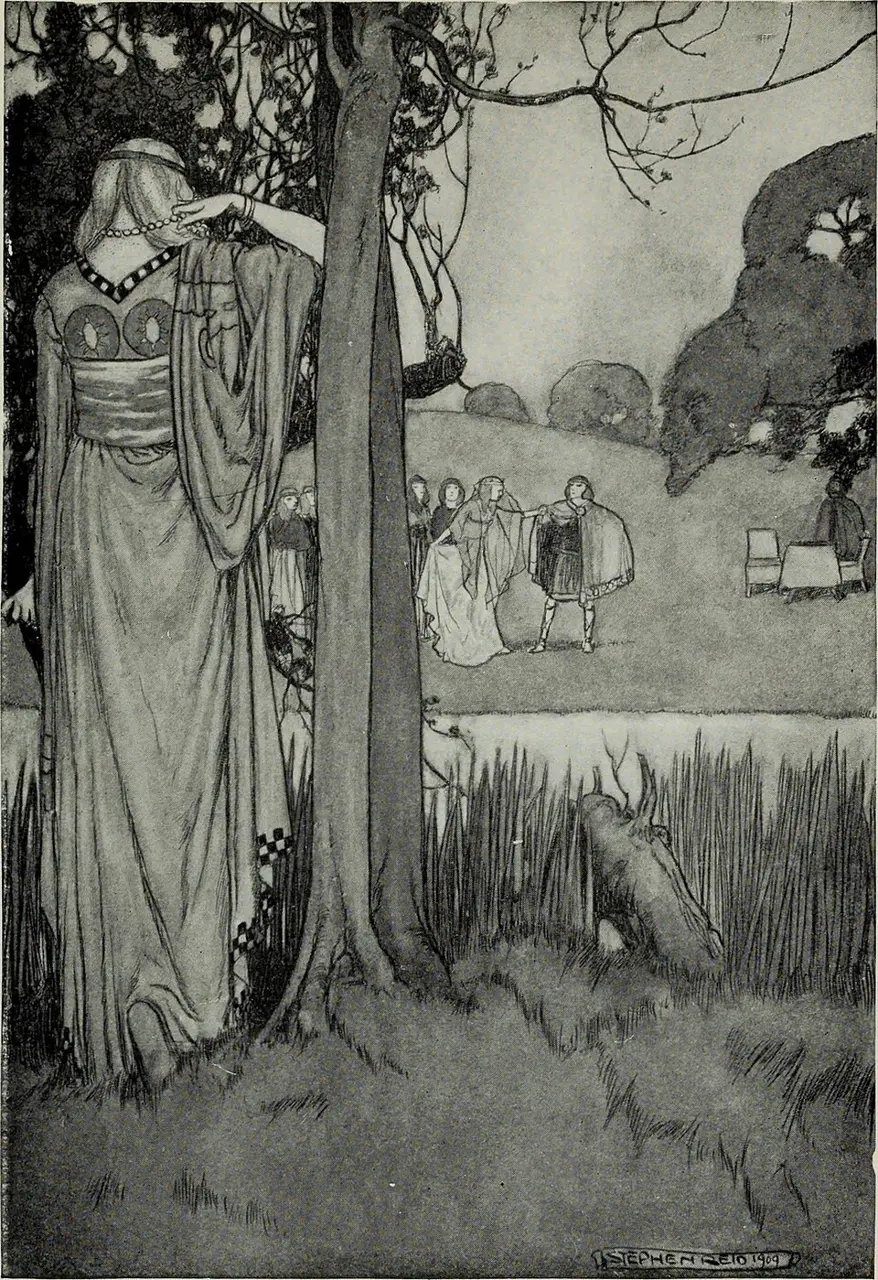
 The Shadowy Watersby W. B. YeatsFar out on a magic sea, a captain who wants a love beyond the world takes a queen captive.
 The Unicorn from the Starsby W. B. Yeats and Lady GregoryA coachbuilder's nephew wakes from a trance with a vision, and leads a band of beggars to destroy.
 Where There Is Nothingby W. B. YeatsA rich young man leaves his house to live with tinkers, then a monastery, preaching that the world should be destroyed.
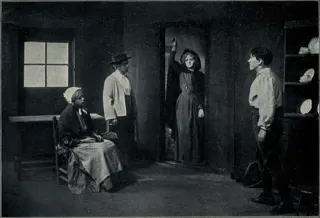 Cathleen ni Houlihanby W. B. YeatsOn the eve of his wedding in 1798, a young man leaves home to follow a poor old woman.

The play
Enter Musicians, who are dressed as in the earlier play. They have the same musical instruments, which can either be already upon the stage or be brought in by the First Musician before he stands in the centre with the cloth between his hands, or by a player when the cloth is unfolded. The stage as before can be against the wall of any room.
During the unfolding and folding of the cloth
A woman's beauty is like a white
Frail bird, like a white sea-bird alone
At daybreak after stormy night
Between two furrows upon the ploughed land:
A sudden storm and it was thrown
Between dark furrows upon the ploughed land.
How many centuries spent
The sedentary soul
In toils of measurement
Beyond eagle or mole,
Beyond hearing or seeing,
Or Archimedes guess,
To raise into being
That loveliness?
A strange unserviceable thing,
A fragile, exquisite, pale shell,
That the vast troubled waters bring
To the loud sands before day has broken.
The storm arose and suddenly fell
Amid the dark before day had broken.
What death? what discipline?
What bonds no man could unbind
Being imagined within
The labyrinth of the mind?
What pursuing or fleeing?
What wounds, what bloody press?
Dragged into being
This loveliness.
When the cloth is folded again the Musicians take their place against wall. The folding of the cloth shows on one side of the stage the curtained bed or litter on which lies a man in his grave-clothes. He wears an heroic mask. Another man with exactly similar clothes and mask crouches near the front. Emer is sitting beside the bed.
[speaking] I call before the eyes a roof
With cross-beams darkened by smoke.
A fisher's net hangs from a beam,
A long oar lies against the wall.
I call up a poor fisher's house.
A man lies dead or swooning,
That amorous man,
That amorous, violent man, renowned Cuchulain,
Queen Emer at his side.
At her own bidding all the rest have gone.
But now one comes on hesitating feet,
Young Eithne Inguba, Cuchulain's mistress.
She stands a moment in the open door,
Beyond the open door the bitter sea,
The shining, bitter sea is crying out,
[singing] White shell, white wing
I will not choose for my friend
A frail unserviceable thing
That drifts and dreams, and but knows
That waters are without end
And that wind blows.
[speaking] Come hither, come sit down beside the bed
You need not be afraid, for I myself
Sent for you, Eithne Inguba.
No, Madam,
I have too deeply wronged you to sit there.
Of all the people in the world we two,
And we alone, may watch together here,
Because we have loved him best.
And is he dead?
Although they have dressed him out in his grave-clothes
And stretched his limbs, Cuchulain is not dead;
The very heavens when that day's at hand,
So that his death may not lack ceremony,
Will throw out fires, and the earth grow red with blood.
There shall not be a scullion but foreknows it
Like the world's end.
How did he come to this?
Towards noon in the assembly of the kings
He met with one who seemed a while most dear.
The kings stood round; some quarrel was blown up;
He drove him out and killed him on the shore
At Baile's tree, and he who was so killed
Was his own son begot on some wild woman
When he was young, or so I have heard it said;
And thereupon, knowing what man he had killed,
And being mad with sorrow, he ran out;
And after to his middle in the foam
With shield before him and with sword in hand,
He fought the deathless sea. The kings looked on
And not a king dared stretch an arm, or even
Dared call his name, but all stood wondering
In that dumb stupor like cattle in a gale,
Until at last, as though he had fixed his eyes
On a new enemy, he waded out
Until the water had swept over him;
But the waves washed his senseless image up
And laid it at this door.
How pale he looks!
He is not dead.
You have not kissed his lips
Nor laid his head upon your breast.
It may be
An image has been put into his place,
A sea-born log bewitched into his likeness,
Or some stark horseman grown too old to ride
Among the troops of Mananan, Son of the Sea,
Now that his joints are stiff.
Cry out his name.
All that are taken from our sight, they say,
Loiter amid the scenery of their lives
For certain hours or days, and should he hear
He might, being angry drive the changeling out.
It is hard to make them hear amid their darkness,
And it is long since I could call him home;
I am but his wife, but if you cry aloud
With that sweet voice that is so dear to him
He cannot help but listen.
He loves me best,
Being his newest love, but in the end
Will love the woman best who loved him first
And loved him through the years when love seemed lost.
I have that hope, the hope that some day and somewhere
We'll sit together at the hearth again.
Women like me when the violent hour is over
Are flung into some corner like old nut shells.
Cuchulain, listen.
No, not yet for first
I'll cover up his face to hide the sea;
And throw new logs upon the hearth and stir
The half burnt logs until they break in flame.
Old Mananan's unbridled horses come
Out of the sea and on their backs his horsemen
But all the enchantments of the dreaming foam
Dread the hearth fire.
She pulls the curtains of the bed so as to hide the sick man's face, that the actor may change his mask unseen. She goes to one side of platform and moves her hand as though putting logs on a fire and stirring it into a blaze. While she makes these movements the Musicians play, marking the movements with drum and flute perhaps.
Having finished she stands beside the imaginary fire at a distance
from Cuchulain & Eithne Inguba.)
Call on Cuchulain now.
Can you not hear my voice.
Bend over him.
Call out dear secrets till you have touched his heart
If he lies there; and if he is not there
Till you have made him jealous.
Cuchulain, listen.
You speak too timidly; to be afraid
Because his wife is but three paces off
When there is so great a need were but to prove
The man that chose you made but a poor choice.
We're but two women struggling with the sea.
O my beloved pardon me, that I
Have been ashamed and you in so great need.
I have never sent a message or called out,
Scarce had a longing for your company
But you have known and come; and if indeed
You are lying there stretch out your arms and speak;
Open your mouth and speak for to this hour
My company has made you talkative.
Why do you mope, and what has closed your ears.
Our passion had not chilled when we were parted
On the pale shore under the breaking dawn.
He will not hear me: or his ears are closed
And no sound reaches him.
Then kiss that image
The pressure of your mouth upon his mouth
May reach him where he is.
[starting back] It is no man.
I felt some evil thing that dried my heart
When my lips touched it.
No, his body stirs;
The pressure of your mouth has called him home;
He has thrown the changeling out.
[going further off] Look at that arm
That arm is withered to the very socket.
[going up to the bed] What do you come for and from where?
I have come
From Mananan's court upon a bridleless horse.
What one among the Sidhe has dared to lie
Upon Cuchulain's bed and take his image?
I am named Bricriu--not the man--that Bricriu,
Maker of discord among gods and men,
Called Bricriu of the Sidhe.
Come for what purpose?
sitting up and showing its distorted face. Eithne Inguba goes out
I show my face and everything he loves
Must fly away.
You people of the wind
Are full of lying speech and mockery.
I have not fled your face.
You are not loved.
And therefore have no dread to meet your eyes
And to demand him of you.
For that I have come.
You have but to pay the price and he is free.
Do the Sidhe bargain?
When they set free a captive
They take in ransom a less valued thing.
The fisher when some knowledgeable man
Restores to him his wife, or son, or daughter,
Knows he must lose a boat or net, or it may be
The cow that gives his children milk; and some
Have offered their own lives. I do not ask
Your life, or any valuable thing;
You spoke but now of the mere chance that some day
You'd sit together by the hearth again;
Renounce that chance, that miserable hour,
And he shall live again.
I do not question
But you have brought ill luck on all he loves
And now, because I am thrown beyond your power
Unless your words are lies, you come to bargain.
You loved your power when but newly married
And I love mine although I am old and withered;
You have but to put yourself into that power
And he shall live again.
No, never, never.
You dare not be accursed yet he has dared.
I have but two joyous thoughts, two things I prize,
A hope, a memory, and now you claim that hope.
He'll never sit beside you at the hearth
Or make old bones, but die of wounds and toil
On some far shore or mountain, a strange woman
Beside his mattress.
You ask for my one hope
That you may bring your curse on all about him.
You've watched his loves and you have not been jealous
Knowing that he would tire, but do those tire
That love the Sidhe?
What dancer of the Sidhe
What creature of the reeling moon has pursued him?
I have but to touch your eyes and give them sight;
But stand at my left side.
He touches her eyes with his left hand, the right being withered
My husband there.
But out of reach--I have dissolved the dark
That hid him from your eyes but not that other
That's hidden you from his.
Husband, husband!
Be silent, he is but a phantom now
And he can neither touch, nor hear, nor see;
The longing and the cries have drawn him hither.
He heard no sound, heard no articulate sound;
They could but banish rest, and make him dream,
And in that dream, as do all dreaming shades
Before they are accustomed to their freedom,
He has taken his familiar form, and yet
He crouches there not knowing where he is
Or at whose side he is crouched.
a Woman of the Sidhe has entered and stands a little inside the door
Who is this woman?
She has hurried from the Country-Under-Wave
And dreamed herself into that shape that he
May glitter in her basket; for the Sidhe
Are fishers also and they fish for men
With dreams upon the hook.
And so that woman
Has hid herself in this disguise and made
Herself into a lie.
A dream is body;
The dead move ever towards a dreamless youth
And when they dream no more return no more;
And those more holy shades that never lived
But visit you in dreams.
I know her sort.
They find our men asleep, weary with war,
Or weary with the chase and kiss their lips
And drop their hair upon them, from that hour
Our men, who yet knew nothing of it all,
Are lonely, and when at fall of night we press
Their hearts upon our hearts their hearts are cold.
She draws a knife from her girdle
And so you think to wound her with a knife.
She has an airy body. Look and listen;
I have not given you eyes and ears for nothing.
The Woman of the Sidhe moves round the crouching Ghost of Cuchulain at front of stage in a dance that grows gradually quicker, as he slowly awakes. At moments she may drop her hair upon his head but she does not kiss him. She is accompanied by string and flute and drum. Her mask and clothes must suggest gold or bronze or brass or silver so that she seems more an idol than a human being. This suggestion may be repeated in her movements. Her hair too, must keep the metallic suggestion.
Who is it stands before me there
Shedding such light from limb and hair
As when the moon complete at last
With every labouring crescent past,
And lonely with extreme delight,
Flings out upon the fifteenth night?
Because I long I am not complete.
What pulled your hands about your feet
And your head down upon your knees,
And hid your face?
Old memories:
A dying boy, with handsome face
Upturned upon a beaten place;
A sacred yew-tree on a strand;
A woman that held in steady hand
In all the happiness of her youth
Before her man had broken troth,
A burning wisp to light the door;
And many a round or crescent more;
Dead men and women. Memories
Have pulled my head upon my knees.
Could you that have loved many a woman
That did not reach beyond the human,
Lacking a day to be complete,
Love one that though her heart can beat,
Lacks it but by an hour or so.
I know you now for long ago
I met you on the mountain side,
Beside a well that seemed long dry,
Beside old thorns where the hawk flew.
I held out arms and hands but you,
That now seem friendly, fled away
Half woman and half bird of prey.
Hold out your arms and hands again
You were not so dumbfounded when
I was that bird of prey and yet
I am all woman now.
I am not
The young and passionate man I was
And though that brilliant light surpass
All crescent forms, my memories
Weigh down my hands, abash my eyes.
Then kiss my mouth. Though memory
Be beauty's bitterest enemy
I have no dread for at my kiss
Memory on the moment vanishes:
Nothing but beauty can remain.
And shall I never know again
Intricacies of blind remorse?
Time shall seem to stay his course,
For when your mouth and my mouth meet
All my round shall be complete
Imagining all its circles run;
And there shall be oblivion
Even to quench Cuchulain's drouth,
Even to still that heart.
Your mouth.
They are about to kiss, he turns away
O Emer, Emer.
So then it is she
Made you impure with memory.
Still in that dream I see you stand,
A burning wisp in your right hand,
To wait my coming to the house,
As when our parents married us.
Being among the dead you love her
That valued every slut above her
While you still lived.
O my lost Emer.
And there is not a loose-tongued schemer
But could draw you if not dead,
From her table and her bed.
How could you be fit to wive
With flesh and blood, being born to live
Where no one speaks of broken troth
For all have washed out of their eyes
Wind blown dirt of their memories
To improve their sight?
Your mouth, your mouth.
Their lips approach but Cuchulain turns away as Emer speaks.
If he may live I am content,
Content that he shall turn on me,
If but the dead will set him free
That I may speak with him at whiles,
Eyes that the cold moon or the harsh sea
Or what I know not's made indifferent.
What a wise silence has fallen in this dark!
I know you now in all your ignorance
Of all whereby a lover's quiet is rent.
What dread so great as that he should forget
The least chance sight or sound, or scratch or mark
On an old door, or frail bird heard and seen
In the incredible clear light love cast
All round about her some forlorn lost day?
That face, though fine enough, is a fool's face
And there's a folly in the deathless Sidhe
Beyond man's reach.
I told you to forget
After my fashion; you would have none of it;
So now you may forget in a man's fashion.
There's an unbridled horse at the sea's edge.
Mount; it will carry you in an eye's wink
To where the King of Country-Under-Wave,
Old Mananan, nods above the board and moves
His chessmen in a dream. Demand your life
And come again on the unbridled horse.
Forgive me those rough words. How could you know
That man is held to those whom he has loved
By pain they gave, or pain that he has given,
Intricacies of pain.
I am ashamed
That being of the deathless shades I chose
A man so knotted to impurity.
The Ghost of Cuchulain goes out
[to Figure of Cuchulain] To you that have no living light, but dropped
From a last leprous crescent of the moon,
I owe it all.
Because you have failed
I must forego your thanks, I that took pity
Upon your love and carried out your plan
To tangle all his life and make it nothing
That he might turn to you.
Was it from pity
You taught the woman to prevail against me?
You know my nature--by what name I am called.
Was it from pity that you hid the truth
That men are bound to women by the wrongs
They do or suffer?
You know what being I am.
I have been mocked and disobeyed--your power
Was more to you than my good-will, and now
I'll have you learn what my ill-will can do;
I lay you under bonds upon the instant
To stand before our King and face the charge
And take the punishment.
I'll stand there first.
And tell my story first, and Mananan
Knows that his own harsh sea made my heart cold.
My horse is there and shall outrun your horse.
The Figure of Cuchulain falls back, the Woman of the Sidhe goes out. Drum taps, music resembling horse hoofs.
[entering quickly] I heard the beat of hoofs, but saw no horse,
And then came other hoofs and after that
I heard low angry cries and thereupon
I ceased to be afraid.
Cuchulain wakes.
The figure turns round. It once more wears the heroic mask.
Eithne Inguba take me in your arms,
I have been in some strange place and am afraid.
The First Musician comes to the front of stage, the others from each side and unfold the cloth singing
What makes her heart beat thus,
Plain to be understood
I have met in a man's house
A statue of solitude,
Moving there and walking;
Its strange heart beating fast
For all our talking.
O still that heart at last.
O bitter reward!
Of many a tragic tomb!
And we though astonished are dumb
And give but a sigh and a word
A passing word.
Although the door be shut
And all seem well enough,
Although wide world hold not
A man but will give you his love.
The moment he has looked at you,
He that has loved the best
May turn from a statue
His too human breast.
O bitter reward!
Of many a tragic tomb!
And we though astonished are dumb
Or give but a sigh and a word
A passing word.
What makes your heart so beat?
Some one should stay at her side.
When beauty is complete
Her own thought will have died
And danger not be diminished;
Dimmed at three quarter light
When moon's round is finished
The stars are out of sight.
O bitter reward!
Of many a tragic tomb!
And we though astonished are dumb
Or give but a sigh and a word
A passing word.
When the cloth is folded again the stage is bare.