
Duologue from Othello by William Shakespeare
Desdemona and Emilia: “I do not think there is any such woman”
Othello has ordered Desdemona to bed and to send Emilia away. As Emilia helps her undress, Desdemona sings the willow song and asks whether any wife could betray her husband.
- 4 min 15 sec
- Dramatic
- Emilia: Woman, 30 to 50
- Desdemona: Woman, 18 to 28
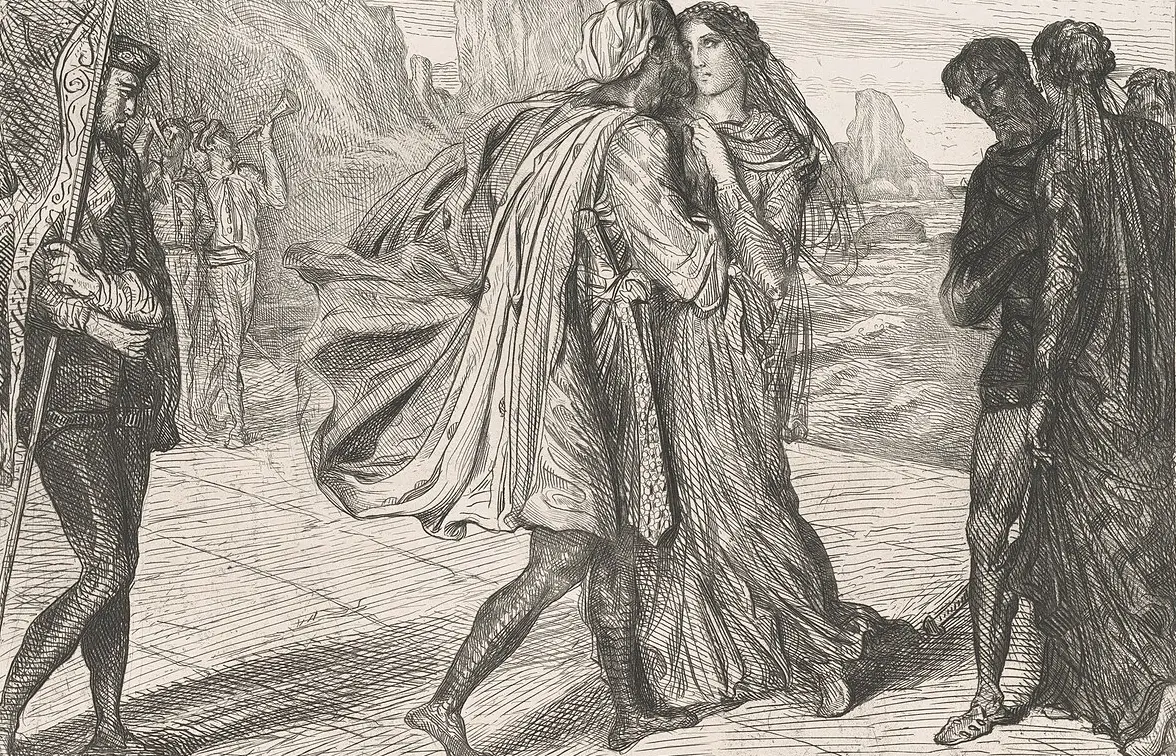

Act 4, Scene 3Another room In the castle
How goes it now? he looks gentler than he did.
He says he will return incontinent:
He hath commanded me to go to bed,
And bade me to dismiss you.
Dismiss me!
It was his bidding: therefore, good Emilia,.
Give me my nightly wearing, and adieu:
We must not now displease him.
I would you had never seen him!
So would not I my love doth so approve him,
That even his stubbornness, his cheques, his frowns--
Prithee, unpin me,--have grace and favour in them.
I have laid those sheets you bade me on the bed.
All's one. Good faith, how foolish are our minds!
If I do die before thee prithee, shroud me
In one of those same sheets.
Come, come you talk.
My mother had a maid call'd Barbara:
She was in love, and he she loved proved mad
And did forsake her: she had a song of 'willow;'
An old thing 'twas, but it express'd her fortune,
And she died singing it: that song to-night
Will not go from my mind; I have much to do,
But to go hang my head all at one side,
And sing it like poor Barbara. Prithee, dispatch.
Shall I go fetch your night-gown?
No, unpin me here.
This Lodovico is a proper man.
A very handsome man.
He speaks well.
I know a lady in Venice would have walked barefoot
to Palestine for a touch of his nether lip.
[Singing] The poor soul sat sighing by a sycamore tree,
Sing all a green willow:
Her hand on her bosom, her head on her knee,
Sing willow, willow, willow:
The fresh streams ran by her, and murmur'd her moans;
Sing willow, willow, willow;
Her salt tears fell from her, and soften'd the stones;
Lay by these:--
Singing
Sing willow, willow, willow;
Prithee, hie thee; he'll come anon:--
Singing
Sing all a green willow must be my garland.
Let nobody blame him; his scorn I approve,-
Nay, that's not next.--Hark! who is't that knocks?
It's the wind.
[Singing] I call'd my love false love; but what
said he then?
Sing willow, willow, willow:
If I court moe women, you'll couch with moe men!
So, get thee gone; good night Ate eyes do itch;
Doth that bode weeping?
'Tis neither here nor there.
I have heard it said so. O, these men, these men!
Dost thou in conscience think,--tell me, Emilia,--
That there be women do abuse their husbands
In such gross kind?
There be some such, no question.
Wouldst thou do such a deed for all the world?
Why, would not you?
No, by this heavenly light!
Nor I neither by this heavenly light;
I might do't as well i' the dark.
Wouldst thou do such a deed for all the world?
The world's a huge thing: it is a great price.
For a small vice.
In troth, I think thou wouldst not.
In troth, I think I should; and undo't when I had
done. Marry, I would not do such a thing for a
joint-ring, nor for measures of lawn, nor for
gowns, petticoats, nor caps, nor any petty
exhibition; but for the whole world,--why, who would
not make her husband a cuckold to make him a
monarch? I should venture purgatory for't.
Beshrew me, if I would do such a wrong
For the whole world.
Why the wrong is but a wrong i' the world: and
having the world for your labour, tis a wrong in your
own world, and you might quickly make it right.
I do not think there is any such woman.
More duologues for two women
 Olivia and Viola: “Now, sir, what is your text?”Twelfth Night · 3 min 45 sec · Comic
 Gwendolen and Cecily: “Did you say Ernest?”The Importance of Being Earnest · 4 min · Comic
 Sonia and Helena: “Autumn roses, beautiful, sorrowful roses!”Uncle Vanya · 5 min · Dramatic
 Hedda and Thea: “Weren't we schoolfellows?”Hedda Gabler · 5 min · Dramatic