
Duologue from Twelfth Night by William Shakespeare
Olivia and Viola: “Now, sir, what is your text?”
Viola, disguised as Cesario, has finally got in to see Olivia with Orsino's message of love. Olivia unveils, and falls for the messenger.
- 3 min 45 sec
- Comic
- Olivia: Woman, 20 to 30
- Viola: Woman, 18 to 25
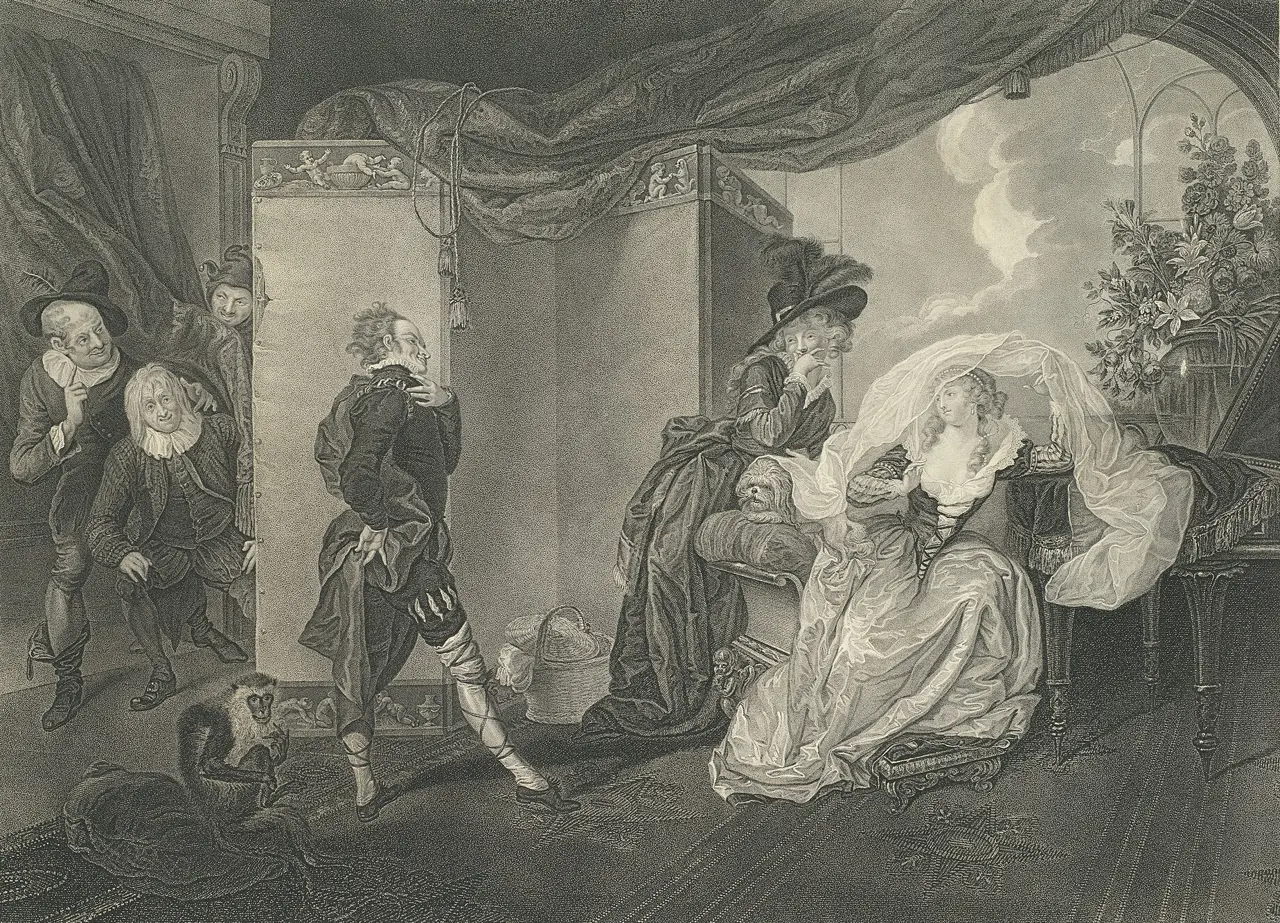

Act 1, Scene 5OLIVIA'S house
Now, sir, what is your text?
Most sweet lady,--
A comfortable doctrine, and much may be said of it.
Where lies your text?
In Orsino's bosom.
In his bosom! In what chapter of his bosom?
To answer by the method, in the first of his heart.
O, I have read it: it is heresy. Have you no more to say?
Good madam, let me see your face.
Have you any commission from your lord to negotiate
with my face? You are now out of your text: but
we will draw the curtain and show you the picture.
Look you, sir, such a one I was this present: is't
not well done?
Unveiling
Excellently done, if God did all.
'Tis in grain, sir; 'twill endure wind and weather.
'Tis beauty truly blent, whose red and white
Nature's own sweet and cunning hand laid on:
Lady, you are the cruell'st she alive,
If you will lead these graces to the grave
And leave the world no copy.
O, sir, I will not be so hard-hearted; I will give
out divers schedules of my beauty: it shall be
inventoried, and every particle and utensil
labelled to my will: as, item, two lips,
indifferent red; item, two grey eyes, with lids to
them; item, one neck, one chin, and so forth. Were
you sent hither to praise me?
I see you what you are, you are too proud;
But, if you were the devil, you are fair.
My lord and master loves you: O, such love
Could be but recompensed, though you were crown'd
The nonpareil of beauty!
How does he love me?
With adorations, fertile tears,
With groans that thunder love, with sighs of fire.
Your lord does know my mind; I cannot love him:
Yet I suppose him virtuous, know him noble,
Of great estate, of fresh and stainless youth;
In voices well divulged, free, learn'd and valiant;
And in dimension and the shape of nature
A gracious person: but yet I cannot love him;
He might have took his answer long ago.
If I did love you in my master's flame,
With such a suffering, such a deadly life,
In your denial I would find no sense;
I would not understand it.
Why, what would you?
Make me a willow cabin at your gate,
And call upon my soul within the house;
Write loyal cantons of contemned love
And sing them loud even in the dead of night;
Halloo your name to the reverberate hills
And make the babbling gossip of the air
Cry out 'Olivia!' O, You should not rest
Between the elements of air and earth,
But you should pity me!
You might do much.
What is your parentage?
Above my fortunes, yet my state is well:
I am a gentleman.
Get you to your lord;
I cannot love him: let him send no more;
Unless, perchance, you come to me again,
To tell me how he takes it. Fare you well:
I thank you for your pains: spend this for me.
I am no fee'd post, lady; keep your purse:
My master, not myself, lacks recompense.
Love make his heart of flint that you shall love;
And let your fervor, like my master's, be
Placed in contempt! Farewell, fair cruelty.
More duologues for two women
 Gwendolen and Cecily: “Did you say Ernest?”The Importance of Being Earnest · 4 min · Comic
 Sonia and Helena: “Autumn roses, beautiful, sorrowful roses!”Uncle Vanya · 5 min · Dramatic
 Desdemona and Emilia: “I do not think there is any such woman”Othello · 4 min 15 sec · Dramatic
 Hedda and Thea: “Weren't we schoolfellows?”Hedda Gabler · 5 min · Dramatic