
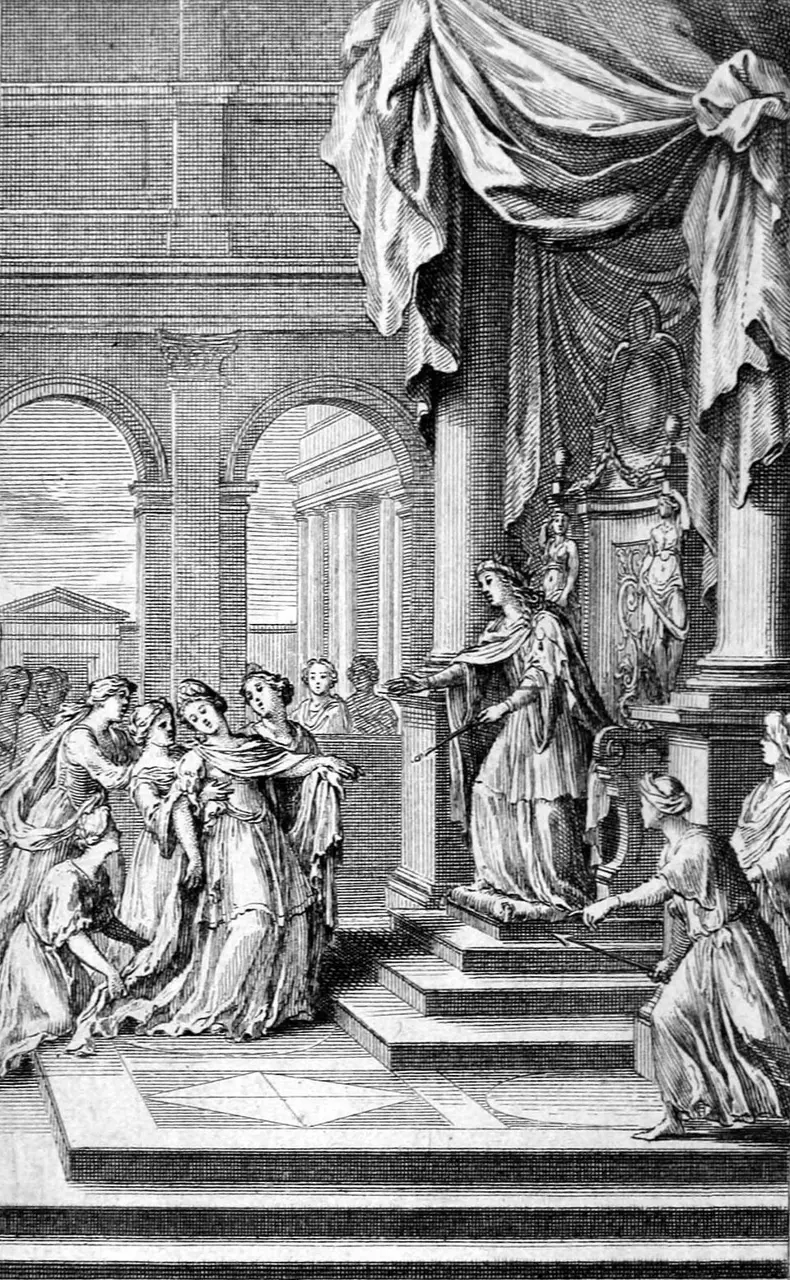
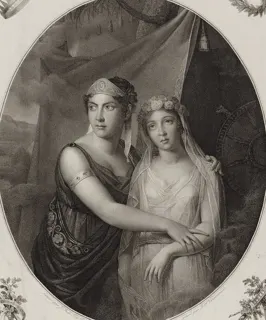
 Iphigeniaby Jean RacineThe Greek fleet is becalmed at Aulis, and the gods ask Agamemnon for his daughter's life.
 Mithridatesby Jean RacineThe old king Mithridates, thought dead, comes home to find both his sons in love with his bride.
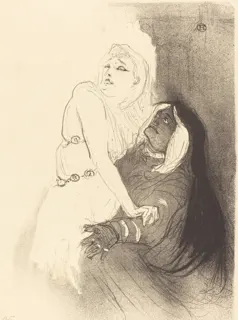 Phèdreby Jean RacineA queen's love for her stepson destroys them both.
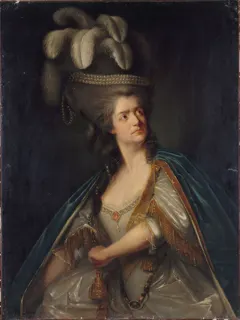 Andromacheby Jean RacineAfter Troy, the son of Achilles loves his captive, Hector's widow, and the woman he jilts sends her own lover to kill him.

Prologue
From the Divine Creator's blest abode
I to this dwelling-place of Grace descend
Which Innocence, my constant comrade, haunts,
And finds no surer refuge 'neath the skies.
Here, far from tumult, by my hand is form'd
In holiest offices a rising race;
I nourish in their hearts the fruitful seed
Of virtues that may sanctify the world.
A King, my guardian, a victorious King,
Has trusted to my care this precious charge.
'Tis he has gather'd here these timid doves,
Else widely scatter'd, without help or guides:
Raising this palace at his gates for them,
He bids them find peace and abundance here.
Great God, forget not Thou this pious work!
Let all the care he for Thy glory takes
Be graven by Thy hand within the book
Where the predestined names of kings beloved
Of Heav'n are written! Ever dost Thou hear me;
Am I not Piety, Thy daughter dear,
Whose voice Thou knowest? And this king's warm vows
I bear, and from the altar of Thy love
Kindle his heart. The fervent zeal that burns
His soul with a consuming fire for Thee
Is spread from east to west. Thou seest him
Daily before Thee bow his crownèd head
In worship, and, by his august example,
Confounding pride, adore Thy sacred threshold.
Of all earth's monarchs he alone maintains
Thy quarrel, and, inspired with holy ardour,
Fights for Thine honour. Jealousy and greed
Conspire against Thee, for foul heresy
Contending; discord rages everywhere;
All, as it seems, forsake Thy holy standards,
And hell, with dismal damps enshrouding all,
Has cast its darkness over saintliest eyes.
He only, grounded upon faith unchanging,
With ready eye and ear seeks naught but Thee,
And, vanquishing the fiend's vain subtlety,
Sustains the entire fabric of religion.
Judge Thine own cause, great God, make bare to-day
Thine arm, that self-same arm which fought for him,
When the Rhine saw so many times dispersed
The armies of the nations that had sworn
To crush him. Those same foes, in proud defiance,
Come to meet shipwreck on the rock before
Found fatal. Everywhere firm barriers burst,
Forth from their ruin'd forts they swarm across
His borders. Thou hast given him a son
Ready to fight, to aid, obey, command;
A son whom, like himself, Conquest attends;
His highest aim to gain his father's heart;
A son whose love submits to all his wishes,
The terror and despair of all his foes;
Worthy to rank with those heroic souls
Thy Justice sends. The King says, Go: he springs
Forward with joy, his vengeance falls like lightning,
And he returns calmly to lay the spoils
Down at his feet.
But while a mighty Monarch
Thus rights my wrongs, you who here taste delights
So pure, if he permits a moment's rest
To his brave heart, call to your blameless pastime
This hero; Esther's glorious history
Enact, and impious wiles by faith subdued.
And ye for whom wild passions have a charm
Kindled by fictions frivolous and vain,
Who love profane and pagan spectacles,
Whose ears are not attuned to solemn words,
The sacred joys I bring are not for you;
Fly, for all here breathes God, and peace, and truth.
Act 1, Scene 1
Scene—Esther's chamber
[ESTHER, ELIZABETH]
Is 't thou, Elizabeth? Thrice happy day!
Blessèd be Heav'n that to my pray'rs restores
The friend of earliest years, like me a daughter
Of Benjamin, who, gall'd by the same yoke
Of dire oppression, mourn'd with me the woes
Of captured Zion. Ah, how memory dwells
Still fondly on the visions of the past!
But thou, thine Esther's glory dost thou know?
Six months and more has search for thee been made;
What clime, what desert so remote could hide thee?
Stricken with grief at rumours of thy death,
I lived a life apart from all mankind,
And waited only for that life of sadness
To end, when suddenly a prophet spake:
"Too long hast thou bewail'd the loss of one
Who yet survives. Rise, take thy way to Shushan;
There shalt thou see the object of thy tears
Seated in pomp and honour on a throne.
Zion," said he, "comfort thy timid tribes;
The day draws nigh when the Lord God of hosts
Shall make the might of His strong arm appear,
For He has heard His people's cry for help."
He spake: and I, with joy and wonder moved,
Set off in haste, found entrance to this palace,
And see a spectacle that fills mine eyes
With admiration, worthy of the arm
That saved our fathers! Proud Ahasuerus
His captive crowns, and falls before the feet
Of a fair Jewess! By what secret springs
Has Heav'n accomplish'd this unhoped for triumph?
Thou may'st have heard the well-known story told
Of haughty Vashti's fall, whose place I fill;
When Persia's king, inflamed with sore displeasure,
Banish'd the queen both from his throne and bed,
But could not drive her from his thoughts so soon;
Long Vashti reign'd in his offended soul.
Then must there search be made thro' all his realms
For some new object that might wean him from her.
From Ind to Hellespont his slaves went forth;
Daughters of Egypt show'd themselves at Shushan;
E'en the wild Scythian and the Parthian sent
Their maidens to contend for beauty's prize,
The sceptre. I was being then brought up
In secret under the wise, watchful eyes
Of Mordecai, to whom I owe so much.
When by the stroke of death I lost my parents,
To me, his brother's offspring, he supplied
The place of father and of mother too.
The Jews were then sore vexèd night and day;
He drew me out of my obscurity,
And, their deliverance to my feeble hands
Confiding, he possess'd me with the hope
Of empire. Trembling I obey'd his will:
Hither I came, but hid my race and country.
Who could recount the jealousies and plots
Hatch'd by the multitude of rivals here
Who all, disputing for so high a favour,
Waited their sentence at the monarch's eyes?
Each had supporters, each a pow'rful faction;
One boasted the advantages of birth;
Another borrow'd help from skilful hands
To deck herself in robes magnificent;
But I placed all my trust in Heav'n's support,
My only art the sacrifice of tears.
At last to me the summons of the King
Came, and before his presence I appear'd.
God holds the hearts of monarchs in His hands;
He brings prosperity to guileless souls,
While in their schemes of pride the wicked fall
Entrapp'd. My feeble charms appear'd to move
The King: in thoughtful silence long he gazed;
And Heav'n, that turn'd the balance in my favour,
Work'd doubtless on his heart the while. At length,
With eyes wherein a look of kindness reign'd,
"Be thou my Queen," he said, and therewithal
With his own hand upon my brow he placed
His diadem. Then he, to show his joy,
Loaded the great ones of his court with gifts;
And throughout all his realms his bounty bade
His subjects to the royal marriage feast.
During those days of jocund mirth, alas,
What secret shame and grief within me burn'd!
Esther, said I, Esther is clad in robes
Of state, and half the world obeys her sceptre,
While the grass grows over the walls of Salem;
Zion, the haunt of unclean reptiles, sees
Her holy temple scatter'd heaps of stones,
And ceased the festivals of Israel's God!
Hast thou not told thy sorrow to the King?
Until this day he knows not who I am:
He by whom under Heav'n my fate is ruled
Forbids me yet this secret to reveal.
Is Mordecai allow'd an entrance here?
His love for me sharpens his wit; tho' absent
I ask his counsel, and his wise replies
Find countless ways and means to reach mine ears;
No father for the welfare of his child
Has more concern. Already warn'd in secret
By him, I to the king made known a plot
Form'd by two household slaves against his life.
Meanwhile my warm attachment to our tribe
Has fill'd this palace with young maids of Zion,
Fair, tender flowers beaten by the storms
Of life, transplanted to an alien clime
With me. Apart from witnesses profane,
I make their training my chief care and study,
And, hither flying from the flattering court,
Sick of vain pomp, retired within myself,
I come to kneel before Jehovah's feet,
And taste the bliss of self-forgetfulness.
But from the Persians I conceal their race.
Now must I call them. Come, my children, come,
Erst my companions in captivity,
The patriarch Jacob's young posterity.
Act 1, Scene 2
[ESTHER, ELIZABETH, CHORUS]
[singing behind the stage] Sister, whose invitation greets our ear?
Those pleasing accents well I know:
It is the Queen.
My sisters, let us go.
It is the Queen we hear,
She calls us; let us hasten and draw near.
[entering from different directions] It is the Queen we hear,
She calls us: let us hasten and draw near.
What an array of innocence and beauty
Before mine eyes gather from every side!
What modesty and grace each countenance
Adorn! All hail, hope of a holy stock!
May your pure aspirations mount to Heav'n
Like the sweet smoke of incense! May our God
Regard you with a look of loving kindness!
My children, sing one of those sacred songs
Wherewith so oft, mingling your tears with mine,
Ye have lamented Zion's misery.
[alone] Where is the light that over Salem shone,
The glory that the world admired of yore?
Thou art but dust, that splendour nothing more
Than a sad memory of brightness gone.
Zion, exalted once to heaven's height,
But now brought down to the abyss of hell,
May dumbness my ingratitude requite,
If in my songs I e'er forget to tell,
Till my last breath, what sorrows thee befell?
Ye banks of Jordan! Plains beloved of Heav'n!
Each fertile valley and each holy hill,
To which God's countless wonders fame have giv'n!
From our dear fatherland sad exiles still,
This time of trouble shall we ne'er fulfil?
[alone] When, Zion, shall I see thy ramparts raised,
Thy lofty tow'rs rebuilt in all their pride?
By festal throngs pressing from every side
When shall I hear the God of Israel praised?
Ye banks of Jordan! Plains beloved of Heav'n!
Each fertile valley and each holy hill,
To which God's countless wonders fame have giv'n!
From our dear fatherland sad exiles still,
This time of trouble shall we ne'er fulfil?
Act 1, Scene 3
[ESTHER, MORDECAI, ELIZABETH, THE CHORUS]
Who dares these sacred precincts to invade?
Is 't thou, my father? See I Mordecai?
Has then an angel of the Lord outspread
His holy wing to hide thee while he guided
Thy footsteps hither? But whence comes that air
Of gloom, that robe of sackcloth, and those ashes
Cast on thine head? What news?
Unhappy Queen!
O guiltless people, to a barbarous fate
Condemn'd! Read—read the hateful, cruel sentence—
We all are lost! and Israel's race is run!
Just Heav'n! My blood is frozen in my veins.
The name of Jew is to be blotted out.
To bloody Haman are we all betray'd;
The swords, the knives already are prepared,
And the whole nation meets one common doom.
Haman, vile Haman, the Amalekite,
Arms all his influence for this fatal blow,
The King believes him, and has sign'd this edict.
Biass'd against us by those lying lips,
He thinks that Nature's very self abhors us.
His orders have been giv'n; in all his States
The fatal day is fix'd for our destruction.
Heav'ns, will ye look on this atrocious slaughter?
The sword will pity neither sex nor age;
All will be prey for tigers and for vultures.
In ten days hence this dreadful day arrives.
O God, to Whom these deadly plots are known,
Wilt Thou forsake the remnant of thy people?
Who will defend us, if Thou fight not for us?
Leave tears, my Esther, to these tender babes.
The only hope of thine unhappy kinsmen
Rests upon thee. Help them; but time is precious,
It flies, and soon will bring the destined day
For Israel's name to be wiped out for ever.
Fired with the ardour of God's holy prophets,
Go, boldly tell thy lineage to the King.
Alas! Dost thou not know what laws severe
Guard the King's privacy from all intruders?
In the seclusion of the inner palace
None may behold his awful majesty;
'Tis death, without his summons, to presume
To show oneself before the royal presence,
Unless the King that instant should extend
His sceptre to be kiss'd, as sign of pardon.
This fatal law affects all ranks alike,
In either sex the crime is still the same.
Entitled as I am to share his throne,
Herein I am a subject like another;
And I must wait, if I would speak with him,
Until he seeks me, or else bids me come.
What! When thou see'st thy country perishing,
Dost thou set store, my daughter, by thy life?
God speaks, and dost thou fear a mortal's wrath?
Nay, Esther. Canst thou count thy life thine own?
Belongs it not to those from whom thy blood
Derived its source? Belongs it not to God
Who gave it? When He led thee to the throne,
Who knows if it was not to save His people?
Ponder it well: God has not chosen thee
To win vain admiration from the gaze
Of heathen eyes, to charm the tribes of Asia:
For nobler ends doth He reserve His saints.
Self-sacrifice for Him and for His flock
Is the true portion of a child of God.
To risk thy life for His name's sake is bliss
Supreme. Not that His arm needs our support;
Earth's mightiest kings cannot withstand His pow'r,
'T were vain for them to league themselves against Him;
If He but show Himself their strength dissolves;
He speaks and they return to dust. The sea
Retreats before His voice, the heavens tremble;
He looks upon the universe as nothing;
And feeble mortals, playthings of an hour,
Are all as though they were not in His sight.
If He has suffer'd Haman's wickedness,
'Tis only, be assured, to prove thy zeal.
'Tis He who, stirring me to this bold step,
Dear Esther, has vouchsafed to march before me:
And if His voice must strike thine ear in vain,
We shall behold His wonders none the less.
He can confound this Haman, He can burst
Our chains asunder by the weakest hand
The world contains. But, should'st thou spurn His grace,
It may be thou wilt perish with thy race.
Go, and let all the Jews that dwell at Shushan,
In earnest supplication night and day,
Unite with thee to lend me all the help
That prayer affords, and keep a three days' fast
Severe. Already has dark night descended:
To-morrow when the sun shall bring back day,
Content to meet my death if die I must,
I will go forth, and for my country offer
Myself. Let all retire.
The Chorus withdraws to the back of the stage
Act 1, Scene 4
[ESTHER, ELIZABETH, THE CHORUS]
O God my King,
Behold me trembling and alone before Thee!
How oft my father in my childhood taught me
That Thou didst swear a covenant with us
When, to prepare a people for Thyself,
It pleased Thee in Thy love to choose our fathers:
Yea, Thine own holy mouth did promise them
Posterity that should endure for ever.
Alas! This people has despised Thy law;
The nation of Thy choice has been unfaithful;
She has cast off her Husband and her Father,
To pay adulterous vows to other gods;
And now she stoops beneath the stranger's yoke.
But to be slaves is not enough, our lives
Are threaten'd; our proud conquerors mock our tears,
To their own gods ascribe their victories,
And with one mortal blow would fain to-day
Destroy Thy name, Thy people, and Thy worship.
Shall then a traitor, after all Thy deeds
Of wondrous might, make void Thy covenant,
Rob all mankind of Thy most precious gift,
The Holy One, long promised, long expected?
No, no, forbid the Gentiles in their fury,
Drunk with our blood, to shut the only mouths
Which hymn Thy praises throughout all the world;
Confound their gods that are no gods at all.
And as for me whom Thou hast placed among
These infidels, Thou knowest how I hate
Their sinful feasts, and count as profanations
Their table, and their offerings, and rites;
This very pomp to which I am condemn'd,
This diadem, that I am forced to wear
On days of high solemnity and pride,
I trample under foot when all alone,
To these vain gauds preferring dust and ashes,
And take no pleasure but in tears like these.
I have been waiting Thine appointed time
To venture boldly in Thy people's cause.
The hour is come; and I, with prompt submission,
Will brave the dreadful presence of the King.
'Tis in Thy name I go; guide Thou my steps
Before this lion fierce that knows Thee not;
Command his wrath to sleep at sight of me,
And lend me gracious words to charm his ear.
The winds and tempests of the skies obey Thee;
Turn Thou his rage against our enemies.
Act 1, Scene 5
The Chorus
All this scene is sung
[alone] Faithful companions, to our tears and sighs
Let us give vent, nor cease to sob and moan;
While tow'rd those holy hills we raise our eyes
Whence innocence can look for help alone.
What terrors round us rise!
Weep, Israel, weep thy total overthrow,
Ne'er was there known so just a cause for woe
As ours beneath the skies.
What terrors round us rise!
Was 't not enough the hateful conqueror's hand
Should have destroy'd majestic Zion's charms,
And led her children captive from their land?
O terrible alarms!
Like feeble sheep 'mid ravening wolves we stand,
Our sighs to Heaven are our only arms.
O terrible alarms!
Let me cast off these ornaments, and tear
The veil that decks my head.
Sackcloth and ashes let us rather wear,
Meet for the banquet dread
By impious Haman spread.
Let us cast off these ornaments, and tear
The veil that decks each head.
On every side terror and bloodshed reign,
The agèd and the young alike are slain,
The sister and the brother,
The daughter with the mother,
The dying father clasps his son in vain!
What scatter'd heaps of mangled corpses lie
Unburied on the ground!
While leopards prowl around,
And make Thy saints their food, great God on high!
Alas! What have I done?
Can one so young deserve a fate so dire?
Scarce has the promise of my life begun
To open, ere it falls, doom'd to expire
Like blossom that ne'er sees a second sun.
Alas! What have I done?
Can one so young deserve a fate so dire?
Unhappy victims we of others' crimes,
What boots it our sad fortune to deplore?
Our fathers sinn'd, our fathers are no more;
We bear the vengeance due to earlier times.
The Lord of hosts Whom we adore
Will ne'er let righteous blood be spilt,
Confounding innocence with guilt.
Let not the heathen say
Where then is Israel's God? Let Him display
His boasted pow'r to-day!
This jealous God, this God of matchless might,
[Quake, nations of the world!]
This jealous God, this God of matchless might
Alone commands the depth, commands the height,
By Him heav'n's bolts are hurl'd;
No other god can make the darkness bright.
He overthrows the mighty in their pride;
Places the meek and humble at His side.
The Lord of Hosts Whom we adore
Will ne'er let righteous blood be spilt,
Confounding innocence and guilt.
O God, Whom glory hovers o'er,
Who art in robes of light array'd,
Who ridest where wild tempests roar,
On cherub's wings as on Thy throne convey'd:
Thou Who art pleased that simple babes should raise
With angel hosts their voices in Thy praise:
See Thou what perils round us rise:
Give honour to Thy name, we pray,
Nor let Thy glory pass away
To foreign gods whom we despise.
Arm Thyself, Lord, Thy people to defend;
And, as the sea saw Thee of old, descend,
That wicked men may be inclined
To fear Thy wrath.
Let them be, like the dust before the wind,
Swept from Thy path!
See Thou what perils round us rise:
Give honour to Thy name, we pray,
Nor let Thy glory pass away
To foreign gods whom we despise.
Act 2, Scene 1
Scene—The throne room of Ahasuerus
[HAMAN, HYDASPES]
What! When the light of day scarce 'gins to dawn,
Dost thou dare bring me to this hall of terrors?
Thou knowest that my faithfulness is trusted;
These doors are shut and open'd at my bidding,
Mine only. Come. Elsewhere we may be heard.
What is this secret then that thou would'st tell me?
Honour'd, my lord, by thee with countless favours,
I ever bear in mind that I have sworn
To show thee without falsehood or disguise
Whatever mysteries this palace holds.
A melancholy cloud inwraps the King:
This very night a frightful dream disturb'd him.
While all around was hush'd in peaceful silence,
His voice was heard in cries of agony.
I ran, and found him with disorder'd speech
Complaining of a peril nigh at hand,
A secret foe, a daring ravisher;
Ay, and the name of Esther pass'd his lips.
In horrors such as these he spent the night.
But tired at last of trying to recall
A vanish'd dream, its phantoms to dispel,
He bade those annals to be brought, wherein
The records of his reign, with care collected,
Are written out each day by faithful hands;
Each service render'd, each offence is there
Inscribed for gratitude or punishment.
I left the King reclining on his couch
More calm, and listening with attentive ear.
What portion of his life did he select?
He is reviewing all those glorious times
Since, by the choice of fate, Ahasuerus
Was call'd to sit upon the throne of Cyrus.
Has then this dream escaped his memory?
From all Chaldæa's most renown'd diviners
Those have been gather'd who can best interpret
Dark messages from Heav'n in doubtful dreams—
But why these signs of sudden agitation?
What have I said to cause thee such dismay?
Has happy Haman then some secret care?
How canst thou ask, knowing how I am placed?
Fear'd, hated, envied, oftentimes more wretched
Than any victim of my utmost vengeance!
On whom has Heaven ever look'd more kindly?
Thou seest the whole world prostrate before thee.
Not all the world! Each day there is a man,
A worthless slave, who dares defy and scorn me.
Who is this enemy of King and country?
Say, dost thou know the name of Mordecai?
What? That vile leader of an impious race?
Ay, he forsooth.
And can so weak a foe
Disturb the peace of one so far above him?
The saucy fellow ne'er bows down before me.
In vain on bended knees all own the marks
Of favour that the mightiest of kings
Awards me. When no Persian dares to lift
His forehead bent to earth in sacred homage,
He, proudly seated, never moves his head,
Brands due obeisance as impiety,
Confronts me with seditious looks nor deigns
So much at least as to cast down his eyes!
Moreover, he besets the palace gate:
Whatever be the hour I leave or enter,
His hateful countenance offends and haunts me.
Ay, in my restless sleep I see him still.
This morning, though I had forestall'd the dawn,
I found him cover'd o'er with dust and ashes,
His raiment rent, cheek pale; but in his eye
Gleam'd the same proud defiance as before.
My friend, whence comes this daring insolence?
Thou knowest all that passes in the palace;
Tell me, is any voice here raised for him?
What is the broken reed on which he leans?
My lord, you know his timely information
Exposed the murderous plot that Teresh plann'd.
The grateful King then promised to reward him,
But since that time seems to have thought of it
No more.
With thee I will throw off disguise.
I have improved th' injustice of my lot:
Brought as a slave to Persia when a child,
I rule the empire now where I was sold;
My riches yield not to the wealth of kings,
Children surround me to maintain my pow'r,
I only lack the royal diadem.
And yet [how blind are mortals to their boons!]
The passing sweetness of this heap of honours
Makes but a light impression on my heart;
This Jew who sits before the palace gates
Plunges a thousand daggers in my breast,
And all my grandeur is to me insipid
So long as shines the sun upon this wretch.
Ten days, and he will vex thy sight no more:
He and his race are promised to the vultures.
Ah, but the time is long to my impatience!
'Tis he, I will not hide from thee my vengeance,
'Tis he who, scorning to bow down before me,
Has brought them all under my arm to blast them.
A single victim is for me too little;
Revenge, if feebly wreak'd, tempts fresh transgression.
A man like Haman, when his wrath is roused,
In his just fury cannot leap too far.
There must be chastisement at which the world
Will tremble when it weighs the punishment
With the offence. Be a whole nation drown'd
In blood, and be it said in times to come:—
"There was a shameless people once, the Jews,
Spread over all the earth, its face they cover'd;
One of them dared to draw upon himself
The wrath of Haman,—and his nation perish'd.
It is not then the blood of Amalek
That secretly incites thee to destroy them?
Sprung as I am from that unhappy stock,
Eternal hatred I might well have felt
For those who slaughter'd the Amalekites;
E'en to their flocks and herds no living thing
Was spared, and hardly did a wretched remnant
Escape the sword. But mine own exaltation
Engrosses every faculty I have,
And little room is left for claims of blood.
I need no further motive than th' offence
Of Mordecai. Against them then I stirr'd
The King, inventing falsehoods, barbing slanders,
Alarm'd him for his honour, for his life.
I show'd them rich and pow'rful, and seditious;
Their God Himself the foe of other gods.
"How long shall such a people be allow'd
To breathe, and with their impious worship taint
Thy realms? A foreign race, to Persia's laws
Opposed, they live a life apart from all,
They study only to disturb our peace.
Hated by all men, all mankind they hate.
Crush them before their insolence has reach'd
Its ripeness; fill thy coffers with their spoils,"
I spake and was believed. The King's own seal
Of pow'r supreme was straightway to my hand
Committed. "Go," said he, "secure my peace,
Destroy those wretches; take the spoil thyself."
Thus the whole nation was condemn'd at once:
I with the King settled the day of slaughter.
But my heart thirsts after this caitiff's blood,
And that his death should be delay'd is torture.
A secret trouble poisons all my joy.
Why must I see the Jew for ten days more?
And canst thou not destroy him with a word?
Speak, and the King will leave him in thy hands.
I watch to seize a favourable moment.
Both thou and I know how the royal will
Is stubborn, and how oft in sudden transports
It breaks the springs of all our strategy.
But I torment me with fantastic fears:
What is the life of Mordecai to him!
Why linger, then? Hence! quickly give command
To raise the shameful instrument of death.
I hear a sound. I go. Should the King call me,
Do thou—
Enough.
Act 2, Scene 2
[AHASUERUS, HYDASPES, ASAPH, ROYAL ATTENDANTS]
So then, without this warning,
Two traitors would have slain me in my bed?
Let Asaph stay, and all the rest withdraw.
Act 2, Scene 3
[AHASUERUS, ASAPH]
[seated on his throne] I must confess I almost had forgotten
The murderous scheme plann'd by this pair of traitors;
And I have twice grown pale at a recital
That leaves its stamp of terror on my heart.
I see how punishment on guilt attended,
So that the miscreants breathed their last in torments.
But he, my zealous subject, whose keen eye
Traced the dark thread of their nefarious plot,
Who show'd me hands already raised to strike,
And by whose means Persia was saved with me,—
Has he been honour'd, or received reward
For faithful service?
He was promised much:
I know no more.
O culpable neglect!
Inevitable consequence of cares
Pressing upon a Prince like boisterous waves,
In quick succession to new objects ever
Drawing his thoughts. The past is swallow'd up
Like lightning's flash. What with the clamorous present,
Fears for the future, every hour a crowd
Of eager suitors vaunting their deserts
With selfish aims, he finds no faithful friend
To guard his Prince's honour from reproach,
Or to remind him of forgotten merit;
While all are eager to point out fit objects
For punishment. Ah, rather let a wrong
'Scape vengeance, than a benefit so rare
Go unrewarded! For he risk'd his life
To save his King. This man of matchless zeal,
Say, lives he yet?
His eyes behold this sun.
Then why has he not sooner claim'd his meed?
What distant land hides him from wealth and honours?
His usual seat is at thy palace gates;
There without blaming destiny or thee,
He drags along a life of misery.
So much the less should I forget the virtue
Forgetful of itself. Tell me his name
Once more.
The name I read was Mordecai.
What countryman?
Since I must tell the truth,
One of those captives who are doom'd to die,
Brought from the banks of Jordan to Euphrates.
A Jew, then? Gracious Heaven, when my life
Was threaten'd by mine own ungrateful subjects,
The kindness of a Jew baffled their efforts!
A Jew preserved me from the sword of Persians?
But, since he saved me, be he what he may,
It matters not. Ho, some one!
Act 2, Scene 4
[AHASUERUS, HYDASPES, ASAPH]
Sire?
Go, see
If any of my nobles wait without.
Haman came hither ere the dawn of day.
Well, let him enter. He may throw some light
On this affair.
Act 2, Scene 5
[AHASUERUS, HAMAN, HYDASPES, ASAPH]
Prop of my throne, approach,
Soul of my counsels, who hast oft relieved
My hand exhausted with the sceptre's weight.
I feel the secret stings of self-reproach.
I know thy zeal devoted and sincere,
Thy tongue a stranger to deceitful words,
Thy constant aim my interest alone.
Then tell me what a generous Prince should do,
To heap the highest honours on a subject
Whom he esteems? How can I recompense
Fidelity and virtue as becomes
A mighty monarch? To my gratitude
Impose no bounds, remember the vast pow'r
I wield.
[aside] 'Tis for thyself that thou art call'd
To speak. Who else so worthy of reward?
What thinkest thou?
I in my thoughts review
The use and custom of the kings of Persia;
But I recall them all in vain. For what
Are they, to rule thy conduct? Thine should rather
Serve as a model to thy late descendants.
If thou would'st recognise a subject's zeal,
Bethink thee honour only has a charm
For generous souls; and my advice, O King,
Is that this happy mortal be array'd
In royal purple, wearing on his brow
The sacred diadem, and let him ride
One of thy steeds, in pompous trappings deck'd,
Before all eyes in Shushan, and, to crown
His glory, let the noblest man at court,
The next to thee in riches and in pow'r,
Hold his proud courser's bridle, as he walks
Magnificently clad, and cry aloud
In all the public places: "Mortals, bow
With reverence due, 'tis thus the king delighteth
To honour merit in a faithful subject."
I recognise the wisdom that inspires
Thy words, with mine own wishes in agreement.
Go, lose no time: let all that thou hast said
Be put in execution to the letter.
Virtue shall not be buried in oblivion.
'Tis Mordecai that I delight to honour,
The Jew that sitteth at the palace gates;
Order his triumph thou, and walk before him;
Let Shushan's streets re-echo with his name,
And all men, when they see him, bow the knee.
I would be now alone.
[aside] Gods!
Act 2, Scene 6
Beyond doubt
'Tis honour quite unheard of, such as subject
Never enjoy'd before; but all the greater
This Jew's reward, the more detestable
His race; thereby I make my life more safe,
By showing how I fear to be ungrateful,
And how I can distinguish between guilt
And innocence. For none the less will I
Destroy this rebel crew, whose crimes—
Act 2, Scene 7
[AHASUERUS, ESTHER, ELIZABETH, TAMAR, SOME OF THE CHORUS]
Esther enters leaning on Elizabeth; four Jewish Maidens bear her train
Who enters
Unbidden? Who thus insolently courts
Destruction? Guards—
What! Esther, is it thou?
I call'd thee not.
My daughters, I'm undone!
Support your dying queen. [She falls in a swoon.]
Pow'rs of Heaven!
What deadly paleness suddenly o'erspreads
Her lovely face! What dost thou fear, my sister?
So harsh a law was never made for thee.
Live: I hold out to thee the golden sceptre,
Sure pledge and token of my clemency.
Whose welcome voice is this that bids me live,
And calls my fluttering soul back to my breast?
Dost thou not know thy husband's voice, my Esther?
Come to thyself! Once more I bid thee live!
The majesty that's stamp'd upon thy brow
Has ever fill'd thy servant's eyes with fear.
Consider how that brow, with awful frown
Bent upon me, could not but terrify
My troubled soul. I seem'd to see thee ready
To crush me into dust, as from thy throne
Loud thunders peal'd. What heart was e'er so bold
That would not shudder as the lightning flash'd
From my lord's eyes? Thus does the wrath of Heav'n—
O sun! Immortal torch of heav'nly light!
Mine own heart feels the shock that made hers cease
Its office, and I tremble at the sight
Of her distress. Calm, calm this agitation,
Esther, my queen, sole mistress of the heart
Of Persia's monarch! Only prove the love
With which it burns. Say, shall I give thee half
Of all my realms?
Ah, can it be that thou,
Dreaded throughout the world, before whose throne
All kneel and kiss the dust, canst cast a look
So gracious on thy slave, and deign to offer
That heart as hers?
Believe me, dearest Esther,
This sceptre, and the homage fear inspires
Have little charm for me; the pomp of pow'r
Is oft a burden to its sad possessor.
In thee, thee only, do I find a grace
That never palls nor loses its attraction.
How sweet the charm of loveliness and virtue!
In Esther breathes the very soul of peace
And innocence. Dark shadows flee before her,
She pours bright sunshine into days of gloom.
With thee beside me seated on this throne,
I fear no more the wrath of adverse stars;
My diadem, fair Esther, seems to borrow
A lustre from thy brow that gods themselves
Might envy. Answer boldly then, nor hide
What urgent purpose leads thy footsteps hither.
What anxious cares perplex thy troubled breast?
Thine eyes are raised to Heaven as I speak.
Tell me thy wish; it shall be gratified,
If its success depends on human hand.
O kindness reassuring to the heart
It honours! No light matter prompts my pray'r.
Lo, misery or happiness awaits me;
Which it shall be hangs trembling on thy will.
One word from thee, ending my sore suspense,
Can render Esther happiest of queens.
Why torture me with curiosity?
If Esther has found favour in thy sight,
If e'er thou wast disposed to grant her wishes,
Vouchsafe thy presence at her board to-day,
Let Esther entertain her sovereign lord,
And Haman be admitted to the banquet.
Then, in his hearing, I will dare to utter
What in his absence I must still conceal.
How restless and impatient thou dost make me!
Yet all shall be according to thy wishes.
To his attendants
Let the Queen's invitation be convey'd
To Haman's ear, bid him not fail to come.
Act 2, Scene 8
[AHASUERUS, ESTHER, ELIZABETH, TAMAR, HYDASPES, SOME OF THE CHORUS]
The wise Chaldæans, call'd by thy command,
Are all assembled in the hall of audience.
A strange dream, Esther, occupies my thoughts;
And in their answer thou too art concern'd
As well as I. Come, and behind a curtain
Hear what is said, and help me with the light
Of thy clear judgment. For myself and thee
I fear some secret foe.
Follow me, Tamar.
You, timid maidens, stay till I return,
And, shelter'd by this throne, fear no rude eye.
Act 2, Scene 9
[ELIZABETH, SOME OF THE CHORUS]
This scene is partly spoken and partly sung
What think ye, sisters, of our present state?
Esther or Haman, which will win the day?
The issue of the struggle we await,
Will it the pow'r of man or God display?
Ye saw what wrath, that struck us all with fear,
Flash'd from the Monarch's eyes in glance severe.
It dazzled like the lightning in the sky.
And when he spake 'twas like the thunder's roar.
How did that wrath, so terrible before,
All in a moment vanish from his eye?
[sings] That stern heart in a moment has grown mild,
More like a gentle lamb than lion wild.
God, our own God, has made the storm to cease,
And lull'd the waves to peace.
[sings] God, our own God, has made the storm to cease,
And lull'd the waves to peace.
[sings] As flowing streams obey
The hand that marks the course that they should go,
And on the land fertility bestow,
Where'er their waters stray
Thus Thou, O God, Whose will our own doth guide,
Canst turn the hearts of kings from side to side.
Ah, sisters, how I dread the dismal mists
That shroud the Monarch's eyes from Heaven's light:
The worship of his gods distorts his sight!
Their hateful service all his zeal enlists.
To all the lifeless fires that Heav'n displays
He impious homage pays.
His palace with their images is stored.
[sings] Unhappy ye who leave man's Sovereign Lord,
Who have the work of your own hands adored!
[sings] O Israel's God, scatter the shades of night:
When will compassion touch Thee for our tears?
Shrouded in darkness all the world appears;
Rend Thou the veil that hides Thee from men's sight.
O God of Israel, let the dawn arise:
How long wilt Thou be hidden from our eyes?
More softly, sisters, lest we be betray'd
To unbelieving ears in ambush laid.
Daughter of Abraham, can fear already
Make thy voice feeble and thy faith unsteady?
What wouldst thou do, should impious Haman try
To make thy timid lips blaspheme
Th' Almighty, while the threat'ning gleam
Of his uplifted sword struck terror on thine eye?
It may be that the King, in wrath profane,
If we to bow th' adoring knee refuse
Before dumb idols vile and vain,
Shall give command that we be slain.
Then life or death, dear sister, wilt thou choose?
The God I love how can my lips betray?
Shall I adore a god deaf, dumb, and blind,
Hewn from a tree laid prostrate by the wind,
That cannot help itself in any way?
[sings] Those who such helpless gods implore
Waste breath on empty air.
Give them and all the demons they adore
Confusion and despair!
[sings] Let heart and mouth and every pow'r I have
Praise the great God Who life and nurture gave.
In trouble and distress,
My soul, His goodness bless.
E'en should He slay me, Him will I confess.
Let heart and mouth and every pow'r I have
Praise the great God Who life and nurture gave.
Shall impious pomp my admiration win?
Let others envy wealth that follows sin.
The wicked seem to lack no happiness
Gold glitters on their dress;
In riches and in pride they know no bound,
The voice of mirth is in their dwellings found,
They wake from sleep at music's dulcet sound;
No hardships and no want their heart oppress.
To crown the wicked man's prosperity,
He lives again in his posterity;
Gay troops of children round his board grow up,
And share his joy from the same brimming cup.
All the rest is sung
The world counts happy all such men as these,
On whom good fortune in abundance flows;
But happier far those who Jehovah please,
And in His holy name their trust repose!
[alone] Food for his frivolous desires to find,
The foolish man consumes himself in vain:
For wormwood will remain
In pleasure's cup behind.
[alone] The wicked soul is like the troubled sea,
That tosses to and fro and cannot cease.
True joy can only be
In innocence and peace.
[with another] O peace sweet joy that gives!
O light that never dies!
New beauty shall surprise
The happy soul that in thy favour lives!
O peace sweet joy that gives!
O light that never dies!
Happy the soul that in thy presence lives!
O peace sweet joy that gives!
O light that never dies!
New beauty shall surprise
The happy soul that in thy presence lives!
O peace sweet joy that gives!
[alone] No peace for the wicked! He seeks her in vain;
No tranquil repose shall he ever attain;
From vengeance without he cannot depart,
And remorse lays her finger of ice on his heart.
In a moment the glory of wickedness dies,
For ever consumed in the dust of the grave;
But more bright than the dawn, O my God, shall arise
Thy servants who fear Thee and walk in Thy ways.
O peace sweet joy that gives!
Happy the heart that in thy presence lives!
[speaks] Sisters, I hear them call. These strains must end.
Let us once more upon our Queen attend.
Act 3, Scene 1
Scene—Esther's garden, and one side of a pavilion, where a banquet is being held
[HAMAN, ZERESH]
This, then, is Esther's garden, gay with flow'rs,
And this the tent spread for the royal feast.
But while its door is still fast shut, do thou
List to the counsel of a wife who fears
Thy rashness. By the sacred bond between us,
Conceal, my lord, this wrath that blinds thy judgment;
Clear from thy brow that frown of discontent;
Reproaches and complaints no king can bear.
Of all the court thou only by the Queen
Art bidden. Then enjoy this happiness.
Against the ill that galls thee weigh the good.
Have I not heard thee say a hundred times:
The man too proud to swallow an affront,
Or wear a mask upon his countenance,
Should ne'er set foot within the courts of kings?
There are mishaps a wise man must endure:
Oft has an insult borne without resentment
Served as a stepping-stone to highest honours.
O grief! O torture insupportable!
O shame, that never can be blotted out!
A cursèd Jew, humanity's disgrace,
Has by my hands in purple been array'd!
Not only did he triumph over me,
I was myself his herald, and proclaim'd
His glory, while he mock'd at my confusion;
And all the people too saw with derision
My crimson'd countenance, and drew therefrom
Sure sign and presage of my coming fall.
Such sports as these delight thee, cruel King.
On me thou hast deceitful favours lavish'd,
Only to make me feel thy tyranny
The more, and crush me with the greater shame.
Judge not the King so ill. His only motive
Is to reward a good and loyal service.
Must it not rather be matter for wonder
That payment should have been postponed so long?
Besides, it was thine own advice he follow'd;
Thou didst thyself dictate this sorry pageant.
Thy rank is only second to his own.
Knows he thy detestation of this Jew?
He knows that all he has he owes to me,
That I have trodden under foot for him
Remorse and fear and shame, with heart of brass
Advanced his pow'r, reduced the laws to silence,
And 'midst the groans of innocence have sought
And cherish'd for his sake curses and hatred.
And for reward I find myself exposed
By his barbarity to jeers and laughter!
We are alone. Why should we gloze the truth?
This zeal on his behalf, that sacrificed
So much to make him great [between ourselves],
Was not thine own promotion its sole end?
To go no farther than these wretched Jews,
Dost thou not offer them in sacrifice
To thine own spleen? Hast thou no cause to fear
Malicious whispers?—all at court are foes,
The people hate us. Ay, this very Jew,
Laden with honours, moves my dread in spite
Of mine own self. Ills are oft link'd together,
His race was alway fatal to thine own.
Learn how to profit by this light affront.
Fortune makes ready, it may be, to quit thee;
Her fickle wheel lifts up but to cast down;
Forestall her humour ere her hand grows weary.
What lure attracts thee higher? Gulfs abysmal
That open out before me make me shudder;
If thou should'st slip, frightful would be thy fall.
Seek somewhere else a calmer destiny;
Back to that distant Hellespont return,
The refuge of thy wandering sires of yore,
When Israel's vengeance, kindled to fierce fire,
Drove out all Amalek from wasted Seir.
Ere 't be too late, hide thee from Fortune's spite;
Our richest treasures shall be sent before us.
Leave me to manage the departure hence,
And, above all, secure our children's flight.
Meanwhile be only careful to conceal
Thy purpose. Gladly will I follow thee
As thou shalt see. The stormiest winds and waves
Are safer far than this deceitful court.
But I see some one walking quickly tow'rds thee:
It is Hydaspes.
Act 3, Scene 2
[HAMAN, ZERESH, HYDASPES]
[to Haman] I am come to fetch thee.
Whilst thou art absent, joy is in abeyance;
The King has sent me for thee. Linger not.
Tell me, is Mordecai among the guests?
Take not that face of gloom to Esther's table.
Why should this Jew for ever blast thy peace?
Let him enjoy a triumph of no moment:
He cannot think thus to escape the rigour
Of the King's sentence. Dost thou not possess
His ear and heart? The punishment of crime
Will follow zeal rewarded, and thy victim
Is deck'd for sacrifice. I'm much mistaken,
Or thou shalt reap, supported by the Queen,
Success beyond thy hopes.
Can I believe
These happy tidings?
I have heard the answer
Of the diviners: that a foreign traitor
In the Queen's blood seeks to imbrue his hand.
And, knowing not where else to fix the guilt,
The King imputes it to the Jews alone.
Ay, they are monsters; he has cause to dread
Their daring leader most of all, my friend.
Earth has endured the loathsome race too long;
The sooner she is rid of them the better.
Ah! I can breathe at last. Farewell, dear Zeresh.
Esther's companions are advancing near us,
With songs no doubt to celebrate the feast.
Enter, and be assured of ready welcome
Act 3, Scene 3
[ELIZABETH, THE CHORUS]
The first part is spoken, not sung
'Tis Haman!
Yes, 'tis he; I know him well,
And tremble.
Fear and horror round me press.
'Tis the proud enemy of Israel!
Ay, he who troubles all the earth no less.
Who, seeing, cannot recognize that face?
Pride and disdain each feature plainly shows.
His eye with rage and wildest fury glows.
Before him Death seems constantly to pace.
Does this fell tiger know his destined prey?
For, when he cast on us his hungry eyes,
A fierce delight therein appear'd to play,
Whereat I still feel fear and horror rise.
How this new honour will increase his pride!
To Esther's board he hastes with willing feet:
I see him, sisters, boldly take his seat,
As tho' it were his right, at the King's side.
Tell me, attendants at the feast, what fare,
What wine for cruel Haman ye prepare.
The orphan's blood.
The tears of the opprest.
Such are the dainties that delight him best
No other drink he finds so rich and rare.
Dear sisters, let your grief be hush'd awhile.
They bid us sing. Oh, may our songs have skill
The King from his harsh temper to beguile,
As David erst Saul's jealous rage could still,
And with sweet strains divert his savage will.
All the rest of this scene is sung
What happiness those subjects find,
Whose king magnanimous and kind,
Dreaded by others, to their love doth cling!
Oh, happy such a people, such a king!
O sweet and calm repose!
What a firm pledge it is of joy and peace,
When a wise monarch knows
How to make truth and righteousness increase,
And prudent counsel shows!
The four following stanzas are sung alternately by a single voice and by all the Chorus
Ye kings, drive calumny away;
Her slanderous assaults can mar
States that at peace and quiet are,
To discord harmony betray.
Thirsting for blood, she madly tracks
The pure and blameless everywhere.
Kings, of her murderous tongue beware,
That slays the good behind their backs.
This monster, ere her prey she grips,
Ofttimes a mask of mildness wears;
Fear her, for in her heart she bears
Revenge, with pity on her lips.
Subtle and dexterous deceit
Strews all her paths with blossoms gay,
But, in her rear, along the way
Comes vain regret with tardy feet.
[alone] As thunder clouds before the north wind fly,
And threat'ning tempests vanish from the sky;
So treacherous imposture cannot brook
An upright monarch's lie-dispelling look.
A king with conquest crown'd we praise,
Whose valour wins victorious bays;
But one who hates injustice, and is wise,
Who suffers not the poor to feel
The pressure of the rich man's heel,
As Heaven's fairest gift we well may prize.
The widow trusts him, and well arm'd is she.
A father to the fatherless is he.
The just man's tears, appealing to his might,—
Are precious in his sight.
[alone] Turn, turn thine ears, great King, away
From cruel counsels by deception bred.
The time is come, awake to-day;
Ere guiltless blood thine hand unwitting shed,
Whilst slumbers on thine eyelids weigh.
Turn, turn thine ears, great King, away
From cruel counsels by deception bred.
So may the whole world tremble 'neath thine arm,
So may thy valour far renown'd avail
To strike thy foes ever with fresh alarm!
If they attack thee, may they quickly fail!
Let them be routed by thy strong right hand,
The terror of thy name their troops disband!
May their vast host like feeble infants yield,
When they the onset of thy soldiers meet;
If by one line of march they take the field,
May thousands be too few for their retreat.
Act 3, Scene 4
[AHASUERUS, ESTHER, HAMAN, ELIZABETH, THE CHORUS]
[to Esther] Ah, yes, thy slightest words have secret charms;
A graceful modesty on every act
Bestows a value above gold and purple.
What happy clime conceal'd so rare a treasure?
Who was the virtuous mother at whose breast
Thine infancy was nursed, whose wise hand train'd
Thy childhood? Tell me quickly thy request:
Whatever thou desirest shall be granted,
E'en should'st thou ask, dear Esther, half my kingdom;
So have I said, and gladly say again.
No such exorbitant desire is mine.
But since I must at last explain my sighs,
Seeing my King himself will have me speak,
She casts herself at the King's feet
I venture to beseech thee for my life,
And for the lives of all that hapless race
Which thou hast doom'd to be destroy'd with me.
[lifting her up] Destroy'd with thee? What mystery is this?
[aside] I tremble.
Esther's father was a Jew:
Thou knowest, Sire, thy pitiless decree.
[aside] Gods!
Oh, how deeply dost thou pierce my heart!
The daughter of a Jew! My best beloved,
My Esther, innocence and gentleness
Itself, whom I esteem'd Heav'n's choicest gift,
Can she have sprung from origin so vile?
Wretched am I!
Thou may'st reject my pray'r:
But I would claim at least as a last boon
That thou should'st hear my story to the end,
Nor suffer Haman's voice to interrupt.
Speak.
O my God, confound shameless imposture!
These Jews of whom thou wouldest rid the world,
Whom thou dost deem the refuse of mankind,
Were once possessors of a wealthy land,
And, while they still adored their fathers God,
Found that His blessing brought prosperity.
This God, sole Master of the earth and skies,
Cannot be represented to the sight
By any form; Jehovah is His name,
The world's Creator. When the meek are wrong'd
He hears their sighs, judges with equal laws
All mortals, yea, examines kings themselves
From His high throne. He but withdraws His hand,
And strongest States fall with a startling crash.
The Jews presumed to worship other gods;
King, people, all were scatter'd in a day,
And Babylon's yoke of slavery was made
The just reward of their ingratitude.
But to requite our masters in their turn
The Lord chose Cyrus ere he saw the light,
Promised his aid, and call'd him by his name.
Born in due time, He arm'd him with His thunders
To break their ramparts down and gates of brass,
Into his hands gave princes for a spoil,
Avenged His temple's pillage and destruction,
And for our tears forced Babylon to pay
With usury. Victorious thro' Him,
Cyrus proclaim'd His praise, and favour'd us,
His people, gave us back our laws and feasts
Divine, and from its ruins raised the temple.
But his mad son, heir of so wise a father,
Forbade the progress of the work begun,
Deaf to our cries. God cast his stock aside,
Cut off the monster, put thee in his place.
What hoped we not from such a noble king!
"God pitying looks on His unhappy people:"
We said: "a King now reigns who is the friend
Of innocence!" His mercy was extoll'd
By all, and from the Jews loud shouts of joy
Were heard. What, gracious Heaven! Must the ear
Of princes the most mild be aye beset
By cruelty, and goodness at its source
Be poison'd? From the heart of Thrace there came
A savage born and bred, here to breathe forth
Slaughter and threats, a minister who hates
Thy greatest glory—
I? Canst thou believe it?
I have no other end, no other god—
Be silent, till I order thee to speak.
Our cruel enemy betrays himself:
Yes, it is he, that barbarous minister
Who has deceived thee with a cloak of zeal,
And arm'd thy virtue against innocence.
Who but a ruthless Scythian, O my God,
Could have suggested such a frightful order!
One simultaneous signal everywhere
Will fill with murders the astonish'd world,
Seeing a foreign traitor in the name
Of the most just of kings wasting thy realms;
While in thy palace, victims of his wrath,
Thy slaughter'd subjects with their blood defile
The throne.
What crime does his envenom'd hatred
Charge to the Jews? Have they awaken'd war
Within thy borders? Have they join'd thy foes?
Was ever thraldom's yoke more mildly borne?
Adoring in their chains God's chastisement,
Whilst thou with heavy hand upon them laid
Did'st give them up defenceless to their foes,
They still besought that God to guard thy life,
To shatter the devices of the wicked,
And o'er thy throne to spread His shadowing wings.
He has been thine upholder, doubt it not:
Parthian and Indian he alone subdued
Beneath thy feet, scatter'd the countless hosts
Of Scythia, and inclosed the seas within
Thy vast domains. He to a Jew reveal'd
The plot two traitors hatch'd against thy life.
Alas! I was that Jew's adopted daughter.
What! Mordecai?
He only of our house
Remain'd, my father's brother, like myself
From our first king's unhappy blood descended.
Viewing with horror an Amalekite,
One of a race cursed by our God Himself,
He could not bow the knee, before this Haman,
Nor pay him honours that he thinks are due
To thee alone: hence, howsoe'er disguised,
This hatred 'gainst the Jews and Mordecai!
In vain hast thou bestow'd on him thy favours;
At Haman's door already is prepared
The instrument of ignominious death;
Within an hour this venerable man,
Dragg'd by his order from thy palace gates,
Wearing thy purple robe, is to be hang'd.
What dreadful light bursts on my startled soul!
How my blood boils with anger and with shame!
I was the dupe, then—Heav'n vouchsafe to make
This matter clear! A moment let me have
To breathe alone. Call Mordecai, I'll hear
His story too.
The King retires
Let Truth from Heav'n appear!
Act 3, Scene 5
[ESTHER, HAMAN, ELIZABETH, THE CHORUS]
[to Esther] I am confounded with astonishment;
Deceived, betray'd by the Jews' enemies.
Heav'n be my witness that I thought to make
Thy life secure, whoever else might perish.
Command my influence on their behalf;
The King, as thou canst see, wavers perplex'd.
I can restrain him, I can urge him on,
And at my pleasure raise or lull the storm.
Behold me willing to befriend the Jews.
Speak: and the instant slaughter of your foes,
Victims to ratify a solemn oath,
Shall make atonement for my fatal error.
What blood dost thou require?
Go, traitor, leave me.
The Jews want nothing from a wretch like thee.
God, the Avenger of the innocent,
Already weighs thee in the scales of justice!
Soon will His righteous sentence be pronounced.
Tremble; His day draws nigh, thy reign is past.
Yea, I confess, your God is to be fear'd.
But doth He bid you keep relentless hatred?
My pride is humbled, I am forced to beg
For mercy; haughty Haman kneels before thee.
He casts himself at her feet
As thou would'st save thy people, and dost honour
Thine uncle's hoary head, by these thy feet
Which I embrace, appease a dreadful king;
Save Haman crouching, trembling at thy knees!
Act 3, Scene 6
[AHASUERUS, ESTHER, HAMAN, ELIZABETH, THE CHORUS, AND GUARDS]
What! Dares the traitor lay his hands on thee?
In the confusion of his look I read
His perfidy, confirming all thy words,
And his whole course of villainy recalling.
Let not this monster live a moment longer;
At his own door instead of Mordecai,
Both heav'n and earth appeasing by his death,
Let him afford a feast for just revenge.
Haman is led away by the Guards
Act 3, Scene 7
[AHASUERUS, ESTHER, MORDECAI, ELIZABETH, THE CHORUS]
[continuing to address Mordecai] Mortal beloved of Heaven, my soul's preserver,
No more am I the prey of evil counsels;
Mine eyes have been unseal'd, and crime confounded;
Come, shine beside me in thy proper sphere.
I give thee Haman's wealth and Haman's pow'r;
Justly possess what his injustice seized.
I break the yoke 'neath which the Jews have groan'd;
To them I yield the blood of all their foes.
Henceforth let Jews be honour'd equally
With Persians; all shall tremble at the name
Of Esther's God. Rebuild His temple, fill
Your wasted cities; let your happy seed
With sacred triumph celebrate this day,
And in their memory live my name for aye!
Act 3, Scene 8
[AHASUERUS, ESTHER, MORDECAI, ASAPH, ELIZABETH, THE CHORUS]
What is it, Asaph?
He is dead, O King.
Half torn asunder by the people's fury,
Dragg'd through the streets, the traitor's mangled corpse
They bear, a horrid spectacle of blood.
May Heaven ever guard our Monarch's life!
The Jews are in sore peril and in need
Of instant succour.
Yes, I understand thee.
Let us go countermand the bloody orders
Of wicked Haman.
God, Thy will is wrought
By ways of wisdom that pass human thought!
Act 3, Scene 9
The Chorus
That innocence has triumph'd God be praised,
To celebrate His pow'r our voices raised.
He saw the wicked leagued against our life,
Laid bare the murderous knife
To shed our blood like water on the ground.
His voice from Heav'n doth sound,
And the proud boaster wallows in the dust,
His own sharp arrows in his bosom thrust.
I saw the bold blasphemer set on high;
Like the tall cedar did he lift his head
Whose branches far above the earth are spread;
He seem'd to wield the thunders of the sky,
His vanquish'd foes beneath him did he tread,
Scarce had I pass'd, and God had struck him dead!
Ill counsel oft the justest kings beguiles;
Themselves too upright to deceive,
Heedless of toils the wicked weave,
They fall an easy prey to subtle wiles.
A noble heart is backward to believe
Another's malice, to his baseness blind,
By its own feelings to judge all inclined.
How has the storm been hush'd to peace?
Whose hand has made the tempest cease?
To gentle Esther owe we this release.
[alone] Her heart was kindled by the love of God;
Ready to meet her death with dauntless breast,
Her ardent zeal the path of danger trod:
She dared to speak, and Heav'n has done the rest.
Esther has triumph'd, Persia's dames retire;
To swell her charms Nature and Heav'n conspire.
What guileless graces in each glance are seen!
Say, was there ever such a lovely queen?
The virtues of her heart yet more abound.
Was ever queen so good and gracious crown'd?
Esther has triumph'd, Persia's dames retire;
To swell her charms Nature and Heav'n conspire.
[alone] Thy God, O Zion, is displeased no more;
Rejoice, and out of dust and ashes rise;
Throw off the garments that the captive wore,
And let thy former splendour greet our eyes.
The ways lie open to your land again;
Break every chain,
Tribes captive bound
On foreign ground,
Gather from east and west and south and north;
Though seas and mountains must be pass'd, go forth.
Break every chain,
Tribes captive bound
On foreign ground
Gather from east and west and south and north;
Though seas and mountains must be pass'd, go forth.
[alone] Those fields beloved once more shall meet mine eye.
I'll weep where my forefathers' ashes lie.
Gather from east and west and south and north;
Though seas and mountains must be pass'd, go forth.
[alone] Once more, once more the stately porches raise
Of God's own temple, where He heareth pray'r,
To deck His altar purest gold prepare;
Out of the mountains hew ye marbles rare.
Dark Lebanon let fall
Thine ancient cedars tall;
Make ready, holy priests, to sing His praise.
To dwell with us again doth God descend:
Tremble thou earth with gladness and with fear.
His holiness and glory to revere,
Ye heav'ns in lowliest adoration bend!
How good is Israel's God, His yoke how sweet!
Blest those who in their youth that sweetness know!
Ye children, run that gracious Lord to meet;
No earthly pleasure can for charm compete
With heartfelt joys that from His presence flow.
How good is Israel's God, His yoke how sweet!
Blest those who in their youth that sweetness know!
Ready to pardon and forego His wrath,
Of thankless souls that wander from His path
He waiteth the return;
He can excuse our weak and wayward wills;
To seek us He doth yearn.
Less tenderness for her own offspring fills
A mother's heart. Ah! Who can share the love
We owe to God above?
We in His might alone have victory won.
His glory shineth on us like the sun.
Ah! Who can share the love
We owe to God above?
Blest be His holy name, His name adore;
His mighty acts enforce
Till Time has run its course,
Praise Him for ever and for evermore!