
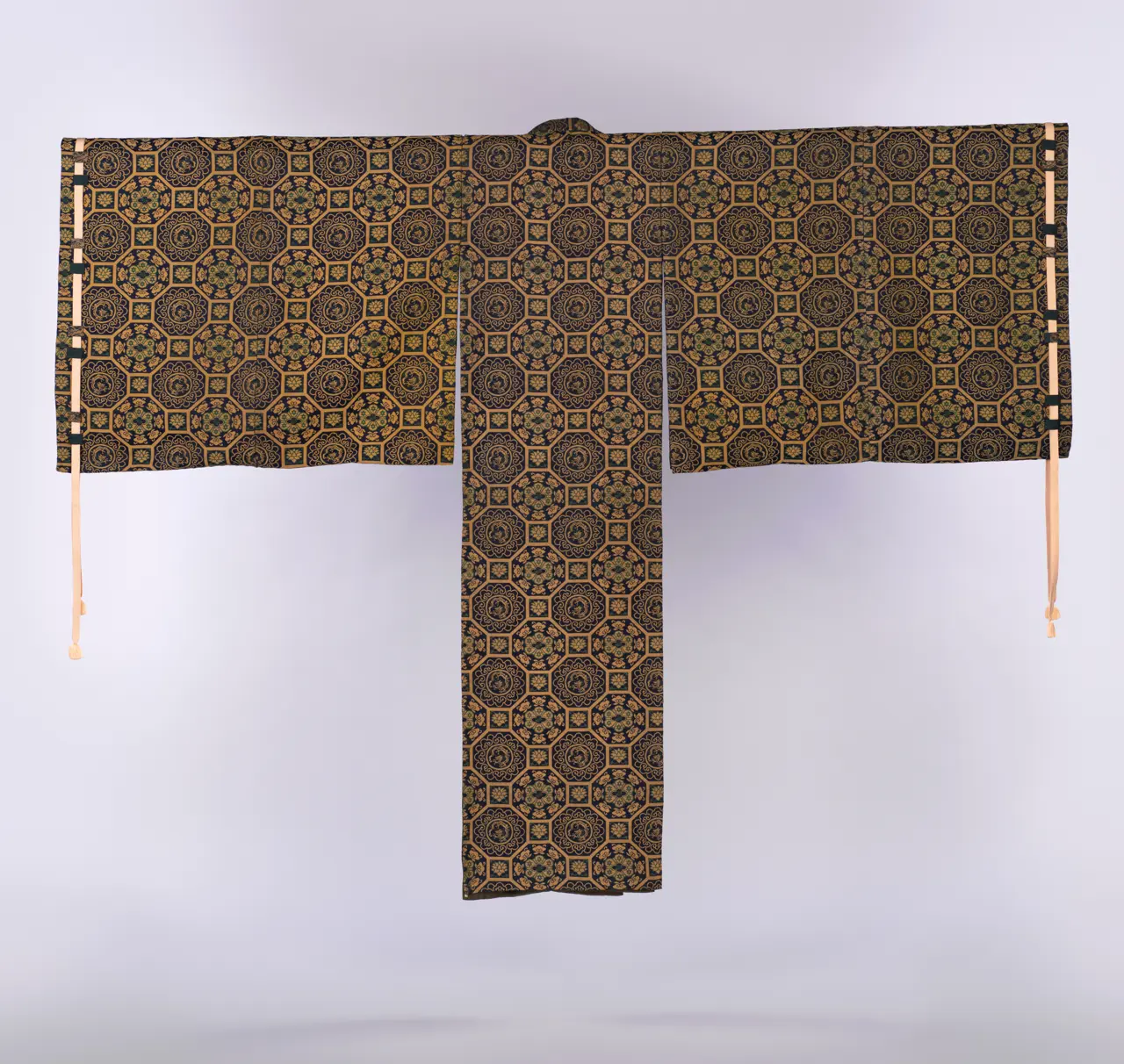
 NakamitsuNoh and kyōgenOrdered to kill his lord's idle son, a loyal retainer gives his own son's life instead.
 The Robe of FeathersNoh and kyōgenA fisherman finds a fairy's robe on a pine by the shore, and will give it back only for a dance.
 The Death-StoneNoh and kyōgenA priest crossing a lonely moor finds a stone that kills whatever touches it, and the spirit inside it.
The play
SCENE.—Inn at the village of Kañtamu in China. TIME.—Early in the eighth century.
Lost in this pathless world of woe, / Where nothing is, but only seems, / How may the weary pilgrim know / His waking moments from his dreams? / My name is Rosei, and I dwell in the land of Shiyoku. Though born to mortal estate, I have hitherto idled my life away without so much as seeking to tread the Buddhist path. But they tell me that on Mount Yauhi in the land of Ibara there dwells a learned and venerable priest; and to Mount Yauhi do I now turn my steps to search after the one great thing needful. / Behind the clouds, in distance veil'd, / The well-known landscape fades from sight, / While endless peaks my feet have scal'd / This many a weary day and night.
On hill and moor the setting sun / Full oft has left him desolate; / But half his course at length is run / What time he sees Kañtamu's gate.
He arrives at the village of Kañtamu.
What then? and is this the celebrated pillow of which I have so often heard tell? Heaven must surely have placed it in my way to bestow on me in a dream a taste of that world whose portals I am about to close for ever behind me.
'Tis but a wayside inn to spend the hour / Of burning noon or wait the passing show'r; / But he would fain through some strange dream be led, / And on the magic pillow lays his head.
How shall I venture to address thee? I have a message for thee, Rosei.
Who, then, art thou?
An ambassador sent by the Emperor of the land of Ibara to tell thee that 'tis his imperial desire to relinquish the throne in thy favour.
Incredible! and for what cause should I be thus raised to the supreme dignity?
Far be it from me to scan the reasons. It must doubtless be because thou possessest the capacity worthily to rule the world. But tarry not, tarry not! Deign to enter the palanquin sent to bear thee to the capital.
What may this strange message mean? / Sure th' imperial palanquin, / Strewn with gems of radiant hue / Sparkling like the evening dew, / For my limbs was ne'er design'd.
Strange to leave the world behind!
But perchance of highest heav'n / To scale the heights to me is giv'n.
Onward the palanquin they bear / In jewell'd flow'ry radiance fair; / And he [unwitting that his pow'r / Forms but the dream of one short hour] / Outsoars the clouds to find a throne / 'Mid scenes of beauty past comparison
For ne'er in those old vasty halls imperial, / Bath'd in the moonbeams bright, / Or where the dragon soars on clouds ethereal, / Was ought like this to entrance the sight: / With golden sand and silvern pebbles white / Was strewn the floor; / And at the corners four, / Through gates inlaid / With diamonds and jade, / Pass'd throngs whose vestments were of radiant light,— / So fair a scene, / That mortal eye might ween / It scann'd the very heav'ns' unknown delight. / Here countless gifts the folk came bearing, / Precious as myriad coins of finest gold; / And there, the lesser with the greater sharing, / Advanc'd the vassals bold, / Their banners to display / That paint the sky with colours gay, / While rings the air as had the thunder roll'd.
And in the east [to please the monarch's will], / Full thirty fathoms high,
There rose a silvern hill, / O'er which a golden sun hung in the sky.
And on the western side, / O'er a gold mountain thirty fathom high,
A silver moon did ride;— / So mote it seem as had the builder striven / To prove the poet's rhyme, / Who sings that in th' abiding heaven / No spring and autumn mark the time, / And o'er that deathless gate / The sun and moon their wonted speed forget.
How shall I venture to address your Majesty? 'Tis already fifty years since your Majesty deigned to ascend the throne; but if you will be pleased to partake of this elixir, your imperial life may be prolonged to a millennium. Therefore have I brought hither the nectar and the patera.
What, then, may nectar be?
'Tis the drink of the immortals.
And the patera?
That likewise is their wine-cup.
After the ensuing dialogue commences the dance, which lasts until Rosei wakes from his dream.
A thousand years this potion gives,
Ten thousand springs my lord outlives.
I the glorious sceptre swaying,
Happy multitudes obeying,
Ev'ry town and ev'ry cot / Blest for ever in its lot.
Oh, lot immortal! rapture flow'ry fair! / Thou bear'st new blossoms still: / Each laughing guest of nectar quaffs his fill, / And bids the others share.
Go circling round for e'er,
Sweet cup, and on the stream securely ride! / But all too swiftly ebbs the flow'ry tide, / To stay whose burden yet the dancer yearning,— / His violet sleeve upturning,— / Waves to and fro like trembling beams of light, / While shines for e'er heav'n's silvern goblet bright.
Haply the dews, an' they should light for ever,
Filling the wine-cups of the flow'rs, / Might grow to be a mighty river: / But ah! what joys more fix'd are ours! / Our nectar is a living spring / Whose flow'ry waters never shall run dry, / What though we quaff for aye / Their heav'nly dews, and dance and sing / All through the day and night, / Not parting day from night, / 'Mid dazzling pomp and joys more ravishing / Than e'er before were shower'd on mortal sight.
Oh, radiant spring-time of delight,
That never more shall end! / 'Tis from the moon that fairies erst did send / This dance; and therefore, rob'd in garments white, / As borrow'd from a fleecy cloud, / He dances and he sings aloud,— / He sings all night for joy, / From night till morn do songs his voice employ:— / And now again 'tis surely even:
No; midday's shining here!
'Tis midday lighting up the heaven:
No; 'tis the moonbeams sparkling clear!
Scarce hath the spring-tide brought the flowers,
When scarlet leaves fall through the bowers;
And summer hardly 'gins to reign,
Ere snow lines all the plain.
Spring, summer, autumn, winter, all turn round; / No herbs so rare but strew the ground; / In one short day no flow'r but charms his sense, / And all is sweet magnificence.
So speed the hours, and now the time is o'er; / His fifty years of splendour are no more: / 'Twas all a dream, whose ev'ry shadowy grace / Must in a moment vanish into space, / Nought, as he wakes, bequeathing in their stead / Save the fam'd pillow where he laid his head.
Mine eyelids ope and the fair vision fades:
His eyelids ope, and all the grandeur fades:— / Astonied he sits up.
But those sweet maids,
In queenly garb, singing soft melodies?
'Twas but the zephyr rustling through the trees.
And those vast halls of royal wealth and pride?
Nought but this inn where I did turn aside.
Thy reign of fifty years?
One hour of dreams / While in the pot a mess of millet steams.
Strange! passing strange!
But he that ponders well
Will find all life the self-same story tell,— / That, when death comes, a century of bliss / Fades like a dream; that 'tis in nought but this / Must end the monarch's fifty years of state, / Age long drawn out, th' ambition to be great, / And all that brilliant, all that joyful seems, / For there is nought on earth but fading dreams.
Save Precious Triad! save a suppliant soul!
Kañtamu's pillow leads him to the goal, / Through insight to renounce all earthly things. / Thrice-bless'd the dream which such salvation brings! / LIFE IS A DREAM is what the pilgrim learns, / Nor asks for more, but straightway home returns.