
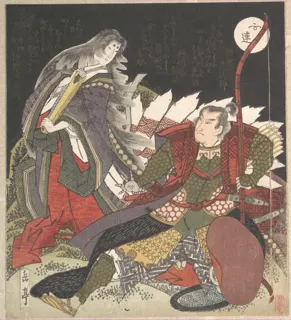
 The Death-StoneNoh and kyōgenA priest crossing a lonely moor finds a stone that kills whatever touches it, and the spirit inside it.
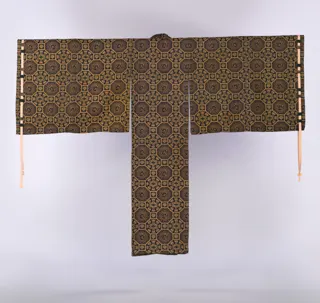 Life Is a DreamNoh and kyōgenA young man seeking the meaning of life lies down on a magic pillow and lives fifty years in a dream.
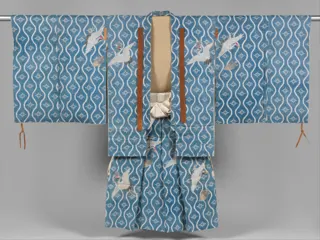 NakamitsuNoh and kyōgenOrdered to kill his lord's idle son, a loyal retainer gives his own son's life instead.
The play
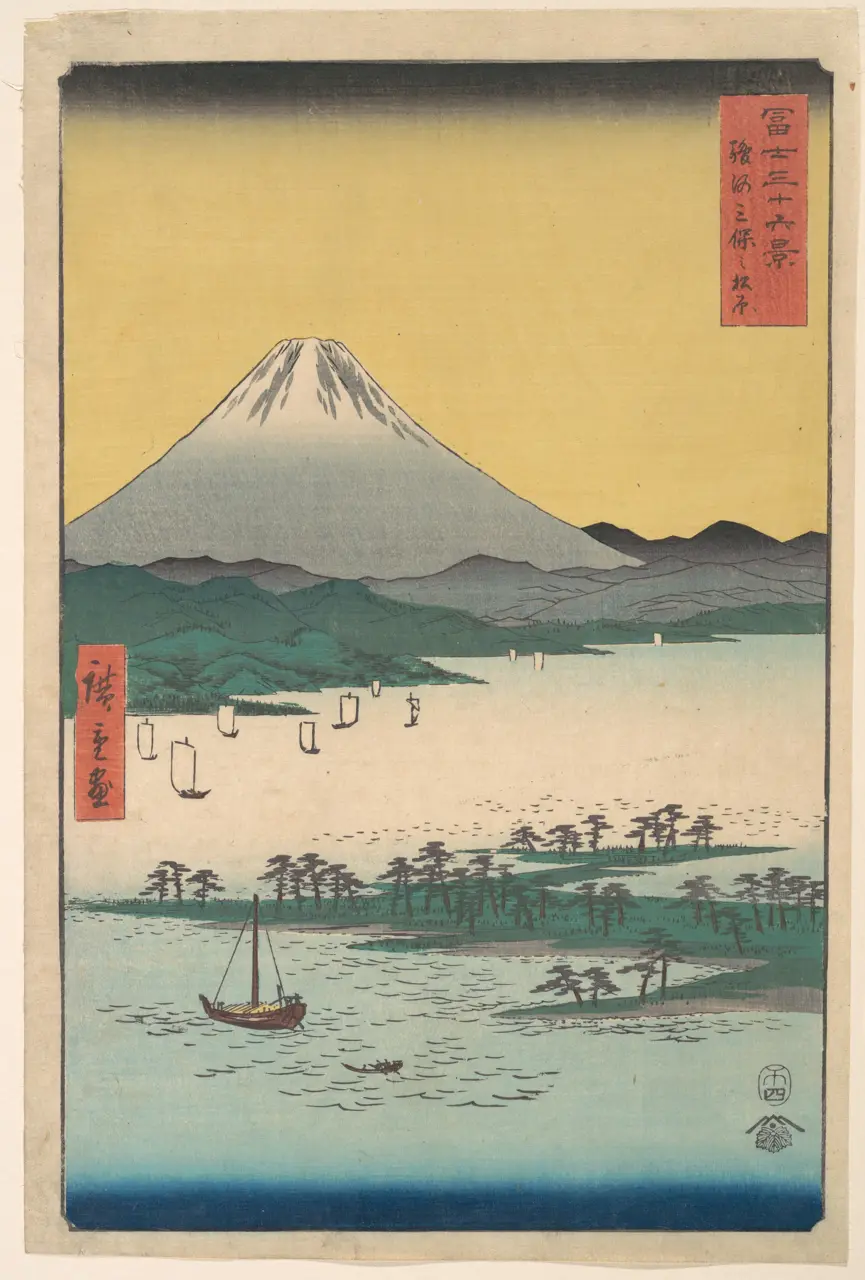
SCENE.—The shore of Miho, in the province of Suruga, near the base of Fusiyama.
The piece opens with a long recitative in which the Fisherman and the Chorus describe the beauties of Miho's pine-clad shore at dawn in spring. The passage is a beautiful one; but, after several efforts at reproducing it in an English form, the translator has had to abandon the task as impossible. At the conclusion of this recitative the Fisherman steps on shore, and the action of the piece then commences as follows:—
As I land on Miho's pine-clad shore and gaze around me, flowers come fluttering down from the ethereal space, strains of music are re-echoing, and a more than earthly fragrance fills the air. Surely there is something strange in this. Yes! from one of the branches of yonder pine-tree hangs a beauteous robe, which, when I draw nigh and closely scan it, reveals itself more fair and fragrant than any common mortal garb. Let me take it back to show to the old folks in the village, that it may be handed down in our house as an heirloom for all generations.
Ah! mine is that apparel! Wherefore wouldst thou carry it away?
'Twas found by me, forsooth, and I shall take it home with me.
But 'tis a fairy's robe of feathers, a thing that may not lightly be bestowed on any mortal being. Prithee leave it on the branch from which it hung.
What, then, art thou thyself a fairy, that thou claimest possession of this feathery raiment? As a marvel for all ages will I keep it, and garner it up among the treasures of Japan. No, no! I cannot think of restoring it to thee.
Alas! without my robe of feathers never more can I go soaring through the realms of air, never more can I return to my celestial home. I beg thee, I beseech thee, therefore, to give it back to me.
Nay, fairy, nay, the more I hear thee plead / The more my soul determines on the deed; / My cruel breast but grows more heartless yet; / Thou mayst not have thy feathers: 'tis too late.
Speak not, dear fisherman! speak not that word! / Ah! know'st thou not that, like the hapless bird / Whose wings are broke, I seek, but seek in vain, / Reft of my wings, to soar to heav'n's blue plain?
Chain'd to dull earth a fairy well may pine.
Whichever way I turn, despair is mine:
For ne'er the fisher will her wings restore,
And the frail fay sinks helpless evermore.
Alas! poor maiden, in thy quiv'ring eyne / Cluster the dews; the flow'rets thou didst twine / Amidst thy tresses languish and decay, / And the five woes declare thy fatal day!
Vainly my glance doth seek the heav'nly plain, / Where rising vapours all the air enshroud, / And veil the well-known paths from cloud to cloud.
Clouds! wand'ring clouds! she yearns, and yearns in vain, / Soaring like you, to tread the heav'ns again; / Vainly she sighs to hear, as erst she heard, / The melting strains of Paradise' sweet bird: / That blessèd voice grows faint. The heav'n in vain / Rings with the song of the returning crane; / In vain she lists, where ocean softly laves, / To the free seagull twitt'ring o'er the waves; / Vainly she harks where zephyr sweeps the plain: / These all may fly, but she'll ne'er fly again!
I would fain speak a word unto thee. Too strong is the pity that overcomes me as I gaze upon thy face. I will restore to thee thy robe of feathers.
Oh, joy! oh, joy! Give it back to me!
One moment! I restore it to thee on condition that thou first dance to me now, at this very hour, and in this very spot, one of those fairy dances whose fame has reached mine ears.
Oh, joy untold! It is, then, granted to me once more to return to heaven! And if this happiness be true, I will leave a dance behind me as a memorial to mortal men. I will dance it here, that dance that makes the Palace of the Moon turn round, so that even poor transitory man may learn its mysteries. But I cannot dance without my feathers. Give them back to me, then, I pray thee.
No, no! If I restore to thee thy feathers, thou mayest fly home to heaven without dancing to me at all.
Fie on thee! The pledge of mortals may be doubted, but in heavenly beings there is no falsehood.
Fairy maid! thou shamest me: / Take thy feathers and be free!
Now the dancing maiden sings, / Rob'd in clouds and fleecy wings.
Wings that flutter in the wind!
Robes like flow'rs with raindrops lin'd!
The Fairy's dance commences.
See the fairy's heav'nly power! / This the dance and this the hour / To which our Eastern dancers trace / All their frolic art and grace.
Now list, ye mortals! while our songs declare / The cause that gave to the blue realms of air / The name of FIRMAMENT. All things below / From that great god and that great goddess flow, / Who first descending to this nether earth, / Ordain'd each part and gave each creature birth. / But older still, nor sway'd by their decree, / And FIRM as ADAMANT eternally, / Stand the wide heav'ns, that nought may change or shake, / And hence the name of firmament did take.
And in this firmament a palace stands / Yclept the Moon, built up by magic hands;
And o'er this palace thirty monarchs rule, / Of whom fifteen, until the moon be full, / Nightly do enter, clad in robes of white; / But who again, from the full sixteenth night, / One ev'ry night must vanish into space, / And fifteen black-rob'd monarchs take their place, / While, ever circling round each happy king, / Attendant fays celestial music sing.
And one of these am I.
From those bright spheres, / Lent for a moment, this sweet maid appears: / Here in Japan she lights [heav'n left behind] / To teach the art of dancing to mankind.
Where'er we gaze, the circling mists are twining: / Perchance e'en now the moon her tendrils fair / Celestial blossoms bear. / Those flow'rets tell us that the spring is shining, / Those fresh-blown flow'rets in the maiden's hair.
Blest hour beyond compare!
Heaven hath its joys, but there is beauty here. / Blow, blow, ye winds! that the white cloud-belts driv'n / Around my path may bar my homeward way: / Not yet would I return to heav'n, / But here on Miho's pine-clad shore I'd stray, / Or where the moon in bright unclouded glory / Shines on Kiyómi's lea, / And where on Fusiyama's summit hoary / The snows look on the sea, / While breaks the morning merrily! / But of these three, beyond compare / The wave-wash'd shore of Miho is most fair / When through the pines the breath of spring is playing.— / What barrier rises 'twixt the heav'n and earth? / Here, too, on earth th' immortal gods came straying, / And gave our monarchs birth,
Who in this empire of the rising sun, / While myriad ages run, / Shall ever rule their bright dominions,
E'en when the feath'ry shock / Of fairies flitting past with silv'ry pinions / Shall wear away the granite rock!
Oh, magic strains that fill our ravish'd ears! / The fairy sings, and from the cloudy spheres, / Chiming in unison, the angels' lutes, / Tabrets and cymbals and sweet silv'ry flutes, / Ring through the heav'n that glows with purple hues, / As when Soméiro's western slope endues / The tints of sunset, while the azure wave / From isle to isle the pine-clad shores doth lave. / From Ukishíma's slope,—a beauteous storm,— / Whirl down the flow'rs: and still that magic form, / Those snowy pinions, flutt'ring in the light, / Ravish our souls with wonder and delight.
The Fairy pauses in the dance to sing the next couplet, and then continues dancing till the end of the piece.
Hail to the kings that o'er the moon hold sway! / Heav'n is their home, and Buddhas, too, are they.
The fairy robes the maiden's limbs endue
Are, like the very heav'ns, of tend'rest blue;
Or, like the mists of spring, all silv'ry white,
Fragrant and fair,—too fair for mortal sight!
Dance on, sweet maiden, through the happy hours! / Dance on, sweet maiden, while the magic flow'rs / Crowning thy tresses flutter in the wind / Rais'd by thy waving pinions intertwin'd! / Dance on! for ne'er to mortal dance 'tis giv'n / To vie with that sweet dance thou bring'st from heav'n: / And when, cloud-soaring, thou shalt all too soon / Homeward return to the full-shining moon, / Then hear our pray'rs, and from thy bounteous hand / Pour sev'nfold treasures on our happy land; / Bless ev'ry coast, refresh each panting field, / That earth may still her proper increase yield! / But ah! the hour, the hour of parting rings! / Caught by the breeze, the fairy's magic wings / Heav'nward do bear her from the pine-clad shore, / Past Ukishíma's widely-stretching moor, / Past Ashidaka's heights, and where are spread / Th' eternal snows on Fusiyama's head,— / Higher and higher to the azure skies, / Till wand'ring vapours hide her from our eyes!