
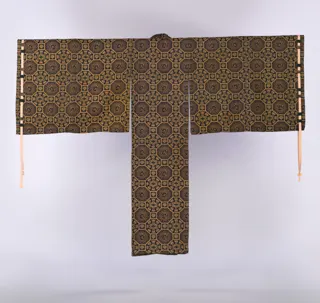
 Life Is a DreamNoh and kyōgenA young man seeking the meaning of life lies down on a magic pillow and lives fifty years in a dream.
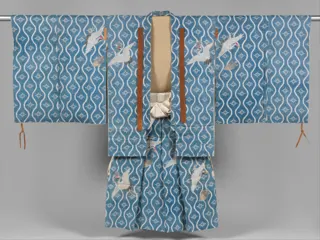 NakamitsuNoh and kyōgenOrdered to kill his lord's idle son, a loyal retainer gives his own son's life instead.
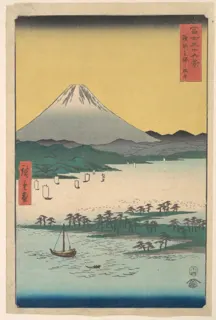 The Robe of FeathersNoh and kyōgenA fisherman finds a fairy's robe on a pine by the shore, and will give it back only for a dance.
The play
SCENE.—The moor of Nasu, in the province of Shimotsuke, some ninety miles to the north of Yedo.
What though the vapours of the fleeting scene / Obscure the view of pilgrims here below? / With heart intent on heav'nly things unseen, / I take my journey through this world of woe. / I am a priest, and Geñwou is my name. Ever fixed in the seat of contemplation, I had long groaned over my imperfection in that which of all things is the most essential. But now I see clear, and, waving in my hand the sacerdotal besom, go forth to gaze upon the world. After sojourning in the province of Michinoku, I would now fain go up to the capital, and there pass the winter season of meditation. I have crossed the river Shirakaha, and have arrived at the moor of Nasu in the province of Shimotsuke. / Alas! the vapours of the fleeting scene / Obscure the view of pilgrims here below; / Strike out the hope in heav'nly things unseen, / What guide were left us through this world of woe?
Ah! rest not under the shadow of that stone!
What then? Is there any reason for not resting under the shadow of this stone?
Yes; this is the Death-Stone of the moor of Nasu; and not men only, but birds even and beasts perish if they but touch it. / Seek not to die! What! hast thou not heard tell / Of Nasu's Death-Stone and its fatal spell? / I entreat thee draw not nigh unto it!
What is it, then, that maketh this stone so murderous?
'Tis that into it, in the olden time, entered the spirit of her who was called the "Flawless Jewel Maiden," concubine to the Emperor Toba.
Into this stone? on this far-distant road? / Methought the palace was the girl's abode.
Verily it cannot be without reason that the story hath been handed down from the olden time.
Thine appearance and thy language seem to assure me that the tale is not unknown to thee.
No! no! I know it but in outline. Fleeting as the dew is the memory of the maiden's fate.
Erst through the king's abode
Proudly the maiden strode,
Now on this des'late road
Her ghost doth dwell,
Broods o'er the fated land,
And ev'ry pilgrim band
Falls 'neath her murd'rous hand,
Wielding the spell!
The Death-Stone stands on Nasu's moor / Through winter snows and summer heat; / The moss grows grey upon its sides, / But the foul demon haunts it yet. / Chill blows the blast: the owl's sad choir / Hoots hoarsely through the moaning pines; / Among the low chrysanthemums / The skulking fox, the jackal whines, / As o'er the moor the autumn light declines.
Fair was the girl,—beyond expression fair; / But what her country, who her parents were, / None knew. And yet, as in her native place, / She proudly dwelt above the Cloudy Space, / So sweetly deck'd by nature and by art, / The monarch's self soon clasp'd her to his heart.
One day th' Imperial Majesty saw fit / To put to proof the Jewel Maiden's wit.
Nor did she fail in ought: grave Buddhist lore, / Confucian classics of the days of yore, / Cipango's bards, the poets of Cathay, / And all the science the two realms display,— / She knew them all, nor did her answers fail / To tell of music all the wondrous tale.
A mind so flawless in a form so fair / Deserv'd the name her lord then gave to her.
Once the Mikado made a splendid feast / At the cool Summer Palace: ev'ry guest / That of accomplishments or wit could boast / Was bidden there,—a gay and brilliant host, / Like to the clouds, from out whose fleecy sphere / Th' imperial kindred, like the moon, shone clear. / But hark! what rumour mingles with the strains / Of liveliest music? See! the heav'nly plains / Are wrapp'd in clouds and darkness! Not a star,— / The moon not risen yet: but from afar, / Heralded by the rustling of the show'r, / The wind comes howling through the festive bow'r; / The lanterns are blown out: "A light! a light!" / Cry all the courtiers in tumultuous fright. / And lo! from out the Jewel Maiden's frame / There's seen to dart a weirdly lustrous flame! / It grows, it spreads, it fills th' imperial halls; / The painted screens, the costly pannell'd walls, / Erst the pale viewless damask of the night, / Sparkling stand forth as in the moon's full light.
From that same hour the sov'reign monarch pin'd.
From that same hour the sov'reign monarch pin'd / In dire disease, whose hidden cause to find / The court magician cast his curious spell, / And thus the fortune of the lots did tell: / "'Tis none but she, great Emp'ror! without doubt / That harlot is the culprit: cast her out! / Expel the fiend, who, with insidious art, / The state to ravage, captivates thy heart!" / Thus spake the seer, and in an instant turn'd / The monarch's love to hate. The sorceress, spurn'd, / Resumes her proper shape, and speeds away / To Nasu's moor, there dwelling to this day.
Thou that hast deigned to tell me this long history, who may'st thou be?
Wherefore any longer conceal it? The demon that of old dwelt in the breast of the "Flawless Jewel Maiden," and that now inhabits the Death-Stone of the moor of Nasu is none other than myself.
Ah, well-a-day! Strange is it, but true, that the soul sunk lowest in the depths of wickedness will rise highest on the pinnacle of virtue. I will bestow on thee the priestly robe and begging-bowl. But, prithee, reveal thyself to mine eyes in thy proper shape.
Alas! what shame is now my portion! / In the garish light of day / I hide myself away, / Like pale Asámá's fires: / With the night I'll come again, / Confess my guilt with pain / And new-born pure desires.
Dark will be the night; / But her red lustrous light / Ne'er needs the moon. / "Wait! fear not!" she cries, / And from the hermit's eyes / Fades 'neath the stone.
The Spirit vanishes.
'Tis said of stocks and stones they have no soul. Yet what signifieth the text: "Herbs and trees, stones and rocks, shall all enter into Nirvâna," save that from the beginning a divine essence dwells within them? How much more, then, if I bestow on this unhappy creature the priestly robe and begging-bowl, must not her attainment of Nirvâna be placed beyond a doubt? Wherefore, with offerings of flowers and of burning incense, I recite the scriptures with my face turned toward the stone, crying: Spirit of the Death-Stone, I conjure thee! what was it in a former world that did cause thee to assume in this so foul a shape? / Tarry not! away! away! / From this very hour shalt thou through mine intercessions obtain Nirvâna, / From this very hour shall they gain for thee the virtues of a saint. / Hear me! hear me!
The stone is rent asunder and the Demon issues from it.
In stones there are spirits, / In the waters is a voice heard: / The winds sweep across the firmament!
Oh, horror! horror! / The Death-Stone's rent in twain, / And lo! the demon stands reveal'd!
Strange! passing strange! / The Death-Stone's rent in twain: / O'er moor and field / A lurid glare / Burns fierce. There stands reveal'd / A fox,—and yet again / The phantom seems to wear / The aspect of a maiden fair!
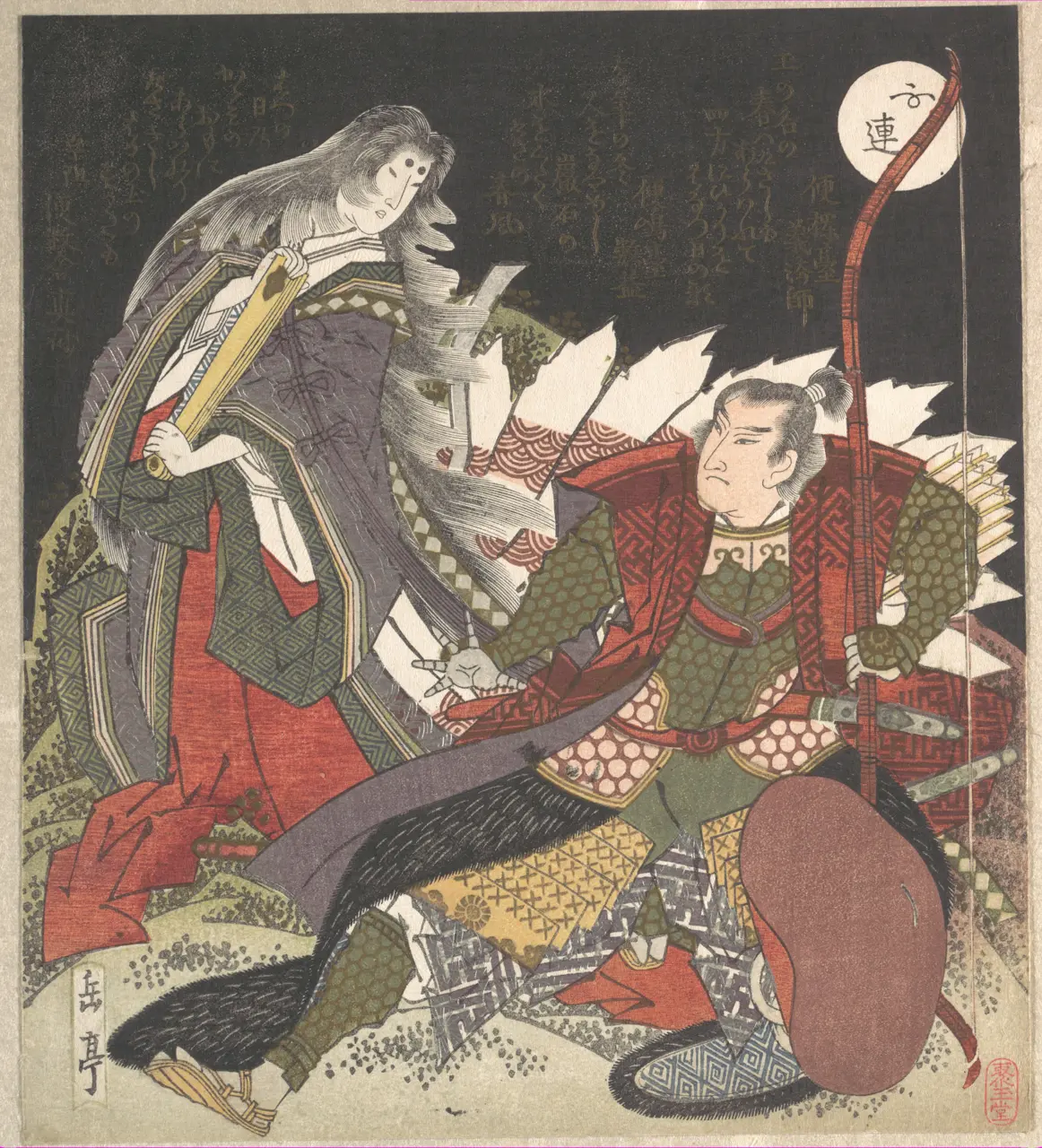
No more the mystery can be conceal'd. I am she who first, in Ind, was the demon to whom Prince Hañzoku paid homage at the murderous mound. In Great Cathay I took the form of Hauzhi, consort of the Emperor Iuwao; and at the court of the Rising Sun I became the "Flawless Jewel Maiden," concubine to the Emperor Toba. Intent on the destruction of the imperial line, I assumed the shape of a fair maiden, whose presence caused the Jewel-body to languish in disease. Already was I gloating over the thought of the monarch's death, when the court magician, Abe-no-Yasunari, directed against me his powers of exorcism; he set up the many-coloured symbols of the gods upon the altar, and gave them also into my hands:
Here the Spirit commences a dance, which lasts till the end of the play.
With fervent zeal the great magician prays:
With fervent zeal the great magician prays, / And ev'ry tone with anguish and amaze / O'erpow'rs the witch, who with convulsive grasp / The holy symbols of the gods doth clasp, / And, heav'nward-soaring, flies o'er land and sea / To seek the shelter of this distant lea.
Thereat the monarch issued his commands:
Thereat the monarch issued his commands / To the two satraps of the neighb'ring lands: / "Drive out," spake he, "the fiend of Nasu's moor!" / And each true liege, to make his aim more sure, / For fivescore days on dogs his arrows tried, / For to the fox the dog is near allied: / May we not thus trace back to that command / The custom of dog-shooting in our land? / Then the two satraps, arm'd with bow and spear, / And myriad horsemen brought from far and near, / Beat all the moor, surround its ev'ry part, / Whose rage to 'scape avails no magic art; / Swift fly the dogs, and swift the arrows fly / And, panting, stricken, I sink down and die. / But yet my ghost [though, like the morning dew / 'Twas wrapt away from grosser human view] / Ceas'd not to haunt this distant des'late moor, / And from the Death-Stone wield its murd'rous pow'r,— / Till thou, great Buddha! send'st thy priest this way / To bid religion reassert her sway. / "I swear, O man of God! I swear," she cries, / "To thee whose blessing wafts me to the skies, / I swear a solemn oath, that shall endure / Firm as the Death-Stone standing on the moor, / That from this hour I'm virtue's child alone!" / Thus spake the ghoul, and vanished 'neath the stone.