Script breakdown for actors
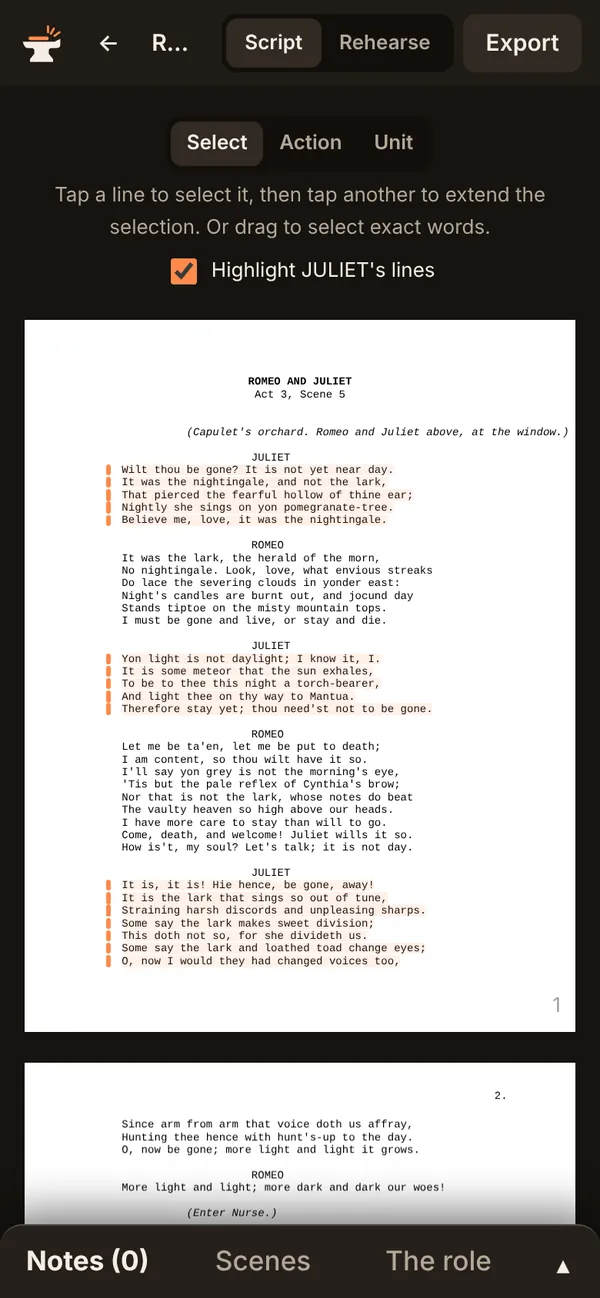
Script analysis, done on the script: read for the facts, find what your character wants, then break each scene into units and action the lines.
Start with the facts
Read the play more than once before you decide anything. Then list the given circumstances: who you are, where and when the scene happens, what has just happened, and who these people are to you. Take only what the script says, and keep your guesses apart from the facts, so you know which choices are yours. Note what other characters say about you as well as what you say about yourself: they don't always agree.
What does your character want?
For the whole play, a super-objective: what they want most. For each scene, an objective: something they want from the other person, now. Name what's in the way, and what happens if they don't get it. Put it as something you could get in this scene, “to make her stay” rather than “to be happy”: an objective you can win or lose gives you something to play.
Units
Break the scene into units, sometimes called beats: a new one starts when the subject changes, or when a tactic stops working and your character tries another. Give each a short name and the tactic in it. Mark where each one starts on the page, at the line where the scene turns, so you can see its shape at a glance.
Actions
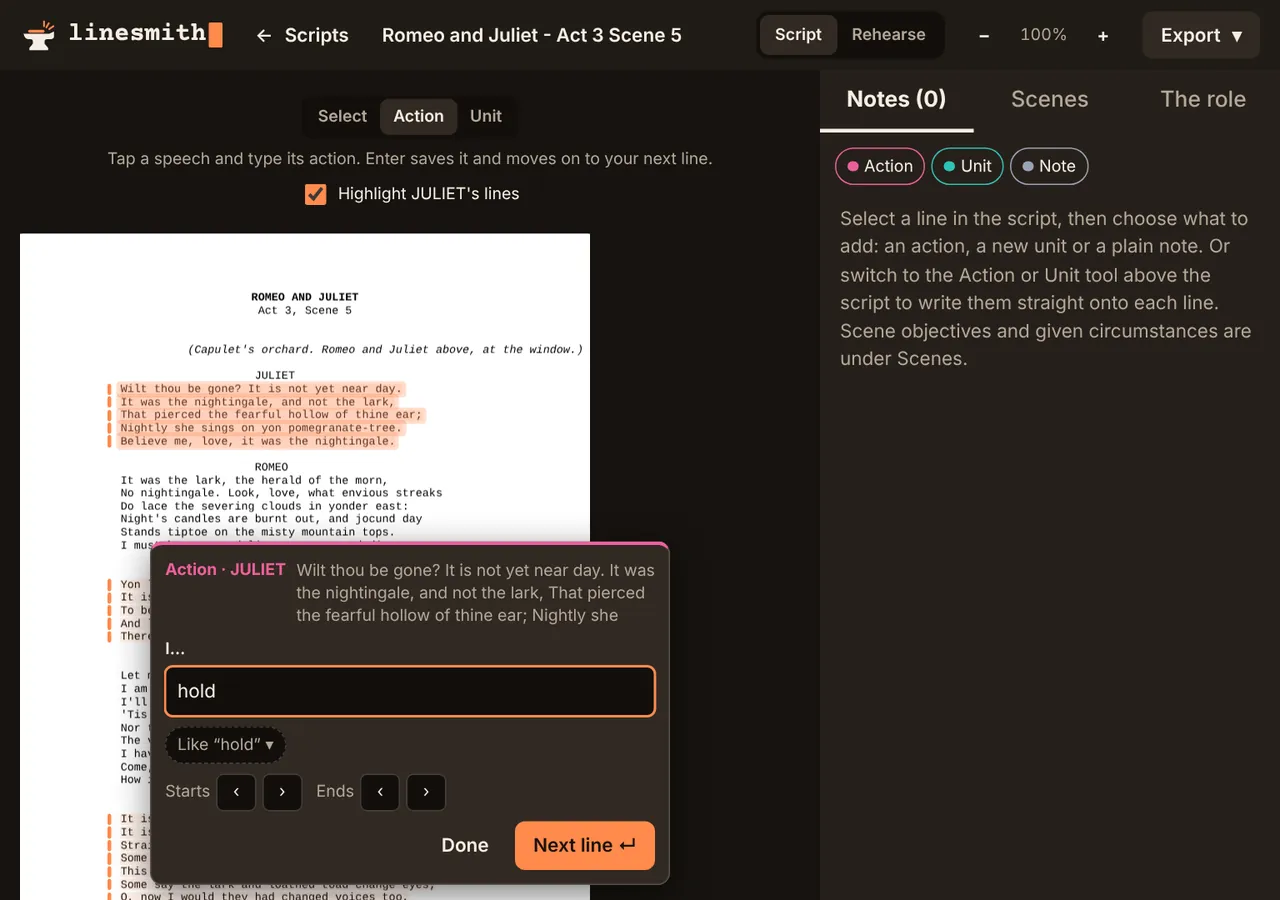
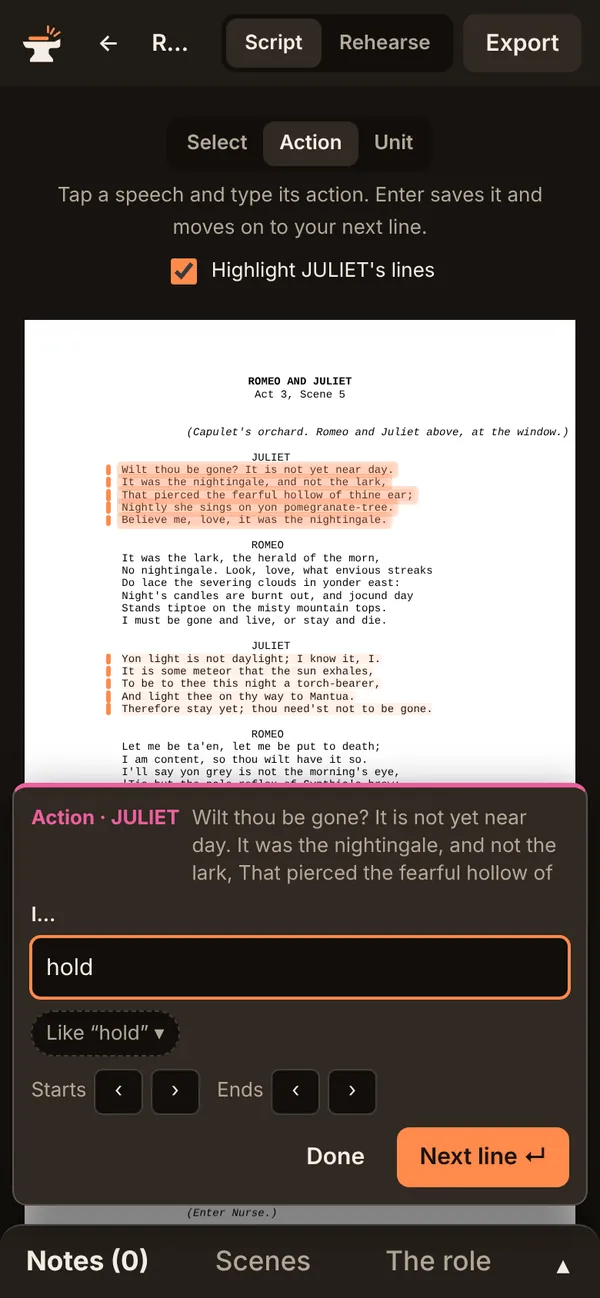
Then go line by line and give each one an action, a transitive verb you play on the other person: I charm you, I warn you, I belittle you. Each is a tactic towards the objective. Our list of actioning verbs has more than five hundred, grouped by what they do.
Keep it with the lines
A breakdown is for rehearsal, not for show. Keep it where you'll see it while you work, and change it when the scene tells you something new.
A scene, actioned
Beatrice wants Benedick to prove his love by killing Claudio. Here is one way to action her lines, each verb a tactic towards it.
Act 4, Scene 1A church
With no sauce that can be devised to it. I protest
I love thee.
alarm
Why, then, God forgive me!
What offence, sweet Beatrice?
tease
You have stayed me in a happy hour: I was about to
protest I loved you.
And do it with all thy heart.
enchant
I love you with so much of my heart that none is
left to protest.
Come, bid me do any thing for thee.
challenge
Kill Claudio.
Ha! not for the wide world.
wound
You kill me to deny it. Farewell.
Tarry, sweet Beatrice.
punish
I am gone, though I am here: there is no love in
you: nay, I pray you, let me go.
Beatrice,--
threaten
In faith, I will go.
We'll be friends first.
provoke
You dare easier be friends with me than fight with mine enemy.
In Linesmith
With the Action tool, tap a speech and type its verb; Enter saves it and moves to your next line, with suggestions from our list as you type. The Unit tool draws a line where a unit starts, with its name and tactic. Each scene has a sheet for where and when, and for your character's objective, obstacle, stakes and given circumstances; the role holds the super-objective and through-line.
When you rehearse a scene, its brief sits beside the lines. Export the whole thing as a PDF to print, with every note drawn on the page and listed at the back.