
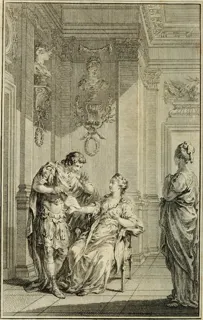
 Bereniceby Jean RacineThe new emperor Titus loves the Queen of Judæa, but Rome will not have a queen.
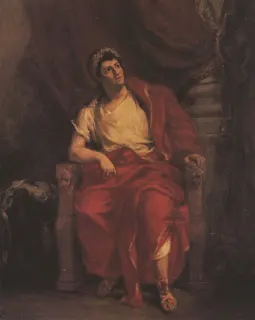 Britannicusby Jean RacineThe young emperor Nero falls for his rival's betrothed and takes his first step into murder.
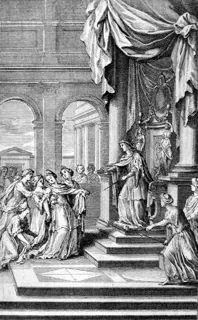 Estherby Jean RacineA Jewish queen of Persia risks her life to save her people from the king's favourite.
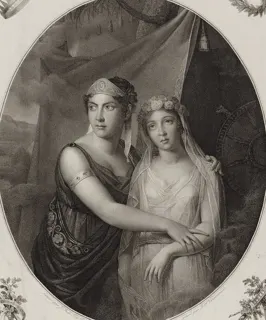 Iphigeniaby Jean RacineThe Greek fleet is becalmed at Aulis, and the gods ask Agamemnon for his daughter's life.

Act 1, Scene 1
[ACHMET, OSMAN]
Come, follow me. Here the Sultana comes
Anon: meanwhile we may converse together.
How long, my lord, has entrance been allow'd
To these forbidden precincts, where so lately
The eyes that dared to pry would soon have closed
In death?
When you have heard all that has pass'd,
You will not be surprised that I am free
To enter. But enough of that, dear Osman.
How long to my impatience seem'd the time
Of your return! How glad am I to see you
Here in Stamboul! What secrets have you learn'd
By travelling so far on my behalf?
Tell me sincerely what your eyes have seen;
Consider, Osman, that on your report
The future fortune of the Crescent hangs.
How fares it with the army and the Sultan?
True to her prince, did Babylon, unmoved
By terror, see our hosts her walls encompass;
The muster'd Persians to her aid were marching,
And daily nearer drew to Amurath's camp.
He, weary with the tedious, fruitless siege,
Seem'd willing to leave Babylon at rest,
And, without making fresh assaults in vain,
Was waiting for the Persians, to give battle.
But, as you know, Sir, make what haste I might,
Long is the journey hither from those parts;
A thousand obstacles my course impeded,
Nor can I tell all that has happened since.
Our valiant janizaries—how did they
Comport themselves? Do they to Amurath yield
Faithful allegiance? Can you read men's hearts?
Enjoys the Sultan undisputed pow'r?
If one may take his word, he is content,
And seem'd full confident of victory.
But his apparent calmness cannot cheat us,
He knows not the repose that he assumes.
In vain he masks habitual distrust,
And grants his janizaries easy access;
He cannot but remember how he wish'd
To pare that gallant force of half its strength,
And, as he said, to 'scape their tutelage.
Oft have I heard them talk among themselves
How Amurath fears them, and how they fear him;
That sore still galls them, flatter as he may.
They murmur at your absence, and regret
The time so dear to their courageous hearts,
When under you, sure of success, they fought.
What! Think you, Osman, that my glory still
In their remembrance lives and stirs their valour?
That they would gladly follow me again,
And hail the voice of their vizier with welcome?
The fortune of the fight will rule their conduct:
They must see Amurath's victory or defeat.
Though loath, my lord, to march with him to lead them,
They have to keep unstain'd their martial glory:
They'll not betray honour so hardly won.
But failure or success depends on fate.
If, seconding their valour, Amurath's star
Awards him victory on Babylon's plains,
Then will you see them to Byzantium bring
Submissive homage and a blind obedience;
But if the heavy hand of destiny
Crush in the conflict his aspiring schemes
Of empire, doubt not his disgraceful flight
Would spur their hatred on to bold contempt,
And his disasters would to them appear
High Heav'n's decree of wrath and reprobation.
Meanwhile, if Rumour's voice has spoken truly,
Three months ago he from the army sent
Hither a slave charged with some secret message.
All in the camp trembled for Bajazet,
Fearing the Sultan had with cruel order
Despatch'd him to demand his brother's head.
Such was his purpose. Ay, that slave has come,
And shown his mandate—which was disregarded.
What! shall the Sultan see that slave again
Without this pledge of your allegiance rendered?
The slave is dead. A secret order cast him
Full many a fathom deep beneath the Euxine.
His lengthen'd absence will surprise the Sultan;
Soon will he seek the cause, and take revenge.
What will you answer him?
Perchance ere then
He'll have more pressing matters to engage him.
I know that Amurath has sworn my ruin,
I know what welcome his return will bring me.
To tear me from his soldiers' hearts, behold
How he excludes me from his fights and sieges;
Himself commands the army and leaves me
Here in Stamboul t'exert a pow'r that's useless.
What base employment, Osman, for a vizier!
But I have used my time to worthier purpose,
And terrible surprises have prepared him;
Soon will the news thereof make his ears tingle.
What have you done?
I hope that Bajazet
To-day will mount the throne,—with him Roxana.
Roxana, my good lord! whom Amurath chose
As fairest of that fair array which fill'd
His court, from Europe and from Asia gather'd
In countless numbers, who alone has fix'd
The Sultan's heart, they say, whom he has named
Sultana, though no son she yet has borne him.
Ay, more, dear Osman. He has will'd that she
Should in his absence wield supreme command.
You know the rigour that our Sultans practise;
Brothers are seldom suffer'd to enjoy
The dangerous honour of their royal rank
Related to their own by ties too near.
The brainless Ibrahim, from peril free,
Needs not to curse his birth, perpetual childhood
Secures his safety, he, in life or death
Alike contemn'd, is left to those who deign
To feed him. With the other 'tis not so,
Of Amurath's jealous fear a worthier object,
Which every moment threatens his destruction:
For Bajazet has ever scorned to live
In slothful ease, like other sultans' sons.
War was his favourite pastime from his boyhood,
And practice under me has made him perfect.
Have you not seen him charge where foes were thickest
With courage that bewitch'd each soldier's heart,
And stain'd with carnage, reap the rare delight
Which valour's earliest triumph brings to youth?
But cruel Amurath, 'spite of jealous fears,
Dared not (before he had a son to make
Succession sure) wreak upon Bajazet
His vengeance, cutting short the royal stock.
So for a time was Amurath's rage disarm'd,
And Bajazet left prisoner in the palace.
He went, and will'd that, faithful to his hatred,
Holding his brother's life at her disposal,
Roxana, at the slightest breath of rumour,
The least suspicion giv'n, no reason else,
Should slay him. I, left here, justly incensed,
Soon turn'd my wishes to the brother's side.
Hiding my purpose, to the young Sultana
I show'd how Amurath's return was doubtful,
The murmurs of the camp, war's fickle fortunes,
Praised Bajazet, and made her pity him,
Dwelt on his charms, so jealously conceal'd,
So near her eyes yet never seen by her.
In short, so well I work'd upon Roxana
That she was all impatient to behold him.
But could they frustrate keen-eyed vigilance,
And overstep the barriers placed between them?
You may perhaps remember how the tidings,
False as they proved, of Amurath's death were spread.
In feign'd alarm Roxana heard the rumour,
And with loud cries of grief strove to confirm it
Trusting the witness of those tears, her slaves
Trembled, and those who guarded Bajazet,
In their perplexity by bribes corrupted,
Relax'd their watchful care; when the Sultana
Found means to see the prince, and in his ear
Whisper'd the secret order she was charged with.
No churl is Bajazet, and, when he saw
That safety lay in pleasing her, full soon
He pleased her well. To aid him all conspired,
Her kindly care, their mutual understanding
Based on the secret shared, sighs all the sweeter
For being stolen, silence that provoked
Wishes they dared not utter, fears and danger
Common to both, united them together;
Whilst those whose eyes should have observed them closely,
Failed to resume the duty once neglected.
What! did Roxana from the first make known
Her heart to them, and to their eyes reveal
Her flame?
They know it not, and till to-day
On their intrigue has Atalide bestow'd
The shelter of her name,—the niece, you know,
Of Amurath's sire, who with his children shared
His fondness, and with them her childhood pass'd.
She, as it seem'd, his tender vows received,
But only to convey them to Roxana,
The willing instrument to aid their passion.
And to secure my countenance, dear Osman,
Both have agreed that Atalide shall be
My bride.
You love her, then!
Would'st have me learn
Now at my age the worthless lore of love?
And shall a heart that years of toil have harden'd
Blindly submit to follow vain delights?
Nay, she attracts my gaze with other charms,
I love in her the blood of royal sires.
Through this alliance to the throne brought near
By Bajazet, I thus secure a shield
To guard myself against him. Some offence
Is sure to rise, for scarcely has vizier
Been chosen ere the Sultan fears his creature,
And greed or envy soon effects his ruin.
To-day he honours me and courts my favour,
The risks he runs incline his heart toward me.
But stablish'd on the throne, this Bajazet
Perchance will throw aside a useless friend:
And, if my faithful service be forgotten,
The day may come when he will dare to doom me
To death—. I say no more, but 'tis my purpose
To keep him waiting for my head full long.
I know the duty that I owe my masters,
But 'tis for slaves to humour their caprices,
Nor am I so besotted as to lick
The hand that strikes me.
Thus it comes to pass
That I within these walls have free admittance,
And with mine eyes may look upon Roxana.
At first she listen'd to my voice, herself
Unseen, and fear'd to break the rigid laws
That guard the harem. But those irksome scruples,
Our converse hampering, ere long were banish'd.
She has herself chosen this nook remote
Where eyes may hearts discover unrestrain'd.
A slave conducts me by a secret passage—
But here she comes, with her loved Atalide.
Stay, and be ready, should there need arise,
To ratify the statement I shall make her.
Act 1, Scene 2
[ROXANA, ATALIDE, ACHMET, OSMAN, FATIMA, ZARA]
Truth, Lady, has confirm'd the voice of Rumour;
Osman has seen the Sultan and the army.
Proud Amurath is ever ill at ease,
And all hearts ever turn to Bajazet;
With one consent they call him to the throne.
The Persian hosts, meanwhile, to Babylon
Were marching, and the rival camp will soon
Meet 'neath her walls to try the chance of battle,
Which must decide, they say, our destinies;
And, counting up the days of Osman's journey,
Heav'n has already settled the event,
And Amurath triumphs now, or flies defeated.
Let us break silence, and declare ourselves,
From this day forth shutting our gates against him,
Nor wait to learn the issue of the conflict,
But hasten to anticipate the tidings.
If he has lost, what fear you? Has he won?
Then are the promptest measures the most safe,
Delay too long, and failure must attend
Our efforts to seduce a people ready
To welcome home their sovereign. I have gain'd
Th' expounders of our sacred law, intriguing
In secret. Well I know religion's pow'r
To turn the multitude this way or that.
Let Bajazet go forth beyond the walls,
And cease to be a prisoner in this palace.
This fateful standard in his name display,
Our wonted signal when the State's in danger.
The people, in his favour prepossess'd,
Know that his virtue is his only crime.
Besides a vague report that I have foster'd
Has spread alarm, and made them think the Sultan
Disdains them and is minded to remove
His presence and his throne far from Byzantium.
Let us declare what danger overhangs
His brother's head, and show the cruel order
Address'd to you; let Bajazet assert
His claim, and mount the throne, with courage worthy
Of royalty.
Enough, I will maintain
All I have promised. Go, brave Achmet, gather
Our friends, their feelings sound, then bring report
Of all, and you shall find my answer ready.
I will see Bajazet. Nought can I say
Till of his heart assured as one with mine.
Go, and return.
Act 1, Scene 3
[ROXANA, ATALIDE, FATIMA, ZARA]
At length, fair Atalide,
Must Bajazet decide my destiny.
Now for the last time will I question him,
And learn if I am loved.
Can you yet doubt it?
Hasten, dear lady, to complete your work.
Did you not hear what Achmet said to urge you?
Is Bajazet beloved? Think that to-morrow
His liberty and life may be no longer
In your control. Perchance this very moment
The Sultan comes in fury to destroy him.
Why is it that you doubt his heart to-day?
Will you be surety, e'en as you have been
His advocate?
The care he takes to please you,
All you have done, all you can do for him,
His danger, and his homage to your charms,
Do not all these assure you of his love?
Doubt not your kindness lives in his remembrance.
Ah! it would give me peace, could I believe it!
But why then speaks he not, my fears to banish,
As I am told by others that he feels?
Relying on your words, full twenty times
Have I enjoy'd a foretaste of his heart's
Emotion, and, in my desire to prove
His passion true, conferr'd with him in secret.
My eagerness may make me hard to please,
But, to cut short a long and tedious story,
I found but little of that amorous ardour
Which flattering lips had led me to expect.
In short, if I to him give life and empire,
I must have pledges that I cannot doubt.
How do you then propose to test his passion?
That if he loves, he should ere nightfall wed me.
Wed you! Good Heav'ns! You surely cannot mean it.
I know 'tis not the custom of our sultans,
Who in their pride stoop not to such constraints,
Nor hold the laws of marriage made for them.
'Mid all the fair who vie for their caresses,
They sometimes deign to choose a favour'd mistress:
But, still a slave, with no security
But beauty's charms, she shares her master's couch,
And, without shaking off the servile yoke,
Must bear a son ere she be named sultana.
Like none before him, Amurath has will'd
This honour to bestow for love alone.
Mine is the title, mine the pow'r as well,
And in my hands his brother's life he left.
But in his ardour Amurath ne'er promised
Prospect of marriage, other gifts to crown:
And I, whose sole ambition was for this,
Have all his other benefits forgotten.
Yet what avails it to excuse my conduct?
'Tis Bajazet that from my memory wipes
The past; more happy, 'spite of his misfortunes,
Than Amurath, for he has learn'd to please me,
Perhaps without the wish; guards, women, vizier,
All have been bribed for him, and in my heart
He reigns supreme. Thanks to my love, right well
I use the pow'r his brother gave me o'er him,
His feet have all but reach'd the Sultan's throne,
There needs but one step more, for that I wait.
In spite of all my love, if he to-day
Refuses to be bound to me by marriage,
And dares to plead an odious privilege;
If he for me, who have done all for him,
Will not do all I ask, that very moment,
Regardless of my love and of my ruin,
I give him up, and let the wretch return
To that unhappy plight in which I found him.
This is the issue Bajazet must settle,
His weal or woe depends upon his answer.
I do not wish that you to-day should lend
Your voice to serve as my interpreter;
Nay, his own mouth and countenance before me
Shall all his heart reveal, and leave no shade
Of doubt; brought hither secretly, must he
All unprepared before mine eyes appear.
Farewell. This meeting o'er, you shall know all.
Act 1, Scene 4
[ATALIDE, ZARA]
Zara, 'tis done, and Atalide is lost.
You?
I foresee already what must come.
The only hope I have lies in despair.
But why so, Madam?
Have you not just heard
The fatal purpose in Roxana's mind?
To what conditions she will bind him down?
The prince, she says, shall marry her or die.
If he submit, what will become of me?
What will become of him, if he refuse?
I understand your grief. But, to be frank,
Your love should long ago have augur'd this.
Ah, Zara, is love ever dow'r'd with prudence?
All seem'd to fit so well with my desires;
Roxana, blindly on my word relying,
Believed the heart of Bajazet her own,
All that concern'd him to my care confided,
Spoke by my mouth, and saw him with mine eyes;
And close at hand I deem'd the happy moment
Which, thanks to her, should crown my lover's triumph.
Heav'n has pronounced against my cherish'd scheme.
What more, my Zara, should I then have done?
Ought I to have opposed Roxana's error,
And lost my lover, to enlighten her?
Ere in her heart that passion had been planted,
I loved him, well assured of being beloved.
E'en from our earliest years you will remember
How ties more tender reinforced the bond
Of kindred blood. Rear'd at his mother's lap
With him, I learn'd to favour Bajazet
Above his brother; she with joy approved
Our fondness, and, though parted when she died,
In absence still we held each other dear,
And nursed in silence a perennial passion.
Since then Roxana's eyes have seen the prince,
And, unsuspicious of my feelings, told
To me what love the sight of him inspired:
With eager joy she stretch'd her hand to help him.
As grateful as surprised, did Bajazet
Return her kindness. How could he do less?
But love too readily believes its wishes!
Roxana, with his courtesy contented,
Led us both on to feed ill-founded hopes,
And leave her to enjoy her sweet delusion.
I must, however, own my weakness, Zara;
A jealous feeling would not be suppress'd,
Roxana, loading him with benefits,
Opposed an empire to my feeble charms;
Her constant care forbade him to forget her,
She held before his eyes a dazzling prospect;
While I, what can I do for him? My heart
Utter'd itself in sighs, and sighs repeated;
Heav'n only knows how many tears I shed.
But Bajazet at last dispell'd my fears;
I wept no more, and, till to-day, have urged him
To act a part, and made myself his mouthpiece.
Alas! 'tis over now; Roxana, scorn'd,
Will soon be disabused of her mistake,
For Bajazet can hide the truth no longer;
I know his virtue quick to take alarm
At falsehood, and I ever gave his words
A sense too tender, trembling thus to use
Deceit, and now exposure means destruction.
Would that my rival's voice through mine might speak
As erst! Or that at least I might have warn'd him
What to expect! But Zara, I can wait
His coming, and by word or look prepare him.
Rather than perish let him marry her;
For die he must, if so Roxana wills.
Ay, he will rush on ruin!
Stay, poor fool;
Your lover may be trusted, never fear
That he will court destruction for your sake.
It well may be that Bajazet's desire
To save his life may e'en outrun your wishes.
Why let imaginary ills o'erwhelm you,
And ever meet affliction ere it comes?
You cannot doubt it, Bajazet adores you:
Calm your emotion, or at least conceal it.
Let not your tears betray the love between you.
The hand that saved him will preserve him still,
If but, encouraged in her self-delusion,
Roxana never know she has a rival.
Come, and elsewhere recover self-possession,
Then learn the prosperous issue of their meeting.
Well, Zara, let us go.
And thou, just Heav'n,
If punishment await misguided lovers,
And this deception merit condemnation,
On me, than he more guilty, vent thy wrath.
Act 2, Scene 1
[BAJAZET, ROXANA]
At length, dear Prince, the fateful hour is come
That Heav'n has kept in store to grant you freedom.
No longer am I bound; this very day
Can I accomplish what my love has plann'd.
It is not mine t' assure an easy triumph,
Nor place a tranquil sceptre in your hands;
But all I can I do, as I have promised:
I arm your valour 'gainst your enemies,
And from your head remove a threatening danger;
Your own firm courage will achieve the rest.
Osman has seen the army, and their hearts
Are yours, and those who represent our law
Conspire with us, Achmet will answer for
Stamboul; and, as you know, I hold submissive
The officers, the eunuchs and the crowd
Of slaves, who guard the precincts of the palace;
Long have they bought my favour by their silence,
Their very lives are placed at my disposal.
Start now upon that grand career of glory
Which I have open'd to your high ambition.
The course that you will run involves no crime;
Thus only may you 'scape th' assassin's hand.
You will but follow an example set
By other sultans who have reign'd before you.
But for a fair beginning let us hasten
To seal at once your happiness and mine
Show to the world that in assisting you
To wield the sceptre I have served my husband:
Let marriage with a sacred bond unite us,
And justify the faith so freely giv'n.
Ah, Madam, what is this that you propose?
What secret hindrance mars our happiness?
You needs must know the pride of royal state—
Spare me the pain of being more explicit.
I know that ever since one of your sultans,
Proving the fury of a barbarous foe,
Beheld his wife bound to the victor's car,
And by all Asia dragg'd along in triumph,
Few who succeeded him have deign'd to take
The name of husband, jealous for their honour.
But love to such vain laws disowns obedience;
And, not to quote more humble instances,
Great Solyman (than whom none of your sires,
Whose conquering arms struck all the earth with dread,
Raised to so high a pitch the Turkish pow'r),
Casting on Roxelana eyes of love,
Forgot the pride that was his ruling passion,
And made her share alike his couch and throne,
Though to that rank she had no other claim
Than much adroitness and some little beauty.
'Tis true. But then compare his matchless might
With weakness like my own. Great Solyman
Held undisputed sway o'er land and sea.
Egypt reduced to yield complete submission;
Rhodes, that strong rock of Ottoman dominion,
Where all her brave defenders found their grave;
The Danube's savage banks forced to obey him;
The bounds of Persian empire far withdrawn;
The burning sands of Africa subdued;
These hush'd all opposition to his will.
But what am I? Dependent on the people
And on the troops, indebted to misfortune
For all my fame. While doubtful yet of empire,
Proscribed and threatened, shall I those offend
To whom I sue? Will they believe our dangers
And troubles true, seeing us steep'd in pleasures?
Speak not to me of Solyman, but think
Rather of hapless Othman's recent murder.
The janizary chiefs, in their revolt
Seeking fair pretext for their bloody schemes,
Deem'd themselves authorised to take his life
For marrying as you would have me do.
The time may come when, in their hearts establish'd,
I may with safety dare to act more boldly.
We must not be too hasty; deign to place me
Firmly upon the throne, then will I show
My gratitude.
I see my own imprudence,
And recognise your admirable foresight.
Not the least danger can escape your notice
To which my too impatient love might lead;
You fear to face dishonour thence resulting,
And since you tell me so I must believe it.
But have you thought, if marriage bind us not
Together, what worse perils you incur?
How, without me, your way is hedged around you,
And it behoves you most to win my favour?
That it is I who hold the palace gates,
Who can for you unlock them, or for ever
Shut them against you? That your life is mine;
That on my love your very breath depends;
And, had you lack'd this love which you reject,
That you would, in a word, be now no more?
Yes, I owe all to you. And I had reason
To think the only glory that you sought
Was to behold the triumph of my cause,
And hear me pay you my acknowledgment.
I feel the obligation and confess it,
Respectful homage ever shall confirm it.
The life that you have giv'n is at your service.
But would you still—
Nay, I wish nothing more.
With forced excuses trouble me no longer;
I see how far your thoughts from mine are parted;
Ungrateful as you are, I will not urge
Compliance farther. To that abject state
Return, from which I saved you. What assurance
Is wanting yet of his indifference?
My ardour meets from him no warm response.
What place has love in all his calculations?
Ah, I can see your schemes. Do what I may,
You think I've risk'd too much to throw you over;
That I am bound to you by bands too strong
For me to part my interests from yours.
But sure am I your brother still is kind,
You know he loves me, and, despite his wrath,
I can appease him with a traitor's blood:
To justify myself your death suffices,
And I will see to it this very moment.
Yet hear me, Bajazet, I feel I love you:
You must not let me go. Why court destruction?
Still doth the way lie open to repentance.
Drive not a frenzied lover to despair.
If but one word escape me, you are lost.
'Tis in your hands, and you can take it from me;
It may be that my death, serving your wishes,
And winning Amurath's pardon, may restore you
The place that in his heart you held before.
His heart, say you? E'en were it Amurath's wish,
And hope were lost of reigning in your own,
A sweet delusion long and fondly cherish'd,
Think you that I could entertain such thoughts,
Or live henceforth unless I live for you?
Lo, in your cruel hands myself have placed
Arms to destroy so weak a wretch as I;
Enjoy your triumph. All the proud disdain
That I assumed just now, I own it false;
My only happiness on you depends,
Your death will be the signal for my own.
Sad fruit of all my care to save your life!
At last I hear you sigh, and see you troubled:
Come, hide it not.
Ah, would that I could speak!
What is it that I hear? What say you, Sir?
Ha! you have secrets then I may not learn!
Your feelings are too sacred to be shown
To such as I!
Madam, 'tis yours once more
To make your choice; open for me to empire
A lawful road, or slay me—I am ready.
This is too much! you shall be satisfied.
Ho, guards there, enter!
Act 2, Scene 2
[BAJAZET, ROXANA, ACHMET]
Achmet, all is over;
You may return, for I have naught to tell you,
Save that I bow to Amurath's sov'reign sway.
Go. Let the palace gates henceforth be lock'd,
And all be order'd as it was aforetime.
Act 2, Scene 3
[BAJAZET, ACHMET]
Prince, what is this I hear with strange surprise?
What will become of you, and what of me?
Whence comes this change? and whom am I to blame?
Good Heav'ns!
'Tis only right that you should know.
Roxana is offended,—burns for vengeance:
Our mutual compact is for ever broken.
Vizier, I warn you, to yourself take heed;
Act as seems best, and count no more on me.
What?
You and yours, some place of refuge seek;
My friendship can afford you naught but peril.
I hoped one day to have repaid you better;
But must not think it more—the bubble's burst.
What is this rock on which your hopes are wreck'd?
Just now I left all peaceful in the palace;
What is this madness that has seized your minds?
She wishes me to wed her, Achmet.
Well,
'Tis true that wish accords not with the custom
That sultans use. But is that rule so strict
That you should lose your life to follow it?
What law more sacred than to save yourself?
To snatch from certain death the royal blood
Of Othman that in you alone survives?
Nay, the last drop would be too dearly purchased,
Were it to be preserved by cowardice.
Why let your mind conceive so dark a picture?
Was Solyman's renown tarnish'd by marriage?
Yet Solyman himself was never menaced
By danger so apparent as yourself.
These very dangers make the chief disgrace
Of such a marriage, prompted by mere love
Of life. It was not so with Solyman:
His slave found favour in her master's eyes,
No dire necessity imposed its yoke,
But freely did he offer heart and hand.
And yet you love her?
Achmet, 'tis enough;
Less than you think I murmur at my fate.
Must I not deem dishonour worse than death,
Which in your steps I follow'd while a youth,
And learn'd to calmly face, when for no fault
I lay in prison. Amurath to my eyes
Has many a time the headsman's axe presented;
She will but end a life of ceaseless trouble.
Alas, and if with some regret I quit it—
Forgive me, Achmet; I have cause to pity
Hearts that with kind attachment, ill rewarded,
Made me the object of their every thought.
You only are to blame, Prince, if we perish;
Speak but a word, and you can save us all.
All the brave janizaries here remaining,
The holy ministers of our religion,
And those who, honour'd for their good example,
Direct the currents of the public favour,
Wait to conduct you to the sacred gate
Thro' which new sultans make their first appearance.
If then so dear they hold me, my brave Achmet,
Let them protect me from Roxana's pow'r,
Ay, and, if need be, break into the palace,
And with their valiant aid effect my rescue.
I would go forth cover'd with wounds and blood
Sooner than loaded with that odious name,
Her husband. In the tumult and confusion
Despair may arm me in my own defence;
And, fighting boldly, I may give you time
To reach my side and prove your loyalty.
The utmost expedition well might fail
To thwart Roxana's violent revenge.
Then what would all such fiery zeal have done,
Save to involve your friends in fruitless guilt?
Promise; and, when no longer danger threatens,
'Tis yours to give your word what weight you will.
This to me, Achmet!
Never blush: the sons
Of Othman are not bound to keep their oaths
Like common slaves. Take counsel of those heroes,
Who made their swords the measure of their rights
As of their faith, and march'd to victories
World-wide, State policy their only law;
Half of this sacred empire rests on pledges
Lavishly given, sparingly fulfill'd.
Pardon my warmth.
Yes, I am well aware
How far they push'd the interest of the State;
But these same heroes freely spent their blood,
And scorn'd to purchase life by perfidy.
O dauntless courage, but too firm and faithful!
Which wins my admiration, tho' it end
In ruin. Must a scruple then destroy—
But some good angel sends us Atalide.
Act 2, Scene 4
[BAJAZET, ATALIDE, ACHMET]
Ah, Madam! Come, unite your pray'rs with mine,
Or he is lost.
'Tis that which brings me here.
But leave us, Achmet. Bent on his destruction,
Roxana means to shut the palace gates.
In any case be within easy call,
There may be reason for a quick return.
Act 2, Scene 5
[BAJAZET, ATALIDE]
Now is the moment come when I must leave you,
Heav'n has our common stratagem confounded,
No weapon can ward off its latest blow;
I should have died, or have resign'd your love.
Vainly have we contrived to mask our feelings,
And nothing gain'd but to defer my death.
I told you how 't would be, but to your wish
Consented, and postponed your grief as long
As might be. In return, fair Atalide,
Obey me now, avoid Roxana's presence,
Hide from her eyes the tears that would betray you,
And let us part; delay is dangerous.
No, Prince. Your kindness to a hapless maid
Has long enough resisted Fate's decrees.
Your wish to spare me costs you far too dear;
You must submit. Leave me, and mount the throne.
Leave you!
'Tis my desire and well consider'd.
True is it that a thousand jealous thoughts
Have surged within me, and I could not bear
That Bajazet should live, yet not be mine;
And often as I pictured to myself
The hateful triumph of my happy rival,
Your death appear'd [pardon a lover's frenzy]
Less fraught with anguish to my tortured heart.
But then there was not shown to my sad eyes
The fatal stroke ready to fall; I saw not,
As now I see, my Bajazet prepared
To bid his Atalide a last farewell.
I know, dear Prince, too well with what firm courage
You go to meet the dread approach of Death;
How with your heart's last sighs you fain would prove
Your faithfulness to me; but have compassion
Upon a soul more timid than your own;
Temper your woes to Atalide's endurance,
Nor thus expose me to the liveliest sorrow
That ever dried the fount of lovers' eyes.
And what will be your future, if to-day
You see me celebrate this fatal marriage?
My future need be no concern to you,
I shall perhaps obey my destiny,
And find some flattering balm to ease my sorrow;
Soothed with this thought e'en in the midst of tears.
You were resolved to lose your life for me,
And live, because I would not let you die.
No, you will never see that cruel sight.
The more you bid me be untrue to you,
The more I see how truly you deserve
To fail in gaining that which you desire.
What! Shall this tender love, that in our childhood
Was born, and grew in silence with our growth;
Your tears that only I could wipe away;
My frequent oaths that I would ne'er forsake you;
Shall all these end in basest perfidy?
And whom would'st have me marry? I will tell you,
A slave who thinks of no one but herself,
Who shows me instruments of death made ready,
And offers me her hand,—or execution:
Whilst Atalide, touch'd by my present dangers,
And worthy of the sires from whom she springs,
Would sacrifice herself, her love, and all.
Ah! Let the jealous Sultan have my head,
Its ransom were too costly.
Generous Prince,
You yet may live without betraying me.
Speak. If I can, I'm willing to obey you.
Roxana loves you, and, despite her wrath,
If you, my lord, would take more pains to please her,
Letting your amorous sighs instil the hope
Of one day—
Say no more: I can't consent.
You must not fancy cowardly despair
Has made me so faint-hearted that I dread
The cares of royal pow'r that might be mine,
And would avoid them by untimely death.
Rash counsels are to me but too congenial:
The glories of my race, my soul possessing
And making ease repugnant, kindled hopes
Of being number'd with that line of heroes.
But tho' ambition fiercely burns within me,
I cannot longer dupe a lover's trust.
Vain would it be for me to promise it,
My lips and eyes, foes to such craven falsehood,
When I might be most anxious to beguile her,
Would all the tumult of my mind betray;
With anger she would see my sighs were forced
From an unwilling breast, as cold as ice
To her. Heav'n knows how oft I had disclosed
The truth, were mine own life alone at stake,
And no fear present that her jealousy
Might but too easily extend to you!
And shall I promise what my heart belies,
Acting the perjured villain to abuse—
Ah! if your judgment were not warp'd by love,
Far from enjoining this base subterfuge,
You would be surely first to blush thereat.
But lest you press me further to forget
The claims of honour, I will find Roxana,
And leave you, Madam.
Nay, I quit you not:
Come, cruel Prince, I will conduct you thither,
And tell our secret to her ears, myself.
Since my distracted lover scorns my tears,
And fain would die before my very eyes,
Roxana shall at least in death unite us;
My blood will better quench her rage than yours,
And to your startled eyes will I present
The rueful sight you would prepare for me.
Heav'ns! What is this?
Can you imagine, Sir,
You hold your honour dearer than is mine
To me? Believe me, while I made you speak,
My shame a hundred times all but compell'd
Disclosure, but I saw your death too nigh.
Why, since my own must follow, why refuse
To do for me what I dared do for you?
One word a little kinder may suffice:
Perchance Roxana in her heart forgives you.
She grants you, as you see, time for repentance;
Nor did she, quitting you, despatch the vizier,
Nor send her guards to seize you in my presence:
Her tears have shown me how her tender feelings
With rage contend, imploring me to aid her.
She waits to catch at hope, however faint,
To drop the arms of vengeance from her hand.
Go to her, Prince, and save your life and mine.
Well, be it so—but how shall I accost her?
Nay, ask not me to choose befitting words,
Heav'n will supply them as occasion serves.
Go: I must not be present at your meeting,
Your eyes or mine would tell what trouble ails us.
Go: once again, I dare not be a witness.
Say—all that may be needful, Sir, to save you.
Act 3, Scene 1
[ATALIDE, ZARA]
Is't true then, Zara? Is his pardon seal'd?
Madam, as I have said, a slave, who ran
With eager steps to do Roxana's pleasure,
Admitted Achmet at the palace gates:
To me they spoke not; but the vizier's joy
Mark'd on his face better than any words
That 'tis a happy change recalls him hither,
And that he comes to sign a lasting peace.
No doubt Roxana leans to milder measures.
Thus pleasure on all sides eludes my grasp,
And, leaving me forsaken, follows them.
Zara, I've done my duty, nor repent it.
Why, Madam, what new trouble now alarms you?
Have you not heard, my Zara, by what charm,
Or rather should I say by what a compact,
The prince has brought about a change so sudden?
Roxana's fury seem'd inflexible;
Has she some pledge that vouches for his heart?
Speak. Does he wed her?
I know naught of that.
But if he thus alone could save himself,
And acts as you yourself have bidden him,
If, in a word, he weds her—
Weds her, Zara!
What! Do you then regret those generous words
Which your unselfish care for him dictated?
No, no. It is but right that he should do it.
Too jealous feelings, hush your clamorous voice!
Wedding Roxana, Bajazet obeys me.
Respect the better nature that has quell'd you,
Nor with its noble counsels mingle yours;
Paint not my prince clasp'd in another's arms,
But let me picture him without regret
Set on the throne my love has made him mount.
I am myself again, and firm as ever.
It was his love, dear Zara, that I wish'd,
He loves me; and this hope at least consoles me,
That worthy of my lover I shall die.
Die! What inspires so terrible a purpose?
I have resign'd my lover; does the rest
Surprise you? Can a death that ends these tears
Be counted in the number of my woes?
Enough for me that Bajazet shall live;
I wish'd it, wish it still, cost what it may:
Be 't joy or grief I care not to inquire,
I love him well enough to give him up.
But he must know that, if I can for him
Make sacrifice so great, tending his life
With anxious effort, yet I love too well
To wish to be the witness of his bridal.
Let us go learn—
Pray calm yourself, dear Madam.
The vizier comes to bring you news of all.
Act 3, Scene 2
[ATALIDE, ACHMET, ZARA]
At last our lovers have been reconciled,
And a fair breeze now wafts us into port.
The wrath of the Sultana is disarm'd;
She has declared to me her latest wishes;
And while the dreadful standard of the Prophet
She to the city's startled sight displays,
And Bajazet prepares my steps to follow,
My task is to explain to all the people
What means this signal, rouse a just alarm,
And the new Sultan publicly proclaim.
Meanwhile permit me to remind you, Madam,
What guerdon has been promised to my zeal.
Do not expect from me such rapturous sighs
As I have witness'd in those ardent lovers:
But if respect more worthy of my years,
The careful homage of a heart devoted
To one so near in blood to royalty,
Can—
Time may teach me what your merits claim,
And you in time may also learn to know me.
But tell me now what transports did you witness?
Can you not fancy, Madam, the soft sighs
Of two young lovers mutually enamour'd?
Nay, 'tis a marvel fills me with surprise.
What price exacts Roxana for this pardon?
Does he consent to wed her?
Yes, I think so.
I'll tell you all I saw with mine own eyes.
'Twas with amazement at their angry quarrel,
Exclaiming against lovers, love, and fortune,
Ay, and in blank despair I left this palace.
Lading a vessel ready in the harbour
With treasure rescued from my ruin'd fortunes,
I thought to sail to some far distant land,
When, full of this sad purpose, I was summon'd
Hither once more. Hope to my feet gave wings,
And at my voice the palace doors flew open.
A female slave my joyful eyes beheld,
Who, all in silence, led me to a chamber
Where with attentive ear Roxana hearken'd
To Bajazet, while all around was stillness;
Resisting my impatience, and respecting
Their secret conference, I stood aloof,
And, motionless, long watch'd what pass'd between them.
At last, with eyes that all her soul betray'd,
The pressure of her hand pledged her affection,
And he, with eloquent and amorous gaze,
Assured her of his passion in his turn.
Alas!
Then both of them perceived my presence:
"Here," said she, "see your sovereign, yours and mine:
Now to your hands, brave Achmet, I consign him.
Go, and for him make ready regal pomp,
Let loyal crowds await him in the mosque;
Soon shall the palace set you the example."
Then at the feet of Bajazet I fell,
And straightway from their presence disappear'd,
Only too happy, on my way, to bring you
True tidings of their reconciliation,
And offer you my most respectful homage.
I go to speed my task,—his coronation.
Act 3, Scene 3
[ATALIDE, ZARA]
Let us withdraw, and not disturb their joy.
Madam, believe—
Why flatter me with falsehoods?
How can I face a sight so terrible!
Fain would they wed forthwith; my fate is settled,
For welcome to Roxana is the love
He vows. But why complain? 'Twas I that wish'd it.
And yet would you have thought this possible,
When no self-sacrifice seem'd great enough
To prove his faith to me, and he refused
The least concession to Roxana's wishes;
When with a secret pleasure I perceived
How all my tears were powerless to move him?
Would you have deem'd his heart, that seem'd so constant,
Could e'er have found such eloquence to woo her?
Ah! but too ready may that heart have been
To echo all his lips have learn'd to utter!
Perchance new graces in her eyes appear'd,
Responsive to more tender looks from him.
She will have touch'd him with her tale of woe;
In generous hearts such love breeds sympathy,
Nor least when tears can purchase pow'r supreme.
Alas! What reasons urge him to forget me!
But, Madam, their success is still uncertain.
Be patient.
No. What boots it to be blind?
I have no wish to swell my tide of trouble;
I know where lies for him the path of safety,
And when my tears recall'd him to Roxana,
I did not mean that he should disobey me.
But, with his fond farewell still in mine ears,
After such tender transports of affliction,
His joy, methinks, need not have been express'd
With such conspicuous warmth as Achmet witness'd.
Judge for yourself if I have cause to murmur.
Why am I only banish'd from their counsels?
Am I concerned so little in the fate
Of Bajazet? Why lingers he so long
Away from me? Does not his heart reproach him,
That thus he shrinks from meeting Atalide?
But I will spare him this uneasiness,
He ne'er shall see me more.
Madam, he comes.
Act 3, Scene 4
[BAJAZET, ATALIDE, ZARA]
Your bidding has been done; and I have spoken.
My life no longer, Madam, is in danger;
And happy should I be if truth and honour
Reproach'd me not for having purchased safety
By means unjust; if mine own heart could pardon
My fault as readily as does Roxana.
But I at last am free, my hand is arm'd,
And I may now meet my unnatural brother,
No more, dependent on your skill, contriving
Secret intrigues, here plotting to seduce
His mistress' heart, but following him afar
To other climes, more nobly in fair fight
Disputing the affections of his people,
And making fame for valour judge between us.
But why is this? I see you weeping!
No, Sir;
I do not grudge you your new happiness:
Heav'n's justice owed you this strange turn of fortune.
You know if e'er your welfare I opposed;
Your eyes are witnesses how all my life
Your perils have engross'd my every care;
And, since my death alone can seal your safety,
It is without regret for you I die.
True is it that, had Heav'n vouchsafed to hear
My pray'rs, I might have made a happier end;
My rival would no less have been your bride,
And found you faithful to the marriage tie;
But, though her husband, you would have withheld
Those tokens of true love so freely lavish'd.
Less fervour would have satisfied Roxana,
And I, in dying, this sweet thought have cherish'd,
That, only yielding to my strict injunction,
You gave your hand to her, your heart to me,
Still, still mine own e'en in the world of shades;
That I was leaving you, but not your love.
Why talk you thus, Madam, of love and marriage?
What, in the name of Heav'n, affords you ground
For speech like this? What falsehood has deceived you?
I love Roxana! I devote my life
To her! Ah, no; and, far from thinking so,
Can you believe my tongue could even say it?
But, as it happen'd, there was need of neither:
Roxana was as credulous as ever;
And whether she at once thought my return
A certain token of my true affection,
Or time too precious for prolong'd resistance,
Scarce had I said a few unheeded words,
When with a flood of tears she cut me short,
And, placing in my hands her life and fortune,
Without reserve trusting my gratitude,
Seem'd satisfied that I intended marriage.
I, blushing to impose upon her faith,
Unworthy of a love so generous,
Show'd my confusion, but she fondly deem'd it
Due to the warmth of passion, while I felt
That I was basely cruel and unjust.
Believe me, I had need that trying moment
To call to mind all my concern for you,
In order to preserve perfidious silence
Unbroken to the end. Now, when I come
After such conflicts seeking consolation
Against remorse, I find you in displeasure,
Charging my harass'd conscience with your death.
Alas! I see too well e'en at this moment
All that I say has little force to move you.
Madam, 'twere well to end what pains us both;
Why should we vainly vex each other longer?
Roxana is not far to seek; permit me
To tell the truth, more gladly will I go
To disabuse her, than I went so often,
Forcing myself to play the hypocrite.
Ah! here she comes.
Heav'n save him from his rashness!
Prince, if you love me, do not undeceive her.
Act 3, Scene 5
[ROXANA, BAJAZET, ATALIDE, ZARA]
Come, Bajazet, 'tis time to show yourself,
That all the Court may recognize its master:
All that these walls contain, many in number,
Gather'd by my command, await my wishes.
My slaves [the rest will follow where they lead],
Are the first subjects that my love allots you.
This sudden change from wrath to milder mood
May well surprise you, Madam. For, but now,
Determined to take vengeance on a traitor,
I swore he should not see another day,
Yet almost ere he spoke my heart relented;
'Twas love imposed that oath, and love revokes it.
Reading deep passion in his wild distraction,
His pardon I pronounced, and trust his promise.
Yes, I have promised, and my word is pledged
Ne'er to forget all that to you I owe:
Have I not sworn that constant care and kindness
Shall duly pay my debt of gratitude?
If on these terms your favour I may claim,
I go to wait the harvest of your bounty.
Act 3, Scene 6
[ROXANA, ATALIDE, ZARA]
Heav'ns! What amazement strikes me at this moment!
Is it a dream? and have mine eyes deceived me?
What mean these frigid words, this sombre greeting,
Which seems to cancel all that pass'd between us?
What hope does he imagine mine, for which
I banish'd my resentment, and restored him
To favour? He, methought, swore that his heart
Would own me mistress to his dying day.
Does he repent already of the peace
That we had sign'd? Was I just now deluded?
But was he not conversing with you, Madam?
What did he say?
To me? He loves you always.
His life at least depends on my belief
That it is so. But tell me, pray, when joy
Should triumph, how you can explain the gloom
That settled on his features as he left me?
Madam, I saw no cloud upon his brow.
Oft has he told me of your gracious kindness,
And he just now was full of it: at parting
He seem'd to me the same as when he enter'd.
But, be that as it may, need it surprise you
That on the eve of such important issues
He should be troubled and some signs escape him
Of anxious thoughts that on his mind intrude?
Such plausible excuses do you credit
For skill that pleads on his behalf more fairly
Than he could do himself.
What other cause—
Enough! I read your motive, Madam, better
Than you suppose. Leave me, for I would be
Alone a little while. I too am troubled,
And anxious cares are mine as well as his,
To which I owe a moment's thought, in secret.
Act 3, Scene 7
Roxana
How must I construe all that I have seen?
Are they in league together to deceive me?
Wherefore this change, those words, that quick departure?
Did I not catch a glance that pass'd between them?
Were they not both struck with embarrassment?
Ah! why has Heav'n doom'd me to this affront?
Is this the fruit of all my blind affection?
So many painful days and sleepless nights,
Plots and intrigues, treason too deep for pardon!
And shall they all turn to a rival's profit?
But yet, too ready to torment myself,
I may too closely scan a passing cloud.
And take for passion what is mere caprice.
Surely he would have carried to the end
His wiles; and, in full prospect of success,
He could have feign'd at least a moment longer.
Love, uncontroll'd by reason, quakes at shadows;
Let me take courage. Why should Atalide
Be dreaded as my rival? What has he
To thank her for? To which of us to-day
Owes he the sceptre?
But too well I know
Love is a tyrant; and, if other charms
Attract, what matter crowns or life itself?
Can benefits outweigh the heart's attachment?
I need but search mine own. Did gratitude
Constrain me to his brother, when this wretch
Bewitch'd me? Ah! if other tie were absent,
Would the idea of marriage so alarm him?
He gladly would have seconded my wishes,
And not have braved destruction by refusal.
Just cause—
But someone comes to speak with me.
What can she want?
Act 3, Scene 8
[ROXANA, FATIMA]
Forgive me this intrusion:
But there is come a courier from the army;
And, though the seaward gate was shut, the guards,
On bended knees, without delay unlock'd it
To orders from the Sultan, to yourself
Address'd; and, strange to say, 'tis Orcan brings them.
Orcan!
Yes, he; of all the Sultan's slaves
The one most trusted for his faithful service,
Blackest of those whom Afric's sun has scorch'd.
Madam, he asks impatiently for you;
I thought it best to give you timely notice,
And, lest you should be taken by surprise,
I have detain'd him in your own apartments.
What new disaster comes to overwhelm me?
What can his bidding be? What my reply?
Doubtless the Sultan, in his mind perturb'd,
Has Bajazet condemn'd a second time.
Without my sanction none will dare to take
His life; for all obey me here. But ought I
To shield him? Bajazet or Amurath,
Which claims allegiance? One have I betray'd;
The other may be false to me. Time presses;
I must resolve this fatal doubt, nor let
The precious moments pass. Love, when most cautious,
Cannot conceal its secret inclination.
I will watch Bajazet and Atalide:
Then crown the lover, or destroy the traitor.
Act 4, Scene 1
[ATALIDE, ZARA]
Ah, know you my alarm? How in this palace
Fierce Orcan's odious features I have seen?
I fear his presence at this fatal moment—
But tell me, have you seen prince Bajazet?
What said he? Will he hear the voice of reason,
And, going to Roxana, calm suspicion?
He may not go again without permission.
Such are her orders; she will have him wait.
No doubt she would not wish that slave to see him.
On finding him I feign'd I had not sought him,
Gave him your letter, and received his answer.
Here, Madam, read what tidings it conveys.
[reads] "Why should thy love bid me accustom'd grown
To labyrinths of deceit, still wander there?
Yet shall my life be cherish'd with due care,
Since thou hast sworn thereon depends thine own.
Yes, I will see Roxana, and will say
Words to appease her anger, if I may.
Swearing how grateful I will ever be.
Exact no more. For neither death nor thou
False promises of love shall make me vow,
When in my heart I cherish only thee."
What need of protestations? Does he think
I know not how devotedly he loves me?
Is this the way in which he meets my wishes?
Roxana, and not I, must be persuaded.
How I am fill'd with anxious fears again!
Why did I heed distrustful jealousy
Reproaching me with blindness? Why give voice
To doubts that all his tales were tinged with falsehood?
Did not my happiness pass expectation?
I was beloved, Roxana well contented.
Return, and, if you can, see Bajazet
Once more. His frigid words will ne'er appease her;
Let eyes and lips alike swear that he loves her,
And force her to believe him. Oh, that I
Might quicken his indifference with my tears,
And with the love I feel inspire his tongue!
But to new perils I should thus expose him.
See, the Sultana comes.
Ah, hide that letter.
Act 4, Scene 2
[ROXANA, ATALIDE, FATIMA, ZARA]
[to FATIMA] This order has been sent me. I must use it
To fright her.
[to ZARA] Run, try all means to persuade him
Act 4, Scene 3
[ROXANA, ATALIDE, FATIMA]
I have received a message from the army.
Madam, have you been told what there has happen'd?
I heard a slave came hither from the camp,
But naught I know of anything besides.
A change of fortune has to Amurath
Brought victory, and Babylon has fallen.
What, Madam! Osman then—
Was ill inform'd;
Since his departure was this slave despatch'd.
The war is over.
Fatal news!
And now,
To crown disgrace, the Sultan follows close
After his messenger.
The Persian hosts
Bar not his progress?
No. He marches hither
With rapid strides.
I pity your alarm!
What you would do must now be quickly finish'd.
Too late the tide of conquest to oppose!
Ah!
Time abates not his severity.
See, in my hand I hold his last commands.
And what are they?
Look: read them for yourself.
Madam, you know the writing and the seal.
I recognize the cruel Sultan's hand.
[She reads.]
"While Babylon still scorn'd to own my sway,
To you express commandment did I send;
Which doubtless you were careful to obey,
And Bajazet ere this has met his end.
Now when proud Babylon my yoke must bear,
That order I confirm, if need there be,
Hold you your own life precious? Take good care
That, when I come, his sever'd head I see."
Well, Madam?
[aside] Hide your tears, poor Atalide.
What think you?
Still he seeks his brother's life
But he believes him helpless and alone.
He knows not of your love that shelters him,
That you and Bajazet are one in soul,
That you would rather die—
For my part, Madam,
I fain would save the prince; I cannot hate him;
But—
What have you decided?
To obey.
Obey?
What choice is left at such a crisis?
I must.
And will you then cut short that life,
Which with fond vows to you the prince devoted?
I must. My order is already given.
Oh! I am dying.
See, she falls, and seems
Lifeless.
Go, take her to the nearest chamber;
Watch every look, and listen to each word,
All that may proof afford of perfidy.
Act 4, Scene 4
Roxana
My rival has at last declared herself.
On what a broken reed have I relied!
Six months have I been thinking all her care
Devoted day and night to aid my love;
While all that time, it seems, mine eyes have watch'd
With zealous service to promote her own,
Devising means whereby she might obtain
Many a sweet and secret interview;
And, e'en anticipating her desire,
Oft have I hasten'd those delightful moments.
This is not all: now must I get to know
How far her perfidy has been successful,
And must—But what more is there left to learn?
Is not my woe writ on her countenance?
Cannot I read beneath this wild distress
Assurance that her lover's heart is hers?
Free from suspicious doubts that harass me,
The fear she feels is only for his life.
No matter: I will learn the truth. She may
Be trusting, like myself, false promises.
I'll lay a trap to catch him unawares.
But is not this a task vain and unworthy?
Devising means but to torment myself,
Why should I rend the veil that hides his scorn?
And, after all, his caution may outwit
My utmost skill. Besides time presses closely,
I must take action and without delay.
'Twere better if I shut mine eyes to all
That I have seen, nor probed the galling wound
I'll try how far he'll go and dare the worst,
See whether, when I've set him on the throne,
He will betray the love that saved his life,
And, with a dastard's liberality,
Share with my rival all he owes to me.
Shall I not always have it in my pow'r
To punish both at need? Yes, I will watch
The traitor, till my righteous fury finds
Fit season to surprise the amorous pair;
Then the same dagger shall in death unite them;
Both will I stab, and after them myself.
This is the proper part for me to play.
I will seem blind to all.
Act 4, Scene 5
[ROXANA, FATIMA]
What have you learn'd?
Is Bajazet indeed in love with her?
And do her words reveal their mutual flame?
She has not spoken. For her swoon continues,
And only long-drawn sighs and feeble moans
Betoken that she lives, while ev'ry moment
Her breath seems ready to depart for ever.
Your ladies, emulous to give relief,
Removed the kerchief from her panting bosom;
In mine own eagerness to aid their efforts,
I found this letter in its folds conceal'd,
Whereon I recognized your lover's writing,
And thought it best to bring it straight to you.
Give it—Why throbs my heart, what sudden shock
Freezes my sense, arrests my trembling hand?
He may have written nothing to offend
My jealousy, he may—See, let me read it—
". . . . . . . Neither death nor thou
False promises of love shall make me vow,
When in my heart I cherish only thee."
Ha! Have I then found the base treason out!
I see the bait with which they thought to catch me.
This then is his return for all my love,
Mean wretch, unworthy of the life I left him!
Now I can breathe once more; what joy to know
The traitor has for once betray'd himself!
Free from the pressure of tormenting fears,
My rage can calmly study its revenge.
Ay, let the monster die! Let him be seized,
Go, bid my mutes prepare his punishment,
And to his neck apply the fatal bowstring
That ends the heinous guilt of such as he.
Run, Fatima; be prompt to serve my wrath.
Ah, Madam!
Well, what is it?
May I venture
Without displeasing you, so justly wroth,
To ask indulgence for a timid voice?
'Tis true that Bajazet, of life unworthy,
Deserves to suffer at their cruel hands;
But, ingrate as he is, 'tis Amurath
Rather than he that should engage your fears
To-day. Who knows but that some faithless tongue
Already may have warn'd him of your plot?
And hearts like his, as you must know full well,
When once offended know not how to pardon;
At such a moment the swift stroke of death
Becomes the dearest token of their love.
Ah, with what cruelty and insolence
They both made sport of my credulity!
How readily, how gladly did I trust them!
'Twas no great victory the traitor gain'd
When he deceived a heart prepared to love him,
Which fear'd the thought so much, it would not dream
Of falsehood! From my proud estate I stoop'd,
And sought you first when in the lowest depths
Of misery, to change a life disturb'd
By constant dangers into one of peace
And pow'r. But, after all my care and kindness,
You vow that you can never say you love me.
But why with vanish'd dreams let memory stray?
You weep, poor fool! Those tears, now shed too late,
Were needed rather when a vain desire
Bred the first fatal thought of seeing him.
You weep! and he, still bent on treachery,
Thinks how he may ensnare you with his words,
And keep his life unharm'd to please your rival.
The wretch shall die!—
What! Fatima still here!
Begone. But I myself must hasten hence:
Like an avenging spirit let him see me,
Showing at once his brother's fatal sentence
And this indisputable proof of treason.
You, Fatima, must keep my rival here;
And in his dying ear her cries shall sound
A last farewell. Let her be well attended;
My hatred needs her life, guard it with care.
If apprehension of her lover's death
So touch'd her heart that almost she expired,
What surfeit of revenge, what strange delight,
To show him soon, a pallid corpse, before her!
Then will her eyes, while on that sight they gaze,
Repay me for the pleasures I have lent them.
Go, guard her safely, above all keep silence.
I—But who comes to make my vengeance linger?
Act 4, Scene 6
[ROXANA, ACHMET, OSMAN]
What mean you, Madam, by this long delay,
Wasting these precious moments? It has been
My care to gather all Stamboul together,
Whose leaders are assail'd by anxious questions;
They all with my adherents wait the signal
You promised me, this movement to explain.
How comes it that, neglecting their impatience,
The palace keeps meanwhile a gloomy silence?
Madam, declare yourself, postpone no longer—
You shall be satisfied, it shall be done.
There's something in your look and voice severe
That seems to contradict such an assurance.
Does then your love, all obstacles o'ercome—
The traitor Bajazet has lived too long.
He, traitor!
Ay, alike to me and you.
We were his dupes.
How so?
That Atalide,
Whose hand was a reward of little worth
For all that you have dared on his behalf—
Well?
Read; and, after such an insult, judge
If we should yet defend so foul a traitor.
'Twere better far to face the just resentment
Of Amurath, who comes with laurels crown'd,
[Leaving a base accomplice to his fate],
And soothe the Sultan by a prompt submission.
[giving her back the letter] Yes; since the wretch dares to insult me thus,
I will myself most willingly avenge you.
Leave it to me from both of us to clear
The stain with which his life has cover'd ours.
Show me the road, and I will run.
Nay, Achmet;
Be mine the pleasure of confounding him,
To see his terror, and enjoy his shame:
Revenge would lose its sweetness if too swift.
I go to make all ready. You, meanwhile,
Disperse at once the crowds that have assembled.
Act 4, Scene 7
[ACHMET, OSMAN]
Stay. 'Tis not time to go away just yet.
What! Has your love bereft you of your judgment?
Desire of vengeance carries you too far.
Will you be witness of the prince's death?
What mean you? Are you then so credulous
As to suspect me of such foolish anger?
You think me jealous? Would to Heav'n that he
Had by his falsehood injured only me!
Why then, instead of pleading for the prince,—
Is the Sultana in a state to hear me?
Did you not see, when I proposed to find him,
I meant to share with him success or ruin?
Unlucky issue of this tangled plot!
Infatuated prince! or rather I,
Loaded with years and honours, to have placed
The labyrinthian clue in hands so young,
And left my own frail and uncertain fortune
To follow where these thoughtless lovers led!
Leave her to wreak her wrath on Bajazet:
If he will perish, think of your own safety.
Who can reveal your secret schemes, my lord,
But friends who may be trusted to keep silence?
The prince's death will pacify the Sultan.
So in her madness may Roxana fancy.
But I have keener eyes; experience
Of many years has taught me how a monarch
Both thinks and acts. Three sultans have I served,
And seen my fellows drop like falling leaves:
Boldness is better than servility
To win and keep the favour of the great,
As I have proved full oft. The cringing slave
Must die when he incurs his master's wrath.
Fly, then.
Just now that seem'd the safest course,
But then my plot had not advanced so far;
Retreat is harder now than to press on.
The lightning's brilliant flash must mark my fall,
Leaving behind me wreck and desolation
Which may retard my enemies' pursuit.
Why be dumfounded? Bajazet still lives;
Have I not brought him out of sorer straits?
Come, let us save him, in his own despite,
For us, our friends, ay, even for Roxana.
Did you not see how, eager to protect him,
She stay'd my arm too ready to avenge her?
Little know I of love, but I am sure
His shame is what she longs for, not his life.
We yet have time. Roxana, tho' despairing,
Still loves him, Osman, and is gone to see him.
What has inspired in you such dauntless daring?
We tarry here but at Roxana's pleasure.
Is not this palace full—
Of abject slaves,
Untrain'd to arms, shelter'd within these walls
From birth. But you, whose valour Amurath
Forgets to honour, link'd by common grievance,
Will you support me to the bitter end?
To doubt it is to wrong me. If you die,
I will die too.
A bold and well arm'd troop
Of friends await us at the palace gates;
Roxana thinks the words I spoke sincere;
Brought up within the palace, well I know
Its windings, and where Bajazet is lodged.
Let us proceed, and, if I needs must die,
Then let us perish, Osman, as becomes
A vizier such as I am and his friend.
Act 5, Scene 1
Atalide
Alas! mine eyes search every spot in vain.
Unhappy that I am! How have I lost him?
Why did kind Heav'n allow my fatal love
To hang such perils o'er his head to-day;
And, worst of all, that this disastrous letter
Should reach my rival's eyes? Yes, it was here
Roxana found me, and my timid hand
Conceal'd the dangerous missive in my bosom,
While, taken by surprise, I check'd my tears.
Then, as with threatening voice she bade me know
The Sultan's order, all my senses left me.
When I recover'd, round me stood her ladies,
Who now have vanish'd from my wondering eyes.
Ah, cruel were the hands that succour'd me;
Their help was purchased at too dear a price,
For they convey'd this letter to Roxana.
What horrid purpose now her mind engrosses?
Who will be first the victim of her vengeance?
What blood will satisfy her keen resentment?
Ah! Bajazet is dead, or dies this moment,
And I meanwhile am kept a prisoner here.
But the door opens. I shall learn his fate.
Act 5, Scene 2
[ROXANA, ATALIDE, FATIMA, GUARDS]
[to ATALIDE] Withdraw!
Forgive the feelings which o'ercome me—
Withdraw, I tell you; answer not a word!
Guards, keep her close.
Act 5, Scene 3
[ROXANA, FATIMA]
Yes, Fatima, all's ready.
Black Orcan and the mutes await their victim.
Yet still, like hound at leash, I hold his fate
Restrain'd; but once let loose it slays its quarry.
Say, is he coming?
Close upon my footsteps
A slave conducts him. Unsuspicious seems he
Of imminent disgrace, for eagerly
To seek you, Madam, did he leave his chamber.
Poor feeble soul, courting thine own deception,
Canst thou again suffer the traitor's presence?
Dost think that words of thine, by love or fear,
May move him? E'en should he submit, canst thou
Forgive? Should vengeance linger any longer?
Have not his wrongs yet overflow'd thy cup?
Waste no more efforts on a heart of stone,
But let the caitiff perish—Ha! he comes.
Act 5, Scene 4
[BAJAZET, ROXANA]
I will not weary you with vain reproaches;
The moments are too precious to be wasted
In words, and I should say but what you know;
Your very life bears witness to my care
For you. And if my love meets no response,
I murmur not thereat, tho', sooth to say,
This love of mine, perchance, and all my kindness
Might well add something to my feeble charms:
But when in place of gratitude I find
That you have met such love and confidence
With feign'd affection and prolong'd deceit,
Your baseness fills me with astonishment.
Mine, Madam?
Yours, I say! Will you not still
Disown the scorn you fancy undetected?
Why should you not continue to disguise
With hues of falsehood love that is another's,
And swear to me with that perfidious tongue
All that you feel for her—your Atalide?
For Atalide! Good Heav'ns! Who then has told you—
Stop, traitor, look, and then deny you wrote it!
[after looking at the letter] I say no more: this letter's frank avowal
Contains the revelation of a love
Cross'd by disaster; now you know a secret
Ready to leap to light, and all but own'd
A thousand times already. Yes, I love,
And ere your flame had shown itself to blast
My hopes, this passion, form'd in infancy,
Had steel'd my heart against all other charms.
If I may dare to tell you so, your love
Thought that by lavish kindness it might win me,
And your own heart interpreted my feelings.
I knew your error; but what could I do?
I saw 'twas one you would be loath to part with.
Oft have ambitious hearts like mine been tempted
By offers of a throne: the gift allured me.
I hesitated not, but gladly seized
The opportunity of gaining freedom;
And all the more that to decline meant death.
That you yourself press'd me with eagerness,
And nothing fear'd so much as my refusal;
That would moreover have involved your ruin,
For, after having dared to speak with me,
Your greatest danger lay in drawing back.
Yet [I would call your own complaints to witness],
Did I beguile you with false promises?
Recall how many times you have reproach'd me
With silence that betray'd my inward trouble;
The nearer to the crown you held before me,
The more I blamed myself and felt abash'd.
The Heav'n that heard me knows what vows sincere
I offer'd, which would surely have been kept,
Had but their pow'r been equal to my hopes.
And to my gratitude free scope afforded;
I with such honours and such dignities
Would have repaid your kindness and contented
Your pride, that even you, perhaps,—
And how
Could you do aught to please me, keeping back
Your heart? What vows of yours could profit me?
Have you forgotten who and what I am?
That, mistress here, your life is in my pow'r?
That to my guidance Amurath has trusted
The helm of State, made me Sultana, me
The sovereign of his heart, tho' yours disowns
Allegiance? On this pinnacle of glory
Already set, how could you lift me higher?
A tempting lot, forsooth, to linger here,
Rejected by a wretch whom I had crown'd,
Degraded from my proper rank, and made
At best the foremost of my rival's slaves!
Enough of idle words—they weary me;
For the last time, say, will you live and reign?
Here is the Sultan's order, yet can I
Still save you, but be quick. Speak!
What is it
That I must do?
Come with me instantly,
And see my rival die, strangled by mutes;
Then, from a love released fatal to greatness,
Pledge me your faith, and time will do the rest.
This is the price that you must pay for pardon.
Should I consent, 'twould be to wreak revenge
On you, to make my horror and my scorn
Brand you with infamy before the world.
But fury surely makes me mad, that thus
I whet your rage against poor Atalide!
If I am guilty, she is no accomplice;
If you are wrong'd, no part had she therein;
Unmoved by selfish jealousy, she urged
That I should give both heart and hand to you.
Let not my fault stain her transcendent virtue.
Pour out your wrath, but temper it with justice;
Without delay perform the Sultan's orders;
But let my death at least be free from hatred.
Not her has Amurath's sentence doom'd with me,
Then spare a life unfortunate enough:
Add this last favour to so many others,
And if you ever held me dear—
Depart!
Act 5, Scene 5
[ROXANA, FATIMA]
Never again shalt thou behold me, traitor;
Thou marchest to the tomb that is thy due.
Atalide craves your ear a moment, Madam,
And fain would do obeisance at your feet.
She wishes to confide to you a secret
That touches you more nearly than herself.
Yes, let her come. You, follow Bajazet,
And, when the time comes, tell me of his fate.
Act 5, Scene 6
[ROXANA, ATALIDE]
I come not now to play the hypocrite,
Too long have I abused your goodness, Madam;
I blush to feel that I deserve your hatred,
And prostrate at your feet confess my crime.
Yes, Madam, it is true, I have deceived you;
My own heart's passion all my care engross'd,
At sight of Bajazet you were forgotten,
And every word I spoke betray'd my trust;
I loved him from a child, and, ever since,
To keep him mine has been my constant study.
His royal mother, blind to Fate's decree,
Favour'd our union, and prepared his ruin.
You loved him later, better far for both
If you had known my heart, or, hiding yours,
Had with less confidence reposed on mine.
I do not wrong myself to justify
The prince. I swear by Heav'n, that sees my shame,
By those great ancestors from whom I spring,
Who kneel with me thus at your feet and plead
For their own blood, the purest they have left:
With time you would have won the love you sought,
And Bajazet been vanquish'd by your charms,
Had not my jealousy been prompt to urge
All that might hold him back; naught I neglected,
Piteous complaints, or tears, or indignation,
And bade him reverence his mother's ashes.
This very day, the climax of misfortune,
Reproaching him with having raised your hopes,
And laying to his charge my death, I strove
With earnest importunity to wrest
A pledge that, giv'n at last against his will,
Has plunged him into ruin with myself.
But why should you be weary of your kindness,
Or dwell upon past coldness? It was I
Who forced him to untie the knot, which soon
Will bind your hearts once more when I am gone,
And yet, howe'er my crime may merit death,
Do not, yourself, inflict just punishment,
Nor show Roxana to his frenzied eyes
Red with the blood of Atalide, but spare
His tender heart so violent a shock.
You need not fear to leave me to my fate;
The stroke of death will suffer no delay
Thereby, nor fail your triumph to secure.
Crown him, and in a hero's love rejoice:
My death be my concern, his life be yours.
Go, Madam, go; and, ere you can return,
You shall not need to fear a rival more.
I have no claim to sacrifice so great;
I judge myself and know my own demerits.
So far from parting you, I mean to-day
To bind you in inseparable bonds
For ever. Soon your eyes shall feast upon him.
Rise—
Fatima! What wild alarm has seized her!
Act 5, Scene 7
[ROXANA, ATALIDE, FATIMA]
Ah, Madam, come and see how all the palace
Is in possession of the traitor Achmet:
His friends with sacrilegious hands have forced
An entrance right into the royal harem.
Your trembling slaves, half of their number fled,
Doubt whether he obeys or violates
Your will.
Let's hasten to confound the traitors.
You, guard my captive, if you love your life.
Act 5, Scene 8
[ATALIDE, FATIMA]
Alas! I know not which should have my pray'rs,
The purposes of both alike unknown.
If any pity for such woes can touch you,
I beg you, Fatima, not to betray
Roxana's secrets, but to tell me only
How fares it now with hapless Bajazet.
Say, have you seen him? Is his life in danger?
I feel compassion for your troubles, Madam.
What! Has Roxana giv'n the fatal order
Already?
I am pledged to secrecy.
Unhappy wretch, but tell me that he lives.
'Tis much as life is worth to speak a word.
Too cruel thus to torture. Make an end;
And give her yet a surer proof of zeal,
This silence pains worse than a dagger's point.
Pitiless slave of a barbarian captive,
She fain would slay me,—pierce this heart yourself,
And show yourself worthy of such a mistress.
You cannot keep me here; this very hour
I must see Bajazet, or else must die.
Act 5, Scene 9
[ATALIDE, ACHMET, FATIMA]
Ah, tell me, Madam, where is Bajazet?
Have I yet time to save him? I have search'd
The palace through and through. At our first entrance
We parted company; with gallant Osman
Went half our valiant comrades, and the rest
Have follow'd me elsewhere with hasty steps;
But all in vain, for frighten'd slaves alone
And flying women meet my anxious eyes.
Alas, I know his fate e'en less than you.
This slave can tell you all.
Fear my just wrath.
Wretch, answer truly.
Act 5, Scene 10
[ATALIDE, ACHMET, FATIMA, ZARA]
Madam—
Well, dear Zara,
What is it?
Fear no longer, for your foe
Is dying.
Who? Roxana?
Ay, and what
May more surprise you, Orcan's hand has done it.
Orcan?
No doubt despair at baffled crime
Has goaded him to take this other victim.
Heav'n's justice then has succour'd innocence!
The prince yet lives. Run, Achmet, and release him.
You will learn all the truth from Osman's lips,
Who saw it done.
Act 5, Scene 11
[ATALIDE, ACHMET, OSMAN, ZARA]
Have not her eyes deceived her?
Is the Sultana dead?
Yes, I have seen
Th' assassin's dagger from her heart withdrawn
Wet with her blood. 'Twas Orcan's cruel hand
That did the deed, not unpremeditate,
For he had secret orders from the Sultan
To slay her lover first, and then Roxana.
Ere we drew near Orcan caught sight of us:
"Respect," said he, "your royal master's mandate,
And recognize his own imperial seal.
Hence, traitors, quit the palace you profane."
Saying these words, he left his dying victim,
Approach'd us, and with blood-stain'd hand unfolded
The written order Amurath had giv'n
The wretch, to execute this double murder.
But, loath to hear him longer, we, my lord,
Transported by the rage and grief that seized us,
With fierce impatience struck the monster down,
And so avenged the blood of Bajazet.
Of Bajazet?
What say you?
He is dead.
Did you not know it?
Gracious Heav'n
Roxana,
Fearing your succour nigh, madden'd with fury,
His life abandon'd to the fatal bowstring.
That saddest of all sights myself I saw,
And vainly sought some lingering spark of life;
The prince was dead. Around his body lay,
Dying or dead, a noble band who fought
For vengeance, and, by numbers overwhelm'd,
Accompanied his spirit to the shades.
Now all is lost, and we must save ourselves.
Ah, cruel Fates, to what have ye reduced me!
Madam, I know the loss that you have suffer'd
In Bajazet, and reverence your sorrow
Too much to offer you the poor support
Of hearts whose hopes lean'd only upon him;
His death has overwhelm'd me with despair,
No wish have I to save this guilty head,
But comrades in misfortune claim my care.
And to the end their lives will I defend.
As to yourself, if you would shelter find
In some far distant land, consider now
If you will trust my guidance: masters here,
My faithful friends your wishes will await,
While I, the favorable moment seizing,
Hasten to make all needful preparation;
Then, where the sea washes the palace walls,
My vessels, furnish'd for their voyage, shall fetch you.
Act 5, Scene 12
[ATALIDE, ZARA]
All then at last is over! My deceits,
Unjust suspicions, and accurst caprices
Have brought me to this hour of agony
When thro' my crime I see my lover die!
Was it not misery enough for me
That cruel Fate should doom me to survive him,
That I must suffer torment past endurance
Knowing his death due to my jealous madness?
Yes, my beloved, it is I have slain thee,
I only, not Roxana, nor the Sultan.
My hand it was that wove the fatal snare
Into whose hateful meshes thou hast fall'n.
Yet I outlive this horror at my heart,
I, who so lately felt my senses leave me
At the mere dread of danger to his life.
Alas, and has my very love destroy'd thee?
I cannot think upon it more; be swift,
My trusty hand, and let my blood atone.
Ye heroes, who in him should have revived
Your glory, whose repose I have disturb'd;
Unhappy Mother, who with other hopes
Didst tell me that he loved me when a boy;
Ill-fated Achmet, friends disconsolate,
And thou, Roxana, banded all against me,
Come, add fresh anguish to a frantic heart,
And take on me the vengeance I deserve.
[She kills herself.]
Ah, Madam—She is dead. Would God that I,
Heart broken as I am, with her might die!