
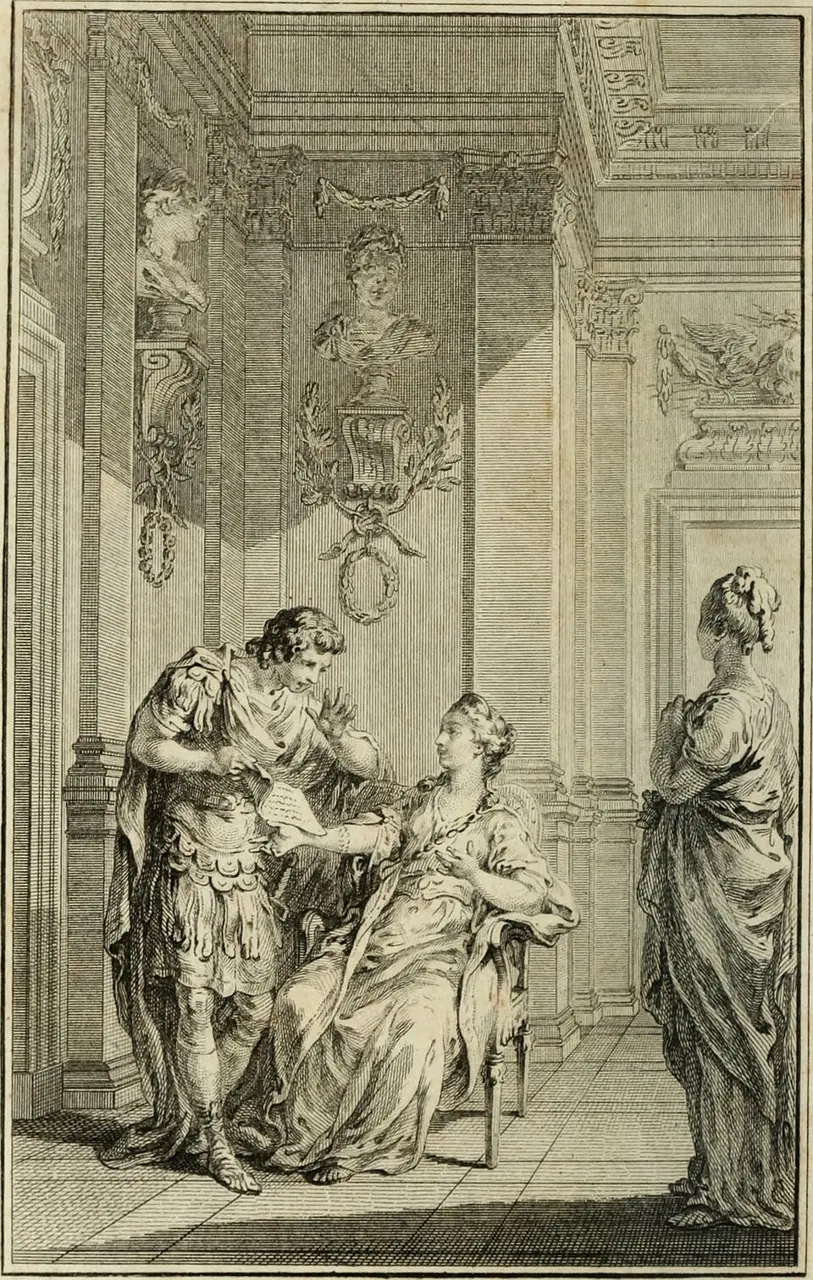
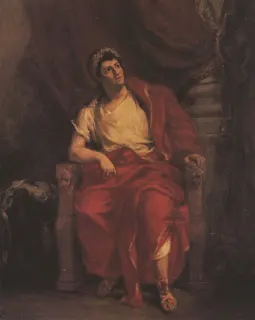
 Britannicusby Jean RacineThe young emperor Nero falls for his rival's betrothed and takes his first step into murder.
 Estherby Jean RacineA Jewish queen of Persia risks her life to save her people from the king's favourite.
 Iphigeniaby Jean RacineThe Greek fleet is becalmed at Aulis, and the gods ask Agamemnon for his daughter's life.
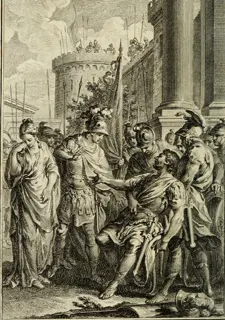 Mithridatesby Jean RacineThe old king Mithridates, thought dead, comes home to find both his sons in love with his bride.

Act 1, Scene 1
[ANTIOCHUS, ARSACES]
Let us stay here a moment! All this pomp
Is a new sight to you, my Arsaces.
This chamber so superb, and so secluded,
Is ofttimes privy to the Emperor's secrets:
Hither he sometimes from the Court retires,
To pour his passion forth into the ears
Of Berenice. Thro' this door he passes
From his apartments; that one leads to hers.
Go, tell her I regret to trouble her,
But must entreat a secret interview.
To trouble her, my lord! And you her friend,
So true and generous in your care for her!
Her lover once, Antiochus, whom all
The East holds great among her greatest monarchs!
What! Tho' in hope she shares the throne with Titus,
Is she so far removed in rank from you?
Go, nor concern yourself with other matters,
See if I soon may speak with her in private.
Act 1, Scene 2
Antiochus
Antiochus, art thou the same as ever?
Canst say to her, "I love thee," without trembling?
I quake already, and my throbbing heart
Dreads now as much as it desired this moment.
Has not fair Berenice slain my hopes,
And did she not enjoin eternal silence?
Five years have they been dead; and, till this day,
My passion has assumed the mask of friendship.
Can I expect the destined bride of Titus
To hear me better than in Palestine?
He weds her. Have I then until this hour
Delay'd to come and own me still her lover?
What fruit will follow from a rash confession?
Since part we must, let's part without displeasure.
I will withdraw unseen, and from her sight
Go, to forget her, or perchance to die.
What! suffer torments that she knows not of
For ever, and for ever feed on tears!
Fear to offend her now when losing her!
And why, fair queen, should I incur thine anger?
Come I to ask you to resign the throne
Of empire, and to love me? Nay, I come
Only to say that, flatter'd for so long
By hope that obstacles might cross my rival,
To-day I find he can do all, and Hymen
Has lit his torch. Vain all my constancy!
After five years of love and wasted hopes,
I leave thee, faithful still, tho' hope be dead,
Can that displease her? Nay she needs must pity;
In any case I can hold out no longer.
And wherefore should a hopeless lover fear,
Who is resolved to see her nevermore?
Act 1, Scene 3
[ANTIOCHUS, ARSACES]
Have we admittance?
I have seen the Queen;
But hard it was to struggle thro' the crowd
That surged around of ever fresh adorers,
Attracted by the news of coming greatness.
Titus, eight days in strict seclusion spent,
Ceases at length to mourn his father's loss,
And gives himself once more to amorous cares;
And, may I trust the rumours of the Court,
Perhaps ere nightfall happy Berenice
Shall change the name of Queen for that of Empress.
Alas!
Can this report disturb my lord?
So then I cannot speak with her alone?
Sire, you shall see her: I have told the Queen
You wish to have a secret interview,
And with a look she deign'd to grant assent,
Willing to lend herself to your entreaty:
Doubtless she waits a favourable moment
T' escape from troublesome congratulations.
'Tis well. But has my Arsaces neglected
None of the weighty matters he was charged with?
You know, my lord, my prompt obedience.
Ships have been fitted out at Ostia,
Ready to quit the port at any moment,
And stay but for your orders. But I know not
Whom you are sending back to Commagene.
When I have seen her, then departure follows.
Who must depart?
Myself.
You?
When I leave
This palace, I leave Rome; and that for ever.
Your words surprise me, and with justice, Sire.
After Queen Berenice for so long
Has forced you to forsake your throne and country,
Detaining you for three whole years at Rome;
And when this queen, her victory achieved,
Expects your presence at her royal nuptials,
When amorous Titus, giving her his hand,
Surrounds her with a glory which reflects
Its light on you—
Let her enjoy her fortune!
We've talk'd enough. Pray, leave me, Arsaces.
I understand you, Sire. These dignities
Have made the Queen ungrateful for your kindness;
Friendship betray'd brings hatred in its train.
No, Arsaces, I never held her dearer.
Has then the Emperor, dazzled with new splendour,
Ventured to slight you? Does his waning favour
Warn you to take your flight from him and Rome?
Titus is constant as a friend can be;
I should do wrong to blame him.
Why depart, then?
Some fancy makes you your own enemy.
Heav'n places on the throne a prince who loves you,
Who erst was witness of your valiant prowess,
When in his steps you follow'd death and glory;
Who, aided by your valour, in the end
Reduced beneath his yoke the rebel Jews.
With mingled pride and pain he well remembers
The day that closed the long and doubtful siege.
The enemy upon their triple rampart
Watch'd at their ease our ineffectual efforts,
And all in vain we plied the battering ram.
You, you alone, bearing a ladder, brought
Death and destruction, as you scaled their walls.
That day had well nigh proved your last, and Titus
Embraced you, lying wounded in my arms,
While Rome's victorious legions wept your fall.
And now the time is come for you to reap
The fruit of all the blood they saw you shed.
If, eager to behold your realm again,
You weary of a life without a sceptre,
Can you not wait at least till, honour laden
From Cæsar's triumph, glad Euphrates greet you
With such additions to your royal title
As Rome bestows in token of her friendship?
Can nought prevail to change your purpose, Sire?
You answer nothing!
What wouldst have me say?
I wait to have a word with Berenice.
And then, my lord?
Hers will decide my fate.
How, Sire?
I wait to learn from her own lips
The truth or falsehood of the voice of rumour
That seats her on th' imperial throne with Titus.
If she is pledged to wed him, I go hence.
And why so fatal in your eyes, this marriage?
The rest I'll tell you after we are gone.
In what perplexity your words involve me!
She comes. Farewell. Do all that I have said.
Act 1, Scene 4
[BERENICE, ANTIOCHUS, PHŒNICE]
At last from these oppressive gratulations
I steal away, from friends made mine by fortune;
Escaping from their vain and tedious homage,
To find a friend whose words come from his heart.
I'll not deny it, that my just impatience
Blamed you for some degree of negligence.
"Why does Antiochus," said I, "whose care
For me has had for witness Rome and Asia,
Constant and true, whatever cross'd my path,
In close attendance on my varied fortunes;
Why, when to-day Heav'n seems to promise me
An honour that I fain would share with him,
Hides he himself, and leaves me to the mercy
Of stranger crowds?"
'Tis true then, Madam, is it?
Am I to understand from what you say
That your long wooing is to end in marriage?
I will confide to you my late alarms.
The last few days not without tears I've spent;
The mourning Titus on his Court imposed
Had held his love suspended e'en in secret;
No more for me that ardour he display'd
When by my eyes entranced the livelong day
He sat, and sigh'd, and could not speak for tears;
He bade me for a while a sad farewell.
Think how I must have grieved, whose fervent passion
Adores him for himself alone, as ofttimes
To you I've own'd; who, were his state as mean
As 'tis exalted, would have chosen him
But for his virtues.
Has he now resumed
His amorous suit?
You witness'd how last night
The senate, seconding his pious cares,
Enroll'd his father as a deity.
His filial duty, satisfied thereby,
Has given place to love and care for me.
E'en at this moment, tho' he told me not
Of his intention, his command has gather'd
The senate, that the bounds of Palestine
May beyond Syria and Arabia reach;
And if I may believe his friends' report
And his own promise sworn a thousand times,
He will crown Berenice Queen of all,
Adding to other titles that of Empress.
Hither he comes himself for my assurance.
And I am come to bid farewell for ever.
Farewell for ever! What is this you say?
Prince, you look pale, and trouble dims your eye!
Yes, I must leave you.
What! may I not know
The reason—
[aside] Without seeing her again
'Twere better to have gone.
What fear you? speak:
Why keep me in suspense? What mystery
Surrounds this parting?
'Tis to your command
I bow, remember, as you hear me now
For the last time. If from your present greatness
Your memory recalls your birthplace, Madam,
You cannot have forgotten that my heart
There felt love's arrows first from your sweet eyes:
Agrippa gave his sanction to my passion,
And, as your brother, spoke on my behalf;
Nor seem'd you angry at the suit so urged.
But to my loss came Titus, saw, and won
Your admiration dazzled by a hero
Who carried in his hands the wrath of Rome.
Judæa quail'd before him, and I fell
The earliest victim of his vanquish'd foes.
Soon did your lips, making my fate more bitter,
Bid mine be silent. Long did I dispute
That cruel sentence, with my eyes I spoke,
Follow'd you everywhere with sighs and tears.
At last your rigour turn'd the trembling scale,
I must conceal my passion, or be banish'd.
You made me swear obedience to that compact:
But I confess, e'en at that very moment,
When you extorted promise so unfair,
I swore that I would never cease to love you.
Alas, what words are these?
Five years have I
Quell'd mine own heart, and will be silent still.
I follow'd my victorious rival's arms,
And hoped, since tears were vain, that I might shed
My blood; or that my name, by many a feat
Renown'd, might reach your ears, deaf to my voice.
Heav'n seem'd disposed to end my misery,
You mourn'd my death, but a worse fate was mine,
And, disappointed, I survived the danger.
The Emperor's valour more than match'd my rage;
His merit I must own with true esteem.
Tho' near in prospect gleam'd th' imperial sceptre,
The darling of the universe, and loved
By you, he seem'd the mark for every blow;
Whilst hopeless, scorn'd, and weary of his life,
His hapless rival follow'd where he led.
I see your heart echoes my praise of him
In secret, and, attentive to my tale
Of woe, you hear me now with less regret,
For Titus' sake forgiving all the rest.
At last the long and cruel siege was o'er,
He tamed the rebels left by feuds intestine,
By fire and famine, bleeding, sick, and pale,
And laid their ramparts low 'neath heaps of ruins.
Rome saw you with the conqueror arrive.
How in my desert home I pined and languish'd!
Long stay'd I roaming about Cæsarea,
Those charming gardens where I learn'd to love you,
And made my quest for you thro' your dominions
Sad at your absence, sought to trace your steps,
And wept my failure; till in mere despair,
Master'd by grief, I turn'd tow'rds Italy;
Where Fate reserved for me her latest stroke.
Titus, embracing me, brought me to you;
A veil of friendship so deceived you both
That you reveal'd your love to me who loved you.
But still some lingering hope soothed my displeasure,
Rome and Vespasian frown'd upon your sighs,
For all his conquests Titus might be foil'd.
The sire is dead, and now the son is master.
Why fled I not at once? Some days I wish'd
Wherein to watch the progress of affairs.
My cup is full of sorrow, yours of joy.
You, without me, will have enough to witness
Your happiness with glad congratulations.
I, who could only add ill-omen'd tears,
Too constant victim of a fruitless love,
Relieved to tell this story of my woes,
Stain'd by no wild revenge, to her who caused them,
Depart, altho' I love you more than ever.
I would not have believed that on this day
Which is to join my destiny with Cæsar's,
I could have suffer'd mortal, unrebuked,
To tell me to my face he is my lover.
But friendship kept me silent; for its sake
I pardon language that might well offend me,
Nor check'd the torrent of unjust upbraiding;
Yet more, I grieve to hear that we must part.
Heav'n knows that in the midst of all my honours
I yearn'd for one thing more, that you might witness
My joy; like all the world I held your virtues
Esteem'd; my Titus met your admiration
With warm regard. And many a time I joy'd
As if with Titus when I talk'd with you.
'Tis this that wings my flight. I shun, too late,
Converse wherein you give no thought to me.
I fly from Titus, from a name that tortures
Each moment that your cruel lips repeat it.
Shall I say more? I cannot bear those eyes
Whose absent gaze seems fix'd upon another.
Farewell. Your image in my heart abides;
I go to wait for death, still loving you.
But fear not that my passion so deluded
Will make the world resound with my misfortunes:
The tidings of a death that I desire
Alone will tell you that I lived so long.
Farewell.
Act 1, Scene 5
[BERENICE, PHŒNICE]
Ah, how I pity him! Such faith
Deserved a happier lot. Madam, do you
Not pity him?
This sudden parting leaves me
[I own it, my Phœnice] secret sorrow.
I would have kept him back.
I keep him back!
Nay, I should rather force me to forget him.
Would'st have me, then, encourage a mad passion?
Not yet has Titus all his heart unbosomed.
With eyes of jealousy Rome sees you, Madam;
I dread for you the rigour of her laws,
They count a foreign marriage a disgrace:
All monarchs Rome detests, and Berenice
Is one.
The time is gone when I could tremble.
The Emperor loves me, and his word has pow'r
Unlimited. He'll see the senate bring me
Their homage, and the people crown his statues
With garlands.
Have you seen this night's rare splendour?
Are not your eyes fill'd with its dazzling glory?
That funeral pyre, the darkness lost in light
Of blazing torches, armies with their eagles,
Long lines of lictors, consuls, senators,
A crowd of Kings, and all with glory borrow'd
From Titus; gold and purple which enhanced
His majesty, and bays that crown'd the victor;
All eyes of visitors from every land
Turning their eager gaze on him alone;
That noble carriage, and that air benign,—
Good gods! with what affection and respect
All hearts assured him of their loyalty!
Could any then behold him and not think,
As I did, that, however lowly born,
The world would still have own'd him as its master?
But whither does my fond remembrance wander?
All Rome, Phœnice, at this very moment
Offers her vows for Titus, and with smoke
Of sacrifice inaugurates his reign.
Why should we linger? Let us add our pray'rs
For his success to Heav'n that watches o'er him.
Then straightway, without waiting to be summon'd,
I'll seek him, and in loving colloquy
Say all that warm affection, long repress'd,
Inspires in hearts contented with each other.
Act 2, Scene 1
[TITUS, PAULINUS, ATTENDANTS]
Has Commagene's monarch been inform'd
That I desire to see him?
To the Queen
I went, and found the Prince had been with her,
But he was gone or ever I arrived.
I have left word to let him know your wishes.
'Tis well. And what does she, Queen Berenice?
The Queen this moment, grateful for your goodness,
Loads Heav'n with pray'rs for your prosperity.
She is gone forth, my lord.
Too kind a Princess!
Alas!
Why breathe for her that sigh of sorrow?
When well nigh all the East will bow before her,
Needs she your pity?
Let us talk in private.
Act 2, Scene 2
[TITUS, PAULINUS]
Rome, still uncertain of my purpose, waits
To learn the future fortune of the Queen;
The secrets of her heart and mine, Paulinus,
Are now become the theme of every tongue.
'Tis time that I should make my meaning plain,
What says the public voice of her and me?
Tell me, what hear you?
By all lips, my liege,
I hear your virtues and her beauty praised.
What say they of the sighs I breathe for her?
What end expect they of a love so faithful?
Nought balks your pow'r; love on, or quench this passion,
The Court will be subservient to your wishes.
Ah yes, I know the Court is insincere,
Too ready always to content its masters,
Approving e'en a Nero's horrid crimes;
I've seen them on their knees adore his madness.
I will not take for judge a servile Court,
I'll play my part upon a nobler stage;
And, without giving ear to Flattery's voice,
I wish to hear the heart of Rome thro' you,
As you have promised. Fear and reverence
Close me the door to murmurs and complaint:
For better eyes and ears, my dear Paulinus,
To you I make appeal, and borrow yours:
'Tis this return I ask for private friendship,
That what my people feel you should express,
That thro' the mists of flattery the truth
Should reach me, thanks to your sincerity.
Speak, then. For what must Berenice look?
Will Rome to her show harshness or indulgence?
Am I to think that she would be offended
Were Queen so fair to grace th' imperial throne?
Doubt not, my lord, be 't reason or caprice,
Rome will be loath to have her for an Empress.
They know her charms, and own that hand so fair
May seem to you worthy to wield your sceptre;
No Roman dame, say they, has heart more noble;
She has a thousand virtues, but, my lord,
She is a Queen. Rome, by a changeless law
Admits no foreign blood with hers to mingle,
Nor will she recognize the lawless issue
Of unions which our customs have forbidden.
Rome, too, you know, when banishing her Kings,
Condemn'd that name, so sacred hitherto,
To the black stigma of eternal hatred;
And, tho' she stoops submissive to her Cæsars,
That hatred, the last relic of her pride,
Survives in hearts whence freedom has departed.
Julius, whose martial glory first subdued her,
And drown'd the voice of law 'mid din of arms,
Smitten with Cleopatra's beauty, fear'd
To wed her, and in Egypt left her lonely
To mourn his absence. Antony, whose love
Made her his idol, in her lap forgot
Country and fame, yet dared not call her wife:
Rome track'd the traitor to his charmer's knees,
Nor let her vengeful fury be disarm'd
Till she had overwhelm'd the amorous pair.
Since then, my lord, Caligula and Nero,
Monsters whose very name I blush to mention,
Whose outward aspect only show'd them human,
Who trampled under foot all other laws,
Fear'd this one only, and refrain'd from lighting
Before our eyes a hymeneal torch
Hateful to Rome. You bade me speak with frankness.
We've seen the brother of the freedman Pallas,
Felix, whose back still bears the brand of Claudius,
Become the husband of two foreign Queens,
And, if I needs must tell unvarnish'd truth,
Both Queens were of the blood of Berenice.
Think you that Rome without offence could see
Partner of Cæsar's bed this Eastern princess,
Whose countrymen beheld one of our slaves
Leave chains and fetters for their Queens' caresses
Thus public feeling views your present passion;
Nor am I sure that, ere this sun has set,
The senate will not, in the name of Rome,
Repeat to you what I have dared to say,
And the whole city, falling at your feet,
Add their entreaties for a choice more worthy
Of you and them. Weigh well what you will answer.
Ah! What a love they wish me to renounce!
That love is ardent, I must e'en confess it.
Stronger a thousand times than you can think.
It has become to me a needful pleasure
To see her every day, and win her favour.
Yet more, [no secrets have I with Paulinus,]
How oft has Heav'n received my warmest thanks
For her, that she embraced my father's side
In Edom, and beneath his banners ranged
The armies of the East, and, all mankind
Rousing, entrusted to his peaceful sway
Rome, drunk with blood! I wish'd my father's throne,
E'en I, Paulinus, who to save his life
Would willingly have died, had Fate consented
To lengthen out the thread of his existence:
And all in hopes, (how ill a lover knows
What he desires!) to share that throne with her,
Her love and loyalty to recognize,
And lay my heart with all the world before her.
In spite of all my love and all her beauty,
After so many oaths, so many tears,
Now when I have the pow'r to crown such charms,
Now when my heart adores her more than ever,
And can, united to her own in marriage,
Pay in one day the vows of five long years,
I am about—Ye gods, how shall I say it?
What, Sire?
To part from her for evermore.
This moment only seals my heart's surrender:
If I desired to hear your frank avowal,
'Twas only that your zeal might aid in secret
Th' extinction of a love with anguish silenced.
Long has fair Berenice held the balance
Suspended, and if glory outweighs passion,
Believe me it has been a desp'rate conflict,
From which my heart will bleed for many a day.
Calm was life's ocean when love's bark I launch'd,
The sceptre of the world by other hands
Was sway'd. Consulting no one but myself,
Free felt I to indulge each amorous sigh;
But scarce had Heav'n recall'd my father's spirit,
And I, with sad farewell, had closed his eyes,
When I awoke from that fools' paradise.
I felt the burden that was laid upon me,
I knew that soon, instead of soft indulgence,
I should be call'd on to renounce myself,
And that Heav'n's choice, thwarting the course of love,
Would make the world henceforth engross my care.
To-day Rome watches my new line of conduct;
What shame for me, for her what evil omen,
If at my first step all her claims I spurn'd,
And based my happiness upon the ruin
Of ancient laws! Bent on this sacrifice,
I wish'd to break the blow to Berenice:
But where can I begin? These last eight days,
How oft have I been minded to disclose
My purpose! And each time my tongue refused
To speak a single word, as if 'twere frozen
Within my mouth. I hoped the pain I felt
Might give her warning of our common woe:
But touch'd by my alarm, all unsuspecting,
She sought to dry the tears whose source she knew not,
And nought foreboded less than that a love,
So well deserved, was drawing to an end.
At length this morning I have steel'd my heart
To tell the truth: Paulinus, I must see her.
I wait to ask Antiochus to take
This precious charge, no longer mine to guard,
Back to the Eastern clime from which she came.
To-morrow Rome shall see the Queen depart
With him. Soon she shall learn her fate from me,
When for the last time we converse together.
I thought no less from that heroic soul
Which Victory has follow'd everywhere.
Captive Judæa, and her smoking ramparts,
Eternal monuments of noble courage,
Assured me well enough you would not mar
The fame that you have won by feats of arms,
And that the victor of so many nations
Sooner or later would subdue his passions.
Under what specious names does Glory mask
Her cruel will! How would her charms seem fairer,
Were it but death she call'd on me to face!
Till now, 'twas Berenice who inspired
The ardour that I felt for her attractions.
You know that once Renown no lustre shed
Around my name; brought up at Nero's Court,
My youth, by ill example led astray,
Too prone to heed the voice of self-indulgence,
Scorn'd nobler aims, Paulinus. Berenice
Enthrall'd my heart. What cannot Love achieve
To please the loved one, and to win tho' vanquish'd?
I spent my blood; all to my sword gave way;
Triumphant I return'd. But tears and blood
Sufficed not to deserve my lady's favour:
A thousand wretches bless'd the aid I brought them.
On every side they saw my bounty spread,
And I was happy, more than you can guess,
When in her eyes I read warm approbation
Of countless hearts won by my benefits.
I owe her all. And what reward is hers?
That debt about to be flung back upon her!
As recompense for virtues so unrivall'd
My tongue will say: "Depart, see me no more."
What, Sire, is all that new-born grandeur nothing,
Which to Euphrates will extend her pow'r?
Honours so great as to surprise the senate,
A hundred tribes added to her dominion,
Are novel tokens of ingratitude.
Weak trifles to engage so great a sorrow!
I know too well how Berenice's heart
Craves nothing but mine own. I loved her fondly,
And was beloved as well. Since that glad day,
[Should I not rather call it most disastrous],
Loving me only for myself, in Rome
A stranger, unfamiliar with my Court,
She lives without a wish but for the hour
When she may see my face, meanwhile content
To wait. And if at times my footstep lingers,
And I appear not at th' expected moment,
I find her when I come all bathed in tears,
Which long refuse my efforts to dispel them.
All the most binding ties of love, reproaches
That sweetly merge in transports of delight
Dash'd with fresh fears, charms unconstrain'd by art,
Beauty and virtue, all I find in her.
For five whole years have I beheld her daily,
And every day her face wears new attractions.
No more I'll think of it. Let's go, Paulinus,
My resolution wavers while we linger.
Great Heav'ns, that I should greet her with such tidings!
Once more, let's go, I must not hesitate.
I know my duty, 'tis for me to follow:
Without concern whether I live or die.
Act 2, Scene 3
[TITUS, PAULINUS, RUTILUS]
The Queen, your Majesty, would speak with you.
Alas, Paulinus!
Drawing back already!
Remember, Sire, your noble resolution;
Now is the time.
We'll see her. Let her come.
Act 2, Scene 4
[TITUS, BERENICE, PAULINUS, PHŒNICE]
Be not offended, if my zeal outruns
Discretion, and disturbs your privacy.
While your Court, gathering around, repeat
The favours show'r'd so freely on my head,
Sir, is it right that I at such a moment
Should stay alone, and gratitude be silent?
I know your friend sincere, nor need I shun
His presence, well acquainted as he is
With our hearts' secret; you have done with mourning,
Nought hinders you, and yet you seek me not.
I hear you offer me another sceptre.
But from yourself I hear no word of it.
Let us have more repose and less display;
Is your love dumb except before the senate?
Ah, Titus (for my heart disowns those titles
Of majesty which fear and reverence prompt),
Why should your love be burden'd with such cares?
Are crowns the only prize that it can offer?
How long have you supposed I covet grandeur?
A sigh, a look, a word that falls from you,
Are all th' ambition of a heart like mine.
See me more often, and come empty handed.
Is all your time devoted to your empire?
Eight days have pass'd, and have you nought to tell me?
One word would reassure this timid heart!
But was your speech of me, when I surprised you?
Were my concerns the subject of discourse?
Was I at least, Sir, present to your thought?
Of that you may be sure: for Heav'n is witness
That Berenice is before me always.
Nor time, nor absence, once again I swear it,
Can banish you from my adoring soul.
Why, what is this? You swear eternal ardour,
But, even while you swear, are cold as ice!
Why make appeal to Heav'n's omnipotence?
What need have I of oaths to strengthen trust?
I have no wish to think you false, my lord,
And will believe the witness of a sigh.
Madam—
I listen. But, without reply,
You turn away your eyes and seem perplex'd!
Why is your countenance so full of woe?
Will you for ever mourn your father's death?
Can nothing charm away this gnawing sorrow?
Ah! would to Heav'n my father yet were living,
How happy should I be!
Sir, this regret
Does honour to your filial piety,
But to his memory your tears have paid
Due tribute. Other cares you owe to Rome;
I dare not say how much your glory moves
My own concern. Once I could soothe your troubles,
And Berenice's voice you heard with pleasure;
For your sake vex'd with manifold misfortunes,
A word from you has made me check my tears.
You mourn a father: 'tis a common sorrow,
While I [the bare remembrance makes me shudder,]
So nearly torn from him whom more than life
I loved, the anguish of whose heart you know
When parted from my Titus for a moment,
I, who would die if banish'd from your sight,
Never to see you more—
Alas! What say you?
Why choose this time? Pray cease, for pity's sake:
Your kindness crushes an ungrateful wretch.
Ungrateful! can it be that you are that?
Are you so weary of my tenderness?
No, never; since I must the truth confess,
My heart burns now with fiercer flames than ever.
But—
Speak.
Alas!
Go on.
Rome and the empire—
Well, Sir?
Let's go, Paulinus; I am dumb.
Act 2, Scene 5
[BERENICE, PHŒNICE]
So soon to leave me! and without a word!
A doleful meeting truly, dear Phœnice!
What have I done? What means he by this silence?
Like you I'm puzzled to account for it.
Does nothing to your memory occur
Which may have raised a prejudice against you?
Consider well.
Alas! you may believe me,
The more I wish to bring to mind the past,
From the first day I saw him till this hour,
The only fault I find is too much fondness.
You heard us. Tell me frankly, my Phœnice,
Did I say anything that could displease him?
I know not if, perchance, with too much heat
I scorn'd his gifts, or blamed the grief that vex'd him—
Is it his people's hatred that he dreads?
He fears, it may be, to espouse a Queen.
Alas, if that were true.—It cannot be,
A hundred times at least he has assured me
He slights their cruel laws. Why does he not
Explain so harsh a silence? This suspense
Will kill me. How could I endure to live
Neglected, feeling I had him offended?
Let us go after him. But thro' my brain
Flashes a thought that may the source reveal
Of this disorder. Has he learn'd where loves
Antiochus? Can that have moved his anger?
I heard the King was summon'd to his presence.
Why further seek for cause of my distress?
Doubtless this trouble that has so alarm'd me
Is but a light suspicion, which with ease
May be disarm'd. This feeble victory
Brings me no pride, my Titus. Would to Heav'n
A rival worthier of your jealous fears
Might try my faith, and offer empire wider
Than Rome can boast, to pay me for my love;
While you had nought to give me but yourself!
Then would you see, victorious and beloved,
How much I prize your heart, my dearest Titus.
Come, let us go. One word will clear his doubts.
Let me take courage, I can please him still.
Too soon have I counted myself unhappy;
Titus must love me if his heart is jealous.
Act 3, Scene 1
[TITUS, ANTIOCHUS, ARSACES]
So you would leave us, Prince! What sudden reason
Speeds your departure, shall I say your flight?
Would you have gone in secret, without taking
Our farewell wishes? Is it as a foe
You quit us? What will Rome then say to this?
I, as your friend, my Court, and all the empire?
Wherein have I offended? Did I treat you
Without distinction just like other kings?
While yet my father lived my heart was yours,
That was the only present I could make you;
Now, when my hand can open with my heart,
You shun the favours I would fain bestow.
Think you, the hazards of the past forgotten,
My present grandeur every thought engrosses,
And all my friends, fast fading in the distance,
Wanted no longer, are accounted strangers?
Of you, dear Prince, who thus would steal away,
My need is greater than it ever was.
Of me?
Of you.
Alas! what can you look for
From one so luckless, Sire, but useless wishes?
Can I forget, Prince, that my victory
Owed half its glory to your valiant deeds,
That in the train of captives Rome beheld
More than one vanquish'd by Antiochus?
And laid up in the Capitol she saw
Spoils that your hands had taken from the Jews?
These brave achievements are enough for me,
No further claim I make but on your counsel.
I know that Berenice, to your care
A debtor, has in you a faithful friend;
Her eyes and ears are giv'n to you alone
In Rome, you share with us one heart and soul.
For friendship's sake, so constant and devoted,
Exert the influence that you have with her;
See her for me.
I? Nay, I cannot face her.
She has received my last farewell for ever.
Prince, speak to her again on my behalf.
Plead your own cause, my lord. The Queen adores you;
Why should you at this hour deny yourself
The pleasure of so charming an avowal?
She waits you with impatience. I will answer
For her obedience with my parting breath;
Ready to yield consent, herself has told me
That when you see her next, 'twill be to woo her.
Ah; would that I could thus confess my passion!
To do so would be happiness indeed!
My love was ready to burst forth to-day,
This very day when I, dear Prince, must leave her.
Leave her, my lord?
Such my sad destiny:
For her and Titus is no longer hope
Of wedlock, vainly that sweet thought has lured me:
To-morrow, Prince, she must depart with you.
Heav'ns! What is this?
Pity the pow'r that galls me:
Lord of the universe, I rule its fortunes;
I set up Kings, and cast them down at will;
Yet can I not of mine own heart dispose.
Rome, the eternal foe of royal titles,
Disdains a beauty born to wear the purple:
The glitter of a crown and long descent
From kingly sires are in her eyes a scandal
To smirch my flame. This heart of mine is free
To rove elsewhere, and choose the meanest bride
Of Roman blood, nor need I dread a murmur
To mar the shouts of welcome and delight.
The mighty Julius could not stem that tide
Which sweeps me on. If Rome to-morrow sees not
The Queen's departure, she will hear the people
Demand of me her instant banishment.
Let us then spare ourselves that base affront,
And yield, since yield we must, without disgrace.
My eight days' silence and averted eyes
Will have prepared her for this sad announcement;
E'en at this moment, restless and excited,
She longs to learn my purpose from myself.
Soothe the keen anguish of a tortured lover,
And spare me the sore task of explanation.
Go, make her understand my troubled silence,
And why it is I must avoid her presence;
Be you sole witness of her tears and mine.
Take her my last farewell, and bring me hers.
I shrink from parting words and looks of sadness,
Which might o'erthrow my tottering resolution.
If it can ease her misery to know
That in my soul her image lives and reigns,
Assure her, Prince, that, faithful to the end,
My broken heart, banish'd from happiness
No less than she, and bearing to the tomb
Her name beloved, will, like a captive bird,
Pine for release, as long as Heav'n that tears
Her from me, may protract my weary life.
You, Prince, whom friendship's ties alone have bound
To her, forsake her not in her affliction;
By you escorted to her Eastern realms,
Let her appear in triumph, not in flight.
And to confirm a friendship so devoted,
And keep my name fresh in your memories,
Let your dominions reach each other's borders;
Euphrates only shall divide your kingdoms.
I know the senate holds your name so honour'd,
They with one voice will ratify this gift,
I join Cilicia to your Commagene.
Farewell. Desert her not, my Berenice,
Queen of my heart, sole object of desire,
Whom only I can love till I expire.
Act 3, Scene 2
[ANTIOCHUS, ARSACES]
Thus is kind Heav'n prepared to do you justice:
You will leave Rome, Sire, but with Berenice.
You force her not away, they to your hands
Consign her.
Give me time, good Arsaces.
The change is great, and my surprise extreme;
Titus to me resigns his dearest treasure!
Gods! can I credit what mine ears have heard?
And should my heart be glad, could I believe it?
And what am I, my lord, to think of you?
With what fresh hindrance is your joy confronted?
Did you deceive me when just now, at parting,
Still moved with anguish at a last farewell,
You told me all your heart had dared to tell her,
And trembled at your own audacity?
'Twas her impending marriage urged your flight,
That fear removed, what care can trouble you?
Follow where love invites your willing footsteps.
With her safe conduct I am charged, my friend,
And sweetest intercourse shall long enjoy;
Her eyes will grow accustom'd to the sight
Of mine, and learn, perchance, how much my ardour,
So persevering, makes the suit of Titus
Seem weak and cold. Here all his grandeur daunts me;
In Rome nought else is seen beside his splendour;
But, tho' his name is in the East renown'd,
The traces of my glory too are there
For her to see.
Ay, Fortune favours you.
Ah! How we mock ourselves with self-deception!
Why, what deception?
Could I ever please her?
Or Berenice cease to thwart my love?
Would she let fall a word to ease my pain?
Think you that she, in her unhappiness,
Tho' all the world besides should slight her charms,
Would thank me for my tears, or condescend
So far as to accept the zealous service
Which she should feel she owed to my affection?
And who can better solace her disgrace?
Her prospect now is changed from what it was:
Titus forsakes her.
Ah! this turn of fortune
Will bring me nothing but an added torture,
To learn how much she loves him from her tears;
I shall behold her grief, and pity her
Myself. The fruit of all my love will be
To see her weep, but not, alas, for me.
Why thus continue to torment yourself?
Was ever known a noble heart more feeble?
Open your eyes, and see how many reasons
Must move fair Berenice to be yours.
Now that no longer Titus courts her favour,
She will perforce accept your hand, my master.
And why perforce?
Give her some days to weep,—
Let the first sobs of grief be unrestrain'd;
Then all will work for you, vexation, vengeance,
His absence and your presence, time itself,
Her single hand too weak to wield three sceptres,
Your realms so ready to be join'd with hers,
Interest, reason, friendship, all unites you.
I breathe once more, you give me back my life,
With joy I hail a presage so agreeable.
Why tarry? Let my mission be discharged.
I'll see the Queen, and since the task is mine,
Tell her that Titus has deserted her—
But stay, what would I do? Is it for me
To take upon myself such cruel errand?
My heart revolts, whether from love or pity.
Shall my dear Berenice hear from me
She is forsaken? Who would e'er have guess'd it,
That such a word should strike upon her ear?
Her indignation will all fall on Titus;
And if you speak, 'twill be at her desire.
No, let us not intrude upon her sorrow;
Let others come to tell of her misfortune.
Do you not think it will be hard enough
For her to hear how Titus spurns her from him,
Without the further bitterness of learning
His scornful treatment from a rival's lips?
Once more, let's fly; nor by such evil tidings
Incur the weight of her undying hatred.
Ah! Here she comes. Now to your part, my lord
Good Heav'ns!
Act 3, Scene 3
[BERENICE, ANTIOCHUS, ARSACES, PHŒNICE]
Why, how is this? I thought you gone.
I see that you are disappointed, Madam,
And it was Cæsar that you here expected.
Him must you blame if, spite of my farewell,
My presence still offends unwilling eyes.
I should, perhaps, have been ere now at Ostia,
Had not his orders kept me at his Court.
Your presence then he welcomes, mine he shuns.
He has detain'd me but to speak of you.
Of me, Prince?
Yes, of you.
What could he say?
A thousand others are more fit to tell you.
What, Sir!—
Suspend, dear Madam, your resentment.
Another, far from seeking to be silent,
Perhaps would triumph, and with ready boldness
Might gladly yield to your impatient wish;
But I, whose heart shrinks ever, as you know,
From wounding feelings dearer than mine own,
Would rather risk displeasure than distress you,
Dreading your sorrow even more than anger.
Ere sunset you will justify my silence.
Madam, farewell.
What words are these? Stay, Prince,
I cannot hide my trouble from your eye.
You see before you a distracted Queen;
Speak but two words, for I am sick at heart.
You fear, say you, to trouble my repose;
This cruel reticence spares me no pain,
It pierces deep, it stirs my wrath, my hatred.
Sir, if you hold my peace of mind so precious,
If ever I myself to you was dear,
Lighten this darkness that you see o'erwhelms me.
Tell me what Titus said.
For Heav'n's sake, Madam—
Do you so little fear to disobey me?
To tell the truth would be to make you hate me.
Speak, I command you.
Gods! What vehemence!
Once more, believe me, you will praise my silence.
This moment, Prince, comply with what I ask,
Or be assured that I shall always hate you.
That sentence, Madam, shall release my tongue.
Since you will have it so, I must content you.
But do not be deceived: I have to tell
Of troubles peradventure little dream'd of.
I know your heart; you must expect a blow
To strike it where your feeling is most tender.
Titus commands me—
What?
To let you know
That you must part for ever from each other.
Part! He and I? Titus from Berenice?
Yet at the same time I must do him justice;
All the repugnance that a generous heart
Can feel when love is vanquish'd by despair,
I've seen in him. He worships while he weeps
But he's convinced 'tis vain to love you longer.
Rome holds the very name of Queen suspected;
Yes, you and he must part. You leave to-morrow.
Part! Oh, Phœnice!
You must show, dear Madam,
The greatness of your soul. This sudden blow
Is doubtless hard to bear, and well may stun you.
Titus forsake me! All his vows forgotten!
Titus, who swore to me—I'll not believe it;
Honour forbids him so to cast me off.
It is a slander on his innocence,
A trap to tear two loving hearts asunder.
Too dear he holds me to desire my death.
Come, I will see him, speak with him forthwith.
Come, let us go.
Is falsehood in my face?—
Too much you wish it true, Sir, to persuade me.
No, I believe you not. Be't as it may,
Take heed you never see my face again.
[to Phœnice]
Do not desert me in this dire distress.
I struggle hard to keep myself deluded.
Act 3, Scene 4
[ANTIOCHUS, ARSACES]
Heard I aright? or did my ears deceive me?
Me did she bid, me, ne'er to see her more?
I'll take good care of that. Was I not leaving,
Had Titus not detain'd me 'gainst my will?
Yes, I must go. Get ready, Arsaces.
Her hatred, wherewithal she thinks to blast me,
Strikes off my chains. Just now you saw a lover
Departing, jealous with a wild despair;
Now, with this warning ringing in mine ears,
I'll go, methinks, in proud indifference.
There is less need to leave her now than ever.
Shall I then stay to see myself disdain'd,
And bear the blame of Cæsar's cruelty?
See myself punish'd because he offends?
With what injustice and unworthy scorn
She tells me to my face that I'm dishonest!
For thanks she taxes me with perfidy,
Saying that I'm a traitor, he is true!
And when forsooth? Just at the bitter moment
When I was setting forth my rival's tears;
When to console her I presented Titus
More tenderly attach'd than truth may warrant.
Why vex yourself, my lord, with thoughts like these?
Give to this angry torrent time to flow;
A week, or at the most a month, will dry it.
Only remain.
No, Arsaces, I leave her.
Her sorrow might excite my sympathy;
My peace, my honour urge me to be gone.
Let us fly far enough from Berenice
To hear her very name no longer mention'd.
Still there is time, the day is not yet spent.
I'll seek my palace, there to wait for you;
Haste, see how she supports this crushing blow,
Until I know she lives, I cannot go.
Act 4, Scene 1
Berenice
Phœnice comes not! Tantalizing moments,
How slow ye seem to my impatient wishes!
Restless I pace this floor, faint, sick at heart;
Strength fails me, yet it kills me to be quiet.
Phœnice comes not! Ah, how this delay
Appals my heart with a too fatal presage!
Phœnice has no answer to bring back;
Titus, ungrateful Titus will not hear her;
He seeks in flight a refuge from my fury.
Act 4, Scene 2
[BERENICE, PHŒNICE]
Well, dear Phœnice, have you seen the Emperor?
What says he? Will he come?
Yes, I have seen him,
And painted your distress in darkest tints;
Tears he would fain have check'd flow'd from his eyes.
And comes he?
He will come; doubt it not, Madam.
But will you show yourself in this disorder?
Calm yourself, dearest lady, be composed.
Let me replace the veil that from its place
Has slipt, and smooth this too dishevell'd hair:
No trace of weeping must your charms disfigure.
Nay, let them be, Phœnice; he shall see
His handiwork. What boots this vain apparel?
If my true love, my tears and sighs, nor they
Alone, but certain death whose near approach
I feel, avail not to recall him to me,
Will your superfluous cares be more successful,
Aiding attractions that have ceased to move him?
Why will you load him with unjust reproaches?
I hear a step, dear Madam; it is Cæsar's.
This place is public, haste to your apartments.
There you in private may converse together.
Act 4, Scene 3
[TITUS, PAULINUS, ATTENDANTS]
Do what you can to soothe the Queen, Paulinus;
Tell her I'm coming.
I would be alone
A moment. Let them leave me.
[aside] How I fear
This conflict! May the gods protect his glory,
And Rome's! I'll see the Queen.
Act 4, Scene 4
Titus
What dost thou, Titus?
How rash art thou, thus to seek Berenice!
Art thou prepared to take a last farewell?
And is thine heart steel'd to such cruelty?
For in the conflict that awaits thee now
Firmness is not enough, thou must be ruthless.
How shall I bear those eyes whose tender glance
Knows but too well the way to reach my heart?
When I encounter that soul-piercing gaze
Fix'd upon mine, can I resist her tears,
Or bear in mind the stern behest of duty?
How shall I say: "See me no more for ever?"
I am about to stab a heart that loves me,
Beloved by me. And why? At whose command?
Mine own, for Rome has not declared her wishes.
I hear no cries surging around this palace,
Nor see the State hanging o'er ruin's brink.
Needs it a sacrifice like this to save it?
Its voice is silent: I, my own tormentor,
Rush to meet troubles I may keep at bay.
Who knows but Rome, owning the Queen's rare virtues,
Will count her one of her own citizens?
Rome by her choice may justify my own;
I will not court destruction, no, not I.
Let Rome against her laws weigh in the balance
Such love as hers, such tears, such constancy,
And she will side with me—
Open thine eyes;
What air is this that thou dost breathe? Can love
Or fear eradicate the hate of Kings
That Romans with their mothers' milk imbibe?
Their sentence against Kings condemns thy Queen.
Hast thou not heard it from thine earliest years?
And even in the camp the voice of Fame
Proclaim'd thy duty in thine ears once more.
When Berenice hither follow'd thee,
Rome did not fail to let thee know her judgment.
How often must that judgment be repeated?
Coward, let love prevail, renounce the throne,
Seek Earth's remotest bounds, and, there confined,
Resign to worthier hands the reins of empire.
Is this the end then of those glorious projects
Which were t' enshrine my memory in all hearts?
Eight days have I been reigning, and till now
Nought have I done for honour, all for love.
What record can I give of time so precious?
Where are the boons I led men to expect?
The tears that I have dried? The happy eyes
Wherein I read the fruit of kindly service?
How have the burdens of the world been lighten'd?
What span of life to me has been allotted
I know not; and how much of these few days,
So long expected, have I lost already!
Delay no longer: do what honour bids,
And break the only tie—
Act 4, Scene 5
[BERENICE, TITUS]
[coming from her apartment] Nay, let me go.
Your counsel all is vain to keep me back;
And I must see him—
Ah, my lord, you here!
Then it is true Titus abandons me!
And we must part! 'Tis he will have it so!
Spare, Madam, to o'erwhelm a hapless prince.
We must not melt each other's hearts with woe.
I am consumed with cruel griefs enough
Without the added torture of those tears.
Recall that noble spirit which so oft
Has made me recognize the voice of duty.
Yet there is time. Reduce your love to silence;
And, with an eye clear'd from the mists of passion,
Regard that duty with unflinching courage.
Strengthen this heart of mine against yourself,
Help me to nerve its weakness, if I can;
To keep back tears that will not cease to rise;
Or, if we cannot stanch those tender springs,
Let dignity at least support our woes,
So that the whole world without blame may mark
When weeps an Emperor and when weeps a Queen.
For, after all, my Princess, we must part.
Ah, cruel Titus, you repent too late.
What have you done? You made me think you loved me,
Accustom'd me to see you with delight,
Till but for that I lived. You knew your laws
When first you brought me to such fond confession,
Why did you let my love grow to this height?
Why said you not: "Poor Princess, fix your heart
Elsewhere, nor let deceitful hopes ensnare it;
Give it to one free to accept the gift?"
You took it gladly, will you now reject it
With cruel scorn, when to your own it clings?
How oft did all the world conspire against us!
Still there was time, you should have left me then.
A thousand reasons might have soothed my woe;
I might have blamed your father for my death,
The senate, and the people, all the empire,
The whole world, rather than a hand so dear.
Their enmity, so long declared against me,
Had long prepared me to expect misfortune.
I did not look, Sir, for this cruel blow
To fall when hope seem'd crown'd with happiness,
Now, when your love can do whate'er it wishes.
When Rome is silent, and your father dead,
When all the world bends humbly at your knees,
When there is nothing left to fear but you.
Yes, it is I who wreak my own destruction!
Till now I lived the victim of delusion,
My heart refused to look into the future,
To think that we might one day have to part.
To eager wishes nothing seems too hard,
And blinded hope grasps the impossible.
Haply I thought to die before your eyes,
And so forestall more cruel separation.
All opposition made my flame burn brighter;
Rome and the empire spoke, but glory's voice
Not yet had to my heart appeal'd in tones
Like those with which it strikes an Emperor's ears.
I know what torments wait on this resolve,
I feel my heart ready to take its flight,
I cannot any longer live without you.
Come life or death, my duty is to reign.
Be cruel, then, and reign, a slave to glory!
I'm ready to submit. Yes, I expected,
For trusting you, to hear those lips, that swore
A thousand vows of everlasting love,
Confess before mine eyes that they were faithless,
And banish me for ever from your presence.
I wish'd to hear that sentence from yourself;
But I will hear no more. Farewell for ever—
For ever! Ah, my lord, think how those words,
Those cruel words, dismay a heart that loves!
A year, a month will be to us an age
Of suff'ring, when the wide sea rolls between us,
And each fresh sun that dawns shall sink in darkness
Without presenting to the eyes of Titus
His Berenice, he unseen by her
The livelong day. But how am I deceived!
No sorrow feels he at the thought of absence,
He will not count the days when I am gone,
So long to me, they'll seem too short for him!
They'll not be many I shall have to count:
I hope ere long the tidings of my death
Will bring assurance that I loved you truly.
Then you will own that Titus could not live—
Ah, my dear lord, why part if that be so?
I speak not now to you of happy marriage.
Has Rome condemn'd me never more to see you?
Why grudge to me the selfsame air you breathe?
I can't resist you, Madam. Stay, I yield;
But not without a sense of mine own weakness;
Ceaseless must be the conflict and the fears,
Ceaseless the watch to keep my steps from you,
Whose charms will ever like a magnet draw me.
Ay, at this very instant, love distracts me
From memory of all things but itself.
Well, well, my lord, what ill can come of it?
Where see you any sign of Rome's displeasure?
Who knows how they will look on this offence?
If they complain, if cries succeed to murmurs,
Must I shed blood to justify my choice?
If they in silence let me break their laws,
To what do you expose me? I must purchase
Their patience at the price of base compliance
With whatsoever else they dare to ask me;
Too weak t' enforce the laws I cannot keep.
You count as nothing Berenice's tears!
I count them nothing! Heavens! What injustice!
Why then, for unjust laws that you can change,
O'erwhelm yourself in ceaseless miseries?
Have you no rights, my lord, as well as Rome?
Why should you hold her interests more sacred
Than ours? Come, tell me.
How you rend my heart!
You are the Emperor, and yet you weep?
Yes, Madam, it is true, with sighs and tears
I am unnerved. But when the throne I mounted
Rome made me swear to vindicate her laws,
And I must keep them. More than once already
Her rulers have been call'd on to display
Their constancy in trial. From her birth
Those whom she honour'd readily obey'd her:
See Regulus who, faithful unto death,
Return'd to Carthage to be slain with tortures,
Torquatus dooming his victorious offspring,
Brutus with tearless eyes seeing his sons
Slain by his orders 'neath the lictor's axe.
Hard lot was theirs! But patriotic duty
Has ever won the victory with Romans.
I know in leaving you unhappy Titus
Attempts what throws their virtues in the shade,
A sacrifice surpassing any other's:
But think you, after all, I am unworthy
To leave posterity a high example
Which those who follow will be task'd to equal?
No! To your cruel heart I deem it easy;
Worthy are you to rob me of my life.
The veil is torn aside, I read your heart.
I will not ask you more to let me stay,—
Me, who had willingly endured the shame
Of ridicule and scorn from those who hate me.
I wish'd to drive you to this harsh refusal.
'Tis done, and soon you'll have no more to fear me.
Think not that I shall vent my wrongs in fury,
Or call on Heav'n to punish perjury:
No, if a wretch's tears still move the gods,
I pray them to forget the pangs I suffer.
If, ere I die, victim of your injustice,
I cherish any wish to leave behind me
Avengers of poor Berenice's death,
I need but seek them in your cruel heart;
Remorse will dwell there, all my love recalling,
Paint my past kindness, and my present anguish,
Show you my blood staining your royal palace,
And haunt you with abiding memories:
I have made every effort to dissuade you,
'Tis vain: to your own heart I trust for vengeance.
Farewell.
Act 4, Scene 6
[TITUS, PAULINUS]
What seem'd her purpose when she left you?
Is she disposed, my lord, to go away?
I am undone, Paulinus! She is bent
On self-destruction. How should I survive it?
Haste, let us follow her!
Did you not order,
Just now, that all her movements should be watch'd?
Her women are not backward in their duty,
And they will turn her from these gloomy thoughts.
Fear nothing. This is her last throw, my lord;
With perseverance victory is yours.
I know you could not hear her without pity,
I was myself affected at the sight.
But take a wider and more distant view,
Think how a moment's pain will lead to glory,
With what applause the universe will ring,
Rank'd in the future—
No, I am a monster.
I hate myself. Nero, by all detested,
Ne'er reach'd a depth of cruelty like this.
I will not let poor Berenice die.
Come, let us go, and Rome say what she will.
My lord!
I know not what I say, Paulinus;
Excess of sorrow overpow'rs my senses.
Soil not the current of your pure renown:
The news, already spread, of your farewell
Makes Rome exchange her sighs for shouts of triumph;
In all her temples fumes of incense rise
For you, your virtues to the skies are lauded,
And everywhere your statues crown'd with bays.
Ah, Rome! Ah, Berenice! Woe is me,
That I should be an Emperor, and a lover!
Act 4, Scene 7
[TITUS, ANTIOCHUS, PAULINUS, ARSACES]
What have you done, my lord? The lovely Queen
Lies in Phœnice's arms, death hovering o'er her:
Deaf to our tears, to counsel, and to reason,
She cries aloud for daggers or for poison.
You, you alone can tear that longing from her—
For when they breathe your name her life comes back;
Her eyes are ever turn'd to your apartments,
As tho' they look'd to see you every moment.
The sight is more than I can bear, it kills me.
Go, show yourself to her. Why tarry longer?
Save to the world such virtue and such beauty,
Or waive all title to humanity.
Speak but one word.
Alas! What can I say?
I scarcely know if I'm alive or dead.
Act 4, Scene 8
[TITUS, ANTIOCHUS, PAULINUS, ARSACES, RUTILUS]
My lord, the senate, consuls, all the tribunes
Seek audience of you in the name of Rome:
With them a multitude, full of impatience,
Throng your apartments, and await your presence.
Great gods, ye thus would reassure my heart,
Distracted as ye see till like to break!
Come, Sire, and let us pass to the next chamber.
There see the senate.
Haste, Sir, to the Queen!
Nay, treat them not with such indignity,
Nor trample on the majesty of Rome,
Whose envoys—
'Tis enough. Yes, I will see them.
[to Antiochus]
Prince, 'tis a duty that I cannot shun.
Go to the Queen. I hope, on my return,
She will no longer need to doubt my love.
Act 5, Scene 1
Arsaces
Where shall I find this Prince of peerless faith?
May Heav'n conduct my steps, and aid my zeal:
Grant me this moment to announce to him
A happiness which he has ceased to hope for!
Act 5, Scene 2
[ANTIOCHUS, ARSACES]
Ah! What good fortune sends you hither, Sire?
If my return can bring you any joy,
It is to my despair your thanks are due.
My lord, the Queen goes hence.
She goes!
To-night.
Her orders have been giv'n. She is offended
That Titus leaves her to her tears so long.
Her passion has cool'd down to proud displeasure;
Rome and the Emp'ror she alike renounces,
And wishes to be gone ere Rome can learn
Her trouble, and rejoice to see her flight.
She writes to Cæsar.
Heavens! Who'd have thought it?
And Titus?
Has not met her eyes again.
The multitude in transport press around him,
Shouting his praises and the names of honour
The senate have conferr'd, and these loud plaudits,
These titles, and these tokens of respect
To Titus seem so many binding pledges,
Links in a chain to fix his wavering will.
Despite his sighs and Berenice's tears.
I think he will not see her more. All's over.
I feel fresh hope; I own it, Arsaces.
But cruel Fate has ofttimes play'd me false,
And mock'd me with such bitter disappointments,
That 'tis with fear and trembling that I hear you:
Evil forebodings mingle with my joy,
And make me dread the turn of Fortune's wheel.
But who is this? Titus is coming hither!
With what intent?
Act 5, Scene 3
[TITUS, ANTIOCHUS, ARSACES]
[to his Attendants] Stay, let none follow me.
[to Antiochus]
I come at last, Prince, to redeem my promise.
The Queen's distress engrosses all my thoughts.
Her tears and yours have pierced me to the heart;
I come to calm sorrows than mine less cruel.
Come, Prince; I would that you yourself should see
For the last time if I love Berenice.
Act 5, Scene 4
[ANTIOCHUS, ARSACES]
Thus ends the hope, then, that you came to offer!
You see the triumph that awaited me!
Justly incensed was Berenice leaving,
For Titus had refused to see her more!
Great gods! What have I done, that thus misfortune
Is destined to pursue me all my life?
My days are pass'd in constant quick transition
From fear to hope, from hope to wild despair,
Yet still I breathe! O Berenice! Titus!
Ah, cruel gods! ye shall no longer mock me.
Act 5, Scene 5
[TITUS, BERENICE, PHŒNICE]
Nay, I'll hear nothing. I am quite resolved:
I mean to go. Why show yourself before me?
Why come you to embitter hopeless sorrow?
Are you not yet content? No more I'll see you.
Pray hear me.
No, the time is past.
Dear Madam,
One word.
Not one.
Into what grief she casts me!
Whence comes, my Princess, this so sudden change?
You said you wish'd me to depart to-morrow;
I am determined to depart this moment:
The die is cast; I go.
Stay.
Why, forsooth?
To hear myself insulted everywhere,
My trouble made the theme of every tongue?
Can you not hear their cries of cruel joy,
While I am drown'd in tears of lonely sorrow?
What have I done to make myself so hated?
No crime I know save loving you too much.
Why heed the malice of a senseless mob?
Nought see I here but sights that wound mine eyes.
This chamber furnish'd by your thoughtful care,
These walls so long the witness of my love,
All seem'd to pledge that yours would last for ever;
These garlands, where our names close link'd together
Meet my sad gaze whene'er I look around,
Are more than I can bear, smiling impostors!
Phœnice, let us go.
Heav'ns! How unjust!
Return, return to that august assembly
Which welcomes with applause your cruelty.
Say, did their praises gratify your ear?
Was your fierce thirst for glory fully slaked?
Confess that you have promised to forget me.
But that would not suffice to seal repentance:
Have you not sworn an everlasting hatred?
Nay, I have promised nothing. Hatred, say you?
How can I e'er forget my Berenice?
Gods! What a bitter moment thus to feel
Crush'd 'neath the weight of her unjust suspicion!
Ah, you should know me better. Count the hours,
The days I spent, these five years past, in telling
My heart's desires with passion that outran
Your own, and fervent sighs when words were dumb.
This day surpasses all. Ne'er, I protest,
Were you beloved with so much tenderness,
Ay, and for ever—
You maintain you love me;
Yet I'm departing, and by your command!
Find you such charms, my lord, in my despair?
Fear you that these mine eyes shed tears too few?
What boots it that your heart returns so late?
For pity's sake at least show me less love,
Recall not an idea too fondly cherish'd;
Let me go hence, persuaded that, already
Banish'd in secret from your soul, I leave
A wretch who loses me without regret.
[Titus reads a letter]
The letter you have seized I had just written.
There you may read all that of you I ask,
And of your love: read it, and let me go.
Nay, that you never shall with my consent.
What! this departure then was but a scheme
Veiling more cruel purpose! You would die!
So should there but remain sad memories
Of all I love.
Go, call Antiochus.
[Berenice sinks upon a seat]
Act 5, Scene 6
[TITUS, BERENICE]
Madam, a true confession I must make.
Whilst my mind brooded on that dreaded moment
When, in obedience to stern laws of duty,
I should be forced to see your face no longer;
When I foresaw that sad farewell approaching,
Contending fears in me, from you rebuke
Of tearful eyes, I arm'd my soul to suffer
All that affliction most intense could bring me:
But I must own that e'en my worst forebodings
Fell short, far short of the reality;
I thought my courage was less prone to yield,
And feel with shame how feeble was its strength.
Before mine eyes I saw all Rome assembled;
The senate spoke, but my distracted soul
Heard without comprehending, and in silence,
As cold as ice, I met their warmest greetings.
Rome knows not yet what destiny awaits you;
I scarcely know myself if at this moment
I am an Emperor, or e'en a Roman.
Uncertain of my purpose, I am come,
Drawn hither by my love, where, peradventure,
Self-consciousness may to my soul return.
What have I found? Death pictured in your eyes.
In search of death I see you mean to leave me.
At this sad prospect I'm o'erwhelm'd with anguish,
The devastating flood has reach'd its height,
The worst that man can feel 'tis mine to suffer.
Nay, not the worst; I see a way of rescue.
Yet hope not for a refuge from these terrors
In happy wedlock that may dry these tears:
Tho' sore the straits to which I am reduced,
Glory asserts inexorable claims,
And evermore reminds me that our marriage
Is incompatible with sovereignty,
That, after all the fame I sought and won,
'Tis less than ever meet that I should wed you,
That I, dear Madam, should declare me ready
For you the throne of empire to resign,
To follow you and, going, hug my chains,
To breathe forth amorous sighs in realms remote.
You would yourself blush at such feeble conduct,
And see with shame an Emperor so unworthy
As humbly to attach himself to you,
Forfeit his crown, and make himself a mark
For all men's scorn. To 'scape my present torments
There is, you know it well, a nobler way;
Many a hero, many a son of Rome
Has shown me, Madam, how to tread that path;
When constant woes have wearied out their patience,
Fate's ceaseless persecution has to them
Seem'd like a secret order from on high
No longer to resist. If still your tears
Reproach me when I look on Berenice,
If I behold you still resolved to die,
If I must ever tremble for your life,
Unless your solemn oath this fear removes,
You will have other tears to shed ere long.
My present strait prompts me to desperate deeds,
Nor can I answer for it that my hand
May not with blood seal our last sad farewell.
Alas!
What is there that I dare not do!
See how my fate rests wholly in your hands;
Ponder it well, and if I still am dear—
Act 5, Scene 7
[TITUS, BERENICE, ANTIOCHUS]
You're welcome, Prince, I sent to bid you come.
Be witness of the weakness of my heart;
Judge whether with too little tenderness
It loves.
I doubt it not; I know you both;
Know in your turn what misery is mine.
You, Sire, have honour'd me with your regard,
And I can here assure you without falsehood,
I have competed with your dearest friends,
And shed my blood, to hold the foremost place.
The Queen and you, my lord, have both confided
Your mutual love to me, against my will:
She hears me and can say if I speak truth,
She ever saw me eager in your praises,
Well I responded to your confidence.
You owe me thanks, ay, more than you suppose,
For little you imagine at this moment
That such a faithful friend was yet your rival.
My rival!
Listen to my explanation.
This heart has ever worshipp'd Berenice;
A hundred times I struggled to forget her,
In vain, but not in vain to make my love
Seem dead. When I was flatter'd with the signs
Of change in you, new hopes within me rose.
But Berenice's tears those hopes have quench'd:
With weeping eyes she begg'd that she might see you,
And, as you know, I summon'd you myself.
You have return'd to her beloved and loving,
The breach between you heal'd, I cannot doubt it.
In final consultation with my heart,
I have resolved to test its utmost courage,
And Reason has resumed her sovereign sway.
I never loved her more than at this moment,
But one strong effort may effect my freedom;
To death I fly for succour, which alone
Can burst my bonds. This is what I desired
To tell you. I recall'd him to you, Madam,
Nor do I now repent what I have done.
May Heav'n pour forth its blessings in rich store
On all your future years, link'd each to other
By happiness! Or, if its wrath still threatens
A life so precious, I implore the gods
To turn it all on this devoted head,
And consummate my sacrifice for you.
[rising] Cease, Princes, cease. This generosity
Is more than I can bear and drives me mad!
Where'er I look, whether on you or him,
I meet the very image of despair,
Eyes full of tears, and lips that utter nought
But words of horror and impending bloodshed.
[to Titus]
My lord, you know my heart, and I am bold
To say I never sigh'd to be an Empress.
Rome's grandeur and the purple of her Cæsars
Could not attract the gaze of Berenice.
My love was all for you, your love alone
My heart's desire; and, when I thought to-day
That I had lost it, 'twas with wild alarm.
I know my error now, you never ceased
To love me. I have seen your deep emotion,
Your heart is troubled more than I deserve.
Let not your love eclipse "the World's Delight,"
Nor rob her of yourself just at the time
When the first taste of your transcendent virtues
Allures her hopes. For five years I have wish'd
To prove to you how faithful is my love;
Now must a crowning effort seal devotion,
Your will shall be obey'd and I will live.
Reign, noble Cæsar! Berenice bids
Adieu to you for ever.
[to Antiochus]
Prince, this parting
May well convince you that no other passion
[Tho' far I go from Rome] can e'er supplant
My love for Titus. Do as we have done,
In generous self-conquest vie with us
Who tear asunder our united hearts.
Live, and, if sigh you must, let it be far
From Berenice. Fare you well.
We three
Shall offer to the world the saddest instance
In History's page of fond affections blighted.
My bark is ready. Do not follow me.
[to Titus]
For the last time, farewell, my lord.
Alas!